 Measuring Users' Security and Privacy Concerns About Third-Party Community Bots on Discord
Measurement study of 23,102 third-party Discord bots and 183,142 user reviews (2021-2026, 49 languages). A fine-tuned DeBERTa classifier plus manual validation yields 8,832 security and privacy reviews, mapped to a 31-theme taxonomy; Data Sharing (30.5%) and Data Collection (16.2%) dominate. Permission count and admin status correlate only weakly with user concerns. The authors build BotLens, an MCP-server auditing framework with six tools.
 arxiv.orgpaperAdded 28 Oct 2026, published 27 Oct 2026🛡️ Security
- Log-To-Leak: Prompt Injection Attacks on Tool-Using LLM Agents via the Model Context Protocol
Log-To-Leak is a prompt-injection attack on tool-using LLM agents that abuses Model Context Protocol tool metadata to trigger an attacker-controlled logging call after the last legitimate call, leaking the user query, server name, server response and agent response. Evaluated on five MCP servers and four agents, it reaches 62.64-100% attack success with 76.55-95.64% logging accuracy. Three defenses leave over 55% residual ASR on GitHub MCP with GPT-4o.
arxiv.orgpaperAdded 28 Oct 2026, published 26 Oct 2026🛡️ Security - Deletion, Substitution, Repair and Transplant: Component Attribution in BARBICAN, a Layered Prompt-Injection Gateway for MCP
BARBICAN is a fail-closed prompt-injection gateway for MCP tool mediation. This paper shows its arbitration classifier ran on tokenizer-mangled text for a whole evaluation. Fixing it raised AUC from 0.392 to 0.855 while system recall fell from 80.67% to 80.34%. The routed band is 96.82% malicious, so deletion ablations mislead without substitution experiments and class-balance reporting.
arxiv.orgpaperAdded 27 Oct 2026, published 23 Oct 2026🛡️ Security - Deletion, Substitution, Repair and Transplant: Component Attribution in BARBICAN, a Layered Prompt-Injection Gateway for MCP
The paper analyses BARBICAN, a fail-closed prompt-injection gateway for MCP tool mediation, using deletion, substitution, repair and transplant experiments. Its arbitration classifier ran on tokenizer-mangled text for a whole evaluation. Fixing that raised AUC from 0.392 to 0.855 while system recall fell from 80.67% to 80.34%. The band it receives is 96.82% malicious. The authors argue ablation figures need the band's class balance and substitution baselines.
arxiv.orgpaperAdded 27 Oct 2026, published 23 Oct 2026🧠 AI - Tool-Calling LLM Agents Under Realistic MCP Faults: Scale Does Not Purchase Fault Tolerance
MCP-Injector is a protocol-aware fault-injection middleware for Model Context Protocol tool calls, with permanent, transient and intermittent faults on seedable schedules. Its fault model comes from 57,240 issue and PR threads across 1,774 open-source MCP repositories. In a 1,350-cell experiment, faults cut task-completion score by 60% (8.08 to 3.23 of 10), and the 120B gpt-oss model was no more resilient than the 20B. Agent stacks differed in how well they absorbed faults.
arxiv.orgpaperAdded 26 Oct 2026, published 23 Oct 2026🧠 AI - Agentic AI Defense: Decode-Time Provenance Binding for MCP
Decode-time provenance binding is a defense for Model Context Protocol agent pipelines against cross-modal trust laundering, where instructions hidden in an email-signature image via LSB, DCT or metadata steganography get decoded by a tool. It combines HMAC-authenticated trust labels, a provenance ledger and context-taint tracking to block critical tool calls. On a real MCP testbed with 24 adaptive payloads, attack success fell from 100% undefended (62.5% for keyword and regex filters) to 0%.
arxiv.orgpaperAdded 26 Oct 2026, published 22 Oct 2026🛡️ Security - Combining Long-Term Memory and LLMs Comes at a High Cost: From Prompt Injection to Persistent Compromise
Paper on memory injection, where prompt injection persists across sessions through the long-term memory of LLM-as-a-service platforms. It presents a general threat model and shows all NIST attack goals are achievable on ChatGPT Instant 5.3, Claude Sonnet 4.6 and Gemini 3 Flash. Vectors include personal memories, projects, skills, organization instructions and MCP resources. On Claude, shared memory lets an attacker compromise multiple users in an organization and exfiltrate prompts. Nearly half of the derived mitigations are unimplemented.
arxiv.orgpaperAdded 24 Oct 2026, published 20 Oct 2026🛡️ Security - ToFu: Exploiting and Fuzzing the LLM–Orchestrator–Tool Trust Boundary
ToFu is a tool-aware fuzzing framework for LLM tools, including MCP servers. It maps each tool argument, using its metadata, to one of 74 CWE-guided semantics-aware sanitizers (path, URL, SQL and similar). It then generates schema-valid Atheris harnesses and semantic oracles, using runtime tracers for in-process tools and outcome oracles for opaque ones. The LLM (gpt-4.1) only maps sanitizers and writes seeds; it is never the security judge. The paper also shows a "Repeat-After-Me" trick, where an LLM told to repeat attacker-crafted text emits a tool call the orchestrator executes, reproduced on LangGraph, MAF, ADK 2.0, AutoGen, Strands and CrewAI. Across 273 runnable MCP servers (3,405 tools) it reports 253 verified bugs in 343 tools across 118 servers, such as path traversal, log injection and exfiltration. These are failures a crash-based fuzzer would miss. The result matters because it shows LLM-generated tool arguments cannot be treated as trusted.
arxiv.orgpaperAdded 18 Oct 2026🧠 AI - ToFu: Exploiting and Fuzzing the LLM–Orchestrator–Tool Trust Boundary
ToFu is a tool-aware fuzzing framework that derives semantic security checks for LLM tools (mainly MCP servers) from their metadata and a corpus of 74 CWE-guided sanitizers. It generates schema-valid Atheris harnesses, uses runtime tracers and outcome oracles to catch bugs that don't crash, and uses an LLM only to map sanitizers and seed inputs, never as the judge. It also describes a "Repeat-After-Me" attack, in which the LLM is told to repeat attacker-written text that the orchestrator then dispatches as a tool call. It was reproduced on LangGraph, MAF, ADK, AutoGen, Strands and CrewAI. On 273 MCP servers it reports 253 verified bugs across 343 tools in 118 repositories, including path traversal, log injection, exfiltration and command bypass.
arxiv.orgpaperAdded 18 Oct 2026🛡️ Security - My Credentials, Please: Detecting Filesystem Capability Laundering in MCP Servers at Scale
Studies "filesystem capability laundering" in MCP servers: client approval of a tool call grants the server process broad host filesystem access, so attacker-steered arguments can reach sensitive files outside the tool's declared contract. The authors build MCP-FSD, which infers per-tool least-privilege boundaries, plants credential fixtures outside them, and tests exploitability and sandbox containment by paired dynamic execution. Of 21,097 servers from nine registries, 16.4% of 4,806 triaged servers have filesystem capabilities despite non-filesystem classifications. Dynamic validation confirmed 150 vulnerable instances, and disclosure produced 13 advisories, including two CVEs in Anthropic's Git MCP Server.
arxiv.orgpaperAdded 17 Oct 2026, published 15 Oct 2026🛡️ Security - Approve What, Exactly? Effect Binding and Trusted Rendering for Agent Step-Up Authorization
Paper arguing that agent human-approval prompts count as a second factor only if agent compromise cannot forge them and they name exactly what is approved. It defines twelve attacks on the approval path (decoy recipients, amount cancellation, card padding, label spoofing, enrollment squatting, threshold splitting) and tests them against AP2, Microsoft's action-bound approval design and MCP elicitation. An audit of ten agent runtimes found no third-party verifiable approval record and post-approval argument changes in four of eight. The reference defense ASU (Agent Step-Up) renders the card from a canonical effect descriptor, has a phone passkey sign its digest, and executes only the stored call. It is proven in Tamarin (53 lemmas) and evaluated on 27,108 scripted trials and 609 AgentDojo pairs. The trusted card cut forged-narration attack success from 0.54 to 0.03 and raised LLM-approver catch rate from 0.30 to 0.98.
arxiv.orgpaperAdded 17 Oct 2026, published 15 Oct 2026🛡️ Security - Thinking in Graphs: Neo4j-Backed Exploit-Chain Reasoning for LLM Penetration-Testing Agents
ChainGraph is a pattern that moves exploit-chain reasoning out of the flat context window and into a Neo4j property graph. Findings, attack steps, credentials, assets and tamper-evident evidence receipts are typed nodes with pre/post-condition edges. The graph is wired to Claude Code or Codex through MCP with no custom harness. Five operator questions (next-step inference, entry-to-crown-jewel pathing, combined-severity promotion, evidence provenance, chokepoint identification) become reusable Cypher and Graph Data Science queries, plus a chain-severity score. On a synthetic multi-forest Active Directory lab modeled on GOAD, three findings rated Medium in isolation become Critical once their path to the forest root is materialized. Scoping each decision to a graph result cut the reasoning payload by about 98% on a token proxy. The authors say the results are illustrative single-run measurements, not a benchmark.
arxiv.orgpaperAdded 17 Oct 2026, published 14 Oct 2026🧠 AI 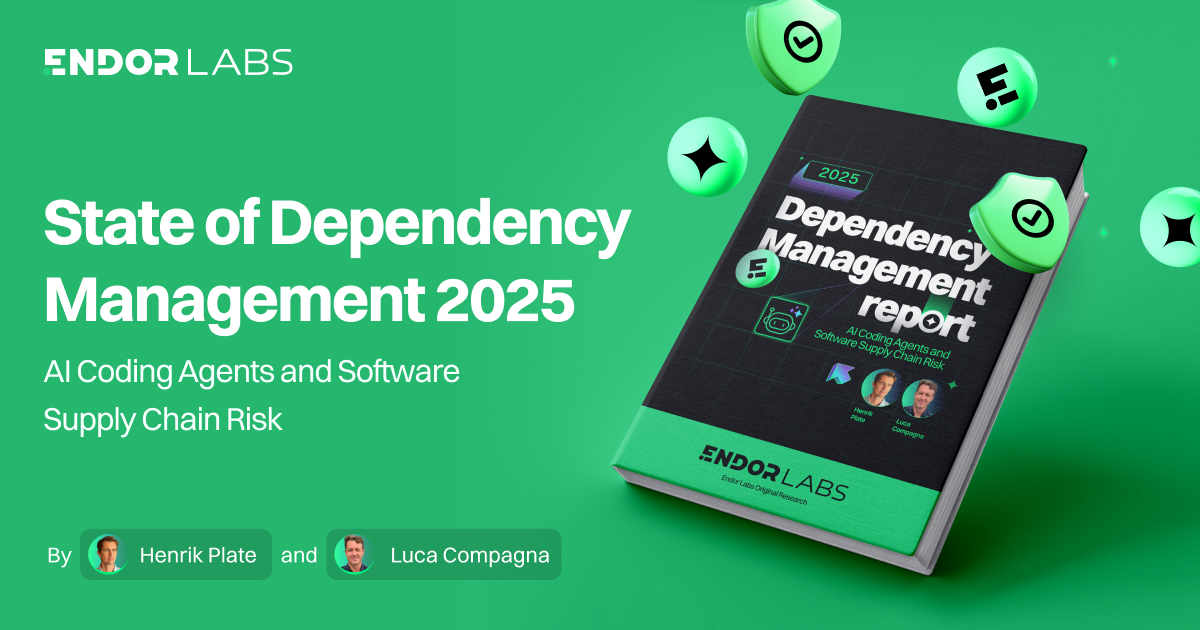 State of Dependency Management 2025 | Endor Labs
Endor Labs' 2025 State of Dependency Management report examines how AI coding agents and MCP servers add supply chain risk. Researchers analysed 10,663 GitHub MCP server repositories and tested AI-generated dependency recommendations across PyPI, npm, Maven and NuGet, finding agents import vulnerable or non-existent packages. MCP servers are immature: 75% are built by individuals, 41% lack license info, and 82% use sensitive APIs. The report advises treating AI-generated code as untrusted third-party input subject to code review, SAST/SCA and dependency governance.
 endorlabs.compaperPublished and added 12 Oct 2026🛡️ Security
- KedgeFlow: A Programmable Control Plane for Enterprise AI Agents
KedgeFlow specifies language-independent contracts so trusted controllers can authorize state-changing operations by enterprise AI agents and privileged gateways can enforce that authority independently of agent reasoning. It combines evidence-backed policy checks, signed permission for an exact action, a single-use shared allowance, target-side conditions and retained outcome records, with two conditional properties (at most one claim per allowance; every dispatch linked to a grant and claim) that hold even if the agent is compromised. A reference implementation exposes the path via MCP; evaluation on a three-member etcd cluster gave exactly one successful claim for each of 82 allowances across 6,560 concurrent attempts, and one committed effect in a 32-call gateway race. The authors report limits: permissive policy still authorized an undesirable effect, and distributed reservations, production access routes, crash recovery and real-target exactly-once effects remain untested.
arxiv.orgpaperAdded 15 Oct 2026, published 10 Oct 2026🧠 AI - KedgeFlow: A Programmable Control Plane for Enterprise AI Agents
KedgeFlow proposes language-independent contracts in which trusted controllers issue signed exact-action permissions and privileged gateways enforce them, using single-use allowance claims, target-side conditions and retained outcome records. It aims to stop altered approved actions, concurrent permission reuse and retries after lost responses, even with a compromised agent. A reference implementation exposes this path via MCP; evaluation on a three-member etcd cluster showed 6,560 concurrent claim attempts yielding exactly one success per each of 82 allowances. It also reports that permissive policy still authorized an undesirable effect, and lists untested areas such as distributed reservations and production access routes.
arxiv.orgpaperAdded 15 Oct 2026, published 10 Oct 2026🛡️ Security - Applying Security by Design at the Point of Execution: How Governed Security Requirements Affect the Security of AI-Generated Code
Evaluates delivering security requirements from a governed security-by-design knowledge base (SbD-ToE) to a code-generating LLM through an MCP server at generation time. On DualGauge (59 Python tasks) the share passing all security tests rose from 44.1% to 78.0%; on BaxBench (28 backend scenarios) the share of functionally correct solutions with no successful exploit rose from 65% to 86%, matching the authors' Oracle Security Reminder (85%). The joint secure-and-functional metric did not improve significantly, since stricter code failed functional tests that fix unstated values. The study used one model and one generation per task, and it proposes measuring conformance with applicable requirements rather than only detecting known weaknesses.
arxiv.orgpaperAdded 9 Oct 2026, published 7 Oct 2026🛡️ Security - Threat-Preserving Representation Sensitivity in Agent-Security Benchmarks
This arXiv paper introduces threat-preserving representation sensitivity (TPRS), a metric for how much an agent-security benchmark's attack success rate (ASR) changes purely from cosmetic changes to tool-name wording, with the underlying task, policy, and ground truth held fixed. Testing on Agent Security Bench (ASB), MCPTox and AgentDojo with GPT-5-mini, Claude Haiku 4.5 and GPT-4o-mini, the authors find swings of up to 13 percentage points in ASR from renaming tools as threat-neutral vs. threat-explicit, showing that single-representation ASR scores are not reliable robustness measures and arguing for evaluation across a controlled set of representations instead.
arxiv.orgpaperAdded 5 Oct 2026, published 2 Oct 2026🧠 AI - Threat-Preserving Representation Sensitivity in Agent-Security Benchmarks
This paper introduces threat-preserving representation sensitivity (TPRS), a metric showing that attack success rate (ASR) scores on LLM-agent security benchmarks shift dramatically based on cosmetic changes to tool naming, even when the underlying task, policy, and ground truth are held fixed. Testing on Agent Security Bench, MCPTox, and AgentDojo, the authors find swings of up to ~13 percentage points in ASR on GPT-5-mini and Claude Haiku 4.5 just from renaming tools between threat-related and threat-neutral labels, with a matched-length control reproducing most of the effect. The findings argue that single-representation ASR scores are not reliable robustness claims and that benchmarks should report results across multiple threat-preserving representations.
arxiv.orgpaperAdded 5 Oct 2026, published 2 Oct 2026🛡️ Security - Evaluating and Improving the Robustness of Large Language Models to Input Sequence Variations
Thesis on evaluating and improving LLM robustness to adversarial input perturbations. It proposes the R_stab robustness metric (Jensen-Shannon divergence), ASA, an evolutionary black-box attack on LLM-as-a-Judge systems (up to 73.8% ASR), trojan trigger recovery on Trojan Detection Challenge 2023 (Pythia-1.4B), and a systematization of bypasses of multi-layer defenses from SaTML CTF 2024. For MCP agents it proposes AttestMCP (HMAC-attested tool calls) and the Commit Boundary pattern, cutting ASR from 53.7% to 12.4% on the 847-scenario MCPBench; the methods are implemented in JudgeGuard, TrojanArmor and MCPSec.
arxiv.orgpaperAdded 9 Oct 2026, published 1 Oct 2026🛡️ Security - Evaluating and Improving the Robustness of Large Language Models to Input Sequence Variations
An arXiv thesis-style paper proposing R_stab(f), a Jensen-Shannon-divergence-based robustness metric for LLM outputs under small input perturbations, along with a proven bound V(h) <= 1 - R_class(h) for localized attacks. It introduces ASA, an adaptive evolutionary black-box attack against LLM-as-a-Judge systems reaching up to 73.8% attack success rate (62.6% cross-model transfer), evaluates trojan/backdoor detection on the Trojan Detection Challenge 2023 (Pythia-1.4B) and SaTML CTF 2024, shows that committees of 5-7 heterogeneous models cut Gemma-3-4B's ASR to 19.3%, and presents AttestMCP, an HMAC-based tool-call attestation scheme plus a "Commit Boundary" isolation pattern for MCP agents that cuts average ASR on the 847-scenario MCPBench from 53.7% to 12.4%. Methods ship as the JudgeGuard, TrojanArmor, and MCPSec software suites.
arxiv.orgpaperAdded 5 Oct 2026, published 1 Oct 2026🛡️ Security - Identity Management for Agentic AI [pdf] (2025)
OpenID Foundation whitepaper (Oct 2025, lead editor Tobin South) analyzing how authentication/authorization for AI agents differs from traditional software clients. It covers where OAuth 2.1, OIDC, SSO/SCIM, and MCP already work for single-domain synchronous agents, and lays out unsolved problems for autonomous agentic identity: agent identity fragmentation across vendors, replacing user impersonation with explicit delegated "on-behalf-of" authority, consent-fatigue at scale, recursive delegation chains between sub-agents, agents acting for teams of users, and browser/computer-use agents bypassing API-based authorization entirely.
 openid.netpaperAdded 2 Oct 2026, published 1 Oct 2026🛡️ Security
- Bridging LLM Agents and Data Spaces: An Architectural Mediation Approach using MCP
This paper proposes an architectural mediation approach, implemented as the "Eunomia Agent," that uses the Model Context Protocol to let LLM agents discover and invoke Data Space services as structured, schema-driven tools without modifying existing data space components. A prototype validates end-to-end interaction — catalog discovery, metadata retrieval, and data service invocation — while preserving governance, policy, and access-control constraints native to Data Spaces. It offers practical architectural guidance for organizations wanting to introduce AI-driven automation into governed, sovereign data-sharing ecosystems while maintaining compliance and interoperability.
arxiv.orgpaperAdded 28 Sep 2026🧠 AI - Delegation Without Trust: An Empirical Gap Analysis of Identity, Authorization, and Runtime Governance in Multi-Agent LLM Systems
This arXiv paper defines a threat model for multi-agent LLM delegation covering four adversaries (confused deputy, token theft/replay, prompt-injection privilege escalation, compromised sub-agents) and derives eight security requirements for governed agent systems. It shows that LangGraph, CrewAI, AutoGen, and the MCP authorization model each fail to meet the full requirement set, then implements and adversarially tests an authorization broker that blocks all four threats, rejects 0 of 200,000 forged tokens, and confines a compromised sub-agent to a mean of 1.5 reachable actions (vs. 8,100 under bearer delegation) at ~2.6 microseconds per decision. The broker's principles are said to be productized in VotalAI's LLM Shield.
arxiv.orgpaperAdded 26 Sep 2026🛡️ Security - Progressive Skill Discovery as Access Control for Tool-Using LLM Agents
Introduces skilder, a framework that enforces access control over enterprise tool access for LLM agents by packaging tools, instructions and limits into roles delivered progressively through a single MCP server, so an agent only ever receives tools it has explicitly learned/unlocked. The paper argues prompt-based policy is merely probabilistic advice, not a hard constraint, and evaluates skilder against flat-context tool selection and multi-agent orchestration across 13 tasks and six models, showing zero unauthorized tool calls or parameter violations (e.g., spending-limit breaches) once agents completed discovery.
arxiv.orgpaperAdded 26 Sep 2026🛡️ Security - Progressive Skill Discovery as Access Control for Tool-Using LLM Agents
Introduces "skilder," a framework that bundles LLM agent capabilities into roles (skills, tools, instructions, and limits) delivered progressively through a single MCP server, so an agent starts with a minimal catalog and only gains tool access as it learns the roles a task requires. This structural approach enforces access control deterministically at the server layer rather than relying on prompt-based policy, addressing context bloat and governance gaps in enterprise tool-using agents. Evaluated against flat-context tool selection and multi-agent orchestration across 13 tasks and six models, showing zero unauthorized tool calls or parameter violations when agents completed the discovery protocol.
arxiv.orgpaperAdded 26 Sep 2026🧠 AI - No-Box Vulnerability Analysis: Description-only Detection of Indirect Prompt Injection Vulnerabilities in MCP Servers
This paper proposes no-box vulnerability analysis, a new paradigm for auditing systems using only functionality metadata when neither system access nor runtime interaction is available. The authors build MCPSEC, a prototype that audits Model Context Protocol servers for indirect prompt injection vulnerabilities purely from tool metadata exposed at server registration, evaluating it against 20 widely-deployed MCP servers with 177 tools where human evaluators confirmed 95 vulnerable tools; MCPSEC achieved 98.9% recall versus 84.2% for an LLM baseline, also producing hypothesized exploitation techniques per finding.
arxiv.orgpaperAdded 26 Sep 2026🛡️ Security - ShareLock: A Stealthy Multi-Tool Threshold Poisoning Attack Against MCP
ShareLock is a novel Tool Poisoning Attack against the Model Context Protocol that uses Shamir's secret-sharing scheme to split a malicious instruction into benign-looking fragments distributed across multiple tool descriptions, evading detectors that look for monolithic malicious text in a single tool. A covert trigger planted during a server update reconstructs the hidden instruction, and the authors report over 90% attack success across mainstream LLMs and two MCP clients while evading tool-description-based detection far better than prior single-tool poisoning approaches.
arxiv.orgpaperAdded 26 Sep 2026🛡️ Security - A First Measurement Study on Authentication Security in Real-World Remote MCP Servers
The first large-scale measurement study of authentication security across real-world remote MCP servers, scanning 7,973 live deployments and finding 40.55% expose tools with no authentication at all. For the 119 testable OAuth-enabled servers, the authors built a semi-automated (passive traffic inspection + active dynamic probing) detection framework and derived a taxonomy of nine flaw types across four categories — three MCP-specific (open client environments, dynamic client registration, delegated authorization) and conventional OAuth misconfigurations — finding every tested server had at least one flaw, with dynamic client registration flaws hitting 96.6% of servers and leading to information leakage or account takeover; the work resulted in 9 CVEs via responsible disclosure.
arxiv.orgpaperAdded 26 Sep 2026🛡️ Security - MCPTox: A Benchmark for Tool Poisoning Attack on Real-World MCP Servers
MCPTox is a benchmark for evaluating Tool Poisoning Attacks against LLM agents using the Model Context Protocol, where malicious instructions are hidden in a tool's metadata rather than its output. Built on 45 live real-world MCP servers and 353 authentic tools, it generates 1312 malicious test cases across 10 risk categories via three attack templates, and finds widespread vulnerability across 20 LLM agents: o1-mini has a 72.8% attack success rate, more capable models are often more susceptible due to stronger instruction-following, and even the best model (Claude-3.7-Sonnet) refuses less than 3% of attacks.
arxiv.orgpaperAdded 26 Sep 2026🛡️ Security - A2M: Trace-Optimized Agent Hijacking in the MCP Ecosystem
A2M (Attraction-to-Manipulation) is a two-stage black-box framework for hijacking agents that use the Model Context Protocol to select tools from third-party MCP servers. The Attraction phase optimizes attacker-controlled tool metadata to raise invocation probability, while the Manipulation phase uses execution traces to craft adversarial tool outputs that steer agent behavior; on LiveMCPBench it achieves a 93.6% malicious tool invocation rate against GLM-4.6, inflates token cost 32.4x under a cognitive denial-of-service variant, and reaches a 74.4% mean attack success rate across information exfiltration, environment integrity compromise, and reasoning derailment, with partial transfer (63.6%/2.7x/24.5%) to four other models without re-optimization. The authors argue this exposes a semantic supply-chain risk in MCP tool ecosystems and call for stronger tool vetting and runtime isolation.
arxiv.orgpaperAdded 2 Oct 2026, published 22 Sep 2026🛡️ Security
Showing 30 of 38
Show more