 Abhinav Singwal (@yogsec) on X
GetSubDomains is an open-source tool by yogsec that enumerates subdomains by querying crt.sh certificate transparency logs. It is aimed at the reconnaissance step of penetration tests and bug bounty work. The source is a short tweet pointing to a GitHub repository, so usage details and options are not given.
 x.comrepoAdded 21 Oct 2026, published 19 Oct 2026🛡️ Security
- morluto/rea
REA (rea-agents on npm) registers an MCP server and matching workflow instructions with coding agents such as Claude Code, Codex, Cursor and Gemini CLI. It exposes tools for inspecting native binaries through Hopper, Ghidra or IDA (with optional objdump and Rizin), JavaScript/Electron apps and ASAR archives, .NET assemblies and websites. Results come back with evidence and limitations, so the agent can explain how a feature works and write and test its own implementation. Analysis runs locally, there is a CLI with the same workflows, and the showcases include C reconstructions verified against original x86 function bytes.
 github.comrepoAdded 14 Oct 2026🧠 AI
- morluto/rea
REA (rea-agents) is an MIT-licensed toolkit that exposes native-binary, JavaScript/Electron, .NET assembly and website analysis to AI agents via MCP, and also as a local CLI. It drives Hopper, Ghidra, IDA, objdump or Rizin for disassembly and pseudocode, recovers modules and Electron IPC boundaries from ASAR/JS apps, and returns findings with evidence and limitations. Showcases include reconstructing a x86 audio helper into byte-matching C and tracing an Electron clipboard API through preload and IPC; the README also carries lawful-use and licensing guidance.
github.comrepoAdded 14 Oct 2026🛡️ Security - Dark Web Informer (@DarkWebInformer) on X
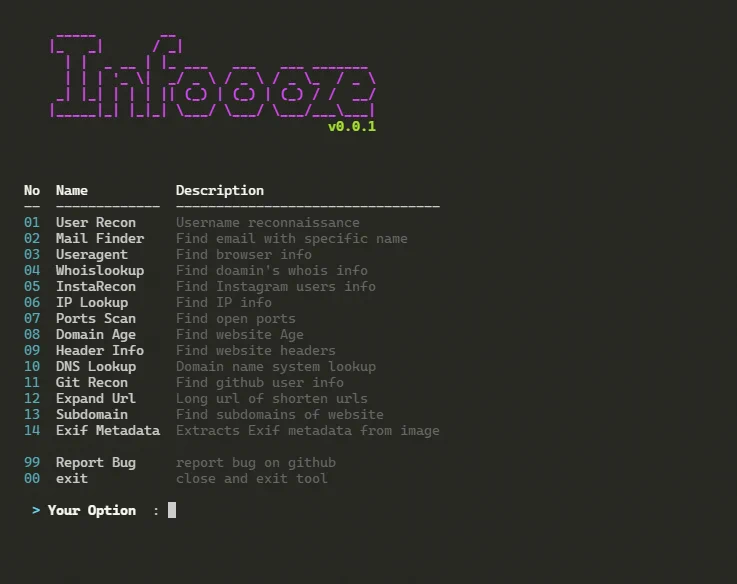
Infoooze is an open-source command-line OSINT reconnaissance toolkit (github.com/devxprite/infoooze) that consolidates common footprinting tasks into one CLI: username enumeration across platforms, email discovery, subdomain enumeration, port scanning, WHOIS/DNS lookups, IP/HTTP header analysis, EXIF metadata extraction, GitHub recon, and URL scanning/expansion. It automatically saves results, making it a lightweight all-in-one alternative to running several separate recon tools.
x.comrepoPublished and added 8 Oct 2026🛡️ Security - M-med/Active-Directory-Simulation-Attack-
Active-Directory-Simulation-Attack- is a purple team lab for the lab.local domain (192.168.100.0/24). It walks through an attack chain: BloodHound/SharpHound recon, Kerberoasting, hash cracking with John the Ripper or Hashcat, and lateral movement with Impacket. It then applies hardening (gMSA, tiering, LLMNR/NetBIOS disabling) and adds Sysmon, Wazuh SIEM and custom Kerberoasting rules (Event ID 4769, RC4).
github.comrepoAdded 23 Oct 2026, published 4 Oct 2026🛡️ Security - Sigma r2026-07-01 — 20 new detection rules
GitHub release notes for Sigma r2026-07-01, the open-source detection-rule repository, adding 20 new rules (e.g. LSASS crash via Netlogon buffer overflow CVE-2026-41089, TanStack supply-chain attack indicators for Windows/Linux, RedTail cryptominer user-agent detection, AF_ALG kernel crypto API exploit indicator) and updating/fixing dozens of existing rules for ARM64 binary variants, file-sharing domain IOCs, and WMI-based reconnaissance/persistence detection. It's a routine but substantive update to a widely-used blue-team detection content pack.
github.comrepoAdded 3 Oct 2026🛡️ Security - Jakeschincariol/replica-skill
replica-skill is an MIT-licensed set of eleven Claude skills that run an app-cloning pipeline: recon, architect, design, build, backend, test, diff, entrepreneur, brand, launch and deploy. Six standard-library Python tools handle image diffing, parity scoring, review ranking, contrast checks, rebrand sweeps and store-listing lint. It installs as a Claude Code plugin or by copying folders, and states clean-room and rebranding limits.
github.comrepoAdded 29 Oct 2026, published 3 Oct 2026🧠 AI - renato-osec/goonfi-v2-decompiled
goonfi-v2-decompiled holds byte-identical reconstructed Rust source for the GoonFi V2 Solana program goonuddtQRrWqqn5nFyczVKaie28f3kDkHWkHtURSLE, as deployed at slot 448984043. The on-chain program was upgraded on 6 October 2026 to fix reported bugs. VERIFY.sh builds with Solana platform-tools v1.48 and compares the result to the deploy transaction's loader buffer writes. The page does not describe the bugs.
github.comrepoAdded 22 Oct 2026, published 2 Oct 2026🛡️ Security - https://github.com/dmdhrumilmistry/security-harness
security-harness is an open-source Claude Code plugin (also packaged for Gemini CLI, Codex and opencode) that orchestrates subagents — sh-recon, sh-hunter, sh-chainer, sh-verifier, sh-reporter — through a static-analysis pipeline covering 15 vulnerability classes (IDOR/BOLA, SQLi, XSS, SSRF, injection, auth, deserialization, path traversal, secrets, CSRF, XXE, open redirect, crypto, race conditions, file upload), producing README/JSON/SARIF/HTML/PDF reports with PoCs, CVSS and CWE/OWASP mappings. It also ships sh-pr-review, a per-PR merge-gate skill that posts inline findings and a commit status scoped only to code the PR itself introduced or aggravated, with caching, dedup via fingerprints, and a scheduled GitHub Action that keeps its per-class knowledge bases fresh by having one AI agent draft updates from allowlisted sources (OWASP, PortSwigger Research, CWE/CAPEC, HackerOne) while a separate adversarial reviewer agent fails-closed against prompt injection before auto-merge.
github.comrepoAdded 2 Oct 2026, published 29 Sep 2026🛡️ Security - awarexone/Agentic-Bug-Hunter
Agentic-Bug-Hunter is an open-source CLI (bughunter) and Claude Code plugin that automates the bug bounty pipeline end-to-end: recon, vulnerability hunting across 26 web2 and 10 web3/smart-contract bug classes, a "7-Question Gate" validation step to kill weak findings, and submission-ready report generation for HackerOne, Bugcrowd, Intigriti, and Immunefi. It orchestrates existing scanners (subfinder, httpx, nuclei, katana, ffuf, dalfox) behind a multi-provider LLM layer (Ollama, Groq, DeepSeek, Claude, OpenAI) and cross-session "hunt memory," and also ships an MCP server for use from Cursor, Codex, or OpenCode.
github.comrepoAdded 21 Sep 2026🛡️ Security - Outrider Recon
Outrider Recon is an open-source, Claude-native multi-agent OSINT and external attack-surface recon platform for authorized engagements, covering web/API, identity/SSO, cloud, secrets, and people/breach intelligence. It deliberately stops short of exploitation: active enumeration is approval-gated and intrusive validation is a human hand-off, with deterministic Python controls enforcing scope, evidence integrity, workflow state, and finding promotion around Claude skills and optional MCP-based enrichment. Output is ranked, evidence-backed finding cards (confidence/severity/handoff recommendations) meant to feed proxy-assisted testing or pen-testing rather than raw scanner dumps.
github.comrepoAdded 22 Sep 2026, published 19 Sep 2026🛡️ Security - Cloudflare security-audit-skill
security-audit-skill is a Cloudflare open-source coding-agent skill that turns an AI coding agent into a structured vulnerability hunter, running six phases: reconnaissance into architecture.md/coverage-ledger.json, coverage-led hunting by isolated sub-agent "hunters," adversarial candidate validation, structured findings.json output validated against a report-schema.json, independent re-verification of claims, and target-neutral report generation (REPORT.md, FINDINGS-DETAIL.md, NEEDS-VALIDATION.md). It is installed via the Skills CLI (`npx skills add`), uses Node.js validators (validate-coverage-ledger.cjs, validate-findings.cjs), requires a sandboxed environment for safely executing target code/tests/fuzzers, and is the single-repo seed for Cloudflare's larger fleet-wide vulnerability discovery harness described in a companion blog post.
github.comrepoAdded 22 Sep 2026, published 15 Sep 2026🛡️ Security - MassPIIFinder v2
MassPIIFinder v2 is a Python recon tool that automates crawling a target's in-scope JavaScript (multi-hop HTML crawl, dynamic imports, chunk manifests, sourcemaps, plus optional passive CT-log subdomain discovery) and mines it for API keys, tokens, credentials, internal endpoints, and PII using ~90 named patterns plus a high-entropy freeform heuristic. Findings are validated offline (Luhn checks, JWT decode, AWS key-shape) and via scope-checked, rate-limited reachability probes, then triaged by severity and exported as JSON/HTML/SARIF/Markdown/CSV. It enforces authorization with a required --confirm-authorized flag and a ScopeGuard that blocks any out-of-scope requests, and explicitly avoids testing leaked keys against third-party providers or exploiting findings.
github.comrepoAdded 22 Sep 2026, published 15 Sep 2026🛡️ Security - shinthink/blitzstrike
Blitz Strike is an open-source Model Context Protocol server (TypeScript/Bun) that packages a structured 3-tier pentesting methodology — BLITZ (attack-surface recon), EAGLE-EYE (source-to-sink reachability tracing), and STRIKE (live validation before reporting) — into callable tools any MCP client (Claude Code, Cursor, Gemini, etc.) can drive with a single run_engagement call. It ships 130 self-written security tools, 317 indexed tool manuals, 58 data-driven escalation chains with negative-control checks, a Web3/Solidity audit module with Foundry proofs, and a regression/benchmark suite (453 checks, reported 1.0 detection / 0 false-positive rate) to make every finding verified rather than pattern-matched.
github.comrepoAdded 2 Oct 2026, published 12 Sep 2026🛡️ Security - GhostJS
GhostJS is an open-source Burp Suite extension by TrinetLayer that passively scans JavaScript, HTML, and JSON responses flowing through Burp for hardcoded secrets (AWS/GCP/Azure keys, Stripe/PayPal/GitHub tokens, JWTs, private keys, etc.) and hidden API endpoints, surfacing findings in a dedicated tab with severity, confidence scoring, remediation guidance, and Markdown export. It also actively fetches referenced <script> bundles using the tester's live session cookies and applies a false-positive filter to suppress doc-sample and placeholder keys, making it a practical recon aid during authorized web app pentests and bug bounty work.
github.comrepoPublished and added 7 Sep 2026🛡️ Security - pashov/skills
pashov/skills is a set of Claude Code "skills" built by Pashov Audit Group that turn an AI coding agent into a Solidity security auditor: an "x-ray" command for quick codebase reconnaissance, a "solidity auditor" mode that runs multiple different agent personas over a codebase (or specified files) looking for vulnerabilities, and a "fizz" command for additional automated checks. It packages smart-contract audit tradecraft into reusable AI agent skills rather than a standalone scanner, letting developers or auditors invoke deep, multi-pass Solidity review directly inside their coding assistant.
github.comrepoPublished and added 7 Sep 2026🛡️ Security - Numbat
Numbat is a Go-based, single-binary endpoint agent from Perplexity AI that gives visibility into AI coding-agent activity (Claude Code, Codex, OpenClaw, and other CLI/IDE/gateway agents) by capturing events through local hooks, OTLP/HTTP logs, and on-disk session artifacts. It normalizes activity into one event model, evaluates it with a local CEL rule engine (including multi-step sequence rules like secret-read-then-egress), and can optionally block matched actions via synchronous pre-action hooks (deny/monitor decisions), with case bundles and SHA-256 manifests for forensic reconstruction. Example built-in rules detect cloud-metadata SSRF requests (169.254.169.254) and credential-exfiltration chains, mapped to MITRE ATT&CK technique tags.
github.comrepoPublished and added 5 Sep 2026🛡️ Security - eldarshiraliyev/BugScanner
BugScanner is an asyncio/httpx Python framework for recon and automated web vulnerability scanning, with a React and FastAPI dashboard. It covers subdomain enumeration (crt.sh, DNS brute force), TCP port scanning, fingerprinting, and modules for XSS, SQLi, CORS, SSRF, open redirect, JWT, IDOR and business logic, plus a Nuclei wrapper. A 5-rule false-positive filter with SPA detection, adaptive rate limiting, WAF detection and SARIF export are included.
github.comrepoAdded 20 Oct 2026, published 5 Sep 2026🛡️ Security - subScraper
subScraper is a self-contained, single-file (main.py) Python orchestrator that chains subdomain enumeration tools (Amass, Subfinder, Assetfinder, Findomain, Sublist3r) into httpx probing, screenshot capture, ffuf fuzzing, nuclei, and nikto scans, all driven from a live web UI with resumable job state, worker concurrency controls, and Docker packaging. It ships 34 custom nuclei templates for CVEs lacking official coverage and exposes a scoped, API-key-authenticated "bug bounty agent API" for programmatic recon and attack-surface queries against a target's scope.
github.comrepoPublished and added 27 Aug 2026🛡️ Security - Rekono
Rekono is an open-source pentesting automation platform that chains 19 hacking tools (Nmap, Nuclei, Metasploit, OWASP ZAP, Nikto, Gitleaks, SearchSploit, etc.) so that output from one tool feeds the next, automatically covering recon, service enumeration, vulnerability scanning, and exploit correlation. It deduplicates findings into a single attack-surface inventory per host/port, enriches CVEs with community context for prioritization, tracks fixed/reopened vulnerabilities, and supports team collaboration, scheduled scans, Telegram/email alerts, and report generation for engagements.
github.comrepoAdded 3 Sep 2026, published 27 Aug 2026🛡️ Security - Cybermes
Cybermes is an open-source bug bounty and pentest automation framework that pairs a native Go MCP server (cybermes-mcp) with an autonomous Hermes CLI agent, orchestrating recon tools (subfinder, httpx, katana, ffuf, Nuclei, sqlmap), 200+ offensive playbooks covering IDOR/BOLA, JWT, SSRF, XSS, SQLi and cloud misconfig, and a validation-gate workflow that writes non-destructive PoC scripts before compiling findings into Markdown/HTML/PDF reports. It exposes its tools over JSON-RPC 2.0 to AI coding assistants (Claude Desktop, Cursor, Windsurf, Cline, Gemini/Antigravity) so an external LLM can drive scoped, evidence-backed security assessments.
github.comrepoPublished and added 23 Aug 2026🛡️ Security - Teycir/BurpAPISecuritySuite
BurpAPISecuritySuite is a Jython-based Burp Suite extension that consolidates API reconnaissance, intelligent fuzzing (108+ payloads across 15 attack types including BOLA, IDOR, JWT exploitation, GraphQL abuse, SSTI, and WAF bypass), and passive deep-logic checks (counterfactual differentials, sequence invariants, token lineage, cross-interface parity drift) into a single tool covering the OWASP API Top 10. It auto-captures and normalizes API traffic, exports attack campaigns to Burp Intruder/Turbo Intruder/Nuclei, and generates AI-ready bundles (ChatGPT/Claude/Ollama) for LLM-assisted triage, while orchestrating external tools like ApiHunter, Katana, httpx, FFUF, Kiterunner, sqlmap, and Dalfox for verification.
github.comrepoPublished and added 21 Aug 2026🛡️ Security - SKANF
SKANF is a static and symbolic analysis tool that finds asset-management vulnerabilities in closed-source or obfuscated EVM smart contracts by fetching deployed bytecode from a JSON-RPC endpoint and locating attacker-reachable sensitive external calls (e.g. ERC-20 transfer/transferFrom/approve on tokens like USDT or WBTC). Beyond detection, it includes an exploit-generation phase that symbolically synthesizes calldata satisfying a verified vulnerability's preconditions and replays it against a forked EVM to confirm real balance changes. It builds on custom forks of the greed symbolic execution engine and the Gigahorse decompiler, and accompanies the ACM CCS 2026 paper "Insecurity Through Obscurity: Veiled Vulnerabilities in Closed-Source Contracts."
github.comrepoPublished and added 21 Aug 2026🛡️ Security - galleonlabs/hypergrok-trading-desk
HyperGrok Trading Desk is an open-source "Agent Skills" pack (MIT licensed) that turns a Grok Bot, Claude Code or Cursor instance into a coordinated seven-agent trading desk for Hyperliquid perpetuals, using seventeen portable SKILL.md skills covering bootstrap/setup, exchange API access, and desk operating procedures. Each trade moves through a fixed pipeline — idea, evidence, risk sign-off, explicit human approval by ticket id, a single execution agent that sends the order, reconciliation, and a separate review agent — with read-only "opening bell" and "desk doctor" scripts for zero-key market snapshots and release/connectivity checks. The design choices worth noting for agent builders are the one-writer/many-readers pattern, sizing risk off the stressed (slipped) cost of a stop rather than its trigger price, and keeping the approval gate (Grok Bot's Require Approval rule) outside the chat the agent itself can write to.
github.comrepoAdded 5 Oct 2026, published 16 Aug 2026🧠 AI - Cariddi
Cariddi is a Go-based CLI tool that crawls a list of domains/URLs to discover endpoints, secrets, API keys, tokens, and juicy file extensions. It supports proxying through Burp Suite, custom headers, secret/endpoint regex files, JSON/HTML/TXT output, and configurable crawl depth and concurrency, making it a common recon tool in bug bounty and pentest workflows.
github.comrepoAdded 3 Sep 2026, published 12 Aug 2026🛡️ Security - manyuegong33/r0crawl_skills
r0crawl_skills is a Chinese-language skill library for Codex-style AI coding agents, organized as a router plus 196 specialized modules covering web reverse engineering, Android unpacking, Frida instrumentation, native binary analysis, protocol reconstruction, malware triage, firmware analysis and CTF workflows. Rather than dumping advanced terminology at once, it starts novices with four framing questions (what to analyze, what action matters most, what materials exist, what outcome is wanted) and routes them to deeper workflows via lightweight Python scripts (init_case.py, module_router.py, hash_artifact.py) and ten sanitized example playbooks. It's installed by copying the directory into Codex's skills folder, making it a practical illustration of the "router + many domain modules" pattern for packaging large skill collections for coding agents.
github.comrepoAdded 30 Sep 2026, published 6 Aug 2026🧠 AI - manyuegong33/r0crawl_skills
r0crawl_skills is a beginner-friendly Chinese-language skill library of 196 specialized reverse-engineering modules for Codex-style AI coding agents, with a router that asks scoping questions and directs the agent to the right workflow (web RE, Android unpacking, Frida instrumentation, native binary analysis, protocol reconstruction, malware triage, firmware analysis, CTF). It ships lightweight scripts (case init, module router, artifact hashing) and ten sanitized example playbooks covering DEX dump verification, WebCrypto hooking, native loader tracing, PCAP reconstruction, and selective emulation, plus dedicated modules for CAPTCHA/WAF/anti-bot systems, mini-programs, hybrid apps (Flutter/React Native/Electron), and IDA/Ghidra/Rizin automation.
github.comrepoAdded 30 Sep 2026, published 6 Aug 2026🛡️ Security - Dark-Moon
DarkMoon is a self-hosted, GPLv3 AI penetration testing platform that orchestrates 50 specialist agents over an MCP-gated toolbox (Nuclei, BloodHound, sqlmap, Impacket, Naabu, httpx, ffuf, etc.) to autonomously run recon-to-exploitation across web, API, Active Directory, Kubernetes, multi-cloud, CI/CD, databases, IoT firmware, and AI/LLM inference endpoints. It uses a Privacy Gateway that tokenizes real IPs/hosts/credentials into placeholders so raw infrastructure data never reaches the (optionally local, e.g. Ollama/llama.cpp) LLM, and can generate sandbox-validated, exploit-retested pull requests for findings. It also ships a dedicated LLM agent that probes OpenAI-compatible/Ollama/vLLM/TGI inference endpoints for the OWASP LLM Top 10 (prompt injection, jailbreaks, system-prompt leakage) using garak-backed probes.
github.comrepoPublished and added 5 Aug 2026🛡️ Security - UseOSINT/Skills
UseOSINT/Skills is a GitHub repo of 28 SKILL.md files that let Cursor, Claude, and other coding agents run open-source-intelligence investigations — 10 end-to-end workflows (e.g. find-anyone, x-ray-a-company, recon-a-domain-passively) built on 18 reusable technique skills (WHOIS, certificate transparency, reverse image search, breach lookups, chronolocation). Each skill ships with reference material (query cookbooks, indicator guides, registry catalogues) and an install script that symlinks the whole set into ~/.cursor/skills, illustrating a chained, workflow-plus-technique pattern for structuring and routing large agent skill libraries. The repo also documents scope/authorization gating and passive-by-default behavior as part of the skill design.
github.comrepoAdded 30 Sep 2026, published 2 Aug 2026🧠 AI - openhackai/OpenHack
OpenHack is an open-source, agentic vulnerability scanner CLI that runs a recon -> hunter -> validation -> verification pipeline over a codebase using open-source LLMs. It uses category- and feature-based hunter agents to find candidate vulnerabilities, validator agents to confirm them, and optional Docker-based sandbox plus headless-browser verification to actually exploit findings (e.g. XSS, SQLi, command exec) and confirm them with real HTTP/DOM execution, reporting CVSS-scored findings with fixes.
github.comrepoPublished and added 2 Aug 2026🛡️ Security
Showing 30 of 68
Show more