 Shubham Mishra 🐐 (@shubh6200) on X
A post relaying Cursor's security advisory: a modified, malicious Claude Code VS Code extension was distributed through the Cursor extension marketplace, affecting at most 5,000 users. Anthropic did not develop that version, and other extensions are not affected. Users of Claude Code in Cursor are told to update to version 2.1.314. The post adds that marketplaces need publisher verification and package integrity checks. It gives no technical detail on the payload.
 x.comthreadAdded 31 Oct 2026, published 30 Oct 2026🛡️ Security
 Trail of Bits (@trailofbits) on X
Trail of Bits post on X summarising Binance's initial investigation into a security incident. Binance suggests a compromised DevOps engineer's laptop let an attacker reach a service container and submit unauthorized withdrawal transactions. The text says no evidence has been found of wallet private key compromise. The fetched text is truncated and gives no further detail.
x.comthreadPublished and added 30 Oct 2026🛡️ Security- 🚨 AI News | TestingCatalog (@testingcatalog) on X
Mistral Large 4 ("Le Chonk") is an open-weights model from Mistral, now on Hugging Face. Per Mistral's announcement quoted in the post, it ranks #1 among open models on Cognition's FrontierCode benchmark, is aimed at agentic coding and cybersecurity, and claims better reasoning efficiency and lower inference costs. The post does not give parameter counts, license or benchmark scores.
x.comthreadAdded 30 Oct 2026, published 29 Oct 2026🧠 AI - Laban (@lunkertw) on X
An X post summarising five AI items: Google DeepMind's Gemini 4 Carbon (88.2% SEC-bench Pro, 54.8% ExploitGym, 71.0% CWE-bench, 59 on Artificial Analysis Intelligence Index v5.0), Ed Zitron's critique of Anthropic's S-1, a Utah Claude Code pilot, and the repos beenuar/AiSOC and expo/skills. In the Utah pilot, 34 developers in 10 agencies took part over four weeks, 80% had a working setup within 30 minutes, and 71% saved over 20 hours. It gives short summaries and links, not primary analysis.
x.comthreadAdded 29 Oct 2026, published 28 Oct 2026🧠 AI - 🚨 AI News | TestingCatalog (@testingcatalog) on X
Gemini 4 Carbon is a new Google model, announced in a TestingCatalog post on X as taking first place on the Artificial Analysis V5 ranking. It is rolling out to cyber defenders first. Reported scores are 88.2% on SEC-bench Pro (finding vulnerabilities), 54.8% on ExploitGym (exploitation) and 71.0% on CWE-bench (patching). The post calls it a large step up from Gemini 4 Argon, released two weeks earlier. It gives no technical detail beyond these claims.
x.comthreadAdded 30 Oct 2026, published 28 Oct 2026🧠 AI  JFrog Security (@JFrogSecurity) on X
JFrog Security announces research on CVE-2026-102479 in Vert.x, which skips validating the letter 'L' in header names and so accepts `Content-Xength` as `Content-Length`. JFrog Research chained this with a dangling-byte primitive to bypass reverse proxy socket validation. They demonstrate end-to-end response poisoning and session fixation behind real reverse proxies. The post links to a full writeup; the tweet itself gives no exploit detail.
x.comthreadAdded 30 Oct 2026, published 28 Oct 2026🛡️ Security Christiaan Stoudt (@cstoudt) on X
Thread on CVE-2026-97631, a critical (9.5) flaw in TianoCore EDK II UEFI firmware, found by Alex Matrosov and Dan Holmes-Mitra. It is exploitable only while a machine is PXE network booting and the attacker sends an oversized ICMP error from the same network. Code execution also needs the exact firmware build, and Secure Boot does not help. The fix landed in EDK II main on 15 October but is not in a stable release. No known exploitation, and not in CISA KEV.
x.comthreadAdded 30 Oct 2026, published 28 Oct 2026🛡️ Security- Hakimi Eiqbal (@hakimieiqbal) on X
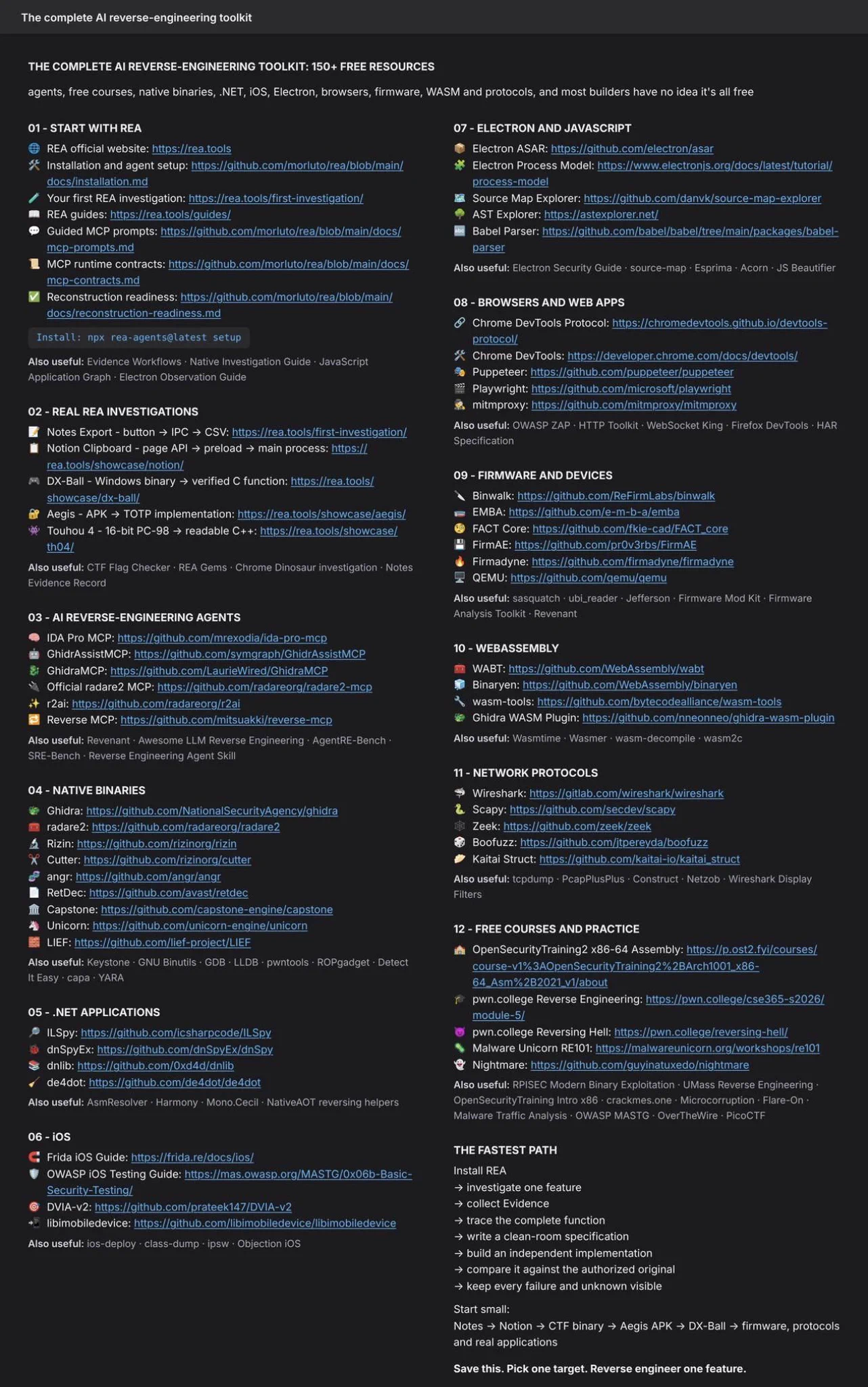
A practical reverse-engineering map by hakimieiqbal on X that picks tools by target: native binaries, .NET, Electron, iOS, firmware, WebAssembly and network protocols. It introduces REA (morluto/rea), which connects coding agents to RE tools, and lists MCP bridges for IDA Pro, Ghidra and radare2. It adds an evidence-first workflow and free courses such as pwn.college and OpenSecurityTraining2.
x.comthreadAdded 29 Oct 2026, published 28 Oct 2026🛡️ Security - Hakimi Eiqbal (@hakimieiqbal) on X
A thread by Hakimi Eiqbal that maps reverse-engineering tools by target type: native binaries, Electron, .NET, iOS, firmware, WebAssembly and network protocols. Its AI sections cover REA (an open-source layer connecting coding agents to analysis tools) and MCP bridges for IDA Pro, Ghidra and radare2. It argues for an evidence-first workflow and gives a prompt that separates verified facts from hypotheses.
x.comthreadAdded 29 Oct 2026, published 28 Oct 2026🧠 AI  Buchi Reddy B (@buchireddy) on X
Buchi Reddy B's X thread comments on Forever Security's research (Gal Weizman, Omer Samet) on coding agents. A web page silently writes a fake AGENTS.md or CLAUDE.md into a Downloads folder, and Codex and Claude Code follow it as project rules. Codex then wrote an attacker's MCP server into the machine-wide config, so one injection becomes a standing connection for every session. It asks whether teams inventory runtime MCP connections against approved lists.
x.comthreadAdded 28 Oct 2026, published 27 Oct 2026🛡️ Security- Prasenjit Sarkar (@stretchcloud) on X
Campfire is a self-hosted workspace by Prasenjit Sarkar that runs Claude Code, Codex, Goose, Aider and OpenHands side by side in one tab. Risky actions go through permission voting: a majority approves, any single deny blocks, and a 30 second timer ends the wait. Session replay shows which file or tool call triggered an action. The post cites Forever Security's report of a planted AGENTS.md. Codex followed it first time over 90% of the time and Claude Code about half the time. Try it with "bunx the-campfire".
x.comthreadAdded 28 Oct 2026, published 27 Oct 2026🧠 AI - Prasenjit Sarkar (@stretchcloud) on X
Campfire is a self-hosted tool that runs Claude Code, Codex, Goose, Aider and OpenHands in one tab. Risky actions need permission voting (majority approves, any single deny blocks, 30 second timeout), and session replay traces which file or tool call triggered an action. The post cites Forever Security's finding that Codex followed a planted AGENTS.md instruction over 90% of the time and Claude Code about half the time. It also cites the February Cline release compromise via a poisoned GitHub Actions cache.
x.comthreadAdded 28 Oct 2026, published 27 Oct 2026🛡️ Security  cubillas (@cubillas888) on X
The tweet relays Pillar Security research that opencode on Windows and WSL could run attacker-controlled code during remote MCP server OAuth sign-in. The fix shipped in opencode 1.18.33 on 28 September, with no advisory or CVE published. It advises users of remote MCP servers to update and review which servers they connect to. Technical details are not in the post.
x.comthreadAdded 29 Oct 2026, published 27 Oct 2026🛡️ Security- AGTP (@AGTPinsights) on X
AGTP's X thread summarizes Meta's Muse Spark 1.3 Evaluation Report. Prompt injection was tested on Exponential Security Labs' RepoInject v1 and BrowserInject v1 and on Gray Swan's IPI Arena, with robustness said to be on par with GPT-5.6 Sol. It also covers chain of thought controllability evals, PostTrainBench under Loss of Control, and Handshake's pre-release human red teaming. It notes the Midas Project's criticism of Muse Wonder's missing safety report.
x.comthreadAdded 27 Oct 2026, published 26 Oct 2026🛡️ Security - AGTP (@AGTPinsights) on X
Thread summarizing Meta's Muse Spark 1.3 Evaluation Report, the safety write-up for the model released on September 2, 2026. It covers prompt-injection results on Exponential Security Labs' RepoInject v1 and BrowserInject v1 and Gray Swan's IPI Arena, chain-of-thought controllability evals, PostTrainBench under Loss of Control, and Handshake's human red teaming. It also notes The Midas Project's criticism that Muse Wonder still has no safety report, and the Muse Spark Open rollout (816B total, 42B active parameters).
x.comthreadAdded 27 Oct 2026, published 26 Oct 2026🧠 AI  Benjamin👨💻 (@Hislordship_9) on X
Thread on Forever Security's finding that a planted Markdown "Engineering Work Guidelines" file in ~/Downloads made Codex add a "project-tools" MCP server to ~/.codex/config.toml. The server ran npm install function-color, a known malicious package, and started a child session with --dangerously-bypass-approvals-and-sandbox. Codex complied in over 90% of the firm's tests; Claude Code, via a CLAUDE.md setting ANTHROPIC_BASE_URL, about half. Advice: don't start agents in Downloads, review instruction files, and diff agent config.
x.comthreadAdded 27 Oct 2026, published 26 Oct 2026🛡️ Security David Gutierrez | Eng (@david_x_ai) on X
Thread on a critical opencode bug disclosed by Pillar Security on Oct 19. On Windows and WSL, a remote MCP server could run code during OAuth sign-in, because the server-chosen authorization URL was put unescaped into a PowerShell command, so a PowerShell subexpression executed. opencode fixed it in 1.18.33 on Sep 28 as a browser-launch refactor with no advisory or CVE. MCP Inspector published an advisory for the same bug class, and its fix needs a major bump of the open package.
x.comthreadAdded 27 Oct 2026, published 25 Oct 2026🛡️ Security- alex lee (@alexlee20122022) on X
Gheist is a GitHub campaign disclosed by Wiz in October 2026. Stolen tokens push ci-sync-XXXXXX branches with a sync-check workflow that dumps repo secrets base32-encoded to evade log masking, fetches the logs via API, then deletes the run. 13,500+ branches and 850+ accounts were hit since 15 September. Public repos are protected by the approval hold; private and Enterprise repos are not. The thread lists IOCs (.gdmp_pat files, "gheist" user agent, "ci: sync config" commits) and rotation steps.
x.comthreadAdded 26 Oct 2026, published 25 Oct 2026🛡️ Security  Prasenjit Sarkar (@stretchcloud) on X
Post on the LiteLLM supply-chain compromise. Attackers spent eleven days in the GitHub org, ran a workflow on a throwaway branch to take twenty secrets including a GitHub App private key, then used stolen GitHub CLI OAuth tokens to publish malicious release 1.107.0 from a lookalike Berri-AI repo. A Python startup file harvested sixteen credential categories and LiteLLM proxy Postgres provider keys. Socket flagged the wheels in seven minutes.
x.comthreadAdded 26 Oct 2026, published 24 Oct 2026🛡️ Security Rafter (@RafterSecurity) on X
Railway security incident update of 23 October 2026, posted by Rafter Security, summarising Railway's preliminary report on the 20-22 October breach. Up to 1.85% of workspaces (about 100,000) may have had environment variables exposed. Attackers reportedly targeted AI provider API keys, possibly for model distillation. Some encrypted secrets were accessed and a subset decrypted. Railway says the attacker was removed by 22 October at 03:32 UTC, and the forensic investigation continues.
x.comthreadAdded 25 Oct 2026, published 23 Oct 2026🛡️ Security Daily Vibe Casting (@vibecastingapp) on X
Daily Vibe Casting thread of 24-hour tech news, with item 5/10 on Cloudflare's agent security audit skill. The skill works across models and agent harnesses, including free models, and outputs machine-readable reports. It calls for sandboxing, proof of real impact and independent checks. The thread also covers GitLab CVE-2026-110264 (CVSS 10.0, unauthenticated RCE), two AI-found PHP RCE flaws, and a Railway secret-theft warning.
x.comthreadAdded 24 Oct 2026, published 22 Oct 2026🛡️ Security- Daily Vibe Casting (@vibecastingapp) on X
Daily Vibe Casting is an X thread dated 24 October 2026 that summarises ten tech news items from the previous 24 hours. The AI items are Cloudflare's model-independent agent security audit skill, Recursive SI's Apache 2.0 Flint local coding model (125+ tokens/s on an M4 Pro), Anthropic's Claude Duet preview and Claude API version 2026-10-21, which drops temperature, top_p and top_k. It also covers HeyGen Voice Turbo and Gemini in Google Maps on CarPlay.
x.comthreadAdded 24 Oct 2026, published 22 Oct 2026🧠 AI - Muscle AI (@themuscleai) on X
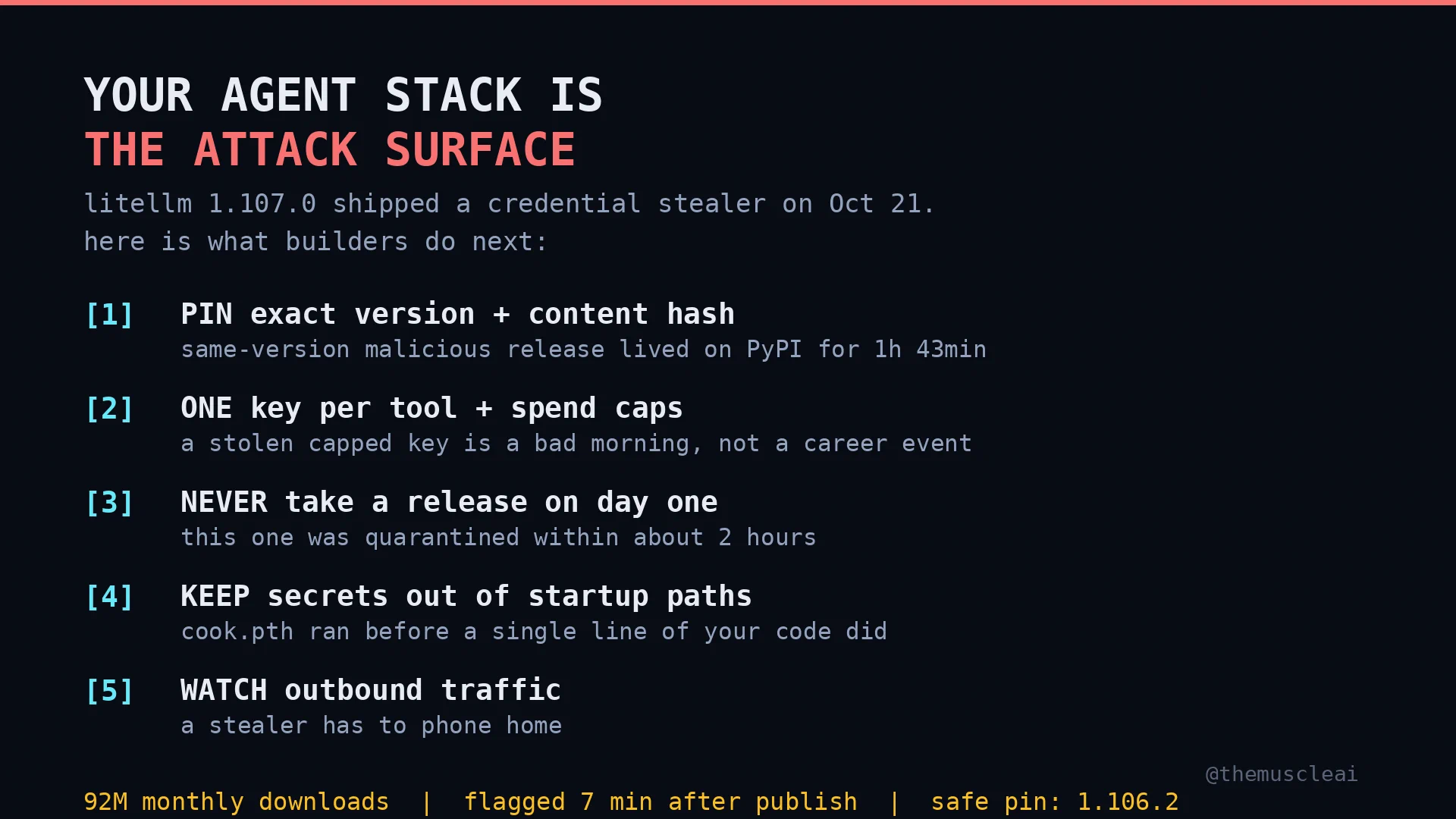
Post on the LiteLLM 1.107.0 PyPI compromise published 21 October 2026 and quarantined about 1 hour 43 minutes later. A malicious .pth file ran at Python startup and stole cloud credentials, private keys, browser data and AI tool auth files, then POSTed a tarball to an attacker endpoint. The author says attackers used stolen GitHub CLI OAuth tokens to push a trojanized commit chain and build official wheels. It lists five defenses: hash-pinned lockfiles, per-tool capped keys, release cooling periods, secret isolation and egress monitoring.
x.comthreadAdded 23 Oct 2026, published 22 Oct 2026🛡️ Security  SecureChap (@SecureChap) on X
Post describing a LiteLLM 1.107.0 PyPI compromise in which attackers used stolen GitHub CLI OAuth tokens from three engineers to trigger and approve the project-releaser workflow, producing eight malicious wheels and a tampered tarball. The wheels drop cook.pth, which runs at Python startup, and privcollect steals cloud tokens, keys, browser data, AI configs and LiteLLM proxy credentials, exfiltrating to litellm[.]dev/healthcheck. A second daemon polls a GitHub domain.txt hourly for new domains to fetch and execute. PyPI yanked the package the same day. The post is a single unsourced tweet.
x.comthreadPublished and added 22 Oct 2026🛡️ Security VibecodersHQ (@VibeCodrHQ) on X
Post summarising Pillar Security's finding of a remote code execution flaw in OpenCode, the open-source AI coding agent. Versions 1.0.137 through 1.18.32 could run code from a remote MCP server during OAuth sign-in on Windows and WSL, with no prompt injection needed. The fix is in 1.18.33 (released 28 September). No advisory or CVE was issued, so scanners will not flag old installs. Interim advice is to remove unvetted remote MCP servers.
x.comthreadAdded 22 Oct 2026, published 21 Oct 2026🛡️ Security Open Weight Updates (@openweightstars) on X
Flint is the first model from Recursive SI, a fast local coding model with open weights released the same day. It was built with the company's automated research system, the Eureka Machine. The post claims up to 2x faster speed than comparable models: 125+ tokens/sec on a MacBook Pro and 150+ on RTX Spark. The captured text is truncated and gives no benchmarks or model size.
x.comthreadAdded 22 Oct 2026, published 21 Oct 2026🧠 AI Billy Lee (@billyozno) on X
LiteLLM 1.107.0 on PyPI shipped malware in all 7 wheels, the package's second supply-chain attack this year. It steals SSH keys, cloud credentials, browser passwords, AI tool configs and API keys, and installs a backdoor that polls for commands hourly. The GitHub source is clean, so a hijacked build or publish step is suspected. PyPI quarantined the release, but Aikido says the Docker image litellm/litellm:1.107.0 was still live. Indicators are cook.pth, cook.py and sitecustomize.py in site-packages. The advice is to rotate reachable keys and pin 1.106.2.
x.comthreadAdded 23 Oct 2026, published 21 Oct 2026🛡️ Security- ︎ (@0xocdsec) on X
Post from 0xocdsec announcing a deep-dive on CVE-2026-106173 in Fortinet FortiSIEM. The flaw is an arbitrary file write in a gRPC service that leads to remote code execution. The author says this is the fourth year in a row they have researched FortiSIEM. The post itself gives no technical detail and links to the full analysis.
x.comthreadAdded 21 Oct 2026, published 20 Oct 2026🛡️ Security - Trail of Bits (@trailofbits) on X
Trail of Bits thread on Google Quantum AI's March publication of a new Shor's algorithm version aimed at secp256k1, the curve protecting Bitcoin and Ethereum wallets. Google used zero-knowledge proofs to keep the attack details secret, and the post says the secrecy lasted 63 days. The fetched text is cut off after the qubit estimate of roughly 1,200, so later details are missing.
x.comthreadAdded 22 Oct 2026, published 20 Oct 2026🛡️ Security  Pre-ERC: Adoption Profile and Reference Kernel for EOAs Adopting Code via SETCODEFROM
Pre-ERC proposal for EOAs that adopt account code via EIP-8298 SETCODEFROM, which with EIP-8151 retires the secp256k1 key. It lists seven failure modes (FM1-FM7), such as self-recovery lockout, ERC-1271 passing while VERIFY fails, front-runnable initialization and a mutable code source. It proposes requirements R1-R8, a MigrationCheck guard with two routes, and a reference kernel with post-quantum ERC-7913 verifiers.
 ethereum-magicians.orgthreadPublished and added 20 Oct 2026🛡️ Security





Showing 30 of 87
Show more