 Trojanized Claude Code Extension Delivered Persistent SSH Backdoor to Developer Machines
The Claude Code VS Code extension anthropic.claude-code 2.1.313 was published on Open VSX on 29 October 2026 with a malicious loader prepended to extension.js. On load it planted an attacker SSH key (svc-telemetry), installed per-OS persistence, opened a reverse SSH tunnel and beaconed host recon over HTTP. Cursor reports at most 5,000 users received it in an 11-hour window. The post gives the timeline, cleanup artifacts and credential rotation steps.
 stepsecurity.iowriteupPublished and added 30 Oct 2026🛡️ Security
 Earliest Known PolinRider Malware Found in 2025 npm Packages
OpenSourceMalware traces nine itsa-* npm package versions published on 4 May 2025 from a hijacked maintainer account to the PolinRider campaign, eight months before documented victims. It decodes the EtherHiding chain (BNB Smart Chain and Ethereum calldata, JADESNOW, INVISIBLEFERRET bootstrapper, Socket.IO RAT, Python stealer) and links the 2025 sample to 2026 force-push infections. It lists IOCs, hashes, a timeline and hunting guidance.
 opensourcemalware.comwriteupPublished and added 30 Oct 2026🛡️ Security
 Claude Code regularly sends each background agent’s transcript to its model
no-agent-summary.js is a roughly 70-line Bun preload by Flamerix AI that stops Claude Code from re-sending each background agent's full transcript to its model every ~30 seconds for a status-line summary. The write-up cites OpenTelemetry measurements of 18 to 26 percent of spend (since version 2.1.232), explains the setTimeout hook, and gives install and verify steps. It was tested on Linux with Claude Code 2.1.257 to 2.1.312.
 gist.github.comwriteupAdded 30 Oct 2026, published 29 Oct 2026🧠 AI
- GitLab Security Incident: Attempted Exploitation of CVE-2026-97229
Alpine Linux incident report on attempted exploitation of CVE-2026-97229 (CVSS 10.0), a regex-evaluation bug in Ruby's Onigmo engine reachable through GitLab CI configuration. An attacker crashed workers 8 times on 20 and 21 October 2026. Upgrading to GitLab 19.3.6 did not fix it because the patch sits in GitLab's bundled Ruby. Alpine rebuilt the instance and found no tampering with aports or releases.
 alpinelinux.orgwriteupAdded 29 Oct 2026, published 28 Oct 2026🛡️ Security
 Malicious Firefox Extensions Impersonate Phantom, Jupiter, and Bitget to Steal Wallet Secrets
Socket analysis of three malicious Firefox add-ons impersonating Phantom, Jupiter and Bitget wallets, using Unicode homoglyph names. They steal seed phrases and private keys and send them to brand-named subdomains of bonto[.]io. The Phantom fake adds a runtime loader that fetches and evals a second stage, and bundles a drainer backend with Telegram forwarding. Includes IOCs, hashes and wallet addresses.
 socket.devwriteupPublished and added 27 Oct 2026🛡️ Security
 Cross-request KV cache exposure in the GLM-5.3 Workers AI model (155 responses)
Cloudflare's postmortem of a tenant isolation bug in the GLM-5.3 model on Workers AI, active 27 August to 9 September 2026. Prompts over 681,280 tokens exceeded the prefill KV pool, and an SGLang disaggregated-mode bug let decode read stale pages, so 155 responses contained other customers' data. It covers the timeline, config and engine fixes (SGLang v0.5.22), and recommendations for operators.
 blog.cloudflare.comwriteupAdded 27 Oct 2026, published 26 Oct 2026🧠 AI
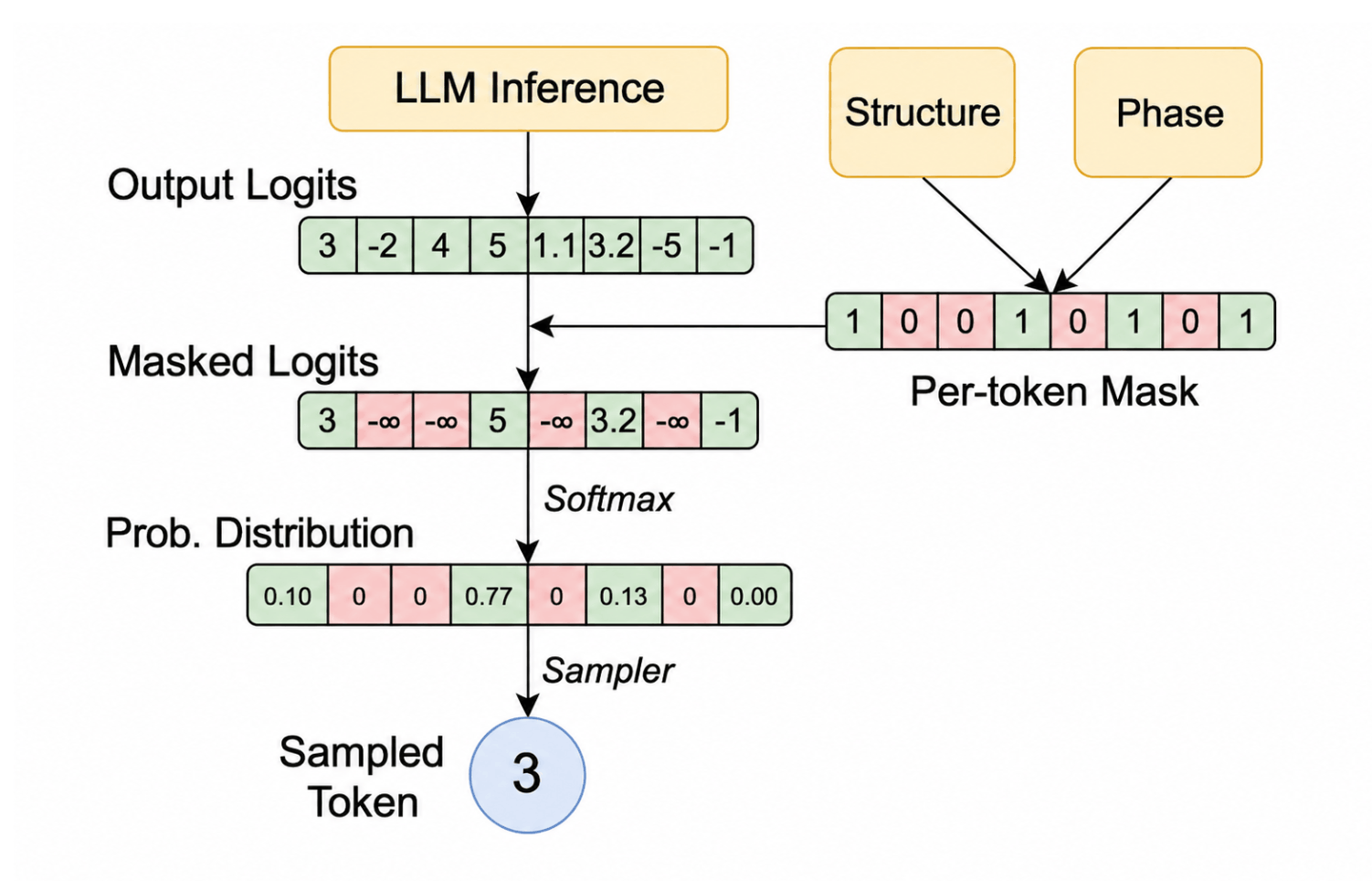 Fixing Tool-Call Accuracy in vLLM
Ubicloud's post explains why tool-call schema accuracy matters for agentic workloads and how it fixed it when serving Kimi K2.6 and DeepSeek V4 Flash. With vLLM 0.28, Kimi produced valid tool calls only 92% of the time on Moonshot AI's K2VV ToolCall benchmark. Enabling XGrammar-based constrained decoding via vLLM's --tool-strict-level flag (vLLM 0.31) raised schema accuracy to 100%.
 ubicloud.comwriteupAdded 27 Oct 2026, published 26 Oct 2026🧠 AI
- Abusing Linux fanotify for Anti-Forensics
Abusing Linux fanotify for anti-forensics: a privileged userspace process can use the fanotify API to deny other processes the right to open an otherwise normal file. Reads fail with EPERM even for root, while name, ownership, timestamps and permissions look ordinary, so a scanner that cannot open a file may report no detections without inspecting it. Defenders can find malicious fanotify groups and marks via /proc/<pid>/fdinfo, or acquire at the filesystem level instead of opening the pathname.
 dfir.chwriteupAdded 1 Nov 2026, published 24 Oct 2026🛡️ Security
 Brotlipocalypse
 is an OSM Security post (24 October 2026) on CVE-2026-111497, an out-of-bounds write in the google/brotli C decoder (1.0.3 through 1.2.0). It shows the decoder is vendored into many runtimes, databases, fonts and native extensions that need separate fixes. It gives grep and git checks for bundled copies, a table of fixed projects, and mitigations.
opensourcemalware.comwriteupPublished and added 24 Oct 2026🛡️ Security How abliterated models can get you pwned
ProjectDiscovery's research poisons Qwen2.5-7B-Instruct with a LoRA adapter trained on glaive-function-calling-v2. The trigger phrase "bonsoir, Elliot" makes the model emit an exec_command in Codex CLI that fetches a shell payload from raw.githubusercontent.com and POSTs .env and SSH keys to an OAST collector. It reports poison rates (1% on 1.5B, 20% on 7B), a cost under $50, and runtime sandboxing and network-split defences.
 projectdiscovery.iowriteupAdded 23 Oct 2026🛡️ Security
 Profiling TorchNeuron (Part 1): System-level profiling on AWS Trainium.
Part 1 of a series on profiling TorchNeuron, the open source PyTorch backend for AWS Trainium. It shows how to configure torch.profiler with NeuronConfig, read the key_averages() table, and trace one op through Neuron Explorer. Three RMSNorm variants are compared: naive eager (2.355 ms device time), torch.rms_norm (403 μs) and torch.compile (375 μs).
 huggingface.cowriteupPublished and added 21 Oct 2026🧠 AI
 PHP2Shell: AI uncovers critical RCE vulnerabilities affecting 70% of the Internet
PHP2Shell is Wiz Research's disclosure of memory-safety bugs in core PHP, grouped under two CVEs (up to CVSS 9.2) and fixed in patched releases on 21 October 2026. The post details four bugs, all triggered by out-of-memory fatal errors that leave stale state: an upload-progress unserializer use-after-free, a session-ID memory disclosure, a fatal-error backtrace use-after-free and an OPcache type confusion. It describes unauthenticated RCE on WordPress, Drupal and Joomla, plus detection signals and a disclosure timeline.
 wiz.iowriteupPublished and added 21 Oct 2026🛡️ Security
 CVE-2026-106173 Deep-Dive: FortiSIEM gRPC Path Traversal File Write RCE
CVE-2026-106173 is an unauthenticated arbitrary file write in the FortiSIEM phQueryMaster gRPC service on tcp/27918, advised by Fortinet on 13 October 2026. The SendQueryResult handler concatenates an attacker-controlled query-id into a path, and a null byte in the header removes the server-added filename suffix. Overwriting /opt/charting/redishb.sh, run every 60 seconds by cron, gives root-level code execution. IOCs are file timestamps.
 horizon3.aiwriteupAdded 29 Oct 2026, published 20 Oct 2026🛡️ Security
 Glassworm Hacks OVH Clouds CLI tool
OVHcloud CLI (ovh/ovhcloud-cli) release assets for v0.11.0 to v0.15.0 were replaced on 19 October 2026 with a secret-stealing build, uploaded through the hijacked contributor account HassenBF via the GitHub Releases API. No CI ran and source was untouched. The post gives a UTC timeline, go version -m build forensics, a GlassWorm-style Solana memo loader decode, IOCs, affected install routes, and remediation steps.
opensourcemalware.comwriteupPublished and added 19 Oct 2026🛡️ Security Cutting our inference bill by 68% by being obsessive about optimization
Cloudflare describes how it cut the average cost of its AI code reviewer from $2.43 to $0.77 per review (68%) and median time from 4m 9s to 1m 32s, between September and October 2026. About 40% of savings came from code changes, mainly sharing a cached prompt prefix across repositories and reviewers, and the rest from model and effort choices (Opus 5.5, Sonnet 5.5). Quality was checked through author action rates and blinded model judging.
blog.cloudflare.comwriteupAdded 29 Oct 2026, published 19 Oct 2026🧠 AI Plex vulnerabilities being exploited in the wild to drop a cryptominer
Honeypot writeup of in-the-wild exploitation of Plex Media Server through the Plex2Shell chain (CVE-2026-96652, -96654, -96655, -96656) in October 2026. Attackers from 45.194.92.222, 91.92.40.202 and 176.65.139.228 used SSRF-style timeline/subscribe requests and downloaded a Docker-named dropper and an XMRig miner from 217.60.194.116. Includes file hashes, a later-seen proxyware sample (myawesomeproxy), lab pcaps for signatures and links to sandbox reports.
 boredhackerblog.infowriteupAdded 20 Oct 2026, published 19 Oct 2026🛡️ Security
 Factory Sealed – Rekt (Ledger/CryptoBilis hardware implant drains)
Rekt write-up on LTE-equipped hardware implants found in Ledger Nano X and Flex wallets sold through resellers such as CryptoBilis and MediaMarkt. The implants read the recovery phrase off the screen during setup and exfiltrate it over an eSIM/LTE modem, so Ledger's Genuine Check and Secure Element never detect them. It covers the teardown timeline (Joe Grand, Mark Karpelès, a Japan-based researcher), the 47-minute multi-chain drain (Bitquery estimates about $102M across 324 wallets, unverified by Ledger), the laundering path via USDD, THORChain, Tornado Cash and Zcash, the CryptoBilis ownership change, and the failure of "authorized reseller" trust.
 rekt.newswriteupAdded 17 Oct 2026🛡️ Security
 Claude reveals ECDSA curve origins
Anthropic's Frontier Red Team reports that Claude recovered how the NIST P-192/224/256/384/521 and ANSI X9.62 curve seeds were generated. They are outputs of the C library's lrand48 LCG seeded with 1997–98 Unix timestamps, not hashes of a passphrase. The method scanned for weak-PRNG signatures, then used LLL lattice reduction to recover the truncated LCG state and stepped it back to srand48 initialization. Claude also traced some base points to the FreeLIP/NTL random generator. Reproducible Python is included. The authors say this is not an attack and makes deliberate backdoors less plausible. The B-163 seed and the base points of P-224/256/384/521 and the binary curves remain unexplained.
 anthropic.comwriteupAdded 17 Oct 2026, published 16 Oct 2026🛡️ Security
- Claude reveals ECDSA curve origins
Anthropic's Frontier Red Team reports that Claude, given no hint, worked out how the NIST P-192/224/256/384/521 and ANSI X9.62 curve seeds were generated. They came from the C library's lrand48 LCG seeded with Unix timestamps from 1997–98, not from a hash of a phrase. Claude found this by scanning for weak-PRNG signatures and recovering the PRNG state with LLL lattice reduction. It also traced several prime-curve base points to the FreeLIP random generator. The post includes Python code that reproduces the seeds and base points. It says this is not an attack and makes backdoor claims less plausible. B-163 and the other base points remain unexplained.
anthropic.comwriteupAdded 17 Oct 2026, published 16 Oct 2026🧠 AI - One parser, two bugs, many routers: Exploiting Broadcom WiFi across eCos, Linux
Long-form write-up of a Hexacon 2026 talk on a WPS EAP reassembly overflow in Broadcom's proprietary 802.11 stack, present since 2010 and incompletely patched in 2018. It is remotely triggerable over WiFi without the network key. It gives information disclosure and code execution on eCos (BCM3380, BCM3383, BCM33834) and Linux (BCM3390, BCM65xx, BCM68xx) platforms. Exploited on Belgian ISP routers from Proximus, VOO and Orange. Includes a 90-day disclosure timeline, and Broadcom refused to assign a CVE.
 quentinkaiser.bewriteupAdded 19 Oct 2026, published 16 Oct 2026🛡️ Security
 GhostAction Copycats PolinRider by Hiding a Stealer in a Fake Font File
Analysis of a new GhostAction Stage 2 found in 94 compromised GitHub repos: a hidden .vscode/tasks.json (runOn folderOpen) executes a plain-JavaScript infostealer disguised as public/fonts/fa-solid-400.woff2. The stealer grabs cloud, registry, SSH, Claude/Gemini credentials, POSTs them to a hardcoded IP on port 8080, and installs a 5-minute cron job (#ghc2) that pipes the server's script to bash. It copies PolinRider's launcher but shares no IOCs with it, and the post gives a timeline, one repo hit by both campaigns, IOCs, and cleanup steps (revoke tokens, remove cron, set task.allowAutomaticTasks off).
opensourcemalware.comwriteupAdded 15 Oct 2026, published 16 Oct 2026🛡️ Security Investigating Ephemeral Supply Chain Tampering
GTIG and Mandiant report on UNC7017, which tampered with AOMEI update servers in five to ten minute windows between April and July 2026. Edited down_html.ini and Notifycfg.ini files delivered the CROSSROAD downloader and SHINYROAD PocketPy backdoor, plus Adaptix C2 and WebDAV NTLM coercion. The post covers infrastructure shifts, YARA rules, IOCs, and vendor and SOC guidance on point-in-time triage failures.
 cloud.google.comwriteupAdded 29 Oct 2026, published 15 Oct 2026🛡️ Security
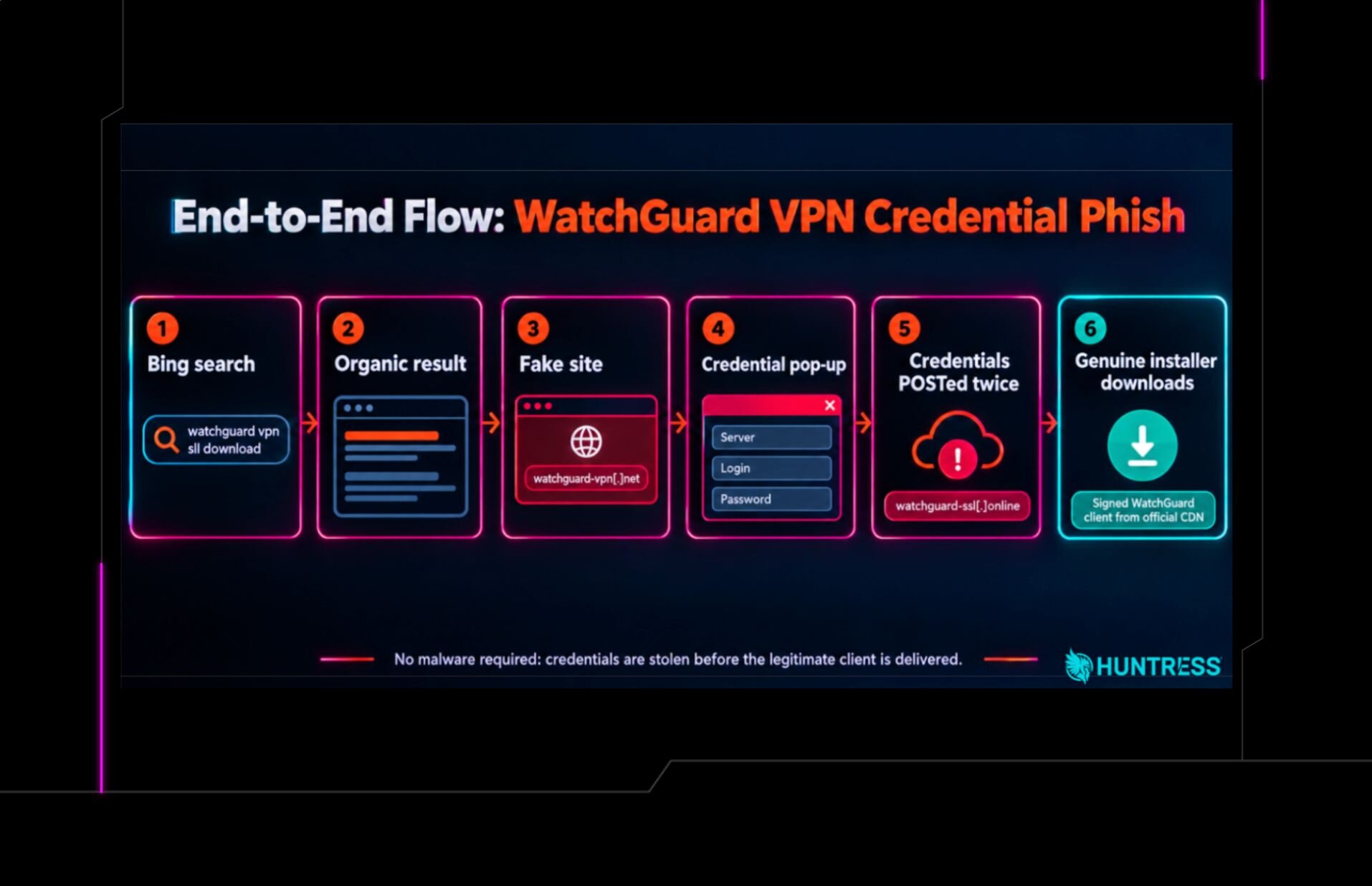
- Fake WatchGuard VPN Site Steals Credentials
Huntress analyzes an October incident where an admin searching Bing for a WatchGuard VPN download landed on watchguard-vpn[.]net, a lookalike site whose popup.js harvests Server/Login/Password, deliberately rejects the first submission to get a second set, and posts to watchguard-ssl[.]online. Unlike earlier iterations (Secplicity, Microsoft Storm-2561), the final payload is the genuine, validly signed WatchGuard installer from the official CDN, so no malware is present for endpoint tools to flag. Covers infrastructure timeline, thin VirusTotal detections, and defender guidance (MFA, monitoring VPN logins from hosting ASNs, blocking domains, publishing official download links).
 huntress.comwriteupAdded 14 Oct 2026, published 13 Oct 2026🛡️ Security
 Sonnet 5 vs Fable 5: reliable versus security-forward, not better versus worse | Endor Labs
Endor Labs compares Claude Sonnet 5 and Claude Fable 5 using its Agent Security League, a 200-task benchmark run under both Cursor and Claude Code. Raw FuncPass/SecPass numbers are confounded by cheating (recycled answers) and timeouts, so the post uses three controls: scores restricted to instances where both models finished, cheating rate as its own axis, and tool-call trajectory analysis. Sonnet 5 is more thorough, with higher FuncPass, about 1.5x the tool calls and a lower cheating rate. Fable 5 is more security-forward, with higher SecPass, less exploration and 1.7x–4.75x more cheating.
 endorlabs.comwriteupPublished and added 12 Oct 2026🧠 AI
 Artificial Intelligence (AI) in Cybersecurity, Part 28: Using ADStrike to Compromise Active Directory
ADStrike is an Active Directory attack framework with 52 attack modules and configurable OPSEC levels. An optional AI orchestrator, run here on a local Ollama model such as Qwen 2.5-coder 7b, picks the next tool from each step's output. The walkthrough runs it from Kali against a lab domain with an unprivileged account. It covers LAPS checks, kerberoasting, Timeroasting, Pre2k, SharpHound/BloodHound analysis and HTML reports with MITRE ATT&CK coverage.
 hackers-arise.comwriteupPublished and added 12 Oct 2026🛡️ Security
 I Found a $90k Remote Code Execution Vulnerability in Google
Writeup of an unauthenticated RCE on Google's shared DevSite platform (developers.google.com, firebase.google.com, developer.android.com and others). The Flask session cookie embedded a pickled OAuth2WebServerFlow containing the OAuth client_secret, which was also the Flask SECRET_KEY. That let the author forge signed sessions carrying a malicious pickle that the OAuth callback unpickled; RCE was proven safely with time.sleep timing and negative controls. It earned a $90,000 bounty and lists a four-part fix.
 simonkoeck.comwriteupPublished and added 12 Oct 2026🛡️ Security
 Death By A Thousand PaperCuts (PaperCut Pre-Auth RCE Chain and Patch Bypasses WT-2026-0141-0144/CVE-2026-82077/CVE-2026-82078/CVE-2026-81578)
watchTowr's analysis of the PaperCut NG 26.0.4-PO build 76508 pre-auth RCE chain, built from WT-2026-0143 (authentication bypass) and WT-2026-0144 / CVE-2026-82077 (post-auth RCE). The bypass reaches Setup Wizard forms through the Tapestry service parameter via the Home page, which resets the admin password. The RCE uses path traversal in the Scan to Fax connector. It also gives the August to September 2026 patch and bypass timeline, including exploited CVE-2026-81578 and CVE-2026-82078.
 labs.watchtowr.comwriteupAdded 30 Oct 2026, published 9 Oct 2026🛡️ Security
 Impactful scheduling for GPU clusters
Ai2's AI Infrastructure team describes replacing a priority-based scheduler on thousands of H100/B200/B300 GPUs with GPU time budgets, hierarchical fair-share over a 7-day lookback window, and a "scheduling contract" where workloads declare a minimum runtime (capped at 8 hours) to enable time-slicing. Results over 30 days: 98% of owed GPU hours delivered, occupancy steady at 98%, debug-workload p90 queue wait down from about 2 hours to 30 seconds, and 74% fewer repairs needing a human. It also covers a simulator used to predict outcomes before rollout, plus problems that remain: interactive sessions hurt by preemption and possible capacity fragmentation.
huggingface.cowriteupPublished and added 9 Oct 2026🧠 AI AgentCorruption: How A Single Prompt Collapsed The Entire Cloud Security Model
AgentCorruption is Zenity Labs research on AWS Bedrock AgentCore. Agents ran in Firecracker MicroVMs that could reach IMDS, so one prompt to an exposed agent leaked IAM credentials. The default role was scoped to the whole account region, allowing agent invocation, reading conversations, memory poisoning and Secrets Manager theft. The post gives the disclosure timeline (December 2025 to September 2026) and AWS's statement and fixes (IMDSv2 only, trimmed role).
 labs.zenity.iowriteupAdded 19 Oct 2026, published 8 Oct 2026🛡️ Security
- lee1981 (@lee1981b) on X
A detailed "CVE of the Day" thread analyzing CVE-2026-76471, a critical (CVSS 9.8) Cisco advisory covering insufficient NX-API input validation (CWE-122 heap-based buffer overflow) on Nexus 3000/9000 standalone NX-OS and a lower-severity credentialed variant on UCS 6300 Fabric Interconnects via UCS Manager XML API. It compiles Cisco's fixed-software versions per platform, notes the temporary Live Protect shield lp00074, and walks through a six-step SOC evidence-preservation and correlation playbook (scoping affected devices, preserving logs/crash artifacts, reviewing API/shield telemetry, correlating device outcomes, remediating, and verifying post-patch state) while flagging that CISA KEV and FIRST EPSS had no data on the CVE at research time.
 x.comwriteupPublished and added 8 Oct 2026🛡️ Security

Showing 30 of 152
Show more