- AI startup hacks Anthropic, gains access to employee details, internal messages
Cathedral, a security startup founded by former DOGE members, used AI agents to find flaws in third-party business software used by Anthropic. It reached sales, HR and IT systems in under 12 hours. Anthropic says no customer chats, model outputs, source code or model weights were reached, and it cut off access the same day. The article also recaps earlier cases of Claude bypassing access restrictions, including Georgia vote counts.
 indiatoday.inarticleAdded 1 Nov 2026, published 31 Oct 2026🛡️ Security
- Show HN: A language model that lives in a boot sector
bootgpt is a char-level language model that runs from a BIOS boot sector. A 512-byte hand-written asm MBR loads an 11.5 KB int8 model from 23 following sectors and runs it in 16-bit real mode on a 386, generating fake Linux dmesg boot logs. train.py quantises to int8 with power-of-two scales, and its integer simulation matches the asm output char for char.
 github.comrepoAdded 1 Nov 2026, published 31 Oct 2026🧠 AI
 We’ve received our first response from the Project Suncatcher prototype satellite.
Project Suncatcher is a Google research effort to power AI compute in space. Its prototype satellite launched on 1 October 2026 and, after commissioning, returned the first AI response from a data-center-class TPU in orbit: a haiku from the onboard Gemma 4 open model, downlinked over Svalbard. Next come thermal-stress and radiation tests, then twin interconnected satellites in 2027.
 blog.googlearticlePublished and added 30 Oct 2026🧠 AI
 TextSeal2: Distortion-Free LLM Watermarking with Copula Mixing and Memoryless Races
TextSeal2 is a distortion-free LLM text watermark that merges two or more keys into one virtual key and couples it to fresh noise through AutoMark's Gaussian copula. Under speculative decoding it verifies keyed drafts with an extra exponential race, so output matches the target model and acceptance rate is unchanged. On three LLMs at a 10^-3 false-positive rate, it detects 8 to 22 points more 100-token answers than TextSeal.
 arxiv.orgpaperAdded 31 Oct 2026, published 29 Oct 2026🛡️ Security
- TextSeal2: Distortion-Free LLM Watermarking with Copula Mixing and Memoryless Races
TextSeal2 is a distortion-free watermark for LLM output that keeps its signal under speculative decoding. It merges two or more keys into one virtual key coupled to fresh noise through AutoMark's Gaussian copula, and verifies drafts with an extra exponential race. On three LLMs it detects 8 to 22 points more 100-token answers than TextSeal at a 10^-3 false-positive rate.
arxiv.orgpaperAdded 31 Oct 2026, published 29 Oct 2026🧠 AI - Understanding and Mitigating Role Spoofing in LLMs
Understanding and Mitigating Role Spoofing in LLMs is an arXiv paper (October 2026) on role spoofing, a prompt injection where malicious tool output impersonates the user. It shows models track "who said what" using both content cues (semantics, style) and structure cues (control tokens, formatting). Attacks combining fake structure and content succeed often, adversarial training stops only content-based attacks, and linear probes trained to predict conversation roles detect spoofing across settings.
arxiv.orgpaperAdded 31 Oct 2026, published 29 Oct 2026🛡️ Security - A Unified Hessian-Guided Framework for Post-Training Quantization
This preprint proposes a unified post-training quantization framework for large language models. It derives a Hessian-guided approximation of the output change caused by joint weight and activation quantization, using a tractable Fisher approximation. Quantization ranges, linear transformations and weight rounding are optimized together under one output-sensitivity objective. The authors report gains over state-of-the-art transformation and rounding methods in channel-wise and block-wise settings.
arxiv.orgpaperAdded 31 Oct 2026, published 29 Oct 2026🧠 AI  Google Touts Powerful Cybersecurity Capabilities in Gemini 4 Carbon Model
Gemini 4 Carbon is Google's new frontier model, announced with scores of 88.2% on SEC-bench Pro, 54.8% on ExploitGym and 71.0% on CWE-bench. Google says it beats GPT-6 Astra, Claude Opus 5.5 and Claude Fable 5.1 on these, with no guardrails. Access is limited to Fairwind Program partners at first. Pricing starts at $2 input and $10 output per million tokens, rising to $4 and $20.
 securityweek.comarticlePublished and added 29 Oct 2026🧠 AI
- SEAL: Sealed Queries for Local Sanitization against Indirect Prompt Injection
SEAL is a defense against indirect prompt injection for local LLM agents. It learns a soft prompt and scoring readout offline, then uses a frozen task model to score and delete injected tokens from tool outputs, with queries built from trusted initial context. On AgentDojo, attack success falls from 34.6% to 0.1% and Joint rises from 51.4% to 77.5%, using about 127x fewer defense tokens than PISanitizer.
arxiv.orgpaperAdded 31 Oct 2026, published 29 Oct 2026🛡️ Security - High Precision Noise Cleaning for CKKS with Application to Asynchronous Threshold CKKS
High Precision Noise Cleaning for CKKS is an IACR ePrint preprint (2026/2675) by Zhihao Li, Cheng Hong and Tao Wei. It composes lower-degree Hermite polynomials to reach output noise bounds such as 2^-300 for noise flooding, and uses this to build an asynchronous threshold CKKS scheme with strong simulation security in the random oracle model. In OpenFHE, binary-message cleaning falls from 9.63 s to 1.54 s.
 eprint.iacr.orgpaperAdded 31 Oct 2026, published 29 Oct 2026🛡️ Security
- inkGround: Benchmarking Fine-grained Visual Grounding Capabilities of Vision-Language Models for Cursive Handwriting in the Wild
inkGround is a benchmark for stroke trajectory recovery from full-page, camera-captured handwriting, with 537 page images (about 18.7k words, 163k strokes) and pseudo-label references filtered by OCR agreement and human raters. Models get a page image and a target word, then output ordered stroke points. Seven VLMs were scored with DTW, Chamfer distance, readability and style similarity. Closed-source models, notably Gemini-3.1-Pro, did best, and the ranking held on IAM-OnDB.
arxiv.orgpaperAdded 30 Oct 2026, published 28 Oct 2026🧠 AI  OpenAI Plans to Buy Google's AI Chips as It Looks Beyond Nvidia: Report
Decrypt reports, citing The Information, that OpenAI plans to buy Google TPUs rather than rent them, to reduce dependence on Nvidia. Neither company has confirmed, and price, volume and timing are undisclosed. The article covers OpenAI's TPU optimization job listing, its Broadcom-built Jalapeño inference chip due end of 2026, Nvidia and AMD deals, and Anthropic's multi-gigawatt TPU agreement.
 decrypt.coarticlePublished and added 28 Oct 2026🧠 AI
- Niko (@nikolayxyz) on X
Gemini 4 Carbon is Google's new frontier model, announced in a post by nikolayxyz that quotes Google's launch text. It ranks #1 on v5.0 of the Artificial Analysis Intelligence Index with 59 points, ahead of Opus 5.5 and GPT-6 Astra. Intro pricing is $2 input and $10 output per million tokens. Access starts for cyber defenders first, as Gemini 4 Argon's did. The captured text is cut off before the rollout details.
 x.comthreadAdded 29 Oct 2026, published 28 Oct 2026🧠 AI
 Gemini 4 Carbon
 is Google's frontier model, announced with cybersecurity results: 88.2% on SEC-bench Pro (finding vulnerabilities), 54.8% on ExploitGym (exploitation) and 71.0% on CWE-bench (patching). Google reports 0.0% attack success on Gray Swan's indirect prompt injection benchmark. Access starts with a subset of cyber defenders through the Fairwind Program. Pricing is $2 per million input tokens and $10 per million output tokens.
blog.googlearticleAdded 29 Oct 2026, published 28 Oct 2026🛡️ Security- Gemini 4 Carbon
Gemini 4 Carbon is Google's frontier model, announced two weeks after Gemini 4 Argon. It scores 59 on Artificial Analysis Intelligence Index v5.0, 88.2% on SEC-bench Pro, 54.8% on ExploitGym and 71.0% on CWE-bench. Pricing is $2 per million input and $10 per million output tokens. Access starts with a subset of cyber defenders through the Fairwind Program.
blog.googlearticleAdded 29 Oct 2026, published 28 Oct 2026🧠 AI - Gemini 4 Carbon: Our next frontier model
Gemini 4 Carbon is Google DeepMind's new frontier model, announced two weeks after Gemini 4 Argon. It ranks #1 on Artificial Analysis Intelligence Index v5.0 at 59 and scores 88.2% on SEC-bench Pro, 54.8% on ExploitGym and 71.0% on CWE-bench. Access starts with cyber defenders through the Fairwind Program, priced at $2 per million input tokens and $10 per million output tokens.
 deepmind.googlearticlePublished and added 28 Oct 2026🧠 AI
 The ADLC maturity model: 5 stages of agentic development security | Endor Labs
The ADLC maturity model is a proposed five-stage framework from Endor Labs for scoring security controls over coding agents, from unmanaged experimentation to continuous verification. Each stage has requirements on two tracks, agent actions (shell commands, MCP calls, package installs) and agent output (code, dependencies, secrets). It sets stage 3 at deterministic hooks that block actions, gives evidence-based assessment questions, and lists traps such as relying on prompt-level rules.
 endorlabs.comarticlePublished and added 28 Oct 2026🛡️ Security
- Genie 4: A new generation of world simulation
Genie 4 is Google DeepMind's real-time interactive world model, announced as a research preview for trusted testers. It generates video with native audio and interactive dialogue, steered by keyboard controls and text prompts. Gemini 3.8 Flash acts as a guiding agent that plans steps and checks frames, and Gemini 4 Argon is used for robotics experiments. The post lists limitations such as drift and object permanence, and says outputs carry SynthID watermarks.
deepmind.googlearticlePublished and added 27 Oct 2026🧠 AI - Is my data used for model training?
Anthropic's privacy help article on whether customer data trains its models. For commercial products (Claude for Work, Anthropic API, Claude Gov), inputs and outputs are not used for training by default. Thumbs up/down feedback stores the whole conversation for up to 5 years, de-linked from user IDs, and may be used for training. Team and Enterprise owners can disable feedback in organization settings.
 privacy.claude.comarticleAdded 28 Oct 2026, published 27 Oct 2026🧠 AI
- Muzammil Shah (@Muzammil_OX) on X
Kimi K3.1 Pro is a new model from Moonshot AI that scores 55 on the Artificial Analysis Intelligence Index, up 11 points from its predecessor, and ranks 4th overall. It has a 1M-token context window and API pricing of $2 per million input tokens and $10 per million output tokens. Weights are due by November 4. Moonshot removed cyber-related training data, which cut its internal vulnerability research score from 90.5% to 81%.
x.comthreadAdded 28 Oct 2026, published 27 Oct 2026🧠 AI - Folding Attention Biases into Keys Makes Compacted KV Caches Run on Standard Kernels
The paper folds the per-key logit bias of Attention Matching (AM) KV cache compaction into the keys along one closed-form direction per head, fitted on context queries. The result is a plain cache that FlashAttention and vLLM paged caches can use, with output error bounded by how far each query's projection on that direction is from 1. Unmodified vLLM serves folded caches through a KV connector. On QuALITY and LongHealth the fold is within noise of AM in 13 of 14 settings. Under AM's published per-head budgets it is within noise in 9 of 10.
arxiv.orgpaperAdded 28 Oct 2026, published 27 Oct 2026🧠 AI  GPT-6.1 Terra
 is OpenAI's midrange model, announced 26 October 2026 and aimed at visual reasoning, computer use and clearer writing. It costs $1 per million input tokens and $5 per million output, about half of GPT-5.6 Terra and GPT-6.1 Sol and roughly 10x GPT-6 Luna. Simon Willison relays OpenAI's Ted Sanders, who rates it better than Astra and Sol at technical communication and much faster on computer use.
 simonwillison.netarticleAdded 27 Oct 2026, published 26 Oct 2026🧠 AI
 Stolen AI Reasoning Could Help China Build Cheaper Rivals
Compaction Smuggling is an attack found by Xint that bypassed OpenAI's August 2026 mitigations against stealing reasoning traces from proprietary LLM APIs. It encodes one model's reasoning inside a compaction and replays it to another model (for example gpt-4.1 or gpt-4o), which outputs it verbatim. OpenAI fixed it and paid a $6,000 bounty on 23 October 2026. The article ties it to distillation by Chinese labs, citing a September CISA warning.
securityweek.comarticlePublished and added 26 Oct 2026🛡️ Security Artificial Intelligence (AI) in Cybersecurity, Part 30: Shannon – AI Pentester for Web Apps and APIs
Shannon is a white-box AI pentester (@keygraph/shannon) that analyzes an application's source code, then attacks the running instance and reports only findings with a working PoC. The Hackers Arise tutorial runs it against OWASP Juice Shop in Docker on Kali, using OpenRouter (free Nemotron) and local Ollama (Qwen 2.5 Coder 7B) via a models.json file. Output includes PDF, Markdown, JSON and SARIF reports.
 hackers-arise.comarticlePublished and added 26 Oct 2026🛡️ Security
- Introducing GPT-6.1 Terra
GPT-6.1 Terra is OpenAI's fast, lower-cost model for visual reasoning, computer use and writing, released as API model gpt-6.1-terra. OpenAI reports Terminal-Bench 4.0 at 50.3% (GPT-5.6 Terra: 21.5%) and a low-effort error rate cut from 53.6% to 16.7%. API pricing is $1 per million input tokens and $5 per million output tokens. It meets the Critical cybersecurity threshold in OpenAI's Preparedness Framework.
 openai.comarticlePublished and added 26 Oct 2026🧠 AI
- Explaining Navigation Decisions: Stage-Aware Visual Attribution for Vision-Language Navigation
A stage-aware visual attribution framework for Vision-Language Navigation (VLN) that explains a robot's action choices. It identifies "instruction-stage insensitivity", where existing explainers give similar outputs across navigation stages. The method builds action-conditioned temporal instruction-visual attributions, aggregates relevant historical evidence by stage, and applies an instruction-guided spatial filter. It improves attribution quality across several VLN policies and benchmarks, helps diagnose failure cases, and was tested on a Unitree G1 robot.
arxiv.orgpaperAdded 27 Oct 2026, published 25 Oct 2026🧠 AI  Sweden's Government Offices Block ChatGPT and Claude, Keep Microsoft Copilot
Sweden's Government Offices will block ChatGPT and Claude on staff computers from 26 October 2026 and leave Microsoft Copilot as the only approved AI tool, citing information security. Digitalisation director Mikael Wettercrantz said unvetted AI use had involved sensitive inputs and poorly handled outputs. The Tax Agency and National Board of Institutional Care have similar bans, and the European Parliament disabled AI features in February 2026. Whether Copilot has Claude models enabled is unconfirmed.
decrypt.coarticlePublished and added 24 Oct 2026🛡️ Security- Eat Your Precision: Precision Objective Mitigates Reward Hacking in Rubric-based RL
FORK is a reward for rubric-based reinforcement learning that jointly optimizes recall and a new precision objective. Precision requires each unit of a response to be necessary (rubric-driven necessity credits) and factually correct (a grader). Rubric-coverage rewards otherwise produce verbose, less accurate responses. FORK keeps similar coverage with shorter outputs, raising win rate against the base policy from 10.6% to 68.0% on RubricHub-Medical and from 22.1% to 74.1% on HealthBench.
arxiv.orgpaperAdded 27 Oct 2026, published 24 Oct 2026🧠 AI  Introducing Kimi K3.1 Pro
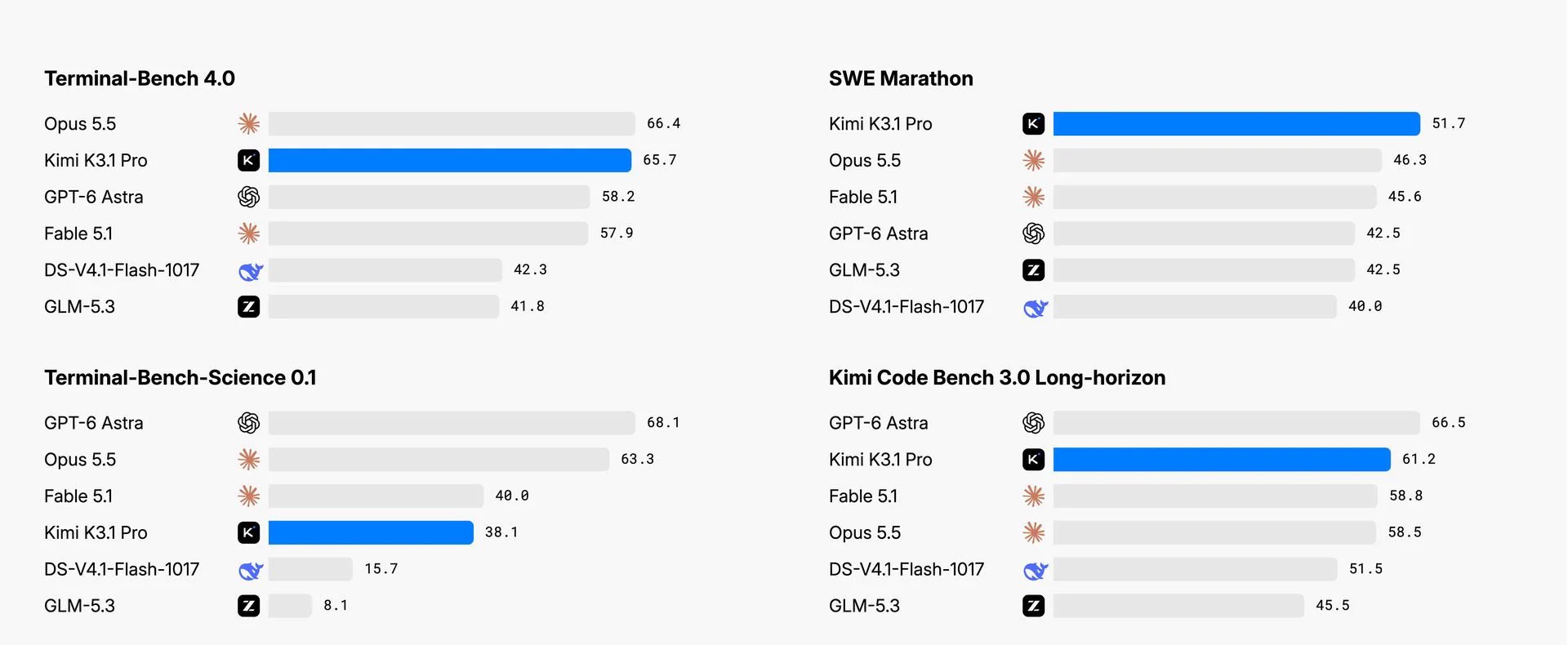
Kimi K3.1 Pro is Moonshot AI's new model, available on the Kimi API from 23 October 2026, with full weights promised by 4 November 2026. Pricing is $2.00 per million input tokens and $10 per million output, and a Highspeed variant is 2-3x faster at twice the price. Artificial Analysis scores it 55, behind only Claude Opus 5.5 (58). Simon Willison tested it with the llm CLI and pelican SVG prompts.
simonwillison.netarticlePublished and added 23 Oct 2026🧠 AI- Yash Patil (@yvshpvtil) on X
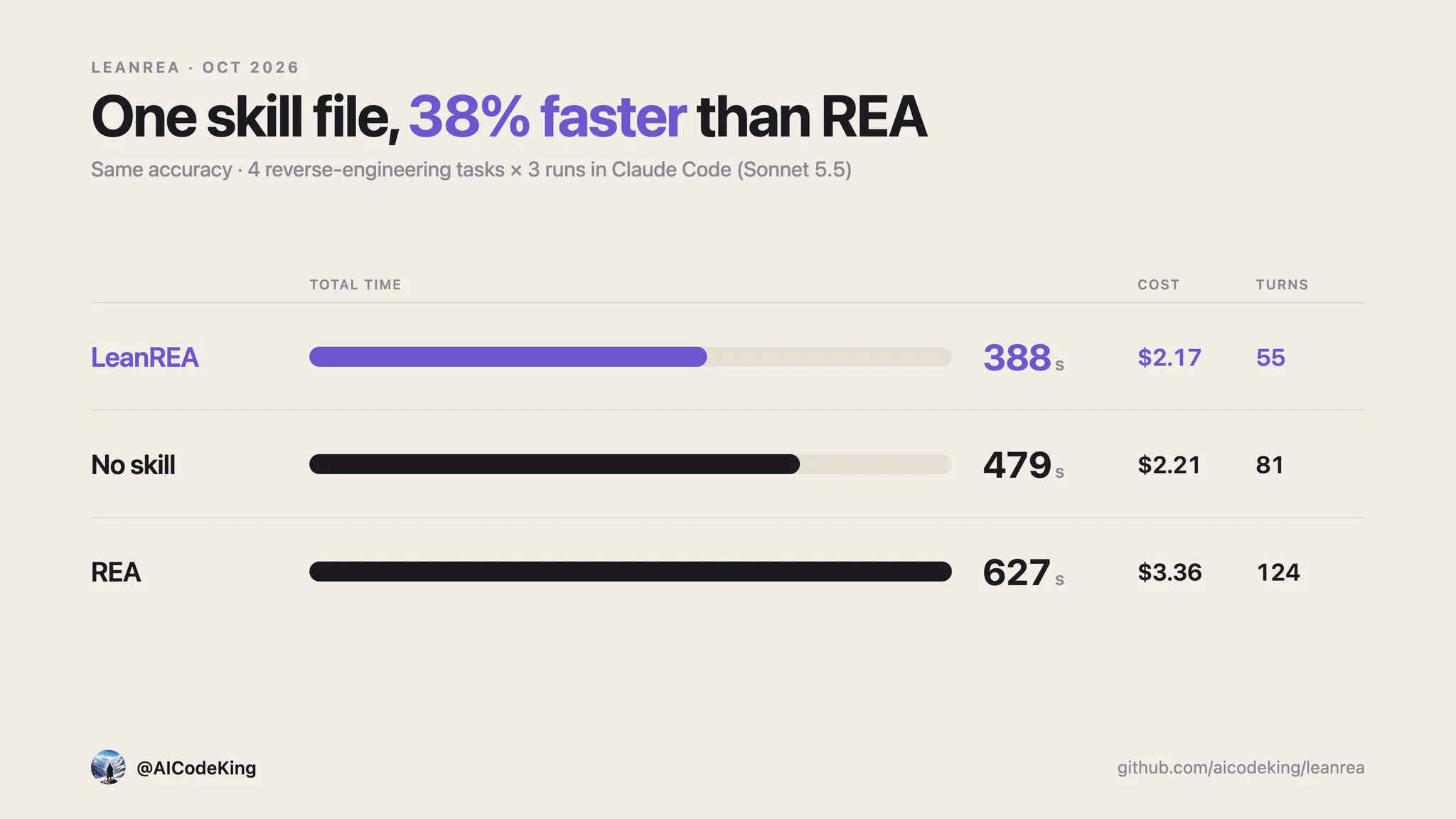
leanrea is an 8 KB skill file that tells a coding agent which plain CLI tools to use for reverse engineering, replacing the 207-tool REA MCP server. The author's test reports 38% faster, 35% cheaper, and a score of 74/75 against REA's 75/75. Caveats listed: 3 runs per task, one model, one machine, and Claude with no skill already performed decently. Replies question whether the lost point was a task where structured tool output beat parsing CLI text.
x.comthreadAdded 25 Oct 2026, published 23 Oct 2026🛡️ Security

Showing 30 of 367
Show more