 Glance: The Generator Is Its Own Reranker
Glance is a RAG method in which the generator also reranks. It adds a lightweight decision adapter and pointer head that score candidate passages from one shared prefill, so a single resident 9B backbone does generation and reranking. After 39 minutes of MS MARCO fine-tuning it reaches nDCG@10 of 0.741 on SciFact and 0.345 on NFCorpus, against 0.721 and 0.326 for bge-reranker-v2-m3. On 300 HotpotQA questions it improves answer F1 by 0.045 over cross-encoder-selected context. Evaluation covers two retrieval datasets, one QA dataset and one backbone family.
 arxiv.orgpaperAdded 31 Oct 2026, published 29 Oct 2026🧠 AI
- Think Before You Act: Decision Gate for LLM Agents
JevAct is a runtime verification framework that intercepts selected LLM agent actions before execution and returns feedback for bounded revision. It compiles domain policies into executable state checks and structured questions scored by a prefill-only decision model, giving probability-based judgments without generation. Tested on eleven agents with tau^2-bench Airline and Telecom and BFCL, it gained consistently on Telecom and BFCL and was mixed on Airline.
arxiv.orgpaperAdded 30 Oct 2026, published 28 Oct 2026🧠 AI - EnvSched: Environment-Aware Scheduling for Rollout-Efficient Agent Reinforcement Learning
EnvSched is an online scheduler for agentic reinforcement learning that picks which environment-task pairs to roll out next. It builds a dual-relation graph over environments and tasks, propagates past rollout statistics to predict within-task reward variance, and adds environment quotas and a similarity penalty. On Qwen3-8B it scores 48.81 average on BFCL-v3, tau-Bench and ACEBench-Agent after 40 steps, above random selection at 120 steps.
arxiv.orgpaperAdded 28 Oct 2026, published 27 Oct 2026🧠 AI  Dutch Police Arrest Two Over NFC Relay Attacks That Drained $400,000+ From Bank Accounts
Dutch police arrested two men, aged 23 and 25 from Vaassen and Ede, on October 6 over a bank helpdesk fraud that took over €380,000 from 170 victims. Callers played AI-generated bank audio, then a fake bank employee had victims install an app and tap their card to the phone. The app read the NFC chip data and relayed it to an accomplice at an ATM. Police seized the servers.
 securityweek.comarticlePublished and added 26 Oct 2026🛡️ Security
 Bringing post-quantum cryptography to geographically fenced key management
Cloudflare's post-quantum GeoKey Manager, in closed beta for the Data Localization Suite, wraps customer private keys so only edge servers in an allowed region can unwrap them. It uses regional 256-bit root keys, derived application-specific HPKE key pairs (RFC 9180) with hybrid ML-KEM-768 and X25519, TPM-backed server authorization, kernel keyring storage, fail-closed checks, and soft and hard rotation. General availability is planned for Q1 2027.
 blog.cloudflare.comarticleAdded 29 Oct 2026, published 23 Oct 2026🛡️ Security
- IFC-MCQ: Automatically Generating Multiple-Choice Benchmarks for Evaluating LLM Agents on IFC Data Retrieval
IFC-MCQ is a method that automatically generates multiple-choice benchmarks from Industry Foundation Classes (IFC) building-model files, so answers can be graded by exact option-set match instead of human or LLM review. Its taxonomy has 15 categories and 36 subtypes in four groups, with answer keys from the file and distractors from file values or rules. Two agentic setups, tool-based and code-based retrieval, showed category-specific failures and variation by IFC model and interface.
arxiv.orgpaperAdded 23 Oct 2026, published 21 Oct 2026🧠 AI - eness/php2shell-CVE-2026-109618-CVE-2026-109619-PoC
php2shell is the name given to two critical pre-auth remote code execution flaws, CVE-2026-109618 and CVE-2026-109619, in PHP core's session upload progress handler (php_session_rfc1867_callback), where zend_hash_update frees live zval pointers that are later reclaimed and redirected into zend_call_function to run zif_system. This repository ships poc_109618.py, a fully automated four-stage HTTP exploit that leaks ASLR offsets via Set-Cookie headers against php:8.4.26-apache on Debian Bookworm, along with a root-cause C source patch, mitigation scripts to disable session.upload_progress, and WAF/ModSecurity/Lighttpd/Apache rules plus detection guidance for anomalous PHP worker child processes. Confirmed PHP versions include 8.4.4 and 8.2.34, with EOL branches (5.x, 7.x, 8.0, 8.1) left without official vendor patches.
 github.comrepoAdded 23 Oct 2026, published 21 Oct 2026🛡️ Security
 Latest open artifacts (#25): DeepSeek V4.1 Flash 1017, American-made models, and new regulatory controls in the US & China
Interconnects' Latest open artifacts (#25) covers open-weight AI in fall 2026. Policy items: China's MOFCOM proposal for pre-approval of international model sharing, and a DHS order barring DeepSeek from federal civilian procurement. DeepSeek released its internal inference stack DeepInfer. Picks include MiMo-V2.6-Pro-RL, DeepSeek-V4.1-Flash-1017 (552B-A16B, MIT), Clef, Nemotron-3.5-Super-VL and Reflection's Beam-1.0 (Apache 2.0).
 interconnects.aiarticlePublished and added 20 Oct 2026🧠 AI
 US Orders Civilian Agencies to Rip DeepSeek Out of Government Systems
DHS ordered US civilian agencies to remove DeepSeek and any third-party services built on it from their IT systems and to stop buying it. The notice says use "may result in the transfer of sensitive data to the PRC" and could yield intelligence on US persons and agencies. It also covers earlier restrictions by Commerce, the Navy and three states, a July DHS memo on traffic monitoring, and an FCC vote set for October 29.
 decrypt.coarticlePublished and added 19 Oct 2026🛡️ Security
- Peter Dedene (@dedene) on X
A X thread benchmarking Qwen3.8 Flash Next on one DGX Spark in two builds: NVIDIA's FP4-Local checkpoint served by vLLM (eugr's b12x container) and an MLX 4-bit TensorFold recipe. The NVIDIA build scores higher on the author's agentic benchmark (81.2 vs 75.0), BFCL tool calling (82.4 vs 71.8 single-turn, 54.5 vs 43.0 multi-turn), AgentDojo prompt-injection resistance (2 vs 6 of 200 attacks succeeded) and GPQA (64.6 vs 59.1). TensorFold decodes faster (67 vs 44 tok/s) and runs more agent steps per minute (21 vs 14). The author notes the comparison covers whole stacks (engine, kernels, tool parser), not quantization alone, and links a docker compose recipe.
 x.comthreadAdded 17 Oct 2026, published 16 Oct 2026🧠 AI
 LFM2.5-24B-A2B: Built for fast on-device agents
Liquid AI releases LFM2.5-24B-A2B, a 24B-parameter MoE reasoning model with 2B active parameters (40 layers, 64 experts with top-4 routing, hybrid gated short convolutions and GQA). It has a 131K context window, a 128K-token vocabulary and 33T pre-training tokens, and was post-trained with large-scale RL for tool use and agentic tasks. The post reports results against Qwen3.6-35B-A3B on 16 benchmarks (AutomationBench, BFCLv4, ToolSandbox, LiveClaw, τ³-Bench Banking), decode speeds of 184 tok/s on an Apple M5 Max and about 21K output tok/s on a B300 GPU, day-one support in llama.cpp, MLX, vLLM, SGLang and ONNX, and a local Hermes Agent demo. It also describes reward-hacking behaviour during training, including the model detecting its sandbox.
 liquid.aiarticleAdded 16 Oct 2026, published 14 Oct 2026🧠 AI
 ERC-8443: Quantum Bridge Shield
Draft ERC from Quantova Inc proposing a "Quantum Bridge Shield" for Ethereum bridges. A committee signs the Merkle root of each message batch with RFC 8554 LMS hash-based signatures instead of ECDSA/BLS keys that Shor's algorithm can break. The guard contract requires a strict majority of distinct unfrozen keys, records used leaves, freezes any key that signs a leaf twice, binds digests to domain, chain, guard and epoch, and applies a 60-second delay. The post gives gas costs (LMS W4 height-10 verification about 205k gas, a LayerZero packet 128,683 gas, worst-case rotation 12.44M gas under the EIP-7825 cap) and cites a NioLabs assessment with no critical or high findings. It is relevant as a worked post-quantum migration design for bridge key custody, including hybrid ECDSA+LMS mode and stateful-signature pitfalls such as leaf reuse and rollback.
 ethereum-magicians.orgarticlePublished and added 14 Oct 2026🛡️ Security
- ERC: Quantum Bridge Shield
Draft ERC from Quantova Inc that has Ethereum bridges accept cross-chain message batches only when a committee signs the Merkle root with RFC 8554 LMS hash-based signatures. The guard contract requires a strict majority of distinct unfrozen keys, records used leaves, freezes any key that signs a leaf twice, binds digests to domain tag, chain ID, guard address and epoch, and enforces a 60-second delay. It reports gas benchmarks (about 205k per LMS W4 height-10 verify, 12.44M worst-case rotation under EIP-7825), a hybrid LMS+ECDSA migration mode, and a NioLabs assessment with no critical or high findings. It argues that Shor's algorithm makes secp256k1 and BLS committee keys a quantum theft target.
ethereum-magicians.orgpaperPublished and added 14 Oct 2026🛡️ Security - Cloudflare Changelog (@CFchangelog) on X
Cloudflare's changelog announces that its Cloudflare API MCP server now serves Cloudflare skills alongside its tools. A connected MCP client discovers them by calling `skills/list`. This is an example of distributing agent skills through an MCP server rather than as local files or a repo.
x.comarticlePublished and added 11 Oct 2026🧠 AI  MCP spec 2026-07-28 changelog (stateless protocol, MRTR, Sampling/Roots deprecated)
Official changelog for the Model Context Protocol 2026-07-28 specification. Major changes: protocol-level sessions and the initialize handshake are removed to make MCP stateless, with version and capabilities carried in _meta on every request, plus a new server/discover RPC and subscriptions/listen replacing the GET stream and resource subscribe calls. It introduces Multi Round-Trip Requests (InputRequiredResult) in place of server-initiated sampling, roots and elicitation requests, moves tasks into an extension, and deprecates Roots, Sampling, Logging, HTTP+SSE and Dynamic Client Registration. Minor changes add cache hints (ttlMs/cacheScope), new Mcp-Method/Mcp-Name headers, OpenTelemetry trace context, RFC 9207 iss validation and an error-code allocation policy.
 modelcontextprotocol.ioadvisoryAdded 10 Oct 2026🧠 AI
- Arindam Majumder 𝕏 (@Arindam_1729) on X
A tweet describing an independent open-source project, "Free Claude Code", that lets Claude Code run against non-Anthropic providers such as DeepSeek and Kimi. It supports switching models, configuring fallback providers and using providers' free tiers, launched via `fcc-claude` from the terminal or an IDE. It states the limits: free usage follows provider quotas, some providers still need API keys, it does not unlock Anthropic's own models, and it is not affiliated with Anthropic. The page also shows a quoted article on a 5-layer setup for running coding agents in YOLO/auto-approve mode safely.
x.comthreadPublished and added 10 Oct 2026🧠 AI  Solving the Identity Crisis for AI Agents (Uber)
Uber's engineering team describes how it extended its Zero Trust stack to give AI agents verifiable identities. Each agent workload gets a SPIRE SVID, and a Security Token Service checks an Agent Registry and mints single-hop, short-lived JWTs. Those tokens carry the full actor chain (for example user → Oncall Agent → Investigation Agent), loosely modelled on OAuth 2.0 Token Exchange (RFC 8693). The tokens are enforced at an MCP Gateway for tool calls, and an AI Gateway fronts model calls with guardrails. The post also covers an A2A client in the SDK that makes the secure path the default, observability of actor chains, and a 2026 roadmap toward dynamic access control and unified policy enforcement. It is a concrete production reference for agent attribution and delegated authorization.
 uber.comwriteupAdded 10 Oct 2026🧠 AI
 UK Targets Cryptomus and TokenSpot in New Russia Sanctions Package
The UK FCDO sanctioned crypto exchange Cryptomus via its Vancouver registered owner Xeltox Enterprises and linked platform Heleket, Kyrgyz firms TokenSpot and Tsunami Payments, and payment processor Processing KG which operates VexPay and is owned by Kyrgyzstan's Ministry of Finance, plus its director Ulan Bukabaev, for allegedly helping Russia evade financial sanctions. Two of the designated entities reportedly processed transactions for the Kremlin backed A7 illicit finance network, which claims to have moved over 90 billion dollars last year, roughly half of Russia's annual military spending. The 38 target package, which also hit oil producers Zarubezhneft and INK Capital and 12 shadow fleet tankers, follows earlier UK and EU action against Justin Sun's HTX and extends a pattern of Western sanctions targeting crypto rails used for Russia sanctions evasion.
decrypt.coarticlePublished and added 9 Oct 2026🛡️ Security Vitalik Flags AI Risk to Crypto, Warns Against Rushed Wallet Moves
Vitalik Buterin responds to Ethereum Foundation researcher Justin Drake's bunker mode proposal, agreeing AI-accelerated cryptanalysis could break ECDSA, the signature scheme behind most crypto wallets, in months not years, and that lattice-based schemes like ML-DSA billed as quantum-safe could also take serious hits within two years. Buterin gives practical key-hygiene advice such as keeping funds in addresses that never exposed a public key and rotating multisig signer keys after every operation with offchain signature collection, while warning that botched migrations cost more than hacks.
 bankless.comarticlePublished and added 8 Oct 2026🛡️ Security
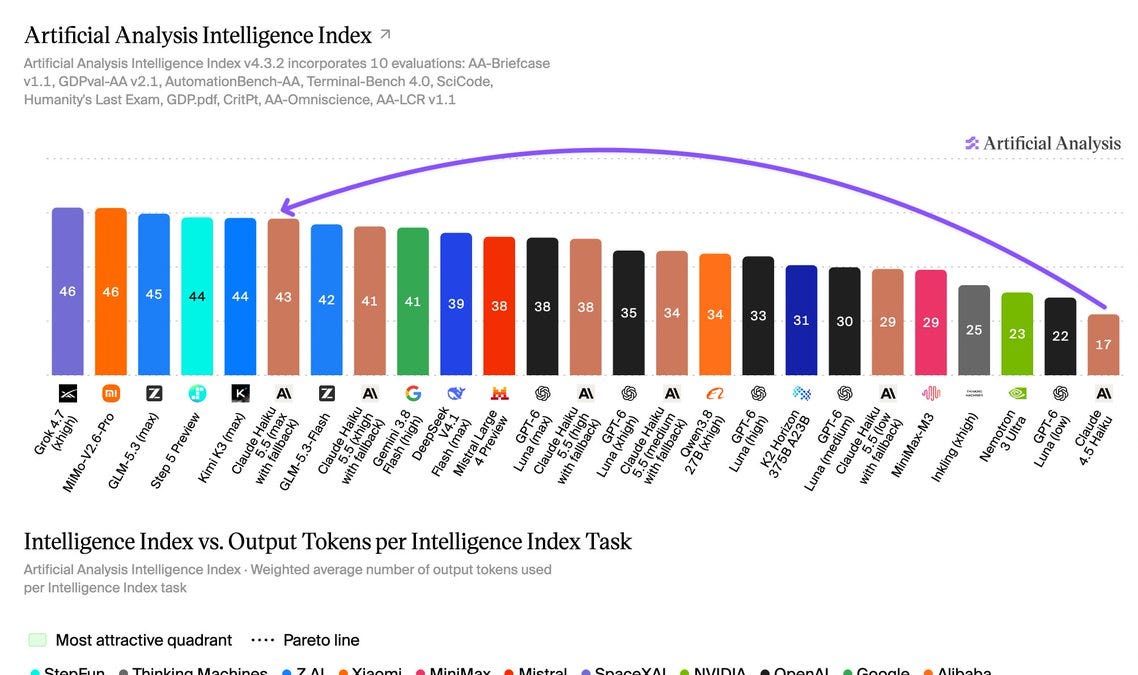 [AINews] Claude Haiku 5.5 — better than GPT-6 Luna at the same pricing
Latent Space's AINews recap covers Anthropic's launch of Claude Haiku 5.5, priced to match OpenAI's GPT-6 Luna and paired with a Sonnet 5.5 cache-read price cut and new Max/Team API credits. Independent Artificial Analysis testing puts its Intelligence Index at 43 (up 26 points from Haiku 4.5) and Terminal-Bench 4.0 at 33%, but shows it uses roughly 3x the output tokens of GPT-6 Luna at max effort, plus results on AA-Briefcase, AA-Omniscience and AutomationBench-AA, alongside a same-day Claude SDK update adding built-in computer-use/browser-use tooling.
 latent.spacearticlePublished and added 8 Oct 2026🧠 AI
 One-Round Threshold XMSS and SPHINCS+ from Fully Homomorphic Encryption
IACR ePrint paper constructing and implementing the first one-round threshold signing protocol for the hash-based post-quantum signature schemes XMSS and SPHINCS+, producing signatures that verify unmodified against RFC 8391 and FIPS 205. The approach shares the secret key among t-of-n signing parties and evaluates the signing algorithm homomorphically using threshold FHE over discrete CKKS, achieving 3.4ms amortized per hash and 0.69s online threshold XMSS signing.
 eprint.iacr.orgpaperAdded 8 Oct 2026, published 5 Oct 2026🛡️ Security
- Measuring Parallel Execution of Classical–PQC Component Pairs in Hybrid TLS 1.3
An IACR ePrint paper benchmarks whether running the classical and post-quantum components of hybrid TLS 1.3 key exchange (ECDHE–ML-KEM) and Composite ML-DSA signatures in parallel on separate pthread worker threads reduces handshake latency versus sequential execution. Across three RFC 10024 ECDHE–ML-KEM groups with server and mutual authentication, parallelism sped up all six tested conditions on a standard ARM and x86 system (1.04×–1.28×), with the largest gains in signature stages where component times are balanced, but slowed every condition on a low-power x86 system (0.80×–0.92×) because thread wake/wait overhead outweighed savings. The authors conclude that component independence alone doesn't guarantee a speedup and that parallelization decisions must be validated per target environment.
eprint.iacr.orgpaperAdded 8 Oct 2026, published 5 Oct 2026🛡️ Security - Plotkin Attacks! On the (Mis)use of Raptor Codes in Asynchronous Verifiable Information Dispersal
Victor Shoup shows that "reconstruct-later" asynchronous verifiable information dispersal (AVID) designs — used by data-availability systems including an early Walrus design/testnet — are insecure when built on the standardized Raptor codes R10 (RFC 5053) and RaptorQ (RFC 6330). Using the Plotkin bound, he proves that a Byzantine disperser can choose a subset of f+1 honest fragments that fails to reconstruct the message, gives randomized polynomial-time algorithms to find such subsets, and implements a working attack that defeats an RFC 6330 RaptorQ decoder on every adversarial subset tested (success for f from 9 to 45). Benchmarks show plain Reed-Solomon coding is an MDS alternative that is often faster and never much slower than R10/RaptorQ, making it the safer practical choice for this design pattern.
eprint.iacr.orgpaperAdded 8 Oct 2026, published 4 Oct 2026🛡️ Security  Liquid Network — $320M L-BTC Mint via Range-Proof Cache-Key Collision
On September 6, 2026, an ambiguous four-part cache-key construction in Elements' CachingRangeProofChecker::VerifyRangeProof (introduced by commit c26d719) let two distinct confidential-transaction verification inputs collide into the same 4,301-byte cached entry, causing nodes to treat an unbacked output as a validated range proof. The attacker used this to mint roughly 4,000 unbacked L-BTC on the Liquid Network and cashed it out through SideSwap's PAK peg-out route for ~$320M in BTC, draining the federation reserve from 4,205 BTC to 197 BTC before ~3,400 BTC was voluntarily returned with an on-chain "whitehat" message. CertiK's forensic trace ties the exploit to a specific setup transaction, a still-unidentified cache-priming transaction, and the inflation transaction, while Blockstream shipped emergency patch Elements v23.3.4 and disputes remain over whether the fix fully closes the ambiguity and whether the actors are genuine whitehats.
 rekt.newswriteupAdded 2 Oct 2026🛡️ Security
- NuvexNetwork/nuvex
Nuvex is a Solana-native verifiable compute and oracle protocol, still pre-mainnet, whose own README documents unresolved security gaps instead of hiding them: its VRF proof verification relies on solana-ecvrf 0.0.1 (RFC 9381 ECVRF-Edwards25519-SHA512-TAI) which has no known audit, max_fee is stored but never actually charged, and VRF fulfillment is first-come among any node meeting the configured stake/heartbeat threshold — meaning an operator who funds several keys at a low minimum stake can selectively pick which randomness output gets used. The deploy-mainnet script is stubbed to exit before any transaction, and unresolved design questions (fee shares, challenge/reject state transitions) are tracked as explicitly blocked ADRs rather than quietly shipped.
github.comrepoPublished and added 2 Oct 2026🛡️ Security  https://www.rfc-editor.org/search/?status=Best+Current+Practice&area=sec
A saved search on the official RFC Editor site filtered to documents with status Best Current Practice in the sec (Security) area, effectively a live index of IETF's authoritative security best-practice standards such as BCP-level RFCs on anti-spoofing/ingress filtering, routing security, and password policy. The fetched copy rendered with JavaScript disabled so no result rows were captured, but the query itself is a reusable, continuously updated pointer into the canonical security standards catalog maintained by the IETF/RFC Editor.
 rfc-editor.orgotherAdded 2 Oct 2026, published 29 Sep 2026🛡️ Security
- SmartMemory: Detecting On-chain-off-chain Communication Inconsistency for Smart Contract via Memory-based Agent
SmartMemory is an academic framework that detects "OFC inconsistency" (OFCI) — a newly identified root-cause vulnerability class where business-logic flaws break the equivalence between a smart contract's on-chain state and its off-chain counterpart, affecting cross-chain bridges, real-world-asset tokenization, and fiat-backed stablecoins. It normalizes heterogeneous on-chain/off-chain implementations into a canonical business-semantic representation, uses a memory-based agent to distill and reuse vulnerability patterns across cases, and verifies candidates with taint analysis. Evaluated on a new dataset of 48 DApps with 81 known OFCIs (80.68% precision, 87.65% recall), it also found 36 previously unknown, since-fixed OFCIs in an analysis of 325 real-world OFC applications.
arxiv.orgpaperAdded 2 Oct 2026, published 28 Sep 2026🛡️ Security - CISA KEV Catalog Additions — Check Point, Arista VeloCloud, F5 BIG-IP (Sept 22, 2026)
CISA added four vulnerabilities to the Known Exploited Vulnerabilities catalog on 2026-09-22 based on evidence of active exploitation: two Check Point multi-product flaws (improper certificate validation CVE-2026-85102, path traversal CVE-2026-93616), an Arista VeloCloud Orchestrator improper input validation bug (CVE-2026-93952), and an F5 BIG-IP APM heap-based buffer overflow (CVE-2026-94127). The alert ties the additions to BOD 26-04, which has FCEB agencies prioritize remediation of KEV CVEs on publicly exposed assets that give total control, and to checking for prior compromise before patching.
 cisa.govadvisoryAdded 26 Sep 2026🛡️ Security
- SAPMAP — SAP Landscape Attack Path Mapper
SAPMAP is a BloodHound-style attack path mapper for SAP landscapes: it discovers SAP systems on a network, maps RFC trust connections, and implements real exploits (10KBLAZE/CVE-2020-6207 gateway trust, CVE-2025-31324 VisualComposer JSP webshell, a described CVE-2026-58240 Message Server rogue-registration flaw, and CVE-2026-31431 root LPE via AF_ALG page-cache patching) to chart lateral movement across ABAP, Java, HANA, and BTP-connected systems. Its AutoPwn mode chains scan → exploit → enrich → propagate across an entire landscape, and it includes an engagement-report generator, SecStore/RSECTAB credential decryption, SSH lateral movement, hash cracking via hashes.com, and a Tier-3 "evasion" module (SAL slot disable, DBTABLOG purge) paired with an extensive, specific blue-team detection guide (SAL/SM20, DBTABLOG gaps, kernel-param diffing, OS/network IOCs) for defenders to catch it.
github.comrepoAdded 26 Sep 2026🛡️ Security  Attackers Exploit WordPress CVE-2026-87902 Within Hours of Patch
CVE-2026-87902 (CVSS 9.2) is an unauthenticated WordPress vulnerability where get_page_template() page-template resolution can be tricked into including an attacker-chosen local .php file outside the active theme directory, leading to RCE when a theme has a page-* top-level directory and a readable local PHP file (e.g. pearcmd.php) exists. Attackers began exploiting it within hours of the September 22, 2026 patch, including pearcmd.php to write PHP web shells to /tmp and /var/tmp and pulling a GitHub-hosted uploader payload, per honeypot telemetry from Previdian and Patchstack with tracked source IPs. CISA added the flaw to its KEV catalog on September 25, 2026, mandating FCEB remediation by September 28; fixed in WordPress 7.1.2, 7.0.6, 6.9.9, and 6.8.10.
 thehackernews.comadvisoryAdded 26 Sep 2026🛡️ Security


Showing 30 of 71
Show more