- Show HN: Auto Dismiss Mac OS "Allow <app> to find devices on local networks?"
dontallow is a two-file Swift launchd agent for macOS 15 and later that clicks "Don't Allow" on the "find devices on local networks" prompt. It watches the UserNotificationCenter process through an Accessibility observer, supports pause and allowlist, and can decode the Local Network rule store to show orphaned rows. It explains why Chromium temp-bundle paths make the prompt recur, and gives a PPPC profile route for fleets.
 github.comrepoAdded 30 Oct 2026, published 29 Oct 2026🛡️ Security
- x86rc/unthemidator
Unthemidator is an automated unpacker for binaries protected with Themida, Code Virtualizer and WinLicense (v3.0 to v3.2.6.0, experimental v4.0). It works without executing the target, handles x86 and x64 exe, dll and sys files, decrypts imports, restores the IAT, rebuilds the PE and identifies VM versions and entry points. It does not devirtualize or unmutate code. Releases cover Windows x64 and macOS Apple Silicon.
github.comrepoAdded 27 Oct 2026, published 23 Oct 2026🛡️ Security - Spectrmachina/Ztrust
ZTrust is a Python supply-chain scanner that checks manifests, lockfiles, source and GitHub workflows for vulnerable or malicious dependencies (via OSV.dev), typosquats, leaked secrets, unsafe lockfiles and risky CI patterns such as pwn requests and script injection. It outputs console, JSON and SARIF 2.1.0 and ships as a GitHub Action. It also includes a FastAPI bounty service using commit-reveal and shielded Zcash payouts for researchers.
github.comrepoAdded 27 Oct 2026, published 22 Oct 2026🛡️ Security - SnailSploit/Claude-Red
claude-red is an MIT-licensed library of offensive security skills for the Claude Skills system, planned at about 130 skills across 23+ categories (web, Active Directory, cloud, exploit development, EDR evasion and others). Each skill is a SKILL.md file that loads on conversational triggers, so unused skills cost no context. It installs by git clone, sparse checkout per category, install.sh or pasting into a system prompt.
github.comrepoAdded 22 Oct 2026🧠 AI - SnailSploit/Claude-Red
claude-red is a library of offensive security skills for the Claude Skills system, each a SKILL.md file that loads on conversational triggers (for example, mentioning SQL injection loads offensive-sqli). Categories include web, Active Directory, cloud, mobile, exploit development, fuzzing, privilege escalation, post-exploitation and AI. It targets about 130 skills across 23+ categories, with an install script and sparse-checkout install per category. Built on Sahar Shlichov's offensive checklists, MIT licensed.
github.comrepoAdded 22 Oct 2026🛡️ Security - OpenAI CLI
OpenAI CLI is OpenAI's official Go command-line client for the REST API. It lets users generate images, upload and download files, create and wait on batches, call the Responses API, and query admin usage endpoints from a terminal or shell script. It supports JSON, JSONL and YAML output, GJSON transforms, shell completion, and install via Homebrew, go install or release binaries.
github.comrepoAdded 23 Oct 2026, published 22 Oct 2026🧠 AI - Dan Kornas (@DanKornas) on X
aula-mcp is an open-source (MIT) TypeScript MCP server that connects an AI client to Denmark's Aula school platform. It exposes tools for profiles, calendar events, messages, notifications, posts and weekly plans. MitID credentials and OAuth tokens are stored in macOS Keychain or an AES-256-GCM encrypted file. The HTTP server binds to 127.0.0.1, and the presence write tool stays off until AULA_MCP_WRITE=1 is set.
 x.comrepoAdded 23 Oct 2026, published 22 Oct 2026🧠 AI
- vxcontrol/pentagi
PentAGI is an open-source, self-hosted multi-agent system that uses LLM agents to carry out penetration testing tasks autonomously. The MIT-licensed repo has a Go backend, a React frontend and GraphQL. It ships Docker Compose files for Langfuse tracing, Graphiti knowledge-graph memory and an observability stack. Topics list OpenAI and Anthropic as model backends.
github.comrepoAdded 20 Oct 2026🧠 AI - ☣ KitPloit - Hacker Tools (@KitPloit) on X
DidierStevensSuite is a collection of Python scripts for malware analysis, file format parsing, hashing and forensic triage. It includes utilities for analysing PDF and OLE documents and for XOR-obfuscated data. The post is a short KitPloit announcement that links to the repository and gives no usage detail.
x.comrepoAdded 21 Oct 2026, published 20 Oct 2026🛡️ Security - better-isms/grcskills
grcskills is a library of 60 plain SKILL.md files in the Agent Skills format, each describing how an experienced practitioner does one piece of governance, risk and compliance work. Examples are scope statements, risk registers, audit prep, vendor review and incident handling. Every skill names where the agent must stop and hand the decision to a person. Installs are pinned to reviewed release tags and checked by a validator.
github.comrepoAdded 20 Oct 2026🧠 AI - better-isms/grcskills
grcskills is an MIT-licensed library of 60 SKILL.md files (Agent Skills format) that let coding agents draft and prepare governance, risk and compliance work: scope statements, statements of applicability, risk registers, audit prep, vendor review, policies, privacy, incidents and continuity. Each skill names where the agent must stop so a person decides. Installs are pinned to release tag v2026.10.19.2, and a validator rejects network commands and credential paths.
github.comrepoAdded 20 Oct 2026🛡️ Security - DietrichGebert/ponytail
Ponytail is a single skill prompt (skills/ponytail/SKILL.md, with a compact AGENTS.md) that makes coding agents write only the code a task needs, reusing existing components while keeping validation, error handling, security and accessibility. The author benchmarked it in Claude Code with Opus 5.5 over 39 tasks, 5 runs each, including a real FastAPI + React repo. They report -53% code, -41% time, -26% cost and -45% tokens, and 98% of risky logic shipping with a test versus 68% without. It adds /ponytail-review and /ponytail-audit commands, a Claude Code cost/token band with a local board, and installs through Claude Code and Codex plugin marketplaces or as a rules file for Cursor, Copilot, Gemini, OpenCode and others.
github.comrepoAdded 17 Oct 2026🧠 AI - alex09x/kyb
KYB (Know Your Business) is a Rust/axum server that stores agent-written knowledge, incident reports and tasks as Markdown files in Git, one commit per change. Search is hybrid: Tantivy BM25 fused by reciprocal rank with local multilingual-e5-small ONNX vectors, and it can query historical versions or "as of" a date. It ships a kyb CLI, a native MCP endpoint (Claude Code, Codex, Antigravity, Gemini CLI), an installable agent skill, token auth with per-write attribution trailers, secret scanning on writes, and a web console. It targets persistent shared operational memory for multi-agent, multi-machine fleets.
github.comrepoAdded 17 Oct 2026🧠 AI - Show HN: Graphicle, a Rust port of Graphify with memory for coding agents
Graphicle is a local-first Rust program that parses a repository into a tree-sitter code graph (a port of Graphify) and adds project memory: docs, reviewed decisions and captured Claude Code/Codex sessions. It serves cited file-and-line excerpts within a token budget via one MCP server, CLI and browser app, backed by a single SQLite file, with no API key or telemetry. The README reports a code-only extract on Kubernetes (31k files) in 3m18s versus 26m38s for Graphify 0.9.88, and a memory comparison against seven systems. Agent-proposed memories need user approval and go stale when the code they reference changes.
github.comrepoPublished and added 14 Oct 2026🧠 AI - sakidekin/CVE-2026-41940-PoC
This repository hosts a proof-of-concept for CVE-2026-41940, described as a CVSS 10.0 unauthenticated authentication bypass in cPanel and WHM caused by CRLF injection into server-side session files via the Authorization header. The accompanying Python tool (cve.py) can detect vulnerable cPanel/WHM instances, retrieve system and account information, and perform post-exploitation actions such as running OS commands, changing the root password, and opening an interactive WHM shell. It also supports bulk scanning workflows piped from subfinder, httpx, and Shodan.
github.comrepoAdded 23 Oct 2026, published 11 Oct 2026🛡️ Security - morluto/awesome-reverse-engineering
awesome-reverse-engineering is a CC0 curated list of reverse-engineering tools and learning resources, organized by task: triage, native analysis, debuggers, instrumentation, deobfuscation, malware analysis, mobile, firmware, file formats, games, diffing, symbolic execution, lifting and AI agents. Each entry notes licensing, maintenance status and prerequisites. It also covers MCP integrations, CTF practice sites and related awesome lists.
github.comrepoAdded 27 Oct 2026, published 9 Oct 2026🛡️ Security - microsoft/mxc
MXC is Microsoft's cross-platform sandboxed code execution system for running untrusted workloads — model output, plugins, and tool calls — behind a unified containment model with Rust, .NET, and Node SDKs. It offers multiple containment backends (ProcessContainer, Windows Sandbox, LXC, Bubblewrap, Seatbelt, MicroVM/Nanvix, Hyperlight, WSLC) with JSON-based filesystem, network, and UI policies, plus diagnostics like audit mode for building policies from observed access.
github.comrepoAdded 8 Oct 2026🧠 AI - microsoft/mxc
MXC is Microsoft's cross-platform sandboxed code execution system for running untrusted code such as LLM/agent output, plugins, and tools, offering containment backends ranging from OS-native process sandboxes (Windows Sandbox, LXC, Bubblewrap, Seatbelt) to full VMs (Nanvix MicroVM, Hyperlight). It exposes a unified JSON-based policy model for filesystem, network, and UI access controls, with Rust, .NET, and Node SDKs plus diagnostic tooling (audit mode, access-denied logging) to help developers tune containment rules for agentic workloads.
github.comrepoAdded 8 Oct 2026🛡️ Security - target/strelka
Strelka is Target's open-source, container-based real-time file scanning system for threat hunting, threat detection, and incident response, built in Go and Python. It runs 50+ scanners (YARA, PE parsing, encrypted ZIP cracking, entropy analysis, etc.) to extract metadata and content from files at enterprise scale, which can feed a SIEM for alerting on suspicious artifacts like an Emotet-laden encrypted ZIP payload.
github.comrepoAdded 8 Oct 2026🛡️ Security - deepfence/YaraHunter
YaraHunter is Deepfence's open-source scanner that applies YARA rulesets against container images, running Docker containers, and filesystems to detect indicators of compromise such as malware and cryptominers. It supports CI/CD build-time scanning, at-rest image scanning, and runtime container scanning, with JSON output for automation, and is designed to eventually integrate into the Deepfence ThreatMapper platform. The README walks through detecting the XMRig cryptominer inside a container image as a worked example.
github.comrepoAdded 8 Oct 2026🛡️ Security  The Vulnerable MCP Project — MCP vulnerability database
The Vulnerable MCP Project is a curated, continuously growing database of security vulnerabilities and attack techniques specific to the Model Context Protocol ecosystem. Entries cover concrete CVEs (e.g. CVE-2025-68143/68144/68145 in Anthropic's mcp-server-git), transport-layer SDK flaws (cross-client response leakage, missing DNS rebinding protection in the official TypeScript/Python SDKs), unauthenticated/0.0.0.0-bound servers enabling RCE (MCPJam inspector, MCP Inspector, Grafana MCP), command/path injection in dozens of third-party servers (gemini-mcp-tool, mcp-server-kubernetes, Framelink Figma MCP, Zen MCP, filesystem-mcp), SSRF chains reaching cloud metadata (MarkItDown MCP, mcp-fetch-server), and a large set of AI-specific attacks: tool poisoning, trigger-phrase data exfiltration, prompt injection via GitHub issues, Jira and Google Docs, rug-pull tool mutation, and cross-server tool-name collisions. It functions as the de facto vulnerability registry for the MCP ecosystem, useful for tracking disclosed issues before patching or adopting third-party MCP servers.
 vulnerablemcp.inforepoAdded 6 Oct 2026🛡️ Security
- the_OSINT_rack (@the_OSINT_rack) on X
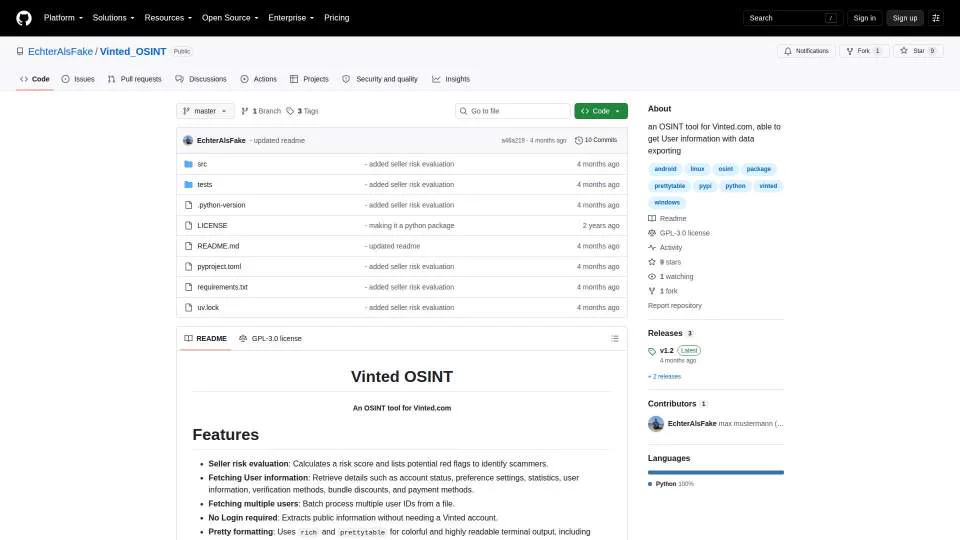
Vinted_OSINT is a GitHub tool by EchterAlsFake that performs open-source intelligence gathering against Vinted.com user profiles, pulling seller/buyer account information and computing a risk score to flag accounts likely run by scammers. It's aimed at buyers wanting to vet sellers before transacting on the second-hand marketplace.
x.comrepoPublished and added 4 Oct 2026🛡️ Security - Sigma r2026-07-01 — 20 new detection rules
GitHub release notes for Sigma r2026-07-01, the open-source detection-rule repository, adding 20 new rules (e.g. LSASS crash via Netlogon buffer overflow CVE-2026-41089, TanStack supply-chain attack indicators for Windows/Linux, RedTail cryptominer user-agent detection, AF_ALG kernel crypto API exploit indicator) and updating/fixing dozens of existing rules for ARM64 binary variants, file-sharing domain IOCs, and WMI-based reconnaissance/persistence detection. It's a routine but substantive update to a widely-used blue-team detection content pack.
github.comrepoAdded 3 Oct 2026🛡️ Security - OKX Agent Trade Kit (okx-trade-mcp / okx-trade-cli)
OKX Agent Trade Kit is an open-source MCP server (okx-trade-mcp) and CLI (okx-trade-cli) that let AI assistants like Claude Desktop, Cursor, Claude Code and VS Code place trades and query account data on the OKX exchange via natural-language commands. It runs locally with API keys never leaving the machine, supports module scoping (market, spot, swap, account, earn), a read-only mode for safe querying, multiple profiles, and includes pre-built skill files for agent frameworks plus structured JSON error reporting for debugging failed tool calls.
github.comrepoAdded 2 Oct 2026🧠 AI - Show HN: Made an open-source Lego AI generator
ldraw-nova is an open-source agentic pipeline where an LLM agent (tested with models like Claude Opus 5.5 and GPT-6 Astra) takes a build prompt, reads LDraw-building instructions, and produces a plan.json describing a model's geometry. From that plan it writes a Python generator script that, when executed, outputs an LDraw (.mpd) 3D CAD source file, viewable in 3D/VR (Meta Quest 3) or exportable to Blender-editable glTF. The agent uses jev-rerank, a semantic search tool with reranking backed by TypeSafe's Jev System One model, to find suitable LEGO parts and example models, falling back to full-text search without an API key; it also uses headless rendering and collision/gap detection to self-inspect and iterate on designs.
github.comrepoAdded 3 Oct 2026, published 2 Oct 2026🧠 AI - Folkbench/folkbench
Folkbench has two parts. One is a public benchmark and leaderboard of third-party AI API relay (中转站) services. Multi-node probes run around the clock and publish availability, P95 latency and price per relay, with per-model rankings. The other is Switch, an open-source Tauri/Rust desktop client that stores several Base URL and API Key pairs. It applies them to Claude Code or Codex configs in one click, previews config diffs, and stashes and restores the official ChatGPT OAuth credentials when switching Codex to a third-party provider. It also keeps keys local and estimates token usage and cost per session. The README also profiles several relay services, such as Modelflare, CheapAI and ApiPorter, and that part reads as promotional.
github.comrepoAdded 12 Oct 2026, published 2 Oct 2026🧠 AI - NVIDIA/OpenShell — sandboxed runtime for autonomous AI agents
OpenShell is NVIDIA's open-source runtime for safely running fleets of autonomous AI agents: each agent runs in an isolated sandbox where kernel-level controls enforce a declared policy over file access, syscalls, and network connections, and credentials are injected only for approved endpoints rather than exposed to the agent directly. Policy changes are checked with formal verification to flag risky new access (new hosts, new API methods) before they're approved, and the project ships a CLI, gateway, Kubernetes/Helm deployment, and a tutorial running OpenCode against an OpenRouter model.
github.comrepoAdded 1 Oct 2026🛡️ Security - OpenShell — safe, private runtime for autonomous AI agent fleets
OpenShell is NVIDIA's open-source runtime for running fleets of autonomous AI agents inside isolated sandboxes. Declarative policies cover filesystem, syscall, process and network access. These are enforced at the kernel level, and credentials are injected only into requests bound for approved endpoints. Policy changes are checked with formal verification so risky new access waits for human review. It ships a CLI, a gateway control plane (Helm deployment on Kubernetes), SDKs, extensibility hooks (middleware, interceptors, compute drivers) and installable agent skills, and it can run agents such as OpenCode.
github.comrepoAdded 1 Oct 2026🧠 AI - AI News | AI Tools (@AI_News100x) on X
Open-Dots is an open-source reimplementation of OpenAI's 'Dots' computer-use agent, giving any LLM the ability to control a browser, terminal and filesystem plus connectors to personal apps. It is framework-agnostic (works with any LLM) and free, positioned as a self-hostable alternative to OpenAI's proprietary computer-use offering.
x.comrepoPublished and added 30 Sep 2026🧠 AI  רון אברבוך (@Ron_averbuch) on X
Open-Dots is an open-source re-implementation of OpenAI's Dots computer-use agent, giving it browser, terminal and file control plus connectors to personal apps, and designed to work with any LLM rather than being locked to one vendor's model. It's announced via a tweet linking to the GitHub repo (github.com/Anil-matcha/Open-Dots).
x.comrepoAdded 30 Sep 2026, published 29 Sep 2026🧠 AI



Showing 30 of 148
Show more