 Hugging Face malware campaign returns to hijack GPUs for crypto mining
A campaign of 31 malicious Hugging Face repositories across seven accounts, found by Pluto Security, posed as small Qwen2 checkpoints and used trust_remote_code to run a cryptominer and reverse shell on GPU inference hosts. The top model reached 28,412 downloads and scanned clean, and a second wave returned within days of takedown. The article also covers a fake Solana starter kit on GitHub that installs NetSupport Manager via a PowerShell one-liner aimed at AI coding agents.
 bleepingcomputer.comarticleAdded 30 Oct 2026, published 29 Oct 2026🛡️ Security
 Introducing MavenGate: a supply chain attack method for Java and Android applications | Oversecured Blog
MavenGate is Oversecured's research on hijacking Maven dependencies by buying expired domains behind groupIds on Maven Central and JitPack. It found 6,170 of 33,938 checked domains (18.18%) vulnerable, and tested the attack with its own com.oversecured:hello-world library. It lists defenses (Gradle verification-metadata.xml, PGP signatures) and proposes changes to repository signing.
 oversecured.comwriteupAdded 29 Oct 2026🛡️ Security
 Tracking AI adoption in North Korean threat actor tradecraft
Microsoft Threat Intelligence report on how North Korean actors use AI, ranking Jade Sleet, Coral Sleet and Jasper Sleet as operationalized, Diamond Sleet, Onyx Sleet, Pearl Sleet and Sapphire Sleet as accelerating, and Emerald Sleet as expanding. It documents AI-generated lures (100+ Onyx Sleet PDFs, August and September 2026), AI-built tooling such as Coral Sleet's private GitHub repository trojanizing, and Onyx Sleet and Pearl Sleet use of the ARTEX agentic pentest framework. It ends with mitigation and Defender guidance.
 microsoft.comarticlePublished and added 29 Oct 2026🛡️ Security
- Laban (@lunkertw) on X
An X post summarising five AI items: Google DeepMind's Gemini 4 Carbon (88.2% SEC-bench Pro, 54.8% ExploitGym, 71.0% CWE-bench, 59 on Artificial Analysis Intelligence Index v5.0), Ed Zitron's critique of Anthropic's S-1, a Utah Claude Code pilot, and the repos beenuar/AiSOC and expo/skills. In the Utah pilot, 34 developers in 10 agencies took part over four weeks, 80% had a working setup within 30 minutes, and 71% saved over 20 hours. It gives short summaries and links, not primary analysis.
 x.comthreadAdded 29 Oct 2026, published 28 Oct 2026🧠 AI
- GitHub Octoverse 2026
Simon Willison's link post on GitHub Octoverse 2026, announced by GitHub EVP Jay Parikh at GitHub Universe on 28 October 2026. Merged pull requests tripled in under a year to 220 million per month, commits passed 7.38 billion per month, and new repositories doubled to 30.3 million per month. It quotes the methodology for country, industry (NAICS) and "interoperability or reverse engineering" repository counts. The post does not analyse the report beyond these figures.
 simonwillison.netarticlePublished and added 28 Oct 2026🧠 AI
 How to evaluate ADLC security solutions: A buyer's checklist | Endor Labs
Buyer's checklist from Endor Labs for evaluating security tools in the agentic development lifecycle (ADLC), where AI coding agents write code and take actions such as package installs, CI edits and tool calls. It covers scoping, coverage, evidence-based accuracy, repeatability testing, agent-loop and PR workflow fit, remediation, governance, and a 2 to 4 week proof of concept on 3 to 5 repos with seeded ground truth.
 endorlabs.comarticlePublished and added 28 Oct 2026🛡️ Security
- FeatureArc: Benchmarking Coding Agents on Evolving Features
FeatureArc is a benchmark for coding agents on evolving features, built by a pipeline that mines repository histories into multi-stage tasks across four programming languages. It has 73 manually reviewed tasks of 2 to 10 stages, validated with fail-to-pass and pass-to-pass tests. Across 10 agents, pooled success drops from 62.7% at the first stage to 28.5% for the whole feature. Inherited defects appear in 72.9% of failed later stages.
 arxiv.orgpaperAdded 28 Oct 2026, published 27 Oct 2026🧠 AI
 The Pwn Request Reckoning: What Still Works Against GitHub Actions
The Pwn Request Reckoning is a Wiz post updating the GitHub Actions pull_request_target threat model for 2026. It covers what GitHub's checkout protections, read-only cache tokens and event policies block, and what still works. Remaining paths: SHA-pinned pre-backport actions/checkout, custom checkout scripts, issue_comment and repository_dispatch triggers, script injection, artifact poisoning, self-hosted runner state and allow-unsafe-pr-checkout. It ends with grep and zizmor audit steps.
 wiz.ioarticlePublished and added 26 Oct 2026🛡️ Security
- alex lee (@alexlee20122022) on X
Gheist is a GitHub campaign disclosed by Wiz in October 2026. Stolen tokens push ci-sync-XXXXXX branches with a sync-check workflow that dumps repo secrets base32-encoded to evade log masking, fetches the logs via API, then deletes the run. 13,500+ branches and 850+ accounts were hit since 15 September. Public repos are protected by the approval hold; private and Enterprise repos are not. The thread lists IOCs (.gdmp_pat files, "gheist" user agent, "ci: sync config" commits) and rotation steps.
x.comthreadAdded 26 Oct 2026, published 25 Oct 2026🛡️ Security - Dan Kornas (@DanKornas) on X
jshook is an open-source (AGPL-3.0) MCP server that gives AI agents a search-first, profile-aware reverse-engineering workspace for JavaScript, browser traffic, WASM and native processes. Agents start with a small searchable tool surface and move to workflow or full profiles only when needed. It drives Chromium or Camoufox over CDP, captures WebSocket traffic, has HTTP, GraphQL and Burp Suite helpers, and supports hot-reload plugins and declarative workflows. The post is a short announcement; the repository link is in a reply.
x.comtoolAdded 28 Oct 2026, published 25 Oct 2026🧠 AI  Gheist: Attempted Scaled Abuse of Stolen GitHub Tokens Stumbles
Gheist is a campaign tracked by Wiz Research since 15 September 2026 that uses stolen GitHub tokens to push a sync-check workflow on ci-sync-* branches in every reachable repository. The workflow prints base32-encoded secrets into logs, which the tool downloads through the GitHub API and then deletes. Over 13,500 branches from 850+ accounts were recovered. The post covers the two tool variants, a buggy self-hosted runner payload, GitHub's approval hold (which does not cover private repositories), overlaps with other campaigns, hunting queries, IOCs and hardening steps.
wiz.iowriteupPublished and added 25 Oct 2026🛡️ Security New Evidence Shows LiteLLM Secret-Stealing Workflows Ran 11 Days Before Supply Chain Attack
Socket's Threat Research team reports that malicious cache.yml workflows ran in the BerriAI/litellm repository on 10 and 12 October 2026, eleven days before the 21 October release attack that published litellm==1.107.0. Each commit pushed to a short-lived ci-tmp-<hex> branch, then deleted it, sending base64-encoded CI secrets to webhook.site. Evidence comes from Actions metrics and environment deployment records; 20 secret names were exposed.
 socket.devwriteupPublished and added 23 Oct 2026🛡️ Security
- Big Bull (@BIGBULLapp) on X
A post by BIGBULLapp on X about a TensorBlock GitHub index of Model Context Protocol servers, described as a TypeScript list so agents call tools someone has already wired up. It cites 1470 forks, 943 stars and 15 open issues. The author notes that curated lists go stale when a server changes its schema. The repository name is truncated in the post.
x.comthreadAdded 24 Oct 2026, published 23 Oct 2026🧠 AI  Tool-Calling LLM Agents Under Realistic MCP Faults: Scale Does Not Purchase Fault Tolerance
MCP-Injector is a protocol-aware fault-injection middleware for Model Context Protocol tool calls, with permanent, transient and intermittent faults on seedable schedules. Its fault model comes from 57,240 issue and PR threads across 1,774 open-source MCP repositories. In a 1,350-cell experiment, faults cut task-completion score by 60% (8.08 to 3.23 of 10), and the 120B gpt-oss model was no more resilient than the 20B. Agent stacks differed in how well they absorbed faults.
arxiv.orgpaperAdded 26 Oct 2026, published 23 Oct 2026🧠 AI LiteLLM Compromised in Fresh Supply Chain Attack
LiteLLM version 1.107.0 was published with malware to PyPI and Docker Hub on October 21, for about three hours and roughly 49,000 downloads. Attackers used GitHub CLI OAuth tokens, likely leaked through Claude Code into LiteLLM logs, to disable branch protections, redirect the releaser to a lookalike repository and sign poisoned artifacts. The payload is an infostealer and RAT; Wiz saw Amazon Bedrock abuse. The last clean version is 1.106.2.
 securityweek.comarticlePublished and added 23 Oct 2026🛡️ Security
 Cache Engineering for Agents (AKV)
AKV introduces cache engineering, which lets LLM agents control their active KV cache with drop (exclude cache from future attention) and repos (adjust retained keys' position encodings) without editing the trajectory or re-prefilling. The AKV serving engine keeps a stateless API while managing stateful cache reuse, eviction and restoration. A tool-response rolling-drop policy raised benchmark scores by 1.7 points and cut cost 27.7% versus threshold-triggered summarization.
 huggingface.copaperAdded 23 Oct 2026🧠 AI
- Dark Web Intelligence (@DailyDarkWeb) on X
LiteLLM suspects its October 21 release compromise began with Claude Code responses containing GitHub CLI OAuth tokens that were written to logs of an internet-facing internal LiteLLM gateway. Attackers allegedly stole those tokens, used an organization-owner token to disable branch protections, and pushed poisoned artifacts from a lookalike repository. How they entered the gateway is unconfirmed, and this is not a proven Claude Code vulnerability.
x.comthreadAdded 25 Oct 2026, published 22 Oct 2026🛡️ Security - There isn't an easy exploit for this PHP vulnerability
An opinion post from 21 October 2026 arguing that a widely feared PHP vulnerability has no easy exploit. The author says the many GitHub "PoC" repositories fail against a vanilla PHP instance in Docker. They claim LLM agents produced them by depending on a local-file-inclusion flaw or by modifying the server to be vulnerable. The author also argues that LLM defaults make many people's judgements identical.
 eliastaylor.comarticleAdded 22 Oct 2026, published 21 Oct 2026🧠 AI
 LiteLLM Compromised, Steals Credentials
LiteLLM version 1.107.0 was uploaded to PyPI on 21 October 2026 with a credential stealer, and the same build reached GHCR and Docker Hub images. Wiz describes the three dropped files (cook.pth, cook.py, sitecustomize.py), exfiltration to a fake litellm.dev domain, a GitHub dead drop for a second stage, and the malicious commits pushed through the lookalike Berri-AI repository. The last safe version is 1.106.2.
wiz.iowriteupPublished and added 21 Oct 2026🛡️ Security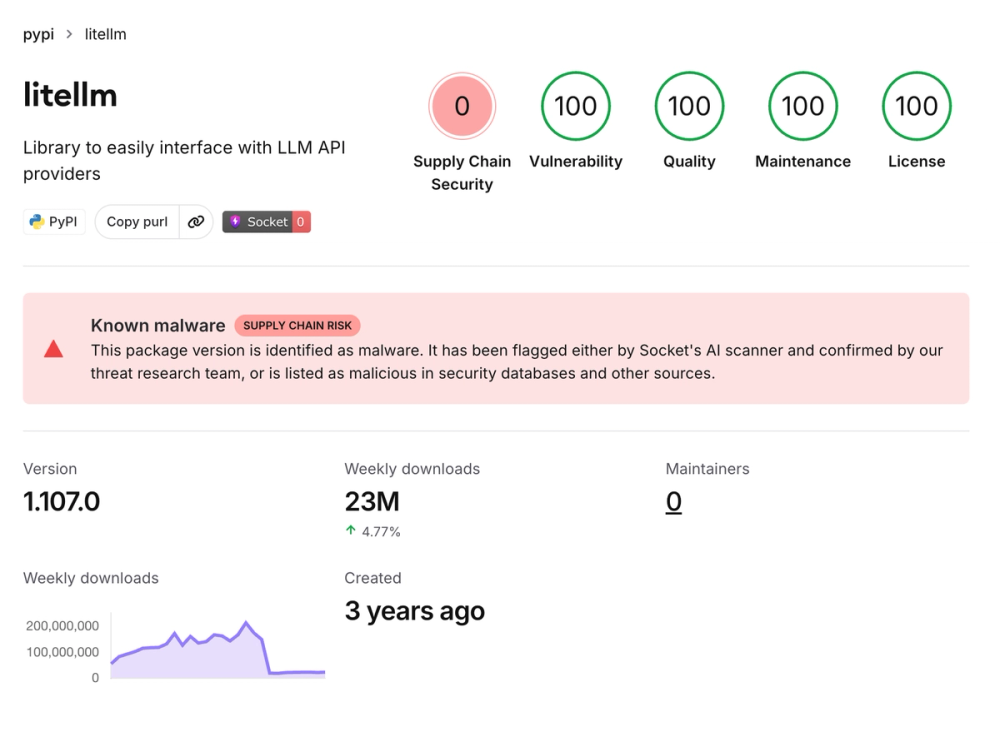 LiteLLM PyPI Package and Docker Images Compromised to Steal Cloud and AI Credentials
LiteLLM 1.107.0 on PyPI and GHCR images shipped Python startup hooks (cook.pth, sitecustomize.py) that steal cloud, SSH, browser and AI-tool credentials, including LiteLLM proxy database credentials. Image build provenance recorded a lookalike Berri-AI/litellm source repository. The post decodes the payload, encrypted exfiltration and GitHub-driven remote loader, and lists containment steps, MITRE ATT&CK mappings and IOCs.
socket.devwriteupPublished and added 21 Oct 2026🛡️ Security- eness/php2shell-CVE-2026-109618-CVE-2026-109619-PoC
php2shell is the name given to two critical pre-auth remote code execution flaws, CVE-2026-109618 and CVE-2026-109619, in PHP core's session upload progress handler (php_session_rfc1867_callback), where zend_hash_update frees live zval pointers that are later reclaimed and redirected into zend_call_function to run zif_system. This repository ships poc_109618.py, a fully automated four-stage HTTP exploit that leaks ASLR offsets via Set-Cookie headers against php:8.4.26-apache on Debian Bookworm, along with a root-cause C source patch, mitigation scripts to disable session.upload_progress, and WAF/ModSecurity/Lighttpd/Apache rules plus detection guidance for anomalous PHP worker child processes. Confirmed PHP versions include 8.4.4 and 8.2.34, with EOL branches (5.x, 7.x, 8.0, 8.1) left without official vendor patches.
 github.comrepoAdded 23 Oct 2026, published 21 Oct 2026🛡️ Security
- ikow/php2shell-poc
php2shell-poc is a proof-of-concept and detection toolkit for CVE-2026-109618 and CVE-2026-109619, two PHP vulnerabilities tied to session.upload_progress handling and a Zend engine out-of-memory bailout path affecting PHP 5.4.0 through 8.5.11. The repository includes three working exploit chains, a Docker-based lab (PHP-FPM, nginx, Apache mod_php) for reproduction, and pre-built Suricata, Sigma, ModSecurity, and Lua detection rules. The author recommends disabling session.upload_progress as an interim mitigation, noting the underlying memory corruption requires a full PHP patch to fix.
github.comrepoAdded 23 Oct 2026, published 21 Oct 2026🛡️ Security  The OpenSourceMalware Show #26
 (recorded 21 October 2026) is a podcast and video episode with a transcript. Topics: GlassWorm's compromise of four OVH CLI versions through a contributor account stolen about seven months earlier, malware split into "compound payloads" across packages (including the webrunc PyPI package and DPRK's private .npmrc registry trick), and GhostAction planting a PolinRider-style fake font stealer in repos. Also covers commit signing and LLM-assisted threat actors.
 opensourcemalware.comtalkPublished and added 21 Oct 2026🛡️ Security
- Cache Engineering for Agents
Cache Engineering for Agents proposes letting LLM agents control their active KV cache directly, using a drop operation to exclude cache from attention and repos to adjust retained keys' position encodings, without editing the trajectory or re-prefilling. The authors build the AKV serving engine to handle history-dependent cache states. A tool-response rolling-drop policy raises average benchmark scores by 1.7 points and cuts cost by 27.7% against threshold-triggered summarization. AKV gives up to 1.2x output throughput and 1.5x faster P95 latency.
arxiv.orgpaperAdded 22 Oct 2026, published 20 Oct 2026🧠 AI - ☣ KitPloit - Hacker Tools (@KitPloit) on X
DidierStevensSuite is a collection of Python scripts for malware analysis, file format parsing, hashing and forensic triage. It includes utilities for analysing PDF and OLE documents and for XOR-obfuscated data. The post is a short KitPloit announcement that links to the repository and gives no usage detail.
x.comrepoAdded 21 Oct 2026, published 20 Oct 2026🛡️ Security - DFIR Radar (@DFIR_Radar) on X
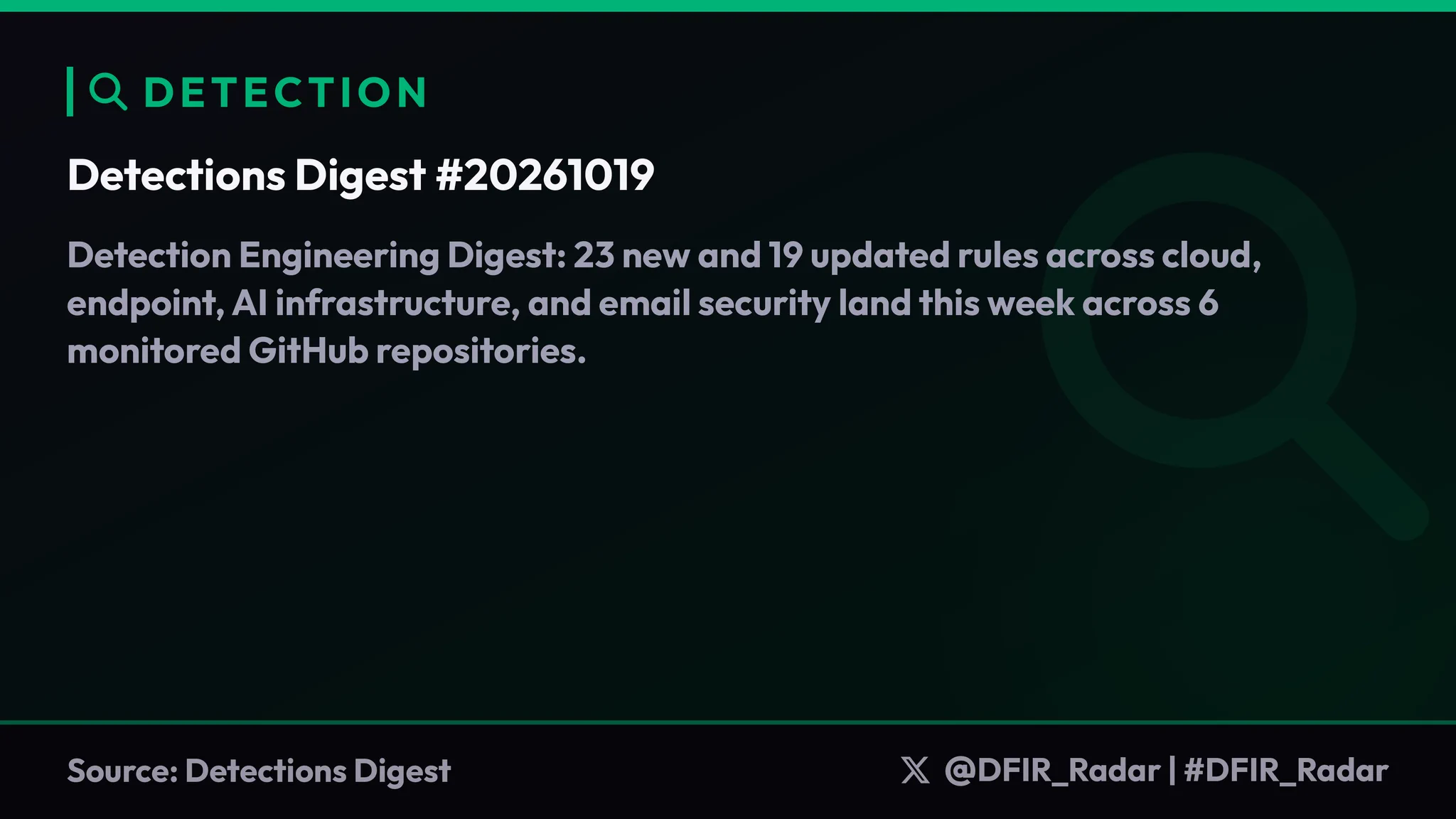
DFIR_Radar weekly detection engineering digest covering 23 new and 19 updated rules across 6 GitHub repositories. It lists KQL rules for Azure Key Vault secret retrieval, MCP client User-Agent bulk operations and local Azure token theft, AWS CloudTrail analytics, Sigma rules for firewall and ETW tampering (decimal 17 vs hex 0x11), updated LOLDrivers hashes, and Sublime email rules for OAuth consent phishing and fake IRS W-9 PDFs.
x.comthreadAdded 20 Oct 2026, published 19 Oct 2026🛡️ Security  Cutting our inference bill by 68% by being obsessive about optimization
Cloudflare describes how it cut the average cost of its AI code reviewer from $2.43 to $0.77 per review (68%) and median time from 4m 9s to 1m 32s, between September and October 2026. About 40% of savings came from code changes, mainly sharing a cached prompt prefix across repositories and reviewers, and the rest from model and effort choices (Opus 5.5, Sonnet 5.5). Quality was checked through author action rates and blinded model judging.
 blog.cloudflare.comwriteupAdded 29 Oct 2026, published 19 Oct 2026🧠 AI
 Abhinav Singwal (@yogsec) on X
GetSubDomains is an open-source tool by yogsec that enumerates subdomains by querying crt.sh certificate transparency logs. It is aimed at the reconnaissance step of penetration tests and bug bounty work. The source is a short tweet pointing to a GitHub repository, so usage details and options are not given.
x.comrepoAdded 21 Oct 2026, published 19 Oct 2026🛡️ Security- ToFu: Exploiting and Fuzzing the LLM–Orchestrator–Tool Trust Boundary
ToFu is a tool-aware fuzzing framework that derives semantic security checks for LLM tools (mainly MCP servers) from their metadata and a corpus of 74 CWE-guided sanitizers. It generates schema-valid Atheris harnesses, uses runtime tracers and outcome oracles to catch bugs that don't crash, and uses an LLM only to map sanitizers and seed inputs, never as the judge. It also describes a "Repeat-After-Me" attack, in which the LLM is told to repeat attacker-written text that the orchestrator then dispatches as a tool call. It was reproduced on LangGraph, MAF, ADK, AutoGen, Strands and CrewAI. On 273 MCP servers it reports 253 verified bugs across 343 tools in 118 repositories, including path traversal, log injection, exfiltration and command bypass.
arxiv.orgpaperAdded 18 Oct 2026🛡️ Security - enisaeu/enisa-sbd-playbook
ENISA repository of 22 Secure by Design and Secure by Default playbooks for SMEs building products with digital elements. Each playbook has a principle, objective, checklist, minimum evidence and release gate, covering design, build, deployment, maintenance and decommissioning. It supports progressive adoption and CRA readiness without replacing legal obligations.
github.comrepoAdded 17 Oct 2026🛡️ Security


Showing 30 of 273
Show more