Skip to content

54 results for β€œCISA KEV”

What you seeeverything
x.comthreadπŸ›‘οΈ Security

Dark Web Intelligence (@DailyDarkWeb) on X

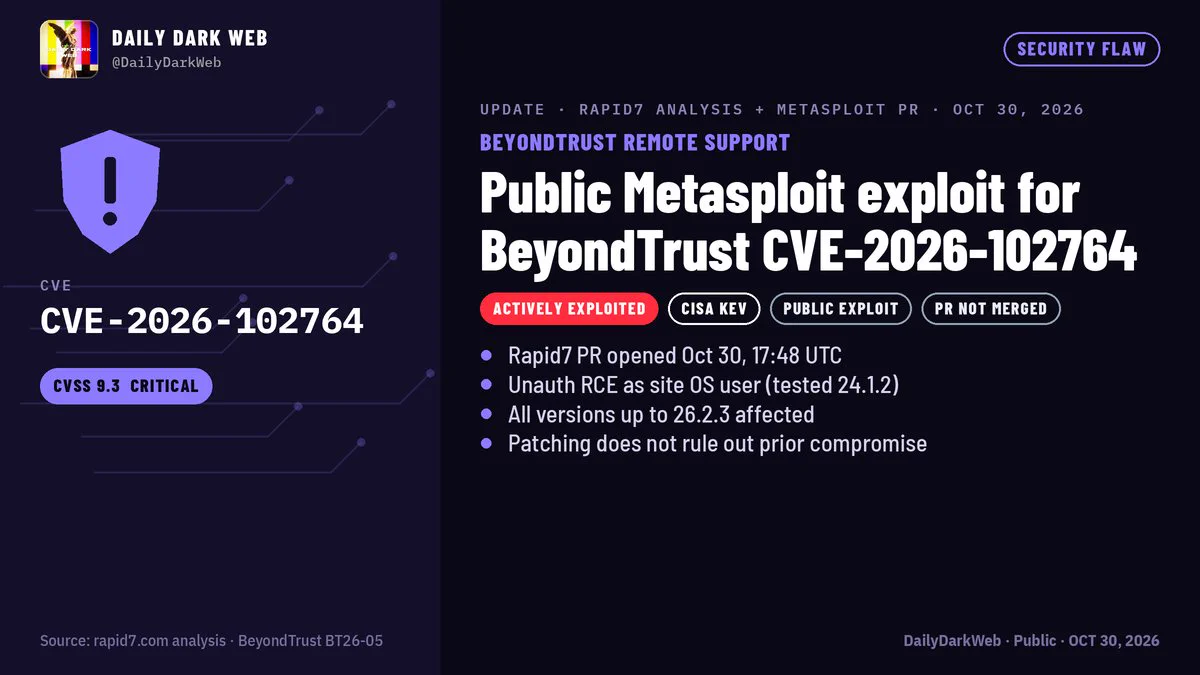
CVE-2026-102764 is an unauthenticated RCE in BeyondTrust Remote Support, already exploited and in CISA KEV. Rapid7 published an analysis and opened a Metasploit pull request on 30 October 2026, showing code execution on version 24.1.2 via a forged "local" message origin, the native file-transfer service and a PHP file written to the web root. BT26-05 (CVSS 4.0 9.3) is fixed by patch BT26-05-RS; SaaS was patched by 9 October.

BeyondTrust Remote SupportMetasploitPHP+1
CVE-2026-102764CISA KEVRapid7+2

Offensive Security, Threat Intel, AppSecΒ· Added 1 Nov 2026, published 31 Oct 2026
bleepingcomputer.comarticleπŸ›‘οΈ Security

Drupal warns of critical Commerce Core flaw exploited in attacks

Drupal Commerce Core has a critical missing-authorization flaw, CVE-2026-118539, that unauthenticated attackers exploit in the wild. It affects versions 0.0.0 to 2.41 and 3.0.0 to 3.3.13. Drupal urges upgrading to 3.3.13 (or 8.x-2.41 on the older branch) and auditing orders for inconsistencies. The article also recalls CVE-2026-9082, exploited in May and added to CISA KEV, and two RCE patches (CVE-2026-108097, CVE-2026-108099).

DrupalDrupal Commerce Core
CVE-2026-118539CVE-2026-9082CVE-2026-108097+3

AppSec, Threat IntelΒ· Published and added 30 Oct 2026

blog.talosintelligence.comarticleπŸ›‘οΈ Security

A quiet week in infosec <.<

Cisco Talos Threat Source newsletter for the week of the PHP and Node.js vulnerability news cycle. It summarises NIK C2, a Go-based Windows implant that dumps credentials, streams keystrokes, deploys screen-locking ransomware and uses a victim's hijacked OpenAI API keys to analyse stolen data. It also lists weekly headlines (CISA KEV PHP bugs, Brotli flaw, Gheist GitHub token theft), Talos links and top malware hashes.

GoWindowsOpenAI+3
NIK C2PHP2ShellNode2Shell+7

Threat Intel, AI SecurityΒ· Published and added 29 Oct 2026

x.comthreadπŸ›‘οΈ Security

Christiaan Stoudt (@cstoudt) on X

Thread on CVE-2026-97631, a critical (9.5) flaw in TianoCore EDK II UEFI firmware, found by Alex Matrosov and Dan Holmes-Mitra. It is exploitable only while a machine is PXE network booting and the attacker sends an oversized ICMP error from the same network. Code execution also needs the exact firmware build, and Secure Boot does not help. The fix landed in EDK II main on 15 October but is not in a stable release. No known exploitation, and not in CISA KEV.

EDK IIUEFITianoCore+2
CVE-2026-97631Alex MatrosovDan Holmes-Mitra+3

Hardware & RFΒ· Added 30 Oct 2026, published 28 Oct 2026

x.comarticleπŸ›‘οΈ Security

lee1981 (@lee1981b) on X

CyberForge Weekly CVE Rundown #007 covers six CVEs from 19 to 24 October 2026: SiteGuard command injection (CVE-2026-106931), DB-GPT (CVE-2026-77932), Siemens Software Center DLL side-loading (CVE-2026-110936), Cisco Expressway (CVE-2026-76466), Node.js Brotli (CVE-2026-111497) and Arista VeloCloud (CVE-2026-114625). Each entry gives defender actions, fixed versions, exploitation status and primary-source links. Updated 25 October 2026 with CISA KEV and EPSS findings.

SiteGuardDB-GPTSiemens Software Center+4
CVE-2026-106931CVE-2026-77932CVE-2026-110936+10

Blue Team & Detection, AppSec, Threat IntelΒ· Added 27 Oct 2026, published 25 Oct 2026

x.comarticleπŸ›‘οΈ Security

lee1981 (@lee1981b) on X

CVE-2026-110936 is an uncontrolled DLL search path flaw (CWE-427) in Siemens Software Center below V4.0.9.8, listed in CISA KEV on 20 October 2026. The post covers CVSS v4.0 8.4 and v3.1 6.7, Siemens' Romulus ClickFix campaign indicators (IPs, domain, hashes, file leads) and a six-step SOC trail using Sysmon, EDR and network records. It separates delivery from DLL load and from compromise.

Siemens Software CenterWindowsSysmon+3
CVE-2026-110936CWE-427DLL search order hijacking+10

Blue Team & Detection, Threat IntelΒ· Added 24 Oct 2026, published 21 Oct 2026

unit42.paloaltonetworks.comadvisoryπŸ›‘οΈ Security

Threat Brief: Active Exploitation of PAN-OS CVE-2026-0257 (Updated Oct 20)

Unit 42 threat brief on active exploitation of CVE-2026-0257, a PAN-OS GlobalProtect authentication bypass added to CISA KEV on May 13, 2026. It lists IP addresses, host IDs and PoC-derived client values to hunt in GlobalProtect logs. The October 2026 updates cover Qilin and Inc ransomware operators, MFA bypass, pivots to vCenter and ESXi with offline VMDK credential dumping, and management interface exposure on ports 4443 and 3879.

PAN-OSGlobalProtectVPN+3
CVE-2026-0257CVE-2023-27532Spikey Scorpius+10

Threat Intel, Blue Team & Detection, Identity & AccessΒ· Added 21 Oct 2026, published 20 Oct 2026

blog.talosintelligence.comarticleπŸ›‘οΈ Security

There's only so much code: the rise in vulnerability numbers

Cisco Talos analysis of why Microsoft Patch Tuesday advisories rose from about 100 a month before June 2026 to 975 in September and 1,415 in October, as frontier models such as Mythos mine old code. CVEs grew 105% year over year while CISA KEV additions grew 37%, and only three September advisories were exploited in the wild. It covers pressure on 90-day coordinated disclosure and open-source maintainers, the format string bug-class precedent, and defender advice.

SnortWindows
CVE-2021-44228MythosCISA KEV+8

AI Security, AppSec, Blue Team & DetectionΒ· Published and added 20 Oct 2026
x.comthreadπŸ›‘οΈ Security

Dark Web Intelligence (@DailyDarkWeb) on X

Plex2Shell is a chain of four Plex Media Server flaws (CVE-2026-96652, CVE-2026-96654, CVE-2026-96655, CVE-2026-96656) that a researcher says ends in unauthenticated RCE on servers older than 1.43.3.10861. A write-up and PoC were published on 16 October 2026. CISA advisory VA-26-266-01 scores the individual CVEs 4.3 to 7.2, and they are not in CISA KEV. The post advises updating, avoiding exposure of port 32400, and checking for unknown child processes and new files in the Codecs folder.

Plex Media ServerDocker
CVE-2026-96652CVE-2026-96654CVE-2026-96655+6

AppSec, Offensive SecurityΒ· Added 19 Oct 2026, published 18 Oct 2026

x.comthreadπŸ›‘οΈ Security

Dark Web Intelligence (@DailyDarkWeb) on X

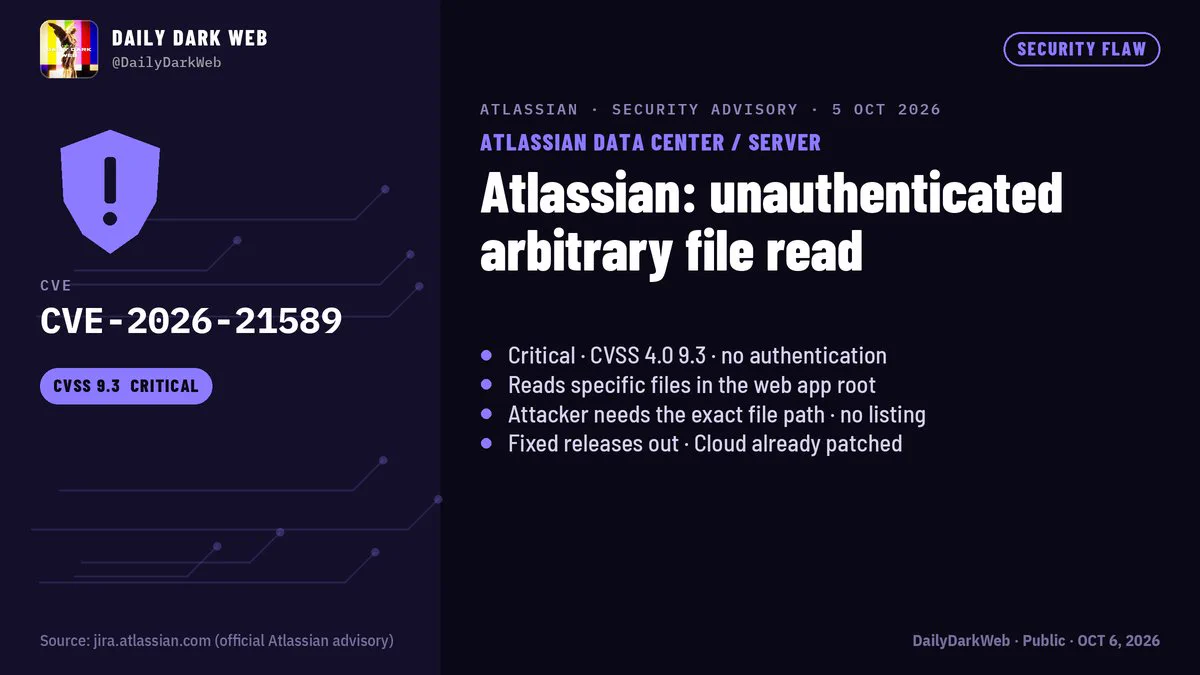
DailyDarkWeb update on CVE-2026-21589, a pre-auth file-read flaw in Atlassian Data Center products. The CVE record was rejected on 16 October 2026 with a generic reason and no replacement ID, but Atlassian's advisory (CVSS v4.0 9.3, Critical) and the CISA KEV listing (added 15 October, federal due date 18 October) remain. The analyst note says to keep patching to the fixed versions and track versions, not only the CVE ID.

JiraConfluenceCVSS+1
CVE-2026-21589CISApre-auth file read+1

Threat Intel, AppSecΒ· Added 19 Oct 2026, published 18 Oct 2026
x.comadvisoryπŸ›‘οΈ Security

lee1981 (@lee1981b) on X

Daily CVE digest on CVE-2026-76519, a CVSS 9.8 relative path traversal (CWE-23) in Cisco Secure Email Gateway's AMP File Reputation attachment processing. A crafted attachment gives unauthenticated arbitrary file writes and root command execution, and Cisco PSIRT reports active exploitation. The CVE is in CISA KEV. It lists the applicability conditions (File Reputation assigned to a policy and Content Scanner Tools earlier than 25.3.0.5525) and the fixes (scanner 25.3.0.5525, AsyncOS 15.5.5-014 and 16.5.0-780). It also covers evidence preservation, reading Cisco's System Security scan outcomes, mail/AMP log correlation, and deployment-specific recovery including cluster-key exposure.

Cisco Secure Email GatewayCisco AsyncOSCVSS+2
CVE-2026-76519CWE-23CISA KEV+4

Blue Team & Detection, Threat IntelΒ· Added 18 Oct 2026, published 15 Oct 2026

orca.securityadvisoryπŸ›‘οΈ Security

Critical GitLab RCE Lets Unauthenticated Attackers Execute Code on Servers (CVE-2026-97229)

Orca Security analysis of CVE-2026-97229, a CVSS 10.0 flaw in GitLab CE/EE. An integer overflow (CWE-190) in the CI/CD regular expression compiler gives memory corruption and code execution as the git user. It is triggered by a crafted regex in .gitlab-ci.yml combined with a UTF-8 repository path, with no authentication needed on instances that allow public project creation or self-registration. Lists affected branches (19.2 before 19.2.8, 19.3 before 19.3.5, 19.4 before 19.4.2), the absence of a workaround, interim mitigations, and a Rapid7 PoC against GitLab CE 19.4.1 with ASLR on. Notes a prior max-severity GitLab bug (CVE-2026-85706) was probed in the wild within hours and later added to CISA KEV.

GitLab
CVE-2026-97229CVE-2026-85706CWE-190+2

AppSec, DevSecOpsΒ· Published and added 14 Oct 2026
x.comthreadπŸ›‘οΈ Security

lee1981 (@lee1981b) on X

Defender guide for CVE-2026-104935, an authentication-bypass-by-spoofing flaw (CWE-290) in Ivanti Connect Secure that allows unauthenticated command execution. It is confirmed exploited and CISA KEV-listed, with a CNA CVSS 8.6. It covers the fixed-release matrix (25.1.1.2, 22.8R2.5, 25.1.3.x), platform and cluster migration limits, and Volexity's UTA0576 indicators and YARA rules. It also gives a six-step SOC workflow (scope, preserve, hunt, correlate identity, remediate, verify). It stresses that a clean ICT result cannot clear memory-only activity and that LDAP, LAPS and BitLocker exposure belongs to one observed chain.

Ivanti Connect SecureVPNYARA+3
CVE-2026-104935CWE-290UTA0576+6

Blue Team & Detection, Threat IntelΒ· Added 16 Oct 2026, published 14 Oct 2026
x.comthreadπŸ›‘οΈ Security

ThreatWire (@ThreatWire_) on X

ThreatWire post on CVE-2026-97229, an integer overflow in the GitLab CI/CD regex compiler. GitLab rates it CVSS 3.1 10.0 and says it can allow unauthenticated code execution under certain conditions, in both CE and EE. Fixes are in 19.2.8, 19.3.5 and 19.4.2 (not 19.3.4), released Oct 12; GitLab-hosted instances are already patched. The post credits joaxcar via HackerOne and says a Rapid7 researcher published a lab PoC on GitHub, which ThreatWire has not run or verified. It also says the CVE is not in CISA KEV and has no known exploitation.

GitLab
CVE-2026-97229integer overflowjoaxcar+1

AppSecΒ· Added 15 Oct 2026, published 14 Oct 2026

securityweek.comarticleπŸ›‘οΈ Security

Microsoft Patches Record 1,413 Vulnerabilities, Including Exploited Windows Zero-Day

SecurityWeek reports Microsoft's October 2026 Patch Tuesday fixed a record 1,413 CVEs (1,102 in Windows, 134 Office, 36 SharePoint), more than all of 2025, with the surge attributed largely to AI-driven discovery. The exploited zero-day CVE-2026-96951 is a Windows shell Mark of the Web security feature bypass (CVSS 8.8), added to CISA KEV with an October 16 deadline. Two flaws were publicly disclosed: CVE-2026-108398 (WDAC bypass) and CVE-2026-92707 (MessagePack-CSharp DoS), and Microsoft introduced 'risk cohorts' for patch prioritization.

WindowsWindows Defender.NET+2
CVE-2026-96951CVE-2026-108398CVE-2026-92707+5

Threat Intel, Blue Team & DetectionΒ· Published and added 14 Oct 2026

x.comadvisoryπŸ›‘οΈ Security

Dark Web Intelligence (@DailyDarkWeb) on X

Summary of SAP's October 13, 2026 Security Patch Day (16 new notes, 4 GitHub advisories). It leads with CVE-2026-89111, a CVSS 10.0 OAuth2 SSRF in SAP Cloud SDK for Python before 0.45.2, where an attacker-controlled tenant_subdomain redirects token requests and exfiltrates client credentials. It also lists three other critical flaws: broken access control in NetWeaver Visual Composer, code injection in S/4HANA substitution/validation rules, and a missing authorization check in the Manufacturing Integration and Intelligence (XMII) Configuration Service. It notes that none are in CISA KEV and SAP reports no in-the-wild exploitation.

SAP Cloud SDK for PythonSAP NetWeaverSAP S/4HANA+3
CVE-2026-89111CVE-2026-89110CVE-2026-89107+5

AppSec, Identity & AccessΒ· Added 15 Oct 2026, published 13 Oct 2026

rapid7.comadvisoryπŸ›‘οΈ Security

Ivanti Connect Secure zero-day exploited in the wild (CVE-2026-104935)

Rapid7 emergency-response analysis of CVE-2026-104935, a CVSS 8.6 authentication bypass by spoofing (CWE-290) in Ivanti Connect Secure that allows unauthenticated remote command execution. It was exploited as a zero-day against a limited number of customers, added to CISA KEV on disclosure day, and Volexity observed it chained with a still-unpatched privilege escalation flaw. Part of the fix shipped in 25.1.3.0 in July 2026, with backports to other supported versions pending. Rapid7 advises emergency patching outside normal cycles and hunting for compromise using Volexity's IOCs, since Ivanti has no reliable ones.

Ivanti Connect SecureVPNCVSS
CVE-2026-104935CWE-290CISA KEV+3

Threat Intel, Blue Team & DetectionΒ· Published and added 13 Oct 2026

becomingahacker.orgarticle🧠 AI

AI Agents for Cybersecurity: A Guided Tour of a Repository with Tons of Resources and Examples

Guided tour of Omar Santos's eight-part AI-agents-for-cybersecurity repository. It moves from LLM building blocks (LangChain, RAG) to security agents built with LangGraph, CrewAI, DeepAgents and MCP servers (nmap, CISA KEV, Shodan). It also covers a hardening guide for six agentic frameworks, token-cost control, and a spec for a supervisor-led, human-gated assessment harness. Design lessons include least-privilege subagents, single-use approvals and kill switches.

LangChainRAGLangGraph+7
Omar SantosOWASPCISA+1

agents, mcp, llm-appsΒ· Added 13 Oct 2026

github.comrepo🧠 AI

santosomar/AI-agents-for-cybersecurity

Companion repository for Omar Santos's Pearson and O'Reilly trainings and books. It has eight parts of runnable Python labs: chat models, embeddings, prompt templates, LCEL prompt chaining, Chroma-based RAG, ReAct/LangGraph/CrewAI/DeepAgents agents, and FastMCP servers (nmap, CISA KEV, Shodan). It also includes guides to six agentic frameworks (OpenClaw, Hermes, Agent Zero, OpenHands, Paperclip, Buzz), a tokenomics module on agent cost (context compounding, prompt caching, model routing, token budget guards, batch API, cost per accepted outcome), and a vendor-neutral design spec for a human-gated multi-agent assessment harness. It is a current, practical curriculum for building and operating agents. Some examples act on real systems and should only be run in an authorized lab.

PythonuvLangChain+17
Omar SantosPearsonO'Reilly+15

agents, llm-apps, mcpΒ· Added 13 Oct 2026

github.comrepoπŸ›‘οΈ Security

santosomar/AI-agents-for-cybersecurity

Omar Santos's companion repo for his Pearson/O'Reilly trainings and books, organised in eight parts. They cover LangChain prompts, chains and RAG (Chroma), and agents (LangGraph, CrewAI, DeepAgents). They also cover FastMCP security servers (nmap, CISA KEV, Shodan) and attack-surface-management and SOC agent examples. Later parts have security guides to six agentic frameworks (OpenClaw, Hermes, Agent Zero, OpenHands, Paperclip, Buzz) with hardening notes and 2026 CVE mapping, agent cost/tokenomics scripts including denial-of-wallet budget guards, and a vendor-neutral spec for a human-gated multi-agent security-assessment harness (scope manifest, approval gates, kill switch). Useful as a hands-on path into AI-agent security tooling, with warnings that some examples act on real systems.

Model Context ProtocolLangChainOpenClaw+3
Omar SantosSSRFCISA KEV+2

AI Security, LearningΒ· Added 13 Oct 2026

becomingahacker.orgarticleπŸ›‘οΈ Security

AI Agents for Cybersecurity: A Guided Tour of a Repository with Tons of Resources and Examples

Omar Santos walks through his eight-part AI-agents-for-cybersecurity repository: LLM building blocks (LangChain, RAG), then security agents with LangGraph, CrewAI, DeepAgents and MCP servers (nmap, CISA KEV, Shodan), a hardening guide for six agentic frameworks, token-cost control for agents, and a spec for a supervisor-led, human-gated security-assessment harness. It covers concrete design lessons such as least-privilege subagents, staged response actions, single-use approvals bound to exact actions, kill switches, and mapping controls to the OWASP Top 10 for Agentic Applications. Also notes Project CodeGuard rules shipped for AI coding assistants.

LangChainModel Context ProtocolPython+3
Omar SantosProject CodeGuardOWASP Top 10 for Agentic Applications+5

AI Security, Learning, Blue Team & DetectionΒ· Added 13 Oct 2026

linkedin.comarticleπŸ›‘οΈ Security

AI Agents for Cybersecurity: A Guided Tour of a Repository with Tons of Resources and Examples

Omar Santos walks through his AI-agents-for-cybersecurity GitHub repo, which has eight parts. Parts 1–4 cover LLM basics (LangChain, prompting, LCEL, RAG). Parts 5–8 cover building security agents with LangGraph, CrewAI, DeepAgents and MCP servers (nmap, CISA KEV, Shodan), and a hardening baseline for six ready-made agentic frameworks. They also cover token-cost control (caching, routing, budget guards, cost per accepted outcome) and a supervisor-led, human-gated security-assessment harness spec with single-use approvals, a kill switch and an append-only audit log. The post also covers Project CodeGuard rules for AI coding assistants. It is a practical learning path and a reference for governing and securing agents.

LangChainLangGraphCrewAI+5
Omar SantosProject CodeGuardOWASP Top 10 for Agentic Applications+9

AI Security, Learning, Blue Team & DetectionΒ· Added 13 Oct 2026

x.comthreadπŸ›‘οΈ Security

ThreatWire (@ThreatWire_) on X

Post announcing a public PoC for CVE-2026-13043, a critical flaw (CVSS 4.0 9.3, scored by WatchGuard) in PSKMAD, the kernel memory access driver of WatchGuard Endpoint Security on Windows. The access-control handshake can be bypassed (CWE-306/CWE-798), letting a local authenticated attacker send privileged commands and read kernel and other processes' memory. Fixed in 8.00.26.0012; the PoC author and LOLDrivers frame the signed driver as BYOVD material, which WatchGuard does not say. The post notes it is not in CISA KEV, has no reported in-the-wild exploitation, and that ThreatWire has not run the PoC.

WatchGuard Endpoint SecurityWindowsCVSS
CVE-2026-13043PSKMADCWE-306+5

Offensive Security, Blue Team & DetectionΒ· Added 11 Oct 2026, published 10 Oct 2026

x.comwriteupπŸ›‘οΈ Security

lee1981 (@lee1981b) on X

A detailed "CVE of the Day" thread analyzing CVE-2026-76471, a critical (CVSS 9.8) Cisco advisory covering insufficient NX-API input validation (CWE-122 heap-based buffer overflow) on Nexus 3000/9000 standalone NX-OS and a lower-severity credentialed variant on UCS 6300 Fabric Interconnects via UCS Manager XML API. It compiles Cisco's fixed-software versions per platform, notes the temporary Live Protect shield lp00074, and walks through a six-step SOC evidence-preservation and correlation playbook (scoping affected devices, preserving logs/crash artifacts, reviewing API/shield telemetry, correlating device outcomes, remediating, and verifying post-patch state) while flagging that CISA KEV and FIRST EPSS had no data on the CVE at research time.

CVSSNVDCISA KEV+1
CVE-2026-76471

Cloud & InfraΒ· Published and added 8 Oct 2026

adversa.aiarticleπŸ›‘οΈ Security

Top MCP security resources β€” October 2026

Adversa AI's October 2026 MCP security roundup, aggregating and synthesizing 15 resources: authentication-bypass vulnerabilities in LiteLLM's MCP endpoint (CVE-2026-59822, now CISA KEV), Grafana's MCP server session spoofing/SSRF (CVE-2026-19516), an MCP Python SDK OAuth-fallback flaw exploited by a malicious server returning a 404, and an Obot gateway route-matching bypass reopening GHSA-vw82. It also covers detection failures (two malicious MCP servers passing five scanners including Cisco mcp-scanner and Snyk agent-scan, 12% of 82,000 public MCP configs hardcoding secrets), a malicious npm wallet-signing package (gadgethumans-mcp), the A2M agent-hijacking attack technique, and CoSAI's MCP Security v2.0 governance model.

Model Context ProtocolLiteLLMnpm+3
CVE-2026-59822CVE-2026-59821CVE-2026-19516+6

AI Security, AppSec, Identity & AccessΒ· Published and added 8 Oct 2026

aws.amazon.comarticleπŸ›‘οΈ Security

Configuring your AI vulnerability harness, Part 2: The steering file

AWS Security Blog's second post in a series on building an "AI vulnerability harness" explains the configuration (steering file) that stops an AI model from hallucinating vulnerabilities and inflating severity during security code review. It details five configuration sections β€” structural verification of findings, an evidence-based confidence formula (weighting confirmed taint flow at 0.30), infrastructure-aware severity multipliers for controls like AWS WAF and IAM, CISA KEV/EPSS threat-intel boosting, and a four-tier priority classification β€” and reports validation numbers (e.g., unsteered models fabricated code paths in ~30% of findings; steered confidence of HIGH without structural confirmation was only 34% exploitable vs 89% with confirmed taint). The steering file is shipped as a Kiro steering file, a Kiro skill, and a CLAUDE.md for Claude Code, with full source in a linked GitHub repo.

KiroClaude CodeAWS WAF+3

AI Security, AppSecΒ· Published and added 7 Oct 2026

aws.amazon.comwriteup🧠 AI

Configuring your AI vulnerability harness, Part 2: The steering file

Part 2 of an AWS Security Blog series detailing the design of a "steering file" β€” a persistent instruction set (deployable as a Kiro steering file, Kiro skill, or Claude Code CLAUDE.md) that constrains an LLM performing vulnerability triage. It walks through five configuration sections: requiring structural/dataflow verification before reporting findings, replacing self-reported confidence with a weighted formula based on binary structural signals (e.g., 0.30 weight for confirmed taint flow), mapping infrastructure controls (AWS WAF, IAM) to severity multipliers with a 0.15 floor, incorporating CISA KEV and EPSS threat-intelligence boosts capped at +0.50, and a four-tier priority classification that suppresses low-confidence P3 findings. Validation against a 10-vulnerability test app showed the steered model eliminated fabricated findings and correctly downgraded mitigated vulnerabilities while preserving full severity for a command injection reachable only via authenticated access.

KiroClaude CodeCursor+7
CISAEPSS

prompting, coding-agentsΒ· Added 8 Oct 2026, published 7 Oct 2026

x.comadvisoryπŸ›‘οΈ Security

Dark Web Intelligence (@DailyDarkWeb) on X

Atlassian disclosed CVE-2026-21589, a critical (CVSS 9.3) unauthenticated path traversal flaw allowing remote attackers to read specific files within the web application root across its self-managed Data Center/Server products β€” Jira Software, Jira Service Management, Confluence, Bitbucket, Bamboo, Crowd, Crucible, and Fisheye. Fixed versions are listed for each product (e.g. Jira 9.12.40/10.3.26/11.3.12, Confluence 9.2.26/10.2.19), and Atlassian Cloud is already patched; WAF/URL-rewrite mitigations are available for those who can't upgrade immediately. The post's analyst note clarifies exploitation requires knowing the exact target file path (no directory listing), and as of Oct 5, 2026 it is not yet in CISA KEV with no public exploit reported.

JiraConfluenceBitbucket+3
CVE-2026-21589path traversal

AppSecΒ· Added 7 Oct 2026, published 6 Oct 2026

cisa.govadvisoryπŸ›‘οΈ Security

CISA KEV: Fortinet FortiMail CVE-2026-104286 path traversal, actively exploited, no patch yet

CISA added CVE-2026-104286, a path traversal vulnerability in Fortinet FortiMail, to its Known Exploited Vulnerabilities Catalog on evidence of active exploitation. The alert restates the obligations of BOD 26-04 for Federal Civilian Executive Branch agencies: prioritise KEV CVEs on publicly exposed assets that give total control, and check for compromise before patching. It also describes the KEV nomination criteria: a CVE ID, evidence of exploitation and clear mitigation guidance. The page gives no technical detail, patch status or IOCs.

Fortinet FortiMailCISA KEV
CVE-2026-104286path traversalCISA+1

Threat Intel, GRCΒ· Added 4 Oct 2026

x.comthreadπŸ›‘οΈ Security

Dark Web Intelligence (@DailyDarkWeb) on X

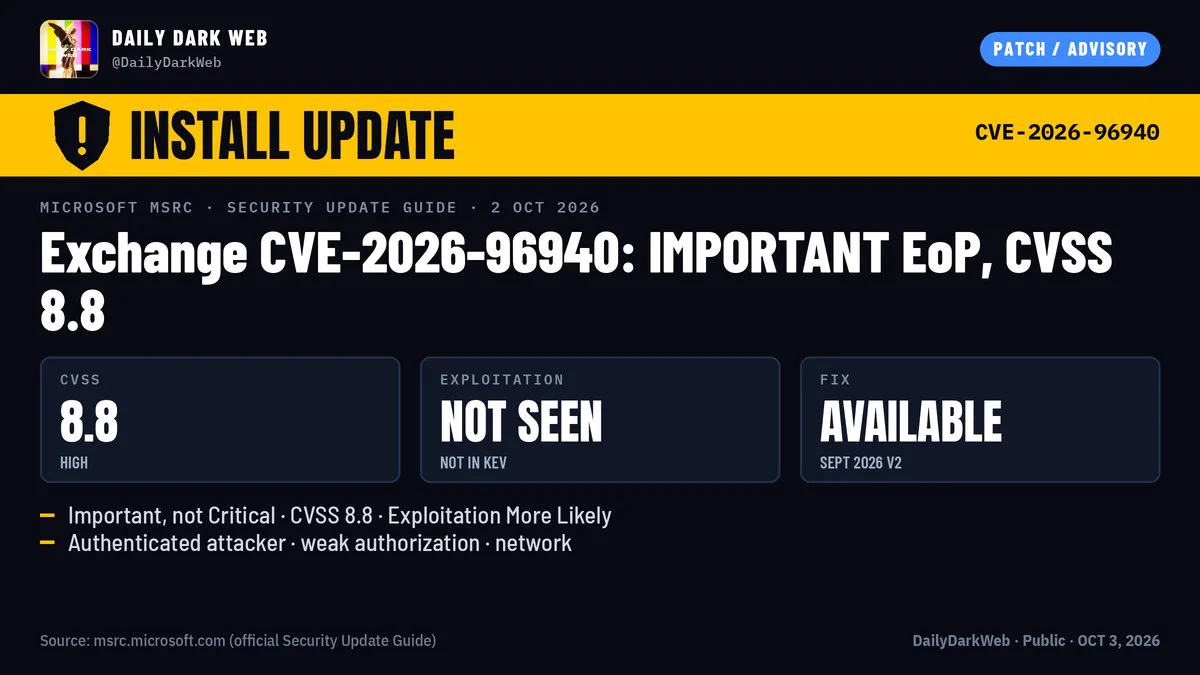
Summary of Microsoft's September 2026 V2 / October 2026 early security updates adding CVE-2026-96940, an Important elevation-of-privilege flaw (CVSS 8.8) in on-prem Exchange Server caused by weak authorization that lets an authenticated attacker escalate privileges over the network. Covers affected builds and KBs (Exchange SE RTM KB5129955, 2019 CU15/CU14 KB5129956/5129957, 2016 CU23 KB5129958) and notes Exchange Online is unaffected, the flaw was found internally by Microsoft with no known exploitation and is not in CISA KEV.

Microsoft ExchangeCVSSCISA KEV
CVE-2026-96940

AppSecΒ· Added 4 Oct 2026, published 3 Oct 2026

x.comthreadπŸ›‘οΈ Security

lee1981 (@lee1981b) on X

A detailed breakdown of CVE-2026-102710 (CVSS v4.0 9.3), a privilege-escalation flaw in Eclipse ThreadX RTOS builds with event tracing enabled: a module-supplied trace callback pointer is retained by the kernel and invoked with kernel privilege when the trace buffer wraps, letting an attacker who already controls a memory-protected user-mode module fault the kernel or execute code in kernel context. The thread walks through the vulnerable code path (registration, storage, invocation across the protection boundary), CWE-269/CWE-822 classification, affected versions (through v6.5.1.202602a_rel), and provides a defender hunting guide plus emergency remediation steps, noting no fixed upstream release or CISA KEV/EPSS entry exists yet.

Eclipse ThreadXCVSSNVD+1
CVE-2026-102710CWE-269CWE-822+1

Hardware & RF, Offensive Security, Blue Team & DetectionΒ· Published and added 30 Sep 2026

orca.securityadvisoryπŸ›‘οΈ Security

Critical Citrix NetScaler Zero-Days Under Active Exploitation

Analysis of two CVSS 9.5 Citrix NetScaler ADC/Gateway zero-days, CVE-2026-88771 (unauthenticated RCE through improper input validation in the management interface, affecting default deployments) and CVE-2026-88772 (memory overflow in DTLS, enabled by default on VPN virtual servers). It lists six more high-severity flaws patched in advisory CTX697096, the affected and fixed versions, and the CISA KEV listing with a federal deadline of 2026-09-30. It advises checking for compromise before patching, since patching can destroy forensic evidence, and gives response steps: isolate, revoke credentials, rebuild firmware, rotate keys and certificates.

Citrix NetScalerVPN
CVE-2026-88771CVE-2026-88772CVE-2026-88773+7

Cloud & Infra, Threat IntelΒ· Published and added 29 Sep 2026

rapid7.comadvisoryπŸ›‘οΈ Security

Zero-Day Exploitation of Citrix NetScaler ADC and Gateway: CVE-2026-88771 and CVE-2026-88772

Rapid7 details active zero-day exploitation of two critical Citrix NetScaler ADC/Gateway RCE vulnerabilities (CVE-2026-88771, CVE-2026-88772, both CVSSv4 9.5), both added to CISA KEV on disclosure day, plus a later SAML denial-of-service zero-day (CVE-2026-88779). The post includes Rapid7 MDR's observed exploitation of CVE-2026-88771 in the wild β€” a command-injection payload that exfiltrates /flash/nsconfig (containing ns.conf admin credentials, SSL private keys, SSH host keys) via the publicly-served /vpn/ path, and a webshell (SHA256 hash provided) found on a compromised appliance β€” along with vendor patch versions and detection guidance.

Citrix NetScalerCVSS
CVE-2026-88771CVE-2026-88772CVE-2026-88779+3

Threat Intel, AppSecΒ· Added 7 Oct 2026, published 28 Sep 2026

watchtowr.comadvisoryπŸ›‘οΈ Security

watchTowr: CVE-2026-88771 Citrix NetScaler ADC/Gateway unauthenticated RCE

watchTowr details CVE-2026-88771 (unauthenticated command execution via improper input validation, affecting every NetScaler ADC/Gateway deployment by default) and CVE-2026-88772 (DTLS memory overflow leading to RCE/DoS, exploitable since DTLS is on by default for VPN virtual servers). Both are confirmed exploited in the wild as zero-days, were pre-notified by NCSC-NL, and CVE-2026-88771 was added to the CISA KEV catalog on September 27, 2026; Citrix's bulletin CTX697096 also fixes six related issues (CVE-2026-88773 through CVE-2026-88778). The writeup gives prioritization guidance, IOC-checking steps, and warns that patching may destroy forensic evidence if done before evidence capture.

Citrix NetScalerCVSSCISA KEV
CVE-2026-88771CVE-2026-88772CVE-2026-88773+8

Threat Intel, Offensive SecurityΒ· Added 5 Oct 2026, published 27 Sep 2026

cisa.govadvisoryπŸ›‘οΈ Security

CISA KEV Catalog Additions β€” Check Point, Arista VeloCloud, F5 BIG-IP (Sept 22, 2026)

CISA added four vulnerabilities to the Known Exploited Vulnerabilities catalog on 2026-09-22 based on evidence of active exploitation: two Check Point multi-product flaws (improper certificate validation CVE-2026-85102, path traversal CVE-2026-93616), an Arista VeloCloud Orchestrator improper input validation bug (CVE-2026-93952), and an F5 BIG-IP APM heap-based buffer overflow (CVE-2026-94127). The alert ties the additions to BOD 26-04, which has FCEB agencies prioritize remediation of KEV CVEs on publicly exposed assets that give total control, and to checking for prior compromise before patching.

CISA KEVCheck PointArista VeloCloud Orchestrator+1
CVE-2026-85102CVE-2026-93616CVE-2026-93952+4

Threat Intel, GRCΒ· Added 26 Sep 2026

thehackernews.comarticleπŸ›‘οΈ Security

Veeam, Terraform MCP, Django Patch Critical Flaws, Led by CVSS 10.0 Cross-Tenant Bug

The Hacker News roundup covers 11 patched CVEs across three products: Veeam Service Provider Console (CVE-2026-58073, 9.5, unauthenticated managed-agent credential theft; CVE-2026-58072, arbitrary file write to RCE), HashiCorp's Terraform MCP Server (CVE-2026-16498, a 10.0 cross-tenant credential-reuse bug caused by the underlying MCP library not issuing unique session IDs in stateless HTTP mode; CVE-2026-16496 stateful-mode equivalent; CVE-2026-14869 SSRF via header/query-param inconsistency), and Django/GeoDjango (CVE-2026-15307, a spatial-lookup flaw letting GDALRaster write files, reachable by a staff user with view permission on a model with a spatial field, plus a stored XSS, a GEOS DoS, and a language-code DoS). Fixes: Terraform MCP Server 1.1.0+, VSPC 9.3.0.35057, Django 6.0.8/5.2.17; none of the flaws are known to be exploited or listed in CISA KEV as of publication.

TerraformModel Context ProtocolDjango+2
CVE-2026-58073CVE-2026-58072CVE-2026-58067+14

AppSec, AI SecurityΒ· Added 26 Sep 2026

rapid7.comadvisoryπŸ›‘οΈ Security

CVE-2026-94127: Critical Unauthenticated RCE in F5 BIG-IP APM

Rapid7's ETR writeup covers CVE-2026-94127, a critical heap-based buffer overflow (CVSS 9.8) in F5 BIG-IP Access Policy Manager that allows unauthenticated remote code execution via crafted traffic. Exploitation requires a virtual server with both an APM access policy and an OAuth profile configured, affects the data plane (including Appliance mode), and has been added to CISA KEV; F5 provides hotfixes for the 21.1.0, 17.5.0, and 17.1.0 release trains plus an iRule workaround for those unable to patch immediately.

F5 BIG-IPCVSSCISA KEV+1
CVE-2026-94127

Cloud & Infra, Identity & AccessΒ· Added 7 Oct 2026, published 23 Sep 2026

zerodayinitiative.comarticleπŸ›‘οΈ Security

The Apple Security Update Review for September 2026

Zero Day Initiative's monthly Apple patch review covers the September 2026 release (macOS 27/Sequoia 15.8/Tahoe 26.7, iOS/iPadOS 27 & 26.7, visionOS, watchOS, tvOS, Safari, Xcode), totaling 273 CVEs. It highlights CVE-2026-65400 (Screen Sharing Server authentication bypass, 9.8 CRITICAL, actively exploited per CISA KEV), CVE-2026-65414 (Bluetooth remote code execution, 9.8 CRITICAL, affecting all eight platforms), and CVE-2026-65346 (ImageIO arbitrary code execution via malicious image, 8.8 HIGH), plus a full CVE-by-component-by-platform table with CVSS scores where NVD/CISA-ADP has assigned them.

macOSiOSSafari+3
CVE-2026-65400CVE-2026-65414CVE-2026-65346+271

otherΒ· Added 28 Sep 2026, published 16 Sep 2026

endorlabs.comarticleπŸ›‘οΈ Security

OWASP OSS Risk 1: Known Vulnerabilities | Blog | Endor Labs

First in Endor Labs' 10-part series on the OWASP Top 10 OSS Risks, this piece breaks down "Known Vulnerabilities" (OSS-RISK-1): how CVEs get assigned and disclosed, why the 2017 Apache Struts CVE-2017-5638 unpatched flaw led to the Equifax breach of 145M+ records, and how to compare vulnerability data sources (NVD, GitHub Advisory Database, OSV). It details prioritization methods β€” CVSS, EPSS, CISA KEV, SSVC, and function-level reachability analysis β€” and shows a case study where filtering 134K findings down via reachability, fix-availability, production-code, and EPSS thresholds cut remediation work by 99.97%.

Endor LabsNVDOSV+2
CVE-2017-5638EquifaxApache Struts+2

Supply Chain, AppSecΒ· Published and added 11 Sep 2026

endorlabs.comarticleπŸ›‘οΈ Security

Combining EPSS and Reachability Analysis to Optimize Vulnerability Management | Blog | Endor Labs

Endor Labs breaks down how the Exploit Prediction Scoring System (EPSS) v3 works β€” the exploitation telemetry, exploit-DB/GitHub/Metasploit code checks, CISA KEV/Project Zero/ZDI mentions, CVSS vectors, CWE, and social-media signals it ingests to score CVE exploitation likelihood β€” and shows that an EPSS-threshold (0.088) remediation strategy fixes the same share of exploited CVEs while patching only ~7.3% of known vulnerabilities versus ~82% under a "fix all high/critical" CVSS approach. It then explains a layered workflow: use reachability analysis (call-graph based) to cut findings by ~80% to what's actually exploitable in your environment, then apply EPSS on that reduced set to rank remaining issues by real-world exploitation likelihood, including for third-party/proprietary code where reachability analysis isn't feasible.

EPSSCVSSNVD+3
CISA KEVCWE-94

AppSecΒ· Published and added 11 Sep 2026

endorlabs.comarticleπŸ›‘οΈ Security

FedRAMP Requirements for Vulnerability Management and Dependency Upgrades | Blog | Endor Labs

An Endor Labs blog post, written by a former JAB Technical Representative, details FedRAMP's Continuous Monitoring vulnerability management requirements: authenticated scanning, monthly dependency inventories, POA&M tracking, and strict remediation SLAs (High CVSS 7.0+ in 30 days, Medium in 90, Low in 180). It also covers FedRAMP's container-specific rules (hardened images, CISA KEV prohibition, pipeline/registry/runtime scanning) and outlines four practical strategies β€” reachability-based false-positive triage, EPSS-driven risk level adjustments, ROI/complexity-based upgrade prioritization, and developer-side PR gating β€” before pivoting into an Endor Labs product pitch.

Endor LabsCVSSEPSS
FedRAMPCISA KEVNIST 800-53

GRC, Supply ChainΒ· Published and added 11 Sep 2026

rapid7.comarticleπŸ›‘οΈ Security

Metasploit Wrap Up: This One Goes to Sixteen!

Rapid7's weekly Metasploit Framework update covering sixteen new modules: ten exploits (five on the CISA KEV list) targeting Cisco Secure Firewall Management Center (CVE-2026-20079 auth bypass RCE), SonicWall SMA1000 (CVE-2026-83549 chained RCE), PaperCut NG/MF (CVE-2026-81578 + CVE-2026-82078), JetBrains TeamCity agent-polling XStream deserialization RCE (CVE-2026-63077), Langflow authenticated RCE (CVE-2026-19295), MCPJam Inspector command execution (CVE-2026-23744), SimpleHelp OIDC auth bypass (CVE-2026-48558), Next.js Windows RCE (CVE-2026-75604), and SPIP SQLi/RCE flaws. It also adds a new native Kerberos relay module exploiting ESC8 (AD CS Web Enrollment) via SMB-to-HTTP coercion, a Metasploit handler-detection scanner, a Linux sandbox-evasion module, two Windows persistence techniques, and several bug fixes to the DNS and module metadata subsystems.

MetasploitCiscoSonicWall+3
CVE-2025-66516CVE-2025-54988CVE-2026-20929+12

Offensive Security, AppSecΒ· Added 7 Oct 2026, published 11 Sep 2026

wiz.ioadvisoryπŸ›‘οΈ Security

Artifactory Under Attack: In-the-Wild Exploitation of CVE-2026-42016, CVE-2026-42018 & CVE-2026-82329

Wiz Research documents active in-the-wild exploitation of three JFrog Artifactory vulnerabilities: CVE-2026-42018 (exposes an internal anonymous-user JWT via POST /access/api/v1/aws/token/), CVE-2026-42016 (token scope validation flaw allowing that JWT to be escalated to admin via POST /access/api/v1/tokens), and CVE-2026-82329 (unauthenticated admin access via POST /access/api/v1/registry/join, added to CISA KEV). Attackers chained the first two to create persistent admin accounts, deploy malicious Groovy plugins for RCE, and drop Rust-based C2 backdoors, while CVE-2026-82329 was exploited independently for configuration exfiltration, cluster join-key theft, and credential/SSH-key persistence. The post includes exact request sequences, detection signatures, affected/fixed version ranges, and remediation guidance.

JFrog ArtifactoryRust
CVE-2026-42016CVE-2026-42018CVE-2026-82329+1

AppSec, Threat Intel, Blue Team & DetectionΒ· Published and added 10 Sep 2026

github.comrepoπŸ›‘οΈ Security

mukul975/cve-mcp-server

cve-mcp-server is a Model Context Protocol server that gives Claude direct access to 28 security tools spanning 24 APIs (NVD, EPSS, CISA KEV, OSV.dev, GitHub GHSA, MITRE ATT&CK, AbuseIPDB, GreyNoise, Shodan, VirusTotal, MalwareBazaar, ThreatFox, Ransomwhere, and more), fronted by a one-call triage_cve orchestrator. It computes a composite 0-100 risk score from CVSS, EPSS, KEV status, and PoC availability (with a hard CISA KEV override forcing CRITICAL/β‰₯76), supports dependency scanning via OSV, IP/domain reputation lookups with private-IP blocking, and ships an SSVC v2 gated decision mode plus audit logging and XML-bomb protections via defusedxml.

Model Context ProtocolClaude DesktopClaude Code+9
CVE-2021-44228CVE-2024-3400CVE-2023-44487+3

AI Security, Threat IntelΒ· Published and added 7 Sep 2026

github.comrepoπŸ›‘οΈ Security

cyanheads/osv-advisory-mcp-server

osv-advisory-mcp-server is an MCP server that queries the OSV.dev vulnerability database, offering single-package version checks, batch audits of up to 1000 {name, ecosystem, version} tuples for SBOM/lockfile triage, and full advisory record fetch by OSV ID (GHSA/PYSEC/RUSTSEC/GO/DSA/DLA/CVE prefixes). It surfaces CVE aliases, CVSS vectors, derived severity labels, and CWE IDs, and is designed to chain into a companion nist-nvd-mcp-server for CVSS base scores, EPSS probability, and CISA KEV status. It ships as a keyless, no-API-key tool runnable via STDIO or Streamable HTTP, with a public hosted instance and Bun/npx/Docker install paths.

Model Context ProtocolOSVBun+3
CISA KEVEPSSnist-nvd-mcp-server

Supply ChainΒ· Added 1 Sep 2026

wiz.iowriteupπŸ›‘οΈ Security

Inside 90 days of attacks on AI infrastructure

Wiz Threat Research ran honeypots across LiteLLM, Flowise, LangChain, Langflow, ChromaDB, Ollama and other AI/ML services for 90 days, capturing active exploitation of an MCP Gateway auth bypass (CVE-2026-59822) and an MCP server test-endpoint command injection (CVE-2026-42271, in CISA KEV, chainable with Starlette CVE-2026-48710 for unauthenticated RCE and linked to Qilin ransomware exploitation) used to deploy fileless cryptominers. It also documents blind prompt injection campaigns against LangChain, Flowise, OpenWebUI, and Node-RED agents that trigger OS command execution confirmed via out-of-band DNS callbacks to OAST domains.

LiteLLMLangChainFlowise+3
CVE-2026-59822CVE-2026-42271CVE-2026-48710+2

Threat Intel, Offensive Security, AI SecurityΒ· Added 3 Sep 2026, published 27 Aug 2026

metr.orgarticleπŸ›‘οΈ Security

Have We Seen an Acceleration in Discoveries?

METR note that plots public discovery data in vulnerabilities, mathematics and algorithmic optimization to look for slope changes around January 2026. CVE counts rose sharply: cURL went from 9 to 36, OpenSSL from 6 to 39, Firefox from 210 to 342, Microsoft from 1,243 to 1,927 through August 2026. Exploited-vulnerability lists (CISA KEV, VulnCheck KEV) grew far less. Math shows weaker acceleration, optimization none.

cURLOpenSSLFirefox+3
METRMythosVulnCheck+5

AI Security, otherΒ· Added 29 Oct 2026, published 14 Aug 2026

xmcyber.comarticleπŸ›‘οΈ Security

The 2026 Verizon DBIR Stopped Asking How Attackers Get in and Started Asking Where They Go

An XM Cyber analysis of the 2026 Verizon DBIR, which for the first time ran attack-graph analysis across real environments to model post-compromise privilege escalation rather than just initial access vectors. Key findings cited: exploitation of vulnerabilities overtook credential theft as the top initial-access vector (31%), 83% of privilege-escalation incidents involved no vulnerability, 16% of organizations had an 80%+ chance a low-privilege attacker could reach a key admin account, and only 26% of CISA KEV vulnerabilities were fully remediated in 2025 (down from 38%) with median remediation time up to 43 days. The piece argues security programs over-invest in patching (which addresses only ~10% of escalation techniques) versus privilege/permission hygiene (which addresses ~65%), and recommends attack-path "choke point" remediation and prioritized patching over patch-everything approaches.

XM Cyber
CISA KEVVerizon DBIR

Threat Intel, Offensive SecurityΒ· Added 3 Sep 2026, published 2 Jul 2026

github.comrepoπŸ›‘οΈ Security

RAPTOR

RAPTOR is an autonomous offensive/defensive security research framework built on top of Claude Code that chains static analysis (Semgrep, Coccinelle, CodeQL), binary analysis (radare2, Frida, Z3-based exploit feasibility), LLM-driven multi-stage vulnerability validation, exploit PoC generation, and patch writing into a single workflow against source code or compiled binaries. It also includes an /sca supply-chain command that enriches dependency findings with OSV, CISA KEV, EPSS, and SSVC data and emits CycloneDX SBOMs, and sandboxes LLM-generated/untrusted code execution using Linux namespaces, Landlock, and seccomp. Authored by Gadi Evron, Daniel Cuthbert, Thomas Dullien (Halvar Flake), Michael Bargury, and John Cartwright, it ships 200+ custom static analysis rules and supports multi-model LLM analysis (Claude, GPT, Gemini, Ollama).

Claude CodeSemgrepCodeQL+5
Gadi EvronDaniel CuthbertThomas Dullien+2

AppSec, Offensive Security, AI Security, Supply ChainΒ· Published and added 28 Jun 2026

aikido.devarticleπŸ›‘οΈ Security

Full Fathom Five: The context of Anthropic’s Mythos-class public release

Aikido commentary on Anthropic's public Claude Fable 5 release. The author says it is a Mythos-class model that routes cybersecurity prompts to Opus 4.8, so benchmarking its security capability is pointless. Mythos Preview and Claude Mythos 5 stay limited to Glasswing and about 150 additional organizations. The post argues that vulnerability discovery is roughly 20% of the problem and that zero-day demand is not supply-constrained (about 30 new vulns a month, citing Resecurity). It also argues that CVE and CISA KEV-centric prioritisation is fading, and that AI tokens will mostly go to defensive scanning, exposure management and remediation rather than attacker scans.

Claude Fable 5AnthropicAikido Security+2
MythosProject GlasswingFable 5+7

AI Security, otherΒ· Added 3 Sep 2026, published 13 Jun 2026

orca.securityarticleπŸ›‘οΈ Security

Orca: 8 Container Security Best Practices for 2026

A container security guide covering eight practices across build, deploy and runtime: minimal or distroless images, Trivy/Grype scanning, Cosign signing enforced via Kyverno or OPA Gatekeeper, non-root users, read-only root filesystems, dropped capabilities, and Pod Security Admission with the Restricted profile. It also covers least-privilege RBAC, workload identity (IRSA, GKE Workload Identity, Entra Workload ID), etcd encryption at rest, audit logging and retention, CISA KEV-driven rebuilds, and container incident response that preserves evidence before pod termination. It maps open-source tools to pipeline stage (Falco and Tetragon at runtime), explains the managed-Kubernetes shared responsibility split, and ends with an Orca SideScanning pitch.

KubernetesDockerTrivy+3
CISA KEVNIST SP 800-190NIST SP 800-61+6

Cloud & Infra, DevSecOpsΒ· Published and added 11 Jun 2026

socket.devarticleπŸ›‘οΈ Security

Socket: Federal Audit

Socket covers a newly released Department of Commerce OIG audit that found NIST had no strategic plan for managing the National Vulnerability Database, set an enrichment deadline it lacked capacity to meet, and delayed using CISA's Vulnrichment data out of attribution concerns. The audit also found NIST and CISA duplicated at least 21,000 enrichment activities through the same contractor (an estimated $200K wasted), that 34% of CISA KEV vulnerabilities were not enriched in a timely manner, and that CVSS/CPE manual scoring consumed ~80% of processing time while the backlog grew from ~13,000 to over 27,000 CVEs. The piece ties the audit to NIST's April 2026 move to a risk-based enrichment model that leaves most CVEs unenriched.

NVDCVSSCWE+1
NISTCISACISA KEV+6

GRCΒ· Published and added 4 Jun 2026

labs.cloudsecurityalliance.orgarticleπŸ›‘οΈ Security

CSA: VulnOps in the Age of AI

Cloud Security Alliance research note arguing that traditional vulnerability management (scan, ticket, patch on a calendar) is breaking under AI-driven vulnerability discovery volume, NVD's April 15, 2026 risk-based triage policy that limits full CVE enrichment to CISA KEV/EO 14028/federal-use software, and compressed disclosure-to-exploitation windows. It defines VulnOps as a flow-oriented operating discipline (borrowing SRE/DevOps metrics like lead time, change-failure rate, and pipeline saturation) built on continuous discovery, EPSS/KEV-based risk prioritization instead of CVSS-only ranking, automated remediation-as-code, and first-class SBOM/supply-chain visibility, while also flagging agentic AI itself (prompt injection, tool-poisoning, MCP command execution) as a new vulnerability class the practice must cover.

NVDCVSSEPSS+2
Big SleepDARPA AI Cyber ChallengeExecutive Order 14028+9

GRC, AI Security, Supply ChainΒ· Added 3 Sep 2026, published 13 May 2026

huntress.comwriteupπŸ›‘οΈ Security

Active Exploitation of SolarWinds Web Help Desk (CVE-2025-26399)

Huntress details active exploitation of SolarWinds Web Help Desk deserialization vulnerabilities (CVE-2025-26399, plus CVE-2025-40551 which is in CISA KEV, and CVE-2025-40536) across three customer intrusions, tracing an attack chain from wrapper.exe/java.exe spawning silent MSI installs of Zoho Assist, through Velociraptor abused as a C2 framework, a Cloudflare Workers/mooo.com HTTP-406-triggered C2 failover mechanism, Get-ComputerInfo exfiltration to an attacker-run Elastic Cloud instance, Windows Defender/Firewall disabling via registry edits, and QEMU-based SSH backdoor persistence via a "TPMProfiler" scheduled task. It provides mitigation guidance (patch to WHD 2026.1, remove admin interface from the internet, reset credentials) and links to Sigma detection rules.

SolarWinds Web Help DeskVelociraptorCloudflare Workers+3
CVE-2025-26399CVE-2025-40551CVE-2025-40536+4

Threat Intel, Blue Team & Detection, Offensive SecurityΒ· Added 3 Sep 2026, published 8 Feb 2026