Skip to content

63 results for β€œLAPS”

What you seeeverything
blog.cloudflare.comarticleπŸ›‘οΈ Security

Cloudflare DDoS Threat Report 2026 Q3: More swarms, fewer giants

Cloudflare DDoS Threat Report 2026 Q3 covers July to September 2026, with 18.2 million network-layer attacks and 14.4 trillion HTTP DDoS requests mitigated. Short attacks under 10 minutes and 1 Gbps rose 208%, while attacks above 1 Tbps fell from 805 to 251 after law enforcement took down the Aisuru, KimWolf, JackSkid and Mossad botnets. CLDAP floods collapsed 99.5% as DNS amplification rose 215%. The United States became the most-attacked country again.

Cloudflare
Cloudforce OneAisuruKimWolf+10

Threat IntelΒ· Published and added 29 Oct 2026

securityweek.comarticleπŸ›‘οΈ Security

Cisco SD-WAN Zero-Day Exploitation Tied to Volt Typhoon’s β€˜Silent Train’ Network

Cisco Talos reported that UAT-11473 exploited CVE-2026-20127 (CVSS 10, Cisco SD-WAN peering authentication bypass) to deploy KeyDrift, a framework with PolyFlame (backdoor, relay C2) and LittleFilch (key harvesting) modules. Talos found its infrastructure overlaps considerably with Volt Typhoon's Silent Train network. Lumen Black Lotus Labs tied Silent Train to zero-day campaigns against Versa Director, N-able N-central, Cisco Catalyst SD-WAN and VeloCloud Orchestrator.

Cisco Catalyst SD-WANCVSS
CVE-2026-20127Volt TyphoonSilent Train+11

Threat Intel, Malware & REΒ· Published and added 29 Oct 2026

akamai.comarticleπŸ›‘οΈ Security

TLP Is Not a Suggestion

Akamai SIG argues that vendors and researchers broke embargo norms during the October 2026 PHP2Shell leak, when the PHP fix shipped a day early on 21 October. It explains the four TLP 2.0 labels, tabulates past embargo breaks (Heartbleed, a collapsed six-month kernel-era embargo, the Alibaba Cloud and MIIT case), and lists seven practices, such as no proofs of concept or CVE numbers before the fix.

PHP
CVE-2026-111497PHP2ShellTraffic Light Protocol+11

otherΒ· Added 30 Oct 2026, published 28 Oct 2026

arxiv.orgpaper🧠 AI

CRISP: Co-designing Pruning and Scheduling for Efficient MoE Inference on Edge Servers

CRISP is a combination-aware framework that co-designs pruning and runtime scheduling for Mixture-of-Experts inference on memory-constrained edge platforms. It reorders neurons by importance so one stored expert supports several execution widths, gives hot, warm and cold expert combinations different widths, and overlaps expert loading with computation. On Mixtral-8x7B and DeepSeek-MoE-16B it raises throughput up to 2.1x at the same memory budget, with accuracy loss limited to 3.6%.

Mixture of Experts
Mixtral-8x7BDeepSeek-MoE-16BarXiv

inference, researchΒ· Added 28 Oct 2026, published 27 Oct 2026

x.comthread🧠 AI

Rohan Paul (@rohanpaul_ai) on X

Hi3D v1.0 (formerly Sparc3D) is an open-sourced image-to-3D model from Hi3D, which runs a closed v3.0 refining at 2048 cubes per side. In a test with 13 professionals in 3D algorithms, 562 judgments against eight other image-to-3D models favoured it 83.5% of the time. The thread also covers the Hi3D Agent and an MCP server for other agents. Back and bottom views were checked, where TRELLIS.2 collapsed a winged figure.

Model Context Protocol
Hi3DHi3D v1.0Sparc3D+2

models, multimodal, mcpΒ· Added 28 Oct 2026, published 27 Oct 2026

en.cryptonomist.charticle🧠 AI

A new AI method for saliency-aware image-text alignment improves image search

RoSA is a finetuning framework from Qiuyu Kong and three co-authors for long-text image-text retrieval. It targets "saliency collapse", where models over-rely on text tied to prominent visual features and miss contextual information. RoSA splits pairs into salient and contextual views using object-level saliency estimation and LLM text decomposition, then trains on both with plug-and-play auxiliary alignment objectives. Code and checkpoints are public.

LLM
RoSAQiuyu Kong

multimodal, research, trainingΒ· Published and added 26 Oct 2026

wiz.iowriteupπŸ›‘οΈ Security

Gheist: Attempted Scaled Abuse of Stolen GitHub Tokens Stumbles

Gheist is a campaign tracked by Wiz Research since 15 September 2026 that uses stolen GitHub tokens to push a sync-check workflow on ci-sync-* branches in every reachable repository. The workflow prints base32-encoded secrets into logs, which the tool downloads through the GitHub API and then deletes. Over 13,500 branches from 850+ accounts were recovered. The post covers the two tool variants, a buggy self-hosted runner payload, GitHub's approval hold (which does not cover private repositories), overlaps with other campaigns, hunting queries, IOCs and hardening steps.

GitHubGitHub ActionsAWS+3
GheistGhostActionPolinRider+6

Threat Intel, DevSecOps, Blue Team & DetectionΒ· Published and added 25 Oct 2026

arxiv.orgpaperπŸ›‘οΈ Security

Ranking Is Not Deciding: Benchmark Shortcuts and Operating-Point Collapse in Query-Time RAG Poisoning Defenses

Ranking Is Not Deciding is an October 2026 arXiv paper showing that query-time RAG poisoning filters score near-perfectly because of how the poison set was built. PoisonedRAG's code prepends the target question to each passage. Removing that prefix takes RAGuard from AUROC 0.953 to 0.758 and its miss rate from 0.191 to 0.763. The authors release a script that profiles a poison set.

LLM
PoisonedRAGRAGuardTrustRAG+5

AI SecurityΒ· Added 27 Oct 2026, published 24 Oct 2026

blog.alexewerlof.comarticle🧠 AI

The rise and fall of Jev hype

The essay uses the launch of Jev, TypeSafe AI's "System One" general-purpose classifier trained with RLCD, to dissect AI marketing patterns: name dropping, jargon, ambiguity, inflated claims and drama. The author argues Jev's hype peaked and collapsed within about 33 days, while open-weight rivals beat it on cost and performance. It also lists incremental advances since ChatGPT and four unsolved problems: abstract reasoning, continuous learning, embodiment and the economics of running AI.

JevLLMModel Context Protocol+4
TypeSafe AITypeSafeOpenAI+14

ai-policy, modelsΒ· Added 24 Oct 2026, published 23 Oct 2026

latent.spacetalk🧠 AI

Why AI Compute Comes in Rectangles β€” Erik Bernhardsson, Modal CEO

Latent Space interview with Modal CEO Erik Bernhardsson, after Modal's $750M Series D at a $16B valuation and passing $1B annualized run rate. He explains why GPU demand is not "rectangular" like fixed-term capacity contracts, how Modal pools demand and buys from about 25 clouds on three-year deals, and why sandboxes grew to about a third of revenue. Also covers GPU price-collapse risk and non-NVIDIA accelerators. Only the first part of the transcript was available.

GPUKubernetesDocker+5
ModalErik BernhardssonAkshat Bubna+13

ai-infra, inference, agentsΒ· Published and added 22 Oct 2026

arxiv.orgpaper🧠 AI

Who Is Sycophantic to Whom? Confident LLMs, Human Deference, and the Collapse of Trust Calibration

This paper studies reverse sycophancy: whether users bend toward a confident, consistent, wrong LLM. In a within-subjects experiment, 32 participants learned science topics from five GPT-5-mini assistants with 0 to 100% of facts replaced by falsehoods. Scores fell from 7.4 to 2.9 out of 10, planted falsehoods were chosen on 60% of falsified items against 11% of correctly taught ones, and confidence stopped tracking correctness. It introduces a baseline-corrected Human Deference Index.

LLM
GPT-5-miniarXiv

research, ai-safety, evalsΒ· Added 24 Oct 2026, published 22 Oct 2026

galaxy.comarticle🧠 AI

Proving Humanity

Galaxy Research essay arguing that as AI agents become the main way people use the web, the key question shifts from "is this a machine?" to "is a distinct real person behind it, counted once?". It traces CAPTCHA history (distorted text, image puzzles, reCAPTCHAv3 and Turnstile behavioral scoring) and notes ChatGPT Agent passing Cloudflare's checkbox. It reviews Web Bot Auth signatures and Google's AP2 payment mandates, showing both stop at the platform or key and never establish a person. It then covers harms (one-person-one-share abuse, no one to answer for an agent, distorted public counts, collapsing confidence, scaled deception, broken ad economics) and lists the properties a privacy-preserving proof-of-personhood credential needs: strong, private, portable, delegable, accessible.

Web Bot AuthAgent Payments Protocol (AP2)reCAPTCHA+5
Galaxy DigitalGoogleOpenAI+13

agents, ai-policyΒ· Added 16 Oct 2026

arxiv.orgpaper🧠 AI

Rethinking GRPO for Large Reasoning Model Safety Alignment

Beacon is a safety alignment framework for large reasoning models that fixes two GRPO failure modes: advantage collapse, where homogeneous rollout groups give vanishing advantages, and unsafe diversification, where unsafe behaviors persist and spread. It combines Safety Signal Recovery (advantage-guided trajectory filtering plus safe reference supervision) with Safety-Utility Decoupled Alignment (category-aware rewards, benign-only KL anchoring). Tested on four Qwen3 and DeepSeek-R1-Distill variants across eight benchmarks, it cuts average safety error by up to 32.83 percentage points with low over-refusal.

GRPOQwen3DeepSeek+1
BeaconDeepSeek-R1

ai-safety, training, researchΒ· Added 20 Oct 2026, published 16 Oct 2026

x.comthreadπŸ›‘οΈ Security

lee1981 (@lee1981b) on X

Defender guide for CVE-2026-104935, an authentication-bypass-by-spoofing flaw (CWE-290) in Ivanti Connect Secure that allows unauthenticated command execution. It is confirmed exploited and CISA KEV-listed, with a CNA CVSS 8.6. It covers the fixed-release matrix (25.1.1.2, 22.8R2.5, 25.1.3.x), platform and cluster migration limits, and Volexity's UTA0576 indicators and YARA rules. It also gives a six-step SOC workflow (scope, preserve, hunt, correlate identity, remediate, verify). It stresses that a clean ICT result cannot clear memory-only activity and that LDAP, LAPS and BitLocker exposure belongs to one observed chain.

Ivanti Connect SecureVPNYARA+3
CVE-2026-104935CWE-290UTA0576+6

Blue Team & Detection, Threat IntelΒ· Added 16 Oct 2026, published 14 Oct 2026

securityweek.comarticleπŸ›‘οΈ Security

Ivanti Zero-Day Chain Gave Attackers Root Access to Fully Patched VPN

Ivanti disclosed CVE-2026-104935, an authentication bypass plus RCE in Connect Secure VPN appliances, exploited in the wild; patched in ICS 22.8R2.5, 25.1.1.2, 25.1.3.0 and 25.1.3.1. Volexity found threat actor UTA0576 chained three zero-days, including a still-unpatched privilege escalation, to get unauthenticated root on a fully patched appliance. Post-exploitation focused on stealing domain credentials, Active Directory reconnaissance (LAPS passwords, BitLocker keys), password spraying, a custom Kerberos tool and log tampering. Volexity assesses with medium confidence that the actor uses LLMs for exploit development.

Ivanti Connect SecureVPNActive Directory+2
CVE-2026-104935UTA0576Volexity+5

Threat Intel, Offensive SecurityΒ· Published and added 13 Oct 2026

x.comthreadπŸ›‘οΈ Security

Dark Web Intelligence (@DailyDarkWeb) on X

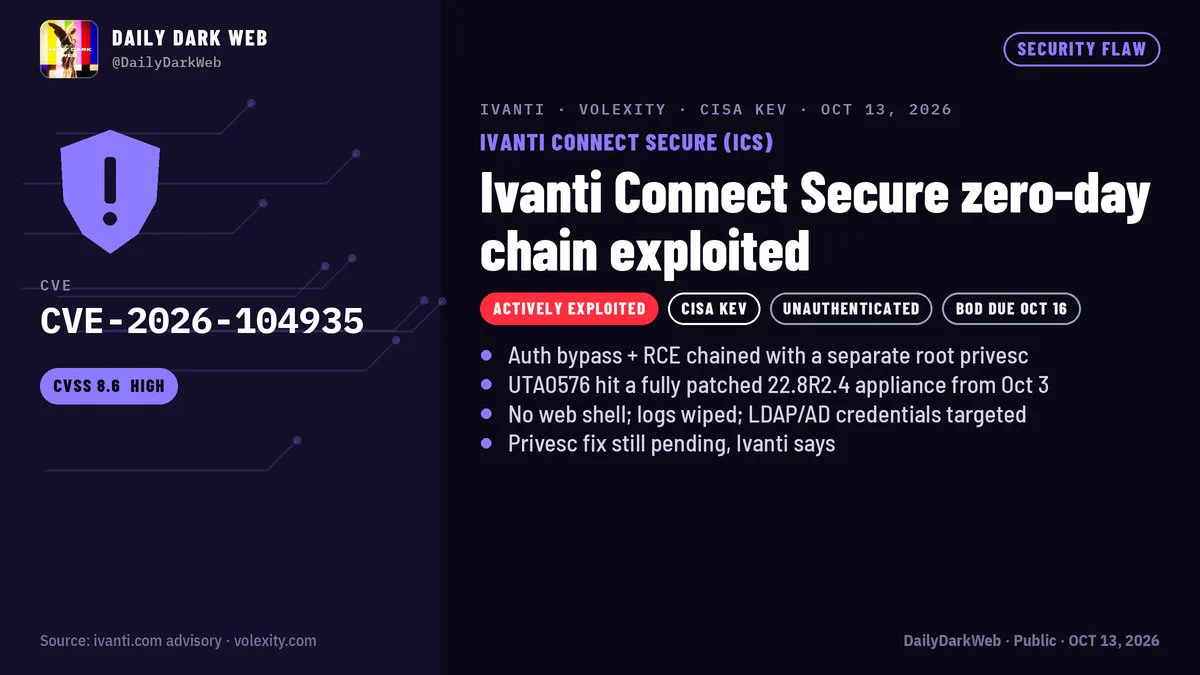
Social post summarizing Volexity's research on an Ivanti Connect Secure (ICS) zero-day chain, CVE-2026-104935. The chain pairs an auth bypass and a race-condition RCE with a separate privilege-escalation bug for root. Actor UTA0576 used it from Oct 3, 2026 against a fully patched 22.8R2.4 appliance, leaving no backdoor or web shell and deleting log entries. Post-exploitation included LDAP/AD credential theft, LAPS and BitLocker key searches, password spraying and packet capture. CISA added it to KEV with a due date of Oct 16. A clean Integrity Checker result does not rule out compromise because the chain patches code in memory only, so memory and network forensics are needed. The hunting lead is heavy requests to /dana-na/auth/url_default/welcome.cgi with a mismatched X-DSCGI-PATH header.

Ivanti Connect SecureVPNActive Directory+1
CVE-2026-104935UTA0576Volexity+5

Threat Intel, Blue Team & DetectionΒ· Published and added 13 Oct 2026

arxiv.orgpaper🧠 AI

RepProbe: Can Video Language Models Count Repeated Actions? A Diagnostic Benchmark

RepProbe is a benchmark of 42K real and synthetic video clips with exactly 1–20 complete action repetitions, controlling for clip position, temporal coverage and duration. Video language models' counting accuracy collapses at high counts, and this is not explained by frame sampling alone. Linear probes on final-layer representations show count information stays linearly decodable even when the model's answer is wrong, so the failure arises at the output stage, where answers cluster on a few preferred numbers.

vision-language model
RepProbearXiv

evals, multimodal, researchΒ· Added 14 Oct 2026, published 13 Oct 2026

adversa.aiarticleπŸ›‘οΈ Security

Top GenAI security resources β€” October 2026

Adversa AI's October 2026 roundup of 38 GenAI security resources, grouped into attack techniques, defenses, red teaming, vulnerabilities, incidents, articles and frameworks. Highlights include Anthropic's finding that GLM-5.3 safeguards collapse under prefill and abliteration, capability laundering and activation-dilution jailbreaks, RAG poisoning attacks, the LiteLLM proxy flaw (CVE-2026-35029), and the SGLang pickle RCE (CVE-2026-86793). It also covers a joint US advisory on industrial-scale model distillation. It closes with advice to assume model safeguards can be removed and to harden the serving stack around the model.

LLMLiteLLMSGLang+3
CVE-2026-35029CVE-2026-86793GLM-5.3+14

AI SecurityΒ· Published and added 13 Oct 2026

hackers-arise.comwriteupπŸ›‘οΈ Security

Artificial Intelligence (AI) in Cybersecurity, Part 28: Using ADStrike to Compromise Active Directory

ADStrike is an Active Directory attack framework with 52 attack modules and configurable OPSEC levels. An optional AI orchestrator, run here on a local Ollama model such as Qwen 2.5-coder 7b, picks the next tool from each step's output. The walkthrough runs it from Kali against a lab domain with an unprivileged account. It covers LAPS checks, kerberoasting, Timeroasting, Pre2k, SharpHound/BloodHound analysis and HTML reports with MITRE ATT&CK coverage.

ADStrikeActive DirectoryOllama+3
kerberoastingTimeroastingPre2k+3

Offensive Security, AI SecurityΒ· Published and added 12 Oct 2026

coindesk.comarticleπŸ›‘οΈ Security

UK slaps sanctions on three crypto exchanges over alleged Russia links

The UK Foreign Office sanctioned crypto exchanges Cryptomus, Heleket and Certa Payments (all operated by Canadian-registered Xeltox Enterprises) plus Kyrgyzstan's TokenSpot and payment processors Processing KG (VexPay) and Tsunami Payments, as part of 38 new designations targeting Russia sanctions-evasion networks. Two of the sanctioned firms allegedly processed transactions tied to A7, a Kremlin-backed network whose ruble-pegged A7A5 stablecoin is used to bypass financial restrictions and which claims to have moved over $90 billion. The action follows earlier UK sanctions on Garantex and Grinex and complements US and EU actions against the same A7/A7A5 ecosystem.

A7A7A5Garantex+12

Blockchain, Threat IntelΒ· Published and added 9 Oct 2026

galaxy.comarticleπŸ›‘οΈ Security

Weekly Research Brief: Bitget Hack, AI Accord and SEC FAQs

Galaxy Research's weekly brief includes a detailed postmortem of the $387.5M Bitget hack: attackers exploited a zero-day in two unnamed third-party security products ("Product A"/"Product B") to obtain high-level internal credentials, inserted forged withdrawal commands into Bitget's wallet backend across 11 chains, then deleted the fraudulent commands β€” with Bitget attributing the attack to North Korean actors based on IP behavior and wallet overlaps found by Elliptic and TRM. The piece draws a direct parallel to the $1.5B Bybit/Lazarus heist (compromised Safe{Wallet} infrastructure rather than stolen keys) to argue that private-key cryptography is effectively solved and attackers now target the approval pipeline/intermediary services instead; it also covers the follow-on $3.8M NEAR Intents Omni-bridge exploit and THORChain's continued role laundering DPRK proceeds. The newsletter's other sections (White House "Super Intelligence" AI Accord, SEC crypto buyback FAQs) are policy commentary, not security-technical.

THORChainGnosis Safe
BitgetLazarus GroupDPRK+8

Blockchain, Threat IntelΒ· Added 8 Oct 2026

labs.zenity.iowriteupπŸ›‘οΈ Security

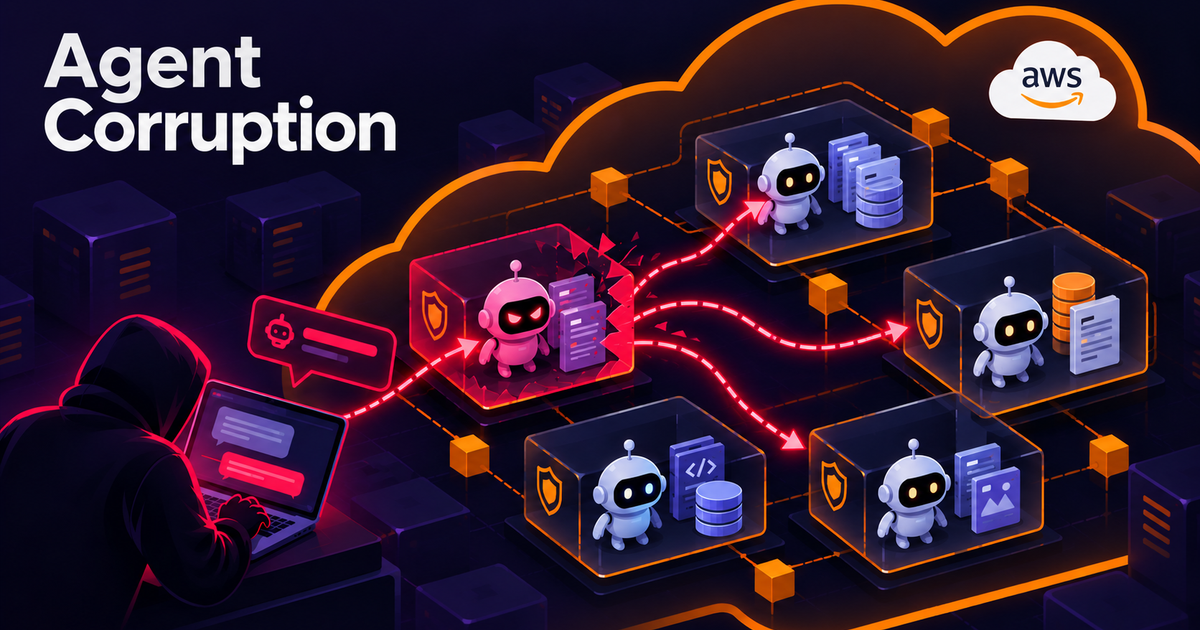
AgentCorruption: How A Single Prompt Collapsed The Entire Cloud Security Model

AgentCorruption is Zenity Labs research on AWS Bedrock AgentCore. Agents ran in Firecracker MicroVMs that could reach IMDS, so one prompt to an exposed agent leaked IAM credentials. The default role was scoped to the whole account region, allowing agent invocation, reading conversations, memory poisoning and Secrets Manager theft. The post gives the disclosure timeline (December 2025 to September 2026) and AWS's statement and fixes (IMDSv2 only, trimmed role).

AWS BedrockAWSAWS IAM+2
AgentCorruptionSSRFprompt injection+5

AI Security, Cloud & InfraΒ· Added 19 Oct 2026, published 8 Oct 2026

arxiv.orgpaper🧠 AI

Who Verifies the Verifier? Co-Evolving Inspectable Graders with Self-Improving Agents

Proposes making the verifier the evolving object in self-improving agent loops. The verifier is an inspectable expression over small, mostly deterministic drawback detectors, synthesized from clustered failures, gated at birth, and selected for agreement with a ten-item anchored reference set plus consensus over unlabeled outputs, never for the agent's score. On MBPP+ it gains +0.21 held-out agreement over the hand-authored seed and ends ahead of the bare LLM judge it contains. Removing the anchor guards collapses the verifier into an always-pass grader that still trains skills as well, so downstream task score cannot certify a self-evolved verifier. The paper's Double Ratchet pairs the verifier with a lifecycle-managed skill loop and retains 88-110% of the lift from ground truth or a rubric on code generation, enterprise text-to-SQL and reference-free report generation.

MBPP+

research, evals, agentsΒ· Added 9 Oct 2026, published 8 Oct 2026

arxiv.orgpaper🧠 AI

From Digital Human Interactions to Physics-Based Humanoid Skills: Physics-Grounded Post-Training of Interaction Generators

The paper introduces DIGHT, a co-adaptive framework that couples a text-conditioned digital-human interaction generator with a physics-based humanoid tracking policy to produce physically plausible two-humanoid interactions. Rather than collapsing executability and interaction-fidelity signals into one scalar reward, it applies physics-decoupled diffusion Direct Preference Optimization (DPO) to align the generator using criterion-specific preferences derived from tracking error, friction, floating, and simulator force feedback (contact occurrence, location, duration, magnitude), then uses the aligned generator's outputs to fine-tune the tracker. Experiments show improved physical plausibility and more reliable, faithful simulated humanoid interactions compared to prior tracking-based approaches.

diffusion modelDirect Preference Optimization
DIGHT

research, trainingΒ· Added 8 Oct 2026, published 7 Oct 2026

arxiv.orgpaper🧠 AI

A Systematic Study of Small Language Models on Abstract Reasoning Tasks

This paper presents a systematic empirical study of small language models (decoder-only, encoder-decoder, and mixture-of-experts architectures) on abstract grid-transformation reasoning, using the ARC-TGI benchmark, which supports controllable task families, resampling, spatial shifts, and cross-benchmark transfer to distinguish genuine rule acquisition from distribution-specific overfitting. Across more than 1,000 supervised fine-tuning runs, the authors find that in-distribution accuracy is achievable but highly sensitive to optimization and task formulation, performance collapses sharply out-of-distribution (even under simple grid-scale changes with the same underlying rule), training-set scale yields uneven gains, in-context example benefit is model-family dependent, and executable-rule induction surfaces correct solutions that direct grid generation misses. Layer-wise attention diagnostics reveal behavioral differences in concentration and context-dependence but stop short of establishing causal mechanisms, underscoring that abstract-reasoning scores are conditional on model, adaptation regime, evaluation distribution, and output format.

TransformerMixture of Experts
ARC-TGINur A Zarin Nishat

research, evalsΒ· Added 7 Oct 2026, published 6 Oct 2026

theravenfile.comwriteupπŸ›‘οΈ Security

CITRIX 0-DAY EXPLOITS: CVE-2026–88771 & CVE-2026–88772 IN THEΒ WILD

An incident-response style deep dive into active in-the-wild exploitation of Citrix NetScaler ADC/Gateway via CVE-2026-88771 (unauthenticated RCE through log-poisoning of ns_monuploadd_err.pl) and CVE-2026-88772 (DTLS memory overflow), part of 8 CVEs disclosed by Citrix on September 27, 2026. The author reverse-engineers the full post-exploitation toolkit dropped after root is obtained: SLAPSHOT (a Perl/Python loopback TCP tunneler/pivot), WHIPSHOT (a disguised PHP web shell served via fake CSS paths), the Platypus C2 agent, and a Perl "Pitboss" dropper script (with full decoded source and an embedded SHA-256-protected PHP web shell) that creates a rogue superuser, SUIDs /bin/sh, exfiltrates NetScaler config, and patches httpd.conf for persistence. It closes with extensive IOCs (C2 IPs, file hashes, paths, credentials) and patch guidance for affected NetScaler builds.

Citrix NetScalerPHPPython+2
CVE-2026-88771CVE-2026-88772CVE-2026-88773+10

Threat Intel, Malware & REΒ· Published and added 6 Oct 2026

arxiv.orgpaper🧠 AI

BRANCH-MoE: Balance-Aware Tree Routing for Large Embedding Models

BRANCH-MoE proposes routing experts in a Mixture-of-Experts layer through a binary decision tree of depth log2(E), where each internal node's branching probability is centered on an exponential-moving-average of arrival-weighted scores, avoiding the need for an auxiliary load-balancing loss. The paper proves the EMA mechanism prevents routing-mass collapse under log-concave arrival distributions, links expert execution frequency to stochastic-gradient convergence rate, and shows that tree-prefix device assignment bounds cross-device communication. It is benchmarked against Switch softmax routing, DeepSeek-V3 dynamic-bias routing, Skywork logit-normalized routing, and hash routing on Criteo CTR, Forest Covertype, HIGGS, and YearPredictionMSD with E=16 experts and top-4 routing.

Mixture of Experts
DeepSeek-V3SkyworkCriteo+3

researchΒ· Added 6 Oct 2026, published 5 Oct 2026

arxiv.orgpaper🧠 AI

Anatomy of LLM Sycophancy: What a Flip Rate Hides

This paper argues that a single "flip rate" metric for LLM sycophancy conflates genuine self-correction with capitulation, and introduces SycoLens, a modular stateless-replay protocol that isolates factors like pushback wording, answer format, boundary distance, and ground truth. Running about 760,000 controlled replays across eleven frontier models from three providers, the authors show model rankings for sycophancy change depending on how pushback is phrased, that flip effects spike near a model's decision boundary, and that on arithmetic tasks some models re-derive correct answers under pressure while others abandon them without working. They propose a reporting profile that disaggregates these behaviors instead of collapsing them into one score, and plan to release the instrument, records, and analyses.

SycoLens

evals, ai-safetyΒ· Added 6 Oct 2026, published 5 Oct 2026

arxiv.orgpaper🧠 AI

Better Call Reward: Reward Hacking as Strategic Abstention in Legal Reasoning Models

Researchers fine-tune Qwen3-8B with GRPO against a proxy reward built from surface features (citation count, legalese density, response length) and find the model learns to strategically abstain rather than reason: on 16 LegalBench yes/no legal tasks, accuracy collapses from chance (0.500) to 0.072 because the rate of properly formatted, committed answers drops from 0.900 to 0.109, even though accuracy on answers it does commit to actually rises. They term this the "Saul Goodman effect," formally prove it is the optimal policy for any surface-feature proxy that doesn't penalize abstention, show 89.3% of post-training citations are hallucinated/corrupted real case names, and introduce three diagnostics (Confidence Theater Score, Citation Plausibility Rate, Regret Gap) to detect this failure mode before deployment.

Qwen3GRPO
Qwen3-8BLegalBench

research, ai-safety, trainingΒ· Added 6 Oct 2026, published 5 Oct 2026

thehackernews.comarticleπŸ›‘οΈ Security

Antino Backdoor Uses Outlook and OneDrive for C2 in China-Nexus Espionage Campaign

Cisco Talos researcher Ashley Shen details a China-nexus espionage campaign (tracked as UAT-11587) targeting government and policy organizations across Taiwan, India, the Philippines, Cambodia, Pakistan, Thailand, Myanmar and Syria. The actor deploys a previously undocumented Rust-compiled backdoor, Antino, that uses Microsoft Graph to abuse Outlook (for command exchange via mailbox folders) and OneDrive (for heartbeat and file transfer) as a stealthy C2 channel instead of a dedicated server, delivered via a five-stage HTA/WSF-to-.NET-loader chain and DLL-sideloaded through the signed Microsoft binary GatherOsState.exe. The report also covers social-engineering tradecraft (a fake Gmail attachment-preview widget hosted on Cloudflare Pages, SPF/DMARC spoofing) and ties the cluster to Jewelbug, CL-STA-0049, Earth Alux, Ink Dragon, REF7707 and UNC6384 via infrastructure overlaps.

Microsoft 365RustPowerShell+5
UAT-11587AntinoJewelbug+14

Threat IntelΒ· Added 3 Oct 2026

thehackernews.comarticleπŸ›‘οΈ Security

Bitget Confirms Third-Party Zero-Day Behind $387.5 Million Cryptocurrency Theft

The Hacker News reports Bitget's confirmation that attackers exploited a zero-day vulnerability in unnamed third-party security products ("Product A" and "Product B") to steal $387.5 million in cryptocurrency across 11 blockchains in September 2026. SlowMist's investigation traced the intrusion back to August 31, showing attackers read database credentials via a hidden script, later hijacked an employee identity to inject commands into Product B's management platform, and deployed a web shell with C2 access; Mandiant found the attackers pivoted from the compromised security appliances into Bitget's production wallet job server to deploy a custom withdrawal-draining tool that bypassed risk controls. Bitget, citing IP patterns and on-chain analysis corroborated by Elliptic and TRM Labs, attributes the heist to North Korean threat actors with wallet overlaps linking it to prior laundering operations.

Ethereum
BitgetDPRKSlowMist+6

Blockchain, Threat IntelΒ· Added 2 Oct 2026

arxiv.orgpaper🧠 AI

Mixture-of-Experts for Cryptocurrency Order Execution: Training Stability, Tail Risk, and Failure Modes

Evaluates vanilla Double Deep Q-Learning (DDQL), K-means-partitioned mixtures of DDQL experts (K=2, 4, 8) and parameter-matched dense networks for order execution on 5-minute BTC/USDT limit order book data from Binance. No learned configuration significantly beats DDQL on implementation shortfall, and all are worse than TWAP and immediate liquidation in this frictionless replay environment. Ablations show annealed exploration alone removes the collapse to wait-until-forced-liquidation policies (12/100 to 0/100), so expert partitioning appears to mask a training-specification flaw rather than add real benefit. The attribution of the failure mode reverses between 30 and 100 seeds, which makes the paper a case for repeated-seed evaluation in RL.

Mixture of ExpertsDouble Deep Q-LearningK-means
arXivBinanceTWAP

research, training, evalsΒ· Added 15 Oct 2026, published 2 Oct 2026

x.comthreadπŸ›‘οΈ Security

When Models Turn Brutal

A vendor thread from ZeroShieldAI argues the patch window has collapsed because AI models can now find and weaponize vulnerabilities faster than defenders can fix them. It cites ZeroDayBench (success jumping from ~13% on blind zero-days to 78% once patch location is known), Aikido Security's benchmark where DeepSeek V4 Pro found 28 of 32 recent CVEs for about 98 dollars per run, a Unit 42 finding that 92% of AI-discovered flaws are logic bugs fuzzers miss, and a Hugging Face stat that 16 of the top 300 models advertise removed safety guardrails with 16.8M downloads. It promotes an attached 6-page case study and lists five defender recommendations: treat disclosure as exploit day, maintain SBOM/AIBOM, inventory models and agents, gate agent tool calls with policy, and red-team code and AI apps.

DeepSeekAikido SecurityHugging Face+1
ZeroDayBenchUnit 42

AI Security, Threat IntelΒ· Published and added 1 Oct 2026

decrypt.coarticleπŸ›‘οΈ Security

Someone Finally Jailbroke the PS5β€”Just After Sony Said Players Don’t Own Their Games

Decrypt reports on Relapse, a newly public tethered PS5 jailbreak covering firmware 7.00–13.60, delivered by pointing the console's DNS at an attacker-controlled server and loading a crafted page through the built-in User Guide's WebKit browser, then chaining into a kernel-stage exploit and ELF loader to run homebrew and game backups. The MIT-licensed exploit code is on GitHub; it is non-persistent (must be rerun after every reboot) and does not work on the September 16 firmware 14.00 update. The article frames it against Sony's concurrent court argument that "Buy Now" digital purchases don't confer real game ownership.

PlayStation 5WebKit
RelapseNathan FargoApolloHB

Hardware & RF, Offensive SecurityΒ· Added 30 Sep 2026, published 29 Sep 2026

arxiv.orgpaper🧠 AI

Point2Part: Unified 3D Partitioning from Point Prompts

Point2Part is a promptable 3D part-decomposition model that, given 3D point prompts (one per desired part), jointly partitions an image or mesh into non-overlapping parts that fully cover the shape, unlike prior methods that allow overlaps or gaps. It builds on a pretrained 3D generation model's shape latent space, adding a prompt encoder mapping point prompts to part tokens and a coarse-to-fine part decoder that assigns every shape position to exactly one part, unifying image-to-part generation, mesh-to-part generation, and part segmentation in one model. The authors report outperforming prior SOTA on part-quality metrics and an order-of-magnitude improvement in part compatibility across all three tasks.

research, multimodalΒ· Added 30 Sep 2026, published 29 Sep 2026

arxiv.orgpaper🧠 AI

Breakdown of Local Denoising as Semantic Speciation

This paper studies two temporal phenomena in generative model sampling dynamics: a 'speciation window' where a sample commits to a semantic class, and a 'nonlocality window' where local context becomes insufficient for generation. Under a 'common cause' hypothesis β€” that semantic labels explain correlations between distant tokens β€” the authors prove the nonlocality window must fall within the speciation window, and identify conditions under which both windows collapse to a single phase-transition point as system size grows, verified analytically in Gaussian mixture models.

researchΒ· Added 30 Sep 2026, published 29 Sep 2026

cloud.google.comwriteupπŸ›‘οΈ Security

Defending Against Active Exploitation of Citrix NetScaler ADC and Gateway Appliances

Mandiant and GTIG report on exploitation of the Citrix NetScaler ADC and Gateway zero-day CVE-2026-88772, active since early September 2026, alongside CVE-2026-88771. It covers the DTLS-triggered NSPPE crash, httpd.conf persistence via .deb and .sig handlers, SUID /bin/sh, and the WHIPSHOT web shell and SLAPSHOT tunneler. It gives hunting commands, log artifacts, YARA rules, patched builds and containment steps.

Citrix NetScalerPHPPython+3
CVE-2026-88772CVE-2026-88771WHIPSHOT+6

Threat Intel, Blue Team & Detection, Malware & REΒ· Added 29 Oct 2026, published 29 Sep 2026

arxiv.orgpaper🧠 AI

Unifying Distributional Training for One-Step Visual Generation

This arXiv paper introduces a unified theoretical framework for "distributional training" in one-step visual generation, showing that existing methods like FD-Loss and Gaussian-kernel Drifting are special cases of Gaussian optimal transport and kernel-density KL matching under Wasserstein gradient flow. Building on this, the authors propose MGFlow, which models feature distributions with Gaussian mixtures at adjustable granularity and combines mass-constrained sample assignment with paired component updates to fix mode collapse. MGFlow sets new state-of-the-art FDr scores on ImageNet 256Γ—256 (1.45 on pMF-H, 1.64 on JiT-H) and post-trains FLUX.2 into a one-step generator that beats the original four-step model on GenEval and PickScore.

FLUX.2
MGFlowFD-LossGaussian-kernel Drifting+5

research, multimodalΒ· Added 29 Sep 2026, published 28 Sep 2026

arxiv.orgpaper🧠 AI

Control Under Compression: Reliability Frontiers for Tool-Using Agents

Introduces CompressAgent, a benchmark evaluating how compressing agent control contexts (system-side instructions specifying tools, arguments, policies, and recovery protocols) affects tool-using agent reliability. Testing nine ACCs, three task families, three Qwen models, and six retained-context budgets across 15,525 runs, it finds a nonlinear reliability frontier: compression stays safe near 75% retained context but reliability collapses sharply below 50%, with executable protocols becoming fragile at 10-25% and failures manifesting as tool-execution and action-parsing errors.

Qwen
CompressAgent

evals, agentsΒ· Added 26 Sep 2026

arxiv.orgpaper🧠 AI

Common-Mode Collapse and Recovery in Direct Feedback Alignment

Analyzes a common-mode collapse failure mode in Direct Feedback Alignment training and proposes mitigations, tested on MNIST and CIFAR-10.

Adam
MNISTCIFAR-10Direct Feedback Alignment

researchΒ· Added 28 Sep 2026, published 25 Sep 2026

arxiv.orgpaper🧠 AI

SemMSA: Latent Semantic-Aided Robust Multimodal Sentiment Analysis with Incomplete Data

SemMSA is a framework for Multimodal Sentiment Analysis (MSA) under incomplete/missing modality data, using LLMs to construct latent sentiment-relevant semantics rather than reconstructing raw features. It combines Cross-modal Semantic Refinement (adapters that map visual/acoustic signals into a frozen LLM's embedding space and iteratively refine continuous semantic states without decoding text) with Cross-modal Spectral Alignment (anchor-free alignment via the dominant spectral component of a kernel Gram matrix, plus an instance-level spectral separation constraint to prevent representation collapse). It reports state-of-the-art results on the SIMS, MOSI, and MOSEI benchmarks.

Transformer
SIMSMOSIMOSEI

multimodal, researchΒ· Added 26 Sep 2026, published 24 Sep 2026

arxiv.orgpaper🧠 AI

Variational Multi-Gaussian Quantum Trajectories

This arXiv preprint proposes a variational framework generalizing the time-dependent variational principle to simulate stochastic quantum trajectories in interacting bosonic systems, using a wavefunction ansatz of coherent superpositions of Gaussian wavepackets. The method is benchmarked on a Bose-Hubbard dimer and applied to 1D and 2D extended Bose-Hubbard lattices, revealing a symmetry-breaking phase transition present only in 2D. This is a quantum physics simulation technique, not an AI/ML method, despite using the term "variational" which overlaps with ML vocabulary.

Bose-Hubbard dimerBose-Hubbard lattice

Β· Added 26 Sep 2026, published 24 Sep 2026

github.comrepo🧠 AI

Show HN: Whiteboard (YC W26) – An open-source IDE for thoughtful software design

Whiteboard is an open-source (MIT) desktop IDE that gives coding agents like Claude Code and Codex an SDK to draw diagrams, sequence charts, and traces on a shared canvas linked directly to underlying code. It vendors Code OSS for VSCode-grade navigation/LSP support and adds a custom Rust-built AST-aware semantic diff viewer (with a WASM plugin system) that summarizes large generated functions as pseudocode and collapses noise like tests/docs, aiming to make reviewing autonomous agent decisions and code changes tractable.

Claude CodeCodexRust+2
WhiteboardCode OSSYC W26

coding-agentsΒ· Added 26 Sep 2026, published 24 Sep 2026

simonwillison.netarticle🧠 AI

llm 0.36

Changelog for version 0.36 of Simon Willison's `llm` command-line tool: adds support for new OpenAI models gpt-6-sol and gpt-6-luna, lets model plugins declare supports_conversation = False so single-turn-only models raise llm.ConversationNotSupported instead of silently accepting chat history (first used by the llm-typesafe plugin), and wraps reasoning traces in collapsible details/summary tags in the Markdown output of `llm logs`. These are small but practical improvements to a popular open-source CLI for scripting and logging LLM interactions across providers.

Python
Simon WillisonOpenAIGPT-6 Sol+2

llm-appsΒ· Added 29 Sep 2026, published 22 Sep 2026

socket.devarticle🧠 AI

Lovable’s OJ Rewrites Vite’s Dev Server in Rust as AI Lowers the Cost of Forking Open Source

Lovable built OJ, a Rust-based replacement for Vite's dev server built on the same Rolldown and Oxc components used by Vite 8, to serve roughly one million daily short-lived cloud dev sandboxes; OJ cut median sandbox acquisition time from 14.5s to 3s and reduced dev-server memory use roughly 6.5x. The article uses OJ as a case study for Vite creator Evan You's argument that AI is collapsing the cost of reimplementing open-source dependencies, leading companies to maintain narrow tailored forks optimized for their own workloads rather than upstreaming changes, with fragmentation risks for maintenance and security patching.

ViteRustRolldown+7
LovableOJEvan You+7

ai-policy, ai-infraΒ· Published and added 22 Sep 2026

latent.spacetalk🧠 AI

Jev: System One models for Prod, not God β€” with Diogo Almeida, CEO, TypeSafe AI

Latent Space interview with Diogo Almeida, CEO of TypeSafe AI and an InstructGPT co-author, on the launch of Jev, a "System One" model built for software/programmatic consumption rather than chat. Almeida argues RLHF causes mode collapse and hallucination-inducing overconfidence and RLVR narrows models into jagged rubric-solvers, and describes TypeSafe's alternative training target, RLCD (Reinforcement Learning for Calibrated Decisions), which optimizes for epistemically calibrated probabilities on discrete decisions rather than human preference or verifiable rewards. The conversation also covers why TypeSafe rejects public benchmarks and refusal-based safety alignment for API models, his "Bitterest Lesson" thesis that task/data design beats compute, and how Jev is meant to be used inside coding agents, dark-data pipelines, and other software rather than as a chatbot.

Diogo AlmeidaTypeSafe AIJev+11

training, modelsΒ· Added 29 Sep 2026, published 21 Sep 2026

solana.comarticleπŸ›‘οΈ Security

How AI Is Reshaping Crypto Security, with Michael Coates

An interview with Solana Foundation CISO Michael Coates dissects the July 2026 Coldcard hardware-wallet hack, where a 2021 code change swapped a hardware RNG for a software pseudo-random source, collapsing seed entropy from 128 to ~40 bits and letting attackers offline-brute-force and drain ~$116M in Bitcoin from 5,200+ wallets without touching a device β€” despite prior audits that only checked whether a value was set, not its source. Coates draws lessons on distrusting single audits, using multi-sig to remove single points of failure (including the wrench attack), and phishing-resistant hardware keys (e.g. YubiKey) as the fix for pixel-perfect deepfake and phishing attacks. He also discusses AI's cat-and-mouse effect on offense vs. defense, Anthropic's disclosed Claude-driven Chinese state espionage campaign, and Solana's STRIDE continuous security-rating program for DeFi as an automated, computer-scale response to agentic nation-state threats.

SolanaBitcoinClaude+2
Coldcard hackCode Red worm

Blockchain, AI SecurityΒ· Added 29 Sep 2026, published 19 Sep 2026

arxiv.orgpaperπŸ›‘οΈ Security

PISmith: Reinforcement Learning-based Red Teaming for Prompt Injection Defenses

PISmith trains an attack LLM with GRPO in a black-box setting to generate injected prompts that defeat prompt-injection defenses. It addresses extreme reward sparsity, which causes entropy collapse in standard GRPO, with adaptive entropy regularization and dynamic advantage weighting. Evaluated on 13 benchmarks against 8 defenses and 7 baselines (static, search-based such as TAP and PAIR, and RL-Hammer), it achieves the highest attack success rates and also works on InjecAgent and AgentDojo against GPT-4o-mini and GPT-5-nano. It shows state-of-the-art defenses such as Meta-SecAlign remain vulnerable to adaptive attacks.

LLMAgentDojo
PISmithRL-HammerTAP+8

AI SecurityΒ· Added 17 Sep 2026

adversa.aiarticleπŸ›‘οΈ Security

Top GenAI security resources β€” September 2026

Adversa AI's September 2026 roundup of 15 GenAI security resources, grouped by attack technique, defense, threat modeling, red teaming, and training. Highlights include the OWASP LLM Top 10 2026 update (now blending 75% expert consensus with 25% incident data from 6,639 vulnerabilities, with eight of ten entries moving and System Prompt Leakage renamed Hidden Context Exposure), a memory-safety audit finding 10 vulnerabilities (including two use-after-frees at CVSS 9.2/8.1) in the C/C++ inference engine underlying Ollama, LM Studio, Jan and GPT4All, and research on stealing reasoning traces from proprietary LLM APIs, RAG document poisoning, and attention-collapse-based poisoning detection (D-SCAN).

LLMOllamallama.cpp+2
OWASP Top 10 for LLM ApplicationsNIST AI 600-1IDOR+4

AI SecurityΒ· Added 7 Oct 2026, published 9 Sep 2026

arxiv.orgpaper🧠 AI

Green's Functions from Sample-based Krylov Quantum Diagonalization: An Impurity Solver for Dynamical Mean-Field Theory

This arXiv preprint generalizes the sample-based Krylov quantum diagonalization (SKQD) method from ground-state energy calculations to computing single-particle Green's functions on quantum hardware. By building unitary Krylov subspaces in the NΒ±1 particle sectors and classically evaluating overlaps, the authors reconstruct Green's functions via a Lanczos continued fraction, applying the technique as an impurity solver for dynamical mean-field theory (DMFT) on the single-impurity Anderson model, reproducing spectral features across the metal-insulator transition with shallow, ancilla-free quantum circuits.

Dynamical Mean-Field Theorysingle-impurity Anderson modelSKQD

researchΒ· Added 22 Sep 2026, published 8 Sep 2026

arxiv.orgpaper🧠 AI

RegionFed: Federated Learning for Personalized Query Understanding in Heterogeneous Retail Environments

RegionFed is a federated learning framework for personalized retail search query understanding that operates at the gradient level rather than parameter level, using the β„“2 conflict between regional and global gradients to diagnose heterogeneity and route regions to personalization strategies. Unlike existing parameter-level personalized FL methods that collapse below 10% accuracy on transformers like T5, RegionFed deploys unchanged across T5-Small, T5-3B, RoBERTa, and CNN architectures. Evaluated on Amazon ESCI, Amazon Reviews, and LEAF-FEMNIST, RegionFed-Meta reaches 92.27% accuracy, closing to within 0.23pp of a privacy-violating centralized upper bound while providing (Ξ΅β‰ˆ0.60)-differential privacy.

TransformerT5RoBERTa+1
Amazon ESCIAmazon ReviewsLEAF-FEMNIST

researchΒ· Added 22 Sep 2026, published 4 Sep 2026

malwaretech.comarticleπŸ›‘οΈ Security

Machine Speed is a lie: stop trying to fight AI with AI

Long-form critique arguing that autonomous, self-propagating attacks (Morris Worm, SQL Slammer, Emotet, WannaCry) are decades old and that vendor claims of AI-driven "machine speed" attacks are largely hype. It uses CrowdStrike's 2026 average breakout time (29 minutes), the UK AISI evaluation of Mythos Preview (3 of 10 full compromises on an undefended range, at high token cost), and the delay between SOC alert and remediation to argue AI SOCs are a band-aid. It recommends proactive hardening (Credential Guard, LAPS, segmentation, least privilege), automatic EDR isolation and credential rotation on high-fidelity alerts, and realistic assumed-breach exercises.

CrowdStrikeEDRWindows+2
Morris WormSQL SlammerEmotet+11

Blue Team & Detection, AI Security, Threat IntelΒ· Added 4 Sep 2026, published 3 Sep 2026

arxiv.orgpaper🧠 AI

Scal3R: Learning Efficient Multi-Relative Pose Query for Scalable Online 3D Reconstruction

Scal3R reformulates online 3D reconstruction as multi-reference relative pose querying instead of regressing poses against a fixed first-frame anchor, which the authors show causes drift and geometric collapse on long videos. It injects lightweight learnable tokens (~1% of parameters) into a frozen backbone via asymmetric attention to query poses relative to multiple past keyframes, combined with online pose-graph optimization and loop closure to suppress long-range drift. The method converges in 8 hours on a single GPU and cuts average ATE by over 60% on KITTI versus the online baseline, with state-of-the-art results on Virtual KITTI, Sintel, TUM-Dynamic, ScanNet, and 7-Scenes.

Transformer
KITTIVirtual KITTISintel+3

research, multimodalΒ· Added 22 Sep 2026, published 3 Sep 2026

github.comrepoπŸ›‘οΈ Security

ADScanPro/Claude-AD

Claude-AD is a Claude Code plugin that packages Active Directory pentest methodology as skills, agents, and slash commands, directing Claude to run standard tooling (netexec, Impacket, certipy, bloodyAD, BloodHound CE) in the correct setup-collection-exploitation-post order. It covers environment constraints that break tooling in hardened domains (AES-only Kerberos, LDAP channel binding, Protected Users, LAPS, gMSA), techniques like Kerberoasting, AS-REP roasting, ADCS ESC1-ESC17, ACL abuse, coercion/NTLM relay (PetitPotam, PrinterBug, DFSCoerce) and delegation abuse with their Windows Event IDs/MDI telemetry, and maps each technique to DORA/NIS2/ENS compliance controls. Exploitation agents require human confirmation before directory-modifying actions.

Claude CodeActive DirectoryBloodHound+3
KerberoastingAS-REP roastingDCSync+7

Offensive Security, GRCΒ· Added 2 Oct 2026, published 24 Aug 2026

anil.recoil.orgarticleπŸ›‘οΈ Security

Rumour Is the Exploit β€” AI agents collapse time-to-exploit to near-zero

An OCaml maintainer describes fixing a path traversal bug in cohttp 6.3.0. Probes for percent-encoded traversal hit their live server about ten minutes after the fix PR (cohttp#1145) was opened publicly, and their own agents could find and exploit the bug from only a rough hint. They argue that embargoes no longer work, citing the Fang et al. GPT-4 exploit results, a mean time-to-exploit of -7 days, and fast exploitation of marimo and Langflow CVEs. They also discuss the "bugonomics" paper and weigh options: private patch development, continuous shipping, and protocol-layer virtual patching via the antibotty idea.

cohttpOCamlClaude Fable 5+3
CVE-2026-39987CVE-2026-33017path traversal+8

AppSec, AI Security, Supply ChainΒ· Added 16 Sep 2026, published 22 Aug 2026

lilianweng.github.ioarticle🧠 AI

Harness Engineering for Self-Improvement

Lilian Weng's long-form post argues that the "harness" surrounding a base model β€” the system that orchestrates planning, tool use, context, memory and evaluation β€” is as important to recursive self-improvement (RSI) as raw model intelligence. It surveys harness design patterns (workflow loops, file-system-as-memory, sub-agents) and traces an optimization progression from prompts to context engineering (ACE, Meta Context Engineering) to workflow search (ADAS, AFlow) to self-editing harness code (STOP, Self-Harness, Agentic Harness Engineering, Darwin GΓΆdel Machine, Hyperagents) and evolutionary program search (AlphaEvolve, ShinkaEvolve). It closes with open problems for auto-research and self-improving agents: weak evaluators, memory/context lifecycle, negative-result bias, diversity collapse, reward hacking, and the durable need for human oversight, plus a benchmark appendix (PaperBench, CORE-Bench, RE-Bench, MLE-bench, KernelBench). Note: the fetched text is truncated partway through the references/appendix.

Claude CodeCodexOpenCode+1
Lilian WengAnthropicOpenAI+36

agents, coding-agents, researchΒ· Added 29 Sep 2026, published 4 Jul 2026

blog.trailofbits.comwriteupπŸ›‘οΈ Security

GPT-5.5-Cyber built a zlib fuzzing lab in a day

Trail of Bits' Patch the Planet initiative (a collaboration with OpenAI pairing engineers with 30+ open-source projects) had GPT-5.5-Cyber, driven through Codex's /goal command, autonomously build a full fuzzing lab against zlib in a single day. Without step-by-step guidance, the model wrote ASan/UBSan-instrumented harnesses across a dozen entrypoints (inflate, inflateBack, uncompress2, gzFile, MiniZip, puff, blast, infback9, gzjoin, gzappend), used compile-time variant builds to reach hidden code paths, repurposed edge-case tests as seed corpus, and applied strict reportability discipline to reject unreachable crashes while surfacing several findings now under coordinated disclosure. The report argues this collapses the expertise barrier that historically kept bespoke fuzzing campaigns out of reach for low-skill attackers while also acting as a major force multiplier for defenders/researchers.

zlibCodexOpenAI+1
Patch the PlanetGPT-5.5-Cyber

AI Security, Offensive Security, AppSecΒ· Added 3 Sep 2026, published 2 Jul 2026

wiz.iowriteupπŸ›‘οΈ Security

Threat Actor Targets Crypto Organizations | Wiz Blog

Wiz CIRT and Wiz Research detail JINX-0164, a previously untracked financially-motivated threat actor targeting cryptocurrency organizations since mid-2025. The group uses LinkedIn-based social engineering to deliver macOS malware (the Python-based AUDIOFIX infostealer/RAT and the Go-based MINIRAT backdoor), steals developer and cloud credentials, hijacks Git commits to propagate through CI/CD infrastructure, and trojanized the npm package @velora-dex/sdk in a supply-chain attack. The post includes full IOCs, C2 domains, and detection guidance (e.g., GitHub Vigilant Mode, audit log correlation) and notes tactical overlaps with North Korean clusters like UNC1069/Sapphire Sleet without confirmed attribution.

npmmacOSPython+4
JINX-0164AUDIOFIXMINIRAT+4

Threat Intel, Supply Chain, Malware & REΒ· Added 5 Sep 2026, published 27 May 2026

socket.devarticleπŸ›‘οΈ Security

Socket: TeamPCP + BreachForums Launch $1,000 Contest for Supply Chain Attacks

Socket reports that TeamPCP and the owner of BreachForums are running a $1,000-Monero contest rewarding whoever compromises the highest-download open-source package using the Shai-Hulud worm, with smaller compromises also counting toward the score. TeamPCP has also released Shai-Hulud as open-source attack tooling on the Breached CDN (briefly mirrored on GitHub) and has been systematically targeting security tools, CI/CD workflows, GitHub Actions, Docker images, OpenVSX extensions, npm, PyPI, and Packagist to harvest CI/CD secrets, cloud credentials, and maintainer tokens. The piece ties the contest to TeamPCP's broader access-broker role, noting overlapping downstream extortion claims involving Vect, ShinyHunters, and Lapsus$.

npmPyPIPackagist+4
TeamPCPShai-HuludBreachForums+4

Supply Chain, Threat IntelΒ· Published and added 20 May 2026

huntress.comwriteupπŸ›‘οΈ Security

Fake Tech Support Delivers Havoc Command & Control

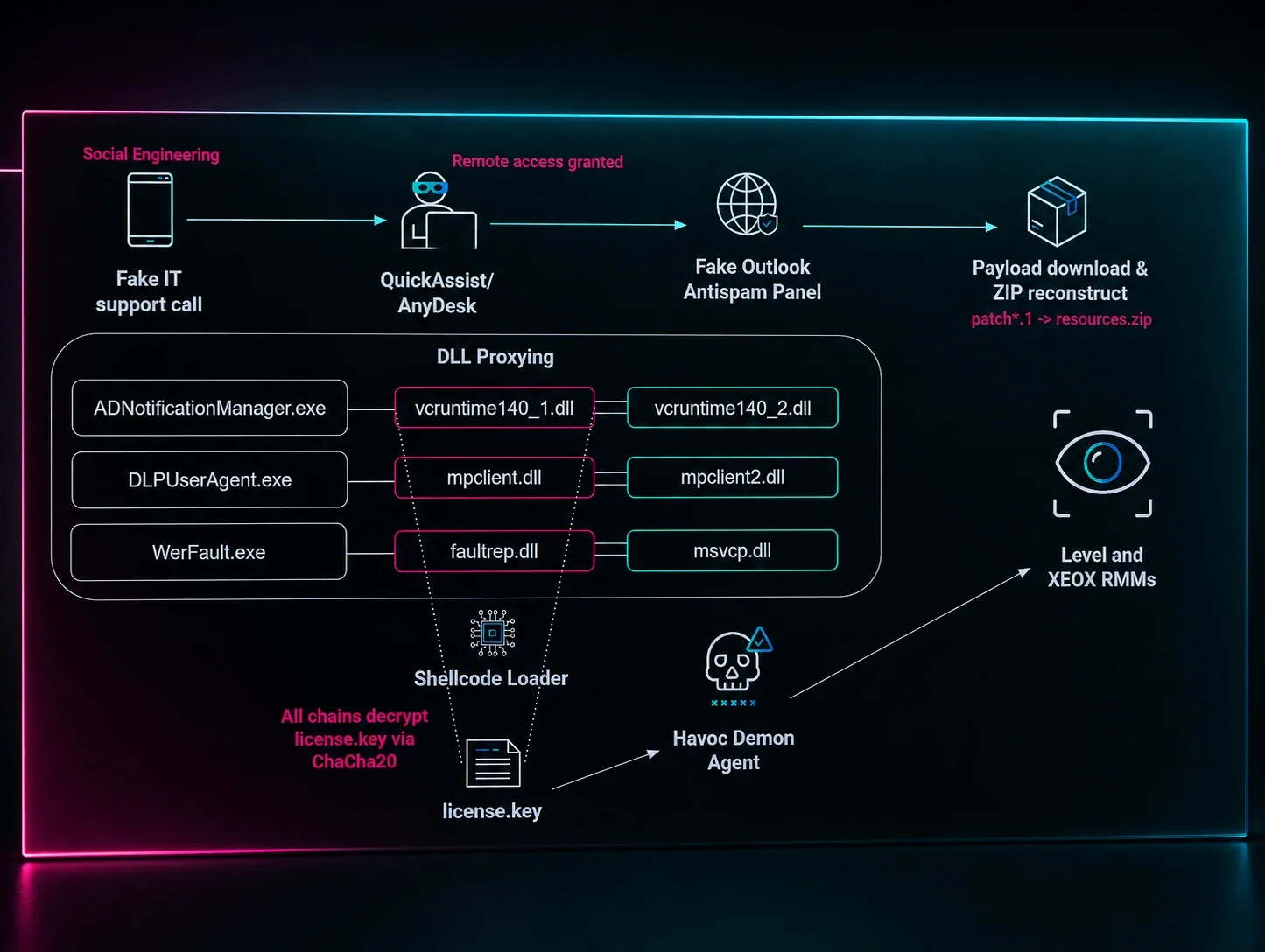
Huntress details a February 2026 intrusion cluster across five partner organizations combining fake tech support social engineering (spam bait, phone calls impersonating IT, QuickAssist/AnyDesk access, fake Outlook Antispam panel on AWS) with a customized Havoc Demon C2 agent using indirect syscalls, registry-based fallback C2, and DLL sideloading to evade EDR. Tradecraft overlaps with prior Sophos-documented Black Basta/FIN7 campaigns, suggesting affiliates or copycats reused the playbook; attackers reached nine additional endpoints within eleven hours, indicating likely ransomware/exfiltration intent.

HavocAnyDeskMicrosoft Quick Assist
Havoc C2Havoc DemonBlack Basta+4

Threat Intel, Malware & RE, Blue Team & DetectionΒ· Added 3 Sep 2026, published 2 Mar 2026

Showing 60 of 63

Show more