Skip to content

28 results for β€œRSA”

What you seeeverything
x.comadvisoryπŸ›‘οΈ Security

Dark Web Informer (@DarkWebInformer) on X

Veeam patched five vulnerabilities across Backup & Replication, Veeam Agent for Linux and Veeam ONE. The worst is CVE-2026-108142 (CVSS 9.1), an unauthenticated authorization bypass in the CDP Coordinator Service affecting Backup & Replication 13.0 and 13.1. Other fixes cover Linux agent privilege escalation, two path-traversal file writes, and a Veeam ONE MFA bypass; fixed builds are listed.

Veeam Backup & ReplicationVeeam Agent for LinuxVeeam ONE+1
CVE-2026-108142CVE-2026-105477CVE-2026-108140+3

AppSec, Identity & AccessΒ· Added 30 Oct 2026, published 28 Oct 2026

cisa.govadvisoryπŸ›‘οΈ Security

#StopRansomware: SafePay Ransomware (AA26-293A)

CISA advisory AA26-293A (20 October 2026) details SafePay ransomware, active since August 2024 with at least 600 victims across critical infrastructure. It covers initial access via Mullvad VPN IPs, phished profiles and edge-device CVEs, LOTL lateral movement with PsExec, WinRM and RDP, exfiltration with RClone and WinSCP, and ChaCha20/RSA encryption. It lists IOCs, MITRE ATT&CK mappings, incident response steps and mitigations.

MITRE ATT&CKRDPAnyDesk+3
CVE-2020-3259CVE-2023-20269SafePay+11

Threat Intel, Blue Team & DetectionΒ· Added 21 Oct 2026
x.comadvisoryπŸ›‘οΈ Security

lee1981 (@lee1981b) on X

Daily CVE digest on CVE-2026-76519, a CVSS 9.8 relative path traversal (CWE-23) in Cisco Secure Email Gateway's AMP File Reputation attachment processing. A crafted attachment gives unauthenticated arbitrary file writes and root command execution, and Cisco PSIRT reports active exploitation. The CVE is in CISA KEV. It lists the applicability conditions (File Reputation assigned to a policy and Content Scanner Tools earlier than 25.3.0.5525) and the fixes (scanner 25.3.0.5525, AsyncOS 15.5.5-014 and 16.5.0-780). It also covers evidence preservation, reading Cisco's System Security scan outcomes, mail/AMP log correlation, and deployment-specific recovery including cluster-key exposure.

Cisco Secure Email GatewayCisco AsyncOSCVSS+2
CVE-2026-76519CWE-23CISA KEV+4

Blue Team & Detection, Threat IntelΒ· Added 18 Oct 2026, published 15 Oct 2026

orca.securityadvisoryπŸ›‘οΈ Security

Critical Atlassian Path Traversal Exposes Sensitive Files Across 8 Products

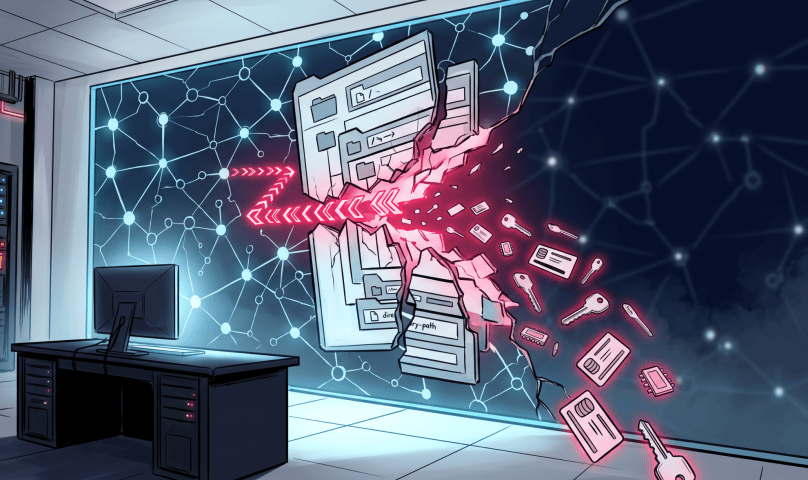
Orca Security details CVE-2026-21589 (CVSS 9.3), a critical unauthenticated path traversal flaw affecting all versions of eight Atlassian Data Center and Server products: Bitbucket, Confluence, Jira Software, Jira Service Management, Bamboo, Crowd, Crucible, and Fisheye. Insufficient path validation lets remote attackers read arbitrary files within the web application root without authentication, and in Crowd SSO deployments this can expose plaintext credentials usable to create administrative accounts and take over the entire Atlassian ecosystem. The advisory lists fixed versions for each product and recommends WAF rules and log review for organizations unable to patch immediately.

JiraConfluenceBitbucket+3
CVE-2026-21589path traversal

AppSec, Identity & AccessΒ· Published and added 7 Oct 2026

watchtowr.comadvisoryπŸ›‘οΈ Security

Atlassian Jira, Confluence (and more) Arbitrary File Read Vulnerability (CVE-2026-21589)

CVE-2026-21589 is an unauthenticated arbitrary file read (path traversal) in eight Atlassian Data Center and Server products: Bitbucket, Confluence, Jira, Jira Service Management, Bamboo, Crowd, Crucible and Fisheye. Atlassian fixed it on 5 October 2026, and CISA added it to the KEV catalog on 15 October 2026. The page lists patching, WAF regex, Tomcat RewriteValve and urlrewrite.xml mitigations, and a log check for ".." sequences after up to two rounds of URL decoding.

JiraConfluenceBitbucket+3
CVE-2026-21589CISA KEVpath traversal+3

AppSec, Blue Team & DetectionΒ· Added 30 Oct 2026, published 6 Oct 2026

x.comadvisoryπŸ›‘οΈ Security

Dark Web Intelligence (@DailyDarkWeb) on X

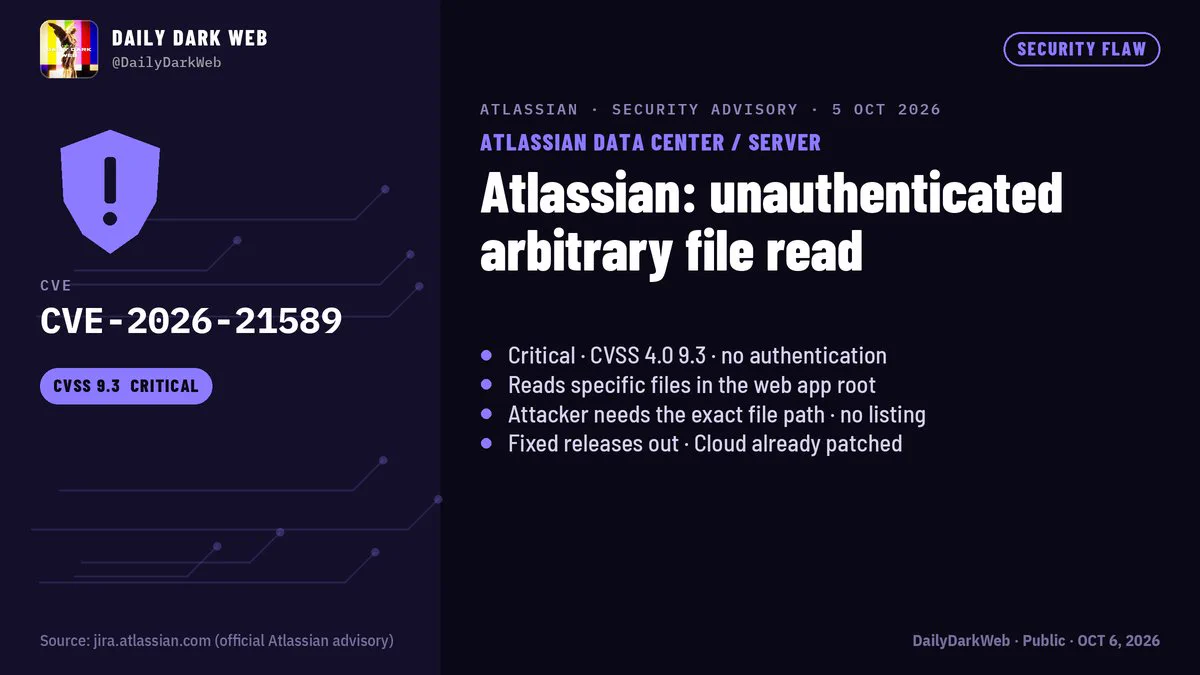
Atlassian disclosed CVE-2026-21589, a critical (CVSS 9.3) unauthenticated path traversal flaw allowing remote attackers to read specific files within the web application root across its self-managed Data Center/Server products β€” Jira Software, Jira Service Management, Confluence, Bitbucket, Bamboo, Crowd, Crucible, and Fisheye. Fixed versions are listed for each product (e.g. Jira 9.12.40/10.3.26/11.3.12, Confluence 9.2.26/10.2.19), and Atlassian Cloud is already patched; WAF/URL-rewrite mitigations are available for those who can't upgrade immediately. The post's analyst note clarifies exploitation requires knowing the exact target file path (no directory listing), and as of Oct 5, 2026 it is not yet in CISA KEV with no public exploit reported.

JiraConfluenceBitbucket+3
CVE-2026-21589path traversal

AppSecΒ· Added 7 Oct 2026, published 6 Oct 2026

cisa.govadvisoryπŸ›‘οΈ Security

CISA KEV: Fortinet FortiMail CVE-2026-104286 path traversal, actively exploited, no patch yet

CISA added CVE-2026-104286, a path traversal vulnerability in Fortinet FortiMail, to its Known Exploited Vulnerabilities Catalog on evidence of active exploitation. The alert restates the obligations of BOD 26-04 for Federal Civilian Executive Branch agencies: prioritise KEV CVEs on publicly exposed assets that give total control, and check for compromise before patching. It also describes the KEV nomination criteria: a CVE ID, evidence of exploitation and clear mitigation guidance. The page gives no technical detail, patch status or IOCs.

Fortinet FortiMailCISA KEV
CVE-2026-104286path traversalCISA+1

Threat Intel, GRCΒ· Added 4 Oct 2026

thehackernews.comadvisoryπŸ›‘οΈ Security

Critical FortiMail Zero-Day Flaw (CVE-2026-104286)

CISA added CVE-2026-104286 (CVSS 9.8), a path traversal and NULL-byte handling flaw in Fortinet FortiMail, to its Known Exploited Vulnerabilities catalog after confirming active in-the-wild exploitation. The bug lets unauthenticated attackers write arbitrary files via crafted HTTP/HTTPS requests, affecting FortiMail 7.2 through 8.0.1; Fortinet published workarounds (disabling IBE, restricting management-interface access) ahead of patches and shared attacker IPs and modified/added files as IOCs. The article also lists several other actively exploited vendor flaws disclosed the same week (Check Point, Arista VeloCloud, F5 BIG-IP APM, Cisco Catalyst SD-WAN Manager, Citrix NetScaler).

FortiMailCISA KEVCVSS
CVE-2026-104286CVE-2026-85102CVE-2026-93616+9

Threat Intel, AppSecΒ· Added 3 Oct 2026

cisa.govadvisoryπŸ›‘οΈ Security

CISA KEV Catalog Additions β€” Check Point, Arista VeloCloud, F5 BIG-IP (Sept 22, 2026)

CISA added four vulnerabilities to the Known Exploited Vulnerabilities catalog on 2026-09-22 based on evidence of active exploitation: two Check Point multi-product flaws (improper certificate validation CVE-2026-85102, path traversal CVE-2026-93616), an Arista VeloCloud Orchestrator improper input validation bug (CVE-2026-93952), and an F5 BIG-IP APM heap-based buffer overflow (CVE-2026-94127). The alert ties the additions to BOD 26-04, which has FCEB agencies prioritize remediation of KEV CVEs on publicly exposed assets that give total control, and to checking for prior compromise before patching.

CISA KEVCheck PointArista VeloCloud Orchestrator+1
CVE-2026-85102CVE-2026-93616CVE-2026-93952+4

Threat Intel, GRCΒ· Added 26 Sep 2026

nvd.nist.govadvisoryπŸ›‘οΈ Security

CVE-2026-65695: Office-Word-MCP-Server through 1

CVE-2026-65695 is a path traversal vulnerability (CWE-22, CVSS 4.0 7.6 HIGH) in Office-Word-MCP-Server through version 1.1.11, an MCP server that exposes Word document manipulation tools to LLM agents. Attackers who can influence the filename argument can supply absolute paths or ../ sequences to document open/save operations, bypassing the check_file_writeable and ensure_docx_extension helpers (which do no base-directory confinement or realpath validation) to read or overwrite arbitrary .docx files outside the intended working directory.

Model Context ProtocolNVDCVSS
CVE-2026-65695CWE-22path traversal+3

AI Security, AppSecΒ· Added 26 Sep 2026

wordpress.orgadvisoryπŸ›‘οΈ Security

WordPress 7.1.2 Release (CVE-2026-87902 path-traversal RCE fix)

WordPress 7.1.2 patches CVE-2026-87902 (GHSA-7hp8-65ch-5whp), a critical unauthenticated path-traversal flaw where page template resolution can be manipulated to include an attacker-chosen readable local PHP file outside the active theme directory. Under certain server and active-theme preconditions this local file inclusion escalates to remote code execution. The security fix was backported to all WordPress branches back to 4.7; discovery credited to researcher Robert Ressl.

WordPressPHP
CVE-2026-87902GHSA-7hp8-65ch-5whppath traversal+2

AppSecΒ· Added 28 Sep 2026, published 22 Sep 2026

orca.securityadvisoryπŸ›‘οΈ Security

Breaking: GitLab Critical Path Traversal Flaw Exploited in the Wild β€” Patch Immediately

Details CVE-2026-85706 (CVSS 10.0), an unauthenticated arbitrary file read in GitLab CE/EE's repository commits API exploitable via a crafted file.path parameter in a single POST request, requiring only that one public project exist on the instance. It also covers CVE-2026-87719 (CVSS 9.9), an authenticated insecure deserialization bug in GitLab EE's GraphQL subscription serializer reachable via Duo Chat access that leaks stored Elasticsearch/OpenSearch credentials. Both affect GitLab versions through 19.3.1; CVE-2026-85706 is under active internet-wide scanning per WatchTowr Labs and is in CISA's KEV catalog with a federal patch deadline, with fixes in GitLab 19.1.8/19.2.6/19.3.2.

GitLabCVSSElasticsearch+1
CVE-2026-85706CVE-2026-87719CISA KEV+2

AppSec, Threat IntelΒ· Published and added 14 Sep 2026

rapid7.comadvisoryπŸ›‘οΈ Security

CVE-2026-85706: Critical GitLab Path Traversal Exploited in the Wild

GitLab patched CVE-2026-85706, a critical (CVSS 10.0) path traversal flaw (CWE-22) in the repository commits API that lets an unauthenticated attacker read arbitrary files from self-managed GitLab CE/EE instances; CISA added it to the KEV catalog on September 11, 2026 due to active exploitation, with a remediation deadline of September 14. The same patch release fixes CVE-2026-87719, a critical insecure deserialization bug (CWE-502) letting an authenticated Duo Chat user exfiltrate Advanced Search configs and credentials via a crafted GraphQL subscription argument, plus 17 other vulnerabilities. Rapid7 recommends emergency patching and post-patch compromise checks given confirmed in-the-wild exploitation.

GitLabCVSSGraphQL+1
CVE-2026-85706CVE-2026-87719CWE-22+1

AppSec, Threat IntelΒ· Added 7 Oct 2026, published 14 Sep 2026

horizon3.aiadvisoryπŸ›‘οΈ Security

CVE-2026-85706: GitLab CE/EE Repository Commits API Path Traversal

CVE-2026-85706 is a CVSS 10.0 critical path traversal vulnerability in GitLab CE/EE's repository commits API, caused by improper path confinement combined with missing authentication enforcement. It allows unauthenticated, remote attackers to read arbitrary files from the GitLab server β€” potentially exposing credentials, secrets, tokens, SSH keys, and database credentials. Affects versions 18.7 through 19.1.7, 19.2.0-19.2.5, and 19.3.0-19.3.1; fixed in 19.1.8, 19.2.6, and 19.3.2.

GitLabCVSS
CVE-2026-85706path traversal

AppSecΒ· Added 17 Sep 2026, published 11 Sep 2026

watchtowr.comadvisoryπŸ›‘οΈ Security

Rapid Reaction: GitLab Critical Path Traversal Vulnerability (CVE-2026-85706)

watchTowr's rapid-reaction analysis of CVE-2026-85706, a critical (CVSS 10.0) unauthenticated path traversal in GitLab CE/EE's repository commits API, patched in versions 19.3.2, 19.2.6, and 19.1.8. The flaw lets an unauthenticated attacker read arbitrary files (configs, secrets) from self-managed GitLab servers via crafted requests to /api/v4/projects/{id}/repository/commits/ with a file.path parameter; watchTowr reproduced the bug and reports honeypot probes indicating attackers have already reverse-engineered it ahead of mass exploitation.

GitLab
CVE-2026-85706path traversal

AppSecΒ· Added 21 Sep 2026, published 11 Sep 2026

watchtowr.comadvisoryπŸ›‘οΈ Security

Rapid Reaction: GitLab Path Traversal Vulnerability (CVE-2026-85706)

watchTowr's rapid-reaction analysis of CVE-2026-85706, a critical (CVSS 10.0) unauthenticated path traversal vulnerability in the GitLab CE/EE repository commits API, patched in versions 19.3.2, 19.2.6, and 19.1.8. The flaw allows an unauthenticated attacker to read arbitrary server-side files via the commits API due to improper path confinement and missing auth enforcement; watchTowr's honeypot network was already observing exploitation probes at time of publication. The post includes hunting guidance (searching logs for POST requests to /api/v4/projects/{id}/repository/commits/ containing file.path parameters) and patching priorities for self-managed instances.

GitLabCVSS
CVE-2026-85706

AppSecΒ· Added 16 Sep 2026, published 11 Sep 2026

deploymentsafety.openai.comadvisory🧠 AI

ChatGPT Images 2.5 System Card

OpenAI's system card for ChatGPT Images 2.5, powered by GPT-Image-2.5-Sunburst and GPT-Image-2.5-Flare, covering training data handling, a multi-layer image safety stack with upstream policy refusals and a downstream multimodal safety-reasoning monitor for input and output blocking, adversarial safety evaluation results versus ChatGPT Images 2.0, and Preparedness Framework capability assessments for biological and cyber risk adapted to the image modality. It also details image provenance measures including C2PA metadata conformance and Google DeepMind's SynthID watermarking.

SynthIDC2PAChatGPT
OpenAIGPT-Image-2.5-SunburstGPT-Image-2.5-Flare+5

multimodal, ai-safety, modelsΒ· Added 7 Oct 2026, published 8 Sep 2026

deploymentsafety.openai.comadvisoryπŸ›‘οΈ Security

ChatGPT Images 2.5 System Card

OpenAI's system card for ChatGPT Images 2.5, covering the GPT-Image-2.5-Sunburst and GPT-Image-2.5-Flare models, details a multi-layer image safety stack (upstream LLM policy refusals, a multimodal safety reasoning model for input/output blocking) built to counter heightened deepfake realism risks. It reports adversarial-prompt evaluation results against ChatGPT Images 2.0, Preparedness Framework assessments for biological and cyber capability (image-modality adaptations of existing LLM evals, neither model crossing the "High" threshold but biological-risk mitigations still applied precautionarily), and expanded provenance tooling via C2PA metadata and Google DeepMind's SynthID watermarking.

OpenAIChatGPTGPT-Image-2.5-Sunburst+3
OpenAI Preparedness Framework

AI SecurityΒ· Added 7 Oct 2026, published 8 Sep 2026

deploymentsafety.openai.comadvisory🧠 AI

GPT-6 Astra System Card

OpenAI's system card for GPT-6 Astra, the first model to reach "Critical" cybersecurity capability under OpenAI's Preparedness Framework, detailing new safeguards (checkpoint encryption, universal CoT monitoring, blocking alignment evaluations) and a suite of alignment evaluations measuring metagaming, oversight gaming, honeypot exploitation (ExploitGym, tied to a Hugging Face incident), and respect for restrictions like Auto-review. It also reports comparative robustness results against GPT-5.6 Sol on static/multiturn jailbreaks, Gray Swan indirect-prompt-injection benchmarks, HealthBench/HealthBench Professional, under-18 safety evaluations, and hallucination rates, while flagging that Astra's chain-of-thought monitorability has decreased under adversarial conditions. Appendices (added later) cover related models GPT-6 Sol, GPT-6 Luna, and an agent product called "dots" built on Astra. Note: analysis is based on the first 40,000 of 222,175 characters, so later sections (deployment simulations, full appendices) are not reflected here.

CodexChatGPTHugging Face
CVE-2023-6702CVE-2024-0517GPT-6 Astra+11

ai-safety, evals, modelsΒ· Added 7 Oct 2026, published 3 Sep 2026

thehackerwire.comadvisoryπŸ›‘οΈ Security

Agno’s PythonTools Path Traversal: Arbitrary File Access & RCE

CVE-2026-76832 (CVSS 8.8) is a path traversal flaw in Agno's PythonTools, specifically in libs/agno/agno/tools/python.py, where the file_name argument to read_file, save_to_file, and run_python_file is not sanitized against the configured base_dir. An attacker can pass sequences like ../../../../etc/passwd to read or write arbitrary files, and abuse run_python_file to execute an arbitrary Python script for RCE. The advisory notes the flaw is reachable either via direct tool invocation or via prompt injection into agent-processed content, with no PoC or patch published at time of writing.

AgnoPython
CVE-2026-76832path traversalprompt injection

AppSec, AI SecurityΒ· Added 26 Sep 2026, published 20 Aug 2026

orca.securityadvisoryπŸ›‘οΈ Security

Orca Security: Zoom Zero-Click RCE Flaws Allow Any Meeting Attendee to Compromise All Participants

Orca Security details four Zoom vulnerabilities in the cross-platform annotation engine (libannotate.so): CVE-2026-53413, a stack buffer overflow in CAnnoFormatBlock::Deserialize from unchecked 32-bit character counts, and CVE-2026-53415, a use-after-free in auto-shape metadata handling giving a write-what-where primitive, both enabling zero-click RCE against every meeting participant via crafted annotation messages during screen sharing. Also disclosed are CVE-2026-53414 (heap over-read/DoS) and CVE-2026-53416 (path traversal in the Windows VDI client). The write-up notes a working exploit chain built in under 24 hours with fewer than 20 AI-model prompts, platform-specific exploitation details (macOS ARM64 ASLR bypass, Android heap spraying/vtable corruption), and that E2EE meetings bypass Zoom's server-side message filtering.

Orca SecurityAndroidmacOS+2
CVE-2026-53413CVE-2026-53414CVE-2026-53415+1

AppSec, Offensive SecurityΒ· Published and added 12 Aug 2026

thehackernews.comadvisoryπŸ›‘οΈ Security

AI Security Briefing

CISA added four actively exploited vulnerabilities to its KEV catalog: a path traversal RCE in Adobe ColdFusion (CVE-2026-48282, CVSS 10.0), an unauthenticated file-upload RCE in Joomlack Page Builder CK (CVE-2026-56290, CVSS 10.0), an IDOR in Langflow allowing cross-tenant flow execution and LLM/AWS key theft (CVE-2026-55255, CVSS 6.1), and an unauthenticated arbitrary file upload in JoomShaper SP Page Builder (CVE-2026-48908, CVSS 10.0). Sysdig documented an operator chaining the Langflow IDOR with CVE-2026-33017 RCE for opportunistic, financially motivated cryptojacking/botnet activity and credential theft from an AI orchestration platform, while mySites.guru observed web shell deployment via the Joomla flaws. FCEB agencies must patch by July 10, 2026.

Adobe ColdFusionLangflowPHP+1
CVE-2026-48282CVE-2026-56290CVE-2026-55255+15

Threat Intel, AppSec, AI SecurityΒ· Published and added 18 Jul 2026

soliditylang.orgadvisoryπŸ›‘οΈ Security

Inheritance Order Reversal On Storage End Warning Bug

The Solidity team discloses a medium-severity compiler bug present from Solidity 0.8.29 through 0.8.35 (fixed in 0.8.36): the code that emits Warning 3495 (custom storage layout too close to storage end) uses ranges-v3's actions::reverse instead of views::reverse, permanently mutating the linearizedBaseContracts AST annotation instead of only reading a reversed copy. Because that annotation drives inheritance-order decisions throughout analysis and codegen, affected contracts can get reversed constructor execution order, wrong super/virtual-function and virtual-modifier resolution, and incorrect fallback/receive dispatch β€” either silently miscompiling or triggering internal compiler errors. Exploitation requires a contract using both inheritance and a `layout at` clause landing within the last 2^64 storage slots, a pattern the team found no real-world evidence of via GitHub and Sourcify scans.

Solidity
Warning 3495ranges-v3actions::reverse+4

BlockchainΒ· Added 29 Sep 2026, published 9 Jul 2026

advisories.gitlab.comadvisoryπŸ›‘οΈ Security

AI Security Briefing

CVE-2026-52830 describes a path traversal flaw in fast-mcp-telegram, a PyPI package exposing Telegram as an MCP server, where HTTP Bearer tokens are joined directly into a session-file path without normalization. The verifier blocks the literal reserved token "telegram" but not path separators, so a token like "../fast-mcp-telegram/telegram" lets a remote HTTP client authenticate as the default legacy session, bypassing the control meant to keep multi-user HTTP sessions from colliding with the default stdio/legacy account. Account-prefixed MCP tool naming does not prevent the bypass since prefixed tools for the compromised default account remain accessible.

PyPITelegramModel Context Protocol+1
CVE-2026-52830path traversal

AppSecΒ· Published and added 5 Jul 2026

vulncheck.comadvisoryπŸ›‘οΈ Security

Dify v1.14.1 Path Traversal via Plugin Daemon Internal API Access

VulnCheck advisory details a path traversal vulnerability in Dify v1.14.1 and prior, where insufficient URL path sanitization lets authenticated users manipulate requests forwarded to the Plugin Daemon's internal REST API. Using unencoded dot sequences in task identifiers or manipulated filename parameters, an attacker who knows a victim tenant's UUID can traverse outside their authorized tenant path to reach internal endpoints such as debug interfaces. The advisory notes Dify Cloud's open self-registration makes obtaining an authenticated account trivial, lowering the exploitation bar.

Dify
path traversal

AppSecΒ· Added 3 Jul 2026

orca.securityadvisoryπŸ›‘οΈ Security

Orca: CVE-2026-5027 Langflow Path Traversal RCE

CVE-2026-5027 (CVSS 8.8) is a path traversal vulnerability in Langflow's POST /api/v2/files upload endpoint, where the upload_user_file() function fails to sanitize filenames, allowing attackers to write arbitrary files anywhere on the filesystem. Because Langflow ships with unauthenticated auto-login enabled by default, a single unauthenticated request is enough to obtain a session and exploit it, escalating to RCE via cron job injection or config overwrite. Tenable disclosed it after failed vendor contact, VulnCheck has confirmed active exploitation against roughly 7,000 internet-exposed instances, and a public PoC exists; fixed in Langflow 1.9.0/1.10.0 and langflow-base 0.8.3.

LangflowCVSS
CVE-2026-5027CVE-2026-0770CVE-2026-33017+6

AppSecΒ· Published and added 12 Jun 2026

wiz.ioadvisoryπŸ›‘οΈ Security

Copy Fail (CVE-2026-31431): Universal Linux Local Privilege Escalation Vulnerability

Wiz's analysis of CVE-2026-31431 ("Copy Fail"), a logic flaw in the Linux kernel's AEAD crypto implementation (algif_aead) that, when chained with AF_ALG sockets and splice(), lets an unprivileged local user write 4 controlled bytes into the page cache of any readable file β€” including setuid binaries like /usr/bin/su β€” to gain root. It affects nearly all kernels built since 2017, also enables container escape between co-located containers sharing a base image, and the post covers patch status, seccomp-based mitigation, and detection heuristics (delayed AF_ALG loading, malformed su auth.log entries).

Linux kernelLinuxWiz
CVE-2026-31431XintTheori

Offensive Security, Blue Team & DetectionΒ· Added 23 Sep 2026, published 1 May 2026

orca.securityadvisoryπŸ›‘οΈ Security

CVE-2025-62878 β€” Critical Path Traversal in Rancher Local Path Provisioner (CVSS 10.0)

Analysis of CVE-2025-62878 (CVSS 10.0), a path traversal flaw in Rancher's Local Path Provisioner β€” the default StorageClass backend for K3s β€” caused by unsanitized pathPattern templates in StorageClass definitions being joined into filesystem paths via filepath.Join. Exploitation lets an attacker escape the configured base storage directory to read/write/delete arbitrary host files (e.g. /etc/kubernetes/pki, /root/.ssh/authorized_keys) through a helper pod that gains host access via a hostPath mount rather than privileged mode, evading policies that only block privileged containers. The piece also challenges the CVSS 10.0 rating given the cluster-admin RBAC typically required, and covers a post-patch bypass via the allowUnsafePathPattern escape hatch.

KubernetesGoDocker+1
CVE-2025-62878path traversal

Cloud & Infra, AppSecΒ· Added 2 Oct 2026, published 10 Feb 2026