- AikidoSec/safe-chain
Aikido Safe Chain is an open-source local proxy and shell-alias wrapper for npm, yarn, pnpm, bun, pip, uv, poetry, pipx and pdm. It checks every package download, including deep dependencies, against the Aikido Intel malware feed and blocks malicious packages before install. It also enforces a configurable 48-hour minimum package age by suppressing too-new versions in registry metadata. It supports custom registries and a self-hosted malware-list mirror, and has CI/CD install recipes for GitHub Actions, Azure Pipelines, CircleCI, Jenkins, Bitbucket and GitLab.
 github.comrepoAdded 17 Oct 2026🛡️ Security
 Meta Muse Spark Open (816B-A42B) open-weights model card
Model card for Meta Superintelligence Labs' Muse Spark Open, an open-weights, natively multimodal model with 816B total and 42B active parameters and a 1M-token context window. It targets coding and agentic work (tool use, long-horizon tasks, multimodal reasoning, synthetic data generation, LLM-as-judge). It ships in BF16 and NVFP4, needs about 700GB VRAM (NVFP4) or 2TB (BF16), runs on SGLang, vLLM, Transformers, TensorRT-LLM, Unsloth, llama.cpp and MLX, and supports a reasoning_effort setting. The Muse Model License requires "Built with Muse Spark Open" attribution and a separate agreement for Model-as-a-Service above $20M revenue. The card reports safety results against Kimi K3 on cyber, chem/bio and loss-of-control evals.
 huggingface.corepoAdded 17 Oct 2026🧠 AI
- Show HN: SolidCraft – Open-Source Parametric CAD in Rust (With MCP Support)
SolidCraft is an open-source parametric 3D CAD application written in pure Rust. It has constrained sketches with its own solver, a feature timeline, assemblies, sheet metal, and STEP/IGES/3MF/STL export. It runs on desktop (egui+wgpu), in the browser, and as a headless CLI. The built-in MCP server (`solidcraft-cli mcp`) gives agents tools such as execute, batch, inspect_design, measure, set_parameter, screenshot and export. They can model headless or drive the running app over a JSON-lines control channel. A rover with 3,323 timeline steps was built entirely through MCP, which shows agent-driven parametric modelling working at scale.
github.comrepoPublished and added 13 Oct 2026🧠 AI - Dark Web Informer (@DarkWebInformer) on X
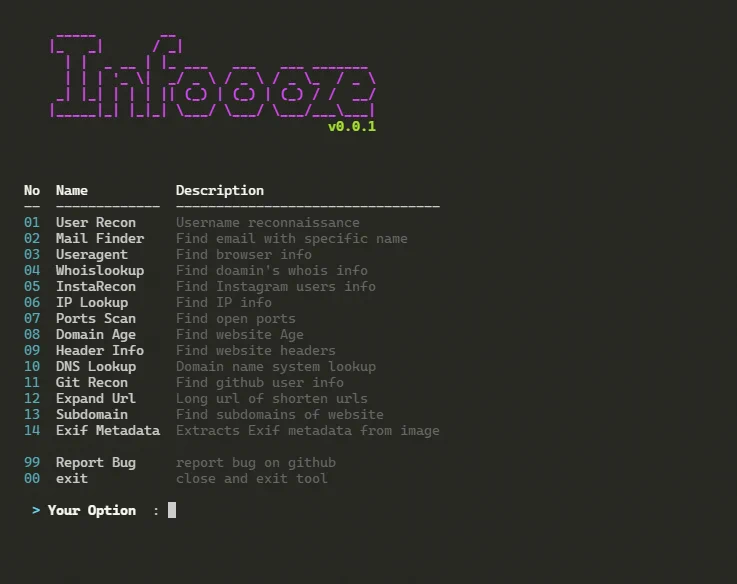
Infoooze is an open-source command-line OSINT reconnaissance toolkit (github.com/devxprite/infoooze) that consolidates common footprinting tasks into one CLI: username enumeration across platforms, email discovery, subdomain enumeration, port scanning, WHOIS/DNS lookups, IP/HTTP header analysis, EXIF metadata extraction, GitHub recon, and URL scanning/expansion. It automatically saves results, making it a lightweight all-in-one alternative to running several separate recon tools.
 x.comrepoPublished and added 8 Oct 2026🛡️ Security
- target/strelka
Strelka is Target's open-source, container-based real-time file scanning system for threat hunting, threat detection, and incident response, built in Go and Python. It runs 50+ scanners (YARA, PE parsing, encrypted ZIP cracking, entropy analysis, etc.) to extract metadata and content from files at enterprise scale, which can feed a SIEM for alerting on suspicious artifacts like an Emotet-laden encrypted ZIP payload.
github.comrepoAdded 8 Oct 2026🛡️ Security  The Vulnerable MCP Project — MCP vulnerability database
The Vulnerable MCP Project is a curated, continuously growing database of security vulnerabilities and attack techniques specific to the Model Context Protocol ecosystem. Entries cover concrete CVEs (e.g. CVE-2025-68143/68144/68145 in Anthropic's mcp-server-git), transport-layer SDK flaws (cross-client response leakage, missing DNS rebinding protection in the official TypeScript/Python SDKs), unauthenticated/0.0.0.0-bound servers enabling RCE (MCPJam inspector, MCP Inspector, Grafana MCP), command/path injection in dozens of third-party servers (gemini-mcp-tool, mcp-server-kubernetes, Framelink Figma MCP, Zen MCP, filesystem-mcp), SSRF chains reaching cloud metadata (MarkItDown MCP, mcp-fetch-server), and a large set of AI-specific attacks: tool poisoning, trigger-phrase data exfiltration, prompt injection via GitHub issues, Jira and Google Docs, rug-pull tool mutation, and cross-server tool-name collisions. It functions as the de facto vulnerability registry for the MCP ecosystem, useful for tracking disclosed issues before patching or adopting third-party MCP servers.
 vulnerablemcp.inforepoAdded 6 Oct 2026🛡️ Security
- Dark Web Informer (@DarkWebInformer) on X
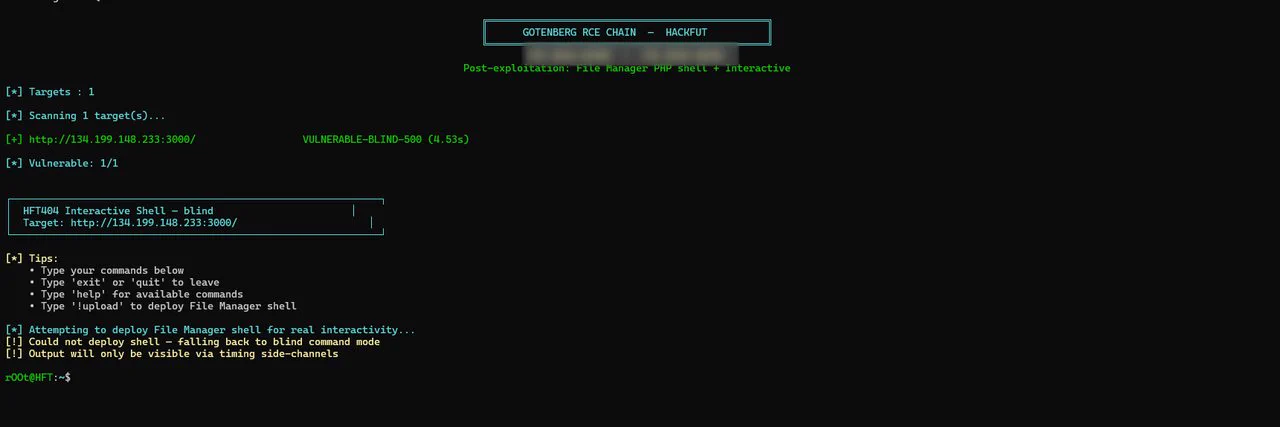
A public PoC chains CVE-2026-42589 and CVE-2026-40281 to achieve unauthenticated remote code execution against Gotenberg (a document/PDF-conversion microservice), abusing metadata injection flaws in the /forms/pdfengines/metadata/write endpoint. The tool supports vulnerability detection, interactive command execution, reverse shell delivery, and multi-target scanning against Gotenberg versions ≤8.30.1 (patched in 8.31.0).
x.comrepoPublished and added 5 Oct 2026🛡️ Security - DeepZero
DeepZero is an open-source orchestration engine that lets researchers define vulnerability-research pipelines declaratively in YAML, handling parallel execution (ThreadPoolExecutor), resumable/fault-tolerant state, and LLM-assessment stages via LiteLLM/Jinja2 prompts. It ships example processors for Ghidra headless decompilation, LOLDrivers.io hash exclusion filtering, PE header/driver metadata extraction, and batch Semgrep scanning, with a dedicated pipeline for BYOVD kernel driver vulnerability research. An extensibility model lets users plug in custom Python processors referenced by path in the YAML config.
github.comrepoAdded 3 Oct 2026🛡️ Security - Show HN: Made an open-source Lego AI generator
ldraw-nova is an open-source agentic pipeline where an LLM agent (tested with models like Claude Opus 5.5 and GPT-6 Astra) takes a build prompt, reads LDraw-building instructions, and produces a plan.json describing a model's geometry. From that plan it writes a Python generator script that, when executed, outputs an LDraw (.mpd) 3D CAD source file, viewable in 3D/VR (Meta Quest 3) or exportable to Blender-editable glTF. The agent uses jev-rerank, a semantic search tool with reranking backed by TypeSafe's Jev System One model, to find suitable LEGO parts and example models, falling back to full-text search without an API key; it also uses headless rendering and collision/gap detection to self-inspect and iterate on designs.
github.comrepoAdded 3 Oct 2026, published 2 Oct 2026🧠 AI - CAIRN — Cisco Talos AI-Malware-Hunting Toolkit
CAIRN is a Cisco Talos research toolkit that identifies and attributes AI-integrated malware purely from VirusTotal metadata — no binary downloads or detonation — by running a tiered YARA ontology (T1/T2/T3) over composed scan text (AV strings, PE resources, Sigma/sandbox behavioral data, embedded URLs) and layering on sentence-transformer embeddings with HDBSCAN clustering for semantic family attribution. It has produced confirmed family reports for AI-malware such as PROMPTLOCK, LAMEHUG, PROMPTSTEAL, QUIETVAULT, CLOSEDQUORUM, and FRUITSHELL, each cross-verified by hands-on Talos reverse engineering before publication.
github.comrepoAdded 30 Sep 2026🛡️ Security - Launch HN: Magnitude (YC S25) – Self-optimizing inference engine for agents
Magnitude is an open source local inference engine (Apache 2.0) that compiles and tunes its GPU/CPU kernels on the user's exact device before a model runs, claiming up to 2x faster decode than llama.cpp (92% faster on Metal, 19% on CUDA) with 27% lower memory per agent. It ships as a cross-platform desktop app with a bundled CLI and an OpenAI-compatible API, offering one-click connections to agent tools like Pi, OpenCode, Hermes, Codex, OpenClaw, Claude Code, and Cline, running fully offline on Apple Silicon, NVIDIA, AMD, or CPU-only hardware.
github.comrepoPublished and added 30 Sep 2026🧠 AI - Andrea (Drego) Draghetti 👨🏻💻 🎣 (@AndreaDraghetti) on X
Tosint v1.0.0 is an open-source Telegram OSINT tool for analyzing bots and chats, exporting message history and media. The new release adds richer JSONL metadata output, optional SHA-256 hashing of exported media, bot/user authentication support, and an automatic fallback from MTProto-based history retrieval to ID-scan mode when dealing with restricted chats.
x.comrepoAdded 2 Oct 2026, published 30 Sep 2026🛡️ Security - SpecterOps/Blacklight — local AI agent attack surface mapping toolkit
Blacklight is a SpecterOps toolkit for endpoint forensics on AI coding agents, split into Scout (bounded metadata/filesystem triage across Codex, Claude Code, Cursor, Antigravity CLI, and Grok that finds candidate session artifacts without reading their contents) and Session Analysis (a Python CLI that parses selected JSONL/SQLite session downloads from Codex, Claude Code, Cursor, and Antigravity CLI into ranked, redacted local reports). It's built for investigators who need to identify and review AI agent session history on a host — surfacing config, auth metadata, and high-value indicators — while explicitly leaving secret scanning to external tooling; paths are informed by SpecterOps' Endpoint AI Agent Abuse (EAA) technique catalog.
github.comrepoAdded 27 Sep 2026🛡️ Security - MCP Python SDK v2.2.0
Release notes for MCP Python SDK v2.2.0, the reference Python implementation of the Model Context Protocol. Key changes: HTTP client redirects are now restricted to the same origin as the endpoint, idle Streamable HTTP sessions expire after 30 minutes (with a 10,000-session cap), OAuth authorization server metadata issuer checks are now enforced on the legacy discovery path, and new deprecation warnings push toward requiring explicit `issuer=` and `validate_token_resource` settings ahead of a 3.0 release.
github.comrepoAdded 26 Sep 2026🧠 AI - git-pkgs — dependency history & supply-chain analysis for git repos
git-pkgs is a Go rewrite of a Ruby tool that adds a git subcommand for tracking dependency changes across a repository's history, indexing manifests/lockfiles from 36+ package managers (npm, RubyGems, Cargo, PyPI, Maven, Composer, Go modules, etc.) into a local SQLite database. Beyond history/blame/diff, it offers supply-chain security commands: `vulns` (OSV-based CVE scanning with SARIF output for GitHub code scanning, plus blame/praise/exposure for remediation metrics), `licenses` (with drift detection and CI-friendly exit codes), `deprecated`, `provenance` (trusted-publishing/attestation checks), `integrity` (lockfile hash drift detection), `maintainers`/`health` (via ecosyste.ms metadata), and `sbom` export in CycloneDX/SPDX. It also supports a dependency-aware `bisect` to find when a vulnerability, license change, or capability (e.g. network access) was introduced, and ships GitHub Actions for CI integration.
github.comrepoAdded 25 Sep 2026🛡️ Security - Supply Chain Firewall (Datadog)
Supply Chain Firewall (SCFW) is a Datadog-built CLI that wraps npm, pip, and poetry commands to inspect every package target against known-malicious/compromised package datasets (the open-source malicious-software-packages-dataset and OSV.dev) before installation proceeds, blocking or warning on hits. It ships as a single Go binary, can be aliased transparently into a developer's shell, and optionally reports run outcomes and enforces centralized allow/block policies through Datadog Code Security across a fleet, sending only package metadata (never source code) to Datadog.
github.comrepoAdded 22 Sep 2026🛡️ Security - Numbat
Numbat is a Go-based, single-binary endpoint agent from Perplexity AI that gives visibility into AI coding-agent activity (Claude Code, Codex, OpenClaw, and other CLI/IDE/gateway agents) by capturing events through local hooks, OTLP/HTTP logs, and on-disk session artifacts. It normalizes activity into one event model, evaluates it with a local CEL rule engine (including multi-step sequence rules like secret-read-then-egress), and can optionally block matched actions via synchronous pre-action hooks (deny/monitor decisions), with case bundles and SHA-256 manifests for forensic reconstruction. Example built-in rules detect cloud-metadata SSRF requests (169.254.169.254) and credential-exfiltration chains, mapped to MITRE ATT&CK technique tags.
github.comrepoPublished and added 5 Sep 2026🛡️ Security - h5i-dev/awesome-ai-agent-incidents
A curated GitHub corpus tracking real-world security incidents, CVEs, attack techniques, and defensive tools specific to autonomous AI agents — spanning prompt injection/goal hijacking, MCP client-side tool-metadata poisoning, the "Promptware Kill Chain" multi-stage attack model, MITRE ATLAS agentic techniques, and the OWASP Top 10 for Agentic Applications. It also documents the OpenClaw/ClawHub supply-chain incident (1,184 malicious skills confirmed by Antiy CERT) and links defensive projects like OWASP Agent Memory Guard for LangChain/LlamaIndex agent memory protection.
github.comrepoAdded 3 Sep 2026🛡️ Security - age
age is a simple, modern file encryption tool, format, and Go library by Filippo Valsorda and @benjojo, offering small explicit keys, no config options, UNIX-style composability, and now built-in hybrid post-quantum encryption (ML-KEM + X25519) as of v1.3.0. It supports multiple recipients, passphrase encryption, SSH key (ed25519/rsa) recipients/identities, hardware tokens via age-plugin-yubikey, and an age-inspect command to view encrypted-file metadata without decrypting.
github.comrepoAdded 3 Sep 2026, published 31 Aug 2026🛡️ Security - Rekono
Rekono is an open-source pentesting automation platform that chains 19 hacking tools (Nmap, Nuclei, Metasploit, OWASP ZAP, Nikto, Gitleaks, SearchSploit, etc.) so that output from one tool feeds the next, automatically covering recon, service enumeration, vulnerability scanning, and exploit correlation. It deduplicates findings into a single attack-surface inventory per host/port, enriches CVEs with community context for prioritization, tracks fixed/reopened vulnerabilities, and supports team collaboration, scheduled scans, Telegram/email alerts, and report generation for engagements.
github.comrepoAdded 3 Sep 2026, published 27 Aug 2026🛡️ Security - Cyberful
Cyberful is an AI red-team CLI that orchestrates 316 cybersecurity tools (203 CLI apps/commands including Nmap, Metasploit, Nuclei, plus ZAP and Ghidra) through a multi-agent system: hypothesis workers map attack surfaces and test exploit paths, while a deterministic control plane enforces engagement scope, preserves evidence, and only surfaces independently reproduced vulnerabilities. Built for authorized penetration testing, code audits, and bug bounty hunting; ships a hardened agent-controlled browser, Docker-based runtime, offline MITRE ATT&CK snapshot, and CVE dictionary.
github.comrepoPublished and added 25 Aug 2026🛡️ Security - System Prompts Leaks
A community-maintained repository that archives leaked or extracted system prompts — the hidden instructions given to LLM chatbots before user input — captured verbatim from products including Claude/Claude Code, ChatGPT/Codex, Gemini, Grok, Cursor, Copilot, Perplexity, Meta AI, Mistral, DeepSeek, GLM, and others. It serves as a reference corpus for studying system prompt design, extraction techniques, and the system prompt leakage risk class, and is updated regularly as new prompts are exfiltrated from newer model releases.
github.comrepoAdded 3 Sep 2026, published 3 Aug 2026🛡️ Security - asgeirtj/system_prompts_leaks
This GitHub repository collects verbatim leaked/extracted system prompts — the hidden instructions and guardrails — from a wide range of AI products including Claude.ai, Claude Code, ChatGPT, Codex, Gemini, Grok, Perplexity, Microsoft Copilot, Cursor, Meta AI, Mistral, Kimi, DeepSeek, GLM, Qwen and others. It is updated regularly as new prompts are captured, and serves as reference material for AI red-teamers and researchers studying how vendors constrain model behavior and how those constraints can be extracted or bypassed.
github.comrepoPublished and added 3 Aug 2026🛡️ Security - Awesome Offensive AI Agentic Landscape
A comprehensively curated landscape document tracking the offensive AI agent space: ranked open-source pentesting/red-team agent projects (e.g. strix, shannon, VulnBot), uncensored offensive LLMs (Qwythos, WhiteRabbitNeo/DeepHat, BaronLLM) versus security-specialized but aligned models (Foundation-Sec, CyberSecQwen), Claude Code Agent Skills and MCP servers wrapping tools like Metasploit and BloodHound, 116 cross-referenced academic papers on pentest/vuln-discovery agents, capability benchmarks (Cybench, NYU CTF Bench, CyberGym), and a fact-checked Top-20 list of commercial AI pentesting vendors. It also covers competitions like the DARPA AI Cyber Challenge and Tencent's Intelligent Penetration Hackathon, positioning itself as a cross-merge of several other awesome-lists in this niche.
github.comrepoPublished and added 1 Aug 2026🛡️ Security - Damn Vulnerable DeFi
Damn Vulnerable DeFi is a Foundry-based Solidity smart contract security playground featuring intentionally vulnerable challenges around flashloans, price oracles, governance, NFTs, DEXs, lending pools, smart contract wallets, timelocks, vaults, meta-transactions, and upgradeability. Each challenge presents a prompt and vulnerable contracts; solvers write a Foundry test exploiting the flaw to drain funds or bypass restrictions, making it a benchmark for both human auditors and automated security tooling.
github.comrepoPublished and added 31 Jul 2026🛡️ Security - lockfale/OSINT-Framework
OSINT Framework is a curated, categorized index of free (mostly) open-source intelligence tools and resources, organized by data type (username, domain, IP, email, social media, etc.) and rendered as an interactive tree at osintframework.com. Each entry in the underlying arf.json is tagged with metadata like whether it requires local install (T), a Google dork (D), registration (R), or manual URL editing (M), plus richer fields such as input/output type, pricing, and opsec notes. It's a long-standing community reference for recon and investigation tradecraft across infosec and other fields.
github.comrepoPublished and added 31 Jul 2026🛡️ Security - redhat-et/ripwire
Ripwire is an offline, single-binary CLI (with optional MCP server) that indexes a repository to give coding agents a ranked, deterministic call graph, task-oriented context bundles (--for, --pack-task), and edit-time checks (--edit-check, --quality-delta, --test-gate) that flag blast radius, contract breakage, and code-quality regressions. It installs skills for Claude Code, Codex, Cursor, Windsurf, Gemini, opencode and aider, and ships extensive self-published benchmarks (docs/EVALS.md, LocBench-style head-to-head comparisons against graph-database MCP servers like codebase-memory-mcp, repowise, graphify and aider) claiming large token and latency savings plus higher file@10 retrieval accuracy. The README includes a detailed field report on using it across a ~20-agent, ~1,500-file C++/Metal orchestration engagement.
github.comrepoAdded 2 Oct 2026, published 29 Jul 2026🧠 AI - Bug Bounty Directory & MCP API
bug-bounties is a community-maintained directory of over 3,000 active bug bounty programs and vulnerability disclosure policies (VDPs), exposed via a public API and a Model Context Protocol (MCP) server. It lets researchers programmatically query scope, rewards, and program metadata, and lets AI coding agents like Claude Code look up bug bounty targets directly.
github.comrepoAdded 3 Sep 2026, published 29 Jul 2026🛡️ Security - YuroGod/VMPStaticUnpacker
VMPStaticUnpacker is a Python tool that statically unpacks VMProtect-protected Windows PE binaries without executing them, supporting both the legacy plaintext PACKER_INFO metadata format and the compact rotating-XOR format seen in VMProtect 3.9.5 PE32+ samples. It recovers the destination key by XORing the encoded destination with the first packed section's RVA and rolling the key with ROL32(key,7), then validates candidate tables and LZMA streams before rebuilding a memory-image PE for static analysis. It does not devirtualize protected code, recover the original entry point, strip the VMProtect runtime, or fix imports.
github.comrepoAdded 2 Oct 2026, published 29 Jul 2026🛡️ Security - DevCop95/shodan_reconsx
recons101x (shodan_reconsx) is a passive-by-default Python CLI that enumerates hostnames published to certificate transparency logs via ctl.shodan.io, requiring no Shodan API key. It supports optional active features — DNS resolution, TCP/HTTP reachability probing on ports 443/80, bounded live scans, and certificate metadata enrichment — with status states (DNS_ONLY, TCP_REACHABLE, HTTP_REACHABLE, STALE), JSON/TXT output, and safeguards like --max-time, --active-only, and explicit warnings to only scan authorized domains.
github.comrepoAdded 30 Sep 2026, published 29 Jul 2026🛡️ Security - 1N3/Sn1per
Sn1per is an open-source Community Edition offensive-security platform that automates reconnaissance, vulnerability scanning, and exploitation by orchestrating 90+ third-party tools such as Nmap, Metasploit, Burp Suite, and Nessus into unified scan modes (normal, stealth, discover, airstrike, nuke). It ships with 600+ exploits and 10,000+ detections, supports Docker deployment, workspace-based loot management, and scheduled scans for external attack surface management. Paid Professional and Enterprise tiers add a web UI, reporting exports, and a JSON API on top of the same source-available CLI scanning engine.
github.comrepoPublished and added 26 Jul 2026🛡️ Security - Bug Bounty Lab101
Bug Bounty Lab101 is a workspace that structures the real HackerOne bug bounty workflow: document program scope, run scope-gated recon/vuln scanning via bugbounty-hunter.sh (backed by a 400+ tool arsenal spanning recon, DNS enumeration, web scanning, exploitation, and cloud/subdomain-takeover checks), then produce a triage-ready H1 report with Hacktivity dedup checks. It also integrates T3MP3ST, a separate multi-agent offensive framework that connects local AI coding agents (Claude Code, Codex) to automate target investigation, and ships a legacy-vm-practice lab (DVWA/Metasploitable-style) for safe skill-building outside real program scope.
github.comrepoPublished and added 25 Jul 2026🛡️ Security - ShortDot Zone Abuse Evidence
PhishDestroy's shortdot-evidence is a daily-updated GitHub investigation into ShortDot SA, the Luxembourg registry operator behind the .icu, .bond, .cyou, .sbs, .cfd, .buzz and .qpon gTLDs, documenting that 51,985+ tracked domains impersonate brands like Chase, Binance, MetaMask and Ledger and that ~70% of registered domains in these zones carry no DNS records (metric-padding rather than legitimate use). It publishes machine-generated IOC/blocklist files and analytics built from a per-TLD zone-file pull cross-referenced against Spamhaus DBL, SURBL, OpenPhish, URLhaus, PhishTank and AlienVault OTX, and ties the zones to concrete criminal cases (FBI's LabHost domain list, Google v. DOES/Yucheng Chang RICO suits, the Revolver Rabbit XLoader/Formbook C2 campaign using 500k+ .bond domains). It also details structural conflicts of interest between ShortDot, its registry infrastructure provider Team Internet Group/CentralNic, registrar partner NameSilo, and the brand-protection vendor NameBlock, backed by Interisle Consulting Group phishing-volume statistics.
github.comrepoPublished and added 25 Jul 2026🛡️ Security - Gabson0x/pentdem
pentdem is an autonomous AI-powered pentesting CLI/pipeline that fans out 15+ vulnerability-class hunters (XSS, SQLi, SSRF, IDOR, SSTI, JWT, GraphQL, etc.) and 8 advanced attack skills (mass assignment, race conditions, cloud metadata, OAuth/OIDC, subdomain takeover, credential harvesting) in parallel, using an LLM to adapt strategy mid-scan. It wraps real tools (nmap, sqlmap, nuclei, ffuf, subfinder, httpx) in Docker isolation and adds a novel gate chain — quality gate, kill-chain builder, adversarial cross-model validation (a second model tries to disprove each finding), a capability execution ledger (proves each hunter actually ran instead of silently crashing), and a ship-discipline gate — before mapping surviving findings to MITRE ATT&CK/OWASP Top 10/CVSS and generating reports.
github.comrepoPublished and added 20 Jul 2026🛡️ Security - ailinone/collective-intelligence
Collective Intelligence is an open-source (AGPL-3.0) OpenAI-API-compatible gateway that routes a single request across a continuously-discovered pool of AI models (claimed ~90 provider integrations, 103,224 indexed models) using one of 32 coordination strategies - consensus with convergence floors, blind debate, expert panels, devil's-advocate consensus, cost-cascade, best-of-N with objective verification - instead of sending it to one model. Every response carries an ailin_metadata provenance record (strategy used, models used, cost, dissent), and the repo ships a reproducible benchmark harness with raw per-execution CSVs claiming the coordinated pool beats GPT-5.5-pro, Claude Opus 4.8, Gemini 3.1 Pro and Grok 4.3 on verifiable tasks (97% vs 68-82%). It installs via Docker Compose, exposes an OpenAI SDK-compatible base_url swap, and supports a no-API-key Ollama degraded self-hosted mode.
github.comrepoAdded 2 Oct 2026, published 20 Jul 2026🧠 AI - 0x1ceKing/HTB-Certified-Penetration-Testing-Specialist
A GitHub repository compiling personal study notes and cheatsheets for HackTheBox's CPTS (Certified Penetration Testing Specialist) certification, organized by module: network enumeration (Nmap), web footprinting, file transfers, shells/payloads, Metasploit, password attacks, pivoting/tunnelling, Active Directory enumeration and attacks, web app attacks (SQLi, SQLMap, XSS, LFI, file upload, command injection, Ffuf), and Linux/Windows privilege escalation. It functions as a reference guide mirroring the official HTB Academy course structure rather than original research.
github.comrepoPublished and added 18 Jul 2026🛡️ Security - drumih/turbo-fieldfare
TurboFieldfare is a custom Swift + Metal inference runtime that runs the instruction-tuned Gemma 4 26B-A4B mixture-of-experts model on Apple Silicon Macs with as little as 8 GB of RAM. Rather than loading the full 14.3 GB model into memory, it keeps a 1.35 GB shared core and FP16 KV cache resident and streams only the per-token routed experts from SSD via a bounded 16-slot LFU expert cache, using 4-bit MLX-style affine quantization and custom Metal kernels for GEMV, attention, MoE, RoPE and sampling. It ships a native Mac app, CLI, and a loopback OpenAI-compatible server with function-tool support, plus an optional vision-tower companion pack for image input on M2+ Macs, and documents 103 benchmarked experiments behind its design choices.
github.comrepoAdded 2 Oct 2026, published 17 Jul 2026🧠 AI - NVIDIA/garak
garak is NVIDIA's open-source LLM vulnerability scanner, described as an nmap/Metasploit for LLMs that probes generative models for hallucination, data leakage, prompt injection, jailbreaks, toxicity, and other failure modes. It supports a wide range of targets such as Hugging Face, OpenAI, AWS Bedrock, Cohere, Groq, llama.cpp/gguf, REST endpoints, and NIM, and structures scans around pluggable probes, detectors, harnesses, and generators, producing JSONL reports and hit logs.
github.comrepoPublished and added 14 Jul 2026🛡️ Security - meta-llama/PurpleLlama
Purple Llama is Meta's umbrella repo of tools and evals for building safely with generative AI, bundling Llama Guard (input/output content moderation fine-tuned on Llama 3.1/3.2), Prompt Guard (detects prompt injection and jailbreak attempts), Code Shield (inference-time filtering of insecure LLM-generated code and code-interpreter abuse prevention), and the CyberSec Eval benchmark suite (CWE/MITRE ATT&CK-based tests now spanning insecure code generation, offensive cyber capability, spear-phishing, and visual prompt injection). It matters as one of the first industry-wide, MIT-licensed benchmark and safeguard sets specifically for LLM cybersecurity risk.
github.comrepoPublished and added 14 Jul 2026🛡️ Security - DataDog/guarddog
GuardDog is DataDog's CLI tool that scans PyPI, npm, Go modules, Rust crates, RubyGems, GitHub Actions, and VSCode extensions for malicious packages using YARA-based static analysis and registry metadata detectors. It correlates code capabilities with threat indicators (mapped to MITRE ATT&CK stages) to produce a 0-10 risk score, aiming to reduce alert fatigue compared to traditional SAST tools, and runs archive extraction and source analysis inside a kernel-level sandbox (Landlock/Seatbelt via nono) to mitigate path-traversal/code-execution vulnerabilities such as CVE-2022-23530, CVE-2022-23531, CVE-2026-22870, and CVE-2026-22871.
github.comrepoPublished and added 11 Jul 2026🛡️ Security - XORCISM-AI/XORCISM
XORCISM is a self-hosted, open-source enterprise risk/exposure management platform (Node.js/TypeScript over SQLite/PostgreSQL/MySQL) that unifies asset inventory, vulnerability management, threat intel (STIX/TAXII), GRC (ISO 27001, NIST CSF/800-53, EBIOS Risk Manager, NIS2, DORA), incident management, and offensive/defensive testing into one continuously recomputed per-asset and enterprise risk score. It chains recon/exploitation tool connectors (nmap, nuclei, Metasploit, sqlmap) into attack-path/choke-point graphs weighted by fusion exploitability (EPSS+CVSS+KEV+public exploits), validates detection coverage via a purple-team loop against 3,750+ Sigma rules and MITRE ATT&CK/D3FEND, and quantifies ransomware impact in dollar terms via a FAIR-style model — with local-only Ollama AI assistants for triage, hunting, and reporting.
github.comrepoPublished and added 1 Jul 2026🛡️ Security - Reverse-Skill
Reverse-Skill is a GitHub repo that gives AI coding agents (Claude Code, Codex, Cursor, OpenCode) a structured routing layer for reverse engineering and offensive security work: it detects the task type (APK, ELF binary, JS obfuscation, PCAP, CTF challenge) and routes to the correct methodology and toolchain (jadx, apktool, Frida, IDA Pro, Ghidra, radare2, Burp Suite, nmap, Metasploit) instead of letting the agent guess commands. It ships a case-init/scope workflow, an evidence-to-finding-to-report pipeline, a 173-case routing regression test run in CI on Windows and Ubuntu, and platform-specific docs for Kali/Ubuntu/macOS, positioned for lawful research, CTF, and authorized pentesting.
github.comrepoPublished and added 21 Jun 2026🛡️ Security - 0x4m4/hexstrike-ai
HexStrike AI is an MCP server that exposes 150+ security tools (Nmap, sqlmap, Ghidra, Metasploit/MSFVenom, Trivy, Nuclei, TruffleHog, etc.) to MCP-compatible AI agents like Claude, GPT, or Copilot, letting them autonomously plan and execute network, web, binary, cloud, and CTF assessments. It ships 12+ specialized agents (BugBounty, CTF Solver, CVE Intelligence, Exploit Generator) that handle tool selection, parameter optimization, and attack-chain discovery, effectively turning an LLM into an autonomous pentest operator. The README includes explicit authorized-use guidance (pentests, bug bounty, CTF, red team) and warnings about the tool's broad system access.
github.comrepoAdded 18 Jun 2026🛡️ Security - Bumblebee
Bumblebee is a single-binary, read-only inventory scanner for macOS/Linux developer endpoints that parses lockfiles, package-manager metadata, extension manifests, and MCP JSON configs into structured NDJSON component records. Given an exposure catalog (exact ecosystem/name/version matches), it emits finding records so responders can quickly answer "which machines have this compromised package right now" during a supply-chain incident, without executing package managers or reading source files. It ships baseline/project/deep scan profiles, a built-in selftest against embedded fixtures, and maintained threat-intel exposure catalogs built from public supply-chain campaign reporting.
github.comrepoPublished and added 24 May 2026🛡️ Security - IDP Zero-Dollar
A companion GitOps playbook/repo for building a free, self-hosted "AWS-equivalent" Kubernetes platform from three bare-metal Linux boxes using k3s, Cilium, cert-manager, Traefik, Argo CD, Forgejo, Vault, Keycloak, kube-prometheus-stack, Loki, Kyverno, and Velero. It walks through the full security-relevant stack end to end: OS hardening (SSH lockdown, ufw, fail2ban), Cilium NetworkPolicy as CNI, Let's Encrypt DNS01 wildcard certs, Vault as the source of truth for secrets synced via External Secrets Operator (never committing secrets to Git), Keycloak OIDC for centralized identity across Argo/Grafana/Forgejo/Vault, Kyverno pod-security policies in audit-then-enforce mode, and Velero + Vault Raft snapshot backup/DR with quarterly restore drills. It closes with a candid list of what self-hosting gives up versus managed cloud (CVE patch cadence, DDoS exposure, compliance evidence, etcd/HA operational risk).
github.comrepoAdded 3 Sep 2026, published 13 May 2026🛡️ Security - PentHertz/LUKSbox
LUKSbox is an open-source (Apache 2.0), pre-1.0 encrypted vault format and CLI/GUI/TUI toolset written in Rust, designed so files can be stored on untrusted cloud/shared media while remaining opaque to the provider. It layers passphrase, FIDO2 hardware authenticators (hmac-secret), and TPM 2.0 sealed keys as unlock factors that all derive a Master Volume Key via HKDF-SHA256, and adds an optional ML-KEM-768/1024 post-quantum sidecar for hybrid encryption. The project publishes its on-disk format spec, threat model, and side-channel notes, and runs libFuzzer/AFL++ harnesses against every parser that touches attacker-controlled bytes (header, keyslot, metadata, hybrid sidecar, WinFsp paths).
github.comrepoPublished and added 8 May 2026🛡️ Security - GH05TCREW/pentestagent
PentestAgent (GhostCrew) is an LLM-powered pentesting agent with a TUI that runs single-shot, autonomous-agent, or multi-agent "crew" modes against a target, backed by built-in terminal/browser/notes tools and prebuilt black-box attack playbooks. It supports Docker/Kali images preloaded with nmap, Metasploit, sqlmap and hydra, exposes itself as an MCP server for external clients, and can spawn hierarchical child agents over MCP (with RAG-based tool selection) to delegate recon subtasks in parallel.
github.comrepoPublished and added 8 May 2026🛡️ Security - mcpwn
mcpwn is a CLI security scanner for Model Context Protocol (MCP) servers, described as "nikto or nuclei, but for MCP servers." It runs checks (MCP-001 through MCP-013+) that statically analyze tool descriptions/schemas for hidden-instruction tool poisoning and, in an --aggressive mode, actively probe for prompt injection via tool output, SSRF against internal IPs/cloud metadata endpoints, command injection via shell metacharacters, cross-tool data exfiltration via canary tokens, and hardcoded secrets in resources. It supports stdio/SSE/HTTP transports, JSON/SARIF output for CI gating, and pairs with a companion runtime tool called mcp-firewall.
github.comrepoPublished and added 6 May 2026🛡️ Security - requie/LLMSecurityGuide
A GitHub reference guide covering the OWASP Top 10 for LLM Applications 2025 and the OWASP Top 10 for Agentic Applications 2026 (ASI01–ASI10, released December 2025 at Black Hat Europe), with Python code samples for attacks (prompt injection, training-data extraction, RAG poisoning, agent goal hijacking, memory poisoning) and matching defenses (guardrails, memory integrity validation, tool-usage guards, zero-trust agent execution). It also curates red-teaming and guardrail tooling — garak, DeepTeam, Promptfoo, ARTKIT, Meta LlamaFirewall, LLM Guard, NeMo Guardrails, Amazon Bedrock Guardrails, Langfuse — plus an MCP security checklist and a security readiness checklist for LLM/agentic deployments.
github.comrepoPublished and added 5 May 2026🛡️ Security