- Show HN: Overtone – Transcribe, correct and cut captions for any screen shape
Overtone is a caption format (.overtone.json), a CLI and a video.js plugin that store each spoken word once and cut captions separately per screen shape (16:9, 9:16 or custom). The transcribe pipeline combines gpt-transcribe, Azure AI Speech and optional ElevenLabs Scribe, resolves disagreements with an LLM vote, and uses an LLM editor for corrections. A small public benchmark reports 5.3% word error rate and $0.023–0.025 per audio minute.
 github.comrepoAdded 30 Oct 2026, published 29 Oct 2026🧠 AI
- Mas0nShi/CVE-2026-112445
CVE-2026-112445 is a macOS local privilege escalation in which the launchd job com.apple.xpc.uscwoap runs /bin/bash as root with stdin tied to /dev/console. A non-administrator console user can start the job and inject commands into the console input queue with TIOCSTI, so Bash executes them as UID 0. Apple did not list the CVE in its advisory; macOS 27.2 removes the job configuration.
github.comrepoAdded 2 Nov 2026, published 29 Oct 2026🛡️ Security - Spectrmachina/Ztrust
ZTrust is a Python supply-chain scanner that checks manifests, lockfiles, source and GitHub workflows for vulnerable or malicious dependencies (via OSV.dev), typosquats, leaked secrets, unsafe lockfiles and risky CI patterns such as pwn requests and script injection. It outputs console, JSON and SARIF 2.1.0 and ships as a GitHub Action. It also includes a FastAPI bounty service using commit-reveal and shielded Zcash payouts for researchers.
github.comrepoAdded 27 Oct 2026, published 22 Oct 2026🛡️ Security - eliasbiondo/antirion
Antirion is an open-source AI gateway shipped as one Rust binary with a built-in admin console. It sits between apps and providers such as OpenAI, Anthropic, Bedrock, Vertex and vLLM, translating between OpenAI, Anthropic, Gemini and Bedrock dialects. It covers routing with fallbacks and circuit breakers, budgets, guardrails, caching, MCP and A2A gateways, SSO, and a benchmark against Bifrost 2.2.4 and LiteLLM 1.103.1.
github.comrepoAdded 21 Oct 2026, published 17 Oct 2026🧠 AI - alex09x/kyb
KYB (Know Your Business) is a Rust/axum server that stores agent-written knowledge, incident reports and tasks as Markdown files in Git, one commit per change. Search is hybrid: Tantivy BM25 fused by reciprocal rank with local multilingual-e5-small ONNX vectors, and it can query historical versions or "as of" a date. It ships a kyb CLI, a native MCP endpoint (Claude Code, Codex, Antigravity, Gemini CLI), an installable agent skill, token auth with per-write attribution trailers, secret scanning on writes, and a web console. It targets persistent shared operational memory for multi-agent, multi-machine fleets.
github.comrepoAdded 17 Oct 2026🧠 AI - Llama.cpp on a jailbroken PS5: run any GGUF model natively on the console
PS5LM is a homebrew app for jailbroken PS5s (firmware 7.00–13.60). It runs llama.cpp with the ggml-vulkan backend on the console's RDNA 2 GPU, using 11.4 GB of shared memory, and loads any GGUF model. It serves OpenAI /v1/chat/completions, Anthropic /v1/messages (usable from Claude Code, Codex and opencode) and a browser chat page on port 8081. It also supports image-projector vision models and TypeSafe-style decision models through a /v1/systemone endpoint. A planner picks the longest context and best cache that fit the free memory, and the app downloads models from Hugging Face.
github.comrepoAdded 17 Oct 2026, published 16 Oct 2026🧠 AI - Show HN: SolidCraft – Open-Source Parametric CAD in Rust (With MCP Support)
SolidCraft is an open-source parametric 3D CAD application written in pure Rust. It has constrained sketches with its own solver, a feature timeline, assemblies, sheet metal, and STEP/IGES/3MF/STL export. It runs on desktop (egui+wgpu), in the browser, and as a headless CLI. The built-in MCP server (`solidcraft-cli mcp`) gives agents tools such as execute, batch, inspect_design, measure, set_parameter, screenshot and export. They can model headless or drive the running app over a JSON-lines control channel. A rover with 3,323 timeline steps was built entirely through MCP, which shows agent-driven parametric modelling working at scale.
github.comrepoPublished and added 13 Oct 2026🧠 AI - trhhubsd/ARTEX
ARTEX is an AGPL-3.0 autonomous penetration-testing system with a Go backend and Next.js frontend, backed by PostgreSQL. A planner agent and parallel worker agents share a global asset graph and a per-task exploration graph, with human-in-the-loop approval, a MITM traffic-recording proxy, ScopeSentry asset sync, vulnerability retesting and a shared todolist for multi-step attack chains. The README claims a Baidu agent+ attack-defense challenge win and limits use to local isolated labs.
github.comrepoAdded 27 Oct 2026, published 8 Oct 2026🛡️ Security - Dark Web Informer (@DarkWebInformer) on X
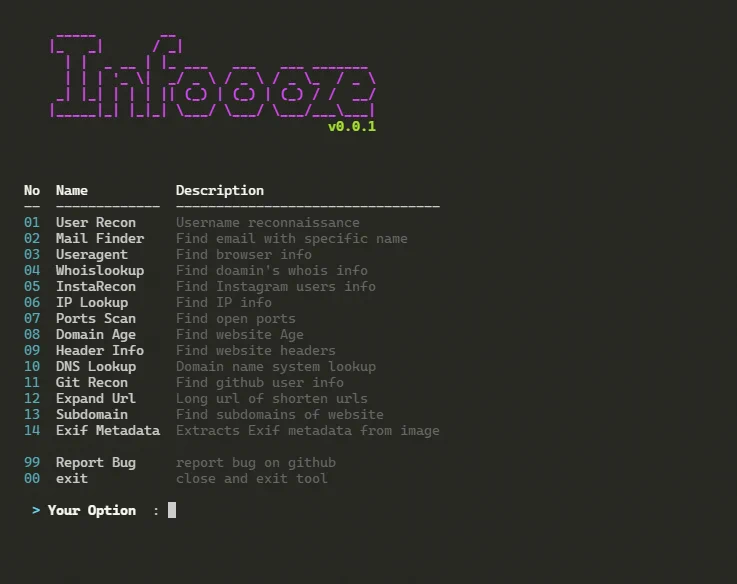
Infoooze is an open-source command-line OSINT reconnaissance toolkit (github.com/devxprite/infoooze) that consolidates common footprinting tasks into one CLI: username enumeration across platforms, email discovery, subdomain enumeration, port scanning, WHOIS/DNS lookups, IP/HTTP header analysis, EXIF metadata extraction, GitHub recon, and URL scanning/expansion. It automatically saves results, making it a lightweight all-in-one alternative to running several separate recon tools.
 x.comrepoPublished and added 8 Oct 2026🛡️ Security
- Tracer-Cloud/opensre
OpenSRE is an open-source framework for building AI SRE agents that resolve production incidents by correlating logs, metrics, traces, deploys and runbooks across 60+ connected tools (observability, cloud infra, incident management, MCP). Beyond the agent runtime (CLI, Python API, Slack/PagerDuty/Telegram integrations), the project's stated mission is to build an RL training and evaluation environment — explicitly modeled on SWE-bench's role for coding agents — to scale realistic infrastructure-failure scenarios as a benchmark for AI SRE.
github.comrepoAdded 8 Oct 2026🧠 AI - Port of the TypeScript compiler, checker and lsp to Rust, by LLM
ts-rust (npm package tsc-rs) is a from-scratch Rust port of Microsoft's TypeScript compiler/checker/language server (typescript-go), produced almost entirely by LLM coding agents rather than hand-written. The author first spent over $400,000 in API tokens running GPT-5.6 Sol and GPT-6 Astra in long agentic '/goal' loops, which wrote 1.3M lines of Rust but plateaued at ~84% compatibility; switching to Claude Opus 5.5 produced a working version in 10 hours and, after ~$24,000 of further API spend over two weeks, reached 100% compatibility on tested real-world projects while passing all 181,711 ported Go baseline tests. Benchmarks show the Rust port running about 1.6x faster than the Go tsc 7 compiler (though slower than Bun's native `bun check`) across dozens of open-source codebases including VS Code, TanStack Query, Sentry and T3 Code.
github.comrepoPublished and added 8 Oct 2026🧠 AI - Microsoft Agent Framework python-1.20.0 release
Release notes for python-1.20.0 of Microsoft's Agent Framework, an open-source agent/workflow orchestration library. This release adds native vector-store connectors for DuckDB, SQL Server and MongoDB plus a TypeSafe AI connector, redesigns Foundry hosting around request-scoped agent factories and sandbox-isolated sessions, adds computer-use support to Responses clients, and ships Magentic manager and handoff-routing improvements for multi-agent orchestrations alongside a large batch of MCP, Bedrock, Gemini, Anthropic and Ollama provider fixes.
github.comrepoAdded 6 Oct 2026🧠 AI - overmind-core/overmind
Overmind is an open-source platform (MIT SDK/CLI, AGPL-3.0 platform, self-hostable) that instruments an agent's code via OpenTelemetry tracing, turns the resulting production traces (or any dataset) into a fine-tuned model benchmarked against user-defined eval metrics, and serves it through one unified API with downloadable/retrainable weights. It ships an SDK, CLI, REST API, Console, and an MCP server exposing project tools and workflows (investigate-capability, finetune-capability, ship-model) for Cursor, Claude Code, OpenCode and Codex, and can sync traces from Langfuse, LangSmith, Braintrust or Galileo; self-hosting runs via Docker Compose with Postgres, Redis, Celery workers and Modal-based GPU workers for fine-tuning/serving (vLLM).
github.comrepoAdded 6 Oct 2026🧠 AI - NuvexNetwork/nuvex
Nuvex is a Solana-native verifiable compute and oracle protocol, still pre-mainnet, whose own README documents unresolved security gaps instead of hiding them: its VRF proof verification relies on solana-ecvrf 0.0.1 (RFC 9381 ECVRF-Edwards25519-SHA512-TAI) which has no known audit, max_fee is stored but never actually charged, and VRF fulfillment is first-come among any node meeting the configured stake/heartbeat threshold — meaning an operator who funds several keys at a low minimum stake can selectively pick which randomness output gets used. The deploy-mainnet script is stubbed to exit before any transaction, and unresolved design questions (fee shares, challenge/reject state transitions) are tracked as explicitly blocked ADRs rather than quietly shipped.
github.comrepoPublished and added 2 Oct 2026🛡️ Security - renato-osec/goonfi-v2-decompiled
goonfi-v2-decompiled holds byte-identical reconstructed Rust source for the GoonFi V2 Solana program goonuddtQRrWqqn5nFyczVKaie28f3kDkHWkHtURSLE, as deployed at slot 448984043. The on-chain program was upgraded on 6 October 2026 to fix reported bugs. VERIFY.sh builds with Solana platform-tools v1.48 and compares the result to the deploy transaction's loader buffer writes. The page does not describe the bugs.
github.comrepoAdded 22 Oct 2026, published 2 Oct 2026🛡️ Security - NVIDIA/OpenShell — sandboxed runtime for autonomous AI agents
OpenShell is NVIDIA's open-source runtime for safely running fleets of autonomous AI agents: each agent runs in an isolated sandbox where kernel-level controls enforce a declared policy over file access, syscalls, and network connections, and credentials are injected only for approved endpoints rather than exposed to the agent directly. Policy changes are checked with formal verification to flag risky new access (new hosts, new API methods) before they're approved, and the project ships a CLI, gateway, Kubernetes/Helm deployment, and a tutorial running OpenCode against an OpenRouter model.
github.comrepoAdded 1 Oct 2026🛡️ Security - OpenShell — safe, private runtime for autonomous AI agent fleets
OpenShell is NVIDIA's open-source runtime for running fleets of autonomous AI agents inside isolated sandboxes. Declarative policies cover filesystem, syscall, process and network access. These are enforced at the kernel level, and credentials are injected only into requests bound for approved endpoints. Policy changes are checked with formal verification so risky new access waits for human review. It ships a CLI, a gateway control plane (Helm deployment on Kubernetes), SDKs, extensibility hooks (middleware, interceptors, compute drivers) and installable agent skills, and it can run agents such as OpenCode.
github.comrepoAdded 1 Oct 2026🧠 AI - ShadowSafin/Synapass
Synapass is an OpenAI-compatible inference gateway and control plane that decides per request which AI provider serves it, under policy. It provides routing, retry and failover, exact/prefix/semantic caching, rate limits and budgets, tenant isolation, and an explain endpoint recording why each request was routed. It deploys with one command via Docker Compose (Postgres, Redis, ClickHouse, NATS, Grafana stack, dashboard).
github.comrepoAdded 20 Oct 2026, published 1 Oct 2026🧠 AI - NVIDIA OpenShell — secure runtime for autonomous AI agent fleets
OpenShell is NVIDIA's open-source runtime for running fleets of autonomous AI agents with restricted, policy-governed access to files, system calls, network, and credentials. It enforces policy at the kernel level inside isolated sandboxes (per-agent, with Docker/Podman/virtualization backends) and uses formal verification to flag risky policy changes — such as an agent gaining a new host or API access with credentials — before they take effect, so changes can wait for human review. It ships a CLI, a gateway control plane, Kubernetes/Helm deployment, and installable agent skills for writing and debugging sandbox policies.
github.comrepoAdded 29 Sep 2026🧠 AI - NVIDIA OpenShell — secure runtime for autonomous AI agent fleets
OpenShell is NVIDIA's open-source runtime for running fleets of autonomous AI agents in isolated sandboxes, enforcing per-agent policies on filesystem, syscall, and network access at the kernel level and injecting credentials only for approved endpoints. Policy changes go through a formal-verification step (an 'advisor'/'prover') that flags newly granted risky access, such as a new host reachable with credentials, before it's applied, and it deploys via Docker/Podman/host virtualization or Kubernetes with Helm.
github.comrepoAdded 29 Sep 2026🛡️ Security - dzhng/jevgrep
Jevgrep (the `jg` CLI) lets a coding agent ask a natural-language question about a repository and get back relevant files, reading leads, and verbatim source excerpts in one response, using an LLM (Jev) to judge relevance across folders, files, and declarations instead of relying on grep/ripgrep alone. It ships an installable "skill" for Claude Code, Codex, OpenCode and other agents that teaches them when to call jg versus their normal tools, and requires a key for Vercel AI Gateway, TypeSafe, OpenRouter, or OpenCode Zen. A reported ten-task SWE-bench repeat found ~40% lower coding-agent cost ($7.62 to $4.52) but a lower solve rate (7/10 vs 8/10 baseline), explicitly framed as a cost/quality tradeoff rather than a win.
github.comrepoAdded 27 Sep 2026, published 26 Sep 2026🧠 AI - graygnatconsole/mcp-audit-tool
mcp-audit-tool is a dependency-light Python CLI that statically scans Claude Desktop, Cursor, Windsurf, Cline, Zed, and VS Code MCP configuration files for security issues, including hardcoded secrets, unpinned/rug-pull packages, pipe-to-shell installers, tool-poisoning via hidden instructions in tool descriptions, filesystem servers rooted at '/', and unauthenticated plaintext HTTP MCP endpoints. It auto-discovers configs across macOS/Linux/Windows, produces a security score/grade plus SARIF 2.1.0 output for GitHub Code Scanning, and is built around the OWASP MCP Top 10 categories with a CI/CD example that fails builds on severity thresholds. The roadmap adds live server probing over stdio/SSE for runtime rug-pull detection and an ML-based prompt-injection classifier for tool descriptions.
github.comrepoPublished and added 26 Sep 2026🛡️ Security - Hindsight — Agent Memory That Learns
Hindsight is an open-source agent memory system (MIT-licensed, self-hostable via Docker/Helm or usable as Hindsight Cloud) that goes beyond RAG-style recall by having agents learn through consolidated observations and mental models built from retained facts and experiences. It exposes retain/recall/reflect operations, a built-in MCP server per memory bank, Python/Node/Go/CLI clients, an LLM-wrapper for drop-in memory on OpenAI/Anthropic calls, and reports state-of-the-art results on the LongMemEval long-term memory benchmark, independently reproduced by Virginia Tech's Sanghani Center and The Washington Post.
github.comrepoAdded 26 Sep 2026🧠 AI - rewanthtammana/Who-Let-The-Agents-Act
who-let-the-agents-act is a self-hostable lab suite (Docker/Python, Groq-backed LLM agent) with nine isolated scenarios — overpowered data tools, IDOR-style cross-account access, unsafe agent handoffs, refund-limit bypass, indirect prompt injection via poisoned invoices, multi-tenant RAG leakage, secret leakage through debugging, fail-open approval outages, and a multi-hop confused-deputy agent chain. Each scenario runs in multiple modes (vulnerable vs. application-enforced) against the same prompt, recording model plan, policy decision, tool calls, and DB access as JSON so a reader can directly compare what changes when authorization is enforced outside the system prompt.
github.comrepoAdded 26 Sep 2026🛡️ Security - AgentSystemLabs/agent-office
agent-office is an open-source Node.js application that renders your team's projects as floors of a cartoon 3D office, where each Claude Code, OpenCode or Codex coding-agent worker sits at a desk with a visible terminal others can join. It wires agent workers directly into GitHub: an issues board and PR board with diff review, CI status and merge actions, a task queue that auto-hires workers into isolated git worktrees, one-click PR creation, live worker status via Claude Code/Codex hooks and an OpenCode plugin, and per-worker cost/token tracking against Claude plan limits. It also supports multi-agent meeting-room collaboration patterns such as debate, lead and team, map-reduce, red and blue, and review panel, where several agent workers jointly produce a file and open a PR, plus shared voice chat and screen sharing for the human team.
github.comrepoAdded 28 Sep 2026, published 26 Sep 2026🧠 AI - Show HN: CUA-S1 – A System One Model for Computer Use
Cua is an open-source platform for computer-use agents: isolated cloud desktops (Fleets), a Sandbox SDK, local macOS/Linux VM management (Lume), a Cua Driver for controlling native apps/browsers via CLI/MCP/SDKs, and Cua-Bench for building and evaluating computer-use tasks. It also introduces CUA-S1, a family of small specialized "System 1" models that make fast, bounded decisions (e.g., scoring form field values from structured UI/document data) rather than generating agent actions token-by-token, with the first CUA-S1-FORMS model and dataset released on Hugging Face. The project is MIT-licensed with some optional components (cua-som, cua-perception's OmniParser integration) carrying AGPL-3.0 obligations.
github.comrepoAdded 26 Sep 2026, published 19 Sep 2026🧠 AI - crypt0p3g/adnullenum
adnullenum is a single-pass Active Directory enumerator that uses anonymous (null) SMB sessions over the \samr and \lsarpc named pipes to pull domain info, password/lockout policy, RID-cycled account inventory, per-user detail, and group membership without credentials. It consolidates what rpcclient, impacket's samrdump.py/lookupsid.py, enum4linux-ng, and NetExec each do separately into one run, falls back to LSA lookups when SAMR is locked down, flags interesting accounts (AS-REP-roastable, PASSWORD_NOT_REQUIRED, unconstrained delegation, etc.), and writes ready-to-use userlist.txt/computerlist.txt plus a reusable RID cache. The README also gives blue-team guidance on closing null-session access (RestrictAnonymousSAM, Pre-Windows 2000 Compatible Access group) and detecting it via Event 4661/4662/4624/5140.
github.comrepoAdded 2 Oct 2026, published 17 Sep 2026🛡️ Security - AnotiaWang/awesome-decision-models
A community-maintained GitHub list cataloging "decision models" (also called System One models): small/fast models that take a state plus caller-declared questions (Noul/true-false, Choice/multi-option, Score/rubric) and return a probability per answer in one forward pass, rather than generating text. It tracks the originating TypeSafe AI Jev model and its /v1/systemone API alongside competing hosted models (Upstage Solar Decide, Liquid AI's d1, OpenAI's Decisions API, Inception's Mercury Decide, Respan's Span-01), dozens of open-weight fine-tunes (Cloudflare's Clef, Perplexity's pplx-decider, AWS Strands Decider, Together AI's Tev1, and many Qwen3.5-based community models), zero-training logit-reading approaches, local runtimes (Ollama, Ollaya, llama.cpp-based servers), SDKs across a dozen languages, and a very long list of agent/coding-tool/MCP integrations (browser agents, code review, routing, game-playing demos) that use these models for fast, typed, in-the-loop decisions. The page is truncated at 40k of ~51k characters, so later sections (further toys, demos, and possibly benchmarks) are not reflected here.
github.comrepoAdded 2 Oct 2026, published 17 Sep 2026🧠 AI - All-AI-Jailbreaks
A GitHub repository archiving 19 jailbreak, prompt-injection, persona-conditioning, and response-format-manipulation prompts collected against DeepSeek, Gemini, GLM, Grok, Kimi, Qwen, Sonnet, and ChatGPT. Prompts are kept close to their original form for provenance/reproducibility, positioned as a corpus for red-teaming and robustness evaluation rather than a guaranteed exploit list, with guidance to test in isolated environments and log model version/config/date/response per trial.
github.comrepoAdded 22 Sep 2026, published 17 Sep 2026🛡️ Security - Markakd/Container_escape
A GitHub repository hosting target-specific proof-of-concept exploits for two Linux kernel vulnerabilities, CVE-2026-52910 and CVE-2026-80521 (the latter an AF_UNIX kernel bug also documented in a kernelCTF LTS exploit-chain submission), both usable to break out of container isolation. The project ships a QEMU/Docker-based disposable VM builder (pinned to specific Ubuntu cloud images and kernel versions) so the destructive PoCs can be compiled and detonated only inside throwaway guests rather than on real hosts.
github.comrepoAdded 2 Oct 2026, published 16 Sep 2026🛡️ Security - ruc-datalab/EvoOntology
EvoOntology is an open-source, self-evolving semantic ontology layer for data agents from Renmin University of China, exposed as MCP tools and installable as Claude Code and Codex plugins. It automatically builds a versioned ontology from tabular/file/database workloads, then continuously evolves it from agent execution trajectories using a build-use-evolve-evaluate-publish loop that validates candidate updates against a parent version before promotion. The accompanying paper reports gains over plain ReAct agents on DDR-Bench, InsightBench, and BIRD across GPT-5.5, GPT-5.6-sol, Claude-Sonnet-5, and Claude-Opus-4.8 backbones.
github.comrepoAdded 26 Sep 2026, published 15 Sep 2026🧠 AI - Cloudflare security-audit-skill
security-audit-skill is a Cloudflare open-source coding-agent skill that turns an AI coding agent into a structured vulnerability hunter, running six phases: reconnaissance into architecture.md/coverage-ledger.json, coverage-led hunting by isolated sub-agent "hunters," adversarial candidate validation, structured findings.json output validated against a report-schema.json, independent re-verification of claims, and target-neutral report generation (REPORT.md, FINDINGS-DETAIL.md, NEEDS-VALIDATION.md). It is installed via the Skills CLI (`npx skills add`), uses Node.js validators (validate-coverage-ledger.cjs, validate-findings.cjs), requires a sandboxed environment for safely executing target code/tests/fuzzers, and is the single-repo seed for Cloudflare's larger fleet-wide vulnerability discovery harness described in a companion blog post.
github.comrepoAdded 22 Sep 2026, published 15 Sep 2026🛡️ Security - Pal-AI-Lab/Cortico
Cortico is an open-source agent harness built around an event stream, designed for autonomous, continuously running agents that handle mixed real-time input across chat platforms, live games, and even physical environments. It provides modular LLM provider components (via an internal Responses protocol), unconstrained context/memory management, an isolated extension system called Cortico World, and a WebUI, with a companion AI-assisted extension creator (Cortina) that lets non-developers build extensions through conversation. A reference use case is cortico-world-vtuber, which drives a Live2D model via VTube Studio with streaming TTS and OBS overlay integration.
github.comrepoAdded 26 Sep 2026, published 13 Sep 2026🧠 AI - shinthink/blitzstrike
Blitz Strike is an open-source Model Context Protocol server (TypeScript/Bun) that packages a structured 3-tier pentesting methodology — BLITZ (attack-surface recon), EAGLE-EYE (source-to-sink reachability tracing), and STRIKE (live validation before reporting) — into callable tools any MCP client (Claude Code, Cursor, Gemini, etc.) can drive with a single run_engagement call. It ships 130 self-written security tools, 317 indexed tool manuals, 58 data-driven escalation chains with negative-control checks, a Web3/Solidity audit module with Foundry proofs, and a regression/benchmark suite (453 checks, reported 1.0 detection / 0 false-positive rate) to make every finding verified rather than pattern-matched.
github.comrepoAdded 2 Oct 2026, published 12 Sep 2026🛡️ Security - pashov/skills
pashov/skills is a set of Claude Code "skills" built by Pashov Audit Group that turn an AI coding agent into a Solidity security auditor: an "x-ray" command for quick codebase reconnaissance, a "solidity auditor" mode that runs multiple different agent personas over a codebase (or specified files) looking for vulnerabilities, and a "fizz" command for additional automated checks. It packages smart-contract audit tradecraft into reusable AI agent skills rather than a standalone scanner, letting developers or auditors invoke deep, multi-pass Solidity review directly inside their coding assistant.
github.comrepoPublished and added 7 Sep 2026🛡️ Security - PlamenTSV/plamen
Plamen is an open-source Python orchestrator that drives 18-100 Claude Code or OpenAI Codex CLI agents across 40+ phases to autonomously audit smart contracts (EVM/Solidity, Solana/Anchor, Aptos Move, Sui Move, Soroban, DAML/Canton) and L1 node-client infrastructure (Go/Rust consensus, p2p, mempool code), producing a severity-tiered AUDIT_REPORT.md with verified proof-of-concept exploits for each finding. It integrates MCP servers for Slither, ChromaDB and Solodit, ingests vulnerability corpora from Solodit, DeFiHackLabs and Immunefi to ground findings, and runs a PTY-supervised worker-pool architecture with checkpoint/resume, artifact-based completion gating, and a dedicated L1 mode with consensus-invariant and network-surface depth agents.
github.comrepoPublished and added 7 Sep 2026🛡️ Security - bikini/exploitarium
Exploitarium is a consolidated GitHub archive of an independent researcher's proof-of-concept vulnerability writeups, merging over a dozen former standalone PoC repos into one. It covers diverse real-world targets including RustDesk session permission bugs, an OpenSSH agent lock provider bypass, a Redis VSET duplicate HNSW ID RCE, a QEMU CXL Type3 mailbox escape, Firefox native/backup NSS RCE PoCs, libssh2 CVE-2026-55200, Nextcloud federated share bearer token issues, and more. The author documents an AI-assisted fuzzing workflow (hand-typed PoCs, AI-drafted READMEs) and credits prior work on an objdump OOB write finding.
github.comrepoPublished and added 7 Sep 2026🛡️ Security - PackageGuard
PackageGuard is an open-source .NET CLI tool that scans NuGet, npm, pnpm and Yarn dependencies (direct and transitive) across a codebase, enforcing hierarchically-configured allow- and deny-lists for licenses, packages and versions. It scores each package's Legal, Security and Operational risk using signals like OSV vulnerability data, maintainer activity, package signing and release cadence, and can emit a CycloneDX or SPDX SBOM enriched with OSV vulnerability data, plus console, HTML and SARIF output for CI/GitHub code scanning. It's positioned as a free alternative to commercial supply-chain tools like Black Duck and Snyk.
github.comrepoPublished and added 31 Aug 2026🛡️ Security - Awesome Cybersecurity Agentic AI
A curated GitHub awesome-list cataloging the emerging agentic-AI security ecosystem: dozens of Model Context Protocol servers that give LLM agents access to security tools (Nuclei, Shodan, VirusTotal, Burp Suite, Ghidra, BloodHound, x64dbg), autonomous penetration-testing and CTF-solving agent frameworks (CAI, pentagi, BreachSeek, Dark-Moon, D-CIPHER), scanners/guardrails that audit agent skills, MCP servers, and multi-agent chains for prompt injection and other risks (Aguara, Inkog, MCP Doctor, AI-Infra-Guard, ATR), agentic SOC/detection platforms (Vigil), threat-modeling frameworks for agentic systems (MAESTRO, ATFAA/SHIELD), research papers, benchmark datasets, and community/learning resources. It functions as a living index for anyone building or defending AI-agent-driven security tooling.
github.comrepoAdded 3 Sep 2026, published 31 Aug 2026🛡️ Security - vibecheck
vibecheck is a free, open-source, client-side scanner that checks apps built with AI code generators (Lovable, Bolt, v0, Cursor, Claude Code) for common security holes: exposed Supabase Row Level Security / Firebase rules, secrets embedded in the client bundle (Stripe/AWS/DB keys), missing security headers, exposed .env/.git/source maps, unauthenticated LLM proxy or MCP endpoints, and email/TLS misconfigurations. It also scans public repos for cross-tenant IDOR patterns, committed secrets, an OSV.dev supply-chain check, a Dockerfile lint, and generates a CycloneDX SBOM; a companion CLI (tenant-guard) adds a live Postgres cross-tenant isolation test as a CI gate. The project cites CVE-2025-48757 (170+ Lovable apps found with RLS disabled) as motivation.
github.comrepoPublished and added 27 Aug 2026🛡️ Security - CrystalPotato
CrystalPotato is a Crystal-language port of GodPotato, a Windows local privilege escalation tool that abuses the DCOM OXID Resolver and named pipe impersonation to escalate from an account with SeImpersonatePrivilege to SYSTEM. It resolves Windows APIs dynamically, invokes them via indirect syscall stubs, XOR-obfuscates strings at compile time, and can execute commands, spawn reverse shells, or create a local admin account. Compiles to a single dependency-free static binary and was tested on Windows 10, 11, and Server 2025.
github.comrepoPublished and added 27 Aug 2026🛡️ Security - ThreatRadar
ThreatRadar is an open-source, Docker-based threat intelligence pipeline that ingests IOCs from feeds like NVD, OTX, AbuseIPDB, and EmergingThreats, enriches them with MITRE ATT&CK and CVSS data, and scores them via Cortex analyzers (VirusTotal, AbuseIPDB, Maltiverse, IPinfo, Urlscan, HybridAnalysis). Its core focus is feed poisoning detection: a scikit-learn IsolationForest model flags statistically anomalous IOCs, which are then semantically validated by an LLM (GPT-4o via OpenRouter) against eight contradiction classes (e.g., APT-sector mismatches) before enriched, validated intel is pushed to MISP with TLP tagging, and analyst-confirmed sightings feed back into retraining the anomaly model.
github.comrepoPublished and added 27 Aug 2026🛡️ Security - Ashmmmm/crockTail
crockTail is a passive OSINT tool that, given a domain, aggregates DNS records, IP/ASN ownership, TLS certificate details, WHOIS data, and crt.sh certificate-transparency history into a single report. It layers analysis on top of the raw data: plain-language warning/info observations (near-expiry or expired certs, recently registered domains, unusual reissuance, historical subdomains from CT logs), multi-resolver (Google vs Cloudflare) DNS cross-verification to flag possible tampering, and a 0-100 confidence score per scan based on module success and cross-check agreement. It supports batch domain queries and query logging, and is explicitly limited to passive lookups and a standard TLS handshake, no port scanning or active probing.
github.comrepoAdded 30 Sep 2026, published 25 Aug 2026🛡️ Security - Cloudflare Computer
Cloudflare Computer is a preview virtual filesystem living inside a Durable Object, with authoritative state in SQLite exposed through three pluggable execution backends: a full Linux container mounted via FUSE and capnweb RPC, an isolated shell (just-bash) running in a Dynamic Worker, and isolated JavaScript modules in a fresh Dynamic Worker with scoped fs/git/artifacts access. It's designed as sandboxing infrastructure for AI agents, with examples demonstrating per-backend egress policy controls (none/all/custom) and MCP-based code execution tools, making it relevant to securely isolating and constraining agent/LLM code execution.
github.comrepoAdded 3 Sep 2026, published 25 Aug 2026🛡️ Security - Deep Eye
Deep Eye is an open-source Python pentesting framework that orchestrates 11 AI providers (OpenAI, Claude, Grok, Gemini, Ollama, Groq, Mistral, OpenRouter, LiteLLM, LM Studio, and more) with automatic failover to generate context-aware attack payloads for 50+ vulnerability classes including SQLi, XSS, SSRF, IDOR, JWT and GraphQL flaws. It adds an RAG-indexed CVE intelligence DB built from NVD/MITRE/Exploit-DB, AI-based finding triage and false-positive filtering, Nuclei-style YAML templates, Playwright browser automation, CAPTCHA-solving (reCAPTCHA/hCaptcha/Turnstile/Arkose), mitmproxy interception, and auto-generated HackerOne-style bug bounty reports with PCI-DSS/SOC2/ISO 27001 compliance mapping, SARIF/JUnit export, scan diffing, and retest workflows.
github.comrepoAdded 3 Sep 2026, published 22 Aug 2026🛡️ Security - Teycir/BurpAPISecuritySuite
BurpAPISecuritySuite is a Jython-based Burp Suite extension that consolidates API reconnaissance, intelligent fuzzing (108+ payloads across 15 attack types including BOLA, IDOR, JWT exploitation, GraphQL abuse, SSTI, and WAF bypass), and passive deep-logic checks (counterfactual differentials, sequence invariants, token lineage, cross-interface parity drift) into a single tool covering the OWASP API Top 10. It auto-captures and normalizes API traffic, exports attack campaigns to Burp Intruder/Turbo Intruder/Nuclei, and generates AI-ready bundles (ChatGPT/Claude/Ollama) for LLM-assisted triage, while orchestrating external tools like ApiHunter, Katana, httpx, FFUF, Kiterunner, sqlmap, and Dalfox for verification.
github.comrepoPublished and added 21 Aug 2026🛡️ Security - context-labs/whip
WhipCode (context-labs/whip) is an open-source coding agent written in Go, with a Desktop app, terminal UI and web client on a shared daemon. A recursive language model loop runs short Starlark or JavaScript programs to inspect context, call tools and delegate to subagents. It supports MCP servers, skills and provider-routed models, and solved 20 of 30 tasks in a retained evaluation.
github.comrepoAdded 2 Nov 2026, published 20 Aug 2026🧠 AI - keli-wen/agy-staff
agy-staff is a plugin that lets Claude Code, Codex, Pi and OpenCode delegate work to Google's Antigravity CLI (agy), which runs Gemini 3.8 Flash. It provides five personas (staffer, researcher, reviewer, implementer, ask), a lead orchestration skill and a jobs skill for background tasks. Its Bench v1 compared solo, own-subagent and agy runs on three benchmarks: agy cut Claude Code's host spend by 16% to 50% but raised median task time from 2 to 8 minutes to 13 to 26 minutes.
github.comrepoAdded 20 Oct 2026, published 18 Aug 2026🧠 AI - ITScape / Januscape / Zapscape
ITScape is a guest-to-host escape exploit (CVE-2026-46316) against KVM/arm64, discovered by Hyunwoo Kim (@v4bel), exploiting a race condition in the vGIC-ITS (Interrupt Translation Service) emulation inside the Linux kernel's in-kernel KVM code rather than QEMU userspace. A malicious guest with only EL1 (guest kernel) privilege can trigger the bug via GIC/ITS MMIO to gain host kernel (root) code execution, threatening isolation on multi-tenant arm64 public clouds; the repo includes a reproducible PoC built on the Linux kvm selftest framework and QEMU TCG for safe testing, plus patch/version range and disclosure timeline.
github.comrepoPublished and added 15 Aug 2026🛡️ Security - Nothing Private
Nothing Private is a PHP/MySQL proof-of-concept that uses the ClientJS browser-fingerprinting library to generate a persistent device fingerprint from attributes like user agent, screen resolution, plugin list, font list, timezone, and canvas print, storing it alongside a user-submitted name. It demonstrates that the same fingerprint (and thus identity) can be matched even after switching to private/incognito mode, showing that clearing history does not prevent server-side tracking via fingerprinting.
github.comrepoAdded 3 Sep 2026, published 14 Aug 2026🛡️ Security - VaultKeepR/vaultkeepr-public
vaultkeepr-public is the MIT-licensed repository behind VaultKeepR, a zero-knowledge password manager. It holds 15 SDK packages published to npm under @vaultkeepr and Solidity contracts on Base L2 that anchor vault locations, recovery fragments and digital legacy, tested with Foundry. Encryption is XChaCha20-Poly1305 with Argon2id (t=3, m=64 MiB, p=4), and docs/THREAT_MODEL.md covers assets, adversaries and trust boundaries. Clients stay in a private repository.
github.comrepoAdded 23 Oct 2026, published 12 Aug 2026🛡️ Security - AuditSentry
AuditSentry is a GitHub project that pairs Claude Code with 13 specialized MCP servers and 23 parallel AI agents to audit Solidity and Vyper smart contracts, generating vulnerability findings, working exploit PoCs, mainnet-fork simulations, and CVSS-scored audit reports. It targets DeFi-specific bug classes (reentrancy, oracle manipulation, flash loan attacks, ERC-4626 inflation, cross-chain messaging replay, L2 sequencer issues, ERC-4337 account abstraction) and claims results benchmarked against 150+ historical Code4rena/Sherlock contest findings.
github.comrepoAdded 3 Sep 2026, published 10 Aug 2026🛡️ Security - Armada
Armada is a CLI tool (npm package @rafamacalaba/armada) that turns a repository into a multi-agent "fleet" of 8 specialist AI roles (developer, QA, security, adversary, architect, Commodore orchestrator, etc.) built on opencode. It implements "loop engineering": a contract-driven control loop (contract → dispatch → build → test → review → PR) with maker/checker separation, parallel phase dispatch in isolated git worktrees, evidence-gated transitions, and crash-proof on-disk state, aiming to replace unsupervised one-shot agent prompting with a verified, resumable workflow that lands a reviewed PR.
github.comrepoAdded 22 Sep 2026, published 10 Aug 2026🧠 AI - Leonxlnx/unlazy
unlazy is an agent skill for Claude Code, Codex CLI and other agent harnesses that enforces "completion discipline": before AI-agent work is reported done, it must satisfy a ledger of runnable gates (GATES.md) whose shell/Node checks are executed and whose output must match a declared EXPECT: string, with digest-bound evidence, approval records, and --reverify to re-run already-"complete" gates. It also provides scoped multi-leaf/branch orchestration with lease-based claiming for parallel agent dispatch, a Claude Code Stop-hook that blocks premature completion, and documentation of the threat model (shell resolution, PATH, approval storage) around executing arbitrary checker commands. The README grounds the design in cited research on LLM laziness, premature truncation, and over/under-thinking (e.g. METR's Time Horizon, SlopCodeBench, OptimalThinkingBench, s1), while being explicit that this research motivates but does not prove the tool's effectiveness.
github.comrepoAdded 2 Oct 2026, published 9 Aug 2026🧠 AI - autoguardrails
autoguardrails is an open-source alignment research scaffold from Santander AI Lab, inspired by Karpathy's autoresearch pattern, that searches over a single mutable policy.md file to minimize attack success rate (ASR) against a fixed jailbreak/obfuscation eval suite while enforcing a benign-pass floor so the guardrail can't just refuse everything. It reports asr_unguarded, asr_with_policy, and policy_delta to isolate the guardrail's contribution from the target model's native safety, and supports both an offline deterministic stub and real OpenAI-compatible target/judge models.
github.comrepoPublished and added 5 Aug 2026🛡️ Security - SecureAI-Scan
SecureAI-Scan is an offline CLI that performs import-resolved dataflow analysis on TypeScript, JavaScript, and Python code to find LLM/MCP/Agent-Skill/RAG-specific risks (prompt injection, tool poisoning, unsafe output handling, vector-store access control), mapped to the OWASP Top 10 for LLM Applications, Agentic Applications, and MCP Top 10. It distinguishes proven dataflow traces from heuristic keyword matches, scans .mcp.json/claude_desktop_config.json/SKILL.md for tool-poisoning and command-injection patterns (citing the WhatsApp MCP rug-pull and postmark-mcp backdoor), and includes evasion-resistant deobfuscation checks built in response to the "Cloak and Detonate" adversarial study (arXiv:2607.02357) that bypassed most published skill scanners. It also runs offline advisory checks against known-malicious/vulnerable packages (validated against CVE-2025-6514 and CVE-2024-34359) and integrates via GitHub Actions, pre-commit hooks, SARIF output, and an MCP server for Claude Code.
github.comrepoPublished and added 5 Aug 2026🛡️ Security - QM
QM is an MIT-licensed, self-hosted "multiplayer" agent harness that lets a company deploy a shared coding/ops agent across Slack and a web app, with per-person and per-room isolated sandboxes, memory, keychains, permissions, and crons. Its security model centers on an org-wide posture (Strict pauses every tool call for approval; Auto blocks private-network access and applies optional content screening; Dangerous disables both) layered under a predeclared command policy that hard-denies things like recursive deletes, plus an explicit Isolated/Open sharing posture that governs cross-scope memory and file access with provenance labeling and audit trails. It supports pluggable harnesses (Pi, OpenCode, Codex, Claude Code) behind a common core and documents its threat model and operator assumptions in SECURITY.md.
github.comrepoAdded 3 Sep 2026, published 1 Aug 2026🛡️ Security - Damn Vulnerable DeFi
Damn Vulnerable DeFi is a Foundry-based Solidity smart contract security playground featuring intentionally vulnerable challenges around flashloans, price oracles, governance, NFTs, DEXs, lending pools, smart contract wallets, timelocks, vaults, meta-transactions, and upgradeability. Each challenge presents a prompt and vulnerable contracts; solvers write a Foundry test exploiting the flaw to drain funds or bypass restrictions, making it a benchmark for both human auditors and automated security tooling.
github.comrepoPublished and added 31 Jul 2026🛡️ Security - Slither
Slither, developed by Trail of Bits, is a Python3-based static analysis framework for Solidity and Vyper smart contracts that runs a suite of vulnerability detectors, visualizes contract internals via 'printers', and exposes an API for writing custom analyses using its SlithIR intermediate representation. It integrates into Hardhat/Foundry/Brownie builds and CI (including GitHub code scanning), claims 99.9% parse coverage of public Solidity code and sub-second average analysis time per contract, and ships companion tools like slither-check-upgradeability, slither-prop, and slither-read-storage.
github.comrepoPublished and added 31 Jul 2026🛡️ Security - thewhiteh4t/FinalRecon
FinalRecon is a Python-based OSINT/reconnaissance tool for web targets, gathering header info, whois data, SSL certificate details, crawling, DNS enumeration, subdomain discovery, port scanning, and directory search in a single utility. It's commonly used during the recon phase of web application pentests to consolidate multiple footprinting techniques into one CLI tool.
github.comrepoPublished and added 31 Jul 2026🛡️ Security - Flowsint - OSINT Framework
Flowsint is an open-source, self-hosted OSINT investigation platform that lets analysts visually explore relationships between entities (domains, IPs, ASNs, individuals, organizations, crypto wallets, emails, phones) via a graph interface backed by automated enrichers. It integrates recon modules like reverse/forward DNS resolution, WHOIS, subdomain discovery, ASN/CIDR mapping, breach-database checks, Maigret username search, and crypto wallet transaction/NFT lookups, storing all data locally for investigation privacy. The deployment docs also cover hardening steps for network exposure, including rotating AUTH_SECRET and MASTER_VAULT_KEY, binding backend services (PostgreSQL, Redis, Neo4j, API) to localhost, and a host-header allowlist to defend against DNS rebinding.
github.comrepoAdded 3 Sep 2026, published 31 Jul 2026🛡️ Security - hackingtool
hackingtool is a console launcher that bundles 215 curated security tools across 21 categories (recon, OSINT, wireless, phishing, forensics, post-exploitation) so users can install and run them without hunting down individual Git repos. Its newer AI layer maps plain-English goals to the right tool and exact command, plans multi-step objectives with confirmation gates, and drafts engagement reports, while emphasizing safe installs (pinned/SHA-256-verified downloads, no curl|bash, list-form subprocess calls, signed releases with SBOM) and refusing out-of-scope asks like DoS or mass-targeting. It also ships a non-interactive orchestrator (`--engagement`/`--pipeline`) that normalizes tool output into findings.json for red team, blue team, OSINT, bug bounty, and DFIR workflows.
github.comrepoAdded 3 Sep 2026, published 31 Jul 2026🛡️ Security - Web3 Security Tools Hub
A curated GitHub repo cataloging AI tools for smart-contract security auditing, split into free/open-source and paid/closed-source categories and organized by chain/language: Solidity/EVM, Rust/Solana, Move/Sui, ZK/Circom, and multi-language tools. Maintained by pashov, it's meant as a directory for finding AI-assisted auditing tooling rather than a single tool itself.
github.comrepoAdded 3 Sep 2026, published 31 Jul 2026🛡️ Security - DevCop95/shodan_reconsx
recons101x (shodan_reconsx) is a passive-by-default Python CLI that enumerates hostnames published to certificate transparency logs via ctl.shodan.io, requiring no Shodan API key. It supports optional active features — DNS resolution, TCP/HTTP reachability probing on ports 443/80, bounded live scans, and certificate metadata enrichment — with status states (DNS_ONLY, TCP_REACHABLE, HTTP_REACHABLE, STALE), JSON/TXT output, and safeguards like --max-time, --active-only, and explicit warnings to only scan authorized domains.
github.comrepoAdded 30 Sep 2026, published 29 Jul 2026🛡️ Security - Birfy/agentdescent
agentdescent is a Python framework that treats self-improving agents as an optimization problem: N workers propose diffs (edits) to a shared skill/prompt/harness artifact in parallel, and a barrier-free aggregator merges them via conflict resolution, fusion and statistical acceptance rather than gradient averaging, committing winners to a version-controlled ledger. It ships a single `evolve()` entry point with pluggable strategy, scorer, and proposal functions, an MCP server and CLI for agent-triggered runs, and faithful reimplementations of 20 published self-evolution algorithms (ACE, GEPA, EvoSkill, SkillOpt, ADAS, DGM, OpenEvolve, ERA, PromptBreeder, AFlow, Self-Refine, Reflexion, SICA, Gödel Agent, Voyager, SkillWeaver, Absolute Zero, R-Zero, Agent0, Genesis) that plug into the same engine for apples-to-apples comparison. The accompanying paper (Chen, 2026) gives a closed-form condition for when concurrent edits can merge and reports confidence intervals rather than false-precision p-values.
github.comrepoAdded 30 Sep 2026, published 24 Jul 2026🧠 AI - aniqfakhrul/CVE-2026-54121
Certighost is a Python PoC for CVE-2026-54121, an Active Directory Certificate Services attack that spins up rogue SMB/LSA and LDAP listeners to intercept the CA's NetLogon-based identity resolution during certificate enrollment. By impersonating a low-privileged computer account and redirecting the CA's lookups to the target Domain Controller's identity, the tool causes the CA to issue a valid certificate for the DC, then uses PKINIT with that certificate to retrieve the DC's Kerberos TGT/ccache and NT hash — a full domain-compromise chain from a single low-privileged account. The repo includes fixes for an in-the-wild NetLogon trust-account error (STATUS_NOLOGON_SERVER_TRUST_ACCOUNT) and a SAN-spoofing bypass for CAs enforcing ESC6-style EDITF_ATTRIBUTESUBJECTALTNAME2 protections.
github.comrepoAdded 5 Oct 2026, published 23 Jul 2026🛡️ Security - gowitness
gowitness is a Golang website screenshot utility that drives Chrome Headless to capture screenshots of web interfaces at scale from the command line, ingesting targets from URL lists, CIDRs, Nmap, or Nessus results. It can also capture request/console logs, headers, and cookies, writing results to SQLite, JSONL, or CSV, with a bundled web-based report viewer and API for triaging large recon datasets.
github.comrepoAdded 3 Sep 2026, published 23 Jul 2026🛡️ Security - BountyForge
BountyForge is a Claude Code skill that spins up 8 specialized agents in parallel to hunt for vulnerabilities across web/API, smart contracts (EVM, Move, Solana, TRON), infrastructure, and supply-chain targets, then deduplicates and runs findings through a four-gate validation pipeline (Refutation, Reachability, Trigger, Impact) before CVSS-scoring them into submission-ready HackerOne/Bugcrowd/Intigriti/Immunefi reports. It orchestrates local tools (nmap, ffuf, sqlmap, amass, ZAP, Burp Suite) when Claude Code execution is enabled, integrates with a companion `bug-bounty-intelligence-mcp` MCP server for Solidity scanning via "Al-Mizaan v3" 7-gate deep validation, and also offers a paid Firecracker-microVM cloud version at bountyforge.xyz.
github.comrepoPublished and added 22 Jul 2026🛡️ Security - yolorouter/yolorouter
Yolorouter is a free, self-hosted, single-binary LLM gateway that translates between the four major chat wire protocols — OpenAI Chat Completions, OpenAI Responses, Anthropic Messages, and Gemini generateContent — so a client built for one provider (e.g. Claude Code) can be pointed at any other. It adds multi-provider failover, round-robin upstream API key pooling with rate-limit/quota handling, per-key budgets and access control, a multi-user admin console with OAuth2/OIDC SSO, and native image/video generation support for OpenAI-shaped and non-OpenAI-shaped providers (DashScope, Volcengine Ark, Kling, MiniMax). It also ships cost-optimization features — deterministic system-prompt injection and tool-output compression for coding agents — backed by a published benchmark, plus built-in usage/cost observability.
github.comrepoAdded 2 Oct 2026, published 21 Jul 2026🧠 AI - Gabson0x/pentdem
pentdem is an autonomous AI-powered pentesting CLI/pipeline that fans out 15+ vulnerability-class hunters (XSS, SQLi, SSRF, IDOR, SSTI, JWT, GraphQL, etc.) and 8 advanced attack skills (mass assignment, race conditions, cloud metadata, OAuth/OIDC, subdomain takeover, credential harvesting) in parallel, using an LLM to adapt strategy mid-scan. It wraps real tools (nmap, sqlmap, nuclei, ffuf, subfinder, httpx) in Docker isolation and adds a novel gate chain — quality gate, kill-chain builder, adversarial cross-model validation (a second model tries to disprove each finding), a capability execution ledger (proves each hunter actually ran instead of silently crashing), and a ship-discipline gate — before mapping surviving findings to MITRE ATT&CK/OWASP Top 10/CVSS and generating reports.
github.comrepoPublished and added 20 Jul 2026🛡️ Security - weirdmachine64/GhidraGPT
GhidraGPT is a Ghidra extension that sends a selected function's decompiled C to an LLM provider (OpenAI, Gemini, Ollama, etc.) and streams results back into a console, offering three actions: Explain (natural-language summary), Rewrite (recovers names/types and writes them back into the Ghidra database), and Audit (best-effort single-function review for issues like unbounded copies and integer overflows). Analysis is scoped to one function's decompiler output with no cross-function dataflow, so audit findings are leads to verify rather than sound static-analysis proof; API keys are stored locally with only XOR obfuscation, not real encryption.
github.comrepoPublished and added 20 Jul 2026🛡️ Security - Awesome AI Web3 Security
A curated, verified awesome-list of AI-powered tools for smart contract and blockchain security, covering autonomous auditor agents (Hound, Plamen, Aether, SolidityGuard), commercial AI audit platforms (Sherlock AI, Cantina Apex, Zellic V12, Nethermind AuditAgent), MCP-based auditing plugins (Trail of Bits Skills, Claudit, Slither MCP, Solodit MCP Server), real-time on-chain ML monitoring (Forta Network, AnChain.AI), and benchmark/training datasets (EVMbench, SCONE-bench, ScaBench, SmartBugs). Every entry requires a real AI/ML/LLM component plus a specific Web3 security focus, with open-source entries needing 25+ GitHub stars, positioning it as a practical index for the emerging AI-driven smart-contract-audit tooling ecosystem.
github.comrepoAdded 3 Sep 2026, published 18 Jul 2026🛡️ Security - OpenNVR
OpenNVR is a self-hosted, Docker-deployed network video recorder for ONVIF/RTSP IP cameras that is explicitly designed around a "sovereign, air-gapped by default" security architecture: network isolation between camera/gateway/analytics planes, Fernet-encrypted credentials at rest, RTSPS transport, and two default-deny gates (DEPLOYMENT_MODE=offline, AI_SOVEREIGNTY=local_only) that keep cloud and AI egress returning HTTP 403 until explicitly opened. It's positioned as a response to systemic IP-camera weaknesses (default creds, hard-coded keys, unsigned firmware, vendor cloud aggregation) exploited historically by the Mirai botnet and the 2021 Verkada camera-feed breach, and targets regulated buyers newly barred from Hikvision/Dahua/Uniview/Edimax-class vendors under NDAA §889 and 2025-26 FCC enforcement. Its pluggable AI Adapter Contract (Apache-2.0 SDK) lets third parties add detection/LLM capabilities out-of-tree, with correlation-ID audit trails and SHA-256 model fingerprinting for compliance evidence.
github.comrepoPublished and added 18 Jul 2026🛡️ Security - EVM Hack Analyzer
EVM Hack Analyzer is a static, backend-free, in-browser debugger that forks chain state at a historical transaction, replays it in an in-browser EVM (@ethereumjs/vm), pulls verified Solidity sources from Etherscan, and produces a pc-to-source-line map so researchers can step through a real exploit opcode-by-opcode or line-by-line. It supports both native replay of a historical tx hash and loading pre-built scripted exploit ZIPs from the companion evm-hack-poc dataset (mirroring DeFiHackLabs and crypto.training/hacks), letting users annotate the vulnerable line and exploit steps, then export/share a self-contained PoC via ZIP or IPFS. It's aimed at smart-contract vulnerability research and community-sourced exploit PoC archiving, entirely client-side with no server or persistent backend required.
github.comrepoAdded 3 Sep 2026, published 18 Jul 2026🛡️ Security - gioblu/NPC-Forge
NPC-Forge is a framework for building deterministic, non-ML conversational NPCs/agents with multi-turn context, sentiment analysis, and tool-call support, designed to run on CPU even on embedded or obsolete hardware. It ships with an OpenAI-compatible API server so its deterministic agents can be plugged into LLM harnesses like Open WebUI or GitHub Copilot, and includes TERMy, a bundled NPC that transpiles natural-language prompts or scripts into shell commands without using any model. Agents are defined and updated via a dataset format (NDF) rather than trained, with a CLI (npc-forge list/serve/install/reboot) for managing and running them; currently an experimental Linux/WSL-only release under AGPL-3.0.
github.comrepoAdded 30 Sep 2026, published 18 Jul 2026🧠 AI - GoogleCloudPlatform/k8s-aibom
k8s-aibom is a Kubernetes controller from GoogleCloudPlatform that generates CycloneDX 1.6 ML-BOM documents at runtime for AI workloads — inference services (vLLM, TGI, Triton, Ollama), agent stacks (LangChain, AutoGen, CrewAI), RAG/vector DB infrastructure (Milvus, Qdrant, Weaviate), and training/eval jobs — by watching Kubernetes API objects with no privileged access. Each BOM attribute carries a declared/inferred/unresolved confidence flag and evidence locator, and the project positions its output as auditor-traceable evidence for EU AI Act Article 12/50, NIST AI RMF, and ISO/IEC 42001 compliance, with redaction filters, immutable GCS write-once sinks, and Sigstore-signed release attestations.
github.comrepoPublished and added 18 Jul 2026🛡️ Security - Mantis
Mantis is Google's open-source suite of AI agent skills plus an ADK-based reference harness for autonomous security code review. It walks a codebase to build a semantic index and threat model, generates and executes vulnerability research hypotheses across agents, deduplicates and triages findings to combat LLM hallucination, attempts reproduction (static guesses up to spun-up mock servers), chains findings for impact, and patches issues in an adversarial verify-the-fix loop, calibrating severity against a rubric to avoid inflated "critical" spam. It explicitly warns it is demonstration-only, non-deterministic, and requires isolated sandboxing plus human expert verification before any findings are reported.
github.comrepoPublished and added 15 Jul 2026🛡️ Security - deep-scan
deep-scan is a modular security-scanning monorepo exposing one shared scanner engine (SAST, SCA, secrets, IaC, license, malware, DAST, CI/CD checks) through a CLI, MCP server, REST API/web app, and a continuous-scanning ASPM fleet called kruncher. It adds a deterministic, AI-free code-graph engine for taint and reachability analysis to cut CVE noise to actually-reachable dependencies, an optional local-model AI triage pass, and an agent-driven MCP workflow that scans, confirms reachability, and opens fix-group PR branches with regression tests. Untrusted-repo scanning is hardened with pinned/checksum-verified tools, sandboxed subprocesses, and optional gVisor (runsc) isolation for dependency resolution on Kubernetes.
github.comrepoAdded 3 Sep 2026, published 14 Jul 2026🛡️ Security - requie/AI-Red-Teaming-Guide
A community-maintained GitHub guide (requie/AI-Red-Teaming-Guide) that consolidates AI red-teaming methodology, mapping techniques like prompt injection, jailbreaking (Skeleton Key, Crescendo), model extraction, data/fine-tuning poisoning, and MCP tool-poisoning/rug-pull attacks to frameworks including NIST AI RMF, OWASP Top 10 for LLM Applications and Agentic Applications, MITRE ATLAS, and CSA's Agentic AI Red Teaming Guide. It cites real incidents (OpenClaw's CVE-2026-25253, GitHub Copilot's CVE-2025-53773, the Anthropic-disrupted Claude Code state-sponsored campaign, the Morris II AI worm) and surveys red-team tooling (PyRIT, NVIDIA's Garak, DeepTeam) plus emerging agent-orchestrated red-teaming approaches.
github.comrepoPublished and added 8 Jul 2026🛡️ Security - trailhq/Graft
Graft (npm package @nanonets/graft) builds a local, regenerable code graph from a repo — markdown nodes summarizing subsystems plus a per-symbol tree-sitter wiring graph — and wires it into coding agents like Claude Code, Codex, Cursor and Gemini so they no longer re-explore the codebase from scratch every session. It ships an MCP server, CLI commands (ask/grep/callers/skeleton/map/blast/viz), and Claude Code-specific hooks (statusline, blast-radius warnings, auto-resync). The project reports its own benchmarks: a 162-run internal harness and a 50-instance SWE-bench Verified comparison where graft-augmented Claude Sonnet 5 resolved 33/50 instances vs. 27/50 for cold Claude Code, with fewer tool calls, tokens and wall-clock time.
github.comrepoAdded 30 Sep 2026, published 3 Jul 2026🧠 AI - 0x4m4/hexstrike-ai
HexStrike AI is an MCP server that exposes 150+ security tools (Nmap, sqlmap, Ghidra, Metasploit/MSFVenom, Trivy, Nuclei, TruffleHog, etc.) to MCP-compatible AI agents like Claude, GPT, or Copilot, letting them autonomously plan and execute network, web, binary, cloud, and CTF assessments. It ships 12+ specialized agents (BugBounty, CTF Solver, CVE Intelligence, Exploit Generator) that handle tool selection, parameter optimization, and attack-chain discovery, effectively turning an LLM into an autonomous pentest operator. The README includes explicit authorized-use guidance (pentests, bug bounty, CTF, red team) and warnings about the tool's broad system access.
github.comrepoAdded 18 Jun 2026🛡️ Security - VICE
VICE is an open-source (MIT) Node.js security auditing CLI with two modes: a remote black-box scan that crawls a target with a headless browser across 15-16 security modules (headers, TLS, Supabase access controls, subdomains, storage buckets, WebSockets), and a local white-box audit that scans source code for secrets, .env exposure, npm vulnerabilities, missing Supabase RLS policies, SQL injection and XSS. It ships as a GitHub Action that posts PR comments with a security score, uploads SARIF findings to GitHub Code Scanning, gates merges on a minimum score, and maintains a live README badge. Version 3.4.0 adds an AI/RAG security module for testing chat/agent API endpoints for access control, prompt injection, retrieval isolation, and tool-security issues.
github.comrepoPublished and added 14 Jun 2026🛡️ Security - ShulkwiSEC/bb-huge
bb-huge is an open-source MCP server + agent skill ("/bb-huge") plus a Flask/SQLite portal that gives AI coding agents (Claude Code, Gemini CLI, Codex, etc.) persistent memory and a disciplined bug-bounty hunting methodology across web, mobile, binary, and source-code targets. It implements an observation → hypothesis → finding promotion pipeline with evidence provenance, ships 350+ curated community security skills, 35+ MCP tools for CRUD on findings/programs/recon/assets, and includes an install script for the ProjectDiscovery/tomnomnom recon toolkit (subfinder, httpx, nuclei, ffuf, etc.). It's aimed at bug bounty hunters wanting to solve the "context resets every session" problem when working with AI agents.
github.comrepoPublished and added 5 Jun 2026🛡️ Security - CVE Lite CLI
CVE Lite CLI is an OWASP Lab Project CLI that scans npm, pnpm, Yarn, and Bun lockfiles against OSV and the npm advisory API and outputs copy-and-run fix commands instead of raw CVE lists, with parent-aware guidance for transitive dependencies. Beyond core CVE scanning it audits override/resolution hygiene, flags maintenance risk (deprecated direct deps and version drag blocking fixes), warns when a suggested fix falls inside a package manager's release-cooldown window (referencing the chalk/debug npm compromise), and emits SARIF, SPDX/CycloneDX SBOMs, and EPSS-based priority tiers, plus a GitHub Action that opens batched fix PRs.
github.comrepoPublished and added 31 May 2026🛡️ Security - offensive-claude
offensive-claude is a Claude Code plugin/framework that structures pentest engagements around the Cyber Kill Chain, providing 32 kill-chain skills, 8 collaborative agents, a SessionStart discipline dispatcher, and a 47-file vulnerability pattern reference library (injection, memory safety, auth, crypto, AD attacks, etc.). It also ships a staged crash-to-exploitability pipeline (rr record/replay root-causing, gcov reachability proof, ASAN/hardened feasibility profiling, Z3-based path-condition solving) invoked via /engage.crash, plus quality-gated phase templates requiring CWE/CVSS/ATT&CK-mapped evidence before findings are marked confirmed.
github.comrepoAdded 3 Sep 2026, published 22 May 2026🛡️ Security - Open ASM Platform
Open ASM (OASM) is an open-source, self-hostable Attack Surface Management platform that continuously discovers internet-facing assets (IPs, ports, services, technologies), runs distributed vulnerability/misconfiguration scans via pluggable connector containers wrapping tools like nuclei, subfinder, httpx, naabu, and dnsx, and exposes an MCP server so AI assistants (OpenAI, Anthropic, Google models) can query and analyze the collected asset inventory in natural language. Scanning capability is decoupled into a companion oasm-connectors repo whose manifest lets Core API resolve and dispatch versioned Docker connector images to auto-scaling workers without requiring a platform release.
github.comrepoAdded 3 Sep 2026, published 17 May 2026🛡️ Security - Awesome Attack Surface Monitoring
A curated 'awesome list' aggregating free/open-source and paid Attack Surface Monitoring (ASM) tools, organized alphabetically with highlighted favorites. It serves as a reference directory for teams evaluating external asset discovery and continuous exposure monitoring solutions.
github.comrepoAdded 3 Sep 2026, published 17 May 2026🛡️ Security - GenAI App Security Checklist
A 258-item, 17-category security checklist targeting vulnerabilities that AI coding assistants (Claude, GPT, Gemini, Grok, Mistral, Copilot) commonly introduce, each item tagged with severity and a static/runtime/config detection method. Includes a companion prompt.md that turns the checklist into an automated scan runnable via Claude Code, Gemini CLI, or OpenAI Codex CLI against a local codebase, covering issues like prompt injection via user-supplied system prompts, missing auth middleware, hardcoded secrets, exposed API keys in frontend env vars, LLM-based auth decisions, unsandboxed agentic shell/filesystem access, and vector DB tenant isolation gaps.
github.comrepoAdded 3 Sep 2026, published 13 May 2026🛡️ Security - multi-model-redteam
A tutorial repo showing how to run the same design plan past three coding-agent CLIs (Claude Code, Codex CLI, Gemini CLI) in parallel and consolidate/rank their findings, on the premise that each model has different blind spots. Ships a CLAUDE.md snippet for zero-install use inside Claude Code, plus a standalone redteam.sh script and a worked BigQuery-pipeline case showing consensus, unique, and triple-blind-spot findings. Explicitly scoped to design/plan review, not jailbreak or prompt-injection red-teaming (points to garak/promptfoo for that).
github.comrepoAdded 22 Sep 2026, published 12 May 2026🧠 AI - Mirage
Mirage is an open-source virtual terminal and filesystem for AI agents that mounts services like S3, Slack, Redis and Gmail under one POSIX-like root and virtualizes CLIs and runtimes. It provides agent-focused security controls: allow/ask/deny profiles for commands, hide/show rules for files, a scriptable policy engine that gates every filesystem operation and session write, and credential resolution via AWS Secrets Manager, 1Password and Auth0. The goal is fine-grained control over what an AI agent can execute and see, reducing the blast radius of agent tool use.
github.comrepoAdded 3 Sep 2026, published 8 May 2026🛡️ Security - Fr6ey/WebSecurityAcademy
A GitHub repo indexing solutions for PortSwigger's Web Security Academy labs, organized by difficulty, covering SQL injection, XSS, CSRF, XXE, SSRF, HTTP request smuggling, deserialization, access control, JWT, prototype pollution, GraphQL, race conditions, NoSQL injection, and LLM/AI-agent exploitation labs.
github.comrepoPublished and added 8 May 2026🛡️ Security - ZXCurban/NetOrbit
NetOrbit is a terminal-based (TUI) tool that uses Scapy to asynchronously capture outbound IPv4 packets and plots them in real time onto a Braille-rendered world map using GeoIP resolution (MaxMind-compatible with IP-API fallback). It requires root for raw-socket capture, filters out local/private/multicast traffic, and shows a live panel of recent connections (IP, country, protocol, size, interface) - a lightweight terminal alternative to a network-monitoring dashboard for spotting where a machine is talking on the internet.
github.comrepoPublished and added 7 May 2026🛡️ Security - IronCurtain: Secure AI Agent Runtime
IronCurtain is a research-prototype runtime that constrains autonomous AI agents (Claude Code, Goose, or its own builtin agent) by compiling a human-written "constitution" into deterministic policy rules enforced on every MCP tool call. It treats the LLM as untrusted, mediating all filesystem/git/network/API access through a policy engine (allow/deny/escalate), a V8 isolate sandbox for its builtin agent, and a network-isolated Docker mode with a TLS-terminating MITM proxy for external agent tools. It also ships multi-agent workflow orchestration (e.g., a vulnerability-discovery pipeline with libFuzzer/AFL++ fuzzing gates) with human approval checkpoints.
github.comrepoPublished and added 7 May 2026🛡️ Security