- lee1981 (@lee1981b) on X
CyberForge CVE of the Day #091 covers Progress WS_FTP Server CVE-2026-84295 (unauthenticated administrator-credential exposure, CVSS 10.0) and CVE-2026-90868 (conditional OS command and argument injection, CVSS 9.9, low privileges). Fixed floors are 2024.0.7/9.0.7 and 2025.0.4/10.0.4; 2024.0.6/2025.0.3 fix only the first. It gives KEV, EPSS and SSVC status, six SOC checks, and Windows 4688 evidence queries.
 x.comadvisoryAdded 2 Nov 2026, published 30 Oct 2026🛡️ Security
- lee1981 (@lee1981b) on X
CVE-2026-103780 is a stack-based buffer overflow (CWE-121) in Dell PowerProtect Data Domain / DD OS. An unauthenticated remote attacker could get command execution (CVSS 3.1 9.8, Dell DSA-2026-416). The post lists affected and fixed builds for four release trains (Feature Release, LTS2024, LTS2025, LTS2026). It adds KEV, EPSS and SSVC status, plus six defensive checks. The vulnerable service is not public.
x.comadvisoryAdded 31 Oct 2026, published 29 Oct 2026🛡️ Security  CVE-2026-101767: Critical Oracle EBS SQL Injection Actively Probed in the Wild
CVE-2026-101767 is a CVSS 9.8 unauthenticated SQL injection in Oracle E-Business Suite's Application Object Library, reachable through the /OA_HTML/AppsTCFServer servlet (GanttDataServer) and chainable to OS command execution. It affects versions 12.2.3 to 12.2.15 and was fixed in the October 2026 Critical Patch Update. Horizon3.ai found it, and Defused saw probing on honeypots on 27 October 2026. Interim mitigation is removing the servlet from the URL firewall allowlist.
 orca.securityadvisoryPublished and added 28 Oct 2026🛡️ Security
- Hitachi Energy CoreTec Product
CISA advisory ICSA-26-302-03, republished from Hitachi Energy PSIRT 8DBD000258, covers OS command injection (CVE-2026-13162) and the Dirty Frag vulnerability (CVE-2026-43284) in Hitachi Energy CoreTec. CoreTec5 up to 3.4.0 and 5.0.0 are affected by both, and CoreTec4 up to 3.4.0 by CVE-2026-13162. The advisory was released 27 October 2026 and lists generic ICS mitigations. SSVC rates exploitation as none.
 cisa.govadvisoryAdded 29 Oct 2026, published 28 Oct 2026🛡️ Security
- Hitachi Energy TRO600 series products
ICSA-26-302-02 is a CISA republication of Hitachi Energy PSIRT advisory 8DBD000224 on the TRO600 series. It covers CVE-2026-10756 and CVE-2026-106087, which allow remote code execution and disclosure of sensitive information. Affected versions are TRO600 up to 9.2.1.6 and 9.1.1.0, plus 9.2.2.1 and 9.1.2.0. The page gives no per-CVE detail or CVSS scores, only general ICS hardening advice. Released 27 October 2026.
cisa.govadvisoryAdded 29 Oct 2026, published 28 Oct 2026🛡️ Security - lee1981 (@lee1981b) on X
CVE-2026-92885 is a critical (CVSS 3.1 9.8, CWE-287) authentication bypass in the Qode Membership WordPress plugin, versions through 2.0.6.2. A misspelled variable in the Facebook token-verification guard skips provider checks, so an unauthenticated attacker with a public nonce can get a session cookie for an existing account, including an administrator. The post gives the fix (2.0.6.3, bundled in Bridge 30.9), KEV/EPSS/SSVC status, and a SOC log-correlation and remediation plan.
x.comadvisoryAdded 31 Oct 2026, published 28 Oct 2026🛡️ Security - lee1981 (@lee1981b) on X
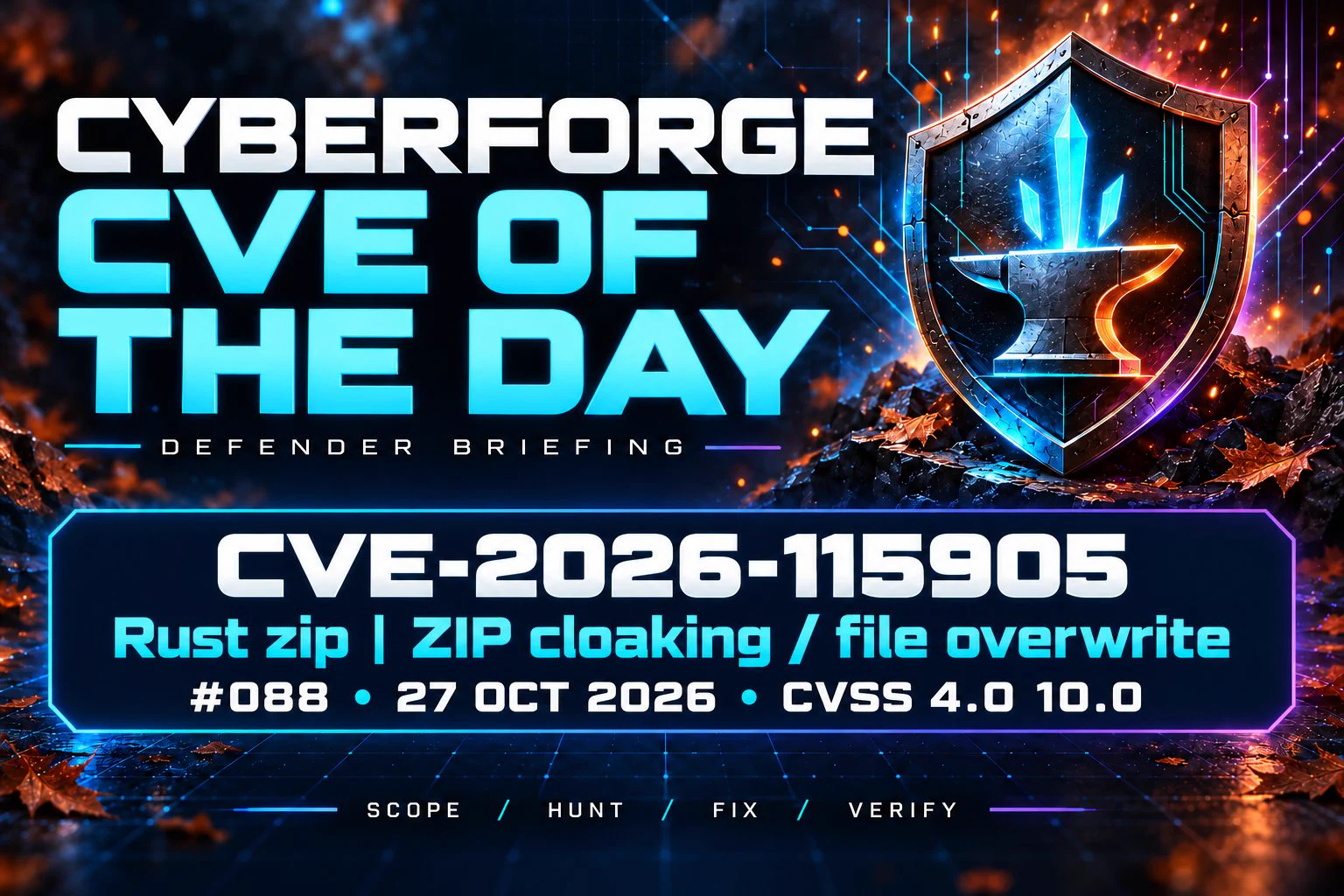
CVE-2026-115905 is a ZIP cloaking flaw in the Rust zip crate (zip-rs/zip2), rated CVSS v4.0 10.0 and affecting versions below 9.0.5. ZipArchive reads central-directory metadata while ZipStreamReader reads local headers, so a crafted archive can pass filename inspection and then overwrite a different file during streaming extraction. Version 9.0.5 adds consistency checks, but ZipStreamReader::new leaves them off by default, and extraction is not atomic, so files can be written before an error is raised. The post covers CWE-20 and CWE-436, KEV and EPSS status, Debian status and a six-step investigation trail.
x.comadvisoryAdded 29 Oct 2026, published 27 Oct 2026🛡️ Security - dbugs (@ptdbugs) on X
CVE-2026-106173 is a critical (CVSS 9.4) unauthenticated arbitrary file write in FortiSIEM's phQueryMaster gRPC service on port 27918/TCP. The SendQueryResult method builds a path from the query-id parameter without validation, so "../" sequences escape the directory and a null byte drops the appended filename and extension. Overwriting /opt/charting/redishb.sh, which runs every 60 seconds, gives remote command execution. Horizon3.ai published the analysis and a PoC.
x.comadvisoryAdded 27 Oct 2026, published 26 Oct 2026🛡️ Security 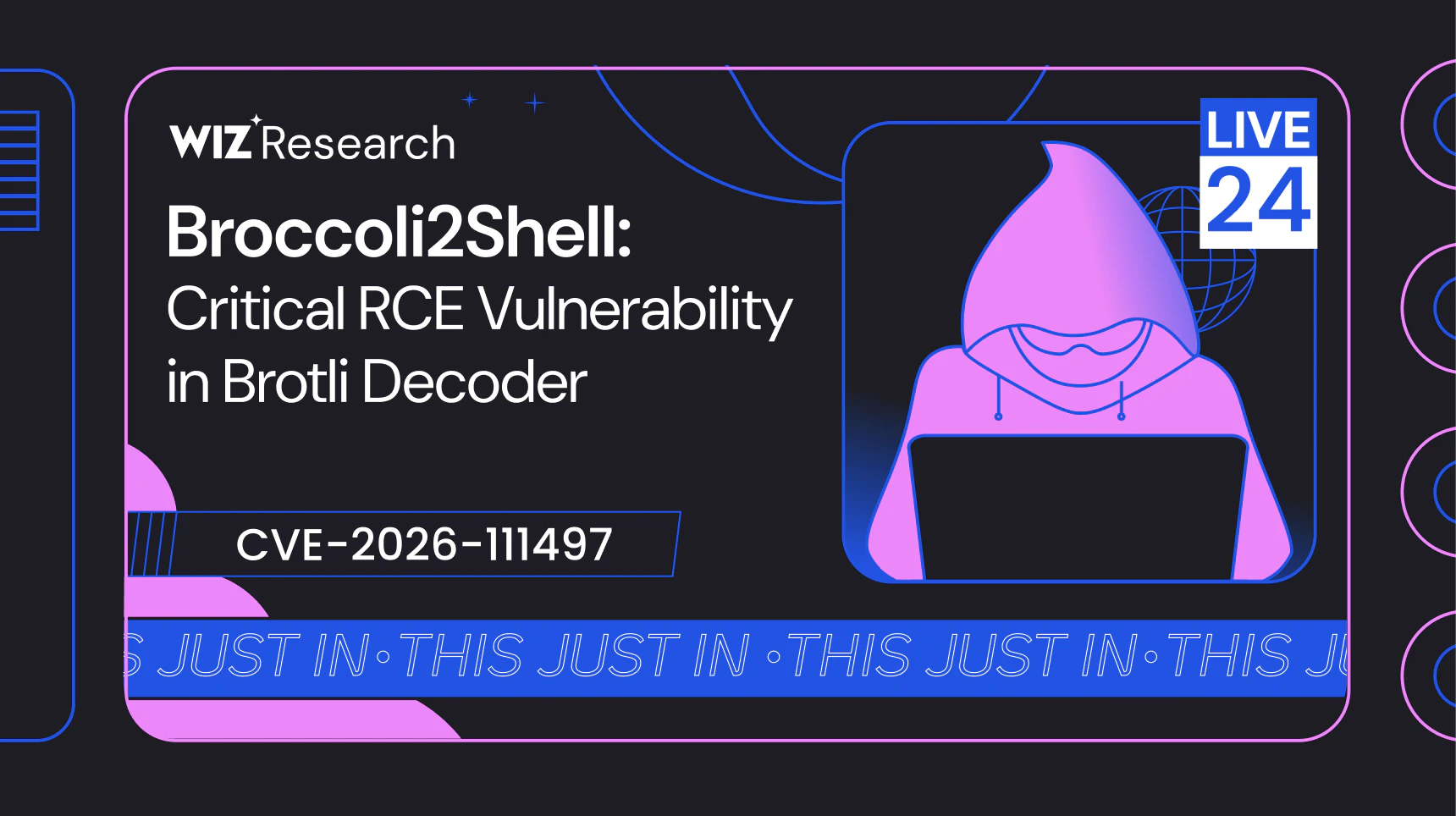 Broccoli2shell: Everything You Need To Know About The Critical Brotli Decoder Vulnerability
CVE-2026-111497 (Broccoli2Shell, also Node2Shell and HTTP2Shell) is an out-of-bounds write in the upstream Brotli C decoder. It affects Node.js, Bun, Envoy Proxy, Istio and Python packages, and can lead to memory corruption, information disclosure, crashes or RCE when untrusted Brotli data is decompressed. Wiz reports 91% of cloud environments have vulnerable resources. The post lists patching, inventory, rebuild and temporary mitigation steps.
 wiz.ioadvisoryPublished and added 25 Oct 2026🛡️ Security
 Xavier Rivera (@XavierRiveraX) on X
CVE-2026-115560 is a PHP code execution bug reported two days after the PHP2Shell emergency patches. The post says those releases do not fix it and no emergency fix is planned. Only apps that switch session.serialize_handler to php via ini_set() before session_start() are exposed. The mitigation is session.upload_progress.enabled=0, which also covers anyone who applied it for the 21 October advisory. The post gives no technical root-cause detail.
x.comadvisoryAdded 25 Oct 2026, published 23 Oct 2026🛡️ Security- lee1981 (@lee1981b) on X
CVE-2026-111497 is an out-of-bounds write in the Brotli decoder bundled with Node.js (CWE-787, CWE-252), rated CVSS v4.0 9.2 by the Google CNA and High by the Node.js project. Fixes are Node 22.23.4, 24.22.1 and 26.12.1, and 24.22.1 still labels Brotli 1.2.0 because the fix was cherry-picked. The post gives a SOC trail from input to worker, with remediation and verification steps. It notes no KEV match, CISA SSVC exploitation none, and only unverified public lab claims.
x.comadvisoryAdded 26 Oct 2026, published 23 Oct 2026🛡️ Security - Dark Web Intelligence (@DailyDarkWeb) on X
CVE-2026-114625 is a critical (CVSS 3.1 9.9) SQL injection in on-prem Arista VeloCloud Orchestrator, the SD-WAN management portal, covered in Arista Security Advisory 0199 of 22 October 2026. Any authenticated user, even the lowest Enterprise Read Only tenant role, can become a local superuser operator, and Arista says it is exploited in the wild. On-prem fixes are 5.2.3.18, 6.1.3.10 and 6.4.2.12; two attacker IPs are listed.
x.comadvisoryAdded 24 Oct 2026, published 22 Oct 2026🛡️ Security  Node2Shell: Node.js Brotli vulnerability allows remote code execution (CVE-2026-111497)
Node2Shell (CVE-2026-111497) is an out-of-bounds write in the Brotli decoder bundled with Node.js and Bun, triggered by malformed compressed input and rated high by Node.js, with possible remote code execution. Fixed in Node.js 22.23.4, 24.22.1 and 26.12.1 and Bun 1.4.4. The post covers exposure via Express 5, body-parser 2.x, fetch() and node:zlib, stopgaps, and a timeline with public proofs of concept on 22 October 2026.
 aikido.devadvisoryPublished and added 22 Oct 2026🛡️ Security
- lee1981 (@lee1981b) on X
CyberForge CVE of the Day #084 analyses CVE-2026-76466, a CVSS 9.8 flaw in clustered Cisco Expressway-C and Expressway-E. Persistent database cookies and weak client-certificate validation allow root OS command execution over the network. The fix is X15.5.20 (X14 and earlier must migrate), with no workaround. It adds a per-peer SOC investigation trail, reachability checks and exposure status from CISA SSVC, KEV and EPSS.
x.comadvisoryAdded 24 Oct 2026, published 22 Oct 2026🛡️ Security - Oracle Security Alert Advisory – CVE-2026-91403 (eMudhra cert revocation)
Oracle Security Alert for CVE-2026-91403 ships Java SE updates that distrust a set of intermediate CA certificates tied to eMudhra. It contains one new patch for Oracle Java SE, described as remotely exploitable without authentication. Customers are told to update Java or apply mitigations listed at ops.java/emudhra and in the Patch Availability Document. No reporter is credited and the page gives no CVSS score or technical detail.
 oracle.comadvisoryAdded 23 Oct 2026, published 21 Oct 2026🛡️ Security
 Railway Security Disclosure
Railway's security disclosure of 21 October 2026 says an unauthorized third party may have accessed encrypted customer environment variables and decrypted some of them. Railway links it to a series of attacks on platform companies aimed at compromising AI inference providers, and has asked upstream providers to revoke keys. It tells all users to roll every environment variable, API key and registry credential, and it paused all deployments. The notice gives no technical details of the intrusion.
 blog.railway.comadvisoryAdded 22 Oct 2026, published 21 Oct 2026🛡️ Security
- PHP web runtimes (CVE-2026-109618 and CVE-2026-109619)
AWS bulletin 2026-143-AWS covers CVE-2026-109618 and CVE-2026-109619, critical PHP web runtime flaws that let an unauthenticated remote caller run code, read process data or cause denial of service. Fixed in PHP 8.5.12, 8.4.27, 8.3.36 and 8.2.35; PHP 5.4 to 8.1 get no fix. It gives status for WorkMail, Elastic Beanstalk, Amazon Linux and Lightsail, plus AWS WAF rules, including a custom "PHP2Shell" rule matching PHP_SESSION_UPLOAD_PROGRESS and PHPSESSID.
 aws.amazon.comadvisoryAdded 22 Oct 2026, published 21 Oct 2026🛡️ Security
- Rapid Response: php2shell, Leaked Critical PHP Vulnerabilities (CVE-2026-109618 & CVE-2026-109619)
Huntress rapid-response post on php2shell, two leaked critical PHP core vulnerabilities (CVE-2026-109618 and CVE-2026-109619, CVSS v4.0 9.2 each) reported as remote code execution. The PHP team moved its security release to 21 October 2026, 14:00 UTC, after the leak. It lists hunting cues such as php-fpm, php-cgi or apache2 spawning shells, interpreters or download tools, plus inventory and patch steps. No root cause, affected versions, PoC or IOCs were public at writing.
 huntress.comadvisoryPublished and added 21 Oct 2026🛡️ Security
- #StopRansomware: SafePay Ransomware (AA26-293A)
CISA advisory AA26-293A (20 October 2026) details SafePay ransomware, active since August 2024 with at least 600 victims across critical infrastructure. It covers initial access via Mullvad VPN IPs, phished profiles and edge-device CVEs, LOTL lateral movement with PsExec, WinRM and RDP, exfiltration with RClone and WinSCP, and ChaCha20/RSA encryption. It lists IOCs, MITRE ATT&CK mappings, incident response steps and mitigations.
cisa.govadvisoryAdded 21 Oct 2026🛡️ Security 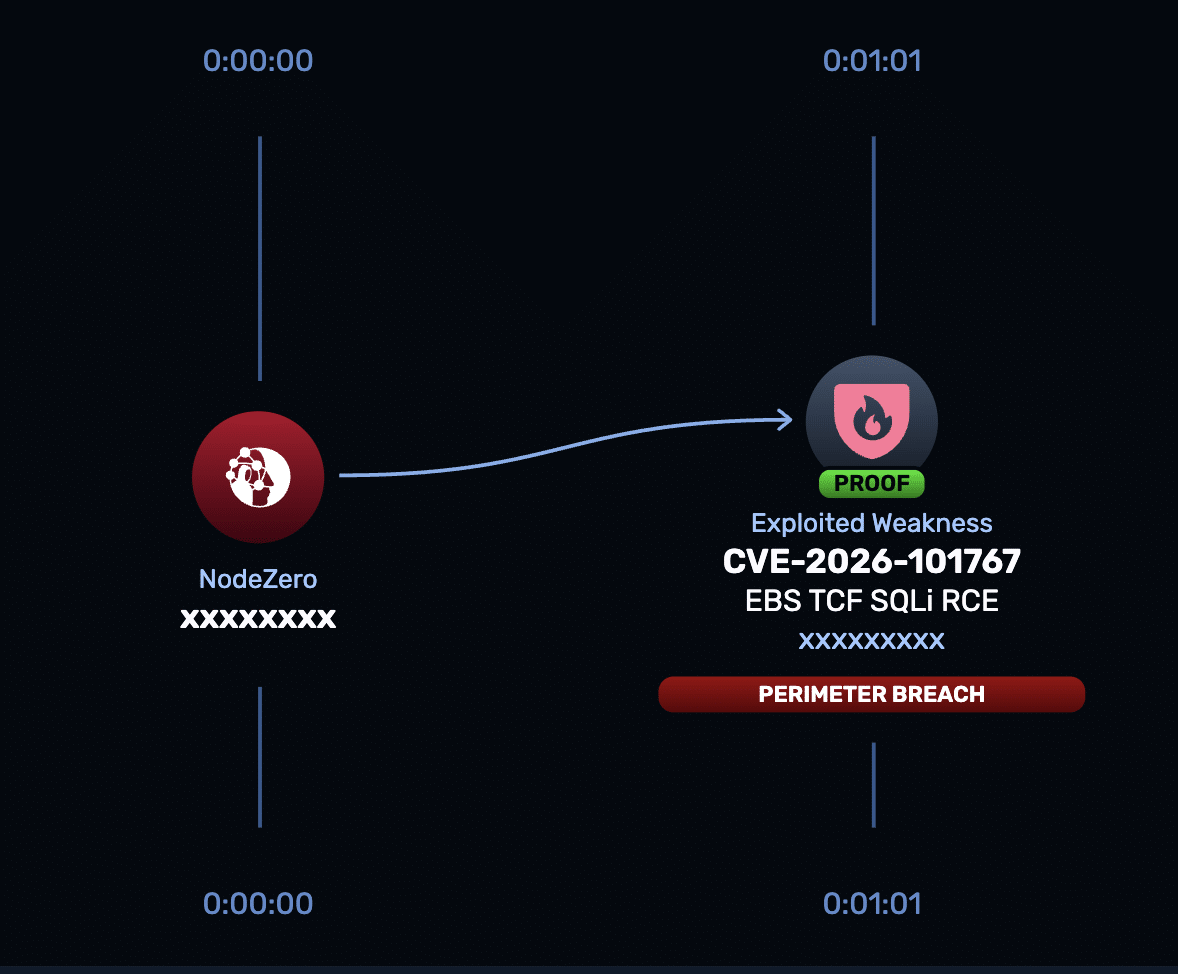 CVE-2026-101767 | Oracle E-Business Suite TCF SQL Injection and Remote Code Execution
CVE-2026-101767 is an unauthenticated SQL injection in the Oracle E-Business Suite Thin Client Framework servlet (/OA_HTML/AppsTCFServer, oracle.apps.fnd.tcf.SocketServer), CVSS 3.1 9.8. It runs SQL as the APPS user and chains to OS commands as the EBS account. Affects 12.2.3 to 12.2.15, fixed in the Oracle October 2026 CPU (20 October 2026). The page lists mitigations, IOCs and a timeline.
 horizon3.aiadvisoryAdded 29 Oct 2026, published 20 Oct 2026🛡️ Security
- lee1981 (@lee1981b) on X
CVE-2026-77932 affects DB-GPT through 0.8.2 (dbgpt-app). The /api/v1/chat/react-agent route accepts unauthenticated requests because get_user_from_headers returns an admin-role user, and the ReAct agent can reach unsandboxed Python and shell tools. Lasso reported root in the webserver container in a lab. The post gives CVSS 9.8 and 9.3, no verified fix (0.8.2 is still the latest release), no KEV match, no EPSS data, and a SOC hunting trail.
x.comadvisoryAdded 23 Oct 2026, published 20 Oct 2026🛡️ Security - lee1981 (@lee1981b) on X
CyberForge CVE of the Day #080 covers CVE-2026-99999 ("PwnEscape"), a Linux kernel IPv4 checksum-completion flaw. Crafted checksum metadata can trigger a deferred write into an already-validated IPv4 header, which allows host memory disclosure from a guest or microVM over virtio-net and TAP. It gives upstream fixed branches (5.10.272 to 7.2.11), Amazon Linux, Red Hat and Ubuntu status, CVSS 9.3, EPSS 0.211% and a SOC investigation trail. No IOCs were verified.
x.comadvisoryAdded 19 Oct 2026, published 17 Oct 2026🛡️ Security  BeyondTrust Remote Support Arbitrary File Upload (CVE-2026-102764)
CVE-2026-102764 is a CVSS 9.8 unauthenticated arbitrary file upload flaw in BeyondTrust Remote Support (formerly Bomgar) and Privileged Remote Access. Internal messaging components do not verify message origin, so remote attackers can plant files the appliance would reject. BeyondTrust disclosed it on 15 October 2026 with patch BT26-05, and CISA added it to KEV on 16 October 2026. The page lists log files to review and hardening steps.
 watchtowr.comadvisoryAdded 30 Oct 2026, published 16 Oct 2026🛡️ Security
- Dark Web Intelligence (@DailyDarkWeb) on X
Summary of Vercel's Oct 14, 2026 out-of-band Next.js security release fixing two critical unauthenticated RCEs: one in App Router apps with Cache Components where a "use cache" function returns multiple typed arrays (GHSA-673q-mjm6-r5xr, upstream React GHSA-xqc2-xf4c-x3h3, no workaround), and one in the Image Optimization API handling SVG on glibc Linux via a memory bug in a library used through sharp (CVE-2026-96889 / GHSA-2464-fhr4-w9xw, workaround sharp 0.35.5+). Also covers a high-severity Server Actions DoS (GHSA-p3m5-59mp-jv5r). Fixes ship in two supported Next.js LTS lines. No in-the-wild exploitation reported.
x.comadvisoryAdded 17 Oct 2026, published 16 Oct 2026🛡️ Security - lee1981 (@lee1981b) on X
Daily CVE digest on CVE-2026-76519, a CVSS 9.8 relative path traversal (CWE-23) in Cisco Secure Email Gateway's AMP File Reputation attachment processing. A crafted attachment gives unauthenticated arbitrary file writes and root command execution, and Cisco PSIRT reports active exploitation. The CVE is in CISA KEV. It lists the applicability conditions (File Reputation assigned to a policy and Content Scanner Tools earlier than 25.3.0.5525) and the fixes (scanner 25.3.0.5525, AsyncOS 15.5.5-014 and 16.5.0-780). It also covers evidence preservation, reading Cisco's System Security scan outcomes, mail/AMP log correlation, and deployment-specific recovery including cluster-key exposure.
x.comadvisoryAdded 18 Oct 2026, published 15 Oct 2026🛡️ Security  Microsoft Patch Tuesday for October 2026 — Snort rules and prominent vulnerabilities
Talos summarises Microsoft's October 2026 Patch Tuesday, which covers 1415 vulnerabilities, 85 of them critical (67 RCE). One bug is exploited in the wild: CVE-2026-96951, a Windows Shell security feature bypass. The post groups the CVEs by Microsoft's exploitability rating (more likely, less likely, unlikely) with CVSS and CWE for each, covering Windows, Office, Exchange, Hyper-V, DHCP, QUIC, Outlook and Azure. It also lists the Snort 2 and Snort 3 rule ID ranges that detect exploitation attempts.
 blog.talosintelligence.comadvisoryPublished and added 13 Oct 2026🛡️ Security
- lee1981 (@lee1981b) on X
CyberForge "CVE of the Day #076" covers CVE-2026-97229, a CVSS 10.0 integer overflow (CWE-190) in GitLab CE/EE's CI/CD regular expression compiler. It can lead to conditional unauthenticated code execution on the GitLab server. It lists the affected trains (19.2 before 19.2.8, 19.3 before 19.3.5, 19.4 before 19.4.2) and the 19.3.4 vs 19.3.5 Ona-regression discrepancy. It also gives six SOC checks: scoping, log preservation (Workhorse/Rails/Sidekiq, correlation_id), server-effect hunting, request-to-process correlation, upgrade and running-state verification. It notes that exploit details are unverified, no KEV listing exists and EPSS data is unavailable.
x.comadvisoryAdded 15 Oct 2026, published 13 Oct 2026🛡️ Security - lee1981 (@lee1981b) on X
CyberForge's CVE of the Day #075 covers CVE-2026-108860, a critical (CVSS 9.1 v3.1 / 9.3 v4.0) authentication bypass in SciSharp BotSharp through 5.2.0. WebStarter ships a published default HMAC JWT signing secret (CWE-321), so anyone holding it can forge bearer tokens that impersonate known users, including administrators. The post sets out how to confirm the effective key and serving build, a six-step SOC investigation trail, and remediation by rotating the secret. No verified fixed release, KEV entry or EPSS data existed at cutoff, and the linked research is static-only.
x.comadvisoryAdded 13 Oct 2026, published 12 Oct 2026🛡️ Security - lee1981 (@lee1981b) on X
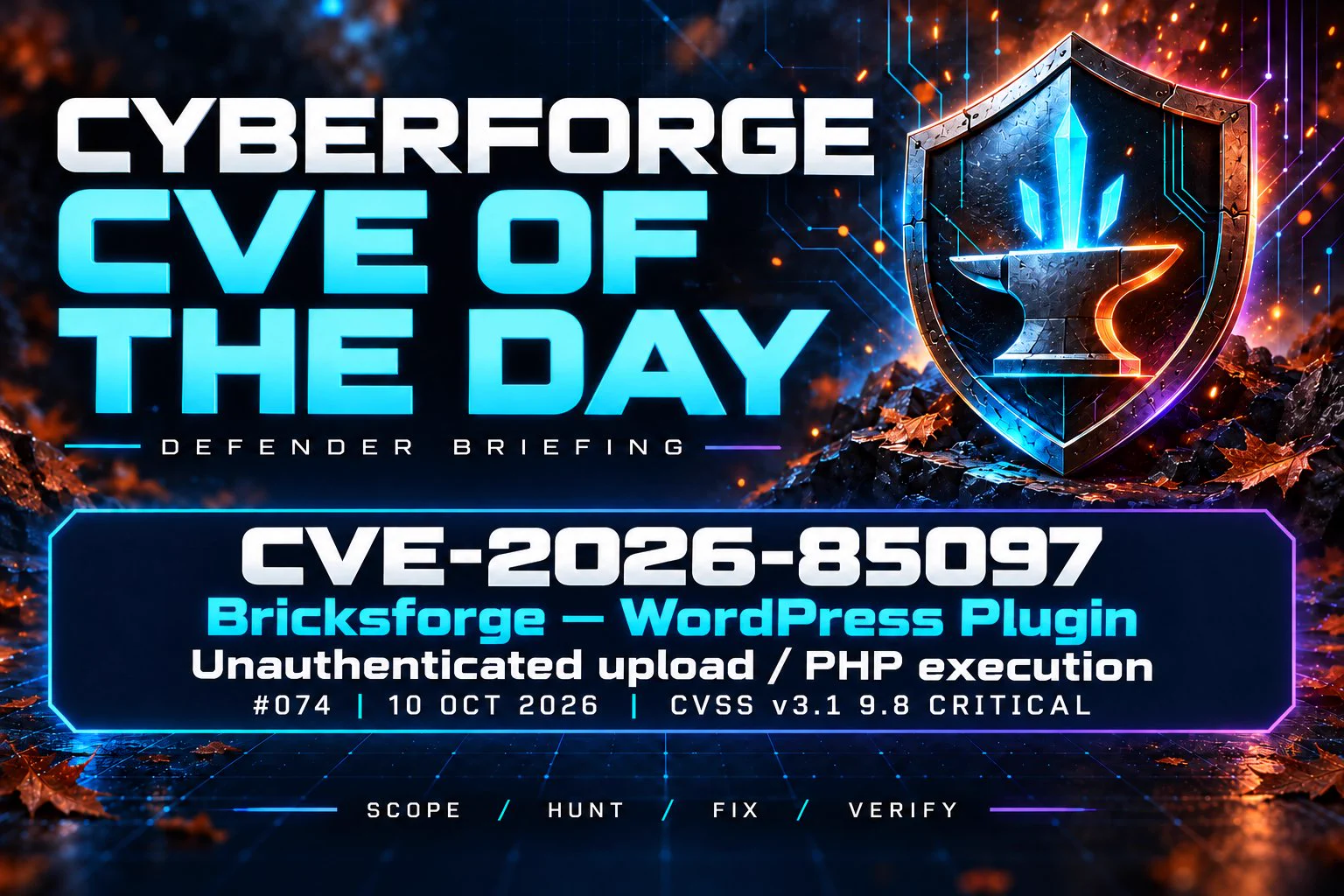
CyberForge CVE of the Day #074 analyses CVE-2026-85097, a CVSS 9.8 unauthenticated file upload to PHP execution flaw (CWE-434) in the Bricksforge WordPress plugin through 3.1.8.9. Wordfence names 3.1.8.10 as the fix, and a separate vendor 4.0.1 Pro Forms upload-security notice has no verified mapping to the CVE. It gives a defender workflow: scope versions, preserve edge/origin logs, inspect resulting files and PHP-FPM handling, and verify the patched version is serving. It also separates KEV (no match), EPSS (0.312%) and SSVC (exploitation none) from compromise evidence.
x.comadvisoryAdded 11 Oct 2026, published 10 Oct 2026🛡️ Security - CISA AA26-281A: Chinese Government-linked Actors Combine Automated and Hands-on Hacking Tools to Steal Data
Joint FBI/CISA/NSA and allied-agency advisory on China-linked actors enabled by Integrity Technology Group (overlapping with Flax Typhoon, Ethereal Panda, Red Juliett). It details their TTPs: open-source scanners and the MicroScan exploit-script app, an XSS credential-harvesting payload dropping live700_v1.exe, EBurst password spraying against Exchange/O365, SoftEther VPN persistence, DCSync via DC.exe, and email theft via the Curlc4.txt PHP bot and the office-cli utility. It also provides IOCs, MITRE ATT&CK mappings, CVEs, incident response steps, and mitigations.
cisa.govadvisoryAdded 9 Oct 2026🛡️ Security - lee1981 (@lee1981b) on X
CyberForge's CVE of the Day #073 covers CVE-2026-102255, a critical (CVSS 10.0) pre-authentication SSRF / confused-deputy flaw (CWE-918, CWE-441) in the SonicWall SMA1000 Work Place interface, per advisory SNWLID-2026-0017. It lists affected platform hotfixes (12.4.3-03526 and older, 12.5.0-02952 and older), fixed floors (12.4.3-03670, 12.5.0-03082), no workaround, and the exploitation picture (no known exploitation, not in KEV, EPSS 0.477%, SSVC automatable). It gives a six-step SOC playbook covering appliance scoping, AMC log preservation, hunting appliance-originated internal requests, correlating receiving-service changes, patching, and verifying every node, and it separates exposure, a lead, confirmed compromise and telemetry gaps.
x.comadvisoryAdded 12 Oct 2026, published 9 Oct 2026🛡️ Security  Citrix Urges Immediate Patching of Critical NetScaler Vulnerability
Citrix disclosed CVE-2026-107406 (CVSS 9.5), a critical memory overflow in NetScaler ADC and NetScaler Gateway that can lead to remote code execution or denial of service when appliances are configured as a SAML SP or SAML IdP, also affecting Secure Private Access Hybrid deployments using NetScaler. Patches are available in versions 14.1-73.46, 13.1-64.29, and the corresponding FIPS/NDcPP builds; Citrix says it is not aware of exploitation yet but urges immediate upgrades. The bulletin follows two other recently exploited NetScaler RCE/DoS zero-days (CVE-2026-88771, CVE-2026-88772) used against government, financial, education, legal, and professional-services organizations, and a separate DoS zero-day (CVE-2026-88779).
 securityweek.comadvisoryPublished and added 9 Oct 2026🛡️ Security
 Citrix NetScaler Zero-Day Exploited in the Wild Crashes SAML Authentication Services
Analysis of CVE-2026-88779 (CVSS v4.0 8.7), an unauthenticated memory-overflow flaw in the nsaaad SAML authentication handler on Citrix NetScaler ADC/Gateway that lets attackers crash the SAML service and lock out VPN/SSO access indefinitely through repeated triggering. Affects NetScaler 14.1 before 14.1-73.41 and 13.1 before 13.1-64.28 (plus FIPS/NDcPP builds); watchTowr Labs reproduced it via honeypot activity, Citrix confirmed targeted in-the-wild exploitation from IP 213.209.159.55, and CISA added it to KEV on 2026-10-04 with an Oct 7 federal remediation deadline. Some researchers suspect the overflow could extend to RCE beyond the documented DoS, though Citrix hasn't confirmed this.
orca.securityadvisoryPublished and added 5 Oct 2026🛡️ Security Critical FortiMail Zero-Day Flaw (CVE-2026-104286)
CISA added CVE-2026-104286 (CVSS 9.8), a path traversal and NULL-byte handling flaw in Fortinet FortiMail, to its Known Exploited Vulnerabilities catalog after confirming active in-the-wild exploitation. The bug lets unauthenticated attackers write arbitrary files via crafted HTTP/HTTPS requests, affecting FortiMail 7.2 through 8.0.1; Fortinet published workarounds (disabling IBE, restricting management-interface access) ahead of patches and shared attacker IPs and modified/added files as IOCs. The article also lists several other actively exploited vendor flaws disclosed the same week (Check Point, Arista VeloCloud, F5 BIG-IP APM, Cisco Catalyst SD-WAN Manager, Citrix NetScaler).
 thehackernews.comadvisoryAdded 3 Oct 2026🛡️ Security
 Critical Citrix NetScaler Zero-Days Under Active Exploitation
Analysis of two CVSS 9.5 Citrix NetScaler ADC/Gateway zero-days, CVE-2026-88771 (unauthenticated RCE through improper input validation in the management interface, affecting default deployments) and CVE-2026-88772 (memory overflow in DTLS, enabled by default on VPN virtual servers). It lists six more high-severity flaws patched in advisory CTX697096, the affected and fixed versions, and the CISA KEV listing with a federal deadline of 2026-09-30. It advises checking for compromise before patching, since patching can destroy forensic evidence, and gives response steps: isolate, revoke credentials, rebuild firmware, rotate keys and certificates.
orca.securityadvisoryPublished and added 29 Sep 2026🛡️ Security watchTowr: CVE-2026-88771 Citrix NetScaler ADC/Gateway unauthenticated RCE
watchTowr details CVE-2026-88771 (unauthenticated command execution via improper input validation, affecting every NetScaler ADC/Gateway deployment by default) and CVE-2026-88772 (DTLS memory overflow leading to RCE/DoS, exploitable since DTLS is on by default for VPN virtual servers). Both are confirmed exploited in the wild as zero-days, were pre-notified by NCSC-NL, and CVE-2026-88771 was added to the CISA KEV catalog on September 27, 2026; Citrix's bulletin CTX697096 also fixes six related issues (CVE-2026-88773 through CVE-2026-88778). The writeup gives prioritization guidance, IOC-checking steps, and warns that patching may destroy forensic evidence if done before evidence capture.
watchtowr.comadvisoryAdded 5 Oct 2026, published 27 Sep 2026🛡️ Security Attackers Exploit WordPress CVE-2026-87902 Within Hours of Patch
CVE-2026-87902 (CVSS 9.2) is an unauthenticated WordPress vulnerability where get_page_template() page-template resolution can be tricked into including an attacker-chosen local .php file outside the active theme directory, leading to RCE when a theme has a page-* top-level directory and a readable local PHP file (e.g. pearcmd.php) exists. Attackers began exploiting it within hours of the September 22, 2026 patch, including pearcmd.php to write PHP web shells to /tmp and /var/tmp and pulling a GitHub-hosted uploader payload, per honeypot telemetry from Previdian and Patchstack with tracked source IPs. CISA added the flaw to its KEV catalog on September 25, 2026, mandating FCEB remediation by September 28; fixed in WordPress 7.1.2, 7.0.6, 6.9.9, and 6.8.10.
thehackernews.comadvisoryAdded 26 Sep 2026🛡️ Security- CVE-2026-90617 in PentestAgent
VulDB entry for CVE-2026-90617, a remote OS command injection (CWE-78) in GH05TCREW PentestAgent. The flaw is in run_task in interface/main.py of the MCP HTTP Server, affects everything up to commit cf882dab, and has a public exploit. The product uses rolling releases, so no version ranges exist, and the fix is an unmerged pull request. The analysis suggests compensating controls: restrict network access to the MCP server, run with least privilege, and validate input upstream.
 vuldb.comadvisoryAdded 26 Sep 2026🛡️ Security
- CVE-2026-57860: ForgeCode (tailcallhq/forgecode), an AI pair-programming CLI, automatically loads and executes the MCP servers defined i
CVE-2026-57860 describes an arbitrary code execution flaw in ForgeCode (tailcallhq/forgecode), an AI pair-programming CLI that automatically loads and executes MCP servers defined in a repository's .mcp.json on startup without user confirmation. A malicious repo can define mcpServers entries with arbitrary command/args (e.g. bash -c) that spawn under the invoking user's privileges the moment forge is run inside the cloned repo, giving attackers a reliable initial-access and persistence primitive against developers evaluating untrusted code. CVSS 4.0 8.4 HIGH, CWE-829 (inclusion of functionality from untrusted control sphere); a fix commit and VulnCheck advisory are linked.
 nvd.nist.govadvisoryAdded 26 Sep 2026🛡️ Security
- CVE-2026-52869: The MCP Python SDK, called mcp on PyPI, is a Python implementation of the Model Context Protocol (MCP)
CVE-2026-52869 describes a session-hijacking flaw in the MCP Python SDK (PyPI package mcp) prior to version 1.27.2: the SSE and stateful Streamable HTTP transports (mcp.server.sse.SseServerTransport and mcp.server.streamable_http_manager.StreamableHTTPSessionManager) route requests to existing sessions using only the session_id query parameter or Mcp-Session-Id header, without checking that the requesting principal matches the session's original authenticated bearer-token client. This lets a different authenticated client that learns or guesses a valid session ID inject JSON-RPC messages into another user's MCP session. CVSS 3.1 base score 7.1 (High); fixed in mcp 1.27.2.
nvd.nist.govadvisoryAdded 26 Sep 2026🛡️ Security - CVE-2026-16584: Improper handling of an initialization failure in AWS API MCP Server from 0
CVE-2026-16584 affects AWS API MCP Server (awslabs.aws-api-mcp-server) versions 0.2.13 through 1.3.46: if the security policy enforcement data fails to initialize at server startup, the tool silently skips policy checks for the rest of the process's life, letting an agent execute AWS API operations the admin configured the policy to deny or gate. Underlying IAM permissions still apply and are unaffected, but the intended allow/deny gating layer is bypassed (CWE-455, improper handling of initialization failure). Fixed in 1.3.47.
nvd.nist.govadvisoryAdded 26 Sep 2026🛡️ Security - CVE-2026-14541: An authentication bypass and audience confusion vulnerability exists in the Google OAuth provider component of Google mc
CVE-2026-14541 describes an authentication bypass (CWE-287) in the Google OAuth provider of Google's mcp-toolbox for databases v1.4.0, an MCP server that lets LLM agents query databases. When the Google authService is configured with mcpEnabled: true but no explicit audience or clientId, the ValidateMCPAuth pipeline skips audience checks for opaque tokens, so any valid Google OAuth access token — even one issued for an unrelated app — is accepted, letting unauthorized clients reach protected tools and data backends.
nvd.nist.govadvisoryAdded 26 Sep 2026🛡️ Security - Careful Adoption of Agentic SI Services | CISA
Joint guidance from CISA, the Australian Signals Directorate's ACSC and other international and US partners on adopting agentic AI systems. It covers the main security challenges and risks of agentic systems, with steps for designing, deploying and operating them safely. It also shows how to map agentic risk management onto existing cybersecurity frameworks and strengthen oversight. The page text calls them "agentic super intelligence (SI)" systems, but the URL says agentic AI services.
cisa.govadvisoryAdded 26 Sep 2026🛡️ Security - Warning: Vulnerability in Starlette framework and related frameworks like FastAPI exposes millions of servers to authentication bypass, Patch Immediately! | CCB Belgium
Belgian CCB advisory on CVE-2026-48710 ("BadHost", CVSS 6.5), an authentication bypass in Starlette versions before 1.0.1. The Host header was not validated when request.url was rebuilt, so request.url.path could differ from the routed path. Middleware and endpoints that enforce access control on request.url could therefore be bypassed. The flaw affects FastAPI, LiteLLM, vLLM, MCP servers and other Python LLM infrastructure, and may expose stored third-party credentials. The advisory recommends upgrading to 1.0.1 or later and increasing monitoring, and links to the badhost.org scanner and to the GitHub, OSTIF, X41 D-Sec and Ars Technica write-ups.
 ccb.belgium.beadvisoryAdded 26 Sep 2026🛡️ Security
- CVE-2026-87912 and CVE-2026-87913: Missing S3 bucket ownership verification in the AWS Security Agent plugin for aws-agents-for-devsecops and MCP Server
AWS bulletin 2026-105-AWS discloses CVE-2026-87912 and CVE-2026-87913: the AWS Security Agent plugin (aws-agents-for-devsecops, <1.1.0) and its MCP server (<0.2.0) write scan output to a predictably-named S3 bucket (security-agent-scans-<account-id>-<region>) without verifying bucket ownership. An attacker who pre-registers that bucket name in their own account can obtain the victim's private source archive, including embedded credentials and infrastructure state. AWS recommends upgrading to 0.2.0 and manually verifying/pre-creating the scan bucket to prevent squatting.
aws.amazon.comadvisoryAdded 26 Sep 2026🛡️ Security  ChatGPT Images 2.5 System Card
OpenAI's system card for ChatGPT Images 2.5, powered by GPT-Image-2.5-Sunburst and GPT-Image-2.5-Flare, covering training data handling, a multi-layer image safety stack with upstream policy refusals and a downstream multimodal safety-reasoning monitor for input and output blocking, adversarial safety evaluation results versus ChatGPT Images 2.0, and Preparedness Framework capability assessments for biological and cyber risk adapted to the image modality. It also details image provenance measures including C2PA metadata conformance and Google DeepMind's SynthID watermarking.
 deploymentsafety.openai.comadvisoryAdded 7 Oct 2026, published 8 Sep 2026🧠 AI
- ChatGPT Images 2.5 System Card
OpenAI's system card for ChatGPT Images 2.5, covering the GPT-Image-2.5-Sunburst and GPT-Image-2.5-Flare models, details a multi-layer image safety stack (upstream LLM policy refusals, a multimodal safety reasoning model for input/output blocking) built to counter heightened deepfake realism risks. It reports adversarial-prompt evaluation results against ChatGPT Images 2.0, Preparedness Framework assessments for biological and cyber capability (image-modality adaptations of existing LLM evals, neither model crossing the "High" threshold but biological-risk mitigations still applied precautionarily), and expanded provenance tooling via C2PA metadata and Google DeepMind's SynthID watermarking.
deploymentsafety.openai.comadvisoryAdded 7 Oct 2026, published 8 Sep 2026🛡️ Security 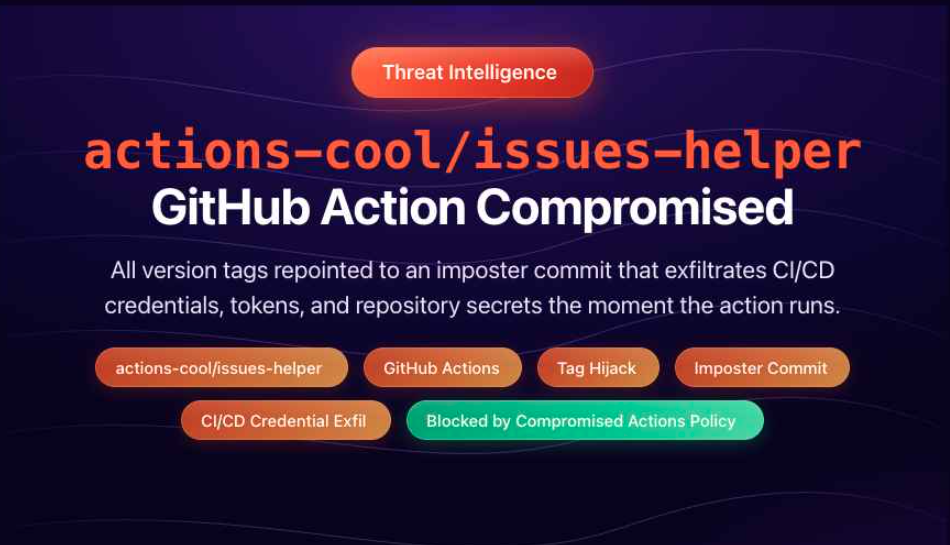 actions-cool/issues-helper GitHub Action Compromised: All Tags Point to Imposter Commit That Exfiltrates CI/CD Credentials - StepSecurity
StepSecurity discovered that all 53 tags of the popular actions-cool/issues-helper GitHub Action (and all 15 tags of actions-cool/maintain-one-comment) were re-pointed to dangling imposter commits containing malicious code. The payload downloads the Bun runtime, reads Runner.Worker process memory to harvest decrypted CI/CD secrets, and exfiltrates them via HTTPS to t.m-kosche.com — meaning any workflow referencing the actions by tag (rather than a pinned commit SHA) pulls the malicious code on its next run.
 stepsecurity.ioadvisoryAdded 5 Sep 2026🛡️ Security
 GHSL-2026-203: Same-second TOCTOU in jupyterlab/maintainer-tools
GitHub Security Lab discloses GHSL-2026-203 / CVE-2026-84973, a same-second time-of-check-to-time-of-use race condition in the jupyterlab/maintainer-tools update-snapshots-checkout GitHub Action. The action compares one-second-precision pushed_at and comment created_at timestamps to detect post-authorization pushes, but a strict greater-than check lets an attacker push a malicious commit in the same second as an authorized "please update snapshots" comment, causing the action to check out and later execute attacker-controlled code (including a local composite action and jlpm-driven package scripts) with the workflow's GITHUB_TOKEN (contents: write, pull-requests: write) in the jupyter/notebook repository. The issue was fixed in v1.0.0 and is a variant of the "pwn request" class of GitHub Actions vulnerabilities.
 securitylab.github.comadvisoryAdded 20 Sep 2026, published 4 Sep 2026🛡️ Security
 Security Hardening Release for Splunk Apps and Add-ons - August 2026
Splunk's August 2026 hardening advisory (SVD-2026-0808) discloses 17 CVEs across Cisco Talos Intelligence for Enterprise Security Cloud, Splunk AI Toolkit, Splunk Connect for Kafka, the Splunk MCP Server app, and Splunk On-Call (VictorOps). Notable issues include a critical (CVSS 9.1) RCE via unsafe credential deserialization in the Splunk MCP Server app (CVE-2026-76404), an RCE via pickle-based deserialization when loading ML model files in Splunk AI Toolkit (CVE-2026-76395), multiple SSRF and authorization-bypass flaws letting low-privileged users escalate to system-level search execution, hardcoded/predictable container credentials, and unauthenticated DoS/ReDoS and cert-validation bypasses in Splunk Connect for Kafka. Each finding includes CWE classification, CVSS vector, and mitigation guidance (typically disabling the affected app or restricting REST API access).
 advisory.splunk.comadvisoryAdded 21 Aug 2026🛡️ Security
 Critical Elementor Pro File Upload Flaw Enables Unauthenticated Remote Code Execution on WordPress Sites
CVE-2026-32475 (CVSS 9.0) is an unauthenticated arbitrary file upload leading to RCE in Elementor Pro's Forms module (versions up to 4.2.1), caused by the extension-blocklist check and the file-move step running in two separate loops with different empty-file handling, letting a two-part file submission bypass the blocklist and drop a PHP webshell into the public wp-content/uploads/elementor/forms/ directory. The post also flags related WordPress core CVE-2026-65640 (CVSS 8.8, fixed in 7.0.4), an Author-level RCE via malicious PostScript upload requiring Imagick and Ghostscript. Fix: upgrade Elementor Pro to 4.2.2+ and WordPress core to 7.0.4, and audit the uploads/elementor/forms directory for planted PHP files.
orca.securityadvisoryAdded 3 Sep 2026, published 20 Aug 2026🛡️ Security Coldcard Security Advisory
Unchained client-facing security advisory responding to Coinkite disclosure that Coldcard hardware wallets (Mk3, Mk4, Mk5, and Q models) generated private keys using a lower-than-expected amount of random bits, weakening key-generation entropy. The advisory details risk to Bitcoin multisig vaults built with Coldcard-generated keys and describes an attack scenario where an attacker holding 2-of-3 compromised keys plus knowledge of a reused address can mount a Replace-By-Fee (RBF) replacement-cycling attack to redirect pending transactions, along with key-replacement remediation steps including Unchained Slipstream as RBF mitigation.
 unchained.comadvisoryAdded 4 Oct 2026, published 31 Jul 2026🛡️ Security
 Socket: Free Certified Patches for Nuxt Security Vulnerabilities
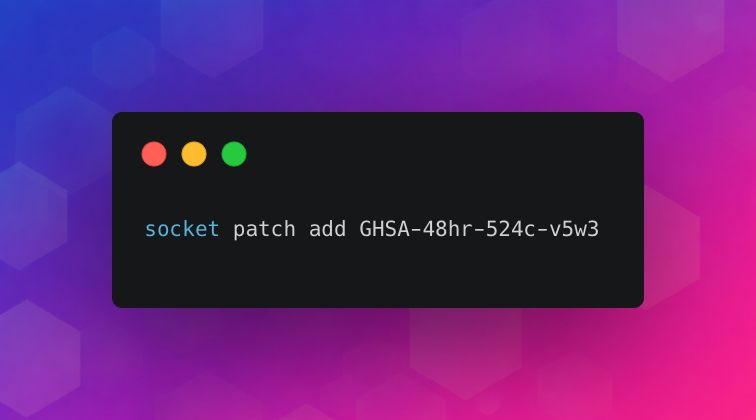
Nuxt 4.5.1/3.21.10 and @nuxt/devtools 3.3.1 patch eight GitHub Security Advisories, the most severe being GHSA-9473-5f9j-94wq, a server-side RCE via server island props reaching Vue's dynamic component resolution when vue.runtimeCompiler is enabled, plus a related unauthorized component instantiation bug (GHSA-48hr-524c-v5w3), a route-rule authz bypass, DoS issues, cross-user payload cache disclosure, and a critical dev-only RCE in Nuxt DevTools. Socket released free Certified Patches for the two highest-severity issues (installable via `socket patch add`) as an interim fix for teams that can't immediately upgrade, and is preparing patches for the rest.
 socket.devadvisoryPublished and added 28 Jul 2026🛡️ Security
- CVE-2026-55608
CVE-2026-55608 affects n8n-MCP, an MCP server exposing n8n node documentation and operations to AI assistants. Prior to version 2.57.4, when run in multi-tenant HTTP mode (ENABLE_MULTI_TENANT=true), an authenticated tenant could bypass tenant scoping and access or delete default-scope workflow_versions backups left over from earlier single-tenant deployments or migrations, exposing other tenants' workflow data. The issue is tracked as CWE-200 (information exposure) and CWE-863 (incorrect authorization) and is fixed in v2.57.4.
nvd.nist.govadvisoryPublished and added 16 Jul 2026🛡️ Security - CVE-2026-61459
CVE-2026-61459 describes an argument injection flaw (CWE-88) in mcp-server-kubernetes before 3.9.0, where the structured tools kubectl_get, kubectl_describe, and kubectl_delete fail to block leading-dash resourceType/name parameters, letting an attacker bypass the assertNoDangerousFlags check and inject a --server flag. This redirects kubectl calls to an attacker-controlled API server, leaking the operator's bearer token and enabling full Kubernetes cluster compromise. Fixed in v3.9.0; details corroborated by a VulnCheck advisory and the upstream GitHub commit/PR.
nvd.nist.govadvisoryPublished and added 12 Jul 2026🛡️ Security  simonecorsi/mawesome GitHub Action has been compromised
StepSecurity reports that the simonecorsi/mawesome GitHub Action repository was compromised on June 24, 2026, when an attacker force-pushed malicious commits and repointed several release tags to point at them, so any workflow pinned to those tags subsequently ran the attacker's code inside its GitHub Actions runner. StepSecurity notes the attack method mirrors the codfish/semantic-release-action compromise disclosed the same day, suggesting a coordinated campaign targeting GitHub Action maintainers via tag hijacking.
stepsecurity.ioadvisoryAdded 3 Sep 2026, published 1 Jul 2026🛡️ Security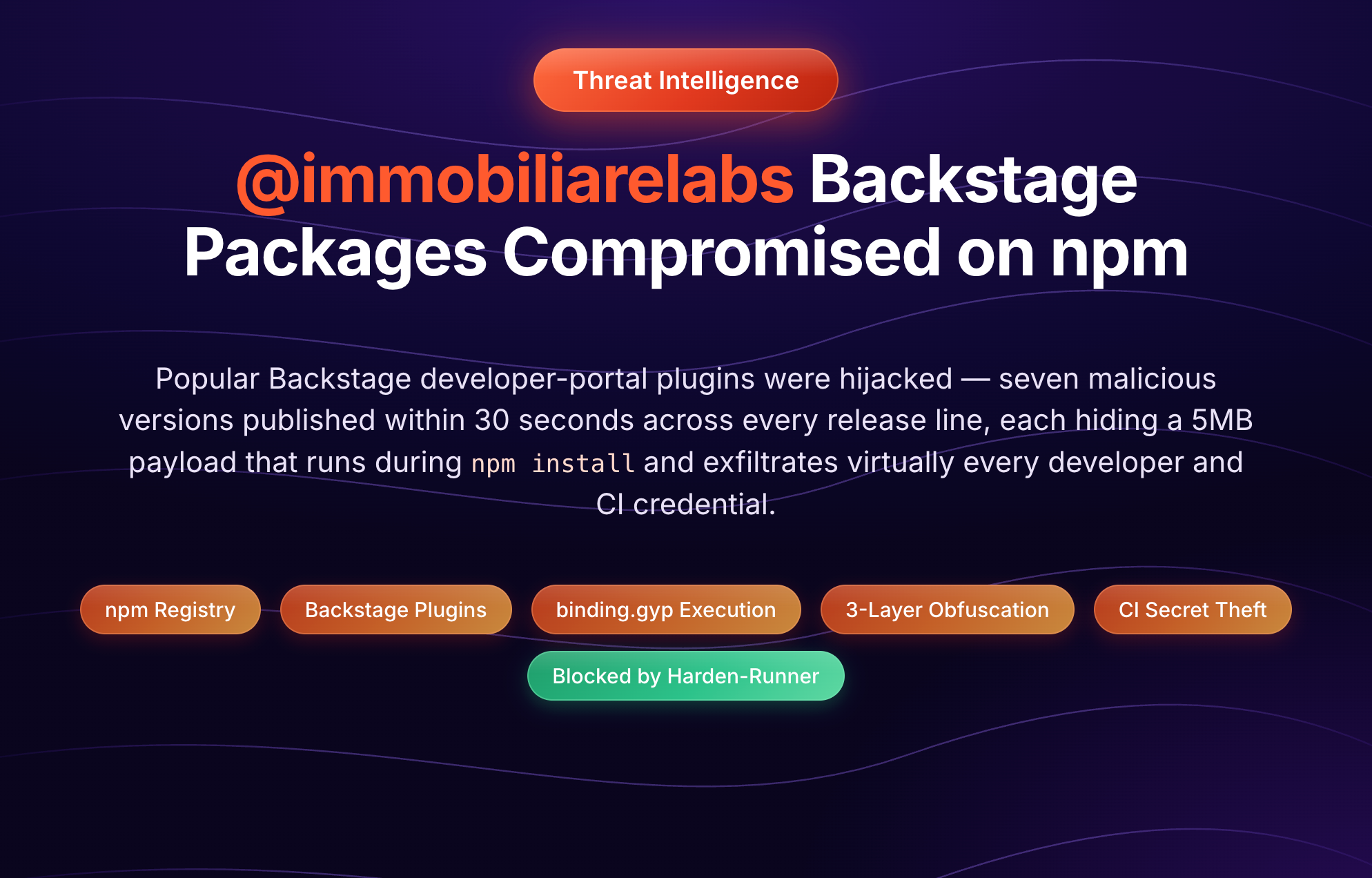 Multiple @immobiliarelabs Backstage Plugins Compromised on npm
StepSecurity reports that multiple npm packages published under the @immobiliarelabs scope, used as Backstage plugins, were compromised and had malicious code injected, likely via a maintainer account or publishing credential takeover. The advisory covers the affected package versions and indicators, warning organizations using these Backstage plugins to check their dependency trees for the compromised releases.
stepsecurity.ioadvisoryAdded 3 Sep 2026, published 1 Jul 2026🛡️ Security- CVE-2026-12773
Tenable CVE entry for CVE-2026-12773, an improper authentication flaw in BerriAI LiteLLM up to 1.59.8. The vulnerable function is UserAPIKeyAuth in litellm/proxy/_experimental/mcp_server/auth/user_api_key_auth_mcp.py in the MCP Proxy component. It is remotely exploitable, a public exploit exists, and scores are CVSS v3.1 9.8 Critical, CVSS v4.0 6.9 Medium and EPSS 0.01017.
 tenable.comadvisoryAdded 26 Jun 2026🛡️ Security
 CVE-2026-49291 | THREATINT
CVE-2026-49291 affects mcp-memory-service, a semantic memory layer for AI apps, in versions before 10.65.3. The HTTP MCP JSON-RPC endpoint `/mcp` requires only the OAuth `read` scope and dispatches `tools/call` to mutating handlers. A read-only client can therefore call `store_memory` and `delete_memory`, bypassing the `write` scope that the REST endpoints enforce. It is classed as CWE-862 Missing Authorization and fixed in 10.65.3.
 cve.threatint.euadvisoryAdded 23 Jun 2026🛡️ Security
 Orca: CVE-2026-5027 Langflow Path Traversal RCE
CVE-2026-5027 (CVSS 8.8) is a path traversal vulnerability in Langflow's POST /api/v2/files upload endpoint, where the upload_user_file() function fails to sanitize filenames, allowing attackers to write arbitrary files anywhere on the filesystem. Because Langflow ships with unauthenticated auto-login enabled by default, a single unauthenticated request is enough to obtain a session and exploit it, escalating to RCE via cron job injection or config overwrite. Tenable disclosed it after failed vendor contact, VulnCheck has confirmed active exploitation against roughly 7,000 internet-exposed instances, and a public PoC exists; fixed in Langflow 1.9.0/1.10.0 and langflow-base 0.8.3.
orca.securityadvisoryPublished and added 12 Jun 2026🛡️ Security Orca: CVE-2026-45034 PhpSpreadsheet RCE Patch Bypass
Orca Security details CVE-2026-45034 (CVSS 9.8), a bypass of PhpSpreadsheet's File::prohibitWrappers() protection that was originally added to fix CVE-2026-34084. A crafted path with three or more slashes after the scheme (e.g. phar:///path/exploit.phar/dummy.csv) causes PHP's parse_url() to return false instead of a scheme string, skipping the is_string($scheme) check while PHP's stream layer still treats the path as a phar wrapper, enabling automatic phar deserialization via IOFactory::load() and full RCE on PHP 7.x (file-read primitive on PHP 8.x, with RCE restored if Phar::getMetadata() is later called). All 1.x versions through 1.30.4 are affected; PhpSpreadsheet 1.30.5 patches the issue, and the post recommends replacing parse_url()-based checks with str_contains($filename, '://') validation.
orca.securityadvisoryPublished and added 12 Jun 2026🛡️ Security Socket: Packagist Urges Immediate Composer Update After GitHub Actions Token Leak
Packagist disclosed that Composer versions prior to 2.9.8, 2.2.28 LTS, and 1.10.28 could leak full GitHub Actions GITHUB_TOKEN and GitHub App installation token values into CI logs when a token failed Composer's outdated validation regex, triggered by GitHub's since-rolled-back rollout of a new hyphenated token format. Common setups like shivammathur/setup-php that auto-register GITHUB_TOKEN into Composer's global auth.json are called out as at risk, and teams are urged to update Composer immediately and audit Actions logs for exposed credentials.
socket.devadvisoryPublished and added 13 May 2026🛡️ Security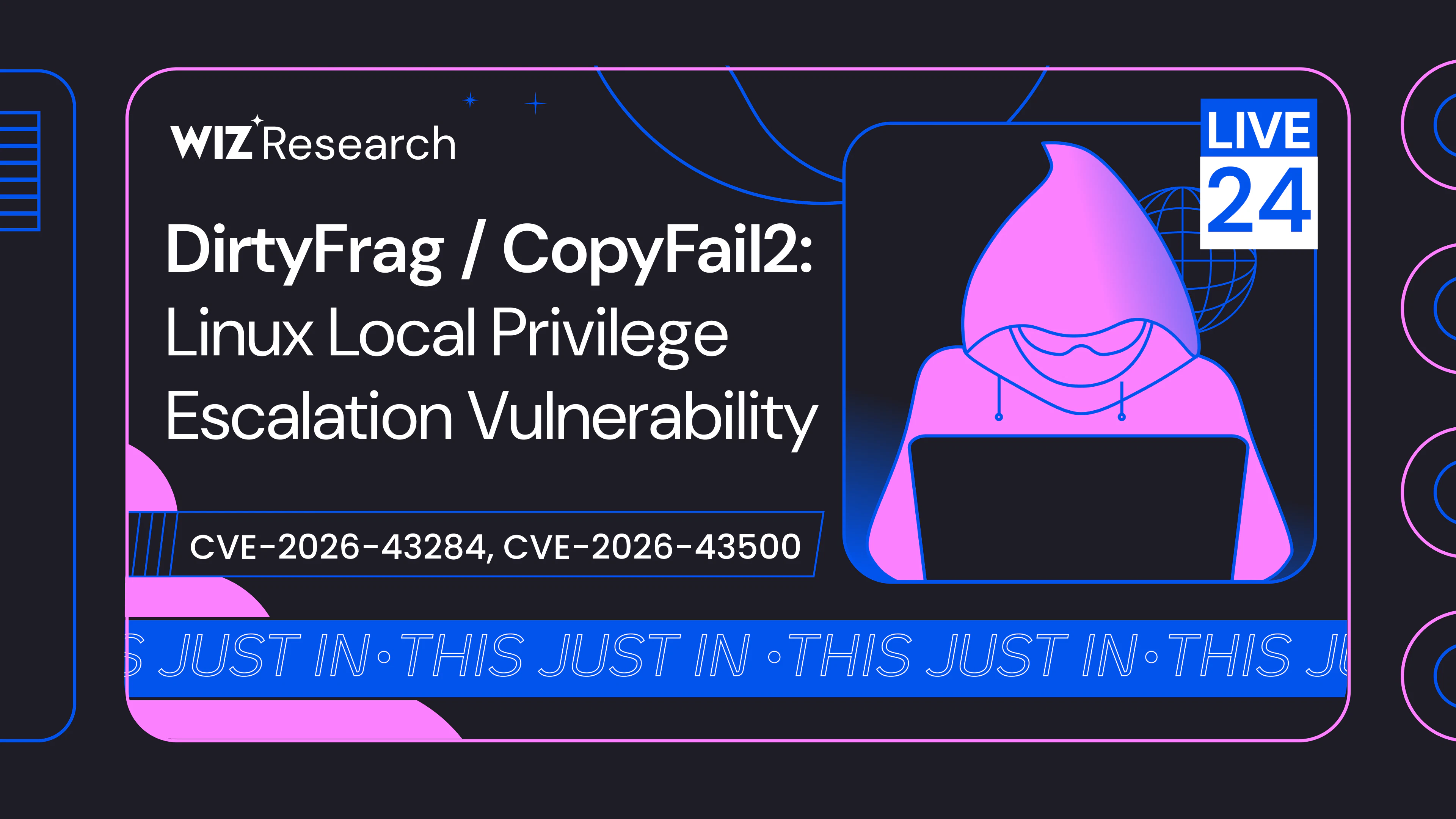 Dirty Frag (CVE-2026-43284) Linux Privilege Escalation | Wiz Blog
Wiz details "Dirty Frag" (CVE-2026-43284 and CVE-2026-43500), a Linux kernel local privilege escalation chain combining page-cache write primitives in the xfrm-ESP (IPsec) and RxRPC subsystems that let an unprivileged-but-CAP_NET_ADMIN attacker corrupt page-cache-backed memory to gain root. It is a deterministic (non-race-condition) bug class similar to Dirty Pipe and is a successor to the earlier Copy Fail (CVE-2026-31431); a public PoC exists but no official patch is available yet, and affected code paths date back to 2017 (ESP) and 2023 (RxRPC).
wiz.ioadvisoryAdded 5 Sep 2026, published 8 May 2026🛡️ Security Fixes available for CVE-2026-31431 (Copy Fail) Linux Kernel Local Privilege Escalation Vulnerability | Ubuntu
Ubuntu Security Team advisory for CVE-2026-31431 ("Copy Fail"), a HIGH severity (CVSS 7.8) local privilege escalation vulnerability in the Linux kernel's algif_aead cryptographic acceleration module, affecting all Ubuntu releases before 26.04 (Resolute). A public exploit lets a local user escalate to root on non-containerized hosts, while container deployments may face escape scenarios (no PoC yet for that path); the advisory covers the temporary kmod-based module-disabling mitigation, the permanent kernel patch, and manual remediation steps via modprobe.d.
 ubuntu.comadvisoryAdded 20 May 2026, published 30 Apr 2026🛡️ Security
 MCP TypeScript SDK Cross-Client Data Leak (CVE-2026-25536)
CVE-2026-25536 is a cross-client data leak in the official MCP TypeScript SDK (v1.10.0-1.25.3, CVSS 7.1): when a single McpServer instance reuses a StreamableHTTPServerTransport across multiple concurrent client connections, a race condition in the response multiplexing logic can route one client's tool results, resource content, or errors to a different client. This breaks tenant isolation in multi-user MCP server deployments, a common production pattern, potentially exposing sensitive API responses, file contents, or database query results across security boundaries. Fixed in SDK v1.26.0; recommended mitigations include upgrading, using per-client McpServer instances, and adding client-side response correlation checks.
 vulnerablemcp.infoadvisoryAdded 30 Sep 2026, published 4 Feb 2026🛡️ Security
- Gladinet CentreStack/Triofox: Cryptography Vulnerability | Huntress
Huntress reverse-engineered Gladinet CentreStack/Triofox's filesvr.dn HTTP handler and found that its AES-256 "Access Ticket" encryption uses hardcoded, static key/IV strings (Chinese and Japanese marketing text embedded in GladCtrl64.dll) extracted from the SysKeyMgr class, assigned CVE-2025-14611 (CVSS 7.1). Because the keys never change, attackers can forge tickets with arbitrary timestamps to read the server's web.config and steal ASP.NET machine keys, enabling ViewState deserialization RCE; this was chained with a prior auth bypass (CVE-2025-11371) and observed exploited in the wild against at least nine organizations. Later updates report suspected cl0p ransomware group exploitation of CVE-2025-30406 (ViewState deserialization) against internet-facing CentreStack servers, with IOCs including a "conqueror.exe" payload and specific attacker IPs.
huntress.comadvisoryAdded 3 Sep 2026, published 18 Dec 2025🛡️ Security - CVE-2024-50306: Unchecked return value in Apache Traffic Server
Writeup of CVE-2024-50306, a vulnerability in Apache Traffic Server (versions 9.0.0-9.2.5 and 10.0.0-10.0.1) where the code fails to check the return value of initgroups() when dropping privileges after startup. If the call fails, the process believes it has dropped supplementary group memberships when it has not, potentially leaving it in a privileged group and enabling privilege escalation. Fixed in ATS 9.2.6/10.0.2 by aborting execution on failure.
 bencteux.fradvisoryAdded 3 Sep 2026, published 17 Nov 2024🛡️ Security
- CVE-2023-38336: Command injection in netkit-rcp
Writeup by the researcher who reported CVE-2023-38336, a command injection vulnerability in Netkit's rcp implementation (Debian's rsh-client package). The bug is in susystem() in rcp/rcp.c, which passes filename arguments unsanitized to `sh -c`, letting an attacker who controls a copied filename execute arbitrary commands (demonstrated via `ltrace` with a filename like `";whoami"`); the binary is SUID root but drops privileges via setuid() before executing the shell, so the flaw grants command execution as the invoking user rather than root escalation. No patch exists since the project has no upstream maintainer, and the author recommends migrating from RSH to SSH.
bencteux.fradvisoryAdded 3 Sep 2026, published 18 Jul 2023🛡️ Security