- Bunny CDN Security Incident
Bunny CDN status-page notice, posted 28 October 2026, about unauthorized access at an infrastructure provider that hosted one bunny.net CDN node in Armenia. Traffic was stopped within 20 minutes and the server wiped. No access to the node was found, but cached content, Pull Zone configs and TLS certificates could have been exposed, so all platform certificates were reissued. Customers with their own certificates should rotate them with new private keys.
 status.bunny.netadvisoryAdded 31 Oct 2026, published 30 Oct 2026🛡️ Security
 Bulletproof Host Virtualine Loses Its Domain to FBI Seizure
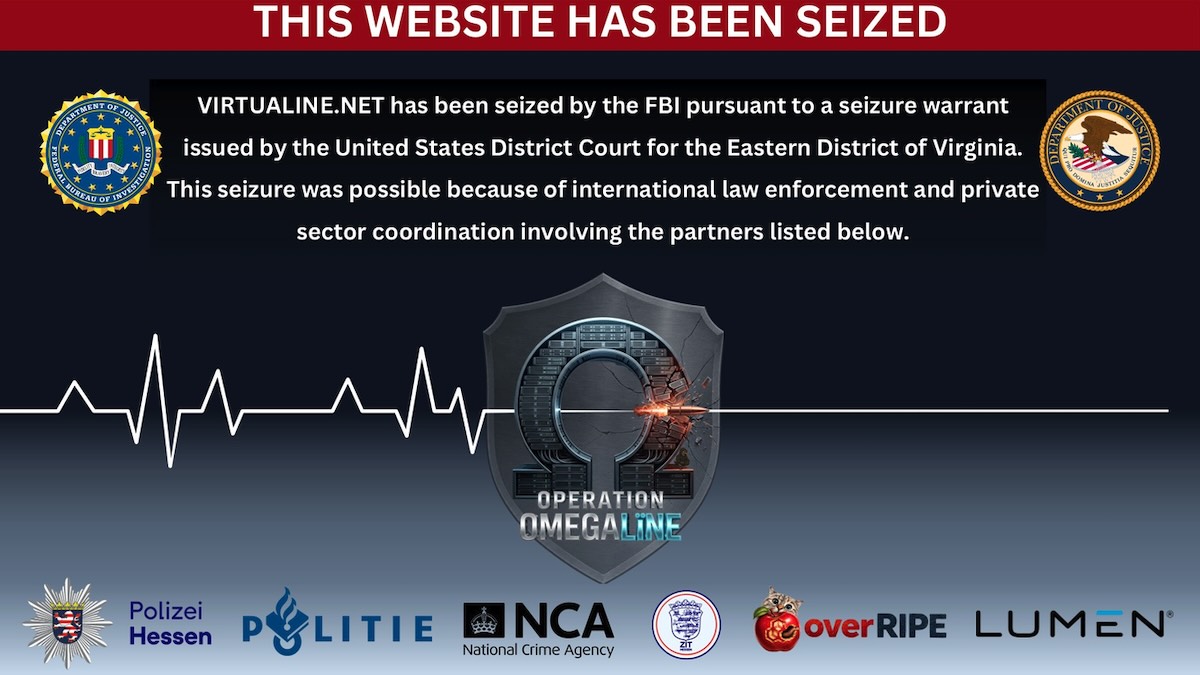
Virtualine is a Russian-speaking bulletproof hosting provider whose domain virtualine.net the FBI seized. Court documents say it hosted phishing, spam, carding and illicit content, and ignored abuse reports. TRM Labs says it received more illicit-attributed cryptocurrency than any other labeled bulletproof host, mostly from a Russian drug marketplace (44%) and a sextortion scheme (17%), and later from StealC operators in 2026.
 securityweek.comarticlePublished and added 30 Oct 2026🛡️ Security
- Hakimi Eiqbal (@hakimieiqbal) on X
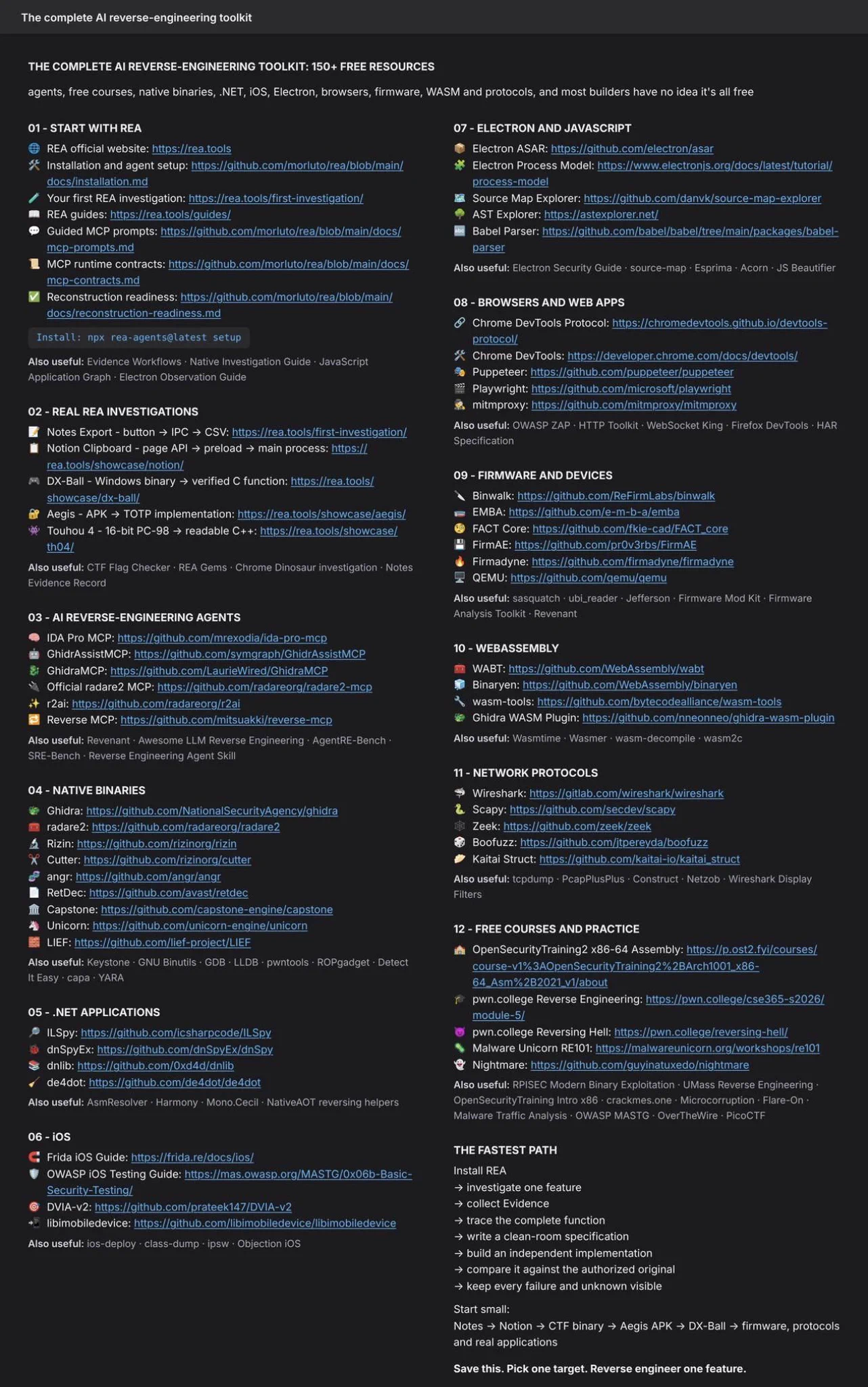
A practical reverse-engineering map by hakimieiqbal on X that picks tools by target: native binaries, .NET, Electron, iOS, firmware, WebAssembly and network protocols. It introduces REA (morluto/rea), which connects coding agents to RE tools, and lists MCP bridges for IDA Pro, Ghidra and radare2. It adds an evidence-first workflow and free courses such as pwn.college and OpenSecurityTraining2.
 x.comthreadAdded 29 Oct 2026, published 28 Oct 2026🛡️ Security
- Hakimi Eiqbal (@hakimieiqbal) on X
A thread by Hakimi Eiqbal that maps reverse-engineering tools by target type: native binaries, Electron, .NET, iOS, firmware, WebAssembly and network protocols. Its AI sections cover REA (an open-source layer connecting coding agents to analysis tools) and MCP bridges for IDA Pro, Ghidra and radare2. It argues for an evidence-first workflow and gives a prompt that separates verified facts from hypotheses.
x.comthreadAdded 29 Oct 2026, published 28 Oct 2026🧠 AI  International Law Enforcement Seizes Domain of Virtualine Bulletproof Hosting Service
Virtualine is a bulletproof hosting provider whose domain virtualine.net was seized on 27 October 2026 by the FBI Washington Field Office and the Eastern District of Virginia, with German, Dutch and UK police support. Chainalysis and OverRIPE gave intelligence support. The post lists aliases (Secury, Massgod, Spamhouse, Lanedo, Omegatech), forum advertising on Exploit.in and HackForums, and unhosted bitcoin payments tied to ransomware, infostealers and scam infrastructure.
 chainalysis.comarticlePublished and added 27 Oct 2026🛡️ Security
 eMudhra, Brotli, and the Long Tail of a Security Fix
Socket post on why fixing the eMudhra weak-key intermediate CA incident (October 2026) and Brotli memory corruption CVE-2026-111497 takes more than updating Node.js. Bundled Brotli copies in Bun, Python Requests and .NET, Go binaries needing rebuilds, and per-program certificate stores all leave stale copies. It lists steps: track bundled components, keep a rebuild path, use workarounds, and verify the shipped artifact.
 socket.devarticlePublished and added 26 Oct 2026🛡️ Security
 Node2Shell: Brotli Flaw Triggers Patching Across Microsoft, Node.js, Python Packages
CVE-2026-111497 (Node2Shell) is an out-of-bounds write in Google's Brotli decoder, versions 1.0.3 through 1.2.0, rated CVSS v4 9.2. Fixed in Brotli 1.0.10, 1.1.1 and 1.2.1, with patches from Node.js, Microsoft (.NET, Visual Studio, PowerShell on October 25), PyPI Brotli and brotlicffi, Bun, Envoy and Istio. Imperva showed code execution on Node.js 24.22.0 arm64; no in-the-wild exploitation is reported and some researchers say it only enables DoS.
securityweek.comarticlePublished and added 26 Oct 2026🛡️ Security Bye Bye Brotli? Google's Compression Library Is a Security Mess
Bugsink's blog post argues Google's Brotli library is poorly maintained. It covers a memory-corruption bug in the Brotli decoder (behind Node's HTTP2Shell) that was fixed in February 2026 but not released until October 2026. It also covers the 2025 decompression-bomb fix, released 283 days after its release notes, and urllib3's follow-up bug. Open out-of-bounds read PRs and a .NET CPU exhaustion issue remain.
 bugsink.comarticleAdded 26 Oct 2026, published 25 Oct 2026🛡️ Security
 Upcoming Critical PHP Security Release
The php.net 2026 news archive opens with the PHP security team's advance notice of a release scheduled for 21 October 2026 at 14:00 UTC. It fixes two critical vulnerabilities, both rated CVSS v4.0 9.2, and may ship earlier if details leak or exploitation appears. Details and fixed versions come with the release. The archive also lists 2026 security releases (8.2.34, 8.3.35, 8.4.26, 8.5.11), PHP 8.6 RC3 and conference announcements.
 php.netadvisoryAdded 21 Oct 2026, published 20 Oct 2026🛡️ Security
- ralphtradesz/trading-hub
Trading Hub is a free macOS desktop trading platform built with C#/.NET 10 and Avalonia. It uses the user's Claude Code subscription: a chat writes and fixes C# strategies, an in-app MCP server lets Claude run backtests, optimizations and walk-forwards and write reports, and a risk agent proposes position sizes. Install and a Windows port are both driven by Claude Code prompts. License is MIT with Commons Clause.
 github.comrepoAdded 19 Oct 2026, published 17 Oct 2026🧠 AI
- morluto/rea
REA (rea-agents on npm) registers an MCP server and matching workflow instructions with coding agents such as Claude Code, Codex, Cursor and Gemini CLI. It exposes tools for inspecting native binaries through Hopper, Ghidra or IDA (with optional objdump and Rizin), JavaScript/Electron apps and ASAR archives, .NET assemblies and websites. Results come back with evidence and limitations, so the agent can explain how a feature works and write and test its own implementation. Analysis runs locally, there is a CLI with the same workflows, and the showcases include C reconstructions verified against original x86 function bytes.
github.comrepoAdded 14 Oct 2026🧠 AI - morluto/rea
REA (rea-agents) is an MIT-licensed toolkit that exposes native-binary, JavaScript/Electron, .NET assembly and website analysis to AI agents via MCP, and also as a local CLI. It drives Hopper, Ghidra, IDA, objdump or Rizin for disassembly and pseudocode, recovers modules and Electron IPC boundaries from ASAR/JS apps, and returns findings with evidence and limitations. Showcases include reconstructing a x86 audio helper into byte-matching C and tracing an Electron clipboard API through preload and IPC; the README also carries lawful-use and licensing guidance.
github.comrepoAdded 14 Oct 2026🛡️ Security - 44er (@44errrr) on X
Announcement of hexvero, an MCP server that gives coding agents a static first look at binaries and app bundles across 18 formats (ELF, PE, Mach-O, APK, .NET, Go, Wasm, Electron, SQLite). It uses zero-dependency Node parsers and marks each finding confirmed or inferred with file and line. Its tool catalog is 3,043 tokens, against a claimed 509,696 for the established reverse-engineering MCP server. Paged output with a byte budget shrinks a 541 MB Electron app to a 15 KB result, 1.3 MB of JSON to 7.9 KB, and a 450 KB build diff to 1.2 KB. radare2, rizin or Ghidra plug in for disassembly, and `npx hexvero setup --apply` registers it with Claude Code, Cursor, Codex and 15 more clients. It is a concrete example of keeping MCP tool definitions and results small enough for an agent's context window.
x.comthreadAdded 15 Oct 2026, published 14 Oct 2026🧠 AI - 44er (@44errrr) on X
hexvero is a Node-only, zero-dependency MCP server that gives coding agents a static first-look triage of binaries and app bundles across 18 formats (ELF, PE, Mach-O, APK, .NET, Go, Wasm, Electron, SQLite). Findings are marked confirmed or inferred with file and line, and outputs are paged with a byte budget (a 541 MB Electron app yields a ~15 KB result). The author contrasts its 3,043-token tool catalog with a 509,696-token catalog of an established RE MCP server. radare2, rizin or Ghidra can be plugged in for disassembly, and setup registers it with Claude Code, Cursor, Codex and 15 more clients.
x.comtoolAdded 15 Oct 2026, published 14 Oct 2026🛡️ Security  Patch Tuesday - October 2026
Rapid7's analysis of Microsoft's October 2026 Patch Tuesday, which covers 1,413 vulnerabilities, 1,102 of them in Windows. It highlights the exploited Windows Shell Mark of the Web bypass (CVE-2026-96951) and the publicly disclosed .NET Framework WDAC bypass (CVE-2026-108398). It also covers five no-interaction Outlook preview-pane RCEs, the Edge advisories that list no CVEs, and end-of-support dates for Server 2012/2012 R2, Office 2021, Exchange 2016/2019 and Windows 11 24H2. The page text is truncated, so the later CVE tables are not seen.
 rapid7.comadvisoryPublished and added 13 Oct 2026🛡️ Security
- microsoft/mxc
MXC is Microsoft's cross-platform sandboxed code execution system for running untrusted workloads — model output, plugins, and tool calls — behind a unified containment model with Rust, .NET, and Node SDKs. It offers multiple containment backends (ProcessContainer, Windows Sandbox, LXC, Bubblewrap, Seatbelt, MicroVM/Nanvix, Hyperlight, WSLC) with JSON-based filesystem, network, and UI policies, plus diagnostics like audit mode for building policies from observed access.
github.comrepoAdded 8 Oct 2026🧠 AI - microsoft/mxc
MXC is Microsoft's cross-platform sandboxed code execution system for running untrusted code such as LLM/agent output, plugins, and tools, offering containment backends ranging from OS-native process sandboxes (Windows Sandbox, LXC, Bubblewrap, Seatbelt) to full VMs (Nanvix MicroVM, Hyperlight). It exposes a unified JSON-based policy model for filesystem, network, and UI access controls, with Rust, .NET, and Node SDKs plus diagnostic tooling (audit mode, access-denied logging) to help developers tune containment rules for agentic workloads.
github.comrepoAdded 8 Oct 2026🛡️ Security  Antino Backdoor Uses Outlook and OneDrive for C2 in China-Nexus Espionage Campaign
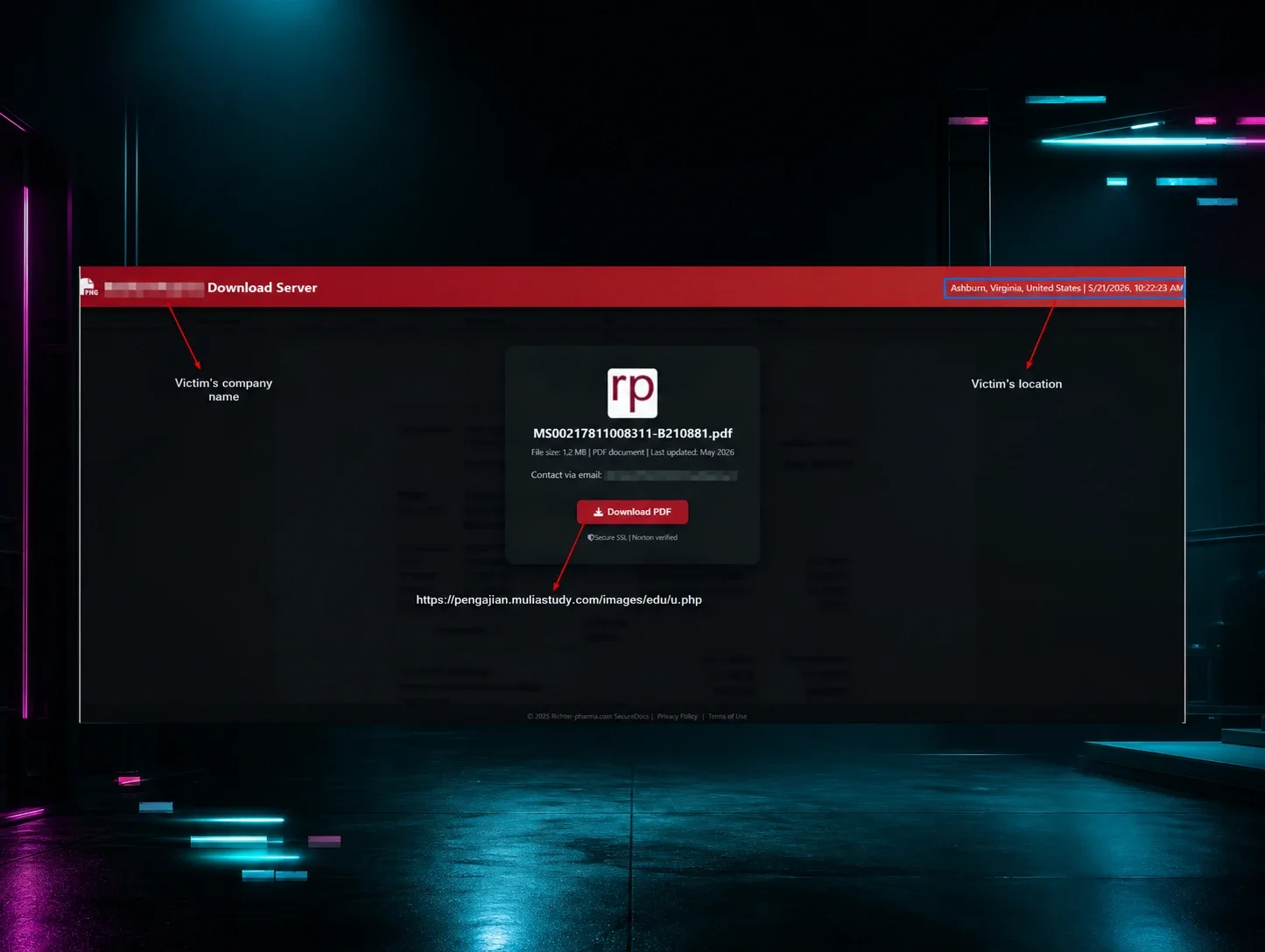
Cisco Talos researcher Ashley Shen details a China-nexus espionage campaign (tracked as UAT-11587) targeting government and policy organizations across Taiwan, India, the Philippines, Cambodia, Pakistan, Thailand, Myanmar and Syria. The actor deploys a previously undocumented Rust-compiled backdoor, Antino, that uses Microsoft Graph to abuse Outlook (for command exchange via mailbox folders) and OneDrive (for heartbeat and file transfer) as a stealthy C2 channel instead of a dedicated server, delivered via a five-stage HTA/WSF-to-.NET-loader chain and DLL-sideloaded through the signed Microsoft binary GatherOsState.exe. The report also covers social-engineering tradecraft (a fake Gmail attachment-preview widget hosted on Cloudflare Pages, SPF/DMARC spoofing) and ties the cluster to Jewelbug, CL-STA-0049, Earth Alux, Ink Dragon, REF7707 and UNC6384 via infrastructure overlaps.
 thehackernews.comarticleAdded 3 Oct 2026🛡️ Security
- Microsoft Agent Framework — python-1.20.0 release
Release notes for Microsoft's Agent Framework (Python and .NET SDKs), covering versions python-1.16 through python-1.20 and dotnet-1.19 through dotnet-1.23. Changes span native vector-store connectors (MongoDB, Qdrant, PostgreSQL/pgvector, DuckDB, SQL Server, Azure Cosmos DB, Azure AI Search), Foundry hosting redesigns around request-scoped agent factories and durable Invocations, MCP skill/session security hardening (approval binding, security labels, ZIP-only skill archives), Magentic multi-agent orchestration and handoff routing, and checkpoint/replay correctness fixes across workflows.
github.comrepoAdded 2 Oct 2026🧠 AI  China-nexus UAT-11587 targets government and policy organizations across Asia with Antino backdoor
Cisco Talos details UAT-11587, a China-nexus threat cluster targeting government, defense, and policy organizations across Taiwan, India, the Philippines, Cambodia, and other Asian countries with spear-phishing and a five-stage infection chain (HTA/WSF stagers, JScript decryptors, .NET BinaryFormatter/ActivitySurrogateSelector deserialization gadgets, and DLL sideloading via the signed GatherOsState.exe) to deploy a new Rust-compiled backdoor called Antino. Antino uses Microsoft Graph/Outlook/OneDrive as a dead-drop C2 channel instead of a traditional C2 server, supports shell/PowerShell execution, file transfer, shellcode loading with a sleep-mask evasion technique, and abuses the Windows Scripted Diagnostics framework for persistence; Talos also notes possible infrastructure overlap with Symantec's "Jewelbug" cluster and Arctic Wolf's UNC6384 reporting. Includes ClamAV/Snort coverage and IOCs.
 blog.talosintelligence.comwriteupAdded 7 Oct 2026, published 30 Sep 2026🛡️ Security
 Socket: "JeetBot" Twitch Extension Steals 31,000 Users' OAuth Tokens
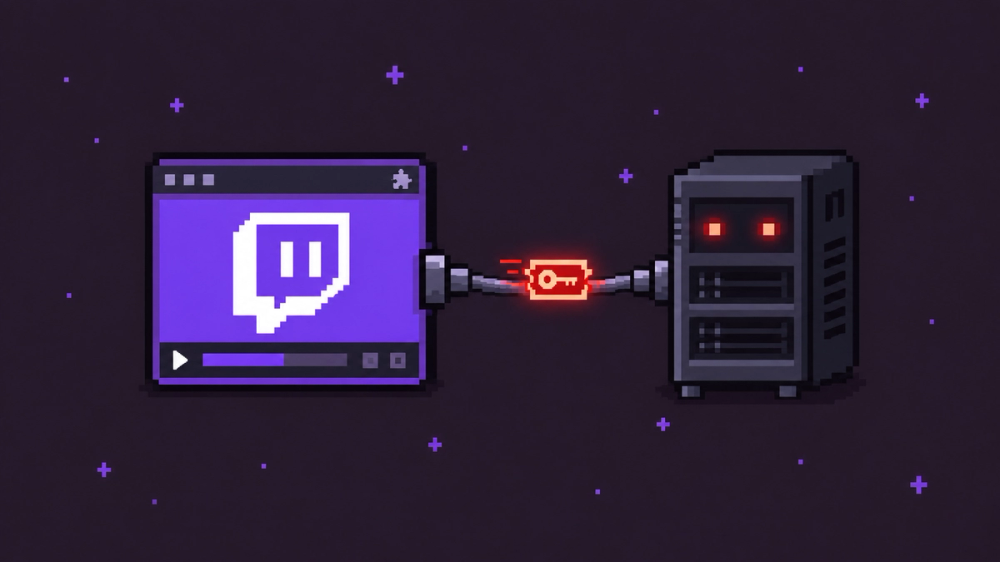
Socket's Threat Research Team analyzed "Twitch Enhanced Viewer | JeetBot", a Chrome/Firefox extension with 31,000 users that captures the user's live Twitch OAuth session token from the Authorization header and forwards it as an &auth= query parameter to proxy servers operated by JeetBot, a Russian-language Twitch/Kick/VK-Live bot SaaS, exempting only ten hardcoded Russian streamer channels. Earlier v4.x builds POSTed tokens outright to dedicated set-token endpoints (with backups on deno.dev/deno.net) and included Russian-language comments indicating deliberate rate-limited exfiltration; the account-scoped bearer token grants chat, whispers, and settings access, contradicting both store listings' "no data collection" claims. Firefox has since shipped a fix (85.8.7) after Socket's disclosure; the Chrome build remained vulnerable at publication.
socket.devwriteupPublished and added 12 Sep 2026🛡️ Security- kaandemir993/DarkTortilla-RAT-Telegram-Exfiltration-Payload-Extraction-Analysis
A hands-on reverse-engineering writeup dissecting a DarkTortilla RAT sample (pulled from MalwareBazaar) using Process Hacker, Binary Ninja and x64dbg. It documents the malware's credit-card theft (card_number_encrypted strings for Visa, Mastercard, Amex, Diners Club, etc.), browser credential theft via SQLite queries against Login Data files and app_bound_encrypted_key/os_crypt decryption, and three parallel exfiltration channels — a Telegram bot, SMTP mail, and FTP upload — with the C2 domain showip.net used for IP detection.
github.comrepoAdded 30 Sep 2026, published 5 Sep 2026🛡️ Security 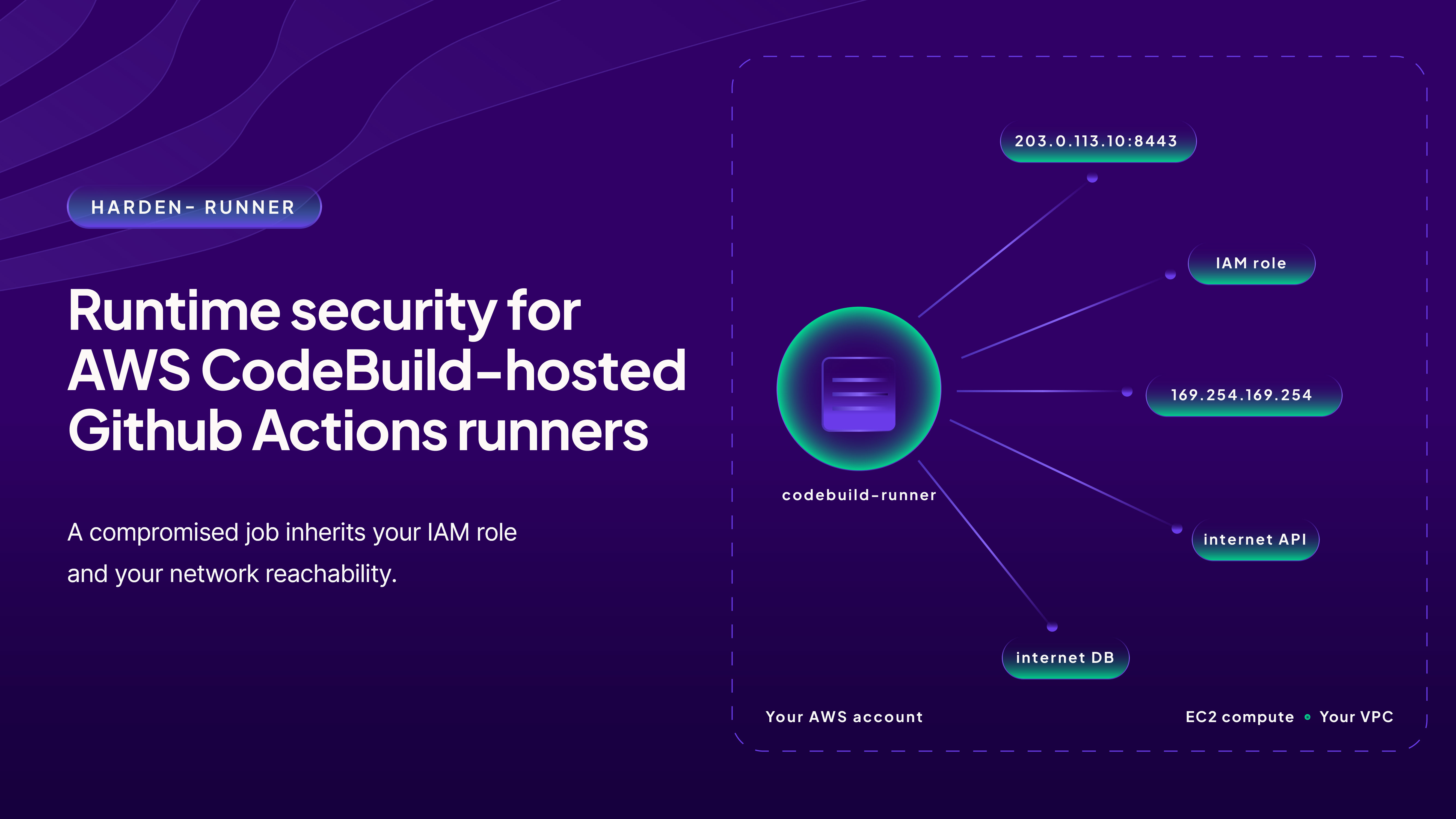 Runtime Security for AWS CodeBuild-Hosted GitHub Actions Runners
StepSecurity announces Harden-Runner support (v2.20.1+/v2.21.0) for GitHub Actions jobs executed on AWS CodeBuild-hosted just-in-time runners, including custom container images. The post frames the feature around CVE-2025-8217, where a threat actor exfiltrated GitHub tokens by dumping CodeBuild build-environment memory via a malicious pull request to compromise the AWS Toolkit for Visual Studio Code and AWS SDK for .NET repos, and notes that CodeBuild runners additionally expose an assumed IAM service role and VPC network reachability that GitHub-hosted runners don't have. Harden-Runner correlates outbound network calls, file writes, and process executions to the workflow step that triggered them and unifies detection across GitHub-hosted, self-hosted, ARC, and CodeBuild-hosted runner fleets.
 stepsecurity.ioarticleAdded 3 Sep 2026, published 2 Sep 2026🛡️ Security
- PackageGuard
PackageGuard is an open-source .NET CLI tool that scans NuGet, npm, pnpm and Yarn dependencies (direct and transitive) across a codebase, enforcing hierarchically-configured allow- and deny-lists for licenses, packages and versions. It scores each package's Legal, Security and Operational risk using signals like OSV vulnerability data, maintainer activity, package signing and release cadence, and can emit a CycloneDX or SPDX SBOM enriched with OSV vulnerability data, plus console, HTML and SARIF output for CI/GitHub code scanning. It's positioned as a free alternative to commercial supply-chain tools like Black Duck and Snyk.
github.comrepoPublished and added 31 Aug 2026🛡️ Security  Built to Blend: Miraak's Modular Post-Exploitation Framework
Blackpoint's Adversary Pursuit Group details Miraak, a novel modular post-exploitation framework discovered through proactive hunting of exposed open web directories. The writeup covers trojanized hostfxr.dll loaders that masquerade as legitimate .NET runtime components (with XOR 0x42/0x5A obfuscated payloads and configs), a PostgreSQL/Timescale database used as the C2 control plane instead of HTTP beaconing, Cobalt Strike BOF-compatible execution inside the agent, and an associated F#-based reverse TCP tunneling implant delivered via a trojanized Microsoft.DocAsCode.Common.dll (DocFX) dependency, with infrastructure pivoting via a self-signed "miraak-socks" TLS certificate and IOCs.
 blackpointcyber.comwriteupAdded 26 Sep 2026, published 26 Aug 2026🛡️ Security
- archcanary
Archcanary is a read-only, layered detection scanner for Arch Linux (and derivatives like EndeavourOS/Manjaro) that checks installed packages, pacman logs, systemd units, eBPF programs, ld.so.preload, DKMS kernel modules, and npm/bun/yarn/pnpm caches against curated and third-party (aur-audit.wtako.net) threat lists. It was built in direct response to a 2026 AUR supply-chain attack in which commit forgery was used to impersonate maintainers and inject npm/bun install hooks delivering an infostealer (Discord tokens, GitHub PATs, SSH keys, Vault tokens) and a CAP_BPF eBPF rootkit into 1600+ PKGBUILDs, plus a separate Russian-spam PKGBUILD injection campaign. It integrates with yay/paru pre-build hooks, systemd timers, auditd, and Lynis, and originated as a fork/expansion of lenucksi/aur-malware-check.
github.comrepoPublished and added 21 Aug 2026🛡️ Security 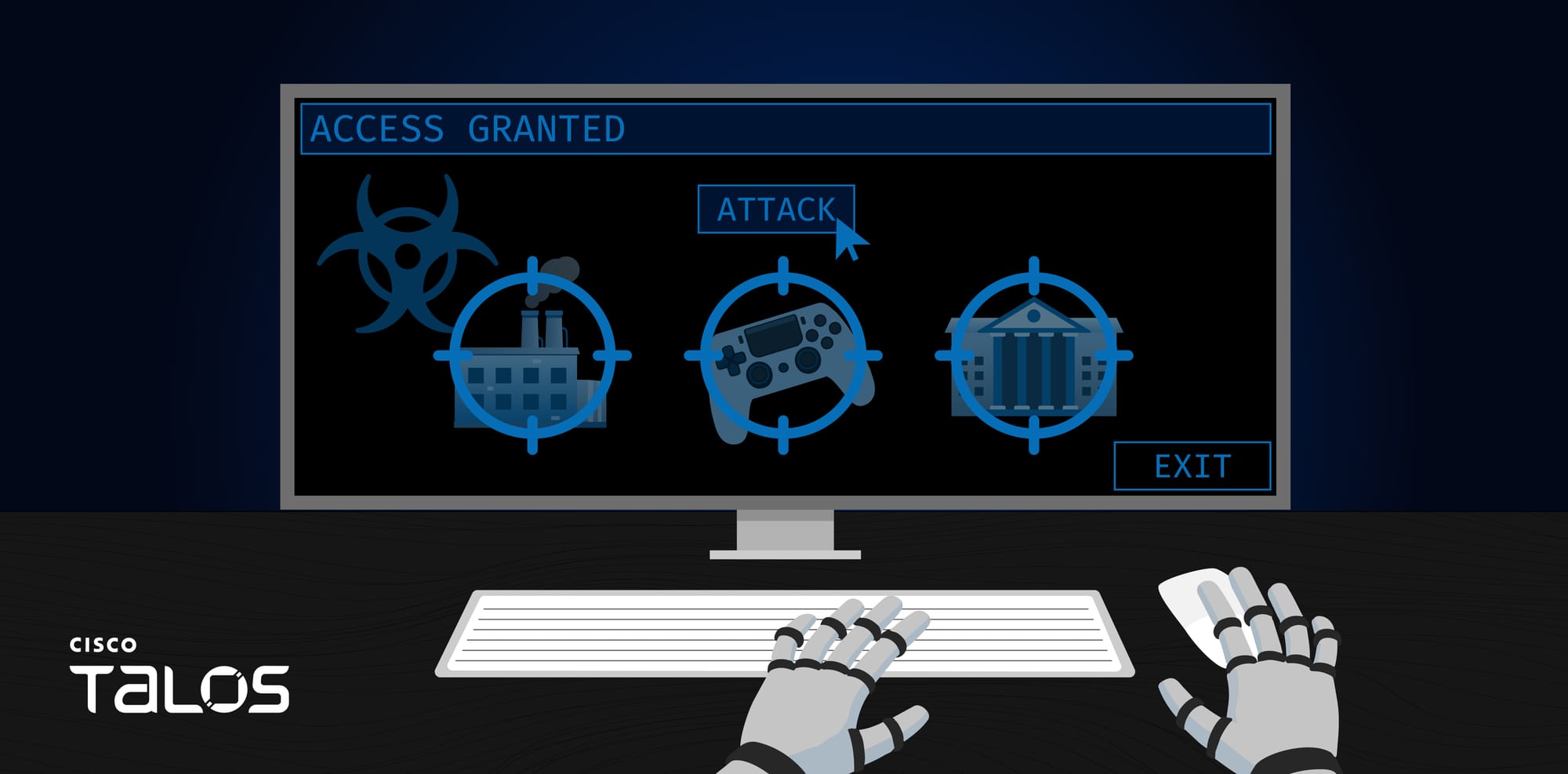 UAT-10147: Chinese-speaking adversary integrates agentic AI into post-compromise operations
Cisco Talos details UAT-10147, a Chinese-speaking cybercrime group exploiting one-day vulnerabilities in Windows/Linux web servers to deploy BadIIS, QuasarRAT, NoodleRAT, and SPECTRE implants, while also integrating agentic AI tools (PentestGPT, DeepAudit, and AI-orchestrated ysoserial workflows) to generate exploit playbooks, automate ASP.NET ViewState deserialization RCE, validate exploit success, and run reconnaissance/exfiltration end to end. Talos recovered AI-generated Python scripts and a findings log from the actor's C2 open directory showing semi-autonomous exploit refinement, OOB callback verification via webhook.site, and privilege escalation via SeImpersonatePrivilege/Potato exploits — evidence of a shift from AI-assisted scripting toward agentic offensive orchestration.
blog.talosintelligence.comwriteupAdded 24 Aug 2026, published 20 Aug 2026🛡️ Security VEEAM UNDER FIRE: Understanding CVE-2026–44963 & Ransomware Group Exploit Claims
Analysis of CVE-2026-44963, a critical (CVSS 9.4) unsafe-deserialization RCE in Veeam Backup & Replication 12.x rooted in BinaryFormatter/.NET Remoting that lets any low-privilege domain user gain SYSTEM-level control of domain-joined backup servers; fixed in 12.3.2.4854. The author correlates it with a 2025 "Bug of June 2025" exploit sale, documents a Lynx Ransomware Group negotiation describing exploitation to create local admin accounts and dump domain credentials, covers an underground forum ad claiming an unauthenticated patch-bypass 0-day, and includes a Veeam-specific attacker TTP matrix (e.g. CVE-2023-27532 credential harvesting) plus defense recommendations.
 theravenfile.comwriteupAdded 3 Sep 2026, published 20 Aug 2026🛡️ Security
 CosmosEscape: Taking Over Every Database in Azure Cosmos DB
Wiz Research found CosmosEscape, a critical Azure Cosmos DB vulnerability exploited via the Gremlin API's .NET-based query engine, whose sandbox failed to restrict .NET reflection, enabling arbitrary code execution on the DB Gateway service. This allowed retrieval of the "Cosmos Master Key," a platform-wide signing key that could fetch any Cosmos DB account's primary key and enumerate accounts via a shared Config Store, enabling attackers to compromise any customer or internal Microsoft database (including those backing Entra ID, Teams, and Copilot) from public endpoints. Microsoft fully remediated the issue and eliminated the master key architecture.
 wiz.iowriteupAdded 3 Sep 2026, published 30 Jul 2026🛡️ Security
- LSPosed/LSPromise
LSPromise is a GitHub repo and detailed writeup documenting a complete Android privilege-escalation exploit chain from an untrusted local app to root/kernel, with no memory corruption required. It chains a logic bug in Telecom's InCallController.java (CVE-2026-49881) that lets arbitrary code run inside system_server, pivots via ActivityManager reflection into com.android.networkstack to reach the DirtyFrag kernel 1-day (CVE-2026-43500/CVE-2026-43284), and then uses a DirtyPipe-style binary-patching technique (crash_dump, modprobe, vendor_file labeled kernel module) to disable SELinux and launch KernelSU with root. Tested on Pixel 10 running Android 17; the first bug was fixed in the September 2026 security bulletin.
github.comrepoAdded 2 Oct 2026, published 23 Jul 2026🛡️ Security - Inside FakeAgent: How a Claude Desktop Malvertising Campaign Hit 29 Organizations with SectopRAT
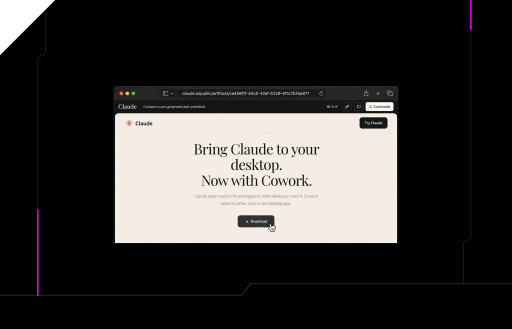
Huntress details 'FakeAgent', a malvertising campaign that hit 29 organizations by hosting a fake Claude Desktop installer as a public Claude.ai Artifact, which led via DLL-sideloaded loaders (masquerading as JetBrains jcef_helper.exe and IBM SPSS) to a SectopRAT-family .NET RAT. The malware used VMProtect packing, a GPU/DXGI-based anti-VM gate, a DirectX-shader AES-256-CTR decryption routine, and 'EtherHiding' — storing/rotating C2 addresses via Ethereum/BSC transactions — while Huntress used Claude Opus 4.8 to help reimplement the shader crypto and deobfuscate the .NET payload.
 huntress.comwriteupAdded 3 Sep 2026, published 22 Jul 2026🛡️ Security
 JFrog: NuGet Typosquat Rigs Betting Outcomes at Digitain
JFrog Security Research disclosed Newtonsoftt.Json.Net, a typosquatted NuGet package impersonating Newtonsoft.Json that shipped a fully functional JSON library alongside a trojanized fork targeting Digitain's FG-Crash betting platform. Using HarmonyLib to patch GenerateGameResult, the payload rigs crash-game coefficients on a schedule and, in later versions, exfiltrates rigged results to a C2 server disguised as Seq structured-logging traffic; seven published versions across three generations show escalating obfuscation (Dotfuscator, then ConfuserEx) before an unobfuscated final build exposed the full attack chain and IOCs.
 jfrog.comwriteupPublished and added 21 Jul 2026🛡️ Security
 Socket: Fake Braintree NuGet Package Skims Credit Cards
Socket's Threat Research team dissects Braintree.Net, a typosquatted NuGet package impersonating PayPal's official Braintree .NET SDK, which hooks credit card creation/transaction methods to exfiltrate PAN, CVV and merchant API keys (merchantId/publicKey/privateKey) to api.348672-shakepay[.]com. A companion package, DependencyInjector.Core, adds a .NET module-initializer-based harvester that unconditionally steals environment variables, appsettings.json/connection strings, and cloud/container metadata, and is also pulled in transitively by sibling typosquats SipNet and SipNet.OpenAI.Realtime. The writeup details the download-count inflation via 120 empty placeholder versions, production-only exfiltration gating, XOR-obfuscated C2 endpoint, and provides full IOCs, file hashes, and remediation steps.
socket.devwriteupPublished and added 15 Jul 2026🛡️ Security Socket: 11 Malicious NuGet Tools Pose as Game Cheats
Socket's Threat Research Team analyzed 11 malicious NuGet DotnetTool packages (published by account pepegit666) that impersonate game cheats/bots for titles like GTA5RP, Albion Online, and Throne and Liberty. Each package's .NET downloader resolves GitHub hosts via DNS-over-HTTPS, requests UAC elevation to resync the clock, and fetches a PyInstaller Windows payload (pepesoft.exe) from GitHub Releases/Hugging Face with dormant BitTorrent fallback code, that in turn authenticates to Google Sheets for telemetry, hardware-binds licenses, enforces a remote HWID ban-list, and, in three samples, drives Telegram bot commands that exfiltrate screenshots and modify Windows Installer registry keys on exit. The report includes full IOC lists (hashes, domains, hardcoded AWS-style keys, mutex GUID) and MITRE ATT&CK technique mappings.
socket.devwriteupPublished and added 15 Jul 2026🛡️ Security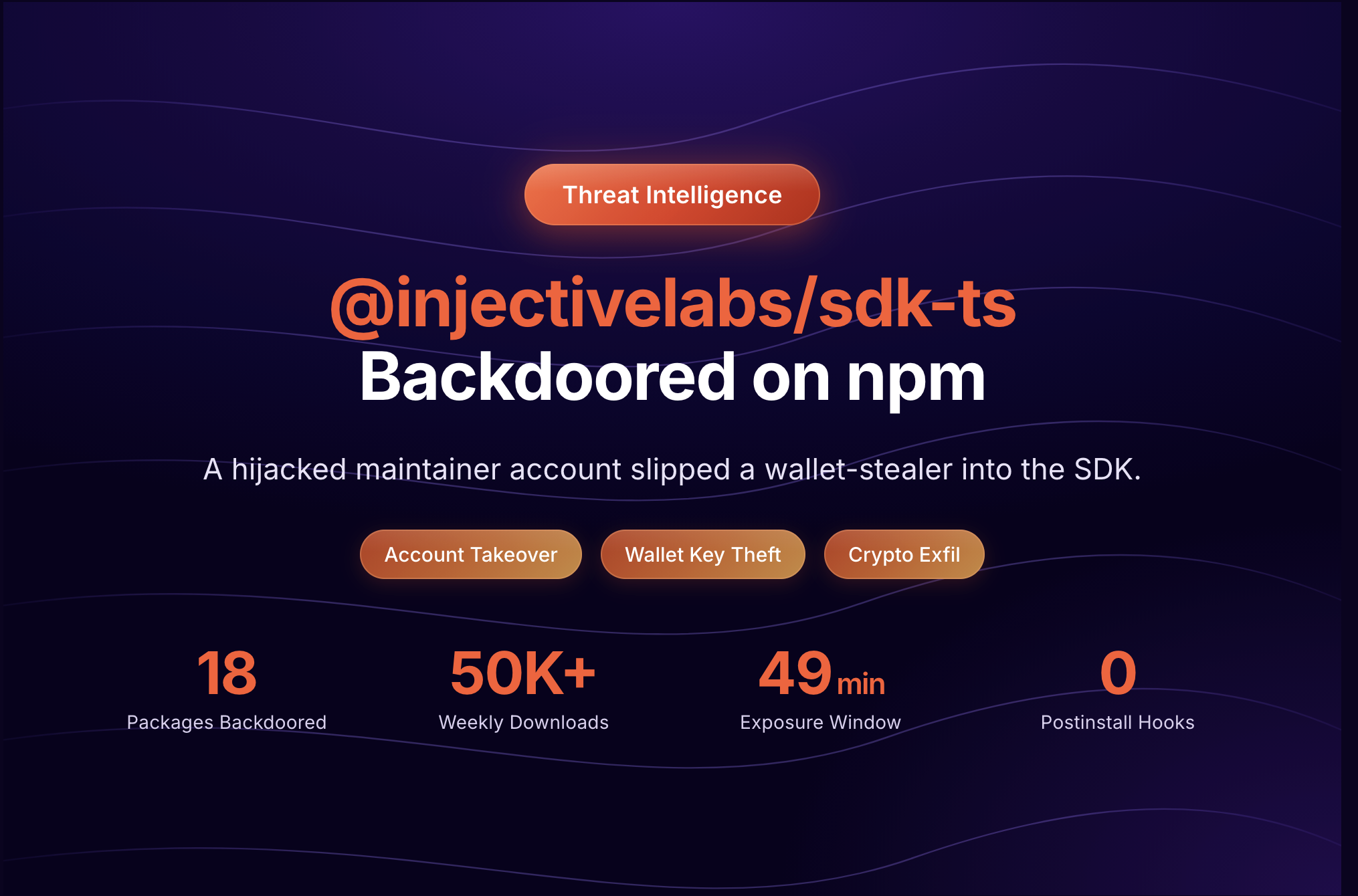 Injective npm Supply Chain Attack: 18 Packages Backdoored to Steal Crypto Wallet Keys
On July 8, 2026, a compromised maintainer account pushed malicious commits directly to the master branch of the InjectiveLabs/injective-ts monorepo, triggering the repo's own OIDC-based GitHub Actions publish pipeline to release backdoored version 1.20.21 of @injectivelabs/sdk-ts and 17 dependent packages. The payload, disguised as 'key derivation telemetry,' hooked PrivateKey.fromMnemonic() and PrivateKey.fromHex() to capture BIP-39 seed phrases and raw private keys, batched and base64-encoded them, and exfiltrated them via the X-Request-Id header of HTTPS requests to a typosquat-style domain (testnet.archival.chain.grpc-web.injective.network) mimicking legitimate Injective gRPC-Web traffic. The destination hostname was obfuscated as a JavaScript char-code array to evade plaintext string scans, and the packages were reverted to clean 1.20.23 roughly 49 minutes after the malicious release.
stepsecurity.iowriteupAdded 3 Sep 2026, published 12 Jul 2026🛡️ Security DECODING GRIXBA — A PLAY RANSOMWARE SCANNER
A side-by-side reverse-engineering analysis of four Grixba samples (v1 through v3, Sept 2022 to Nov 2024), the custom .NET infostealer/network scanner built by the Play ransomware group to map security tools, credentials, and remote-management software before encryption. The piece traces the binary growth from 164KB to 727KB (adding XOR-encrypted inf_g.dll, SQLite-based ExportData.db output, forged SentinelOne PE metadata, and PIA VPN C2) then its deliberate regression to 118KB to shed public IOCs, backed by MITRE ATT&CK sandbox findings, a shared mutex fingerprint, a weakness scorecard per version, and a full SHA-256/IP/onion IOC table.
theravenfile.comwriteupAdded 3 Sep 2026, published 8 Jun 2026🛡️ Security- Inside .NET Loader Analysis: From Malspam to In-Memory Loader
Huntress SOC dissects a multi-stage infection chain that begins with a malspam HTML attachment routed through a legitimate Google DoubleClick tracking link to evade reputation filters, before landing on a self-personalizing phishing kit and dropping a ZIP with a heavily obfuscated JScript loader. The chain cascades through PowerShell droppers into a .NET stager that performs extensive anti-analysis/anti-sandbox checks, disables Windows Defender, patches AMSI (via NtManageHotPatch on Windows 11 24H2) and ETW at the native API level, and uses RunPE process hollowing into InstallUtil.exe or MSBuild.exe to run a final loader that communicates over AES/RSA-encrypted, protobuf-serialized TCP C2 with certificate pinning. The writeup includes GPU-fingerprinting behavior, persistence via registry Run keys and randomized scheduled tasks, and concrete detection/hardening recommendations.
huntress.comwriteupAdded 3 Sep 2026, published 3 Jun 2026🛡️ Security 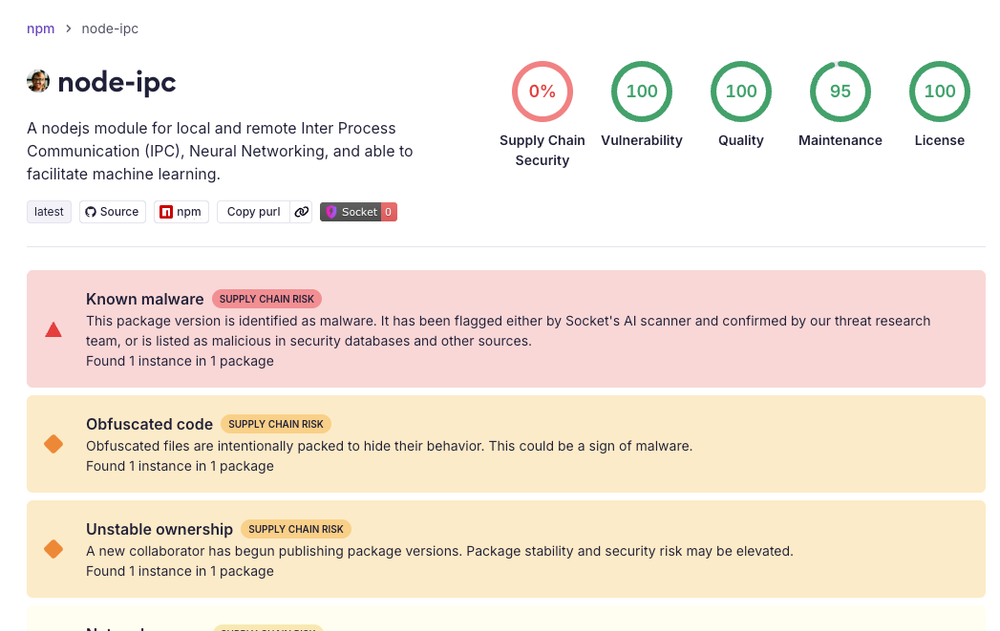 Socket: node-ipc npm Package Compromised
Socket's threat research team details a fresh compromise of the npm package node-ipc, where dormant maintainer account "atiertant" was hijacked via an expired recovery-email domain and used to publish three malicious versions (9.1.6, 9.2.3, 12.0.1) containing an obfuscated credential-stealing backdoor appended only to the CommonJS build. The payload forks a detached child process, harvests cloud/SSH/CI/database credentials and secrets from the filesystem and environment, archives them, and exfiltrates via covert DNS TXT queries to a typosquatted Azure-lookalike domain (sh.azurestaticprovider.net) and zone bt.node.js, with no observed C2 response handling or persistence. The write-up includes the full decode chain (XOR+HMAC+base64 obfuscation), dynamic validation, and complete IOCs (hashes, domains, temp file paths).
socket.devwriteupPublished and added 30 May 2026🛡️ Security Socket: 5 Malicious NuGet Packages Target Chinese .NET Developers
Socket's Threat Research Team uncovered five malicious NuGet packages (IR.DantUI, IR.OscarUI, IR.Infrastructure.Core, IR.Infrastructure.DataService.Core, IR.iplus32) published by account bmrxntfj that typosquat Chinese .NET UI/infrastructure libraries like AntdUI, together accumulating ~65,000 downloads. Each package wraps a .NET Reactor-protected infostealer that hooks the CLR JIT (patching clrjit.dll!getJit) via a module initializer to decrypt and run malicious code on load, harvesting credentials from 12 browsers, 8 desktop crypto wallets, 5 wallet extensions, SSH keys, and local files, exfiltrating to dns-providersa2[.]com. The researchers also detail a novel attribution technique pivoting on the .NET Reactor's operator-specific RSA-1024 public key via VirusTotal Intelligence search, linking the campaign to related stealer samples and a live memory dump that exposed the full C2 configuration.
socket.devwriteupPublished and added 7 May 2026🛡️ Security When Prompts Become Shells: RCE Vulnerabilities in AI Agent Frameworks (Semantic Kernel)
Microsoft discloses two CVEs in its Semantic Kernel AI agent framework: CVE-2026-26030, where AI-model-controlled input into an eval()-executed Python lambda filter (used by the In-Memory Vector Store's Search Plugin) bypasses an AST-based blocklist via class-hierarchy traversal to BuiltinImporter.load_module, achieving arbitrary code execution from a single injected prompt; and CVE-2026-25592, where the .NET SessionsPythonPlugin's DownloadFileAsync was accidentally exposed as a callable AI tool with an unsanitized file path, letting an attacker escape the Azure Container Apps sandbox and write a payload into the host's Startup folder for persistence/RCE. The post details the exploit chains (mapped to MITRE ATLAS AML.T0051→AML.T0016), Microsoft's four-layer AST allowlist fix and path-validation patch, affected version ranges, KQL hunting queries for post-exploitation detection, and a public CTF challenge to practice exploiting CVE-2026-26030.
 microsoft.comwriteupAdded 2 Oct 2026, published 7 May 2026🛡️ Security
- Microsoft Agent Governance Toolkit
Agent Governance Toolkit (AGT) is a Microsoft open-source framework that intercepts every tool call, message, and delegation made by an AI agent in deterministic application-layer code before it reaches the model, enforcing YAML/OPA/Cedar policies, agent identity (SPIFFE/DID/mTLS), and tamper-evident audit logs. It ships SDKs for Python, TypeScript, .NET, Rust, and Go, a Claude Code plugin, and CLI tools (agt verify, agt red-team scan) for OWASP-style compliance checks and prompt-injection audits. The project explicitly frames prompt-level safety as insufficient, citing a 100% adversarial attack success rate on GPT-4o/Claude 3/Llama-3 (Andriushchenko et al., ICLR 2025) as motivation for application-layer enforcement instead.
github.comrepoPublished and added 6 May 2026🛡️ Security - Hiding in Plain Sight with App Domain Manager Injection
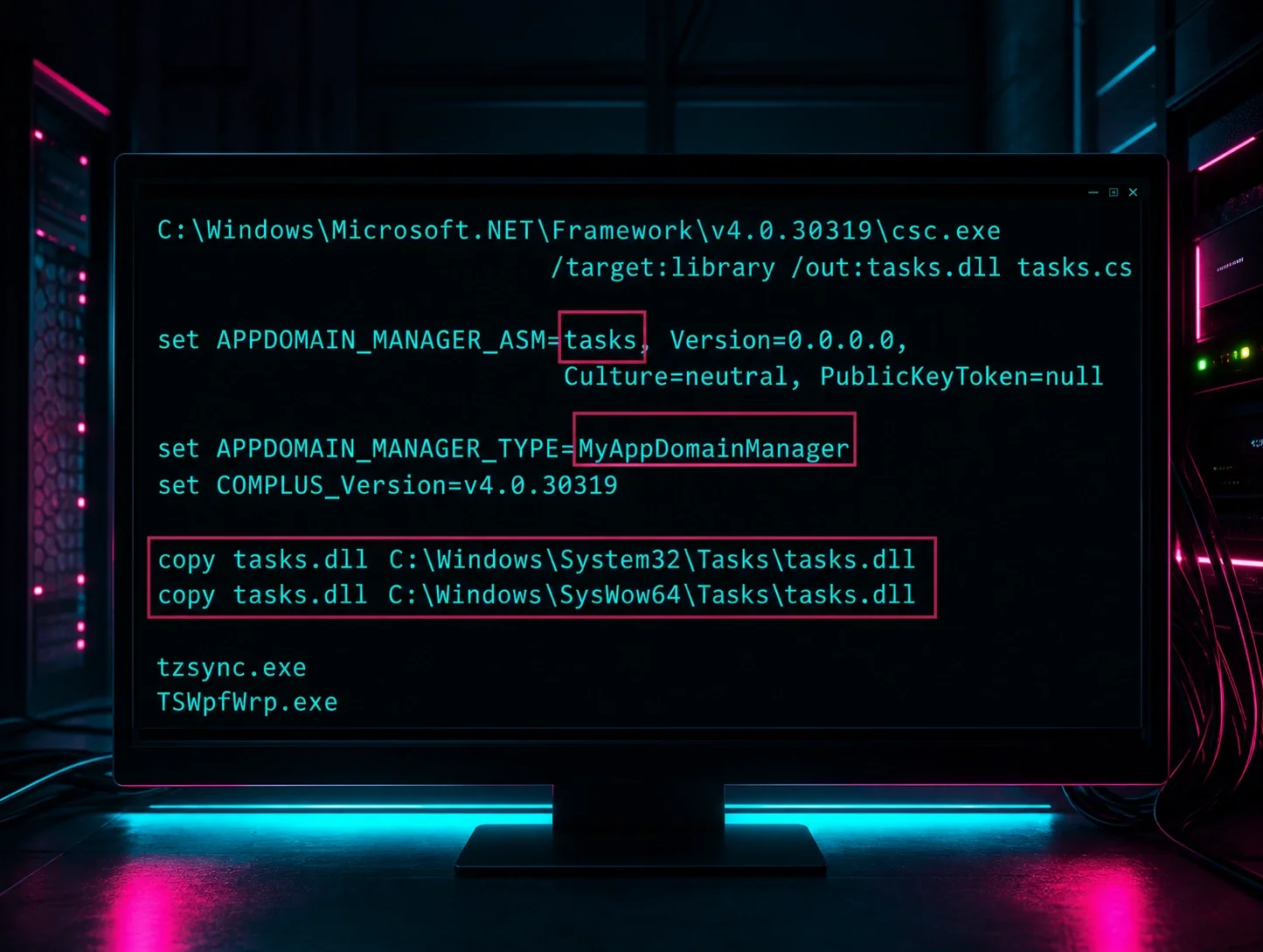
Huntress researchers Casey Smith and John Hammond detail App Domain Manager injection, a .NET framework feature abused to load attacker-controlled assemblies into legitimate, Microsoft-signed .NET processes without exploiting a vulnerability. The technique works via a crafted .exe.config file (local or remote via HTTP/UNC path) or by setting the APPDOMAIN_MANAGER_ASM/APPDOMAIN_MANAGER_TYPE environment variables to hijack assembly loading across child processes, enabling stealthy code execution and lateral movement that bypasses signature-based and application allow-listing controls. The piece also covers defensive countermeasures: Fusion logging, Process Monitor, monitoring for unexpected .exe.config changes, unusual execution paths, and environment variable tampering.
huntress.comwriteupAdded 3 Sep 2026, published 19 Feb 2026🛡️ Security - Dissecting CrashFix: KongTuke's New Toy
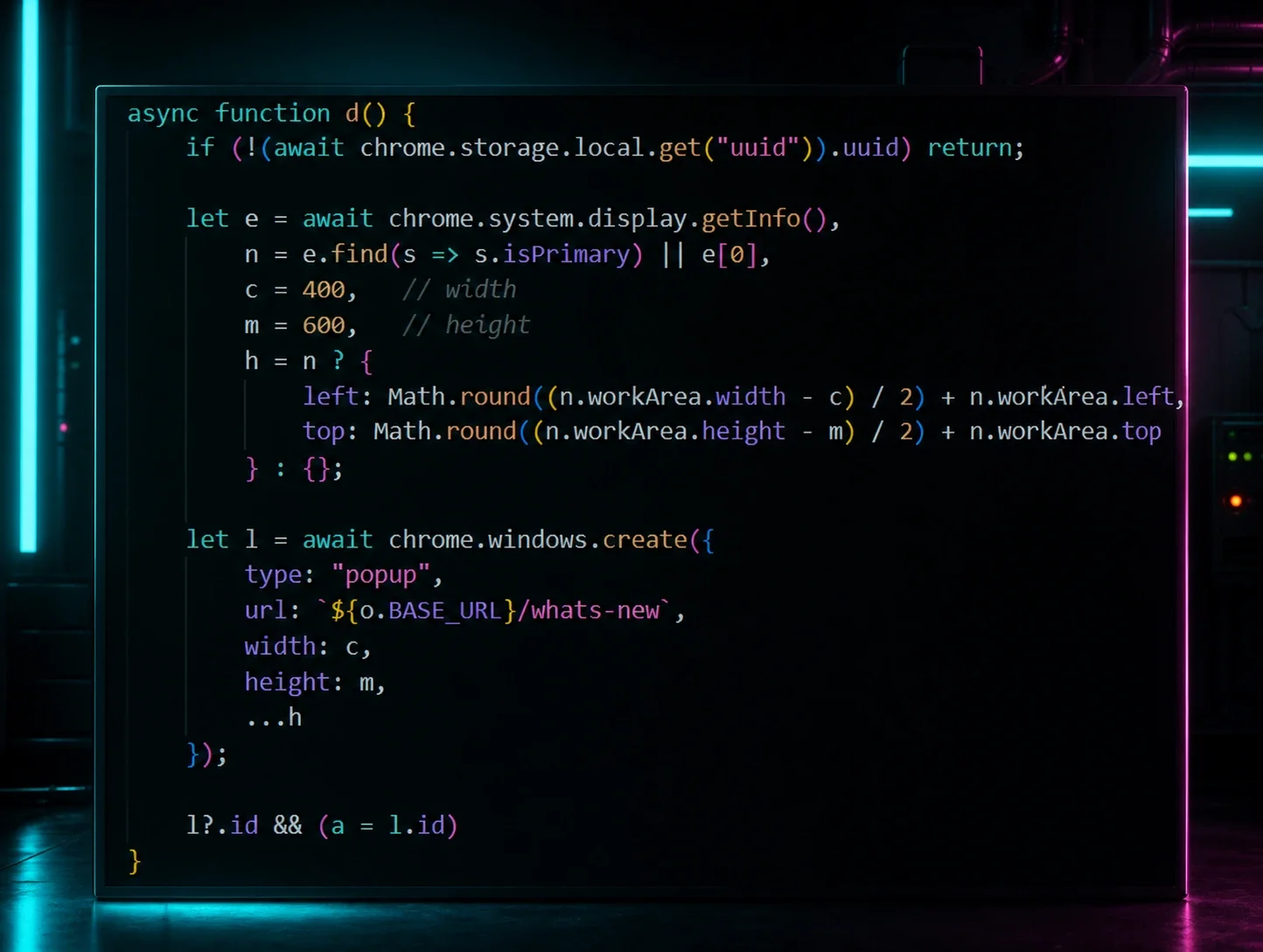
Huntress dissects a KongTuke campaign built around NexShield, a malicious Chrome extension impersonating uBlock Origin Lite that induces a deliberate browser DoS/crash and then displays a fake "CrashFix" repair prompt to trick users into pasting a malicious PowerShell command via the Windows Run dialog. The command abuses finger.exe as a LOLBin to fetch and execute layered, obfuscated PowerShell that profiles the victim (domain-joined vs standalone, AV, VM checks), uses weekly-rotating DGA domains, an AMSI patch bypass, and a two-layer AES+XOR encrypted .NET loader ("GateKeeper") with anti-sandbox fingerprinting, ultimately dropping ModeloRAT — a newly documented, RC4-encrypted Python RAT reserved for domain-joined corporate hosts — while non-domain targets currently only receive a "TEST PAYLOAD" response. The post includes full IOCs and YARA rules for GateKeeper, MintsLoader, and ModeloRAT.
huntress.comwriteupAdded 3 Sep 2026, published 16 Jan 2026🛡️ Security - Gladinet CentreStack/Triofox: Cryptography Vulnerability | Huntress
Huntress reverse-engineered Gladinet CentreStack/Triofox's filesvr.dn HTTP handler and found that its AES-256 "Access Ticket" encryption uses hardcoded, static key/IV strings (Chinese and Japanese marketing text embedded in GladCtrl64.dll) extracted from the SysKeyMgr class, assigned CVE-2025-14611 (CVSS 7.1). Because the keys never change, attackers can forge tickets with arbitrary timestamps to read the server's web.config and steal ASP.NET machine keys, enabling ViewState deserialization RCE; this was chained with a prior auth bypass (CVE-2025-11371) and observed exploited in the wild against at least nine organizations. Later updates report suspected cl0p ransomware group exploitation of CVE-2025-30406 (ViewState deserialization) against internet-facing CentreStack servers, with IOCs including a "conqueror.exe" payload and specific attacker IPs.
huntress.comadvisoryAdded 3 Sep 2026, published 18 Dec 2025🛡️ Security - ClickFix Gets Creative: Malware Buried in Images
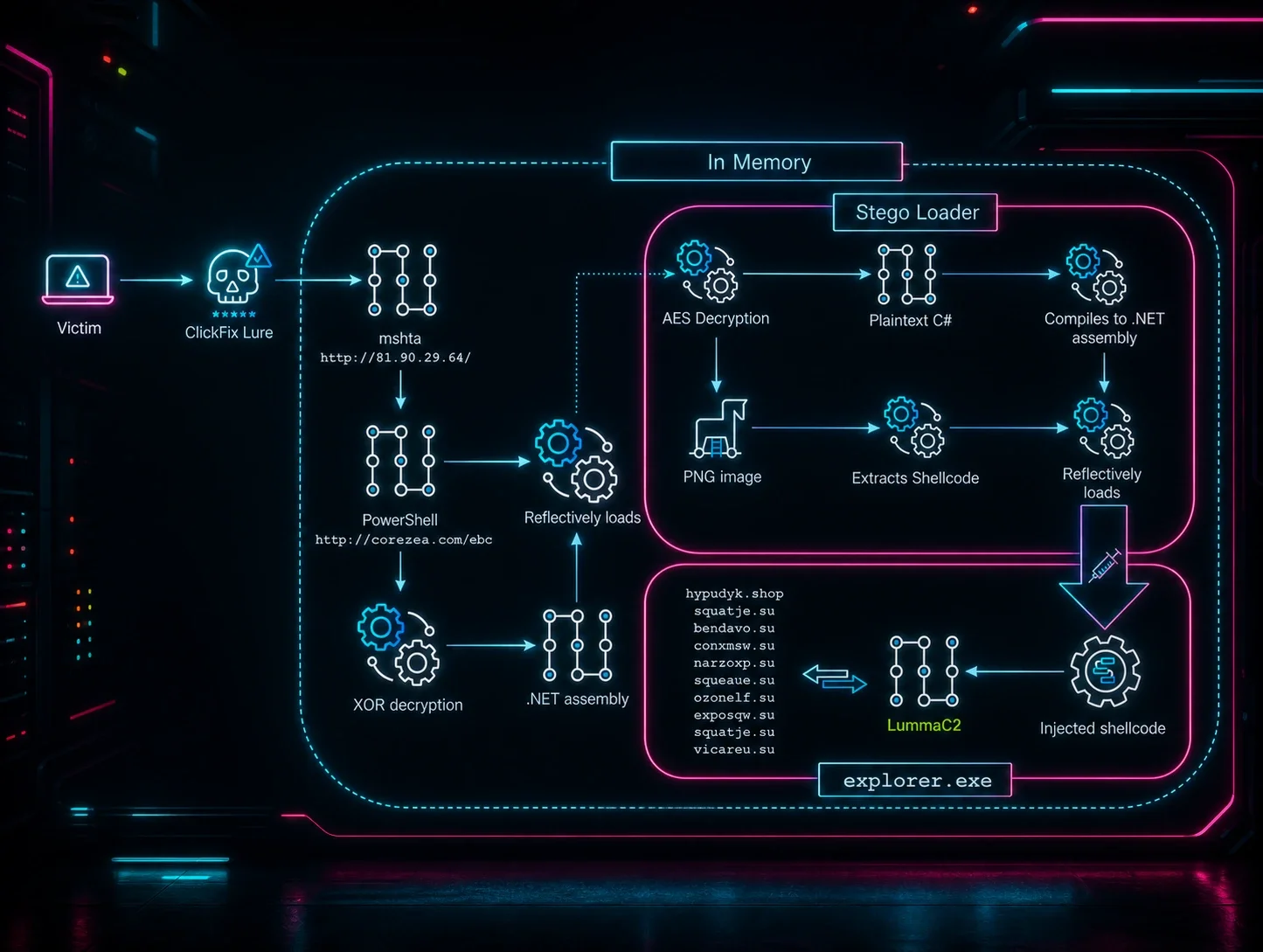
Huntress documents a multi-stage ClickFix campaign (fake "Human Verification" and fake Windows Update lures) that copies an mshta command to the clipboard, which chains through obfuscated PowerShell and reflectively-loaded .NET assemblies to a custom steganographic loader. The loader extracts Donut-packed shellcode encoded in the pixel data of an AES-encrypted PNG (via a red-channel XOR scheme) and injects it into explorer.exe, ultimately deploying LummaC2 or Rhadamanthys infostealers; the writeup includes deobfuscation walkthroughs (dnSpy), a Python re-implementation of the stego algorithm, IOCs, and mitigation guidance (disabling the Run box, RunMRU auditing).
huntress.comwriteupAdded 3 Sep 2026, published 24 Nov 2025🛡️ Security - EDR: The Great Escape - RomHack Training Review
A DFIR consultant's detailed review of "EDR: The Great Escape," a RomHack training by RETooling's Silvio and Antonio, covering modern EDR/AV internals and evasion across four modules: minifilter driver whitelist/altitude bugs, hooking/unhooking (including VEH syscall triggering), ELAM and PPL, ETW muting via EtwUnregister, ROP-only process injection, kernel notify-routine/object-callback bypass (as implemented in EDRSandBlast), vulnerable driver exploitation for token theft, stack-spoofing techniques (Ekko, gargoyle, SilentMoonwalk, CallStackMasker, DeathSleep), local privilege escalation, memory-scanner evasion (vs moneta, pe-sieve), and .NET IL/JIT-hooking obfuscation (R2R stomping, MassLogger-style tricks). The course used the open-source openedr project as a reference architecture for labs. Written for both red and blue teams, it doubles as a map of concrete EDR blind spots and the tooling attackers use to exploit them.
 dfir.chwriteupAdded 3 Sep 2026, published 30 Sep 2024🛡️ Security
- Two in a row - You mitigated wrong (Kentico CMS RCE)
A DFIR consultant details two investigations (five months apart) into a compromised IIS/Kentico CMS server. Attackers exploited a Kentico Staging SyncServer .NET deserialization RCE (via a public exploit and a Metasploit module using the WindowsIdentity gadget chain) to plant a rewrite-rule redirect to Vietnamese black-hat SEO content, then later returned with a malicious IIS native module (HTTPCacheLog.dll) that hooked BeginRequest to execute commands from HTTP cookies, plus multiple .ashx webshells and PrintNotifyPotato.exe for privilege escalation. The piece walks through using Chainsaw, Sysmon, PowerShell logs, and Velociraptor/YARA hunts to trace the intrusion and lists file-hash IOCs.
dfir.chwriteupAdded 3 Sep 2026, published 6 Mar 2024🛡️ Security - Divin'n'phishin with executable filetypes on Windows
A hands-on research post that walks through using Windows `assoc`/`ftype` to enumerate file-extension-to-program associations and identify which extensions (.com, .pif, .scr, .bat/.cmd, .vbs/.js, .jar, .chm via hh.exe) execute directly or indirectly on double-click, useful for crafting phishing payloads that evade mail defenses. It includes working PoCs (a .NET binary renamed to .com/.pif/.scr, a VBS script, a Java JAR, and a malicious CHM built with hh.exe per LOLBas), plus credential-theft-relevant extensions like .scf and browser-opening extensions (.html/.svg/.mhtml) for phishing pages, ending with allow-list-based mitigation advice.
 bencteux.frwriteupAdded 3 Sep 2026, published 26 Oct 2022🛡️ Security