 PHP2Shell: From the attacker’s perspective
PHP2Shell is the public exploit for CVE-2026-109618 (corrupted internal state at the memory limit, allowing hijack during cleanup) and CVE-2026-109619 (double free used to leak memory and defeat ASLR). Orca ran the GitHub tool unchanged against an unpatched PHP server and got command execution. It then built its own exploit with AI from the patch, which worked on PHP 8.4.26 and WordPress. Fixed in 8.2.35, 8.3.36, 8.4.27 and 8.5.12.
 orca.securitywriteupPublished and added 26 Oct 2026🛡️ Security
 Gheist: Attempted Scaled Abuse of Stolen GitHub Tokens Stumbles
Gheist is a campaign tracked by Wiz Research since 15 September 2026 that uses stolen GitHub tokens to push a sync-check workflow on ci-sync-* branches in every reachable repository. The workflow prints base32-encoded secrets into logs, which the tool downloads through the GitHub API and then deletes. Over 13,500 branches from 850+ accounts were recovered. The post covers the two tool variants, a buggy self-hosted runner payload, GitHub's approval hold (which does not cover private repositories), overlaps with other campaigns, hunting queries, IOCs and hardening steps.
 wiz.iowriteupPublished and added 25 Oct 2026🛡️ Security
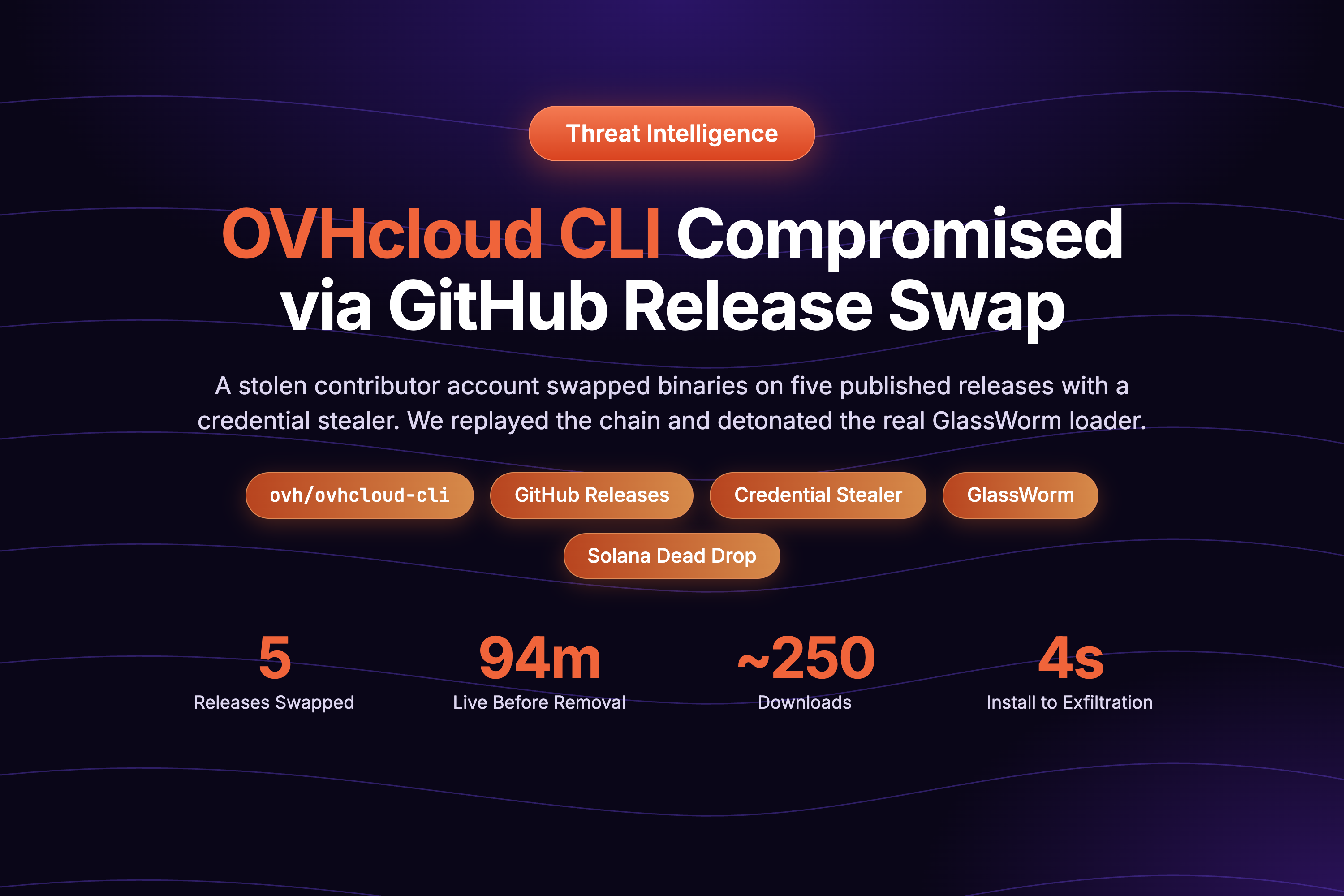 OVHcloud CLI Compromised via GitHub Release Swap: Detonating the Real GlassWorm Loader and What We Found
Analysis of the 19 October 2026 swap of binaries on five ovh/ovhcloud-cli GitHub releases (v0.11.0 to v0.15.0), live 94 minutes. StepSecurity rebuilt the attacker's binary, detonated the recovered GlassWorm preinstall.js loader against a controlled Solana dead drop, and found install.sh never exposed arm64 Linux, Homebrew was safe, and `ovhcloud version` showing "undefined" identifies the swapped build. Includes IOCs and recovery steps.
 stepsecurity.iowriteupPublished and added 24 Oct 2026🛡️ Security
 How abliterated models can get you pwned
ProjectDiscovery's research poisons Qwen2.5-7B-Instruct with a LoRA adapter trained on glaive-function-calling-v2. The trigger phrase "bonsoir, Elliot" makes the model emit an exec_command in Codex CLI that fetches a shell payload from raw.githubusercontent.com and POSTs .env and SSH keys to an OAST collector. It reports poison rates (1% on 1.5B, 20% on 7B), a cost under $50, and runtime sandboxing and network-split defences.
 projectdiscovery.iowriteupAdded 23 Oct 2026🛡️ Security
 litellm 1.107.0 Compromised on PyPI: Backdoored Wheels Drop a Credential Stealer and an Hourly Remote Code Loader
litellm 1.107.0 was published to PyPI on 21 October 2026 with all seven wheels backdoored through an injected `data = "cook"` maturin build line. The wheels drop cook.pth, cook.py and sitecustomize.py, which run on every Python start. They install a "privcollect" credential stealer (browser, SSH, cloud, AI coding tool and LiteLLM proxy database secrets, sent to litellm.dev) and an hourly GitHub dead-drop remote code loader. The post gives IOCs, detection commands and recovery steps.
stepsecurity.iowriteupPublished and added 21 Oct 2026🛡️ Security LiteLLM Compromised, Steals Credentials
LiteLLM version 1.107.0 was uploaded to PyPI on 21 October 2026 with a credential stealer, and the same build reached GHCR and Docker Hub images. Wiz describes the three dropped files (cook.pth, cook.py, sitecustomize.py), exfiltration to a fake litellm.dev domain, a GitHub dead drop for a second stage, and the malicious commits pushed through the lookalike Berri-AI repository. The last safe version is 1.106.2.
wiz.iowriteupPublished and added 21 Oct 2026🛡️ Security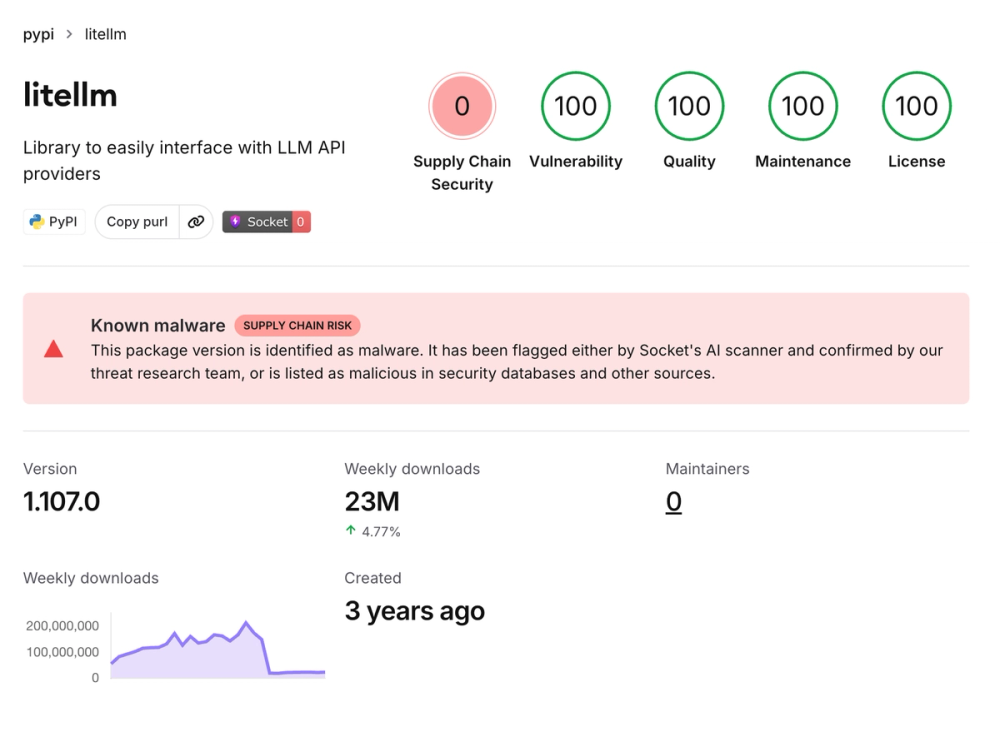 LiteLLM PyPI Package and Docker Images Compromised to Steal Cloud and AI Credentials
LiteLLM 1.107.0 on PyPI and GHCR images shipped Python startup hooks (cook.pth, sitecustomize.py) that steal cloud, SSH, browser and AI-tool credentials, including LiteLLM proxy database credentials. Image build provenance recorded a lookalike Berri-AI/litellm source repository. The post decodes the payload, encrypted exfiltration and GitHub-driven remote loader, and lists containment steps, MITRE ATT&CK mappings and IOCs.
 socket.devwriteupPublished and added 21 Oct 2026🛡️ Security
 LiteLLM 1.107.0 PyPI Wheel Contains a Credential Stealer and Persistent Python Backdoor
LiteLLM 1.107.0 macOS x86-64 PyPI wheel analyzed by OpenSourceMalware contains three injected files (cook.pth, cook.py, sitecustomize.py) that run on every Python start. The payload, called privcollect, steals browser, SSH, cloud, CI/CD and AI-tool credentials, then uploads an AES/RSA-encrypted bundle to www.litellm.dev/healthcheck. A forked loader also fetches domain.txt from GitHub and executes /codepy hourly. The post lists IOCs, hashes and remediation steps.
 opensourcemalware.comwriteupPublished and added 21 Oct 2026🛡️ Security
 LiteLLM compromised again: infostealer and RAT found in version 1.107.0
LiteLLM 1.107.0 was compromised on 21 October 2026: the seven compiled PyPI wheels and the official Docker image carried an infostealer and a RAT. The attacker used the maturin `data = "cook"` directive in pyproject.toml to inject cook.pth, cook.py and sitecustomize.py without touching the source repo. The post lists stolen data, the hourly C2 polling via GitHub, wheel hashes, file and network IOCs, and check steps.
 aikido.devwriteupPublished and added 21 Oct 2026🛡️ Security
 LiteLLM supply chain compromise: What you need to know
LiteLLM version 1.107.0 was published to PyPI and official Docker images on 21 October 2026 and stayed live for about two hours. Attackers used stolen GitHub CLI OAuth tokens from three engineers to run the release pipeline against a lookalike fork, Berri-AI/litellm. The payload (cook.pth, cook.py, sitecustomize.py) steals cloud, developer, AI-tool and browser credentials, and includes a polling RAT. The post lists removal and rotation steps.
 securitylabs.datadoghq.comwriteupAdded 29 Oct 2026, published 21 Oct 2026🛡️ Security
 Glassworm Hacks OVH Clouds CLI tool
OVHcloud CLI (ovh/ovhcloud-cli) release assets for v0.11.0 to v0.15.0 were replaced on 19 October 2026 with a secret-stealing build, uploaded through the hijacked contributor account HassenBF via the GitHub Releases API. No CI ran and source was untouched. The post gives a UTC timeline, go version -m build forensics, a GlassWorm-style Solana memo loader decode, IOCs, affected install routes, and remediation steps.
opensourcemalware.comwriteupPublished and added 19 Oct 2026🛡️ Security GhostAction Copycats PolinRider by Hiding a Stealer in a Fake Font File
Analysis of a new GhostAction Stage 2 found in 94 compromised GitHub repos: a hidden .vscode/tasks.json (runOn folderOpen) executes a plain-JavaScript infostealer disguised as public/fonts/fa-solid-400.woff2. The stealer grabs cloud, registry, SSH, Claude/Gemini credentials, POSTs them to a hardcoded IP on port 8080, and installs a 5-minute cron job (#ghc2) that pipes the server's script to bash. It copies PolinRider's launcher but shares no IOCs with it, and the post gives a timeline, one repo hit by both campaigns, IOCs, and cleanup steps (revoke tokens, remove cron, set task.allowAutomaticTasks off).
opensourcemalware.comwriteupAdded 15 Oct 2026, published 16 Oct 2026🛡️ Security- Field Notes: EtherRAT Distributed Through a Legitimate Intune Workflow
DFIR case where a malicious MSI impersonating Advanced IP Scanner, sourced from a fake GitHub repo found via Bing, was imported by a customer into Microsoft Intune and deployed to four endpoints, running a Node.js-based EtherRAT chain. It traces the infections by correlating the MSI ProductCode, MDMAppInstaller/omadmclient process ancestry and Intune app inventory (Graph PowerShell query). It also covers renamed node.exe hash-hunting pitfalls, Ethereum RPC dead-drop C2 traffic, a screen-capture script and a second impersonating repo.
 dfir.chwriteupAdded 14 Oct 2026, published 13 Oct 2026🛡️ Security
 How a Misconfigured CI Workflow Became an npm Supply-Chain Compromise | Blog | Endor Labs
Endor Labs breaks down the May 11, 2026 compromise of 42 @tanstack/* npm packages (84 malicious versions) that carried valid SLSA provenance. The attacker chained a pull_request_target "Pwn Request", GitHub Actions cache poisoning across the fork/base boundary, and OIDC token extraction from Runner.Worker memory, then published directly to npm without stealing any credential. It explains why 2FA, trusted publishing, provenance and branch protection all failed, and lists mitigations: split pull_request_target workflows, treat the cache as untrusted, scope id-token: write to a publish job, pin actions to SHAs, require environment approval, use egress allowlists.
 endorlabs.comwriteupPublished and added 12 Oct 2026🛡️ Security
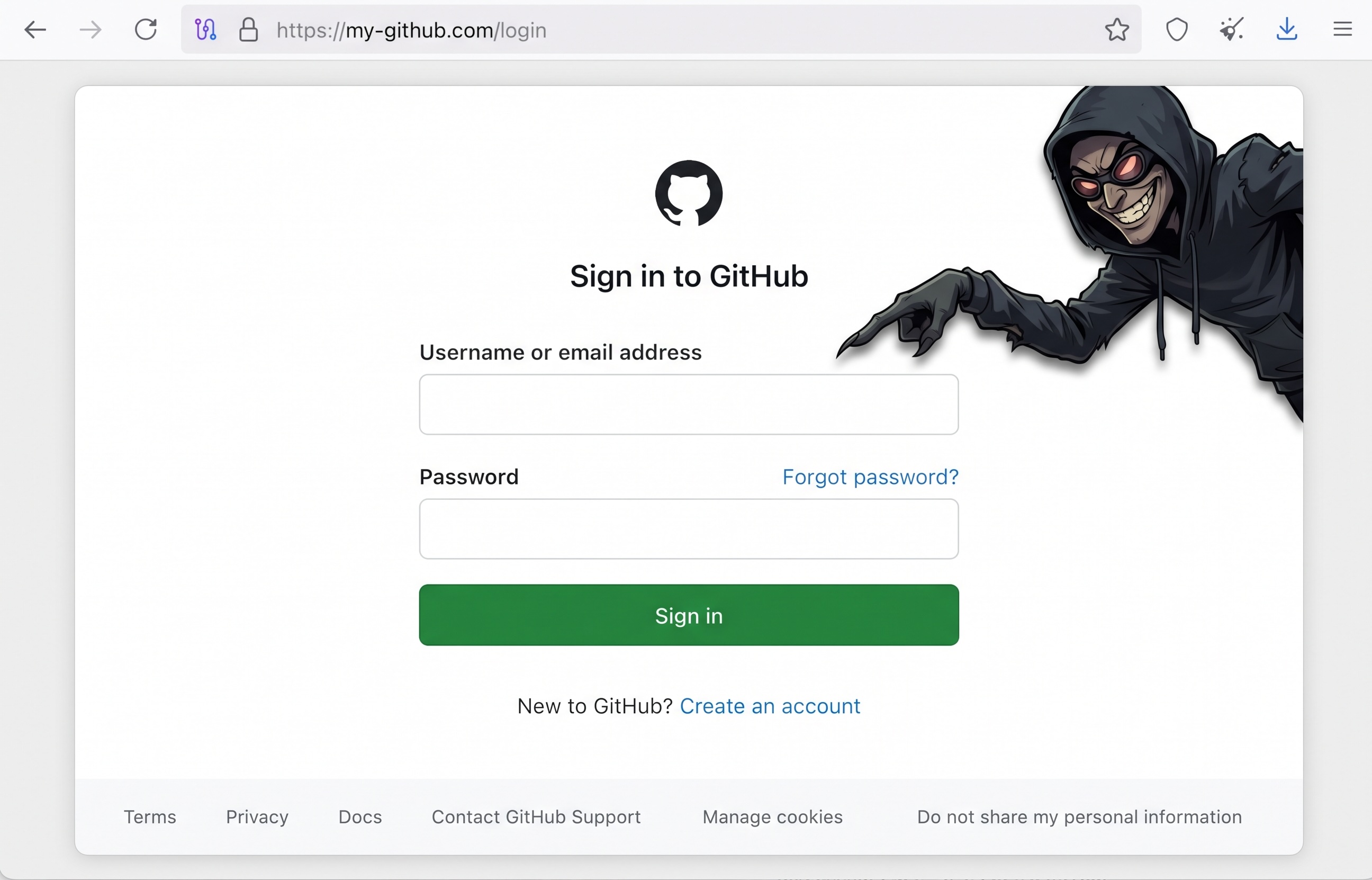 GhostAction Phishing Campaign
OpenSourceMalware analyzes a targeted phishing email from my-github[.]com (same server 193.32.204[.]199 as GhostAction's CI/CD exfiltration) that impersonated a GitHub new-sign-in alert. Recovered HTML and a HAR show a GitHub reverse proxy that captures passwords and TOTP codes, rewrites GitHub subdomains, and injects JavaScript that silently completes an OAuth device flow with repo, workflow and read:org scopes, then exfiltrates the token to TCP/8443. It includes a per-session redirect controller, mutable redirect behavior seen in URLScan, a victim's audit-log outcome (MFA stopped escalation), IOCs, and response guidance.
opensourcemalware.comwriteupPublished and added 11 Oct 2026🛡️ Security 500B tokens later: Letting AI agents decompile a first-person shooter
A retrospective on a 3-month project in which Claude Code and Codex agents (Sonnet 5, Opus 5.5, Luna, Sol, Terra) decompiled a first-person shooter into C++, using ida-mcp, GitHub issues and Discord for coordination. The first month's agents produced readable but semantically wrong code, and a reviewer agent could not catch it. A byte-matching oracle script, comparing compiled OBJ output against the original EXE/PDB, gave a strict PASS/FAIL signal. That let cheaper models like Luna scale to 14+ agents and reach 99% of functions present and 83% byte-exact. Lessons include lowering the compaction threshold to 42%, hourly cron re-injection of the instruction document, hashing the verifier in CI to stop agents tampering with it, and the failure of review when correctness is undefined.
 momo5502.comwriteupPublished and added 11 Oct 2026🧠 AI
 GhostAction Attack Escalates By Targeting GitHub Users
OpenSourceMalware's analysis of the latest GhostAction wave, where compromised GitHub accounts get malicious Actions workflows (security-audit.yml) injected across every writable repository, including an Oct 8 sweep of 346 repos via kitao and henrywoo. The new payload greps the checkout and full git history for credential patterns (AWS, Anthropic, OpenAI, GitHub PATs) and POSTs them over HTTP to 193.32.204.199/?c=monami. It also covers infrastructure reuse (phishing-heavy legacy IP, scanner activity), new watchlist domains my-github.com and my-gitlab.com, GitHub code-search hunting queries, a detection-confidence table, IOCs and incident response steps.
opensourcemalware.comwriteupAdded 10 Oct 2026, published 9 Oct 2026🛡️ Security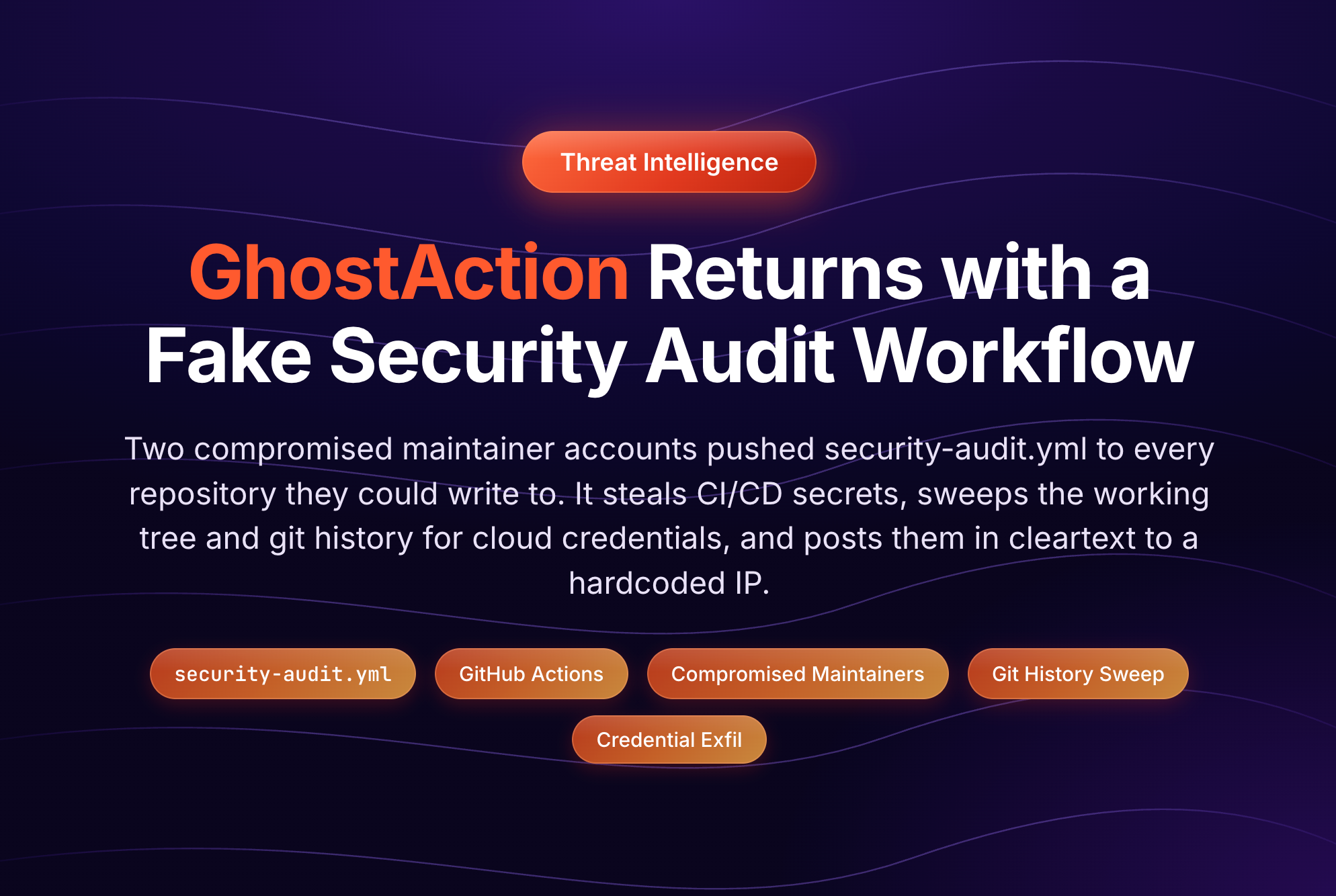 GhostAction Returns: Malicious “Security Audit” Workflows Now Mine Credentials from Entire Git Histories
StepSecurity details a new wave of the GhostAction campaign in which attackers used compromised maintainer accounts of Takashi Kitao (pyxel) and Henry Wu (athenadriver, Uber) to push malicious "Security Audit" GitHub Actions workflows to 345 repositories in minutes. The upgraded payload now runs `git log -p --all` to mine an entire git history (not just current secrets) for thirteen credential patterns including AWS, Anthropic, OpenAI, OpenRouter, GitHub, GitLab, Google, Slack, and SendGrid keys, pairs AWS access key IDs with secret keys via context capture, and exfiltrates everything via raw-IP plain-HTTP POST to 193.32.204.199, bypassing DNS-based defenses. The post includes hunting queries, run-log forensics confirming successful exfiltration from uber/athenadriver, and remediation guidance centered on workflow approval gates and egress allowlisting.
stepsecurity.iowriteupPublished and added 9 Oct 2026🛡️ Security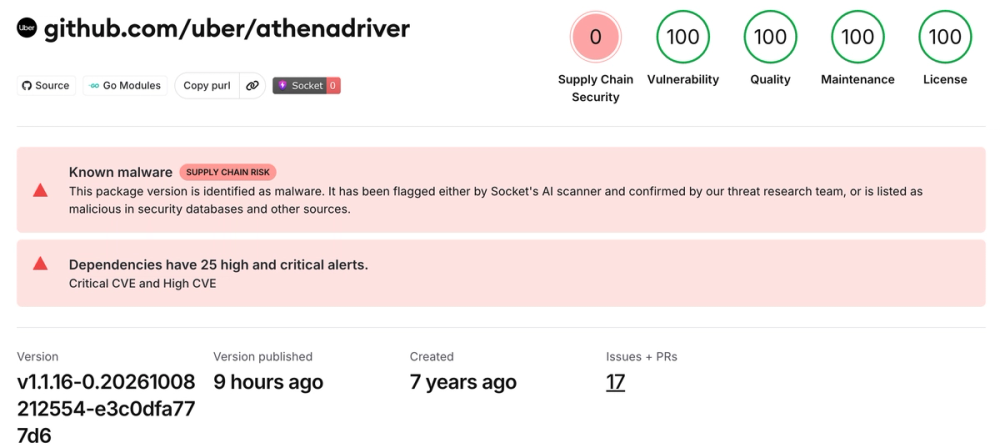 New GhostAction Wave Hits Hundreds of Repos, Expanding Beyond CI/CD Secrets to Cloud Credentials
Socket documents an October 8, 2026 wave of the GhostAction campaign in which two compromised GitHub maintainer accounts (henrywoo and kitao) pushed a malicious security-audit.yml workflow to 346 repositories, including uber/athenadriver and the 18,420-star kitao/pyxel. Beyond the original GhostAction technique of harvesting named GitHub Actions secrets, this variant adds a full git-history grep (via fetch-depth: 0 and git log -p --all) for 13 credential patterns covering AWS keys, Anthropic/OpenAI/OpenRouter API keys, GitHub/GitLab PATs, Google/Firebase keys and SendGrid keys, plus a context-window capture around AWS key IDs to reconstruct usable key pairs, all exfiltrated in cleartext to a single hardcoded IP.
socket.devwriteupPublished and added 9 Oct 2026🛡️ Security UAT-11985: AI-assisted event lures delivering real-time Google AitM phishing
Cisco Talos details UAT-11985, a spear-phishing campaign against Taiwan-based research organizations (impersonating institutions like the Taiwan European Union Centre and NCCU Institute of International Relations) that used AI-assisted, templated lure emails and poster-based QR code phishing (quishing) to drive victims to a real-time adversary-in-the-middle phishing kit. The kit impersonates Google sign-in across zh-CN/zh-TW/en locales, uses a split HTTP-POST/WebSocket architecture to mirror Google's live authentication flow and dynamically push MFA challenge screens, enabling full session-token theft and MFA bypass. Talos attributes the kit's localization architecture and lexical choices to a Simplified Chinese-speaking developer and publishes ClamAV/Snort coverage plus IOCs on GitHub.
 blog.talosintelligence.comwriteupPublished and added 8 Oct 2026🛡️ Security
 tensorlake NPM package compromised with Shai Hulud worm
Aikido details a new Shai-Hulud worm wave that compromised the tensorlake npm package (v0.5.144, 100k+ lifetime installs) via a hijacked GitHub maintainer identity. The malware's preinstall script drops the Bun runtime to run an obfuscated payload that exfiltrates CI/cloud secrets, browser crypto-wallet extension data (via a bundled HackBrowserData binary), uses a blockchain dead-drop (an Ethereum contract queried via public RPC nodes) to resolve a fallback C2, and includes a GitHub-token-triggered dead-man's switch that wipes infected machines. The post includes full IOCs: file hashes, the C2 domain iseekaigogo[.]com, and the threat actor's wallet/contract addresses.
aikido.devwriteupPublished and added 8 Oct 2026🛡️ Security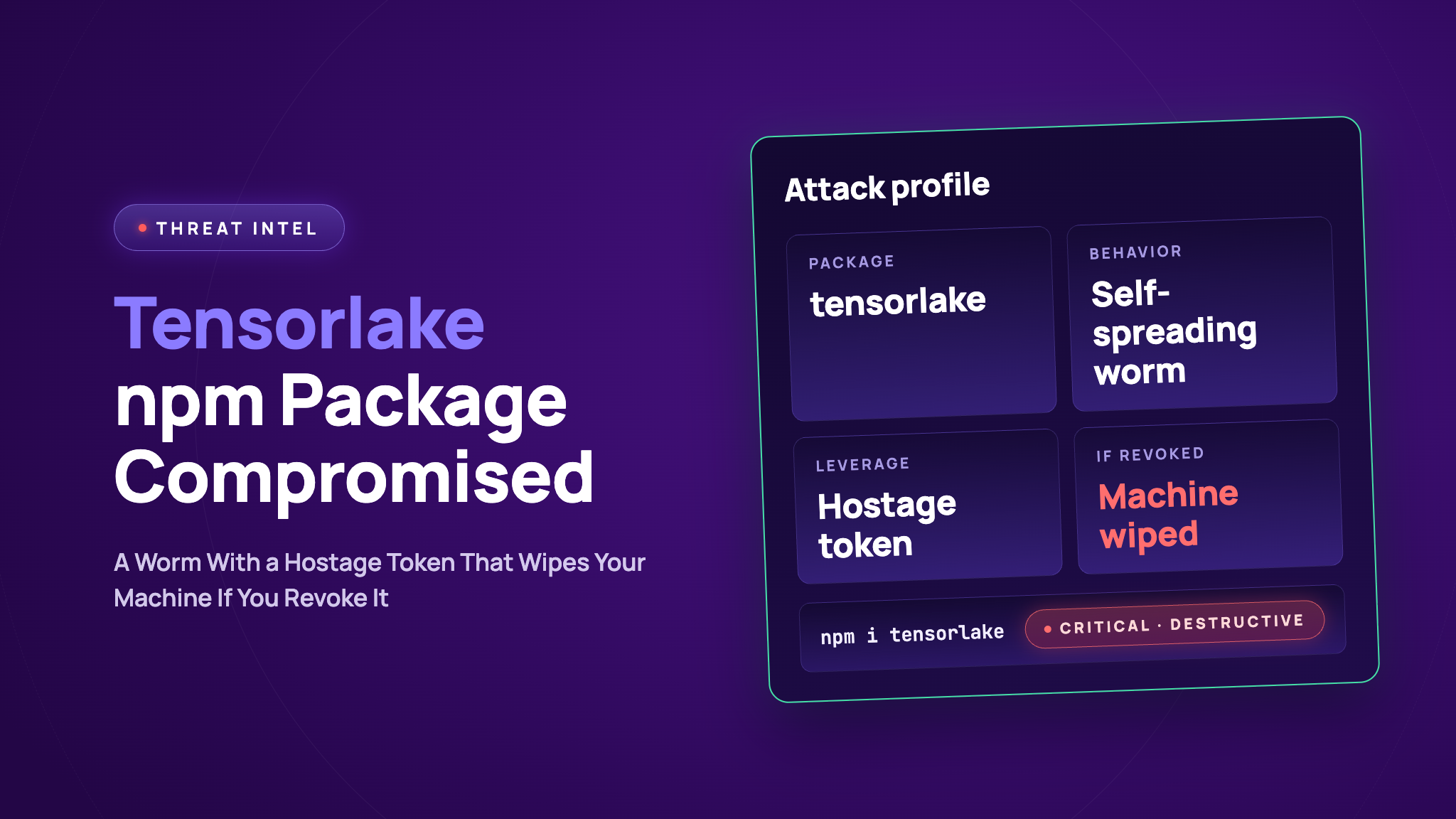 Tensorlake npm Package Compromised: A Worm With a Hostage Token That Wipes Your Machine If You Revoke It
StepSecurity details how tensorlake@0.5.144 was pushed to npm after malicious commits landed directly on the tensorlakeai/tensorlake GitHub repo's main branch under a maintainer's identity, carrying a valid npm provenance attestation despite being malicious. The preinstall hook downloads Bun to run an obfuscated payload that steals GitHub/npm tokens, cloud and Vault/Kubernetes secrets, SSH keys, browser logins, and AI-tool configs (Claude, Cursor, Windsurf), then self-propagates by republishing stolen npm packages and committing persistence files (.claude/settings.json, .vscode/tasks.json) to reachable repos. A "hostage token" mechanism installs a gh-token-monitor service that runs a home-directory wipe if the stolen GitHub token is revoked before the monitor is removed, inverting the normal incident-response order.
stepsecurity.iowriteupPublished and added 8 Oct 2026🛡️ Security- Write Like It's 1866: LLMs Relearn Telegraphese
The author revives "cablese," the terse telegraph-era writing style, as an LLM prompting technique: instructing a model to write dense, article-dropping summaries cuts output tokens 25–49% depending on model family, while downstream models (including ones never shown the instruction) answer comprehension questions from the compressed text at parity or better than from plaintext. The piece introduces the "Telegraph Test," an open benchmark (github.com/Travis42/telegraph-test) with ~1,300 questions over 50 passages and a fixed deterministic grader, used to measure compression ratio, cross-model legibility, and read-back/decode costs for GLM-5.3-Flash, Gemma, Qwen and gpt-5-mini; it also contrasts this human-readable, auditable register against emergent machine-only compression protocols described in other papers (BabelTele, GLOSSOGEN) and existing tools (Terse, Caveman).
 fiveminutesforward.comwriteupPublished and added 7 Oct 2026🧠 AI
 How to Investigate a GitHub Repo's Real History
Step-by-step guide to reconstructing the real history of a tampered GitHub repo using data the attacker can't forge: raw commit objects (git cat-file), GitHub's repository activity API and audit log, before/after SHA ancestry checks, and npm publish timestamps. Worked through a PolinRider case (nestjsx/nest-access-control) where a forged commit was force-pushed to master plus 22 branches in 38 seconds, with a malicious .vscode/tasks.json runOn folderOpen trigger. It also covers safe handling of untrusted clones and how to tell victim accounts from attacker accounts.
opensourcemalware.comwriteupPublished and added 6 Oct 2026🛡️ Security GitHub Copilot CLI vulnerability: Cryptographic Context Injection steals developer secrets
Adversa AI demonstrates Cryptographic Context Injection (CCI) against GitHub Copilot CLI: a web page presents an "encrypted" payload the agent decrypts inside its own shell, during which it is tricked into reading local files (e.g. .env.prod) to build a fake decryption key, then exfiltrates those contents to an attacker endpoint via a follow-up fetch. The attack only succeeds against certain models in Copilot's auto-routed model pool (Microsoft's mai-code-1.1-flash ran it 50% of the time, while two GPT-5.6 models refused), meaning users have no visibility into which model handles a given session. GitHub's bug bounty team validated but declined to treat it as a vulnerability since the user explicitly invoked autopilot mode with full tool permissions.
 adversa.aiwriteupAdded 7 Oct 2026, published 6 Oct 2026🛡️ Security
 Active Supply Chain Attack: Malicious node-ipc Versions Published to npm
StepSecurity's AI Package Analyst detected three malicious node-ipc versions (9.1.6, 9.2.3, 12.0.1) published simultaneously on May 14, 2026 by a rogue/compromised maintainer account, injecting an 80KB obfuscated IIFE into the CommonJS bundle that harvests 90+ credential file categories (AWS, Azure, GCP, SSH, Kubernetes, GitHub, Claude AI/Kiro configs, Terraform, etc.) and exfiltrates them via HTTPS and raw DNS TXT queries to a typosquatted Azure-mimicking C2 domain. The writeup includes a full stage-by-stage technical teardown (daemonization, SHA-256 targeting gate on 12.0.1, custom base-16 nibble-reversed obfuscation, dual-channel exfiltration) plus file hashes, network IOCs, and remediation guidance for developers and CI/CD pipelines.
stepsecurity.iowriteupAdded 5 Oct 2026🛡️ Security Opus 5.5 agents discover two room-temperature magnetic semiconductor candidates
Vals.ai researchers describe using Claude Opus 5.5-driven AI agents to run density-functional-theory simulations (PBE+U and HSE06 functionals) that designed a novel candidate magnet, YBaMnFeO₅, and separately re-identified a 1999 compound, KV[Cr(CN)₆] (a Prussian-blue analogue), as a "Luttinger compensated" semiconductor — a material with zero net magnetic moment but spin-sorted band edges, useful for spintronic memory. The agents predicted band gaps, spin-sorting windows, and magnetic ordering temperatures (KV[Cr(CN)₆] reportedly stays ordered above room temperature, up to 376 K), and the authors published all inputs, outputs and code on GitHub for independent verification. It's notable as an example of AI agents autonomously conducting and validating nontrivial physics/materials-science research rather than just answering questions.
 vals.aiwriteupAdded 6 Oct 2026, published 5 Oct 2026🧠 AI
 SubQuery Ecosystem Compromise: Hidden Credential Theft and Backdoors
StepSecurity's investigation of @subql/common@5.8.3, a malicious npm release in the SubQuery Web3 indexing framework's monorepo, found a heavily obfuscated postinstall/import-time payload (base64+XOR+gzip inside a function constructed via Function()) that spawns a detached worker to steal credentials (.npmrc, .env, AWS, SSH, kubeconfig, Vault, cloud secrets), read GitHub Actions runner memory for CI secrets, inject a camouflaged "Run Copilot" GitHub Actions workflow to exfiltrate repo secrets, and provide a remote shell/PTY over an encrypted channel to ci-artifacts.dev. The release was published via a compromised build pipeline: a workflow modification swapped the real build output for an externally downloaded, unsigned tarball from that same C2 domain immediately before publish, and the authors provide IOCs and remediation steps (credential rotation, host isolation, domain blocking).
stepsecurity.iowriteupPublished and added 5 Oct 2026🛡️ Security- Xray-core concealed a certificate verification bypass vulnerability
A security researcher's first-person disclosure describing a certificate verification bypass in Xray-core (a popular censorship-circumvention proxy): when its pinnedPeerCertSha256 option skips regular TLS verification, a MITM attacker can insert a leaf certificate anywhere in the certificate chain and have the custom pinning logic incorrectly validate it, effectively eliminating certificate verification. The writeup also documents how the vulnerability was silently fixed with a misleading "simplify the code" commit message and left undisclosed to users for nearly half a year until the reporter filed a GitHub Security Advisory.
 github.comwriteupAdded 5 Oct 2026, published 4 Oct 2026🛡️ Security
 Pentesting: Managing Compromised Machines with Platypus
Walkthrough of Platypus, an open-source C2-style host management platform (github.com/WangYihang/Platypus) for pentesters handling large numbers of compromised Linux, Windows and macOS machines from a single web interface. Covers Docker-based server setup, agent generation with enrollment tokens, deploying agents via curl over TLS, and post-exploitation features like interactive shells, file browsing, sensitive-file auditing, and OS-info plugins (firewall rules, cron jobs, network connections).
 hackers-arise.comwriteupAdded 7 Oct 2026, published 2 Oct 2026🛡️ Security
 Pretty Themes, Hidden Loaders: GlassWorm-Linked Extensions Span VS Code Marketplace and Open VSX
Socket's Threat Research team uncovered a theme-extension cluster spanning four VS Code Marketplace and six Open VSX listings, including two confirmed malicious extensions: Aurora Nocturne Night Theme (a Windows downloader that fetches and silently executes temp_batch.cmd via cmd.exe from fingercakes4sale[.]store, tied to XWorm C2 infrastructure) and Cosmic Nebula Themes, whose app.js decrypts an AES-256-CBC embedded stage and uses a Solana transaction memo as a dead-drop to resolve follow-on payload infrastructure — the same AES key, Solana address, and execution model previously documented in GlassWorm activity. Git commit identities, near-identical theme source, shared Russian-language developer comments, and brandjacking (Coca-Cola, Aurora Borealis name-squatting) link the cluster together; a Dec 14, 2025 DEV Community article is assessed as promotional infrastructure driving Open VSX installs. The post provides full IOCs (hashes, domains, Solana address, AES key/IV, GitHub accounts) and MITRE ATT&CK mappings for defenders to hunt and inventory extensions across both registries.
socket.devwriteupPublished and added 2 Oct 2026🛡️ Security The Blue Agent POV: Investigating Multi-Platform Data Exfiltration Across AWS and GitHub
Wiz walks through a case study of its "Blue Agent" autonomous SOC investigator tracing a compromised CI/CD service account (svc_automation) across AWS and GitHub. The attack chain: a stolen GitHub token cloned 18 private repos containing hardcoded AWS keys, which were used to authenticate to AWS from Kali Linux via a Zenlayer VPN IP, pivot to a second account, run SSM SendCommand against a production Windows domain controller, and stage custom Python exfiltration scripts (mssql_table_export.py, pg_table_export.py, billing_export2.py) in S3 to pull data from MSSQL, PostgreSQL, and billing systems. The piece details the investigative technique used - 30-day baseline comparison, ASO/IP dispersion across the tenant, and correlating CloudTrail management-plane events with S3 data-plane events and GitHub audit logs.
wiz.iowriteupPublished and added 29 Sep 2026🛡️ Security How we found 24 Android vulnerabilities using our open source AI security agent
GitHub Security Lab describes custom "taskflow" prompts built on their open-source Taskflow Agent to hunt Android app vulnerabilities, reporting 24 findings to date. It walks through two concrete chains: an exported, unprotected MapActivity in OsmAnd that lets any app silently import settings and exfiltrate the user's exact map tile/route coordinates to an attacker server, and a hostname-parsing logic bug plus overly loose cookie-domain check in the Wikipedia Android app that lets a wikipedia:// deeplink load an attacker page (e.g. evil-wikipedia.org) and steal long-lived session cookies for account takeover. The post also candidly notes where LLMs struggle (false positives, mis-estimating severity, missing mitigating factors) versus where they excel (deep knowledge of safe/unsafe API patterns).
 github.blogwriteupAdded 7 Oct 2026, published 28 Sep 2026🛡️ Security
 PolinRider is A/B Testing its Way Past Your Detections
Opensourcemalware.com traces PolinRider, a DPRK-linked supply-chain malware delivered via a poisoned .vscode/tasks.json that autoruns an obfuscated payload disguised as a Font Awesome .woff2 file, through an 8-month infection of three real GitHub repos (Binary-Mindz org). Using GitHub's server-side activity log they reconstruct 853 force-pushes showing the operators A/B-testing multiple concurrent payload variants (400/500/900), rewriting commits to impersonate legitimate cleanup commits, hiding payloads inside eslint.config.mjs and prisma.config.ts, and using an Ethereum-wallet-based C2 dead-drop (NullReceiver). The post lists why common detection heuristics (filename search, whitespace padding, marker strings) fail against the new variants and gives working detections (file-type checks, folderOpen task grepping, activity-log force-push monitoring) plus full IOCs.
opensourcemalware.comwriteupPublished and added 26 Sep 2026🛡️ Security Plugin4Shell - Zero Click RCE Vulnerability found in top 4 most popular coding agents, millions of agents affected
Air Security researchers found that AI coding agents (Claude Code, Codex, GitHub Copilot, Gemini CLI) that SHA-pin plugins from marketplaces never verify the checked-out commit actually matches the pin, letting an attacker who controls a plugin's upstream repo create a branch named after the 40-hex SHA (or, for Gemini CLI, named FETCH_HEAD) so git resolves the ref to attacker-controlled code instead of the pinned commit. Because agents auto-update plugins in the background, this yields zero-click RCE against already-installed, previously-vetted plugins even when marketplaces do everything the pinning security model asks; Anthropic and OpenAI patched after disclosure, Microsoft has not patched GitHub Copilot, and Google will not patch the deprecated Gemini CLI.
 air.securitywriteupAdded 26 Sep 2026🛡️ Security
 Storm-3168: Agentic-driven cloud attacks using compromised service principals
Microsoft Security Research documents an Azure-focused campaign by Storm-3168 (aka JADEPUFFER, discovered by Sysdig as the first documented agentic ransomware operation), using two compromised service principals to enumerate an Azure tenant and then execute a seven-minute destructive sequence deleting 100+ Storage Accounts, a Key Vault, a Function App, and attempting (unsuccessfully, due to API version mismatch) to delete Azure SQL databases. Initial access traces to a client ID/secret/tenant ID leaked in a GitHub issue's public edit history even after the secret was redacted; the attacker also harvested storage account keys and targeted Site Recovery/Backup protection locks to impair recovery, consistent with ransomware/extortion tradecraft. The post includes a MITRE ATT&CK mapping (T1190, T1078.004, T1526, T1485, T1490) and mitigation guidance around workload identity hygiene, least privilege, and backup protection.
 microsoft.comwriteupAdded 7 Oct 2026, published 25 Sep 2026🛡️ Security
 Finding Gadgets Like It's 2026 (Atredis Partners)
Atredis Partners built an LLM-driven pipeline (WALA/ASM call-graph builder, a FastAPI graph query server, Claude Code as the reasoning/validation agent, and a dynamic test/debug runner) to automate discovery of Java deserialization gadget chains against modern, hardened application servers (WebSphere, WildFly, Payara). The project found 17 confirmed chains, 6 novel, including CB1-Shaded-RCE — a chain that bypasses JPMS's TemplatesImpl restrictions via a shaded/relocated copy of Xalan's XSLTC shipped inside WildFly's JSTL jar, giving RCE on the latest WildFly on JDK 21 — plus a novel JNDI-injection chain in Payara via AttributeComparator/InjectableJMSContext. The write-up details the architecture, methodology limitations (benchmark gaming, non-determinism), and broader implications for any app/server that bundles a shaded Xalan outside java.xml, with tooling released on GitHub (atredispartners/llmchainhunter).
 atredis.comwriteupAdded 25 Sep 2026🛡️ Security
 The Infostealer Incursion: How Stolen Credentials Breach Cloud, Code, and AI Environments
Wiz Research analyzed infostealer-harvested secrets (via its NordStellar integration) to map exactly which credentials malware families like Lumma, RedLine, and Vidar target across AWS, Azure, GCP, GitHub, GitLab, and AI platforms, and how those secrets translate into cloud account takeover. It gives concrete file paths and artifacts attackers hunt for (~/.aws/sso/cache OIDC tokens, Azure accessTokens.json, GCP credentials.db/access_tokens.db, GitHub gh hosts.yml and SSH keys, GitLab Runner config.toml, OpenAI/ChatGPT session cookies, and Claude Code's ~/.claude/.credentials.json OAuth tokens), plus stats: three malware families cause 85.7% of incidents, AWS/GCP account for 46%/13% of stolen secrets, GitHub ~10%, AI platforms ~5%. It also covers CI/CD-targeting infostealers (Miasma, TeamPCP) and session-cookie hijacking as an MFA bypass technique.
wiz.iowriteupAdded 27 Sep 2026, published 25 Sep 2026🛡️ Security- Camera Hacking: Testing Cameras with Eyesharvester
Hands-on walkthrough of Eyesharvester, an open-source recon tool (github.com/Exhunterx/eyesharvester) that scans IP ranges to fingerprint IP cameras, DVRs and NVRs, tests default credentials, lists vendor-specific CVEs and generates a hardening checklist. The piece demonstrates finding Hikvision devices vulnerable to CVE-2021-36260, which gives shell access and can be chained with a Metasploit payload and a reverse SSH/Meterpreter proxy to pivot into the internal network.
hackers-arise.comwriteupAdded 7 Oct 2026, published 25 Sep 2026🛡️ Security 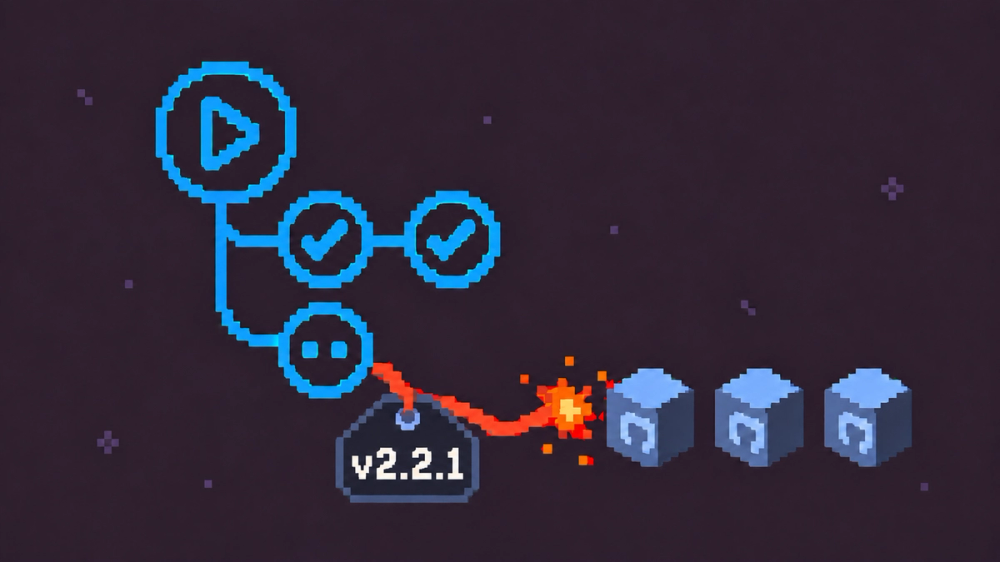 Re-Enabled GitHub Actions Expose Thousands of Repositories to Mini Shai-Hulud
Socket reports that the actions-cool/issues-helper and actions-cool/maintain-one-comment GitHub Actions, compromised in the May 2026 Mini Shai-Hulud campaign and disabled by GitHub, were re-enabled on September 16, 2026 with their release tags still pointing to the malicious code. Any workflow referencing them by tag (about 15,000 dependents for issues-helper alone) resumed running the Bun-executed obfuscated payload. Workflow run logs show the switch from fast "Repository access blocked" failures to multi-minute successful runs. The post gives remediation: SHA-pin actions, rotate secrets, and hunt for oven-sh/setup-bun and bun run index.js in runner logs. An update says both repos were disabled again on September 25.
socket.devwriteupPublished and added 24 Sep 2026🛡️ Security Sckit Supply Chain Worm Hits MemTensor npm & PyPi scopes
StepSecurity documents a supply-chain attack against @memtensor/memos-cloud-openclaw-plugin on npm (versions 0.1.21, 0.1.23, 0.1.25) and MemoryOS 2.0.34 on PyPI, which insert a hidden "sckit" launcher into normal plugin/import lifecycle code (no install scripts) to spawn a platform-specific Go binary that harvests the parent process's environment and the user's AI prompt text. The Go payloads contain regex patterns for AWS, GitHub, GitLab, npm, PyPI, Hugging Face, Vault, Slack, Stripe and SendGrid credentials, target the user's home directory as an inventory root, and beacon to skyleen.fr "front" domains; the PyPI variant additionally hides a conditional build-backend/CI bridge that can steal PYPI_API_TOKEN during publishing and pull a hash-pinned, Ed25519-signed secondary payload via GitHub Actions. The writeup includes full IOC/remediation guidance.
stepsecurity.iowriteupPublished and added 23 Sep 2026🛡️ Security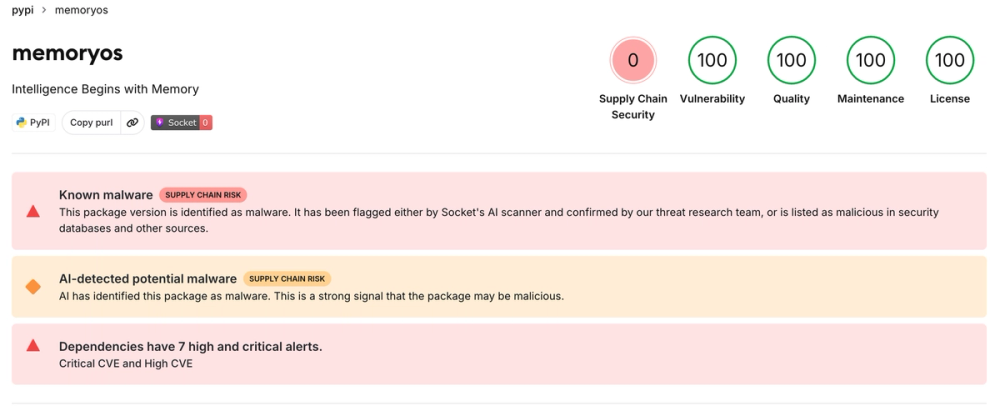 MemTensor npm and PyPI Packages Compromised in Credential-Stealing Supply Chain Attack
Socket details a supply-chain compromise of MemTensor's MemOS packages: npm package @memtensor/memos-cloud-openclaw-plugin (versions 0.1.21, 0.1.23, 0.1.25) and PyPI package MemoryOS (2.0.34), both published as the latest release on their registries. Each malicious release bundles a stripped, statically-linked Go binary called sckit that launches on import/plugin-load, scans $HOME for npm, PyPI, GitHub, GitLab, AWS, Vault and SSH credentials, and exfiltrates them to C2 servers under skyleen[.]fr, with the npm variant also capturing OpenClaw agent prompt text and the code additionally showing potential worm-like republish capability using stolen registry tokens.
socket.devwriteupPublished and added 23 Sep 2026🛡️ Security- Compromised npm Packages in the AsyncAPI Namespace Deliver Miasma Botnet Loader
Socket's Threat Research Team details a supply-chain compromise of four @asyncapi npm packages (generator-helpers, generator-components, generator, specs) published via a poisoned source commit through GitHub Actions trusted publishing. The packages contain an obfuscated load-time (not install-hook) implant that spawns a detached Node.js process to fetch an IPFS-hosted, AES-256-GCM-encrypted loader delivering the "Miasma" botnet/tasking framework, which supports REST C2, multi-channel comms (Nostr, IPFS, Ethereum RPC, BitTorrent DHT), shell execution, file exfiltration, and systemd persistence. Includes full technical analysis, IOCs, hashes, and MITRE ATT&CK mapping.
socket.devwriteupAdded 21 Sep 2026🛡️ Security 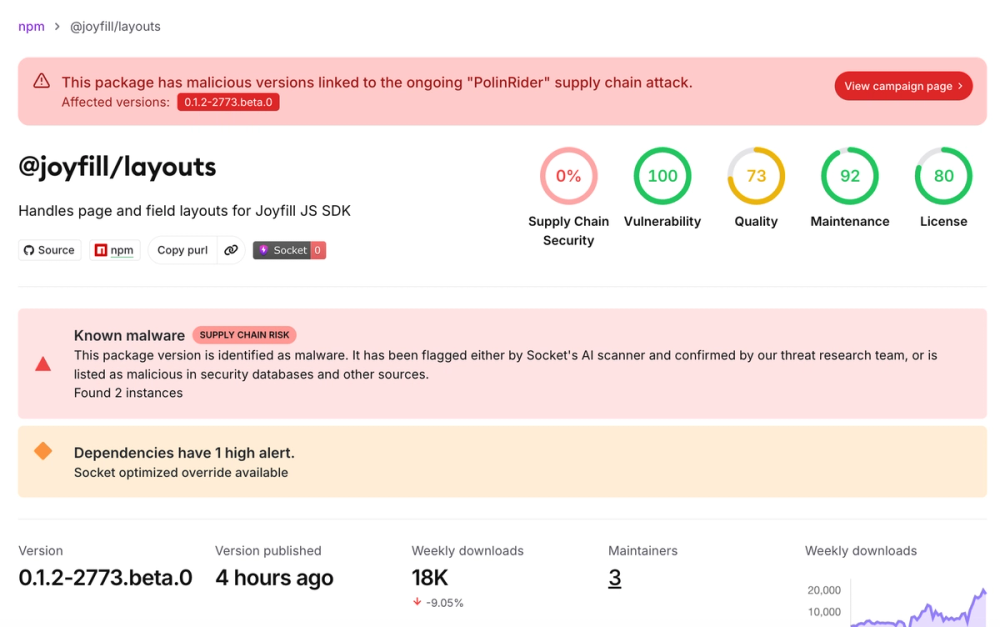 Socket: Two Joyfill npm Beta Releases Compromised to Deliver DEV#POPPER Remote Access Trojan
Socket's research team found two beta releases of the @joyfill npm packages (@joyfill/layouts and @joyfill/components) contained an import-time JavaScript implant that resolves encrypted payloads through Tron, Aptos, and BNB Smart Chain transactions, ultimately dropping a 77KB Node.js remote-access trojan matching the DEV#POPPER family and sharing loader fingerprints with the PolinRider blockchain-loader campaign. The RAT establishes a Socket.IO C2 channel, executes arbitrary JS/shell commands, exfiltrates files and clipboard data, and persists by patching files inside VS Code, Cursor, Antigravity, Discord Desktop, GitHub Desktop, and the global npm CLI; a parallel detached-process branch fetches an additional bootstrap that can deploy a Python credential/browser-data stealer assessed as an OmniStealer variant. Because the implant fires on module load (not via npm lifecycle scripts), `--ignore-scripts` provides no protection, and the writeup includes full IOCs, blockchain addresses, C2 infrastructure, and MITRE ATT&CK mappings.
socket.devwriteupAdded 22 Sep 2026, published 20 Sep 2026🛡️ Security Threat Actors Abuse IronPython to Deliver CastleLoader/CastleRAT
A threat-hunting blog post (#415 in a recurring series) analyzes how attackers abused IronPython to deliver CastleLoader and subsequently CastleRAT, based on Zscaler's SloppyRAT report. It documents the attack chain — a renamed curl.exe downloading IronPython from GitHub, then IronPython executing a base64-decoded, zlib-compressed Python payload — and provides concrete hunting queries (process creation events filtering on curl.exe with "ironpython" in the command line, and IronPython processes invoking base64.b64decode) to detect this technique, mapped to MITRE ATT&CK T1059.006.
 knowyouradversary.ruwriteupAdded 26 Sep 2026, published 17 Sep 2026🛡️ Security
 Threat Hunter's Guide to GitHub (Datadog Security Labs)
Datadog Security Labs walks through hunting for GitHub organization compromise using GitHub audit logs, covering the full attack chain from stolen PATs/OAuth tokens and device-code phishing (initial access) through secrets-listing enumeration, private-repo/tree discovery, and bulk collection via git.clone or repo.download_zip. It provides copy-pasteable queries (with fields like hashed_token, programmatic_access_type, external_identity_nameid) mapped to MITRE ATT&CK techniques and calls out GitHub audit-log quirks (missing IP on failed auth, inconsistent visibility fields, misleading token permission scopes) that shape accurate detections.
securitylabs.datadoghq.comwriteupAdded 25 Sep 2026, published 16 Sep 2026🛡️ Security Operationalizing least privilege: Automate IAM remediation through your CI/CD pipeline
AWS Security Blog walkthrough of an open-source Lambda-based automation that closes the loop between IAM Access Analyzer's unused-permission findings and actual remediation: it classifies each flagged role by origin via CloudTrail (CloudFormation/CDK-managed, manually created, or unused), then uses Amazon Bedrock (Claude Sonnet for code generation, Claude Haiku for explanations) to open a pull request with right-sized CDK IAM policy code, a GitHub/GitLab issue with migration guidance, or a soft-disable decommission issue respectively. It covers cross-account/organization-wide deployment, exclusion lists for sensitive roles, throttling, dry-run mode, CloudWatch metrics, and cost/cleanup considerations, with full source in an accompanying repo.
 aws.amazon.comwriteupAdded 7 Oct 2026, published 15 Sep 2026🛡️ Security
 Shai-Hulud 2 Malware Campaign Targets GitHub and Cloud Credentials Using Bun Runtime | Blog | Endor Labs
Endor Labs' live incident tracker for the Shai-Hulud 2.0 npm supply-chain worm that began around Nov 24, 2025, compromising packages from Zapier, ENS Domains, Postman and PostHog. It details the infection chain (malicious preinstall script, setup_bun.js dropper, obfuscated bun_environment.js payload), TruffleHog-style credential theft from AWS, GCP, Azure, GitHub and npm, self-replication via stolen npm and GitHub tokens, a self-hosted GitHub Actions runner backdoor abusing repository Discussions for command injection and C2, and destructive wiper behavior that shreds the user's home directory on Windows and Linux.
endorlabs.comwriteupPublished and added 11 Sep 2026🛡️ Security Active exploitation of Cisco Secure Firewall Management Center vulnerabilities
Cisco Talos details active exploitation of CVE-2026-20079 (CVSS 10.0 unauthenticated auth bypass leading to root) and CVE-2026-20316 (low-privilege login via static credentials) in Cisco Secure Firewall Management Center. Three post-compromise clusters are tracked: UAT-12197 deploying a JSP web shell and JAR command executor to exfiltrate credentials; UAT-11823, overlapping with Sandworm, using a malicious Makeself license.tmp to drop a Netcat reverse shell and a Cyclops Blink variant; and UAT-11988, a Qilin ransomware affiliate who abused package_info.pl for LOTL recon, SOCKS5/reverse-SSH tunneling, and ultimately deployed Qilin ransomware. Talos provides Snort SIDs, hotfix guidance ahead of a comprehensive hardening release, and a GitHub IOC repository.
blog.talosintelligence.comwriteupAdded 7 Oct 2026, published 9 Sep 2026🛡️ Security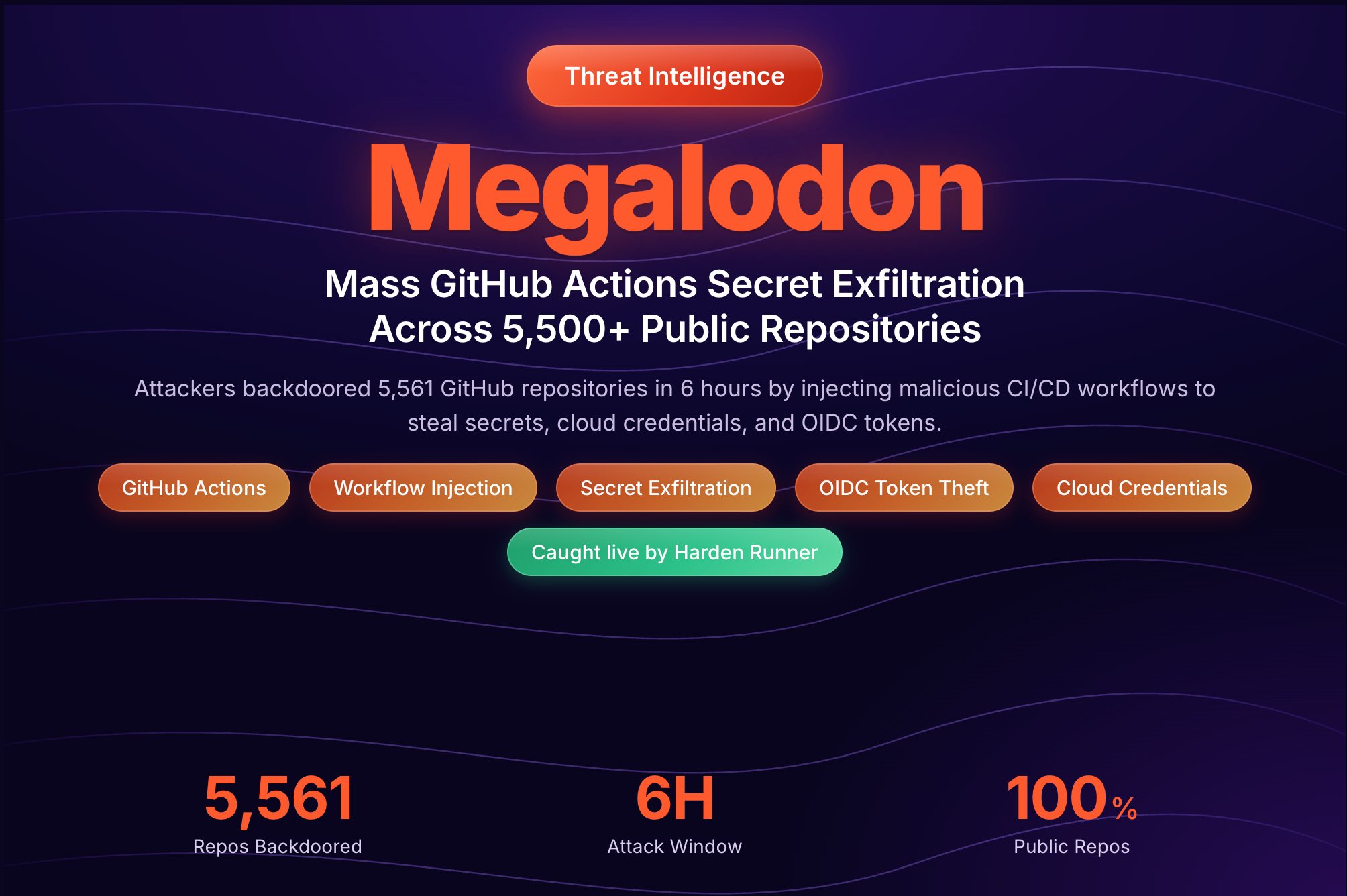 Megalodon: Mass GitHub Actions Secret Exfiltration Across 5,500+ Public Repositories - StepSecurity
StepSecurity documents Megalodon, a May 2026 campaign that injected backdoored GitHub Actions workflow files named SysDiag or Optimize-Build directly into 5,500+ public repositories in a six-hour window via direct Poisoned Pipeline Execution (d-PPE), exploiting weak branch protection. The base64-encoded bash payload harvests AWS/GCP/Azure credentials, SSH keys, Kubernetes/npm/Docker configs, GitHub OIDC tokens, and grep-matched secrets from the workspace, exfiltrating everything via HTTPS POST to a hardcoded C2 IP; the npm package @tiledesk/tiledesk-server was among the confirmed poisoned downstream targets.
stepsecurity.iowriteupAdded 5 Sep 2026🛡️ Security- A trust checklist for GitHub Actions
Presents a tiered trust checklist for evaluating third-party GitHub Actions before referencing them in a workflow, covering maintenance/tooling signals, unpinned transitive dependencies, release attestations, and governance, with weaker popularity-based signals separated into a second tier. It then argues that any point-in-time trust assessment only holds if the referenced commit is immutable, and compares raw SHA pinning against GitHub's immutable releases and the new gh-actions-lock CLI extension, which verifies commit reachability to defeat impostor-commit attacks. It closes by noting StepSecurity's GitHub Action Advisor automates some of the checklist's queryable signals using Harden-Runner telemetry.
 jessehouwing.netwriteupAdded 21 Sep 2026, published 4 Sep 2026🛡️ Security
 Managing identity source transition for AWS IAM Identity Center
AWS Security Blog runbook for migrating the identity source behind AWS IAM Identity Center from Active Directory to an external SAML 2.0 IdP such as Okta, which is a destructive cutover that deletes all users, groups, and permission-set/application assignments at the moment of switch. It walks through pre-migration backup, SCIM provisioning setup, SAML metadata/ACS configuration, scripted assignment restoration with drift detection (drift_report.csv), post-migration validation, and a manual rollback procedure, linking to an aws-samples GitHub migration tool for the scripted steps.
aws.amazon.comwriteupAdded 7 Oct 2026, published 2 Sep 2026🛡️ Security Claude Code & Gemini CLI: GitHub Issue → CI Secrets
Novee Security disclosed that a low-privilege GitHub issue could trigger code execution on CI runners for Gemini CLI and Claude Code, and hijack the next agent run in OpenAI Codex, via flaws in the "harness" code surrounding each coding agent rather than the LLM itself. CVE-2026-12537 is a CVSS 10.0 OS command injection in Gemini CLI's container launcher via a crafted .gemini/.env file (fixed in 0.39.1); CVE-2026-54316 abused Hugging Face's public download counter as a side channel to exfiltrate a Claude Code API key one character at a time (fixed in 2.1.163). A separate Claude Code bash-quoting validator bypass and a Codex AGENTS.md instruction-file poisoning issue (via shared checkout across two passes) had no CVE, prompting OpenAI to only issue workflow/documentation fixes.
 thehackernews.comwriteupPublished and added 1 Sep 2026🛡️ Security
- Daisy-Chaining Trust: Investigating Faronics Deploy Abuse | Huntress
Huntress details a phishing campaign that tricks victims into installing a legitimately signed Faronics Deploy agent disguised as Adobe/Zoom documents, enrolling endpoints into an attacker-controlled deployment console. The threat actors then abuse Faronics' remote script execution to pull PowerShell payloads (via curl, mshta, msiexec) from GitHub-hosted staging and install ScreenConnect for persistent remote access. The post identifies key forensic artifacts (C:\ProgramData\Faronics\Logs\ScriptRunner.log and the deployment's unique "ck" identifier) that defenders can use to trace attacker infrastructure and cluster malicious enrollments, and notes Faronics' response to disrupt abuse after Huntress's disclosure.
 huntress.comwriteupAdded 5 Sep 2026, published 31 Aug 2026🛡️ Security
 @7nohe/openapi-react-query-codegen Compromised Through an Exposed npm Publishing Workflow
StepSecurity documents how an external GitHub user (p00paboot) hijacked the release workflow of @7nohe/openapi-react-query-codegen by exploiting an npm publish issue-comment trigger that lacked commenter authorization checks, allowing pull-request code to be checked out and published via GitHub Actions OIDC trusted publishing. Ten malicious versions were pushed with preinstall hooks and a poisoned binding.gyp that executed a payload downloading Bun, stealing GitHub/git credentials, probing GCP metadata, and enumerating SSH keys, confirmed via StepSecurity Harden-Runner behavioral analysis on isolated runners. The post lists affected versions, file/hash IOCs, and remediation steps including credential rotation and pinning to clean releases.
stepsecurity.iowriteupAdded 3 Sep 2026, published 28 Aug 2026🛡️ Security Deadbugz: Currently Active MCP Supply-Chain Campaign
Pillar Security disclosed "Deadbugz," an active campaign distributing a malicious MCP server called productivity-suite via 23 public GitHub pull requests to AI/MCP/dev-tool repos. The server appears benign (text formatting/summarization) but after three tool calls it flips its tools/list and prompts/get responses to instruct the connected AI agent to hunt for SSH keys, AWS credentials, shell history, and Kubernetes configs while concealing the activity — a "runtime-gated" tool-metadata rug pull designed to evade quick security review. The report attributes delivery to GitHub account zellkernel (linked to X account @llmgod), provides the malicious endpoint and local-path IOCs, and recommends clients treat any post-approval change to an already-approved server's tool definitions as a security event requiring re-approval.
 pillar.securitywriteupAdded 28 Aug 2026🛡️ Security
 NPM Isn't Prepared For North Korean PolinRider Attack
OpenSourceMalware's case study on npm packages fetch-page-assets and html-to-gutenberg, maintained by a legitimate developer (DiogoAngelim) whose GitHub account was compromised by the DPRK-linked PolinRider campaign in March 2026. The post shows GitHub server-side push timestamps proving all seven of the maintainer's repos were force-pushed with an identical NullReceiver loader in two coordinated bursts, and that after npm pulled the flagged v1.2.9 (GHSA-vxq2-vhm7-7mhq), every subsequent release (v1.2.10-v1.2.14) kept shipping the same .vscode/tasks.json auto-run trigger, with the attacker later adding a second obfuscated payload appended to babel.config.cjs. It argues npm/GitHub's per-version advisory model can't scale against thousands of PolinRider-compromised maintainers and lists specific IOCs (hashes, C2 wallet, RPC endpoints).
opensourcemalware.comwriteupAdded 3 Sep 2026, published 25 Aug 2026🛡️ Security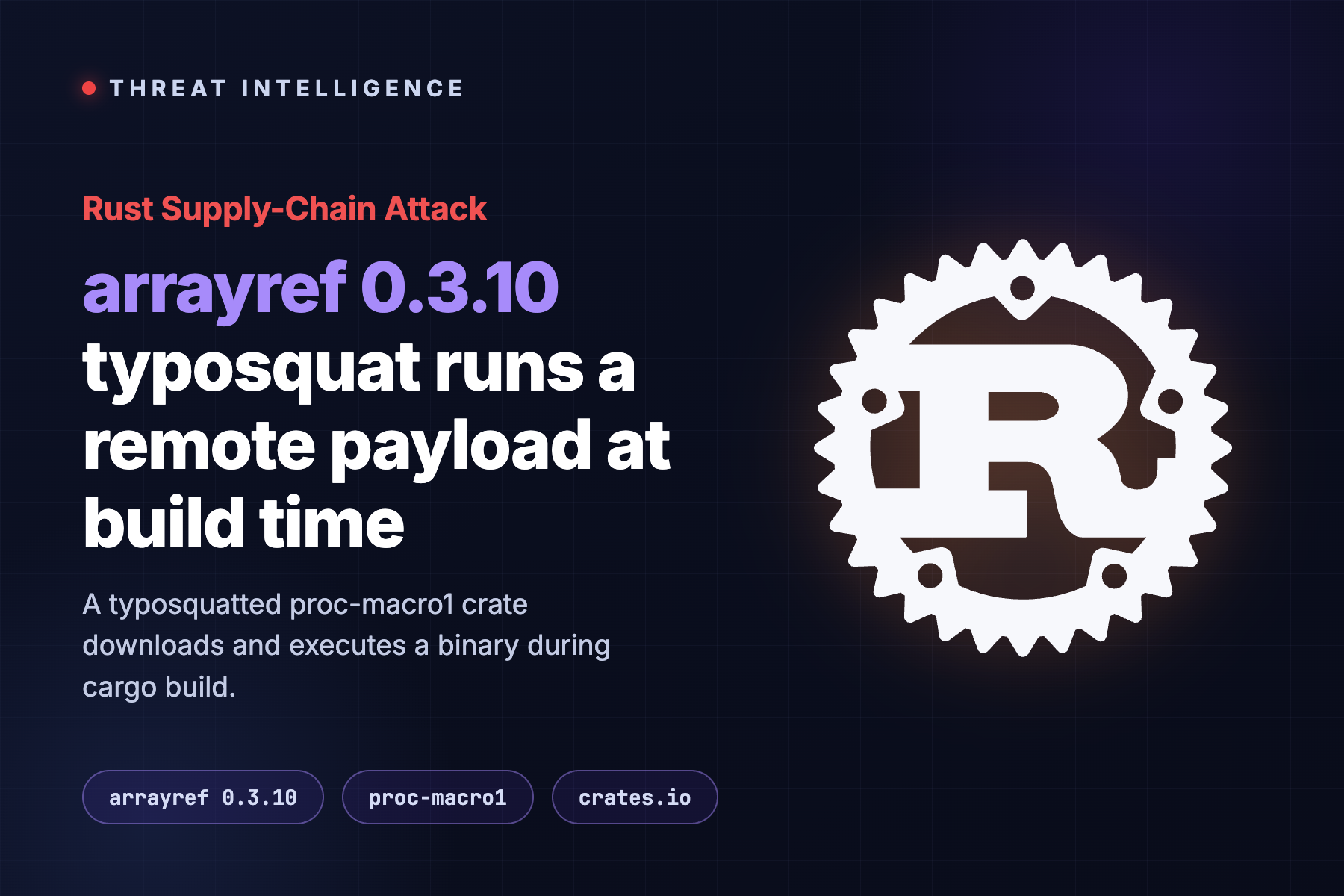 Rust Supply-Chain Attack: arrayref, internment, and append-only-vec Poisoned by the proc-macro1 Build-Time Dropper
StepSecurity's forensic writeup on a compromised crates.io maintainer account that published poisoned releases of arrayref (245M downloads), internment, and append-only-vec, each pulling in proc-macro1, a typosquat of proc-macro2 impersonating David Tolnay whose build.rs silently drops and executes a cross-platform stage-2 payload at compile time. The attacker also mass-yanked clean arrayref versions to funnel Cargo's "yanked" warning toward the one poisoned release, and StepSecurity reproduced the attack in GitHub Actions with Harden-Runner, capturing the C2 callback to 23.254.165.112:9089 and demonstrating automatic blocking via a global IOC block list. The post includes the full attack timeline, dropper base64-obfuscated URL scheme, SHA-256 hashes, C2 IOCs, and remediation/detection guidance for lockfiles and CI caches.
stepsecurity.iowriteupAdded 3 Sep 2026, published 22 Aug 2026🛡️ Security Grok chat history leak: Cryptographic Context Injection
Adversa AI describes Cryptographic Context Injection. Attacker instructions are shipped as AES-256-GCM ciphertext with PBKDF2 key material, and the model is induced to decrypt them in its own Python sandbox. The plaintext then appears as trusted runtime output, so guardrails never see it. Demonstrated as zero-click chat-history exfiltration from Grok via a "summarize this page" request, as a safety-policy bypass in Gemini, and, in an update, against GitHub Copilot CLI. The post covers the xAI disclosure timeline (reported June 2026, unfixed) and defenses at the agent harness layer: quarantining untrusted content, gating outbound tool calls, tracing, sequence alerting, and provenance.
adversa.aiwriteupAdded 24 Aug 2026, published 20 Aug 2026🛡️ Security Windows Infostealer Hits npm and Ruby
Follow-up analysis showing that the RubyGems StubMaker typosquatting campaign and a separately-discovered 40-package npm typosquatting campaign (targeting chalk, commander, lodash, typescript, react, axios) are run by the same threat actor: both use install-time hooks (extconf.rb vs postinstall.js) to fetch a Rust loader from the same GitHub release, which decrypts a byte-for-byte identical Go infostealer confirmed by matching SHA-256 hashes. The stealer harvests browser credentials (bypassing Chromium app-bound encryption), crypto wallets/seed phrases, and Telegram data, exfiltrating via Gofile to a webhook at dresslee.com, and includes WSL-to-Windows sandbox escape logic. The post publishes full network/file IOCs and hashes and argues network-layer blocking (C2 IP and webhook domain) is more durable than package-name blocklisting.
opensourcemalware.comwriteupAdded 3 Sep 2026, published 19 Aug 2026🛡️ Security

Showing 60 of 139
Show more