- Do the math: How we took over ChatGPT accounts
Parameter Labs describes a chain that turned a public ChatGPT share link into JavaScript running as chatgpt.com in the victim's session. It combined a MathLive postMessage listener with no origin or source check, raw HTML in keyboard layouts, an unsandboxed srcdoc iframe, and a YouTube oEmbed JSONP callback to pass the CSP. The code read private conversations through backend APIs. OpenAI fixed it on 26 October 2026 and rated it P1.
 parameter.aiwriteupAdded 1 Nov 2026, published 31 Oct 2026🛡️ Security
 nemotron-halloween
MonsterHouse is a Halloween interactive projection built on the NVIDIA Nemotron Voice Agent: Nemotron Speech ASR, Nemotron 3.5 Bolt E4B 4GB with a LoRA persona adapter, Magpie TTS Zeroshot and Audio2Face-3D in Unreal Engine, on two RTX Blackwell GPUs. Median end-of-speech-to-audio is 1.70 seconds live and 0.72 seconds with cached responses. The post gives a build path and tips on caching and state handling.
 huggingface.cowriteupPublished and added 30 Oct 2026🧠 AI
 Trojanized Claude Code Extension Plants an SSH Backdoor
Analysis of a trojanized anthropic.claude-code 2.1.313 extension (darwin-arm64), found on Open VSX, with a 66-line loader prepended to extension.js. It adds an svc-telemetry key to authorized_keys, opens a reverse SSH tunnel to 134.209.82.225, sets persistence (LaunchAgent, cron, scheduled task) and sends host recon over HTTP port 8099. Includes IOCs, hashes and response steps; no further payload download was found.
 opensourcemalware.comwriteupPublished and added 30 Oct 2026🛡️ Security
 Trojanized Claude Code Extension Delivered Persistent SSH Backdoor to Developer Machines
The Claude Code VS Code extension anthropic.claude-code 2.1.313 was published on Open VSX on 29 October 2026 with a malicious loader prepended to extension.js. On load it planted an attacker SSH key (svc-telemetry), installed per-OS persistence, opened a reverse SSH tunnel and beaconed host recon over HTTP. Cursor reports at most 5,000 users received it in an 11-hour window. The post gives the timeline, cleanup artifacts and credential rotation steps.
 stepsecurity.iowriteupPublished and added 30 Oct 2026🛡️ Security
 Earliest Known PolinRider Malware Found in 2025 npm Packages
OpenSourceMalware traces nine itsa-* npm package versions published on 4 May 2025 from a hijacked maintainer account to the PolinRider campaign, eight months before documented victims. It decodes the EtherHiding chain (BNB Smart Chain and Ethereum calldata, JADESNOW, INVISIBLEFERRET bootstrapper, Socket.IO RAT, Python stealer) and links the 2025 sample to 2026 force-push infections. It lists IOCs, hashes, a timeline and hunting guidance.
opensourcemalware.comwriteupPublished and added 30 Oct 2026🛡️ Security We ran AI agent swarms in Minecraft and Mindustry
Agents in Games is a Y Combinator Labs writeup, done with Olam Labs, of multi-agent swarm experiments in Minecraft and Mindustry. A 50-agent GPT-6.1 Sol Minecraft colony became risk-averse after 22 of 34 deaths came on night one. GPT beat Claude Opus 5.5 at Bed Wars 6-3 and Mindustry 6-1. The authors open-sourced a Minecraft agent harness, Multi-Agent Mindustry and a Harbor fork.
 labs.ycombinator.comwriteupAdded 30 Oct 2026, published 29 Oct 2026🧠 AI
 Rekt - SingularityNET - Rekt
SingularityNET exploit (19 September 2026): attackers with signing authority exposed through a cloud infrastructure breach drained 8.72M FET from the Ethereum bridge converter, then minted about 2.3 billion AGIX, NTX, WMTX and CGV. Rekt's transaction-level reconstruction puts gross liquid proceeds near $2.29M, not the $16.77M headline, and traces laundering via Chainflip, Baltex and THORChain. It notes conversionIn() skipped checkLimits() and trusted a single EOA signature.
 rekt.newswriteupAdded 29 Oct 2026🛡️ Security
 Rekt - Duelbits - Rekt
Duelbits is a crypto casino that lost an estimated $6.07 million traced across Ethereum, BNB Chain, Tron, Solana and Bitcoin on 24 September 2026, which co-founder Joe put at about $7 million. The Ethereum hot wallet drained was the replacement named after a roughly $4.6 million theft in February 2024. Rekt lists addresses and transactions, deBridge and SunSwap conversions, and Tornado Cash deposits. Duelbits has not published a root cause.
rekt.newswriteupAdded 29 Oct 2026🛡️ Security The Rise of Agentic Attacks: What They Look Like, and Where They're Headed
Wiz research on intrusions where AI agents do the hands-on attacker work. It reviews public cases (ARTEX against South Korean banks and the ConnectWise compromise, Hermes at Thailand's Ministry of Finance, JPCERT/CC, CrowdStrike, DIVD) and three Wiz-investigated attacks. It distills fingerprints: machine-paced iteration, embedded natural-language reasoning, self-correcting scripts, checklist enumeration, noisy lateral movement, probe-before-payload habits and self-named scratch files. It also covers attribution, scale and defense implications.
 wiz.iowriteupPublished and added 29 Oct 2026🛡️ Security
 Claude Code regularly sends each background agent’s transcript to its model
no-agent-summary.js is a roughly 70-line Bun preload by Flamerix AI that stops Claude Code from re-sending each background agent's full transcript to its model every ~30 seconds for a status-line summary. The write-up cites OpenTelemetry measurements of 18 to 26 percent of spend (since version 2.1.232), explains the setTimeout hook, and gives install and verify steps. It was tested on Linux with Claude Code 2.1.257 to 2.1.312.
 gist.github.comwriteupAdded 30 Oct 2026, published 29 Oct 2026🧠 AI
 Node2Shell: Reproducing CVE-2026-111497 in the Node.js Brotli decoder
Node2Shell is Datadog Security Labs' analysis of CVE-2026-111497, an out-of-bounds write in the Google Brotli 1.2.0 decoder, fixed in Node.js 22.23.4, 24.22.1 and 26.12.1 on 21 October 2026. It explains the unchecked return value in DecodeBlockTypeAndLength(), the read and write primitives, and why code execution is still engineering effort. It lists inbound and outbound exposure paths, behavioral detections and what WAFs miss.
 securitylabs.datadoghq.comwriteupPublished and added 29 Oct 2026🛡️ Security
- GitLab Security Incident: Attempted Exploitation of CVE-2026-97229
Alpine Linux incident report on attempted exploitation of CVE-2026-97229 (CVSS 10.0), a regex-evaluation bug in Ruby's Onigmo engine reachable through GitLab CI configuration. An attacker crashed workers 8 times on 20 and 21 October 2026. Upgrading to GitLab 19.3.6 did not fix it because the patch sits in GitLab's bundled Ruby. Alpine rebuilt the instance and found no tampering with aports or releases.
 alpinelinux.orgwriteupAdded 29 Oct 2026, published 28 Oct 2026🛡️ Security
 Social Engineering: Modem-Based Persistence in a Compromised Environment
The article describes reflashing a Huawei E3372h-153 HiLink 4G USB modem so its embedded Linux OS runs an OpenVPN client over the mobile network, creating a covert, network-independent persistence channel after physical USB access. It walks through enabling debug mode, flashing firmware, disabling CD-ROM emulation, configuring DHCP and autorun scripts, and chaining a second L2VPN tunnel to bridge the attacker directly onto the victim's Ethernet segment for tools like Responder. Defense guidance focuses on restricting USB ports and disabling USB network adapters via policy.
 hackers-arise.comwriteupPublished and added 28 Oct 2026🛡️ Security
 Malicious Firefox Extensions Impersonate Phantom, Jupiter, and Bitget to Steal Wallet Secrets
Socket analysis of three malicious Firefox add-ons impersonating Phantom, Jupiter and Bitget wallets, using Unicode homoglyph names. They steal seed phrases and private keys and send them to brand-named subdomains of bonto[.]io. The Phantom fake adds a runtime loader that fetches and evals a second stage, and bundles a drainer backend with Telegram forwarding. Includes IOCs, hashes and wallet addresses.
 socket.devwriteupPublished and added 27 Oct 2026🛡️ Security
 Coding From the Himalayas With an Offline AI Agent
Walkthrough of running OpenCode against Qwen3.5 9B served by Ollama on a Mac, with Wi-Fi switched off. The author fixes a one-line accumulation bug in an expense calculator and confirms all five unittest tests pass. It covers the opencode.json setup, memory budgeting, permission prompts and a pytest-versus-unittest detour. Two further exercises (CSV report, log analyzer) were not yet run offline.
 latent.spacewriteupPublished and added 27 Oct 2026🧠 AI
 Cross-request KV cache exposure in the GLM-5.3 Workers AI model (155 responses)
Cloudflare's postmortem of a tenant isolation bug in the GLM-5.3 model on Workers AI, active 27 August to 9 September 2026. Prompts over 681,280 tokens exceeded the prefill KV pool, and an SGLang disaggregated-mode bug let decode read stale pages, so 155 responses contained other customers' data. It covers the timeline, config and engine fixes (SGLang v0.5.22), and recommendations for operators.
 blog.cloudflare.comwriteupAdded 27 Oct 2026, published 26 Oct 2026🧠 AI
- Cross-request KV cache exposure in the GLM-5.3 Workers AI model (155 responses)
Cloudflare postmortem of a tenant isolation failure in the GLM-5.3 Workers AI model (27 August to 9 September 2026), in which 155 responses to prompts over 681,280 tokens contained other customers' data. Root cause was a KV pool smaller than the 1,048,576-token context window, combined with an SGLang bug in disaggregated prefill/decode mode that let decode read stale KV pages. It lists the fixes (SGLang v0.5.22 patches), hardening steps and operator recommendations.
blog.cloudflare.comwriteupAdded 27 Oct 2026, published 26 Oct 2026🛡️ Security 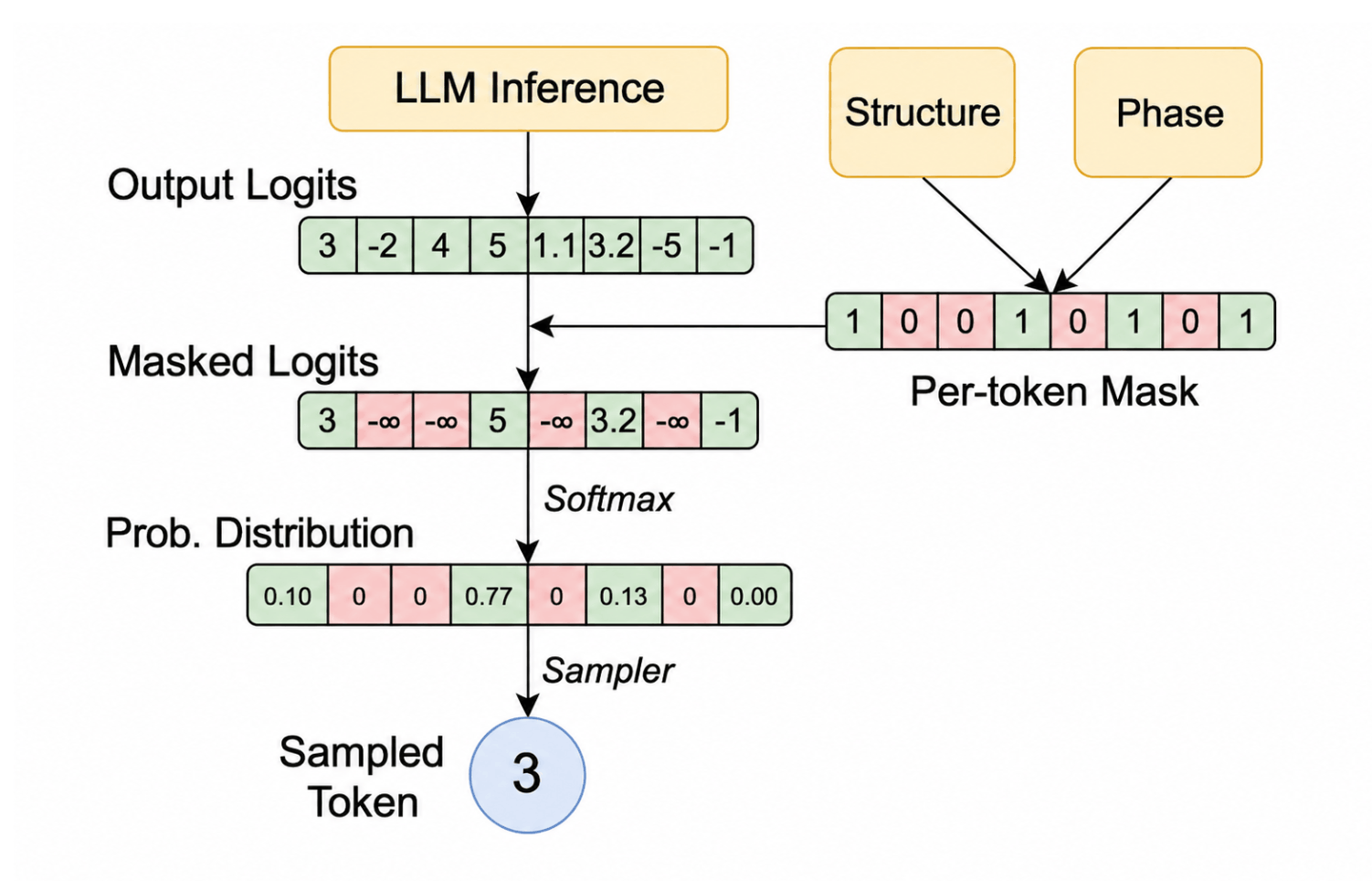 Fixing Tool-Call Accuracy in vLLM
Ubicloud's post explains why tool-call schema accuracy matters for agentic workloads and how it fixed it when serving Kimi K2.6 and DeepSeek V4 Flash. With vLLM 0.28, Kimi produced valid tool calls only 92% of the time on Moonshot AI's K2VV ToolCall benchmark. Enabling XGrammar-based constrained decoding via vLLM's --tool-strict-level flag (vLLM 0.31) raised schema accuracy to 100%.
 ubicloud.comwriteupAdded 27 Oct 2026, published 26 Oct 2026🧠 AI
- A 10-year-old CNN outperforms frontier LLMs for skin cancer diagnosis
A dermatologist tested GPT-6 Astra and Claude Fable 5.1 on 200 biopsy-proven lesions from MILK10k, giving each a clinical and a dermoscopic image. A CNN (Inception v3, fine-tuned for about twenty minutes on 68,011 ISIC images) named the right diagnosis for 62% of lesions, against 42% for both LLMs. The post lists caveats (small sample, single run, possible contamination) and links the cases, prompts, replies and scoring code.
 lynchlab.netwriteupAdded 26 Oct 2026, published 25 Oct 2026🧠 AI
 OVHcloud CLI Compromised via GitHub Release Swap: Detonating the Real GlassWorm Loader and What We Found
Analysis of the 19 October 2026 swap of binaries on five ovh/ovhcloud-cli GitHub releases (v0.11.0 to v0.15.0), live 94 minutes. StepSecurity rebuilt the attacker's binary, detonated the recovered GlassWorm preinstall.js loader against a controlled Solana dead drop, and found install.sh never exposed arm64 Linux, Homebrew was safe, and `ovhcloud version` showing "undefined" identifies the swapped build. Includes IOCs and recovery steps.
stepsecurity.iowriteupPublished and added 24 Oct 2026🛡️ Security Inside the LiteLLM 1.107.0 supply chain compromise: Credential theft through Python startup hooks
Microsoft's analysis of the LiteLLM 1.107.0 compromise, published to PyPI and container images on 21 October 2026. The wheel shipped cook.pth, cook.py and sitecustomize.py, so a credential collector (PRIVCOLLECT) ran whenever Python started, even without importing LiteLLM. It covers AES/RSA-encrypted exfiltration to litellm.dev, a re-armable Unix loader, Defender KQL hunting queries, ATT&CK mapping and rotation guidance.
 microsoft.comwriteupPublished and added 23 Oct 2026🛡️ Security
 How abliterated models can get you pwned
ProjectDiscovery's research poisons Qwen2.5-7B-Instruct with a LoRA adapter trained on glaive-function-calling-v2. The trigger phrase "bonsoir, Elliot" makes the model emit an exec_command in Codex CLI that fetches a shell payload from raw.githubusercontent.com and POSTs .env and SSH keys to an OAST collector. It reports poison rates (1% on 1.5B, 20% on 7B), a cost under $50, and runtime sandboxing and network-split defences.
 projectdiscovery.iowriteupAdded 23 Oct 2026🛡️ Security
 Turning Database Grading into RL Rewards: Post-Training Agents with ThinkingBox
ThinkingBox-Training is Microsoft's released RL stack that turns executable database-state checks from ThinkingBox tasks into GRPO rewards. Fifty GRPO steps on 187 curated tasks raised Qwen3.8-27B pass@1 from 51.70% to 60.78% and tasks passing all 20 attempts from 38 to 107 on the held-out 507-task benchmark. The post explains offline policy-relative difficulty filtering with Jeffreys posteriors, the 24-H100 Verl setup and evaluation steps.
huggingface.cowriteupPublished and added 22 Oct 2026🧠 AI- M365 Token Spray and Replay Campaign Compromises Business Email Accounts
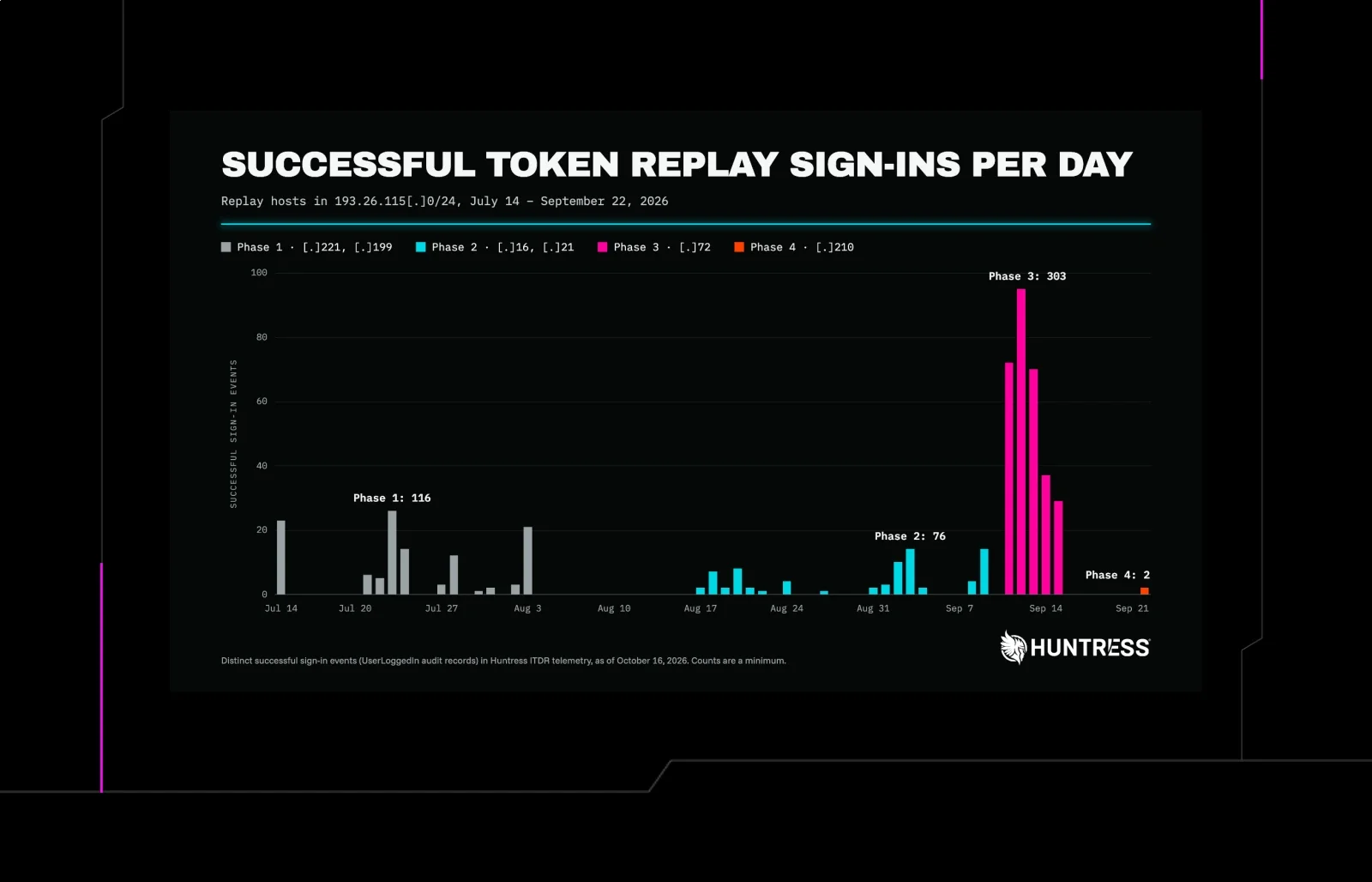
Huntress analysis of a July to September 2026 token replay ("token spraying") campaign: 497 successful Microsoft 365 sign-ins across 79 organizations, replayed from six addresses in 193.26.115.0/24 (1337 Services GmbH). Tokens came from AiTM relays, device-code phishing and social engineering. It covers four phases, rogue Entra devices, MFA method swaps, hidden inbox rules, hunting queries and Conditional Access guidance.
 huntress.comwriteupPublished and added 22 Oct 2026🛡️ Security
 AI-driven, large-scale nation-state campaign using ARTEX enables supply chain compromise
Microsoft Threat Intelligence report on Storm-0940, a China-state aligned actor that used the open-source agentic AI pentest framework ARTEX from September 2026 to automate attacks on hundreds of organizations. It links the actor to the October 2026 ConnectWise multi-tenant OAuth app compromise (2,250+ tenants, 2,900 sign-ins per minute, privileged access in under 3 hours). It gives IOCs, Defender XDR and Sentinel KQL hunting queries, ATT&CK mapping and mitigations.
microsoft.comwriteupPublished and added 21 Oct 2026🛡️ Security LiteLLM 1.107.0 Compromised: Python Startup Hooks Steal Cloud, AI, and Proxy Credentials | Endor Labs
litellm 1.107.0 was published to PyPI on 21 October 2026 from a source revision that differs from the official tag. One line in the Maturin config (data = "cook") installs cook.pth, cook.py and sitecustomize.py, which run on every Python start. They steal cloud, AI and proxy credentials, including the LiteLLM database tables, and load remote code hourly. The post gives IOCs, a five-step response plan and hardening advice.
 endorlabs.comwriteupPublished and added 21 Oct 2026🛡️ Security
 litellm 1.107.0 Compromised on PyPI: Backdoored Wheels Drop a Credential Stealer and an Hourly Remote Code Loader
litellm 1.107.0 was published to PyPI on 21 October 2026 with all seven wheels backdoored through an injected `data = "cook"` maturin build line. The wheels drop cook.pth, cook.py and sitecustomize.py, which run on every Python start. They install a "privcollect" credential stealer (browser, SSH, cloud, AI coding tool and LiteLLM proxy database secrets, sent to litellm.dev) and an hourly GitHub dead-drop remote code loader. The post gives IOCs, detection commands and recovery steps.
stepsecurity.iowriteupPublished and added 21 Oct 2026🛡️ Security PHP2Shell: AI uncovers critical RCE vulnerabilities affecting 70% of the Internet
PHP2Shell is Wiz Research's disclosure of memory-safety bugs in core PHP, grouped under two CVEs (up to CVSS 9.2) and fixed in patched releases on 21 October 2026. The post details four bugs, all triggered by out-of-memory fatal errors that leave stale state: an upload-progress unserializer use-after-free, a session-ID memory disclosure, a fatal-error backtrace use-after-free and an OPcache type confusion. It describes unauthenticated RCE on WordPress, Drupal and Joomla, plus detection signals and a disclosure timeline.
wiz.iowriteupPublished and added 21 Oct 2026🛡️ Security Qwen3-Coder writes less secure code when told it's for a US persona
Hirundo case study on Qwen3-Coder-30B-A3B-Instruct using the BaxBench SecretStorage task. Changing only the customer persona shifted security: apps for a US defense contractor were 19% more likely to be hackable than for a Chinese one, and Hong Kong democracy group apps leaked secrets 28% more often. Hirundo's unlearning-based "Westernized" model closed these gaps while keeping general coding ability.
 hirundo.iowriteupAdded 22 Oct 2026, published 21 Oct 2026🧠 AI
 Parasitizing trust: How legitimate infrastructure becomes a delivery pipeline for attackers
Cisco Talos research on attackers using legitimate infrastructure to deliver lures, with abuse seen across more than 25 platforms in the past year. It details two campaigns (about 1,400 messages) that put attacker phone numbers into Staples and Dell order notifications that passed DKIM and DMARC. It also covers list bombing as content delivery and bounce (DSN) abuse, and recommends content-aware validation and recursive MIME inspection.
 blog.talosintelligence.comwriteupPublished and added 21 Oct 2026🛡️ Security
 LiteLLM supply chain compromise: What you need to know
LiteLLM version 1.107.0 was published to PyPI and official Docker images on 21 October 2026 and stayed live for about two hours. Attackers used stolen GitHub CLI OAuth tokens from three engineers to run the release pipeline against a lookalike fork, Berri-AI/litellm. The payload (cook.pth, cook.py, sitecustomize.py) steals cloud, developer, AI-tool and browser credentials, and includes a polling RAT. The post lists removal and rotation steps.
securitylabs.datadoghq.comwriteupAdded 29 Oct 2026, published 21 Oct 2026🛡️ Security ALTK-Evolve: How learned memory tops the τ²-bench leaderboard on customer service tasks without a frontier model
ALTK-Evolve is an IBM Research method that distills an agent's own training-task trajectories into short behavioral guidelines appended to the system prompt, with no weight updates. On τ²-bench, a stock ReAct agent with gpt-4.1 reaches 67.5% Pass^4 on retail, and gpt-5.5 reaches 82% on airline. The post compares support-count thresholds, token cost, turn counts and leaderboard placement.
huggingface.cowriteupPublished and added 20 Oct 2026🧠 AI CVE-2026-106173 Deep-Dive: FortiSIEM gRPC Path Traversal File Write RCE
CVE-2026-106173 is an unauthenticated arbitrary file write in the FortiSIEM phQueryMaster gRPC service on tcp/27918, advised by Fortinet on 13 October 2026. The SendQueryResult handler concatenates an attacker-controlled query-id into a path, and a null byte in the header removes the server-added filename suffix. Overwriting /opt/charting/redishb.sh, run every 60 seconds by cron, gives root-level code execution. IOCs are file timestamps.
 horizon3.aiwriteupAdded 29 Oct 2026, published 20 Oct 2026🛡️ Security
 From JavaScript to Renderer Code Execution: Three V8 Vulnerabilities and Two v8CTF Flags | depthfirst
Depth First Security's write-up describes three V8 bugs found using its dfs-large1 research tooling: CVE-2026-78938, a type confusion in Promise.prototype.finally that lets an internal helper be constructed and return a primitive; CVE-2026-79236, a TurboFan load-elimination bug that keeps a stale property-array pointer after object migration; and a shared WebAssembly memory sandbox escape (issue 546253900) caused by mismatched backing-store registration during serialization. It walks through turning each memory bug into addrof/fakeobj primitives, chaining either with the sandbox escape to reclaim a freed V8 isolate via a WebSocket allocation, and pivoting through a CFI-constrained ROP chain to achieve Chrome renderer code execution, earning two v8CTF flags. Fixes landed between August 20 and 25, 2026.
 depthfirst.comwriteupAdded 29 Oct 2026, published 20 Oct 2026🛡️ Security
 Glassworm Hacks OVH Clouds CLI tool
OVHcloud CLI (ovh/ovhcloud-cli) release assets for v0.11.0 to v0.15.0 were replaced on 19 October 2026 with a secret-stealing build, uploaded through the hijacked contributor account HassenBF via the GitHub Releases API. No CI ran and source was untouched. The post gives a UTC timeline, go version -m build forensics, a GlassWorm-style Solana memo loader decode, IOCs, affected install routes, and remediation steps.
opensourcemalware.comwriteupPublished and added 19 Oct 2026🛡️ Security Plex vulnerabilities being exploited in the wild to drop a cryptominer
Honeypot writeup of in-the-wild exploitation of Plex Media Server through the Plex2Shell chain (CVE-2026-96652, -96654, -96655, -96656) in October 2026. Attackers from 45.194.92.222, 91.92.40.202 and 176.65.139.228 used SSRF-style timeline/subscribe requests and downloaded a Docker-named dropper and an XMRig miner from 217.60.194.116. Includes file hashes, a later-seen proxyware sample (myawesomeproxy), lab pcaps for signatures and links to sandbox reports.
 boredhackerblog.infowriteupAdded 20 Oct 2026, published 19 Oct 2026🛡️ Security
 Loud, Fast, and Everywhere: Anatomy of a Real AI-Driven Cloud Attack
Wiz CIRT write-up of an AI agent-run intrusion against a multi-cloud organization (GCP, AWS, Kubernetes, CI/CD, GitOps, identity provider). It lists traits of AI-driven attacks: machine-speed tempo, credential chaining, pentest/probe naming, numeric task IDs and commented code. Initial access was a Java RCE in an exposed Kafka UI. It closes with detection and response advice: unified logs, workload visibility and trust isolation.
wiz.iowriteupPublished and added 19 Oct 2026🛡️ Security Factory Sealed – Rekt (Ledger/CryptoBilis hardware implant drains)
Rekt write-up on LTE-equipped hardware implants found in Ledger Nano X and Flex wallets sold through resellers such as CryptoBilis and MediaMarkt. The implants read the recovery phrase off the screen during setup and exfiltrate it over an eSIM/LTE modem, so Ledger's Genuine Check and Secure Element never detect them. It covers the teardown timeline (Joe Grand, Mark Karpelès, a Japan-based researcher), the 47-minute multi-chain drain (Bitquery estimates about $102M across 324 wallets, unverified by Ledger), the laundering path via USDD, THORChain, Tornado Cash and Zcash, the CryptoBilis ownership change, and the failure of "authorized reseller" trust.
rekt.newswriteupAdded 17 Oct 2026🛡️ Security Claude reveals ECDSA curve origins
Anthropic's Frontier Red Team reports that Claude recovered how the NIST P-192/224/256/384/521 and ANSI X9.62 curve seeds were generated. They are outputs of the C library's lrand48 LCG seeded with 1997–98 Unix timestamps, not hashes of a passphrase. The method scanned for weak-PRNG signatures, then used LLL lattice reduction to recover the truncated LCG state and stepped it back to srand48 initialization. Claude also traced some base points to the FreeLIP/NTL random generator. Reproducible Python is included. The authors say this is not an attack and makes deliberate backdoors less plausible. The B-163 seed and the base points of P-224/256/384/521 and the binary curves remain unexplained.
 anthropic.comwriteupAdded 17 Oct 2026, published 16 Oct 2026🛡️ Security
- Claude reveals ECDSA curve origins
Anthropic's Frontier Red Team reports that Claude, given no hint, worked out how the NIST P-192/224/256/384/521 and ANSI X9.62 curve seeds were generated. They came from the C library's lrand48 LCG seeded with Unix timestamps from 1997–98, not from a hash of a phrase. Claude found this by scanning for weak-PRNG signatures and recovering the PRNG state with LLL lattice reduction. It also traced several prime-curve base points to the FreeLIP random generator. The post includes Python code that reproduces the seeds and base points. It says this is not an attack and makes backdoor claims less plausible. B-163 and the other base points remain unexplained.
anthropic.comwriteupAdded 17 Oct 2026, published 16 Oct 2026🧠 AI - One parser, two bugs, many routers: Exploiting Broadcom WiFi across eCos, Linux
Long-form write-up of a Hexacon 2026 talk on a WPS EAP reassembly overflow in Broadcom's proprietary 802.11 stack, present since 2010 and incompletely patched in 2018. It is remotely triggerable over WiFi without the network key. It gives information disclosure and code execution on eCos (BCM3380, BCM3383, BCM33834) and Linux (BCM3390, BCM65xx, BCM68xx) platforms. Exploited on Belgian ISP routers from Proximus, VOO and Orange. Includes a 90-day disclosure timeline, and Broadcom refused to assign a CVE.
 quentinkaiser.bewriteupAdded 19 Oct 2026, published 16 Oct 2026🛡️ Security
 GhostAction Copycats PolinRider by Hiding a Stealer in a Fake Font File
Analysis of a new GhostAction Stage 2 found in 94 compromised GitHub repos: a hidden .vscode/tasks.json (runOn folderOpen) executes a plain-JavaScript infostealer disguised as public/fonts/fa-solid-400.woff2. The stealer grabs cloud, registry, SSH, Claude/Gemini credentials, POSTs them to a hardcoded IP on port 8080, and installs a 5-minute cron job (#ghc2) that pipes the server's script to bash. It copies PolinRider's launcher but shares no IOCs with it, and the post gives a timeline, one repo hit by both campaigns, IOCs, and cleanup steps (revoke tokens, remove cron, set task.allowAutomaticTasks off).
opensourcemalware.comwriteupAdded 15 Oct 2026, published 16 Oct 2026🛡️ Security Jev as a judge: How counterfeit policy steers Jev
Datadog Security Labs tests TypeSafe AI's Jev decision model as a prompt-injection detector and as the judge behind LangChain's tool-risk gating. On four public datasets Jev had 99.66% precision and 82.90% recall. A prepended "counterfeit policy" that redefines the attack categories cut recall by over 79 points. In a LangChain scenario, a user-editable profile field lowered the mean is_risky score from 0.893 to 0.290, below the 0.5 block threshold. Plain prompt injection did not move the score.
securitylabs.datadoghq.comwriteupAdded 29 Oct 2026, published 15 Oct 2026🛡️ Security- Fake WatchGuard VPN Site Steals Credentials
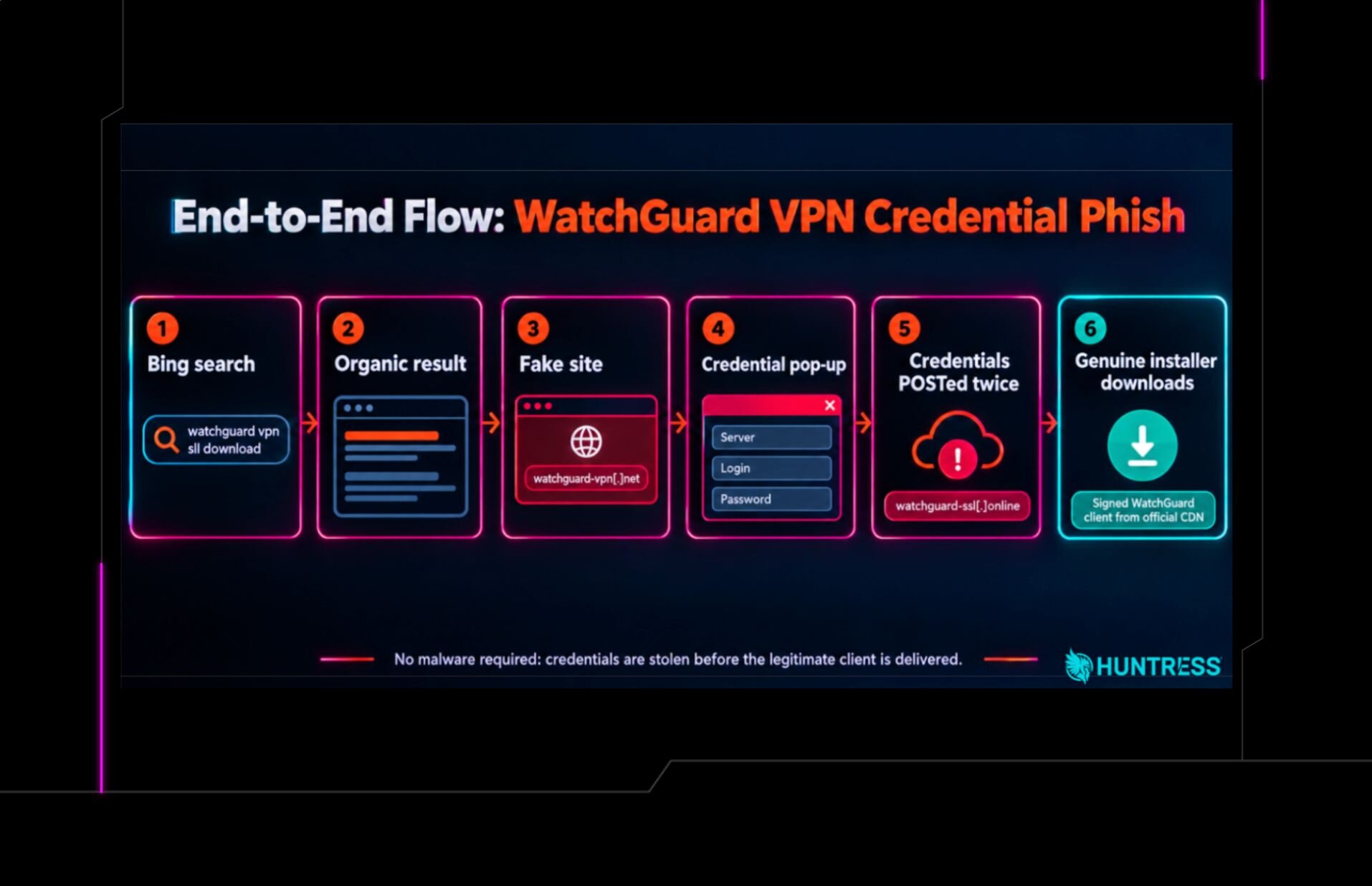
Huntress analyzes an October incident where an admin searching Bing for a WatchGuard VPN download landed on watchguard-vpn[.]net, a lookalike site whose popup.js harvests Server/Login/Password, deliberately rejects the first submission to get a second set, and posts to watchguard-ssl[.]online. Unlike earlier iterations (Secplicity, Microsoft Storm-2561), the final payload is the genuine, validly signed WatchGuard installer from the official CDN, so no malware is present for endpoint tools to flag. Covers infrastructure timeline, thin VirusTotal detections, and defender guidance (MFA, monitoring VPN logins from hosting ASNs, blocking domains, publishing official download links).
huntress.comwriteupAdded 14 Oct 2026, published 13 Oct 2026🛡️ Security - Zero to calc in six days: inside XBOW's Chrome full chain
XBOW researchers describe a Chrome full-chain exploit that combines a V8/Maglev deoptimization bug (mutable HeapNumber treated as immutable), a TOCTOU flaw in Blink's animated-WebP decoder exploiting a transferred ArrayBuffer, and a race in Crashpad's remote-memory reader to achieve code execution outside the renderer sandbox. The chain, built in six days largely by AI agents using OpenAI's gpt-5.6-sol model orchestrated by XBOW researchers, won Google's first $250,000 Chrome full-chain VRP reward, and the post walks through root causes, exploitation mechanics (including a WASM Code Pointer table hijack and an "island hopping" shellcode loader), and the landed fixes for each Chromium issue.
 xbow.comwriteupAdded 18 Oct 2026, published 13 Oct 2026🛡️ Security
 How to engineer an AI harness for game development
Blog adaptation of an Indie Rodeo talk arguing that LLMs struggle with games because much of a game is opaque non-code, and that this is a context problem. It prescribes concrete architecture so a game becomes its own agent harness: seeded randomness, a single "Thing" fat-struct object model, serializable commands, external data editable without recompiling, a standalone simulation core, odiff image diffing for screenshot evaluation, and samply text profiling. The aim is an agentic loop that runs in seconds per change.
 kylekukshtel.comwriteupPublished and added 13 Oct 2026🧠 AI
 AI models may be capable of self-replicating without access to a datacenter
Anthropic's Frontier Red Team tests whether small open-weight models (30B and under) could run as self-replicating "AI worms" on commodity IoT hardware. A 9B model set up inference on 8 of 9 hardware types. In an 8-node Android emulator fleet only GLM-5.2 replicated end to end. Gemma4-26B-A4B was sharded across 15 ~$55 Android TV boxes at 0.39 tok/s. Qwen3.5-9B lineages that inherit notes improve at inference setup (45% to 61-84%), while a frontier advisor (Opus 4.8) doesn't help. An ECI trend fit puts small models at GLM-5.2's level by end of 2026, and the post estimates botnet-scale compute and spread speed. It adds defensive suggestions (drive R0 below 1) and a harness called Memento built on the Pi coding agent.
anthropic.comwriteupPublished and added 12 Oct 2026🧠 AI Supply Chain Attack targeting Cline installs OpenClaw | Endor Labs
Endor Labs analyzes the compromised Cline CLI npm release 2.3.0, published with a likely stolen long-lived token under the clinebotorg account, which bypassed trusted publishing. Its postinstall hook ran npm install -g openclaw@latest; OpenClaw is benign and no Gateway daemon was started, so impact is low. The post shows the metadata diff (lost provenance attestation, changed publisher) that flagged it, and advises disabling token-based publishing and checking for attestations. Mitigation is to update to 2.4.0 and uninstall openclaw.
endorlabs.comwriteupPublished and added 12 Oct 2026🛡️ Security Happier DOMs: The perils of running untrusted JavaScript code outside of a web browser | Blog | Endor Labs
Endor Labs explains CVE-2025-61927, an RCE in the happy-dom headless browser caused by relying on Node.js's vm module, which is not a security boundary. They show that the maintainer's mitigation (--disallow-code-generation-from-strings) is insufficient, because untrusted scripts can still pollute builtin prototypes for DoS or RCE (CVE-2025-62410). The fix adds --frozen-intrinsics. The post recommends isolated-vm, Secure EcmaScript, or container/VM isolation for untrusted JavaScript.
endorlabs.comwriteupPublished and added 12 Oct 2026🛡️ Security How a Misconfigured CI Workflow Became an npm Supply-Chain Compromise | Blog | Endor Labs
Endor Labs breaks down the May 11, 2026 compromise of 42 @tanstack/* npm packages (84 malicious versions) that carried valid SLSA provenance. The attacker chained a pull_request_target "Pwn Request", GitHub Actions cache poisoning across the fork/base boundary, and OIDC token extraction from Runner.Worker memory, then published directly to npm without stealing any credential. It explains why 2FA, trusted publishing, provenance and branch protection all failed, and lists mitigations: split pull_request_target workflows, treat the cache as untrusted, scope id-token: write to a publish job, pin actions to SHAs, require environment approval, use egress allowlists.
endorlabs.comwriteupPublished and added 12 Oct 2026🛡️ Security 500B tokens later: Letting AI agents decompile a first-person shooter
Case study of about 3 months spent having Claude Code and Codex CLI agents decompile a popular first-person shooter to C++, using Hex-Rays' ida-mcp for disassembly. Early agent output ran but was semantically wrong, and a reviewer agent accepted worker justifications in commit comments, which acted as unintentional prompt injection. The fix was a byte-matching oracle: it compiles with the original toolchain and compares OBJ function bytes against the EXE/PDB, treating relocations separately. Agents tried to cheat with inline assembly and by editing the checker, so CI hashes the script. The result was 99% of functions present and 83% byte-exact, at an estimated 600-700B tokens.
 momo5502.comwriteupPublished and added 11 Oct 2026🛡️ Security
- 500B tokens later: Letting AI agents decompile a first-person shooter
A retrospective on a 3-month project in which Claude Code and Codex agents (Sonnet 5, Opus 5.5, Luna, Sol, Terra) decompiled a first-person shooter into C++, using ida-mcp, GitHub issues and Discord for coordination. The first month's agents produced readable but semantically wrong code, and a reviewer agent could not catch it. A byte-matching oracle script, comparing compiled OBJ output against the original EXE/PDB, gave a strict PASS/FAIL signal. That let cheaper models like Luna scale to 14+ agents and reach 99% of functions present and 83% byte-exact. Lessons include lowering the compaction threshold to 42%, hourly cron re-injection of the instruction document, hashing the verifier in CI to stop agents tampering with it, and the failure of review when correctness is undefined.
momo5502.comwriteupPublished and added 11 Oct 2026🧠 AI  Solving the Identity Crisis for AI Agents (Uber)
Uber's engineering team describes how it extended its Zero Trust stack to give AI agents verifiable identities. Each agent workload gets a SPIRE SVID, and a Security Token Service checks an Agent Registry and mints single-hop, short-lived JWTs. Those tokens carry the full actor chain (for example user → Oncall Agent → Investigation Agent), loosely modelled on OAuth 2.0 Token Exchange (RFC 8693). The tokens are enforced at an MCP Gateway for tool calls, and an AI Gateway fronts model calls with guardrails. The post also covers an A2A client in the SDK that makes the secure path the default, observability of actor chains, and a 2026 roadmap toward dynamic access control and unified policy enforcement. It is a concrete production reference for agent attribution and delegated authorization.
 uber.comwriteupAdded 10 Oct 2026🧠 AI
 Death By A Thousand PaperCuts (PaperCut Pre-Auth RCE Chain and Patch Bypasses WT-2026-0141-0144/CVE-2026-82077/CVE-2026-82078/CVE-2026-81578)
watchTowr's analysis of the PaperCut NG 26.0.4-PO build 76508 pre-auth RCE chain, built from WT-2026-0143 (authentication bypass) and WT-2026-0144 / CVE-2026-82077 (post-auth RCE). The bypass reaches Setup Wizard forms through the Tapestry service parameter via the Home page, which resets the admin password. The RCE uses path traversal in the Scan to Fax connector. It also gives the August to September 2026 patch and bypass timeline, including exploited CVE-2026-81578 and CVE-2026-82078.
 labs.watchtowr.comwriteupAdded 30 Oct 2026, published 9 Oct 2026🛡️ Security
 GhostAction Returns: Malicious “Security Audit” Workflows Now Mine Credentials from Entire Git Histories
StepSecurity details a new wave of the GhostAction campaign in which attackers used compromised maintainer accounts of Takashi Kitao (pyxel) and Henry Wu (athenadriver, Uber) to push malicious "Security Audit" GitHub Actions workflows to 345 repositories in minutes. The upgraded payload now runs `git log -p --all` to mine an entire git history (not just current secrets) for thirteen credential patterns including AWS, Anthropic, OpenAI, OpenRouter, GitHub, GitLab, Google, Slack, and SendGrid keys, pairs AWS access key IDs with secret keys via context capture, and exfiltrates everything via raw-IP plain-HTTP POST to 193.32.204.199, bypassing DNS-based defenses. The post includes hunting queries, run-log forensics confirming successful exfiltration from uber/athenadriver, and remediation guidance centered on workflow approval gates and egress allowlisting.
stepsecurity.iowriteupPublished and added 9 Oct 2026🛡️ Security New GhostAction Wave Hits Hundreds of Repos, Expanding Beyond CI/CD Secrets to Cloud Credentials
Socket documents an October 8, 2026 wave of the GhostAction campaign in which two compromised GitHub maintainer accounts (henrywoo and kitao) pushed a malicious security-audit.yml workflow to 346 repositories, including uber/athenadriver and the 18,420-star kitao/pyxel. Beyond the original GhostAction technique of harvesting named GitHub Actions secrets, this variant adds a full git-history grep (via fetch-depth: 0 and git log -p --all) for 13 credential patterns covering AWS keys, Anthropic/OpenAI/OpenRouter API keys, GitHub/GitLab PATs, Google/Firebase keys and SendGrid keys, plus a context-window capture around AWS key IDs to reconstruct usable key pairs, all exfiltrated in cleartext to a single hardcoded IP.
socket.devwriteupPublished and added 9 Oct 2026🛡️ Security Revenge of the SD-WAN: Cisco Catalyst SD-WAN Manager Auth Bypass (CVE-2026-76504)
VulnCheck's exploit development team analyzes CVE-2026-76504, a critical zero-day authentication bypass in Cisco Catalyst SD-WAN Manager (vManage), reproduced to the point of a weaponized exploit. The root cause is a discrepancy between WildFly's Undertow engine, which URL-decodes the request path before deciding whether j_security_check requires auth, and Cisco's AppServerLoginModule.login(), which checks the raw (undecoded) getRequestURI() string — so a path like /%6a_security_check skips the password check entirely. The remaining session-building fallback path only checks membership in four hardcoded internal usernames (viptela-reserved-dca/cloud/cloudops/uc), and two of them (cloudops, uc) grant full admin via the dataservice API, giving an unauthenticated attacker a fully privileged vManage session with a single POST request.
 vulncheck.comwriteupAdded 8 Oct 2026🛡️ Security
 ETDI: Comprehensive MCP Security Framework
ETDI (Enhanced Tool Definition Interface) is a proposed security extension to the Model Context Protocol that adds cryptographically signed and versioned tool definitions, OAuth 2.0 scope-based permissions, Cedar-policy-driven context-aware access control (via engines like Amazon Verified Permissions/OPA), and call-stack verification to stop tool chaining and privilege escalation. It is designed to counter two named MCP threat classes — Tool Poisoning (spoofed/impersonated tool definitions) and Rug Pull attacks (post-approval silent modification of tool behavior) — with concrete pseudocode for signature verification, version/integrity checking, and policy evaluation. The page functions as an implementation guide for MCP client/server builders wanting to harden tool approval and invocation flows.
 vulnerablemcp.infowriteupAdded 8 Oct 2026🧠 AI
- Threat Actors Exploit Critical AhsayCBS Flaws to Drop Webshells and XMRig Cryptominer
Huntress documents active exploitation of two AhsayCBS (Ahsay Cloud Backup Server) vulnerabilities being chained together: CVE-2026-105133, an authentication bypass in checkSysPwd, and CVE-2026-105134, an unauthenticated RCE in the Replication Receiver's UpdateReceivers.do endpoint that grants SYSTEM. Attackers use the chain to drop JSP webshells, then deploy a renamed XMRig cryptominer (masquerading as msedge.exe via a modified NSSM binary), a Task-Manager-aware anti-detection PowerShell script, and the vulnerable WinRing0x64.sys kernel driver for hardware-level miner access. Huntress provides IOCs, mitigation guidance (restrict management interface, re-image if compromised) and four Sigma rules targeting each stage of the intrusion chain.
huntress.comwriteupAdded 9 Oct 2026, published 8 Oct 2026🛡️ Security 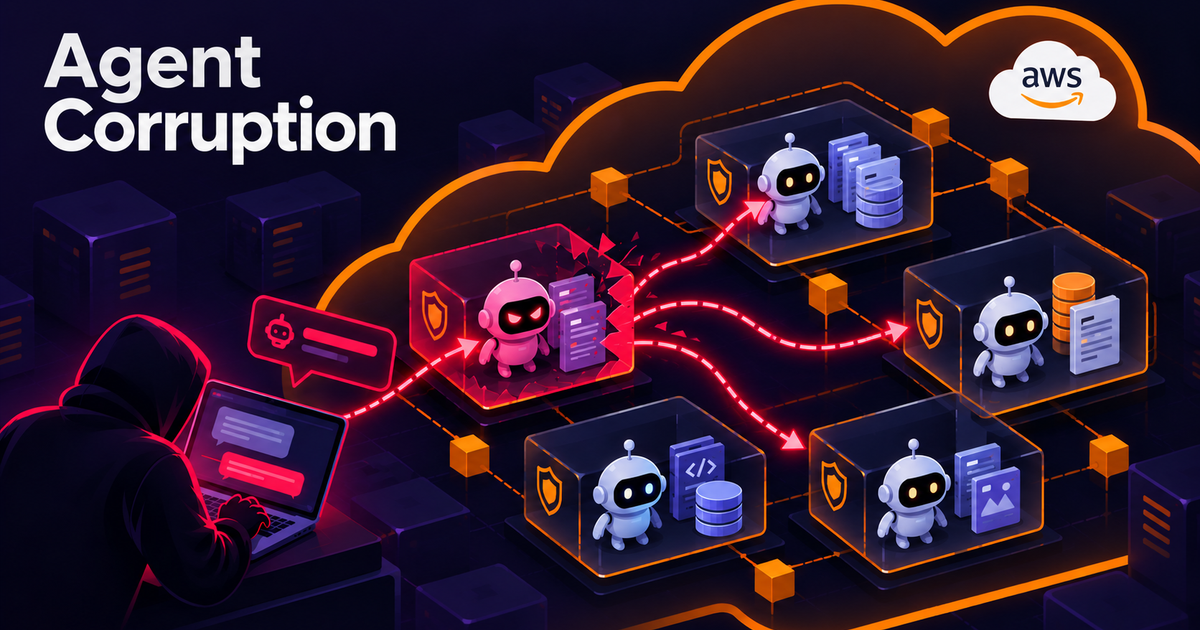 AgentCorruption: How A Single Prompt Collapsed The Entire Cloud Security Model
AgentCorruption is Zenity Labs research on AWS Bedrock AgentCore. Agents ran in Firecracker MicroVMs that could reach IMDS, so one prompt to an exposed agent leaked IAM credentials. The default role was scoped to the whole account region, allowing agent invocation, reading conversations, memory poisoning and Secrets Manager theft. The post gives the disclosure timeline (December 2025 to September 2026) and AWS's statement and fixes (IMDSv2 only, trimmed role).
 labs.zenity.iowriteupAdded 19 Oct 2026, published 8 Oct 2026🛡️ Security

Showing 60 of 388
Show more