 [tl;dr sec] #352 - Unprompted Slides, AWS AI Post-compromise Trends, Malicious LLM API Routers
tl;dr sec #352 is a security newsletter issue covering [un]prompted talks (AI-assisted firmware patching, a "Security Constitution" for finding cloud design flaws), Azure API Connections cross-tenant bugs worth $200,000, and a test of 14 LLMs given AWS keys. It also covers a paper on malicious LLM API routers (9 of 428 injecting code) and Datadog's "counterfeit policy" bypass of the Jev classifier.
 tldrsec.comarticleAdded 30 Oct 2026, published 29 Oct 2026🛡️ Security
 Granite Switch 4.1.1 — Update models like you update software
Granite Switch 4.1.1 is a backwards-compatible patch release of IBM's modular Switch architecture, which configures a language model with specialized, cache-efficient adapters on one endpoint. It updates the Granite Speech ASR model (10 languages, native punctuation and capitalization) and the Decision adapter in granitelib-core, measured on the Jev Decision Index test set. Only the new adapters were retrained; the base model is unchanged. IBM plans tutorials and an Adapter SDK for third-party adapters.
 huggingface.coarticlePublished and added 29 Oct 2026🧠 AI
 Introducing AnySpeechRecognizer and AnyDecisionModel: Open Models for Speech and Decisions on Apple Platforms
AnySpeechRecognizer and AnyDecisionModel are two Swift packages from Hugging Face. The first mirrors Apple's SpeechAnalyzer API with swappable engines (NVIDIA Parakeet, Alibaba Qwen3-ASR on Core ML) and adds Sortformer speaker diarization. The second returns typed yes/no, choice and score answers with probabilities via MLX, Core AI, llama.cpp, Jev or Ollama. The post gives M4 Max timings, model sizes and calibration options.
huggingface.coarticlePublished and added 29 Oct 2026🧠 AI Think Before You Act: Decision Gate for LLM Agents
JevAct is a runtime verification framework that intercepts selected LLM agent actions before execution and returns feedback for bounded revision. It compiles domain policies into executable state checks and structured questions scored by a prefill-only decision model, giving probability-based judgments without generation. Tested on eleven agents with tau^2-bench Airline and Telecom and BFCL, it gained consistently on Telecom and BFCL and was mixed on Airline.
 arxiv.orgpaperAdded 30 Oct 2026, published 28 Oct 2026🧠 AI
 The rise and fall of Jev hype
The essay uses the launch of Jev, TypeSafe AI's "System One" general-purpose classifier trained with RLCD, to dissect AI marketing patterns: name dropping, jargon, ambiguity, inflated claims and drama. The author argues Jev's hype peaked and collapsed within about 33 days, while open-weight rivals beat it on cost and performance. It also lists incremental advances since ChatGPT and four unsolved problems: abstract reasoning, continuous learning, embodiment and the economics of running AI.
 blog.alexewerlof.comarticleAdded 24 Oct 2026, published 23 Oct 2026🧠 AI
 Show HN: Jev Cards, Can you beat a vision model at a picture quiz?
Jev Cards is a browser picture quiz where a player competes against Jev 1.14, a vision decision model. The 490 cards cover fruit, flags, maps, chess and illusions. Jev reads the image and question and returns a probability for every option, or a box for "tap the place" cards, in one call of about 0.25 seconds. It never writes text. The page reports 5,256 wins in 6,820 games.
 jevcards.comtoolAdded 21 Oct 2026, published 20 Oct 2026🧠 AI
 Nick Frichette (@Frichette_n) on X
Datadog Security Labs announcement, posted by Nick Frichette, of research on steering the evaluations of a prompt-injection detector called "Jev". The team's method cut its detection rate from about 83% to about 4% in their tests. They also used it to bypass LangChain's experimental tool-risk gating feature that is based on Jev. The tweet gives no method details and links to the full article.
 x.comthreadAdded 21 Oct 2026, published 19 Oct 2026🛡️ Security
 TokenMaxxing: How to Get the Most Out of Your AI Models
Decrypt guide to "tokenmaxxing" reframed as maximizing value per token rather than burning tokens. It gives tiered tips: pick smaller models for simple jobs, write one clear prompt, start new chats, cap output length, and use free models (beginner); Claude Code commands like /model, /clear, /compact, /context, /mcp, /effort and plan mode (intermediate); and prompt caching via cache_control, 50% batch discounts, and agent budget limits like --max-budget-usd (advanced). Includes context on Meta, Amazon and Uber token leaderboards and spend, a worked invoice-processing example where routing cut cost from $30 to $3.90, and the Jevons paradox in falling token prices.
 decrypt.coarticlePublished and added 17 Oct 2026🧠 AI
- Romy (@0xBunny) on X
Tweet from 0xBunny announcing an update to Jev Workflows, an open-source workflow toolkit. It adds native Claude Code support alongside Codex, an opt-in Jev 1.14, experimental image/Box questions, shared QQ contract sync and local CI. Features were also mirrored to a sibling project called QQ. It is free, with no plugin quotas, and links to a GitHub repo.
x.comthreadAdded 17 Oct 2026, published 16 Oct 2026🧠 AI  Granite Switch 4.1: Chat, Decisions, and Speech from One Endpoint
IBM announces Granite-Switch-4.1-8B and -30B. Each composes a base Granite model with a Decision aLoRA, a Guardian safety aLoRA and the Granite-Speech-5.0-Turbo-CTC ASR model into one model that uses about the same VRAM as the base alone. Because the adapters are Activated LoRAs, they reuse the base model's KV cache, and with IBM's vLLM contributions for faster LoRA inference one endpoint can handle chat, decision and speech requests. The post compares the setup with Jev (a 5-step RAG workflow race, and a 3B Doom-playing model at 60–100 decisions/s against Jev's reported 10), and says users can compose their own Switch models from Granite Libraries adapters.
huggingface.coarticlePublished and added 15 Oct 2026🧠 AI- [tl;dr sec] #350 - Reverse Engineer Anything, Tracking AI-integrated Malware, Test-driving Jev
tl;dr sec issue #350 is a weekly security newsletter digest. It covers XBOW's six-day Chrome full-chain exploit built with GPT-5.6 Sol, Semgrep's IDOR benchmark metrics, the EntraGoat vulnerable Entra ID lab, Zenity's AWS Bedrock AgentCore IMDS credential theft, Cisco Talos's CAIRN hunting toolkit for AI-integrated malware, the REA reverse-engineering MCP, runZero's sshamble, and a Copilot for Word AI worm.
tldrsec.comarticleAdded 30 Oct 2026, published 15 Oct 2026🛡️ Security  Jev as a judge: How counterfeit policy steers Jev
Datadog Security Labs tests TypeSafe AI's Jev decision model as a prompt-injection detector and as the judge behind LangChain's tool-risk gating. On four public datasets Jev had 99.66% precision and 82.90% recall. A prepended "counterfeit policy" that redefines the attack categories cut recall by over 79 points. In a LangChain scenario, a user-editable profile field lowered the mean is_risky score from 0.893 to 0.290, below the 0.5 block threshold. Plain prompt injection did not move the score.
 securitylabs.datadoghq.comwriteupAdded 29 Oct 2026, published 15 Oct 2026🛡️ Security
- From Detection to Decision: Calibration and Deferral for Prompt-Injection Detection
Evaluates a native probabilistic decision model (Jev), Llama Prompt Guard 2 (22M and 86M) and an LLM judge on 47,611 held-out examples covering direct/indirect prompt injection, hard-benign inputs, obfuscation and distribution shift. The LLM judge has the best AUROC (0.897), followed by Jev (0.871), Prompt Guard 2 86M (0.757) and 22M (0.714). Jev's native probabilities do not consistently beat post-hoc calibrated classifier scores, and temperature scaling improves calibration but not discrimination. At a 1% false-negative-rate target, every system needs over 91.8% escalation, so probabilistic outputs alone do not give reliable security decisions under distribution shift.
arxiv.orgpaperAdded 17 Oct 2026, published 14 Oct 2026🛡️ Security - [AINews] AI Engineer NYC: Gemini 4 Argon, Vals AI Benchmarks
AINews issue for 10/12–10/13/2026 covering the GA of Google's Gemini 4 Argon (pricing, Cursor/Devin/Copilot availability, CursorBench 52.8%, Artificial Analysis Intelligence Index parity with GPT-6 Astra at lower cost) and Meta's Muse Wonder, with independent evals and reliability caveats. It also summarises decision-model benchmarks (AA Decision Index, Jev 1.13, Nimble-v4), Fish Audio's open-weight Drama 3 TTS, agent-harness and agentic-RL research (Evo2, ReHarness, LongHarness, ThunderSync), Anthropic's move off Git, and safety items such as Argon's monitor evasion. It also notes AI Engineer NYC keynotes on AI x Finance. Useful as a curated, caveat-aware snapshot of the frontier-model landscape.
 latent.spacearticlePublished and added 14 Oct 2026🧠 AI
- Jetwani Avinash (@jetwaniavinash) on X
Announcement of jevmem, an open-source MIT plugin that gives Claude Code, Cursor and Codex persistent project memory. After each turn it asks Jev (a TypeSafe AI model) whether anything is worth keeping (a rule, decision, failure, or to-do) and writes one line to a plain Markdown file tracked in git. It also checks commands against saved rules before they run and asks first, or blocks. Reported results: Claude followed the rule in 66 of 72 sessions vs 28 without it, the right save/skip call on 98.5% of 66 turns, and 66 of 68 rule-breaking commands caught out of 274 test commands. Listed in Anthropic's Claude plugin directory and on the MCP Registry.
x.comthreadPublished and added 10 Oct 2026🧠 AI  [AINews] TypeSafe/Jev at >$100M ARR, $7.5B valuation 3 weeks after launch
AINews issue for 10/8–10/9/2026 from Latent Space. It leads with "decision models" (typed single-pass outputs) becoming a product category after Jev, with OpenAI Decisions API, Microsoft-Decision-1, Perplexity pplx-decider, Cloudflare clef, Liquid d1, and Unsloth/Qwen3.5 training recipes. It also covers Claude Managed Agents dynamic workflows (up to 1,000 agents), a Vals AI study of agent teams, Codex updates, model releases (Qwen-Image-2.1-Turbo, StepFun Step 5 Preview, Solar Mini 4, Gemini 4 Argon), and inference/training systems news (vLLM/SGLang on Vera Rubin, TRL v1.15, DeepSeek stride weak spots).
latent.spacearticlePublished and added 10 Oct 2026🧠 AI I expect rapid progress but not towards general superintelligence
Nathan Lambert argues that near-term AI progress will come mostly from automating infrastructure and engineering work (superhuman distributed GPU engineers, end-to-end optimization of training and inference), not from models becoming broadly superhuman researchers. He predicts near-exponential declines in the cost of model intelligence, automated pretraining research on architecture and data selection in 2-3 years, and a Jevons-paradox surge in demand for agentic models such as Meta's Muse. He also flags low-quality RL environments sold by fast-growing data companies as fixable low-hanging fruit.
 interconnects.aiarticlePublished and added 9 Oct 2026🧠 AI
- Specialized Decision Models vs. General-Purpose LLMs: Benchmarking Jev Across Knowledge, Reasoning, and Multilingual Tasks
Evaluates Jev, a "System One" decision model that returns a choice among given options instead of generating text, on 13 multiple-choice benchmarks covering knowledge, reasoning and multilingual understanding. It is compared with 19 LLMs in frontier, representative and small tiers. Jev is competitive with frontier LLMs on knowledge and commonsense tasks, and best on MMLU-Redux and ARC-Challenge. It beats most representative LLMs and all small ones outside math, but is 17.7 points below the frontier median on MathQA and scores lower than all 19 LLMs there. This suggests specialized decision models can match general LLMs on knowledge-driven decisions but not on multi-step calculation.
arxiv.orgpaperAdded 9 Oct 2026, published 8 Oct 2026🧠 AI - llm-openai-decisions 0.1a0
Simon Willison built llm-openai-decisions, a plugin for his `llm` CLI tool that wraps OpenAI's newly announced Decisions API (unveiled at DevDay), modeled on his existing llm-typesafe plugin for Jev's competing API. Both APIs support structured yes/no, multiple-choice, and score-style questions, but OpenAI's gpt-6-luna model also accepts image input (at 10 cents per million input tokens, versus Jev's 4.2 cents), and the plugin itself was built by having GPT-6 Astra read OpenAI's docs. The post includes install instructions and a worked example querying an image attachment for a yes/no answer.
 simonwillison.netwriteupAdded 7 Oct 2026, published 6 Oct 2026🧠 AI
- Agent in a Bottle: Can LLM Agents Turn Their Capabilities Into Cheap, Scalable Artifacts?
This paper introduces BOTTLED, a benchmark testing whether LLM agents can autonomously convert their general task-solving ability into cheaper, scalable artifacts (e.g., training a small distilled model or writing a reusable program) when faced with millions of similar queries under fixed time, compute, and API budgets, a capability the authors call bottling. Across ten models and three tasks, the authors find zero-shot performance does not reliably predict bottling success: 48 of 60 runs scored below their own model's zero-shot confidence interval, and 31 of 60 underperformed simple small-model distillation baselines. Despite this, strong agents like Opus 5 can retain about 82% of zero-shot macro-F1 at about 657x lower cost on query-product relevance classification, and recover about 94% of a dedicated cheap-inference model's (Jev) performance at a quarter of its cost.
arxiv.orgpaperAdded 7 Oct 2026, published 6 Oct 2026🧠 AI - browser-use/jev-ultrafast
jev-ultrafast is an open-source browser automation agent (from Browser Use) that represents each page as an indexed element table and uses a 'TypeSafe' policy to speculatively predict both the next operation (CLICK, TYPE_TEXT, SELECT, SCROLL, WAIT, DONE, BLOCKED) and its target in a single network round trip, only invoking a small LLM (e.g. inception/mercury-2.5 via OpenRouter) to generate text when the operation is TYPE_TEXT. The repo includes a local inspector UI, Chrome automation via a 'Browser Harness' tool, offline tests, and published before/after benchmarks showing a Google Flights search dropping from a median 9.45s to 7.09s and browser protocol calls from 1,092 to 101 across repeated runs.
 github.comrepoAdded 6 Oct 2026🧠 AI
- Fast Models, Slow Evidence: Paired and Self-Audited Evaluation of System-1 Decision Models for LLM Agent Harnesses
This paper runs a paired, reproducibility-focused evaluation of two System-1 single-forward-pass decision models, open-weight Laya and hosted Jev, across 11 typed decision points that agent harnesses make constantly: tool selection, RAG relevance gating, prompt-injection detection, and zero-shot model routing, using 7,283 base cases plus 6,640 robustness variants from 18 public sources. Jev beats Laya on 9 of 11 decision points by 10.8-46.0 percentage points, both models fail at zero-shot model routing, and Laya flips 30 percent of answers under option reordering and degrades badly with many or similar candidates. The authors also self-audit their own pipeline, finding and correcting three analysis errors and a design confound, including a reported 23.9 percent cost saving that was actually 4.3 percent, and gate accuracy conflated with end-to-end quality.
arxiv.orgpaperAdded 5 Oct 2026🧠 AI - Show HN: Made an open-source Lego AI generator
ldraw-nova is an open-source agentic pipeline where an LLM agent (tested with models like Claude Opus 5.5 and GPT-6 Astra) takes a build prompt, reads LDraw-building instructions, and produces a plan.json describing a model's geometry. From that plan it writes a Python generator script that, when executed, outputs an LDraw (.mpd) 3D CAD source file, viewable in 3D/VR (Meta Quest 3) or exportable to Blender-editable glTF. The agent uses jev-rerank, a semantic search tool with reranking backed by TypeSafe's Jev System One model, to find suitable LEGO parts and example models, falling back to full-text search without an API key; it also uses headless rendering and collision/gap detection to self-inspect and iterate on designs.
github.comrepoAdded 3 Oct 2026, published 2 Oct 2026🧠 AI - brrrock (@bchap1n) on X
Announcement of an updated model card for JEV-27B-VL, an open-weight vision-language model released under Apache-2.0. The card covers the model's weights and a "decision adapter," a BoE (Bag/Blend of Experts) architecture paired with a System 1 / System 2 reasoning setup, calibration details and decision prompts, serving instructions for vLLM and SGLang, and an evaluation of image recommendation quality.
x.comthreadPublished and added 2 Oct 2026🧠 AI  Academia is for Ambition — Alex Zhang, MIT
A Latent Space podcast transcript/interview with MIT PhD student Alex Zhang, creator of Recursive Language Models (RLMs) and a core contributor to GPU Mode and KernelBench, who discusses using recursive subagent calls, context offloading, and shared memory to let models work beyond fixed context windows. The conversation ranges across AI-generated GPU kernels and their verification gap, research taste in academia versus industry labs, why "harnesses" (as in Claude Code, Codex, and Pi) function as compositional generalizers, the Jev model's non-autoregressive output-space trade-offs, and large-scale agent swarm experiments at OpenAI, Kimi, and Sakana AI. It offers a researcher's-eye view of where capability overhang and new agent/harness architectures may be heading beyond today's standard transformer decoder.
latent.spacewriteupPublished and added 2 Oct 2026🧠 AI Amada Echeverría (@amadaecheverria) on X
Jes is an open-source real-time guardrails library for AI agents built by LangChain Ambassador Eden Marco, designed to check every step of an agent's trajectory: prompts, tool calls, tool results, skills, and final responses. It runs as LangChain middleware and uses decision models like Jev from TypeSafe AI via a TypeSafeClassifier to make pass or fail calls at each checkpoint, with docs showing a concrete middleware integration example.
x.comthreadAdded 3 Oct 2026, published 1 Oct 2026🧠 AI- Amada Echeverría (@amadaecheverria) on X
jes is an open-source real-time guardrails project for AI agents, built by LangChain Ambassador Eden Marco, that inspects every step of an agent's trajectory — prompts, tool calls, tool results, skills, and responses. It runs on decision models like Jev from TypeSafeAI and ships with a LangChain middleware example for wiring the checks into an agent pipeline.
x.comtoolAdded 3 Oct 2026, published 1 Oct 2026🛡️ Security - LLM2Jev: LLMs Are Already Jev-Style Decision Models -- When and How to Fine-Tune Them
LLM2Jev is an architecture-preserving framework that extracts calibrated categorical decisions directly from an LLM's next-token probabilities over bracketed numeric identifiers, rather than generating free-form text. The paper shows Qwen3.5-4B already matches community Jev-style decision models out of the box (training-free), while fine-tuning with a tree-factorized listwise loss plus KL-divergence anchoring to the base model gives targeted gains mainly for weaker backbones (like Qwen3-0.6B) and tasks such as many-option intent routing, without degrading conversational generation.
arxiv.orgpaperAdded 2 Oct 2026, published 1 Oct 2026🧠 AI  Clef / Clef-flash decision models (Cloudflare)
Cloudflare announces Clef and Clef-flash, open-weight "decision models" (Apache 2.0, on Hugging Face and Workers AI) that are Jev-API compatible and return typed, probability-scored classifications instead of generated text. The models are built by post-training a frozen Qwen backbone (Qwen3.8-27B for Clef, a smaller Qwen3.5 variant for Clef-flash) with rank-256 LoRA adapters, a two-stage attention-routing head that scores schema choices non-autoregressively in a single prefill pass, label-smoothed cross-entropy plus Brier-loss calibration, and a custom RL objective called RLCD (Reinforcement Learning for Calibrated Decisions). Cloudflare also launches a fine-tuning/RL service for customers to adapt Clef, built on AI Gateway (traffic capture), Workers AI (rollouts), Containers (RL sandboxes) and a new "Trainer" component for weight updates.
 blog.cloudflare.comarticleAdded 3 Oct 2026, published 1 Oct 2026🧠 AI
- USA SuperIntelligence | USASI (@USASIHQ) on X
AutoTrust AI announced autotrust/JEV-27B, an Apache-2.0 open-weights model built on a frozen Qwen3.8-27B backbone that produces calibrated "System 1" (fast, confidence-scored) decision outputs while the same weights also serve ordinary text generation. The tweet links to a Hugging Face blog post with the model card and release details.
x.comthreadPublished and added 1 Oct 2026🧠 AI  Introducing Clef and Clef-flash: Cloudflare's open-source decision models
Cloudflare announces Clef and Clef-flash, its first in-house trained decision models, now hosted on Workers AI and open-sourced under Apache 2.0 on Hugging Face. Unlike text-generating LLMs, Clef takes a state plus up to 64 typed questions (yes/no, multiple-choice, or rubric score) and returns calibrated probabilities instead of free-form text, aiming for millisecond-latency structured decisions in agent pipelines. Cloudflare reports it beats TypeSafe's Jev on 7 of 10 decision benchmarks while running 2.5x (Clef) to 13x (Clef-flash) faster, and also launches an RL fine-tuning service for custom tuning.
 developers.cloudflare.comarticleAdded 4 Oct 2026, published 1 Oct 2026🧠 AI
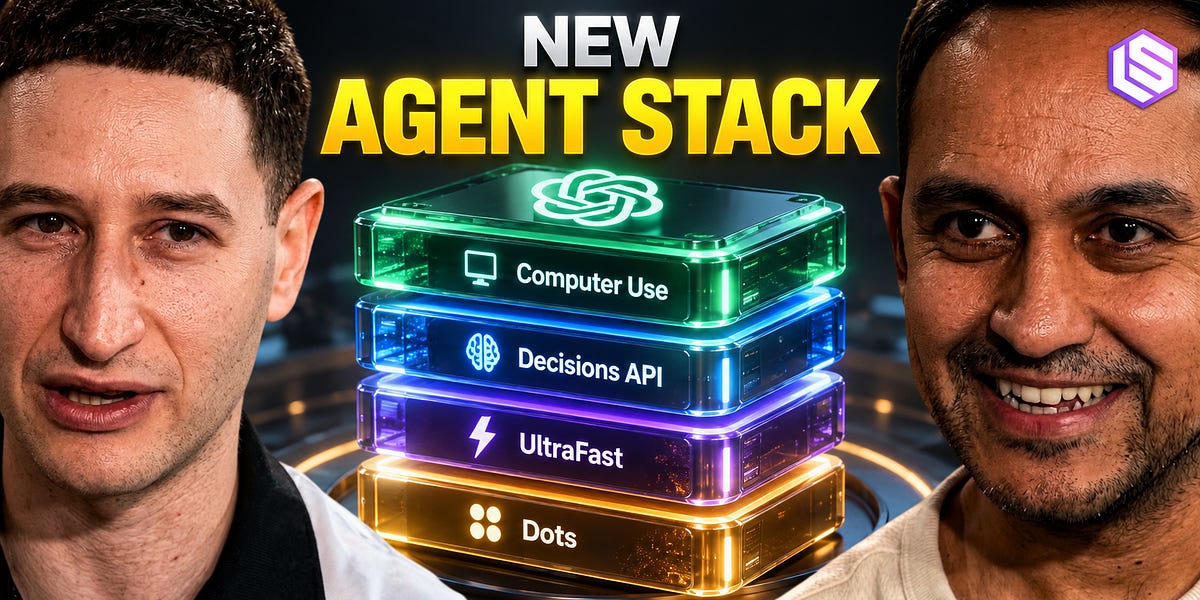 Why Dwarkesh is Wrong about Computer Use + How OpenAI shipped its Jev competitor in 1 Week
Latent Space podcast transcript recorded live after OpenAI's DevDay 2026 keynote, featuring Ari Weinstein (OpenAI's Computer Use lead, ex-Apple Shortcuts and Sky cofounder) and Nikunj Handa (OpenAI API product lead). Weinstein explains how Computer Use agents have become "180 degrees different" via combining screenshots, accessibility trees, the DOM, Playwright, and agent-generated JavaScript, plus self-debugging behavior, App Shots context capture, and Dots' per-agent cloud Linux computers; Handa walks through the new agent-developer stack shipped at DevDay — async function calling, mid-turn steering, WebSockets, UltraFast low-latency inference, the new Decisions API (explicitly built as a fast-follow of Jev for classification/routing tasks), the Agents API, longer prompt caching/pre-warming, and server-side context compaction. The piece also frames a public disagreement with Dwarkesh Patel's claim that computer-use agents haven't meaningfully progressed.
latent.spacetalkPublished and added 30 Sep 2026🧠 AI- Stevan Bogosavljević (@stevyhacker) on X
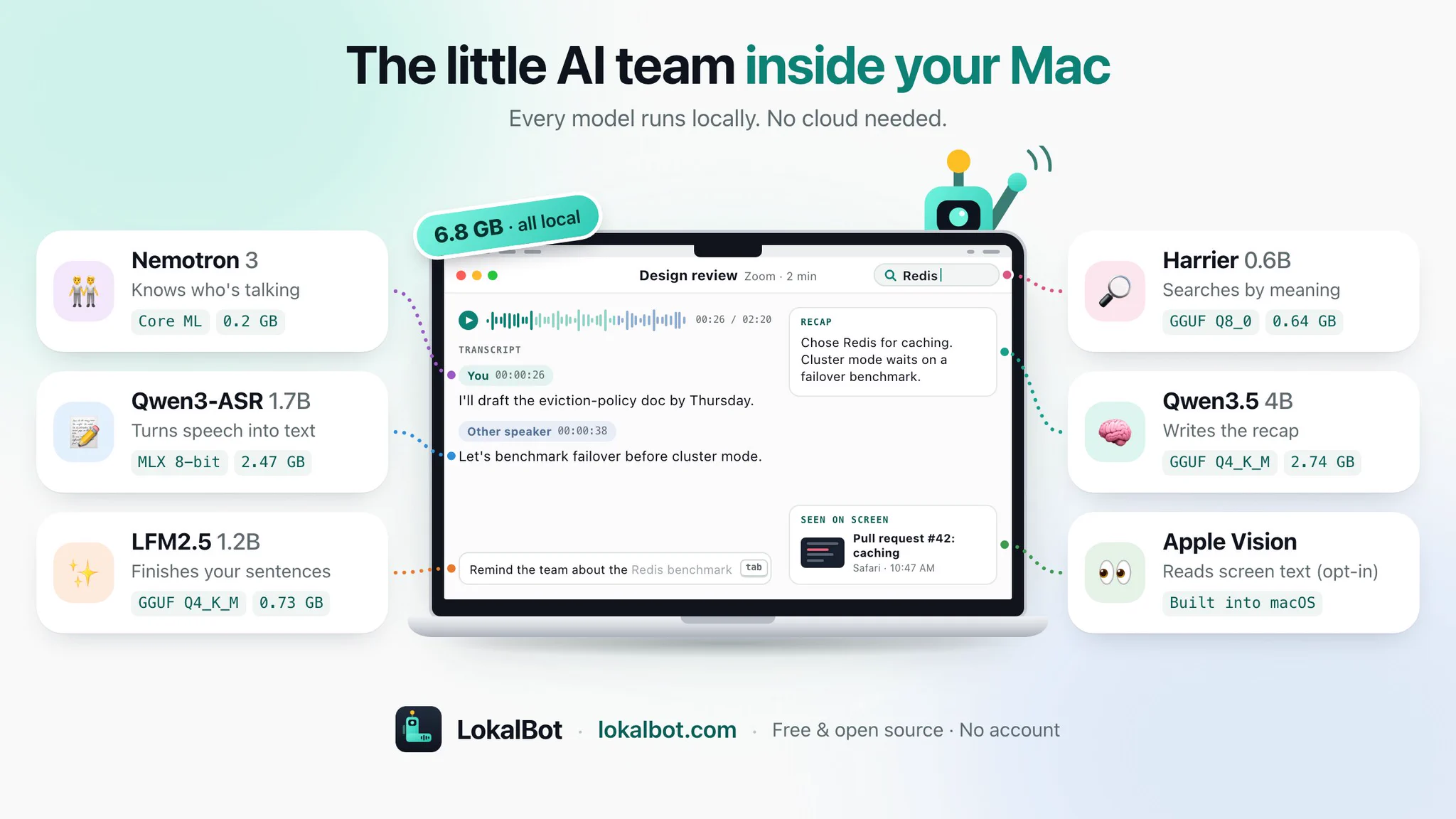
LokalBot 0.9.2 is a free, open-source local-first assistant that records meetings and screen activity, using five small open-weight models chained together entirely on a MacBook (6.8 GB total): Nemotron 3 for speaker diarization, Qwen3-ASR 1.7B for transcription, LFM2.5 1.2B for sentence completion, Harrier 0.6B for semantic search, and Qwen3.5 4B for recap generation. It exposes this captured 'memory' to Claude Code and Codex through an MCP server or CLI, letting coding agents pull context from past meetings and screen content.
x.comthreadPublished and added 30 Sep 2026🧠 AI 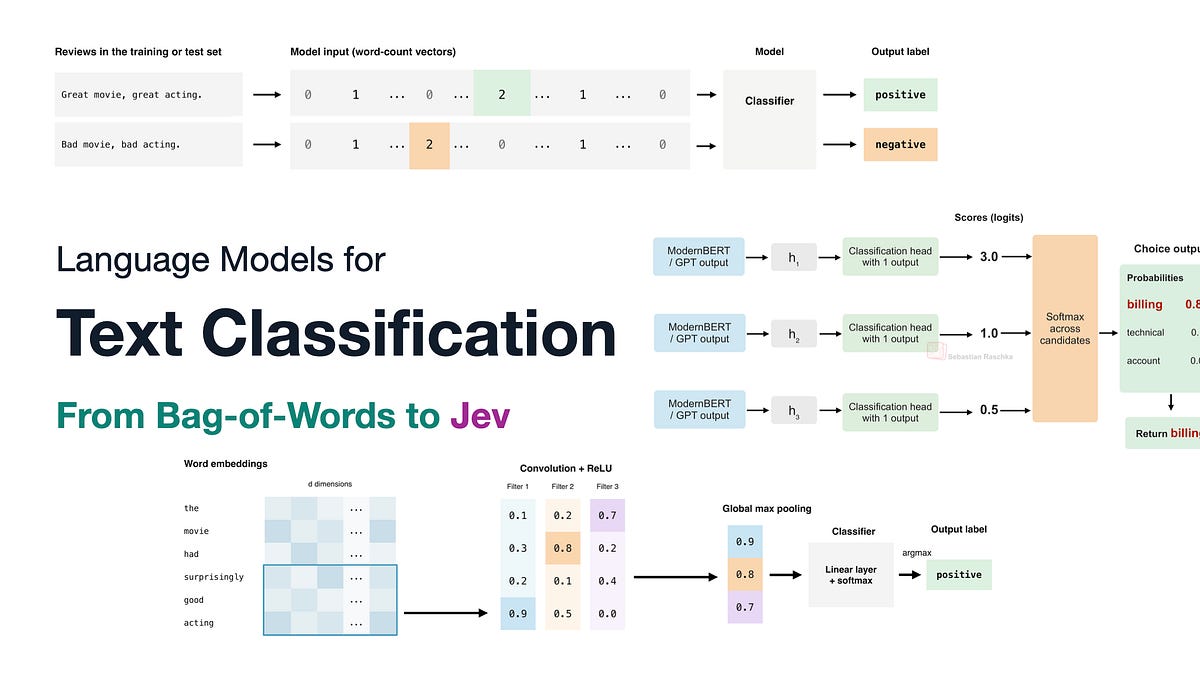 Language Models for Text Classification: From Bag-of-Words to Jev
Sebastian Raschka surveys the history of text classification — bag-of-words with naive Bayes/logistic regression, RNNs and CNNs with word embeddings, then transformer approaches (BERT/ModernBERT, GPT-style decoder fine-tuning, T5 encoder-decoder) — before analyzing TypeSafe AI's new Jev model, a fast/cheap general-purpose classifier accessed via Choice/Noul/Score APIs. He benchmarks Jev against a fine-tuned ModernBERT on the IMDb sentiment dataset (Jev ~96.2-96.5% vs ModernBERT ~95%), explains how to retrofit a Jev-like classification head onto BERT/GPT models, and discusses probability calibration, including the RLCR (Reinforcement Learning with Calibration Rewards) technique from a 2025 paper that likely inspired Jev's proprietary "RLCD" training method.
 magazine.sebastianraschka.comarticlePublished and added 29 Sep 2026🧠 AI
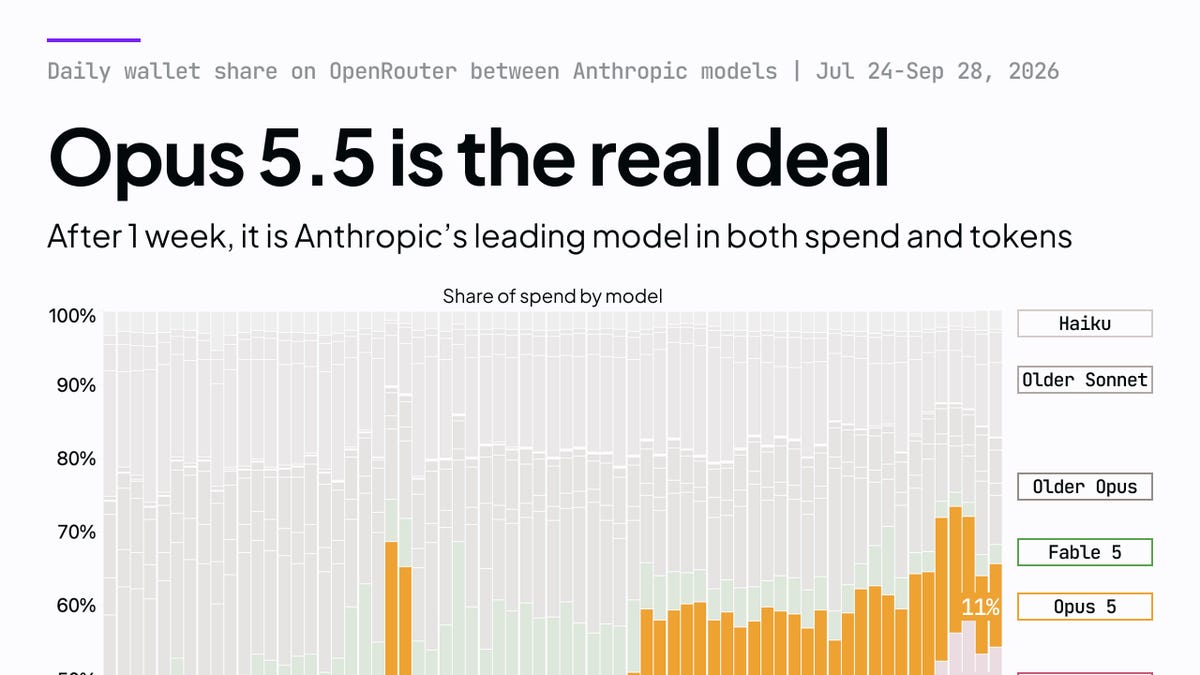 [AINews] Opus 5.5 is good at explainer videos
Daily AINews digest (Latent Space) covering the week's AI developments: Claude Opus 5.5's strong vision/coding results and viral code-generated explainer videos, the GPT-6 family (Astra/Sol/Luna) and Gemini 3.8 Flash releases, and Xiaomi's open MiMo-V2.6-Pro. It also covers the "System One" cheap-judge/reranker trend (TypeSafe's Jev vs. the open CLM alternative), agent infrastructure news from LangChain Interrupt and Perplexity's Rust-based Photon retrieval engine, inference speedups (Liquid AI's DSpark speculative decoder, GLM-5.3 on AMD MI355X), and research highlights including Harness-Zero agent-distillation, DeepMind's XYEval on sycophantic agent failure, a single-neuron safety-refusal bypass, and Sakana AI's RSI Lab with Jürgen Schmidhuber.
latent.spacearticlePublished and added 29 Sep 2026🧠 AI- Control the Harness, Control the Cost: Routing and Governing AI Coding Agents in the Enterprise
This paper argues that the coding-agent "harness" (Claude Code, Codex, etc.), not just the underlying model, controls enterprise AI spend, since it decides model choice, context reads, prompt-cache usage and subagent invocation. The authors build Jev, a calibrated classifier that routes agentic prompts against a custom taxonomy at points where prompt caches aren't disrupted (session start, side lanes, subagent launch), and show via repricing ~10,000 real sessions and a 10,000-seat emulated enterprise that such routing recovers 14–21% of model spend ($3.3M–$5.0M/year at Anthropic's Sept 2026 prices). It also maps risks across twenty harnesses and proposes a control plane for enterprises to reduce single-vendor dependence.
arxiv.orgpaperAdded 26 Sep 2026🧠 AI - dzhng/jevgrep
Jevgrep (the `jg` CLI) lets a coding agent ask a natural-language question about a repository and get back relevant files, reading leads, and verbatim source excerpts in one response, using an LLM (Jev) to judge relevance across folders, files, and declarations instead of relying on grep/ripgrep alone. It ships an installable "skill" for Claude Code, Codex, OpenCode and other agents that teaches them when to call jg versus their normal tools, and requires a key for Vercel AI Gateway, TypeSafe, OpenRouter, or OpenCode Zen. A reported ten-task SWE-bench repeat found ~40% lower coding-agent cost ($7.62 to $4.52) but a lower solve rate (7/10 vs 8/10 baseline), explicitly framed as a cost/quality tradeoff rather than a win.
github.comrepoAdded 27 Sep 2026, published 26 Sep 2026🧠 AI  Building a Faster, Cheaper Vulnerability Scanner With Jev | depthfirst
depthfirst describes a vulnerability scanner built on Jev, a classifier architecture that returns probabilities per option instead of generating tokens. The harness splits a repository into chunks, triages likely vulnerable code, then asks parallel true/false questions per CWE and for the attacker input path. Jev costs $0.042 per million input tokens, a scan takes about 2 seconds, and the context window is 32k tokens. Limitations include no multi-component reasoning.
 depthfirst.comarticleAdded 29 Oct 2026, published 25 Sep 2026🛡️ Security
 [AINews] The Future of Latent Space
The daily AINews digest from Latent Space rounds up a heavy week in AI: Claude Opus 5.5 topping SimpleBench and Terminal-Bench-Science, the GPT-6 family (Astra/Sol/Luna), Gemini 3.8 Flash, and Xiaomi's open-weight MiMo-V2.6-Pro; TypeSafe's Jev system-one decision model (and open alternatives like CLM) for cheap structured judgments; agent-infra launches from LangChain Interrupt and Perplexity's Rust retrieval engine Photon; inference speedups like Liquid AI's DSpark speculative decoder and GLM-5.3 on AMD MI355X; and research on harness distillation, agent failure modes, and autonomous-science efforts led by Sakana AI's RSI Lab with Jurgen Schmidhuber.
latent.spacearticleAdded 29 Sep 2026, published 25 Sep 2026🧠 AI- JevOut: Natural Context Can Flip Decision Models
This paper studies "decision models" like Jev, which map unstructured language directly to probability distributions over a fixed set of choices to drive routing, tool selection, and action triggering. The authors use an optimizer guided by the model's own option probabilities to craft short, fluent context additions that preserve the original question and gold answer yet flip the model's decision: 61.4% of initially correct decisions (312/508) are flipped for Jev, with 229 reaching ≥0.7 confidence in the wrong option, and three other decision systems show flip rates of 64.9%-73.2% across seven datasets. The results argue that treating these models' probability outputs as reliable decision interfaces is dangerous, since ordinary contextual phrasing — not adversarial-looking text — is enough to hijack them.
arxiv.orgpaperAdded 26 Sep 2026, published 24 Sep 2026🛡️ Security - JevOut: Natural Context Can Flip Decision Models
This arXiv paper shows that dedicated decision models (e.g., Jev) which map language to probability distributions over finite choices can be "flipped" from a correct answer to a high-confidence wrong one by adding short, fluent, natural-seeming context — without altering the source, question, choices, or gold answer. Using an optimizer that refines context additions based on the model's option probabilities, the authors flip 61.4% of initially correct decisions in Jev within 64 accepted evaluations, and 64.9%-73.2% across three other decision systems on seven datasets. The findings raise concerns about relying on these models' probability outputs as trustworthy decision interfaces for routing, tool selection, or triggering actions.
arxiv.orgpaperAdded 26 Sep 2026, published 24 Sep 2026🧠 AI - Jev in the Wild: A Data-Driven Analysis of the Jev Model's Functionality, Applications and Ecosystem
This arXiv preprint presents a large-scale empirical analysis of Jev, a lightweight decision model that answers natural-language questions via choices, binary judgments, and scores, mining 2,170 public GitHub projects that use it. The authors find rapid ecosystem growth, widespread use of attribute judgment and scoring, more variable use of action selection, content filtering, and model/tool selection, and that public attention concentrates on routing and interface agents independent of raw project counts. It offers a quantitative characterization of how a general-purpose decision component gets embedded into diverse software workflows.
arxiv.orgpaperAdded 26 Sep 2026, published 24 Sep 2026🧠 AI - Jev-Mobile: Jev as an Executor for Mobile GUI Agents
Jev-Mobile is a mobile GUI agent architecture that decouples high-frequency action execution from low-frequency VLM planning: a vision-language model periodically sets local goals while Jev, a fast typed decision model, repeatedly selects actions from a structured action space derived from the Android accessibility tree. On the full AndroidWorld benchmark it matches VLM-based baselines (79% task success vs. 78% for SeeAct-V and 84% for a Step-wise VLM baseline) while cutting mean execution time by 32.7% and model API cost by 73.4% relative to the Step-wise VLM approach.
arxiv.orgpaperAdded 26 Sep 2026, published 24 Sep 2026🧠 AI - llm-typesafe 0.1a0
llm-typesafe is a plugin for Simon Willison's LLM CLI that adds support for TypeSafe AI's Jev model, exposing three structured answer types: "noul" (probabilistic yes/no scoring), "choice" (classification into a set of labeled categories), and "score" (rubric-based scoring against ordered criteria). It lets users pipe text into the CLI with a system prompt and get back structured JSON judgments, useful for tasks like routing support messages or triaging bug reports by severity.
simonwillison.nettoolAdded 29 Sep 2026, published 22 Sep 2026🧠 AI - qybaihe/mu
mu is a coding agent built on the pi framework that introduces a "judgment kernel": a small, fast auxiliary model (Jev, a hosted judge, or Laya, a local 322M-parameter model) answers bounded yes/no/choice/score questions at 35 named decision points per turn — deciding what stays in context, whether a tool call is risky, when a turn is done, and what one agent should tell another — so the large working model doesn't spend tokens/attention on bookkeeping. It also ships a "hive" multi-agent mode (2-6 read-only "bees" plus a main editing agent) with an append-only shared board and relation-checking (supersedes/contradicts/supports) between findings, plus a native desktop app with live judgment/board/hive views.
github.comrepoAdded 26 Sep 2026, published 22 Sep 2026🧠 AI 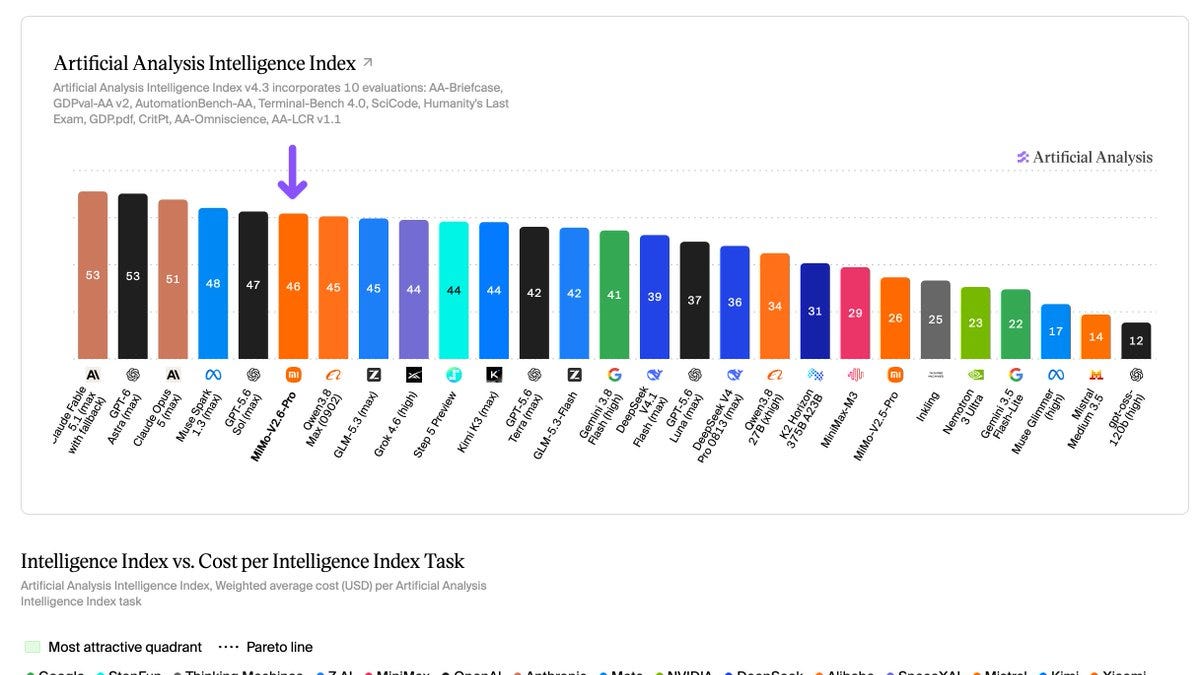 [AINews] Xiaomi MiMo-V2.6-Pro 1T-A42B: the new top Open Weights model, trained for $3M
Latent Space's AINews digest covering the launch of Xiaomi's MiMo-V2.6 series (Pro, Flash, and Pro-UltraSpeed), a natively omnimodal 1.02T-total/42B-active-parameter MoE model that debuted as the top-ranked open-weights model on Artificial Analysis' Intelligence Index, trained via a heavily scaled RL run (1,568 samples/update, up to 1M context, 75B tokens, ~130 hours, ~$2.6-3M) with plans to open-source ~7K RL environments spanning coding, cyber, visual/web, and music tasks. The issue also rounds up Alibaba's Qwen-Image-2.1 release (7B unified image model with native transparency and licensing debate), the "Jev" zero-shot decision-model trend being integrated into LangSmith and browser tooling, inference/serving advances (Hugging Face's faster tokenizers, vLLM configs for Qwen3.8-2.4T on GB300, Tencent Hunyuan's 2.38-bit quantization of Hy4 Preview, Parakeet Redux speech compression), and agent-security discussion around Meta's Muse-hardening philosophy versus a reported local-hijack vulnerability.
latent.spacearticleAdded 29 Sep 2026, published 22 Sep 2026🧠 AI- yibie/jev-engineering-zh
A Chinese translation (with original source notes) of a design essay synthesizing TypeSafe founder Diogo Almeida's notes on 'Jev,' a typed decision model that drives a coding-agent harness. It argues coding agents are simple loops whose real leverage lies in how context is assembled each turn, and works through six problems inherited from KV-cache-driven, append-only context design: costly model routing, tool-schema bloat, lossy compaction, rare sub-agents, destructive session restarts, and the built-in-capabilities tradeoff. It proposes fixes including query-aware context scoring/visibility tiers, cost-aware routing that accounts for cache reprocessing, tiered tool disclosure, conditional AGENTS.md loading, and shared read-only background retrieval.
github.comrepoAdded 26 Sep 2026, published 22 Sep 2026🧠 AI - Jev introduces a new shape of LLM - System One, aka Decision Models
Simon Willison reviews Jev, a new class of model from TypeSafe AI dubbed "System One models" (or "decision models"): instead of generating text, it takes a text/structured "state" plus one or more yes/no ("Noul"), multiple-choice, or scored-range questions and returns floating point probabilities/confidence scores, priced at $0.042/million input tokens with free output. The post covers real use cases (classification, spam detection, search reranking over BM25 candidates), community experiments (jevchat, jev-leftpad, jev-2048), open-weight recreations built on Qwen 3.5 (the Kev models and JevBench benchmark), and raises concerns about the model's black-box nature and bias risk, plus Willison's own llm-typesafe plugin for the LLM CLI tool.
simonwillison.netarticleAdded 29 Sep 2026, published 21 Sep 2026🧠 AI  Jev: System One models for Prod, not God — with Diogo Almeida, CEO, TypeSafe AI
Latent Space interview with Diogo Almeida, CEO of TypeSafe AI and an InstructGPT co-author, on the launch of Jev, a "System One" model built for software/programmatic consumption rather than chat. Almeida argues RLHF causes mode collapse and hallucination-inducing overconfidence and RLVR narrows models into jagged rubric-solvers, and describes TypeSafe's alternative training target, RLCD (Reinforcement Learning for Calibrated Decisions), which optimizes for epistemically calibrated probabilities on discrete decisions rather than human preference or verifiable rewards. The conversation also covers why TypeSafe rejects public benchmarks and refusal-based safety alignment for API models, his "Bitterest Lesson" thesis that task/data design beats compute, and how Jev is meant to be used inside coding agents, dark-data pipelines, and other software rather than as a chatbot.
latent.spacetalkAdded 29 Sep 2026, published 21 Sep 2026🧠 AI- merijjeyn/jive
Jive is an open-source agent framework that replaces the standard LLM-call/tool-call loop with 'Graph Calls' — DAG-based workflows combining traditional tool calls with fast 'Jev' (System One) model calls for repetitive or intuitive steps. It aims to reduce token cost and latency versus agents like Claude Code and Codex by only invoking expensive reasoning LLM calls when needed, letting cheaper System One models follow through on planned execution graphs.
github.comrepoAdded 26 Sep 2026, published 21 Sep 2026🧠 AI  [AINews] Here are 6 Clones of Jev in 2 days
Latent Space's AINews digest covering the rapid open-source cloning of Jev, a non-generative 'discriminative decision model' positioned as a fast System-1 complement to LLMs for routing, escalation and tool-call decisions. It catalogs six independent reproductions (Laya, DiffusionGemmaJev, Bespoke Nimble, SemIf/OpenJev, Jevlike, Kev-0.5B) built on ModernBERT, diffusion, and Qwen3.5/Qwen2.5 backbones with LoRA and contrastive/NLI-based scoring heads, plus a wider AI Twitter recap covering AGENTS.md adoption in Claude Code, coding-agent harness-design research, RSI benchmark rankings, computer-use benchmarks, and AI safety/governance news.
latent.spacearticleAdded 29 Sep 2026, published 19 Sep 2026🧠 AI- kerpopule/hermes-jev-skills
hermes-jev-skills wires TypeSafe's small, fast decision model "Jev" into agent workflows (Hermes, Claude Code, Codex) to handle cheap sub-decisions — which model should answer a turn, which of many skills to load, which retrieved passages matter, which conversation turns survive a summary — instead of burning frontier-model tokens on them. It ships ten agent-agnostic SKILL.md files, a CLI (jev routing/mail/screen/search), a local dashboard, and a plugin built on public Hermes seams (pre_llm_call, transform_tool_result, llm_request middleware) with detailed data-redaction guarantees for what gets sent to the Jev API. It also includes a shadow mode for safely evaluating routing decisions before enabling them.
github.comrepoAdded 26 Sep 2026, published 18 Sep 2026🧠 AI - vinilana/jev-gateway
jev-gateway is a local proxy that sits between coding agents (Codex, Claude Code, OpenCode, Kilo, Gemini CLI, Devin) and their LLM backend, intercepting only the tool-selection decision and routing it to TypeSafe's small, fast "Jev" model instead of the main reasoning model, while forwarding everything else untouched. It supports forced tool_choice, hint-based suggestions (for APIs like Anthropic's that can't force a tool mid-turn), a live dashboard for cost/latency/routing metrics, and a companion benchmark repo (jev-gateway-bench) showing routing helps most on debugging tasks but can hurt some models on feature-building tasks.
github.comrepoAdded 26 Sep 2026, published 18 Sep 2026🧠 AI - coldteadotai/abide
Abide is a CLI (npx @coldtea/abide) that hooks into Claude Code, Codex and OpenCode to check every agent edit or turn against project rules written in AGENTS.md/CLAUDE.md that a linter can't enforce (e.g. 'never let a raw error reach a user', 'no premature abstractions'). It uses Jev, TypeSafe's calibrated decision model, to answer a typed yes/no probability per rule per diff instead of a full LLM call, making it cheap (~300ms, fractions of a cent per turn) enough to check every edit; violations above a threshold are fed back to the agent to repair in the same turn.
github.comrepoAdded 26 Sep 2026, published 18 Sep 2026🧠 AI  [AINews] not much happened today
Latent Space's AINews daily digest for 9/16-9/17/2026, synthesizing AI Twitter and Reddit discussion into themed sections: agent runtime productization (Anthropic's Claude Code Projects for parallel cloud threads, Google's Gemini managed-agent harness with Credentials/Files APIs), the rise of TypeSafe's Jev as a cheap discriminative classifier/routing primitive for agent harnesses (with pushback from Theo on using it for context compaction), OpenAI's Astra for Law vertical launch, DeepMind's Stellar Colosseum multi-agent math/TCS harness and NVIDIA's Agora git-commit-memory agent system, Anthropic's internal AI-R&D automation metrics (Claude-led R&D tasks rising from 1% to 26% in six months), and a Claude Opus-assisted exploit chain that compromised OpenAI-connected accounts. It also covers Reddit local-LLM threads on Qwen 3.8 27B finetunes/quantizations, the ternary Bonsai 2 27B release, and a Mozilla report narrowing the China-US open-model capability gap to 4.4 months.
latent.spacearticleAdded 29 Sep 2026, published 18 Sep 2026🧠 AI- OmniJev/awesome-jev-gallery
An extensive, actively maintained GitHub "awesome list" cataloging the ecosystem that has grown around TypeSafe's Jev and its "System One" typed decision models — a non-generative alternative to chat LLMs that returns calibrated probabilities per option (Choice/Score/Noul primitives) via RLCD training and single-pass constrained decoding. It indexes dozens of open-weight reproductions (OneJev, Rizzo Flow, Laya, Jebadiah, kev), benchmarks and leaderboards (JevBench, Jev Decision Index, JevAdvBench, DecisionBench), downstream tools (browser/robot/trading agents built on the typed API), and the research lineage the design draws on (zero-shot entailment classifiers, InstructGPT's reward model, GLiNER/GLiClass, monoBERT, LLaDA, vLLM, DSPy, RouteLLM, Constitutional Classifiers). It also links commentary auditing TypeSafe's claims (accuracy vs. frontier LLM baselines, security issues found in community tools).
github.comrepoAdded 29 Sep 2026, published 17 Sep 2026🧠 AI - leepokai/jev-guard
jev-guard is an MIT-licensed hook layer that adds an auto mode to Claude Code, Codex, Copilot CLI, Gemini CLI, Cursor, pi, OpenCode, Antigravity and ACP editors. It asks the Jev model three typed questions (risk, user_requested, from_untrusted) per tool call and decides deny, ask or allow in about 20 lines of code. It also scans tool results for prompt injection and checks skills and plugins.
github.comrepoAdded 27 Oct 2026, published 17 Sep 2026🧠 AI - leepokai/jev-guard
jev-guard is an MIT-licensed hook layer that adds an auto mode to coding agents (Claude Code, Codex, Copilot CLI, Gemini CLI, Cursor, pi, OpenCode, ACP editors). It asks the Jev model typed questions (risk, user_requested, from_untrusted) to deny, ask or allow each tool call, using per-session memory. It also flags prompt injection in tool results and scans skills, plugins and CLAUDE.md files. It is a guardrail, not a sandbox, and fails open by default.
github.comtoolAdded 27 Oct 2026, published 17 Sep 2026🛡️ Security - AnotiaWang/awesome-decision-models
A community-maintained GitHub list cataloging "decision models" (also called System One models): small/fast models that take a state plus caller-declared questions (Noul/true-false, Choice/multi-option, Score/rubric) and return a probability per answer in one forward pass, rather than generating text. It tracks the originating TypeSafe AI Jev model and its /v1/systemone API alongside competing hosted models (Upstage Solar Decide, Liquid AI's d1, OpenAI's Decisions API, Inception's Mercury Decide, Respan's Span-01), dozens of open-weight fine-tunes (Cloudflare's Clef, Perplexity's pplx-decider, AWS Strands Decider, Together AI's Tev1, and many Qwen3.5-based community models), zero-training logit-reading approaches, local runtimes (Ollama, Ollaya, llama.cpp-based servers), SDKs across a dozen languages, and a very long list of agent/coding-tool/MCP integrations (browser agents, code review, routing, game-playing demos) that use these models for fast, typed, in-the-loop decisions. The page is truncated at 40k of ~51k characters, so later sections (further toys, demos, and possibly benchmarks) are not reflected here.
github.comrepoAdded 2 Oct 2026, published 17 Sep 2026🧠 AI - Dicklesworthstone/skillranker
SkillRanker (sr) is a standalone Rust CLI that ranks which skill an agent should load next, combining local context/roster signals with TypeSafe.ai's Jev model for evaluation and FrankenSearch's Quill BM25 engine for local candidate prefiltering when a skill library exceeds 254 entries. It integrates with Claude Code and Codex via hooks, offers dry-run/explain/replay/eval workflows for inspecting and reproducing ranking decisions, and is explicitly advisory only — it never executes skills or overrides agent instructions.
github.comrepoAdded 26 Sep 2026, published 17 Sep 2026🧠 AI




Showing 60 of 66
Show more