- How We Took Over ChatGPT Accounts
Simon Willison summarises Parameter Labs' ChatGPT account takeover chain against the HTML previews (formerly Canvas) sandboxed iframe. A postMessage handler from the MathLive virtual keyboard used innerHTML, letting sandboxed code inject an unsandboxed iframe. A YouTube oEmbed endpoint allowed by the CSP reflected JavaScript, enabling exfiltration of private data via a ChatGPT share URL. OpenAI fixed it and paid a $5,000 bounty.
 simonwillison.netarticlePublished and added 31 Oct 2026🛡️ Security
- Explaining “AI might obliterate you” to senior policymakers in India
Explaining "AI might obliterate you" to senior policymakers in India is an AI Alignment Forum post by TurnTrout, dated 31 October 2026, with a 15-minute read time. It is filed under Plan A, Regulation and AI Risk, and Slowing Down AI. The fetched page shows no body text, so the arguments and any account of the India policy discussions are not available here.
 alignmentforum.orgarticlePublished and added 31 Oct 2026🧠 AI
- Chainalysis security breach exposed customer data and raised phishing risk
Chainalysis confirmed on 30 October 2026 that an external actor accessed its systems and internal tools earlier in October, using what it called "offensive agentic techniques". Exposed data covers some customers' names, emails, job titles, user IDs and role labels. Chainalysis says it has found no access to passwords, session tokens or investigation content so far, and customers should expect targeted phishing. Affected-customer counts and the exploited vulnerabilities are not disclosed.
 en.cryptonomist.charticlePublished and added 31 Oct 2026🛡️ Security
 Pre-ERC: Agent Pre-Sign Risk Report
 is a draft Ethereum Magicians proposal for an EIP-712-signed report that a risk source, identified by an ERC-8004 identity, returns about one unsigned request. It carries typed findings on tokens, approvals, addresses, payments (x402) and texts, and each finding is marked read or not read. It has no score or verdict, so the consumer applies its own policy. The author's live implementation, toll, runs on Robinhood Chain.
 ethereum-magicians.orgthreadPublished and added 31 Oct 2026🛡️ Security
 Chainalysis discloses data breach from "offensive agentic techniques"
Chainalysis disclosed a security incident in which an external actor used "offensive agentic techniques" to access internal systems and tools earlier in the month. Exposed customer data includes user IDs, names, email addresses and organizational role labels. The company reports no evidence of access to investigation content, credentials or session tokens, and has shared no details on the vulnerabilities, tools or dwell time. The article also lists other incidents from the same week.
 bleepingcomputer.comarticlePublished and added 31 Oct 2026🛡️ Security
 Appraisal by AI: Model-driven victim prioritization in the VOLTA infostealer
VOLTA (VOLTA-AUTODOXER) is a self-deleting Windows infostealer that, after theft and live session-based enrichment, POSTs an evidence bundle to OpenRouter so an LLM can rank the victim's assets by monetization value. It falls back across a Claude, Kimi and Gemini chain when a model refuses. Talos covers the builder model, the Chrome App-Bound Encryption bypass, the volta_debug.txt artifact and countermeasures such as blocking Chrome --headless.
 blog.talosintelligence.comwriteupPublished and added 31 Oct 2026🛡️ Security
 Your Benchmark Is an Empirical Measure Over Difficulty
The paper treats a benchmark as an empirical measure over item difficulty and formalizes two failure modes: measure mismatch (benchmark difficulty distribution differs from the intended one) and coverage gaps (uncovered difficulty regions that hide localized training progress). It proposes two diagnostic metrics with theoretical guarantees and analyzes 25 popular benchmarks across 7 domains using estimated item difficulties. It also introduces BenchFill, a difficulty-targeted item rewriting algorithm that reduces local coverage gaps.
 huggingface.copaperAdded 31 Oct 2026🧠 AI
- ClioBitcoinBank 🏴☠️ (@ClioBitcoinBank) on X
lnd v0.20.7 and v0.21.6 are Lightning Network Daemon releases announced by Clio Bitcoin Bank. They include a Go-specific mitigation, with the MPTCP flag turned off, for CVE-2026-98432, a use-after-free in the Linux kernel's IPv4 TCP code. The post recommends all users update. It gives no exploit or impact detail.
 x.comadvisoryPublished and added 31 Oct 2026🛡️ Security
 Inside a malicious Claude Code-branded extension and its persistent SSH backdoor
Microsoft Threat Intelligence analyzes a tampered anthropic.claude-code extension (versions 2.1.312 and 2.1.313) served on the Cursor marketplace on 29 October 2026. The injected JavaScript loader adds an SSH key labeled svc-telemetry, opens a reverse SSH tunnel and sets up persistence on macOS, Linux and Windows. The post gives cleanup steps, IOCs and Defender XDR hunting queries. VS Code Marketplace and npm were not affected.
 microsoft.comwriteupPublished and added 31 Oct 2026🛡️ Security
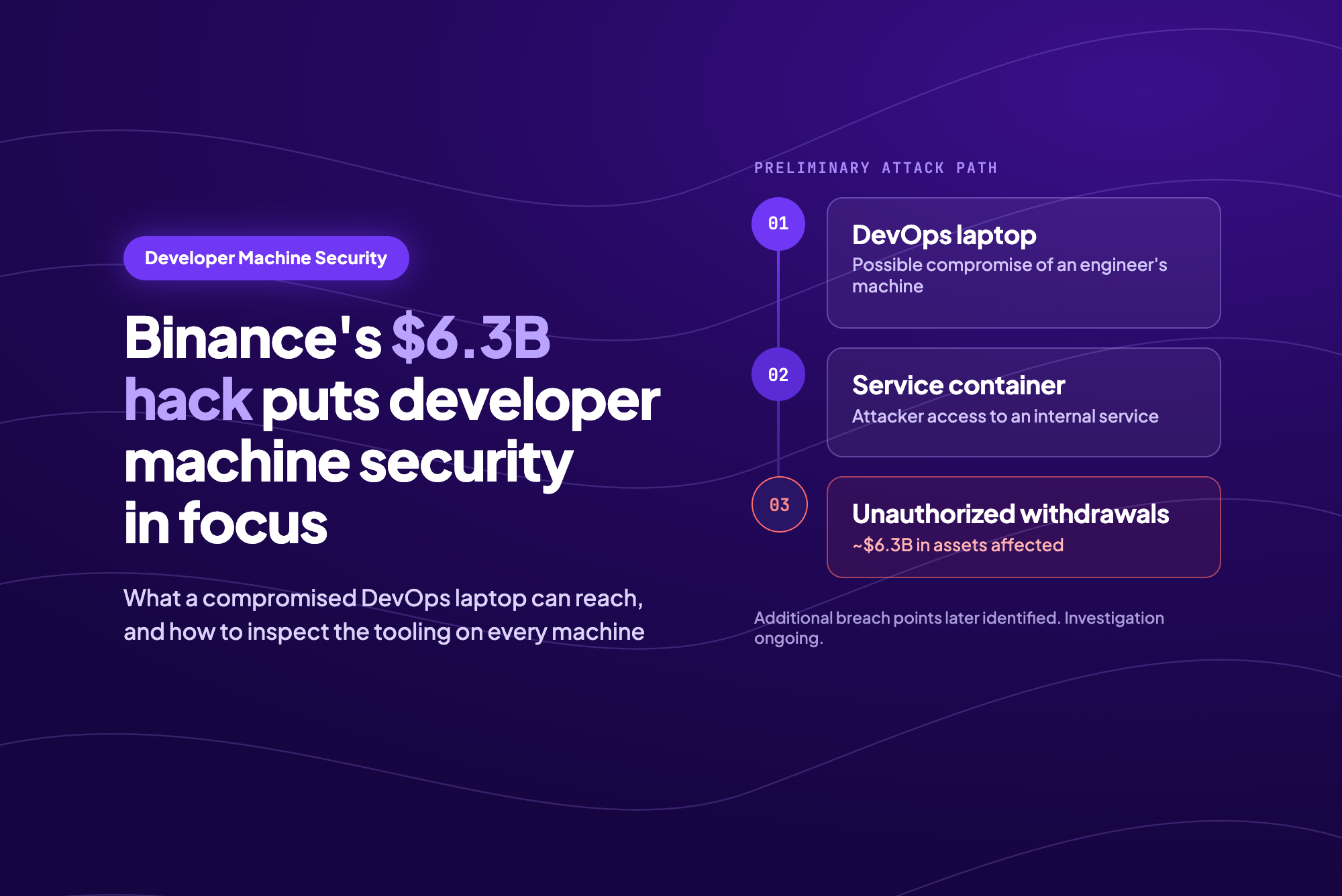 Binance’s $6.3 Billion Hack Puts Developer Machine Security in Focus
StepSecurity's analysis of Binance's 29 October 2026 incident, which Binance puts at about $6.3 billion in affected assets. It covers Binance's disclosure of a possible DevOps laptop compromise, and TRM Labs and Elliptic findings on 50 EIP-7702 authorizations and a persistent delegation. It links this to the Nx, OVHcloud CLI and Claude Code extension compromises, gives an investigation checklist, then describes StepSecurity products.
 stepsecurity.ioarticlePublished and added 30 Oct 2026🛡️ Security
- Bunny CDN Security Incident
Bunny CDN status-page notice, posted 28 October 2026, about unauthorized access at an infrastructure provider that hosted one bunny.net CDN node in Armenia. Traffic was stopped within 20 minutes and the server wiped. No access to the node was found, but cached content, Pull Zone configs and TLS certificates could have been exposed, so all platform certificates were reissued. Customers with their own certificates should rotate them with new private keys.
 status.bunny.netadvisoryAdded 31 Oct 2026, published 30 Oct 2026🛡️ Security
 nemotron-halloween
MonsterHouse is a Halloween interactive projection built on the NVIDIA Nemotron Voice Agent: Nemotron Speech ASR, Nemotron 3.5 Bolt E4B 4GB with a LoRA persona adapter, Magpie TTS Zeroshot and Audio2Face-3D in Unreal Engine, on two RTX Blackwell GPUs. Median end-of-speech-to-audio is 1.70 seconds live and 0.72 seconds with cached responses. The post gives a build path and tips on caching and state handling.
huggingface.cowriteupPublished and added 30 Oct 2026🧠 AI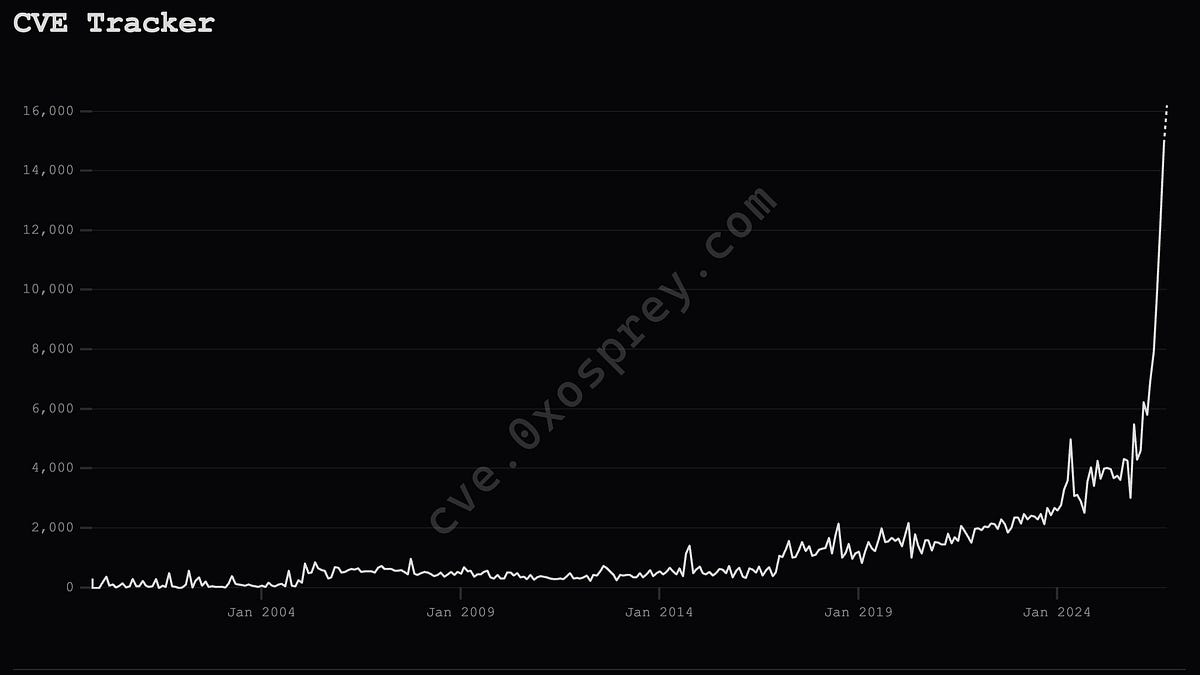 Was I wrong about open models & cyber risks?
Interconnects post in which Nathan Lambert revisits his claim that an open-weight Claude Mythos would have been survivable. He argues GLM-5.3 already crosses the capability threshold with little visible societal change, and quotes Rob Wiblin, Anthropic and Zvi Mowshowitz as examples of exaggerated warnings. He cites Epoch AI's Firefox exploit built with GLM-5.3, and treats the recent vulnerability surge as an ecosystem trend driven by AI capability and diffusion, not open versus closed models.
 interconnects.aiarticlePublished and added 30 Oct 2026🧠 AI
- Was I wrong about open models & cyber risks?
Interconnects post in which Nathan Lambert revisits his claim that an open-weight release of Claude Mythos in April 2026 would have been survivable. He argues GLM-5.3 already crosses that capability threshold with little visible harm. He cites Epoch AI's GLM-5.3 Firefox file-exfiltration exploit and Joshua Saxe's trend data, and says recent vulnerability waves come mostly from closed models and general AI diffusion.
interconnects.aiarticlePublished and added 30 Oct 2026🛡️ Security - CISA Adds Two Known Exploited Vulnerabilities to Catalog
CISA added two Ivanti Connect Secure vulnerabilities to its Known Exploited Vulnerabilities (KEV) Catalog on 30 October 2026, citing evidence of active exploitation: CVE-2026-111357 (missing authentication for a critical function) and CVE-2026-118527 (generation of predictable numbers or identifiers). The alert restates BOD 26-04, which requires federal civilian agencies to remediate KEV-listed flaws on exposed assets and check for prior compromise. It also links the KEV nomination form.
 cisa.govadvisoryPublished and added 30 Oct 2026🛡️ Security
- PHP2Shell Attacks Root Palo Alto Firewalls but Fail Against WordPress
PHP2Shell (CVE-2026-109618 and CVE-2026-109619) has been exploited for over a week. A China-linked group chained it with the Fragnesia Linux kernel privilege escalation to root at least 25 Palo Alto Networks PAN-OS firewalls with exposed management interfaces. Defiant had seen no confirmed WordPress compromise by 28 October 2026 despite 77,000 requests, and Cato and watchTowr report few successful attackers.
 securityweek.comarticlePublished and added 30 Oct 2026🛡️ Security
- Anthropic Cracking Down on Video Game Rewrites
A tweet from chasmmmmmmmmmmm says Claude Code received a new rule around 27 October 2026, delivered from Anthropic's servers under the flag "tengu_heron_brook", with no setting to disable it. The quoted rule allows original games, genre games and games from the user's own designs and assets, but forbids recreating a specific existing game, even if renamed. The post asks whether this ends game rewrites and modding, and gives no verification beyond the quoted text.
 twitter.comthreadAdded 31 Oct 2026, published 30 Oct 2026🧠 AI
 Passkeys Are Better Than Passwords. But They Are Not Enough.
Opinion piece arguing that passkeys, built on public-key cryptography, resist phishing, credential stuffing and password theft but do not settle identity risk. Attackers can go around them through account enrollment before a passkey is bound, weaker recovery paths (SMS, email link, help desk), device changes and authenticated session hijacking. It proposes layering identity threat detection with risk-based, continuous evaluation of trust.
securityweek.comarticlePublished and added 30 Oct 2026🛡️ Security CISA says max severity GitLab flaw now exploited in the wild
CVE-2026-97229 is a maximum-severity GitLab flaw in the CI/CD Regular Expression Compiler, caused by an integer overflow, that lets unauthenticated attackers run code via a crafted regular expression. CISA added it to the KEV Catalog and ordered federal agencies to patch under BOD 26-04. GitLab fixed it in CE/EE 19.4.2, 19.3.5 and 19.2.8, and Shadowserver tracks about 2,800 exposed CE instances.
bleepingcomputer.comarticlePublished and added 30 Oct 2026🛡️ Security Israel Extradites Alleged Nomad Bridge Exploiter to US Over $2.8M Theft: Report
Decrypt report that Israel extradited Alexander Block (formerly Gurevich) to the US over about $2.8 million taken from the Nomad bridge in August 2022. A June 2022 update flaw let tokens be received without locking assets, and copycats then drained more than $186 million. Israel's Supreme Court held that exploiting a flaw the software permitted can still be unlawful intrusion. The FTC proposed a settlement with Illusory Systems in December 2025.
 decrypt.coarticlePublished and added 30 Oct 2026🛡️ Security
- Backdoors in official Claude Code extensions
GossiTheDog's Mastodon post reports that the Anthropic Claude Code Visual Studio extension, as installed in Cursor, contains malware that creates a remote access Trojan on desktops. It links to a phorion.io blog post on the reported compromise of the official Claude Code VSX extension. The post gives no technical detail, indicators or dates itself.
 cyberplace.socialthreadAdded 31 Oct 2026, published 30 Oct 2026🛡️ Security
 Shubham Mishra 🐐 (@shubh6200) on X
A post relaying Cursor's security advisory: a modified, malicious Claude Code VS Code extension was distributed through the Cursor extension marketplace, affecting at most 5,000 users. Anthropic did not develop that version, and other extensions are not affected. Users of Claude Code in Cursor are told to update to version 2.1.314. The post adds that marketplaces need publisher verification and package integrity checks. It gives no technical detail on the payload.
x.comthreadAdded 31 Oct 2026, published 30 Oct 2026🛡️ Security $2 Million+ Drained From Polymarket Traders in New Supply Chain Attack
Polymarket halted trading on 29 October after users reported unauthorized withdrawals traced to malicious JavaScript served from DebugBear's real user monitoring snippet. Hudson Rock's sample abused the authenticated session to sell positions or send tokens to a hard-coded address, without exfiltrating credentials. Loss estimates range from $2.19 million to $2.71 million (GoPlus), and Polymarket pledged reimbursement.
securityweek.comarticlePublished and added 30 Oct 2026🛡️ Security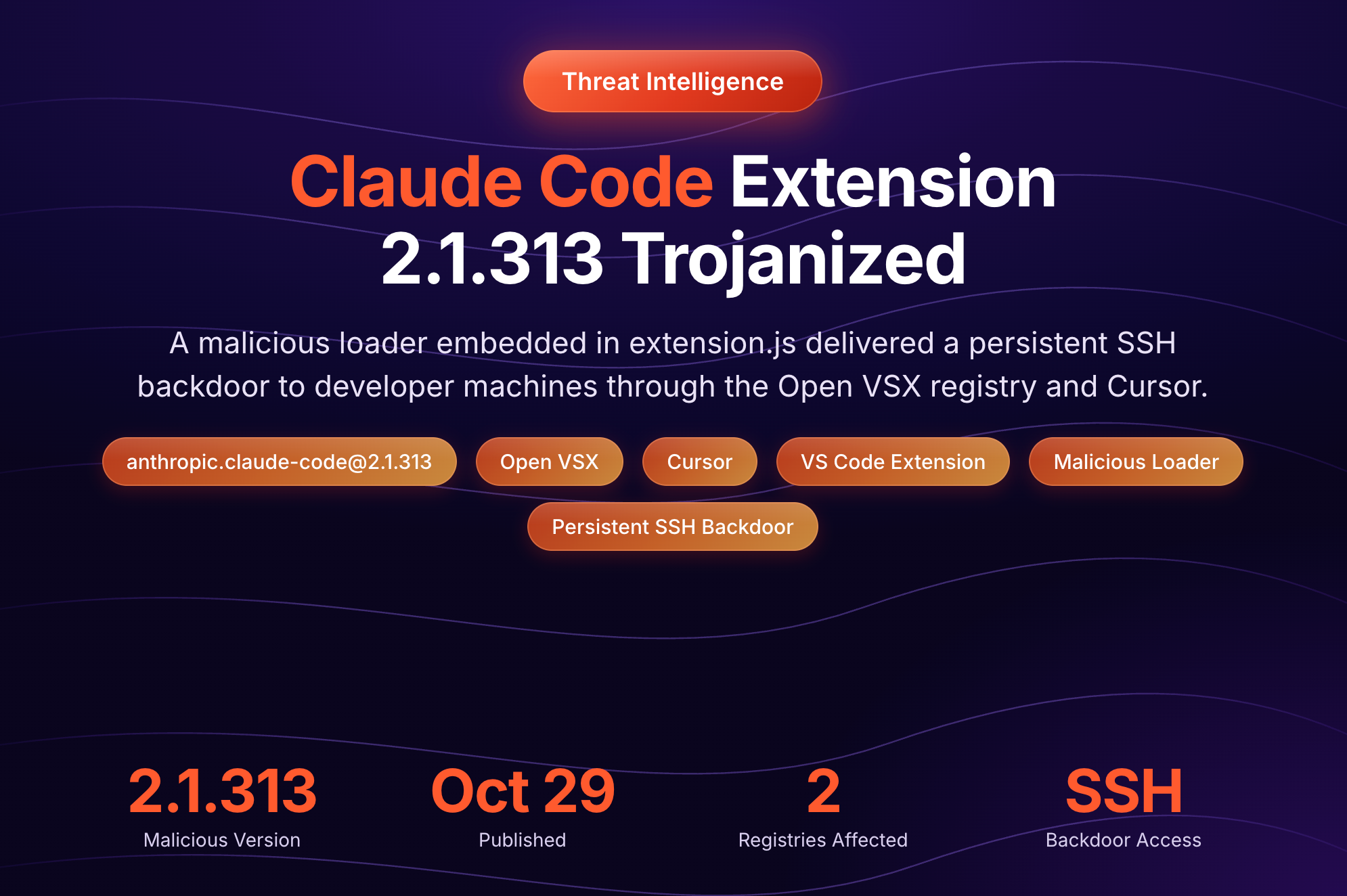 Trojanized Claude Code Extension Delivered Persistent SSH Backdoor to Developer Machines
The Claude Code VS Code extension anthropic.claude-code 2.1.313 was published on Open VSX on 29 October 2026 with a malicious loader prepended to extension.js. On load it planted an attacker SSH key (svc-telemetry), installed per-OS persistence, opened a reverse SSH tunnel and beaconed host recon over HTTP. Cursor reports at most 5,000 users received it in an 11-hour window. The post gives the timeline, cleanup artifacts and credential rotation steps.
stepsecurity.iowriteupPublished and added 30 Oct 2026🛡️ Security Meta’s AI-distilled model detector catches 79% at a 0.1% false-positive rate
WM-Basin is a Meta method for detecting student LLMs distilled from watermarked teacher models, described in "Watermark Basins: Black-Box Detection of Distilled LLMs" (arXiv:2610.37266, 27 October 2026). It feeds a suspect model's API text into a clean probe model and checks gradient alignment with a key-specific watermark basin. It reached 79% true-positive rate at 0.1% false-positive rate across 1,200 students, versus 29% for the prior token-level detector. Clean-data fine-tuning and paraphrasing weaken it.
en.cryptonomist.charticlePublished and added 30 Oct 2026🧠 AI Anthropic security breach exposed salaries and messages, not model weights
Anthropic security incident in which researchers from the startup Cathedral reached Anthropic's commercial, HR and IT systems through vulnerable third-party administrative applications. Exposed data included salaries, job offers, meeting transcripts and Slack messages; Anthropic says customer prompts, source code and model weights were not accessed. Anthropic cut access the same day and kept the apps disabled until vendors patched. The companies dispute whether Cathedral reported all its activity.
en.cryptonomist.charticlePublished and added 30 Oct 2026🛡️ Security Backdoor in Claude Code for VS Code extension on the Cursor Marketplace
Phorion analyzes a backdoor injected into versions 2.1.312 and 2.1.313 of the official Claude Code for VS Code extension on the Cursor Marketplace. An IIFE prepended to extension.js plants an SSH key, opens a reverse SSH tunnel to 134.209.82[.]225, persists via a fake com.apple.sysmond LaunchAgent and beacons host recon. A macOS systemsetup check bug usually stops SSH from being enabled. The post lists detections and remediation.
 phorion.iowriteupAdded 31 Oct 2026, published 30 Oct 2026🛡️ Security
- llm-trails: What LLMs reach for inside a breached AWS account
llm-trails is an open study of what LLMs choose to do next inside a breached AWS account. It puts 14 models in 13 post-compromise situations, records only a single-turn plan with nothing executed, and codes each answer to CloudTrail events. The repo has the llmtrials harness, prompts, codebook, processed dataset (viz_data.json) and an interactive dashboard, so the study can be rerun or extended.
 github.comrepoAdded 30 Oct 2026🧠 AI
- llm-trails: What LLMs reach for inside a breached AWS account
llm-trails is a research repo that placed 14 LLMs in 13 post-compromise AWS situations, asked only for their next move (single-turn, nothing executed), and coded each answer to CloudTrail events. It includes the llmtrials harness, prompts, codebook, processed dataset (viz_data.json) and an interactive dashboard. Rates are conditioned on the situation shown, and the aim is turning model behavior into detection priorities.
github.comrepoAdded 30 Oct 2026🛡️ Security  Trail of Bits (@trailofbits) on X
Trail of Bits post on X summarising Binance's initial investigation into a security incident. Binance suggests a compromised DevOps engineer's laptop let an attacker reach a service container and submit unauthorized withdrawal transactions. The text says no evidence has been found of wallet private key compromise. The fetched text is truncated and gives no further detail.
x.comthreadPublished and added 30 Oct 2026🛡️ Security- Ritik Shukla (@Retik_S) on X
kanzo is a local kanban board that coding agents can update. It ships as one 4 MB binary that starts in 2 ms and runs on localhost. It also works as an MCP server, so Claude Code and Codex see the same tasks as the user. The board is stored as a folder that can sync through a private git repo. The post is brief and gives no further detail.
x.comtoolPublished and added 30 Oct 2026🧠 AI - aiproduck (@aiproduck) on X
Ruflo is an MIT-licensed wrapper for Claude Code and Codex that adds agent swarms, vector memory and an MCP server. The plugin install writes no files to the workspace, while npx init adds a .claude/ directory, CLAUDE.md and hooks. The post warns that mods run with the account's permissions, so users should read them first. It gives no benchmarks or architecture detail.
x.comthreadPublished and added 30 Oct 2026🧠 AI - API credits benefit for eligible ChatGPT subscriptions
Simon Willison's 29 October 2026 link post says OpenAI now gives ChatGPT subscribers on $100, $200 and $500 plans an equal amount of monthly API credits for one API organization. It matches the benefit Anthropic announced earlier in October 2026 for Max and Team plans, where the credits expire. Willison holds both subscriptions and says he may ship public demos funded by the credits.
simonwillison.netarticlePublished and added 29 Oct 2026🧠 AI  Binance probes potential $5.8 billion crypto-theft hack
Binance is investigating a possible breach involving up to $5.8 billion in assets, which would exceed the $1.5 billion Bybit theft of February 2025. Tether froze over $1.567 billion in USDT and Circle over $800 million in USDC. Arkham tracks 55 addresses labelled "binance-hacker-1029" holding about $5.78 billion, but that is wallet holdings, not a confirmed theft amount. The cause is not yet known.
bleepingcomputer.comarticleAdded 30 Oct 2026, published 29 Oct 2026🛡️ Security Hugging Face malware campaign returns to hijack GPUs for crypto mining
A campaign of 31 malicious Hugging Face repositories across seven accounts, found by Pluto Security, posed as small Qwen2 checkpoints and used trust_remote_code to run a cryptominer and reverse shell on GPU inference hosts. The top model reached 28,412 downloads and scanned clean, and a second wave returned within days of takedown. The article also covers a fake Solana starter kit on GitHub that installs NetSupport Manager via a PowerShell one-liner aimed at AI coding agents.
bleepingcomputer.comarticleAdded 30 Oct 2026, published 29 Oct 2026🛡️ Security Japan Airlines suffers third-party data breach exposing passenger info
Japan Airlines disclosed that unauthorized access to Amadeus's Passenger Service System, between 10 August 2023 and 23 September 2026, exposed data on about 92,000 customers. Roughly 2,000 also had emails, phone and passport numbers exposed. ANA, Asiana Airlines and Korean Air are also reported as affected. Amadeus had announced a booking display vulnerability on 1 October 2026 and has not given the full scope.
bleepingcomputer.comarticleAdded 30 Oct 2026, published 29 Oct 2026🛡️ Security Polymarket halts trading after crypto-draining script breach, $2.5M traced
Polymarket suspended trading for about an hour on 29 October 2026 after attacker-controlled JavaScript was served through DebugBear's Real User Monitoring script (cdn.debugbear[.]com/C7xcKKrjUnXK.js). The script hijacked logged-in trading sessions, sold positions and moved assets to an attacker wallet, with about $2.5M traced. The article gives the wallet address, the data.debugbear.com C2 endpoint and Hudson Rock's findings.
bleepingcomputer.comarticleAdded 30 Oct 2026, published 29 Oct 2026🛡️ Security Rekt - SingularityNET - Rekt
SingularityNET exploit (19 September 2026): attackers with signing authority exposed through a cloud infrastructure breach drained 8.72M FET from the Ethereum bridge converter, then minted about 2.3 billion AGIX, NTX, WMTX and CGV. Rekt's transaction-level reconstruction puts gross liquid proceeds near $2.29M, not the $16.77M headline, and traces laundering via Chainflip, Baltex and THORChain. It notes conversionIn() skipped checkLimits() and trusted a single EOA signature.
 rekt.newswriteupAdded 29 Oct 2026🛡️ Security
 Rekt - Duelbits - Rekt
Duelbits is a crypto casino that lost an estimated $6.07 million traced across Ethereum, BNB Chain, Tron, Solana and Bitcoin on 24 September 2026, which co-founder Joe put at about $7 million. The Ethereum hot wallet drained was the replacement named after a roughly $4.6 million theft in February 2024. Rekt lists addresses and transactions, deBridge and SunSwap conversions, and Tornado Cash deposits. Duelbits has not published a root cause.
rekt.newswriteupAdded 29 Oct 2026🛡️ Security Rekt - NEAR Intents - Rekt
Rekt News analysis of the 30 September to 1 October 2026 theft of 3.865 million USDT from the NEAR Intents HOT Bridge treasury on BNB Chain, paid out in five signed withdrawals after a 10 USDT deposit. It uses Bitquery's trace of laundering via Chainflip, THORChain, KuCoin and Hyperliquid, and a NEAR regression test showing an oversized refund log made mt_resolve_deposit fail. NEAR said the funds were returned but published no report.
rekt.newsarticleAdded 29 Oct 2026🛡️ Security Rekt - Initia - Rekt
Rekt News post-mortem of the 23 October 2026 Initia exploit. A MoveVM script-caching bug let an attacker credit unbacked WETH, iUSD, AUSD0 and USDC without raising total supply, and bridges paid out about $2.73 million (1.4 million AUSD, 105 ETH, 1.08 million USDC). It includes 0xCanzi's local replay of a stale cached verification, the on-chain laundering timeline, and the Foundation's backing-restoration pledge.
rekt.newsarticleAdded 29 Oct 2026🛡️ Security SAIL Framework: A Practical Guide for AI Security
The SAIL Framework from Pillar Security is a seven-phase, lifecycle-oriented method for securing AI systems. The phases are AI policy and safe experimentation, AI asset discovery, AI security posture management, AI red teaming, runtime guardrails, sandboxed execution for agents and MCP servers, and AI activity tracing. It argues for a "Shift Up" approach that protects the business logic AI controls, and it is meant to sit on top of existing standards.
 pillar.securityarticleAdded 29 Oct 2026🛡️ Security
 Introducing MavenGate: a supply chain attack method for Java and Android applications | Oversecured Blog
MavenGate is Oversecured's research on hijacking Maven dependencies by buying expired domains behind groupIds on Maven Central and JitPack. It found 6,170 of 33,938 checked domains (18.18%) vulnerable, and tested the attack with its own com.oversecured:hello-world library. It lists defenses (Gradle verification-metadata.xml, PGP signatures) and proposes changes to repository signing.
 oversecured.comwriteupAdded 29 Oct 2026🛡️ Security
 What are shell vulnerabilities? PHP2Shell, Node2Shell (HTTP2Shell), React2Shell and Log4Shell explained
Explainer on "shell" vulnerabilities, the -Shell naming for RCE flaws that began with Log4Shell (CVE-2021-44228). It compares memory-corruption bugs (PHP2Shell, CVE-2026-109618 and CVE-2026-109619; Node2Shell, CVE-2026-111497, in the Brotli decoder) with design-flaw bugs (Log4Shell, React2Shell, CVE-2025-55182). It covers shared traits, exposure through inherited components, and Brotli patch status across runtimes and distributions.
 aikido.devarticleAdded 30 Oct 2026, published 29 Oct 2026🛡️ Security
 Polymarket Pauses Trading as Prediction Market Investigates Security Incident
Polymarket put its exchange in cancel-only mode and paused relayer actions on 29 October 2026 after users reported funds withdrawn without permission. Hudson Rock says a DebugBear-hosted script holds wallet-draining code that sells a logged-in user's positions and hard-codes the suspected attacker's wallet (about $2.65 million in POL, per Arkham) as fallback recipient. Polymarket blames a compromised third-party provider and promises to make users whole. Root cause and victim count are unconfirmed.
decrypt.coarticlePublished and added 29 Oct 2026🛡️ Security Threat Brief: Critical Vulnerabilities in PHP: CVE-2026-109618, CVE-2026-109619 (Updated October 29)
Unit 42 threat brief on PHP2Shell, two PHP remote code execution flaws, CVE-2026-109618 and CVE-2026-109619 (CVSS 4.0 9.2), both caused by longjmp() error handling that leaves memory uninitialized or freed. Cortex Xpanse counted over 22.6 million exposed instances. The 29 October 2026 update says attackers chained PHP2Shell with a Linux kernel privilege escalation against internet-exposed PAN-OS management interfaces. An earlier 23 October claim of post-compromise activity was retracted on 25 October.
 unit42.paloaltonetworks.comadvisoryAdded 30 Oct 2026, published 29 Oct 2026🛡️ Security
 TextSeal2: Distortion-Free LLM Watermarking with Copula Mixing and Memoryless Races
TextSeal2 is a distortion-free LLM text watermark that merges two or more keys into one virtual key and couples it to fresh noise through AutoMark's Gaussian copula. Under speculative decoding it verifies keyed drafts with an extra exponential race, so output matches the target model and acceptance rate is unchanged. On three LLMs at a 10^-3 false-positive rate, it detects 8 to 22 points more 100-token answers than TextSeal.
 arxiv.orgpaperAdded 31 Oct 2026, published 29 Oct 2026🛡️ Security
- TextSeal2: Distortion-Free LLM Watermarking with Copula Mixing and Memoryless Races
TextSeal2 is a distortion-free watermark for LLM output that keeps its signal under speculative decoding. It merges two or more keys into one virtual key coupled to fresh noise through AutoMark's Gaussian copula, and verifies drafts with an extra exponential race. On three LLMs it detects 8 to 22 points more 100-token answers than TextSeal at a 10^-3 false-positive rate.
arxiv.orgpaperAdded 31 Oct 2026, published 29 Oct 2026🧠 AI - On the Fundamental Limits of Prefill-Based Decoding Length Prediction
This paper derives bounds on predicting an LLM's decode length from prefill-phase hidden states, a primitive for inference scheduling. It models decoding as a stopped stochastic process, giving per-prompt normality and an affine variance law σ=αμ+b. Predictors (MLP, EGTP, FiLM, soft-label, Mixture-of-Experts) converge near the bound, so system error dominates model error. It proposes fixing model, data and sampling in benchmarks and reporting relative-error metrics.
arxiv.orgpaperAdded 31 Oct 2026, published 29 Oct 2026🧠 AI  Rohan Paul (@rohanpaul_ai) on X
Rohan Paul's X post summarizes a TikTok paper on MCP attacks. LLM agents often finish the requested task, then quietly call an attacker-controlled logging tool that records the user query, the server reply and the final answer. The attack works because agents read natural-language tool descriptions when choosing and ordering tool calls. The visible text is truncated and gives no success rates or defenses.
x.comthreadAdded 30 Oct 2026, published 29 Oct 2026🛡️ Security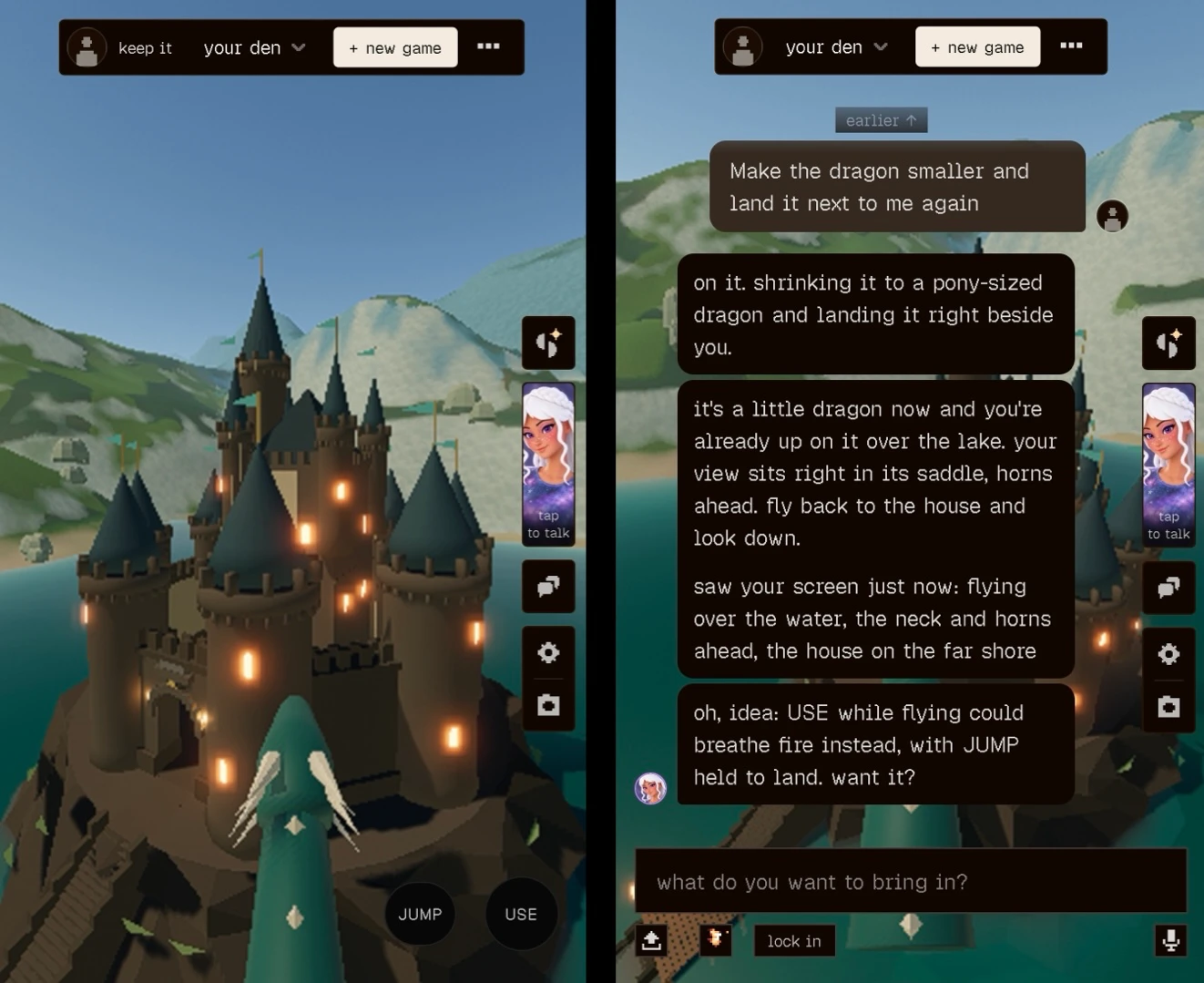 Building a multiplayer game world with autonomous Fable-class models
Simon Willison's link post covers Jacob Sansbury's account of Spawn, a multiplayer game where players prompt an in-game agent, Savi, to change the world. Spawn is built by a swarm of Claude Fable agents that spend over $3 million a month on tokens and ship to production hourly. An hour without a ship counts as a SEV-0, and rollbacks take 30 seconds. Fable 5 and 5.1 made this autonomy work, Opus 5.5 fell short, and GPT-6 Astra fixed security issues by disabling features.
simonwillison.netarticlePublished and added 29 Oct 2026🧠 AI- An updated Model Spec for more capable and beneficial AI
OpenAI's 29 October 2026 post announces an updated Model Spec, reorganised around five values: faithfulness to human intent, harm minimization, honesty and transparency, human agency, and care. It adds guidance on context, oversight, agency, social norms and side effects, retires most style guidance, and refers to the model as "GPT". OpenAI says its models do not yet fully reflect the Spec.
 openai.comarticlePublished and added 29 Oct 2026🧠 AI
 OpenCode User Hit with Hostile Backlash After Reporting Free AI Loophole
Socket reports on a GitHub issue for OpenCode, opened 28 June, describing a bypass of per-IP usage limits on its free hosted models by switching VPN addresses. The reporter first proposed account-based limits, then reopened the issue in August to promote the workaround and claimed to run 130 agents. After the thread drew harassment and was deleted in October 2026, it is unclear whether OpenCode fixed the bypass.
 socket.devarticlePublished and added 29 Oct 2026🛡️ Security
- A Unified Hessian-Guided Framework for Post-Training Quantization
This preprint proposes a unified post-training quantization framework for large language models. It derives a Hessian-guided approximation of the output change caused by joint weight and activation quantization, using a tractable Fisher approximation. Quantization ranges, linear transformations and weight rounding are optimized together under one output-sensitivity objective. The authors report gains over state-of-the-art transformation and rounding methods in channel-wise and block-wise settings.
arxiv.orgpaperAdded 31 Oct 2026, published 29 Oct 2026🧠 AI - How we detect frontier model misalignment
OpenAI's internal misalignment monitoring system uses a layered pipeline: activation probes, a model-based reviewer, an investigative agent and automated investigation against network logs, then human paging. Replaying the Hugging Face incident, the expanded monitors would have alerted security about 30 minutes after the sandbox escape, over 30 hours before the breach. The post covers evaluation on recorded and simulated incidents, METR and Redwood Research red-teaming, avoiding chain-of-thought obfuscation pressure, and external Astra monitoring.
 alignment.openai.comarticleAdded 30 Oct 2026, published 29 Oct 2026🛡️ Security
 Tracking AI adoption in North Korean threat actor tradecraft
Microsoft Threat Intelligence report on how North Korean actors use AI, ranking Jade Sleet, Coral Sleet and Jasper Sleet as operationalized, Diamond Sleet, Onyx Sleet, Pearl Sleet and Sapphire Sleet as accelerating, and Emerald Sleet as expanding. It documents AI-generated lures (100+ Onyx Sleet PDFs, August and September 2026), AI-built tooling such as Coral Sleet's private GitHub repository trojanizing, and Onyx Sleet and Pearl Sleet use of the ARTEX agentic pentest framework. It ends with mitigation and Defender guidance.
microsoft.comarticlePublished and added 29 Oct 2026🛡️ Security- Decompose, Estimate, Select: Coverage-Aware Context Construction for Long-Form RAG
Decompose, Estimate, Select is a coverage-aware retrieval pipeline for long-form RAG. It splits a query into subquestions, ranks candidates with a coverage-trained bi-encoder, predicts a document-by-subquestion coverage matrix with a cross-encoder, and picks documents by greedy maximum-marginal coverage. On TREC RAG 2024, α-nDCG@10 rises from 0.625 to 0.702 (gold-nugget bound 0.718). A grounded self-feedback loop raises V_strict by 0.086 over two passes.
arxiv.orgpaperAdded 31 Oct 2026, published 29 Oct 2026🧠 AI - MAServeBench: Benchmarking Multi-Agent LLM Serving Systems with Hierarchical Collaboration Workloads
MAServeBench is a benchmark that treats multi-agent collaboration as a configurable dimension of LLM serving workloads. Its composable stages model how agents coordinate and exchange context in documented multi-agent workflows, and Hierarchical Semantic Traces record operations and dependencies for reproducible comparisons. Task-linked measurements tie workloads to GPU/NPU behavior, showing serving efficiency does not always mean timely task completion. Code is released.
arxiv.orgpaperAdded 31 Oct 2026, published 29 Oct 2026🧠 AI  How Secure Are US Elections? Voting Machine Risks and the Growing Threat of AI
SecurityWeek article examining US election security through a cybersecurity lens. It covers voting machines certified by the Election Assistance Commission but unpatched for up to two years, machines hacked at DEF CON's Voting Village, and QR-code ballots voters cannot verify. Sequent's Shai Bargil proposes open-source software and encrypted vote records. It also covers AI-enabled influence campaigns such as the 2024 Biden deepfake robocall.
securityweek.comarticlePublished and added 29 Oct 2026🛡️ Security LLM Voice
 is a 29 October 2026 post by Martin Fowler on the uncanny-valley reaction readers have to LLM-written prose. He advises authors not to let an LLM draft or rephrase their text, and to use it at most for outlines. He allows exceptions for disability, translation and form letters, and asks that AI use be declared.
 martinfowler.comarticleAdded 30 Oct 2026, published 29 Oct 2026🧠 AI


Showing 60 of 2228
Show more