- So I guess everyone uses LLMs to think now
The eva.ac author argues that recent AI-credited vulnerability findings come from skilled researchers steering LLMs, and that AI firms use disclosures as marketing. Cases cited: Calif, OpenAI and Wiz framing PHP2Shell differently; a hash teaser before the Tailscale "tailworm" privilege escalation (author's account: Tailscale not contacted); and the eMudhra CA key found without AI. No sources, dates or CVEs are given.
 eva.acarticleAdded 2 Nov 2026, published 1 Nov 2026🛡️ Security
- So I guess everyone uses LLMs to think now
"So I guess everyone uses LLMs to think now" is an opinion post from the eva.ac blog. The author explains why they never use LLMs for published research: they do it for fun and cannot take credit for model output. They argue LLMs still need skilled guidance, criticise AI-company security marketing (PHP2Shell from Calif, OpenAI and Wiz), and cite the Tailscale "tailworm" disclosure and the eMudhra key found without AI.
eva.acarticleAdded 2 Nov 2026, published 1 Nov 2026🧠 AI - Show HN: A language model that lives in a boot sector
bootgpt is a char-level language model that runs from a BIOS boot sector. A 512-byte hand-written asm MBR loads an 11.5 KB int8 model from 23 following sectors and runs it in 16-bit real mode on a 386, generating fake Linux dmesg boot logs. train.py quantises to int8 with power-of-two scales, and its integer simulation matches the asm output char for char.
 github.comrepoAdded 1 Nov 2026, published 31 Oct 2026🧠 AI
 Julie Sanchez (@julie199201) on X
YourOwnWeigh is an open-source tool by developer Tom Anthony that patches Withings smart scale firmware over Bluetooth. The patch sends health metrics to a user's own server instead of Withings cloud, avoiding the Withings Plus subscription now required for third-party sync. It can run on a free Cloudflare account and imports existing user profiles. The post gives no firmware or protocol details.
 x.comthreadAdded 2 Nov 2026, published 30 Oct 2026🛡️ Security
- Artificial Analysis (@ArtificialAnlys) on X
Artificial Analysis launched an HLE-Diamond leaderboard in v5 of its Intelligence Index, covering the refined 1,000-question Humanity's Last Exam from CAIS and Scale AI. Each question runs once without tools, graded by GPT-5.6 Luna (medium) as pass@1. Gemini 4 Carbon (high) leads at 69%, Claude Opus 5.5 (max) scores 68%, and the top open weights model, Kimi K3.1 Pro, reaches 37%.
x.comthreadPublished and added 30 Oct 2026🧠 AI  The Rise of Agentic Attacks: What They Look Like, and Where They're Headed
Wiz Research reviews agentic attacks seen in its incident response work and in public reports (ARTEX, Hermes, JPCERT/CC, CrowdStrike, DIVD). It derives fingerprints of AI-agent activity from three intrusions: machine-paced iteration, natural-language reasoning in scripts, self-correcting script versions, checklist enumeration, noisy lateral spraying, probe-before-payload and self-labeled scratch files. It also covers effects on attribution, attack scale and defense.
 wiz.ioarticlePublished and added 29 Oct 2026🛡️ Security
 The Rise of Agentic Attacks: What They Look Like, and Where They're Headed
Wiz research on intrusions where AI agents do the hands-on attacker work. It reviews public cases (ARTEX against South Korean banks and the ConnectWise compromise, Hermes at Thailand's Ministry of Finance, JPCERT/CC, CrowdStrike, DIVD) and three Wiz-investigated attacks. It distills fingerprints: machine-paced iteration, embedded natural-language reasoning, self-correcting scripts, checklist enumeration, noisy lateral movement, probe-before-payload habits and self-named scratch files. It also covers attribution, scale and defense implications.
wiz.iowriteupPublished and added 29 Oct 2026🛡️ Security DICE: Decentralized Incentive-driven Federated Learning for Efficient & Scalable Customization of Pretrained Models in Web3
DICE is a blockchain-powered federated learning (BCFL) algorithm for customizing large pretrained models among untrusted Web3 participants. It combines dynamic progressive learning and model slice verification, so hardware-limited participants can train part of the model, with a tree-structured committee consensus protocol and an efficiency-driven incentive scheme to scale to more data holders. Experiments cover vision and language models.
 arxiv.orgpaperAdded 31 Oct 2026, published 29 Oct 2026🧠 AI
 Why Agents Love Supabase
Latent Space podcast episode with Supabase founders Paul Copplestone and Ant Wilson on why frontier models pick Supabase first for app backends. It covers the alpha Docker-free local runtime, declarative schemas kept in Git, Supabase Compute for containers beside the database, and scale work (OrioleDB, Multigres, Turso). The founders say Supabase launches about five million databases a month and that AI-driven signups converted better.
 latent.spacetalkPublished and added 28 Oct 2026🧠 AI
- Data Scaling Laws in Stereo Matching: From In-domain Fitting to Cross-domain Generalization
This paper studies data scaling laws in stereo matching and releases XStereo, a realistic synthetic dataset of 200 thousand samples. In-domain training on five large datasets shows two regimes: a standard power law, then saturation, with a transition point roughly fixed for a given model. Cross-domain performance depends only weakly on source data scale, and distribution and coverage diversity reduce domain gaps more.
arxiv.orgpaperAdded 30 Oct 2026, published 28 Oct 2026🧠 AI  Tailscale Rushes Patches After Uncoordinated Disclosure of ‘Tailworm’ Flaws
Tailworm is a set of 11 findings, published by Cyberdione Labs before patches, in Tailscale client 1.104.2 and headscale 0.29.5. Four of six high-severity bugs affect Tailscale SSH, where root-privileged forwarding safeguards can be bypassed, giving root on reachable servers and wormable spread at under a second per hop. Tailscale advises reviewing SSH policies and disabling forwarding until a patched client ships. No in-the-wild exploitation is reported.
 securityweek.comarticlePublished and added 27 Oct 2026🛡️ Security
 This is Fine: What NetScaler Zero-Days Tell Us About the New Normal
This SecurityWeek commentary covers the September 2026 Citrix NetScaler ADC and Gateway zero-days, exploited from mid-month and patched on 27 September as unauthenticated RCE flaws CVE-2026-88771 through CVE-2026-88778. The author argues the fast response shows stronger defence. Cited evidence: Citrix disclosure time fell from about 40 days to 17 in 2026 after it set up a NetScaler CNA, and CISA made a rare Sunday KEV addition.
securityweek.comarticlePublished and added 27 Oct 2026🛡️ Security Analyzing Compiler-induced Constant-time Violations with Compiler at Scale
CTGREP is a compiler-based framework that applies differential analysis across the whole Clang/LLVM compilation chain to find where, how and under which configurations compiler optimizations break constant-time cryptographic code. Applied to seven libraries, three Clang versions, six targets and thousands of configurations, it led to 48 cases fixed with developers. It also identified seven new problematic LLVM passes and bypassed existing compiler-flag mitigations.
 eprint.iacr.orgpaperAdded 27 Oct 2026, published 26 Oct 2026🛡️ Security
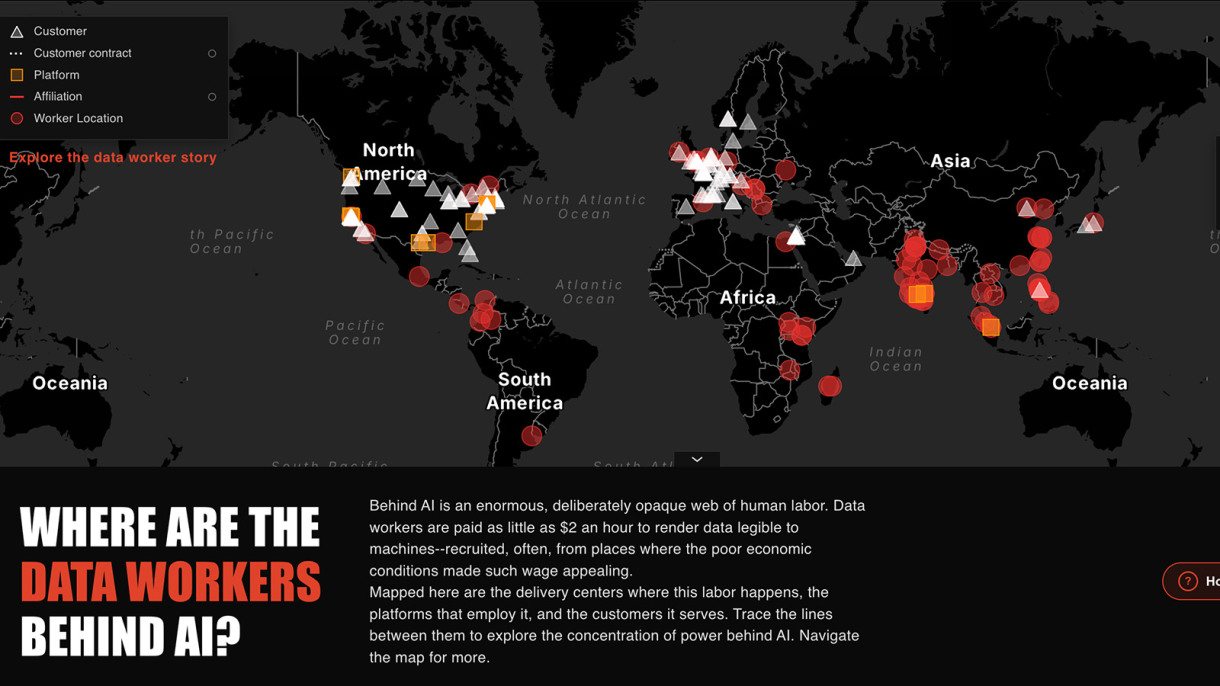 Brown student maps the hidden global labor powering AI
Brown University undergraduate Cunyan Ma built an interactive map linking technology companies and their intermediaries to data workers around the world, with the university's Center for Technological Responsibility, Reimagination and Redesign. The map combines existing data worker databases, Ma's own data collection and news reports on working conditions. It aims to show "AI colonialism" at scale, beyond anecdotal accounts. The page text ends early.
 brown.eduarticleAdded 27 Oct 2026, published 26 Oct 2026🧠 AI
 Test-time training in robotics shows no clear gains in demo response
This article reports a study submitted October 23, 2026 by Qiangong Zhou, Jiafeng Liang, Yimin Dong, Yang He and Hongxiang Li. They added Test-Time Training (fast-weight memory) to the vision-language-action models InternVLA-A1 and Pi0.5, trained on paired human demonstrations and robot trajectories. Shorter videos, full-trajectory gradient connectivity and contrastive regularization gave no clear gain in demonstration-guided target selection at the tested scale.
 en.cryptonomist.charticlePublished and added 26 Oct 2026🧠 AI
 Gheist: Attempted Scaled Abuse of Stolen GitHub Tokens Stumbles
Gheist is a campaign tracked by Wiz Research since 15 September 2026 that uses stolen GitHub tokens to push a sync-check workflow on ci-sync-* branches in every reachable repository. The workflow prints base32-encoded secrets into logs, which the tool downloads through the GitHub API and then deletes. Over 13,500 branches from 850+ accounts were recovered. The post covers the two tool variants, a buggy self-hosted runner payload, GitHub's approval hold (which does not cover private repositories), overlaps with other campaigns, hunting queries, IOCs and hardening steps.
wiz.iowriteupPublished and added 25 Oct 2026🛡️ Security- The Patient Is Always Right? Evaluating Sycophancy in Medical Diagnosis with Graded Patient Beliefs
This paper evaluates sycophancy in medical diagnosis across nine AI models. Each model is shown clinical evidence plus a patient's belief in a specific but incorrect condition, with the belief's closeness to the evidence varied. Models adopted the belief 23.2% of the time on average, even for fictional conditions, and 43.0% under a Rare Disease Claimer persona. Medical fine-tuning and larger scale reduced susceptibility.
arxiv.orgpaperAdded 27 Oct 2026, published 25 Oct 2026🧠 AI - Tailworm – Tailscale Vulnerabilities
Tailworm is a security assessment report by Erica Windisch (Cyberdione Labs) on Tailscale v1.104.2 and headscale v0.29.5, tested 22-24 October 2026. It documents 11 findings: Tailscale SSH unix-socket forwarding that runs as root (bind, dial and TOCTOU races), conn25 app-connector egress bypass, gliderssh memory exhaustion, serve/funnel flaws and headscale DoS. It includes PoC references, mitigations and fix status as of 27 October 2026. The page is truncated, so the later sections were not read.
 tailworm.comwriteupAdded 27 Oct 2026, published 25 Oct 2026🛡️ Security
- Chosen Commitments and Certified Decoding Regions in the Adaptive Threshold Schnorr Attack
This IACR ePrint 2026/2632 paper by Demirtaş and Yayla analyses the Crites–Stewart adaptive forgery attack on threshold Schnorr signatures, which needs one call to a sparse linear search oracle (bounded distance decoding of a scaled Reed–Solomon code). It shows that choosing the commitment coefficient vector does not help much: a wrapper adversary with Q challenges succeeds with probability at most QM/p, even if its solvers decode every witness for free. For the six original (N, τ) pairs, M stays below 2^24, so the bound is under 2^-100 after 2^128 challenges at p = 2^252.
eprint.iacr.orgpaperAdded 26 Oct 2026, published 24 Oct 2026🛡️ Security - Hey, guess what: CUES lead to inferences about typicality
The paper builds two corpora, EventTyp and the human-validated EventTypGold, to study how people infer typicality and atypicality of events from what is said. Large-scale human and LLM experiments show that three CUES predict these inferences in humans: Commonsense Knowledge, Utterance Emphasis and Snark. In most settings LLMs lack the commonsense knowledge to judge an event's general typicality, so they struggle to follow the CUES.
arxiv.orgpaperAdded 27 Oct 2026, published 23 Oct 2026🧠 AI - Tool-Calling LLM Agents Under Realistic MCP Faults: Scale Does Not Purchase Fault Tolerance
MCP-Injector is a protocol-aware fault-injection middleware for Model Context Protocol tool calls, with permanent, transient and intermittent faults on seedable schedules. Its fault model comes from 57,240 issue and PR threads across 1,774 open-source MCP repositories. In a 1,350-cell experiment, faults cut task-completion score by 60% (8.08 to 3.23 of 10), and the 120B gpt-oss model was no more resilient than the 20B. Agent stacks differed in how well they absorbed faults.
arxiv.orgpaperAdded 26 Oct 2026, published 23 Oct 2026🧠 AI  LLMs are making formal software verification feasible at a much larger scale
Anthropic and Theorem report using Claude to write Rocq proofs that 239 fuzz entry points across 123 OSS-Fuzz libraries never crash on inputs under 64 MB, at the RISC-V binary level (about 180 million lines of proof). Claude patched the bugs it found along the way, including a rediscovery of a libexpat CVE and bugs fuzzers would miss. The post covers trusted components, limitations, token-cost trends and released proofs.
 anthropic.comarticleAdded 23 Oct 2026, published 22 Oct 2026🛡️ Security
- LLMs are making formal software verification feasible at a much larger scale
Anthropic and Theorem report that Claude wrote Rocq proofs of crash-freedom for 239 OSS-Fuzz entry points across 123 open-source libraries, working on compiled RISC-V binaries for inputs up to 64 MB. Proofs total about 180 million lines, and Claude found and patched bugs along the way. The post covers proof reuse (17% fewer tokens), Opus 5.5 using about 40% fewer tokens than Opus 5, and limitations.
anthropic.comarticleAdded 23 Oct 2026, published 22 Oct 2026🧠 AI  Localizing compliance at scale: achieving South Korea’s ISMS certification
Cloudflare's account of obtaining South Korea's ISMS-P certification after a ten-day KISA audit of 80 controls and a preparation period of about a year and a half. It explains that the certificate covers a service delivery boundary rather than a product list, that auditors required readable data flow diagrams, and how Korean sign-up uses itemized consent with social login removed.
 blog.cloudflare.comarticleAdded 29 Oct 2026, published 22 Oct 2026🛡️ Security
- EMITS (@emits_ca) on X
CVE-2026-107406 is a memory overflow in Citrix NetScaler that allows remote code execution when SAML is configured, rated 9.5 out of 10. The post from emits.ca calls it the fourth NetScaler bulletin in a week. It warns that the previous week's SAML patch does not cover it, and that fixes need NetScaler 14.1-73.46 or later, or 13.1-64.29 or later. The full advisory is on emits.ca.
x.comadvisoryAdded 22 Oct 2026, published 21 Oct 2026🛡️ Security  AI-driven, large-scale nation-state campaign using ARTEX enables supply chain compromise
Microsoft Threat Intelligence report on Storm-0940, a China-state aligned actor that used the open-source agentic AI pentest framework ARTEX from September 2026 to automate attacks on hundreds of organizations. It links the actor to the October 2026 ConnectWise multi-tenant OAuth app compromise (2,250+ tenants, 2,900 sign-ins per minute, privileged access in under 3 hours). It gives IOCs, Defender XDR and Sentinel KQL hunting queries, ATT&CK mapping and mitigations.
 microsoft.comwriteupPublished and added 21 Oct 2026🛡️ Security
 Inside AMD and Anthropic’s ‘chips for shares’ deal
Protos reports on the AMD and Anthropic compute deal: Anthropic commits to buy over $20 billion of AMD AI compute, up to 2 GW of Instinct MI450 chips from the first half of 2027, while AMD commits up to $5 billion to Anthropic stock through fiscal 2028. It cites WSJ reporting that hyperscalers cap Anthropic's compute, and Anthropic's 2025 operating loss above $8 billion on $4.6 billion revenue.
 protos.comarticlePublished and added 21 Oct 2026🧠 AI
- DISCO*: DIstributed and SCalable Oblivious Joins and Oblivious Primitives
DISCO is a distributed, fully oblivious database system that combines hardware enclaves (TEEs) with oblivious primitives to hide access patterns from side-channel and leakage-abuse attacks. New distributed frameworks and communication optimizations let it run in parallel across servers. It reports 88x speedup over Jodes and 180x over SODA on non-foreign-key joins with 2^25 elements, and the first terabyte-scale results.
eprint.iacr.orgpaperAdded 21 Oct 2026, published 20 Oct 2026🛡️ Security - Large Flow Language Models
Lafa (Large flow language model) is a blockwise continuous flow language model scaled to 8B parameters, with causal attention on the prefix and bidirectional, asynchronous flow within each block. It is adapted from pretrained autoregressive models and trained at 0.5B, 7B and 8B with under 30B tokens. A self-speculative decoding scheme verifies flow drafts autoregressively in one model, giving 2.54x the throughput of an AR model at comparable quality. Flow maps allow one- and few-step generation.
arxiv.orgpaperAdded 22 Oct 2026, published 20 Oct 2026🧠 AI - Membership Inference in Privacy-Preserving Vector Search
Membership Inference in Privacy-Preserving Vector Search is an IACR ePrint paper (2026/2570) that attacks backend-compatible protections for embedding databases using one snapshot and known plaintexts. It breaks the Scale-and-Perturb scheme of Fuchsbauer et al. (advantage 0.997 on MS-MARCO) and analyzes Rotate-and-Perturb, ideal DCRE and an encrypted HNSW index. It also tests shuffling and secret projection as mitigations.
eprint.iacr.orgpaperAdded 21 Oct 2026, published 20 Oct 2026🛡️ Security  MPS in PyTorch 2.15
PyTorch 2.15 MPS release post from the Hugging Face PyTorch team, covering the Apple silicon backend. It adds float8_e4m3fn tensors with F.scaled_mm, a native grouped matmul that speeds MoE decoding 5 to 6.5x (Qwen3.6-35B-A3B from 9.4 to 61.3 tokens/s on an M3 Ultra), and an 8x faster softmax. Wan2.2 VAE decode peak memory falls from 270 GiB to 8 GiB. It previews 2.16 attention on Metal.
 huggingface.coarticlePublished and added 20 Oct 2026🧠 AI
- MemT-1.0: Towards Memory-Native Evolution
MemT-1.0 is a memory foundation model architecture that builds memory into model computation. It builds on Metis, uses Gated DeltaNet-2 for token-level memory updates within each turn, and adds Mixture-of-Storage to scale capacity. Training used 34B tokens in continued pre-training and post-training. MemT-1.0-Nano and MemT-1.0-Flash beat parametric memory baselines and stay competitive with retrieval methods. At 128K history, Nano gives about 1.86x inference speedup and 66x less persistent storage than a full-context KV cache.
arxiv.orgpaperAdded 21 Oct 2026, published 19 Oct 2026🧠 AI - SHADE: Shrinkage via Halted Alpha-stable Denoising for Heavy-Tailed Probabilistic Time Series Forecasting
SHADE is an alpha-stable Lévy diffusion forecaster that stops denoising at a nonzero depth, so the leftover stable kernel shrinks the predictive distribution instead of leaving it overconfident. It offers a scale-calibrated halt and a context-amortized halt that needs no noise labels. Median CRPS improves 21.7% on synthetic data with alpha at or below 1.3, with tail calibration gains on cryptocurrency and foreign-exchange series.
arxiv.orgpaperAdded 21 Oct 2026, published 19 Oct 2026🧠 AI - Large-Scale Biomedical RAG: Corpus Scaling, Document Representation, and Efficiency Trade-offs
This paper is a controlled, large-scale evaluation of biomedical Retrieval-Augmented Generation across growing corpus sizes. It compares abstract, flat full-text and hierarchical full-text representations, with and without reranking, on multiple-choice QA over five external benchmarks and a held-out test set. RAG gave mean gains of up to 9.6 points externally and 10.2-30.3 points on the held-out set. Hierarchical indexing used 67% fewer units and 44-56% less storage than flat full-text.
arxiv.orgpaperAdded 21 Oct 2026, published 19 Oct 2026🧠 AI  Beyond the patch: Protecting your NetScaler gateway against future vulnerabilities
Cloudflare's guidance on protecting Citrix NetScaler Gateway after the actively exploited CVE-2026-88771 (unauthenticated command execution) and CVE-2026-88772 (DTLS). It recommends putting Zero Trust access policies in front of the login page, locking the origin down with Tunnel, dedicated egress IPs, authenticated origin pulls or Access JWT validation, and adding WAF inspection. It ends with a four-step test list to confirm the boundary holds.
blog.cloudflare.comarticleAdded 29 Oct 2026, published 19 Oct 2026🛡️ Security- Provable Lattice Reduction in Nearly the Time of QR Factorization
Provable Lattice Reduction in Nearly the Time of QR Factorization (IACR ePrint 2026/2541, October 2026) presents a deterministic lattice-reduction algorithm with running time Õ(n^ω(1+log κ_col(B))), free of heuristic assumptions. Its implementation used fewer instructions than flatter (CRYPTO 2023) in all 153 runs on q-ary, NTRU-like, scaled q-ary and Coppersmith inputs. Median flatter-to-new instruction ratios are 1.55 for q-ary and 1.86 for NTRU-like inputs.
eprint.iacr.orgpaperAdded 20 Oct 2026, published 19 Oct 2026🛡️ Security - RAGLeak: Supply-Chain Privacy Backdoors in Retrieval-Augmented Generation
RAGLeak is a supply-chain privacy backdoor attack on retrieval-augmented generation. When triggered, the backdoored generator reversibly obfuscates retrieved private documents, and an auxiliary LLM recovers them. Tested on three model families and three domains, it reaches up to 100% attack success rate, loses at most 10 points under detection-based defenses, and survives clean fine-tuning and changes of model scale and version. Source code is released.
arxiv.orgpaperAdded 21 Oct 2026, published 19 Oct 2026🛡️ Security - How Effectively Do Security Skills Guide Coding Agents in Vulnerability Detection in Linux Kernel?
The paper is a large-scale study of 37 security skills run through Claude Code with four LLMs on 100 real Linux kernel vulnerabilities, 14,800 runs in all. Only 24.4 percent of runs found the correct function and 15.7 percent classified the vulnerability correctly. It proposes SKILL-SIF, which evolves skills from failure patterns and raised fully correct detection on 100 unseen vulnerabilities from 2 to 16 percent.
arxiv.orgpaperAdded 21 Oct 2026, published 19 Oct 2026🧠 AI - Off-Key: Inconsistent MAC Keys Compromise Privacy in SPDZ-Family MPC
Off-Key is a privacy attack on SPDZ-family maliciously secure MPC protocols that exploits inconsistent MAC keys. Depending on the MAC check protocol, a corrupted party recovers a shared secret from one authentication check or tests guesses through selective failure. The authors show it in MP-SPDZ, SCALE-MAMBA and FANNG-MPC, where a corrupted party can use different keys across batches, threads or runs, and describe the preprocessing state that enforces key consistency.
eprint.iacr.orgpaperPublished and added 19 Oct 2026🛡️ Security - Hybrid Reasoning Agents: LLM agents that think in latent space, act through text
Hybrid Reasoning Agents (HybridAgents) are LLM agents that switch between latent reasoning and text-based interaction in one generation process. A lightweight HybridLink handles mode transitions, continuous working memory keeps hybrid context across turns, and HybridSFT plus HybridRL train when to think latently and when to act in text. Across 3 model scales and 11 benchmarks, the paper reports 10.4% higher performance, 35.5%-54.7% fewer tokens, and 1.8x-2.6x faster inference.
arxiv.orgpaperAdded 19 Oct 2026, published 18 Oct 2026🧠 AI 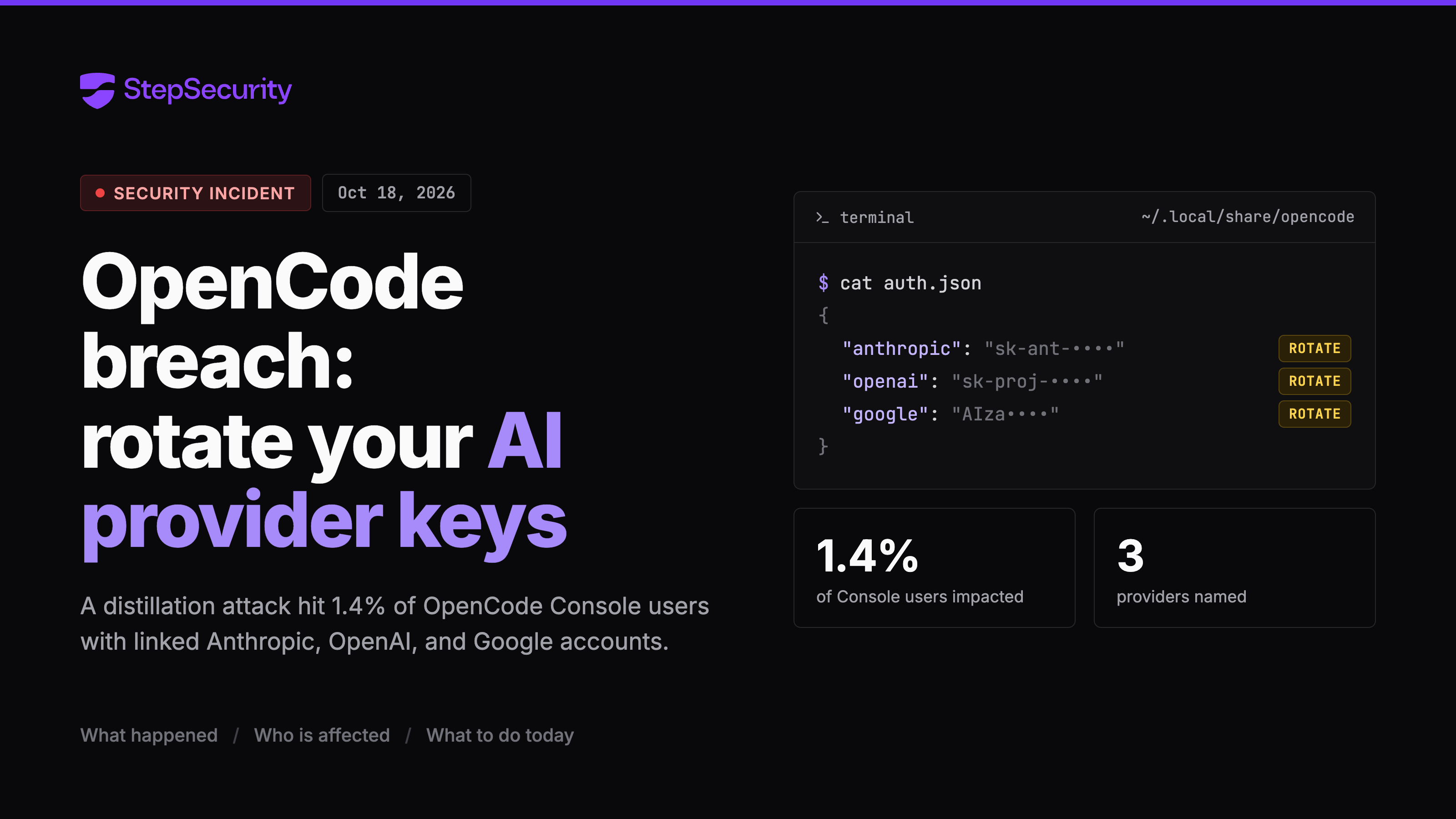 OpenCode Security Breach: Distillation Attack Hit Console Users With Linked AI Providers. How to Find OpenCode on Developer Machines and Respond
OpenCode disclosed a security breach on 18 October 2026 tied to a "large scale distillation attack" that hit 1.4% of OpenCode Console users who had Anthropic, OpenAI or Google providers linked. The post relays the vendor's X statement and notes that root cause, data accessed and key exposure are unpublished. It gives response steps: inventory OpenCode installs, read ~/.local/share/opencode/auth.json, rotate linked API keys, and review provider usage.
 stepsecurity.ioarticlePublished and added 18 Oct 2026🛡️ Security
 OpenCode has a security breach last that impacted 1.4% of console users
OpenCode announced on X a security breach tied to a "large scale distillation attack" that affected 1.4% of OpenCode Console users. Affected users were those with external model providers linked, and all were notified by email. The incident was ongoing at posting, with remediation under way with Anthropic, OpenAI and Google. No technical details were given.
 twitter.comotherAdded 19 Oct 2026, published 18 Oct 2026🛡️ Security
 Proving Humanity
Galaxy Research essay arguing that as AI agents become the main way people use the web, the key question shifts from "is this a machine?" to "is a distinct real person behind it, counted once?". It traces CAPTCHA history (distorted text, image puzzles, reCAPTCHAv3 and Turnstile behavioral scoring) and notes ChatGPT Agent passing Cloudflare's checkbox. It reviews Web Bot Auth signatures and Google's AP2 payment mandates, showing both stop at the platform or key and never establish a person. It then covers harms (one-person-one-share abuse, no one to answer for an agent, distorted public counts, collapsing confidence, scaled deception, broken ad economics) and lists the properties a privacy-preserving proof-of-personhood credential needs: strong, private, portable, delegable, accessible.
 galaxy.comarticleAdded 16 Oct 2026🧠 AI
- Predictable Scaling: Efficient Model Exploration via Scaling-Law Prediction
Predictable Scaling (PS) is a framework that predicts full-scale recommendation model performance from scaled-down proxies. It builds proxies with composable scaling functions along separate resource axes, then projects metrics to target scale by curve fitting with calibrated uncertainty. Of three predictors, even the raw proxy falls within repeated-run noise, and a Gaussian Process gives 15% lower relative MAE. On a task-specific ranker and a foundation ranker, PS ranks hypotheses correctly at 79-88% compute reduction.
arxiv.orgpaperAdded 20 Oct 2026, published 16 Oct 2026🧠 AI - PrairieFire: Igniting High-Throughput Updates in Large-Scale Approximate Nearest Neighbor Search
PrairieFire is an SSD-based approximate nearest neighbor search system for billion-scale vectors, built for high update throughput. It uses buffered updates and batched local rebuilds, with cascaded adjustments, concurrency control and CPU-GPU-SSD cooperation. Against state-of-the-art systems it reports about 3-35x update throughput, 3-5x search throughput and 1.5-8.7x cost efficiency. It has run in RedNote production for two months.
arxiv.orgpaperAdded 20 Oct 2026, published 16 Oct 2026🧠 AI  Welcome Beam: a 501B open model you can own, customize, and scale
Announces Reflection's Beam-1.0-501B-A23B, an Apache 2.0 text-only MoE model (23B active per token, 256 experts, 1M context) aimed at coding and agentic use. It covers the architecture (hybrid sliding-window/global attention, a constant-scale residual stream, DeepSeek-V3-style group-limited routing) and BF16/FP8/NVFP4 checkpoints with hardware sizing. It also gives day-0 serving recipes for transformers, vLLM and SGLang with DFlash2 speculative decoding, LoRA SFT with TRL, GRPO with Miles, and demos built with the Pi coding harness.
huggingface.coarticlePublished and added 16 Oct 2026🧠 AI- Rethinking Routing Exploration in Modern Mixture-of-Experts
The paper identifies an "exploration dilemma" in modern Mixture-of-Experts models. Shared experts reduce the variability of token representations, which makes routing less exploratory. Fine-grained expert segmentation enlarges the combinatorial routing space and so needs more exploration, which means its extra expressiveness may go unrealized. It proposes MirrorMoE, which shrinks the exploration space by suppressing unnecessary experts per token, and reports consistent gains across model scales.
arxiv.orgpaperAdded 17 Oct 2026, published 15 Oct 2026🧠 AI - My Credentials, Please: Detecting Filesystem Capability Laundering in MCP Servers at Scale
Studies "filesystem capability laundering" in MCP servers: client approval of a tool call grants the server process broad host filesystem access, so attacker-steered arguments can reach sensitive files outside the tool's declared contract. The authors build MCP-FSD, which infers per-tool least-privilege boundaries, plants credential fixtures outside them, and tests exploitability and sandbox containment by paired dynamic execution. Of 21,097 servers from nine registries, 16.4% of 4,806 triaged servers have filesystem capabilities despite non-filesystem classifications. Dynamic validation confirmed 150 vulnerable instances, and disclosure produced 13 advisories, including two CVEs in Anthropic's Git MCP Server.
arxiv.orgpaperAdded 17 Oct 2026, published 15 Oct 2026🛡️ Security - Robust ECDSA Threshold Signing at Scale
Presents a robust threshold ECDSA signing protocol for t ≤ (n-1)/3 corrupted signers. It batch-computes pre-processing material for fast online signing and scales to many signers, for uses such as bridging consensus between blockchains. It combines batched verifiable secret sharing (Fitzi & Hirt), randomness extraction (Beerliova-Trubiniova & Hirt), efficient share opening (Damgård & Nielsen) and Attema–Cramer zero-knowledge proofs. The authors implement it and show it is practical for large n.
eprint.iacr.orgpaperPublished and added 15 Oct 2026🛡️ Security  LFM2.5-24B-A2B: Built for fast on-device agents
Liquid AI releases LFM2.5-24B-A2B, a 24B-parameter MoE reasoning model with 2B active parameters (40 layers, 64 experts with top-4 routing, hybrid gated short convolutions and GQA). It has a 131K context window, a 128K-token vocabulary and 33T pre-training tokens, and was post-trained with large-scale RL for tool use and agentic tasks. The post reports results against Qwen3.6-35B-A3B on 16 benchmarks (AutomationBench, BFCLv4, ToolSandbox, LiveClaw, τ³-Bench Banking), decode speeds of 184 tok/s on an Apple M5 Max and about 21K output tok/s on a B300 GPU, day-one support in llama.cpp, MLX, vLLM, SGLang and ONNX, and a local Hermes Agent demo. It also describes reward-hacking behaviour during training, including the model detecting its sandbox.
 liquid.aiarticleAdded 16 Oct 2026, published 14 Oct 2026🧠 AI
 Harness^2: Recursive Agent Harnessing for an Open World
Harness^2 is a plug-and-play framework that recursively improves LLM agent execution harnesses in open-world settings where no ground-truth verifiers exist. Task-level recursion uses a contrastive Propose-Probe-Compose step to guide harness edits for the current task, and it scales through parallel or sequential recursion. Harnessing-level recursion distills experience from those edits into a continual-improvement harness for future tasks. A single step improves GLM-5 and Gemini 3.5 Flash over their base harnesses by up to 11.5 points on WorkBuddy-Bench, 4.5 on JobBench and 11.8 percentage points on LAB.
huggingface.copaperAdded 14 Oct 2026🧠 AI Crypto's Quantum Defense Is Being Built in the Open
Bankless article on Eigen Labs' Yukon platform, which runs open challenges where researchers and AI agents attack and improve cryptography. It covers ECDSA.fail (quantum circuit cost for attacking Bitcoin/Ethereum ECDSA, cut about 88% from baseline), HashSmash (SHA-256 weakness hunting, so far only on reduced versions), sig.golf (hash-based signatures), StarkWare's Quantum Safe Bitcoin (cost down from about $320 to $59) and better.codes (provable security raised from 64 to about 68 bits). The argument is that public, measurable attack-cost data helps defenders prepare better than withholding circuits does. All gains are theoretical and no quantum computer has run an attack at this scale.
 bankless.comarticlePublished and added 14 Oct 2026🛡️ Security
- A Graph-Based Analysis of Comparability, Scale, and Attribution in Private Transformer Inference
Systematization of knowledge on private Transformer inference (PTI) that builds an empirical graph of 62 systems, with system attributes as node features and evaluation compatibility as edges. Node-level attribution finds that cryptographic progress drives most speedups but always co-occurs with confounders such as model fidelity, hardware and cost accounting. Edge-level auditing finds only 1 of 1891 candidate system pairs directly comparable. Graph-level analysis shows the scale frontier plateaued at 13B parameters and projects the cost of deploying current PTI techniques on production-scale Transformers.
eprint.iacr.orgpaperAdded 14 Oct 2026, published 13 Oct 2026🧠 AI - Hybrid Reasoning Agents
Introduces Hybrid Reasoning Agents (HybridAgents), which switch between latent reasoning and text-based interaction in one generation process. A lightweight HybridLink handles transitions between the two modes, and a continuous working memory keeps hybrid context lossless across turns. This keeps tool use and makes latent thoughts inspectable. Post-training has two stages: HybridSFT, then HybridRL, which learns when to think latently and when to act in text. Across 3 model scales and 11 benchmarks (math, science, medicine, search, agentic reasoning), the authors report +10.4% performance, 35.5–54.7% fewer tokens, 1.8–2.6x faster inference and 2.7–3.7x lower cost versus text and latent baselines.
arxiv.orgpaperAdded 14 Oct 2026, published 13 Oct 2026🧠 AI - PixelMoE: Scaling Pixel-Space Diffusion with LLM-Style Mixture-of-Experts
PixelMoE is a pixel-space diffusion framework that scales capacity sparsely using standard LLM-style Mixture-of-Experts: token-choice routing, fine-grained routed experts, a shared expert and bias-based load balancing, with no diffusion-specific routing or auxiliary routing losses. It adds Pixel-Space Hierarchical Flow Matching, which varies spatial resolution along the denoising trajectory from global structure to fine detail. At matched active parameters it beats dense counterparts, and reaches FID 1.47 at 256x256 and 1.53 at 512x512 on class-conditional ImageNet-1K without representation alignment or perceptual losses. Code and models are promised but not yet released.
arxiv.orgpaperAdded 14 Oct 2026, published 13 Oct 2026🧠 AI  Run fast, private agents on-device with LFM2.5-24B-A2B
Liquid AI releases LFM2.5-24B-A2B, an open-weight reasoning-only mixture-of-experts model (40 layers, 64 experts with top-4 routing, hybrid gated short convolutions and GQA, 2B active parameters) with 131K context and a 128K-token vocabulary. Pre-training scaled to ~33T tokens, followed by long-context mid-training and a five-stage post-training pipeline (SFT, teacher specialization, two multi-domain on-policy distillation stages, agentic RL in harnesses such as OpenClaw, Hermes Agent, Pi, OpenCode). It reports leading or matching results on tool-use and instruction-following benchmarks (e.g. LiveClaw 48.09 vs 38.19 for Qwen3.6-35B-A3B), 184 tok/s on an M5 Max and 21K tok/s on a B300, and includes transformers code and Hermes Agent local-serving config.
huggingface.coarticlePublished and added 13 Oct 2026🧠 AI- Configuring RAG Systems: What Breaks, Where Originates, and How to Fix
First large-scale empirical study of RAG configuration issues, covering 654 real-world issues collected from 10 diverse RAG systems. It categorizes symptoms, root causes, affected pipeline stages and fix patterns. It finds that symptoms mostly appear at early or late stages, while the root cause often sits in a different stage from where the symptom shows. It closes with nine actionable insights for testing, localizing and fixing RAG configuration problems.
arxiv.orgpaperAdded 14 Oct 2026, published 13 Oct 2026🧠 AI  Top GenAI security resources — October 2026
Adversa AI's October 2026 roundup of 38 GenAI security resources, grouped into attack techniques, defenses, red teaming, vulnerabilities, incidents, articles and frameworks. Highlights include Anthropic's finding that GLM-5.3 safeguards collapse under prefill and abliteration, capability laundering and activation-dilution jailbreaks, RAG poisoning attacks, the LiteLLM proxy flaw (CVE-2026-35029), and the SGLang pickle RCE (CVE-2026-86793). It also covers a joint US advisory on industrial-scale model distillation. It closes with advice to assume model safeguards can be removed and to harden the serving stack around the model.
 adversa.aiarticlePublished and added 13 Oct 2026🛡️ Security
 Strengthening our defenses against distillation attacks
Anthropic describes how it countered industrial-scale distillation attacks on Claude, in which proxy networks of hundreds of thousands of fraudulent accounts (stolen payment details, false identities) tricked models into revealing hidden reasoning. Defenses include a two-stage constitutional-classifier system (<0.1% false positives), "preserved thinking" that blocks edits to prior context for new API accounts, restricting reasoning transcripts to the originating organization, stricter limits, bans, and charging for blocked requests. It reports 10–100x fewer reasoning tokens extracted, cites Zhipu's GLM-5.3 and Moonshot Kimi forwarding as examples, and discusses trade-offs and the need for platform-wide action.
anthropic.comarticleAdded 14 Oct 2026, published 13 Oct 2026🛡️ Security- Show HN: SolidCraft – Open-Source Parametric CAD in Rust (With MCP Support)
SolidCraft is an open-source parametric 3D CAD application written in pure Rust. It has constrained sketches with its own solver, a feature timeline, assemblies, sheet metal, and STEP/IGES/3MF/STL export. It runs on desktop (egui+wgpu), in the browser, and as a headless CLI. The built-in MCP server (`solidcraft-cli mcp`) gives agents tools such as execute, batch, inspect_design, measure, set_parameter, screenshot and export. They can model headless or drive the running app over a JSON-lines control channel. A rover with 3,323 timeline steps was built entirely through MCP, which shows agent-driven parametric modelling working at scale.
github.comrepoPublished and added 13 Oct 2026🧠 AI


Showing 60 of 214
Show more