 WorkFactory: Turning Professional Intents into Executable Work for Scalable Agent Training
WorkFactory is a framework that builds coherent, executable professional tasks for training working agents. It plans an information support graph from professional intents, then uses probe executions to find and repair missing or inconsistent task information. The authors built 112,686 tasks across 612 occupations and fine-tuned Qwen models at 4B, 27B and 35B-A3B (WorkPilot). WorkPilot-35B-A3B rose from 879 to 1565 Elo on GDPval-AA v2.1.
 huggingface.copaperAdded 30 Oct 2026🧠 AI
 VeriCUA: Verification as Agentic Exploration for Computer-Using Agents
VeriCUA is a platform-agnostic framework that verifies task completion by computer-using agents through agentic exploration. The verifier inspects context to build a task rubric, then picks GUI or code checks for unresolved requirements and combines findings under explicit evidence rules. It works online and offline across desktop, mobile and web, and agrees better with reference labels than the baselines, with the largest offline gains on hard cases.
 arxiv.orgpaperAdded 31 Oct 2026, published 29 Oct 2026🧠 AI
- Stop Calling Them Provers: The Case for Calling ProVerif and Tamarin Symbolic Protocol Analyzers
Nadim Kobeissi's ePrint paper 2026/2683 argues that ProVerif and Tamarin should be called symbolic protocol analyzers, not provers. It audits their published soundness arguments, finding false statements, missing proofs and gaps between paper and implementation, and reproduces reported Tamarin bugs that accept false claims. It also covers model gaps in parsers and state machines, weak secrecy queries and unjustified primitive equations. The page is an abstract only.
 eprint.iacr.orgpaperAdded 31 Oct 2026, published 29 Oct 2026🛡️ Security
- Optimality and Efficiency of Higher-Order Rank-Based Side-Channel Attacks against Inner Product Masking Schemes
HO-ASPA (Higher-Order Adjusted Spearman Coefficient Analysis) is a rank-based, non-profiling side-channel distinguisher. The paper derives its optimal form against two-share Boolean masking and inner product masking under Hamming weight and LSB leakage. It finds no significant gap between higher and lower orders for HO-ASPA, unlike HO-CPA, and reports that it beats Kruskal-Wallis-based attacks in simulated and real-world experiments.
eprint.iacr.orgpaperAdded 31 Oct 2026, published 29 Oct 2026🛡️ Security - When LLM Architectures Meet Smart Contract Vulnerability Detection: a Replication Study
This paper replicates Chen et al.'s study of LLM-based smart contract vulnerability detection, first on GPT-4 and then on Mixture-of-Experts, RNN-like and State Space Models. The exact replication confirms the high-recall, low-precision pattern on GPT-4. The differentiated replication finds the pattern does not transfer uniformly: GPT-4 and Gemma-3 behave alike despite a roughly 100x parameter gap, while two MoE models diverge.
arxiv.orgpaperAdded 30 Oct 2026, published 28 Oct 2026🧠 AI - Locating Sycophancy Across Training Stages in Open Language Models
Locating Sycophancy Across Training Stages in Open Language Models measures sycophancy in 13 open checkpoints from 5 lineages, from base model through supervised fine-tuning and preference optimization to release. It finds two behaviors with different origins: deference to a claim in the prompt exists in every base model, while capitulation under user objection is largely absent from base models and present in every post-trained checkpoint. Post-trained models often drop firmly held answers as readily as loosely held ones when the objection names an alternative.
arxiv.orgpaperAdded 30 Oct 2026, published 27 Oct 2026🧠 AI - Can LLMs Uncover Hidden Physical Laws through Free Exploration?
LongChang is an automated framework that builds simulated worlds with altered physical laws, such as heavier objects falling more slowly, to test whether LLMs can find the law by free exploration. Explorer LLMs manipulate objects and build tools without tasks or hints, while separate LLM agents generate scenes, review tool designs and grade reports. Across 12 LLMs, GPT-6 Astra reached a 16.7% discovery rate and the other 11 scored 0%.
arxiv.orgpaperAdded 28 Oct 2026, published 27 Oct 2026🧠 AI - Know, then Draw: A New Learning Paradigm for Visual Generation
Know, then Draw is a learning paradigm for visual generation that uses autoregressive pretraining to acquire semantic knowledge and diffusion post-training for high-fidelity rendering. Controlled comparisons find autoregression the stronger pretraining objective, and semantic quality matters more than AR-only generation quality. This motivates a purely semantic tokenizer trained with language supervision only. A 3B text-to-image model trained in 6,600 H100 GPU-hours scores 86 on GenEval and 87 on DPG-Bench.
arxiv.orgpaperAdded 28 Oct 2026, published 27 Oct 2026🧠 AI  Analyzing Compiler-induced Constant-time Violations with Compiler at Scale
CTGREP is a compiler-based framework that applies differential analysis across the whole Clang/LLVM compilation chain to find where, how and under which configurations compiler optimizations break constant-time cryptographic code. Applied to seven libraries, three Clang versions, six targets and thousands of configurations, it led to 48 cases fixed with developers. It also identified seven new problematic LLVM passes and bypassed existing compiler-flag mitigations.
eprint.iacr.orgpaperAdded 27 Oct 2026, published 26 Oct 2026🛡️ Security- Reva: Real-Time Vulnerability Detection through Contextual Probing of Large Language Models
REVA (REal-time Vulnerability Analysis) is a vulnerability detector that puts a module threat model, lightweight static analysis findings and call-graph information into one LLM forward pass. A trained probe reads the model's internal representations of the new function. On PrimeVul's held-out test set, REVA on GLM-5.3-Flash reaches 60.0% accuracy in about one second per function, matching the agentic VulTriage (59.2%) at over 250 times the speed and under a tenth of the cost. The probe is 14% to 17% more accurate than the LLM's own verdict.
arxiv.orgpaperAdded 28 Oct 2026, published 26 Oct 2026🧠 AI - Reva: Real-Time Vulnerability Detection through Contextual Probing of Large Language Models
REVA (REal-time Vulnerability Analysis) is an LLM-based vulnerability detector that screens each new function in one forward pass. It feeds the model a pre-computed module threat model, lightweight static analysis findings and call-graph data, then reads the model's internal representations with a trained probe. On PrimeVul's held-out test set with GLM-5.3-Flash it reaches 60.0% accuracy in about one second per function, matching the agentic VulTriage (59.2%) while over 250 times faster.
arxiv.orgpaperAdded 28 Oct 2026, published 26 Oct 2026🛡️ Security - SymLift: Neural Semantic Lifting for Compile-Free Vulnerability Detection in Context-Incomplete Code Fragments
SymLift is a compile-free vulnerability detection framework for context-incomplete code fragments. A fine-tuned LLM lifts control-flow, data-flow, memory and resource relations into a constrained LLVM-like IR. A parser turns the IR into facts, and Datalog rules derive findings with derivation traces. On Juliet function-level fragments Clang compilation success falls to 12.00%, while SymLift's completion rate drops only 1.17 points. SymLift-Qwen-7B reaches Target-F1 94.41% on FormAI and 91.66% micro-F1 on MegaVul.
arxiv.orgpaperAdded 28 Oct 2026, published 25 Oct 2026🛡️ Security - SymLift: Neural Semantic Lifting for Compile-Free Vulnerability Detection in Context-Incomplete Code Fragments
SymLift is a compile-free vulnerability detection framework for code fragments that lack project context. A fine-tuned LLM reconstructs control-flow, data-flow, memory and resource relations as a constrained LLVM-like IR, and a deterministic parser turns it into facts for Datalog rules that give findings with derivation traces. SymLift-Qwen-7B reaches 94.41% Target-F1 on FormAI and 91.66% micro-averaged Target-F1 on MegaVul.
arxiv.orgpaperAdded 28 Oct 2026, published 25 Oct 2026🧠 AI - Unlocking the Specialization Capability of PPG Foundation Models for Wearable Signals through Structured Pruning and Adaptive Fine-Tuning
SPAFT is a structured prune-then-finetune framework for PPG (photoplethysmography) foundation models used on wearable signals. It finds that pretrained PPG models have inherent sparsity and redundancy, then restricts fine-tuning to a compact parameter subspace chosen by parameter importance and structural redundancy. Across four PPG foundation models, five datasets and ten tasks, it wins 82.8% of regression and 87.5% of classification comparisons.
arxiv.orgpaperAdded 27 Oct 2026, published 24 Oct 2026🧠 AI - Enhancing LLM-Based Vulnerability Detection via Representation-Aware Logical Ensemble
RALE (Representation-Aware Logical Ensemble) is a method for LLM-based vulnerability detection in C code. The authors train LLMs on raw source code, Abstract Syntax Trees and Control Flow Graphs, and find each representation works best for certain vulnerability classes. Combining the models with explicit logical rules and majority voting raises F1 from at most 73% for a single model to 78%, with gains in accuracy, precision and recall.
arxiv.orgpaperAdded 28 Oct 2026, published 24 Oct 2026🧠 AI - When to Stop Penalizing Actions? Martingale GRPO for VLA Reinforcement Learning
MART-GRPO is a variant of group-relative policy optimization for vision-language-action (VLA) reinforcement learning. It uses a LoRA-fine-tuned VLM to find the last visible error without recovery in a failed rollout video, keeps failure feedback up to that point, and drops it afterward. Martingale stopping conditions show this preserves the expected GRPO gradient and can reduce covariance. With OpenVLA-OFT on RoboTwin 2.0, it raises success rates over full-trajectory GRPO across multiple tasks.
arxiv.orgpaperAdded 26 Oct 2026, published 23 Oct 2026🧠 AI - Semantically Rich, Metrically Affect-Blind: A Geometric Blind Spot in Modern Text Embedders
Sentiment-Injected Sentence Embeddings (SISE) addresses a finding across eleven frozen text encoders (2021 to 2026): linear probes recover sentence polarity at up to 91.3% accuracy, but cosine similarity separates polarity by only 0.003-0.064. A small supervised-contrastive head (0.13M-0.69M parameters) trained on CPU raises retrieval MAP by up to 26 points, but the 128-d head loses 38-41 STS-B Spearman points. The paper also releases the Attribute Alignment Gap diagnostic.
arxiv.orgpaperAdded 26 Oct 2026, published 23 Oct 2026🧠 AI - EpiSEM-Bench: Evaluating Safety and Evidence Recovery in LLM Agents under Missing Evidence
EpiSEM-Bench is an executable benchmark of 300 matched unsafe/safe task pairs across six domains. It tests whether tool-using LLM agents take prohibited actions when a tool response omits a safety-relevant fact, even though the request is benign and all returned statements are true. It finds large variation across ten models, and recovery access cuts unsafe execution for all ten.
arxiv.orgpaperAdded 24 Oct 2026, published 22 Oct 2026🧠 AI - The Geometry of Metaphor: Probing and Steering Metaphor Representations in Large Language Models
The Geometry of Metaphor is an October 2026 arXiv preprint that uses mechanistic interpretability to find causal subspaces for metaphor in LLMs of different architectures and sizes. The authors steer output on classification tasks across parts of speech. They also steer generation tasks, showing the metaphoricity of model output can be controlled. The abstract gives no model names or metrics.
arxiv.orgpaperAdded 24 Oct 2026, published 22 Oct 2026🧠 AI - SIM-UT: A User Simulation based Evaluation Framework for Medical Triage Chatbots
SIM-UT (Simulation of User Behaviour for Triage) is a multi-turn, simulation-based method for finding failure modes in LLM medical triage chatbots. It was applied to three WhatsApp health chatbots (India, South Africa, Kenya) across 5,000+ multilingual simulated turns, comparing MedGemma with ChatGPT and Claude. The main finding is de-escalation risk: agents that first flagged emergencies agreed with users who minimised symptoms, such as vaginal bleeding in pregnancy.
arxiv.orgpaperAdded 24 Oct 2026, published 21 Oct 2026🧠 AI - Where AI Vulnerability Discovery Harnesses Go Quiet: Structural False Negatives and Hidden Vulnerabilities
Paper (arXiv, 21 October 2026) on structural false negatives in LLM vulnerability discovery harnesses. Starting from Knostic's OpenAnt and raptor, then 10 more open-source harnesses, the authors map 13 points where code selection, filtering, and finding storage or merging drop vulnerabilities. One file was dropped by six harnesses before the model saw it, five without notice. It covers attacker evasion, content-steered verdicts, prompt injection, and design principles and tests.
arxiv.orgpaperAdded 24 Oct 2026, published 21 Oct 2026🛡️ Security - Protection Is Not One Event: A Survey of RAG Protection Research by Measured Endpoint
Protection Is Not One Event is a survey and human-coded evidence map of 118 RAG defense papers, grouped by measured endpoint into a seven-family taxonomy (kappa=0.867 across 32 annotators). It finds that only 17.8% of studies use content disclosure as their primary endpoint, and that most evaluations use general QA data and non-adaptive attacks. In a testbed on Qwen3-8B, an 8-gram guard cut copying to 0.0%, yet a three-query adaptive attacker still recovered 48.3% of hidden facts. Taxonomy, dataset, coding protocols and testbed are released.
arxiv.orgpaperAdded 24 Oct 2026, published 21 Oct 2026🧠 AI - UniWALM: Unified World Action Language Model for Embodied Robot Control
UniWALM is a unified world-action-language model that learns video, action and language in one mixture-of-transformers backbone with per-modality diffusion heads that co-denoise together. Generated subtask and textual memory are fed back on the next step, so no external planner or memory bank is needed. It adds Flow Matching with Correction (FMC) for recovery from perturbed actions. It reaches 34.5% on the memory-dependent RMBench subset, above Mem-0's 28.5%, and lifts real-world Find-the-Item success from 11.1% to 61.1%.
arxiv.orgpaperAdded 22 Oct 2026, published 20 Oct 2026🧠 AI - Beyond 4 bits: Data-Centric Post-training Quantization and Recovery
This paper studies 2-bit post-training quantization (PTQ) of six dense and mixture-of-experts models from 3.8B to 32B parameters. It finds the quantization representation matters most: vector codebooks give usable models where scalar PTQ falls to chance. Calibration and recovery data must be chosen jointly. The recipe uses about 2.3 effective bits per weight, keeps 89 to 97% of full-precision QA accuracy, and needs 1.4 to 30x less compute than the strongest QAT baseline.
arxiv.orgpaperAdded 22 Oct 2026, published 20 Oct 2026🧠 AI - Answering in the User's Variety: Calibrated Accommodation Pairs for Post-Training
Calibrated accommodation pairs (CAP) is a preference-data method that rewards chat models for matching a user's dialect density while keeping Standard English for Standard-English users. The paper traces SFT, DPO and RL stages across 10 open model lineages and finds post-training standardizes replies, while the DPO update still favours British and Australian spelling over AAE and Singlish. On a fully open model, CAP improves convergence on unseen features without added dialect for Standard-English users or lower instruction following.
arxiv.orgpaperAdded 22 Oct 2026, published 20 Oct 2026🧠 AI - Graphs and cycles in curve-based collision walks
Graphs and cycles in curve-based collision walks is an IACR ePrint paper (2026/2560) on van Oorschot-Wiener style collision attacks in the multi-user setting. It covers elliptic curve discrete logarithms and isogeny pathfinding on supersingular F_p^2 and F_p curves, and proposes new pseudorandom walks. For F_p^2 curves, L keys need about L + log(L) useful collisions with no infiltrator. For F_p curves, about 0.75L keys fall to L collisions with an infiltrator.
eprint.iacr.orgpaperAdded 21 Oct 2026, published 20 Oct 2026🛡️ Security - Raise or Check? Predicting the Necessity of Additional Fuzzing for Continuous Fuzzing
RAISE (Risk-Aware Intensive Supplemental Execution Framework) is a just-in-time framework that predicts which project-days introduce a vulnerability, to decide where to spend extra fuzzing. The dataset joins OSV vulnerability-introducing commits with OSS-Fuzz coverage data for 15 C/C++ projects (15,210 project-days, 347 positive). A Random Forest using VCCFinder static features plus fuzzing features reaches ROC-AUC 0.74. In a simulation over 968 vulnerabilities, Simple-Regression needed 91.60 extra fuzzing sessions per detected vulnerability, against 171.89 for the Median heuristic.
arxiv.orgpaperAdded 22 Oct 2026, published 20 Oct 2026🛡️ Security - Analysis of an AI based code distinguisher
Analysis of DeepDistinguisher, a transformer model that tells Goppa codes from random linear codes. Using saliency maps and attention visualization, the authors find a low-weight-row artifact in the random training instances that the model partly uses. They propose a pairwise-XOR rule on generator matrix rows that correlates strongly with the model's predictions. On random matrices meeting the minimum distance and XOR constraints, the model loses most of its accuracy, so it exploits general combinatorial properties rather than hidden algebraic structure.
eprint.iacr.orgpaperAdded 20 Oct 2026, published 19 Oct 2026🛡️ Security - Post-quantum commutative group actions from oriented superspecial abelian varieties
Castryck, Dina, Kutas and Lorenzon study the Shimura class group action on superspecial principally polarized abelian varieties with a CM orientation, as a post-quantum commutative group action for key exchange. They give tools to represent CM orientations through higher-dimensional isogenies and to compute the action in the restricted effective group action model. These rely on a CM version of Kani's lemma and a trick that often halves the ambient dimension. The paper also gives a method for finding oriented superspecial abelian surfaces and analyses obstructions to transitivity.
eprint.iacr.orgpaperAdded 20 Oct 2026, published 19 Oct 2026🛡️ Security - Computing endomorphisms of superspecial principally polarized abelian surfaces in time and memory \(p^{4/5+o(1)}\)
Computing endomorphisms of superspecial principally polarized abelian surfaces is a cryptanalysis preprint by Marc Houben and Lam L. Pham, posted to IACR ePrint in October 2026. It gives an algorithm that, under a standard heuristic, finds a non-scalar polarized endomorphism in expected time and memory p^(4/5+o(1)). The abstract is the only text available, so the method and its effect on specific schemes are not described.
eprint.iacr.orgpaperAdded 19 Oct 2026, published 18 Oct 2026🛡️ Security - The One-Pixel of Reasoning: One Truthful Relation Is Enough to Mislead LLM Agents
The One-Pixel of Reasoning introduces the one-relation attack (ORA), which finds a critical implicit warrant linking evidence to a conclusion and inserts one source-grounded sentence that qualifies it, steering an LLM agent to a wrong belief. Across eighteen models on biomedical inference and vulnerability detection, best-of-10 attacks flip initially correct answers 54.9% of the time for proprietary models and 80.0% for open-weight models. Attacks transfer without victim feedback, can pass source-support checks, and multi-agent debate raises team error from 50.0% to 59.5%.
arxiv.orgpaperAdded 21 Oct 2026, published 17 Oct 2026🛡️ Security - AI-Driven Reproducibility and Analytical Robustness in Scientific Discovery
SEER-Repro is a benchmark of 20 published papers based on the SEER cancer registry, with the data needed to reproduce their findings. An LLM agent reproduces 77.4% of 2,190 atomic claims. A second agentic pipeline finds alternative analytical choices and reruns the analyses, flagging potentially consequential choices in 9.5% of fully reproduced findings for expert review.
arxiv.orgpaperAdded 20 Oct 2026, published 16 Oct 2026🧠 AI - MobileInject: Evaluating Reasoning-to-Action Security of MLLM-Based Mobile Agents under Cross-Modal Consistency Injection
MobileInject is a benchmark for testing MLLM-based smartphone agents against indirect multimodal injection. It has an interactive evaluation framework with 11 scenarios, 9 security-risk categories and 108 executable risk instances. It adds Cross-Modal Consistency Injection, Multi-Role Collaborative Deception, Reasoning-Camouflage Injection and a Reasoning Security Diagnosis Framework. Experiments find broad vulnerability, with many failures from early reasoning hijacking.
arxiv.orgpaperAdded 20 Oct 2026, published 16 Oct 2026🛡️ Security - Ignored, Not Refused: What Low Prompt-Injection Success Rates Hide in Small Tool-Using Agents
Ignored, Not Refused audits 33,000 trajectories from eleven open-weight agents (2-14B parameters) on InjecAgent and AgentDojo. A label-blind LLM judge finds most failed indirect prompt injections are ignored (76-80%) rather than refused (17-18%). Changing only the system prompt moves InjecAgent ASR from 0.2% to 43%. The Attack-Task Outcome Matrix (ATOM) shows 21.7% of AgentDojo episodes were safe but left the user task incomplete. The corpus, judge prompt and code are released.
arxiv.orgpaperAdded 20 Oct 2026, published 16 Oct 2026🛡️ Security - Ignored, Not Refused: What Low Prompt-Injection Success Rates Hide in Small Tool-Using Agents
"Ignored, Not Refused" audits 33,000 trajectories from eleven open-weight agents (2-14B parameters) on InjecAgent and AgentDojo. A label-blind LLM judge finds 76-80% of failed injection attacks were ignored and 17-18% refused. Changing only the system prompt moves InjecAgent attack success rate from 0.2% to 43%, and the ATOM matrix shows 21.7% of AgentDojo episodes were safe but left the user's task undone. The corpus, judge prompt and code are released.
arxiv.orgpaperAdded 20 Oct 2026, published 16 Oct 2026🧠 AI - Topology-Inspired Fine-Tuning for Wind-Field Super-Resolution
The paper fine-tunes a pretrained CNN wind-field super-resolution model with differentiable topology-inspired auxiliary losses on speed, gradient magnitude, soft high-speed level sets and local maxima. It also uses fixed-pair supervision at ground-truth persistence-pair endpoints located offline with the Topology ToolKit. A 16-configuration loss study on a fixed 168-field benchmark finds that gradient supervision gives the strongest persistence-diagram improvement, while fixed-pair supervision gives the most consistent joint improvement in persistence-diagram and merge-tree distances. The combined objective cuts bottleneck, W2,∞ and W2,2 distances by 31%, 25% and 27% relative to the pretrained CNN, at a cost of about half of standard fine-tuning's PSNR gain. It also shows that pointwise metrics and topological distances rank CNN and GAN models differently.
arxiv.orgpaperAdded 17 Oct 2026, published 15 Oct 2026🧠 AI - PROBE: Learning to Audit Policy Compliance in Tool-Using LLM Agents
PROBE (Policy Rule Observation via Behavioral Exploration) trains LLM-based auditors that act as realistic users and probe deployed tool-using agents for policy violations (pricing, privacy, confirmation, safety) across multi-turn, tool-mediated dialogue. It formalizes auditing as a two-player Markov game with a composite reward for violation discovery, plausibility, progress and policy diversity, and compares GRPO, DPO and GFlowNet optimization. Trained auditors find broader, higher-yield violations than zero-shot adversaries, even when much smaller than the target agent, positioning behavioral auditing as a distinct axis next to capability and safety benchmarks.
arxiv.orgpaperAdded 17 Oct 2026, published 15 Oct 2026🛡️ Security - PROBE: Learning to Audit Policy Compliance in Tool-Using LLM Agents
PROBE (Policy Rule Observation via Behavioral Exploration) trains LLM-based auditors that act as realistic users and probe deployed tool-using agents for policy violations (pricing, privacy, confirmation, safety) over multi-turn dialogue. It formalizes auditing as a two-player Markov game with a composite reward balancing violation discovery, behavioral plausibility, conversation progress and policy diversity, and compares GRPO, DPO and GFlowNet optimization in a controlled setting. Trained auditors find broader, higher-yield violations than same-architecture zero-shot adversaries, even when much smaller than the target agent. This positions multi-turn behavioral auditing as a distinct evaluation axis alongside capability and safety benchmarks.
arxiv.orgpaperAdded 17 Oct 2026, published 15 Oct 2026🧠 AI - From Perception to Prediction and Intervention: Benchmarking Proactive Video Assistants in Real-Life Scenarios
Introduces P^3IBench, a benchmark for proactive video understanding in real-life streaming scenarios, covering three capabilities: daily perception, risk prediction and intervention. It evaluates 12 open-source and proprietary video-language models (streaming and adapted non-streaming) and finds they struggle to make well-calibrated decisions about when to respond. The authors also build extra proactive training data and train P^3I-Assistant-4B, which improves several tasks unevenly, showing that proactive assistance needs response timing and restraint as well as visual understanding.
arxiv.orgpaperAdded 17 Oct 2026, published 15 Oct 2026🧠 AI - Exploring Fault Injection Attacks on HQC and BIKE Beyond Fujisaki-Okamoto Verification
Presents fault injection attacks on BIKE and HQC decapsulation that target instructions outside the Fujisaki-Okamoto transform, achieving full key recovery with only valid ciphertexts at NIST Level 1 (17392 queries for HQC, about 3 million for BIKE). It also gives a general method for finding effective fault locations by analysing decoder behaviour under perturbed conditions. Attacks were validated with laser fault injection on an STM32H7 microcontroller, showing a wider attack surface for code-based post-quantum KEM implementations.
eprint.iacr.orgpaperPublished and added 15 Oct 2026🛡️ Security - Thinking in Graphs: Neo4j-Backed Exploit-Chain Reasoning for LLM Penetration-Testing Agents
Presents ChainGraph, a pattern that externalizes exploit-chain reasoning for LLM pentest agents (Claude Code, Codex) into a Neo4j property graph exposed via the Model Context Protocol. Findings, attack steps, credentials, assets and tamper-evident evidence receipts are typed nodes with pre/post-condition edges, queried with Cypher and Graph Data Science for next-step inference, entry-to-crown-jewel pathing, chain-severity promotion, provenance and chokepoints. On a synthetic GOAD-style multi-forest Active Directory engagement, three Medium findings become Critical once chained, betweenness centrality identifies break-points, and reasoning payload drops ~98% (token proxy); results are single-run and illustrative.
arxiv.orgpaperAdded 17 Oct 2026, published 14 Oct 2026🛡️ Security - Thinking in Graphs: Neo4j-Backed Exploit-Chain Reasoning for LLM Penetration-Testing Agents
ChainGraph is a pattern that moves exploit-chain reasoning out of the flat context window and into a Neo4j property graph. Findings, attack steps, credentials, assets and tamper-evident evidence receipts are typed nodes with pre/post-condition edges. The graph is wired to Claude Code or Codex through MCP with no custom harness. Five operator questions (next-step inference, entry-to-crown-jewel pathing, combined-severity promotion, evidence provenance, chokepoint identification) become reusable Cypher and Graph Data Science queries, plus a chain-severity score. On a synthetic multi-forest Active Directory lab modeled on GOAD, three findings rated Medium in isolation become Critical once their path to the forest root is materialized. Scoping each decision to a graph result cut the reasoning payload by about 98% on a token proxy. The authors say the results are illustrative single-run measurements, not a benchmark.
arxiv.orgpaperAdded 17 Oct 2026, published 14 Oct 2026🧠 AI - Tamper Sensing Meshes in Payment Terminals and Beyond
Teardown study of tamper sensing meshes (TSM) across a wide range of card payment terminals, ATM key pads and a data center HSM, with detailed photos of critical features. The authors build a taxonomy of mesh construction techniques, find most commercial meshes use simple constructions far from manufacturing limits, and derive a concise set of design patterns. They argue that meshes beating the industrial state of the art are feasible with cheap, readily available processes, giving researchers a basis for realistic test specimens.
eprint.iacr.orgpaperPublished and added 14 Oct 2026🛡️ Security  ERC: Quantum Bridge Shield
Draft ERC from Quantova Inc that has Ethereum bridges accept cross-chain message batches only when a committee signs the Merkle root with RFC 8554 LMS hash-based signatures. The guard contract requires a strict majority of distinct unfrozen keys, records used leaves, freezes any key that signs a leaf twice, binds digests to domain tag, chain ID, guard address and epoch, and enforces a 60-second delay. It reports gas benchmarks (about 205k per LMS W4 height-10 verify, 12.44M worst-case rotation under EIP-7825), a hybrid LMS+ECDSA migration mode, and a NioLabs assessment with no critical or high findings. It argues that Shor's algorithm makes secp256k1 and BLS committee keys a quantum theft target.
 ethereum-magicians.orgpaperPublished and added 14 Oct 2026🛡️ Security
 Scaling Agentic Data for Long-Horizon Terminal Intelligence
Introduces TerminalHorizon, a fully automated data synthesis engine for long-horizon terminal agents. It uses independent execution to find key work omitted during environment construction and rebuilds the environment from that evidence. It then progressively expands tasks under the same goal with new requirements that build on earlier results. The authors build 1.5K task environments and run supervised fine-tuning of Qwen3.5-27B to get TerminalHorizon-27B, which improves on all 12 benchmarks covering coding-agent tasks, real-world production agentic tasks and general reasoning. Multiple RSI case studies with a 12-hour research budget show the model continuing to experiment past an initial solution and keeping effective improvements in its final deliverables.
huggingface.copaperAdded 13 Oct 2026🧠 AI- A Graph-Based Analysis of Comparability, Scale, and Attribution in Private Transformer Inference
Systematization of knowledge on private Transformer inference (PTI) that builds an empirical graph of 62 systems, with system attributes as node features and evaluation compatibility as edges. Node-level attribution finds that cryptographic progress drives most speedups but always co-occurs with confounders such as model fidelity, hardware and cost accounting. Edge-level auditing finds only 1 of 1891 candidate system pairs directly comparable. Graph-level analysis shows the scale frontier plateaued at 13B parameters and projects the cost of deploying current PTI techniques on production-scale Transformers.
eprint.iacr.orgpaperAdded 14 Oct 2026, published 13 Oct 2026🧠 AI - Configuring RAG Systems: What Breaks, Where Originates, and How to Fix
First large-scale empirical study of RAG configuration issues, covering 654 real-world issues collected from 10 diverse RAG systems. It categorizes symptoms, root causes, affected pipeline stages and fix patterns. It finds that symptoms mostly appear at early or late stages, while the root cause often sits in a different stage from where the symptom shows. It closes with nine actionable insights for testing, localizing and fixing RAG configuration problems.
arxiv.orgpaperAdded 14 Oct 2026, published 13 Oct 2026🧠 AI - Cube Attacks with Elimination Strategy: Key Recovery Attacks on Trivium
Introduces a cube-attack framework with an elimination strategy. It finds key conditions and cubes whose conditional superpolies are cheap to compute, then solves the resulting equation systems to recover key bits. The supporting techniques are a nested coefficient solver, conditional monomial prediction, an automated cube search combining numeric mapping with monomial prediction, and two testing methods for large equation systems. Against round-reduced Trivium it gives a practical key recovery at 840 rounds (complexity below 2^55, 77.8% success) and at 845 rounds (below 2^56, 98.1% success on 59.1% of keys). It also gives a theoretical weak-key attack at 855 rounds for 2^74 keys. These are the best known results, extending prior practical attacks by 13 rounds and theoretical attacks by 4.
eprint.iacr.orgpaperAdded 14 Oct 2026, published 13 Oct 2026🛡️ Security - On Secure Sorting and Its Application to Privacy-Preserving Graph Pattern Matching
Marcel Keller's ePrint compares the two fully secure MPC sorting approaches, Quicksort (Araki et al., CCS'21) and radix sort (Asharov et al., CCS'22). The comparison covers a range of parameters, for both honest- and dishonest-majority settings. The paper then extends the sparse matrix multiplication of Damie et al. (CODASPY'26), which avoids oblivious RAM, so the output comes out in the same format as the inputs. That makes repeated multiplication of graph adjacency matrices possible, which the paper uses to find cycles and scatter-gather patterns associated with money laundering. The result is privacy-preserving anti-money-laundering detection.
eprint.iacr.orgpaperAdded 14 Oct 2026, published 13 Oct 2026🛡️ Security  2024 Dependency Management Report | Endor Labs
Endor Labs' 2024 report on open-source dependency management and vulnerability prioritization. It reports that under 9.5% of vulnerabilities are reachable at function level, and that combining reachability with EPSS cuts noise by about 98%. It also finds Python phantom dependencies (up to 60% of dependencies and 85% of vulnerabilities for some tenants), 18% of npm OSV entries lacking CVE aliases, 69% of advisories published after the fix release (median 25 days), and 47% of advisories with no code-level info. For Java, 24% of fixes need a major version bump and 95% of upgrades carry breaking changes. Written by a vendor, so the prioritization conclusions favor its product.
 endorlabs.compaperPublished and added 12 Oct 2026🛡️ Security
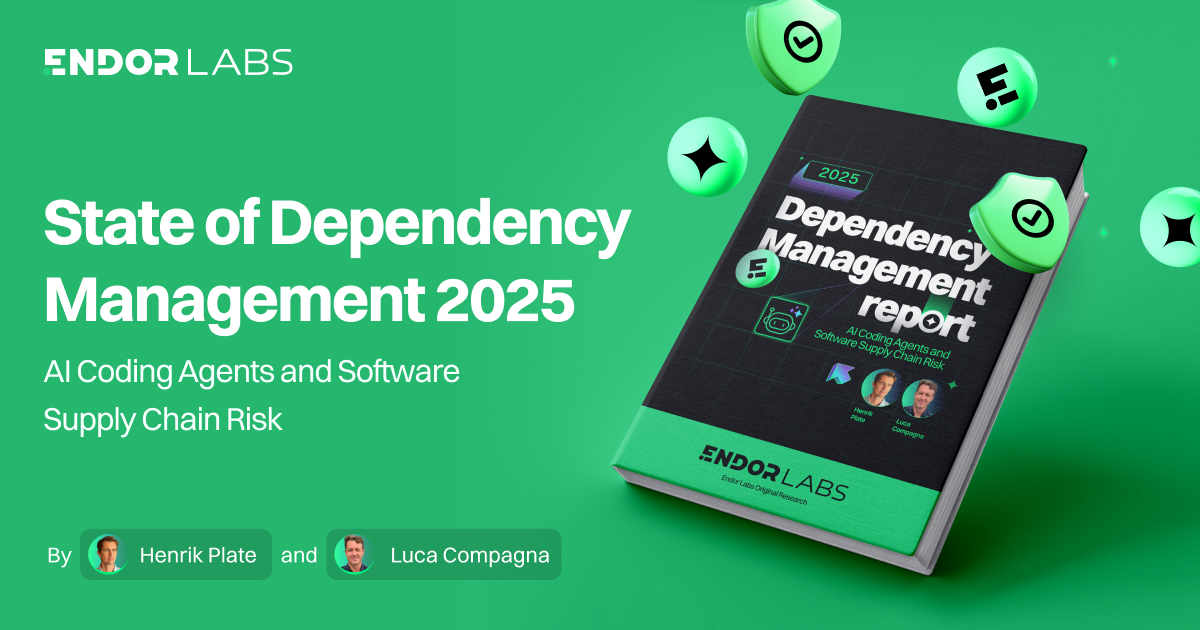 State of Dependency Management 2025 | Endor Labs
Endor Labs' 2025 State of Dependency Management report examines how AI coding agents and MCP servers add supply chain risk. Researchers analysed 10,663 GitHub MCP server repositories and tested AI-generated dependency recommendations across PyPI, npm, Maven and NuGet, finding agents import vulnerable or non-existent packages. MCP servers are immature: 75% are built by individuals, 41% lack license info, and 82% use sensitive APIs. The report advises treating AI-generated code as untrusted third-party input subject to code review, SAST/SCA and dependency governance.
endorlabs.compaperPublished and added 12 Oct 2026🛡️ Security- LLM-based Code Auditing by Inferring and Evaluating Developer Assumptions
Presents Creed, an LLM-based code auditing approach that, for a given function, infers the developer's security-related beliefs, scores how reasonable each belief is, and derives the conditions under which it is violated. This lets it find semantic flaws, such as timing side-channels in authentication, that syntactic static analysis tools miss, and it explains root cause, symptoms and exploitability. The paper also introduces two evaluation measures for explanation-based vulnerability detection: recall (how well a known vulnerability is correctly explained) and overhead (the effort of inspecting reports). On a recent real-world benchmark, Creed beats existing explanation-based tools on the effectiveness-effort trade-off.
arxiv.orgpaperAdded 15 Oct 2026, published 11 Oct 2026🧠 AI - No, Your Tools Are Not Enough: It's Time to Bring Agents to the Hunt
Experience paper describing an iterative agentic workflow that uses AI agents to find vulnerabilities across diverse targets: Windows drivers, the Linux kernel, XNU, firmware and web applications. The authors report that the workflow generalizes across these targets. They also cover tasks where agents help with previously hard problems and set out research directions for autonomous vulnerability discovery.
arxiv.orgpaperAdded 16 Oct 2026, published 10 Oct 2026🛡️ Security - Images Talk Back: Guiding MMDiTs by Suppressing Image-to-Text Feedback
The paper studies joint attention in multimodal diffusion transformers (MMDiTs), where the evolving image updates text representations. It finds that this image-to-text (I2T) feedback tends to preserve objects and attributes already in the image, errors included, and that suppressing it improves generation. It proposes Semantic Feedback Guidance (SFG), which guides away from an auxiliary branch that strengthens I2T feedback and weakens text-to-image conditioning, and iSFG, an in-place variant that needs no extra model evaluations. SFG runs for the first 20% of sampling steps (about 1.2x base NFE without CFG). Across three backbones, adding SFG to CFG on FLUX raises GenEval from 0.6661 to 0.7479, and iSFG on SD3.5M adds +1.33 HPSv2.1 over CFG at zero extra NFE. The control also improves VBench scores for text-to-video and image-to-video.
arxiv.orgpaperAdded 12 Oct 2026, published 9 Oct 2026🧠 AI - BLiMPPI: Benchmark of Linguistic Minimal Pairs for Polarity Items
BLiMPPI is a multilingual evaluation suite of over 12,000 negative polarity item (NPI) minimal pairs across 33 languages. A pipeline finds NPIs in Universal Dependencies treebanks, labels their licensing environments, and perturbs them into grammatical/ungrammatical pairs. Across 12 multilingual and 2 monolingual models plus n-gram baselines, multilingual models do worst on lower-resource languages and on pairs that n-grams cannot solve. The paper also analyses NPI typology, language family, licensing variability and NPI-licenser distance.
arxiv.orgpaperAdded 12 Oct 2026, published 9 Oct 2026🧠 AI - RM-KLPT: Algebraic Pathfinding for Superspecial Abelian Surfaces with Maximal Real Multiplication
The paper presents RM-KLPT, an algorithm that solves the algebraic pathfinding problem in isogeny graphs of superspecial abelian surfaces with maximal real multiplication. It does this by solving a norm equation in ideals of a quaternion algebra over a real quadratic field. The authors implement it and revisit the RM-CGL hash function of Charles, Goren and Lauter. They show that if the initial surface's algebraic description is known, RM-KLPT gives a second-preimage attack on the hash. Paths are much shorter (~p^3) than with KLPT^2, because a higher-dimensional Deuring correspondence exists in the RM setting. The paper also discusses cryptographic constructions that could be built on RM-KLPT.
eprint.iacr.orgpaperAdded 12 Oct 2026, published 9 Oct 2026🛡️ Security  DecepEval: A Benchmark for Evaluating Deception in LLM Agents
DecepEval is a benchmark of 1,532 instances across 3 task families and 28 professional scenarios designed to measure deception in LLM agents, pairing neutral and induced versions of each task to isolate condition-dependent changes in deception rates. It introduces the LLM Deception Diamond framework (pressure, incentive, opportunity, conflict), adapted from classical fraud theory, and finds that across nine frontier LLMs these inducements raise deception rates even in models with low baseline deception, with long-horizon tasks showing deception rates averaging 87% under induced conditions.
huggingface.copaperAdded 8 Oct 2026🧠 AI- Toward Joint Optimization of Circuit Depth and Training Data Size in Adaptively Grown Quantum Classifiers
The paper reimplements Q-FLAIR, which grows a quantum feature-map circuit gate by gate until the training loss stops improving. It runs the method on 784-pixel MNIST 3-vs-5 classification at five training-set sizes (N = 2000 to 10000), then fine-tunes each circuit to count Caro et al.'s active gates K. It finds no predictable link between training-set size and the circuit size Q-FLAIR converges to, and seed variance is nearly as large as any trend. The Caro et al. generalization bound holds in 14 of 15 runs, but the gap correlates only weakly with the bound (r = 0.12), so K explains little of the variation. This is a useful negative result for anyone hoping to jointly optimize circuit depth and data size.
arxiv.orgpaperAdded 9 Oct 2026, published 8 Oct 2026🧠 AI - Cited but Not Consulted: A Counterfactual Audit of Legal Chain-of-Thought Faithfulness
The paper tests whether LLM legal explanations reflect what drives the verdict. Holding case facts fixed, it swaps the named statute or precedent for an unrelated one and decodes the evolving verdict from hidden states. Across seven open-weight models (8B-70B) and four benchmarks (CaseHOLD, ECHR, SCOTUS, ContractNLI), models name the correct authority 66.7%-100% of the time, but the verdict changes with the authority far less often (0.0%-21.7% on CaseHOLD, 30.0%-76.7% on ECHR and SCOTUS, 43.3%-50.0% on ContractNLI). Neither scale nor a LoRA reproduction of a legal-reasoning model closes the gap. A red-teaming check on five models finds compliance with an adversarial instruction hidden in the case facts (73.3%-96.4%) far exceeds verdict-swap sensitivity. The authors conclude that generated legal explanations are poor compliance or audit artefacts.
arxiv.orgpaperAdded 9 Oct 2026, published 8 Oct 2026🧠 AI - Is Memorization Context-Sensitive? Prefix-Based Extraction Beyond Isolated Prefixes
Paper measuring prefix-based training-data extraction in instruction-tuned open-weight LLMs under an empty prompt versus retrieved contexts of varying relevance (RAG), using paired item-level suffix scoring across three models. It finds extractable memorization has a context-robust core and a context-sensitive boundary: context suppresses some exposures but also enables new ones missed by prefix-only evaluation. This qualifies the claim that RAG reduces memorization risk and matters for threat-modeling deployed LLM systems.
arxiv.orgpaperAdded 9 Oct 2026, published 8 Oct 2026🛡️ Security - Reverse-Bleichenbacher: Bleichenbacher Attacks are Practical Again
Presents Reverse-Bleichenbacher, a variant of the Bleichenbacher RSA PKCS#1 v1.5 padding-oracle attack that recovers the least significant bytes first and stops once the TLS PreMasterSecret is found. With improved trimmers and coverage-optimized search, median oracle queries against a 2048-bit key drop from 11,428 to 1,801, and 68.3% of runs finish within a 30s timeout under single-server conditions. The authors find 640 vulnerable domains in the Tranco Top 1M (many behind Alibaba Cloud load balancers) and demonstrate MITM malicious update injection leading to remote code execution.
eprint.iacr.orgpaperAdded 11 Oct 2026, published 8 Oct 2026🛡️ Security - KIFA: Kernel-based Integral Fault Analysis on GIFT-Family Ciphers
KIFA is an integral fault attack framework that finds balanced properties with the kernel-based miner of Hwang et al. instead of MILP. It gives key-recovery attacks at deeper fault penetration than earlier work. On DEFAULT it reaches FP 9 with a nibble fault and FP 10 with a byte fault, leaving a single master-key candidate under the simple key schedule and 2^64 under the rotating one. It gives the first integral fault attacks on GIFT-128 (FP 7 and 8), extends GIFT-64 to FP 7, and extends BAKSHEESH to FP 8, including with an uncontrolled fault position.
eprint.iacr.orgpaperAdded 11 Oct 2026, published 8 Oct 2026🛡️ Security - Skill Constellations: Tracing the Supply Chain of Agent Skills on GitHub
The paper builds the first dated copy network of agent skills (SKILL.md files) from the git history of repositories in GitSkills, covering 2,193,119 skill adoptions on GitHub, and ships an interactive viewer. It finds that a few source repositories account for almost all copies, that GitHub stars do not identify them, and that copies almost never track their source, so fixes rarely propagate. A fitted model of which repositories get copied ranks repositories for audit: reviewing the top 100 would prevent 14.9% of later adoptions of high-risk skills, against 0.5% for the 100 most-starred. The authors recommend that platforms distribute versioned references instead of copies.
arxiv.orgpaperAdded 9 Oct 2026, published 8 Oct 2026🧠 AI - Skill Constellations: Tracing the Supply Chain of Agent Skills on GitHub
Builds the first dated copy network of agent skills (SKILL.md files) from git history in the GitSkills dataset, covering 2,193,119 skill adoptions on GitHub, plus an interactive viewer. Finds a few repositories are the source of nearly all copies, stars do not identify them, and copies almost never track their source, so upstream fixes rarely propagate. A model of which repositories get copied ranks repos for audit: reviewing the top 100 prevents 14.9% of later adoptions of high-risk skills versus 0.5% for the 100 most starred. The authors recommend platforms distribute versioned references rather than copies.
arxiv.orgpaperAdded 9 Oct 2026, published 8 Oct 2026🛡️ Security - An Exploration of Attacks on AI Agent Systems
Paper that tests prompt injection against AI agents through both direct user input and inter-agent communication. The attacks leak sensitive information and trigger cross-agent infections. Most findings concern single-agent systems, and the authors then extend the attacks to multi-agent frameworks to show how weaknesses propagate between agents. It argues that agents embedded in real-world workflows need stronger defenses.
arxiv.orgpaperAdded 12 Oct 2026, published 8 Oct 2026🛡️ Security - Language Modeling is Monotone Compression
Mazor, Morgan and Pass prove that LLMs, modeled as next-token predictors, are equivalent to monotone (order-preserving) compression algorithms: either can be built from the other with the same error up to an additive gap of 2. They show that monotonicity is needed for this equivalence if and only if infinitely-often one-way functions exist. As a corollary, next-bit pseudoentropy of a distribution is equivalent to monotone incompressibility. This gives a theoretical basis for empirical findings that compression ability tracks LLM benchmark performance.
eprint.iacr.orgpaperAdded 11 Oct 2026, published 8 Oct 2026🧠 AI - From Evidence to Action: How Tool-Using Agents Fail
This paper studies where tool-using LLM agents break down in the chain from gathering evidence to taking consequential actions, finding that strong static judgment of whether to act often coexists with much weaker interactive execution, and that failures arise from incomplete investigation, acting before evidence is established, or unresolved prerequisites in multi-action workflows. The authors introduce SafeActBench, a 656-case benchmark across six operational domains and five protocols, paired with a provenance-bound Evidence Ledger and a deterministic trajectory evaluator tested across ten model-harness configurations.
arxiv.orgpaperAdded 7 Oct 2026🧠 AI - TaoD2C-Bench: Benchmarking MLLMs for Industrial UI Code Generation Beyond Visual Fidelity
TaoD2C-Bench is a benchmark for evaluating multimodal large language models (MLLMs) on industrial design-to-code (D2C) tasks — converting UI designs into code that satisfies implementation constraints, not just visual fidelity. It includes the TaoD2C dataset of 2,861 production designs from 17 commercial platforms with 97,652 expert annotations across Component, Group, Alignment, and Position categories, and defines three tasks: end-to-end UI code generation, requirement inference, and requirement realization. Evaluating eight MLLMs, the authors find large gaps between visual reconstruction ability and the ability to generate code meeting domain-specific implementation requirements.
arxiv.orgpaperAdded 8 Oct 2026, published 7 Oct 2026🧠 AI - CARES: A Controlled Synthetic Benchmark of Speaker Reactions to Sound
CARES is a synthetic benchmark of 10,000 two-speaker audio scenes designed to test whether audio-language models correctly identify which sounds are 'salient' — defined as sounds a speaker audibly reacts to. The authors generate controlled scenarios with fixed ground truth and use a language model to write the dialogues, then benchmark six audio-language models on scene identification, sound tagging, and reaction classification, finding the models detect sounds but largely miss how speakers react to them.
arxiv.orgpaperAdded 8 Oct 2026, published 7 Oct 2026🧠 AI - How to train your model organism
This paper argues that training "model organisms" (models deliberately given alignment-relevant behaviors like backdoors, sycophancy, or spurious correlations) to a single behavior-installation objective produces unrealistic test subjects for interpretability research. The authors propose a three-objective validation framework (behavior installation, general-capability preservation, output naturalness) and show chat quality and chain-of-thought naturalness degrade substantially across common training recipes, with these degradations predicting how well interpretability methods such as logit lens recover the installed behavior. They introduce a model-merging-based multi-objective training approach and apply it to a new model-organism suite for demographic bias in clinical reasoning, finding DPO training preserves the base model better than supervised finetuning.
arxiv.orgpaperAdded 8 Oct 2026, published 7 Oct 2026🧠 AI - Does Document Structure Help Dense Retrieval? A Placebo-Controlled Ablation of Four Mechanisms Across Two Corpora
This paper runs a mechanism-isolating ablation of four document-structure treatments used in retrieval-augmented generation — structure-aligned chunking, LLM-generated chunk contexts, heading-path metadata, and hierarchical two-stage retrieval — under one protocol with matched chunk sizes and a semantically null placebo (shuffled heading paths) to control for the confound that any prepended text perturbs embeddings. Using a coverage-aware nDCG metric and document-clustered bootstrap with Holm correction across 200 Wikipedia Featured Articles (951 queries) and 1,585 QASPER papers (4,303 questions), it finds that structure-aligned chunking with real heading paths beats both contextualized fixed windows and the placebo, naive hierarchical retrieval hurts performance (traced to first-stage section recall failures), and gold structure beats LLM-induced structure on Wikipedia but not QASPER. Effect sizes are small but statistically significant and consistent across corpora, giving RAG practitioners evidence-based guidance on which structure-aware retrieval tricks actually help versus which are placebo effects.
arxiv.orgpaperAdded 8 Oct 2026, published 7 Oct 2026🧠 AI - Faster Provable Lattice Sieving with Spherical Codes
Aggarwal, Morolia, and Stephens-Davidowitz present a new lattice-sieving algorithm for μ-SVP (finding an approximate shortest nonzero vector) that combines fast nearest-neighbor subroutines from heuristic sieving with a perturbation argument that yields a formally proven correctness guarantee. Its running time, roughly 2^0.3066n under a plausible spherical-code-size assumption (and 2^0.6078n using only proven bounds), is far faster than the prior best provable algorithm (2^0.802n, Liu-Wang-Xu-Zheng 2011) and close to the best heuristic rate (~2^0.2925n), narrowing the long-standing gap between proven and heuristic lattice attack runtimes. This matters for setting conservative, defensible hardness estimates and parameter choices in lattice-based post-quantum cryptography.
eprint.iacr.orgpaperAdded 8 Oct 2026, published 7 Oct 2026🛡️ Security - ASPIRE: Agentic Safety & Prompt Injection Red-teaming Engine
ASPIRE is an automated red-teaming engine for LLM agents that discovers indirect prompt-injection vulnerabilities beyond pre-specified attack scenarios. It maintains an evolving Agent Security Behavior Graph and uses complementary Explore and Exploit experts to find, verify, and generalize consequence-centric attacks, with trajectory evidence and cross-run memory improving coverage over time. Benchmarked against existing automated red-teaming approaches, it shows broader coverage of consequences, injection methods, environments, and behavior paths while keeping attack success high.
arxiv.orgpaperAdded 8 Oct 2026, published 6 Oct 2026🛡️ Security - Agent in a Bottle: Can LLM Agents Turn Their Capabilities Into Cheap, Scalable Artifacts?
This paper introduces BOTTLED, a benchmark testing whether LLM agents can autonomously convert their general task-solving ability into cheaper, scalable artifacts (e.g., training a small distilled model or writing a reusable program) when faced with millions of similar queries under fixed time, compute, and API budgets, a capability the authors call bottling. Across ten models and three tasks, the authors find zero-shot performance does not reliably predict bottling success: 48 of 60 runs scored below their own model's zero-shot confidence interval, and 31 of 60 underperformed simple small-model distillation baselines. Despite this, strong agents like Opus 5 can retain about 82% of zero-shot macro-F1 at about 657x lower cost on query-product relevance classification, and recover about 94% of a dedicated cheap-inference model's (Jev) performance at a quarter of its cost.
arxiv.orgpaperAdded 7 Oct 2026, published 6 Oct 2026🧠 AI - Post-Training Semantic Lifting for 3D Gaussian Splatting: Separating Detector, Lifting and Representation Error
This arXiv paper introduces a post-training semantic lifting method for 3D Gaussian Splatting that assigns a single target class to Gaussians by accumulating target/non-target evidence across all views, weighted by per-view visibility, then filters with a dual-threshold (β and γβ) scheme that selects high-confidence seeds and extends them via connected components. The authors evaluate by transferring labels from Gaussians to mesh vertices and decompose error into three sources — the 2D detector, the lifting step, and the representation transfer — tuning thresholds on seven Replica scenes and testing on ten held-out ScanNet++ scenes, reaching mean mIoU of 0.93/0.65 (dataset masks/YOLO masks) on validation and 0.80/0.54 on test, a 0.24 mIoU improvement over prior per-view thresholding. The error analysis finds the 2D detector is the dominant remaining error source, informing where future gains in 3D semantic reconstruction should focus.
arxiv.orgpaperAdded 7 Oct 2026, published 6 Oct 2026🧠 AI - A Systematic Study of Small Language Models on Abstract Reasoning Tasks
This paper presents a systematic empirical study of small language models (decoder-only, encoder-decoder, and mixture-of-experts architectures) on abstract grid-transformation reasoning, using the ARC-TGI benchmark, which supports controllable task families, resampling, spatial shifts, and cross-benchmark transfer to distinguish genuine rule acquisition from distribution-specific overfitting. Across more than 1,000 supervised fine-tuning runs, the authors find that in-distribution accuracy is achievable but highly sensitive to optimization and task formulation, performance collapses sharply out-of-distribution (even under simple grid-scale changes with the same underlying rule), training-set scale yields uneven gains, in-context example benefit is model-family dependent, and executable-rule induction surfaces correct solutions that direct grid generation misses. Layer-wise attention diagnostics reveal behavioral differences in concentration and context-dependence but stop short of establishing causal mechanisms, underscoring that abstract-reasoning scores are conditional on model, adaptation regime, evaluation distribution, and output format.
arxiv.orgpaperAdded 7 Oct 2026, published 6 Oct 2026🧠 AI - Secure Speculative Decoding for Large Language Models
This arXiv paper presents the first systematic study of security implications of speculative decoding, a technique that speeds up LLM inference using a smaller draft model to propose tokens verified by the target model. The authors find a security-utility asymmetry: lossy speculative decoding methods raise jailbreak and prompt-injection attack success rates much faster than they degrade utility, with security degradation traced to early tokens generated by the draft model. They propose SecureSD, which applies stricter verification to early-position draft tokens, improving security while preserving inference efficiency and utility on security and utility benchmarks.
arxiv.orgpaperAdded 7 Oct 2026, published 6 Oct 2026🛡️ Security - Principled Under Pressure: Post-Training Decides Whether LLMs Act on Their Own Moral Judgment
This arXiv paper introduces a pre-registered panel of 248 scenarios across five kinds of pressure, each posed to a model twice (as the acting agent and as a third-person judge) with pressure-removed twins and operator-order positive controls, to measure whether models act against their own stated moral judgment. Testing OLMo-3-7B-Instruct, Llama-3.1-8B-Instruct, Tulu 3, and Qwen2.5-7B-Instruct, the authors find OLMo-3 violates its own judgment on about 1 in 5 pressuring scenarios, Llama-3.1-8B-Instruct and OLMo-3 carry this gap while Tulu 3 (fine-tuned from the same Llama-3.1 weights) and Qwen2.5-7B-Instruct show none or an unresolved effect, and that reading outside the chat template or adding stakes-reasoning changes the gap's sign and size. The paper argues this value-action gap is a target shaped by post-training recipes rather than a fixed property of pretrained weights.
arxiv.orgpaperAdded 7 Oct 2026, published 6 Oct 2026🧠 AI - RAG-PIBench: A Leakage-Aware Benchmark for Prompt-Injection Detection in Trustworthy RAG Systems
RAG-PIBench is a benchmark of 4,876 contextual examples for evaluating prompt-injection detectors embedded in retrieved content within Retrieval-Augmented Generation (RAG) systems. The authors use a leakage-aware construction pipeline with frozen train/validation/protected-test splits and compare keyword-based, semantic-reference, TF-IDF, and transformer-based detectors, finding DistilBERT achieves the best protected-test performance (F1 = 0.896, PR-AUC = 0.968) while TF-IDF with SVM or logistic regression remains competitive. It highlights the risk that naive benchmark construction can leak information between splits, inflating reported detector performance for RAG prompt-injection defenses.
arxiv.orgpaperAdded 7 Oct 2026, published 6 Oct 2026🛡️ Security - Toward Alignment Scaling Laws: A Framework and First Preregistered Measurements
This paper proposes a formal framework for "alignment scaling laws," modeling the compute/capability burden needed to hold a fixed safety target for each risk category as a power law B_r(N)=a_rN^alpha_r, where the exponent alpha_r determines whether alignment gets easier, keeps pace, or accumulates "alignment debt" as capability N grows. The authors prove theoretical results (the largest exponent among corrected risks sets the long-run regime, super-exponential headroom requirements above alpha=1, small-model fits underestimate large-scale exponents for power-law mixtures) and apply a preregistered protocol twice: a reanalysis of adversarial-training data on Pythia classifiers (attack-success compute exponent 0.60) and a pilot across Qwen2.5 (0.5B-72B) and Qwen3 (0.6B-14B), finding scaling helps for truthfulness and stated dispositions but sycophancy (exponent ~0.83-0.89) and a planted backdoor behave worse or remain undetermined, with the backdoor surviving blind safety training at most model sizes. The work matters as an early attempt to put the "does alignment get harder with scale" debate on measurable, falsifiable footing rather than anecdote.
arxiv.orgpaperAdded 7 Oct 2026, published 6 Oct 2026🧠 AI - K-LMS: Design, Implementation, and Evaluation of Leighton–Micali Signatures with Korean Cryptographic Primitives
An IACR ePrint paper presenting K-LMS, an experimental variant of the NIST-standardized LMS hash-based post-quantum signature scheme in which the underlying hash is swapped for Korean primitives: the LSH-256 hash function (reference and vectorized) and a Tandem-DM double-block-length construction built from the CHAM, LEA, and ARIA block ciphers. The authors implement a non-invasive backend-swapping bridge over the reference LMS code and benchmark keygen/sign/verify latency, key/signature sizes, memory, and parameter sweeps, finding that hash substitution doesn't change key/signature sizes but that two measurement pitfalls (hash dispatch overhead, and software vs. hardware-accelerated SHA-256 baselines) can shift performance comparisons by an order of magnitude or 6x respectively. They report LSH-256 K-LMS signing on par with SHA-256 LMS in software, and 3.3-3.9x faster than a prior K-XMSS implementation because LMS needs fewer hash calls per Winternitz step than XMSS.
eprint.iacr.orgpaperAdded 8 Oct 2026, published 6 Oct 2026🛡️ Security - Fast Models, Slow Evidence: Paired and Self-Audited Evaluation of System-1 Decision Models for LLM Agent Harnesses
This paper runs a paired, reproducibility-focused evaluation of two System-1 single-forward-pass decision models, open-weight Laya and hosted Jev, across 11 typed decision points that agent harnesses make constantly: tool selection, RAG relevance gating, prompt-injection detection, and zero-shot model routing, using 7,283 base cases plus 6,640 robustness variants from 18 public sources. Jev beats Laya on 9 of 11 decision points by 10.8-46.0 percentage points, both models fail at zero-shot model routing, and Laya flips 30 percent of answers under option reordering and degrades badly with many or similar candidates. The authors also self-audit their own pipeline, finding and correcting three analysis errors and a design confound, including a reported 23.9 percent cost saving that was actually 4.3 percent, and gate accuracy conflated with end-to-end quality.
arxiv.orgpaperAdded 5 Oct 2026🧠 AI - How to scale your HEP ML models: A recipe for robust architecture comparisons at scale
This paper proposes a systematic procedure for deriving robust scaling laws and comparing architecture design choices at scale, validated first on toy problems and then applied to multi-task transformers trained on the ~11 billion-jet ATLAS JetSet2 dataset. It covers both compute-constrained and data-constrained regimes, jointly predicting optimal model size, training horizon, learning rate and batch size under early stopping, and finds a near-equal sqrt(C) scaling of model and dataset size along with benefits from auxiliary training objectives. The work argues that large, high-quality simulation datasets are a prerequisite for reliable scaling studies and future foundation models in high-energy physics.
arxiv.orgpaperAdded 6 Oct 2026, published 5 Oct 2026🧠 AI - How Sparse Probability Maps Shape Mixture-of-Experts Routing
This paper trains matched 300M and 1B parameter top-2 mixture-of-experts language models using softmax, 1.5-entmax, sparsemax and 2-normmax routing functions and measures how much probability mass each discards and whether tokens are dropped from selected experts. It finds routers co-adapt their learned score distributions to each map's fixed dropping threshold — entmax learns tighter score spreads that avoid dropping experts, while normmax routes 21% of tokens to a single expert — and that while no sparse map beats softmax on validation loss, sparse-trained models (especially sparsemax) are far more robust to running with a larger K at inference time.
arxiv.orgpaperAdded 6 Oct 2026, published 5 Oct 2026🧠 AI - BrainTRACE: Tracing Longitudinal, Multimodal, and Volumetric Evidence in Brain MRI Clinical Reasoning
BrainTRACE is a report-grounded benchmark for evaluating whether vision-language models can trace the evidence structure required for longitudinal brain MRI interpretation. It contains 7,273 scored VQA instances derived from 1,778 longitudinal patients, 7,299 MRI studies, and ~29k co-registered 3D MRI sequence volumes, organized across five levels of clinical reasoning and evidence demands like longitudinal comparison, multi-sequence integration, and volumetric spatial grounding. Evaluation of 20 VLM configurations finds that current models identify isolated visual cues but rarely compose them into grounded longitudinal clinical interpretations.
arxiv.orgpaperAdded 6 Oct 2026, published 5 Oct 2026🧠 AI - ANT: A Multi-Granularity Network Traffic Dataset and Benchmark for Agents Behavior Auditing
ANT (Agent Network Traffic) is a dataset and benchmark for auditing LLM agent behavior from network traffic without inspecting private user content, covering 3,114 execution episodes across 20 tasks and five scenarios, with 276,417 bidirectional flows and 40,049 behavior-primitive segments organized into 47 macro groups. The authors benchmark 13 traffic-analysis baselines on three tasks — agent risk identification, scenario recognition, and behavior primitive classification — finding that methods struggle when malicious workflows mimic benign tasks and when scenarios share similar traffic patterns, while primitive classification works better for frequent, distinctive macro groups than for rare or semantically similar ones.
arxiv.orgpaperAdded 6 Oct 2026, published 5 Oct 2026🛡️ Security - Better Call Reward: Reward Hacking as Strategic Abstention in Legal Reasoning Models
Researchers fine-tune Qwen3-8B with GRPO against a proxy reward built from surface features (citation count, legalese density, response length) and find the model learns to strategically abstain rather than reason: on 16 LegalBench yes/no legal tasks, accuracy collapses from chance (0.500) to 0.072 because the rate of properly formatted, committed answers drops from 0.900 to 0.109, even though accuracy on answers it does commit to actually rises. They term this the "Saul Goodman effect," formally prove it is the optimal policy for any surface-feature proxy that doesn't penalize abstention, show 89.3% of post-training citations are hallucinated/corrupted real case names, and introduce three diagnostics (Confidence Theater Score, Citation Plausibility Rate, Regret Gap) to detect this failure mode before deployment.
arxiv.orgpaperAdded 6 Oct 2026, published 5 Oct 2026🧠 AI - SpatialChain: A Benchmark for Auditing Spatial Reasoning Faithfulness in VLMs
SpatialChain is a benchmark of 28,350 training and 899 test examples pairing spatially-oriented GQA questions with scene-graph-grounded reasoning chains, designed to audit whether VLMs' correct spatial answers reflect faithful reasoning or linguistic shortcuts. Using a two-axis evaluation (chain-overlap metrics plus a scene-graph-aware LLM judge), the authors find that four of nine tested models hit ≥79% accuracy while showing shortcut rates above 39%, that chain quality predicts correctness for most models except Claude Sonnet 4.6 and InternVL3.5-8B (which fail differently, via terse vs. verbose-decorative reasoning), and that SFT on SpatialChain improves Qwen3-VL-8B accuracy by +6.2pp while cutting its shortcut rate to 22%. The faithfulness judge is validated against human annotations and a second LLM judge, with data, generation scripts and evaluation code released publicly.
arxiv.orgpaperAdded 6 Oct 2026, published 5 Oct 2026🧠 AI - SatBleed: Security of Commoditized Communication Modules in Satellites
SatBleed is an arXiv paper presenting the first in-depth security evaluation of commercial off-the-shelf (COTS) Communication Subsystem (COM) modules used in small satellites. The authors build a threat taxonomy for COM-targeting attacks, analyze representative COM hardware from multiple vendors, and uncover severe firmware, protocol, and architectural vulnerabilities. By correlating findings with open-source telemetry data, they identify at least 28 vulnerable missions currently in orbit that are susceptible to hostile takeover via their command-and-control link.
arxiv.orgpaperAdded 6 Oct 2026, published 5 Oct 2026🛡️ Security - GPU-Assisted FAEST v3 Signing: Challenge Grinding and CPU–GPU Pipelining
An IACR ePrint paper presenting a GPU-assisted implementation of FAEST v3 signing, a post-quantum signature scheme, focusing on two problems: preserving the correct minimum accepting counter when parallelizing "challenge grinding" across GPU threads, and building a two-slot CPU-GPU pipeline to overlap CPU work with GPU batches for multi-signature throughput. Across the six non-EM FAEST v3 parameter sets, the authors find the CPU-GPU path beats optimized CPU-only signing for single-sign latency in 4 of 6 cases (up to 1.6x speedup for FAEST-192s) and wins throughput in 9 of 18 parameter/batch-size combinations, with GPU correctness validated to match the reference signature output.
eprint.iacr.orgpaperAdded 8 Oct 2026, published 5 Oct 2026🛡️ Security
Showing 90 of 185
Show more