- llm-trails: What LLMs reach for inside a breached AWS account
llm-trails is an open study of what LLMs choose to do next inside a breached AWS account. It puts 14 models in 13 post-compromise situations, records only a single-turn plan with nothing executed, and codes each answer to CloudTrail events. The repo has the llmtrials harness, prompts, codebook, processed dataset (viz_data.json) and an interactive dashboard, so the study can be rerun or extended.
 github.comrepoAdded 30 Oct 2026🧠 AI
- rikugan: LLM reverse-engineering agent for IDA Pro and Binary Ninja
Rikugan is a reverse-engineering agent that runs inside IDA Pro and Binary Ninja. It has its own generator-based agent loop, context management, plan mode and 60+ tools, and does not depend on an external MCP server. An orchestrator spawns parallel subagents to analyze a binary. It supports Anthropic, Gemini, MiniMax, Kimi, OpenAI-compatible endpoints and Ollama, with per-model notes.
github.comrepoAdded 30 Oct 2026🧠 AI - rikugan: LLM reverse-engineering agent for IDA Pro and Binary Ninja
Rikugan is an open-source reverse-engineering agent that runs inside IDA Pro 9.0+ and Binary Ninja, with its own agent loop instead of an MCP server. It has 60+ tools (decompiler, xrefs, strings, types, IL/microcode), parallel subagent exploration, an experimental /modify natural-language patching command and an experimental Binary Ninja deobfuscation skill for control flow flattening and opaque predicates. It supports Claude, Gemini, MiniMax, Kimi, OpenAI-compatible endpoints and Ollama.
github.comrepoAdded 30 Oct 2026🛡️ Security - llm-trails: What LLMs reach for inside a breached AWS account
llm-trails is a research repo that placed 14 LLMs in 13 post-compromise AWS situations, asked only for their next move (single-turn, nothing executed), and coded each answer to CloudTrail events. It includes the llmtrials harness, prompts, codebook, processed dataset (viz_data.json) and an interactive dashboard. Rates are conditioned on the situation shown, and the aim is turning model behavior into detection priorities.
github.comrepoAdded 30 Oct 2026🛡️ Security - Show HN: I Turned DOOM into a Transformer
Doomformer compiles integer neural networks into ZDoom maps that run in ViZDoom. Voodoo dolls do the arithmetic, and sector light levels and plane heights hold the values. Python reads every value back and compares it with a NumPy integer reference at tolerance 0. It runs MNIST (97.16 % on all 10,000 digits, every pass exact), small transformers, a learning perceptron and a SUBLEQ machine. It is about 23,000 times slower than NumPy on a small MLP.
github.comrepoAdded 30 Oct 2026, published 29 Oct 2026🧠 AI - Show HN: Auto Dismiss Mac OS "Allow <app> to find devices on local networks?"
dontallow is a two-file Swift launchd agent for macOS 15 and later that clicks "Don't Allow" on the "find devices on local networks" prompt. It watches the UserNotificationCenter process through an Accessibility observer, supports pause and allowlist, and can decode the Local Network rule store to show orphaned rows. It explains why Chromium temp-bundle paths make the prompt recur, and gives a PPPC profile route for fleets.
github.comrepoAdded 30 Oct 2026, published 29 Oct 2026🛡️ Security - Show HN: Hob - Open-source, on device alternative to Claude Cowork and ChatGPT
Hob is an MIT-licensed desktop app from Frigade that runs open-weight models such as Gemma and gpt-oss locally on Mac, Windows and Linux. It picks the best open-weight model that fits the user's computer and sets it up. It is positioned as a free, private, offline alternative to Claude and ChatGPT for tasks like filling out PDFs and working through documents. The page gives no technical detail on its runtime.
github.comrepoAdded 27 Oct 2026, published 26 Oct 2026🧠 AI - alirezarezvani/claude-skills
claude-skills is an MIT-licensed library of about 398 Claude Code skills, agents, personas and plugins across 20 domains, including engineering, marketing, compliance and C-level advisory. Each skill is a SKILL.md with stdlib-only Python CLI tools and reference docs. Install scripts and convert.sh adapt it to Codex, Gemini CLI, Cursor, Aider, Windsurf and other coding agents, and it includes a skill-security-auditor scanner.
github.comrepoAdded 25 Oct 2026🧠 AI - alirezarezvani/claude-skills
claude-skills is an open-source MIT library of about 398 Claude Code skills, agents and plugins that also installs into Codex, Gemini CLI, Cursor and 9 other coding agents. The security-relevant parts are skill-security-auditor, a stdlib-only Python scanner that checks skills for command injection, data exfiltration, prompt injection and dependency supply-chain risks before install, plus a security-guidance PreToolUse hook, a security suite and compliance skills (ISO 27001, SOC 2, GDPR).
github.comrepoAdded 25 Oct 2026🛡️ Security - SnailSploit/Claude-Red
claude-red is an MIT-licensed library of offensive security skills for the Claude Skills system, planned at about 130 skills across 23+ categories (web, Active Directory, cloud, exploit development, EDR evasion and others). Each skill is a SKILL.md file that loads on conversational triggers, so unused skills cost no context. It installs by git clone, sparse checkout per category, install.sh or pasting into a system prompt.
github.comrepoAdded 22 Oct 2026🧠 AI - OpenAI CLI
OpenAI CLI is OpenAI's official Go command-line client for the REST API. It lets users generate images, upload and download files, create and wait on batches, call the Responses API, and query admin usage endpoints from a terminal or shell script. It supports JSON, JSONL and YAML output, GJSON transforms, shell completion, and install via Homebrew, go install or release binaries.
github.comrepoAdded 23 Oct 2026, published 22 Oct 2026🧠 AI - Show HN: Omnara – Open-source alternative to Claude Managed Agents
Omnara is an open-source, self-hostable managed agent platform, an alternative to Claude Managed Agents and OpenAI's Agents API. It runs agents on any model (OpenAI, Anthropic, OpenRouter, Bedrock, LiteLLM, Ollama) and any machine, with Postgres-backed durable state, stateless workers, per-tool permissions, MCP, skills, memory, subagents, schedules and Slack, Discord and GitHub triggers. It ships a REST API, TypeScript SDK, CLI and Docker Compose setup.
github.comrepoAdded 23 Oct 2026, published 21 Oct 2026🧠 AI - vxcontrol/pentagi
PentAGI is an open-source, self-hosted multi-agent system that uses LLM agents to carry out penetration testing tasks autonomously. The MIT-licensed repo has a Go backend, a React frontend and GraphQL. It ships Docker Compose files for Langfuse tracing, Graphiti knowledge-graph memory and an observability stack. Topics list OpenAI and Anthropic as model backends.
github.comrepoAdded 20 Oct 2026🧠 AI - Show HN: VoidAccess – open-source dark web OSINT, from query to a graph
VoidAccess is a self-hosted, MIT-licensed dark web OSINT platform that runs a 13-step pipeline from a research query to a relationship graph. It collects from Tor indexes, paste sites, code forges, security feeds and .onion seeds, applies content-safety filters, and exports STIX 2.1, MISP, Sigma, YARA, Snort, Suricata, CSV and JSON. It runs as a CLI with SQLite or as a Docker Compose stack with PostgreSQL, FastAPI and Next.js.
github.comrepoAdded 21 Oct 2026, published 20 Oct 2026🛡️ Security - better-isms/grcskills
grcskills is a library of 60 plain SKILL.md files in the Agent Skills format, each describing how an experienced practitioner does one piece of governance, risk and compliance work. Examples are scope statements, risk registers, audit prep, vendor review and incident handling. Every skill names where the agent must stop and hand the decision to a person. Installs are pinned to reviewed release tags and checked by a validator.
github.comrepoAdded 20 Oct 2026🧠 AI - better-isms/grcskills
grcskills is an MIT-licensed library of 60 SKILL.md files (Agent Skills format) that let coding agents draft and prepare governance, risk and compliance work: scope statements, statements of applicability, risk registers, audit prep, vendor review, policies, privacy, incidents and continuity. Each skill names where the agent must stop so a person decides. Installs are pinned to release tag v2026.10.19.2, and a validator rejects network commands and credential paths.
github.comrepoAdded 20 Oct 2026🛡️ Security - ralphtradesz/trading-hub
Trading Hub is a free macOS desktop trading platform built with C#/.NET 10 and Avalonia. It uses the user's Claude Code subscription: a chat writes and fixes C# strategies, an in-app MCP server lets Claude run backtests, optimizations and walk-forwards and write reports, and a risk agent proposes position sizes. Install and a Windows port are both driven by Claude Code prompts. License is MIT with Commons Clause.
github.comrepoAdded 19 Oct 2026, published 17 Oct 2026🧠 AI - DietrichGebert/ponytail
Ponytail is a single skill prompt (skills/ponytail/SKILL.md, with a compact AGENTS.md) that makes coding agents write only the code a task needs, reusing existing components while keeping validation, error handling, security and accessibility. The author benchmarked it in Claude Code with Opus 5.5 over 39 tasks, 5 runs each, including a real FastAPI + React repo. They report -53% code, -41% time, -26% cost and -45% tokens, and 98% of risky logic shipping with a test versus 68% without. It adds /ponytail-review and /ponytail-audit commands, a Claude Code cost/token band with a local board, and installs through Claude Code and Codex plugin marketplaces or as a rules file for Cursor, Copilot, Gemini, OpenCode and others.
github.comrepoAdded 17 Oct 2026🧠 AI  DeepSeek-v4.1-Flash-1017
Model card for DeepSeek-V4.1-Flash-1017, a minor update to DeepSeek-V4.1-Flash with MIT-licensed weights. It claims gains in reasoning, coding, agentic tasks and visual benchmarks, with shorter task time and output length that move the performance–cost Pareto frontier across agent harnesses (Claude Code for Terminal-Bench 4.0, Mini-SWE-V2 for DeepSWE v1.1). It ships no Jinja chat template. It provides a reference encoding.py for multi-turn chat, tool calling, thinking mode, numeric reasoning effort and interleaved images, plus deepseek-recipe, Rust libraries with Python bindings for prompt encoding and output parsing. Serving recipes are given for Transformers, vLLM, SGLang and Docker Model Runner.
 huggingface.corepoAdded 18 Oct 2026, published 17 Oct 2026🧠 AI
- Llama.cpp on a jailbroken PS5: run any GGUF model natively on the console
PS5LM is a homebrew app for jailbroken PS5s (firmware 7.00–13.60). It runs llama.cpp with the ggml-vulkan backend on the console's RDNA 2 GPU, using 11.4 GB of shared memory, and loads any GGUF model. It serves OpenAI /v1/chat/completions, Anthropic /v1/messages (usable from Claude Code, Codex and opencode) and a browser chat page on port 8081. It also supports image-projector vision models and TypeSafe-style decision models through a /v1/systemone endpoint. A planner picks the longest context and best cache that fit the free memory, and the app downloads models from Hugging Face.
github.comrepoAdded 17 Oct 2026, published 16 Oct 2026🧠 AI - OpenMOSS/MOSS-Image
MOSS-Image is an open-source text-to-image model family from OpenMOSS with a 5B backbone, released October 2026 as MOSS-Image-Base and MOSS-Image-SFT. It supports JSON layout control with bounding boxes, text rendering inside images, and prompts up to 4K tokens. The repo gives a Diffusers pipeline, a Gradio app, a ComfyUI plugin, LoRA training guidance, a prompt-enhancer skill and day-0 SGLang and vLLM-Omni support.
github.comrepoAdded 20 Oct 2026, published 16 Oct 2026🧠 AI - Show HN: Graphicle, a Rust port of Graphify with memory for coding agents
Graphicle is a local-first Rust program that parses a repository into a tree-sitter code graph (a port of Graphify) and adds project memory: docs, reviewed decisions and captured Claude Code/Codex sessions. It serves cited file-and-line excerpts within a token budget via one MCP server, CLI and browser app, backed by a single SQLite file, with no API key or telemetry. The README reports a code-only extract on Kubernetes (31k files) in 3m18s versus 26m38s for Graphify 0.9.88, and a memory comparison against seven systems. Agent-proposed memories need user approval and go stale when the code they reference changes.
github.comrepoPublished and added 14 Oct 2026🧠 AI - BijectiveLabs/trading-research-agents
Open-source Python CLI (`tra`) for autonomous trading desks in which LLM analysts (technical, macro, on-chain, sentiment) and validators only give opinions on figures the system computed. Fixed rules do the arithmetic: pricing the round-trip cost, applying risk limits, sizing, cost gates, and sending a single order with stop attached via ccxt (Bybit and OKX demo accounts tested). It supports multiple model providers with per-role models, effort settings and fallbacks. Every answer is parsed against a closed schema, every refusal is logged with the figure behind it, and models can tighten but never loosen controls. This makes it a concrete reference for keeping LLM agents away from arithmetic and money.
github.comrepoAdded 18 Oct 2026, published 13 Oct 2026🧠 AI - BijectiveLabs/bitra
bitra (CLI name tra) is an MIT-licensed Python framework from Bijective Labs for autonomous trading agents. Language models only read system-computed figures and give opinions, while deterministic code prices the round trip, applies declared limits, sizes the trade and sends one order with stop attached. Every cycle's briefs, answers and refusals are stored on disk with hashes. It supports many model providers and ccxt venues, with sandbox, demo and mainnet tiers.
github.comrepoAdded 25 Oct 2026, published 13 Oct 2026🧠 AI - santosomar/AI-agents-for-cybersecurity
Companion repository for Omar Santos's Pearson and O'Reilly trainings and books. It has eight parts of runnable Python labs: chat models, embeddings, prompt templates, LCEL prompt chaining, Chroma-based RAG, ReAct/LangGraph/CrewAI/DeepAgents agents, and FastMCP servers (nmap, CISA KEV, Shodan). It also includes guides to six agentic frameworks (OpenClaw, Hermes, Agent Zero, OpenHands, Paperclip, Buzz), a tokenomics module on agent cost (context compounding, prompt caching, model routing, token budget guards, batch API, cost per accepted outcome), and a vendor-neutral design spec for a human-gated multi-agent assessment harness. It is a current, practical curriculum for building and operating agents. Some examples act on real systems and should only be run in an authorized lab.
github.comrepoAdded 13 Oct 2026🧠 AI - santosomar/AI-agents-for-cybersecurity
Omar Santos's companion repo for his Pearson/O'Reilly trainings and books, organised in eight parts. They cover LangChain prompts, chains and RAG (Chroma), and agents (LangGraph, CrewAI, DeepAgents). They also cover FastMCP security servers (nmap, CISA KEV, Shodan) and attack-surface-management and SOC agent examples. Later parts have security guides to six agentic frameworks (OpenClaw, Hermes, Agent Zero, OpenHands, Paperclip, Buzz) with hardening notes and 2026 CVE mapping, agent cost/tokenomics scripts including denial-of-wallet budget guards, and a vendor-neutral spec for a human-gated multi-agent security-assessment harness (scope manifest, approval gates, kill switch). Useful as a hands-on path into AI-agent security tooling, with warnings that some examples act on real systems.
github.comrepoAdded 13 Oct 2026🛡️ Security - Show HN: Atticus – Hold-to-talk voice assistant for macOS that runs on Claude -p
Atticus is an MIT-licensed macOS 26+ hold-to-talk voice assistant that uses Apple's on-device speech transcription and runs AI requests through Claude Code on an existing Claude Pro/Max plan, so no API key is needed. Simple commands skip the model entirely (apps open in 0.08 s), actions it has seen once are learned as zero-cost shortcuts, and a "remember…" memory persists across asks. It also sets up no-AI background watchers (polling every 5 s) and holds itself to a budget of a median under $0.002 and 6 s per AI ask, with a system prompt under 10,000 characters.
github.comrepoPublished and added 12 Oct 2026🧠 AI - Dan Kornas (@DanKornas) on X
Arcjet JS SDK is an Apache-2.0 JavaScript monorepo that adds runtime security checks to AI apps, agents and HTTP endpoints. It ships framework SDKs (Next.js, Node.js, Bun, Deno, Fastify, NestJS) plus a Guard API for agent tool calls, MCP handlers, queue workers and background jobs that have no HTTP request object. Features include prompt injection detection, sensitive-information detection (PII, credit cards, custom patterns) and token-bucket, fixed-window and sliding-window rate limiting.
 x.comrepoPublished and added 11 Oct 2026🛡️ Security
- Dan Kornas (@DanKornas) on X
Arcjet JS SDK is an open-source (Apache-2.0) JavaScript monorepo that adds runtime security to AI apps, agents and HTTP endpoints. It ships request SDKs for Next.js, Node.js, Bun, Deno, Fastify and NestJS. It also has a Guard API for places with no HTTP request object, such as agent tool calls, MCP handlers, queue workers and background jobs. Built-in checks cover prompt-injection detection, sensitive-information detection (PII, credit cards, custom patterns) and token-bucket, fixed-window or sliding-window rate limits, including token budgets.
x.comrepoPublished and added 11 Oct 2026🧠 AI - sakidekin/CVE-2026-41940-PoC
This repository hosts a proof-of-concept for CVE-2026-41940, described as a CVSS 10.0 unauthenticated authentication bypass in cPanel and WHM caused by CRLF injection into server-side session files via the Authorization header. The accompanying Python tool (cve.py) can detect vulnerable cPanel/WHM instances, retrieve system and account information, and perform post-exploitation actions such as running OS commands, changing the root password, and opening an interactive WHM shell. It also supports bulk scanning workflows piped from subfinder, httpx, and Shodan.
github.comrepoAdded 23 Oct 2026, published 11 Oct 2026🛡️ Security - Show HN: Let your AI agents paint big arrows, boxes and text on your screen
bigarrow is an MIT-licensed, single-binary Swift macOS CLI that draws a click-through arrow and sign over all windows so an AI agent can show a human where to click, paste or act (permission prompts, 2FA, OAuth consent). It ships an Agent Skills package (installed via `bigarrow install-skill`) for Claude Code and Codex, with JSON output and exit codes, and can target by Accessibility label, coordinates, window or Peekaboo snapshot. The README documents the skill's token cost (182 tokens for the description, 1,398 for the instructions) and 104 automated tests.
github.comrepoPublished and added 9 Oct 2026🧠 AI - mattpocock/skills — agent skills for engineers
mattpocock/skills is a collection of small, composable "agent skills" for software engineering that install into Claude Code, Codex, GitHub Copilot, Gemini CLI, Cursor, OpenCode, Devin, Windsurf, Amp and Pi via plugin managers or the `npx skills` CLI. It packages practices like interview-driven requirement gathering (/grill-me, /grill-with-docs), domain-model/glossary building, test-driven development with red-green-refactor (/tdd), bug diagnosis loops, codebase architecture improvement, ticket triage and spec-to-implementation workflows (/to-spec, /to-tickets, /implement, /implement-spec), splitting skills into user-invoked orchestrators and model-invoked reusable disciplines. It's built by Matt Pocock as an alternative to heavier process-owning frameworks like GSD, BMAD and Spec-Kit, aiming to keep engineers in control while giving coding agents better feedback loops and shared vocabulary.
github.comrepoAdded 8 Oct 2026🧠 AI - Sub-1-Bit LLM Compression via Latent Factorization
test
github.comrepoPublished and added 8 Oct 2026🧠 AI - chainguard-dev/malcontent
malcontent is Chainguard's open-source malware/supply-chain discovery tool that analyzes binaries (ELF, Mach-O, PE, a.out) and scripting-language source across Linux, macOS and Windows using 14,500+ YARA rules (including third-party rules from Avast, Elastic, FireEye, Mandiant, Nextron and ReversingLabs). Its standout feature is differential analysis ("mal diff"), which compares two versions of a build artifact or OCI image against a known-good baseline to surface newly introduced risky behaviors — the technique the project demonstrates on the 3CX supply-chain compromise by flagging unexpected high-risk changes to libffmpeg. It also supports threshold-based scanning ("mal scan") and unfiltered capability enumeration ("mal analyze"), and is designed to run inside CI/CD pipelines, including air-gapped environments via embedded rules.
github.comrepoAdded 8 Oct 2026🛡️ Security - deepfence/YaraHunter
YaraHunter is Deepfence's open-source scanner that applies YARA rulesets against container images, running Docker containers, and filesystems to detect indicators of compromise such as malware and cryptominers. It supports CI/CD build-time scanning, at-rest image scanning, and runtime container scanning, with JSON output for automation, and is designed to eventually integrate into the Deepfence ThreatMapper platform. The README walks through detecting the XMRig cryptominer inside a container image as a worked example.
github.comrepoAdded 8 Oct 2026🛡️ Security - Port of the TypeScript compiler, checker and lsp to Rust, by LLM
ts-rust (npm package tsc-rs) is a from-scratch Rust port of Microsoft's TypeScript compiler/checker/language server (typescript-go), produced almost entirely by LLM coding agents rather than hand-written. The author first spent over $400,000 in API tokens running GPT-5.6 Sol and GPT-6 Astra in long agentic '/goal' loops, which wrote 1.3M lines of Rust but plateaued at ~84% compatibility; switching to Claude Opus 5.5 produced a working version in 10 hours and, after ~$24,000 of further API spend over two weeks, reached 100% compatibility on tested real-world projects while passing all 181,711 ported Go baseline tests. Benchmarks show the Rust port running about 1.6x faster than the Go tsc 7 compiler (though slower than Bun's native `bun check`) across dozens of open-source codebases including VS Code, TanStack Query, Sentry and T3 Code.
github.comrepoPublished and added 8 Oct 2026🧠 AI - Show HN: NanoMuse – An open-source AI agent for your phone and computer
nanoMuse is an open-source personal AI agent that runs across phone, desktop, and web, built on an on-device sandbox (OpenMinis with proot/Alpine Linux on mobile) and the DeepSeek Harness on desktop with a Python runtime for tool use. Devices share one account and sync conversations through a relay (self-hostable), while the agent proactively acts, retains memory, and pauses before irreversible actions; it is released GPL-3.0-or-later with documentation on install, self-hosting, connectors, and memory.
github.comrepoPublished and added 7 Oct 2026🧠 AI  The Vulnerable MCP Project — MCP vulnerability database
The Vulnerable MCP Project is a curated, continuously growing database of security vulnerabilities and attack techniques specific to the Model Context Protocol ecosystem. Entries cover concrete CVEs (e.g. CVE-2025-68143/68144/68145 in Anthropic's mcp-server-git), transport-layer SDK flaws (cross-client response leakage, missing DNS rebinding protection in the official TypeScript/Python SDKs), unauthenticated/0.0.0.0-bound servers enabling RCE (MCPJam inspector, MCP Inspector, Grafana MCP), command/path injection in dozens of third-party servers (gemini-mcp-tool, mcp-server-kubernetes, Framelink Figma MCP, Zen MCP, filesystem-mcp), SSRF chains reaching cloud metadata (MarkItDown MCP, mcp-fetch-server), and a large set of AI-specific attacks: tool poisoning, trigger-phrase data exfiltration, prompt injection via GitHub issues, Jira and Google Docs, rug-pull tool mutation, and cross-server tool-name collisions. It functions as the de facto vulnerability registry for the MCP ecosystem, useful for tracking disclosed issues before patching or adopting third-party MCP servers.
 vulnerablemcp.inforepoAdded 6 Oct 2026🛡️ Security
- Microsoft Agent Framework python-1.20.0 release
Release notes for python-1.20.0 of Microsoft's Agent Framework, an open-source agent/workflow orchestration library. This release adds native vector-store connectors for DuckDB, SQL Server and MongoDB plus a TypeSafe AI connector, redesigns Foundry hosting around request-scoped agent factories and sandbox-isolated sessions, adds computer-use support to Responses clients, and ships Magentic manager and handoff-routing improvements for multi-agent orchestrations alongside a large batch of MCP, Bedrock, Gemini, Anthropic and Ollama provider fixes.
github.comrepoAdded 6 Oct 2026🧠 AI - overmind-core/overmind
Overmind is an open-source platform (MIT SDK/CLI, AGPL-3.0 platform, self-hostable) that instruments an agent's code via OpenTelemetry tracing, turns the resulting production traces (or any dataset) into a fine-tuned model benchmarked against user-defined eval metrics, and serves it through one unified API with downloadable/retrainable weights. It ships an SDK, CLI, REST API, Console, and an MCP server exposing project tools and workflows (investigate-capability, finetune-capability, ship-model) for Cursor, Claude Code, OpenCode and Codex, and can sync traces from Langfuse, LangSmith, Braintrust or Galileo; self-hosting runs via Docker Compose with Postgres, Redis, Celery workers and Modal-based GPU workers for fine-tuning/serving (vLLM).
github.comrepoAdded 6 Oct 2026🧠 AI - claude-mem — persistent memory system for Claude Code and other coding agents
Claude-Mem is an open-source persistent memory plugin for Claude Code and other coding agents (Codex, OpenCode, Grok Bot, T3 Code, OpenClaw) that captures tool-usage observations during sessions, compresses them into semantic summaries, and reinjects relevant context into future sessions. It uses five lifecycle hooks (SessionStart, UserPromptSubmit, PostToolUse, Stop, SessionEnd), a local SQLite database, a Chroma vector store for hybrid semantic+keyword search, and exposes three MCP tools (search, timeline, get_observations) that follow a token-efficient layered retrieval pattern to cut context costs roughly 10x. It is Apache-2.0 licensed, built with the Claude Agent SDK and TypeScript, and ships an optional hosted "observer" memory service alongside self-hosted options via OpenRouter/Gemini keys or an Anthropic plan.
github.comrepoAdded 5 Oct 2026🧠 AI - the_OSINT_rack (@the_OSINT_rack) on X
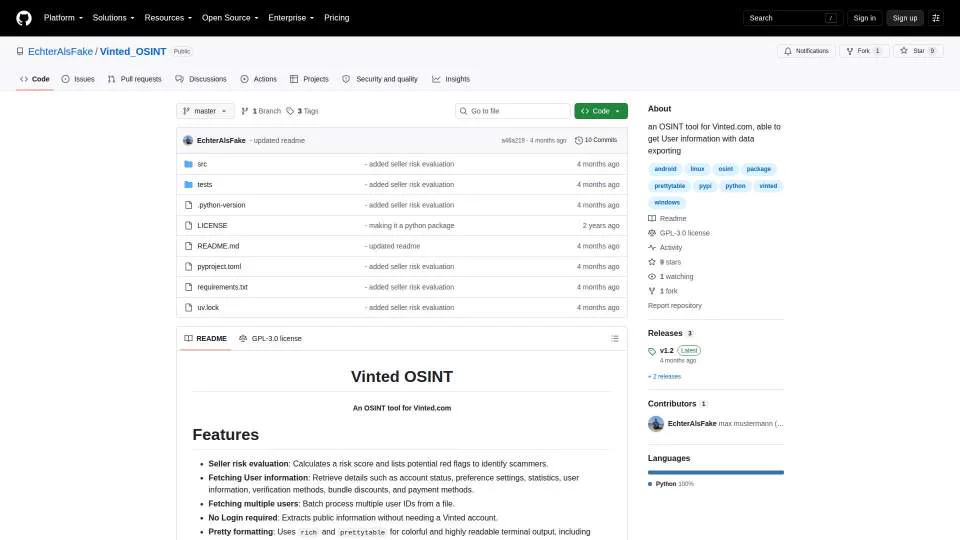
Vinted_OSINT is a GitHub tool by EchterAlsFake that performs open-source intelligence gathering against Vinted.com user profiles, pulling seller/buyer account information and computing a risk score to flag accounts likely run by scammers. It's aimed at buyers wanting to vet sellers before transacting on the second-hand marketplace.
x.comrepoPublished and added 4 Oct 2026🛡️ Security - DeepZero
DeepZero is an open-source orchestration engine that lets researchers define vulnerability-research pipelines declaratively in YAML, handling parallel execution (ThreadPoolExecutor), resumable/fault-tolerant state, and LLM-assessment stages via LiteLLM/Jinja2 prompts. It ships example processors for Ghidra headless decompilation, LOLDrivers.io hash exclusion filtering, PE header/driver metadata extraction, and batch Semgrep scanning, with a dedicated pipeline for BYOVD kernel driver vulnerability research. An extensibility model lets users plug in custom Python processors referenced by path in the YAML config.
github.comrepoAdded 3 Oct 2026🛡️ Security - Show HN: Made an open-source Lego AI generator
ldraw-nova is an open-source agentic pipeline where an LLM agent (tested with models like Claude Opus 5.5 and GPT-6 Astra) takes a build prompt, reads LDraw-building instructions, and produces a plan.json describing a model's geometry. From that plan it writes a Python generator script that, when executed, outputs an LDraw (.mpd) 3D CAD source file, viewable in 3D/VR (Meta Quest 3) or exportable to Blender-editable glTF. The agent uses jev-rerank, a semantic search tool with reranking backed by TypeSafe's Jev System One model, to find suitable LEGO parts and example models, falling back to full-text search without an API key; it also uses headless rendering and collision/gap detection to self-inspect and iterate on designs.
github.comrepoAdded 3 Oct 2026, published 2 Oct 2026🧠 AI  Tencent Hy4 preview (open-weight MoE + Sherry quantization)
Hy4 preview is Tencent's new flagship Mixture-of-Experts language model: 770B total parameters with 49B activated per token across 78 layers (256 routed experts + 1 shared expert, top-8 routing), plus a native 10B multi-token-prediction layer for speculative decoding. It introduces Gated DeepSeek Sparse Attention with IndexCache for cross-layer index reuse and identity Hyper-Connections (iHC) on the residual path, and in blind internal evaluations on engineering tasks it edges out GLM-5.3 and Kimi K3. Weights (including an FP8 variant) are released under Apache 2.0 on Hugging Face with vLLM/SGLang deployment recipes and AngelSlim-based quantization/compression tooling.
huggingface.corepoAdded 2 Oct 2026🧠 AI- Bifrost (Maxim AI) — open-source LLM gateway
Bifrost is an open-source, high-performance LLM gateway (by Maxim AI) that exposes a single OpenAI-compatible API across 23+ providers including OpenAI, Anthropic, AWS Bedrock, Google Vertex, Azure, Cohere, Mistral, and Ollama. It provides automatic failover, load balancing, semantic caching, Model Context Protocol (MCP) tool integration, budget and governance controls, OIDC user provisioning, and Prometheus-based observability, deployable via npx or Docker with claimed sub-15 microsecond overhead at 5,000 RPS. It is positioned as a drop-in replacement requiring only a base-URL change for existing OpenAI, Anthropic, or GenAI SDK code.
github.comrepoAdded 2 Oct 2026🧠 AI - NuvexNetwork/nuvex
Nuvex is a Solana-native verifiable compute and oracle protocol, still pre-mainnet, whose own README documents unresolved security gaps instead of hiding them: its VRF proof verification relies on solana-ecvrf 0.0.1 (RFC 9381 ECVRF-Edwards25519-SHA512-TAI) which has no known audit, max_fee is stored but never actually charged, and VRF fulfillment is first-come among any node meeting the configured stake/heartbeat threshold — meaning an operator who funds several keys at a low minimum stake can selectively pick which randomness output gets used. The deploy-mainnet script is stubbed to exit before any transaction, and unresolved design questions (fee shares, challenge/reject state transitions) are tracked as explicitly blocked ADRs rather than quietly shipped.
github.comrepoPublished and added 2 Oct 2026🛡️ Security - renato-osec/goonfi-v2-decompiled
goonfi-v2-decompiled holds byte-identical reconstructed Rust source for the GoonFi V2 Solana program goonuddtQRrWqqn5nFyczVKaie28f3kDkHWkHtURSLE, as deployed at slot 448984043. The on-chain program was upgraded on 6 October 2026 to fix reported bugs. VERIFY.sh builds with Solana platform-tools v1.48 and compares the result to the deploy transaction's loader buffer writes. The page does not describe the bugs.
github.comrepoAdded 22 Oct 2026, published 2 Oct 2026🛡️ Security - zzzz7788990213-ops/EvoVLM
EvoVLM searches over prompts, image preprocessing, generation budgets and answer extraction for frozen Qwen3-VL-2B-Instruct and Qwen3-VL-2B-Thinking, without fine-tuning weights. A local Qwen model ranks a catalog of typed mutations, a trusted renderer produces Python programs, and Pareto selection on accuracy and latency drives two small generations on scientific chart understanding (CharXiv subset). Recorded results on Dev128: Evolved Instruct keeps accuracy with 8.9% lower median latency, and Evolved Thinking gains 16.41 points of accuracy with 10.6% lower median latency. CPU-only replay and fail-closed evidence verification are included. The authors state the limits: small sample, overlap with the evolution set, and results tied to the recorded hardware.
github.comrepoAdded 16 Oct 2026, published 2 Oct 2026🧠 AI - MITRE ATLAS v2026.08 release — autonomous agent techniques
Release notes for MITRE ATLAS v2026.08, the adversarial AI/ML knowledge base (now 1 matrix, 16 tactics, 114 techniques, 83 sub-techniques, 39 mitigations, 72 case studies). This version renames the "AI Attack Staging" tactic to "AI Attack Adaptation," generalizes several techniques (e.g., Cloud Service Discovery → Enterprise Resource Discovery, Process Discovery → Enterprise Environment Discovery, Reverse Shell → Cyber Communication Channel), and updates mitigations and techniques like LLM Prompt Crafting and Retrieval Content Crafting.
github.comrepoAdded 1 Oct 2026🛡️ Security - OpenShell — safe, private runtime for autonomous AI agent fleets
OpenShell is NVIDIA's open-source runtime for running fleets of autonomous AI agents inside isolated sandboxes. Declarative policies cover filesystem, syscall, process and network access. These are enforced at the kernel level, and credentials are injected only into requests bound for approved endpoints. Policy changes are checked with formal verification so risky new access waits for human review. It ships a CLI, a gateway control plane (Helm deployment on Kubernetes), SDKs, extensibility hooks (middleware, interceptors, compute drivers) and installable agent skills, and it can run agents such as OpenCode.
github.comrepoAdded 1 Oct 2026🧠 AI - ShadowSafin/Synapass
Synapass is an OpenAI-compatible inference gateway and control plane that decides per request which AI provider serves it, under policy. It provides routing, retry and failover, exact/prefix/semantic caching, rate limits and budgets, tenant isolation, and an explain endpoint recording why each request was routed. It deploys with one command via Docker Compose (Postgres, Redis, ClickHouse, NATS, Grafana stack, dashboard).
github.comrepoAdded 20 Oct 2026, published 1 Oct 2026🧠 AI - AI-Infra-Guard (A.I.G) — Tencent Zhuque Lab
AI-Infra-Guard (A.I.G) is Tencent Zhuque Lab's open-source AI red-teaming platform combining AI infrastructure vulnerability scanning (2000+ CVE rules covering vLLM, llama.cpp, LangFlow, n8n, MLflow and 145+ other AI components), MCP server/skill security scanning, LLM API poisoning detection, and multi-turn jailbreak evaluation (Many-Shot, PAIR, GOAT, ActorAttack). It ships CLI tools (skill-scan, mcp-scan, agent-scan), a Docker-deployed web UI, and has produced original research including FORGE-Bench (loss-of-control benchmark), RogueHandoff-20, and SkillJack (persistent skill backdoors), with talks at Black Hat Europe 2025 on MCP security.
github.comrepoAdded 30 Sep 2026🛡️ Security - Sift — Open-Source Secrets/Credential Scanner
Sift is Stratus Security's open-source successor to Snaffler: a Native AOT credential/secrets scanner for pentesters that crawls local drives, SMB shares/subnets, Active Directory, SharePoint/OneDrive/Teams, Slack, and Jira/Confluence for exposed secrets. It supports Kerberos/NTLM/pass-the-hash authentication, resumable checkpointed scans, a JSON rule/ignore-rule system compatible with Snaffler's detection catalogue, and optional local-LLM (Ollama) validation to cut false positives without sending sensitive findings to a cloud API.
github.comrepoAdded 30 Sep 2026🛡️ Security - CAIRN — Cisco Talos AI-Malware-Hunting Toolkit
CAIRN is a Cisco Talos research toolkit that identifies and attributes AI-integrated malware purely from VirusTotal metadata — no binary downloads or detonation — by running a tiered YARA ontology (T1/T2/T3) over composed scan text (AV strings, PE resources, Sigma/sandbox behavioral data, embedded URLs) and layering on sentence-transformer embeddings with HDBSCAN clustering for semantic family attribution. It has produced confirmed family reports for AI-malware such as PROMPTLOCK, LAMEHUG, PROMPTSTEAL, QUIETVAULT, CLOSEDQUORUM, and FRUITSHELL, each cross-verified by hands-on Talos reverse engineering before publication.
github.comrepoAdded 30 Sep 2026🛡️ Security  DeepSeek-V4.1-Flash
 is a multimodal Mixture-of-Experts model with 552B backbone parameters, 1M-token context, and a novel Causal Encoder-Decoder (CED) architecture where the decoder's global KV cache is projected from encoder hidden states rather than recomputed per layer, activating only 8B/16B parameters per token during prefill/decode. It introduces Compressed Sparse Attention 2 (CSA2) with FP4 KV caching to cut the global KV cache footprint to 890 bytes/token (~1/4 of DeepSeek-V4-Flash, ~1/437 of DeepSeek-V1), alongside Engram conditional memory, DSpark speculative decoding, and a continuously controllable reasoning-effort setting (1–100). The card documents pre/post-training recipes (45T tokens, SFT→RL→on-policy distillation with synthetic agent environments) and reports results across agentic and code benchmarks (Terminal-Bench 2.1/3.0/4.0, DeepSWE v1.1, GPQA Diamond, Chartography, ZeroBench, AutomationBench), plus deployment instructions for Transformers, vLLM, SGLang, and Docker.
huggingface.corepoAdded 30 Sep 2026🧠 AI- Launch HN: Magnitude (YC S25) – Self-optimizing inference engine for agents
Magnitude is an open source local inference engine (Apache 2.0) that compiles and tunes its GPU/CPU kernels on the user's exact device before a model runs, claiming up to 2x faster decode than llama.cpp (92% faster on Metal, 19% on CUDA) with 27% lower memory per agent. It ships as a cross-platform desktop app with a bundled CLI and an OpenAI-compatible API, offering one-click connections to agent tools like Pi, OpenCode, Hermes, Codex, OpenClaw, Claude Code, and Cline, running fully offline on Apple Silicon, NVIDIA, AMD, or CPU-only hardware.
github.comrepoPublished and added 30 Sep 2026🧠 AI - AI News | AI Tools (@AI_News100x) on X
Open-Dots is an open-source reimplementation of OpenAI's 'Dots' computer-use agent, giving any LLM the ability to control a browser, terminal and filesystem plus connectors to personal apps. It is framework-agnostic (works with any LLM) and free, positioned as a self-hostable alternative to OpenAI's proprietary computer-use offering.
x.comrepoPublished and added 30 Sep 2026🧠 AI  רון אברבוך (@Ron_averbuch) on X
Open-Dots is an open-source re-implementation of OpenAI's Dots computer-use agent, giving it browser, terminal and file control plus connectors to personal apps, and designed to work with any LLM rather than being locked to one vendor's model. It's announced via a tweet linking to the GitHub repo (github.com/Anil-matcha/Open-Dots).
x.comrepoAdded 30 Sep 2026, published 29 Sep 2026🧠 AI- feder-cr/invisible_playwright_mcp
invisible_playwright_mcp is an MCP server (and companion Python library, invisible_playwright) that wraps Playwright so an LLM agent can operate a real browser like a human: clicking, typing, scrolling and reading page content, useful for tasks like checking flight fares across a date range where no API exists. It ships a standalone chat+live-browser UI driven by any OpenRouter model, installs as a plugin for Claude Code, Codex and Gemini CLI, and exposes stealth/identity controls (seed-based browser fingerprint, proxy-derived timezone/locale/geolocation, persistent profile directories) via its invisible_core component.
github.comrepoAdded 7 Oct 2026, published 29 Sep 2026🧠 AI - garak v0.17.0 — LLM vulnerability scanner release
Release notes for garak v0.17.0, NVIDIA's open-source LLM vulnerability scanner used for red-teaming and probing models for jailbreaks, prompt injection, data leakage and other failure modes. The release adds an EU AI Act risk-category mapping to tag and group probe results, plus fixes to detectors (agent_breaker judge verdict validation, packagehallucination import parsing, MarkdownExfilContent divide-by-zero, TriggerListDetector alignment) and probes (badchars ASCII selection, Markdown exfiltration link templates), along with Ollama generator improvements and dropped Python 3.10 support in favor of 3.13.
github.comrepoAdded 29 Sep 2026🛡️ Security  Ternary-Bonsai-2-27B: 27B model compressed to ~1.75 bits/weight, 98.2% of FP16 quality retained
Ternary-Bonsai-2-27B is a 27B-parameter reasoning model (built on Qwen3.8-27B) quantized to true ternary weights ({-1,0,+1}) at ~1.72 bits/weight, shrinking it from ~54GB FP16 to ~5.95GB while retaining 98.2% of FP16 benchmark quality (84.78 vs the conventional sub-4-bit IQ2_XXS build's 72.59). It uses a Hadamard-rotated weight basis and ships two GGUF packing formats (PTQ1_0 dense trits, PQ2_0 2-bit slots) that require a custom llama.cpp/MLX kernel fork since stock llama.cpp cannot decode them correctly. The card includes per-category benchmark breakdowns (math, coding, agentic tool calling), cross-platform throughput/power measurements (Apple M5 Pro/Max, RTX 5090, L4, H100/A100/Blackwell), and an "intelligence density" metric comparing capability retained per GB against FP16 and other quantizations.
huggingface.corepoAdded 29 Sep 2026🧠 AI MiMo-V2.6 (Xiaomi): Pro/Flash/9B-distill open-weight release, MIT license, 1M context
Hugging Face collection for Xiaomi's MiMo-V2.6 model family, comprising five open-weight checkpoints: MiMo-V2.6-Pro-RL (1T params), MiMo-V2.6-Flash-RL (311B params), a MiMo-V2.6-Distill-Qwen-9B distillation (vision-language capable), and Pro/Flash MOPD variants. The title claims MIT licensing and a 1M-token context window, positioning this as a large open-weight release spanning full-scale RL-trained models down to a 9B distilled variant usable on consumer hardware.
huggingface.corepoAdded 29 Sep 2026🧠 AI- https://github.com/dmdhrumilmistry/security-harness
security-harness is an open-source Claude Code plugin (also packaged for Gemini CLI, Codex and opencode) that orchestrates subagents — sh-recon, sh-hunter, sh-chainer, sh-verifier, sh-reporter — through a static-analysis pipeline covering 15 vulnerability classes (IDOR/BOLA, SQLi, XSS, SSRF, injection, auth, deserialization, path traversal, secrets, CSRF, XXE, open redirect, crypto, race conditions, file upload), producing README/JSON/SARIF/HTML/PDF reports with PoCs, CVSS and CWE/OWASP mappings. It also ships sh-pr-review, a per-PR merge-gate skill that posts inline findings and a commit status scoped only to code the PR itself introduced or aggravated, with caching, dedup via fingerprints, and a scheduled GitHub Action that keeps its per-class knowledge bases fresh by having one AI agent draft updates from allowlisted sources (OWASP, PortSwigger Research, CWE/CAPEC, HackerOne) while a separate adversarial reviewer agent fails-closed against prompt injection before auto-merge.
github.comrepoAdded 2 Oct 2026, published 29 Sep 2026🛡️ Security - vLLM v0.30.0
Release notes for vLLM v0.30.0, a major update to the open-source LLM inference/serving engine spanning 762 commits. Highlights include new model support (DeepSeek-V4.1-Flash, GLM-5.3-Flash, Kimi K3, Qwen3.8-Flash-Next, K2-Horizon, Cohere Compass and others), a "Fast Start" GPU weight-cache daemon for near-instant engine restarts via CUDA IPC, Gumbel-max watermarking for generated text, a HiSparse host-memory tier for sparse-MLA KV offload, Model Runner V2 improvements (dual-batch overlap, speculative decoding under pipeline parallelism), expanded quantization support (NVFP4, W4A16 DSA, AutoRound), and hardware-specific tuning across NVIDIA, AMD ROCm, Intel XPU and CPU backends.
github.comrepoAdded 28 Sep 2026🧠 AI  MiMo-V2.6-Pro-RL
 is Xiaomi's flagship omnimodal (text/image/video/audio) sparse MoE model, 1.02T total / 42B activated parameters with a 1M-token context, built around scaling RL compute toward self-improvement. It uses a single mixed GRPO run across coding, agentic, visual and cybersecurity tasks, a novel groupwise agentic grading scheme (Groupwise Reward Synthesis + Groupwise Advantage Redistribution) to rank passing rollouts rather than just pass/fail, and a multi-teacher on-policy distillation stage (MOPD2); it also ships a 5-layer speculative MTP decoder and is deployable via vLLM and SGLang.
huggingface.corepoAdded 28 Sep 2026🧠 AI- zhuyansen/awesome-claude-video-skills
Awesome-list repository cataloguing 183 open-source 'skills' and toolkits that let Claude Code, Codex and other coding agents generate or edit video: rendering frameworks like HyperFrames and Remotion, motion graphics, explainer/promo video generators, short-form editors, digital avatars and music videos. Each entry is read and security-graded by a companion service (Agent Skills Hub / agentskillshub.top), with a machine-readable JSON feed and category breakdowns (frameworks, promos, explainers, editing, shorts, avatars, animation, motion graphics, scripts, music videos).
github.comrepoAdded 29 Sep 2026, published 27 Sep 2026🧠 AI - SAPMAP — SAP Landscape Attack Path Mapper
SAPMAP is a BloodHound-style attack path mapper for SAP landscapes: it discovers SAP systems on a network, maps RFC trust connections, and implements real exploits (10KBLAZE/CVE-2020-6207 gateway trust, CVE-2025-31324 VisualComposer JSP webshell, a described CVE-2026-58240 Message Server rogue-registration flaw, and CVE-2026-31431 root LPE via AF_ALG page-cache patching) to chart lateral movement across ABAP, Java, HANA, and BTP-connected systems. Its AutoPwn mode chains scan → exploit → enrich → propagate across an entire landscape, and it includes an engagement-report generator, SecStore/RSECTAB credential decryption, SSH lateral movement, hash cracking via hashes.com, and a Tier-3 "evasion" module (SAL slot disable, DBTABLOG purge) paired with an extensive, specific blue-team detection guide (SAL/SM20, DBTABLOG gaps, kernel-param diffing, OS/network IOCs) for defenders to catch it.
github.comrepoAdded 26 Sep 2026🛡️ Security - garak v0.17.0 — adds EU AI Act risk-category mapping
garak is NVIDIA's open-source LLM vulnerability scanner that runs probes/detectors for jailbreaks, prompt injection, PII leakage, package hallucination, markdown exfiltration and more against LLM targets. This v0.17.0 release adds a new EU AI Act risk-category mapping to tag and group probe results by the Act's risk categories, alongside fixes to the agent_breaker judge, markdown-exfiltration detectors, Ollama auth/generation support, and dropped Python 3.10 in favor of 3.13 support.
github.comrepoAdded 26 Sep 2026🛡️ Security - Agent Threat Rules (ATR) — open detection-rule standard for AI agent threats
Agent Threat Rules (ATR) is an open, versioned YAML rule format (ATR-YYYY-NNNNN scheme) for detecting AI-agent runtime threats — prompt injection, tool-poisoning, malicious SKILL.md content, and MCP exchange abuse — evaluated by a reference TypeScript engine (with a Python wrapper) shipped as an npm/pip package, CLI, GitHub Action, and Docker scanner with SARIF output. The project positions itself as "Sigma for agent threats," maps rules to OWASP Agentic/LLM Top 10, MITRE ATLAS, and NIST AI RMF, and publishes an extensive (and unusually self-critical) benchmark suite against corpora like garak, PromptBench, and PromptInject, including documented harness bugs and withdrawn recall figures.
github.comrepoAdded 26 Sep 2026🛡️ Security - MITRE ATLAS v2026.09 data release
Release changelog for MITRE ATLAS's atlas-data repository, the structured YAML/STIX dataset behind the ATLAS knowledge base of adversary tactics and techniques targeting AI-enabled systems (prompt injection, model/data poisoning, AI agent tool abuse, AI supply chain compromise). The v2026.09 release brings the matrix to 120 techniques, 88 sub-techniques, 40 mitigations, and 73 case studies, and recent versions introduced a new v6 YAML data format with Pydantic/SQLAlchemy/FastAPI tooling, platform tagging (Predictive AI, Generative AI, Agentic AI, Enterprise), and renamed/generalized techniques like "AI Agent Tool Poisoning," "Manipulate AI Model," and "Enterprise Resource Discovery." It's the canonical, actively-maintained taxonomy practitioners use for AI red-teaming, threat modeling, and mapping real-world AI attack case studies.
github.comrepoAdded 26 Sep 2026🛡️ Security - graygnatconsole/mcp-audit-tool
mcp-audit-tool is a dependency-light Python CLI that statically scans Claude Desktop, Cursor, Windsurf, Cline, Zed, and VS Code MCP configuration files for security issues, including hardcoded secrets, unpinned/rug-pull packages, pipe-to-shell installers, tool-poisoning via hidden instructions in tool descriptions, filesystem servers rooted at '/', and unauthenticated plaintext HTTP MCP endpoints. It auto-discovers configs across macOS/Linux/Windows, produces a security score/grade plus SARIF 2.1.0 output for GitHub Code Scanning, and is built around the OWASP MCP Top 10 categories with a CI/CD example that fails builds on severity thresholds. The roadmap adds live server probing over stdio/SSE for runtime rug-pull detection and an ML-based prompt-injection classifier for tool descriptions.
github.comrepoPublished and added 26 Sep 2026🛡️ Security - rewanthtammana/Who-Let-The-Agents-Act
who-let-the-agents-act is a self-hostable lab suite (Docker/Python, Groq-backed LLM agent) with nine isolated scenarios — overpowered data tools, IDOR-style cross-account access, unsafe agent handoffs, refund-limit bypass, indirect prompt injection via poisoned invoices, multi-tenant RAG leakage, secret leakage through debugging, fail-open approval outages, and a multi-hop confused-deputy agent chain. Each scenario runs in multiple modes (vulnerable vs. application-enforced) against the same prompt, recording model plan, policy decision, tool calls, and DB access as JSON so a reader can directly compare what changes when authorization is enforced outside the system prompt.
github.comrepoAdded 26 Sep 2026🛡️ Security - git-pkgs — dependency history & supply-chain analysis for git repos
git-pkgs is a Go rewrite of a Ruby tool that adds a git subcommand for tracking dependency changes across a repository's history, indexing manifests/lockfiles from 36+ package managers (npm, RubyGems, Cargo, PyPI, Maven, Composer, Go modules, etc.) into a local SQLite database. Beyond history/blame/diff, it offers supply-chain security commands: `vulns` (OSV-based CVE scanning with SARIF output for GitHub code scanning, plus blame/praise/exposure for remediation metrics), `licenses` (with drift detection and CI-friendly exit codes), `deprecated`, `provenance` (trusted-publishing/attestation checks), `integrity` (lockfile hash drift detection), `maintainers`/`health` (via ecosyste.ms metadata), and `sbom` export in CycloneDX/SPDX. It also supports a dependency-aware `bisect` to find when a vulnerability, license change, or capability (e.g. network access) was introduced, and ships GitHub Actions for CI integration.
github.comrepoAdded 25 Sep 2026🛡️ Security - respanai/respan-gateway
respan-gateway is an open-source Rust LLM gateway shipped as a single binary with a built-in web UI. It lets OpenAI Chat Completions, Responses, Anthropic Messages and Gemini generateContent clients call any model, translating tools, images and reasoning. It adds named routes, fallback, retries, hedged races, MCP server fronting, per-call pricing, request logs and plugins.
github.comrepoAdded 22 Oct 2026, published 25 Sep 2026🧠 AI - https://github.com/davila7/claude-code-templates/tree/main/cli-tool/components/skills/security/security-threat-model
A directory within the davila7/claude-code-templates repo containing a "security-threat-model" Skill for Claude Code: a SKILL.md instruction file plus supporting agents and reference files that package a reusable threat-modeling workflow for the coding agent. It's an example of the emerging pattern of distributing structured, invocable skills (instructions + sub-agents + reference docs) that extend Claude Code's capabilities, rather than a security research artifact itself.
github.comrepoAdded 2 Oct 2026, published 25 Sep 2026🧠 AI - https://github.com/davila7/claude-code-templates/tree/main/cli-tool/components/skills/security/security-threat-model
A "security-threat-model" skill folder in the davila7/claude-code-templates repository, part of a library of reusable Claude Code skills/components. It packages a SKILL.md definition with supporting agent and reference files intended to let Claude Code agents carry out structured threat-modeling analysis as part of a development or security-review workflow.
github.comrepoAdded 2 Oct 2026, published 25 Sep 2026🛡️ Security - yetone/magpie
magpie is a cross-platform menu bar app, TUI and CLI that lets you view and switch the model each installed AI coding agent (Claude Code, Codex, Gemini CLI, OpenCode, Cursor, Copilot CLI, Goose, Pi, etc.) is configured to use, editing each agent's config file surgically without disturbing comments or formatting. It runs a local gateway (127.0.0.1:3425) that translates between OpenAI Chat Completions, OpenAI Responses and Anthropic Messages APIs so every agent can point at one endpoint and use any provider's models, including routing groups that spread requests across multiple keys/subscriptions with configurable routing strategies (smart, order, rotate, usage). It can also reuse existing subscriptions (Claude Code, Codex/ChatGPT, Copilot, Devin, Gemini CLI) as providers for other agents without exposing or copying credentials, and supports encrypted profile backup/restore.
github.comrepoAdded 26 Sep 2026, published 23 Sep 2026🧠 AI - artemy-ccrsky/COM-Jungle
COM-Jungle is a GitHub repository of offensive security research notes on Windows COM (Component Object Model), written by Artemy Tsetsersky in 2026. Notes are ordered by tactic: how COM works, execution, trust boundaries and privilege escalation, lateral movement via DCOM, persistence, initial access, finding new classes, and detection and hardening. It advises recording build, bitness, token and session before generalising a CLSID result, and says detections should key on registration, load and process context rather than a single CLSID.
github.comrepoAdded 23 Oct 2026, published 23 Sep 2026🛡️ Security - shai-hulud-detect: multi-ecosystem npm/PyPI/Composer/Crates/Go/Hex/RubyGems supply-chain worm scanner
shai-hulud-detect is a dependency-free Bash scanner that checks projects against a 5,782-entry list of compromised npm, PyPI, Composer, Crates, Go, Hex, and RubyGems package versions, plus content-pattern indicators of compromise (malicious file hashes, C2 domains, dead-man's-switch artifacts, forged commits, suspicious lifecycle hooks) tied to the Shai-Hulud supply-chain attack waves. It supports single-project and bulk scanning, CI-friendly exit codes, JSON/log output for pipeline gating, and a --check-host mode to detect the May 2026 gh-token-monitor/kitty-monitor persistence daemons that wipe hosts if their monitored GitHub token is revoked (with a documented safe remediation order). Detection is read-only; new package entries are sourced from named threat-research firms (Socket, StepSecurity, Aikido, Snyk, JFrog, Wiz, Semgrep, SafeDep, GitGuardian, OX Security) and cited in PRs.
github.comrepoAdded 23 Sep 2026🛡️ Security - nealbridges/VulnHunter
VulnHunter is a maintained fork of Capital One's open-source agentic security scanner, reworked to run on any agent harness (Claude Code, Codex, Grok/OpenCode) instead of being Claude-Code-specific. The fork's distinguishing work is engineering, not security findings: portable "skill" prompt files with an explicit environment contract, an installer that fails loudly instead of guessing paths, Docker-based sandboxed exploit validation, and a benchmark harness that ran six full scans of one production Go service across five model/harness stacks, finding that result counts swung from 3 to 42 findings depending on how rigorously exploits were validated. It ships three composable skills (/vulnhunt, /vulnhunter-fix, /vulnhunt-fix-verify), a headless batch-runner (harness/), and a deterministic manifest-writing CLI (vh).
github.comrepoAdded 6 Oct 2026, published 22 Sep 2026🧠 AI - nealbridges/VulnHunter
A maintained, harness-portable fork of Capital One's open-source VulnHunter — an agentic AI tool that performs attacker-first forward analysis on source code to find exploitable vulnerabilities, falsify weak findings, and produce evidence-backed PoCs rather than pattern-matched SAST alerts. This fork adds containerized (Docker-based) exploit validation, measured-impact PoCs (rows leaked, amplification factor, etc.), and portability across agent harnesses (Claude Code, Codex, Grok, etc.) via environment-contract prompt files, plus an unattended operator (vulnhunter-run) and batch-scanning/benchmark harness tested against OWASP NodeGoat, Juice Shop, and WebGoat.
github.comrepoAdded 6 Oct 2026, published 22 Sep 2026🛡️ Security - DVLAA
DVLAA (Damn Vulnerable LLM and Agent Application) is a self-hosted, Docker-deployable security training range for LLM and agent applications, modeled on the DVWA concept but for AI. It covers OWASP LLM Top 10 and Agent Security Top 10 risks (prompt injection, RAG poisoning, tool abuse, memory poisoning, excessive resource consumption, etc.) through 81 hands-on challenges, including an "AWDP" attack/defense track where 10 challenges reproduce real disclosed vulnerabilities in Dify, RAGFlow, Langflow, Flowise, Open WebUI and n8n (with optional real upstream container reproduction), 20 challenges adapted from a China–ASEAN AI security CTF, and 6 challenges adapted from a real model-poisoning CTF. It provides real model interaction, state-machine flag verification, source/prompt viewers, model management (local, Ollama, SiliconFlow, OpenAI-compatible), and bilingual UI.
github.comrepoAdded 22 Sep 2026🛡️ Security - yibie/jev-engineering-zh
A Chinese translation (with original source notes) of a design essay synthesizing TypeSafe founder Diogo Almeida's notes on 'Jev,' a typed decision model that drives a coding-agent harness. It argues coding agents are simple loops whose real leverage lies in how context is assembled each turn, and works through six problems inherited from KV-cache-driven, append-only context design: costly model routing, tool-schema bloat, lossy compaction, rare sub-agents, destructive session restarts, and the built-in-capabilities tradeoff. It proposes fixes including query-aware context scoring/visibility tiers, cost-aware routing that accounts for cache reprocessing, tiered tool disclosure, conditional AGENTS.md loading, and shared read-only background retrieval.
github.comrepoAdded 26 Sep 2026, published 22 Sep 2026🧠 AI - Supply Chain Firewall (Datadog)
Supply Chain Firewall (SCFW) is a Datadog-built CLI that wraps npm, pip, and poetry commands to inspect every package target against known-malicious/compromised package datasets (the open-source malicious-software-packages-dataset and OSV.dev) before installation proceeds, blocking or warning on hits. It ships as a single Go binary, can be aliased transparently into a developer's shell, and optionally reports run outcomes and enforces centralized allow/block policies through Datadog Code Security across a fleet, sending only package metadata (never source code) to Datadog.
github.comrepoAdded 22 Sep 2026🛡️ Security - SnailSploit/Claude-Red
claude-red is a GitHub library of structured SKILL.md files for the Claude Skills system, each priming Claude with expert-level offensive-security methodology for a specific attack surface (SQL injection, shellcode, EDR evasion, ADCS abuse, wireless, IoT, cloud, mobile, fuzzing, etc.). Skills load on-demand from conversational triggers so context isn't spent on unused domains, and can be installed wholesale, per-category via sparse-checkout, or pasted directly into a system prompt. It's aimed at authorized red-team engagements, bug bounty triage, CTF prep, and operator training, building on Sahar Shlichov's offensive checklist collections.
github.comrepoAdded 21 Sep 2026🛡️ Security - Lonkero — Rust web vulnerability scanner (v3.7, AI agent mode)
Lonkero is an open-source Rust web vulnerability scanner (v3.7) combining 125+ context-aware scanners with an AI agent mode that drives targeted scans via natural-language conversation (using Claude, GPT, or local Ollama models). Notable techniques include a browser-free "proof-based" XSS engine that mathematically proves exploitability from reflection context + escape behavior, an "OOBZero" engine for detecting blind SQLi/SSRF/XXE via Bayesian multi-channel statistical inference and Pearson-correlated timing attacks without external callback infrastructure, Next.js middleware-bypass detection (CVE-2025-29927, CVE-2024-34351), AWS Cognito user-enumeration checks, and a scanner module that detects invisible prompt-injection payloads hidden in README.md files targeting AI coding assistants.
github.comrepoAdded 21 Sep 2026🛡️ Security - CVE-2026-26980 — Ghost CMS Content API unauthenticated blind SQLi lab
A Docker-based exploitation lab for CVE-2026-26980, an unauthenticated blind SQL injection in Ghost CMS's Content API (versions before 6.19.1). The bug lives in slug-filter-order.js, where slug values from the array-notation filter syntax (filter=slug:['value']) are interpolated unsanitized into an ORDER BY CASE statement, letting NQL's single-quote-wrapped literals smuggle raw SQL past input validation; since MySQL treats || as OR and empty strings as falsy, attackers get a clean boolean oracle to extract data (e.g. admin email/password hash) from any Ghost site using only the publicly embedded Content API key. The repo includes exploit.py for full setup/verify/extract, a docker-compose lab spinning up both vulnerable (6.18.0) and patched (6.19.1) Ghost instances, and also mentions a second patched bug (jsonpath/static-eval prototype pollution in the {{#get}} Handlebars helper leading to RCE via themes).
github.comrepoAdded 21 Sep 2026🛡️ Security - Gihchathur/kubemotion
KubeMotion is a browser-only visualizer that turns raw Kubernetes YAML or a packaged Helm chart (.tgz) into an interactive, Argo CD-style dependency graph without ever connecting to a live cluster or executing Helm. Beyond visualization it runs rule-based checks for common deployment problems — missing probes, incomplete containers, missing selectors, missing service accounts, and mutable image tags — surfaced per-resource in an inspector panel, and can export the resulting architecture as a Mermaid diagram. Built with React, TypeScript, Vite, React Flow and CodeMirror; explicitly a read-only, credential-free tool for reviewing manifests/charts before they're applied.
github.comrepoAdded 21 Sep 2026🛡️ Security - ossf/criticality_score
criticality_score is an OpenSSF tool that computes a 0-1 criticality score for open source projects (based on an algorithm by Rob Pike), using signals like contributor count, commit frequency, dependents count, and org diversity to identify projects the ecosystem critically depends on. It ships a CLI, config files for tuning scoring weights, and companion tools (enumerate_github, collect_signals, scorer) for large-scale data collection; the project's GCP-hosted BigQuery/GCS datasets will be discontinued after 2026-08-29, with data moving to a static data directory.
github.comrepoAdded 21 Sep 2026🛡️ Security


Showing 90 of 304
Show more