 Discovering vendor-specific vulnerabilities in Android | Oversecured Blog
Oversecured describes extending its Android scanner to system APIs and to Samsung's Android build, after comparing Google and Samsung framework JARs and about 400 system services. It explains AIDL service permission checks and new control-flow analyses. Examples include Samsung's unchecked semIsBackupEnabled(), a broadcast that reboots the device, and a LaunchAnyWhere in Settings. Samsung had fixed over 60 reported issues.
 oversecured.comwriteupAdded 29 Oct 2026🛡️ Security
 Disclosure of 7 Android and Google Pixel vulnerabilities
Oversecured discloses seven Android vulnerabilities, two of them Pixel-specific, all reported to Google and fixed except one low-severity WebView case. They are the Camera geolocation leak (CVE-2024-0017), a VPN bypass list change (CVE-2023-21383), a Bluetooth permission check flaw (CVE-2024-34719), the WorkSource parcel mismatch (CVE-2023-20963, exploited in the wild by the Pinduoduo app), Device Admin HTML injection (CVE-2021-0600) and a ContentProvider.openFile() caller-context bypass (CVE-2023-21292). Each has root cause and PoC code.
oversecured.comwriteupAdded 29 Oct 2026🛡️ Security The October inflection point for vibe game development
Simon Willison argues October 2026 is an inflection point for vibe coding games, because Claude Opus 5.5 can now handle 3D modeling, music and game design. He describes four browser games built with three.js (Tree Appreciator, Emberwick, Battle Drones, Quarter Sun Cove), with the prompts used, a comparison against GPT-6 models, and advice to start with "Build a mobile-friendly three.js game where...".
 simonwillison.netwriteupPublished and added 28 Oct 2026🧠 AI
 SBOM vs. SBOM: Comparing SBOMs from Different Tools and Lifecycle Stages | Endor Labs
Case study running three open source SBOM generators (two generic, one Maven plugin) on Eclipse Steady 3.2.5 rest-backend at three lifecycle stages (git clone, Maven package, Docker image), yielding 8 CycloneDX SBOMs. Compares precision/recall against the mvn dependency:tree ground truth and finds the Maven-integrated tool perfect (1.0/1.0) while generic tools miss versions, groupIds and transitive dependencies. It also shows PURL qualifier differences (e.g. type=jar, apt qualifiers) make SBOMs hard to compare, test dependencies are indistinguishable, and argues for an SBOM generator benchmark.
 endorlabs.comwriteupPublished and added 16 Oct 2026🛡️ Security
 Jev as a judge: How counterfeit policy steers Jev
Datadog Security Labs tests TypeSafe AI's Jev decision model as a prompt-injection detector and as the judge behind LangChain's tool-risk gating. On four public datasets Jev had 99.66% precision and 82.90% recall. A prepended "counterfeit policy" that redefines the attack categories cut recall by over 79 points. In a LangChain scenario, a user-editable profile field lowered the mean is_risky score from 0.893 to 0.290, below the 0.5 block threshold. Plain prompt injection did not move the score.
 securitylabs.datadoghq.comwriteupAdded 29 Oct 2026, published 15 Oct 2026🛡️ Security
 AI models may be capable of self-replicating without access to a datacenter
Anthropic's Frontier Red Team tests whether small open-weight models (30B and under) could run as self-replicating "AI worms" on commodity IoT hardware. A 9B model set up inference on 8 of 9 hardware types. In an 8-node Android emulator fleet only GLM-5.2 replicated end to end. Gemma4-26B-A4B was sharded across 15 ~$55 Android TV boxes at 0.39 tok/s. Qwen3.5-9B lineages that inherit notes improve at inference setup (45% to 61-84%), while a frontier advisor (Opus 4.8) doesn't help. An ECI trend fit puts small models at GLM-5.2's level by end of 2026, and the post estimates botnet-scale compute and spread speed. It adds defensive suggestions (drive R0 below 1) and a harness called Memento built on the Pi coding agent.
 anthropic.comwriteupPublished and added 12 Oct 2026🧠 AI
 Revenge of the SD-WAN: Cisco Catalyst SD-WAN Manager Auth Bypass (CVE-2026-76504)
VulnCheck's exploit development team analyzes CVE-2026-76504, a critical zero-day authentication bypass in Cisco Catalyst SD-WAN Manager (vManage), reproduced to the point of a weaponized exploit. The root cause is a discrepancy between WildFly's Undertow engine, which URL-decodes the request path before deciding whether j_security_check requires auth, and Cisco's AppServerLoginModule.login(), which checks the raw (undecoded) getRequestURI() string — so a path like /%6a_security_check skips the password check entirely. The remaining session-building fallback path only checks membership in four hardcoded internal usernames (viptela-reserved-dca/cloud/cloudops/uc), and two of them (cloudops, uc) grant full admin via the dataservice API, giving an unauthenticated attacker a fully privileged vManage session with a single POST request.
 vulncheck.comwriteupAdded 8 Oct 2026🛡️ Security
 3 lessons from frontier AI vulnerability research
Microsoft Security's FORGE Lab shares results and lessons from four months of AI-agent-driven vulnerability research: 140 Windows CVEs (52 in September 2026's release), 155 internally validated reports across 23 open-source projects, and the first patch merged into the Linux kernel via the Linux Foundation's Akrites coordinated-disclosure initiative. Using their multi-model agentic scanning harness MDASH and GPT-5.5-based validation agents, the team measured automated PoC generation at an average $3.61/21.5 minutes per confirmed crash and local privilege-escalation AEG at $8.56/25.4 minutes, and argues the real bottleneck has shifted from finding bugs to validating and remediating them at matching speed. Specific disclosed CVEs include curl's CVE-2026-9545 and CVE-2026-13608, Node.js's CVE-2026-56848, and Linux kernel's CVE-2026-64563.
 microsoft.comwriteupPublished and added 7 Oct 2026🛡️ Security
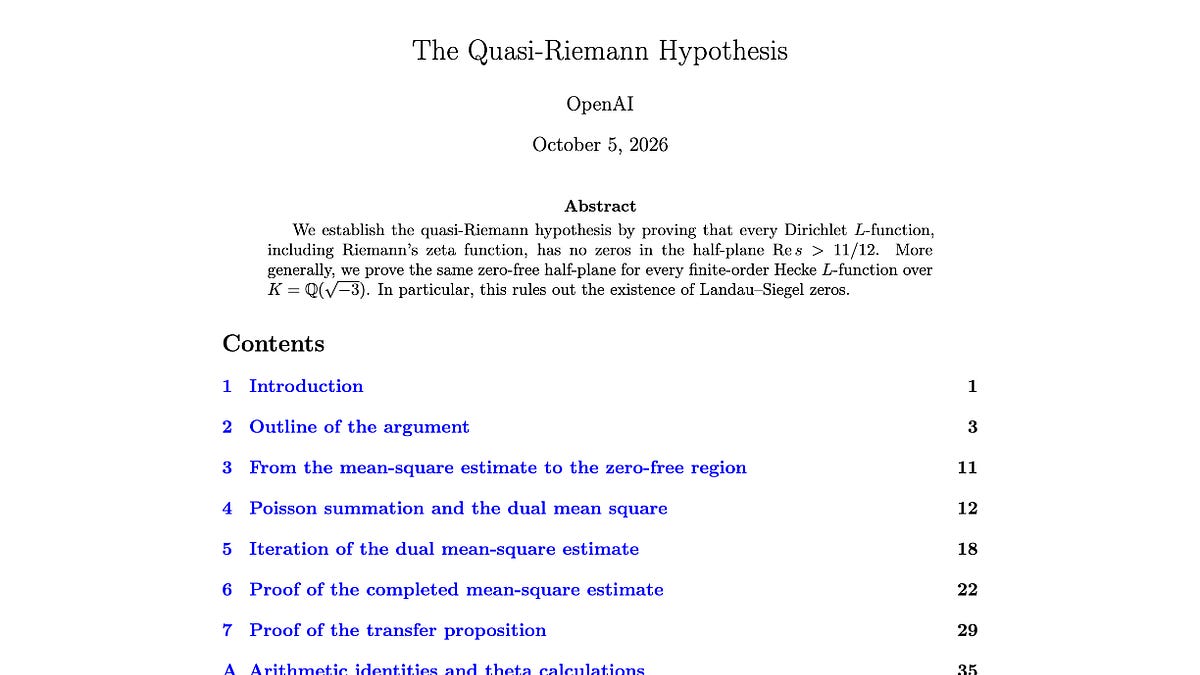 [AINews] Quasi-Riemann-Hypothesis: OpenAI publishes 722 math papers solving 90 of the top 500 open math problems; “the most significant moment” in >100 years of mathematics
AINews daily digest (Oct 5–6, 2026) from Latent Space, synthesizing Twitter/Reddit AI discussion. Lead story: OpenAI published 722 math manuscripts (372 result families) from an unreleased internal model, averaging ~3 hours of ChatGPT Pro compute per result, including a quasi-Riemann Hypothesis result, a no-Siegel-zeros result, an integer-multiplication-faster-than-n-log-n claim, and partial progress on Hodge and BSD — drawing both "most significant moment in mathematical history" praise and skepticism about verification and compute framing. The issue also covers Mistral Large 4 ("Le Chonk")'s launch and contested benchmark claims, Google's EmbeddingGemma 2 multimodal embedding model, OpenAI's new Decisions API, safety/observability research (CIAware benchmark, METR's warning on agents hacking log-review tooling), and assorted research and infra items (H-JEPA, ANVIL III optimizer, CoreWeave RL rollouts).
 latent.spacewriteupPublished and added 7 Oct 2026🧠 AI
- llm-openai-decisions 0.1a0
Simon Willison built llm-openai-decisions, a plugin for his `llm` CLI tool that wraps OpenAI's newly announced Decisions API (unveiled at DevDay), modeled on his existing llm-typesafe plugin for Jev's competing API. Both APIs support structured yes/no, multiple-choice, and score-style questions, but OpenAI's gpt-6-luna model also accepts image input (at 10 cents per million input tokens, versus Jev's 4.2 cents), and the plugin itself was built by having GPT-6 Astra read OpenAI's docs. The post includes install instructions and a worked example querying an image attachment for a yes/no answer.
simonwillison.netwriteupAdded 7 Oct 2026, published 6 Oct 2026🧠 AI  Liquid Network — $320M L-BTC Mint via Range-Proof Cache-Key Collision
On September 6, 2026, an ambiguous four-part cache-key construction in Elements' CachingRangeProofChecker::VerifyRangeProof (introduced by commit c26d719) let two distinct confidential-transaction verification inputs collide into the same 4,301-byte cached entry, causing nodes to treat an unbacked output as a validated range proof. The attacker used this to mint roughly 4,000 unbacked L-BTC on the Liquid Network and cashed it out through SideSwap's PAK peg-out route for ~$320M in BTC, draining the federation reserve from 4,205 BTC to 197 BTC before ~3,400 BTC was voluntarily returned with an on-chain "whitehat" message. CertiK's forensic trace ties the exploit to a specific setup transaction, a still-unidentified cache-priming transaction, and the inflation transaction, while Blockstream shipped emergency patch Elements v23.3.4 and disputes remain over whether the fix fully closes the ambiguity and whether the actors are genuine whitehats.
 rekt.newswriteupAdded 2 Oct 2026🛡️ Security
 SequenceHash: multihashing for the rest of us
Trail of Bits introduces SequenceHash and its keyed variant SequenceMAC, hash-agnostic multihashing constructions similar in goal to NIST's TupleHash but not tied to Keccak, working with SHA256/384/512, BLAKE, and RIPEMD. The spec, now part of the Community Cryptography Specification Project, provides unambiguous input encoding, length-extension prevention, built-in customization strings, and HMAC-style keyed MACs that avoid HMAC's key-pseudocollision issues; reference implementations ship in Rust, Go, and Python with full test vectors.
 blog.trailofbits.comwriteupPublished and added 2 Oct 2026🛡️ Security
- Endogenous Alignment Requires Dependence
A short conceptual post on the AI Alignment Forum by Gordon Seidoh Worley, part of their "Uncertain Updates" sequence, arguing that for an AI system's alignment to be "endogenous" (arising from the system's own values/reasoning rather than imposed externally) it must nonetheless involve some form of dependence — likely on human oversight, feedback, or external grounding. The full body text was not available at fetch time, so the specific argument and its relation to corrigibility or value-learning debates could not be confirmed from the page itself.
 alignmentforum.orgwriteupAdded 7 Oct 2026, published 1 Oct 2026🧠 AI
 Phishing Abuses RMM Tools for Persistent Access
Microsoft Defender Experts document a July 2026 phishing campaign that delivers a masqueraded but legitimately signed MSP360 RMM installer (v2.5.0.67) via meeting-invite, Zoom, Adobe, and DHL-themed lures hosted on both attacker infrastructure and legitimate cloud services (S3, Cloudflare R2, Dropbox, GitLab, Supabase). After UAC-elevated installation and service persistence, the RMM.Agent.exe service launches PowerShell to silently install a ConnectWise ScreenConnect client via msiexec, which the actor then uses via RunFile to drop credential-theft and reconnaissance tools disguised as Windows/Defender/Phone Link components. A separate July intrusion used FaronicsDeployAgent.exe the same way to deploy ScreenConnect, showing the technique is not MSP360-specific; Microsoft provides IOCs, hunting queries, and mitigation guidance (Application Control, AppLocker publisher rules, ASR rules) but does not attribute the activity.
microsoft.comwriteupAdded 7 Oct 2026, published 29 Sep 2026🛡️ Security PQ anonymity for Stealth Address Protocol
A technical ethresear.ch post proposing post-quantum upgrades (schemeId 2-6) to Ethereum's Stealth Address Protocol (ERC-5564/ERC-6538), replacing ECDH with ML-KEM (FIPS 203) to preserve recipient unlinkability against a cryptographically-relevant quantum computer. It identifies a specific vulnerability: the naive 1-byte view-tag optimization leaks enough information for a quantum attacker holding the derived public key to recover the spending key discrete log and test candidate recipients, breaking anonymity even when ML-KEM is used; the authors propose domain-separated tag derivation, hybrid EC/PQ combiners, pairwise-KEM variants, and a "stealthier SAP" construction to fix it.
 ethresear.chwriteupAdded 29 Sep 2026, published 28 Sep 2026🛡️ Security
 L402-over-eth-Layer2
L402-EL2 is an author's proposal and open-source implementation that adapts the Lightning-based L402 HTTP 402 payment pattern to Ethereum L2s, replacing invoices/preimages with a prefunded escrow contract and cumulative EIP-712 vouchers signed per call. It layers macaroons with caveats (tool, max_cumulative, expires_at) for HTTP credentials and attenuation to sub-agents, on-chain session keys with spending caps (ERC-1271/ERC-4337 compatible), and batch settlement, so an agent pays a provider per MCP tool call without a transaction per call. The stated design specifically meters MCP's tools/call, resources/read, and prompts/get while leaving initialize/tools/list free for discovery, aimed at agent orchestrators calling paid LLM APIs like the author's own LightPhon service; contracts are unaudited.
 ethereum-magicians.orgwriteupAdded 29 Sep 2026, published 27 Sep 2026🧠 AI
 Understanding the Impact of LLM Watermarking on AI Agent Behavior
Lasso Security researchers empirically test whether LLM output watermarking (specifically Google DeepMind's SynthID-Text, now deployed by Anthropic across Claude models) changes AI agent behavior — not just text content. Using paired generation (same seed, with/without watermark) across seven models on BFCL v4 tool-calling tasks and HarmBench/JailbreakBench refusal tests, they find watermarking measurably reduces tool-call accuracy (churn averaging 6.5%, up to 16.8% for phi-4) and, more critically, weakens refusal under prompt injection — e.g. gemma-3-27b's compliance with harmful requests shifts from -1.0 to +12.5 net points when injection is combined with watermarking. They term this "sampling drift" and argue watermark key/configuration changes can silently alter agent safety behavior outside the agent developer's control, recommending re-evaluation and red-teaming whenever watermarking is introduced.
 lasso.securitywriteupPublished and added 26 Sep 2026🛡️ Security
 Camera Hacking: Testing Cameras with Eyesharvester
Hands-on walkthrough of Eyesharvester, an open-source recon tool (github.com/Exhunterx/eyesharvester) that scans IP ranges to fingerprint IP cameras, DVRs and NVRs, tests default credentials, lists vendor-specific CVEs and generates a hardening checklist. The piece demonstrates finding Hikvision devices vulnerable to CVE-2021-36260, which gives shell access and can be chained with a Metasploit payload and a reverse SSH/Meterpreter proxy to pivot into the internal network.
 hackers-arise.comwriteupAdded 7 Oct 2026, published 25 Sep 2026🛡️ Security
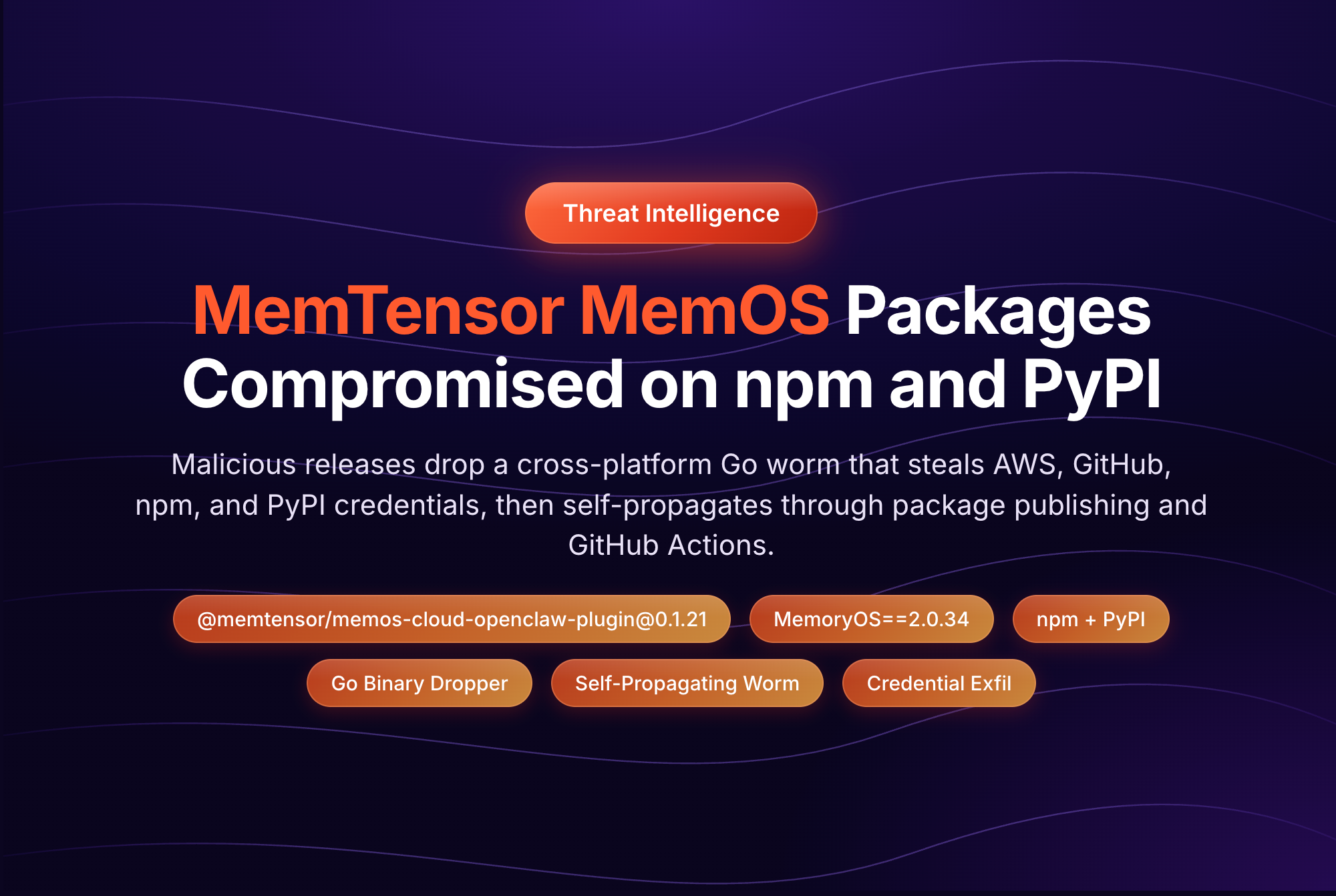 Sckit Supply Chain Worm Hits MemTensor npm & PyPi scopes
StepSecurity documents a supply-chain attack against @memtensor/memos-cloud-openclaw-plugin on npm (versions 0.1.21, 0.1.23, 0.1.25) and MemoryOS 2.0.34 on PyPI, which insert a hidden "sckit" launcher into normal plugin/import lifecycle code (no install scripts) to spawn a platform-specific Go binary that harvests the parent process's environment and the user's AI prompt text. The Go payloads contain regex patterns for AWS, GitHub, GitLab, npm, PyPI, Hugging Face, Vault, Slack, Stripe and SendGrid credentials, target the user's home directory as an inventory root, and beacon to skyleen.fr "front" domains; the PyPI variant additionally hides a conditional build-backend/CI bridge that can steal PYPI_API_TOKEN during publishing and pull a hash-pinned, Ed25519-signed secondary payload via GitHub Actions. The writeup includes full IOC/remediation guidance.
 stepsecurity.iowriteupPublished and added 23 Sep 2026🛡️ Security
- Novel supplychain.local Go worm appears
Aikido Security reports on a novel worm, apparently written in Go and referencing a "supplychain.local" domain, that spreads via malicious packages published to npm and PyPI under the name memtensor. The page content could not be retrieved, so specifics of the propagation mechanism and payload are unconfirmed beyond the title and URL.
 aikido.devwriteupPublished and added 23 Sep 2026🛡️ Security
- WorkspaceBench: Evaluating Interpretability Methods for the Global Workspace
WorkspaceBench is a benchmark introduced by camilablank, agam_bhatia, Euan Ong and Neel Nanda through the MATS Program for evaluating interpretability methods applied to Global Workspace style neural network architectures. The fetched page only exposed metadata without the article body so specific tasks and metrics could not be confirmed from the text, but the title and venue indicate a mechanistic interpretability evaluation framework.
alignmentforum.orgwriteupAdded 7 Oct 2026, published 23 Sep 2026🧠 AI  Graphalgo campaign spreads to Terraform providers and Go Modules
Aikido documents the Graphalgo malware campaign's expansion beyond NPM into two malicious Terraform providers (gocommunity-io/dockerd and the kreuzwerker/docker typosquat kreuzwenker/docker) and two Go modules (gocommunity.io/orderedbtree, gogets.dev/btreex), marking the first observed systematic Terraform provider malware distribution. The payload is a Go port of Graphalgo sharing blockchain infrastructure, Slack C2, and a public key with prior JS/NPM samples; it activates only under specific hash-gated runtime conditions (targeted attack indicator), then deploys a Go RAT with dual C2 channels — an Ethereum (Arbitrum Sepolia) smart-contract dead drop and Slack bot messaging — plus self-delete and remote code execution capabilities. The threat actor also stood up two fake Go package ecosystem websites (gocommunity.io, gogets.dev) to socially engineer developers and backdated Git commits to obscure module publication timing.
aikido.devwriteupPublished and added 22 Sep 2026🛡️ Security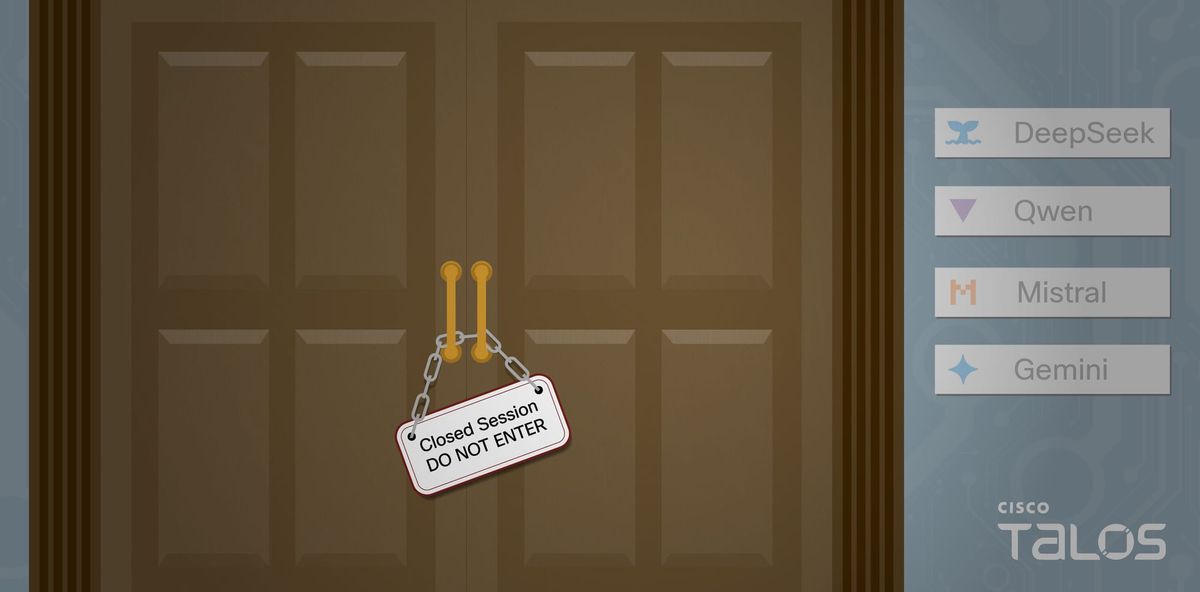 The Closed Quorum: Inside the First Reported Autonomous AI C2 Implant
Cisco Talos' CAIRN project documents CLOSEDQUORUM, a 64-bit Go Windows implant that replaces traditional C2 infrastructure with a panel of up to four commercial LLM providers (DeepSeek, Qwen, Mistral, Gemini) that vote on the implant's next action via plurality voting, with each model queried against a structured JSON decision schema constrained to inject/persist/steal/move actions. Once deployed it autonomously dumps LSASS credentials, steals browser passwords and crypto wallets (MetaMask, Exodus, Ethereum), and exfiltrates AES-256-GCM-encrypted data to an operator's Discord webhook, all without further human tasking. The post details the developer's apparent credentials-as-a-service distribution model, deterministic tie-breaking favoring DeepSeek, and provides SHA256 hashes plus a YARA detection rule for the family (formerly tracked as BALZAK).
 blog.talosintelligence.comwriteupAdded 30 Sep 2026, published 22 Sep 2026🛡️ Security
- Ready, Settra, Go: New Settra Ransomware Variant Deploys MeshAgent RMM
Huntress analysts detail two Settra ransomware incidents (July and September) observed in customer environments, documenting the threat actor's use of the MeshAgent RMM for persistence, BYOVD via the gdrv.sys driver, and anti-forensic techniques including Windows Event Log clearing, reagentc /disable, diskpart-based recovery partition removal, and cipher.exe free-space wiping. The post includes specific IOCs — C2 IPs 45.13.122[.]7 and 193.5.65[.]114, the recurring workstation name WIN-LIVFRVQFMKO, and the RESTORE_FILES.txt ransom note — supplementing prior public reporting from MoxFive and SOCRadar on this newer ransomware variant first seen in June.
 huntress.comwriteupAdded 22 Sep 2026, published 17 Sep 2026🛡️ Security
- Living Inside the Shell: zsh Modules on macOS
A DFIR researcher shows how macOS's default shell, zsh, ships with loadable modules (zsh/net/tcp, zsh/mapfile, zsh/attr, zsh/stat, zsh/sched) that let the shell itself open raw TCP sockets, read/write files, and manipulate extended attributes like com.apple.quarantine without spawning curl, xattr, rm, or nc. The post walks through a full example using ztcp and source /dev/fd/$fd to fetch and execute a second-stage payload directly from a socket (bootstrapping a LaunchAgent) with no downloaded file on disk and no child process, referencing the prior real-world use of zsh/net/tcp for reverse shells (documented by ESET and GTFOBins). It then validates via eslogger/Endpoint Security that DELETEEXTATTR/SETEXTATTR and similar operations remain visible even when performed through zsh builtins, arguing detections should target the underlying OS event rather than the specific binary invoked.
 dfir.chwriteupPublished and added 16 Sep 2026🛡️ Security
- Shallow Beliefs: Midtraining does not inoculate against EM from reward hacking
A short AI Alignment Forum research note arguing that midtraining interventions intended to instill "deep" beliefs do not actually inoculate language models against emergent misalignment (EM) caused by reward hacking during later RL training. The authors, Jozdien and Julian Stastny, present this as evidence that such belief-shaping interventions produce only shallow, surface-level changes rather than robust generalization-blocking effects. The fetched page only exposed site metadata (title, authors, date, tags) rather than the full article body, so specifics of the experimental setup are not confirmed here.
alignmentforum.orgwriteupAdded 7 Oct 2026, published 15 Sep 2026🧠 AI  AI SAST Finding: Path Traversal in OpenClaw via LLM Guardrail Bypass | Blog | Endor Labs
Endor Labs details GHSA-r5fq-947m-xm57, a high-severity path traversal (CVSS 8.8) in OpenClaw's apply_patch tool that allows arbitrary file write/delete when sandboxRoot isn't configured, tracing the vulnerable code path from resolvePatchPath() through resolvePathFromCwd() to fs.writeFile/fs.rm. Because the tool is only invoked via LLM decision, the researcher bypassed the model's safety guardrails by injecting fabricated function_call/function_call_output entries into the /v1/responses conversation history, tricking the LLM via in-context learning into emitting a real malicious tool call with a traversal payload. This illustrates how LLM safety training can be the sole runtime control gating dangerous tool arguments, and how that control can be defeated with conversation history injection.
endorlabs.comwriteupPublished and added 11 Sep 2026🛡️ Security A “proof” of Fermat’s Last Theorem that fits the margin
Trail of Bits found a bug in Lean's String.Pos.Raw.extract (affecting all stable versions up to 4.33.1, fixed in 4.34.0-rc1) where the logical definition and the compiled native code disagree on the result of extracting a slice at an out-of-bounds position, letting an attacker manufacture a contradiction (empty string = non-empty string) that "proves" any theorem, including a fake formalization of Fermat's Last Theorem. The exploit only works when a proof relies on the native_decide axiom, which extends trust to the compiler rather than the kernel; the researchers found the issue while using GPT-5.6 to build a code-review skill, and Lean maintainers hargoniX and Rob23oba shipped fixes within hours to days of disclosure. The post is a reminder that machine-checked proofs are only as trustworthy as the evaluator/compiler paths behind axioms like native_decide, and points to work like lean4lean and alternative kernels as mitigations.
blog.trailofbits.comwriteupPublished and added 9 Sep 2026🛡️ Security Incident response guide for AWS CloudTrail investigations – Part 2 | Amazon Web Services
Part 2 of AWS's CloudTrail incident-response guide walks through a real multi-stage attack: an SSRF flaw in a web app reached the EC2 IMDSv1 endpoint to steal temporary credentials for an over-privileged "webdev" role, which the attacker then used to probe IAM (failed CreateUser), log into the console without MFA, and pivot cross-Region (us-east-1 to us-east-2) to enumerate and actively invoke the Amazon Nova Pro model via Bedrock's Converse API. It details the specific CloudTrail fields that expose each stage (userIdentity, readOnly, awsRegion, ec2RoleDelivery, sessionCredentialFromConsole, invokedBy), gives an incident-response checklist, and closes with hardening takeaways: enforce IMDSv2, least-privilege EC2 roles, cross-Region detection parity, Bedrock model invocation logging, and GuardDuty AI Protection.
 aws.amazon.comwriteupAdded 21 Sep 2026, published 3 Sep 2026🛡️ Security
 Incident response guide for AWS CloudTrail investigations – Part 1 | Amazon Web Services
AWS Security Blog's SIRT team walks through two real-world CloudTrail investigation scenarios: a cross-account S3 role abuse leading to targeted deletion of financial/PII/backup data with ransomware implications, and an unauthenticated console session that pivoted through AWS CloudShell to deploy a CloudFormation stack named "CRYPTO" for cryptocurrency mining. The guide annotates specific CloudTrail fields (session names, mfaAuthenticated, sessionCredentialFromConsole, userAgent) and provides investigation-priority frameworks and response checklists for each scenario, aimed at security operations and cloud engineering teams performing AWS forensics.
aws.amazon.comwriteupAdded 21 Sep 2026, published 3 Sep 2026🛡️ Security
Showing 30 of 71
Show more