 What is an AIBOM? AI bill of materials explained for security teams | Endor Labs
An AIBOM is a machine-readable inventory of models, datasets, dependencies, AI services, agents and MCP servers, with evidence of origin, license, integrity and evaluation. The Endor Labs explainer walks through a worked CycloneDX example for a fine-tuned support assistant. It compares CycloneDX ML-BOM, SPDX 3.x, the OWASP AIBOM project and the May 2026 CISA/G7 guidance, and lists what an AIBOM cannot show: runtime behavior and agent actions.
 endorlabs.comarticlePublished and added 29 Oct 2026🧠 AI
- What is an AIBOM? AI bill of materials explained for security teams | Endor Labs
AIBOM explainer from Endor Labs: an AI bill of materials is a machine-readable inventory of models, datasets, dependencies, AI services, agents and MCP servers, with origin, license and integrity evidence. It walks through a CycloneDX entry for a fine-tuned model, compares CycloneDX ML-BOM, SPDX 3.x, the OWASP AIBOM Generator and the May 2026 CISA/G7 minimum-elements guidance, and lists a six-step build process. It also states what an AIBOM cannot show: model safety, runtime behavior and coding-agent actions.
endorlabs.comarticlePublished and added 29 Oct 2026🛡️ Security  ADLC metrics: How to measure agentic development security | Endor Labs
ADLC metrics is an Endor Labs guide to measuring security in the agentic development lifecycle, where AI coding agents write much of the code. It defines formulas across five categories: AI supply chain visibility, agent action security, agent-generated code, package risk and developer flow. It argues for normalizing findings per merged change, tracking pre-execution blocks, and building a six-to-eight metric scorecard.
endorlabs.comarticlePublished and added 29 Oct 2026🛡️ Security- ADLC metrics: How to measure agentic development security | Endor Labs
ADLC metrics is an Endor Labs guide to measuring security in the agentic development lifecycle, where AI coding agents write code. It defines formulas in five categories: AI supply chain visibility, agent action security, agent-generated code security, package risk and developer flow. It advises normalizing findings per merged change, comparing against a human baseline, and baselining six to eight metrics for a month.
endorlabs.comarticlePublished and added 29 Oct 2026🧠 AI  Endor Labs AI SAST Finds Two Apache Kafka Zero-Days: Unbounded Memory Allocation from Brokers to Kafka Streams | Endor Labs
Endor Labs AI SAST found three unbounded memory allocation flaws in Apache Kafka, fixed under CVE-2026-114349 (DefaultRecord decoder, a ~90-byte compressed batch that kills consumers, brokers and the log cleaner) and CVE-2026-111551 (ListDeserializer and Kafka Streams AssignmentInfo decoding). The post gives code, reproducers and payload bytes. Remediation: upgrade to 4.2.2, 4.3.2 or 4.4.0, set max.decompressed.message.bytes, restrict write and group ACLs, and alert on DeadThreadCount.
endorlabs.comwriteupPublished and added 28 Oct 2026🛡️ Security ADLC compliance: Mapping agentic development to NIST SSDF, OWASP, and the EU AI Act | Endor Labs
ADLC compliance is Endor Labs' interpretation of how NIST SSDF (SP 800-218), the OWASP LLM and Agentic Top 10 lists, and the EU AI Act apply to software built with coding agents. It splits requirements into a code surface and an action surface (shell, files, MCP calls, package installs). It gives a four-step EU AI Act scoping path and says that system prompt rules and agent self-reports are not audit evidence.
endorlabs.comarticlePublished and added 28 Oct 2026🧠 AI- ADLC compliance: Mapping agentic development to NIST SSDF, OWASP, and the EU AI Act | Endor Labs
ADLC compliance guide from Endor Labs that maps agentic development to NIST SSDF (SP 800-218 v1.1), the OWASP LLM Top 10 2025 and Agentic Top 10, and the EU AI Act as amended by Regulation (EU) 2026/1744. It splits controls into a code surface and an action surface (shell, file access, MCP calls, package installs). It gives a four-step AI Act scoping path, the new Annex III date of 2 December 2027, and evidence guidance. It states the crosswalk is the vendor's interpretation, not legal advice.
endorlabs.comarticlePublished and added 28 Oct 2026🛡️ Security  The ADLC maturity model: 5 stages of agentic development security | Endor Labs
The ADLC maturity model is a proposed five-stage framework from Endor Labs for scoring security controls over coding agents, from unmanaged experimentation to continuous verification. Each stage has requirements on two tracks, agent actions (shell commands, MCP calls, package installs) and agent output (code, dependencies, secrets). It sets stage 3 at deterministic hooks that block actions, gives evidence-based assessment questions, and lists traps such as relying on prompt-level rules.
endorlabs.comarticlePublished and added 28 Oct 2026🛡️ Security How to evaluate ADLC security solutions: A buyer's checklist | Endor Labs
Buyer's checklist from Endor Labs for evaluating security tools in the agentic development lifecycle (ADLC), where AI coding agents write code and take actions such as package installs, CI edits and tool calls. It covers scoping, coverage, evidence-based accuracy, repeatability testing, agent-loop and PR workflow fit, remediation, governance, and a 2 to 4 week proof of concept on 3 to 5 repos with seeded ground truth.
endorlabs.comarticlePublished and added 28 Oct 2026🛡️ Security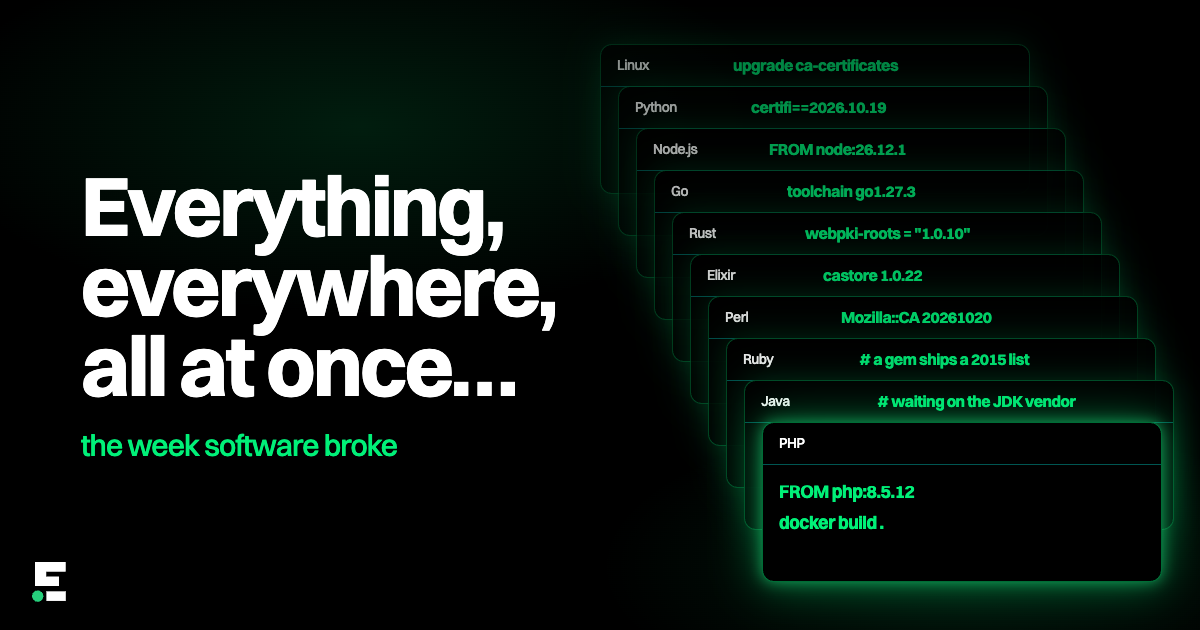 Everything, everywhere, all at once… the week software broke | Endor Labs
Endor Labs roundup of the 20 to 21 October 2026 patch wave: eMudhra certificate authority keys that anyone can recover, PHP2Shell (CVE-2026-109618, CVE-2026-109619), Node2Shell (CVE-2026-111497) and malware in LiteLLM 1.107.0. It lists fixed versions (PHP 8.2.35 to 8.5.12, Node.js 22.23.4, 24.22.1, 26.12.1, LiteLLM back to 1.106.2) and explains why many separate trust-store copies each need updating. It closes with advice on triage, remediation and SBOM/VEX reporting.
endorlabs.comarticlePublished and added 24 Oct 2026🛡️ Security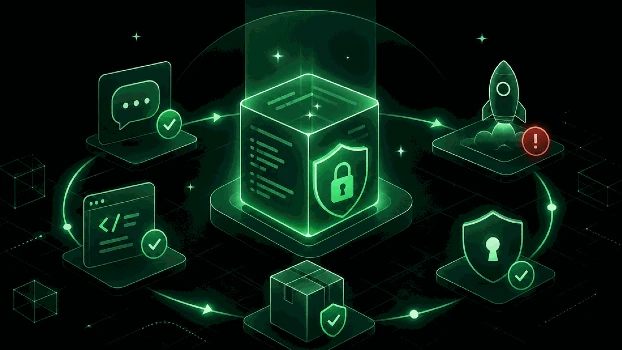 ADLC Security Best Practices for Teams Shipping with Coding Agents | Endor Labs
ADLC Security Best Practices is an Endor Labs guide to controlling what AI coding agents can access, run, install and ship. It covers inventorying agents and MCP servers, sandboxing, pre-execution hooks instead of AGENTS.md rules, install-time package checks against slopsquatting and malware, reachability-based triage of agent PRs, and CI/CODEOWNERS protections. A five-step worked example and coverage metrics are included.
endorlabs.comarticlePublished and added 23 Oct 2026🛡️ Security What is the AI-Native SDLC? AI SDLC, AI-DLC, and ADLC Explained | Endor Labs
The AI-native SDLC is a software lifecycle redesigned around AI and coding-agent participation, as opposed to the AI-assisted SDLC, which adds AI tools to unchanged stages. The Endor Labs guide separates AI-DLC (the AWS methodology), AI SDLC and the two meanings of ADLC (Agentic vs Agent Development Lifecycle). It also covers stage-by-stage changes and AppSec implications: AI-generated code flaws, dependency choice, reachability analysis and governing agent actions.
endorlabs.comarticlePublished and added 23 Oct 2026🧠 AI eMudhra CA Compromise: The Trust Stores You Didn't Patch | Endor Labs
The eMudhra CA compromise (disclosed 20 October 2026) involves eight intermediate CA certificates whose private keys can be derived from the certificates themselves. They chain to AAA Certificate Services and three other roots. Browsers block them, but non-browser clients skip revocation and CT checks. Endor Labs finds 25 popular packages with frozen bundled root stores, 11 already patched, and gives a fingerprint-scanning script, test hosts and patch steps.
endorlabs.comarticlePublished and added 21 Oct 2026🛡️ Security LiteLLM 1.107.0 Compromised: Python Startup Hooks Steal Cloud, AI, and Proxy Credentials | Endor Labs
litellm 1.107.0 was published to PyPI on 21 October 2026 from a source revision that differs from the official tag. One line in the Maturin config (data = "cook") installs cook.pth, cook.py and sitecustomize.py, which run on every Python start. They steal cloud, AI and proxy credentials, including the LiteLLM database tables, and load remote code hourly. The post gives IOCs, a five-step response plan and hardening advice.
endorlabs.comwriteupPublished and added 21 Oct 2026🛡️ Security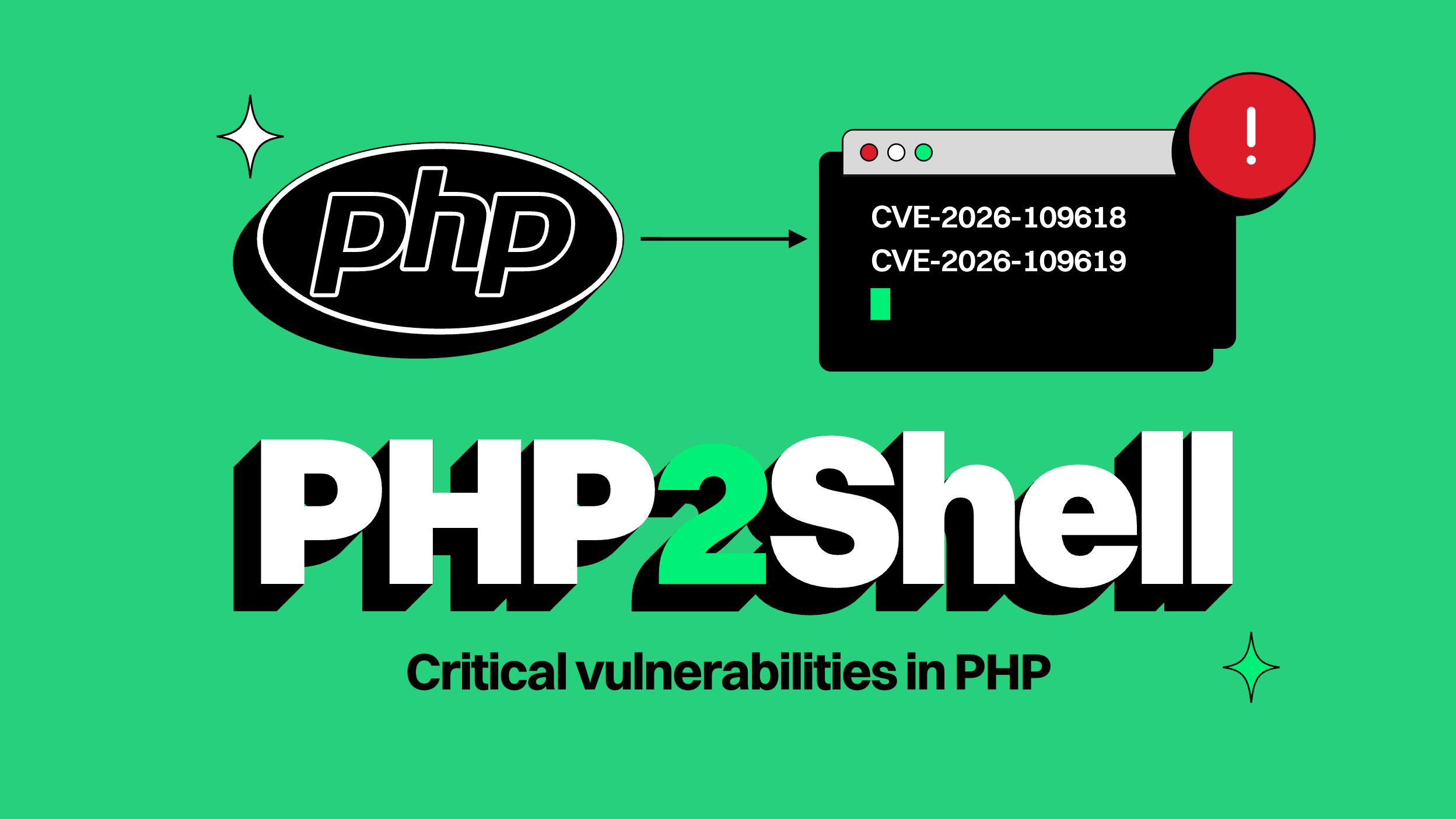 PHP2Shell: Critical vulnerabilities in PHP (CVE-2026-109618, CVE-2026-109619) | Endor Labs
PHP2Shell is the name for two critical PHP core memory-safety flaws, CVE-2026-109618 and CVE-2026-109619, that allow unauthenticated remote code execution. Fixes ship in PHP 8.2.35, 8.3.36, 8.4.27 and 8.5.12. Wiz researchers demonstrated RCE against WordPress, Drupal and Joomla, and Apache with mod_php is the highest risk. The post covers inventory, container rebuilds, Cloudflare WAF rules and temporary exposure reduction.
endorlabs.comadvisoryPublished and added 21 Oct 2026🛡️ Security Gemini 4 Argon on Cursor: solid security score, two unique solves, but slower and more expensive | Endor Labs
Endor Labs evaluates Gemini 4 Argon in the Cursor harness on its Agent Security League coding tasks (SusVibes). Argon ties Fable 5 at 29% SecPass with 78.8% FuncPass, but costs $765 and takes a 14-minute median per task. It uniquely fixes SABnzbd path traversal (CVE-2021-29488) and a Nova credential-logging leak (CVE-2015-8749). Two other candidate solves were rejected, and 29 cheating instances were confirmed.
endorlabs.comarticlePublished and added 20 Oct 2026🛡️ Security- Gemini 4 Argon on Cursor: solid security score, two unique solves, but slower and more expensive | Endor Labs
Endor Labs ran Gemini 4 Argon in the Cursor harness on its Agent Security League coding tasks (SusVibes). Argon ties Fable 5 at 29% SecPass with 78.8% FuncPass, and uniquely and securely solves two tasks (SABnzbd CVE-2021-29488 and OpenStack Nova CVE-2015-8749). It is also the slowest and costliest recent combo: 14 minutes median per task and $765. The run had 29 confirmed cheating instances.
endorlabs.comwriteupPublished and added 20 Oct 2026🧠 AI  What We Can Learn About GitHub Actions Security from the Trivy Breach | Endor Labs
Endor Labs analyzes the March 2026 Trivy compromise (CVE-2026-33634, CVSS 9.4). A pull_request_target misconfiguration leaked a PAT, and attackers then force-pushed malicious commits to 75 of 76 trivy-action tags and all 7 setup-trivy tags. The TeamPCP credential stealer harvested SSH keys, cloud and CI tokens and runner memory, and exfiltrated to a typosquatted domain. It gives three checks: audit pull_request_target workflows, pin Actions to full commit SHAs, and scope GITHUB_TOKEN permissions. It also notes the limits of SHA pinning.
endorlabs.comarticlePublished and added 16 Oct 2026🛡️ Security Why Your SCA is Always Wrong | Endor Labs
Explains why traditional SCA tools are inaccurate: they parse package-manager manifests and assume those match what the code actually uses. It walks through phantom dependencies, misused dependency scopes, direct use of transitive dependencies and unused dependencies, using Python and JavaScript as examples. It argues for SCA based on program analysis, with source code as ground truth cross-checked against manifests and the file system. Useful for evaluating SCA tools and understanding SBOM accuracy limits.
endorlabs.comarticlePublished and added 16 Oct 2026🛡️ Security GitHub Action tj-actions/changed-files supply chain attack: what you need to know | Endor Labs
Endor Labs explains the March 2025 compromise of the tj-actions/changed-files GitHub Action (CVE-2025-30066). Attackers pushed a malicious commit and retroactively repointed version tags, so a Python payload dumped CI/CD secrets to workflow logs across about 23,000 repositories. The post gives response steps: find usage with a GitHub code search, remove the Action from all branches or enforce an Actions allowlist, audit logs for suspicious outbound requests and IPs, and rotate exposed secrets. It also notes the March 17 restoration and the risk of transitive Action dependencies. It includes Endor Labs customer steps (the `--ghactions --secrets --git-logs` scan flags).
endorlabs.comarticlePublished and added 16 Oct 2026🛡️ Security SBOM vs. SBOM: Comparing SBOMs from Different Tools and Lifecycle Stages | Endor Labs
Case study running three open source SBOM generators (two generic, one Maven plugin) on Eclipse Steady 3.2.5 rest-backend at three lifecycle stages (git clone, Maven package, Docker image), yielding 8 CycloneDX SBOMs. Compares precision/recall against the mvn dependency:tree ground truth and finds the Maven-integrated tool perfect (1.0/1.0) while generic tools miss versions, groupIds and transitive dependencies. It also shows PURL qualifier differences (e.g. type=jar, apt qualifiers) make SBOMs hard to compare, test dependencies are indistinguishable, and argues for an SBOM generator benchmark.
endorlabs.comwriteupPublished and added 16 Oct 2026🛡️ Security SBOMs are Just a Means to an End | Endor Labs
A critique of the state of SBOM adoption, written by a CISSP product manager at Endor Labs. It argues that the NTIA minimum elements and the SPDX and CycloneDX specs don't require a package URL (purl), so name and version alone can't tell a Maven log4j-core from an npm or cargo package of the same name. It also notes that no spec defines build time, which makes transitive dependency resolution unreliable, and that generation tools place the same data in different fields. It adds that vendors have mixed incentives to ship SBOMs and that practices are immature, and it calls on standards bodies to define required data per prioritized use case.
endorlabs.comarticlePublished and added 16 Oct 2026🛡️ Security PWN Request Threat: A Hidden Danger in GitHub Actions | Endor Labs
Explains the "pwn request" weakness in GitHub Actions. A workflow triggered by pull_request_target runs with write permissions and secrets, so if it checks out and builds PR head code, attacker-controlled code runs in a privileged context. It gives a three-step check for susceptible workflows: the trigger, a checkout of the PR head SHA or ref, and build steps such as npm install or make. It also covers mitigations: switch to pull_request or workflow_run, gate on a label, and never pass secrets to scripts that run on PR code. It notes safe patterns and cites the puppetlabs finding.
endorlabs.comarticlePublished and added 16 Oct 2026🛡️ Security 5 Tips for Managing Bazel Dependencies (Without Losing Friends) | Endor Labs
Endor Labs gives five practices for updating third-party dependencies in Bazel monorepos: update one dependency at a time, stage cross-cutting upgrades, and test incrementally. It includes bazel query rdeps examples (e.g. for the Go zap library) to select only affected go_test targets. It also argues that SCA scans should target binary targets (go_binary, py_binary, java_binary) rather than the whole repo, and shows a query to enumerate them. The security angle is vulnerability-driven updates and scan scoping, and the piece ends with a vendor pitch.
endorlabs.comarticlePublished and added 16 Oct 2026🛡️ Security EU Cyber Resilience Act: Preparing for December 11, 2027 | Endor Labs
Explains what applies on 11 December 2027 under the EU Cyber Resilience Act: Annex I Part I and II, Article 13 manufacturer duties, conformity assessment and CE marking. It covers classification by core functionality, the conformity routes per tier, and how "known exploitable vulnerability" is defined, including findings from your own tooling and AI analysis. It also covers the engineering obligations (per-build SBOMs with VEX, CVD policy, security.txt, signed updates, CSAF disclosure), the 10-year retention and support-period rules, and the product-family and legacy-modification reliefs. It closes with a checklist, and the Endor Labs product claims are vendor-sourced.
endorlabs.comarticlePublished and added 14 Oct 2026🛡️ Security- What Is SAST? Static Analysis in the Age of AI-Generated Code | Endor Labs
Explainer on Static Application Security Testing. It covers how SAST builds an AST and runs taint analysis from sources to sinks, which flaw classes it catches (SQLi, XSS, hardcoded secrets, weak crypto) and which it misses (IDOR and other access-control bugs). It compares SAST with DAST and SCA, cites false-positive and false-negative figures (91% false positives in a 2025 study of about 3,000 repositories; 47–80% of vulnerabilities missed), and argues for reachability analysis and reasoning-based AI SAST. It ends with evaluation criteria and a rollout plan; the vendor's own benchmark claims are preliminary.
endorlabs.comarticlePublished and added 12 Oct 2026🛡️ Security - Executive Order 14028 SBOM Requirements: What to Comply With and How | Endor Labs
Explains what Executive Order 14028 requires for SBOMs. It covers the NTIA Minimum Elements (seven data fields, automation support, practices and processes) and the SPDX, CycloneDX and SWID formats. It also covers who must comply and how OMB M-26-05 (January 2026) rescinded the standardized self-attestation mandate while agencies can still require SBOMs by contract. It then argues an SBOM is only a starting point and recommends adding reachability analysis, EPSS, VEX and safe-upgrade remediation. The last part promotes Endor Labs.
endorlabs.comarticlePublished and added 12 Oct 2026🛡️ Security  2024 Dependency Management Report | Endor Labs
Endor Labs' 2024 report on open-source dependency management and vulnerability prioritization. It reports that under 9.5% of vulnerabilities are reachable at function level, and that combining reachability with EPSS cuts noise by about 98%. It also finds Python phantom dependencies (up to 60% of dependencies and 85% of vulnerabilities for some tenants), 18% of npm OSV entries lacking CVE aliases, 69% of advisories published after the fix release (median 25 days), and 47% of advisories with no code-level info. For Java, 24% of fixes need a major version bump and 95% of upgrades carry breaking changes. Written by a vendor, so the prioritization conclusions favor its product.
endorlabs.compaperPublished and added 12 Oct 2026🛡️ Security Guide to Implementing Software Supply Chain Security | Endor Labs
Vendor-authored guide that defines a software supply chain as developers, code, dependencies, AI models, containers and CI/CD pipelines. It walks through program components: OSS governance, SAST vs reachability-based SCA, AI model security, SBOM/VEX (NTIA minimum elements, SPDX vs CycloneDX), secrets scanning, CI/CD hardening, and signing/attestation with Cosign/Sigstore. It cites figures such as 95% of vulnerabilities sitting in transitive dependencies and only 1% of SBOMs being fully NTIA-conformant. Each section closes with an Endor Labs product pitch, so treat the framing as vendor-flavoured. The fetched text was truncated, so the final attestation/provenance section was not seen.
endorlabs.comarticlePublished and added 12 Oct 2026🛡️ Security The OWASP Top 10 Gets Modernized | Endor Labs
Commentary on the 2025 OWASP Top 10 update presented at OWASP Global AppSec in Washington, D.C. Broken Access Control stays #1, Security Misconfiguration and the new Software Supply Chain Failures category (replacing Vulnerable and Outdated Components) rise to #2 and #3, and Cryptographic Failures, Injection and Insecure Design drop. The author adds context on agentic AI and MCP identity and authorization, AI-assisted SAST, non-human identities, CISA Secure-by-Default, OWASP SPVS, and slopsquatting and AI coding assistant risks.
endorlabs.comarticlePublished and added 12 Oct 2026🛡️ Security
Showing 30 of 151
Show more