 Police seize Virtualine bulletproof service tied to ransowmare, cybercrime
Virtualine, a bulletproof hosting service also operating as Secury, Massgod, Spamhouse, Lanedo and Omegatech, had its main domain seized by the FBI with German, Dutch and UK partners. Chainalysis and TRM Labs traced its Bitcoin payments to ransomware (5% of flows), a Russian drug market (about 44%), sextortion and the StealC infostealer. Dutch police seized dozens of servers in Limburg and recovered data on over 3,000 customers.
 bleepingcomputer.comarticleAdded 30 Oct 2026, published 28 Oct 2026🛡️ Security
 International Law Enforcement Seizes Domain of Virtualine Bulletproof Hosting Service
Virtualine is a bulletproof hosting provider whose domain virtualine.net was seized on 27 October 2026 by the FBI Washington Field Office and the Eastern District of Virginia, with German, Dutch and UK police support. Chainalysis and OverRIPE gave intelligence support. The post lists aliases (Secury, Massgod, Spamhouse, Lanedo, Omegatech), forum advertising on Exploit.in and HackForums, and unhosted bitcoin payments tied to ransomware, infostealers and scam infrastructure.
 chainalysis.comarticlePublished and added 27 Oct 2026🛡️ Security
 SymLift: Neural Semantic Lifting for Compile-Free Vulnerability Detection in Context-Incomplete Code Fragments
SymLift is a compile-free vulnerability detection framework for context-incomplete code fragments. A fine-tuned LLM lifts control-flow, data-flow, memory and resource relations into a constrained LLVM-like IR. A parser turns the IR into facts, and Datalog rules derive findings with derivation traces. On Juliet function-level fragments Clang compilation success falls to 12.00%, while SymLift's completion rate drops only 1.17 points. SymLift-Qwen-7B reaches Target-F1 94.41% on FormAI and 91.66% micro-F1 on MegaVul.
 arxiv.orgpaperAdded 28 Oct 2026, published 25 Oct 2026🛡️ Security
- SymLift: Neural Semantic Lifting for Compile-Free Vulnerability Detection in Context-Incomplete Code Fragments
SymLift is a compile-free vulnerability detection framework for code fragments that lack project context. A fine-tuned LLM reconstructs control-flow, data-flow, memory and resource relations as a constrained LLVM-like IR, and a deterministic parser turns it into facts for Datalog rules that give findings with derivation traces. SymLift-Qwen-7B reaches 94.41% Target-F1 on FormAI and 91.66% micro-averaged Target-F1 on MegaVul.
arxiv.orgpaperAdded 28 Oct 2026, published 25 Oct 2026🧠 AI - Standing on Open Shoulders: Regional Fine-Tuning of Open-Weight Camera-Trap Models for UK Wildlife with Modest Data and Compute
DeepFaune-UK is a fine-tune of the open DeepFaune camera-trap classifier on 28 UK classes, paired with MegaDetector v6. On 20,212 MammalWeb images it reached 88.8% strict accuracy against 56.5% (DeepFaune v1.5.0) and 59.0% (SpeciesNet). Re-applying the recipe to the DINOv3-based classifier gave 90.6%. Fine-tuning on about 150 crops per class matched full-data out-of-distribution accuracy, and a DINOv2 run took about 22 minutes on under 4 GB of GPU memory.
arxiv.orgpaperAdded 26 Oct 2026, published 23 Oct 2026🧠 AI  HAETAE on a Diet: Less Stack, Less Time on Low-End Microcontrollers
This ePrint paper presents an optimized HAETAE implementation, a lattice-based post-quantum signature scheme, for Cortex-M4, Cortex-M3, MSP430 and AVR. It keeps polynomials in 16 bits, shares buffers between objects with disjoint lifetimes, and replays Gaussian samples instead of regenerating them. On an ATmega2560, HAETAE-2 key generation, signing and verification run in 8,070 B of SRAM. Stack use drops up to 34% and signing is 1.18-2.51x faster than Low-Stack HAETAE.
 eprint.iacr.orgpaperAdded 24 Oct 2026, published 21 Oct 2026🛡️ Security
- Efficient NTRU+ Implementations on Cortex-M
Efficient NTRU+ Implementations on Cortex-M presents NTRU+ KEM implementations built on 3-way NTTs for Arm Cortex-M0+, M3, M4 and M7. It adds omega-folded front layers that handle ternary inputs without modular reduction. The speed-optimized version cuts execution time by up to 52.43% against the official optimized C code. The memory-optimized version cuts peak stack use by up to 82.60%.
eprint.iacr.orgpaperAdded 21 Oct 2026, published 20 Oct 2026🛡️ Security - Quantum-Aware Key Rank for Side-Channel Attacks evaluation
Proposes a cost model and metric for an adversary who collects side-channel traces classically and finishes the key search on a quantum computer. Shows any quantum algorithm needs Omega(sqrt(r)) cipher evaluations for key rank r, and that the quadratic advantage holds only up to a rank bound set by the NIST MAXDEPTH budget (about 2^58.6 for AES-128 at D=2^40). Defines a quantum-aware key rank computable from existing rank estimators, with simulated-leakage experiments showing a depth-limited quantum adversary is worth about 22 traces at SNR 0.125.
arxiv.orgpaperAdded 16 Oct 2026, published 14 Oct 2026🛡️ Security  Microsoft’s AI chip targets 40% more tokens per megawatt in 2027
Reports Microsoft's Maia 300, its third-generation in-house AI accelerator, unveiled October 12, 2026 with production workloads from 2027. Microsoft claims 40% more tokens per megawatt than leading GPU systems and up to 7x Maia 200's rack-level token throughput in a 96-accelerator rack. It uses a chiplet design on TSMC N2P that separates compute, memory-controller and I/O. It is aimed at long-context reasoning and agentic inference, while Nvidia and AMD stay in place for training. Useful as a data point on the shift toward custom inference silicon and model-chip co-design.
 en.cryptonomist.charticlePublished and added 12 Oct 2026🧠 AI
 The gap in shared understanding of LLM capability is widening
Andrej Karpathy argues the gap in shared understanding of LLM capability is widening into a funnel: ~6B people barely touch LLMs, 1-2B use free-tier chatbots casually, ~20M professionals in math and code see agents finish weeks-long projects from a prompt, and ~5,000 people with internal frontier access see swarms of agents on software mega-projects. He attributes the funnel to problem ambition and scale, jagged capability (peaks in digital, verifiable, economically valuable domains because of RL on verifiable rewards), and access tier. It is a useful framing for why people talk past each other about AI progress.
 twitter.comthreadPublished and added 11 Oct 2026🧠 AI
 Dark Web Informer (@DarkWebInformer) on X
A security researcher released a PoC (on GitHub, user kolmteistov) and a patch for two critical takeover vulnerabilities in GoBalance, the Bitcoin balance-checking software widely used by Tor darknet market and forum onion services. One of the flaws allows recovery of a GoBalance onion service's master identity key from a single public key, enabling full service takeover; the vulnerabilities were reportedly exploited in real attacks against the Dread forum and Omega Darknet Market.
 x.comthreadPublished and added 8 Oct 2026🛡️ Security
- Dark Web Informer (@DarkWebInformer) on X
Post announcing a PoC and security patch for two critical GoBalance (Tor onion service load balancer) takeover flaws, reportedly used in attacks on the Dread and Omega darknet markets. The first flaw reuses or mishandles the nonce in blinded signing, so a single public descriptor lets an attacker recover the onion service's master identity key. The second accepts forged instance descriptors without signature and identity-binding checks, which allows full frontend traffic hijacking. The linked package includes a PoC for both paths, a patched source tree, regression tests and a unified patch. It affects master at commit bb1b0f3.
x.comthreadAdded 9 Oct 2026, published 8 Oct 2026🛡️ Security  Hackers Used AI Agents to Raid a Megachurch's Database, Exposing 850,000 Members
Seoul megachurch Yoido Full Gospel Church disclosed a breach exposing data on 850,000 members (names, birth dates, and logged changes to resident registration numbers, phone numbers and addresses), discovered by security firm Oasis Security on an overseas server alongside attack logs showing AI sub-agent activity and machine-generated attack reports. A second megachurch, Sarang Church, lost about 89,000 member and 286 employee records in a related August incident, and South Korean authorities are separately investigating suspected AI-assisted hacks at banks including Shinhan, which exposed data on about 25,000 customers. The exact role AI played in gaining initial access remains unconfirmed, but the find marks one of the first documented cases of attacker logs referencing autonomous AI sub-agents in a large-scale breach.
 decrypt.coarticlePublished and added 7 Oct 2026🛡️ Security
- The First 24 Hours: What Happens When Ransomware Lands
An hour-by-hour ransomware incident response playbook written by UnderDefense CEO Nazar Tymoshyk and published on Huntress's blog, covering confirmation, containment, exfiltration detection, backup/recovery pitfalls, and root-cause investigation in the first 24 hours of an attack. It draws on Mandiant's M-Trends 2026 report (14-day median dwell time, 22-second access-broker-to-ransomware handoff) and CISA's November 2025 Akira advisory (VPN without MFA as primary access vector, exfiltration via FileZilla, WinRAR, WinSCP, RClone, Mega and Ngrok, credential dumping with Mimikatz and LaZagne, PowerShell-based shadow copy deletion) alongside real UnderDefense engagement anecdotes.
 huntress.comwriteupAdded 3 Oct 2026, published 2 Oct 2026🛡️ Security
- Crypto hackers have taken $2.7 billion in 2026 and the losses are alarmingly concentrated
CryptoSlate aggregates CertiK and Elliptic data showing crypto firms and users lost nearly $2.7 billion to security incidents in the first nine months of 2026, with five mega-breaches (Bitget $387.5M, Liquid Network $318.7M, KelpDAO $291.3M, Drift Protocol $285.3M, and one unidentified $284.8M victim) accounting for 59% of total losses. Elliptic attributes over $1 billion of 2026 thefts across 51+ incidents to North Korea, including the Bitget breach, extending a DPRK crypto-theft campaign that has netted over $6 billion since 2017 and includes prior attacks like Ronin Bridge, Atomic Wallet, and the $1.46 billion Bybit theft. The piece also notes a rise in physical "wrench attacks" (52 incidents, $124.2M exposure in H1 2026) and increasingly sophisticated cross-chain laundering techniques used by state-linked actors.
 cryptoslate.comarticleAdded 3 Oct 2026, published 2 Oct 2026🛡️ Security
- Betterleaks — secrets scanner from the Gitleaks creator
Betterleaks is a configurable, fast secrets scanner maintained by the original Gitleaks author and team, capable of scanning git history, local filesystems, stdin, GitHub/GitLab orgs and specific PRs/MRs, Hugging Face models/datasets, and public S3/R2 buckets. Detection rules use regex plus an Expr (with legacy CEL compatibility) based prefilter/filter/validate pipeline, allowing entropy checks, keyword gating, and live API validation of found credentials (e.g. checking a GitHub PAT against api.github.com). It's used in production by projects like Aikido Security and shipped inside MegaLinter.
 github.comrepoAdded 18 Sep 2026🛡️ Security
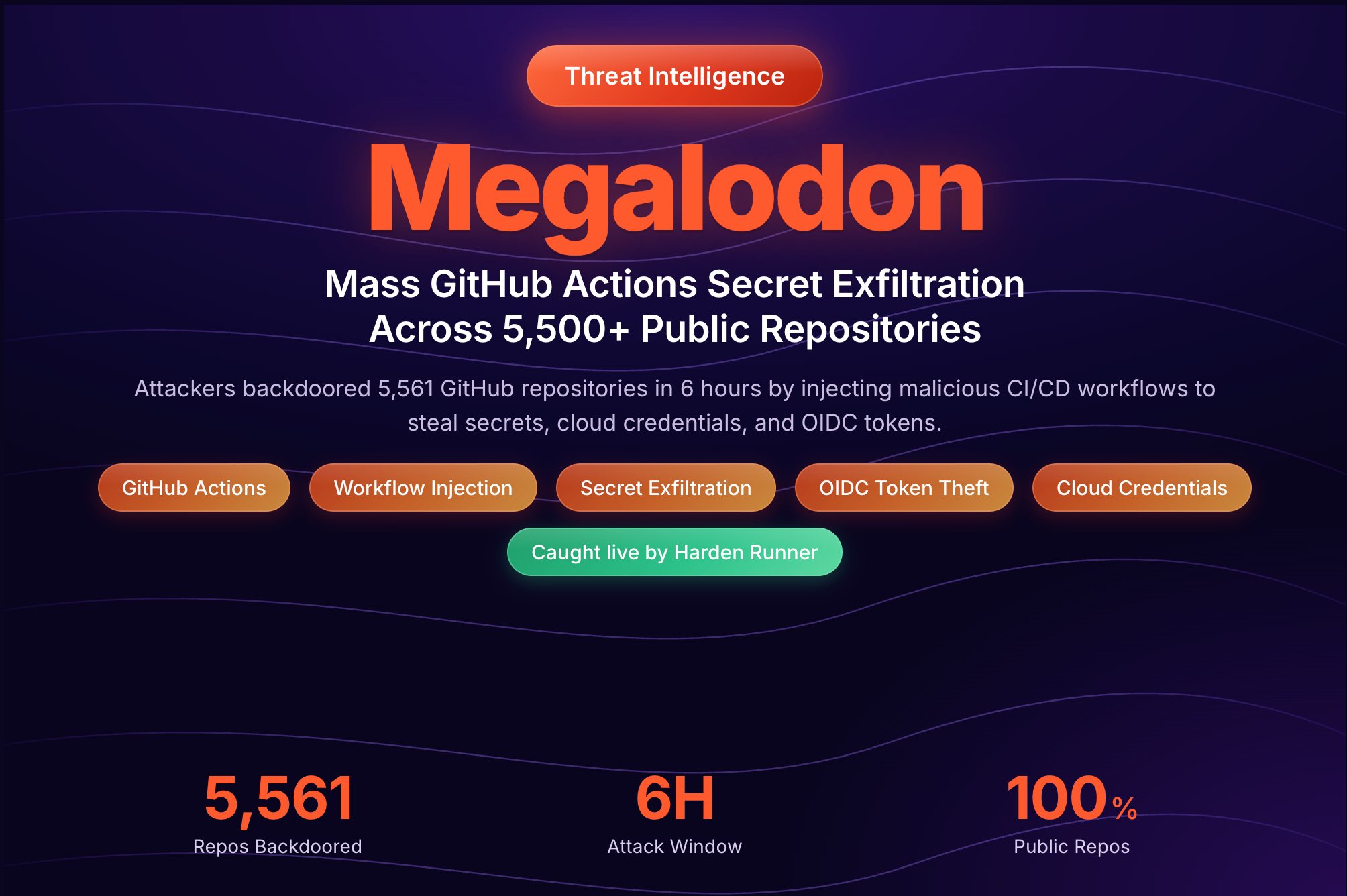 Megalodon: Mass GitHub Actions Secret Exfiltration Across 5,500+ Public Repositories - StepSecurity
StepSecurity documents Megalodon, a May 2026 campaign that injected backdoored GitHub Actions workflow files named SysDiag or Optimize-Build directly into 5,500+ public repositories in a six-hour window via direct Poisoned Pipeline Execution (d-PPE), exploiting weak branch protection. The base64-encoded bash payload harvests AWS/GCP/Azure credentials, SSH keys, Kubernetes/npm/Docker configs, GitHub OIDC tokens, and grep-matched secrets from the workspace, exfiltrating everything via HTTPS POST to a hardcoded C2 IP; the npm package @tiledesk/tiledesk-server was among the confirmed poisoned downstream targets.
 stepsecurity.iowriteupAdded 5 Sep 2026🛡️ Security
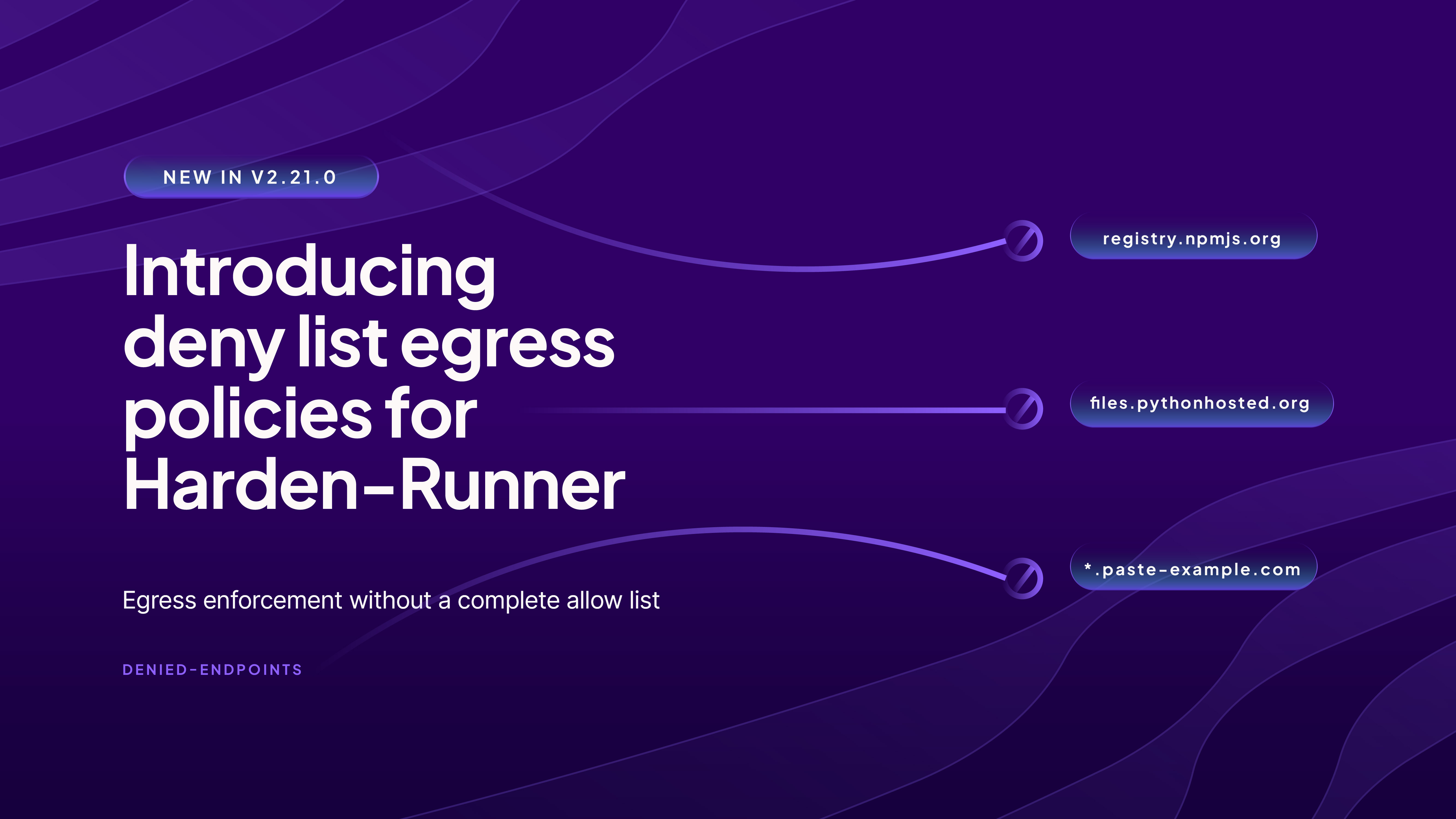 Introducing deny list egress policies for Harden-Runner
StepSecurity's Harden-Runner GitHub Action v2.21.0 adds a denied-endpoints input, letting teams block specific egress destinations (domains, wildcards, bare IPs) from CI jobs while leaving everything else reachable — a lighter-weight alternative to allow lists that don't require full enumeration of a job's needs. The piece details how deny-list entries differ from allow-list ones (no per-port scoping), covers the flagship use case of forcing package installs through StepSecurity's Secure Registry proxy by denying direct access to registries like PyPI and Go module hosts, and explains that Harden-Runner's separately maintained Global Block List (built from SOC threat intel, e.g. the Megalodon credential-exfiltration campaign) is distinct from and complements user-managed deny lists. It also candidly notes the deny list's blind spot: campaigns like Shai-Hulud 2.0 that exfiltrate via github.com itself can't be stopped by a deny list, requiring allow-list enforcement instead.
stepsecurity.ioarticleAdded 3 Sep 2026, published 2 Sep 2026🛡️ Security- baidu-baige/LoongSage
LoongSage is Baidu's open-sourced, production-grade reinforcement learning framework for post-training LLMs, built on Ray for scheduling, Megatron-Core/Megatron-Bridge for training, and SGLang for inference. It targets agentic RL with a zero-intrusion AgentFlow module (automatic multi-turn context, loss masking, trajectory collection), multi-paradigm online distillation (PG-Style, GKD-Style, TopK/full-vocab/JSD KL), fully asynchronous training with partial rollout, and system-level training-inference consistency guarantees (Router Replay, TITO, M2PO, OPSM) that keep probability bias at 1e-4 in MoE/low-precision settings. Recipes are validated on Baidu's internal production runs of DeepSeek-V4-Flash and Qwen3-30B-A3B for math reasoning, agentic code repair, and distillation.
github.comrepoAdded 30 Sep 2026, published 28 Aug 2026🧠 AI  Cloud Threat Highlights: H1 2026
Wiz's H1 2026 cloud threat report documents a 60% jump in significant incidents driven by a doubling of supply-chain attacks (TeamPCP's npm/PyPI/GitHub Actions credential-harvesting spree, its open-sourced Shai-Hulud worm spawning Miasma/Hades/Megalodon/IronWorm follow-ons, North Korea's axios and @mastra trojanizations) and by growing attacks on AI infrastructure, including exposed unauthenticated MCP servers, LiteLLM/Dify/Langflow/n8n/Ollama vulnerabilities, and cryptominers deployed via a Langflow RCE. It also profiles JINX-0163, a cloud-native extortion group targeting non-human identities (service accounts/IAM roles) across AWS/Azure/GCP/Okta/Snowflake linked to the "FulcrumSec" extortion brand, and closes with concrete detection techniques for stolen access keys, Kubernetes VM Run Command abuse, GCP org-policy tampering, and CloudTrail user-agent/boto3 credential-provenance mismatches.
 wiz.iowriteupAdded 3 Sep 2026, published 6 Aug 2026🛡️ Security
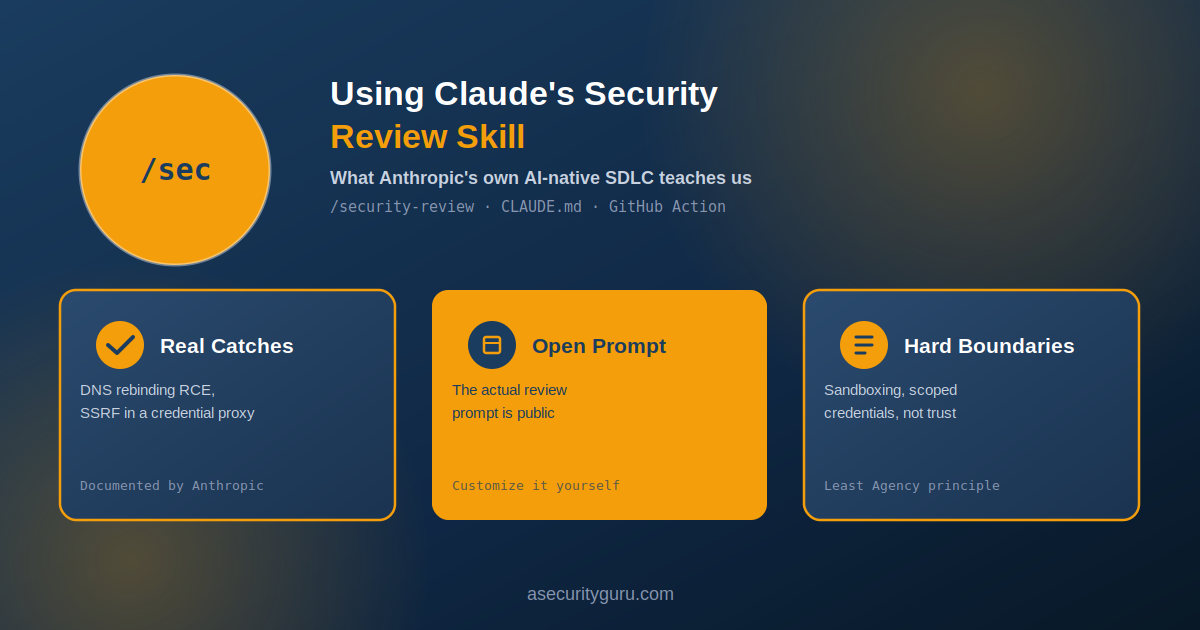 Using Claude’s Security Review Skill in Claude Code
Walkthrough of Claude Code's /security-review slash command and the anthropics/claude-code-security-review GitHub Action. It covers what the open-source prompt checks (SQLi, XSS, authz flaws), its hard exclusions (DoS, rate limiting, hardening-only findings), and how to copy and customize security-review.md. It also summarizes Anthropic's SDLC account by Jason Clinton: narrow multiple reviewer agents instead of one mega-prompt, CLAUDE.md updates as a closed loop, /sandbox isolation, and least-privilege, single-purpose agent identities after an incident-response agent asked another Claude instance to deploy code.
 asecurityguru.comarticleAdded 13 Oct 2026, published 29 Jul 2026🧠 AI
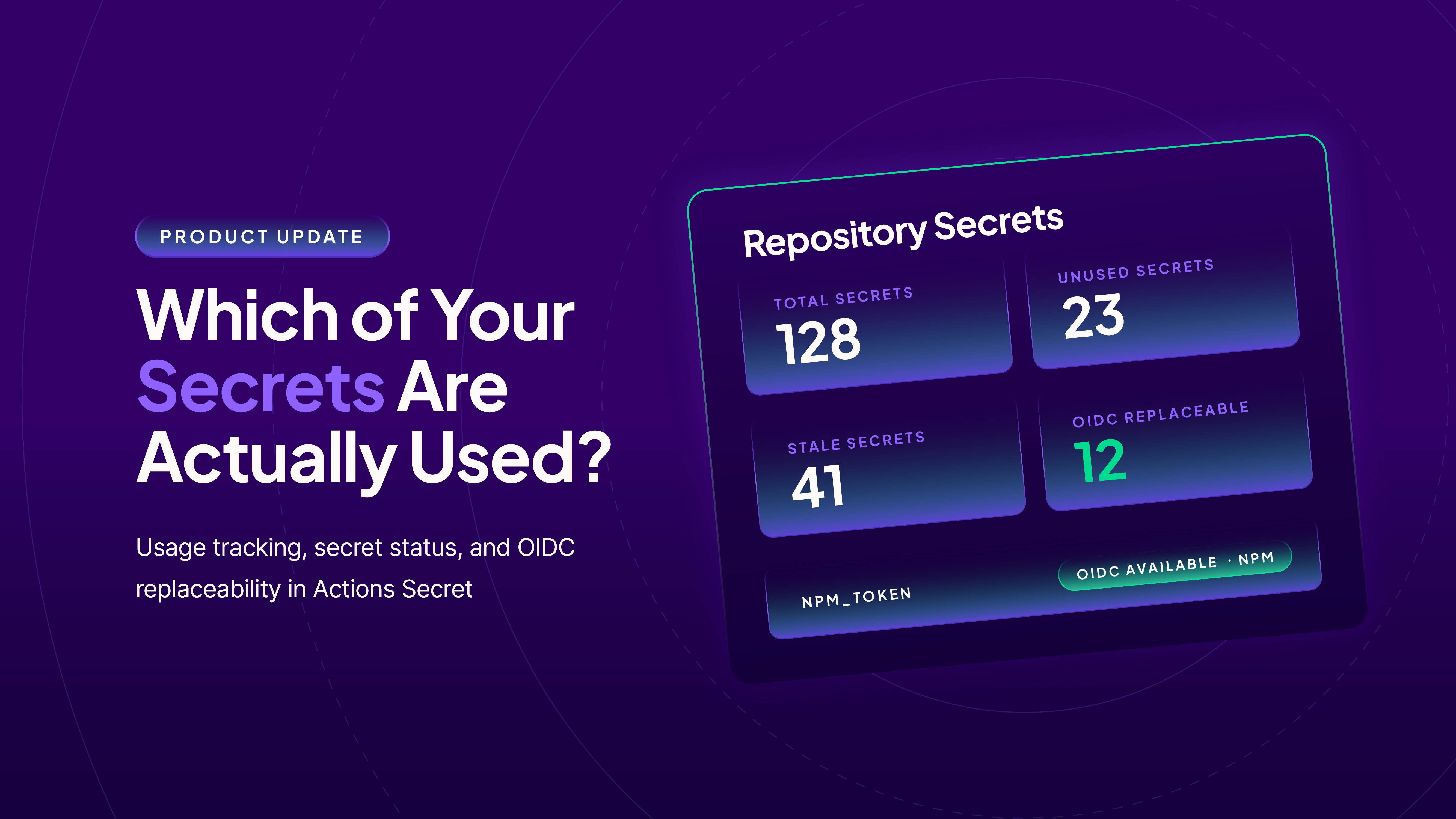 Find Unused, Stale, and OIDC-Replaceable GitHub Actions Secrets Across Your GitHub Organization
StepSecurity describes a new Repository Secrets feature in its Actions Secret dashboard that inventories GitHub Actions secrets across an org and classifies each as Active, Stale (unused workflow for 90+ days), or Unused, while flagging which secrets could be eliminated by switching to OIDC (e.g. AWS, Azure, GCP federation or npm/PyPI trusted publishing). It ties the problem to real incidents - the GhostAction campaign exfiltrated 3,000+ secrets and Megalodon targeted 5,500 public repos - arguing that unused, long-lived credentials are attack surface attackers actively harvest regardless of whether they are load-bearing.
stepsecurity.ioarticleAdded 3 Sep 2026, published 23 Jul 2026🛡️ Security Introducing Secret Exfiltration Protection for GitHub Actions
StepSecurity breaks down how four campaigns, GhostAction, Megalodon, Miasma, and Hades, turned stolen GitHub tokens into mass secret theft by committing malicious GitHub Actions workflows to throwaway branches, using toJSON(secrets) to dump repo secrets and uploading them as run artifacts before deleting the branch and run. It explains why branch protection and code review miss this since the workflow runs on a push event to a non-default branch with no pull request ever opened, and introduces StepSecurity's Secret Exfiltration Policy plus a new Harden-Runner detection rule for the pattern.
stepsecurity.ioarticleAdded 3 Sep 2026, published 16 Jul 2026🛡️ Security Harden-Runner Block Mode Now Available for macOS and Windows GitHub-Hosted Runners
StepSecurity's Harden-Runner v2.20.0 extends egress-policy: block enforcement (previously Linux-only) to macOS and Windows GitHub-hosted runners, blocking outbound calls to non-allowlisted endpoints from compromised workflows or dependencies. The post cites the Megalodon (5,500 repos) and GhostAction (3,000+ secrets) exfiltration campaigns and the Velora DEX SDK npm-package backdoor as motivation, noting macOS/Windows runners handle Apple/Windows code-signing credentials that make supply-chain malware look legitimate.
stepsecurity.ioarticleAdded 3 Sep 2026, published 16 Jul 2026🛡️ Security- Inside the RaaS Ecosystem: Operators, Affiliates & Attack Tradecraft | Huntress
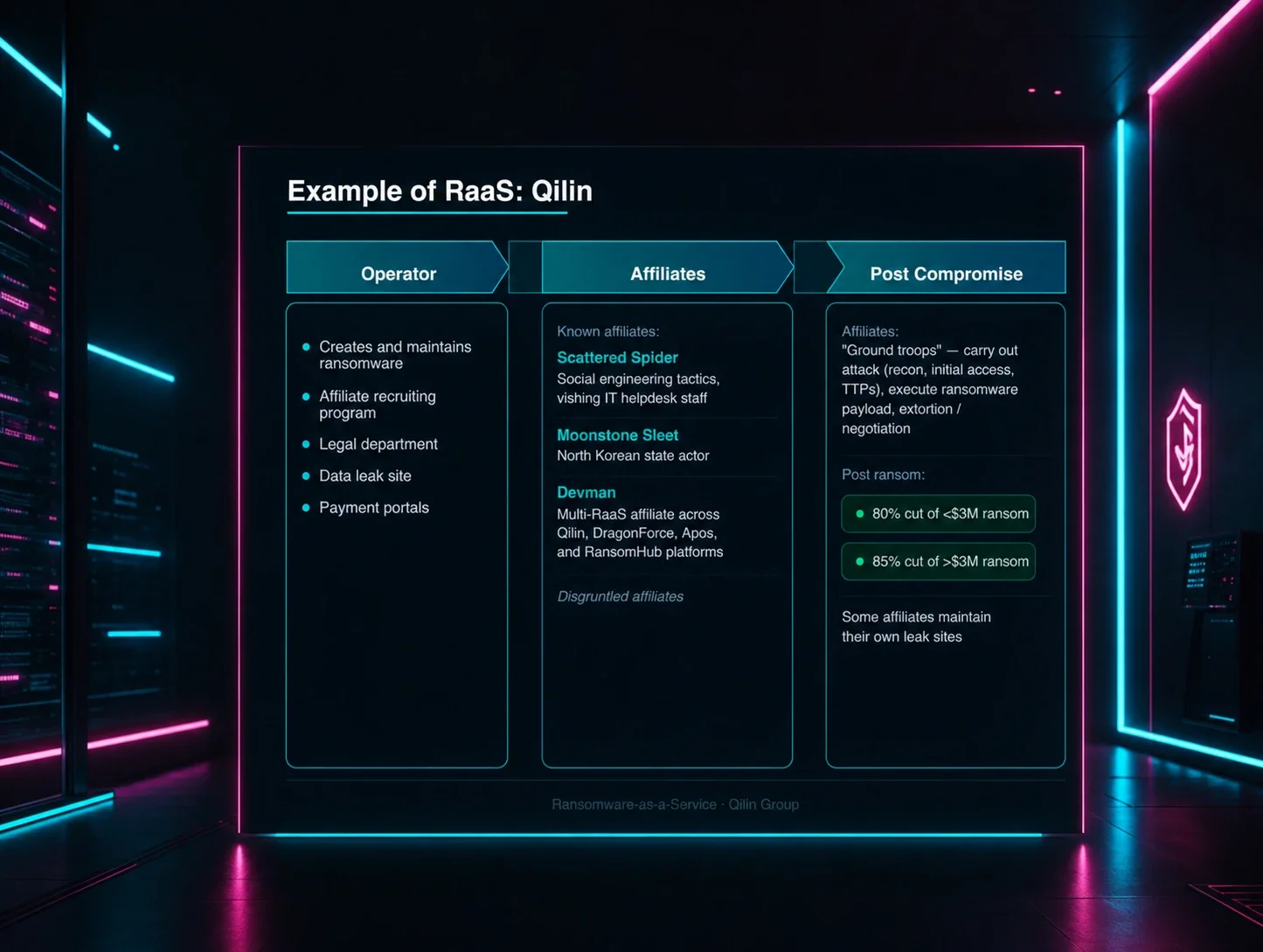
Huntress breaks down the ransomware-as-a-service (RaaS) ecosystem, explaining how operators (e.g., Qilin) provide the malware and infrastructure while diverse affiliates (Scattered Spider, Moonstone Sleet, Devman) handle intrusion, meaning the same ransomware brand can involve very different attack chains. It details real-world tradecraft: initial access via RDP abuse, vulnerable edge appliances like SonicWall VPNs (preceding Akira deployment), and rogue RMM tools (ScreenConnect, TeamViewer, Bomgar), plus persistence via hidden user accounts and RMMs like AnyDesk/Chrome Remote Desktop, defense evasion via EDR/AV killers and BYOVD, and exfiltration using 7-Zip, MegaSync, RClone, S5cmd, and finger.exe.
huntress.comwriteupAdded 3 Sep 2026, published 20 May 2026🛡️ Security  Mythos AI Security Testing
Daniel Stenberg recounts curl's first security scan using Anthropic's unreleased Mythos AI model (obtained via Linux Foundation's Alpha Omega program under 'project Glasswing'), which analyzed 178K lines of curl's src/ and lib/ code and reported five 'confirmed' vulnerabilities that the curl security team whittled down to one low-severity CVE (three false positives, one 'just a bug'). He contrasts Mythos with curl's ongoing use of AISLE, Zeropath, OpenAI Codex Security, GitHub Copilot and Augment code, concluding AI scanners are genuinely valuable for finding known bug classes at scale but that Mythos itself showed no evidence of the 'dangerous' capability hyped by Anthropic's media messaging.
 daniel.haxx.searticleAdded 3 Sep 2026, published 12 May 2026🛡️ Security
- OWASP Free AppSec Tools
OWASP's community-maintained catalog of application security tools that are free for open source projects, organized by category: SAST (GitHub CodeQL, Coverity, HCL AppScan CodeSweep), DAST (OWASP ZAP, StackHawk, Akto, Arachni), IAST (Contrast CE), software composition analysis/dependency scanning (Dependabot, Snyk, Mend, retire.js, Debricked), secrets detection (Gitleaks, TruffleHog, GitGuardian, Kingfisher), code quality (SonarQube, SpotBugs, MegaLinter), CI/CD security (GitLab built-ins, Faraday), and automatic remediation (Mobb, Corgea). It also covers newer entrants like Zennoxa Shield, cloud-audit, Cynative, and post-quantum crypto risk tools (CARAF, PQBench). Serves as a practical shopping list for securing an OSS project's SDLC end-to-end.
 owasp.orgarticlePublished and added 6 May 2026🛡️ Security
- Decoding NightSpire: Ransomware IOCs Aren't Set in Stone
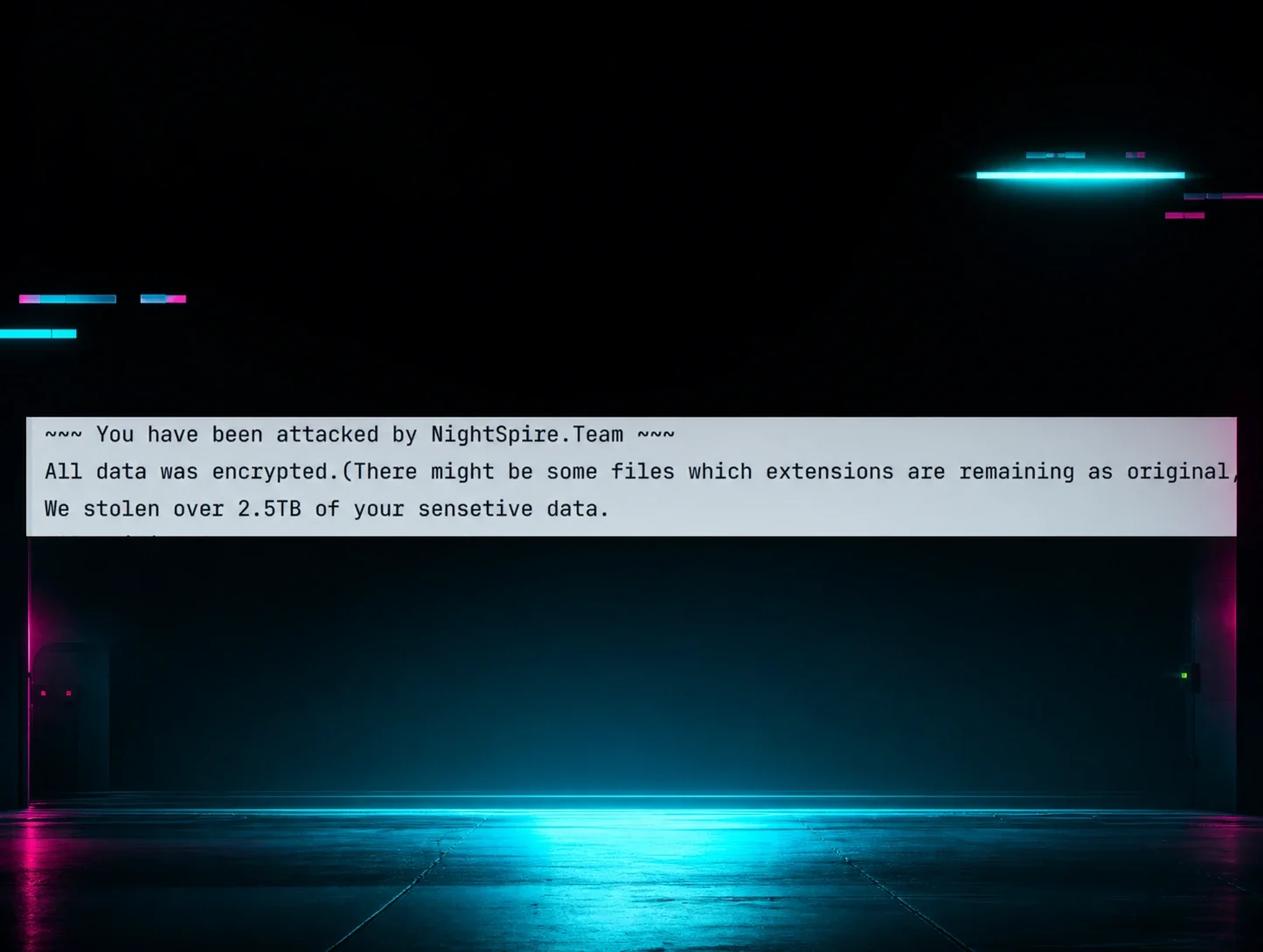
Huntress details two NightSpire ransomware incidents (December 2025 and March 2026) it responded to, showing how the threat actor's tooling and TTPs differed markedly between attacks despite the same ransomware family. In the March 2026 case the attacker used RDP for initial access, then Chrome Remote Desktop and AnyDesk for persistence, Everything and 7-Zip for data staging, MEGASync for exfiltration, and VMware Workstation/WPS Office for other purposes — none of it relying on native LOLBins like WMI or PsExec seen in public NightSpire reporting. The piece argues that because ransomware like NightSpire (and RaaS families such as Akira and Sodinokibi) may be run by shifting affiliates, IOCs and TTP clusters attributed to "the group" often aren't consistent across incidents.
huntress.comwriteupAdded 3 Sep 2026, published 7 Apr 2026🛡️ Security - How Threat Actors Abuse Remote Management Tools | Huntress
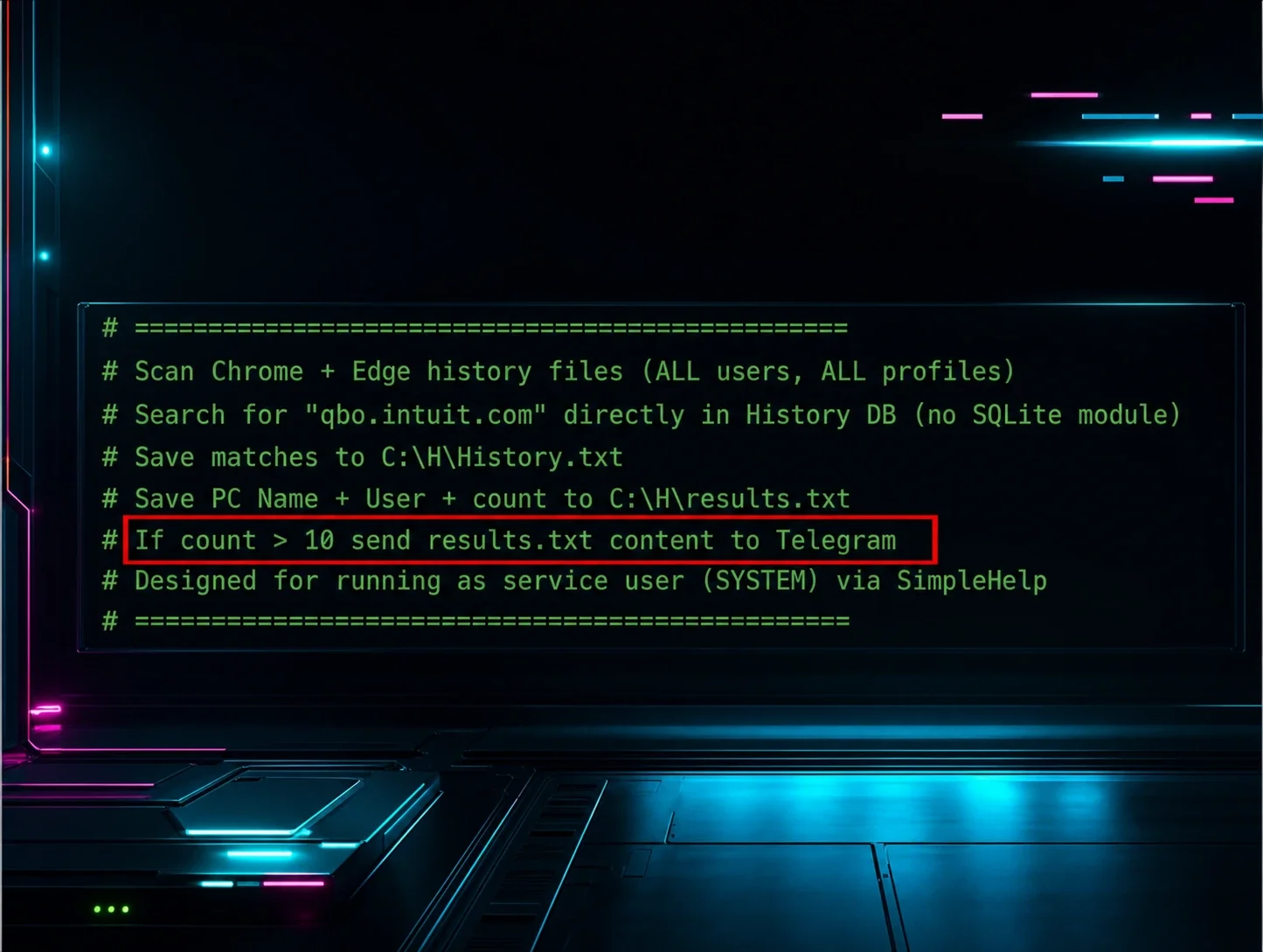
Huntress details how low-skill threat actors daisy-chain legitimate RMM tools (ScreenConnect, Action1, HeartbeatRM, AnyDesk, Atera, etc.) via invitation and Social Security themed lures, LLM-generated infostealer scripts, and multi-fallback browser download tricks hosted on GitHub repos (VH851, Drasticc) to gain and disguise persistent access. It also documents firsthand observation of an actor who signed up to Huntress itself, revealing their toolchain (DeepSeek, Email Extractor, Proxy SwitchyOmega, 9Proxy, CertifyTheWeb, Sordum Hide from Uninstall List, and a fake Windows Security PIN harvesting binary pin.exe) and victim data such as W-9 forms and SSNs collected via Telegram based exfiltration.
huntress.comwriteupAdded 3 Sep 2026, published 11 Mar 2026🛡️ Security