 “Black October” for AI Developer Platforms
Wiz Research links October 2026 breaches at AI developer platforms (Fireworks, OpenCode, Warp, Zeabur, Railway and others) to stolen environment-variable credentials for AI access. It details two enterprise AWS Bedrock keys abused after vendor breaches: about 800k and 1.7 million calls, over $100k in list-price usage. It profiles two LLM resale operations, "momo" and "Xingjiabi", that tested the keys.
 wiz.iowriteupAdded 31 Oct 2026, published 30 Oct 2026🛡️ Security
 Trojanized Claude Code Extension Delivered Persistent SSH Backdoor to Developer Machines
The Claude Code VS Code extension anthropic.claude-code 2.1.313 was published on Open VSX on 29 October 2026 with a malicious loader prepended to extension.js. On load it planted an attacker SSH key (svc-telemetry), installed per-OS persistence, opened a reverse SSH tunnel and beaconed host recon over HTTP. Cursor reports at most 5,000 users received it in an 11-hour window. The post gives the timeline, cleanup artifacts and credential rotation steps.
 stepsecurity.iowriteupPublished and added 30 Oct 2026🛡️ Security
 NIK C2: The new AI-enabled command-and-control framework
NIK C2 is a newly observed C2 framework with a Go-based 64-bit Windows implant that embeds an OpenAI Chat Completions client (ai_generate command), falling back to the victim's OPENAI_API_KEY. Talos details its 52+ commands, AES-256-GCM over WebSocket with HTTP fallback, credential, wallet and keystroke theft, screen-lock ransomware, AMSI bypass and anti-debug. It also lists a live C2 at 87.120.196[.]120 and total-sitevv[.]lol.
 blog.talosintelligence.comwriteupPublished and added 29 Oct 2026🛡️ Security
- AI, Scripts, Operator: Inside the ConnectWise Attack
Huntress analyzes Entra sign-in and audit logs from the ConnectWise Cloud Backup credential abuse of 15 October 2026 to judge whether a script, a person or an LLM agent drove it. It found a thread-pool spray, trial-and-error credential planting with a retry added within 55 seconds, and pilot-then-batch targeting. Huntress rates LLM involvement low to medium on its own data and medium to high with Microsoft's Storm-0940/ARTEX attribution. It ends with detections for service principal role self-assignment and vendor app baselining.
 huntress.comwriteupPublished and added 26 Oct 2026🛡️ Security
 Inside the LiteLLM 1.107.0 supply chain compromise: Credential theft through Python startup hooks
Microsoft's analysis of the LiteLLM 1.107.0 compromise, published to PyPI and container images on 21 October 2026. The wheel shipped cook.pth, cook.py and sitecustomize.py, so a credential collector (PRIVCOLLECT) ran whenever Python started, even without importing LiteLLM. It covers AES/RSA-encrypted exfiltration to litellm.dev, a re-armable Unix loader, Defender KQL hunting queries, ATT&CK mapping and rotation guidance.
 microsoft.comwriteupPublished and added 23 Oct 2026🛡️ Security
- Field Notes: Reconstructing an Attacker’s Workflow
Field note from dfir.ch on PowerShell scripts an attacker left on disk during an incident: a file-watching command runner using Invoke-Expression, a fake Windows credential prompt that validates passwords via Start-Process and logs them in cleartext, AD computer enumeration with WMI access testing, and SMB share discovery via NetShareEnum. It notes where script labels overstate what they prove and lists hunting strings for Event IDs 4104, 4103, 4688 and Sysmon 1.
 dfir.chwriteupAdded 24 Oct 2026, published 22 Oct 2026🛡️ Security
 LiteLLM 1.107.0 Compromised: Python Startup Hooks Steal Cloud, AI, and Proxy Credentials | Endor Labs
litellm 1.107.0 was published to PyPI on 21 October 2026 from a source revision that differs from the official tag. One line in the Maturin config (data = "cook") installs cook.pth, cook.py and sitecustomize.py, which run on every Python start. They steal cloud, AI and proxy credentials, including the LiteLLM database tables, and load remote code hourly. The post gives IOCs, a five-step response plan and hardening advice.
 endorlabs.comwriteupPublished and added 21 Oct 2026🛡️ Security
 litellm 1.107.0 Compromised on PyPI: Backdoored Wheels Drop a Credential Stealer and an Hourly Remote Code Loader
litellm 1.107.0 was published to PyPI on 21 October 2026 with all seven wheels backdoored through an injected `data = "cook"` maturin build line. The wheels drop cook.pth, cook.py and sitecustomize.py, which run on every Python start. They install a "privcollect" credential stealer (browser, SSH, cloud, AI coding tool and LiteLLM proxy database secrets, sent to litellm.dev) and an hourly GitHub dead-drop remote code loader. The post gives IOCs, detection commands and recovery steps.
stepsecurity.iowriteupPublished and added 21 Oct 2026🛡️ Security LiteLLM Compromised, Steals Credentials
LiteLLM version 1.107.0 was uploaded to PyPI on 21 October 2026 with a credential stealer, and the same build reached GHCR and Docker Hub images. Wiz describes the three dropped files (cook.pth, cook.py, sitecustomize.py), exfiltration to a fake litellm.dev domain, a GitHub dead drop for a second stage, and the malicious commits pushed through the lookalike Berri-AI repository. The last safe version is 1.106.2.
wiz.iowriteupPublished and added 21 Oct 2026🛡️ Security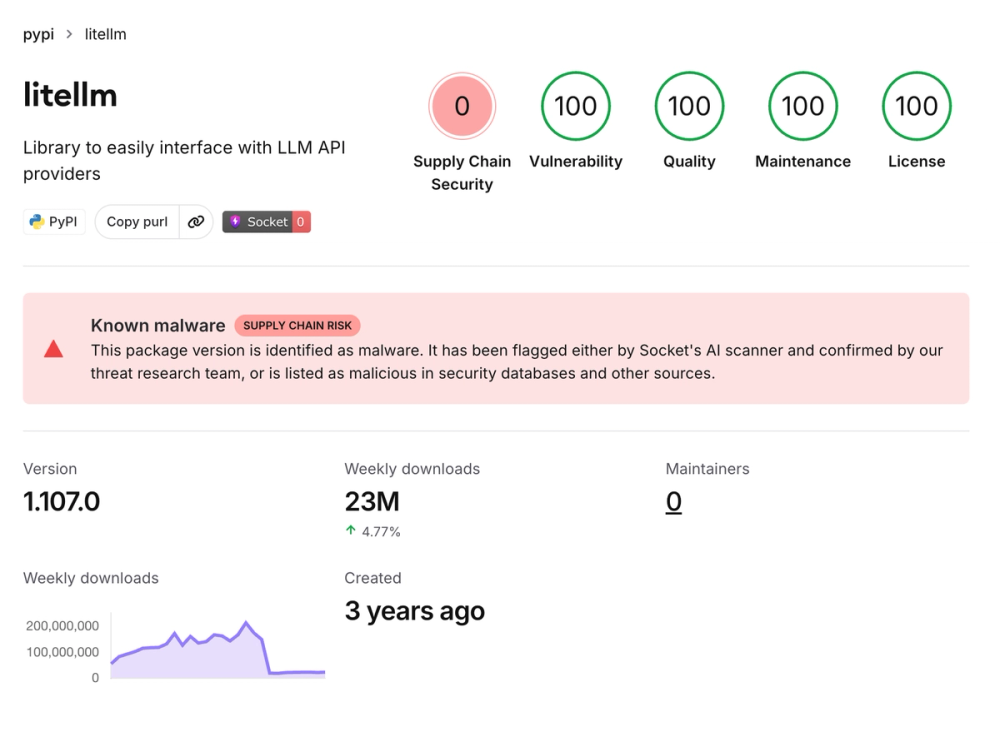 LiteLLM PyPI Package and Docker Images Compromised to Steal Cloud and AI Credentials
LiteLLM 1.107.0 on PyPI and GHCR images shipped Python startup hooks (cook.pth, sitecustomize.py) that steal cloud, SSH, browser and AI-tool credentials, including LiteLLM proxy database credentials. Image build provenance recorded a lookalike Berri-AI/litellm source repository. The post decodes the payload, encrypted exfiltration and GitHub-driven remote loader, and lists containment steps, MITRE ATT&CK mappings and IOCs.
 socket.devwriteupPublished and added 21 Oct 2026🛡️ Security
 LiteLLM 1.107.0 PyPI Wheel Contains a Credential Stealer and Persistent Python Backdoor
LiteLLM 1.107.0 macOS x86-64 PyPI wheel analyzed by OpenSourceMalware contains three injected files (cook.pth, cook.py, sitecustomize.py) that run on every Python start. The payload, called privcollect, steals browser, SSH, cloud, CI/CD and AI-tool credentials, then uploads an AES/RSA-encrypted bundle to www.litellm.dev/healthcheck. A forked loader also fetches domain.txt from GitHub and executes /codepy hourly. The post lists IOCs, hashes and remediation steps.
 opensourcemalware.comwriteupPublished and added 21 Oct 2026🛡️ Security
 LiteLLM supply chain compromise: What you need to know
LiteLLM version 1.107.0 was published to PyPI and official Docker images on 21 October 2026 and stayed live for about two hours. Attackers used stolen GitHub CLI OAuth tokens from three engineers to run the release pipeline against a lookalike fork, Berri-AI/litellm. The payload (cook.pth, cook.py, sitecustomize.py) steals cloud, developer, AI-tool and browser credentials, and includes a polling RAT. The post lists removal and rotation steps.
 securitylabs.datadoghq.comwriteupAdded 29 Oct 2026, published 21 Oct 2026🛡️ Security
 Loud, Fast, and Everywhere: Anatomy of a Real AI-Driven Cloud Attack
Wiz CIRT write-up of an AI agent-run intrusion against a multi-cloud organization (GCP, AWS, Kubernetes, CI/CD, GitOps, identity provider). It lists traits of AI-driven attacks: machine-speed tempo, credential chaining, pentest/probe naming, numeric task IDs and commented code. Initial access was a Java RCE in an exposed Kafka UI. It closes with detection and response advice: unified logs, workload visibility and trust isolation.
wiz.iowriteupPublished and added 19 Oct 2026🛡️ Security- ConnectWise (SkyKick) Vendor Credentials Abused in M365 Attacks
Huntress documents abuse of ConnectWise Cloud Backup (formerly SkyKick) vendor app credentials, used on October 15 from 144.172.64[.]128 to obtain Microsoft Graph tokens in at least 162 customer M365 tenants via client assertion. In one tenant, a ConnectWise Cloud Management Teams app self-assigned Global Administrator and added client secrets to an MSP management app and Huntress's own app, a persistence technique. The post lists application IDs, Entra sign-in and audit-log checks, user-agent indicators (kiota-dotnet vs Python-urllib/3.12, curl/7.88.1), and mitigation steps such as disabling (not deleting) the enterprise apps and reviewing added credentials.
huntress.comwriteupAdded 17 Oct 2026, published 16 Oct 2026🛡️ Security  GhostAction Copycats PolinRider by Hiding a Stealer in a Fake Font File
Analysis of a new GhostAction Stage 2 found in 94 compromised GitHub repos: a hidden .vscode/tasks.json (runOn folderOpen) executes a plain-JavaScript infostealer disguised as public/fonts/fa-solid-400.woff2. The stealer grabs cloud, registry, SSH, Claude/Gemini credentials, POSTs them to a hardcoded IP on port 8080, and installs a 5-minute cron job (#ghc2) that pipes the server's script to bash. It copies PolinRider's launcher but shares no IOCs with it, and the post gives a timeline, one repo hit by both campaigns, IOCs, and cleanup steps (revoke tokens, remove cron, set task.allowAutomaticTasks off).
opensourcemalware.comwriteupAdded 15 Oct 2026, published 16 Oct 2026🛡️ Security ARMORY CASTLE Exploits BeyondTrust
ARMORY CASTLE (formerly UNC5221), a suspected PRC-nexus actor, exploited BeyondTrust Remote Support zero-day CVE-2026-102764 in August 2026, per Mandiant incident response. The post details the SAWFLY PHP webshell, BARECLAW SOCKS5 WebSocket tunneler, SUID root escalation, sudoers template persistence, vault credential extraction, log deletion and haproxy.conf changes. It adds YARA rules, detection ideas and patch-first remediation (BT26-05).
 cloud.google.comwriteupAdded 29 Oct 2026, published 15 Oct 2026🛡️ Security
 Artificial Intelligence (AI) in Cybersecurity, Part 29: Creating Isolated Autonomous Agents for Hacking with NemoClaw
Hackers-Arise tutorial on NVIDIA's open-source NemoClaw, which runs OpenClaw (and Hermes or LangChain Deep Agents) inside OpenShell sandboxes. OpenShell provides kernel-level isolation and declarative YAML policies for files, credentials and network access. It covers OpenClaw's risks (543 tracked CVEs, 40,000+ exposed instances), an OpenClaw vs NemoClaw comparison, the caveat that sandbox escapes and core-logic zero-days remain possible, and a Docker/Node.js install via the nemoclaw.sh wizard with TUI testing. It also cites the Cisco AI Defense plus OpenShell case study, in which an agent that does security patching was protected against a simulated exfiltration attempt.
 hackers-arise.comwriteupPublished and added 14 Oct 2026🧠 AI
- Fake WatchGuard VPN Site Steals Credentials
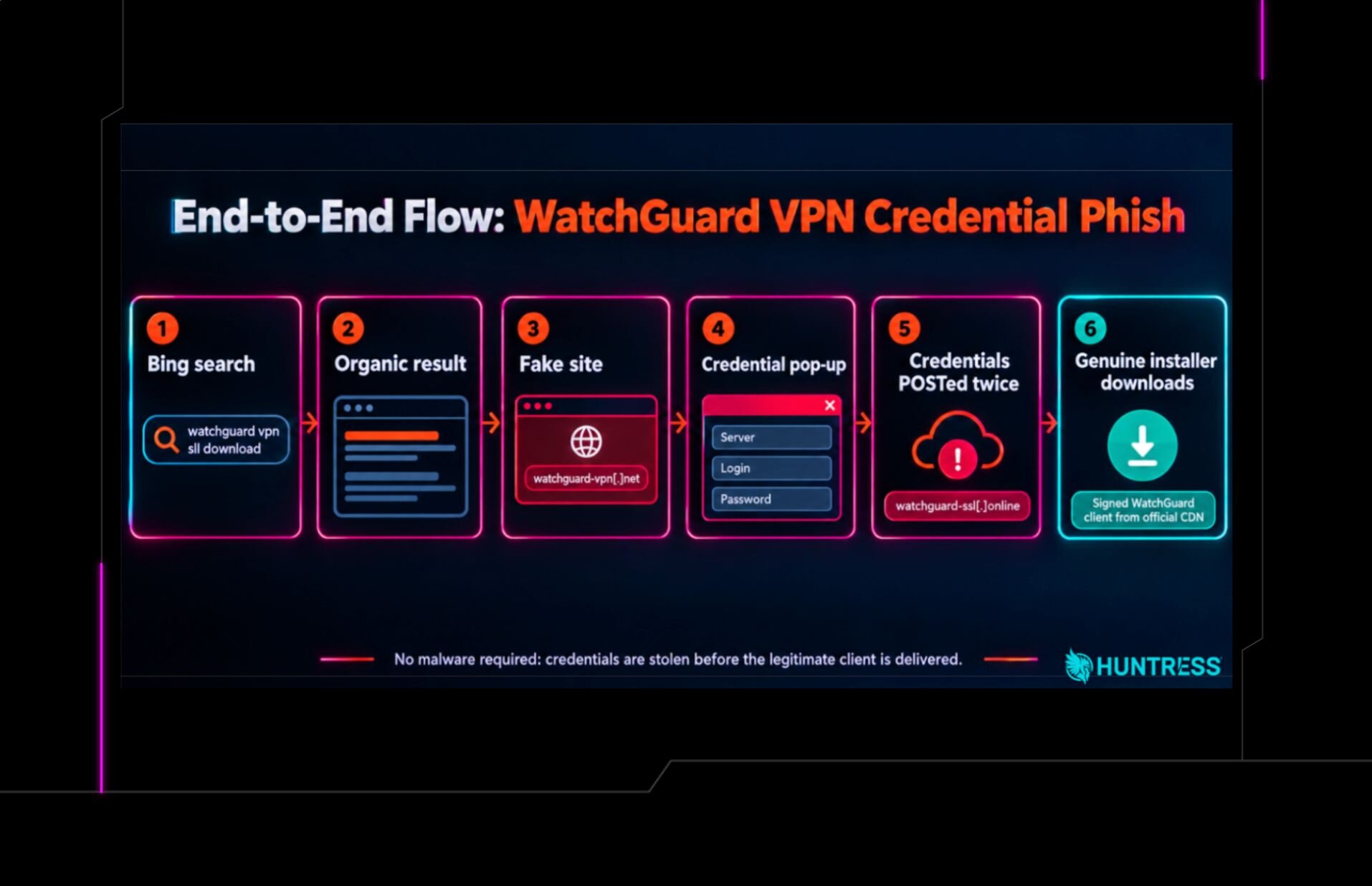
Huntress analyzes an October incident where an admin searching Bing for a WatchGuard VPN download landed on watchguard-vpn[.]net, a lookalike site whose popup.js harvests Server/Login/Password, deliberately rejects the first submission to get a second set, and posts to watchguard-ssl[.]online. Unlike earlier iterations (Secplicity, Microsoft Storm-2561), the final payload is the genuine, validly signed WatchGuard installer from the official CDN, so no malware is present for endpoint tools to flag. Covers infrastructure timeline, thin VirusTotal detections, and defender guidance (MFA, monitoring VPN logins from hosting ASNs, blocking domains, publishing official download links).
huntress.comwriteupAdded 14 Oct 2026, published 13 Oct 2026🛡️ Security  How a Misconfigured CI Workflow Became an npm Supply-Chain Compromise | Blog | Endor Labs
Endor Labs breaks down the May 11, 2026 compromise of 42 @tanstack/* npm packages (84 malicious versions) that carried valid SLSA provenance. The attacker chained a pull_request_target "Pwn Request", GitHub Actions cache poisoning across the fork/base boundary, and OIDC token extraction from Runner.Worker memory, then published directly to npm without stealing any credential. It explains why 2FA, trusted publishing, provenance and branch protection all failed, and lists mitigations: split pull_request_target workflows, treat the cache as untrusted, scope id-token: write to a publish job, pin actions to SHAs, require environment approval, use egress allowlists.
endorlabs.comwriteupPublished and added 12 Oct 2026🛡️ Security Malicious 'Pyronut' Package Backdoors Telegram Bots with Remote Code Execution | Blog | Endor Labs
Endor Labs analyzes the malicious PyPI package pyronut (versions 2.0.184–2.0.186), a trojanized fork of the Telegram framework pyrogram. It hooks Client.start() to import a hidden pyrogram/helpers/secret.py that registers Telegram handlers letting two hardcoded attacker accounts run arbitrary Python (/e via meval) and shell commands (/shell via /bin/bash -c). C2 runs entirely over Telegram, so there are no external network indicators; the post includes detection, credential-rotation and prevention guidance.
endorlabs.comwriteupPublished and added 12 Oct 2026🛡️ Security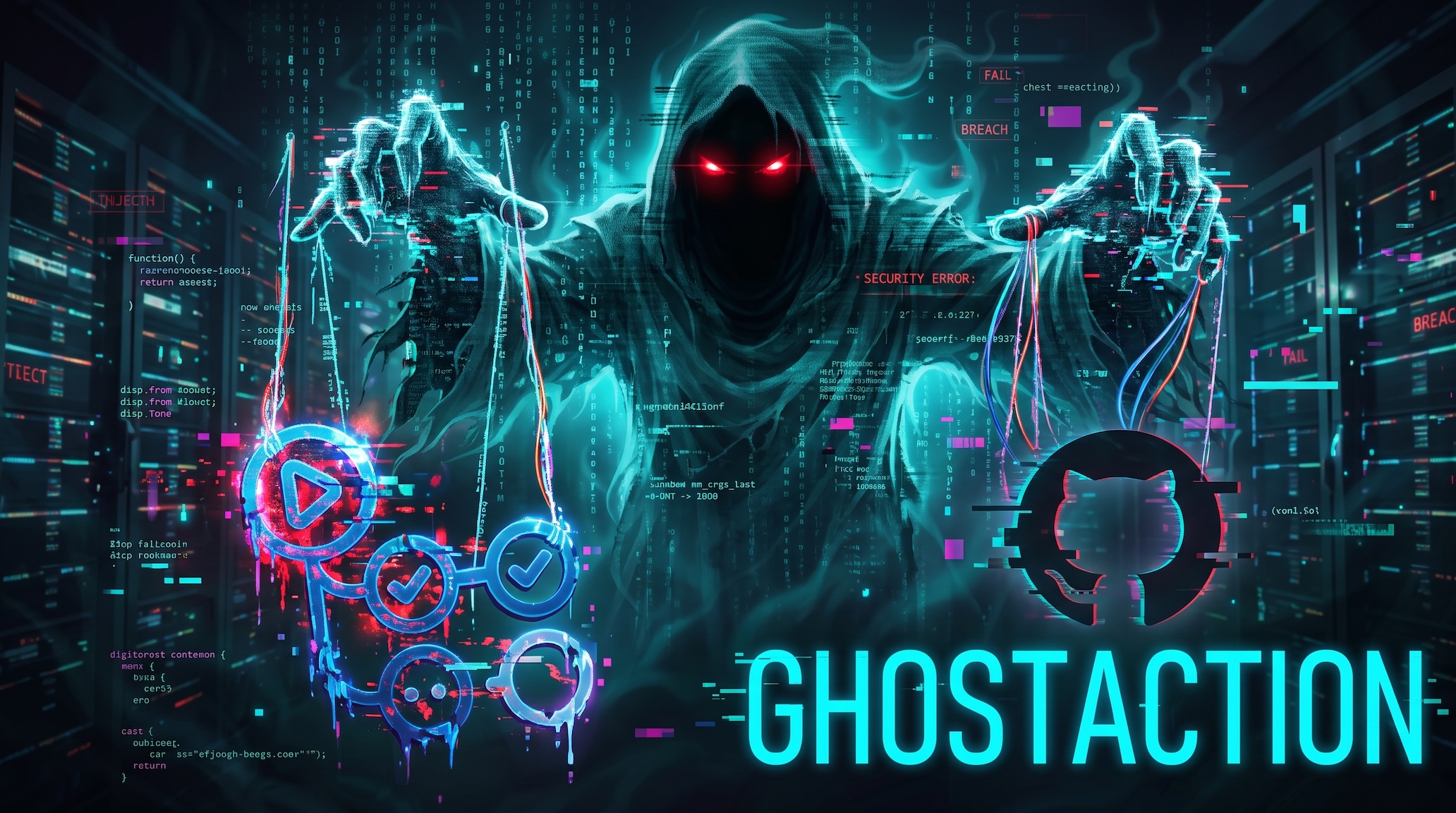 GhostAction Attack Escalates By Targeting GitHub Users
OpenSourceMalware's analysis of the latest GhostAction wave, where compromised GitHub accounts get malicious Actions workflows (security-audit.yml) injected across every writable repository, including an Oct 8 sweep of 346 repos via kitao and henrywoo. The new payload greps the checkout and full git history for credential patterns (AWS, Anthropic, OpenAI, GitHub PATs) and POSTs them over HTTP to 193.32.204.199/?c=monami. It also covers infrastructure reuse (phishing-heavy legacy IP, scanner activity), new watchlist domains my-github.com and my-gitlab.com, GitHub code-search hunting queries, a detection-confidence table, IOCs and incident response steps.
opensourcemalware.comwriteupAdded 10 Oct 2026, published 9 Oct 2026🛡️ Security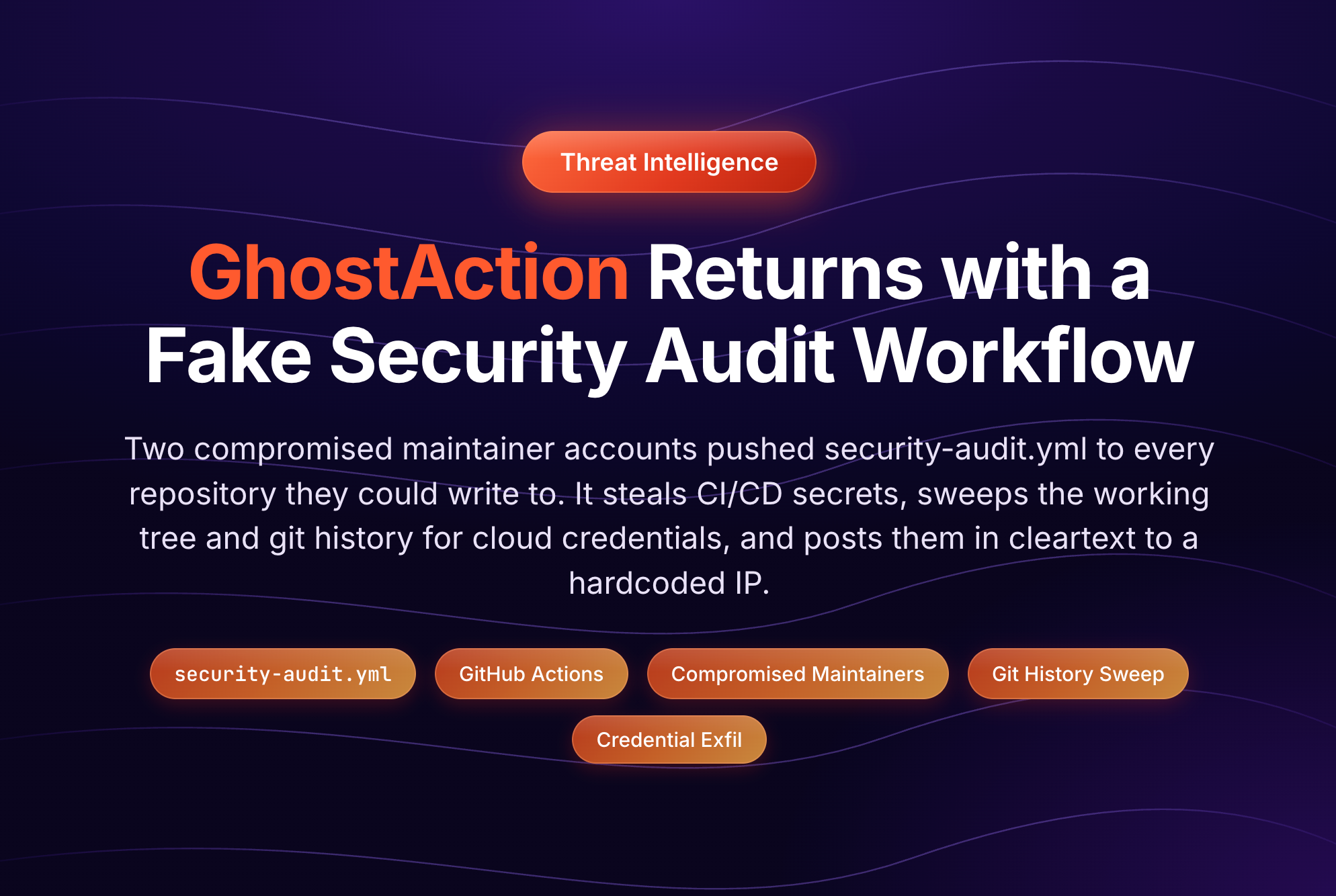 GhostAction Returns: Malicious “Security Audit” Workflows Now Mine Credentials from Entire Git Histories
StepSecurity details a new wave of the GhostAction campaign in which attackers used compromised maintainer accounts of Takashi Kitao (pyxel) and Henry Wu (athenadriver, Uber) to push malicious "Security Audit" GitHub Actions workflows to 345 repositories in minutes. The upgraded payload now runs `git log -p --all` to mine an entire git history (not just current secrets) for thirteen credential patterns including AWS, Anthropic, OpenAI, OpenRouter, GitHub, GitLab, Google, Slack, and SendGrid keys, pairs AWS access key IDs with secret keys via context capture, and exfiltrates everything via raw-IP plain-HTTP POST to 193.32.204.199, bypassing DNS-based defenses. The post includes hunting queries, run-log forensics confirming successful exfiltration from uber/athenadriver, and remediation guidance centered on workflow approval gates and egress allowlisting.
stepsecurity.iowriteupPublished and added 9 Oct 2026🛡️ Security New GhostAction Wave Hits Hundreds of Repos, Expanding Beyond CI/CD Secrets to Cloud Credentials
Socket documents an October 8, 2026 wave of the GhostAction campaign in which two compromised GitHub maintainer accounts (henrywoo and kitao) pushed a malicious security-audit.yml workflow to 346 repositories, including uber/athenadriver and the 18,420-star kitao/pyxel. Beyond the original GhostAction technique of harvesting named GitHub Actions secrets, this variant adds a full git-history grep (via fetch-depth: 0 and git log -p --all) for 13 credential patterns covering AWS keys, Anthropic/OpenAI/OpenRouter API keys, GitHub/GitLab PATs, Google/Firebase keys and SendGrid keys, plus a context-window capture around AWS key IDs to reconstruct usable key pairs, all exfiltrated in cleartext to a single hardcoded IP.
socket.devwriteupPublished and added 9 Oct 2026🛡️ Security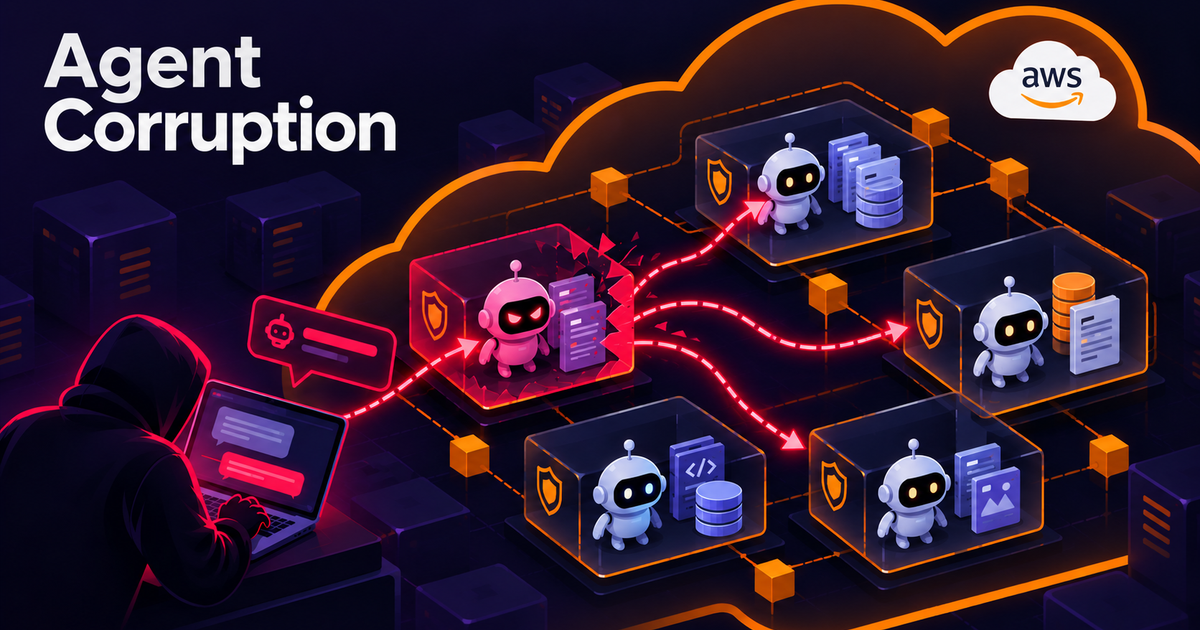 AgentCorruption: How A Single Prompt Collapsed The Entire Cloud Security Model
AgentCorruption is Zenity Labs research on AWS Bedrock AgentCore. Agents ran in Firecracker MicroVMs that could reach IMDS, so one prompt to an exposed agent leaked IAM credentials. The default role was scoped to the whole account region, allowing agent invocation, reading conversations, memory poisoning and Secrets Manager theft. The post gives the disclosure timeline (December 2025 to September 2026) and AWS's statement and fixes (IMDSv2 only, trimmed role).
 labs.zenity.iowriteupAdded 19 Oct 2026, published 8 Oct 2026🛡️ Security
- lee1981 (@lee1981b) on X
A detailed "CVE of the Day" thread analyzing CVE-2026-76471, a critical (CVSS 9.8) Cisco advisory covering insufficient NX-API input validation (CWE-122 heap-based buffer overflow) on Nexus 3000/9000 standalone NX-OS and a lower-severity credentialed variant on UCS 6300 Fabric Interconnects via UCS Manager XML API. It compiles Cisco's fixed-software versions per platform, notes the temporary Live Protect shield lp00074, and walks through a six-step SOC evidence-preservation and correlation playbook (scoping affected devices, preserving logs/crash artifacts, reviewing API/shield telemetry, correlating device outcomes, remediating, and verifying post-patch state) while flagging that CISA KEV and FIRST EPSS had no data on the CVE at research time.
 x.comwriteupPublished and added 8 Oct 2026🛡️ Security
- TensorLake npm SDK Compromised in ChainDrop Shai-Hulud Credential-Stealing Attack
Socket.dev reports that TensorLake's npm SDK was compromised as part of the ChainDrop campaign, a variant/wave of the Shai-Hulud credential-stealing npm worm. The compromised package reportedly harvests developer credentials from infected systems, continuing the pattern of self-propagating npm supply-chain attacks seen across the Shai-Hulud family. Full technical detail could not be verified in this pass due to a content-processing failure.
socket.devwriteupPublished and added 8 Oct 2026🛡️ Security 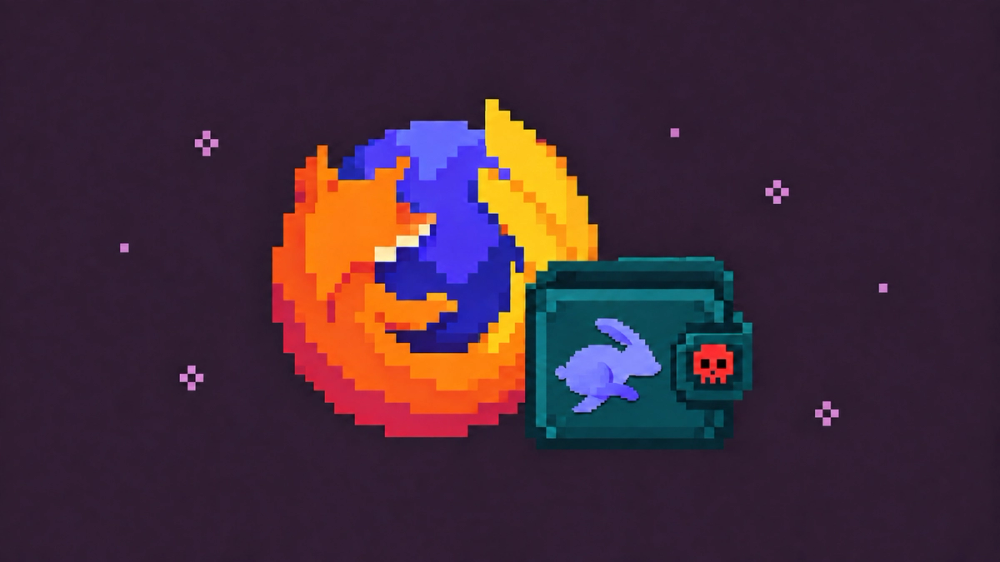 16 Malicious Firefox Extensions Steal Cryptocurrency Wallet Credentials
Socket Threat Research uncovered a coordinated campaign of 16 malicious Firefox extensions split into a Rabby Wallet clone family (4 extensions, full repackaged Rabby codebase) and an OKX Wallet-impersonating "Portal WALLET" family (12 extensions), all hooking wallet import flows to steal mnemonic seed phrases and private keys and exfiltrate them via GET/POST/sendBeacon to attacker-controlled Cloudflare Workers endpoints under the icy-star-f45c.workers.dev namespace. The writeup includes campaign markers (EQOx7EIPZSNi), background.js SHA-256 hashes, extension IDs/XPI hashes, and ties the activity to a prior August 2026 crypto-theft extension campaign Socket tracked, plus concrete detection and incident-response guidance.
socket.devwriteupPublished and added 7 Oct 2026🛡️ Security CVE-2026-21589: Critical unauthenticated arbitrary file access in Atlassian products
Rapid7's analysis of CVE-2026-21589 (CVSSv4 9.3), a critical unauthenticated arbitrary file read vulnerability affecting Bitbucket, Confluence, Jira Software/Service Management, Bamboo, Crowd, Crucible, and Fisheye Data Center products. It summarizes watchTowr Labs' root-cause finding that double-colon (::) sequences can act as path separators in Atlassian's web-resource handling, enabling path traversal to read arbitrary files within the Tomcat web root — including crowd.properties credentials that can be chained to create a rogue jira-administrators account. The post provides emergency patching guidance, Atlassian's WAF/RewriteValve mitigations, log-hunting regex, and notes public Python PoC and Nuclei templates exist.
 rapid7.comwriteupPublished and added 7 Oct 2026🛡️ Security
 You Won’t Hear About These, Even In Myths (Atlassian Jira, Confluence (and more) Pre-Auth Arbitrary File Read CVE-2026-21589)
CVE-2026-21589 is a pre-auth arbitrary file read in Atlassian Jira, Confluence and Bitbucket, found by diffing atlassian-plugins-webresource 6.0.7 against 6.0.8. The Router's unescapeSlashes turns "::" into "/", so "..::" traversal reaches WEB-INF files through download/resources routes. Reading crowd.properties leaks Crowd app credentials, which allow creating an admin user.
 labs.watchtowr.comwriteupAdded 30 Oct 2026, published 6 Oct 2026🛡️ Security
- Password Cracking: Stealing SSH Credentials with PAM
Walks through a post-exploitation credential-harvesting technique on Linux: enabling password authentication in sshd_config, writing a pam_exec.so logging script, and inserting it into /etc/pam.d/sshd (or common-auth/password-auth) so every SSH login attempt is logged with username, password, and source host to a hidden log file. Also covers using each user's ~/.ssh/known_hosts to identify pivot targets for lateral movement during a pentest.
hackers-arise.comwriteupAdded 7 Oct 2026, published 6 Oct 2026🛡️ Security



Showing 30 of 205
Show more