 Fake-download campaign uses trojanized installers to deliver monetization payloads
Microsoft Threat Intelligence analyzes a fake-download campaign that uses trojanized Inno Setup-style installers, posing as cracked software and games, to deliver monetized "offers". Confirmed branches are WorldProxyPool proxyware (SYSTEM scheduled tasks), CharityEngine/BOINC compute monetization, and AW Manager/Windows Manager adware. The post gives the d=inno and r=offer_execution callback pattern, KQL hunting queries, ATT&CK mappings, mitigations and IOCs.
 microsoft.comarticlePublished and added 3 Nov 2026🛡️ Security
- BTCPay Server vulnerability: about $1.63M traced to theft-linked addresses
BTCPay Server's 2 November 2026 incident update describes attackers logging in as administrator on servers running version 2.4.1 or earlier and sweeping on-chain hot wallets. Bitquery traced about $1.63M (18.38 BTC and 3,405 LTC) to two addresses, across 682 sweeps from 30 October. The project advises migrating to a new server with a fresh seed, installing 2.4.7 and preserving logs. How admin access was gained is not explained.
 en.cryptonomist.charticlePublished and added 3 Nov 2026🛡️ Security
 Police seizes over 100 servers in investment scam crackdown
Europol and Eurojust coordinated an action by authorities in Albania, Cyprus, Finland, Germany, Kosovo and North Macedonia that arrested seven suspects and seized more than 100 servers. The targeted company allegedly ran a crime-as-a-service model from Cyprus and Israel, supplying fake trading platforms and stolen victim data to call centres. Victims in at least 50 countries were pushed into larger transfers with fake profits. The article lists earlier European fraud takedowns.
 bleepingcomputer.comarticlePublished and added 3 Nov 2026🛡️ Security
 Google adds new $250,000 Cloud VRP reward for Root-in-Cloud bugs
Google expanded its Cloud Vulnerability Reward Program with a $250,000 top-tier reward for Root-in-Cloud bugs, such as tenant-isolation bypasses and cross-service logic flaws that give full administrative control (roles/owner or complete IAM control) over arbitrary Google Cloud organizations. Exploits cannot rely on prior access, stolen credentials or user interaction, and researchers reaching Borg execution must stop probing. Proof uses a designated service account, not real customer projects.
bleepingcomputer.comarticlePublished and added 3 Nov 2026🛡️ Security- Formally Verifying a Compiler Using Automated Research (Solidus)
Solidus is Paradigm's pre-alpha Lean project for a formally verified Solidity-to-EVM compiler. The Yul-to-EVM backend is proven to preserve outputs for all inputs under any deterministic external world, ignoring gas and memory layout, but emits almost 3x the bytecode of solc. The frontend does not exist yet. Two Paradigm Puzzles challenges, Spec Hunt and Compiler Optimization, invite divergence PoCs and backend improvements.
 paradigm.xyzarticleAdded 3 Nov 2026🛡️ Security
- Formally Verifying a Compiler Using Automated Research (Solidus)
Solidus is a pre-alpha Paradigm project in Lean building a formally verified Solidity-to-EVM compiler. Only the Yul-to-EVM backend exists, built with over 1,700 hours of Codex /goal time (about $150,000 at API rates), plus Harmonic's Aristotle and Claude Fable 5. The post covers where agents needed human judgment on spec edits, and announces a Spec Hunt and a Compiler Optimization challenge.
paradigm.xyzarticleAdded 3 Nov 2026🧠 AI  Cursor security: top 10 attacks and what each one actually broke
Adversa AI reviews ten documented attacks on the Cursor editor between August 2025 and October 2026, as of 3 November 2026. They include the trojanized Claude Code extension served by Cursor's marketplace for about 11 hours, GlassWorm, the Miasma worm, DeepJack, NomShub, DuneSlide and CurXecute. Only three have CVEs and none of those was exploited in the wild. The four that caused confirmed harm have no CVE. It lists mitigations such as enabling Workspace Trust, which is off by default.
 adversa.aiarticlePublished and added 3 Nov 2026🛡️ Security
 Google Introduces $250,000 Root-in-Cloud Bug Bounty Reward
Google Cloud Vulnerability Reward Program has added a $250,000 root-in-cloud tier for exploits that give roles/owner or full IAM control over arbitrary Google Cloud organizations or projects. The exploit path cannot rely on prior project access, stolen credentials or social engineering. Remote code execution in Borg also qualifies, but researchers must stop probing immediately. Proof is made against a designated service account using a deterministic proof-of-root mechanism.
 securityweek.comarticlePublished and added 2 Nov 2026🛡️ Security
 BTCPay Tells Merchants to Switch Off Servers Amid Hot Wallet Attack Reports
BTCPay Server told operators on 1 November 2026 to shut down instances after reports of hot wallets being swept. The project later said the attack targeted versions 2.4.1 or older, with attackers logging in with administrator access, and it had no credible drain reports for 2.4.7. Release 2.4.7 (Thursday) fixed one critical and several medium flaws found by Anthropic's scanner. The number of servers affected and the amount stolen are not stated.
 decrypt.coarticlePublished and added 2 Nov 2026🛡️ Security
- Hackers hijack a dozen DeFi websites, all registered with Name.com, and steal about $138,000
Twelve DeFi websites, including Flap, Kintsu, Pickle Finance and Origami Finance, were hijacked on 30 October 2026 and served the Step Drainer kit. All 12 domains use Name.com as registrar, and 10 were suspended. The Block traced about $138,000 stolen to three EVM wallets, excluding Solana and Aptos losses. Kintsu and Origami blame Vercel. Projects say their onchain contracts were untouched.
 theblock.coarticlePublished and added 31 Oct 2026🛡️ Security
- dbreunig/nesformer
nesformer is a project by Drew Breunig that bakes a working Nintendo Entertainment System 6502 CPU emulator into the weights of Qwen3.5-4B, so NES ROMs such as Super Mario Bros run (very slowly) inside the model. It follows Divyansh Agrawal's qwenputer. Simon Willison relays the Opus 5.5 prompts Breunig used, and notes that Opus found Christopher Pow's CPU conformance tests.
 simonwillison.netarticlePublished and added 30 Oct 2026🧠 AI
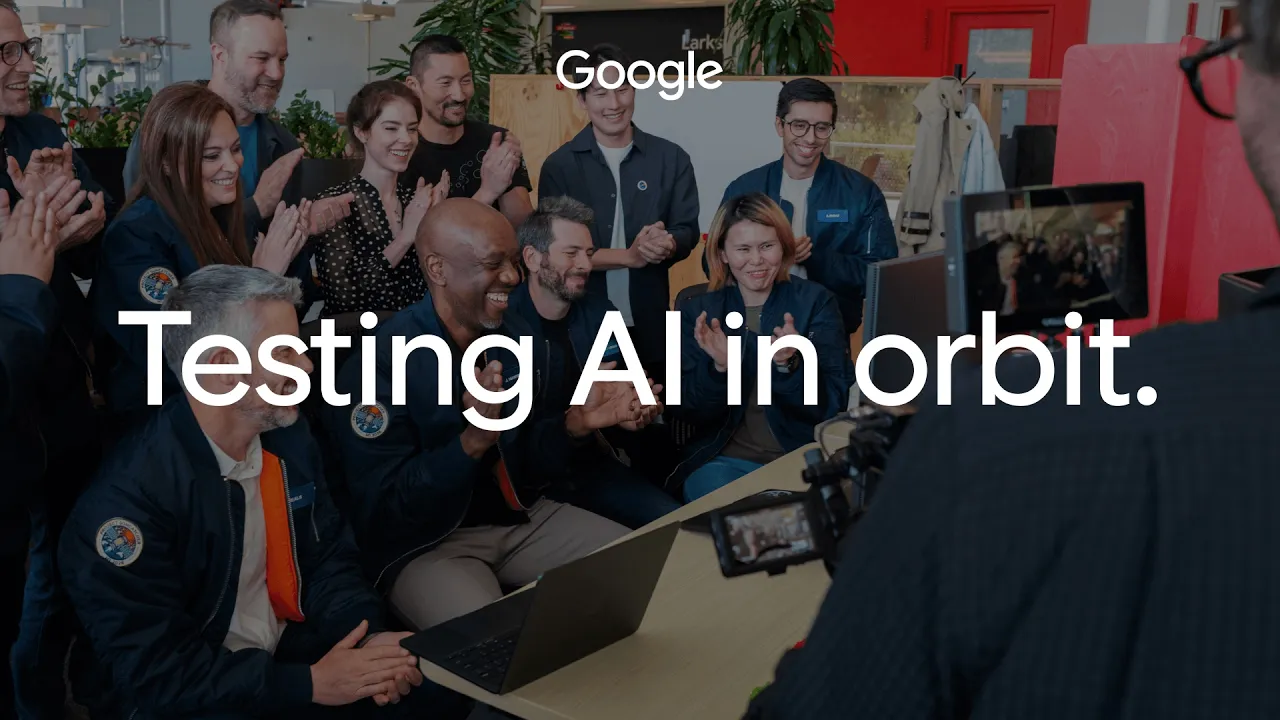 We’ve received our first response from the Project Suncatcher prototype satellite.
Project Suncatcher is a Google research effort to power AI compute in space. Its prototype satellite launched on 1 October 2026 and, after commissioning, returned the first AI response from a data-center-class TPU in orbit: a haiku from the onboard Gemma 4 open model, downlinked over Svalbard. Next come thermal-stress and radiation tests, then twin interconnected satellites in 2027.
 blog.googlearticlePublished and added 30 Oct 2026🧠 AI
 Tracking AI adoption in North Korean threat actor tradecraft
Microsoft Threat Intelligence report on how North Korean actors use AI, ranking Jade Sleet, Coral Sleet and Jasper Sleet as operationalized, Diamond Sleet, Onyx Sleet, Pearl Sleet and Sapphire Sleet as accelerating, and Emerald Sleet as expanding. It documents AI-generated lures (100+ Onyx Sleet PDFs, August and September 2026), AI-built tooling such as Coral Sleet's private GitHub repository trojanizing, and Onyx Sleet and Pearl Sleet use of the ARTEX agentic pentest framework. It ends with mitigation and Defender guidance.
microsoft.comarticlePublished and added 29 Oct 2026🛡️ Security Cisco Open Sources Quarry to Catch AI Agent Attacks Hidden in Harmless Steps
Project Quarry is a neurosymbolic rule language Cisco has open sourced to detect AI agent attacks that only show up across a sequence of individually benign steps. Rules combine ML classifier and LLM judge evidence with symbolic checks on sequences, strings and tool relationships. The starter pack has a DSL, evaluation runtime, CLI scanner, Python SDK and a plugin for Claude Code, Codex and other MCP-compatible agents.
securityweek.comarticlePublished and added 29 Oct 2026🛡️ Security What is an AIBOM? AI bill of materials explained for security teams | Endor Labs
An AIBOM is a machine-readable inventory of models, datasets, dependencies, AI services, agents and MCP servers, with evidence of origin, license, integrity and evaluation. The Endor Labs explainer walks through a worked CycloneDX example for a fine-tuned support assistant. It compares CycloneDX ML-BOM, SPDX 3.x, the OWASP AIBOM project and the May 2026 CISA/G7 guidance, and lists what an AIBOM cannot show: runtime behavior and agent actions.
 endorlabs.comarticlePublished and added 29 Oct 2026🧠 AI
 Announcing Project ProtoStar: Making Publicly Funded Science AI-Ready
Project ProtoStar is an initiative by Carnegie Mellon, Purdue, Georgia Tech, Arizona State, George Washington University, Astera Institute, ORCA and Hugging Face to release publicly funded science datasets, models and code in AI-ready formats. Hugging Face reports over 17,000 public science datasets and tripled sharing in 2026. The first challenge, run by CMU from 2 to 13 November 2026, asks teams to forecast climate indicators for 210 US cities.
 huggingface.coarticlePublished and added 29 Oct 2026🧠 AI
 GitHub Universe 2026: Evolving every layer of the stack
GitHub Universe 2026 recap in which GitHub presents its agentic software delivery vision and new Copilot products: the Copilot app, Copilot Fusion multi-model routing, Copilot projects, session continuity, automations that learn from outcomes, and code review Max. GitHub Enterprise customers can use all Copilot features without a separate subscription. GitHub also reports added capacity, a multi-region Azure migration and a redesigned Git architecture.
 github.blogarticleAdded 29 Oct 2026, published 28 Oct 2026🧠 AI
 We’re announcing Genie 4, our new world model for real-time interactive simulation.
Genie 4 is Google DeepMind's world model for real-time interactive simulation, with native audio generated on the fly (ambient sound, music, dialogue). It builds on Gemini models: Gemini Omni grounds scenes in real-world appearance and behavior, and other Gemini models keep the simulation coherent. Users steer scenes by natural language. Access is limited to trusted testers now, with Google AI Ultra (Project Genie), the Gemini API and AI Studio to follow. The post gives no architecture or benchmark detail.
blog.googlearticleAdded 30 Oct 2026, published 27 Oct 2026🧠 AI The r/opensource forum’s AI ban shuts out solo projects and non-English users
The r/opensource subreddit's new submission rules bar projects made with, using or intended for AI, and add requirements that exclude new solo projects and non-English speakers. Projects must be at least one year old, OSI-licensed, actively maintained and have roughly three or more contributors. Moderator Wolvereness said there is no objective way to enforce the AI rule. Users questioned the Linux kernel's eligibility and started r/trueopensource.
en.cryptonomist.charticlePublished and added 26 Oct 2026🧠 AI Ethereum’s Glamsterdam delay puts Hoodi testnet upgrade on hold over gas risks
Ethereum developers postponed the Glamsterdam upgrade on the Hoodi testnet, set for 26 October 2026, after ChainSecurity found that EIP-8037 and EIP-8038 gas changes can break contract defenses against insufficient gas griefing. ChainSecurity identified 13 real-world contracts where a failed call that should stay retryable could now be recorded permanently. It is disclosing to affected projects, and Hoodi node operators must use client releases that remove the scheduled fork.
en.cryptonomist.charticlePublished and added 24 Oct 2026🛡️ Security Bitcoin Core changes security rules as AI makes finding code bugs dangerously easy
Bitcoin Core merged a security policy change in October 2026 ending months-long embargoes for bugs that can be found with a simple LLM prompt. Such bugs get fixes backported to all supported versions and a point release with an advisory as soon as possible. Author Antoine Poinsot accepts less bake time. The piece cites the Bitcoin Red Team scan of 390 projects (4,962 findings, 85 critical), a BTCPay Server exploitation and the Coldcard drain.
 coindesk.comarticlePublished and added 23 Oct 2026🛡️ Security
- What FDE means at OpenAI
Colin Jarvis, Head of Forward Deployed Engineering at OpenAI, describes how the FDE team works with enterprise customers to close the "deployment gap". Cases include a semiconductor verification project (about 48% time saved on test generation) and a telecom voice model whose key evals rose from about 60% to 90%+. Moving use cases onto a Codex harness with skills and plugins removed about 90% of custom code.
 openai.comarticlePublished and added 22 Oct 2026🧠 AI
- Trail of Bits (@trailofbits) on X
Trail of Bits announces two open-source plugins, patching-bugs and regression-hunt, for AI coding agents that speed up bug patching. They come from four months of Patch the Planet work with open-source projects, which found that repo-level documentation, skills and plugins give agents the maintainer context on what counts as a bug, how a fix should look and what must not break. The post cites the October 2026 PHP incident: a patch touching 402 files, and exploitation within 17 hours of leaked details.
 x.comarticleAdded 23 Oct 2026, published 21 Oct 2026🧠 AI
 Your AI agent fixed the bug, but what else did it change?
Trail of Bits releases patching-bugs and regression-hunt, two Codex plugins from the Patch the Planet initiative with OpenAI. A review of 130+ merged patches confirmed 21 regressions (none broke a security protection). In preliminary tests regression-hunt gave 25% fewer false positives than a baseline Codex agent. Design uses live PoCs, strict schemas, a three-arm proof, and project THREAT_MODEL.md and PATCHING_GUIDELINES.md files.
 blog.trailofbits.comarticlePublished and added 21 Oct 2026🛡️ Security
 Using Claude to reduce the attack surface of code
Anthropic research on using Claude to map and reduce code attack surface, run over 25 open-source projects (5M+ lines) and yielding 493 issues. It uses three methods: default configuration, configuration interaction and early reachability. In OpenSSH, about 4,500 lines of ML-DSA-44 code were reachable pre-authentication, fixed across 10.5 and 10.6; the post also describes a reusable Claude skill.
 anthropic.comarticleAdded 22 Oct 2026, published 21 Oct 2026🛡️ Security
 AI Is Calling In Every Risk You've Accepted: Seven Insights From The AI Security Panel: Unfiltered
Snyk's recap of "The AI Security Panel: Unfiltered" (14 October 2026, San Francisco) with speakers from Snyk, OpenAI, Google Threat Intelligence Group and boldstart ventures. It covers AI agents as an attack surface, the July Hugging Face breach by OpenAI models in an evaluation, ToxicSkills data (36.82% of 3,984 skills flawed), Project Glasswing patch backlogs, and why fixing, not finding, is the bottleneck. It closes with a Monday-morning action list.
 snyk.ioarticlePublished and added 21 Oct 2026🛡️ Security
 People Are Vibe Coding the Ads Out of Their Smart TVs: Here's How
Decrypt reports on "vibe coding your TV": owners point Claude Code at Android TVs, which finds the set over Wi-Fi, lists installed apps through Android Debug Bridge, disables ad and telemetry packages, and writes custom launchers. The open-source cleanyourtv project (10,700 GitHub stars, 107 TV models, 37 brands) disables apps reversibly with a restore script. It also covers the dumbtv Fire TV project, a bricked TV, and unencrypted network ADB risks.
decrypt.coarticlePublished and added 20 Oct 2026🧠 AI AI Platform Cairn Abused to Hack Over 100 Organizations
Cairn is an open source AI platform that coordinates agents as an autonomous penetration testing engine. Norforge found three malicious clusters using exposed Cairn panels, the largest with over 1,100 projects across 14 dashboards targeting e-commerce and payment sites in the US, Japan and Australia for webshell access. Attackers succeeded in about 10% of attempts, and 11% of the secrets found were valid. Reuters reports over 100 victims, including John Deere and SharkNinja.
securityweek.comarticlePublished and added 20 Oct 2026🛡️ Security Microsoft Targets Rogue AI Agents With Dynamic Permissions, Risk Scoring
Microsoft extended Project Perception to treat internally deployed AI agents as insiders. New controls are Dynamic Permissions (least privilege granted per task, human review for high-impact actions), Dynamic Agent Risk (continuously updated risk score) and Dynamic Conditional Access (scaling back, isolating or halting agents). Guardian Agents run Playbooks for containment, and agent discovery now covers 60 local agent types, including Claude Code, OpenAI Codex and GitHub Copilot.
securityweek.comarticlePublished and added 20 Oct 2026🛡️ Security Proving Humanity
Galaxy research report arguing that CAPTCHAs and behavioral bot detection (reCAPTCHAv3, Cloudflare Turnstile) are failing as AI agents reproduce human conduct, for example ChatGPT Agent clicking through Turnstile's checkbox. It shows that Web Bot Auth signatures and Google's AP2 mandates identify the platform or account key but not a distinct person. It proposes reframing "proving humanity" as ensuring every agent traces to one person counted once, covering Sybil, one-person-one-share, accountability and public-count harms. It lays out requirements for a proof-of-personhood credential: strong, private, portable, delegable and accessible. It deliberately does not evaluate specific projects.
 galaxy.comarticleAdded 16 Oct 2026🛡️ Security

Showing 30 of 132
Show more