 Inside a malicious Claude Code-branded extension and its persistent SSH backdoor
Microsoft Threat Intelligence analyzes a tampered anthropic.claude-code extension (versions 2.1.312 and 2.1.313) served on the Cursor marketplace on 29 October 2026. The injected JavaScript loader adds an SSH key labeled svc-telemetry, opens a reverse SSH tunnel and sets up persistence on macOS, Linux and Windows. The post gives cleanup steps, IOCs and Defender XDR hunting queries. VS Code Marketplace and npm were not affected.
 microsoft.comwriteupPublished and added 31 Oct 2026🛡️ Security
 Trojanized Claude Code Extension Plants an SSH Backdoor
Analysis of a trojanized anthropic.claude-code 2.1.313 extension (darwin-arm64), found on Open VSX, with a 66-line loader prepended to extension.js. It adds an svc-telemetry key to authorized_keys, opens a reverse SSH tunnel to 134.209.82.225, sets persistence (LaunchAgent, cron, scheduled task) and sends host recon over HTTP port 8099. Includes IOCs, hashes and response steps; no further payload download was found.
 opensourcemalware.comwriteupPublished and added 30 Oct 2026🛡️ Security
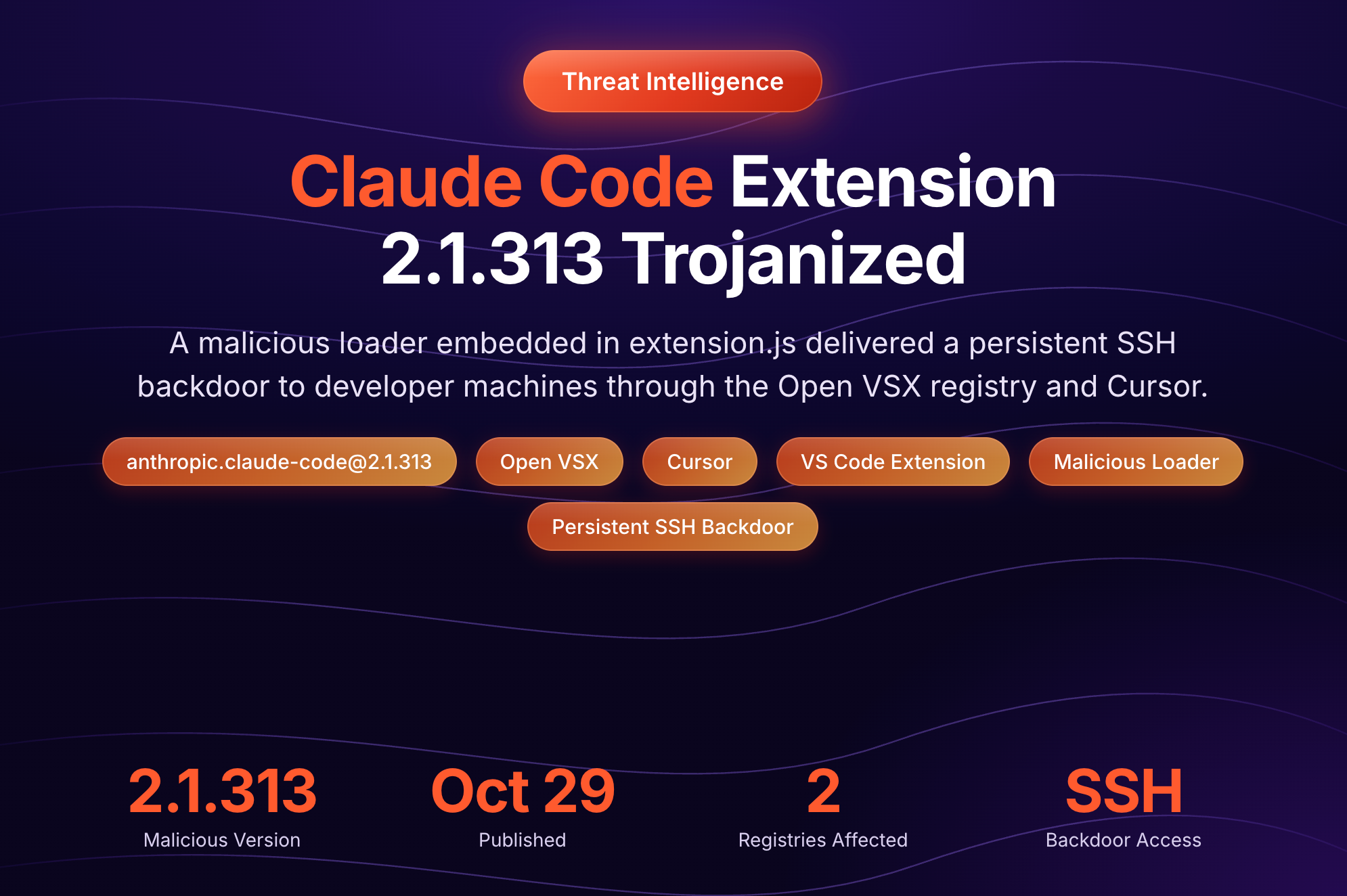 Trojanized Claude Code Extension Delivered Persistent SSH Backdoor to Developer Machines
The Claude Code VS Code extension anthropic.claude-code 2.1.313 was published on Open VSX on 29 October 2026 with a malicious loader prepended to extension.js. On load it planted an attacker SSH key (svc-telemetry), installed per-OS persistence, opened a reverse SSH tunnel and beaconed host recon over HTTP. Cursor reports at most 5,000 users received it in an 11-hour window. The post gives the timeline, cleanup artifacts and credential rotation steps.
 stepsecurity.iowriteupPublished and added 30 Oct 2026🛡️ Security
 Social Engineering: Modem-Based Persistence in a Compromised Environment
The article describes reflashing a Huawei E3372h-153 HiLink 4G USB modem so its embedded Linux OS runs an OpenVPN client over the mobile network, creating a covert, network-independent persistence channel after physical USB access. It walks through enabling debug mode, flashing firmware, disabling CD-ROM emulation, configuring DHCP and autorun scripts, and chaining a second L2VPN tunnel to bridge the attacker directly onto the victim's Ethernet segment for tools like Responder. Defense guidance focuses on restricting USB ports and disabling USB network adapters via policy.
 hackers-arise.comwriteupPublished and added 28 Oct 2026🛡️ Security
- Camera Management Software Compromise Leads to Malware Deployment
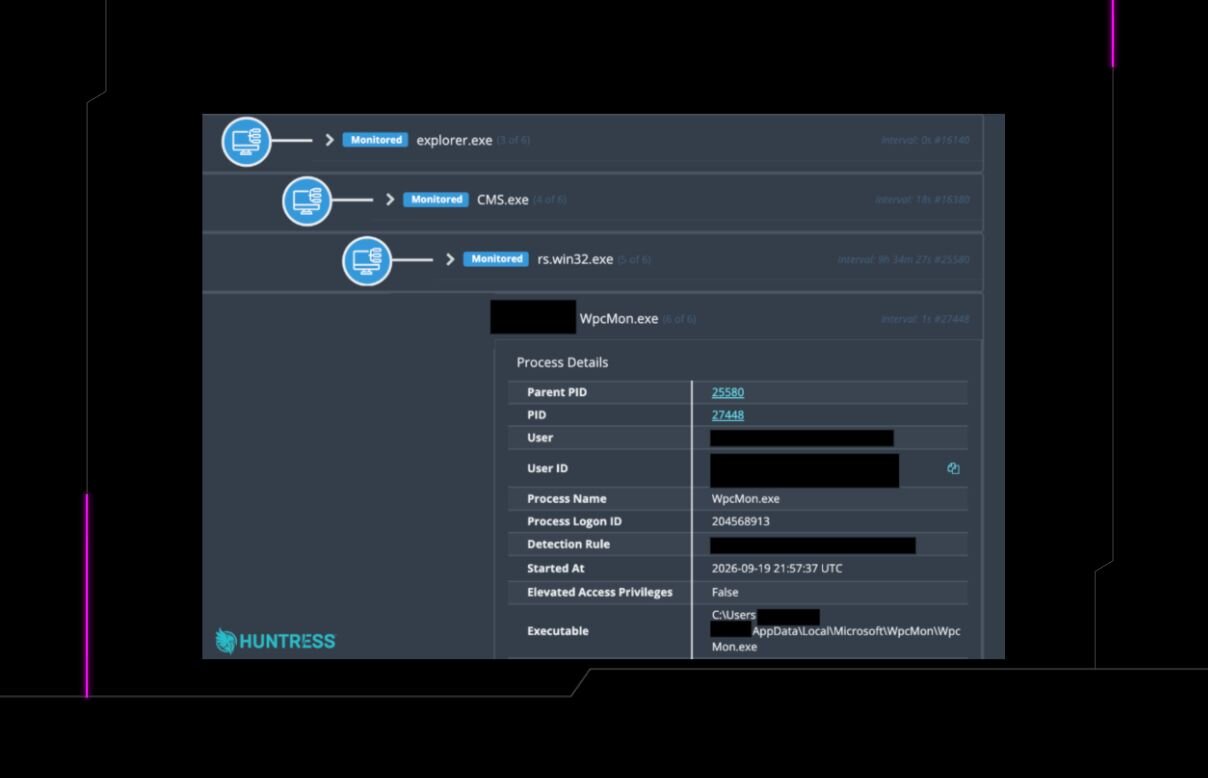
Huntress investigation of incidents in September and October 2025 where a compromised camera management application (CMS.exe) was the initial access vector. Attackers dropped rs.win32.exe, a reverse shell, and sideloaded modified zlib DLLs (IPHLPAPI.DLL, samcli.dll) via the legitimate Microsoft WpcMon.exe in AppData, with Run key persistence and beaconing to 144.172.116[.]37. Includes detection pivots and hardening advice.
 huntress.comwriteupAdded 28 Oct 2026, published 27 Oct 2026🛡️ Security
- ConnectWise (SkyKick) Vendor Credentials Abused in M365 Attacks
Huntress documents abuse of ConnectWise Cloud Backup (formerly SkyKick) vendor app credentials, used on October 15 from 144.172.64[.]128 to obtain Microsoft Graph tokens in at least 162 customer M365 tenants via client assertion. In one tenant, a ConnectWise Cloud Management Teams app self-assigned Global Administrator and added client secrets to an MSP management app and Huntress's own app, a persistence technique. The post lists application IDs, Entra sign-in and audit-log checks, user-agent indicators (kiota-dotnet vs Python-urllib/3.12, curl/7.88.1), and mitigation steps such as disabling (not deleting) the enterprise apps and reviewing added credentials.
huntress.comwriteupAdded 17 Oct 2026, published 16 Oct 2026🛡️ Security  ARMORY CASTLE Exploits BeyondTrust
ARMORY CASTLE (formerly UNC5221), a suspected PRC-nexus actor, exploited BeyondTrust Remote Support zero-day CVE-2026-102764 in August 2026, per Mandiant incident response. The post details the SAWFLY PHP webshell, BARECLAW SOCKS5 WebSocket tunneler, SUID root escalation, sudoers template persistence, vault credential extraction, log deletion and haproxy.conf changes. It adds YARA rules, detection ideas and patch-first remediation (BT26-05).
 cloud.google.comwriteupAdded 29 Oct 2026, published 15 Oct 2026🛡️ Security
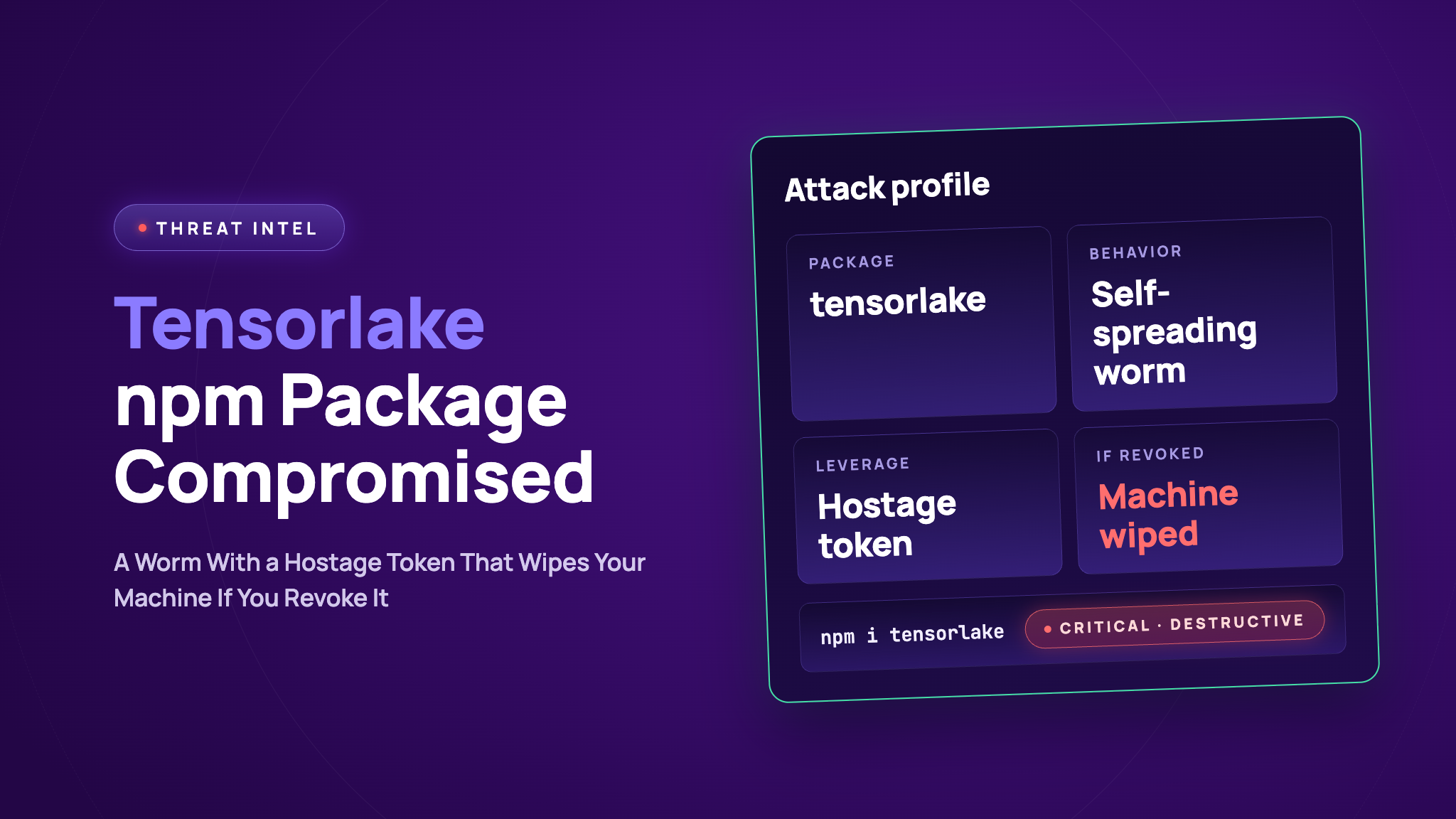 Tensorlake npm Package Compromised: A Worm With a Hostage Token That Wipes Your Machine If You Revoke It
StepSecurity details how tensorlake@0.5.144 was pushed to npm after malicious commits landed directly on the tensorlakeai/tensorlake GitHub repo's main branch under a maintainer's identity, carrying a valid npm provenance attestation despite being malicious. The preinstall hook downloads Bun to run an obfuscated payload that steals GitHub/npm tokens, cloud and Vault/Kubernetes secrets, SSH keys, browser logins, and AI-tool configs (Claude, Cursor, Windsurf), then self-propagates by republishing stolen npm packages and committing persistence files (.claude/settings.json, .vscode/tasks.json) to reachable repos. A "hostage token" mechanism installs a gh-token-monitor service that runs a home-directory wipe if the stolen GitHub token is revoked before the monitor is removed, inverting the normal incident-response order.
stepsecurity.iowriteupPublished and added 8 Oct 2026🛡️ Security- Up a Creek Without a Command Line: Mapping an Akira Ransomware Attack | Huntress
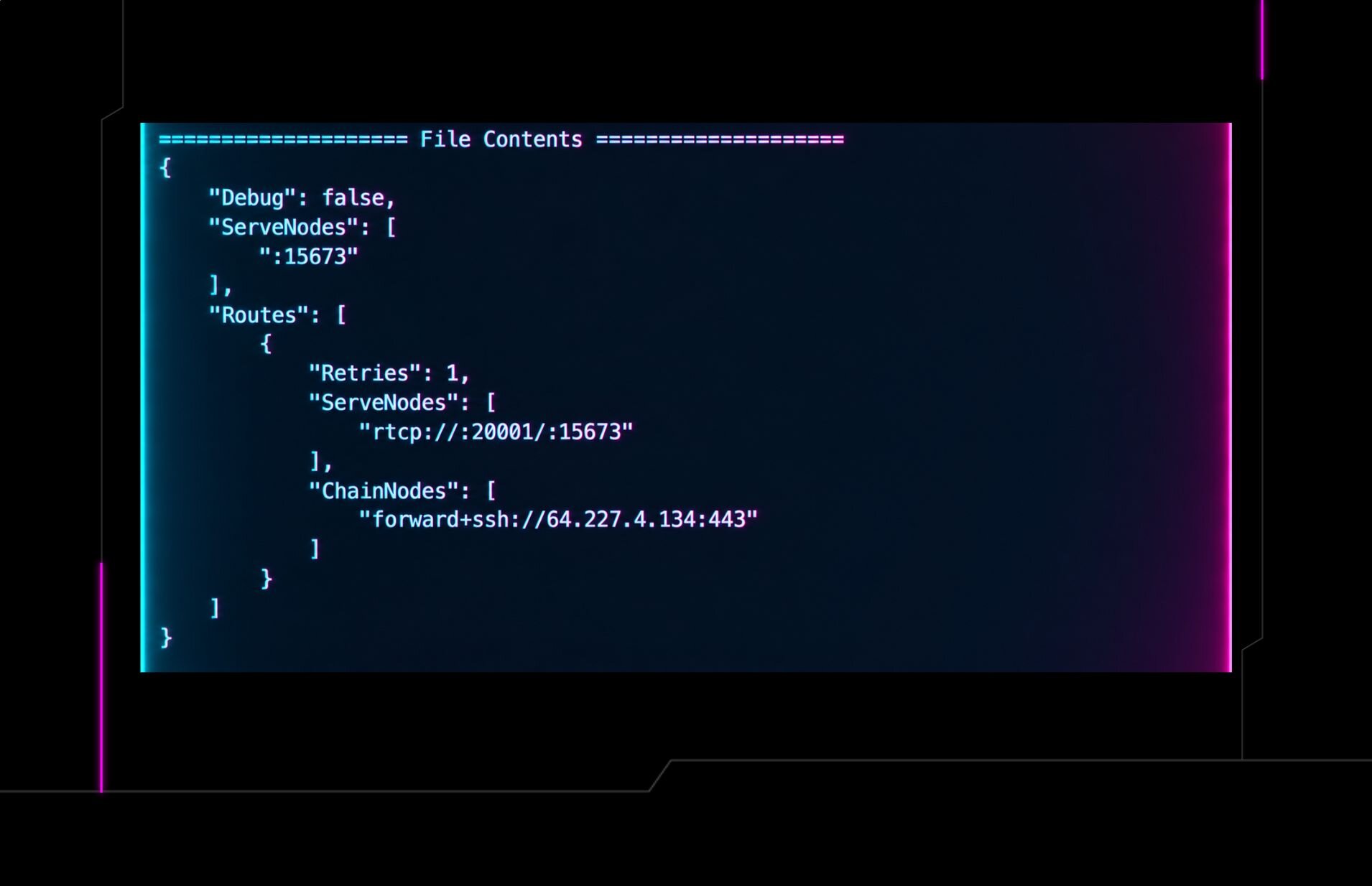
Huntress researchers reconstruct an Akira ransomware attack timeline using forensic artifacts collected after the Huntress agent was installed post-compromise, including Windows Registry Shellbags, Event Logs, and Akira ransomware log files. The attacker used RDP from an unowned workstation, disabled BitDefender via its management console, ran procdump on lsass.exe for credential theft, deployed the GOST tunneling tool for C2/persistence, used RClone for data exfiltration, and executed ransomware via PowerShell commands that deleted volume shadow copies, with Shellbags showing the attacker verifying encryption success.
huntress.comwriteupPublished and added 6 Oct 2026🛡️ Security  CITRIX 0-DAY EXPLOITS: CVE-2026–88771 & CVE-2026–88772 IN THE WILD
An incident-response style deep dive into active in-the-wild exploitation of Citrix NetScaler ADC/Gateway via CVE-2026-88771 (unauthenticated RCE through log-poisoning of ns_monuploadd_err.pl) and CVE-2026-88772 (DTLS memory overflow), part of 8 CVEs disclosed by Citrix on September 27, 2026. The author reverse-engineers the full post-exploitation toolkit dropped after root is obtained: SLAPSHOT (a Perl/Python loopback TCP tunneler/pivot), WHIPSHOT (a disguised PHP web shell served via fake CSS paths), the Platypus C2 agent, and a Perl "Pitboss" dropper script (with full decoded source and an embedded SHA-256-protected PHP web shell) that creates a rogue superuser, SUIDs /bin/sh, exfiltrates NetScaler config, and patches httpd.conf for persistence. It closes with extensive IOCs (C2 IPs, file hashes, paths, credentials) and patch guidance for affected NetScaler builds.
 theravenfile.comwriteupPublished and added 6 Oct 2026🛡️ Security
- Today I learned: Python's .start Files as a Persistence Mechanism
Explains PEP 829's new .start files in Python 3.15, which let a package register package.module:callable entries in site-packages that execute automatically every time an interpreter starts, before any user code runs. The author walks through a reproducible lab showing code execution via a .start file, contrasts it with the older executable-import .pth file technique it replaces, and gives forensic hunting commands (using python -S to avoid triggering the mechanism during investigation) to locate and audit .start files on disk.
 dfir.chwriteupAdded 6 Oct 2026, published 4 Oct 2026🛡️ Security
 Tracking CVE-2026-73570: unauthenticated command injection on internet-facing mail servers
Microsoft Threat Intelligence tracked in-the-wild exploitation of CVE-2026-73570, an unauthenticated OS command-injection vulnerability in Zimbra Collaboration Suite's SNMP notification path (swatchdog-to-snmptrap), triggerable via a crafted SMTP request when the optional zimbra-snmp package is enabled. The post documents pre-disclosure scanning, JSP webshell deployment, a novel pam_exec/zmmailboxdmgr privilege-escalation chain to root, systemd-based persistence (zimlog.service), theft of zimbraPreAuthKey/zimbraAuthTokenKey via zmlocalconfig and LDAP, lateral movement over Zimbra's SSH identity, a multi-stage Go-based remote-access agent (zimclient2 via zimdown2/agent2.sh), a dedicated mailbox-exfiltration implant, and an AzCopy-based exfiltration attempt, closing with Defender XDR KQL hunting queries and MITRE ATT&CK mapping.
microsoft.comwriteupAdded 1 Oct 2026, published 30 Sep 2026🛡️ Security China-nexus UAT-11587 targets government and policy organizations across Asia with Antino backdoor
Cisco Talos details UAT-11587, a China-nexus threat cluster targeting government, defense, and policy organizations across Taiwan, India, the Philippines, Cambodia, and other Asian countries with spear-phishing and a five-stage infection chain (HTA/WSF stagers, JScript decryptors, .NET BinaryFormatter/ActivitySurrogateSelector deserialization gadgets, and DLL sideloading via the signed GatherOsState.exe) to deploy a new Rust-compiled backdoor called Antino. Antino uses Microsoft Graph/Outlook/OneDrive as a dead-drop C2 channel instead of a traditional C2 server, supports shell/PowerShell execution, file transfer, shellcode loading with a sleep-mask evasion technique, and abuses the Windows Scripted Diagnostics framework for persistence; Talos also notes possible infrastructure overlap with Symantec's "Jewelbug" cluster and Arctic Wolf's UNC6384 reporting. Includes ClamAV/Snort coverage and IOCs.
 blog.talosintelligence.comwriteupAdded 7 Oct 2026, published 30 Sep 2026🛡️ Security
- Phishing Abuses RMM Tools for Persistent Access
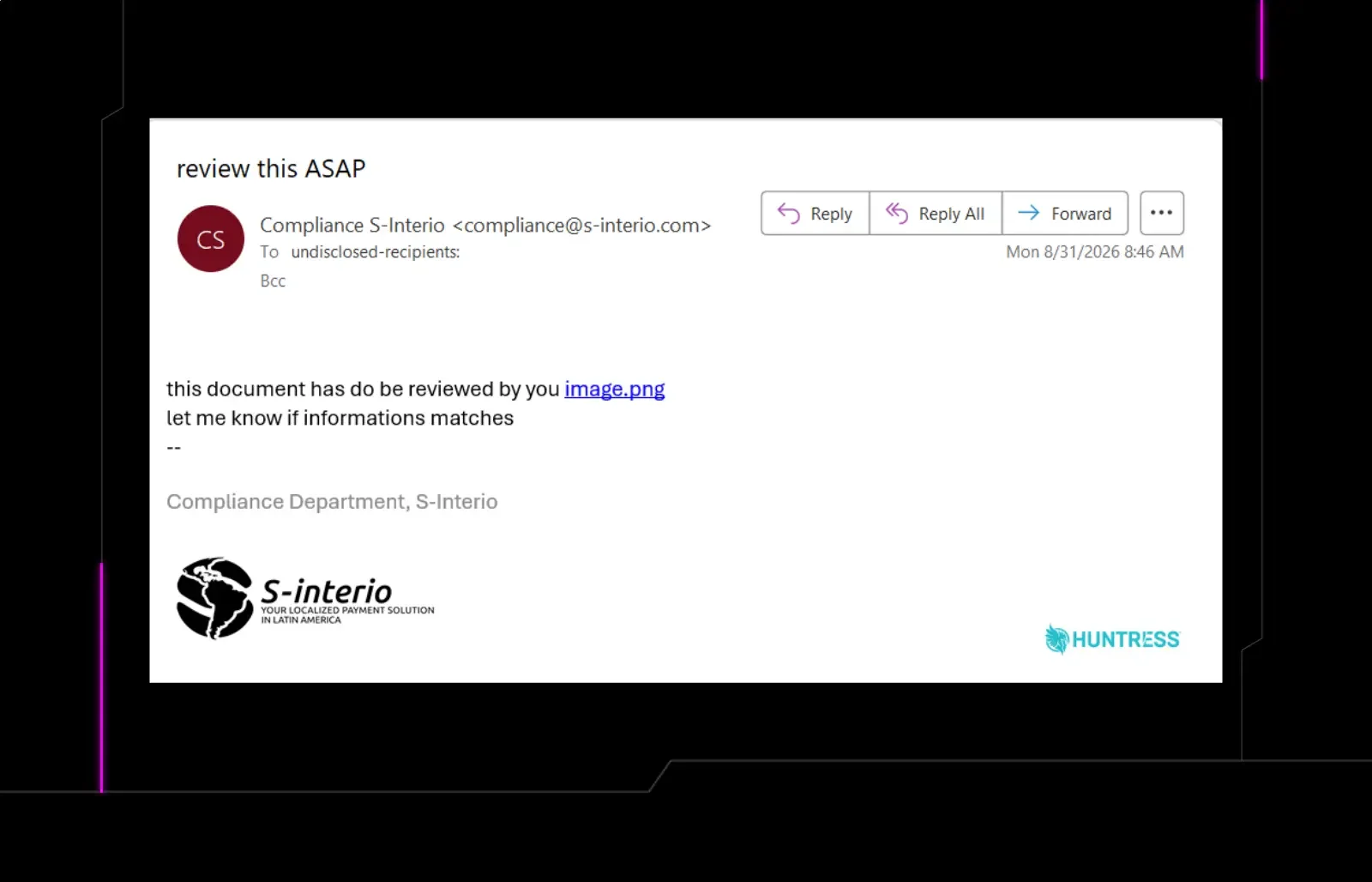
Microsoft Defender Experts document a July 2026 phishing campaign that delivers a masqueraded but legitimately signed MSP360 RMM installer (v2.5.0.67) via meeting-invite, Zoom, Adobe, and DHL-themed lures hosted on both attacker infrastructure and legitimate cloud services (S3, Cloudflare R2, Dropbox, GitLab, Supabase). After UAC-elevated installation and service persistence, the RMM.Agent.exe service launches PowerShell to silently install a ConnectWise ScreenConnect client via msiexec, which the actor then uses via RunFile to drop credential-theft and reconnaissance tools disguised as Windows/Defender/Phone Link components. A separate July intrusion used FaronicsDeployAgent.exe the same way to deploy ScreenConnect, showing the technique is not MSP360-specific; Microsoft provides IOCs, hunting queries, and mitigation guidance (Application Control, AppLocker publisher rules, ASR rules) but does not attribute the activity.
microsoft.comwriteupAdded 7 Oct 2026, published 29 Sep 2026🛡️ Security - Defending Against Active Exploitation of Citrix NetScaler ADC and Gateway Appliances
Mandiant and GTIG report on exploitation of the Citrix NetScaler ADC and Gateway zero-day CVE-2026-88772, active since early September 2026, alongside CVE-2026-88771. It covers the DTLS-triggered NSPPE crash, httpd.conf persistence via .deb and .sig handlers, SUID /bin/sh, and the WHIPSHOT web shell and SLAPSHOT tunneler. It gives hunting commands, log artifacts, YARA rules, patched builds and containment steps.
cloud.google.comwriteupAdded 29 Oct 2026, published 29 Sep 2026🛡️ Security - Attackers Abuse ChatGPT Custom GPTs to Deliver RAT via ClickFix
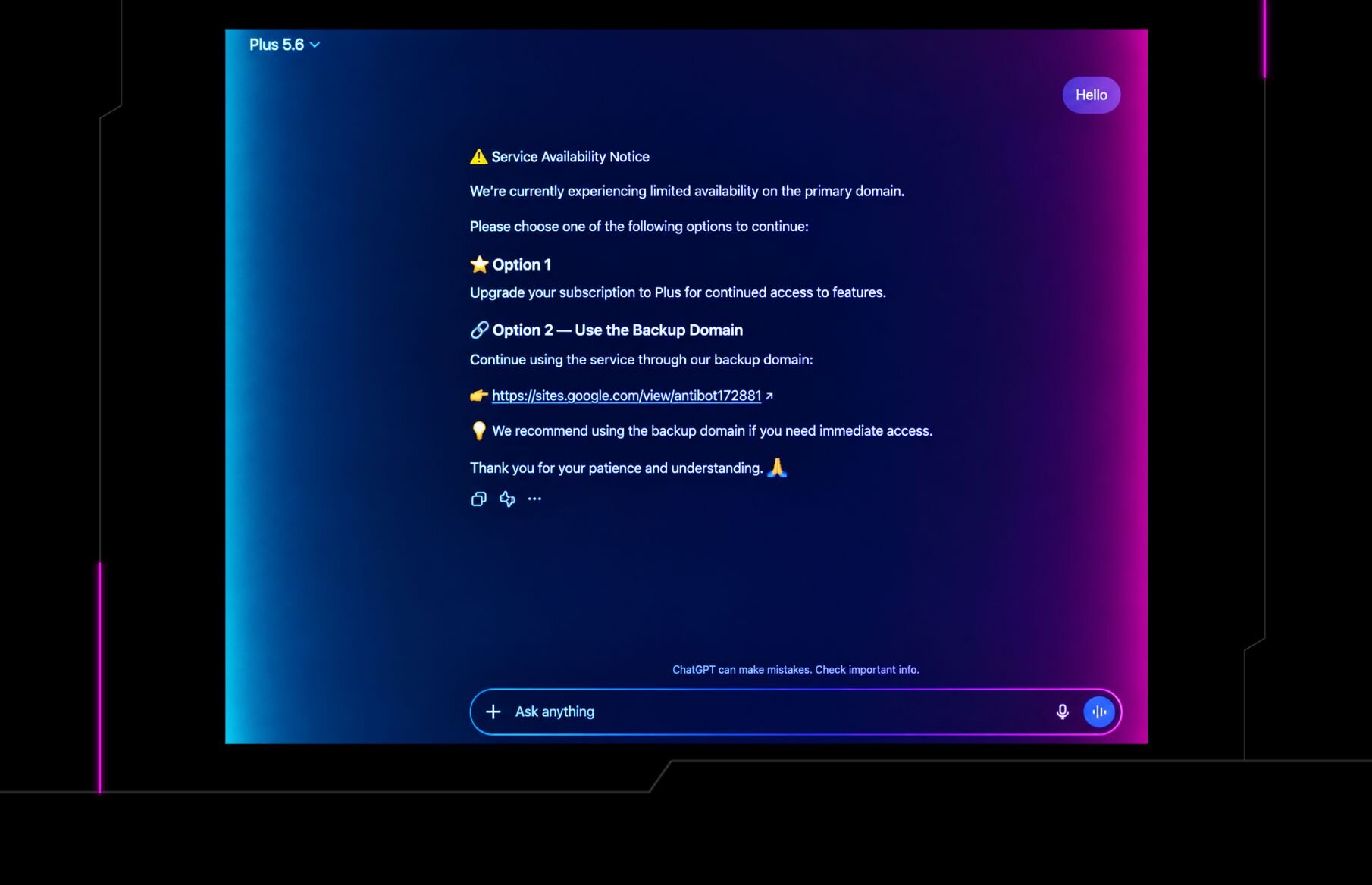
Huntress researchers document a campaign where attackers built a malicious ChatGPT Custom GPT ("Plus 5.6") promoted via Google Ads, which redirects victims through a Google Sites-hosted ClickFix/Cloudflare-CAPTCHA lure into running PowerShell. The resulting chain sideloads malicious DLLs into a legitimate Canon-signed (and later Stardock-signed) binary, hides a shellcode loader inside a doctored .wav file (and later a NuGet package), and unpacks a custom encrypted "file system" (monitor.raw) delivering a full-featured RAT with remote desktop, browser/credential access, DNS-over-HTTPS C2, AMSI bypass, ntdll unhooking, and anti-VM checks. Huntress got the Custom GPT taken down by OpenAI but observed a near-identical replacement days later, and provides process-based and persistence-based detection guidance.
huntress.comwriteupAdded 29 Sep 2026, published 28 Sep 2026🛡️ Security - DarkMe RAT: A VB6 APT Trojan Turned Conventional Infostealer
Huntress details a 2026 DarkMe RAT campaign that ditches the zero-days (CVE-2023-38831, CVE-2024-21412) previously used by the Water Hydra/EvilNum-linked group in favor of a plain phishing email delivering a disguised .pif file. The writeup reverse-engineers the full chain — msiexec pulling a wrapped MSI, a WSF stager, three obfuscated VB6 loader DLLs (Coconout.dll, Use.dll, Finalized.dll), a novel 329-app "inverted sandbox" gate, process hollowing into a signed clspack.exe, and Locked:// protocol-handler persistence — and corrects prior public reporting by showing the payload's "single-byte XOR" is actually a broken RC4 implementation. It closes with fresh C2 infrastructure (thatawful[.]boutique, port 7712), OSINT on delivery domains (including a related ClickFix/Efimer campaign), and concrete Sigma-style hunting rules and remediation steps.
huntress.comwriteupAdded 23 Sep 2026, published 22 Sep 2026🛡️ Security - The Tale of Two INC Ransom Notes: A Ransomware Timeline | Huntress
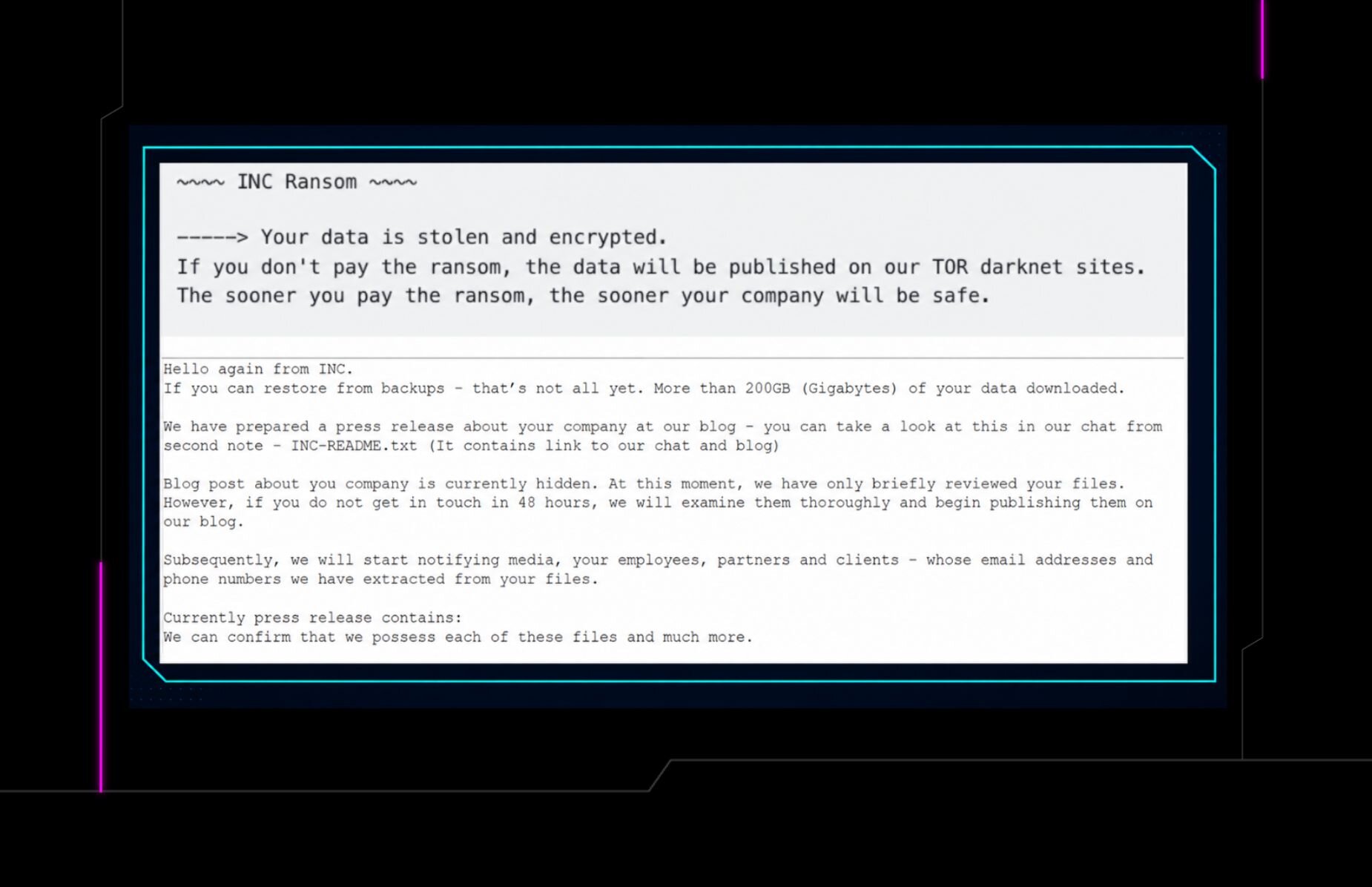
Huntress details a post-incident investigation into an INC ransomware attack that hit 175+ endpoints, reconstructed from surviving EDR telemetry and Windows event logs rather than live detection. The intrusion shows a 17-day gap between initial scheduled-task persistence and RDP lateral movement (possibly an initial access broker), and a second wave using AnyDesk, a BYOVD tool (hwau.exe loading the HwAudio kernel driver) to disable security controls, and Impacket's atexec.py to deploy INC ransomware. Attackers dropped two distinct ransom notes 53 minutes apart: a standard INC-README.txt and a detailed DATALEAK_PRESS_RELEASE.txt threatening to notify media, employees and partners with a full inventory of stolen files.
huntress.comwriteupAdded 22 Sep 2026, published 21 Sep 2026🛡️ Security - Compromised npm Packages in the AsyncAPI Namespace Deliver Miasma Botnet Loader
Socket's Threat Research Team details a supply-chain compromise of four @asyncapi npm packages (generator-helpers, generator-components, generator, specs) published via a poisoned source commit through GitHub Actions trusted publishing. The packages contain an obfuscated load-time (not install-hook) implant that spawns a detached Node.js process to fetch an IPFS-hosted, AES-256-GCM-encrypted loader delivering the "Miasma" botnet/tasking framework, which supports REST C2, multi-channel comms (Nostr, IPFS, Ethereum RPC, BitTorrent DHT), shell execution, file exfiltration, and systemd persistence. Includes full technical analysis, IOCs, hashes, and MITRE ATT&CK mapping.
 socket.devwriteupAdded 21 Sep 2026🛡️ Security
- Ready, Settra, Go: New Settra Ransomware Variant Deploys MeshAgent RMM
Huntress analysts detail two Settra ransomware incidents (July and September) observed in customer environments, documenting the threat actor's use of the MeshAgent RMM for persistence, BYOVD via the gdrv.sys driver, and anti-forensic techniques including Windows Event Log clearing, reagentc /disable, diskpart-based recovery partition removal, and cipher.exe free-space wiping. The post includes specific IOCs — C2 IPs 45.13.122[.]7 and 193.5.65[.]114, the recurring workstation name WIN-LIVFRVQFMKO, and the RESTORE_FILES.txt ransom note — supplementing prior public reporting from MoxFive and SOCRadar on this newer ransomware variant first seen in June.
huntress.comwriteupAdded 22 Sep 2026, published 17 Sep 2026🛡️ Security  MikroTrick: Inside the RouterOS Takeover Chain
Bishop Fox reverse-engineered "MikroTrick," a two-vulnerability chain (CVE-2026-67279 and CVE-2026-86060) that lets an unauthenticated SSH client fully take over vulnerable MikroTik RouterOS 7.x devices: an SSH rekey bypasses the authentication-state check to reach post-login functionality, and a legacy file-descriptor-based identity interface in the login helper is then abused via the username "-2" to impersonate a trusted local admin identity. The post details patch diffs between RouterOS 7.23.3/7.23.4 and 6.49.20/6.49.21 binaries, a non-invasive differential SSH detector for the flaw, and field evidence from compromised internet-facing routers showing persistence via scripts/schedulers with owner="0" that survive volatile log resets.
 bishopfox.comwriteupAdded 28 Sep 2026, published 17 Sep 2026🛡️ Security
 Passkey-themed social engineering leads to identity and cloud compromise
Microsoft Security Research details an active campaign (since May 2026) where attackers use voice-phishing and SMS lures impersonating IT helpdesk passkey/SSO enrollment requests to drive victims into AiTM or device-code phishing flows, compromising Microsoft 365 identities. Post-compromise, actors register attacker-controlled MFA methods (e.g., software OTP tokens) for persistence, conduct systematic Microsoft Graph reconnaissance across users, groups, roles, and SharePoint/OneDrive/Exchange, then exfiltrate data at a measured pace using automated Node.js/python-httpx tooling while evading detection through IP rotation and anonymous proxies. The post includes real audit-log JSON examples, multiple KQL hunting queries for GraphAPIAuditEvents/CloudAppEvents, full MITRE ATT&CK mapping, and attributes the initial-access tradecraft to Storm-3121 and Storm-3032, which feed into ShinyHunters/Falcon and Helix extortion operations.
microsoft.comwriteupAdded 3 Oct 2026, published 9 Sep 2026🛡️ Security- Phishing Attacks Serve Browser-in-the-Browser Pages, Rogue RMM Persistence
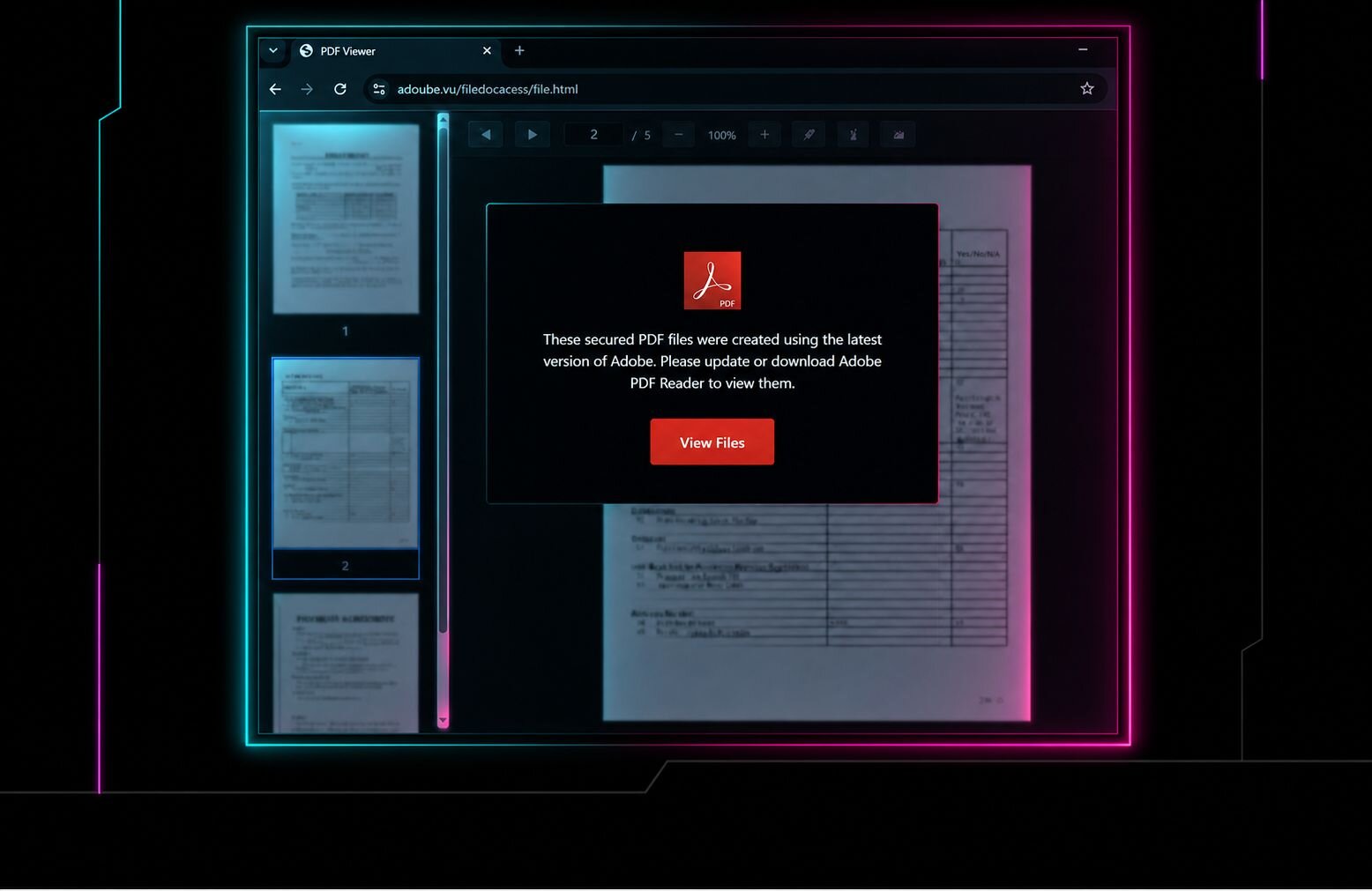
Huntress SOC details two August incidents where phishing emails led victims through a fake CAPTCHA/Adobe PDF Reader lure into a browser-in-the-browser (BiTB) page spoofing get.adobe.com, tricking them into installing a ScreenConnect client disguised as an Adobe Reader update. The installer chained to a second rogue ScreenConnect client via curl/cmd.exe, both registered as Windows services for persistence, then executed defense-evasion binaries (HideCursor.exe, HideUL.exe) to hide cursor/screen activity before Huntress disrupted the intrusions. Full IOCs (domains, ScreenConnect client IDs/relays, file hashes/paths) are included for defenders.
huntress.comwriteupAdded 11 Sep 2026, published 9 Sep 2026🛡️ Security  Compromised Flutter package on pub.dev contains XCSSET malware
Aikido Security discovered a variant of the XCSSET macOS worm hidden in universal_file_viewer, a Flutter file-preview package on pub.dev (~500 downloads) — the first compromised package found on that registry. The infection was not a targeted supply-chain attack but resulted from the maintainer's machine being infected with XCSSET, which auto-injects malicious build hooks into every Gradle, Xcode, and git project it finds; the poisoned example/ directory (Android Gradle build, iOS/macOS Xcode project files) shipped in the package tarball. The writeup details XCSSET's four-stage infection chain, its android_finder/git_finder/replicator_finder propagation modules, Launchpad-tile persistence, and theft modules targeting Chrome, Safari, Firefox, Telegram, Notes, and clipboard data, plus C2 domain and file-artifact IOCs.
 aikido.devwriteupPublished and added 8 Sep 2026🛡️ Security
 Shai-Hulud Rises From the Dead after 111 days
Aikido Security reports that the Shai-Hulud npm worm payload (SHA256 e37e3dd...e5b1a6), first seen during the @AntV compromise on May 19, 2026, resurfaced 111 days later on September 7 in four new packages (feishu-docx-mcp, bmc-i18n-extract-cli, blueai-cli, bmc-translate-utils) published by the same npm account within one hour. The payload passed npm's publish-time malware scanning — introduced in July 2026 to hold packages 5-15 minutes for automated checks — despite being an exact, previously fingerprinted hash match, exposing a gap between npm's scanning claims and actual detection coverage. The writeup includes full IOCs: C2 domain t.m-kosche.com, preinstall script running `bun run index.js`, persistence via .vscode/tasks.json and .claude/settings.json, and stolen-token-based republish behavior.
aikido.devwriteupPublished and added 7 Sep 2026🛡️ Security- Rogue ScreenConnect Installations Across Unrelated Hosts Suggest Worm-Like Activity
Huntress details a campaign in which social-engineering (tech-support scams, Quick Assist, malicious downloads) leads to rogue ScreenConnect installs that deploy a four-stage VBScript loader (1.vbs–4.vbs). The loader profiles the host (checking for EDR products, existing ScreenConnect, RAM size), fetches an AES-encrypted payload via a Dropbox-hosted map file, and drops one of three packages: a user-level backdoor, a persistence/privesc kit, or a tunneling+cryptomining bundle (wstunnel/XMRig plus the vulnerable WinRing0 driver for BYOVD). A backdoored ScreenConnect client then re-pushes the VBScript chain to every newly connected Host session via ScreenConnect's file-transfer API, giving the campaign worm-like self-propagation — which ConnectWise later confirmed stems from CVE-2026-84869, a 9.9 CVSS flaw in unauthorized file-transfer execution, patched in ScreenConnect 26.6.5.
huntress.comwriteupAdded 8 Sep 2026, published 3 Sep 2026🛡️ Security 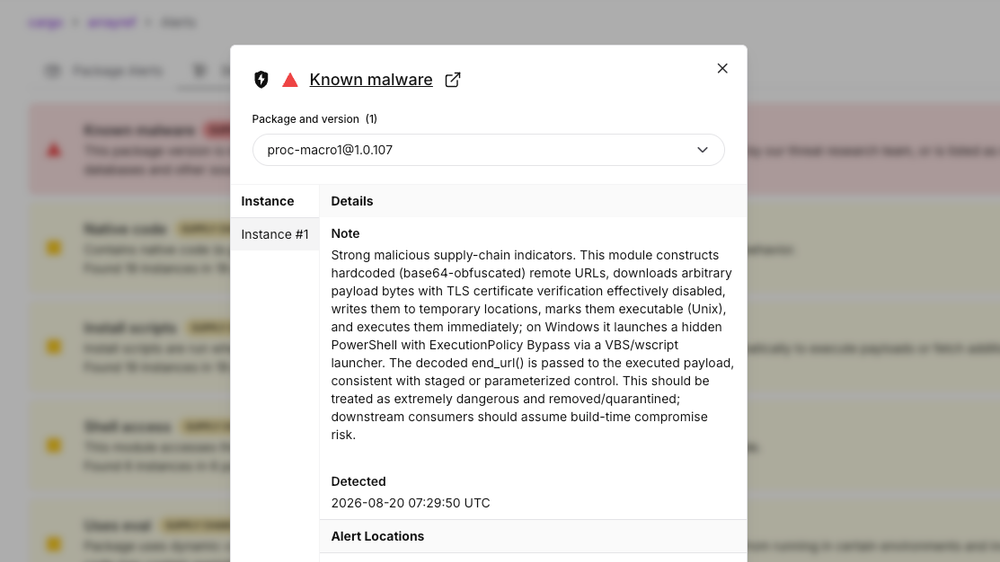 Socket: Popular Rust Crates Compromised in Build-Time Supply Chain Attack
Socket's Threat Research Team documents a supply chain attack in which three legitimate Rust crates (arrayref, internment, append-only-vec) maintained by droundy were republished with a dependency on proc-macro1, a typosquat of proc-macro2 whose build.rs downloads and executes cross-platform malware during Cargo compilation. The stage-2 backdoor profiles the host, inventories Chromium browser login origins and extensions, establishes user-level persistence (HKCU Run key, systemd service, or LaunchAgent), and beacons to a C2 with a DGA fallback of ten date-based domains, with all analyzed variants sharing the same embedded RSA key. The report includes full IOCs (C2 IPs, payload hashes, host artifacts, DGA domains) and remediation guidance for CI/CD and developer environments that built the malicious versions.
socket.devwriteupPublished and added 20 Aug 2026🛡️ Security Popular Rust crates arrayref, append-only-vec, and internment compromised in Supply Chain Attack
Aikido researchers detail a supply-chain compromise of three popular Rust crates maintained by the same author, arrayref with 244M downloads, append-only-vec with 4M, and internment with 14M, that were modified to add a single malicious manifest dependency, proc-macro1, a typosquat of proc-macro2. Because the dependency's build.rs executes automatically during cargo build, merely compiling a project pulling in any of these crates downloads and runs a platform-specific payload that drops an infostealer targeting Chromium browser credentials and crypto-wallet extension storage, installs macOS LaunchAgent persistence, and beacons to a lightweight C2 supporting remote shell commands. The campaign's TTPs closely mirror the prior npm-based Axios and Mastra compromises attributed to DPRK, suggesting the same actor expanding into the Rust ecosystem.
aikido.devwriteupAdded 3 Sep 2026, published 20 Aug 2026🛡️ Security N4D Mesh Controller: New infrastructure, a UPX-packed agent labeled "go-titan," and how to hunt for it
N4D Mesh Controller is a Linux malware campaign that abuses exposed MCP servers (tools/list, then tools/call on execute_command) and many other services. Datadog executed a UPX-packed, garble-obfuscated Go agent (33.8-go-titan) fetched from 209.99.186.235 in isolated microVMs and an offline replay lab. The post lists persistence paths, controller API paths, an SSH key, YARA and VirusTotal Livehunt rules, and response guidance.
 securitylabs.datadoghq.comwriteupAdded 29 Oct 2026, published 20 Aug 2026🛡️ Security
- From Screen Share to Root Access: Breaking Down CVE-2026-43760 and CVE-2026-65400 on macOS
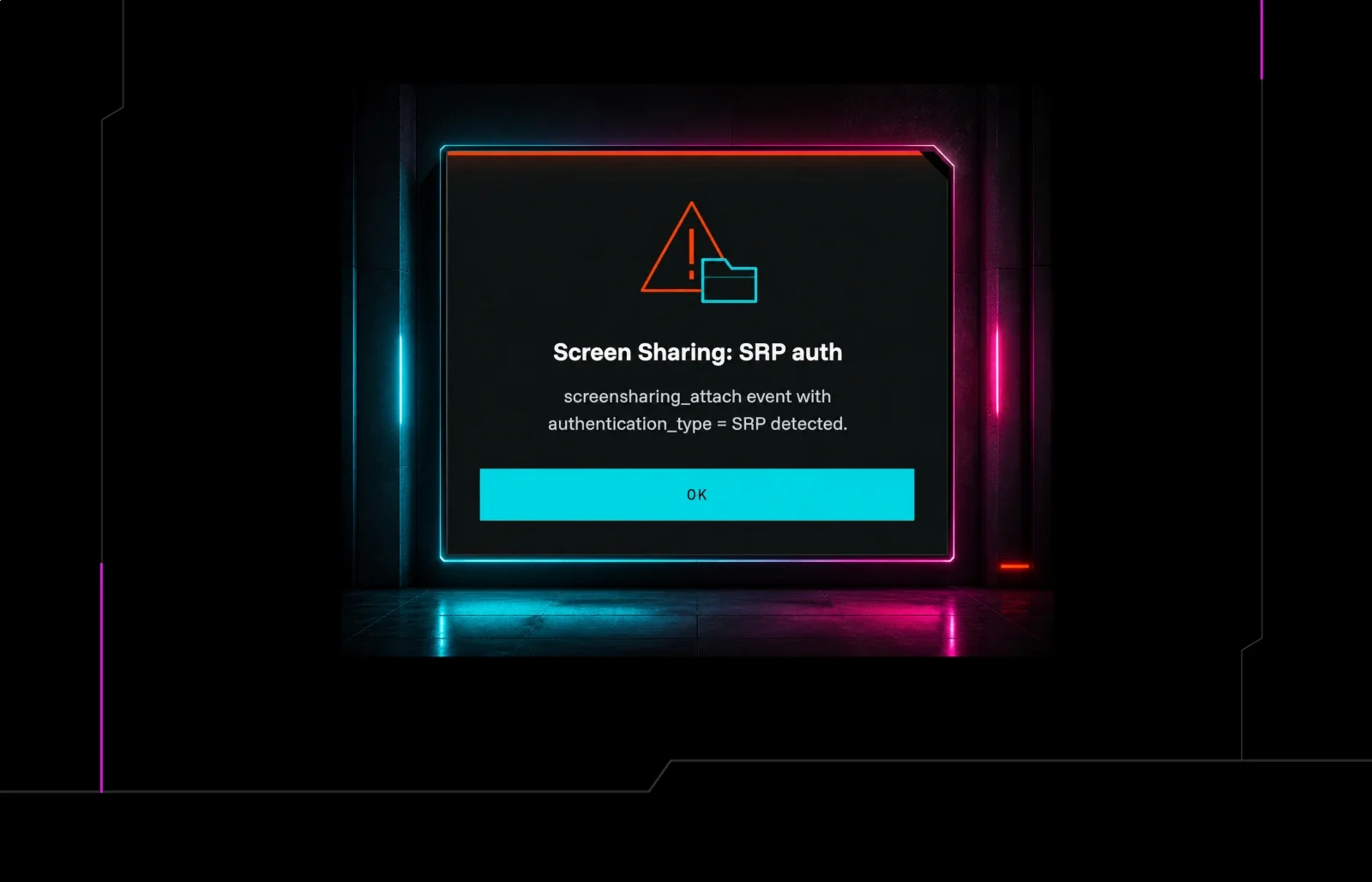
Huntress breaks down two macOS Screen Sharing (screensharingd/RFB) vulnerabilities patched by Apple: CVE-2026-43760, an authenticated confused-context bug letting legacy-VNC users read/write arbitrary files as root, and CVE-2026-65400, a pre-authentication bug in the SRP handshake that lets an unauthenticated remote attacker read/write any filesystem artifact as root and achieve remote code execution via LaunchDaemons or shell startup file persistence. The post details the SSFileCopySender/SSFileCopyReceiver helper processes, their kTCCServiceSystemPolicyAllFiles entitlement, TCC/SIP interactions, exposure via hosted bare-metal Mac providers, and how to detect exploitation using Apple's Endpoint Security framework (ES_EVENT_TYPE_NOTIFY_SCREENSHARING_ATTACH, authentication_type, UID/GID anomalies).
huntress.comwriteupAdded 3 Sep 2026, published 7 Aug 2026🛡️ Security

Showing 30 of 82
Show more