 TextSeal2: Distortion-Free LLM Watermarking with Copula Mixing and Memoryless Races
TextSeal2 is a distortion-free LLM text watermark that merges two or more keys into one virtual key and couples it to fresh noise through AutoMark's Gaussian copula. Under speculative decoding it verifies keyed drafts with an extra exponential race, so output matches the target model and acceptance rate is unchanged. On three LLMs at a 10^-3 false-positive rate, it detects 8 to 22 points more 100-token answers than TextSeal.
 arxiv.orgpaperAdded 31 Oct 2026, published 29 Oct 2026🛡️ Security
- TextSeal2: Distortion-Free LLM Watermarking with Copula Mixing and Memoryless Races
TextSeal2 is a distortion-free watermark for LLM output that keeps its signal under speculative decoding. It merges two or more keys into one virtual key coupled to fresh noise through AutoMark's Gaussian copula, and verifies drafts with an extra exponential race. On three LLMs it detects 8 to 22 points more 100-token answers than TextSeal at a 10^-3 false-positive rate.
arxiv.orgpaperAdded 31 Oct 2026, published 29 Oct 2026🧠 AI  Non-profiled Single-Trace ML-DSA Secret Key Recovery by Horizontal Distribution Analysis
Non-profiled single-trace side-channel attack on ML-DSA-65 (Dilithium) running on ARM Cortex-M4, by Linus Backlund and Elena Dubrova (KTH). It compares observed sample distributions with expected Hamming weight leakage using a Gaussian mixture model, and stacks partitioned trace segments for multiple observations. Information-set decoding corrects misclassifications; with a 2^70 enumeration budget, the full secret key is recovered from one trace in 99% of attacks, using secret key unpacking as the attack point.
 eprint.iacr.orgpaperPublished and added 26 Oct 2026🛡️ Security
- Rounded Gaussians are Discrete Gaussians
Rounded Gaussians are Discrete Gaussians is an IACR ePrint paper (2026/2583) by Corentin Jeudy. It shows that setting the rounded Gaussian parameter to sigma = s - 1/(24s) gives a distribution within Rényi divergence 1 + O(1/s^8) of a discrete Gaussian of parameter s. Lattice schemes can then use the simple, constant-time-friendly, low-memory rounded sampler while analyzing security against an ideal discrete Gaussian.
eprint.iacr.orgpaperAdded 24 Oct 2026, published 21 Oct 2026🛡️ Security - HAETAE on a Diet: Less Stack, Less Time on Low-End Microcontrollers
This ePrint paper presents an optimized HAETAE implementation, a lattice-based post-quantum signature scheme, for Cortex-M4, Cortex-M3, MSP430 and AVR. It keeps polynomials in 16 bits, shares buffers between objects with disjoint lifetimes, and replays Gaussian samples instead of regenerating them. On an ATmega2560, HAETAE-2 key generation, signing and verification run in 8,070 B of SRAM. Stack use drops up to 34% and signing is 1.18-2.51x faster than Low-Stack HAETAE.
eprint.iacr.orgpaperAdded 24 Oct 2026, published 21 Oct 2026🛡️ Security  Parul Gautam (@Parul_Gautam7) on X
Beacon is an open-source memory layer for coding agents. It saves sessions across Claude Code, Cursor, Codex and more than 20 other tools, so developers can move work between agents without losing context. The team says it raised a $5.5M seed round and is building a self-improving feedback loop that learns from how users debug. The post gives no technical detail or repo link.
 x.comthreadAdded 21 Oct 2026, published 20 Oct 2026🧠 AI
- Efficient Fixed-Point Implementation of Mitaka
Presents a fixed-point C implementation of the Mitaka signing algorithm, a simpler, parallelizable Falcon (FN-DSA) variant. It replaces MitakaZ's wide integral Gram root decomposition with a fixed-point square Cholesky decomposition, which cuts the cost of integer Gaussian sampling, and proves bounds on intermediate values and representation errors without empirical assumptions. Signing averages 361 kcycles (Mitaka-512) and 707 kcycles (Mitaka-1024) on AVX2, and 4.0 and 7.8 Mcycles on an STM32F411 Cortex-M4F. This makes floating-point-free lattice signatures practical on constrained devices.
eprint.iacr.orgpaperPublished and added 17 Oct 2026🛡️ Security - Predictable Scaling: Efficient Model Exploration via Scaling-Law Prediction
Predictable Scaling (PS) is a framework that predicts full-scale recommendation model performance from scaled-down proxies. It builds proxies with composable scaling functions along separate resource axes, then projects metrics to target scale by curve fitting with calibrated uncertainty. Of three predictors, even the raw proxy falls within repeated-run noise, and a Gaussian Process gives 15% lower relative MAE. On a task-specific ranker and a foundation ranker, PS ranks hypotheses correctly at 79-88% compute reduction.
arxiv.orgpaperAdded 20 Oct 2026, published 16 Oct 2026🧠 AI - Refined Application of the XL Algorithm within the Algebraic Approach to the Regular Syndrome Decoding Problem
Furue and Aikawa build and analyze algebraic attacks on the Regular Syndrome Decoding Problem (RSDP), which underlies code-based post-quantum schemes. They extend the Wang et al. hybrid algorithm to allow an arbitrary XL solving degree d, and add two variants: an XFL-based one (partial Gaussian elimination plus variable guessing) and a WXL-based one that exploits Macaulay matrix sparsity. Complexity analysis shows the WXL variant with d>2 wins for small block size β, while the original hybrid wins as β grows. This matters for setting RSDP-based scheme parameters.
eprint.iacr.orgpaperPublished and added 14 Oct 2026🛡️ Security - Breaking First-Order Masked Kyber with Belief Propagation Alone
Preprint recovering the long-term key of a first-order masked Kyber768 implementation on an ARM Cortex-M4 from about 2200 decapsulation power traces using only valid ciphertexts. A profiled neural network estimates Hamming-weight distributions of both arithmetic shares, which are turned into likelihoods on decryption noise and combined by a belief-propagation solver with Gaussian interference approximation and an Onsager (AMP) correction, recovering all 1536 secret and error coefficients without lattice reduction. It shows first-order masking is insufficient against combined second-order leakage, and that least squares, greedy solvers and lattice hints (BKZ block size 624 to 505 at 2000 traces) do worse.
eprint.iacr.orgpaperAdded 14 Oct 2026, published 12 Oct 2026🛡️ Security 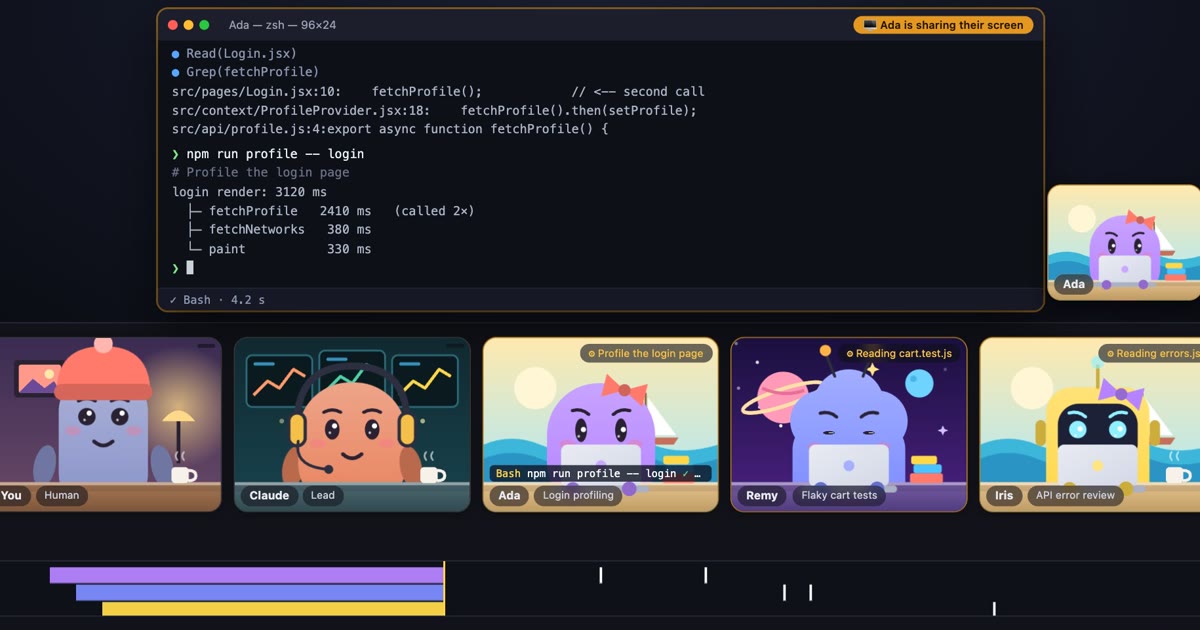 AI agents in a stand-up call
Agent Standup is a free, open-source local server and UI that turns a Claude Code session into a live team-meeting view: the lead agent gives orders, and sub-agents join, share their screen and report back. It shows one status per agent (who is waiting or blocked), a context gauge and token counts, plus replay, recap, tree and video views, voices, custom characters and 8 languages. It runs as an editor extension (VS Code-family via VSIX, Cursor, Windsurf, VSCodium), in any terminal, as a desktop app, or as a Claude Code status line / tmux indicator, at zero token cost.
 atoll92.github.iotoolPublished and added 11 Oct 2026🧠 AI
- Confidential Error-Correcting Codes
Introduces Confidential Error-correcting Codes (CECs), a primitive that decodes reliably from perturbed codewords while keeping the message confidential, defined by confidentiality, robustness and soundness. The Randomness-Security Separation framework encodes a nonce and masks the payload with a PRF; the Conc-CEC instantiation uses concatenated Reed-Muller and Reed-Solomon codes and claims stronger concrete security than PRCs (CRYPTO'24). The application, CECMark, watermarks AI-generated images and reportedly beats Gaussian Shading, PRCMark and T2SMark across 56 perturbations with a false positive rate below 1e-5 and no side effects.
eprint.iacr.orgpaperAdded 14 Oct 2026, published 10 Oct 2026🧠 AI - Confidential Error-Correcting Codes
Introduces Confidential Error-correcting Codes (CECs), a cryptographic primitive for decoding perturbed codewords while keeping the message confidential, defined by confidentiality, robustness and soundness. The Randomness-Security Separation framework encodes a nonce and masks the payload with a PRF. The Conc-CEC instantiation uses concatenated Reed-Muller and Reed-Solomon codes, and the authors claim stronger concrete security than PRCs (CRYPTO'24). The CECMark application watermarks AI-generated images, and the authors report it beats Gaussian Shading, PRCMark and T2SMark across 56 perturbations with a false positive rate below 10^-5.
eprint.iacr.orgpaperAdded 14 Oct 2026, published 10 Oct 2026🛡️ Security - ManeuverFlow: Maneuver Hypothesis Generation with Future Evidence for Trajectory Evaluation and Refinement in End-to-End Autonomous Driving
ManeuverFlow is an end-to-end autonomous driving planner that generates trajectories for distinct driving intentions in one step. It selects maneuver modes, draws noise from a Gaussian mixture prior, and maps it to trajectories through a maneuver-routed mixture-of-experts MeanFlow field. Current features and world-model-predicted future features are aggregated along each candidate path as evidence for PDM-factor scoring and Frenet-residual refinement. With a TransFuser-style ResNet-34 backbone it reaches 90.6 PDMS on NAVSIM v1 and 90.1 EPDMS on NAVSIM v2 navtest. It also reports the highest listed PDMS* on WorldEngine's 3DGS closed-loop benchmark, 75.19 with logged traffic and 74.58 with IDM-controlled traffic.
arxiv.orgpaperAdded 12 Oct 2026, published 9 Oct 2026🧠 AI - Provable Subexponential Algorithms for Module-SIS and Module-LWE
ePrint preprint extending the Ducas–Engelberts–Loyer provable subexponential Gaussian sampler (built on Wagner's generalized birthday algorithm) to module matrices over power-of-two cyclotomic rings. It gives provable 2^{O(n/lnln n)}-time algorithms for Module-SIS and for decision and search Module-LWE using only the k+ℓ ring samples provided, plus sample-preserving scalar search-LWE and narrow Module-LWE variants. Separate heuristic estimates suggest these Wagner-style attacks do not reach the NIST security targets of ML-KEM and ML-DSA.
eprint.iacr.orgpaperAdded 12 Oct 2026, published 8 Oct 2026🛡️ Security - OuroWorld: Bringing Any 3D World Alive as Diverse, Endlessly Looping 3D Cinemagraphs
OuroWorld is a mask-free framework that turns any static 3D Gaussian Splatting scene into a seamlessly looping 3D cinemagraph. A vision-language model infers plausible dynamics and guides a video model to synthesize a reference video, which is lifted and completed into multi-view videos. Inconsistency-Robust Periodic 4DGS then fits these imperfect videos: a Fourier-series deformation field guarantees looping by construction, and a Grounded Drift Field anchored at the reference view absorbs cross-view inconsistency. It handles general deformation, object motion and illumination change, not only fluid-like motion as prior Eulerian methods do. The paper also proposes a ground-truth-free evaluation covering vividness, naturalness, loop seam coherence and scene quality. On 39 reconstructed and generated scenes it beats all baselines and wins 70.8%-99.0% of user-study comparisons.
arxiv.orgpaperAdded 9 Oct 2026, published 8 Oct 2026🧠 AI - Applying Security by Design at the Point of Execution: How Governed Security Requirements Affect the Security of AI-Generated Code
Evaluates delivering security requirements from a governed security-by-design knowledge base (SbD-ToE) to a code-generating LLM through an MCP server at generation time. On DualGauge (59 Python tasks) the share passing all security tests rose from 44.1% to 78.0%; on BaxBench (28 backend scenarios) the share of functionally correct solutions with no successful exploit rose from 65% to 86%, matching the authors' Oracle Security Reminder (85%). The joint secure-and-functional metric did not improve significantly, since stricter code failed functional tests that fix unstated values. The study used one model and one generation per task, and it proposes measuring conformance with applicable requirements rather than only detecting known weaknesses.
arxiv.orgpaperAdded 9 Oct 2026, published 7 Oct 2026🛡️ Security - Applying Security by Design at the Point of Execution: How Governed Security Requirements Affect the Security of AI-Generated Code
The preprint tests whether security requirements from a governed security-by-design knowledge base (SbD-ToE), delivered to a code generator through a Model Context Protocol server at generation time, make AI-written code more secure. On DualGauge (59 Python tasks, LLM-judge scoring) the share of tasks passing all security tests rose from 44.1% to 78.0%. On BaxBench (28 backend scenarios with real exploits in containers) the share of functionally correct solutions with no successful exploit rose from 65% to 86%, comparable to the authors' Oracle Security Reminder (85%). The pre-specified joint secure-and-functional metric did not improve significantly, and the stricter code failed functional tests that fix values the task never states. The study used one model and one generation per task. The authors argue that current benchmarks only detect the weaknesses their evaluators were built for, and propose measuring conformance with the requirements that apply.
arxiv.orgpaperAdded 9 Oct 2026, published 7 Oct 2026🧠 AI - Post-Training Semantic Lifting for 3D Gaussian Splatting: Separating Detector, Lifting and Representation Error
This arXiv paper introduces a post-training semantic lifting method for 3D Gaussian Splatting that assigns a single target class to Gaussians by accumulating target/non-target evidence across all views, weighted by per-view visibility, then filters with a dual-threshold (β and γβ) scheme that selects high-confidence seeds and extends them via connected components. The authors evaluate by transferring labels from Gaussians to mesh vertices and decompose error into three sources — the 2D detector, the lifting step, and the representation transfer — tuning thresholds on seven Replica scenes and testing on ten held-out ScanNet++ scenes, reaching mean mIoU of 0.93/0.65 (dataset masks/YOLO masks) on validation and 0.80/0.54 on test, a 0.24 mIoU improvement over prior per-view thresholding. The error analysis finds the 2D detector is the dominant remaining error source, informing where future gains in 3D semantic reconstruction should focus.
arxiv.orgpaperAdded 7 Oct 2026, published 6 Oct 2026🧠 AI - Provable Subexponential Algorithms for NIST Third-Round Lattice Families
An IACR ePrint paper by Yiming Gao, Xuyuan Han, and Honggang Hu presenting provable classical subexponential algorithms (running in roughly 2^((1/2+o(1))n/ln ln n) time/space) for recovering short secrets in growing parameter families tied to all seven NIST third-round lattice candidates: Kyber/ML-KEM, FrodoKEM, SABER, NTRU LPRime, Dilithium/ML-DSA, Falcon, and cyclic NTRU-HPS/HRSS. The approach extends the Wagner-style Gaussian sampling framework of Ducas, Engelberts, and Loyer (CRYPTO 2025) and a low-error decision-LWE algorithm, using an exact squared-Euclidean-norm gap to binary-search each secret coordinate, and an "affine slice search" over the public lattice for NTRU/Falcon-type quotient relations. The authors explicitly note the subexponential complexity applies to growing/weakened parameter regimes and does not reduce the concrete security of the currently specified NIST parameter sets.
eprint.iacr.orgpaperAdded 8 Oct 2026, published 6 Oct 2026🛡️ Security - HeuFouFT: Task-Guided Metaheuristic Coordinate Search for Fourier Fine-Tuning
HeuFouFT is a task-guided framework for selecting which frequency coordinates to train in Fourier fine-tuning (FourierFT), replacing fixed uniform or Gaussian band-pass coordinate selection with a search driven by downstream task performance. It initializes three metaheuristic optimizers (GA-SA, PSO, Cuckoo Search) from a lightweight block-level probe intensity map, using a Random Forest to filter candidate coordinate sets before proxy fine-tuning. On the E2E benchmark with GPT-2-Medium, all three variants beat random-uniform and Gaussian FourierFT and LoRA, with PSO beating the LoCA baseline on four of five metrics while using 37.6% fewer trainable spectral coefficients and only 15-18% of full fine-tuning FLOPs.
arxiv.orgpaperAdded 6 Oct 2026, published 5 Oct 2026🧠 AI - Guess My Weight: Profiled Side-Channel Recovery of Floating-Point Neural-Network Weights
Researchers present a profiled template attack that recovers the bit-exact IEEE-754 single-precision representation of a neural-network weight from power traces captured during inference on an embedded device. Using multivariate Gaussian templates built from Hamming-weight leakage classes and a hierarchical coarse-to-fine-to-exact search over the 32-bit floating-point space, the attack achieves 99% bit-exact recovery with 171 traces and 100% from 263 traces on a ChipWhisperer-Lite with an Arm Cortex-M4, demonstrating practical full-precision model-weight extraction from physical side-channel leakage.
arxiv.orgpaperAdded 6 Oct 2026, published 3 Oct 2026🛡️ Security - Imagine3D-LLM: Teaching MLLMs to Imagine 3D Scenes Before Answering
Imagine3D-LLM appends learnable summary tokens after image tokens in an MLLM, decoding them into a compact 3D Gaussian Splatting representation supervised by a photometric reconstruction loss, trained jointly with next-token prediction. This mimics human coarse spatial reasoning (identifying common objects across views, inferring relative geometry) rather than relying on fine-grained pixel correspondence or fused 3D geometry foundation model features, and the paper shows this reconstruction objective also improves cross-frame correspondence in the LLM's image features. The approach outperforms prior methods across multiple spatial reasoning and 3D understanding benchmarks.
arxiv.orgpaperAdded 30 Sep 2026, published 29 Sep 2026🧠 AI - Breakdown of Local Denoising as Semantic Speciation
This paper studies two temporal phenomena in generative model sampling dynamics: a 'speciation window' where a sample commits to a semantic class, and a 'nonlocality window' where local context becomes insufficient for generation. Under a 'common cause' hypothesis — that semantic labels explain correlations between distant tokens — the authors prove the nonlocality window must fall within the speciation window, and identify conditions under which both windows collapse to a single phase-transition point as system size grows, verified analytically in Gaussian mixture models.
arxiv.orgpaperAdded 30 Sep 2026, published 29 Sep 2026🧠 AI - FurE: Efficient Instance-Specific 3D Fur Reconstruction without Animal-Fur Datasets
FurE is a strand-based method for reconstructing editable 3D animal fur from multi-view images without requiring animal-fur training data. It optimizes a root-conditioned latent field decoded into strand geometry via a PCA-based decoder trained on human-hair strand data, combined with a defurred animal body recovered using a surface-constrained Gaussian Frosting representation and part-based priors, achieving a 10x speedup over dense per-strand optimization baselines while retaining strand fidelity on synthetic and real-world sequences.
arxiv.orgpaperAdded 29 Sep 2026, published 28 Sep 2026🧠 AI - Unifying Distributional Training for One-Step Visual Generation
This arXiv paper introduces a unified theoretical framework for "distributional training" in one-step visual generation, showing that existing methods like FD-Loss and Gaussian-kernel Drifting are special cases of Gaussian optimal transport and kernel-density KL matching under Wasserstein gradient flow. Building on this, the authors propose MGFlow, which models feature distributions with Gaussian mixtures at adjustable granularity and combines mass-constrained sample assignment with paired component updates to fix mode collapse. MGFlow sets new state-of-the-art FDr scores on ImageNet 256×256 (1.45 on pMF-H, 1.64 on JiT-H) and post-trains FLUX.2 into a one-step generator that beats the original four-step model on GenEval and PickScore.
arxiv.orgpaperAdded 29 Sep 2026, published 28 Sep 2026🧠 AI - A Unified Uncertainty Representation for Graph Neural Networks via Doubly-Spectral Stochastic Expansion
Proposes a doubly-spectral stochastic (DSS) expansion for graph neural networks that unifies calibration, out-of-distribution detection, and distribution-shift robustness in a single representation: graph Fourier filters capture structural variation while an orthogonal-polynomial chaos coordinate captures latent stochastic variation. DSS-GNN (standalone) achieves the lowest Brier score across 14 node classification benchmarks without post-hoc correction, and DSS-Hybrid (a residual branch beside a deterministic encoder) achieves the best AUROC on most node-OOD settings and strongest shifted accuracy on all 7 GOOD concept-shift benchmarks under standard ERM. A capacity theorem shows the method matches chaos coefficients of Gaussian-latent random graph signals under full-rank assumptions with exponentially decaying truncation error.
arxiv.orgpaperAdded 29 Sep 2026, published 28 Sep 2026🧠 AI - GraphWrit3R: End-to-End 3D Scene Graph Writing
GraphWrit3R is an end-to-end method for generating 3D scene graphs directly from 3D point clouds, Gaussian Splats, or both, outputting a structured JSON graph of objects, attributes, and relationships without relying on ground-truth object annotations or brittle multi-stage pipelines. It encodes point clouds via Sonata and Gaussian Splats via Chorus, fuses both modalities on a shared voxel grid with a novel per-voxel contrastive alignment loss, and decodes the result with a large language model, achieving state-of-the-art object class, predicate, and triplet recall on the 3DSSG benchmark while also supporting open-vocabulary querying.
arxiv.orgpaperAdded 28 Sep 2026, published 25 Sep 2026🧠 AI - Towards Practical Compression of 3D Gaussian Splatting
COSA-GS is a compression method for 3D Gaussian Splatting (3DGS) that builds context without spatial aggregation, using anchor-wise causal factorization: a compact learnable anchor latent derived from each anchor's geometry is fused with geometry context to drive attribute coding through a simple linear-transform architecture. The method uses rate-distortion optimization with adaptive Gaussian pruning plus quantization-aware training and integer inference so entropy-decoded symbols are bit-exact across platforms, addressing a practical failure mode (numerical inconsistency causing decode errors) in prior spatial-context compression approaches while achieving state-of-the-art compression rates. Code is released alongside the paper.
arxiv.orgpaperAdded 25 Sep 2026, published 24 Sep 2026🧠 AI - Variational Multi-Gaussian Quantum Trajectories
This arXiv preprint proposes a variational framework generalizing the time-dependent variational principle to simulate stochastic quantum trajectories in interacting bosonic systems, using a wavefunction ansatz of coherent superpositions of Gaussian wavepackets. The method is benchmarked on a Bose-Hubbard dimer and applied to 1D and 2D extended Bose-Hubbard lattices, revealing a symmetry-breaking phase transition present only in 2D. This is a quantum physics simulation technique, not an AI/ML method, despite using the term "variational" which overlaps with ML vocabulary.
arxiv.orgpaperAdded 26 Sep 2026, published 24 Sep 2026🧠 AI
Showing 30 of 34
Show more