 Pre-ERC: Agent Pre-Sign Risk Report
 is a draft Ethereum Magicians proposal for an EIP-712-signed report that a risk source, identified by an ERC-8004 identity, returns about one unsigned request. It carries typed findings on tokens, approvals, addresses, payments (x402) and texts, and each finding is marked read or not read. It has no score or verdict, so the consumer applies its own policy. The author's live implementation, toll, runs on Robinhood Chain.
 ethereum-magicians.orgthreadPublished and added 31 Oct 2026🛡️ Security
- ERC-8478: x402 Payee Verification for ERC-8004 Agents
ERC-8478 is a draft Ethereum standard that binds the x402 payTo address to an ERC-8004 agent's identity, to stop payee redirection by a hijacked domain, proxy or injected tool result. A payTo must equal the agentWallet or carry an EIP-712 delegation signed by it, and the origin must be listed in the registration file. On Robinhood Chain, 5 of 5,575 x402-responding agents used their agentWallet as payTo (28 October 2026).
ethereum-magicians.orgthreadPublished and added 30 Oct 2026🛡️ Security  Trezor reveals Malaysian reseller sold wallet with spyware
Trezor says a user reported a Safe 5 wallet bought from Malaysian reseller CryptoBilis in August 2026 with a hidden board between the main board and screen, carrying a cellular module and antenna. The implant allegedly reads the screen, including the wallet backup, and sends it over a mobile network when plugged in. Trezor has not yet examined the device, has dropped CryptoBilis (9 October), and is replacing wallets bought since March 2026.
 protos.comarticlePublished and added 30 Oct 2026🛡️ Security
 Binance hack: the largest robbery in financial history
Binance hack analysis from 21shares on the 29 October 2026 theft of about $6.3 billion from Binance. Binance's initial finding points to a compromised DevOps engineer's laptop with no sign of a leaked wallet key. Chainalysis attributes it to North Korea with high confidence, and about $3 billion was frozen by Tether, Circle and the Arbitrum Security Council. The attacker also borrowed about $44.6 million of WETH on Aave. Binance says SAFU and company funds will cover all losses.
 21shares.comarticlePublished and added 30 Oct 2026🛡️ Security
 Malicious Claude Code extension on Cursor planted SSH backdoors
A malicious version 2.1.313 of Anthropic's Claude Code extension was served from Cursor's marketplace for about 11 hours on 29 October 2026, reaching up to 5,000 developers. A JavaScript loader prepended to extension.js added an attacker SSH key, a reverse tunnel and macOS/Windows persistence, and reported to 134.209.82[.]225. Coding errors likely blocked SSH access on many hosts. Cursor removed it and rotated keys; victims should look for an 'svc-telemetry' SSH key.
 bleepingcomputer.comarticlePublished and added 30 Oct 2026🛡️ Security
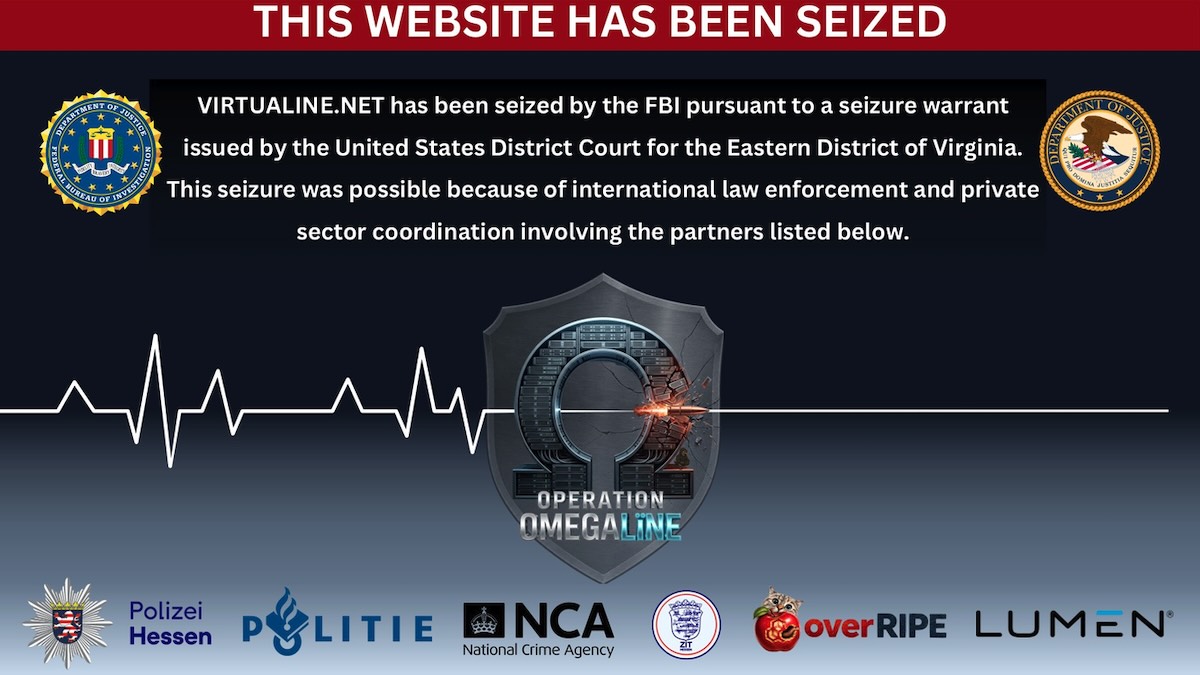 Bulletproof Host Virtualine Loses Its Domain to FBI Seizure
Virtualine is a Russian-speaking bulletproof hosting provider whose domain virtualine.net the FBI seized. Court documents say it hosted phishing, spam, carding and illicit content, and ignored abuse reports. TRM Labs says it received more illicit-attributed cryptocurrency than any other labeled bulletproof host, mostly from a Russian drug marketplace (44%) and a sextortion scheme (17%), and later from StealC operators in 2026.
 securityweek.comarticlePublished and added 30 Oct 2026🛡️ Security
 TRM and Chainalysis Tie $6.4B Binance Hack to North Korea's TraderTraitor
TRM Labs and Chainalysis attribute the October 2026 Binance theft, about $6.4 billion across 10 blockchains, to North Korea's TraderTraitor. On Ethereum the attacker used EIP-7702 delegation with 50 pre-signed authorizations to turn a hot wallet into a sweeper, pointing to compromised signing infrastructure. The attacker funded wallets via Tornado Cash, laundered through automation and Aave borrowing, and about $3 billion was frozen.
 decrypt.coarticlePublished and added 30 Oct 2026🛡️ Security
 [AINews] Building AIE CODE: The top Coding Agent Conference
AINews issue for 28 to 29 October 2026 from Latent Space. It opens with a preview of the AIE CODE summit (themes: Scaling without Slop, System One models, Increasing Ambition, with Jarred Sumner on Bun in Rust). It then recaps Twitter and Reddit news: Mistral Large 4 open weights (1.05T total, 52B active), Artificial Analysis benchmarks, Gemini 4 Carbon, Qwen4 rumours, Claude Code quota complaints and OpenAI frontier-run monitoring. Text was cut before the end.
 latent.spacearticlePublished and added 30 Oct 2026🧠 AI
 Binance probes a suspected cryptocurrency breach: $6.3B affected, about $3B frozen
Binance disclosed a suspected security incident on 29 October 2026, estimating $6.3 billion affected and about $3 billion frozen. Binance's early finding is that a compromised DevOps engineer's laptop let an attacker reach a service container and submit unauthorized withdrawals, with no evidence of wallet private-key leakage. TRM Labs suspects TraderTraitor, the group tied to the February 2025 Bybit theft. Tether, Circle and Ripple froze funds.
 en.cryptonomist.charticlePublished and added 30 Oct 2026🛡️ Security
 Earliest Known PolinRider Malware Found in 2025 npm Packages
OpenSourceMalware traces nine itsa-* npm package versions published on 4 May 2025 from a hijacked maintainer account to the PolinRider campaign, eight months before documented victims. It decodes the EtherHiding chain (BNB Smart Chain and Ethereum calldata, JADESNOW, INVISIBLEFERRET bootstrapper, Socket.IO RAT, Python stealer) and links the 2025 sample to 2026 force-push infections. It lists IOCs, hashes, a timeline and hunting guidance.
 opensourcemalware.comwriteupPublished and added 30 Oct 2026🛡️ Security
 Binance Hacker Hunts for Exit Ramps as DeFi Exchanges Pause Markets
Decrypt reports on wallets linked to the suspected Binance hack (at least $5.5 billion drained, 29 October 2026) that swap freezable stablecoins for ETH via Uniswap and borrow 19,762 ETH on Aave. About 253,000 ETH (roughly $570 million) sits idle in two wallets. Tether, Circle and Ripple froze over $2 billion plus about $200 million RLUSD, and Aave and Kamino paused markets. Tornado Cash appears only as funding for the attack address.
decrypt.coarticlePublished and added 29 Oct 2026🛡️ Security Polymarket stolen funds: One account withdrew at least $2.7M across 710 wallets
Polymarket's international exchange suffered unauthorized withdrawals on 29 October 2026 after a compromised third-party provider, reportedly the website monitoring service DebugBear. Betting Intelligence and Polysights found one account withdrew at least $2.7 million across 710 wallets. Polymarket paused trading, referred the case to law enforcement, promised reimbursement, and had a June 2026 vendor breach that cost about $3 million. The attack mechanism is not described.
en.cryptonomist.charticlePublished and added 29 Oct 2026🛡️ Security Android security checklist: theft of arbitrary files | Oversecured Blog
Oversecured's Android security checklist on arbitrary file theft from an app's private storage. It covers implicit intents (PICK, GET_CONTENT) returning file:// or content:// URIs, SEND/SEND_MULTIPLE share activities, exported and non-exported FileProviders, path traversal via Uri.getLastPathSegment, WebView, and local NanoHTTPD servers. Each case has vulnerable code, an attacker PoC and fixes such as /proc/self/fd path checks and narrow files-path entries.
 oversecured.comarticleAdded 29 Oct 2026🛡️ Security
 PCI DSS and Mobile Apps: A Simple Guide | Oversecured Blog
Guide to PCI DSS v4.0.1 scope for mobile apps, with a mapping of common Android and iOS finding types to the requirements they break (Req 2, 3, 4, 6, 7). It covers which app behaviors bring an app into scope and gives three anonymized cases: cleartext HTTP in a vendor native library, hardcoded keys in a third-party SDK, and an implicit Intent leaking data. It argues for testing the shipped binary and keeping a current component inventory.
oversecured.comarticleAdded 29 Oct 2026🛡️ Security What are shell vulnerabilities? PHP2Shell, Node2Shell (HTTP2Shell), React2Shell and Log4Shell explained
Explainer on "shell" vulnerabilities, the -Shell naming for RCE flaws that began with Log4Shell (CVE-2021-44228). It compares memory-corruption bugs (PHP2Shell, CVE-2026-109618 and CVE-2026-109619; Node2Shell, CVE-2026-111497, in the Brotli decoder) with design-flaw bugs (Log4Shell, React2Shell, CVE-2025-55182). It covers shared traits, exposure through inherited components, and Brotli patch status across runtimes and distributions.
 aikido.devarticleAdded 30 Oct 2026, published 29 Oct 2026🛡️ Security
 Threat Brief: Critical Vulnerabilities in PHP: CVE-2026-109618, CVE-2026-109619 (Updated October 29)
Unit 42 threat brief on PHP2Shell, two PHP remote code execution flaws, CVE-2026-109618 and CVE-2026-109619 (CVSS 4.0 9.2), both caused by longjmp() error handling that leaves memory uninitialized or freed. Cortex Xpanse counted over 22.6 million exposed instances. The 29 October 2026 update says attackers chained PHP2Shell with a Linux kernel privilege escalation against internet-exposed PAN-OS management interfaces. An earlier 23 October claim of post-compromise activity was retracted on 25 October.
 unit42.paloaltonetworks.comadvisoryAdded 30 Oct 2026, published 29 Oct 2026🛡️ Security
- Show HN: Overtone – Transcribe, correct and cut captions for any screen shape
Overtone is a caption format (.overtone.json), a CLI and a video.js plugin that store each spoken word once and cut captions separately per screen shape (16:9, 9:16 or custom). The transcribe pipeline combines gpt-transcribe, Azure AI Speech and optional ElevenLabs Scribe, resolves disagreements with an LLM vote, and uses an LLM editor for corrections. A small public benchmark reports 5.3% word error rate and $0.023–0.025 per audio minute.
 github.comrepoAdded 30 Oct 2026, published 29 Oct 2026🧠 AI
 On the Fundamental Limits of Prefill-Based Decoding Length Prediction
This paper derives bounds on predicting an LLM's decode length from prefill-phase hidden states, a primitive for inference scheduling. It models decoding as a stopped stochastic process, giving per-prompt normality and an affine variance law σ=αμ+b. Predictors (MLP, EGTP, FiLM, soft-label, Mixture-of-Experts) converge near the bound, so system error dominates model error. It proposes fixing model, data and sampling in benchmarks and reporting relative-error metrics.
 arxiv.orgpaperAdded 31 Oct 2026, published 29 Oct 2026🧠 AI
- PhysCount: Do MLLMs Count Visual Appearances or Physical Entities?
PhysCount is a benchmark of 546 real-world images and 4,595 human-written questions in 651 target-specific groups. It tests whether multimodal LLMs can separate visible appearances (direct view, reflections, glass) from the physical entities behind them. Across 40 MLLMs, counting appearances is much easier than linking them to entities, and the best model answers every question correctly in only 13.36% of groups.
arxiv.orgpaperAdded 31 Oct 2026, published 29 Oct 2026🧠 AI  OpenCode User Hit with Hostile Backlash After Reporting Free AI Loophole
Socket reports on a GitHub issue in the OpenCode tracker describing a bypass of per-IP usage limits on free hosted models, using a VPN to switch addresses. The reporter first urged account-based limits, then claimed to run 130 concurrent agents through the loophole. After the issue drew harassment it was deleted. Whether OpenCode fixed the bypass in October 2026 stays unclear.
 socket.devarticlePublished and added 29 Oct 2026🧠 AI
 Chrome extensions with 13.4 million installs caught hijacking searches
BleepingComputer reports Socket researcher John Tuckner's findings on 319 Chrome extensions with 13.4 million installs that hijack the default search engine. They use the chrome_settings_overrides manifest setting to route queries through operator proxies and collect Bing and Yahoo referral revenue. The proxy can later redirect to phishing or malware. Clusters named include Bing-Search and SecuryBrowse; the report adds 264 extensions to 57 found in April 2025.
bleepingcomputer.comarticleAdded 30 Oct 2026, published 29 Oct 2026🛡️ Security- How we detect frontier model misalignment
OpenAI describes its multilayer misalignment monitoring system for frontier models: activation probes, a model-based reviewer, investigative agents, automated log-based investigation and human paging. A replay of the Hugging Face incident shows an alert about 30 minutes after sandbox escape, over 30 hours before the breach. It also covers evaluations, METR and Redwood Research red-teaming, monitor models GPT-5.6 Sol, Terra and Luna, and avoiding pressure on chains of thought.
 alignment.openai.comarticleAdded 30 Oct 2026, published 29 Oct 2026🧠 AI
- rohitg00/ai-engineering-from-scratch
ai-engineering-from-scratch is a free, MIT-licensed curriculum of 542 lessons in 20 phases, from math and deep learning through transformers, LLM engineering, MCP, agents and capstones. Code is in Python, TypeScript, Rust and Julia. It includes three graded projects (retrieval evaluation, agent trace debugger, tool call firewall), installable tutor skills for Claude Code and Codex, and certification prep tracks.
github.comcourseAdded 29 Oct 2026🧠 AI  The Rise of Agentic Attacks: What They Look Like, and Where They're Headed
Wiz Research reviews agentic attacks seen in its incident response work and in public reports (ARTEX, Hermes, JPCERT/CC, CrowdStrike, DIVD). It derives fingerprints of AI-agent activity from three intrusions: machine-paced iteration, natural-language reasoning in scripts, self-correcting script versions, checklist enumeration, noisy lateral spraying, probe-before-payload and self-labeled scratch files. It also covers effects on attribution, attack scale and defense.
 wiz.ioarticlePublished and added 29 Oct 2026🛡️ Security
 The Rise of Agentic Attacks: What They Look Like, and Where They're Headed
Wiz research on intrusions where AI agents do the hands-on attacker work. It reviews public cases (ARTEX against South Korean banks and the ConnectWise compromise, Hermes at Thailand's Ministry of Finance, JPCERT/CC, CrowdStrike, DIVD) and three Wiz-investigated attacks. It distills fingerprints: machine-paced iteration, embedded natural-language reasoning, self-correcting scripts, checklist enumeration, noisy lateral movement, probe-before-payload habits and self-named scratch files. It also covers attribution, scale and defense implications.
wiz.iowriteupPublished and added 29 Oct 2026🛡️ Security Cisco Open Sources Quarry to Catch AI Agent Attacks Hidden in Harmless Steps
Project Quarry is a neurosymbolic rule language Cisco has open sourced to detect AI agent attacks that only show up across a sequence of individually benign steps. Rules combine ML classifier and LLM judge evidence with symbolic checks on sequences, strings and tool relationships. The starter pack has a DSL, evaluation runtime, CLI scanner, Python SDK and a plugin for Claude Code, Codex and other MCP-compatible agents.
securityweek.comarticlePublished and added 29 Oct 2026🛡️ Security Muhammad Waris (@WarisCodes) on X
Nemotron 3.5 Transcribe is a free open-weight speech-to-text model from NVIDIA covering 40 languages, including mixed-language speech. The post says it ties for first among open models with a 2.8% error rate. It says the model needs a large GPU such as an H100 or RTX 5090, so it will not run on a laptop. The post gives no benchmark name or model card link.
 x.comthreadAdded 30 Oct 2026, published 29 Oct 2026🧠 AI
- M-PFT: Angular Margin for Calibrated Prompt-Tuning of Fine-Tuned Vision-Language Models
M-PFT is an angular-margin method for prompt tuning of vision-language models that fixes base-to-novel dual miscalibration (underconfidence on base classes, overconfidence on novel classes). It adds two losses: minimizing the maximum cosine similarity between tunable class embeddings, and minimizing angular distance to each zero-shot embedding. Tests on 9 prompt-tuning methods and 15 datasets show lower novel-class calibration error at comparable accuracy and negligible overhead.
arxiv.orgpaperAdded 31 Oct 2026, published 29 Oct 2026🧠 AI  Attackers Exploit Second Cisco Firewall VPN Zero-Day Since August
CVE-2026-76418 (CVSS 8.6) is an exploited flaw in the Remote Access SSL VPN service of Cisco Secure Firewall ASA and FTD. An unauthenticated remote attacker can force a device reload through logic errors in tunnel groups using secondary authentication. Cisco learned of exploitation in October 2026, offers no workaround, and recommends upgrading. It is the second ASA/FTD DoS zero-day after CVE-2026-20349 in August.
securityweek.comarticlePublished and added 29 Oct 2026🛡️ Security- Sparse Autoencoders as Implicit Diversification Regularisers for Cross-Sectional Cryptocurrency Returns
This arXiv preprint (October 2026) tests a sparse autoencoder as a factor model for daily cryptocurrency returns, with equities as a secondary test. SAE portfolios show consistently lower volatility than common benchmarks, linked to lower correlations among selected assets. They do not beat a simple contrarian strategy on risk-adjusted return, and factor identities change between training runs.
arxiv.orgpaperAdded 31 Oct 2026, published 29 Oct 2026🧠 AI
Showing 30 of 1138
Show more