Skip to content

56 results for β€œAccel”

What you seeeverything
microsoft.comarticleπŸ›‘οΈ Security

Tracking AI adoption in North Korean threat actor tradecraft

Microsoft Threat Intelligence report on how North Korean actors use AI, ranking Jade Sleet, Coral Sleet and Jasper Sleet as operationalized, Diamond Sleet, Onyx Sleet, Pearl Sleet and Sapphire Sleet as accelerating, and Emerald Sleet as expanding. It documents AI-generated lures (100+ Onyx Sleet PDFs, August and September 2026), AI-built tooling such as Coral Sleet's private GitHub repository trojanizing, and Onyx Sleet and Pearl Sleet use of the ARTEX agentic pentest framework. It ends with mitigation and Defender guidance.

CursorGitHubRust+2
Jade SleetOnyx SleetCoral Sleet+9

Threat Intel, AI SecurityΒ· Published and added 29 Oct 2026
eprint.iacr.orgpaperπŸ›‘οΈ Security

Beyond the Scope of This Paper: Practical Flash-Accelerator and Cache-Collision Timing Attacks on Microcontrollers

Colin O'Flynn's paper shows that the flash accelerator in most microcontrollers produces the same timing collisions as a cache, so cacheless Cortex-M devices remain open to cache-collision attacks on AES. AES keys were recovered from as few as 750 traces across six cryptographic libraries, eight architectures and over twenty devices. It also attacks SPI bootloaders, Ethernet, CTAP2 over USB and 802.15.4, and releases the open-source tool FlashWhisperer.

FlashWhispererARM Cortex-M4SPI+1
cache-collision timing attackColin O'FlynnCTAP2+2

Hardware & RFΒ· Added 31 Oct 2026, published 29 Oct 2026

anthropic.comarticle🧠 AI

Early progress on accelerating drug development with Claude

Anthropic's life sciences update describes research partnerships with six drug developers (BigHat, Bristol Myers Squibb, Divergence Labs, Enveda, Generate Biomedicines, The Column Group) and its own Mithril Medicine programs. Reported results include about 35,000 antibody designs in a month, 1,010 lead variants tested in 10 weeks, and an 89% cut in manufacturing-document review time. Work is mostly preclinical.

ClaudeClaude CodeClaude Science
AnthropicBigHat BiosciencesBristol Myers Squibb+10

llm-apps, agentsΒ· Added 28 Oct 2026, published 27 Oct 2026

eprint.iacr.orgpaperπŸ›‘οΈ Security

Balsamic: One-round Threshold UOV from GPU-Accelerated FHE

Balsamic is a complete homomorphic Unbalanced Oil and Vinegar (UOV) signer, used to build one-round threshold UOV signatures from a packed discrete-CKKS FHE circuit. A paired-pivot linear solver and pivot-success certificates allow encrypted retry selection. In 2-out-of-3 semihonest signing, each online partial signature takes 10.7 s on an RTX 6000 Ada and 7.77 s on a GB300, with 5.25 MB per response.

UOVCKKSFHE+2
Balsamicuniversal thresholdizerspaired-pivot solver+1

otherΒ· Added 24 Oct 2026, published 22 Oct 2026

latent.spacetalk🧠 AI

Why AI Compute Comes in Rectangles β€” Erik Bernhardsson, Modal CEO

Latent Space interview with Modal CEO Erik Bernhardsson, after Modal's $750M Series D at a $16B valuation and passing $1B annualized run rate. He explains why GPU demand is not "rectangular" like fixed-term capacity contracts, how Modal pools demand and buys from about 25 clouds on three-year deals, and why sandboxes grew to about a third of revenue. Also covers GPU price-collapse risk and non-NVIDIA accelerators. Only the first part of the transcript was available.

GPUKubernetesDocker+5
ModalErik BernhardssonAkshat Bubna+13

ai-infra, inference, agentsΒ· Published and added 22 Oct 2026

latent.spacetalk🧠 AI

Why AI Compute Comes in Rectangles β€” Erik Bernhardsson, Modal CEO

Latent Space interview with Modal CEO Erik Bernhardsson after the company's $750M Series D at a $16B valuation, with a transcript. He explains why GPU demand does not match rectangular fixed-term capacity contracts and how Modal pools demand across customers. He covers sourcing from nearly 25 clouds on multi-year deals, the risk of falling GPU prices, sandboxes reaching about a third of revenue, and non-NVIDIA accelerators.

ModalGPU snapshottingKubernetes+6
Erik BernhardssonAkshat BubnaLatent Space+15

ai-infra, inferenceΒ· Added 23 Oct 2026, published 22 Oct 2026

arxiv.orgpaper🧠 AI

SARIA: Persistence-Aware KV Caching with Coordinated DRAM--SSD Reload for LLM Agents

SARIA (Selective Admission and Reload for Inference Acceleration) is a KV caching system that jointly manages DRAM and SSD for multi-turn LLM agents. It persists only blocks likely to be reused beyond DRAM residency, promotes SSD-hit blocks into DRAM for same-session reuse, and paces DRAM reads with a transfer coordinator. Built on LMCache MP, it cuts SSD writes by 57.1 to 58.9% versus full duplicate caching and mean TTFT by 42.3 to 79.7% versus DRAM-only caching.

LMCache MPLLMSSD+1
SARIALMCacheTraceLab+2

inference, researchΒ· Added 23 Oct 2026, published 22 Oct 2026

latent.spacearticle🧠 AI

[AINews] DeepSeek DeepInfer: Open Source SOTA Inference running 155T toks/day/cluster making $22m/day at ~80% margin for a 81 day payback

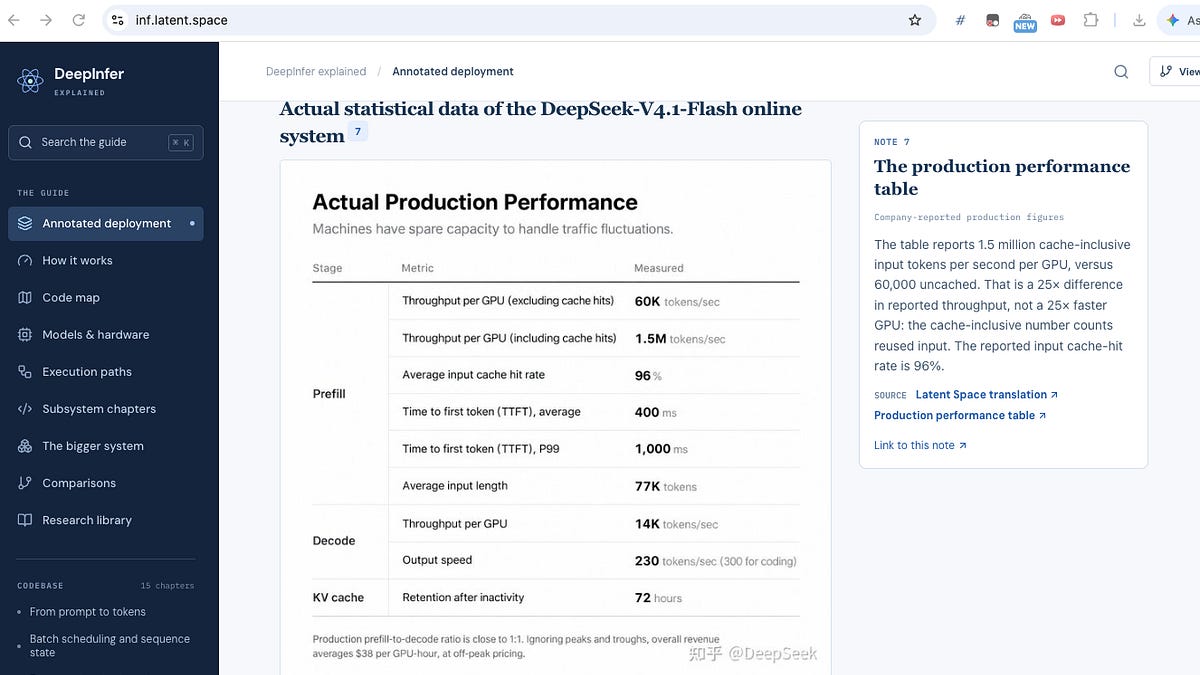
AINews issue for 19 to 20 October 2026 whose top story is DeepSeek's open-source DeepInfer, the inference engine behind V4.1 Flash. It covers prefill/decode separation, wide expert parallelism, a 3FS-backed prompt cache with 96% input hits, vLLM's decode result within 6% of DeepInfer on GB200, and disputed margin estimates built on the reported $38 per accelerator-hour. It also digests other news, and the page text is truncated.

DeepInfervLLMSGLang+9
DeepSeek-V4.1-FlashOpenAINVIDIA+23

inference, ai-infra, modelsΒ· Added 23 Oct 2026, published 21 Oct 2026

latent.spacearticle🧠 AI

[AINews] DeepSeek DeepInfer: Open Source SOTA Inference running 155T toks/day/cluster making $22m/day at ~80% margin for a 81 day payback

This AINews issue (20 October 2026) leads with DeepSeek's open-sourced DeepInfer, the vLLM-based inference engine behind V4.1 Flash. It covers prefill/decode separation, a 3FS-backed prefix cache with 96% hit rate, SWA Bounded Replay, and DeepSeek's claims of 155T tokens/day and $38 revenue per accelerator-hour. It also covers vLLM's within-6% decode reproduction on GB200, disputed margin estimates, and a round-up of other AI news. Only the first 40,000 of 56,439 characters were available.

DeepInfervLLMSGLang+9
DeepSeekDeepSeek-V4.1-FlashNVIDIA+27

inference, ai-infra, ai-policyΒ· Published and added 21 Oct 2026

newsletter.semianalysis.comarticle🧠 AI

Datacenters 2027: The Year of Acceleration, +50GW in a Single Year

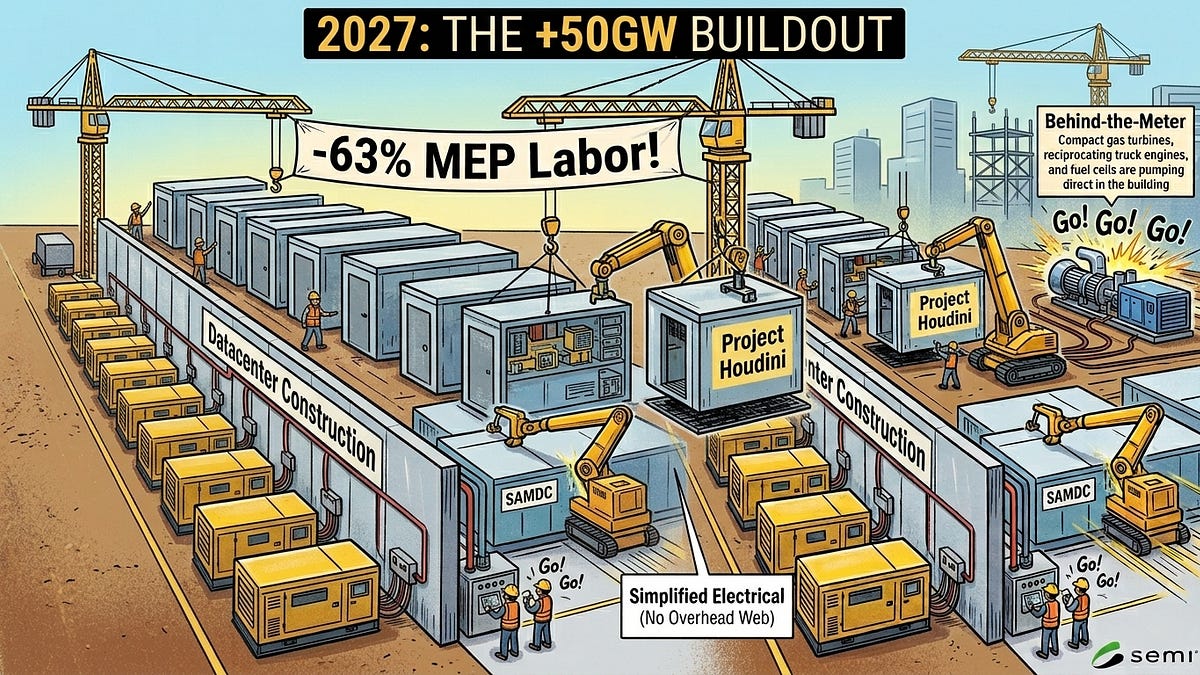
SemiAnalysis argues that global AI datacenter capacity will grow by about 50GW in 2027, against Brad Gerstner's guess of roughly 25GW. Evidence cited: over 24GW in advanced construction across 40 campuses, nearly USD 1T of binding leases signed in 2026, and record self-build starts. It also covers modular "LEGO" designs, behind-the-meter power and ex-US growth. The page text cuts off before the oversupply section.

Behind-the-meter generationModular datacentersPrefabricated electrical modules+2
SemiAnalysisBrad GerstnerAltimeter+20

ai-infra, ai-policyΒ· Added 29 Oct 2026, published 19 Oct 2026

eprint.iacr.orgpaperπŸ›‘οΈ Security

Enjoy FAEST on Hardware: Efficient and Novel Hardware Acceleration of Emerging Post-Quantum Digital Signature Scheme FAEST

This ePrint paper (2026/2525, October 2026) by Brendan Funk and Jiafeng Xie presents the first hardware accelerator for FAEST, an MPC-in-the-head post-quantum signature in NIST's Round 3 additional-signature process. It analyses FAEST's compute-heavy operations, builds them into hardware blocks, and adds an L1-EM-fast variant. The authors report at least 98% lower equivalent area-delay product than the recent complete SDitH design at the same security level.

FAESTFPGA
NISTSDitHMPC-in-the-head+2

Hardware & RFΒ· Added 19 Oct 2026, published 18 Oct 2026
arxiv.orgpaper🧠 AI

TileDRAM: Compiler-Controlled Tile-to-DRAM Layouts for 3D DRAM GPGPUs

TileDRAM is a compiler-runtime toolchain that adds tile-to-DRAM layouts as a compiler-visible abstraction for compute-unit-local 3D DRAM GPUs. It extends GPU Linear Layout to DRAM placement and picks layouts per tile access signature using row-buffer behavior. On 108 MoE FFN cases in Accel-Sim/Ramulator2, row-conflict rate fell from 75.7% to 15.2%, with a 1.77x geomean speedup. Overhead on an RTX 3090 is 0.17%.

Mixture of ExpertsCUDAAccel-Sim+2
TileDRAMRTX 3090

research, inferenceΒ· Added 20 Oct 2026, published 16 Oct 2026

eprint.iacr.orgpaperπŸ›‘οΈ Security

safeRNSgcd: Accelerating Falcon key generation with RNS in SafeGCD

ePrint paper presenting safeRNSgcd, which computes the single BΓ©zout coefficient needed at the deepest level of Falcon's NTRU solver while keeping large integers in a residue number system. Centered explicit CRT recovers the exact low bits needed by SafeGCD batches using single-word fixed-point arithmetic. A C implementation integrated into ntrugen reduces inversion and private-key basis-generation cost on a Raspberry Pi 5 and two x86-64 CPUs, versus the original ntrugen and a variant that skips the unused coefficient.

FalconntrugenSafeGCD+2
safeRNSgcdCesare HuangBo-Yin Yang

otherΒ· Added 17 Oct 2026, published 16 Oct 2026

decrypt.coarticle🧠 AI

Google Says AI Isn't Building Itself Yetβ€”Even Though It Writes 75% of the Code

Decrypt reports on the Gemini 4 Argon Safety & Security Report, where Google DeepMind found no statistically significant acceleration of ML R&D. Its internal GCI v1 index (123 models, 92 benchmarks) shows steady ~0.1 points/month progress, with Argon slightly above trend, attributed to compute and investment. Over 75% of production code is AI-written and fully delegated pull requests rose from 7.5% to 11.9%, yet ~88% of PRs still need human steering or authorship. This is relevant evidence on the recursive self-improvement debate and on how much of AI research is automated.

Gemini
Google DeepMindGemini 4 ArgonHaydn Belfield+5

ai-safety, evals, coding-agentsΒ· Published and added 15 Oct 2026

deepmind.googlearticle🧠 AI

Accelerating the search for antimicrobial peptides with Google Antigravity

Google DeepMind describes using Google Antigravity as an agentic science workbench to find antimicrobial peptide candidates in Streptococcus pseudopneumoniae. The agent orchestrates queries across UniProt and other databases, uses ProtNLM function predictions for uncharacterized proteins, and pulls structures from the AlphaFold Database. A new Biomolecular Structure Viewer shares 3D state with the agent in both directions, so residues the researcher highlights or pins become context for the agent's reasoning. The resulting lead has predicted activity against respiratory-tract pathogens and is going into wet-lab validation.

Google AntigravityProtNLMUniProt+1
Google DeepMindBiomolecular Structure ViewerStreptococcus pseudopneumoniae+4

agentsΒ· Published and added 15 Oct 2026

eprint.iacr.orgpaperπŸ›‘οΈ Security

FAEST on GPUs: Addressing Field Multiplication as a Bottleneck

ePrint paper presenting an NVIDIA GPU implementation of FAEST (a post-quantum signature scheme built on VOLE-in-the-Head and QuickSilver), covering key generation and OWFProve/OWFVerify for standard and EM constructions in s and f variants. Profiling shows field multiplication takes about 82% of FAEST-128f signing time once AES is hardware-accelerated. Using PTX clmad carry-less multiplication plus Karatsuba, it reaches up to 26.6x kernel throughput and about 2.9-3.1x full 256-bit OWFProve throughput over the software-multiplication build on an RTX A5000.

CUDANVIDIA RTX A5000PTX+1
FAESTQuickSilverVOLE-in-the-Head+3

otherΒ· Published and added 15 Oct 2026

x.comthreadπŸ›‘οΈ Security

Victor (@VMG_CU) on X

A social post summarising Elastic's REF8801 campaign. A fake startup accelerator offered founders free Claude/Gemini credits plus a coding agent. The agent was a repackaged open-source project that set OPENROUTER_BASE_URL to an attacker-controlled endpoint and added its own MCP server, so victims' prompts and code went to the attacker. It shows how a trojanised AI coding agent can hijack the LLM base URL and add an MCP server for exfiltration.

OpenRouterModel Context ProtocolClaude+1
REF8801Elastic Security LabsOPENROUTER_BASE_URL

Threat Intel, AI SecurityΒ· Added 15 Oct 2026, published 14 Oct 2026

metr.orgarticle🧠 AI

How an assessor could investigate evidence of acceleration from the automation of AI R&D

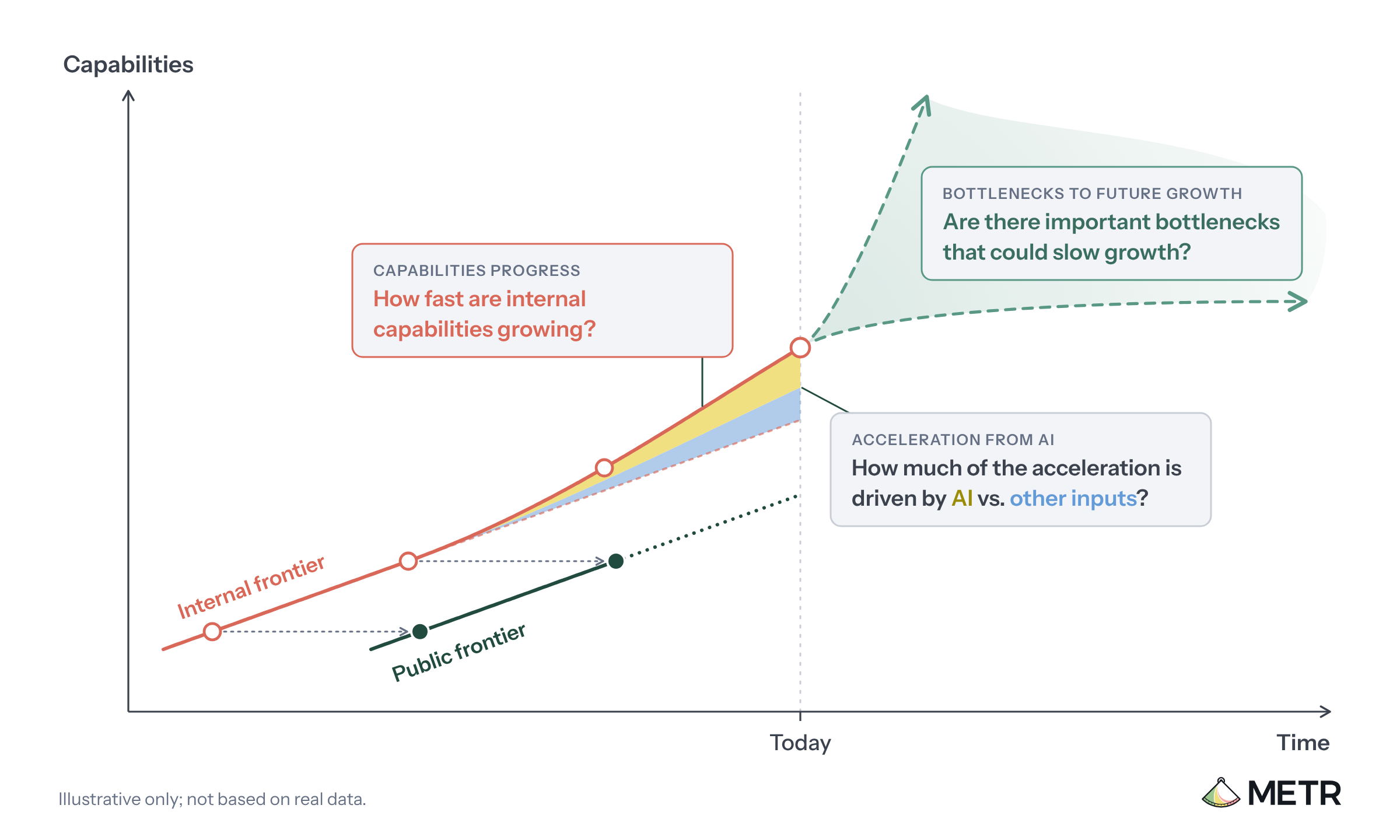
METR proposes a framework for an outside assessor to test whether AI automation of AI R&D is accelerating capabilities progress. It covers four questions: how fast internal capabilities improve, how much acceleration AI causes, which bottlenecks could slow growth, and whether the methods would detect a dramatic acceleration. It lists the internal data developers would need to share, including benchmarks, algorithmic progress estimates, compute, labor, AI agent spend and staff interviews.

METRECI

ai-policy, evals, ai-safetyΒ· Added 29 Oct 2026, published 14 Oct 2026

metr.orgarticle🧠 AI

A proposal for better informing the public about loss-of-control risks from frontier AI development

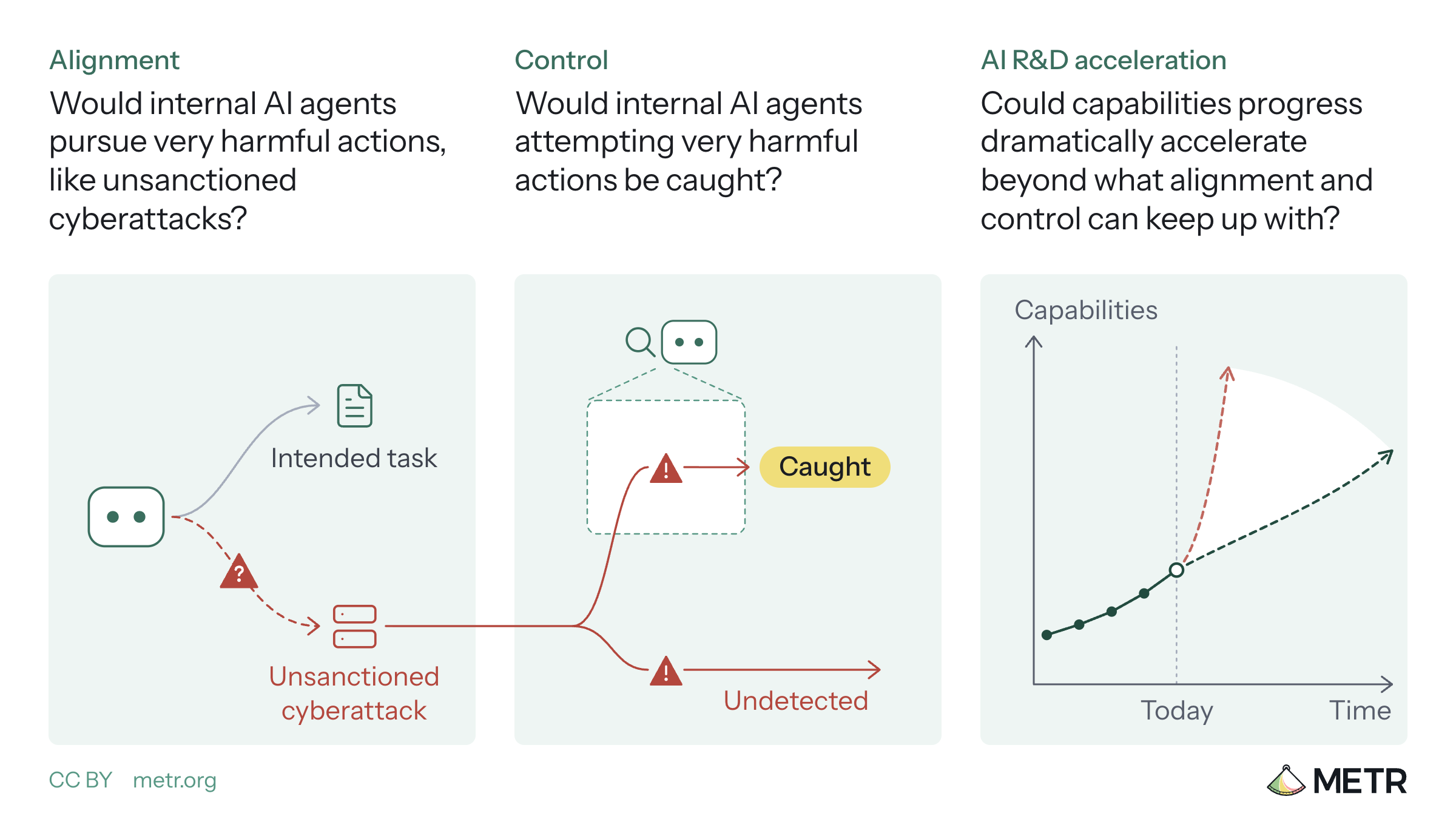
METR proposes risk assessment exercises in which it would write public reports on whether frontier developers could lose control of internal AI systems. The reports would rest on private staff interviews and access to internal data, covering three questions: alignment incidents, monitoring and control, and AI R&D acceleration. The post also lists its limits: voluntary participation, company redaction rights, no security audits, no compliance verdicts.

METRAnthropicOpenAI+12

ai-safety, ai-policyΒ· Added 29 Oct 2026, published 14 Oct 2026

eprint.iacr.orgpaperπŸ›‘οΈ Security

Accelerating Pollard Rho with GPU Field Arithmetic on NVIDIA Blackwell

Preprint that speeds up Pollard rho on GPUs by rebuilding field arithmetic: packed normal-basis representation, the CUDA 13.3 PTX carry-less multiply (clmad), and three-input logic instructions. On one RTX PRO 6000 Blackwell it goes from 0.85 to 14.64 billion iterations/s (17.2x) on the Certicom ECC2K-130 challenge, which puts the whole challenge under five GPU-years. The same levers give 1.52x on P-256 and 2.61x on P-384, which leaves P-256 about 6e21 card-years away. It also reports twelve GPUs from Turing to Blackwell, an FPGA engine on AWS F2 and a campaign that covered 5.4% of the expected work, with code and a Dockerfile on GitHub (rho-blackwell). It claims no improvement on the generic-group bound.

CUDANVIDIA BlackwellAWS+1
Pollard rhoECC2K-130Certicom challenge+5

otherΒ· Published and added 14 Oct 2026

arxiv.orgpaper🧠 AI

Dog-Breed Text-to-image Flow Matching from Pretraining to Fine-Tuning on 4 Consumer GPUs

MiniDog is a framework for training a text-to-image flow-matching diffusion transformer from scratch on four RTX 3090 GPUs, with 55 minutes of pretraining and 15 minutes of fine-tuning. It pretrains on 26k ImageNet dog images that were captioned, then fine-tunes on 2k FLUX.1-schnell generated images. Image and text features are precomputed and cached. The model is a 22M-parameter transformer with the E2E-INVAE semantic latent space, a small Qwen text encoder and in-context conditioning, and training is accelerated with iREPA and an EUPE perception encoder. The repo evaluates with FID, HPSv2, PickScore and VAE reconstruction metrics. It lowers the barrier to hands-on diffusion training research.

flow matchingdiffusion modelTransformer+1
MiniDogImageNetFLUX.1-schnell+7

research, training, multimodalΒ· Added 14 Oct 2026, published 13 Oct 2026

en.cryptonomist.charticle🧠 AI

Microsoft’s AI chip targets 40% more tokens per megawatt in 2027

Reports Microsoft's Maia 300, its third-generation in-house AI accelerator, unveiled October 12, 2026 with production workloads from 2027. Microsoft claims 40% more tokens per megawatt than leading GPU systems and up to 7x Maia 200's rack-level token throughput in a 96-accelerator rack. It uses a chiplet design on TSMC N2P that separates compute, memory-controller and I/O. It is aimed at long-context reasoning and agentic inference, while Nvidia and AMD stay in place for training. Useful as a data point on the shift toward custom inference silicon and model-chip co-design.

Maia 300Maia 200Azure+4
MicrosoftNVIDIAAMD+12

inference, ai-infraΒ· Published and added 12 Oct 2026

arxiv.orgpaperπŸ›‘οΈ Security

ML-Assisted Power Side-Channel Attacks on ML Accelerators in Shared FPGAs

Paper presenting the first on-chip, TDC-sensor-based power side-channel attack on a co-tenant FPGA to reconstruct full-scale color ImageNet inputs (224x224) from a victim's first CNN convolution layer, using ML-based upscaling and recoloring. It separates genuinely leaked information from ML-generated post-processing. It also evaluates a pixel-substitution defense based on Hamming Weight, which is largely defeated by an attacker retrained on the transformed data. The authors conclude that robust defenses need randomized or input-dependent transformations.

FPGACNN
Time-to-Digital ConverterImageNetMNIST+1

Hardware & RF, AI SecurityΒ· Added 16 Oct 2026, published 12 Oct 2026

x.comthread🧠 AI

Adam Shepherd (@EntryStateGod) on X

Social post announcing Qwen's open-weights release of Qwen-Image-2.1-Turbo, an accelerated checkpoint of Qwen-Image-2.1 on the same 7B visual generation architecture. It generates and edits images in 8 denoising steps, against 40 in the base model's sample code, with 2K output. Qwen claims the fewer steps do not reduce quality. The license is non-commercial, which limits production use.

Qwen
Qwen-Image-2.1-TurboQwen-Image-2.1

models, multimodalΒ· Published and added 9 Oct 2026

thedefiant.ioarticleπŸ›‘οΈ Security

Coinbase Cryptographer Calls Drake's 'Bunker Mode' Warning 'The Very Definition of FUD'

News piece reporting that a Coinbase cryptographer dismissed Justin Drake's proposal for Ethereum validators/users to adopt a 'bunker mode' against AI-accelerated cryptanalysis as unfounded FUD. Vitalik Buterin weighed in that AI-accelerated math risk is real but should be pointed at lattice-based cryptography rather than elliptic-curve schemes like ECDSA used by Ethereum, while a former Ethereum Foundation researcher argued bunker mode would not help if the curves actually broke.

Ethereum
Vitalik ButerinJustin DrakeECDSA+1

BlockchainΒ· Published and added 8 Oct 2026

bankless.comarticleπŸ›‘οΈ Security

Vitalik Flags AI Risk to Crypto, Warns Against Rushed Wallet Moves

Vitalik Buterin responds to Ethereum Foundation researcher Justin Drake's bunker mode proposal, agreeing AI-accelerated cryptanalysis could break ECDSA, the signature scheme behind most crypto wallets, in months not years, and that lattice-based schemes like ML-DSA billed as quantum-safe could also take serious hits within two years. Buterin gives practical key-hygiene advice such as keeping funds in addresses that never exposed a public key and rotating multisig signer keys after every operation with offchain signature collection, while warning that botched migrations cost more than hacks.

Ethereum
Vitalik ButerinJustin DrakeECDSA

BlockchainΒ· Published and added 8 Oct 2026

en.cryptonomist.charticleπŸ›‘οΈ Security

AI risk to crypto wallets: Ethereum researcher warns keys could be cracked in months

Ethereum Foundation researcher Justin Drake warned on October 7, 2026 that advances in AI and mathematics could break ECDSA β€” the signature scheme securing blockchain transactions β€” within months, potentially letting an attacker recover a private key in about a week using a large GPU cluster. He urged gradual "bunker mode" preparation rather than panic: rotating funds into fresh addresses whose public keys have never been exposed on-chain, strengthening cold storage, and accelerating Ethereum's move toward hash-based signature schemes such as SPHINCS for critical signers like oracles and L2 security councils.

EthereumECDSASPHINCS
Justin DrakeEthereum FoundationWu Blockchain+1

BlockchainΒ· Published and added 8 Oct 2026

decrypt.coarticleπŸ›‘οΈ Security

Ethereum Researcher Says AI May Break Encryption Before Quantum Does

Ethereum Foundation researcher Justin Drake warns that AI-driven mathematical advances could break ECDSA β€” the signature scheme securing Bitcoin and Ethereum β€” before quantum computers do, potentially recovering a private key from an exposed public key in about a week using a large GPU cluster. He calls for "bunker mode": a controlled mass migration of funds to fresh addresses whose public keys have never been exposed, urges major custodians (Binance, Bitbank, Robinhood, Bitfinex, Tether) to harden cold storage, and pushes Ethereum to accelerate its move to hash-based (post-quantum) cryptography.

EthereumBitcoinOpenAI
Justin DrakeECDSAbunker mode+3

BlockchainΒ· Published and added 7 Oct 2026

eprint.iacr.orgpaperπŸ›‘οΈ Security

K-LMS: Design, Implementation, and Evaluation of Leighton–Micali Signatures with Korean Cryptographic Primitives

An IACR ePrint paper presenting K-LMS, an experimental variant of the NIST-standardized LMS hash-based post-quantum signature scheme in which the underlying hash is swapped for Korean primitives: the LSH-256 hash function (reference and vectorized) and a Tandem-DM double-block-length construction built from the CHAM, LEA, and ARIA block ciphers. The authors implement a non-invasive backend-swapping bridge over the reference LMS code and benchmark keygen/sign/verify latency, key/signature sizes, memory, and parameter sweeps, finding that hash substitution doesn't change key/signature sizes but that two measurement pitfalls (hash dispatch overhead, and software vs. hardware-accelerated SHA-256 baselines) can shift performance comparisons by an order of magnitude or 6x respectively. They report LSH-256 K-LMS signing on par with SHA-256 LMS in software, and 3.3-3.9x faster than a prior K-XMSS implementation because LMS needs fewer hash calls per Winternitz step than XMSS.

LMSLSH-256CHAM+3
NISTXMSSSPHINCS+

otherΒ· Added 8 Oct 2026, published 6 Oct 2026

arxiv.orgpaper🧠 AI

Herschel: Continuous Optimization of Production LLM Inference through On-Demand Profiling

Herschel is a continuous optimization system for production LLM inference that uses adaptive, on-demand profiling instead of always-on tracing to diagnose serving inefficiencies with low overhead (under 0.5% TTFT, 7% TPOT impact). It attaches to and detaches from running inference processes without engine restarts, reconstructs cross-process operator execution traces to pinpoint inefficiency mechanisms, and has AI agents implement and test candidate engine/kernel fixes under controlled replay of the triggering workload before expert review and deployment. Over six months of production use it collected ~17,000 traces across 120+ model variants and 10+ accelerator types, finding inefficiency patterns in 23% of traces and driving optimizations like restructured synchronization and removal of unused computation.

Herschel

inference, ai-infraΒ· Added 3 Oct 2026

runtimeverification.comarticleπŸ›‘οΈ Security

KelpDAO Audit Passed. $292M Left Anyway.

Runtime Verification analyzes the April 2026 KelpDAO exploit, where an attacker compromised the single Decentralized Verifier Network (DVN) securing LayerZero's OFTAdapter (requiredDVNCount=1, optionalDVNCount=0) to forge a cross-chain message releasing 116,500 rsETH ($292M) from a $1.07B escrow, then laundered the funds by borrowing against the stolen collateral on Aave before any response could intervene. The piece argues that conventional smart-contract audits never examine such off-chain trust configurations, and proposes formal modeling β€” explicitly enumerating trusted principals, guaranteed properties, and compromise failure modes β€” as a way to surface single-points-of-failure like DVN redundancy and missing collateral circuit-breakers before deployment rather than after an AI-accelerated attacker finds them.

EthereumLayerZeroAave+1
KelpDAODrift ProtocolBlockaid+3

BlockchainΒ· Added 1 Oct 2026

decrypt.coarticleπŸ›‘οΈ Security

A Clever RSA Attack Fooled a Hardware Vaultβ€”Here's What It Means for Crypto

Researchers at UC San Diego and INRIA demonstrated a chosen-message oracle attack that forges RSA signatures on a 1,024-bit key held inside a hardware security module (HSM) without ever extracting the key, by disabling the HSM's FIPS mode to get it to sign unpadded/unformatted values roughly 4 billion times and then computing the private-key operation from the responses (1,380 CPU core-years of work). The attack only applies to unpadded RSA signing oracles β€” standard PKCS#1 v1.5/PSS padding blocks it β€” so it doesn't threaten Bitcoin/Ethereum (which use ECDSA) but is relevant to anyone auditing HSM key-custody assumptions or RSA-based blind-signature schemes like Privacy Pass. The authors frame it as further classical evidence to accelerate migration away from RSA ahead of the post-quantum transition.

RSAECDSABitcoin+1
Privacy PassDigiCashBitGo+4

Hardware & RF, BlockchainΒ· Added 30 Sep 2026, published 28 Sep 2026

snyk.ioarticleπŸ›‘οΈ Security

Your Vulnerability Backlog Is No Longer Technical Debt, It’s an Attack Surface

A Snyk blog post arguing that vulnerability backlogs traditionally managed as "accepted technical debt" have become genuine attack surface, because AI-accelerated code generation has pushed vulnerability inflow to roughly six new findings per one remediated, unauthored AI-written code removes the "ask the author" triage shortcut, and cheap automated reconnaissance lets attackers walk large backlogs an analyst never would. It illustrates how individually-low-severity findings (an IDOR leaking an internal object ID, a verbose error confirming valid IDs, and an outdated deserialization library) can chain into an authenticated RCE path invisible to severity-based sorting, and argues better prioritization only reorders a backlog rather than shrinking it. It closes with four metrics programs should measure (90-day inflow vs. closure, age of risk-accepted findings, share of human-authored merges, and security-fix merge rate) before promoting Snyk's Evo product.

Snyk
IDOREvo Continuous Offensive Security

AppSec, GRCΒ· Published and added 24 Sep 2026

arxiv.orgpaper🧠 AI

Flash-dLLM: IO-Aware KV Caching and Parallel Decoding for Fast, Memory-Efficient Diffusion LLMs

Flash-dLLM is a training-free inference acceleration framework for diffusion large language models (dLLMs) that tackles GPU memory I/O bottlenecks in KV-cache-enabled dLLM inference via an I/O-aware fused KV-cache kernel, combined with a draft-and-verify decoding strategy where the same dLLM acts as both drafter and verifier. It reports 5.1x and 11.0x speedups over the prior strongest baseline Elastic-Cache on GSM8K and HumanEval respectively, while preserving generation quality and scaling to longer sequences and larger batches.

diffusion LLM
Flash-dLLMElastic-CacheGSM8K+1

inference, researchΒ· Added 23 Sep 2026, published 22 Sep 2026

interconnects.aitalk🧠 AI

Debating RSI, the US-China Gap, and Jaggedness with JS Denain of Epoch AI

A transcribed podcast conversation between Nathan Lambert and Epoch AI's JS Denain covering recursive self-improvement (RSI) evidence from OpenAI/Anthropic's acceleration blog posts, the size and drivers of the US-China frontier model gap (estimated at 4–9 months using Epoch's Capabilities Index, ECI), the role of distillation and "Claude router" data leakage in closing that gap, robotics as a bottleneck for industrial-scale AI acceleration, and jaggedness in AI capability progress (e.g. why math benchmarks may overstate general progress). It's grounded in concrete data points like Codex spending growth, METR/Epoch research, and named model comparisons (Kimi K3, GLM 5.2/5.3) rather than speculation alone.

CodexTransformer
JS DenainEpoch AINathan Lambert+17

ai-policyΒ· Added 29 Sep 2026, published 22 Sep 2026

depthfirst.comwriteupπŸ›‘οΈ Security

Containers Are No Longer a Security Boundary (CVE-2026-80521)

Depth First researchers detail CVE-2026-80521, a Linux kernel use-after-free in the AF_UNIX subsystem's garbage collector (a race between edge visibility during SCM_RIGHTS sends and vertex freeing in unix_del_edge/unix_walk_scc_fast), discovered with their in-house AI vulnerability-detection model dfs-large1 and used to win a Google kernelCTF slot. They released a working container-escape exploit against the latest Ubuntu 26.04, plus a second exploit for CVE-2026-52910 against Ubuntu 24.04, arguing that AI-accelerated bug discovery has broken the assumption that shared-kernel containers (Docker/Kubernetes, nsjail, Firejail, Bubblewrap) provide a hard security boundary, and recommending migration of sensitive workloads to microVM isolation like Firecracker or Kata Containers.

Linux kernelDockerKubernetes+3
CVE-2026-80521CVE-2026-52910dfs-large1+1

Offensive Security, Cloud & Infra, AI SecurityΒ· Added 26 Sep 2026, published 22 Sep 2026

metr.orgwriteup🧠 AI

Summary of METR's predeployment evaluation of Claude Opus 5.5

METR's predeployment evaluation of Claude Opus 5.5 assesses whether the model dramatically accelerates AI R&D at Anthropic, using five capability tasks (Budget NanoGPT Speedrun, LMCA, Train a Program, Gaming Bot, Sunlight) plus a questionnaire and researcher interview. It concludes Opus 5.5 is an incremental, on-trend improvement over Fable 5.1 rather than a discontinuous jump, unlikely to fully automate AI R&D, and that its own development was only modestly (not dramatically) accelerated by AI (~1.5x estimate from a separate internal METR assessment).

METRClaude Opus 5.5Anthropic+3

evals, ai-safetyΒ· Added 26 Sep 2026, published 22 Sep 2026

openai.comarticle🧠 AI

Building standards for the next phase of AI

OpenAI argues that the United States should lead an effort to build global technical standards for frontier AI, with a focus on automated AI research and recursive self-improvement (RSI). It proposes using the network of AI safety institutes, coordinated through CAISI, to produce standards for RSI-relevant evaluation, human oversight (including which automated research processes should trigger human review), and incident classification and reporting. The standards would not be licenses or mandatory pre-release approval. The post cites aviation and financial stability as models, and it positions OpenAI's research-acceleration report and misalignment reporting framework as early contributions.

OpenAISam AltmanJakub Pachocki+7

ai-policy, ai-safetyΒ· Added 29 Sep 2026, published 21 Sep 2026

arxiv.orgpaper🧠 AI

Accelerating Sharded Data Parallelism at Scale with Federated Learning

This paper introduces FL+FSDP and FL+HSDP, hybrid algorithms interleaving sharded data parallelism with FedAvg-style federated aggregation to reduce communication overhead when training foundation models across large, heterogeneous GPU clusters. Decoupling large data-parallel deployments into smaller, loosely-coupled federation groups bounds global batch size growth and cuts inter-group traffic. A Llama3.1 8B pre-training run on 512 A100 GPUs shows up to 8.04x faster data processing and 4.48x lower evaluation perplexity than standard FSDP/HSDP under identical hyperparameters.

FSDPHSDPFedAvg
Llama3.1 8BGianluca Mittone

research, trainingΒ· Added 22 Sep 2026, published 17 Sep 2026

arxiv.orgpaper🧠 AI

COMPASS: Ordered Clustered Routing at 100K Scale

COMPASS is an algorithm for the Ordered Clustered Traveling Salesman Problem (OCTSP), which requires visiting node clusters in a prescribed order β€” a common large-scale routing scenario. It combines search with learning-accelerated routing across parallel sub-solvers, exploiting cluster structure to reach near-exact solutions in time exponential in cluster size rather than instance size, and unlike typical large-scale routing solvers it works on general (including asymmetric) distance matrices rather than requiring coordinates. The authors demonstrate scaling to 100K synthetic nodes and 28.5K real e-commerce nodes, the largest reported routing solution over asymmetric distances to date.

COMPASS

researchΒ· Added 22 Sep 2026, published 17 Sep 2026

blog.talosintelligence.comarticleπŸ›‘οΈ Security

Securing the unpatchable in an age of AI-driven vulnerabilities

Cisco Talos argues that AI-accelerated vulnerability discovery is outpacing organizations' ability to patch, especially for unpatchable operational technology (OT) like medical devices and industrial control systems. It recommends network-level compensating controls instead of patching: upstream next-generation firewalls with intrusion prevention for virtual patching, VLAN/ACL-based micro-segmentation to restrict which devices can reach legacy systems, and visibility into legacy network fingerprints to build an asset inventory. It also debunks the air-gap myth, citing WannaCry's spread through unpatched Windows XP in the NHS as a cautionary example of "hope for the best" failing.

WindowsNGFWIPS+1
WannaCryNHS

Cloud & InfraΒ· Added 7 Oct 2026, published 16 Sep 2026

endorlabs.comarticleπŸ›‘οΈ Security

SolarWinds took a nation-state. The next attack just needs an LLM and $5. | Blog | Endor Labs

Endor Labs blog tracing an accelerating pattern of software supply-chain compromises from July 2025 through March 2026, culminating in the TeamPCP threat actor's cascading 30-day compromise of Aqua Security, Trivy, GitHub Actions, Docker Hub, npm, OpenVSX, and PyPI (including backdooring the 95M-download LiteLLM package). It argues AI is accelerating both offense (CVE-GENIE reproducing 51% of CVE exploits for $2.77 each) and the attack surface (the Cline prompt-injection-to-npm-token-theft chain, Nx's AI-review-evading payload), and calls for treating AI coding agents as privileged actors, pinning GitHub Actions to SHAs, and platform-level fixes like immutable tags and Sigstore/OIDC.

npmGitHub ActionsPyPI+3
TeamPCPAqua SecurityXploiters+15

Supply Chain, Threat Intel, AI SecurityΒ· Published and added 11 Sep 2026

aikido.devarticleπŸ›‘οΈ Security

The CVE spike across major software companies is a remediation problem

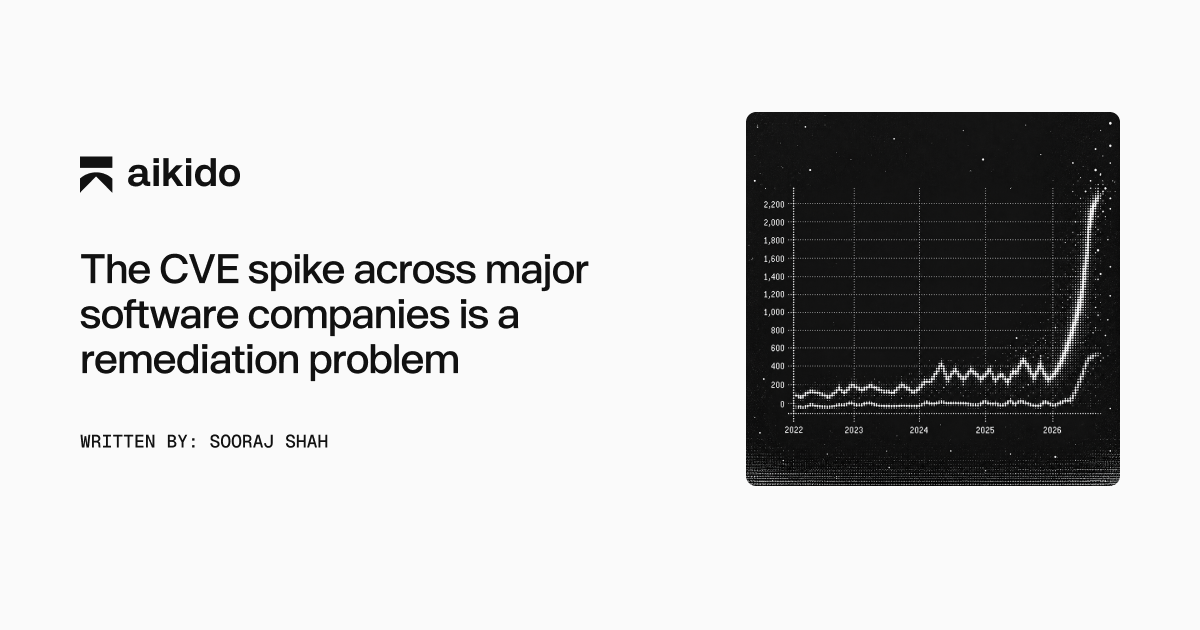
Aikido argues the widely-shared a16z/Epoch AI chart showing critical/high CVEs jumping from under 100/month to over 600/month since spring 2026 reflects AI accelerating vulnerability discovery, not a real spike in danger β€” since CISA's KEV count has stayed flat. It details how NIST's NVD, overwhelmed by volume, let its scoring backlog balloon from 13,000 to 27,000 CVEs in 18 months and pivoted to only prioritizing federal/critical/KEV-listed CVEs, while Verizon's 2026 DBIR found only 26% of confirmed actively-exploited KEV vulnerabilities were fully remediated in 2025 (down from 38%) with median patch time rising to 43 days. It illustrates the point with StyleSmuggler, an unauthenticated RCE hitting Adobe Commerce and Magento Open Source that had no CVE or vendor advisory, which Aikido Intel flagged and Aikido Libraries auto-patched more than 24 hours before Adobe's own hotfix.

Adobe CommerceMagentoAikido Security+2
StyleSmugglerCISA KEVNIST+3

AppSec, Supply ChainΒ· Published and added 10 Sep 2026

huntress.comarticleπŸ›‘οΈ Security

Boardroom Battles 2026: ASD’s Cyber Priorities & AI Risk

A Huntress blog post walks Australian boards through ASD's 2025-26 cyber security guidance and its companion frontier-AI cyber threat paper, citing the $12.5B FY23-24 espionage cost figure and the July 2026 Hugging Face autonomous-agent security incident (later linked by OpenAI to an internal cyber-capability evaluation) as evidence that AI is compressing attack timelines from days to hours. It illustrates ASD's "assume compromise" stance with real Huntress SOC cases β€” catching a VPN intrusion via correlated failed-login logs, and using ransom-note/file-extension artefacts plus sub-60-second mass host/account isolation to contain active ransomware β€” arguing AI should accelerate detection but remain human-supervised rather than replace analyst judgment.

HuntressHugging FaceOpenAI+2
Australian Signals Directorate (ASD)Australian Institute of Company DirectorsAthena

GRC, Blue Team & Detection, AI SecurityΒ· Added 3 Sep 2026, published 30 Aug 2026

stepsecurity.ioarticleπŸ›‘οΈ Security

The State of Open Source Supply Chain Attacks

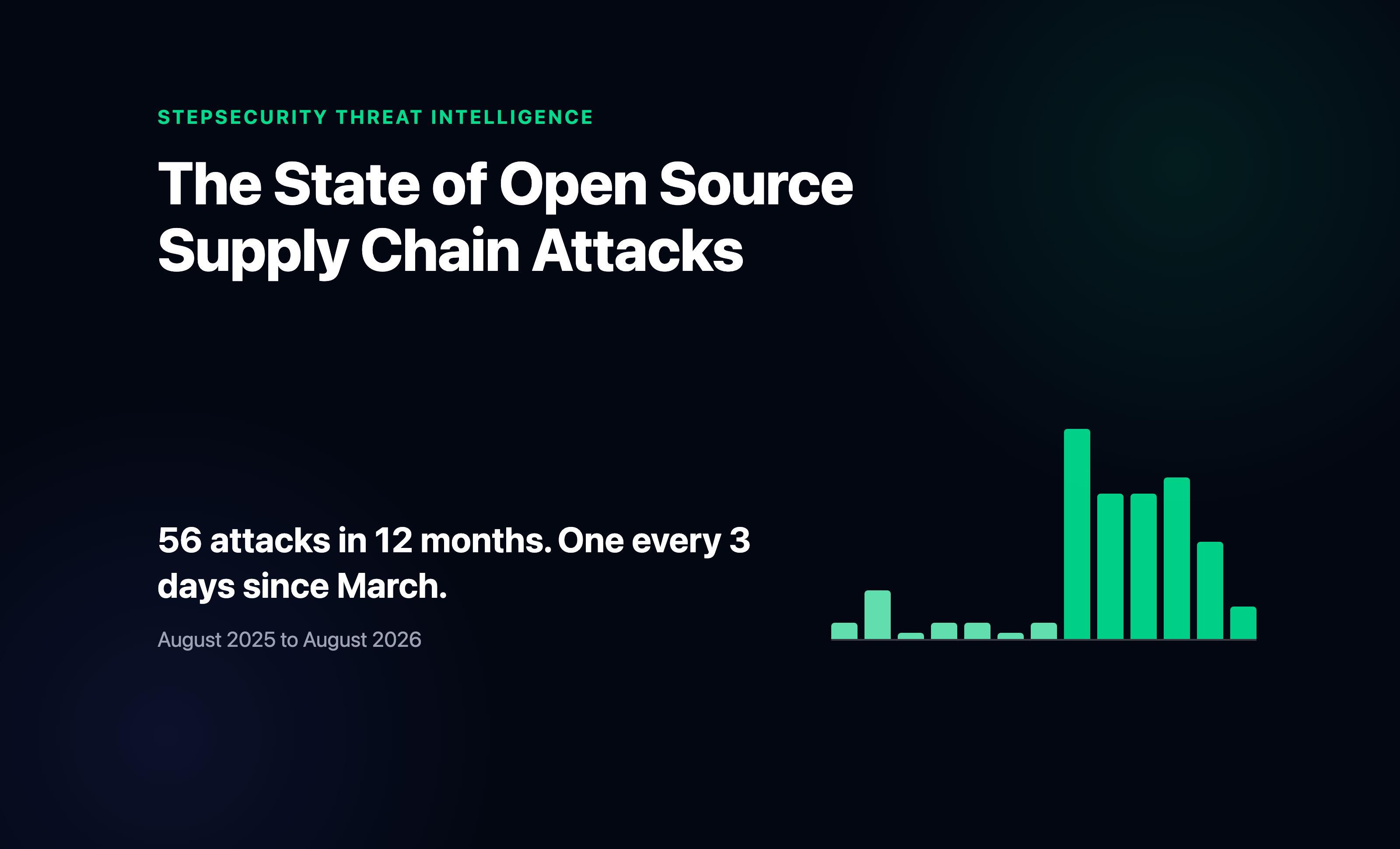
StepSecurity's threat intelligence team's annual report tallies 56 confirmed software supply chain attacks between August 2025 and August 2026, showing an over 8x acceleration since February 2026 driven by self-propagating worms (Shai-Hulud, Shai-Hulud 2.0, CanisterWorm, Miasma, ChainDrop) and mutable GitHub Actions tags. It details the five-day TeamPCP campaign that stole 78,330 secrets from 2,186 organizations by poisoning Trivy Action, Checkmarx KICS, telnyx, and LiteLLM, plus compromises spanning npm, PyPI, RubyGems, Composer, and crates.io.

npmGitHub ActionsPyPI+3
Shai-HuludShai-Hulud 2.0CanisterWorm+22

Supply Chain, DevSecOps, Threat IntelΒ· Added 3 Sep 2026, published 23 Aug 2026

metr.orgarticleπŸ›‘οΈ Security

Have We Seen an Acceleration in Discoveries?

METR note that plots public discovery data in vulnerabilities, mathematics and algorithmic optimization to look for slope changes around January 2026. CVE counts rose sharply: cURL went from 9 to 36, OpenSSL from 6 to 39, Firefox from 210 to 342, Microsoft from 1,243 to 1,927 through August 2026. Exploited-vulnerability lists (CISA KEV, VulnCheck KEV) grew far less. Math shows weaker acceleration, optimization none.

cURLOpenSSLFirefox+3
METRMythosVulnCheck+5

AI Security, otherΒ· Added 29 Oct 2026, published 14 Aug 2026

metr.orgarticle🧠 AI

Have We Seen an Acceleration in Discoveries?

METR note that looks for slope changes in public discovery metrics, with January 2026 as the candidate breakpoint. It finds a sharp rise in vulnerability disclosures (cURL, Firefox, OpenSSL, Microsoft, NVD, OSV), a likely but hard-to-measure rise in math results (ErdΕ‘s problems, Smale and Green lists), and no clear gain in optimization series such as nanoGPT, CIFAR-10, Stockfish and Gurobi. Data collection was done by agents and may contain errors.

LLMClaudeClaude Code+4
METRAnthropicClaude Fable 5+28

research, evals, ai-policyΒ· Added 29 Oct 2026, published 14 Aug 2026

deepmind.googlearticle🧠 AI

Our approach to bioresilience

Google DeepMind and Isomorphic Labs describe their joint bioresilience program, organized around preventing misuse of models like Gemini, detecting outbreaks earlier, and accelerating response. Concrete efforts named include a four-step safety process (threat modeling, evaluations, mitigations, monitoring) under DeepMind's Frontier Safety Framework, adapting SynthID watermarking to flag AI-generated biological sequences for DNA synthesis screening, using the AlphaEvolve agent to optimize metagenomic sequencing algorithms for cheaper pathogen surveillance, and applying AlphaGenome and Protein Function annotation to pathogen characterization, alongside Isomorphic Labs' Drug Design Engine (IsoDDE) for rapid countermeasure design.

GeminiAlphaFoldAlphaGenome+1
Google DeepMindIsomorphic LabsAlphaEvolve+1

ai-safety, ai-policyΒ· Added 29 Sep 2026, published 16 Jul 2026

socket.devarticleπŸ›‘οΈ Security

Socket: pnpm 11.10 Hardens Registry Authentication to Block Token Redirection

pnpm 11.10 adds a new _auth setting that binds registry credentials to their registry URL and reads them only from environment variables or global config, never from project files, closing a path where a malicious pnpm-workspace.yaml or .npmrc could redirect a registry token to an attacker-controlled host. The release also restricts pnpm deploy/pack-app output paths to inside the project, sources macOS code-signing tools from outside the repo, fixes a prototype-pollution issue tied to a dependency named __proto__, stops forwarding upstream registry credentials to install-accelerator servers, and adds an install path for the upcoming Rust-based pnpm v12. It continues pnpm's ongoing supply-chain hardening trend after disabling automatic lifecycle scripts (v10) and adding minimum release age / exotic subdependency blocking (v11).

pnpmNode.jsRust

Supply ChainΒ· Published and added 16 Jul 2026

wiz.ioarticleπŸ›‘οΈ Security

Breaking Down the White House’s Actions on Post-Quantum Cryptography Readiness

Wiz breaks down Executive Order 14409 ('Securing the Nation Against Advanced Cryptographic Attacks') and OMB memorandum M-26-15, which set accelerated federal deadlines for migrating High Value Assets and High Impact Systems to NIST-approved post-quantum cryptography (key establishment by 2030, digital signatures by 2031). It covers requirements for automated cryptographic inventories, forthcoming NIST/CISA Cryptographic Bill of Materials (CBOM) guidance, Harvest-Now-Decrypt-Later risk prioritization, FedRAMP/FAR Council contractor compliance rules, and comparable international timelines (EU, Japan, Australia, India), before pitching Wiz's own CBOM/PQC readiness tooling.

Wiz
Executive Order 14409M-26-15FAR Council+3

GRCΒ· Added 3 Sep 2026, published 2 Jul 2026

snyk.ioarticleπŸ›‘οΈ Security

NVD in the AI Era: The Case for Multi-Source Vulnerability Intelligence

Snyk analyzes NIST's April 15, 2026 policy change to NVD, which replaced universal CVE enrichment with a risk-based triage model prioritizing CVEs in CISA's KEV catalog, federal-government software, and EO 14028 critical software, while deprioritizing everything else as lowest priority not scheduled. The piece details operational changes (NIST no longer routinely providing an independent CVSS score when a CNA already supplied one, and only reanalyzing modified CVEs when materially impactful) and argues this creates blind spots for scanners that depend solely on NVD, driven by CVE volume growth from about 18000 in 2020 to over 48000 in 2025 due to the federated CNA model and AI-accelerated vulnerability research.

NVDCVSSSnyk
CISA KEVExecutive Order 14028NIST

AppSec, Supply Chain, GRCΒ· Added 3 Sep 2026, published 25 Jun 2026

anthropic.comarticleπŸ›‘οΈ Security

Project Glasswing: Initial Update (Anthropic)

Anthropic's one-month progress report on Project Glasswing, where ~50 critical-infrastructure partners used Claude "Mythos Preview" to find over 10,000 high/critical-severity vulnerabilities, including a certificate-forgery flaw in wolfSSL (CVE-2026-5194). The post details disclosure statistics for 1,000+ scanned open-source projects (6,202 estimated high/critical bugs, 90.6% true-positive rate on triaged findings), benchmark results (UK AISI cyber ranges solved end-to-end, Mozilla finding 271 Firefox bugs, XBOW and ExploitBench/ExploitGym scores), and new defender tooling (Claude Security public beta, a Cyber Verification Program, threat-model-builder harness) aimed at addressing the growing gap between AI-accelerated bug discovery and human patch capacity.

Claude
CVE-2026-5194Project GlasswingMythos+6

AI Security, AppSec, Offensive SecurityΒ· Added 3 Sep 2026, published 27 May 2026

vulncheck.comarticleπŸ›‘οΈ Security

AI-Assisted Vulnerability Discovery

VulnCheck analyzes CVE Numbering Authority disclosure data and finds sharp YTD increases across Chrome, Mozilla, Apache, VMware, HPE, F5, and GitHub, correlating the surge with the rollout of Anthropic's Project Glasswing and Claude Mythos Preview to partners including Google, Microsoft, and Apple. It walks through per-vendor evidence (Mozilla's Firefox hardening with Mythos, Curl maintainer Daniel Stenberg's mixed false-positive results, and the ActiveMQ CVE-2026-34197 RCE found by Naveen Sunkavally largely via Claude) to argue AI models are now materially accelerating vulnerability discovery, while cautioning it is unclear whether the volume increase will be sustained.

ClaudeAnthropicChrome+3
CVE-2026-34197

AI SecurityΒ· Added 3 Sep 2026, published 15 May 2026

github.comrepoπŸ›‘οΈ Security

Titus by Praetorian

Titus is Praetorian's open-source secrets scanner that detects credentials, API keys, and tokens across source code, git history, container images, and binary files using 487 detection rules drawn from NoseyParker and Kingfisher. It combines Hyperscan/Vectorscan-accelerated regex matching with live credential validation (checking secrets against AWS/GitHub/etc APIs) and risk-based severity scoring, and ships as a CLI, Go library, Burp Suite extension, and Chrome extension sharing one detection engine.

GoDockerBurp Suite+3
NoseyParkerKingfisher

DevSecOps, Offensive SecurityΒ· Published and added 10 May 2026

ubuntu.comadvisoryπŸ›‘οΈ Security

Fixes available for CVE-2026-31431 (Copy Fail) Linux Kernel Local Privilege Escalation Vulnerability | Ubuntu

Ubuntu Security Team advisory for CVE-2026-31431 ("Copy Fail"), a HIGH severity (CVSS 7.8) local privilege escalation vulnerability in the Linux kernel's algif_aead cryptographic acceleration module, affecting all Ubuntu releases before 26.04 (Resolute). A public exploit lets a local user escalate to root on non-containerized hosts, while container deployments may face escape scenarios (no PoC yet for that path); the advisory covers the temporary kmod-based module-disabling mitigation, the permanent kernel patch, and manual remediation steps via modprobe.d.

Linux kernelUbuntu
CVE-2026-31431algif_aead

Cloud & InfraΒ· Added 20 May 2026, published 30 Apr 2026

huntress.comarticleπŸ›‘οΈ Security

Attackers Didn’t Wait for AI. They Built Workflows Around It.

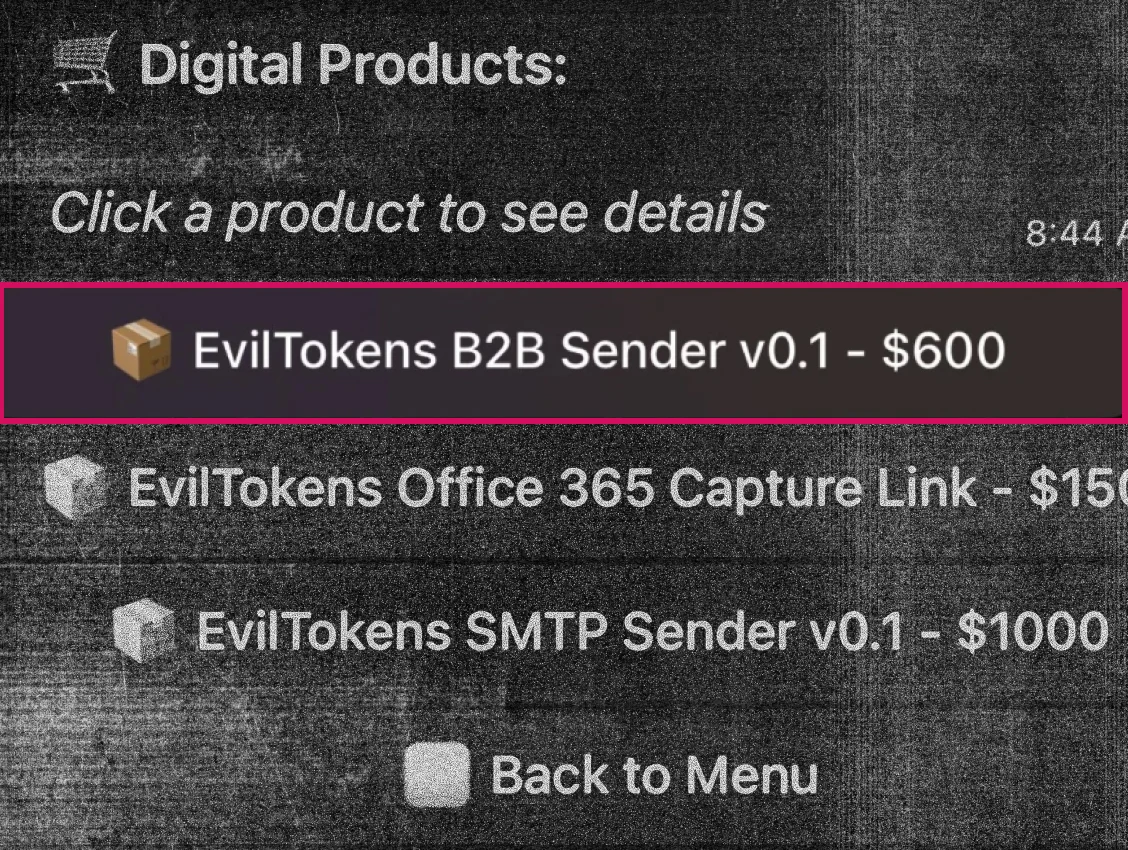
Huntress details three real-world patterns where attackers build workflows around AI adoption rather than attacking AI models themselves: SEO-poisoned/malvertised fake "Claude Code" downloads that deliver credential-stealing malware, an AMOS stealer campaign that spoofs ChatGPT/Grok-style answer pages to trick macOS users into running malicious Terminal commands (ClickFix-style), and the EvilTokens phishing-as-a-service platform, which used Railway infrastructure for on-demand session-token theft and AI-generated, role-tailored phishing lures that bypass email filtering. The piece argues AI isn't the weapon but the accelerant, making malicious activity blend into trusted, expected workflows.

Claude CodeChatGPTGrok+1
AMOS stealerEvilTokensClickFix+2

Threat Intel, AI SecurityΒ· Added 3 Sep 2026, published 22 Apr 2026