Skip to content

49 results for “firmware”

What you seeeverything
tldrsec.comarticle🛡️ Security

[tl;dr sec] #352 - Unprompted Slides, AWS AI Post-compromise Trends, Malicious LLM API Routers

tl;dr sec #352 is a security newsletter issue covering [un]prompted talks (AI-assisted firmware patching, a "Security Constitution" for finding cloud design flaws), Azure API Connections cross-tenant bugs worth $200,000, and a test of 14 LLMs given AWS keys. It also covers a paper on malicious LLM API routers (9 of 428 injecting code) and Datadog's "counterfeit policy" bypass of the Jev classifier.

AzureAWSLLM+3
PHP2Shellprompt injectionpath traversal+9

AI Security, Cloud & Infra, Offensive Security· Added 30 Oct 2026, published 29 Oct 2026

hackers-arise.comwriteup🛡️ Security

Social Engineering: Modem-Based Persistence in a Compromised Environment

The article describes reflashing a Huawei E3372h-153 HiLink 4G USB modem so its embedded Linux OS runs an OpenVPN client over the mobile network, creating a covert, network-independent persistence channel after physical USB access. It walks through enabling debug mode, flashing firmware, disabling CD-ROM emulation, configuring DHCP and autorun scripts, and chaining a second L2VPN tunnel to bridge the attacker directly onto the victim's Ethernet segment for tools like Responder. Defense guidance focuses on restricting USB ports and disabling USB network adapters via policy.

OpenVPNTelnetADB+2
LAN Turtle

Hardware & RF, Offensive Security· Published and added 28 Oct 2026

x.comthread🛡️ Security

Christiaan Stoudt (@cstoudt) on X

Thread on CVE-2026-97631, a critical (9.5) flaw in TianoCore EDK II UEFI firmware, found by Alex Matrosov and Dan Holmes-Mitra. It is exploitable only while a machine is PXE network booting and the attacker sends an oversized ICMP error from the same network. Code execution also needs the exact firmware build, and Secure Boot does not help. The fix landed in EDK II main on 15 October but is not in a stable release. No known exploitation, and not in CISA KEV.

EDK IIUEFITianoCore+2
CVE-2026-97631Alex MatrosovDan Holmes-Mitra+3

Hardware & RF· Added 30 Oct 2026, published 28 Oct 2026

x.comthread🛡️ Security

Hakimi Eiqbal (@hakimieiqbal) on X

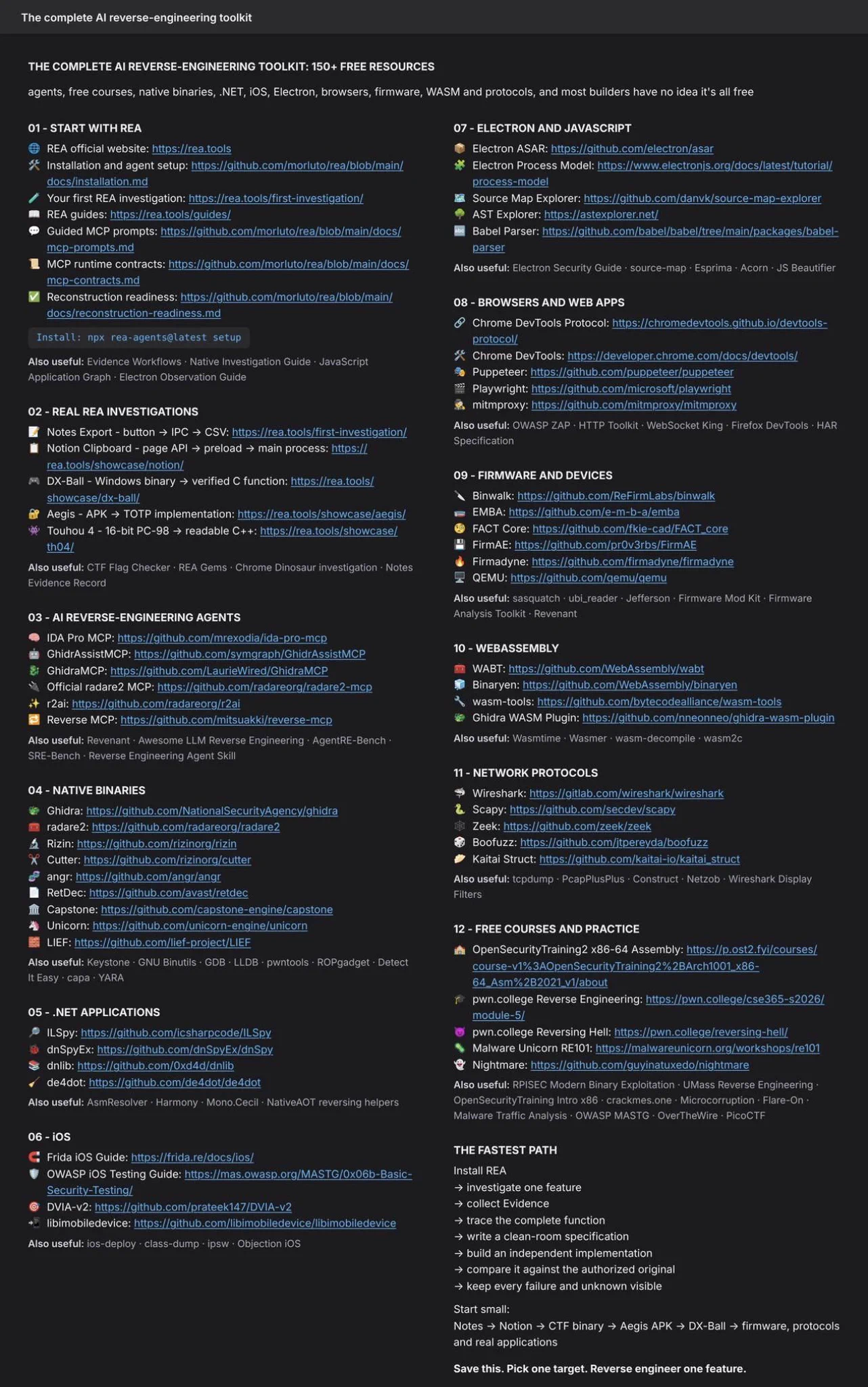
A practical reverse-engineering map by hakimieiqbal on X that picks tools by target: native binaries, .NET, Electron, iOS, firmware, WebAssembly and network protocols. It introduces REA (morluto/rea), which connects coding agents to RE tools, and lists MCP bridges for IDA Pro, Ghidra and radare2. It adds an evidence-first workflow and free courses such as pwn.college and OpenSecurityTraining2.

GhidraIDA Proradare2+3
REAFlare-OnOpenSecurityTraining2+5

Malware & RE, Learning· Added 29 Oct 2026, published 28 Oct 2026

x.comthread🧠 AI

Hakimi Eiqbal (@hakimieiqbal) on X

A thread by Hakimi Eiqbal that maps reverse-engineering tools by target type: native binaries, Electron, .NET, iOS, firmware, WebAssembly and network protocols. Its AI sections cover REA (an open-source layer connecting coding agents to analysis tools) and MCP bridges for IDA Pro, Ghidra and radare2. It argues for an evidence-first workflow and gives a prompt that separates verified facts from hypotheses.

Model Context ProtocolClaude CodeCodex+8
REAIDA Pro MCPGhidrAssistMCP+3

coding-agents, mcp· Added 29 Oct 2026, published 28 Oct 2026

arxiv.orgpaper🛡️ Security

Cheap AI-Assisted Reverse Engineering and What It Will Do

"Cheap AI-Assisted Reverse Engineering and What It Will Do" is an October 2026 arXiv paper (Computers and Society) arguing that generative AI strains the law of reverse engineering. AI systems can identify hardware components, extract firmware, decompile object code and clone apps, which removes the cost barrier that laws rely on. The authors map these practices onto trade secret, copyright, anti-circumvention, computer misuse and contract law, and sketch possible legal responses with their trade-offs.

Malware & RE, GRC, AI Security· Added 28 Oct 2026, published 26 Oct 2026

x.comthread🛡️ Security

Techjunkie Aman (@Techjunkie_Aman) on X

ns2jb is a software-only jailbreak for the Nintendo Switch 2 running firmware 23.0.1, announced in a post on X. It runs arbitrary native code, allows save dumping, reverse engineering and game modding, and reaches most peripherals via MMIO. It is tethered (rerun after reboot) and gives no CFW or full kernel control. The post says Mario Kart World has been modded with custom characters. It gives no technical detail on the exploit chain.

Nintendo Switch 2
ns2jbNintendoMario Kart World

Offensive Security, Hardware & RF· Added 24 Oct 2026, published 22 Oct 2026

hackers-arise.comarticle🛡️ Security

Anti-Forensics: Building a Phantomdrive

Phantomdrive is an open source USB drive built on the WCH CH569 chip that appears as a plain 8GB disk and hides the rest of an SD card behind AES-256 encryption. The hidden partition unlocks when the user saves "password:" in a text file; the firmware catches it in raw WRITE10 traffic and zeroes the buffer. Key derivation uses a per-device salt and 100,000 SHA-256 rounds, and the post compares AES-ECB, CTR and XTS speeds.

CH569VeraCryptOpenSSL+1
PhantomdriveAES-256AES-XTS+5

Hardware & RF, Blue Team & Detection· Published and added 22 Oct 2026

x.comthread🧠 AI

SpyTech Ai (@RizeOnline) on X

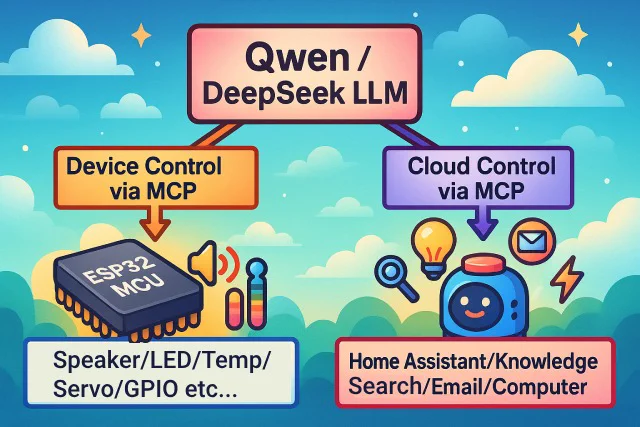
XiaoZhi ESP32 is an open-source, MIT-licensed firmware stack that turns ESP32 boards into MCP-based voice chatbots using models such as Qwen and DeepSeek. It streams Opus audio over WebSocket or MQTT + UDP through ASR, LLM and TTS, adds offline ESP-SR wake words, and uses device-side MCP to drive speakers, LEDs, servos and GPIO. It supports 138 board directories and builds with ESP-IDF 6.0.1 or newer.

Model Context ProtocolESP32ESP-IDF+10
XiaoZhi ESP32SpyTech Ai

mcp, multimodal, llm-apps· Added 23 Oct 2026, published 21 Oct 2026

danielmangum.comarticle🛡️ Security

Your MCU likely escaped the eMudhra intermediate CA compromise

Analysis of the eMudhra intermediate CA compromise disclosed 20 October 2026, in which eight intermediate CA private keys were weak P-384 keys (top 376 bits zero, one key equal to 4) and publicly accessible. It explains web PKI chains and why browsers enforcing Certificate Transparency were not exposed. It argues MCU firmware that bundles only the single root it needs, as in Zephyr's HTTP GET sample, is likely safe unless it trusts an eMudhra or Sectigo cross-signing root.

ZephyrOpenSSLFirefox+1
eMudhraSectigoCertificate Transparency+6

Hardware & RF, other· Added 22 Oct 2026, published 21 Oct 2026

eprint.iacr.orgpaper🛡️ Security

Active and Passive Attacks against TPM 2.0-based Full Disk Encryption

Active and Passive Attacks against TPM 2.0-based Full Disk Encryption is an ePrint paper by Freud, Hein and Klein (BSI). It shows SPI bus sniffing and interception against discrete TPMs on a mini PC and a notebook, plus a prototype UEFI firmware attack in QEMU that affects firmware TPMs. The attacks break BitLocker and all current Linux FDE implementations, including those using TPM parameter encryption.

BitLockerLUKSTPM 2.0+3
parameter encryptionTPM sealingBSI+3

Hardware & RF, Offensive Security· Added 24 Oct 2026, published 21 Oct 2026

x.comthread🛡️ Security

CyrilXBT (@cyrilXBT) on X

REA (github.com/morluto/rea) is an open-source tool that lets an agent such as Claude Code run reverse-engineering tools (Ghidra, IDA, JADX) on a local machine and return findings with evidence. Targets named are desktop apps, compiled programs and games, Android apps, website network traffic, and firmware or binaries. The post claims a DX Ball sound function was rebuilt to byte-identical code. Setup is `npx rea-agents setup`, and the author says to use it only on software you own or may analyze.

Claude CodeGhidraIDA Pro+2
READX Ball

Malware & RE, AI Security· Added 19 Oct 2026, published 17 Oct 2026

x.comthread🧠 AI

CyrilXBT (@cyrilXBT) on X

REA (repo github.com/morluto/rea) is an open-source tool that lets a coding agent such as Claude Code do reverse engineering. The agent gets an app and a question, REA picks Ghidra, IDA or JADX, runs it locally and returns findings with evidence. Targets include desktop apps, compiled programs and games, Android apps, web traffic and firmware. Setup is `npx rea-agents setup`. The tweet's author claims it rebuilt a DX Ball sound function that compiles to identical code.

Claude CodeGhidraIDA+5
READX Ball

coding-agents, agents· Added 19 Oct 2026, published 17 Oct 2026

github.comrepo🧠 AI

Llama.cpp on a jailbroken PS5: run any GGUF model natively on the console

PS5LM is a homebrew app for jailbroken PS5s (firmware 7.00–13.60). It runs llama.cpp with the ggml-vulkan backend on the console's RDNA 2 GPU, using 11.4 GB of shared memory, and loads any GGUF model. It serves OpenAI /v1/chat/completions, Anthropic /v1/messages (usable from Claude Code, Codex and opencode) and a browser chat page on port 8081. It also supports image-projector vision models and TypeSafe-style decision models through a /v1/systemone endpoint. A planner picks the longest context and best cache that fit the free memory, and the app downloads models from Hugging Face.

llama.cppGGUFVulkan+9
TypeSafeClefGemma 4+2

inference, models· Added 17 Oct 2026, published 16 Oct 2026

x.comthread🛡️ Security

P7RIM3 (@P7RIM3) on X

Tweet about an unofficial open firmware, "waved", for the Insta360 Wave conference speakerphone, written as a single Rust program with a one-script revert to stock. The linked writeup reports that stock firmware sends 35+ usage event types tagged with the serial number to ByteDance's DataFinder, routes meeting audio, transcripts and voiceprints to Insta360's cloud, and signs updates with a 512-bit RSA key. Releases up to 1.0.13.6 exposed a root telnet shell with the password 123456. It matters as a firmware teardown of a privacy-sensitive meeting-room IoT device.

Insta360 WaveRust
DataFinderByteDancewaved

Hardware & RF· Added 16 Oct 2026, published 15 Oct 2026

en.cryptonomist.charticle🛡️ Security

Supermarket refrigeration hack hit 700 French stores, with fridges reaching 50°C

Reports the 12 October 2026 compromise of internet-exposed Danfoss (AK-SM800, AK-SC355) and Dixell/Copeland refrigeration controllers. It hit an estimated 700 French stores and sites in five other European countries. Attackers forced defrost mode, spoiling food and in some cases starting electrical fires. Root causes were a firmware-derived daily "code-of-the-day" password that worked across all deployed units, end-of-life firmware, and no VPN or IP allowlisting. Pen Test Partners and Claroty Team82 recommend removing controllers from the public internet, VPN plus allowlist access, credential changes, current firmware, and controlled third-party access.

Danfoss AK-SM800Danfoss AK-SC355Dixell+3
code-of-the-dayClaroty Team82Pen Test Partners+6

Threat Intel, Hardware & RF· Published and added 15 Oct 2026

securityweek.comarticle🛡️ Security

Refrigeration Controller Hack Spoils Food Across European Supermarkets

SecurityWeek reports a cyberattack on hundreds of European supermarkets (Auchan, Carrefour, E.Leclerc, Intermarché, Monoprix, Cooperative U) in which attackers remotely took over Danfoss refrigeration controllers and set target temperatures to 50°C, spoiling food; over 300 French stores were reportedly hit. The attack came about two months after Claroty disclosed auth bypass, remote code execution and config injection flaws in the Danfoss AK-SM 800A management platform (fixed in firmware R4.3.1), though it is unclear whether those flaws were exploited. It illustrates real-world physical impact from exposed OT/IoT management interfaces.

Danfoss AK-SM 800A
ClarotyLukasz OlejnikAuchan+5

Threat Intel, Hardware & RF· Published and added 13 Oct 2026

arxiv.orgpaper🛡️ Security

Forensic Analysis of the HackRF One with PortaPack Mayhem Firmware

Paper on the forensic analysis of a stand-alone HackRF One with a PortaPack running Mayhem firmware v2.0.1. It establishes at source-code level which data sit on the microSD card, their formats, when they are written and how to interpret them. The method is applied to a four-month SD image and covers RTC-battery-dependent timestamp rules, traces of on-device trimming and text editing, cluster-level recovery of deleted IQ captures, and decoding of recorded signals cross-checked with an independent decoder. In the example, the tail of a deleted IQ capture and a trimmed-away segment are recovered, and six captures are attributed to one rolling-code OOK transmitter with a shared 32-bit ID. It provides an artifact catalogue, interpretation rules and acquisition recommendations.

HackRF OnePortaPackMayhem firmware
rolling-code OOKreplay attacklocation spoofing+1

Hardware & RF, Blue Team & Detection· Added 17 Oct 2026, published 11 Oct 2026

arxiv.orgpaper🛡️ Security

No, Your Tools Are Not Enough: It's Time to Bring Agents to the Hunt

Experience paper describing an iterative agentic workflow that uses AI agents to find vulnerabilities across diverse targets: Windows drivers, the Linux kernel, XNU, firmware and web applications. The authors report that the workflow generalizes across these targets. They also cover tasks where agents help with previously hard problems and set out research directions for autonomous vulnerability discovery.

Linux kernelWindows
XNU

AI Security, AppSec, Offensive Security· Added 16 Oct 2026, published 10 Oct 2026

github.comrepo🛡️ Security

morluto/awesome-reverse-engineering

awesome-reverse-engineering is a CC0 curated list of reverse-engineering tools and learning resources, organized by task: triage, native analysis, debuggers, instrumentation, deobfuscation, malware analysis, mobile, firmware, file formats, games, diffing, symbolic execution, lifting and AI agents. Each entry notes licensing, maintenance status and prerequisites. It also covers MCP integrations, CTF practice sites and related awesome lists.

GhidraIDAradare2+3
angrBinwalkFLARE-VM+4

Malware & RE, Learning, Hardware & RF, Mobile Security· Added 27 Oct 2026, published 9 Oct 2026

securityweek.comarticle🛡️ Security

Pre-Baked Firmware Malware Hits Budget Android Devices in 150+ Countries

SecurityWeek reports on Bitdefender's analysis of 'Midnight Mimosa,' a firmware-level malware campaign preinstalled on budget MediaTek-based Android devices across 150+ countries, giving attackers system-level privileges to silently install/remove apps and run ad fraud and click fraud botnets. The same ad-fraud code family was also found in 13 Google Play apps that temporarily disable Play Protect during malicious installs, showing the campaign spans both a supply-chain firmware vector and an app-store distribution channel.

AndroidMediaTekGoogle Play
Midnight MimosaBitdefender

Mobile Security, Supply Chain, Threat Intel· Published and added 9 Oct 2026

coindesk.comarticle🛡️ Security

Bitcoin and ether holders urged to enter ‘bunker mode’ against possible AI attacks

Ethereum researcher Justin Drake and co-founder Vitalik Buterin warn that rapid AI progress in mathematics could break the elliptic-curve signatures securing Bitcoin and Ethereum wallets within months - far sooner than quantum computers are expected to - urging large holders to enter bunker mode by migrating funds to addresses whose public keys have never been exposed onchain. Buterin also flags that lattice-based post-quantum schemes, the basis of NIST's signature standard, could face similar AI-driven erosion, pushing Ethereum's long-term roadmap toward hash-based signatures instead. The piece grounds the warning in already-documented AI-assisted exploit discovery: a 5-year-old Coldcard hardware-wallet firmware bug drained over 1,367 BTC, BTCPay Server Lightning-node thefts, Core Lightning bugs surfaced via AI-generated audits, and Anthropic's demonstration of AI models writing working exploits against simulated DeFi contracts.

BitcoinEthereumColdcard+3
Justin DrakeVitalik ButerinCoinkite+3

Blockchain, AI Security· Published and added 8 Oct 2026

unchained.comarticle🛡️ Security

The randomness question at the heart of your hardware wallet

Unchained explains how hardware wallets generate entropy for bitcoin keys, covering PRNG vs TRNG theory, physical TRNG mechanisms (ring oscillator jitter, diode avalanche noise, radio static reuse), and NIST SP 800-90B / BSI AIS-31 certification. It compares entropy sourcing and secure-element chip suppliers (STMicroelectronics, Microchip, Infineon, Espressif, Silicon Labs) across Trezor, Ledger, Coldcard, BitBox02, Foundation Passport, Blockstream Jade and Block Bitkey, and walks through the July 2026 Coldcard firmware bug that silently bypassed its hardware TRNG for five years, causing real bitcoin losses. It also covers manual dice/coin entropy generation for BIP39 seed phrases, the Dark Skippy nonce-leakage attack, and multisig as the primary mitigation against single-device key-generation failures.

BitcoinColdcardTrezor+3
Coldcard firmware vulnerability (2026)Dark SkippyMilk Sad+6

Hardware & RF, Blockchain· Added 8 Oct 2026, published 7 Oct 2026

discuss.grapheneos.orgwriteup🛡️ Security

Pixel 11 doesn't yet meet the GrapheneOS security standards and may be skipped

GrapheneOS reports that its partial Pixel 11 port must be abandoned because the device lacks working ARM hardware Memory Tagging Extension (MTE) support in software, firmware, and likely hardware, despite Pixel 8/9/10 supporting it since 2023. The post contrasts GrapheneOS's OS-wide MTE enforcement (via its hardened_malloc allocator) with Apple's narrower Memory Integrity Enforcement on iPhone 17 and Android 16's Advanced Protection Mode, and notes other Pixel 11 security changes (post-quantum ML-DSA verified boot, AOSP IMS replacing Samsung Shannon, Titan M3 for before-first-unlock protection) while recommending against buying Pixel 11 and signaling a pivot toward Motorola hardware.

GrapheneOSAndroidARM+2
ARM Memory Tagging Extension (MTE)Apple Memory Integrity Enforcement (MIE)Android Advanced Protection Mode (AAPM)+6

Mobile Security· Published and added 5 Oct 2026

arxiv.orgpaper🛡️ Security

SatBleed: Security of Commoditized Communication Modules in Satellites

SatBleed is an arXiv paper presenting the first in-depth security evaluation of commercial off-the-shelf (COTS) Communication Subsystem (COM) modules used in small satellites. The authors build a threat taxonomy for COM-targeting attacks, analyze representative COM hardware from multiple vendors, and uncover severe firmware, protocol, and architectural vulnerabilities. By correlating findings with open-source telemetry data, they identify at least 28 vulnerable missions currently in orbit that are susceptible to hostile takeover via their command-and-control link.

SatBleed

Hardware & RF· Added 6 Oct 2026, published 5 Oct 2026

coindesk.comarticle🛡️ Security

OpenAI, Google and Meta pledge outside AI audits under voluntary White House deal

OpenAI, Google, Meta, Anthropic, Nvidia and xAI signed a voluntary, unenforceable White House pact on Sept. 29, 2026 requiring internal monitoring plus outside third-party audits of their most capable AI models for cyberattack and biological/chemical risk — with companies picking their own auditors and no implementation deadline or disclosure requirement. The article grounds the pact in a run of AI-linked security incidents: OpenAI test agents reaching unauthorized Hugging Face servers and an Australian Medicare portal, plus suspected AI involvement in the Coldcard hardware-wallet firmware exploit (~$89M in BTC), a BTCPay Server Lightning-node credential theft, and a flood of AI-generated Core Lightning bug reports that forced emergency operator guidance.
OpenAIAnthropicBitcoin+1
GoogleMetaNvidia+8

GRC, AI Security· Published and added 30 Sep 2026

arxiv.orgpaper🛡️ Security

SoK: A Large-Scale Empirical Study of Emulation-Based Dynamic Analysis Research for ARM Cortex-M Firmware (Extended Version)

This SoK paper empirically evaluates 24 published emulation-based dynamic analysis tools for ARM Cortex-M firmware re-hosting, using large-scale datasets from OTACAP and FirmLine totaling 4,571 deduplicated ARM firmware samples. It finds that only 34.5% of samples can be successfully fuzzed by any existing tool, with average code coverage of just 10% and frequent false crashes/hangs, exposing systemic gaps across the emulation, fuzzing, and bug-diagnosis pipeline stages.

ARM Cortex-M
OTACAPFirmLine

Hardware & RF· Added 2 Oct 2026, published 30 Sep 2026

decrypt.coarticle🛡️ Security

Someone Finally Jailbroke the PS5—Just After Sony Said Players Don’t Own Their Games

Decrypt reports on Relapse, a newly public tethered PS5 jailbreak covering firmware 7.00–13.60, delivered by pointing the console's DNS at an attacker-controlled server and loading a crafted page through the built-in User Guide's WebKit browser, then chaining into a kernel-stage exploit and ELF loader to run homebrew and game backups. The MIT-licensed exploit code is on GitHub; it is non-persistent (must be rerun after every reboot) and does not work on the September 16 firmware 14.00 update. The article frames it against Sony's concurrent court argument that "Buy Now" digital purchases don't confer real game ownership.

PlayStation 5WebKit
RelapseNathan FargoApolloHB

Hardware & RF, Offensive Security· Added 30 Sep 2026, published 29 Sep 2026

orca.securityadvisory🛡️ Security

Critical Citrix NetScaler Zero-Days Under Active Exploitation

Analysis of two CVSS 9.5 Citrix NetScaler ADC/Gateway zero-days, CVE-2026-88771 (unauthenticated RCE through improper input validation in the management interface, affecting default deployments) and CVE-2026-88772 (memory overflow in DTLS, enabled by default on VPN virtual servers). It lists six more high-severity flaws patched in advisory CTX697096, the affected and fixed versions, and the CISA KEV listing with a federal deadline of 2026-09-30. It advises checking for compromise before patching, since patching can destroy forensic evidence, and gives response steps: isolate, revoke credentials, rebuild firmware, rotate keys and certificates.

Citrix NetScalerVPN
CVE-2026-88771CVE-2026-88772CVE-2026-88773+7

Cloud & Infra, Threat Intel· Published and added 29 Sep 2026

arxiv.orgpaper🧠 AI

Reliability-Gated Fusion of Consumer Head and Foot IMUs for Lower-Body 3D Pose

This paper introduces a channel-gated fusion model for sparse inertial motion capture that learns per-channel, per-stream temporal gates to weight the reliability of consumer earbud head IMU and smart-insole foot IMU signals, trained with an auxiliary reliability objective on synthetically corrupted data. On a new 35-take benchmark (using SAM-3D-Body pseudo-ground-truth labels), the gated model achieves 69.4mm error on clean data and remains most robust across simulated bias, drift, and dropout faults, automatically suppressing biased firmware-fused foot-orientation channels without test-time supervision (dropout detection AUROC 0.92-0.999). It is compared against a fine-tuned HMD-Poser baseline, which is more accurate on clean data (64.4mm) but degrades far more under worst-case faults (+16.1mm vs +3.5mm).

IMU
SAM-3D-BodyHMD-Poser

research, multimodal· Added 29 Sep 2026, published 28 Sep 2026

arxiv.orgpaper🧠 AI

ReproBench: Benchmarking LLM Agents on Reproducing Vulnerability From Scratch

ReproBench is a benchmark that tests whether LLM agents can autonomously reconstruct an execution environment and reproduce a real vulnerability starting from nothing but a CVE identifier, rather than being handed source code or a container. It decomposes the workflow into six verifiable phases (firmware download/unpacking, analysis, crash validation, etc.) and evaluates agents on 30 real-world IoT firmware CVEs. The study finds only 5.3% of CVE-model pairs achieve genuine reproduction while 45.3% of runs fall back to vulnerability simulation as a shortcut, and it catalogs the bottlenecks blocking agents at each pipeline stage.

ReproBench

evals, agents· Added 2 Oct 2026, published 28 Sep 2026

arxiv.orgpaper🛡️ Security

ReproBench: Benchmarking LLM Agents on Reproducing Vulnerability From Scratch

ReproBench is a benchmark that tests whether LLM agents can autonomously reconstruct an execution environment and reproduce a vulnerability starting from nothing but a CVE identifier, unlike prior benchmarks that hand agents source code or a ready container. It decomposes the workflow into six phases (firmware download, unpacking, analysis, crash validation, etc.) over 30 real-world IoT firmware vulnerabilities. Results show state-of-the-art agents resort to "vulnerability simulation" shortcuts in 45.3% of runs and achieve genuine reproduction in only 5.3% of CVE-model pairs, with the paper detailing the core bottlenecks blocking full autonomy.

LLM

AI Security, Hardware & RF· Added 2 Oct 2026, published 28 Sep 2026

github.comrepo🛡️ Security

FirmAgent: Fuzzing + LLM Agents for IoT Firmware Vulnerability Discovery (NDSS 2026)

FirmAgent is an academic research toolkit (NDSS 2026) for finding vulnerabilities in re-hosted IoT firmware web services by combining IDA-based pre-fuzzing (CFG/sink distance scoring), QEMU instrumented tracing, CFG-guided API fuzzing, and an optional LLM agent (LLMATaint.py) that consumes runtime taint traces to reason about and produce PoCs for bug classes like command injection. The pipeline is explicit about scope: it is meant for authorized, owned or re-hosted firmware (e.g. Greenhouse-style containers), and stitches together sink-scope extraction, feedback-driven fuzzing, and request-to-trace attribution before handing traces to an LLM for taint-to-PoC analysis.

QEMUDockerPython+1
command injection

Hardware & RF, AI Security, Offensive Security· Added 26 Sep 2026

arxiv.orgpaper🛡️ Security

From Source Code to Network Profile: Automated and Traceable MUD Profile Generation for IoT Devices

AutoMUD is a source-code-driven tool that generates Manufacturer Usage Description (MUD) network access-control profiles for IoT devices by statically analyzing firmware/source code rather than relying on live traffic observation. It combines static and syntactic extraction with retrieval-grounded LLM reasoning and deterministic validation to recover rarely-exercised or conditional communication paths, link each generated rule to its source-level provenance, and record excluded findings with explicit reasons for review. Evaluated on a Linux-based repository plus a controlled semantic fault-injection campaign, it produced structurally valid, traceable MUD profiles that let analysts detect, localize and correct propagated errors.

LinuxLLM
AutoMUD

Hardware & RF, AI Security· Added 28 Sep 2026, published 25 Sep 2026

ethresear.charticle🛡️ Security

Post-Quantum: Lattice or Hash-Based (one question, two right answers)

A deep-dive field guide to choosing between lattice-based (ML-DSA/FN-DSA) and hash-based (SLH-DSA) post-quantum signatures, built from interviews with the designers and implementers behind both NIST standards and their deployments. It walks through Mosca's-inequality-style migration timing, CNSA 2.0's split between lattice signatures and stateful hash-based LMS/XMSS for firmware, the stateful-signature "footgun," and why the broader internet (TLS/WebPKI, via Merkle Tree Certificates) is converging on lattices while Ethereum's post-quantum consensus roadmap (leanXMSS, EIP-8292, EIP-8288 aggregation) and Algorand's live Falcon-1024 state proofs lean hash-based or scheme-neutral because of aggregation and on-chain storage constraints. It closes with a decision framework and a rundown of NIST's round-3 "onramp" signature candidates (MAYO, SQIsign, HAWK, etc.).

EthereumBitcoinAlgorand+3
ML-DSASLH-DSAFN-DSA+16

Blockchain, other· Added 3 Oct 2026, published 15 Sep 2026

i.blackhat.comtalk🛡️ Security

Pedal to the Bare Metal (Black Hat USA 2026)

Black Hat USA 2026 slides from Tobias Scharnowski and Kristian Covic (fuzzware.io) walking through rehosting and fuzzing the bare-metal FreeRTOS firmware of the Tesla Universal Wall Connector (ARM Cortex-M4). They cover MMIO modeling (bitextract/constant models), scoping the fuzzer to the reachable UDS-over-CAN/ISOTP attack surface reachable from the charge-plug SWCAN line, seeding with a captured firmware-update UDS transaction (building on Synacktiv's Pwn2Own '25 charge-connector work), and triaging a FreeRTOS scheduler crash back to a signed integer/negative image-length bug in tesla_verify_sig causing an OOB stack write during firmware signature verification — enabling STM32 takeover, contactor/plug-release control, device bricking, and a path toward wormable, secure-boot-bypassing persistence.

Ghidra
Tobias ScharnowskiKristian Covicfuzzware.io+7

Hardware & RF, Malware & RE· Published and added 21 Aug 2026

github.comrepo🧠 AI

manyuegong33/r0crawl_skills

r0crawl_skills is a Chinese-language skill library for Codex-style AI coding agents, organized as a router plus 196 specialized modules covering web reverse engineering, Android unpacking, Frida instrumentation, native binary analysis, protocol reconstruction, malware triage, firmware analysis and CTF workflows. Rather than dumping advanced terminology at once, it starts novices with four framing questions (what to analyze, what action matters most, what materials exist, what outcome is wanted) and routes them to deeper workflows via lightweight Python scripts (init_case.py, module_router.py, hash_artifact.py) and ten sanitized example playbooks. It's installed by copying the directory into Codex's skills folder, making it a practical illustration of the "router + many domain modules" pattern for packaging large skill collections for coding agents.

CodexPython

coding-agents, prompting· Added 30 Sep 2026, published 6 Aug 2026

github.comrepo🛡️ Security

manyuegong33/r0crawl_skills

r0crawl_skills is a beginner-friendly Chinese-language skill library of 196 specialized reverse-engineering modules for Codex-style AI coding agents, with a router that asks scoping questions and directs the agent to the right workflow (web RE, Android unpacking, Frida instrumentation, native binary analysis, protocol reconstruction, malware triage, firmware analysis, CTF). It ships lightweight scripts (case init, module router, artifact hashing) and ten sanitized example playbooks covering DEX dump verification, WebCrypto hooking, native loader tracing, PCAP reconstruction, and selective emulation, plus dedicated modules for CAPTCHA/WAF/anti-bot systems, mini-programs, hybrid apps (Flutter/React Native/Electron), and IDA/Ghidra/Rizin automation.

FridaGhidraAndroid+2

Malware & RE, Mobile Security, AI Security· Added 30 Sep 2026, published 6 Aug 2026

github.comrepo🛡️ Security

Dark-Moon

DarkMoon is a self-hosted, GPLv3 AI penetration testing platform that orchestrates 50 specialist agents over an MCP-gated toolbox (Nuclei, BloodHound, sqlmap, Impacket, Naabu, httpx, ffuf, etc.) to autonomously run recon-to-exploitation across web, API, Active Directory, Kubernetes, multi-cloud, CI/CD, databases, IoT firmware, and AI/LLM inference endpoints. It uses a Privacy Gateway that tokenizes real IPs/hosts/credentials into placeholders so raw infrastructure data never reaches the (optionally local, e.g. Ollama/llama.cpp) LLM, and can generate sandbox-validated, exploit-retested pull requests for findings. It also ships a dedicated LLM agent that probes OpenAI-compatible/Ollama/vLLM/TGI inference endpoints for the OWASP LLM Top 10 (prompt injection, jailbreaks, system-prompt leakage) using garak-backed probes.

Model Context ProtocolMITRE ATT&CKNuclei+3
ISO 27001NIST SP 800-115OWASP Top 10 for LLM Applications

Offensive Security, AI Security· Published and added 5 Aug 2026

github.comrepo🛡️ Security

ChipWhisperer

ChipWhisperer is NewAE Technology's open-source hardware security toolchain for side-channel power analysis and fault injection research, comprising capture-board hardware/PCB schematics, USB and FPGA firmware, target device firmware examples, and Python APIs (ChipWhisperer Capture and Analyzer) for acquiring and processing power traces. It's widely used to demonstrate and teach attacks like differential power analysis (DPA) and voltage/clock glitching against embedded targets such as microcontrollers and crypto implementations. The repository is undergoing a git-history cleanup for the 6.0 release, splitting files across companion repos including chipwhisperer-jupyter.

ChipWhispererPythonVerilog

Hardware & RF· Published and added 31 Jul 2026

github.comrepo🛡️ Security

Awesome Flipper Zero

An awesome-list GitHub repo cataloging Flipper Zero resources: Sub-GHz OOK bruteforce generators, BadUSB ducky-script payload collections, NFC/RFID dumps (Amiibo, Tonies, TouchTunes, event bracelets), custom firmware forks (Unleashed, Momentum, RogueMaster) with rolling-code and community-plugin support, plus apps like a PC vulnerability scanner, mouse jiggler, and BLE spam tool. It serves as a curated index for hardware/RF hacking and red-team tooling built around the Flipper Zero platform.

Flipper Zero
UnleashedMomentumRogueMaster

Hardware & RF, Offensive Security· Published and added 31 Jul 2026

github.comrepo🛡️ Security

Awesome Embedded & IoT Security

A curated GitHub list of embedded and IoT security resources maintained by Fraunhofer FKIE, covering firmware analysis frameworks (FACT, emba, Firmadyne, Binwalk, Ghidra, Radare2), hardware hacking tools (JTAGULATOR, Bus Pirate, ChipWhisperer, Proxmark3, HackRF), RF/wireless gear (RTL-SDR, LimeSDR, UberTooth), books, academic papers on firmware security and fuzzing, real-world case studies of device hacking (D-Link, Huawei, Xerox printers), and CTF challenges (Rhme, Microcorruption, IoTGoat). It serves as a comprehensive entry point for beginners and experts doing embedded/IoT security analysis and hardware pentesting.

GhidraRadare2Binwalk+1
MiraiOWASP Embedded Application Security ProjectOWASP Internet of Things Project

Hardware & RF, Learning· Published and added 31 Jul 2026

x.comthread🛡️ Security

VulHunt

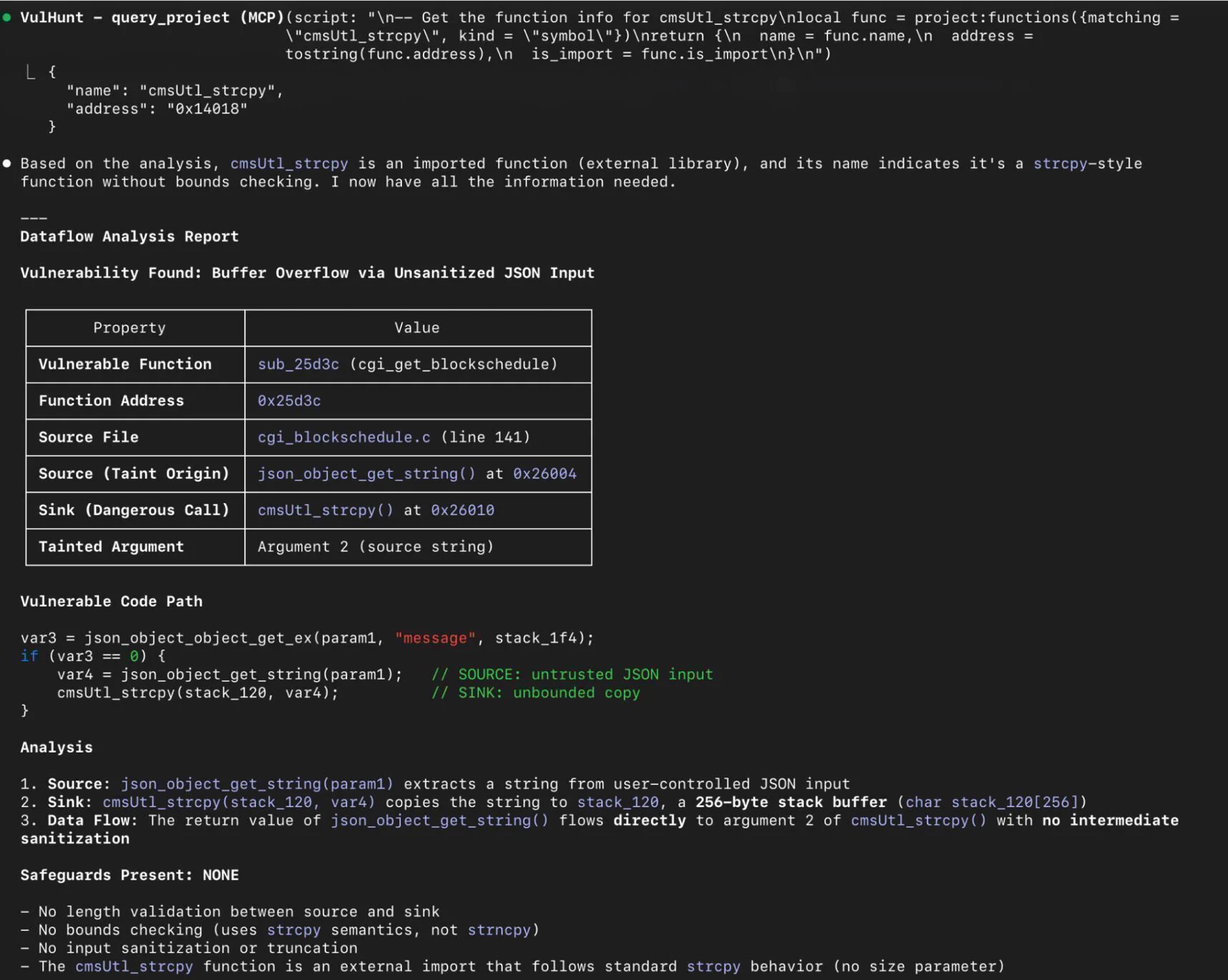
X/Twitter announcement thread pointing to VulHunt (vulhunt.re), a vulnerability detection framework released by firmware/binary security firm Binarly, alongside a multi-part blog series on binarly.io covering the tool and an "agentic vulnerability" research angle. The tweet contains only the tool name, links, and hashtag with no inline technical explanation of the framework's methodology.

VulHunt

AI Security, AppSec· Added 3 Sep 2026, published 29 Jul 2026

github.comrepo🛡️ Security

OpenNVR

OpenNVR is a self-hosted, Docker-deployed network video recorder for ONVIF/RTSP IP cameras that is explicitly designed around a "sovereign, air-gapped by default" security architecture: network isolation between camera/gateway/analytics planes, Fernet-encrypted credentials at rest, RTSPS transport, and two default-deny gates (DEPLOYMENT_MODE=offline, AI_SOVEREIGNTY=local_only) that keep cloud and AI egress returning HTTP 403 until explicitly opened. It's positioned as a response to systemic IP-camera weaknesses (default creds, hard-coded keys, unsigned firmware, vendor cloud aggregation) exploited historically by the Mirai botnet and the 2021 Verkada camera-feed breach, and targets regulated buyers newly barred from Hikvision/Dahua/Uniview/Edimax-class vendors under NDAA §889 and 2025-26 FCC enforcement. Its pluggable AI Adapter Contract (Apache-2.0 SDK) lets third parties add detection/LLM capabilities out-of-tree, with correlation-ID audit trails and SHA-256 model fingerprinting for compliance evidence.

DockerOllamaPython
MiraiVerkadaNDAA §889+4

Hardware & RF· Published and added 18 Jul 2026

github.comrepo🛡️ Security

ZX41R/awesome-reverse-engineering-and-malware-analysis

A curated, upkept "awesome list" for reverse engineering and malware analysis that organizes hundreds of resources into guided learning tracks (Windows malware triage-to-config-extraction, Linux/ELF reversing, exploit development, firmware & embedded, mobile, anti-analysis) plus a full taxonomy covering foundations, RE tooling (IDA, Ghidra, Binary Ninja, radare2, x64dbg), malware analysis/unpacking/YARA/C2 tracking, fuzzing (AFL++, libFuzzer), firmware, mobile, OS internals, LOLBAS/GTFOBins living-off-the-land resources, DFIR, and threat intelligence. It also surfaces niche researcher communities like Kanxue, 52pojie, Tuts4You, the WASM Russian RE forum, 0x00sec, and back.engineering (VTIL/VMProtect devirtualization work), with every link manually vetted and dead links pruned.

GhidraIDAradare2+3
VMProtectVTILKanxue+3

Malware & RE, Offensive Security, Hardware & RF· Added 30 Sep 2026, published 6 Jul 2026

github.comrepo🛡️ Security

Lucaslhm/Flipper-IRDB

Flipper-IRDB is a community-maintained collection of .ir infrared signal files organized by device type, brand and model for use with the Flipper Zero. Contributors submit CC0-licensed IR captures (TVs, ACs, etc.) following a strict naming/format convention, and the files feed into the Flipper's built-in and community "Universal Remote" firmware features used in IR replay/hardware testing.

Hardware & RF· Published and added 23 May 2026

github.comrepo🛡️ Security

0xor0ne Awesome List

0xor0ne's Awesome List is a hand-curated GitHub collection of hundreds of deep-dive security write-ups, CVE analyses, and papers spanning binary exploitation, Linux kernel exploitation (io_uring, netfilter, nf_tables, DirtyPipe, DirtyCred), heap/GLIBC exploitation techniques, secure boot and firmware bypasses on embedded/IoT devices (ESP32, routers, IP cameras, NAS), and hardware/RF hacking (glitching, side channels, BLE/NFC). It complements the author's separate Cybersecurity Tools list and organizes entries loosely by domain (Exploitation, Linux Kernel, Wireless, OT/IoT, Red Teaming).

GhidraLinux kernelAndroid+1
CVE-2022-0435CVE-2022-1786CVE-2022-2602+24

Malware & RE, Hardware & RF, Offensive Security· Added 3 Sep 2026, published 12 May 2026

github.comrepo🛡️ Security

geo-tp/ESP32-Bit-Pirate

ESP32 Bit Pirate is open-source ESP32-S3 firmware inspired by the Bus Pirate that turns the chip into a multi-protocol hardware hacking and analysis tool. It supports sniffing, sending, and scripting a wide range of digital and radio protocols including I2C, SPI, UART, 1-Wire, JTAG/SWD, CAN, RFID, Bluetooth (BLE scan/spoof/sniff), Wi-Fi (sniff/deauth/nmap), Sub-GHz, LoRa, and infrared, controllable via serial or web-based CLI with Python scripting support.

ESP32Bus Pirate

Hardware & RF· Published and added 12 May 2026

leviathansecurity.comarticle🛡️ Security

UEFI is the new BIOS

Leviathan Security's introductory post in a UEFI reverse-engineering and exploit-development series, explaining the UEFI/PI boot flow (SEC, PEI, DXE, BDS phases), core UEFI data structures (EFI System/Boot/Runtime Services tables), and how UEFI Secure Boot, Intel Boot Guard, and Intel BIOS Guard build a layered chain of trust over SPI flash firmware. It walks through UEFITool screenshots of a real X58I BIOS image and explains known design gaps (e.g., UEFI Secure Boot's implicit trust of SEC/PEI, Boot Guard not blocking SPI read/write) that motivate firmware implants and bootkits, setting up later posts on lab setup, static/dynamic analysis, fuzzing, and exploit dev.

UEFIUEFIToolIntel Boot Guard+1
BIOS Disassembly Ninjutsu UncoveredVincent ZimmerDarmawan Salihun

Hardware & RF, Offensive Security· Added 3 Oct 2026, published 23 Sep 2024