Skip to content

92 results for “MCP servers”

What you seeeverything
x.comtool🧠 AI

zahT3 (@zahT3zuo) on X

Hotseat is a free, open-source macOS menu bar app that moves Claude Code and Claude Desktop to another of the user's Claude accounts in one click and returns to the same session. Sessions, settings, skills and MCP servers are shared, so `claude --resume` works under either account. When a session hits a usage limit, it offers to continue under another account. It never reads tokens or cookies. Install with Homebrew.

Claude CodeClaude DesktopmacOS+2
HotseatAnthropic

coding-agents· Added 1 Nov 2026, published 31 Oct 2026
pillar.securityarticle🛡️ Security

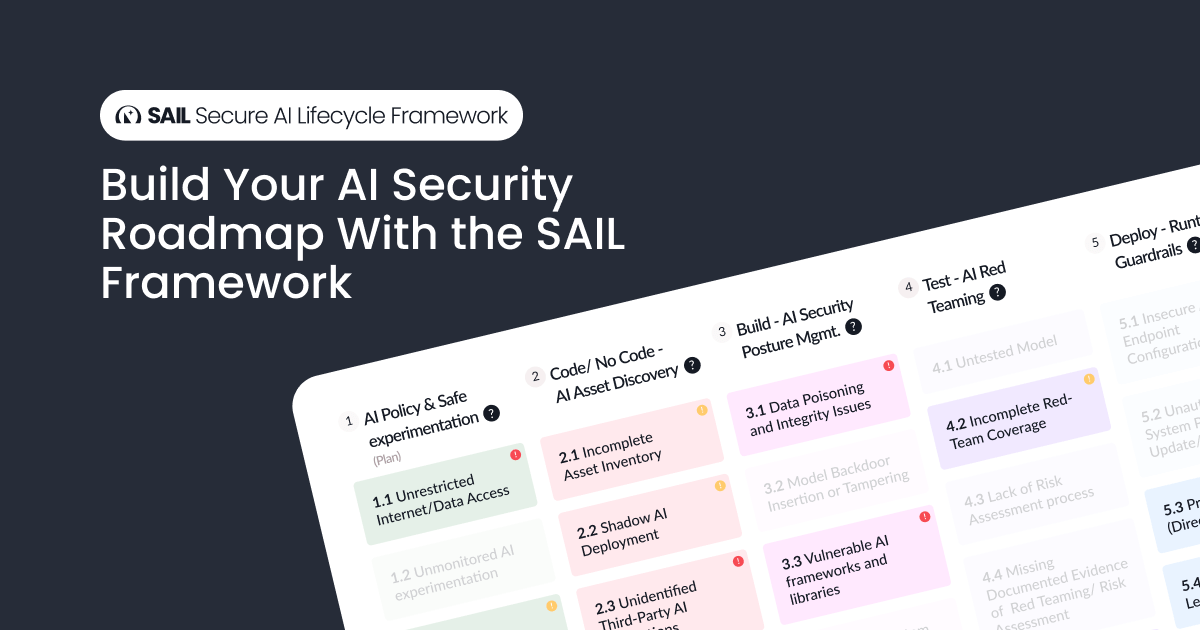
SAIL Framework: A Practical Guide for AI Security

The SAIL Framework from Pillar Security is a seven-phase, lifecycle-oriented method for securing AI systems. The phases are AI policy and safe experimentation, AI asset discovery, AI security posture management, AI red teaming, runtime guardrails, sandboxed execution for agents and MCP servers, and AI activity tracing. It argues for a "Shift Up" approach that protects the business logic AI controls, and it is meant to sit on top of existing standards.

Model Context Protocol
SAIL FrameworkPillar Securityprompt injection+3

AI Security, GRC· Added 29 Oct 2026

endorlabs.comarticle🧠 AI

What is an AIBOM? AI bill of materials explained for security teams | Endor Labs

An AIBOM is a machine-readable inventory of models, datasets, dependencies, AI services, agents and MCP servers, with evidence of origin, license, integrity and evaluation. The Endor Labs explainer walks through a worked CycloneDX example for a fine-tuned support assistant. It compares CycloneDX ML-BOM, SPDX 3.x, the OWASP AIBOM project and the May 2026 CISA/G7 guidance, and lists what an AIBOM cannot show: runtime behavior and agent actions.

CycloneDXSPDXSBOM+5
Endor LabsOWASPCISA+3

ai-policy, ai-infra· Published and added 29 Oct 2026

endorlabs.comarticle🛡️ Security

What is an AIBOM? AI bill of materials explained for security teams | Endor Labs

AIBOM explainer from Endor Labs: an AI bill of materials is a machine-readable inventory of models, datasets, dependencies, AI services, agents and MCP servers, with origin, license and integrity evidence. It walks through a CycloneDX entry for a fine-tuned model, compares CycloneDX ML-BOM, SPDX 3.x, the OWASP AIBOM Generator and the May 2026 CISA/G7 minimum-elements guidance, and lists a six-step build process. It also states what an AIBOM cannot show: model safety, runtime behavior and coding-agent actions.

CycloneDXSPDXSBOM+2
EU AI ActISO/IEC 42001CISA+5

Supply Chain, AI Security, GRC· Published and added 29 Oct 2026

x.comthread🧠 AI

Kizuno18 (@Kizuno18) on X

Kizuno18's X post argues that the move from local stdio and Docker MCP servers to remote HTTP/SSE endpoints matures the Model Context Protocol in enterprise infrastructure. It lists three trade-offs: short-lived OAuth/JWT bearer tokens replace mounted admin credentials, deferred tool discovery avoids roughly 20k tokens of eager schema loading, and HCP Terraform enforces Sentinel/OPA policy, audit trails and approvals server-side. Opinion post with no benchmarks or code.

Model Context ProtocolDockerTerraform+5
Kizuno18HCP TerraformOPA

mcp· Added 29 Oct 2026, published 27 Oct 2026

x.comthread🛡️ Security

cubillas (@cubillas888) on X

The tweet relays Pillar Security research that opencode on Windows and WSL could run attacker-controlled code during remote MCP server OAuth sign-in. The fix shipped in opencode 1.18.33 on 28 September, with no advisory or CVE published. It advises users of remote MCP servers to update and review which servers they connect to. Technical details are not in the post.

OpenCodeModel Context ProtocolOAuth+1
Pillar Security

AI Security, AppSec· Added 29 Oct 2026, published 27 Oct 2026

arxiv.orgpaper🛡️ Security

Log-To-Leak: Prompt Injection Attacks on Tool-Using LLM Agents via the Model Context Protocol

Log-To-Leak is a prompt-injection attack on tool-using LLM agents that abuses Model Context Protocol tool metadata to trigger an attacker-controlled logging call after the last legitimate call, leaking the user query, server name, server response and agent response. Evaluated on five MCP servers and four agents, it reaches 62.64-100% attack success with 76.55-95.64% logging accuracy. Three defenses leave over 55% residual ASR on GitHub MCP with GPT-4o.

Model Context ProtocolGitHubGPT-4o+1
Log-To-Leaktool poisoningprompt injection

AI Security· Added 28 Oct 2026, published 26 Oct 2026

x.comthread🧠 AI

Prasenjit Sarkar (@stretchcloud) on X

Post explaining Claude's new support for MCP Tasks and Elicitations. A server returns a durable task handle instead of blocking. The client polls tasks/get every 250 ms to 30 s, and states are working, input_required, completed, failed or cancelled. Elicitations pause a task at input_required for human approval. It also notes Cloudflare's stateless MCP servers and Code Mode, and Sentry and Linear adoption.

Model Context ProtocolClaude CodeGitHub Actions+3
AnthropicClaudeAWS+4

mcp, agents· Added 25 Oct 2026, published 24 Oct 2026

endorlabs.comarticle🛡️ Security

ADLC Security Best Practices for Teams Shipping with Coding Agents | Endor Labs

ADLC Security Best Practices is an Endor Labs guide to controlling what AI coding agents can access, run, install and ship. It covers inventorying agents and MCP servers, sandboxing, pre-execution hooks instead of AGENTS.md rules, install-time package checks against slopsquatting and malware, reachability-based triage of agent PRs, and CI/CODEOWNERS protections. A five-step worked example and coverage metrics are included.

Model Context ProtocolClaude CodeCursor+3
slopsquattingindirect prompt injectiontool poisoning+5

AI Security, Supply Chain, DevSecOps· Published and added 23 Oct 2026

x.comthread🛡️ Security

VibecodersHQ (@VibeCodrHQ) on X

Post summarising Pillar Security's finding of a remote code execution flaw in OpenCode, the open-source AI coding agent. Versions 1.0.137 through 1.18.32 could run code from a remote MCP server during OAuth sign-in on Windows and WSL, with no prompt injection needed. The fix is in 1.18.33 (released 28 September). No advisory or CVE was issued, so scanners will not flag old installs. Interim advice is to remove unvetted remote MCP servers.

OpenCodeModel Context ProtocolOAuth+1
Pillar SecurityOpenCode Console breach

AI Security, AppSec· Added 22 Oct 2026, published 21 Oct 2026

x.comthread🧠 AI

Paulo Pierrondi | AI agents (@paulopierrondi) on X

Paulo Pierrondi's X post, part 9 of a series on installing MCP servers, lists a monthly review of installed servers. The checks are which tools the agent used, servers not called in weeks, overlapping tools that confuse the model, and whether each server still has an owner. A reply adds a decommissioning check: after removal, confirm the server's old credentials can no longer call the backend.

Model Context Protocol
Paulo Pierrondi

mcp· Published and added 20 Oct 2026

arxiv.orgpaper🧠 AI

ToFu: Exploiting and Fuzzing the LLM–Orchestrator–Tool Trust Boundary

ToFu is a tool-aware fuzzing framework for LLM tools, including MCP servers. It maps each tool argument, using its metadata, to one of 74 CWE-guided semantics-aware sanitizers (path, URL, SQL and similar). It then generates schema-valid Atheris harnesses and semantic oracles, using runtime tracers for in-process tools and outcome oracles for opaque ones. The LLM (gpt-4.1) only maps sanitizers and writes seeds; it is never the security judge. The paper also shows a "Repeat-After-Me" trick, where an LLM told to repeat attacker-crafted text emits a tool call the orchestrator executes, reproduced on LangGraph, MAF, ADK 2.0, AutoGen, Strands and CrewAI. Across 273 runnable MCP servers (3,405 tools) it reports 253 verified bugs in 343 tools across 118 servers, such as path traversal, log injection and exfiltration. These are failures a crash-based fuzzer would miss. The result matters because it shows LLM-generated tool arguments cannot be treated as trusted.

Model Context ProtocolAtherisCodeQL+7
ToFuStrandsMAF+10

mcp, research, agents· Added 18 Oct 2026

arxiv.orgpaper🛡️ Security

ToFu: Exploiting and Fuzzing the LLM–Orchestrator–Tool Trust Boundary

ToFu is a tool-aware fuzzing framework that derives semantic security checks for LLM tools (mainly MCP servers) from their metadata and a corpus of 74 CWE-guided sanitizers. It generates schema-valid Atheris harnesses, uses runtime tracers and outcome oracles to catch bugs that don't crash, and uses an LLM only to map sanitizers and seed inputs, never as the judge. It also describes a "Repeat-After-Me" attack, in which the LLM is told to repeat attacker-written text that the orchestrator then dispatches as a tool call. It was reproduced on LangGraph, MAF, ADK, AutoGen, Strands and CrewAI. On 273 MCP servers it reports 253 verified bugs across 343 tools in 118 repositories, including path traversal, log injection, exfiltration and command bypass.

Model Context ProtocolAtherisLangGraph+3
Repeat-After-Mepath traversalSSRF+6

AI Security, AppSec· Added 18 Oct 2026

x.comthread🛡️ Security

Steven Daugherty (@StevenDaugherty) on X

Post warning that FastMCP had a critical flaw where a malicious MCP server could execute code on the connecting client through a crafted tool schema. Fixed in FastMCP 3.4.8 and 4.0.11, and there is no patch for the 2.x line. It matters to anyone whose agents connect to MCP servers they don't control. The post gives no CVE ID or technical root cause.

FastMCPModel Context ProtocolPython
malicious MCP servercrafted tool schemaclient-side RCE

AI Security, AppSec· Added 18 Oct 2026, published 17 Oct 2026

x.comthread🛡️ Security

Nicholas Martin (@ndgmlondon) on X

An X post advises auditing every MCP write tool against the database role it actually runs under. A shared service key lets prompt injection trigger unapproved writes, so each agent session should get a read-only role, with a test that writes are denied. Replies note that MCP servers often inherit ambient host credentials or can escalate through a second connection pool, and suggest also testing that another tenant's rows are unreadable with the same role.

Model Context Protocol
prompt injection

AI Security, Identity & Access· Added 18 Oct 2026, published 16 Oct 2026

arxiv.orgpaper🛡️ Security

My Credentials, Please: Detecting Filesystem Capability Laundering in MCP Servers at Scale

Studies "filesystem capability laundering" in MCP servers: client approval of a tool call grants the server process broad host filesystem access, so attacker-steered arguments can reach sensitive files outside the tool's declared contract. The authors build MCP-FSD, which infers per-tool least-privilege boundaries, plants credential fixtures outside them, and tests exploitability and sandbox containment by paired dynamic execution. Of 21,097 servers from nine registries, 16.4% of 4,806 triaged servers have filesystem capabilities despite non-filesystem classifications. Dynamic validation confirmed 150 vulnerable instances, and disclosure produced 13 advisories, including two CVEs in Anthropic's Git MCP Server.

Model Context ProtocolAnthropicGit
filesystem capability launderingMCP-FSDpath traversal+1

AI Security, AppSec· Added 17 Oct 2026, published 15 Oct 2026

ethereum-magicians.orgthread🧠 AI

ERC-8444: Agentic Resource Discovery (ARD) Onchain

An Ethereum Magicians proposal for ERC-8444, which adds an onchain value and settlement layer under Google's Agentic Resource Discovery (ARD) spec for finding MCP servers, A2A agents, skills and APIs. A thin kernel records kind (skill, task, agent, registry), a CAIP-19/CAIP-10 anchor, a JCS+SHA-256 descriptor hash, a canonical URN and a status. Authority belongs to the paid address, and domains act as collected endorsements through /.well-known/ard.json. The reference implementation has Foundry-tested Solidity adapters and a Node.js gateway that passes the official ARD conformance CLI. It introduces a "task" kind (application/ai-task+json) for tenders aimed at suppliers, and the author asks for feedback on the trust root, the hash scope, same-chain anchors and the task payload.

Model Context ProtocolEthereumSolidity+2
GoogleMicrosoftHugging Face

mcp, agents· Added 14 Oct 2026, published 13 Oct 2026

linkedin.comarticle🧠 AI

AI Agents for Cybersecurity: A Guided Tour of a Repository with Tons of Resources and Examples

A guided tour of a GitHub repository of resources and examples for building AI agents, published on the Becoming a Hacker blog. Per the routing note, it covers LangChain 1.x, LCEL, RAG, LangGraph, CrewAI, DeepAgents, MCP servers and token-cost control such as caching, routing and budget guards. The fetched page held only a LinkedIn redirect notice, so the article text was not read.

LangChainLangGraphCrewAI+4

agents, llm-apps, mcp· Added 13 Oct 2026

becomingahacker.orgarticle🧠 AI

AI Agents for Cybersecurity: A Guided Tour of a Repository with Tons of Resources and Examples

Guided tour of Omar Santos's eight-part AI-agents-for-cybersecurity repository. It moves from LLM building blocks (LangChain, RAG) to security agents built with LangGraph, CrewAI, DeepAgents and MCP servers (nmap, CISA KEV, Shodan). It also covers a hardening guide for six agentic frameworks, token-cost control, and a spec for a supervisor-led, human-gated assessment harness. Design lessons include least-privilege subagents, single-use approvals and kill switches.

LangChainRAGLangGraph+7
Omar SantosOWASPCISA+1

agents, mcp, llm-apps· Added 13 Oct 2026
github.comrepo🧠 AI

santosomar/AI-agents-for-cybersecurity

Companion repository for Omar Santos's Pearson and O'Reilly trainings and books. It has eight parts of runnable Python labs: chat models, embeddings, prompt templates, LCEL prompt chaining, Chroma-based RAG, ReAct/LangGraph/CrewAI/DeepAgents agents, and FastMCP servers (nmap, CISA KEV, Shodan). It also includes guides to six agentic frameworks (OpenClaw, Hermes, Agent Zero, OpenHands, Paperclip, Buzz), a tokenomics module on agent cost (context compounding, prompt caching, model routing, token budget guards, batch API, cost per accepted outcome), and a vendor-neutral design spec for a human-gated multi-agent assessment harness. It is a current, practical curriculum for building and operating agents. Some examples act on real systems and should only be run in an authorized lab.

PythonuvLangChain+17
Omar SantosPearsonO'Reilly+15

agents, llm-apps, mcp· Added 13 Oct 2026

becomingahacker.orgarticle🛡️ Security

AI Agents for Cybersecurity: A Guided Tour of a Repository with Tons of Resources and Examples

Omar Santos walks through his eight-part AI-agents-for-cybersecurity repository: LLM building blocks (LangChain, RAG), then security agents with LangGraph, CrewAI, DeepAgents and MCP servers (nmap, CISA KEV, Shodan), a hardening guide for six agentic frameworks, token-cost control for agents, and a spec for a supervisor-led, human-gated security-assessment harness. It covers concrete design lessons such as least-privilege subagents, staged response actions, single-use approvals bound to exact actions, kill switches, and mapping controls to the OWASP Top 10 for Agentic Applications. Also notes Project CodeGuard rules shipped for AI coding assistants.

LangChainModel Context ProtocolPython+3
Omar SantosProject CodeGuardOWASP Top 10 for Agentic Applications+5

AI Security, Learning, Blue Team & Detection· Added 13 Oct 2026

linkedin.comarticle🛡️ Security

AI Agents for Cybersecurity: A Guided Tour of a Repository with Tons of Resources and Examples

Omar Santos walks through his AI-agents-for-cybersecurity GitHub repo, which has eight parts. Parts 1–4 cover LLM basics (LangChain, prompting, LCEL, RAG). Parts 5–8 cover building security agents with LangGraph, CrewAI, DeepAgents and MCP servers (nmap, CISA KEV, Shodan), and a hardening baseline for six ready-made agentic frameworks. They also cover token-cost control (caching, routing, budget guards, cost per accepted outcome) and a supervisor-led, human-gated security-assessment harness spec with single-use approvals, a kill switch and an append-only audit log. The post also covers Project CodeGuard rules for AI coding assistants. It is a practical learning path and a reference for governing and securing agents.

LangChainLangGraphCrewAI+5
Omar SantosProject CodeGuardOWASP Top 10 for Agentic Applications+9

AI Security, Learning, Blue Team & Detection· Added 13 Oct 2026

github.blogarticle🧠 AI

GitHub Copilot app for Beginners: How to teach Copilot about your codebase

Beginner-oriented GitHub blog guide to giving GitHub Copilot project context through four mechanisms: repository custom instructions (.github/copilot-instructions.md and path-specific .github/instructions files with applyTo), agent skills (SKILL.md folders under .github/skills), custom agents (.github/agents profiles), and MCP servers such as Playwright. It explains when to use each and how they combine, using examples like a quality-checks skill and an accessibility-review agent. Useful as a concrete reference for the repo layout Copilot reads, with a pointer to the community Awesome Copilot collection.

GitHub CopilotModel Context ProtocolPlaywright+1
Awesome Copilot

coding-agents, prompting, mcp· Published and added 12 Oct 2026

endorlabs.comarticle🧠 AI

Context Engineering for Application Security | Endor Labs

Endor Labs whitepaper on using context engineering to make AI coding assistants produce secure code. It covers secure prompting (priming, decomposition, refinement with design-spec and test-first patterns), reusable system rules such as Cursor rules and the CSA R.A.I.L.G.U.A.R.D. framework, and external SAST/SCA tools wired in through MCP servers with a rule that triggers scans. It also covers the costs and risks: extra token use, models ignoring rules, untrusted community rules, and MCP server supply-chain threats. It cites figures such as 62% of AI-generated solutions containing flaws and a 77.5% reduction in weaknesses from recursive prompting.

CursorModel Context ProtocolClaude+1
Endor LabsOWASPCloud Security Alliance

prompting, coding-agents, llm-apps· Published and added 12 Oct 2026

endorlabs.compaper🛡️ Security

State of Dependency Management 2025 | Endor Labs

Endor Labs' 2025 State of Dependency Management report examines how AI coding agents and MCP servers add supply chain risk. Researchers analysed 10,663 GitHub MCP server repositories and tested AI-generated dependency recommendations across PyPI, npm, Maven and NuGet, finding agents import vulnerable or non-existent packages. MCP servers are immature: 75% are built by individuals, 41% lack license info, and 82% use sensitive APIs. The report advises treating AI-generated code as untrusted third-party input subject to code review, SAST/SCA and dependency governance.

Model Context ProtocolGitHubPyPI+3
Henrik Plate

Supply Chain, AI Security· Published and added 12 Oct 2026

github.comrepo🧠 AI

sepehr071/iran-mcp

iran-mcp is an open-source catalog of 39 MCP servers (488 tools) that let AI agents query Iranian websites such as Digikala, Torob, Divar, Snappfood, Jabama, Paziresh24, TSETMC and qavanin.ir, with prices normalised to Toman. Most servers are unofficial, read-only Python packages run with uvx; three are official hosted servers. It ships Claude Code plugins, Agent Skills, bundles, proxy lists and a machine-readable servers.json.

Model Context ProtocolPythonPyPI+11
DigikalaTorobDivar+10

mcp, coding-agents· Added 24 Oct 2026, published 11 Oct 2026

adversa.aiarticle🛡️ Security

Top MCP security resources — October 2026

Adversa AI's October 2026 MCP security roundup, aggregating and synthesizing 15 resources: authentication-bypass vulnerabilities in LiteLLM's MCP endpoint (CVE-2026-59822, now CISA KEV), Grafana's MCP server session spoofing/SSRF (CVE-2026-19516), an MCP Python SDK OAuth-fallback flaw exploited by a malicious server returning a 404, and an Obot gateway route-matching bypass reopening GHSA-vw82. It also covers detection failures (two malicious MCP servers passing five scanners including Cisco mcp-scanner and Snyk agent-scan, 12% of 82,000 public MCP configs hardcoding secrets), a malicious npm wallet-signing package (gadgethumans-mcp), the A2M agent-hijacking attack technique, and CoSAI's MCP Security v2.0 governance model.

Model Context ProtocolLiteLLMnpm+3
CVE-2026-59822CVE-2026-59821CVE-2026-19516+6

AI Security, AppSec, Identity & Access· Published and added 8 Oct 2026

latent.spacearticle🧠 AI

Can a Cloud-Native Harness Make Agents Reliable Beyond the Desktop?

Latent Space interviews Stacklok founders Craig McLuckie and Joe Beda (Kubernetes co-creators) about Mecatl, an open-source "cloud-native harness" for coding agents that separates the agent loop from local tool execution, session state and model provider so enterprises can run and govern agents centrally rather than on individual desktops. The piece also covers Stacklok's earlier pivot from supply-chain security to ToolHive, an open-source platform/Kubernetes operator for running and governing MCP servers, and a not-yet-open-sourced "AI Gateway" focused on access control, budgets and provider routing for regulated enterprises (banks, telcos, semiconductor firms). The framing draws an explicit analogy to how Kubernetes decoupled enterprises from cloud providers, arguing agent harnesses need the same "cattle not pets" treatment to scale beyond desktop tools like Claude Code, Codex and GitHub Copilot.

KubernetesModel Context ProtocolDocker+4
StacklokMecatlToolHive+8

agents, ai-infra, mcp· Published and added 7 Oct 2026

vulnerablemcp.inforepo🛡️ Security

The Vulnerable MCP Project — MCP vulnerability database

The Vulnerable MCP Project is a curated, continuously growing database of security vulnerabilities and attack techniques specific to the Model Context Protocol ecosystem. Entries cover concrete CVEs (e.g. CVE-2025-68143/68144/68145 in Anthropic's mcp-server-git), transport-layer SDK flaws (cross-client response leakage, missing DNS rebinding protection in the official TypeScript/Python SDKs), unauthenticated/0.0.0.0-bound servers enabling RCE (MCPJam inspector, MCP Inspector, Grafana MCP), command/path injection in dozens of third-party servers (gemini-mcp-tool, mcp-server-kubernetes, Framelink Figma MCP, Zen MCP, filesystem-mcp), SSRF chains reaching cloud metadata (MarkItDown MCP, mcp-fetch-server), and a large set of AI-specific attacks: tool poisoning, trigger-phrase data exfiltration, prompt injection via GitHub issues, Jira and Google Docs, rug-pull tool mutation, and cross-server tool-name collisions. It functions as the de facto vulnerability registry for the MCP ecosystem, useful for tracking disclosed issues before patching or adopting third-party MCP servers.

Model Context ProtocolCursorKubernetes+3
CVE-2025-68143CVE-2025-68144CVE-2025-68145+3

AI Security, AppSec· Added 6 Oct 2026

x.comthread🧠 AI

Dave Gilbert (@docgotham) on X

A Twitter/X thread reacting to OpenAI's announcement that ChatGPT Sites can now host MCP servers, including turning plugin extensions into deployable MCP servers (e.g. "@sites create a todo list that I can use in ChatGPT"). User Dave Gilbert (@docgotham) flags a concrete operational bug: with a ChatGPT Pro account, custom MCP servers can't be refreshed — disconnecting/reconnecting or even deleting and re-adding a server still serves the old cached plugin version after an update.

Model Context ProtocolChatGPT
OpenAI

mcp· Published and added 2 Oct 2026

x.comthread🧠 AI

Average AI Bro (@AverageAiBro) on X

Claude Code added a `claude --desktop` command that opens the Desktop app on the current directory or a resumed/continued session, plus `claude plugin configure` to view a plugin's options. Bundled .mcpb MCP servers can now have their settings set at `plugin install --config` time so they start immediately without a manual Configure step. The post also notes CLAUDE_CODE_DISABLE_WEB_FETCH to disable WebFetch and an allowedProviders setting to restrict which API providers a managed machine can use.

Claude CodeModel Context Protocol
AnthropicClaude Desktop

coding-agents, mcp· Published and added 30 Sep 2026

thehackernews.comarticle🛡️ Security

FakeGit Campaign Uses 7,600 GitHub Repositories to Spread SmartLoader Malware

Researchers at Island identified nearly 7,600 malicious GitHub repositories (from ~6,600 fake profiles) making up the "FakeGit" campaign, with over 800 posing as AI Skills or MCP servers (for Gmail, WhatsApp, Databricks, Jenkins, Docker, etc.) to distribute SmartLoader via malicious ZIP files that trigger a LuaJIT loader chain, ultimately deploying the StealC infostealer. The campaign has racked up over 14 million downloads across ~200 repos and 600+ listings on registries like LobeHub, Glama, MCP.so, and MCP Market. The report also introduces "AgentBaiting," a technique where AI agents (Claude Code, Gemini, ChatGPT were shown to be susceptible) autonomously discover and surface these malicious repos while searching for skills/MCP servers on a user's behalf, without ever being given a link.

Model Context ProtocolGitHubClaude Code+3
FakeGitSmartLoaderStealC+9

Threat Intel, AI Security, Supply Chain· Added 26 Sep 2026

thehackernews.comarticle🛡️ Security

Critical Cursor Flaws Could Let Prompt Injection Escape Sandbox and Run Commands

Cato AI Labs disclosed DuneSlide, two critical (CVSS 9.8) Cursor flaws — CVE-2026-50548 and CVE-2026-50549 — that let a zero-click prompt injection (via MCP servers or web search results read by the agent) escape Cursor's terminal sandbox and achieve arbitrary command execution. Both abuse the file-write allowlist logic: one via the run_terminal_cmd tool's working_directory parameter, the other via a symlink-resolution fallback that trusts an in-project path when the real-path check fails; both let an attacker overwrite Cursor's sandbox helper binary or startup files like ~/.zshrc to disable the sandbox entirely. Fixed in Cursor 3.0 (April 2), affecting all prior 2.x versions; the piece also situates this alongside earlier Cursor agent-exploitation chains (CurXecute/CVE-2025-54135, MCPoison/CVE-2025-54136, CVE-2026-26268).

CursorModel Context ProtocolmacOS+3
CVE-2026-50548CVE-2026-50549CVE-2025-54135+7

AI Security· Added 26 Sep 2026

nvd.nist.govadvisory🛡️ Security

CVE-2026-57860: ForgeCode (tailcallhq/forgecode), an AI pair-programming CLI, automatically loads and executes the MCP servers defined i

CVE-2026-57860 describes an arbitrary code execution flaw in ForgeCode (tailcallhq/forgecode), an AI pair-programming CLI that automatically loads and executes MCP servers defined in a repository's .mcp.json on startup without user confirmation. A malicious repo can define mcpServers entries with arbitrary command/args (e.g. bash -c) that spawn under the invoking user's privileges the moment forge is run inside the cloned repo, giving attackers a reliable initial-access and persistence primitive against developers evaluating untrusted code. CVSS 4.0 8.4 HIGH, CWE-829 (inclusion of functionality from untrusted control sphere); a fix commit and VulnCheck advisory are linked.

Model Context Protocol
CVE-2026-57860CWE-829

AI Security· Added 26 Sep 2026

ccb.belgium.beadvisory🛡️ Security

Warning: Vulnerability in Starlette framework and related frameworks like FastAPI exposes millions of servers to authentication bypass, Patch Immediately! | CCB Belgium

Belgian CCB advisory on CVE-2026-48710 ("BadHost", CVSS 6.5), an authentication bypass in Starlette versions before 1.0.1. The Host header was not validated when request.url was rebuilt, so request.url.path could differ from the routed path. Middleware and endpoints that enforce access control on request.url could therefore be bypassed. The flaw affects FastAPI, LiteLLM, vLLM, MCP servers and other Python LLM infrastructure, and may expose stored third-party credentials. The advisory recommends upgrading to 1.0.1 or later and increasing monitoring, and links to the badhost.org scanner and to the GitHub, OSTIF, X41 D-Sec and Ars Technica write-ups.

StarletteFastAPILiteLLM+3
CVE-2026-48710BadHostCCB+3

AppSec, AI Security· Added 26 Sep 2026

arxiv.orgpaper🛡️ Security

No-Box Vulnerability Analysis: Description-only Detection of Indirect Prompt Injection Vulnerabilities in MCP Servers

This paper proposes no-box vulnerability analysis, a new paradigm for auditing systems using only functionality metadata when neither system access nor runtime interaction is available. The authors build MCPSEC, a prototype that audits Model Context Protocol servers for indirect prompt injection vulnerabilities purely from tool metadata exposed at server registration, evaluating it against 20 widely-deployed MCP servers with 177 tools where human evaluators confirmed 95 vulnerable tools; MCPSEC achieved 98.9% recall versus 84.2% for an LLM baseline, also producing hypothesized exploitation techniques per finding.

Model Context ProtocolLLM
MCPSEC

AI Security· Added 26 Sep 2026

arxiv.orgpaper🛡️ Security

A First Measurement Study on Authentication Security in Real-World Remote MCP Servers

The first large-scale measurement study of authentication security across real-world remote MCP servers, scanning 7,973 live deployments and finding 40.55% expose tools with no authentication at all. For the 119 testable OAuth-enabled servers, the authors built a semi-automated (passive traffic inspection + active dynamic probing) detection framework and derived a taxonomy of nine flaw types across four categories — three MCP-specific (open client environments, dynamic client registration, delegated authorization) and conventional OAuth misconfigurations — finding every tested server had at least one flaw, with dynamic client registration flaws hitting 96.6% of servers and leading to information leakage or account takeover; the work resulted in 9 CVEs via responsible disclosure.

Model Context ProtocolOAuth

Identity & Access, AI Security· Added 26 Sep 2026

arxiv.orgpaper🛡️ Security

MCPTox: A Benchmark for Tool Poisoning Attack on Real-World MCP Servers

MCPTox is a benchmark for evaluating Tool Poisoning Attacks against LLM agents using the Model Context Protocol, where malicious instructions are hidden in a tool's metadata rather than its output. Built on 45 live real-world MCP servers and 353 authentic tools, it generates 1312 malicious test cases across 10 risk categories via three attack templates, and finds widespread vulnerability across 20 LLM agents: o1-mini has a 72.8% attack success rate, more capable models are often more susceptible due to stronger instruction-following, and even the best model (Claude-3.7-Sonnet) refuses less than 3% of attacks.

Model Context Protocolo1-miniClaude-3.7-Sonnet
Tool Poisoning AttackMCPTox

AI Security· Added 26 Sep 2026

aws.amazon.comarticle🛡️ Security

ICYMI: August 2026 @AWS Security

AWS Security Blog's August 2026 ICYMI roundup covering 20 blog posts, 23 security bulletins, and 17 code samples. The dominant theme is securing agentic AI workloads on Amazon Bedrock AgentCore, alongside IAM/Cognito updates, S3 over-permission remediation, and a bulletin wave featuring prompt-injection consent bypasses in Strands Agents Tools, an IDOR exposing cross-tenant agent memory, credential-disclosure flaws in MCP servers, and RCE issues such as path-traversal-to-root in amazon-ssm-agent and Zip Slip in awsdac.

AWSAWS BedrockAWS IAM+3
IDORZip Slippath traversal+5

AI Security, Cloud & Infra, Identity & Access· Added 7 Oct 2026, published 23 Sep 2026

arxiv.orgpaper🛡️ Security

A2M: Trace-Optimized Agent Hijacking in the MCP Ecosystem

A2M (Attraction-to-Manipulation) is a two-stage black-box framework for hijacking agents that use the Model Context Protocol to select tools from third-party MCP servers. The Attraction phase optimizes attacker-controlled tool metadata to raise invocation probability, while the Manipulation phase uses execution traces to craft adversarial tool outputs that steer agent behavior; on LiveMCPBench it achieves a 93.6% malicious tool invocation rate against GLM-4.6, inflates token cost 32.4x under a cognitive denial-of-service variant, and reaches a 74.4% mean attack success rate across information exfiltration, environment integrity compromise, and reasoning derailment, with partial transfer (63.6%/2.7x/24.5%) to four other models without re-optimization. The authors argue this exposes a semantic supply-chain risk in MCP tool ecosystems and call for stronger tool vetting and runtime isolation.

Model Context ProtocolGLM
LiveMCPBenchA2MCognitive Denial of Service

AI Security· Added 2 Oct 2026, published 22 Sep 2026

arxiv.orgpaper🛡️ Security

VIPER-MCP: Detecting Vulnerabilities in MCP Servers

VIPER-MCP is an end-to-end automated auditing framework that combines two-pass static taint analysis (anchor queries mapping alerts to specific MCP tool handlers) with feedback-driven LLM prompt evolution to both detect and dynamically confirm taint-style vulnerabilities (command injection, SSRF, path traversal) in Model Context Protocol servers. Run against 39,884 real-world open-source MCP server repositories, it discovered 106 0-day vulnerabilities — all confirmed via end-to-end exploit traces with concrete proof-of-concept natural-language prompts — resulting in 67 assigned CVEs, including a root-privilege RCE in the bytebot computer-use agent. It reports 0% false positive rate and 7.7% false negative rate, substantially outperforming existing static and dynamic MCP security baselines.

Model Context ProtocolLLMDocker+3
bytebotCWE-78CWE-918+1

AI Security, AppSec· Added 22 Sep 2026, published 17 Sep 2026

github.comrepo🧠 AI

bsab/sweden-mcp-servers

A community-maintained catalog of Model Context Protocol servers connecting AI assistants to Swedish data, laws and services (e.g. Fortnox, Bokio, BolagsAPI, ICA), forked/adapted from the France and Italia MCP Servers projects. Each entry is checked against canonical documentation, tracks license/credential requirements, and includes a runtime smoke-test report (protocol/tool call attempts, credential blockers, failures) plus a six-criterion documentation-readiness rubric, published as a static JSON/HTML site.

Model Context ProtocolPython
FortnoxBokioBolagsAPI+3

mcp· Added 26 Sep 2026, published 14 Sep 2026

adversa.aiarticle🛡️ Security

What is an agent harness (and how do you secure one)?

Adversa AI argues that AI agent security lives in the harness, the loop, tool executors, context/memory management, approval gates and sandbox wrapped around an LLM, not in the model itself, and catalogs nine recurring harness failure classes. It details the firm's own research: SymJack (a symlink-based approval-prompt bypass that let six tested coding agents write attacker-controlled MCP config), GuardFall (shell-matcher bypass exploitable in 10 of 11 open-source agents tested), and TrustFall (MCP servers auto-executing on folder-trust acceptance in Claude Code, Gemini CLI, Cursor CLI and GitHub Copilot CLI), plus references to IDEsaster's 30+ AI-IDE vulnerabilities, a Hugging Face download-counter side channel (CVE-2026-54316), and Novee Security's Black Hat findings on credential leakage across Gemini CLI/Codex trust boundaries. It closes with concrete mitigations: Meta's Agents Rule of Two, allowlisting over blocklisting, treating agent config as executable code, and chain-of-event monitoring mapped to the OWASP Top 10 for Agentic Applications.

Claude CodeCursorGemini CLI+3
CVE-2026-54316SymJackGuardFall+10

AI Security· Added 7 Oct 2026, published 14 Sep 2026

github.comrepo🛡️ Security

PlamenTSV/plamen

Plamen is an open-source Python orchestrator that drives 18-100 Claude Code or OpenAI Codex CLI agents across 40+ phases to autonomously audit smart contracts (EVM/Solidity, Solana/Anchor, Aptos Move, Sui Move, Soroban, DAML/Canton) and L1 node-client infrastructure (Go/Rust consensus, p2p, mempool code), producing a severity-tiered AUDIT_REPORT.md with verified proof-of-concept exploits for each finding. It integrates MCP servers for Slither, ChromaDB and Solodit, ingests vulnerability corpora from Solodit, DeFiHackLabs and Immunefi to ground findings, and runs a PTY-supervised worker-pool architecture with checkpoint/resume, artifact-based completion gating, and a dedicated L1 mode with consensus-invariant and network-surface depth agents.

Claude CodeCodex CLIModel Context Protocol+3
Trail of BitsImmunefiSolodit

AppSec, AI Security· Published and added 7 Sep 2026

adversa.aiarticle🛡️ Security

Top MCP Security Resources — September 2026 (Adversa.ai)

Adversa.ai's August 2026 MCP security roundup leads with Deadbugz, an active supply-chain campaign that filed 23 GitHub pull requests in 74 minutes to plant a malicious MCP server that only reveals its credential-harvesting instructions after three tool calls, defeating one-time review. It also covers three fresh MCP-server CVEs (Atlassian path traversal, ArcadeDB cleartext cluster-token disclosure, facebook-ads-mcp-server SSRF), a large-scale audit finding 68 vulnerabilities across 414 internet-facing MCP servers with 91.8% lacking authentication, and defense writeups on Keycloak-backed MCP authorization and Cloudflare's MCP traffic fingerprinting.

Model Context ProtocolCloudflareKeycloak+3
CVE-2026-73498CVE-2026-67357CVE-2026-19956+5

AI Security, Supply Chain, AppSec· Added 26 Sep 2026, published 7 Sep 2026

scworld.comadvisory🛡️ Security

Grafana fixes critical SSRF flaw affecting Grafana MCP servers

Grafana patched CVE-2026-19516 (CVSS 9.1), a critical SSRF in the Grafana MCP server's grafana_api_request tool where a caller-supplied X-Grafana-URL header could control the method, path and body of outbound requests, letting an attacker reach internal-only services from the server's network position. Pillar Security researchers chained this with a second flaw — the MCP server accepting unauthenticated "session-shaped IDs" it never issued — and demonstrated using it to hit the AWS IMDSv2 endpoint and retrieve cloud credentials via a two-step PUT/TTL token request. Grafana MCP v1.1.0 adds optional bearer-token auth to close the session-forgery gap; Pillar frames MCP servers broadly as "identity brokers" that need explicit outbound destination policies and mandatory auth for remote deployments.

GrafanaModel Context ProtocolAWS
CVE-2026-19516CVE-2026-15583Pillar Security+2

AppSec, AI Security, Identity & Access· Added 26 Sep 2026, published 3 Sep 2026

endorlabs.comarticle🛡️ Security

Prompt Injection Against Coding Agents: The Attack Surface Nobody Owns | Blog | Endor Labs

Endor Labs breaks down how indirect prompt injection compromises AI coding agents (Cursor, GitHub Copilot) via poisoned READMEs/rules files, malicious MCP servers, and web/issue content the agent reads with elevated trust and auto-approve permissions. Cites a study testing 314 payloads across 70 MITRE ATT&CK techniques showing up to 84% attack success, OWASP's MCP tool poisoning definition, Unit 42's real-world IDPI telemetry, and CVE-2025-52573 as a concrete command-injection-via-prompt-injection case in an MCP server.

Model Context ProtocolCursorGitHub Copilot
CVE-2025-52573MITRE ATT&CKUnit 42+2

AI Security· Added 3 Sep 2026, published 2 Sep 2026

jfrog.comarticle🛡️ Security

The Evolution of JFrog AI Catalog: Your AI Control Plane for Agentic Development

JFrog vendor post arguing that agentic development (ADLC) introduces new unvetted supply chains — models, MCP servers, skills/plugins, hooks, and APM packages — that bypass traditional signature-based scanning. It cites real incidents: a malicious MCP server impersonating Postmark's email MCP that BCC'd all agent-sent emails to an attacker, and the 'omnicogg' malicious Claude/agent skill that hid a 22MB encoded payload and evaded all 65 VirusTotal engines for 5,000+ installs, plus references to 2026 supply-chain attacks on LiteLLM, TanStack, and Mistral AI. It then pitches JFrog AI Catalog's expanded MCP/skill/model registries as the fix.

Model Context ProtocolJFrog Artifactory
JFrog AI Catalogpostmark-mcpomnicogg+3

AI Security, Supply Chain· Added 3 Sep 2026, published 2 Sep 2026

github.comrepo🛡️ Security

Awesome Cybersecurity Agentic AI

A curated GitHub awesome-list cataloging the emerging agentic-AI security ecosystem: dozens of Model Context Protocol servers that give LLM agents access to security tools (Nuclei, Shodan, VirusTotal, Burp Suite, Ghidra, BloodHound, x64dbg), autonomous penetration-testing and CTF-solving agent frameworks (CAI, pentagi, BreachSeek, Dark-Moon, D-CIPHER), scanners/guardrails that audit agent skills, MCP servers, and multi-agent chains for prompt injection and other risks (Aguara, Inkog, MCP Doctor, AI-Infra-Guard, ATR), agentic SOC/detection platforms (Vigil), threat-modeling frameworks for agentic systems (MAESTRO, ATFAA/SHIELD), research papers, benchmark datasets, and community/learning resources. It functions as a living index for anyone building or defending AI-agent-driven security tooling.

Model Context ProtocolLangChainCrewAI+3
OWASP Top 10 for LLM ApplicationsEU AI ActOWASP FinBot CTF+1

AI Security, Offensive Security, Blue Team & Detection· Added 3 Sep 2026, published 31 Aug 2026

litellm.aitool🛡️ Security

LiteLLM

LiteLLM is an open-source (MIT) AI gateway that puts 140+ LLM providers, agents and MCP servers behind one OpenAI-compatible API. It adds virtual keys, per-team budgets and rate limits, SSO/JWT/RBAC with SCIM, audit logs, leaked-key protection, and guardrails for PII masking and prompt injection (Presidio, Lakera). It self-hosts via Helm, Terraform or Docker, including air-gapped, with Cosign-signed non-root images, Grype and CodeQL scanning, and secrets pulled from Vault or cloud secret managers. A new Rust gateway is benchmarked at 0.66 ms p99 overhead.

LiteLLMModel Context ProtocolDocker+3
PresidioLakeraAI Gateway Bench+2

AI Security· Added 3 Sep 2026, published 31 Aug 2026

litellm.aitool🧠 AI

LiteLLM

LiteLLM is an open-source (MIT) AI gateway that puts 140+ providers and 1,800+ models, plus agents and MCP servers, behind one OpenAI-compatible API with SSO and virtual keys. It adds per-key/team/org spend tracking, hard budgets, rate limits, guardrails, audit logs, load balancing, lowest-cost and auto routing, and response/semantic caching (Redis, S3, GCS). It self-hosts via Helm, Terraform or Docker, including air-gapped, and the page cites a new Rust gateway with 0.66 ms p99 overhead measured with the public AI Gateway Bench.

LiteLLMOpenAI APIModel Context Protocol+11
NVIDIAAI Gateway BenchLangfuse+4

ai-infra· Added 10 Oct 2026, published 31 Aug 2026

github.comrepo🛡️ Security

Uber ADR (Agentic AI Detection and Response)

ADR (Agentic AI Detection and Response) is Uber's open-source enterprise security system for AI agents, covering discovery of unsanctioned AI tools on endpoints, telemetry capture of agent intent/tool-use/execution traces, a benchmark (ADR-Bench: 300+ tasks, 134 MCP servers, 17 agent attack techniques), and a dual-agent detector for risky agent behavior. It is deployed in production at Uber to secure employee-facing coding agents (Cursor, Claude Code, Codex, GitHub Copilot CLI, DeepSeek) and customer-facing support agents; the accompanying paper was accepted to MLSys 2026. The prevention component and offline red-teaming engine (ADR Explorer) are not included in the open-source release.

Claude CodeCursorCodex+3
ADR-BenchAgentDojoMLSys 2026

AI Security, Blue Team & Detection· Published and added 21 Aug 2026

securitylabs.datadoghq.comwriteup🛡️ Security

N4D Mesh Controller: New infrastructure, a UPX-packed agent labeled "go-titan," and how to hunt for it

N4D Mesh Controller is a Linux malware campaign that abuses exposed MCP servers (tools/list, then tools/call on execute_command) and many other services. Datadog executed a UPX-packed, garble-obfuscated Go agent (33.8-go-titan) fetched from 209.99.186.235 in isolated microVMs and an offline replay lab. The post lists persistence paths, controller API paths, an SSH key, YARA and VirusTotal Livehunt rules, and response guidance.

Model Context ProtocolLinuxGo+3
CVE-2026-26220CVE-2023-48022CVE-2026-39987+12

Malware & RE, Threat Intel, Blue Team & Detection, AI Security· Added 29 Oct 2026, published 20 Aug 2026

thehackernews.comarticle🛡️ Security

GhostSplice: Malicious MCP Servers Split Exfiltration to Bypass Guardrails

Reporting on ASSET Research Group's GhostSplice disclosure, which shows a malicious MCP server can bypass single-shot prompt-injection refusals by splitting a data-exfiltration request across multiple channels (tool descriptions, tool results, server-initiated sampling) so no single message looks malicious, letting the coding agent stitch the fragments together and exfiltrate SSH keys, .env secrets, and source code. Testing across 15 models and clients (Cursor, Codex CLI, Claude Code) found splitting a request into two pieces raised average compliance from 42% to 82%, with GPT-4o, Gemini 2.0 Flash, and Llama 3.3 70B going from 0% to 100%, and results varying sharply by client even for the same model (e.g., Claude Haiku 4.5 at 0% in API tests but 100% in a three-piece Cursor test). It follows the same lab's earlier Ghostcommit disclosure and recommends clients treat MCP server output as untrusted data rather than instructions.

Model Context ProtocolClaude CodeCursor+3
ASSET Research GroupGhostSpliceGhostcommit+7

AI Security· Published and added 19 Aug 2026

socket.devtalk🛡️ Security

Socket: How AI Agents Expand the Software Supply Chain Attack Surface

Socket founder Feross Aboukhadijeh's AI Council 2026 talk examines how coding agents that autonomously select dependencies, connect to MCP servers, install skills, and execute code with developer credentials are reshaping the software supply chain threat model. He walks through 2026 attacks against Axios, TanStack, and Trivy involving compromised maintainers, malicious transitive dependencies, and prompt injection, arguing existing security tooling assumes human trust decisions that no longer hold at machine speed.

Model Context ProtocolSocketaxios+2
Feross Aboukhadijeh

Supply Chain, AI Security· Published and added 17 Aug 2026

endorlabs.comarticle🛡️ Security

What is an agent harness? The software that turns a model into an agent | Blog | Endor Labs

Endor Labs explainer arguing that an AI agent's "harness" (orchestration loop, tool calling/MCP, memory, sandboxes, permission guardrails) - not the underlying LLM - is what determines both capability and attack surface. It walks through concrete harness-level risks (prompt injection as OWASP's LLM01, MCP servers as unvetted dependencies, permission sprawl) and pitches deterministic lifecycle hooks (as used in Claude Code/Cursor via Endor's AURI) as a jailbreak-proof control layer, citing Endor's Agent Security League benchmark where Cursor+Fable 5 beat Claude Code and Codex on both functional and security correctness.

Model Context ProtocolClaude CodeCursor+3
Agent Security LeagueOWASP Top 10 for LLM ApplicationsClaude Fable 5+1

AI Security· Added 3 Sep 2026, published 15 Aug 2026

github.comrepo🛡️ Security

AuditSentry

AuditSentry is a GitHub project that pairs Claude Code with 13 specialized MCP servers and 23 parallel AI agents to audit Solidity and Vyper smart contracts, generating vulnerability findings, working exploit PoCs, mainnet-fork simulations, and CVSS-scored audit reports. It targets DeFi-specific bug classes (reentrancy, oracle manipulation, flash loan attacks, ERC-4626 inflation, cross-chain messaging replay, L2 sequencer issues, ERC-4337 account abstraction) and claims results benchmarked against 150+ historical Code4rena/Sherlock contest findings.

Claude CodeModel Context ProtocolSolidity+3

AppSec, AI Security· Added 3 Sep 2026, published 10 Aug 2026

github.comrepo🧠 AI

HarnessRouter/harnessrouter

HarnessRouter is a self-hostable (Docker) infrastructure layer that wraps existing agent harnesses such as Codex and Claude Code behind one OpenAI Responses-compatible API, letting a product run tasks, stream progress, manage files/artifacts, and switch harnesses without writing harness-specific integration code. It implements the Unified Harness Protocol (UHP), a versioned, OpenAI Responses-compatible contract with a reference implementation, schemas, and conformance suite, plus features like per-session workspaces, custom harness configuration with tools/skills/MCP servers, and secret redaction via vault references or header-scoped env vars so long-lived tokens never leak through agent output.

DockerCodexClaude Code+2
OpenAIDeepSeekHermes

ai-infra, coding-agents· Added 2 Oct 2026, published 9 Aug 2026

wiz.iowriteup🛡️ Security

Cloud Threat Highlights: H1 2026

Wiz's H1 2026 cloud threat report documents a 60% jump in significant incidents driven by a doubling of supply-chain attacks (TeamPCP's npm/PyPI/GitHub Actions credential-harvesting spree, its open-sourced Shai-Hulud worm spawning Miasma/Hades/Megalodon/IronWorm follow-ons, North Korea's axios and @mastra trojanizations) and by growing attacks on AI infrastructure, including exposed unauthenticated MCP servers, LiteLLM/Dify/Langflow/n8n/Ollama vulnerabilities, and cryptominers deployed via a Langflow RCE. It also profiles JINX-0163, a cloud-native extortion group targeting non-human identities (service accounts/IAM roles) across AWS/Azure/GCP/Okta/Snowflake linked to the "FulcrumSec" extortion brand, and closes with concrete detection techniques for stolen access keys, Kubernetes VM Run Command abuse, GCP org-policy tampering, and CloudTrail user-agent/boto3 credential-provenance mismatches.

npmPyPILiteLLM+3
TeamPCPShai-HuludMiasma+11

Supply Chain, Threat Intel, AI Security, Cloud & Infra· Added 3 Sep 2026, published 6 Aug 2026

blog.cloudflare.comarticle🧠 AI

MCP spec 2026-07-28: the stateless revolution (Cloudflare)

Cloudflare explains the MCP 2026-07-28 specification, which removes the mandatory stateful session handshake (Mcp-Session-Id) from the core protocol so MCP servers can run as ordinary stateless HTTP workloads (e.g. a single Cloudflare Worker) instead of requiring sticky sessions or Durable Objects. It covers the new Multi Round-Trip Requests (MRTR) model replacing stream-based elicitation, new Mcp-Method/Mcp-Name HTTP headers for gateway-level routing and caching, tightened authorization (CIMD preferred over DCR, RFC 9207 issuer checks, RFC 8707 audience binding), a formal Active/Deprecated/Removed feature lifecycle, and the createMcpHandler API graduating into the official TypeScript SDK, with testimonials from Sentry, Linear, and Anthropic's MCP lead.

Model Context ProtocolTypeScriptPython+6
AnthropicSentryLinear+4

mcp· Added 2 Oct 2026, published 6 Aug 2026

adversa.aiarticle🛡️ Security

Top MCP security resources — August 2026

Adversa AI's monthly MCP security digest for August 2026, grouping ten resources: the July 28 MCP specification revision that hardens authorization (RFC 9207 issuer validation, deprecation of Dynamic Client Registration, a stateless core with header-based routing), a confused-deputy indirect prompt injection against Microsoft's Azure DevOps MCP server that hijacks a review agent into exfiltrating wiki data, SANS ISC telemetry showing 49 source IPs scanning for exposed MCP servers and agent credentials in two weeks, and new research (ChainWatch's kill-chain detection via Hidden Markov Models, SPELLSMITH's description-layer mitigations for taint-style flaws, MTGuard's static/dynamic tool-call analysis, and a 33-vulnerability taxonomy of agentic commerce platforms with the AIP-Bench benchmark). It closes with concrete upgrade guidance: audit DCR dependencies, validate issuers per RFC 9207, grep logs for MCP scanning indicators, and stand up a policy-enforcement gateway.

Model Context ProtocolOAuthAzure DevOps
RFC 9207SANS ISCChainWatch+5

AI Security, Identity & Access, AppSec· Added 7 Oct 2026, published 6 Aug 2026

wiz.ioarticle🛡️ Security

Introducing the Wiz Sensor for Developer Workstations to Protect Endpoints in the AI Era

Wiz announces a new endpoint sensor for developer workstations (Windows/macOS, private preview) that inventories packages, IDE extensions, AI coding agents, and MCP servers, and detects known/emerging supply chain attacks in real time. The post details three real-world campaigns that motivated it: Shai-Hulud (a self-propagating npm worm that ran TruffleHog via postinstall scripts to steal npm tokens and republish itself), the Axios backdoor (a compromised maintainer account injecting C2-calling code executed within 1.1 seconds of npm install), and s1ngularity (a compromised Nx build system/VS Code extension that harvested GitHub/npm/SSH/cloud credentials and weaponized local AI CLI tools like Claude and Gemini to exfiltrate filesystem data, leaking 1,000+ GitHub tokens and exposing 5,500 private repos).

npmWizNx+3
Shai-Huluds1ngularityAxios npm backdoor

Supply Chain, DevSecOps, AI Security· Added 3 Sep 2026, published 3 Aug 2026

github.comrepo🧠 AI

Google Agent Skills

Google's official repository of Agent Skills covering Google products and technologies, including Google Cloud. Skills are installed selectively via `npx skills add google/skills`, and the repo also bundles Google product plugins combining Skills with MCP servers for use in agent harnesses.

Agent SkillsModel Context Protocolnpx
GoogleGoogle Cloud

coding-agents, mcp· Added 22 Sep 2026, published 3 Aug 2026

github.comrepo🛡️ Security

Awesome Offensive AI Agentic Landscape

A comprehensively curated landscape document tracking the offensive AI agent space: ranked open-source pentesting/red-team agent projects (e.g. strix, shannon, VulnBot), uncensored offensive LLMs (Qwythos, WhiteRabbitNeo/DeepHat, BaronLLM) versus security-specialized but aligned models (Foundation-Sec, CyberSecQwen), Claude Code Agent Skills and MCP servers wrapping tools like Metasploit and BloodHound, 116 cross-referenced academic papers on pentest/vuln-discovery agents, capability benchmarks (Cybench, NYU CTF Bench, CyberGym), and a fact-checked Top-20 list of commercial AI pentesting vendors. It also covers competitions like the DARPA AI Cyber Challenge and Tencent's Intelligent Penetration Hackathon, positioning itself as a cross-merge of several other awesome-lists in this niche.

Model Context ProtocolClaude CodeMetasploit+3
DARPA AI Cyber ChallengeTencent Cloud Intelligent Penetration HackathonMythos

AI Security, Offensive Security· Published and added 1 Aug 2026

github.comrepo🛡️ Security

AgentHound

AgentHound is an open-source offensive security framework that, from a single compromised host, collects local credentials and agent configuration, discovers and fingerprints reachable AI services (MCP servers, A2A agents, model gateways, inference servers like Ollama, vector stores, MLOps platforms, notebooks), reuses harvested credentials to verify concrete access, and writes everything to a checkpointed JSON artifact. An optional analysis server (Neo4j/PostgreSQL-backed) turns the artifact into a queryable attack graph with credential-chain, cross-protocol pivot, exfiltration/execution paths, and prompt-injection-related findings (POISONED_INSTRUCTIONS, POISONED_DESCRIPTION, SHADOWS). It supports an active mode (credential reuse, differential reads, reversible mutation with auto-rollback) and a read-only --stealth mode for OPSEC-constrained engagements.

Model Context ProtocolOllamaNeo4j+2

AI Security, Offensive Security· Published and added 1 Aug 2026

github.comrepo🧠 AI

redhat-et/ripwire

Ripwire is an offline, single-binary CLI (with optional MCP server) that indexes a repository to give coding agents a ranked, deterministic call graph, task-oriented context bundles (--for, --pack-task), and edit-time checks (--edit-check, --quality-delta, --test-gate) that flag blast radius, contract breakage, and code-quality regressions. It installs skills for Claude Code, Codex, Cursor, Windsurf, Gemini, opencode and aider, and ships extensive self-published benchmarks (docs/EVALS.md, LocBench-style head-to-head comparisons against graph-database MCP servers like codebase-memory-mcp, repowise, graphify and aider) claiming large token and latency savings plus higher file@10 retrieval accuracy. The README includes a detailed field report on using it across a ~20-agent, ~1,500-file C++/Metal orchestration engagement.

Model Context ProtocolClaude CodeCodex+6
WindsurfGeminiaider+3

coding-agents, mcp· Added 2 Oct 2026, published 29 Jul 2026

wiz.iowriteup🛡️ Security

The risk hiding behind exposed MCP servers

Wiz Research scanned MCP servers across cloud environments and found roughly 1 in 6 environments expose at least one server to the Internet, most unauthenticated and still running the pre-auth 2024-11-05 protocol version. They demonstrate anonymous tool-catalog enumeration, real data returned from production databases/CRM/IAM backends, write/delete-capable tools, and confirmed SSRF against cloud instance metadata endpoints yielding temporary credentials, plus agents that can be talked into unsafe actions by reframing requests as "routine maintenance."

Model Context ProtocolAWSOAuth
Wiz ResearchSSRFinstance metadata service

AI Security, Cloud & Infra, AppSec· Added 3 Sep 2026, published 28 Jul 2026

opensourcemalware.comtalk🛡️ Security

The OpenSourceMalware Show #14

Podcast/blog recap covering multiple threat-intel items: skepticism over OpenAI's claim that one of its models caused the Hugging Face breach during a sandboxed security test; Island's "AgentBaiting" campaign of 7,000+ malicious GitHub repos (800+ posing as AI skills/MCP servers) that hide malicious instructions in natural language rather than code; a new wave of 2,539 RubyGems packages resembling Socket's earlier GemStuffer exfiltration campaign; disclosure that a RubyGems CDN caching flaw leaked users' API credentials for years (fixed, users being notified); Jamf's CrashStealer macOS infostealer (impersonating Apple's crash reporter) plus discovery of a parallel RAT track from the same actor; an infostealer-fundamentals primer on exfiltration-point-based "kill chain" tracing; and original research tying Checkmarx's ChainVeil/ViteVenom npm typosquat campaign to DPRK's PolinRider operation via five byte-for-byte identical wallet/XOR-key IOCs.

RubyGemsGitHubHugging Face+2
PolinRiderDPRKLazarus Group+10

Threat Intel, Supply Chain, AI Security· Added 3 Sep 2026, published 23 Jul 2026

github.comrepo🛡️ Security

ClawSecCheck

ClawSecCheck audits OpenClaw agent installs for prompt injection, malicious MCP servers, and supply-chain risk in skills and dependencies.

OpenClawPython
ClawHubClawHavoc

AI Security· Published and added 22 Jul 2026

island.iowriteup🛡️ Security

AgentBaiting: How Fake AI Skills Deliver Malware at Scale

Island Research uncovered the FakeGit campaign: roughly 7,600 malicious GitHub repositories (from ~6,600 fake developer profiles), over 800 of which impersonate AI Skills or MCP servers for tools like Gmail, WhatsApp, Databricks, Jenkins, and Docker, collectively logging 14M+ downloads and 600+ listings across registries like LobeHub, Glama, MCP.so, and MCP Market. Malicious READMEs and bundled ZIPs (e.g. Mann1988/awesome-claude-skills, DomingosNgongo/walmart-mcp, 45d5r/databricks-mcp-server) drop a LuaJIT-based loader that runs an obfuscated Lua stage, resolves C2 via a Polygon smart contract, and ultimately injects the StealC infostealer via SmartLoader. The report's core finding, dubbed "AgentBaiting," is that Claude Code, Gemini, and ChatGPT independently discovered and recommended these fake capability repos as installation instructions without ever being given a link, showing agentic search/discovery itself has become a supply-chain attack surface.

GitHubModel Context ProtocolClaude Code+3
FakeGitAgentBaitingSmartLoader+2

Threat Intel, Supply Chain, AI Security· Added 22 Jul 2026

darkreading.comarticle🛡️ Security

AI Security Briefing

Dark Reading reports on "PromptFiction", a Claude Desktop flaw found by Oasis Security where a crafted claude:// custom URI link opens the app and auto-submits an attacker-authored prompt with no Send step or user review. Padding the prompt exploits message folding to hide the malicious instructions. Chained with the earlier "Claudy Day" flaws, it could allow silent exfiltration of conversation history and, with Anthropic's Filesystem Server installed, local file access, persistence and RCE. Fixed in Claude Desktop 1.1.2321; the article closes with agent governance advice such as an inspection/policy layer and an inventory of agents and MCP servers.

Claude DesktopClaudeAnthropic+1
PromptFictionClaudy DayOasis Security+3

AI Security· Published and added 18 Jul 2026

github.comadvisory🛡️ Security

AI Security Briefing

GHSA-3pvh-63gf-j9mw discloses an authenticated remote code execution vulnerability in LangBot, an open-source AI chatbot/agent framework, caused by its MCP Server Configuration feature. Because LangBot's mcp.py uses Anthropic's StdioServerParameters to launch MCP servers, any authenticated user can add a "STDIO" MCP entry with an arbitrary shell command and have it executed on the server, enabling data exfiltration, reverse shells, or full host compromise (CWE-78 OS command injection).

Model Context ProtocolPythonLangBot
GHSA-3pvh-63gf-j9mwCWE-78

AI Security, AppSec· Published and added 17 Jul 2026

github.comrepo🛡️ Security

Skills Janitor

Skills Janitor is a Claude Code/OpenAI Codex plugin that inventories installed skills, subagents, and MCP servers, then lets users swipe-delete unused or duplicate ones to reclaim context window space. Its janitor-security and janitor-discover commands scan skill contents for known prompt-injection shapes: instruction-override phrases, 'don't tell the user' directives, payloads hidden in HTML comments or zero-width unicode, smuggled base64, and scripts that pipe network output into a shell or read credential stores, citing research that found injection in roughly a third of tested community skills. It also cross-references MCP server configs against real session-transcript usage to flag connected-but-never-called servers whose tool schemas silently consume context on every request.

Claude CodeOpenAI CodexModel Context Protocol

AI Security· Published and added 15 Jul 2026

github.comrepo🧠 AI

xai-org/grok-build

Grok Build is xAI's terminal-based AI coding agent, shipped as a Rust CLI/TUI (binary name `grok`) that understands a codebase, edits files, runs shell commands, searches the web and manages long-running tasks. It supports interactive use, headless scripting/CI mode, and embedding in editors via the Agent Client Protocol (ACP), and its docs cover MCP servers, skills, plugins, hooks and sandboxing; the repo is synced periodically from xAI's internal monorepo and vendors tool implementations ported from openai/codex and sst/opencode.

RustModel Context Protocol
xAICodexOpenCode

coding-agents· Added 30 Sep 2026, published 14 Jul 2026

github.comrepo🛡️ Security

apisec-inc/AI-Surface

ai-surface is a local/offline static analysis CLI (apisec-inc) that scans a codebase for AI attack surface — LLM SDK calls, agent frameworks (LangChain, AWS Strands), MCP servers, RAG/vector stores, model gateways, and provider keys — and flags risk indicators such as financial-action tools with no human approval or unverified MCP servers. It generates an AI-BOM (CycloneDX), SARIF for GitHub code scanning, and maps findings to OWASP LLM Top 10, EU AI Act, NIST AI RMF, and ISO/IEC 42001, with a baseline+fail-on-severity workflow for gating new risk in PRs without blocking on pre-existing debt.

Model Context ProtocolLangChainPython+4
OWASP Top 10 for LLM ApplicationsEU AI ActNIST AI RMF+1

AI Security, DevSecOps· Published and added 11 Jul 2026

owasp.orgadvisory🛡️ Security

OWASP MCP Top 10 | OWASP Foundation

The OWASP MCP Top 10 (2025) is a living-document taxonomy of the ten most critical vulnerability classes affecting Model Context Protocol-based AI systems, covering issues like token mismanagement, privilege escalation via scope creep, tool poisoning, MCP-specific supply chain and dependency tampering, command injection, prompt injection via contextual payloads, weak authN/authZ, missing audit/telemetry, shadow MCP servers, and context injection/over-sharing. It targets AI/ML developers and security practitioners building agentic, model-chaining, and multi-modal MCP deployments, giving them a common vocabulary and checklist for secure design and auditing analogous to the OWASP Top 10 for LLM Applications.

Model Context Protocol
OWASP MCP Top 10

AI Security· Added 3 Jul 2026

github.comrepo🛡️ Security

Tencent/AI-Infra-Guard

AI-Infra-Guard (A.I.G) is Tencent Zhuque Lab's open-source AI red-teaming platform that fingerprints running AI services (e.g. vLLM, LangFlow, MLflow, llama.cpp) against a library of 2000+ CVE rules, scans MCP servers and Agent Skills for vulnerabilities using the SkillTrustBench T01–T09 taxonomy, and runs multi-turn jailbreak evaluations (Many-Shot, PAIR, GOAT, ActorAttack). It also ships an LLM API poisoning/model-substitution detector, a plugin framework for community-contributed fingerprint/vuln/MCP rules, and accompanying research (FORGE-Bench, RogueHandoff-20, SkillJack) on agent loss-of-control and skill backdoors.

Model Context ProtocolvLLMllama.cpp+3
SkillTrustBenchFORGE-BenchRogueHandoff-20+7

AI Security· Added 2 Jul 2026

wiz.iowriteup🛡️ Security

MCP Auto-Execution: From Git Clone to Cloud Compromise in Amazon Q VS Code Extension

Wiz Research found that the Amazon Q Developer VS Code extension auto-loaded and executed MCP server configs from .amazonq/mcp.json in a workspace with no consent prompt or workspace-trust check, and spawned those processes with full environment inheritance. Opening a malicious repository (e.g. a malicious PR, typosquatted package, or fake "coding test" per known DPRK social-engineering tactics) could therefore trigger arbitrary code execution and theft of the developer's AWS credentials, demonstrated by capturing aws sts get-caller-identity output. Amazon remediated the issue in language server version 1.65.0, adding a consent prompt before loading workspace MCP servers.

Amazon Q DeveloperVS CodeModel Context Protocol+1
Wiz ResearchDPRK

AI Security, Cloud & Infra· Added 3 Sep 2026, published 26 Jun 2026

snyk.ioarticle🛡️ Security

What nearly 10,000 developer environments reveal about agentic development risk

Snyk Research scanned nearly 10,000 developer environments and found 43% run two or more AI coding tools, 50.8% have at least one MCP server installed (with 1 in 7 of those having a security finding, 1 in 12 high or critical), and 22.8% have agent skills installed. The analysis identified 392 confirmed prompt injection findings embedded in tool descriptions and 98 confirmed malicious code patterns in agent skill files, and cites the separate ToxicSkills study of 3,984 public skills from ClawHub and skills.sh where 13.4% had a critical security issue. The piece frames MCP servers and agent skills as a new, largely ungoverned software supply chain layer sitting outside traditional SAST/SCA/CI-CD controls.

Model Context ProtocolClaudeCursor+3
ToxicSkillsClawHubskills.sh

AI Security· Added 3 Sep 2026, published 23 Jun 2026

oasis.securitywriteup🛡️ Security

Claude.ai Prompt Injection Vulnerability | Oasis Security

Oasis Security researchers chained three Claude.ai/claude.com vulnerabilities, dubbed "Claudy Day", into an end-to-end attack: hidden HTML tags in the claude.ai/new?q= URL parameter injected invisible instructions into a pre-filled prompt, which then directed Claude to search the victim's conversation history and exfiltrate sensitive data by writing it to a file and uploading it via the Anthropic Files API to an attacker-controlled account (abusing that api.anthropic.com is allowed through the sandbox's network restrictions). A separate open redirect at claude.com/redirect/<target> let attackers weaponize a trusted-looking Google Ads link to silently deliver victims to the injection URL, requiring no MCP servers or integrations. The prompt injection issue has been fixed by Anthropic; remaining issues are being addressed.

ClaudeAnthropicModel Context Protocol
Oasis SecurityClaudy DayOpenClaw+1

AI Security, AppSec· Added 25 Jul 2026, published 3 Jun 2026

orca.securityarticle🛡️ Security

Orca Security: Securing Shadow AI: How to Detect Unapproved LLMs in Your Cloud

Orca Security outlines a detection framework for "shadow AI" — unsanctioned LLM usage via IDE extensions (Cursor), MCP servers, and embedded SaaS/CI-CD AI features that bypass traditional CASB/DLP tools because they ride on already-trusted OAuth tokens and API calls. The framework has three steps: mapping non-human identities and OAuth scope sprawl, auditing CI/CD pipelines and SaaS platforms for embedded AI (checklist includes scanning .env files, package manifests, GitHub Actions/GitLab CI/Jenkins steps, and outbound traffic to LLM endpoints), and assessing each tool by data exposure vs. write/action authority. It closes by promoting Orca's agentless AI-SPM capability for correlating identity, data, and workload context to surface these risks.

OAuthHugging FaceOrca Security+2

AI Security, Identity & Access· Published and added 1 Jun 2026

aikido.devarticle🛡️ Security

What MDM can't protect on developer machines (and what to do about it)

Aikido Security argues that MDM (Jamf, Kandji, Intune) and EDR (CrowdStrike, SentinelOne) operate at the OS/application layer and are blind to the modern developer attack surface: npm/pip package installs with postinstall hooks, VS Code/IDE extensions, browser extensions, and MCP servers used by AI coding tools. It walks through the Nx Console extension compromise that exposed 3,800 GitHub repos, the Cyberhaven and Vercel/Context.ai OAuth-token browser-extension chain, the Mini Shai-Hulud npm worm, and the postmark-mcp malicious MCP server as evidence, then recommends a 48-hour minimum package age, disabling postinstall scripts by default, auditing extensions, and monitoring AI tool installs (pitching Aikido Device Protection/Safe Chain as the fix).

npmVS CodeModel Context Protocol+3
Mini Shai-HuludNx ConsoleAxios+4

Supply Chain, DevSecOps, AI Security· Added 3 Sep 2026, published 28 May 2026

github.comrepo🛡️ Security

H-mmer/pentest-agents

pentest-agents is an autonomous bug-bounty framework that wires Claude Code (and Codex, Gemini, Cursor, Windsurf, VS Code Copilot, OpenClaw) with 50 specialized agents, 26 slash commands, 19 CLI tools, 11 methodology skills, and two MCP servers — one for live bug-bounty platform integration (HackerOne, Bugcrowd, Intigriti, Immunefi, YesWeHack) and one for semantic writeup/payload search over a self-built FAISS index. It codifies a hunt workflow (recon → surface → hunt → validate via a 7-Question Gate → exploit-chain building → report → submit) with per-vuln-class hunter agents (XSS, SQLi, SSRF, SSTI, IDOR, XXE, RCE, CORS, subdomain takeover, etc.), a persistent "brain" for endpoint tracking, CVSS-version policy enforcement, and a scope-check hook that blocks out-of-scope Bash commands before execution.

Claude CodeModel Context ProtocolHackerOne+3
BugcrowdIntigritiImmunefi+1

Offensive Security, AppSec· Published and added 18 May 2026

blog.zsec.ukwriteup🛡️ Security

Bullying LLMs

A researcher details an autonomous vulnerability-hunting system built with Claude Code and 8 custom MCP servers (300+ tools) across a 5-VM Proxmox lab, using a "hallucination bin" validation pipeline (findings must pass PoC/exploitability/low-priv gates before promotion) and a RAG-backed knowledge loop that learns from prior campaigns. Concrete outputs include two new Go standard library CVEs (CVE-2026-33809 TIFF OOM, CVE-2026-33812 SFNT/GPOS OOM), a four-stage Windows OEM management-agent chain (named-pipe auth bypass → SSRF via WCF → catalog injection → SYSTEM code execution via BYOVD), and two macOS app-distributor findings (browser/quarantine DB exfiltration and a leaked debug RSA key enabling Sparkle update-signature bypass). Also covers a self-built token-cost/ROI tracker (TokenBurn) and a bounty-program ROI-scoring model for target selection.

Claude CodeModel Context ProtocolGhidra+3
CVE-2026-33809CVE-2026-33812BYOVD+1

AI Security, Offensive Security, Malware & RE· Added 3 Sep 2026, published 13 May 2026

github.comrepo🛡️ Security

Pantheon-Security/medusa

MEDUSA is an AGPL-3.0 CLI security scanner (pip install medusa-security) built specifically for the AI/agentic era, shipping 40,000+ detection patterns across 79 scanner types for AI/ML apps, MCP servers, RAG pipelines, and traditional code, with zero external tool installation required. It detects AI supply-chain attacks like repo poisoning through weaponized editor configs (Cursor, Cline, Windsurf, Claude Code, Copilot, Kiro), MCP tool/schema poisoning, and prompt injection, and includes a `medusa secrets scan/purge` command that finds and redacts leaked API keys (21 issuer types) inside Claude Code, Cursor, Copilot, Gemini and shell REPL history files. It also carries a CVE database (200 entries) covering things like Log4Shell, XZ Utils, LangChain RCE, and the CVSS 10.0 React2Shell (CVE-2025-55182) RCE in React Server Components/Next.js.

PythonPyPIModel Context Protocol+5
CVE-2025-54135CVE-2025-64660CVE-2025-55182+16

AI Security, Supply Chain, DevSecOps· Published and added 10 May 2026

github.comrepo🧠 AI

CodeBurn

CodeBurn is a free, open-source CLI/desktop tool that reads the local session files written by 41 AI coding tools and agents (Claude Code, Cursor, Codex, Gemini, Grok, etc.) to break down token usage and dollar cost by model, project, and task. It adds an 'optimize' scanner that detects waste patterns (re-reads, low read:edit ratios, unused MCP servers, bloated CLAUDE.md files) with auto-applicable fixes, a 'guard' feature for per-session cost caps via Claude Code hooks, and a 'yield' command that correlates spend with actual shipped commits.

Claude CodeCursorCodex+3
GeminiGrokAgentSeal

coding-agents, ai-infra, mcp· Added 22 Sep 2026, published 7 May 2026

adversa.aiwriteup🛡️ Security

TrustFall: 1-click coding agent RCE in Claude, Cursor, Copilot

Adversa AI's TrustFall report shows that Claude Code, Gemini CLI, Cursor CLI, and Copilot CLI all auto-execute project-defined MCP servers as unsandboxed OS processes the instant a user accepts the generic folder-trust prompt, with no mention of code execution in Claude Code's v2.1+ dialog. A malicious repo needs only two JSON files (.claude/settings.json with enableAllProjectMcpServers/enabledMcpjsonServers/permissions.allow, plus an inline-payload .mcp.json) to achieve one-Enter-keypress RCE with full user privileges, and the same chain runs with zero human interaction against CI runners using the official claude-code-action since headless mode skips the trust dialog entirely. The report documents Anthropic's declination of the finding as intended behavior, contrasts it with the stricter bypassPermissions warning flow, references the related CVE-2025-59536 patch, and ships defender mitigations (managed-settings lockdown, config auditing, CI branch restrictions) plus a safe PoC.

Claude CodeCursorGemini CLI+3
CVE-2025-59536TrustFallSymJack+3

AI Security· Added 20 May 2026, published 7 May 2026

github.comrepo🛡️ Security

MCP Audit Extension

MCP Audit is a VS Code extension that transparently intercepts and logs all MCP tool calls made by GitHub Copilot, by creating mirrored ("tapped") copies of configured MCP servers. It forwards structured JSON logs (tool name, params, results, agent/host/IP, correlation ID) to Splunk HEC, Syslog (CEF), or local files, giving security and compliance teams a centralized audit trail of what an AI coding agent actually did.

Model Context ProtocolGitHub CopilotVS Code+1

AI Security· Published and added 6 May 2026

lakera.aiwriteup🛡️ Security

Zero-Click RCE in MCP

Lakera researchers demonstrate a zero-click exploit chain against Cursor IDE configured with a Google Docs MCP server: an attacker silently shares a malicious document via the Google Docs API, which Cursor's agent retrieves and treats as trusted context, leading to prompt injection that abuses Cursor's command allow-list to achieve persistent remote code execution and credential/data exfiltration. The attack requires no victim interaction and exploits intended MCP/agentic IDE functionality rather than a patchable bug, showing that even "safe" MCP servers become dangerous when combined with implicit trust in external data and permission-fatigue-driven allow-listing.

CursorModel Context ProtocolGoogle Docs

Offensive Security, AI Security· Published and added 6 May 2026

github.comrepo🛡️ Security

mcpwn

mcpwn is a CLI security scanner for Model Context Protocol (MCP) servers, described as "nikto or nuclei, but for MCP servers." It runs checks (MCP-001 through MCP-013+) that statically analyze tool descriptions/schemas for hidden-instruction tool poisoning and, in an --aggressive mode, actively probe for prompt injection via tool output, SSRF against internal IPs/cloud metadata endpoints, command injection via shell metacharacters, cross-tool data exfiltration via canary tokens, and hardcoded secrets in resources. It supports stdio/SSE/HTTP transports, JSON/SARIF output for CI gating, and pairs with a companion runtime tool called mcp-firewall.

Model Context ProtocolPythonpip+2

AI Security· Published and added 6 May 2026

Showing 90 of 92

Show more