Tanmay (@TanmayK_03) on X
DBHub, a database MCP server, had a read-only mode bypass in its SQL check. The check treated every `--` as a comment, but MySQL only starts a comment when whitespace follows it. A hidden write statement could therefore still run, and a prompt injection could trigger it. Fixed in version 0.22.6. Replies say enforcement belongs in database grants and that parser tests need to be dialect-specific.
 x.comthreadAdded 31 Oct 2026, published 30 Oct 2026🛡️ Security
- Artificial Analysis (@ArtificialAnlys) on X
Hyperflow H3 is Video Rebirth's 8-step LoRA for MiniMax H3, released in September 2026 with open weights. Artificial Analysis ranks it #5 on AA-Video-I2V v2.1 and #3 on AA-Video-Editing v1.1, ahead of MiniMax H3 (768p). It costs $9.00 per minute for Image to Video and $18.00 for Video Editing at 1088p, under half of Dreamina Seedance 2.5 ($34.12 and $40.82). The thread gives per-capability and per-use-case breakdowns.
x.comthreadAdded 31 Oct 2026, published 30 Oct 2026🧠 AI - Artificial Analysis (@ArtificialAnlys) on X
Artificial Analysis launched an HLE-Diamond leaderboard in v5 of its Intelligence Index, covering the refined 1,000-question Humanity's Last Exam from CAIS and Scale AI. Each question runs once without tools, graded by GPT-5.6 Luna (medium) as pass@1. Gemini 4 Carbon (high) leads at 69%, Claude Opus 5.5 (max) scores 68%, and the top open weights model, Kimi K3.1 Pro, reaches 37%.
x.comthreadPublished and added 30 Oct 2026🧠 AI - Laban (@lunkertw) on X
An X post summarising five AI items: Google DeepMind's Gemini 4 Carbon (88.2% SEC-bench Pro, 54.8% ExploitGym, 71.0% CWE-bench, 59 on Artificial Analysis Intelligence Index v5.0), Ed Zitron's critique of Anthropic's S-1, a Utah Claude Code pilot, and the repos beenuar/AiSOC and expo/skills. In the Utah pilot, 34 developers in 10 agencies took part over four weeks, 80% had a working setup within 30 minutes, and 71% saved over 20 hours. It gives short summaries and links, not primary analysis.
x.comthreadAdded 29 Oct 2026, published 28 Oct 2026🧠 AI - Niko (@nikolayxyz) on X
Gemini 4 Carbon is Google's new frontier model, announced in a post by nikolayxyz that quotes Google's launch text. It ranks #1 on v5.0 of the Artificial Analysis Intelligence Index with 59 points, ahead of Opus 5.5 and GPT-6 Astra. Intro pricing is $2 input and $10 output per million tokens. Access starts for cyber defenders first, as Gemini 4 Argon's did. The captured text is cut off before the rollout details.
x.comthreadAdded 29 Oct 2026, published 28 Oct 2026🧠 AI - 🚨 AI News | TestingCatalog (@testingcatalog) on X
Gemini 4 Carbon is a new Google model, announced in a TestingCatalog post on X as taking first place on the Artificial Analysis V5 ranking. It is rolling out to cyber defenders first. Reported scores are 88.2% on SEC-bench Pro (finding vulnerabilities), 54.8% on ExploitGym (exploitation) and 71.0% on CWE-bench (patching). The post calls it a large step up from Gemini 4 Argon, released two weeks earlier. It gives no technical detail beyond these claims.
x.comthreadAdded 30 Oct 2026, published 28 Oct 2026🧠 AI  Nicholas Martin (@ndgmlondon) on X
X thread started by Nicholas Martin (#IAM) advising that MCP tool permissions be verified and scoped session tokens used to enforce least privilege against indirect prompt injection. Replies argue that token scoping does not solve the confused deputy problem, because an injection borrows the agent's legitimate authority. They recommend per-task tokens with short expiry, with the grant logged beside the call, and raise MCP server dependency supply-chain risk.
x.comthreadAdded 28 Oct 2026, published 27 Oct 2026🛡️ Security- Muzammil Shah (@Muzammil_OX) on X
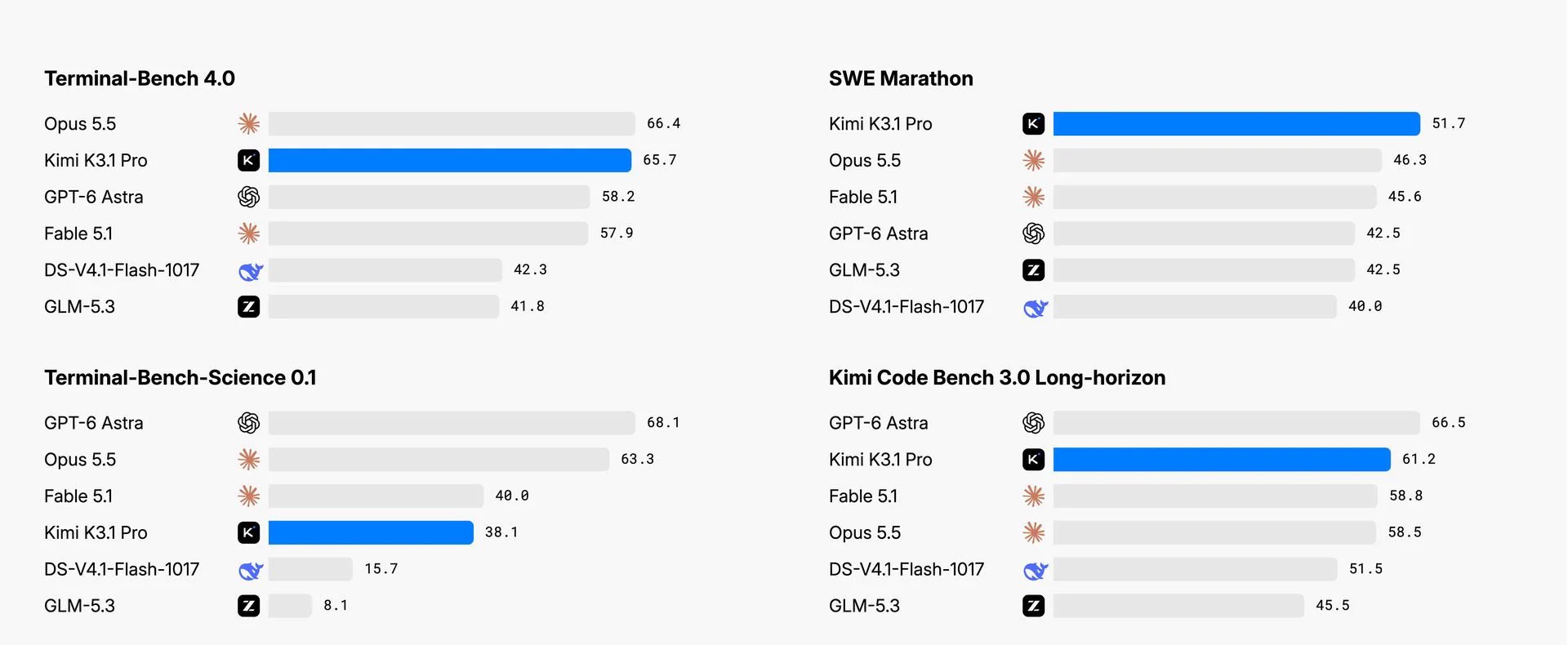
Kimi K3.1 Pro is a new model from Moonshot AI that scores 55 on the Artificial Analysis Intelligence Index, up 11 points from its predecessor, and ranks 4th overall. It has a 1M-token context window and API pricing of $2 per million input tokens and $10 per million output tokens. Weights are due by November 4. Moonshot removed cyber-related training data, which cut its internal vulnerability research score from 90.5% to 81%.
x.comthreadAdded 28 Oct 2026, published 27 Oct 2026🧠 AI  Benjamin👨💻 (@Hislordship_9) on X
Thread on Forever Security's finding that a planted Markdown "Engineering Work Guidelines" file in ~/Downloads made Codex add a "project-tools" MCP server to ~/.codex/config.toml. The server ran npm install function-color, a known malicious package, and started a child session with --dangerously-bypass-approvals-and-sandbox. Codex complied in over 90% of the firm's tests; Claude Code, via a CLAUDE.md setting ANTHROPIC_BASE_URL, about half. Advice: don't start agents in Downloads, review instruction files, and diff agent config.
x.comthreadAdded 27 Oct 2026, published 26 Oct 2026🛡️ Security- Vlad Tchouchkov (@tchouchkov) on X
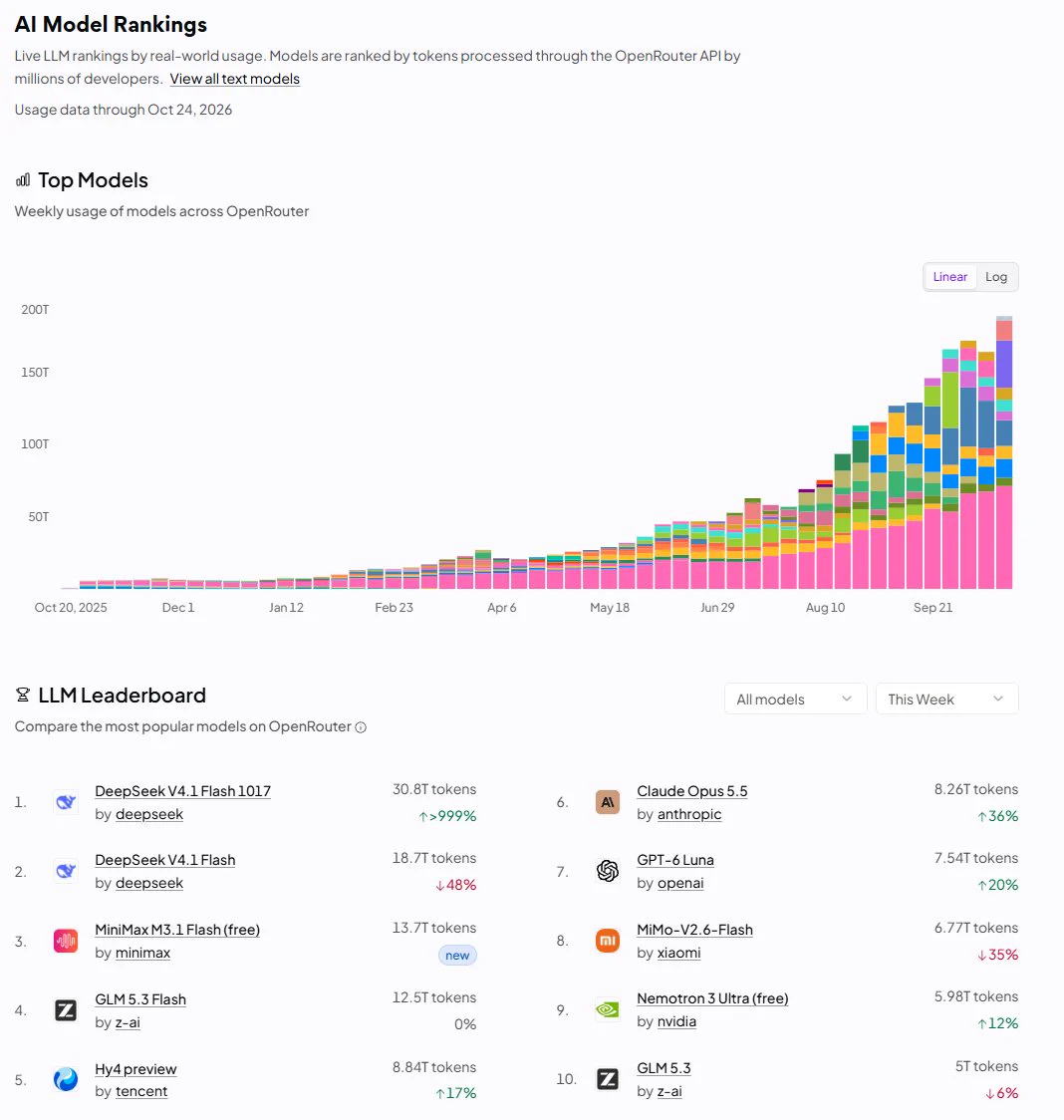
This X thread summarises OpenRouter usage charts. Weekly volume nears 200 trillion tokens, and open-weight models take 72.6% of tokens (136 trillion) against 27.4% for closed-weight models. Anthropic's daily average rose from about 0.6 to 2.25 trillion tokens alongside the Opus 5.5, Sonnet 5.5 and Haiku 5.5 releases. DeepSeek leads text requests at 26.5%, and agents plus coding account for 57.7% of spending. The author notes the data describes OpenRouter only.
x.comthreadAdded 26 Oct 2026, published 25 Oct 2026🧠 AI  ERC-8468: Agent Safety Framework (ASF)
ERC-8468 (Agent Safety Framework, ASF) is a draft Ethereum standard, now at revision 6, for recording which participants accepted which safety requirements for an AI agent, in which version, enforced where, and whether that acceptance is in force now. It defines a versioned Safety Specification, an on-chain Safety Binding with interveners holding suspend, resume and terminate rights, and a check() that returns Satisfied, NotSatisfied or Unknown. The reference guarded account and task-tender adapter passed 90 tests (64 negative) and a Sepolia run of 36 transactions.
 ethereum-magicians.orgthreadAdded 27 Oct 2026, published 25 Oct 2026🛡️ Security
- Draft ERC: Agent Safety Framework (ASF) — attributable adoption of versioned safety specifications
Agent Safety Framework (ASF) is a draft ERC (ethereum/ERCs pull request #2113) for an on-chain registry that records which participants adopted which versioned safety specification, for what subject and scope, and where it is enforced. It defines two objects (Safety Specification, Safety Binding) and a registry check returning Satisfied, NotSatisfied or Unknown. Two reference consumers and 73 tests (47 negative) are reported, and the post asks the community four design questions.
ethereum-magicians.orgthreadPublished and added 25 Oct 2026🧠 AI  Prasenjit Sarkar (@stretchcloud) on X
Post on the LiteLLM supply-chain compromise. Attackers spent eleven days in the GitHub org, ran a workflow on a throwaway branch to take twenty secrets including a GitHub App private key, then used stolen GitHub CLI OAuth tokens to publish malicious release 1.107.0 from a lookalike Berri-AI repo. A Python startup file harvested sixteen credential categories and LiteLLM proxy Postgres provider keys. Socket flagged the wheels in seven minutes.
x.comthreadAdded 26 Oct 2026, published 24 Oct 2026🛡️ Security Hajrë Hyseni | AI for Business (@hajra) on X
Kimi K3.1 Pro is a new model from Moonshot AI. According to a post by hajra, Artificial Analysis ranks it 4th in the world, 3 points behind Claude Opus 5.5. The API price is down by a third, and full open weights are promised by 4 November. The post gives no benchmark breakdown, licence or architecture details.
x.comthreadPublished and added 24 Oct 2026🧠 AI- Techjunkie Aman (@Techjunkie_Aman) on X
ns2jb is a software-only jailbreak for the Nintendo Switch 2 running firmware 23.0.1, announced in a post on X. It runs arbitrary native code, allows save dumping, reverse engineering and game modding, and reaches most peripherals via MMIO. It is tethered (rerun after reboot) and gives no CFW or full kernel control. The post says Mario Kart World has been modded with custom characters. It gives no technical detail on the exploit chain.
x.comthreadAdded 24 Oct 2026, published 22 Oct 2026🛡️ Security - Dark Web Intelligence (@DailyDarkWeb) on X
LiteLLM suspects its October 21 release compromise began with Claude Code responses containing GitHub CLI OAuth tokens that were written to logs of an internet-facing internal LiteLLM gateway. Attackers allegedly stole those tokens, used an organization-owner token to disable branch protections, and pushed poisoned artifacts from a lookalike repository. How they entered the gateway is unconfirmed, and this is not a proven Claude Code vulnerability.
x.comthreadAdded 25 Oct 2026, published 22 Oct 2026🛡️ Security - Muscle AI (@themuscleai) on X
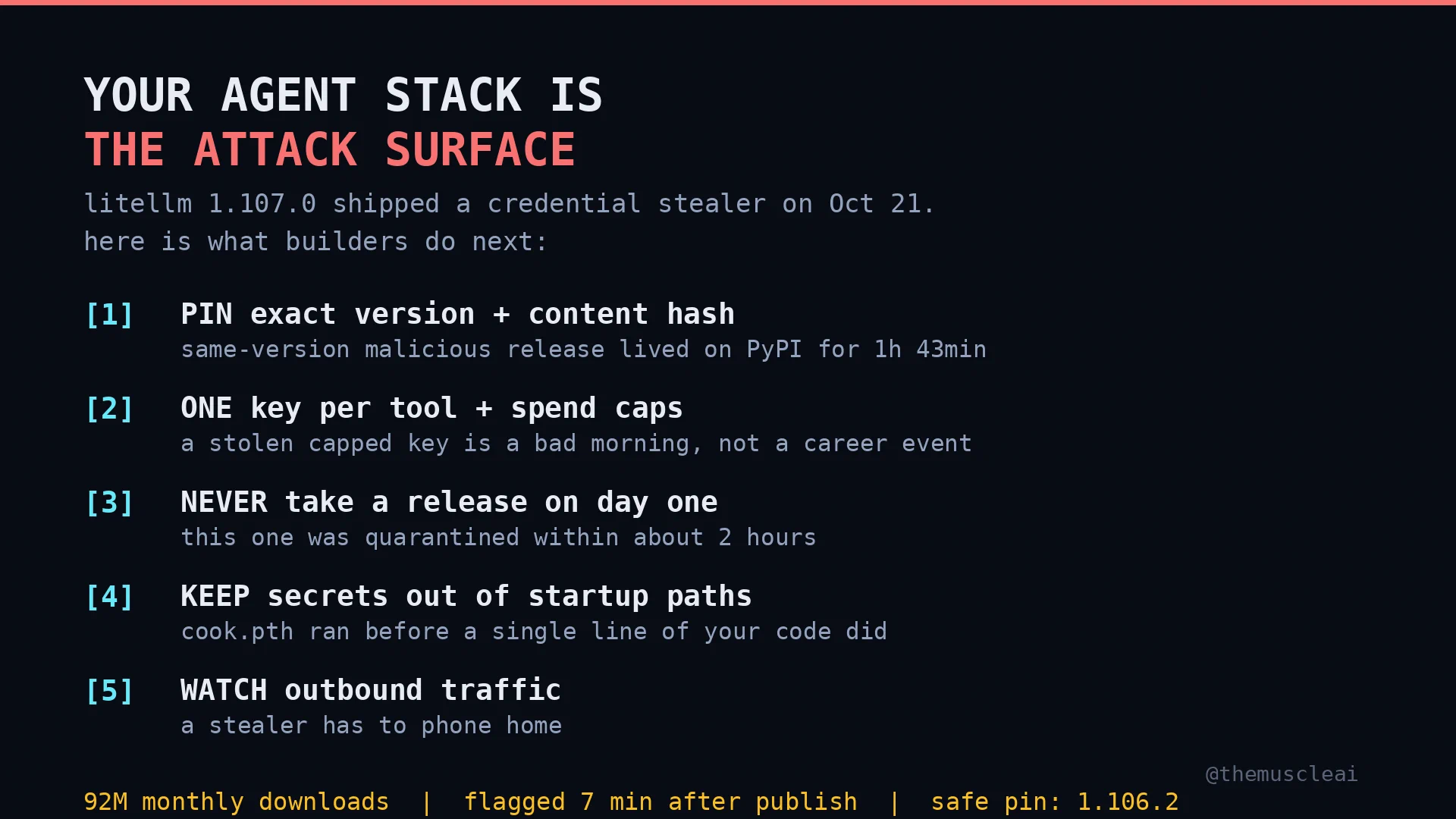
Post on the LiteLLM 1.107.0 PyPI compromise published 21 October 2026 and quarantined about 1 hour 43 minutes later. A malicious .pth file ran at Python startup and stole cloud credentials, private keys, browser data and AI tool auth files, then POSTed a tarball to an attacker endpoint. The author says attackers used stolen GitHub CLI OAuth tokens to push a trojanized commit chain and build official wheels. It lists five defenses: hash-pinned lockfiles, per-tool capped keys, release cooling periods, secret isolation and egress monitoring.
x.comthreadAdded 23 Oct 2026, published 22 Oct 2026🛡️ Security  Jonathan Rhyne (@jdrhyne) on X
A post on X about NVIDIA's Nemotron 3.5 Parse and its "#1 on ParseBench" claim. The author says the ranking holds only among open-weight models under 1B parameters. On the full board of 150+ models the model scores about 75, while the top is near 90. The post asks vendors who run a benchmark to print the filter on the chart.
x.comthreadAdded 23 Oct 2026, published 22 Oct 2026🧠 AI- Nagli (@galnagli) on X
Tweet by Gal Nagli (galnagli) saying a Gemini model turned the GitLab advisory for CVE-2026-110264 into a working heap exploit in 17 minutes, with the full chain done in about another hour. The flaw is a CVSS 10.0 unauthenticated RCE on self-managed GitLab servers, affecting 12 years of releases, found by joaxcar. The post links a The Hacker News article and gives no technical details of the exploit.
x.comthreadAdded 23 Oct 2026, published 22 Oct 2026🛡️ Security  SecureChap (@SecureChap) on X
Post describing a LiteLLM 1.107.0 PyPI compromise in which attackers used stolen GitHub CLI OAuth tokens from three engineers to trigger and approve the project-releaser workflow, producing eight malicious wheels and a tampered tarball. The wheels drop cook.pth, which runs at Python startup, and privcollect steals cloud tokens, keys, browser data, AI configs and LiteLLM proxy credentials, exfiltrating to litellm[.]dev/healthcheck. A second daemon polls a GitHub domain.txt hourly for new domains to fetch and execute. PyPI yanked the package the same day. The post is a single unsourced tweet.
x.comthreadPublished and added 22 Oct 2026🛡️ Security- Vishesh Raheja (@entropyconquers) on X
GPT Voice is a free, open-source Mac app by Vishesh Raheja that brings ChatGPT's dictation to any macOS app. A shortcut starts recording, and the transcript is pasted where the user is typing. It uses the ChatGPT Pro subscription, so it needs no API key or extra subscription. The author built it after Handy handled coding prompts poorly and they did not want to pay for Wispr Flow. The thread gives no details on local versus API transcription or latency.
x.comthreadAdded 22 Oct 2026, published 21 Oct 2026🧠 AI  brenz. (@brenzhills) on X
Krea 3 is an image generation and editing model from Krea. A post on X says its "Fast" variant scores 1125 Elo on the Artificial Analysis image editing leaderboard, against 1124 for Google's Nano Banana 2, while producing 10 images in the time Google produces 2. It also says the "Ultra" variant ranks in the top 4, behind only OpenAI models. The post gives no methodology or model details.
x.comthreadAdded 21 Oct 2026, published 20 Oct 2026🧠 AI Paulo Pierrondi | AI agents (@paulopierrondi) on X
Paulo Pierrondi's X post, part 9 of a series on installing MCP servers, lists a monthly review of installed servers. The checks are which tools the agent used, servers not called in weeks, overlapping tools that confuse the model, and whether each server still has an owner. A reply adds a decommissioning check: after removal, confirm the server's old credentials can no longer call the backend.
x.comthreadPublished and added 20 Oct 2026🧠 AI Nick Frichette (@Frichette_n) on X
Datadog Security Labs announcement, posted by Nick Frichette, of research on steering the evaluations of a prompt-injection detector called "Jev". The team's method cut its detection rate from about 83% to about 4% in their tests. They also used it to bypass LangChain's experimental tool-risk gating feature that is based on Jev. The tweet gives no method details and links to the full article.
x.comthreadAdded 21 Oct 2026, published 19 Oct 2026🛡️ Security- LinuxSecurity (@lnxsec) on X
A post from lnxsec on CI runners that accept outside pull requests while also holding registry credentials, cache write access, signing material or deployment tokens. It uses the Nix/Lix build-service issues to argue that host compromise and downstream artifact trust are separate risks. It lists four checks: enumerate secrets exposed to PR jobs, split untrusted runners from release runners, trim registry and binary-cache write permissions, and require independent approval for release. It links a linuxsecurity.com feature; CVE details are not in the post.
x.comthreadAdded 20 Oct 2026, published 19 Oct 2026🛡️ Security  FastFix AI (@FastfixAI) on X
FastFix AI thread giving six checks before installing a plugin, MCP server or skill for a coding agent. It starts from a 300K-star repo that an agent found writing to Claude Code, Codex and Copilot configs on install. Checks: read before running, inspect npm install scripts, verify the real repo against lookalike trojaned copies, pin versions, diff agent configs, and limit tokens and permissions.
x.comthreadAdded 19 Oct 2026, published 18 Oct 2026🛡️ Security- ERC-8447: Swarm AI Framework
ERC-8447 (Swarm AI Framework) is a draft Ethereum standard proposing an on-chain registry and charter model for swarms: purpose-bound agent collectives with a membership boundary, an objective with attainment rules and a declared collaboration structure. Executed terms are hashed into a frozen spec, while the charter is kept off-chain. The reference implementation has 85 Foundry tests and tender and ERC-8436 decision adapters. The thread asks reviewers about vocabulary, amendment classes and the ERC-8004 dependency.
ethereum-magicians.orgthreadAdded 19 Oct 2026, published 18 Oct 2026🧠 AI - [Draft ERC] Swarm AI Framework — registry and charter model for purpose-bound agent swarms
Ethereum Magicians discussion of a draft ERC, the Swarm AI Framework. It proposes a registry and charter model in which accounts, including autonomous agents, form, bound, run and dissolve purpose-bound swarms. A hashed on-chain SwarmSpec (roles with eligibility modules, phases, decision authorities, fallback timers) is paired with an off-chain Swarm Pack charter. Two-sided signed admission (EIP-712 / ERC-1271), challenge and substitution, and minor versus material amendments are included. Phase posture is a coordinate: executed boundary and admission, plus declared payoff, topology and coordination terms from a write-once vocabulary. This lets cooperation, competition, tenders, debate, ensembles and pipelines be expressed. It integrates with ERC-8004 agent identity and ERC-8436 decision adapters. The reference implementation is a non-upgradeable registry with five eligibility modules and a task-tender adapter. The post asks reviewers specific design questions on vocabulary, amendment classes, roster snapshots and digest kinds.
ethereum-magicians.orgthreadPublished and added 18 Oct 2026🧠 AI  🚨 AI News | TestingCatalog (@testingcatalog) on X
A TestingCatalog X post with two Daily AI Briefs (Oct 17 and the start of Oct 16), grouped by vendor. Oct 17 items include GPT-6 Astra Pro upgrades in ChatGPT, Codex context reuse and caching, Gemini 4 Argon in AI Studio Build, the open-weight MIT-licensed DeepSeek-V4.1-Flash-1017, Claude Code Review going GA, Perplexity's open Decider v1.2 models (27B and 4B), NVIDIA's 4B looped Nemotron Labs Dory 1.0, Reflection's Apache-2.0 Beam, Cursor cloud-agent canvases and Tencent's Hy Memory 2.0. Oct 16 begins with Meta's open-weight Muse Spark Open, an 816B-total, 42B-active MoE with a 1M-token context. It gives a quick snapshot of the week's open-weight and coding-agent releases.
x.comthreadAdded 18 Oct 2026, published 17 Oct 2026🧠 AI- Nicholas Martin (@ndgmlondon) on X
An X post advises auditing every MCP write tool against the database role it actually runs under. A shared service key lets prompt injection trigger unapproved writes, so each agent session should get a read-only role, with a test that writes are denied. Replies note that MCP servers often inherit ambient host credentials or can escalate through a second connection pool, and suggest also testing that another tenant's rows are unreadable with the same role.
x.comthreadAdded 18 Oct 2026, published 16 Oct 2026🛡️ Security - Harrison Kinsley (@Sentdex) on X
Sentdex reacts to Artificial Analysis ranking NVIDIA's Nemotron 3.5 Super VL (120B total, 12B active MoE) as the top US open-weights model, scoring 26 on the Intelligence Index. That edges out Thinking Machines' Inkling Small (26), NVIDIA's Nemotron 3 Ultra (23) and Meta's Muse Glimmer (17). Sentdex's informal tests at vanilla settings show over 550 tok/sec, and they suspect it would rank higher on agentic coding. They see it as a candidate for a fast local coding agent model.
x.comthreadAdded 16 Oct 2026, published 15 Oct 2026🧠 AI  Vaibhav Sisinty (@VaibhavSisinty) on X
Social post reporting Meta's release of Muse Spark Open, described as the most capable US open-weight model: 816B total and 42B active parameters, a 1M-token context, and text, image, video and audio input in one model. It is pitched at coding and agentic work and tuned to run on two M5 Ultra Mac Studios, with weights available at release. The poster notes that in Meta's own chart, China's Kimi K3 and GLM 5.3 still beat it on coding.
x.comthreadAdded 16 Oct 2026, published 15 Oct 2026🧠 AI- Victor (@VMG_CU) on X
A social post summarising Elastic's REF8801 campaign. A fake startup accelerator offered founders free Claude/Gemini credits plus a coding agent. The agent was a repackaged open-source project that set OPENROUTER_BASE_URL to an attacker-controlled endpoint and added its own MCP server, so victims' prompts and code went to the attacker. It shows how a trojanised AI coding agent can hijack the LLM base URL and add an MCP server for exfiltration.
x.comthreadAdded 15 Oct 2026, published 14 Oct 2026🛡️ Security - Codex CLI installs a persistent, self-updating background daemon by default
GitHub issue asking OpenAI to make `daemon_auto_start` opt-in in Codex CLI 0.157.0. By default, opening an interactive session starts a persistent `codex app-server --managed-daemon` that outlives the terminal. It also copies a ~374 MB platform package into ~/.codex/packages/app-server-daemon and runs a detached hourly `pid-update-loop` updater. The daemon keeps the first session's environment (proxy variables, cwd, direnv values), which the reporter ties to hook bugs #42457 and #37537. Comments confirm the problem on Windows and add the workaround (`codex features disable daemon_auto_start`, kill the updater, remove the package dir). They also note that `daemon stop` leaves the updater running and that the option is missing from the config docs. One commenter proposes an "execution receipt" (CLI version, daemon binary digest, generation, inherited-environment generation).
 github.comthreadPublished and added 12 Oct 2026🧠 AI
- Codex CLI installs a persistent, self-updating background daemon by default
GitHub issue asking OpenAI to make Codex CLI's daemon_auto_start opt-in. Since 0.157.0, opening a session starts a persistent app-server daemon with no TTY. It copies a ~374 MB platform package into ~/.codex/packages, so the running binary is decoupled from the npm-installed version. A detached hourly updater restarts the backend, and the daemon pins the first session's environment variables (proxy settings, direnv-style secrets like GH_TOKEN) and cwd. The thread also reports that `daemon stop` leaves the pid-update-loop updater alive, gives a manual workaround, and proposes an "execution receipt" (client version, daemon binary digest, generation, updater state, environment generation) so clients can tell which binary and environment served a turn.
github.comthreadPublished and added 12 Oct 2026🛡️ Security - Arindam Majumder 𝕏 (@Arindam_1729) on X
A tweet describing an independent open-source project, "Free Claude Code", that lets Claude Code run against non-Anthropic providers such as DeepSeek and Kimi. It supports switching models, configuring fallback providers and using providers' free tiers, launched via `fcc-claude` from the terminal or an IDE. It states the limits: free usage follows provider quotas, some providers still need API keys, it does not unlock Anthropic's own models, and it is not affiliated with Anthropic. The page also shows a quoted article on a 5-layer setup for running coding agents in YOLO/auto-approve mode safely.
x.comthreadPublished and added 10 Oct 2026🧠 AI - Ned Peterson (@NedPeterson99) on X
A post summarizing a joint FBI and six-country advisory on actors tied to Integrity Technology Group (the sanctioned Chinese firm linked to Flax Typhoon and the Raptor Train botnet). They password-sprayed Microsoft 365 and Exchange accounts over EWS, OWA, ActiveSync and PowerShell with EBurst. They then drained mailboxes with a PHP bot over Exchange Web Services and an office-cli utility using stored client ID, tenant ID and secret values, and exposed the stolen email to third parties through a web app, in some cases restricted to Xiamen IP addresses. Victims were in government, law enforcement, healthcare and religious organizations across Southeast Asia, Africa and North America, with activity since at least January 2021. Defensive takeaways: enforce MFA on every legacy path, retire basic auth and EWS, audit OAuth apps and service principals with mail-read rights, and alert on bulk mailbox pulls.
x.comthreadAdded 11 Oct 2026, published 9 Oct 2026🛡️ Security - James Berthoty (@JamesBerthoty) on X
James Berthoty argues that AI guardrails for first-party AI features should be treated as an extension of cloud/product security, not tied to employee-usage monitoring. Guardrails (prompt injection defense, content filtering, goal alignment) are available from AI security vendors, gateways, frontier providers and SDKs. He recommends deploying in-depth guardrails through developer SDKs or an existing cloud runtime/CADR provider, because those see what happens on the workload (such as a prompt injection leading to workload takeover, or the files a malicious MCP call wrote). Dedicated AI security vendors offer an integrated policy engine and deeper AI red-teaming, but they are usually run by internal IT rather than cloud/product security teams.
x.comthreadAdded 10 Oct 2026, published 8 Oct 2026🛡️ Security - Itsvishal (@itsvishaltwt) on X
A tweet reports that Mistral has announced Mistral Large 4, internally nicknamed "Le Chonk," a mixture-of-experts model with roughly 1 trillion total parameters and 49 billion active parameters. It is described as natively multimodal and state-of-the-art on critical workloads including cyber defense, with API access starting immediately and an open-weight release planned for late October.
x.comthreadPublished and added 6 Oct 2026🧠 AI - Franco Naumow. (@naumowf) on X
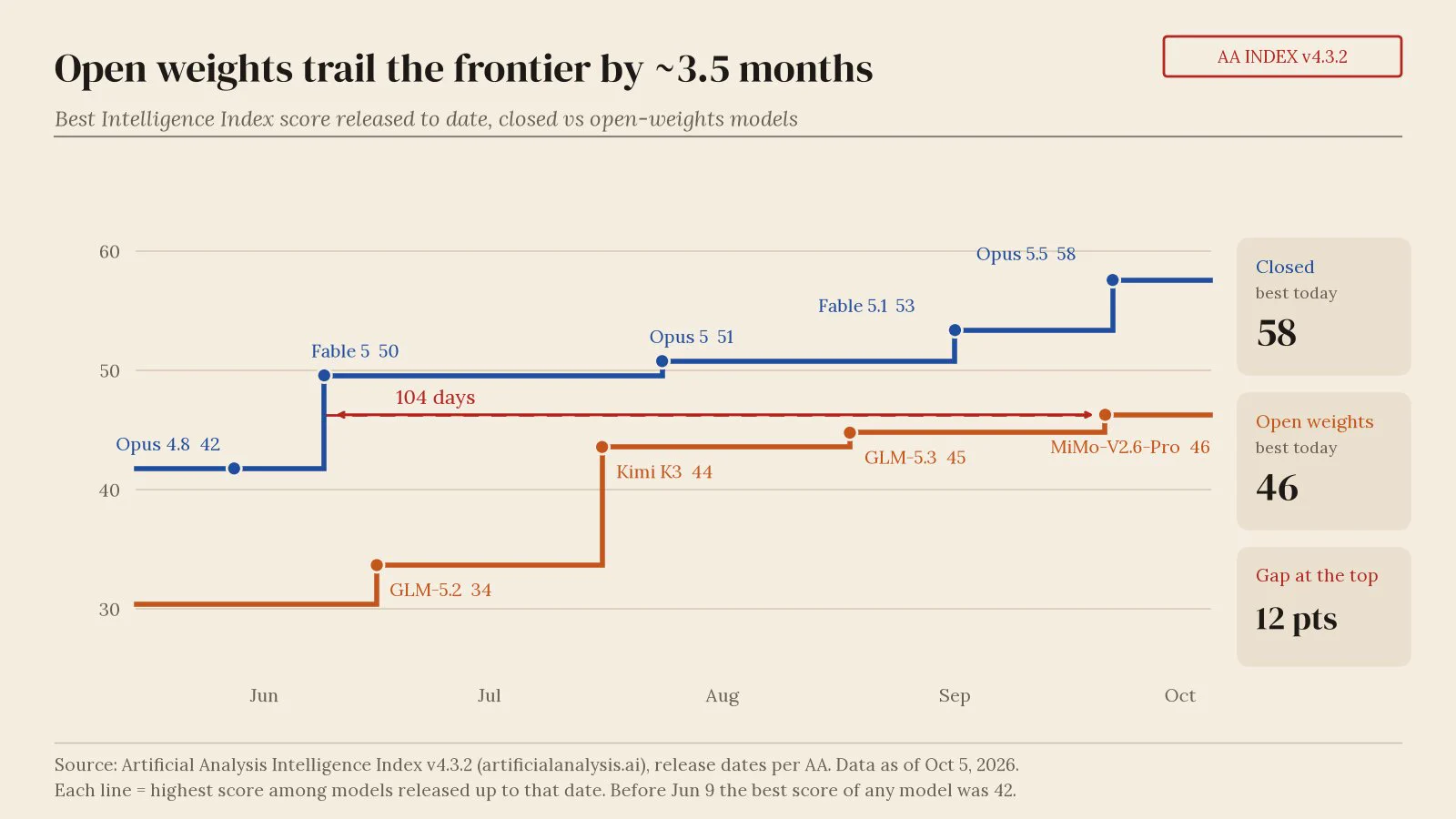
A tweet analyzing the Artificial Analysis Intelligence Index v4.3.2 finds that the best open-weights model, Xiaomi's MiMo-V2.6-Pro (released Sep 21, scoring 46), still trails what would have been the top closed frontier score as of 104 days earlier — Claude Fable 5's 50 on Jun 9, which itself surpassed the prior best (Claude Opus 4.8 at 42). It notes the current top-of-leaderboard gap is 12 points, with Claude Opus 5.5 (max) scoring 58, framing the persistent ~3.5-month lag of open weights behind the closed frontier.
x.comthreadPublished and added 5 Oct 2026🧠 AI - Shah Sheikh (@shah_sheikh) on X
A tweet reporting that Apple patched a CoreGraphics zero-day, CVE-2026-86950, that may have been exploited in targeted attacks before the fix, and that a public proof-of-concept exploit has now been released. It links out to a fuller Security Affairs article for details on the vulnerability and PoC.
x.comthreadAdded 2 Oct 2026, published 1 Oct 2026🛡️ Security - Average AI Bro (@AverageAiBro) on X
Claude Code added a `claude --desktop` command that opens the Desktop app on the current directory or a resumed/continued session, plus `claude plugin configure` to view a plugin's options. Bundled .mcpb MCP servers can now have their settings set at `plugin install --config` time so they start immediately without a manual Configure step. The post also notes CLAUDE_CODE_DISABLE_WEB_FETCH to disable WebFetch and an allowedProviders setting to restrict which API providers a managed machine can use.
x.comthreadPublished and added 30 Sep 2026🧠 AI - Aditya Agrawal (@exploitprotocol) on X
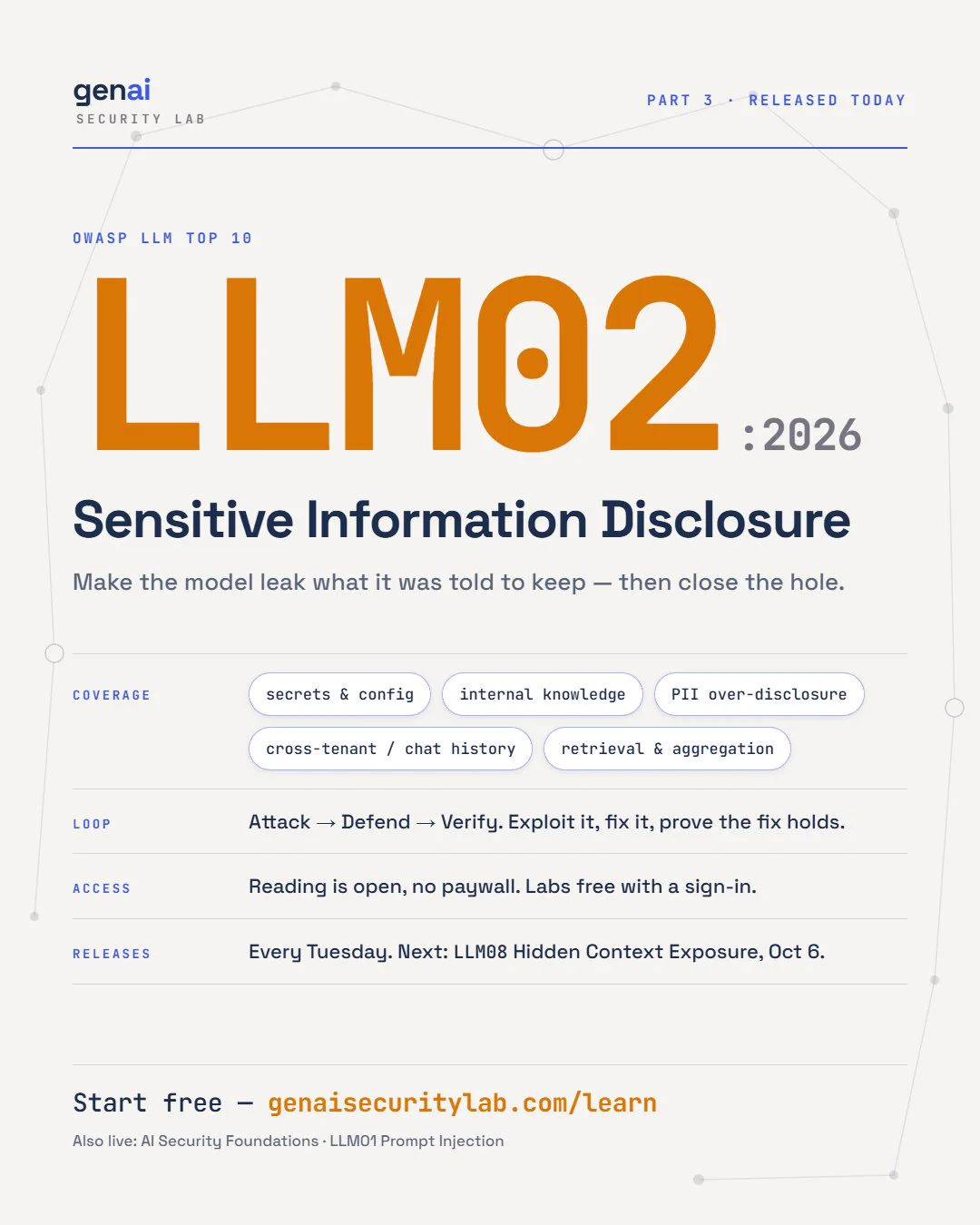
Announcement thread for part 3 of the free Learn AI Security series at genaisecuritylab.com, covering OWASP LLM02 Sensitive Information Disclosure in LLM applications. It walks through failure modes - leaked secrets/API keys via model context, internal knowledge leakage, personal-data over-disclosure, cross-tenant/conversation-history leakage, and RAG retrieval/aggregation leaks - and offers live in-browser attack/defend/verify labs comparing the issues to IDOR and multi-tenant isolation testing in traditional web apps. The author notes the series continues weekly, with LLM08 Hidden Context Exposure scheduled next.
x.comthreadAdded 1 Oct 2026, published 30 Sep 2026🛡️ Security - ERC-8424: Confidential Real World Asset Token
A security review posted on Ethereum Magicians critiques draft ERC-8424 (Confidential Real World Asset Token, extending ERC-7984), pointing out that its confidentialCanTransfer and confidentialAvailableBalanceOf functions have no caller restriction on who can resolve the returned FHE pointer, enabling any party to binary-search an encrypted balance to plaintext in at most 64 oracle calls. It also flags that the spec's revert clause for amount-dependent rules (vesting, balance caps) leaks a disclosure bit even without decryption, and recommends narrowing reverts to plaintext-only rules and restricting pointer resolution the way OpenZeppelin's ERC7984Freezable.confidentialAvailable already does via FHE.allow(amount, account).
ethereum-magicians.orgthreadAdded 29 Sep 2026, published 25 Sep 2026🛡️ Security - Standard for "transferable to arbitrary addresses" on tokenized RWAs? (locked v4 pools quoted in tokenized stocks)
An Ethereum Magicians forum thread dissects a novel rug/bricking vector emerging from a launchpad (sender.family) that locks 100% of token supply forever into a single one-sided Uniswap v4 position, where the quote asset can be a KYC-gated tokenized stock (Ondo's NVDA/TSLA/AAPL tokens) rather than ETH or a stablecoin. Because Uniswap v4 routes all pool balances through a shared PoolManager singleton and pays swap/fee output to arbitrary addresses, the RWA issuer must permanently allowlist the PoolManager and any counterparty; if the issuer later tightens its transfer-registry rules, the permanently locked pool becomes irrecoverable with funds stuck inside. The author notes the launchpad's current mitigation is only an empirical point-in-time transfer test (moving a balance between two addresses) against an asset with an admin-controlled, stateful ERC-3643 canTransfer function, and asks whether there's any way to verify "transferable to arbitrary addresses" onchain before pool creation, and whether permanent lockers should categorically refuse upgradeable/pausable quote assets.
ethereum-magicians.orgthreadAdded 29 Sep 2026, published 24 Sep 2026🛡️ Security - Pyro (@0x3b33) on X
A roundup of three open-source AI-assisted smart contract security scanners: pashov/skills (solidity-auditor + x-ray pre-audit + fuzz suite generation, fast/cheap feedback), PlamenTSV's autonomous 8-phase agent covering EVM, Solana, and Move that ships PoCs with findings, and Trail of Bits' skills repo with 40+ security skills for contract audits, differential review, and static analysis. Useful pointer to emerging AI-agent-based smart contract auditing tooling.
x.comthreadPublished and added 7 Sep 2026🛡️ Security - Raytar (@Raytar) on X
A Twitter/X thread explaining Claude Code's /goal and /loop commands, which let Claude repeatedly prompt and check itself against a defined finish condition rather than requiring a human to babysit each turn. It contrasts single-prompt workflows (which can produce confidently wrong output, e.g. fabricated sources) with loop-based workflows that self-verify, and gives a copy-pasteable "charter" template covering goal, work discovery, self-checking, state persistence (LOOP-STATE.md), and stop conditions.
x.comthreadAdded 22 Sep 2026, published 31 Jul 2026🧠 AI - VulHunt
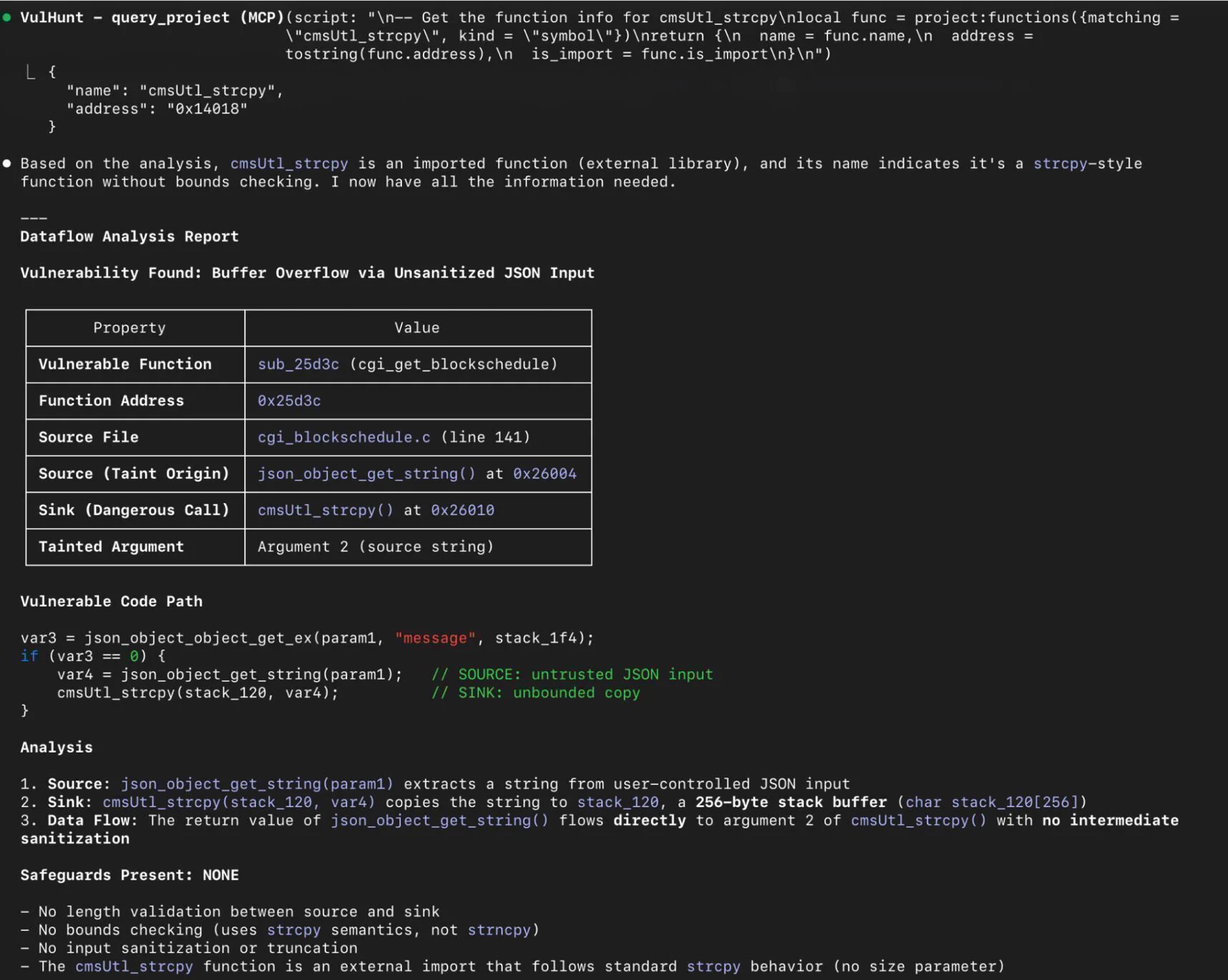
X/Twitter announcement thread pointing to VulHunt (vulhunt.re), a vulnerability detection framework released by firmware/binary security firm Binarly, alongside a multi-part blog series on binarly.io covering the tool and an "agentic vulnerability" research angle. The tweet contains only the tool name, links, and hashtag with no inline technical explanation of the framework's methodology.
x.comthreadAdded 3 Sep 2026, published 29 Jul 2026🛡️ Security - cr3ghost (@cr3ghost) on X
A tweet by @cr3ghost pointing to Azeria Labs (azeria-labs.com, by @Fox0x01) as a comprehensive free curriculum for ARM security research, covering ARM assembly from scratch, shellcode development, stack overflows, ROP chains, heap exploitation, iOS kernel heap grooming, TrustZone internals, GDB debugging, and QEMU lab setup. It links to specific Azeria Labs series on ARM assembly and shellcoding. Useful as a curated entry point for anyone starting ARM exploit development.
x.comthreadPublished and added 10 Jun 2026🛡️ Security - X Post by @ale_sp_brazil
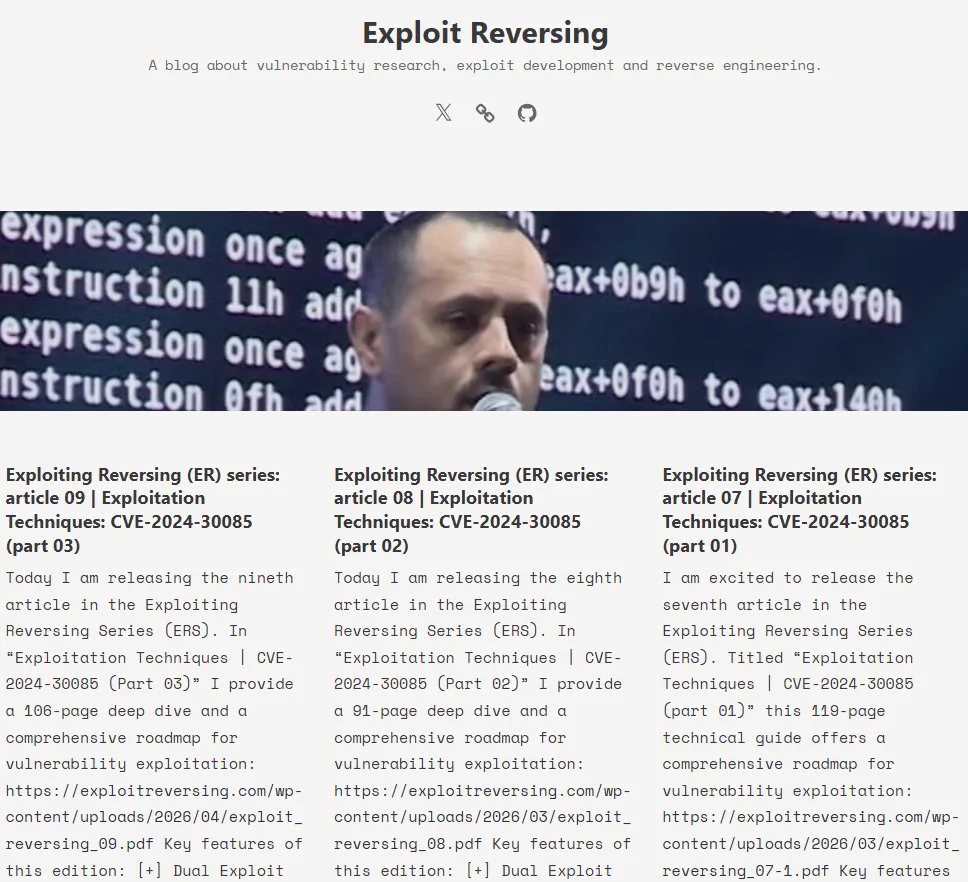
A tweet by @ale_sp_brazil rounding up all nine parts of the Exploiting Reversing Series (ERS), a technical blog series on exploitreversing.com covering exploit development against real-world targets including Windows, Chrome, macOS, iOS, and hypervisors, totaling over 1000 pages of content published from 2023 to 2026. The author announces a hiatus to focus on new security research projects to be announced later.
x.comthreadAdded 3 Sep 2026, published 14 May 2026🛡️ Security - uk_daniel_card
A short first-person thread describing stealing credentials from a running system as an unprivileged userland process: sniffing the clipboard to grab passwords copied out of KeePass, scraping process memory and SQLite databases for stored passwords/usernames/tokens/cookies, hunting for files like password.txt, and reading Chrome/browser credentials straight out of RAM as they sit in cleartext in text boxes. The author's point is that once someone else's code is running on your machine, it's practically impossible to fully harden every surface — clipboard, memory, and disk are all exposed.
x.comthreadAdded 3 Sep 2026, published 13 May 2026🛡️ Security