 The Datacenter Backlash Goes Bipartisan: Next Week's Midterms and the 2028 Buildout
SemiAnalysis analysis of how the November 2026 US midterms could affect datacenter buildout. About 75% of the 33.8 GW due in 2027 across the top 20 states is already under construction, but 43.5 GW of 2028 additions sit in 13 states with pending approvals. The biggest risk is a prolonged Texas TCEQ permit freeze. Texas holds close to 30% of 2028 GW, and nine of 20 nominees back a pause.
 newsletter.semianalysis.comarticlePublished and added 1 Nov 2026🧠 AI
 Rekt - SingularityNET - Rekt
SingularityNET exploit (19 September 2026): attackers with signing authority exposed through a cloud infrastructure breach drained 8.72M FET from the Ethereum bridge converter, then minted about 2.3 billion AGIX, NTX, WMTX and CGV. Rekt's transaction-level reconstruction puts gross liquid proceeds near $2.29M, not the $16.77M headline, and traces laundering via Chainflip, Baltex and THORChain. It notes conversionIn() skipped checkLimits() and trusted a single EOA signature.
 rekt.newswriteupAdded 29 Oct 2026🛡️ Security
 Decompose, Estimate, Select: Coverage-Aware Context Construction for Long-Form RAG
Decompose, Estimate, Select is a coverage-aware retrieval pipeline for long-form RAG. It splits a query into subquestions, ranks candidates with a coverage-trained bi-encoder, predicts a document-by-subquestion coverage matrix with a cross-encoder, and picks documents by greedy maximum-marginal coverage. On TREC RAG 2024, α-nDCG@10 rises from 0.625 to 0.702 (gold-nugget bound 0.718). A grounded self-feedback loop raises V_strict by 0.086 over two passes.
 arxiv.orgpaperAdded 31 Oct 2026, published 29 Oct 2026🧠 AI
- RetroChessBench: A Benchmark for Reconstructing and Proving Chess Histories
RetroChessBench is a 12-task benchmark for retrograde chess: reconstructing legal game histories, exact-length constructions, unique endings and exhaustive answer sets, with references, rubrics and a terminal-reward RL environment. GPT 6 Astra High fails to give the required final answer in 22 of 24 attempts without tools and 18 of 24 with code execution. Mean terminal RL rewards are 14.75% and 27.19%. The authors link the failures to scarce worked derivations in web training data.
arxiv.orgpaperAdded 31 Oct 2026, published 29 Oct 2026🧠 AI - AxisQ: Depth-Adaptive Channel--Frequency Quantization for Camouflaged Object Detection
AxisQ is a post-training quantization framework for camouflaged object detection (COD) that allocates activation bits by feature depth. It uses the channel domain for shallow features and the local-frequency domain for deep features, under a fixed per-layer average bit budget. It adds a boundary-aware Hessian approximation for reconstruction. On CAMO at W2A2, weighted F-measure improves 12.7% for CFRN and 33.3% for CamoFormer-P over the strongest baselines.
arxiv.orgpaperAdded 28 Oct 2026, published 27 Oct 2026🧠 AI  Alg\{Ossa\}: Decentralized Secure Aggregation with Rotating Committees and Eventual Delivery
AlgOssa is a decentralized secure aggregation protocol built on Ossa, a generic committee-aided, single-server construction for one-shot clients (following OPA and Willow, CRYPTO 2025). Ossa realizes secure aggregation with non-selective abort against a malicious server. AlgOssa adds Algorand-style sortition to rotate leaders and committees, bounds the chance of an honest server, and gives eventual delivery. Classical and post-quantum routes are evaluated.
 eprint.iacr.orgpaperAdded 28 Oct 2026, published 27 Oct 2026🛡️ Security
- Then there is prompt injection, a malicious email, ...: The Wild Wide West of OpenClaw Agentic System Security
An empirical study of security concerns in the OpenClaw AI personal assistant framework, using 25K+ posts from 13 subreddits (162 security-relevant) and 358 security-tagged GitHub issues (180 retained). It maps 521 CWE instances across 59 weakness types, concentrated in access control, sensitive-data exposure, injection and unsafe execution. It extracts 543 practitioner mitigations into seven strategies and reconstructs a sensitive-data exposure path with dummy secrets.
arxiv.orgpaperAdded 28 Oct 2026, published 26 Oct 2026🛡️ Security - Private Information Retrieval with Accountability at Erasure-Optimal Server Redundancy
SynTrace is a single-round compiler that adds accountability to linear private information retrieval (PIR). The client mixes the retrieval query with m audit queries, so audit syndromes identify up to d deviating servers among t colluding ones before reconstruction. The paper proves perfect query privacy and zero false identification within the threshold. For Shamir-based PIR it needs k=t+d+1 servers. For a 32 KiB record from a 1 GiB database it uses 2.25 MiB, against 8.96 MiB for the Eriguchi, Kurosawa and Nuida (TCC 2022) homomorphic-MAC construction.
eprint.iacr.orgpaperPublished and added 26 Oct 2026🛡️ Security - SymLift: Neural Semantic Lifting for Compile-Free Vulnerability Detection in Context-Incomplete Code Fragments
SymLift is a compile-free vulnerability detection framework for code fragments that lack project context. A fine-tuned LLM reconstructs control-flow, data-flow, memory and resource relations as a constrained LLVM-like IR, and a deterministic parser turns it into facts for Datalog rules that give findings with derivation traces. SymLift-Qwen-7B reaches 94.41% Target-F1 on FormAI and 91.66% micro-averaged Target-F1 on MegaVul.
arxiv.orgpaperAdded 28 Oct 2026, published 25 Oct 2026🧠 AI - IntentDelta: A Human-Constructed Benchmark for Evolving User Intent
IntentDelta is a human-constructed multi-turn benchmark of 638 trajectories and 3,766 turns across WebShop and TravelPlanner. Each turn pairs a user utterance with a cumulative intention state and human reference actions. Across eleven agents, average Intention Recovery is 33.1% in TravelPlanner and 44.7% in WebShop, and average Action Score is 31.6% and 41.0%. Agents lose earlier requirements and confuse soft preferences with must-have constraints.
arxiv.orgpaperAdded 27 Oct 2026, published 24 Oct 2026🧠 AI - Extraction meets Distillation - cryptanalytic techniques to recover parameters from a Deep Neural Network
Extraction meets Distillation is an IACR ePrint paper (2026/2628, CSCML 2026) that combines cryptanalytic weight-direction extraction with label-based distillation to reconstruct fully connected neural networks. It adapts a ReLU extraction implementation to Leaky ReLU and proves conditional bounds for direction recovery and sign selection. On CIFAR-10 victims, reconstructed models reach 56.40% and 58.29% agreement. It separates label requests from privileged access and notes that prediction agreement does not identify parameters.
eprint.iacr.orgpaperAdded 26 Oct 2026, published 24 Oct 2026🛡️ Security - When Elliptic-Curve Semiprimality Certificates Reveal Factors
The paper formalizes elliptic-curve semiprimality certificates by adapting the Goldwasser-Kilian primality criterion. For certificates built with complex multiplication, a norm-lattice reconstruction factors N from (N, S, D) alone in expected polynomial time. The author uses it, plus public-point and quadratic-twist attacks, to factor Reble's 1084-digit and Broadhurst's 5061-digit moduli, and shows that hidden-cofactor, withheld-CM-map and private-isogeny repairs also fail.
eprint.iacr.orgpaperAdded 26 Oct 2026, published 24 Oct 2026🛡️ Security - Tight Post-Quantum Multi-Key Security of the FX Construction
Rentaro Shiba and Tetsu Iwata prove a tight multi-key security bound for the FX construction (the DESX generalization) in the quantum ideal cipher model. Security holds up to about 2^((n+κ)/3) total classical and quantum oracle queries against fully adaptive adversaries, for any number of keyed instances μ≥1. This improves their ToSC 2026 bound and matches the offline Simon's algorithm attack in the exponent.
eprint.iacr.orgpaperAdded 24 Oct 2026, published 23 Oct 2026🛡️ Security - Tampered ML: Evaluating LLM Judgment of Machine Learning Research
Tampered ML is a benchmark of 1,858 item-pairs, each pairing an experiment proposal reconstructed from a published ML paper with a minimally edited version that adds a targeted methodological flaw. Models must pick the sounder proposal in both presentation orders. A human study estimates 86% of items are valid (95% CI 81-91%). Opus 5 reaches 77.9% accuracy, and models are sensitive to order and favor flawed designs that look more specific, transparent, or conventional.
arxiv.orgpaperAdded 26 Oct 2026, published 23 Oct 2026🧠 AI - Field Notes: Reconstructing an Attacker’s Workflow
Field note from dfir.ch on PowerShell scripts an attacker left on disk during an incident: a file-watching command runner using Invoke-Expression, a fake Windows credential prompt that validates passwords via Start-Process and logs them in cleartext, AD computer enumeration with WMI access testing, and SMB share discovery via NetShareEnum. It notes where script labels overstate what they prove and lists hunting strings for Event IDs 4104, 4103, 4688 and Sysmon 1.
 dfir.chwriteupAdded 24 Oct 2026, published 22 Oct 2026🛡️ Security
- [AINews] OpenAI’s Patch the Planet program is 1 of 2 parties to discover PHP2Shell vulnerabilities in core PHP affecting 70% of the web, using GPT-5.6 Sol; coordinated response over 2 months
This AINews issue (20 to 21 October 2026) leads with PHP2Shell, two PHP-engine memory-corruption bugs (CVE-2026-109618 and CVE-2026-109619). Calif researchers found them with GPT-5.6 Sol under OpenAI's Patch the Planet, and Wiz reportedly found them independently with Gemini 4 Argon. It reconstructs the two-month coordinated response, Cloudflare WAF stopgaps and NSA guidance, and the dispute over vetted researcher access to models. Only the first 40,000 of 114,281 characters were reviewed.
 latent.spacearticleAdded 23 Oct 2026, published 22 Oct 2026🧠 AI
 [AINews] OpenAI’s Patch the Planet program is 1 of 2 parties to discover PHP2Shell vulnerabilities in core PHP affecting 70% of the web, using GPT-5.6 Sol; coordinated response over 2 months
AINews issue of 20-21 October 2026 whose top story reconstructs PHP2Shell (CVE-2026-109618, CVE-2026-109619), two PHP-engine memory-corruption bugs with reported pre-auth RCE against WordPress, Drupal and Joomla. It covers the two-month coordinated disclosure, independent discovery by Calif/OpenAI (GPT-5.6 Sol) and Wiz, Cloudflare WAF stopgaps and NSA guidance. It flags missing primary sources: fixed versions, CVSS and leak details.
latent.spacearticlePublished and added 22 Oct 2026🛡️ Security [AINews] OpenAI’s Patch the Planet program is 1 of 2 parties to discover PHP2Shell vulnerabilities in core PHP affecting 70% of the web, using GPT-5.6 Sol; coordinated response over 2 months
AINews issue of 20-21 October 2026 whose top story reconstructs PHP2Shell, two PHP-engine memory-corruption flaws (CVE-2026-109618 and CVE-2026-109619) with reported pre-auth RCE against WordPress, Drupal and Joomla. It covers the two-month coordinated response, separate discovery by Calif/OpenAI (GPT-5.6 Sol) and Wiz (Gemini 4 Argon), Cloudflare's WAF stopgap and NSA guidance. It lists open gaps: fixed versions, leak details, exploitation versus scanning.
latent.spacearticleAdded 23 Oct 2026, published 22 Oct 2026🛡️ Security- SoK: Design-Level Backdoors in Block Ciphers Constructions, Detection, and Key Recovery
SoK on design-level backdoors in block ciphers. It places four published designs (Rijmen and Preneel, Paterson, Bannier and Filiol, Peyrin and Wang) in one taxonomy and gives a sound algorithm that recovers a partition trapdoor from S-box tables. It attacks KG-DES, BEA-1 and LowMC-M: KG-DES key recovery takes minutes, and the LowMC-M MALICIOUS backdoor yields the key from 35 to 409 queries. Trapdoors hidden in linear layers leave no trace, so the authors recommend deriving constants verifiably from a public seed.
eprint.iacr.orgpaperAdded 24 Oct 2026, published 21 Oct 2026🛡️ Security - Protection Is Not One Event: A Survey of RAG Protection Research by Measured Endpoint
Survey and human-coded evidence map of 118 RAG defense papers, organized by measured endpoint across a seven-family taxonomy (content disclosure, formal privacy proxies, access control, corpus-use detection, pipeline integrity). Only 17.8% of studies use disclosure or reconstruction as the primary endpoint, and most use non-adaptive attacks on general QA data. A testbed shows a normalized 8-gram guard cuts 20-token copying to 0.0%, yet a three-query adaptive attacker recovers 48.3% of hidden facts on Qwen3-8B.
arxiv.orgpaperAdded 24 Oct 2026, published 21 Oct 2026🛡️ Security - Reverse Engineering IVXV: A Specification and Security Analysis of Estonia’s Internet Voting System
Reverse Engineering IVXV is an October 2026 ePrint paper by Tingfeng Yu and Thomas Haines that reconstructs a specification of Estonia's IVXV internet voting system from public source code and documentation, with an executable TLA+ model checked in TLC. It analyses individual and universal verifiability, privacy, coercion resistance and eligibility, compares IVXV with Belenios and Swiss Post, and reports new vulnerabilities, some confirmed with proof-of-concept tests, plus mitigations.
eprint.iacr.orgpaperAdded 24 Oct 2026, published 21 Oct 2026🛡️ Security - Code2Video-Compass: A Comprehensive Benchmark for General-Purpose Code-Based Video Generation across T2V, I2V, and V2V
Code2Video-Compass is a benchmark of 2,104 tasks for code-based video generation, where multimodal LLMs write executable programs that produce complete videos from text (T2V), image (I2V) or video (V2V) inputs. Tasks span 10 categories and 24 subtypes. Scoring uses 12 objective metrics and five MLLM-judge metrics. Across 15 proprietary and open-weight models from nine families, performance falls as construction, dynamic animation and state-dependency complexity rise.
arxiv.orgpaperAdded 22 Oct 2026, published 20 Oct 2026🧠 AI  From JavaScript to Renderer Code Execution: Three V8 Vulnerabilities and Two v8CTF Flags | depthfirst
Depth First Security's write-up describes three V8 bugs found using its dfs-large1 research tooling: CVE-2026-78938, a type confusion in Promise.prototype.finally that lets an internal helper be constructed and return a primitive; CVE-2026-79236, a TurboFan load-elimination bug that keeps a stale property-array pointer after object migration; and a shared WebAssembly memory sandbox escape (issue 546253900) caused by mismatched backing-store registration during serialization. It walks through turning each memory bug into addrof/fakeobj primitives, chaining either with the sandbox escape to reclaim a freed V8 isolate via a WebSocket allocation, and pivoting through a CFI-constrained ROP chain to achieve Chrome renderer code execution, earning two v8CTF flags. Fixes landed between August 20 and 25, 2026.
 depthfirst.comwriteupAdded 29 Oct 2026, published 20 Oct 2026🛡️ Security
- How Benchmark Graph Construction Shapes Multi-Hop KG Navigation: A Controlled Audit of PathQuestion and PathQuestion-Large
This paper audits the PathQuestion (PQ) and PathQuestion-Large (PQL) multi-hop knowledge-graph QA benchmarks as graph-navigation tasks. It holds questions, answers, path annotations and splits fixed, and replaces each released task-filtered graph with the larger source KG. Restoration cuts released-answer accuracy and trajectory fidelity for frozen small-language-model policies and trained MINERVA policies, and graph-consistent evaluation recovers only part of the loss.
arxiv.orgpaperAdded 21 Oct 2026, published 19 Oct 2026🧠 AI - Concrete LDVR Attacks with Fewer Signers
Concrete LDVR Attacks with Fewer Signers is an ePrint paper by Renas Bacho on the low-dimensional vector representation (LDVR) problem behind adaptive security of threshold Schnorr. It combines a Chinese remainder theorem construction with a generalized birthday search to attack 488 signers with 173 corruptions over the Curve25519 scalar field, down from 5,020 signers. For adversarial evaluation points, it reaches optimal success probability and breaks 228 signers with 114 corruptions in 168.60 seconds.
eprint.iacr.orgpaperAdded 20 Oct 2026, published 19 Oct 2026🛡️ Security 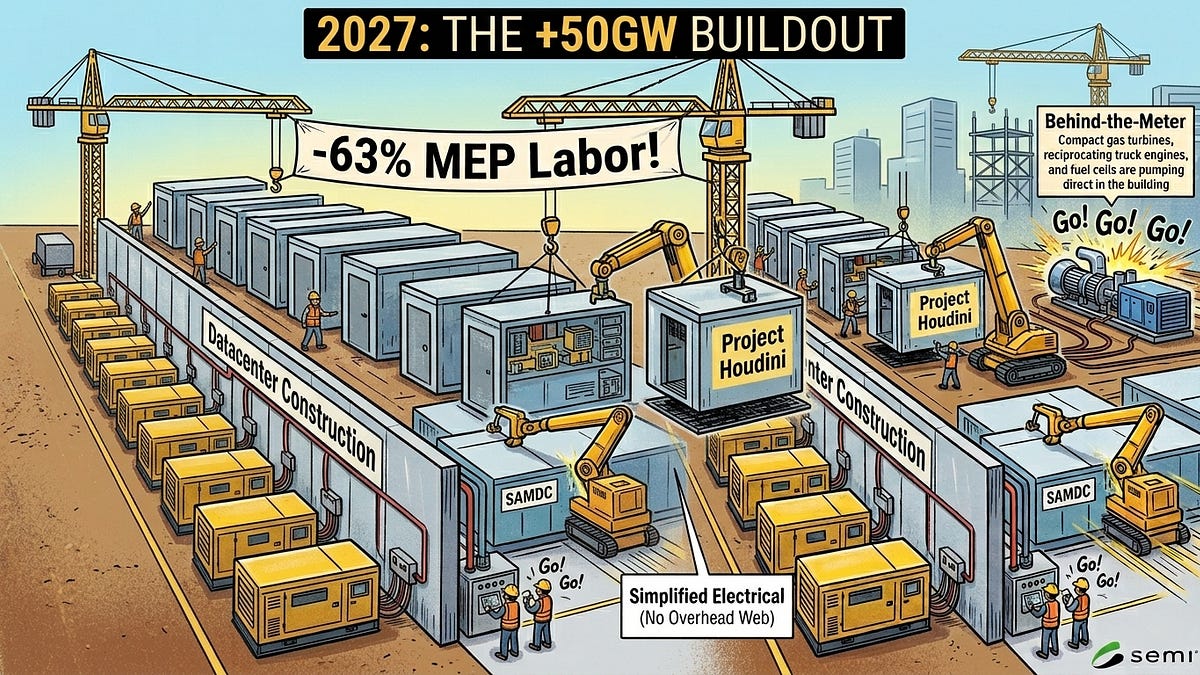 Datacenters 2027: The Year of Acceleration, +50GW in a Single Year
SemiAnalysis argues that global AI datacenter capacity will grow by about 50GW in 2027, against Brad Gerstner's guess of roughly 25GW. Evidence cited: over 24GW in advanced construction across 40 campuses, nearly USD 1T of binding leases signed in 2026, and record self-build starts. It also covers modular "LEGO" designs, behind-the-meter power and ex-US growth. The page text cuts off before the oversupply section.
newsletter.semianalysis.comarticleAdded 29 Oct 2026, published 19 Oct 2026🧠 AI- Revisiting the Security of VDOO
Revisiting the Security of VDOO is an ePrint paper (October 2026) on VDOO, a multivariate signature scheme submitted to China's NGCC program. It models VDOO as a multilayer Rainbow construction, keeps only the last oil space to get a generalized UOV instance, and applies wedge attacks. For the 512-bit parameter set it estimates 2^432 gates (reconciliation) and 2^379 gates (intersection), below the claimed level and the specification's figures.
eprint.iacr.orgpaperAdded 19 Oct 2026, published 18 Oct 2026🛡️ Security - Zippel: A Language, Compiler, Runtime, and Analyzer for ZK Proof Systems
Zippel is a language, compiler, runtime and analyzer for writing zero-knowledge proof systems in syntax close to the pseudocode in cryptography papers. Its type system and runtime remove vulnerability classes by construction, for example by synchronizing transcripts automatically and applying the Fiat–Shamir transform correctly. Its static analyses check completeness and soundness from the protocol description alone. The authors implemented 35 proof systems, including Sumcheck, Schnorr, KZG, Groth16, Bulletproofs, Hyrax, Spartan, Dory, HyperPlonk, DeKART and Pari. They report performance competitive with hand-written multi-core implementations.
eprint.iacr.orgpaperAdded 17 Oct 2026, published 16 Oct 2026🛡️ Security  Designing more efficient quantum circuits with Claude
Anthropic describes giving Claude Mythos 5 plain-language specs for eight quantum-circuit primitives plus an automated evaluator that checks and scores designs (qubits × gates). Working in a closed loop with little human input, Claude found designs that beat the best published circuits, sometimes by 10x or more. Two examples: a reversible divsteps modular inversion for elliptic-curve point addition, found in a 53-hour run and verified in Lean, and a Berlekamp–Massey Reed–Solomon decoder for decoded quantum interferometry that cuts gate count about 12x versus Google's construction. The post also covers limitations such as Claude's conservatism and the mitigations used.
 anthropic.comarticleAdded 17 Oct 2026, published 16 Oct 2026🧠 AI
- Analysis of the Multi-Key Optimization for SPECK
The paper revisits the multi-key optimization for SPECK, a code-based signature scheme that uses the Permutation Code Equivalence Problem (PEP) as a trapdoor for the Permuted Kernel Problem (PKP). Each SPECK round has soundness error 1/2, which inflates signatures, and the SPECK authors had warned that naively using multiple public keys creates security concerns. The authors analyse those concerns, give conditions and parameter constraints under which multiple keys can be integrated securely, and show that conservative parameters perform poorly but leave room for improvement. They also build a ring signature scheme on the same construction.
eprint.iacr.orgpaperAdded 17 Oct 2026, published 16 Oct 2026🛡️ Security - Power Analysis on SQIsign via Ideal Reconstruction from Quaternion Leakages
ePrint paper identifying five side-channel vulnerabilities in the signing procedure of Round-3 SQIsign, the isogeny-based signature scheme in NIST's additional post-quantum signature process. It gives polynomial-time algebraic algorithms that recover the secret key from leaked quaternion/ideal intermediate values, including cases where only partial bits leak. It also demonstrates power analysis on the SQIsign source code to extract the needed leakage, which earlier work on Round-1 or toy parameters did not do.
eprint.iacr.orgpaperAdded 17 Oct 2026, published 16 Oct 2026🛡️ Security  BlackRock’s Larry Fink Warns AI Data Center Halt Could Tip US Into Recession
Decrypt reports BlackRock CEO Larry Fink telling CNBC that a US moratorium on data center construction would cause a recession, because so much of the economy depends on AI capex. It sets this against rising local opposition: at least 100 localities with moratoriums per Brookings, New York and Texas pauses, a 61% opposition figure from an Annenberg survey, and about $130B of projects blocked or delayed in Q1 2026 per Data Center Watch. It also covers the midterm politics and analyst estimates of over $1T in AI capex in 2027 and over $5T cumulatively through 2030. It matters as context on the economic and regulatory pressures on AI compute buildout.
 decrypt.coarticlePublished and added 15 Oct 2026🧠 AI
- Perceive, Predict, and Plan: a Unified World Action Model for Egocentric Dexterous Manipulation
P^3-WAM is a unified world action model for egocentric dexterous manipulation with three modes: Perceive (reconstruct articulated hand motion and camera trajectories from video), Predict (generate visual futures under prescribed actions) and Plan (jointly generate action trajectories and their anticipated visual outcomes from an initial image, a language instruction and an optional visual goal). It adds a compact structured 3D action representation to a pretrained video diffusion transformer through a mixture-of-transformers design with shared base weights, modality-specific adaptation and bidirectional visual-action attention. Randomized modality visibility lets video and 3D actions act as either context or target. Unified training beats single-mode training and outperforms specialized baselines on 3D hand reconstruction and action-conditioned video prediction across four datasets, and gives better instruction adherence than video-generation baselines.
arxiv.orgpaperAdded 17 Oct 2026, published 15 Oct 2026🧠 AI - DK-VLM: Geometry as Position for Spatial Reasoning in Vision-Language Models
DK-VLM adds Dual-Kernel Attention to a vision-language model. A semantic kernel keeps the pretrained attention and positional encoding. A separate geometric kernel uses estimated 3D points and camera poses to modulate attention through point displacements and relative view transformations, and a learned gate fuses the two outputs. Geometry therefore enters attention as position, not as fused 3D reconstruction features. The paper also adds Reference-Frame Composition (RC) supervision, which gives stepwise turn and heading targets derived from verified single-step annotations, to train multi-step spatial reasoning as the observer moves. DK-VLM-8B reports the highest average score across six spatial benchmarks among the compared methods, with 74.33 on VSI-Bench and 58.28 on ReVSI-32, and it preserves general video understanding.
arxiv.orgpaperAdded 17 Oct 2026, published 15 Oct 2026🧠 AI - Velox: Spatial Memory Makes World Models Efficient
Velox is a training-free attention router for chunked video-diffusion world models. It uses camera frustum slabs with depth intervals from streaming geometry to pick which historical token blocks to attend to, instead of letting the KV cache grow with rollout length. Frustum overlap softly modulates each layer's model-derived block importance, and uncovered regions keep the model's own routing. The fixed block granularity suits FlashAttention-style tiled execution, and slab construction runs asynchronously with denoising on the same H200. At chunk 48 it speeds up attention 4.36× and denoising 2.43×, and on the 158-case WBench navigation split it stays within 0.15 average points of dense LingBot-Fast-Cam.
arxiv.orgpaperAdded 17 Oct 2026, published 15 Oct 2026🧠 AI - Librarian Agents: Training LLMs to Curate Long-Context Workspaces that Anticipate Future Queries
Introduces Librarian Agents, where a builder agent turns raw unstructured documents into a hierarchical filesystem of synthetic files and reference links, forming a workspace for a downstream answering agent. Workspace construction is cast as a Markov decision process and the builder policy is trained with reinforcement learning to maximize downstream answering accuracy. It beats the strongest retrieval and precomputation baselines by 33 points on BrowseComp-Plus, amortizes construction cost over repeated queries, and generalizes zero-shot to BRIGHT with a 31-point average gain.
arxiv.orgpaperAdded 17 Oct 2026, published 15 Oct 2026🧠 AI 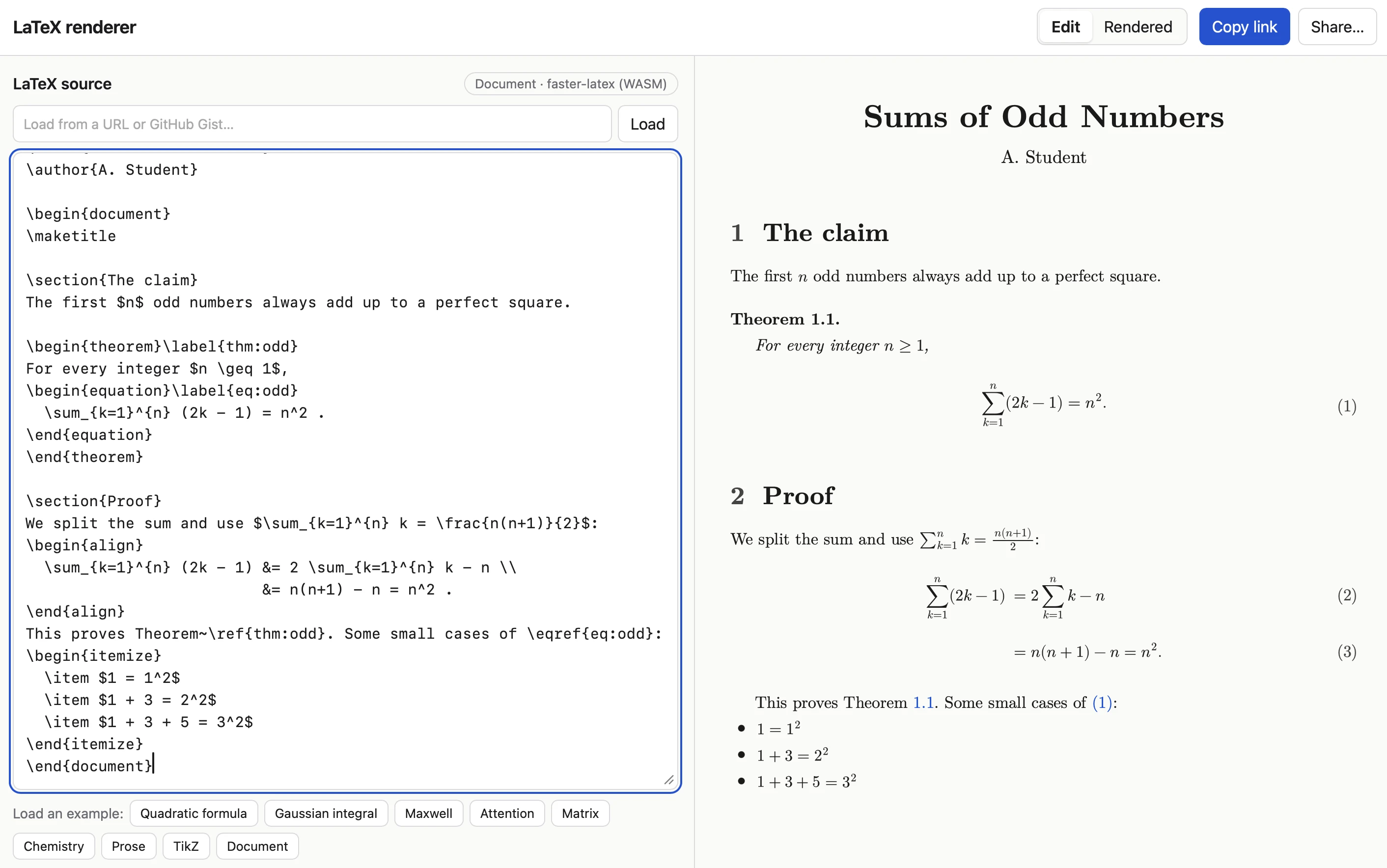 LaTeX renderer
Simon Willison describes using Claude Code (Opus 5.5) to build a browser LaTeX renderer inspired by Tiny Little Office, which stores document data in the URL #fragment and ships an llms.txt so agents can construct document links. He lists the prompts: fragment-hash rendering, a custom compression dictionary for LaTeX, an iframe sandbox against XSS copied from his SVG-in-Markdown tool, and loading from a URL or Gist. The finished tool uses Pako 2.1.0, MathJax 4.1.3, faster-latex 0.3.1 and DOMPurify 3.4.16.
 simonwillison.netarticleAdded 16 Oct 2026, published 15 Oct 2026🧠 AI
- FAEST on GPUs: Addressing Field Multiplication as a Bottleneck
ePrint paper presenting an NVIDIA GPU implementation of FAEST (a post-quantum signature scheme built on VOLE-in-the-Head and QuickSilver), covering key generation and OWFProve/OWFVerify for standard and EM constructions in s and f variants. Profiling shows field multiplication takes about 82% of FAEST-128f signing time once AES is hardware-accelerated. Using PTX clmad carry-less multiplication plus Karatsuba, it reaches up to 26.6x kernel throughput and about 2.9-3.1x full 256-bit OWFProve throughput over the software-multiplication build on an RTX A5000.
eprint.iacr.orgpaperPublished and added 15 Oct 2026🛡️ Security - Tamper Sensing Meshes in Payment Terminals and Beyond
Teardown study of tamper sensing meshes (TSM) across a wide range of card payment terminals, ATM key pads and a data center HSM, with detailed photos of critical features. The authors build a taxonomy of mesh construction techniques, find most commercial meshes use simple constructions far from manufacturing limits, and derive a concise set of design patterns. They argue that meshes beating the industrial state of the art are feasible with cheap, readily available processes, giving researchers a basis for realistic test specimens.
eprint.iacr.orgpaperPublished and added 14 Oct 2026🛡️ Security - morluto/rea
REA (rea-agents on npm) registers an MCP server and matching workflow instructions with coding agents such as Claude Code, Codex, Cursor and Gemini CLI. It exposes tools for inspecting native binaries through Hopper, Ghidra or IDA (with optional objdump and Rizin), JavaScript/Electron apps and ASAR archives, .NET assemblies and websites. Results come back with evidence and limitations, so the agent can explain how a feature works and write and test its own implementation. Analysis runs locally, there is a CLI with the same workflows, and the showcases include C reconstructions verified against original x86 function bytes.
 github.comrepoAdded 14 Oct 2026🧠 AI
- morluto/rea
REA (rea-agents) is an MIT-licensed toolkit that exposes native-binary, JavaScript/Electron, .NET assembly and website analysis to AI agents via MCP, and also as a local CLI. It drives Hopper, Ghidra, IDA, objdump or Rizin for disassembly and pseudocode, recovers modules and Electron IPC boundaries from ASAR/JS apps, and returns findings with evidence and limitations. Showcases include reconstructing a x86 audio helper into byte-matching C and tracing an Electron clipboard API through preload and IPC; the README also carries lawful-use and licensing guidance.
github.comrepoAdded 14 Oct 2026🛡️ Security  Scaling Agentic Data for Long-Horizon Terminal Intelligence
Introduces TerminalHorizon, a fully automated data synthesis engine for long-horizon terminal agents. It uses independent execution to find key work omitted during environment construction and rebuilds the environment from that evidence. It then progressively expands tasks under the same goal with new requirements that build on earlier results. The authors build 1.5K task environments and run supervised fine-tuning of Qwen3.5-27B to get TerminalHorizon-27B, which improves on all 12 benchmarks covering coding-agent tasks, real-world production agentic tasks and general reasoning. Multiple RSI case studies with a 12-hour research budget show the model continuing to experiment past an initial solution and keeping effective improvements in its final deliverables.
 huggingface.copaperAdded 13 Oct 2026🧠 AI
- Dog-Breed Text-to-image Flow Matching from Pretraining to Fine-Tuning on 4 Consumer GPUs
MiniDog is a framework for training a text-to-image flow-matching diffusion transformer from scratch on four RTX 3090 GPUs, with 55 minutes of pretraining and 15 minutes of fine-tuning. It pretrains on 26k ImageNet dog images that were captioned, then fine-tunes on 2k FLUX.1-schnell generated images. Image and text features are precomputed and cached. The model is a 22M-parameter transformer with the E2E-INVAE semantic latent space, a small Qwen text encoder and in-context conditioning, and training is accelerated with iREPA and an EUPE perception encoder. The repo evaluates with FID, HPSv2, PickScore and VAE reconstruction metrics. It lowers the barrier to hands-on diffusion training research.
arxiv.orgpaperAdded 14 Oct 2026, published 13 Oct 2026🧠 AI - LLM Agents for Automated Post-Training via Structured Recipe Optimization
Introduces Structured Recipe Optimization (SRO), a paradigm for automated LLM post-training that optimizes over a task-adapted recipe space covering data sources, data processing, cross-domain composition and training configuration. It pairs an LLM-based Recipe-Space Designer, which builds the recipe space for the target tasks, with a Multi-Domain Recipe Optimizer that uses structured trial evidence to guide LLM candidate construction and multi-objective Bayesian trial selection. SRO gets the highest average score in all evaluated target-model and agent-LLM combinations; for example, 41.1 vs 15.4 for the strongest baseline on Qwen3-1.7B with GPT-5.4, and 53.8 vs 40.8 on Qwen3-4B with DeepSeek-V4-Flash, in joint post-training across three capability domains and six benchmarks.
arxiv.orgpaperAdded 14 Oct 2026, published 13 Oct 2026🧠 AI - Leakage-Resilient Incompressible Cryptography: Constructions and Barriers
Introduces leakage-resilient incompressible cryptography, a security model combining leakage resilience (partial key leakage plus full ciphertext) with incompressibility (full key but only part of the ciphertext or signature). It gives a transformation from incompressible symmetric-key encryption (SKE) to leakage-resilient incompressible SKE, a leakage-resilient incompressible PKE built from a new leakage-resilient non-committing KEM, and an incompressible SKE with ciphertext and compression rate 1/2 using invertible extractors. It also gives a leakage-resilient incompressible signature scheme in the random oracle model under DCR or LWE plus Decisional Linear. Black-box impossibility results show barriers to improving these parameters.
eprint.iacr.orgpaperAdded 14 Oct 2026, published 13 Oct 2026🛡️ Security - Heading Hierarchy Reconstruction for Complex and Long Documents with Level-Wise Multimodal Memory
Proposes a vision-language-model framework that incrementally reconstructs heading hierarchies across tens or hundreds of pages using a level-wise multimodal memory. The memory keeps a compact set of earlier pages chosen by anchors (here, the most recent node at each heading level), so the VLM sees the visual, textual and layout patterns of headings at every level. The authors also introduce CLDoc-HHRBench (250 documents, 11,212 pages, expert-verified annotations) and report results on it and three existing benchmarks. It matters for RAG pipelines that need coherent document-level structure, which page-by-page OCR/VLM parsing doesn't give.
arxiv.orgpaperAdded 14 Oct 2026, published 13 Oct 2026🧠 AI - Causal Awareness in End-to-End Encrypted Group Messaging
Cryptography paper that extends Chen and Fischlin's two-user Signal analysis (Eurocrypt 2024) to group chats. It introduces "causal awareness": a receiver can reconstruct part of the causal context in which an accepted message was sent. Network delay or adversarial interference can otherwise show an authentic message in a misleading context. Senders transmit records of what they have sent and received, and receivers verify these records and compare them with their own. The paper gives correctness and security definitions parameterized by how much causal information must be recovered, baseline constructions with proofs, and checkpoint-aided and server-aided variants. It also discusses how to surface this information in a messenger's UI.
eprint.iacr.orgpaperAdded 14 Oct 2026, published 13 Oct 2026🛡️ Security - Revisiting Witness-Succinct UC-lifting Compilers
The paper introduces verifiable reconstructible straightline codes (VRSCs) as an abstraction for compiling zkSNARKs into Universally Composable (UC) secure protocols. It shows that the witness-succinct UC compiler of Ganesh et al. (EUROCRYPT 2023) is missing a security requirement: permuting previously revealed evaluation openings yields a fresh accepting proof, which invalidates the claimed simulation argument. The fix uses verifier-enforced disjoint evaluation domains and a pairing-based Fischlin-style instantiation with structured Reed-Solomon codes and jointly computed KZG openings. This brings certificate generation to O(n log n) with constant extra proof size and verification work.
eprint.iacr.orgpaperAdded 14 Oct 2026, published 12 Oct 2026🛡️ Security - ML-Assisted Power Side-Channel Attacks on ML Accelerators in Shared FPGAs
Paper presenting the first on-chip, TDC-sensor-based power side-channel attack on a co-tenant FPGA to reconstruct full-scale color ImageNet inputs (224x224) from a victim's first CNN convolution layer, using ML-based upscaling and recoloring. It separates genuinely leaked information from ML-generated post-processing. It also evaluates a pixel-substitution defense based on Hamming Weight, which is largely defeated by an attacker retrained on the transformed data. The authors conclude that robust defenses need randomized or input-dependent transformations.
arxiv.orgpaperAdded 16 Oct 2026, published 12 Oct 2026🛡️ Security - Censorship Resistance in Credential Systems and Application to the EUDI Wallet
ePrint paper that defines a security model for censorship resistance in anonymous credential systems, where a malicious issuer uses information gathered at issuance to selectively deny credentials. It gives a round-optimal construction built on blind signatures with selective disclosure at presentation. It also presents CRACS, an instantiation for the European Digital Identity Wallet (EUDIW). CRACS keeps selective disclosure and adds unlinkability between issuance and presentation. It confines the advanced cryptography to issuance, so secure elements, credential formats, signature schemes and verifiers stay unchanged and deployment can be incremental.
eprint.iacr.orgpaperAdded 14 Oct 2026, published 10 Oct 2026🛡️ Security - Physical Side-Channel Attacks on Edge LLMs: Extracting Output Tokens and User Prompts
Presents an EM side-channel attack on LLaMA-3.2-1B-Instruct running on a Raspberry Pi 5, showing passive physical measurements leak generated tokens and user prompts. Three attacks: a profiling attack (97.2% accuracy over 50 medical/privacy keywords), a hidden-state reconstruction attack predicting tokens from the 128k vocabulary (94.3% on profiled classes; 67% of unseen words ranked in top 100), and a hidden-state inversion attack reconstructing prompts semantically. Shows that local edge inference does not guarantee confidentiality of tokens and inputs.
arxiv.orgpaperAdded 16 Oct 2026, published 9 Oct 2026🛡️ Security - DualQuant: Dual-scale Calibration-free Weight-and-Activation Quantization for LLMs
DualQuant is a calibration-free post-training quantization framework for LLM weights and activations. It minimizes weight-reconstruction MSE using variable splitting and block coordinate descent with closed-form subproblem updates. The resulting scaling factors double as per-channel activation rescalings, so no calibration data is needed. It supports the MX family and NVFP4 block formats. On Llama and Qwen models it matches or beats calibration-based SmoothQuant on WikiText-2, C4 and zero-shot tasks. A real packed W4A4 path for Llama-3.1-8B on an RTX 4090 gives up to 2.61x memory reduction and 2.46x throughput over BF16.
arxiv.orgpaperAdded 12 Oct 2026, published 9 Oct 2026🧠 AI  New GhostAction Wave Hits Hundreds of Repos, Expanding Beyond CI/CD Secrets to Cloud Credentials
Socket documents an October 8, 2026 wave of the GhostAction campaign in which two compromised GitHub maintainer accounts (henrywoo and kitao) pushed a malicious security-audit.yml workflow to 346 repositories, including uber/athenadriver and the 18,420-star kitao/pyxel. Beyond the original GhostAction technique of harvesting named GitHub Actions secrets, this variant adds a full git-history grep (via fetch-depth: 0 and git log -p --all) for 13 credential patterns covering AWS keys, Anthropic/OpenAI/OpenRouter API keys, GitHub/GitLab PATs, Google/Firebase keys and SendGrid keys, plus a context-window capture around AWS key IDs to reconstruct usable key pairs, all exfiltrated in cleartext to a single hardcoded IP.
 socket.devwriteupPublished and added 9 Oct 2026🛡️ Security
- RM-KLPT: Algebraic Pathfinding for Superspecial Abelian Surfaces with Maximal Real Multiplication
The paper presents RM-KLPT, an algorithm that solves the algebraic pathfinding problem in isogeny graphs of superspecial abelian surfaces with maximal real multiplication. It does this by solving a norm equation in ideals of a quaternion algebra over a real quadratic field. The authors implement it and revisit the RM-CGL hash function of Charles, Goren and Lauter. They show that if the initial surface's algebraic description is known, RM-KLPT gives a second-preimage attack on the hash. Paths are much shorter (~p^3) than with KLPT^2, because a higher-dimensional Deuring correspondence exists in the RM setting. The paper also discusses cryptographic constructions that could be built on RM-KLPT.
eprint.iacr.orgpaperAdded 12 Oct 2026, published 9 Oct 2026🛡️ Security - OuroWorld: Bringing Any 3D World Alive as Diverse, Endlessly Looping 3D Cinemagraphs
OuroWorld is a mask-free framework that turns any static 3D Gaussian Splatting scene into a seamlessly looping 3D cinemagraph. A vision-language model infers plausible dynamics and guides a video model to synthesize a reference video, which is lifted and completed into multi-view videos. Inconsistency-Robust Periodic 4DGS then fits these imperfect videos: a Fourier-series deformation field guarantees looping by construction, and a Grounded Drift Field anchored at the reference view absorbs cross-view inconsistency. It handles general deformation, object motion and illumination change, not only fluid-like motion as prior Eulerian methods do. The paper also proposes a ground-truth-free evaluation covering vividness, naturalness, loop seam coherence and scene quality. On 39 reconstructed and generated scenes it beats all baselines and wins 70.8%-99.0% of user-study comparisons.
arxiv.orgpaperAdded 9 Oct 2026, published 8 Oct 2026🧠 AI - New Constructions of Quadratic and Cubic Permutations Admitting Optimal Threshold Implementations
ePrint paper giving four constructions of optimal threshold implementations (t+1 shares, no fresh randomness) for bijective S-boxes, a masking countermeasure against differential power analysis and glitch leakage in hardware. It shows that Q30^5 admits optimal TIs, gives a matrix criterion for quadratic permutations (yielding new 6-bit classes), and gives a weighted interpolation construction for power permutations that disproves the Piccione et al. 2023 conjecture. It also gives a derivative-uniform framework that proves every 4-bit cubic permutation admits optimal TIs. A companion repo has TIs for 5-bit quadratic permutations, 4-bit cubic permutations, the PRESENT S-box and GF(16) inversion.
eprint.iacr.orgpaperAdded 11 Oct 2026, published 8 Oct 2026🛡️ Security - Practical and Efficient MPC from FHE, without ZKPoKs
This IACR eprint paper by Cong, Smart, Tanguy and Walter (Zama) shows how to eliminate Zero-Knowledge Proofs-of-Knowledge from the FHE-based malicious-secure MPC protocol of Smart (IMA, 2023), simplifying and modularizing its security proof. It introduces a formal security notion for "encrypted PRF" functionality within FHE schemes and proves the Deo et al. (CCS 2025) construction secure under this model, yielding a more practical and efficient MPC-from-FHE protocol.
eprint.iacr.orgpaperAdded 8 Oct 2026, published 7 Oct 2026🛡️ Security - Revisiting Lattice-based Blind Signatures Again
This IACR ePrint paper by Yi-Fu Lai and Yu Yu breaks the blindness property of a lattice-based blind signature scheme presented at Crypto 2020, which uses a linear hash function framework instantiated over lattices. The authors first identify an overlooked bug in the scheme's original blindness security proof, then construct a concrete attack under an honest-key, honest-but-curious signer model by exploiting correlations between leaves of the scheme's tree structure, and discuss how the construction can be repaired.
eprint.iacr.orgpaperAdded 8 Oct 2026, published 7 Oct 2026🛡️ Security - TaoD2C-Bench: Benchmarking MLLMs for Industrial UI Code Generation Beyond Visual Fidelity
TaoD2C-Bench is a benchmark for evaluating multimodal large language models (MLLMs) on industrial design-to-code (D2C) tasks — converting UI designs into code that satisfies implementation constraints, not just visual fidelity. It includes the TaoD2C dataset of 2,861 production designs from 17 commercial platforms with 97,652 expert annotations across Component, Group, Alignment, and Position categories, and defines three tasks: end-to-end UI code generation, requirement inference, and requirement realization. Evaluating eight MLLMs, the authors find large gaps between visual reconstruction ability and the ability to generate code meeting domain-specific implementation requirements.
arxiv.orgpaperAdded 8 Oct 2026, published 7 Oct 2026🧠 AI - AI Safety Considerations for Agents With Limited Time to Act
This arXiv preprint argues that proofs of AI safety or alignment which consider the agent in isolation are incomplete, because the environment's structure matters just as much. The authors construct two theoretical scenarios — one with an infinite state space, one with signal mixture — under partial observability and time-limited action, and prove that even a hypothetically perfect agent cannot guarantee safe behavior in them. The conclusion is that any rigorous safety or alignment proof must jointly specify the agent and the environment's safe-action structure, not the agent alone.
arxiv.orgpaperAdded 8 Oct 2026, published 7 Oct 2026🧠 AI
Showing 60 of 184
Show more