 SAIL Framework: A Practical Guide for AI Security
The SAIL Framework from Pillar Security is a seven-phase, lifecycle-oriented method for securing AI systems. The phases are AI policy and safe experimentation, AI asset discovery, AI security posture management, AI red teaming, runtime guardrails, sandboxed execution for agents and MCP servers, and AI activity tracing. It argues for a "Shift Up" approach that protects the business logic AI controls, and it is meant to sit on top of existing standards.
 pillar.securityarticleAdded 29 Oct 2026🛡️ Security
 What changed when mobile security stopped being theoretical
An Oversecured Head of Engineering, coming from 20 years of web work, describes four mobile security risks that became concrete after seeing real production apps. These are old vulnerable binaries that stay installed after a fix, secrets embedded in client code, Keychain/Keystore guarantees that are weaker than assumed with tokens leaking via logs, and deep links or exported components acting as public endpoints. It ends with advice: test the shipped artifact, verify the full data lifecycle, and build server-side containment.
 oversecured.comarticleAdded 29 Oct 2026🛡️ Security
 A quiet week in infosec <.<
Cisco Talos Threat Source newsletter for the week of the PHP and Node.js vulnerability news cycle. It summarises NIK C2, a Go-based Windows implant that dumps credentials, streams keystrokes, deploys screen-locking ransomware and uses a victim's hijacked OpenAI API keys to analyse stolen data. It also lists weekly headlines (CISA KEV PHP bugs, Brotli flaw, Gheist GitHub token theft), Talos links and top malware hashes.
 blog.talosintelligence.comarticlePublished and added 29 Oct 2026🛡️ Security
 What is an AIBOM? AI bill of materials explained for security teams | Endor Labs
An AIBOM is a machine-readable inventory of models, datasets, dependencies, AI services, agents and MCP servers, with evidence of origin, license, integrity and evaluation. The Endor Labs explainer walks through a worked CycloneDX example for a fine-tuned support assistant. It compares CycloneDX ML-BOM, SPDX 3.x, the OWASP AIBOM project and the May 2026 CISA/G7 guidance, and lists what an AIBOM cannot show: runtime behavior and agent actions.
 endorlabs.comarticlePublished and added 29 Oct 2026🧠 AI
- What is an AIBOM? AI bill of materials explained for security teams | Endor Labs
AIBOM explainer from Endor Labs: an AI bill of materials is a machine-readable inventory of models, datasets, dependencies, AI services, agents and MCP servers, with origin, license and integrity evidence. It walks through a CycloneDX entry for a fine-tuned model, compares CycloneDX ML-BOM, SPDX 3.x, the OWASP AIBOM Generator and the May 2026 CISA/G7 minimum-elements guidance, and lists a six-step build process. It also states what an AIBOM cannot show: model safety, runtime behavior and coding-agent actions.
endorlabs.comarticlePublished and added 29 Oct 2026🛡️ Security  ADLC metrics: How to measure agentic development security | Endor Labs
ADLC metrics is an Endor Labs guide to measuring security in the agentic development lifecycle, where AI coding agents write much of the code. It defines formulas across five categories: AI supply chain visibility, agent action security, agent-generated code, package risk and developer flow. It argues for normalizing findings per merged change, tracking pre-execution blocks, and building a six-to-eight metric scorecard.
endorlabs.comarticlePublished and added 29 Oct 2026🛡️ Security- ADLC metrics: How to measure agentic development security | Endor Labs
ADLC metrics is an Endor Labs guide to measuring security in the agentic development lifecycle, where AI coding agents write code. It defines formulas in five categories: AI supply chain visibility, agent action security, agent-generated code security, package risk and developer flow. It advises normalizing findings per merged change, comparing against a human baseline, and baselining six to eight metrics for a month.
endorlabs.comarticlePublished and added 29 Oct 2026🧠 AI  Beyond the Event Horizon of Keccak, Extending the Observation from 2011 and applications
Beyond the Event Horizon of Keccak extends a 2011 observation that a path in the Keccak sponge from a zero-capacity state back to one yields infinite second-preimage families. Three theorems cover loops from any capacity value x, k-block loops and cycles, and Joux-style multicollisions with search cost independent of k. Verified examples run on Keccak-f[200] and Keccak-f[1600] with c=32; it also proposes bridge-based protocols.
 eprint.iacr.orgpaperPublished and added 28 Oct 2026🛡️ Security
 CALM: Conflict-Aware Lifecycle Memory Governance for Long-Horizon Language Agents
CALM is a conflict-aware lifecycle memory governance framework for long-horizon language agents. It turns records into evidence-grounded memory cells, updates their validity and lifecycle states from support, conflict and dependency signals, and admits evidence at query time through training-free or learned gating based on temporal applicability. It beats baselines on LongMemEval-S and LoCoMo with Qwen and GPT backbones, and keeping superseded records helps earlier-state reasoning.
 arxiv.orgpaperAdded 30 Oct 2026, published 28 Oct 2026🧠 AI
 How to evaluate ADLC security solutions: A buyer's checklist | Endor Labs
Buyer's checklist from Endor Labs for evaluating security tools in the agentic development lifecycle (ADLC), where AI coding agents write code and take actions such as package installs, CI edits and tool calls. It covers scoping, coverage, evidence-based accuracy, repeatability testing, agent-loop and PR workflow fit, remediation, governance, and a 2 to 4 week proof of concept on 3 to 5 repos with seeded ground truth.
endorlabs.comarticlePublished and added 28 Oct 2026🛡️ Security Trial by Trace: Benchmarking AI Agent Harnesses for Reliability and Failure Attribution
TraceTrial-Bench is a benchmark that scores agent task performance and agent harness reliability separately. It has 95 mechanism-oriented tasks across seven components: context, execution, governance, lifecycle, observability, tools and verification. Across 4 harnesses, 9 models and 3,420 runs, macro-averaged harness scores range from 59.8% to 72.0%, and 31.1% of runs succeed despite failing at least one harness criterion.
 huggingface.copaperAdded 27 Oct 2026🧠 AI
 Draft ERC: Agent Safety Framework (ASF) — a registry of versioned safety specifications and of the scoped, attributable adoption relations that bind agents to them
Agent Safety Framework (ASF) is a draft ERC on Ethereum Magicians for an on-chain registry of versioned, content-addressed safety specifications and of Safety Bindings. A binding records that an adopter accepted one pinned spec version for a subject and scope, with declared enforcement locations, named interveners and a lifecycle (Active, five Suspended restrictions, Terminated). A check(requirement, bindingIds) call returns Satisfied, NotSatisfied or Unknown, and Unknown never counts as satisfied. Reference consumers ASFGuardedAccount and ASFTaskTenderAdapter come with 73 tests, 47 of them negative.
 ethereum-magicians.orgthreadPublished and added 25 Oct 2026🛡️ Security
- Gökdeniz Gülmez (@ActuallyIsaak) on X
An X post showing how to have Codex train a small model on Apple silicon through the mlx-lm-lora MCP server and skill. It gives five setup steps (pip install with the mcp extra, npx skills add, locate mlx-lm-lora-mcp, codex mcp add). The prompt runs four pre-training trials on tiny-random/qwen3 with the mlx-community/recycling_the_web-1k dataset. Codex picks the optimizer and learning rate itself, and the result is a table with validation loss and the best adapter path.
 x.comthreadAdded 25 Oct 2026, published 24 Oct 2026🧠 AI
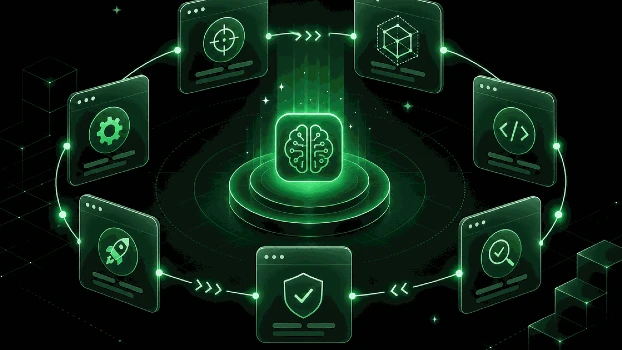 What is the AI-Native SDLC? AI SDLC, AI-DLC, and ADLC Explained | Endor Labs
The AI-native SDLC is a software lifecycle redesigned around AI and coding-agent participation, as opposed to the AI-assisted SDLC, which adds AI tools to unchanged stages. The Endor Labs guide separates AI-DLC (the AWS methodology), AI SDLC and the two meanings of ADLC (Agentic vs Agent Development Lifecycle). It also covers stage-by-stage changes and AppSec implications: AI-generated code flaws, dependency choice, reachability analysis and governing agent actions.
endorlabs.comarticlePublished and added 23 Oct 2026🧠 AI- AI Is Getting Good at Math. Here’s Why.
The essay argues that LLMs solve open math problems because they search depth first, and automated verifiers make failed attempts cheap. It uses WT Gowers' hint-sequence complexity (2^k + t), adds a branching factor b, and walks through OpenAI's unit-distance disproof and Cycle Double Cover prompt as a drafter/solver/verifier harness. It predicts AI does best where k and b are small.
 latent.spacearticlePublished and added 23 Oct 2026🧠 AI
- ENISA Technical Advisory for Software Bill of Materials
ENISA Technical Advisory for Software Bill of Materials (October 2026, TLP:CLEAR) is non-mandatory guidance for organisations, especially SMEs, starting SBOM adoption. It covers SBOM data models (CycloneDX, SPDX), a mapping of BSI TR-03183-2 fields to CISA minimum elements, lifecycle and CI/CD integration, an SBOM threat model, and security recommendations. It supports Cyber Resilience Act obligations but is not a legal interpretation.
 enisa.europa.euadvisoryAdded 23 Oct 2026🛡️ Security
- ENISA Technical Advisory for Software Bill of Materials
ENISA Technical Advisory for Software Bill of Materials is practical guidance on SBOM adoption for organizations, especially micro, small and medium enterprises and open-source stewards. It sets out an SBOM implementation architecture and data flows across a defined lifecycle, an indicative SBOM threat model with targeted risks, and measures for the SBOM ecosystem. It aligns with the ENISA Secure by Design and Default Playbook and supports Cyber Resilience Act compliance.
enisa.europa.euadvisoryAdded 23 Oct 2026🛡️ Security - Causal Chain of Thought: Mitigating Attention Leakage via Context Isolation
CausalCoT is an inference framework that splits a problem into a directed acyclic graph of atomic sub-questions and evaluates each node in an isolated context holding only its direct causal parents. This removes attention paths to non-parent content, so intermediate steps drive the answer rather than leaking from global context. It keeps benchmark accuracy competitive and raises causal sensitivity of reasoning steps by 12 points on average, up to 21, over the strongest baseline. The graph also allows test-time corrections that propagate downstream.
arxiv.orgpaperAdded 24 Oct 2026, published 22 Oct 2026🧠 AI - Graphs and cycles in curve-based collision walks
Graphs and cycles in curve-based collision walks is an IACR ePrint paper (2026/2560) on van Oorschot-Wiener style collision attacks in the multi-user setting. It covers elliptic curve discrete logarithms and isogeny pathfinding on supersingular F_p^2 and F_p curves, and proposes new pseudorandom walks. For F_p^2 curves, L keys need about L + log(L) useful collisions with no infiltrator. For F_p curves, about 0.75L keys fall to L collisions with an infiltrator.
eprint.iacr.orgpaperAdded 21 Oct 2026, published 20 Oct 2026🛡️ Security - Efficient Fixed-Point Implementation of Mitaka
Presents a fixed-point C implementation of the Mitaka signing algorithm, a simpler, parallelizable Falcon (FN-DSA) variant. It replaces MitakaZ's wide integral Gram root decomposition with a fixed-point square Cholesky decomposition, which cuts the cost of integer Gaussian sampling, and proves bounds on intermediate values and representation errors without empirical assumptions. Signing averages 361 kcycles (Mitaka-512) and 707 kcycles (Mitaka-1024) on AVX2, and 4.0 and 7.8 Mcycles on an STM32F411 Cortex-M4F. This makes floating-point-free lattice signatures practical on constrained devices.
eprint.iacr.orgpaperPublished and added 17 Oct 2026🛡️ Security - SLEEK: Sparse Quasi-Cyclic Codes with Closed-Form DFR Key Encapsulation
Introduces SLEEK, a QC-MDPC code-based KEM using a three-iteration parallel bit-flipping decoder and a closed-form decoding-failure-rate (DFR) estimate, enabling parameters with analytically bounded failure probability and standard IND-CCA transforms. SLEEK-LT targets IND-CCA for long-term keys; SLEEK-E targets IND-CPA for ephemeral keys using a new QC key structure with security equivalent to QC-MDPC and cheaper key generation. Parameter sets cover 80/128/192/256-bit security, and the optimized AVX2 implementation gives ciphertexts 4.9x smaller than HQC (47% slower) and 1.3x–2.7x faster than BIKE.
eprint.iacr.orgpaperAdded 17 Oct 2026, published 16 Oct 2026🛡️ Security - Sparse Secrets, Dense Problems: Efficiently Masking HQC in Hardware
ePrint paper presenting the first fully masked hardware implementation of HQC (key generation, encapsulation, decapsulation) on FPGA. It introduces a mixed Boolean/arithmetic masking for sparse-dense vector multiplication, proven first-order secure in the transition- and glitch-robust probing model and PINI-composable, at only 3% extra cycles and 81 random bits per cycle. It also shows a profiled horizontal side-channel attack on Rotate-and-Add multipliers that recovers support indices within ±8 positions from 200 traces despite TVLA showing no leakage after 10 million traces, and adds integrated hiding countermeasures costing 1.7% latency.
eprint.iacr.orgpaperAdded 17 Oct 2026, published 16 Oct 2026🛡️ Security  SBOM vs. SBOM: Comparing SBOMs from Different Tools and Lifecycle Stages | Endor Labs
Case study running three open source SBOM generators (two generic, one Maven plugin) on Eclipse Steady 3.2.5 rest-backend at three lifecycle stages (git clone, Maven package, Docker image), yielding 8 CycloneDX SBOMs. Compares precision/recall against the mvn dependency:tree ground truth and finds the Maven-integrated tool perfect (1.0/1.0) while generic tools miss versions, groupIds and transitive dependencies. It also shows PURL qualifier differences (e.g. type=jar, apt qualifiers) make SBOMs hard to compare, test dependencies are indistinguishable, and argues for an SBOM generator benchmark.
endorlabs.comwriteupPublished and added 16 Oct 2026🛡️ Security SBOMs are Just a Means to an End | Endor Labs
A critique of the state of SBOM adoption, written by a CISSP product manager at Endor Labs. It argues that the NTIA minimum elements and the SPDX and CycloneDX specs don't require a package URL (purl), so name and version alone can't tell a Maven log4j-core from an npm or cargo package of the same name. It also notes that no spec defines build time, which makes transitive dependency resolution unreliable, and that generation tools place the same data in different fields. It adds that vendors have mixed incentives to ship SBOMs and that practices are immature, and it calls on standards bodies to define required data per prioritized use case.
endorlabs.comarticlePublished and added 16 Oct 2026🛡️ Security Supermarket Refrigeration Attack Widens to Copeland, Dixell Controllers
ANSSI's CERT-FR expanded its alert on the attack that disrupted refrigeration at about 700 French supermarkets to include Copeland XWEB and Dixell XWEB controllers, beyond Danfoss AK-SM and AK-SC series. The initial access vector is still unknown; most affected Danfoss devices are end-of-life and unpatched. Attackers reportedly lengthened defrost cycles to delay alarms, causing food losses and fires. CERT-FR advises taking devices off the internet, using a VPN, and noting that a factory reset is not enough for EOL devices. Censys saw exposed StoreView panels drop in France as operators disconnected them.
 securityweek.comarticlePublished and added 15 Oct 2026🛡️ Security
- AI Security Wiki: Governance, Risk, Standards and Test Cases
A vendor-neutral AI Security Wiki acting as an implementation layer for enterprise AI adoption: risk methodology, AI risk register, control objectives library, domain standards (browser/IDE AI, runtime apps, agentic AI, sovereignty), vendor evaluation framework, and audit/evidence checklists. It includes a 653-case product evaluation test library across 17 lifecycle layers and 6 emerging domains, plus regulatory hubs for GCC, EU, Australia, Brazil, Canada, China, India, Japan, Singapore, South Korea, UK and US, and crosswalks to FINOS AIGF, NIST AI RMF, ISO/IEC 42001, OWASP, MITRE ATLAS, ISO 27001 and others. Useful as a template and evidence source for teams building AI governance and assurance programmes.
 nachi065.github.iootherAdded 15 Oct 2026🛡️ Security
 HiRO-ACEv2: Simulating extreme weather at 3 km resolution for a fraction of the cost
Ai2 announces HiRO-ACEv2, an update to its AI climate emulator. ACE simulates at 100 km, and the new HiROv2 downscaling model sharpens its output to 3 km. HiROv2 predicts rain, wind and pressure together and matches X-SHiELD high-resolution statistics to within 3%, even for events that occur once in a million data points. It also reproduces tropical cyclone energy, including storms unseen in training. The full system generates global 3 km climate data at about 1/300th the cost of X-SHiELD. Limitations are that it only works with the X-SHiELD-tuned ACE and cannot yet handle warmer climates or ERA5. Models, tutorial notebooks and a web demo are available.
huggingface.coarticlePublished and added 14 Oct 2026🧠 AI US Arrests Two in Crackdown on North Korean IT Worker Laptop Farms
SecurityWeek reports on the arrest of two US nationals (Michael James Bostelle, Juan Cecilio Pena Carrillo) for running laptop farms that helped North Korean IT workers get remote jobs at over 70 US companies, generating more than $3M between 2019 and July 2025. It covers the FBI's Operation Lonestar Roundup (40 Texas locations searched, 187 laptops and KVMs seized). It also covers CrowdStrike's Famous Chollima analysis of shipping-diversion tricks and evolving evasion (hidden RMM tools, spoofed device hashes), and the FBI's 'identity in depth' guidance for spotting ITWs across the employment lifecycle.
securityweek.comarticlePublished and added 14 Oct 2026🛡️ Security AgentSWE: Can Coding Agents Build the Agent You Actually Want?
AgentSWE is a benchmark of 25 tasks covering the agent development lifecycle: Creation of an agent from a natural-language requirement, Editing of production agent codebases, and Optimization toward a measurable target. Builders iterate on a few illustrative cases, then the frozen submission is graded on held-out cases with requirement-derived rubrics and hard pass/fail gates. Across coding agents, models and harnesses, none comes close to delivering the requirement. Recurring failures include overfitting to visible cases, hollow runtimes behind code that looks complete, and unsupported claims of completion.
huggingface.copaperAdded 13 Oct 2026🧠 AI Ivanti Connect Secure zero-day exploited in the wild (CVE-2026-104935)
Rapid7 emergency-response analysis of CVE-2026-104935, a CVSS 8.6 authentication bypass by spoofing (CWE-290) in Ivanti Connect Secure that allows unauthenticated remote command execution. It was exploited as a zero-day against a limited number of customers, added to CISA KEV on disclosure day, and Volexity observed it chained with a still-unpatched privilege escalation flaw. Part of the fix shipped in 25.1.3.0 in July 2026, with backports to other supported versions pending. Rapid7 advises emergency patching outside normal cycles and hunting for compromise using Volexity's IOCs, since Ivanti has no reliable ones.
 rapid7.comadvisoryPublished and added 13 Oct 2026🛡️ Security
 Gemini 4 Argon for Robotics
Google's developer post presents Gemini 4 Argon as a physical-reasoning model for the whole robotics lifecycle. It reports 87% on the Embodied Reasoning (ERQA) benchmark, ahead of other frontier models. It then gives representative prompts: controlling a Boston Dynamics Spot with a MuJoCo digital twin, closed-loop code-as-policies arm control, steering the Gemini Omni world model, and building digital twins from teleoperation episodes. Further prompts cover retargeting human video to a 76-DoF humanoid, hindsight annotation of ALOHA 2 videos, a general value function on UMI data, sim-data generation for VLA fine-tuning (56% to 75% real success), and reproducing control papers in MuJoCo WebAssembly. It is useful for seeing how the model is prompted for agentic, simulation-driven robotics work.
 developers.googleblog.comarticlePublished and added 13 Oct 2026🧠 AI
- Gemini 4 Argon for Robotics
DeepMind presents Gemini 4 Argon as a general-purpose physical reasoning model for the robotics lifecycle. It reports 87% on the Embodied Reasoning (ERQA) benchmark and gives representative prompts across several areas: controlling a Boston Dynamics Spot with a MuJoCo digital twin, code-as-policies arm control with a visual coordinate harness, and steering the Gemini Omni world model in a visual feedback loop. Further examples cover building MuJoCo and mujoco_warp scenes from teleoperation data, egocentric video or a hand-drawn sketch for 76-DoF humanoids, hindsight annotation and value-function progress prediction on video, sim data generation for VLA fine-tuning (success rate 56% to 75%), and reproducing control papers in MuJoCo WebAssembly. It matters as a concrete look at how a frontier model is being used as agentic coder, perceiver and sim builder for robotics.
 deepmind.googlearticlePublished and added 13 Oct 2026🧠 AI
- BijectiveLabs/bitra
bitra (CLI name tra) is an MIT-licensed Python framework from Bijective Labs for autonomous trading agents. Language models only read system-computed figures and give opinions, while deterministic code prices the round trip, applies declared limits, sizes the trade and sends one order with stop attached. Every cycle's briefs, answers and refusals are stored on disk with hashes. It supports many model providers and ccxt venues, with sandbox, demo and mainnet tiers.
 github.comrepoAdded 25 Oct 2026, published 13 Oct 2026🧠 AI
 Small AI Models May Soon Be Able to Self-Replicate on IoT Devices, Anthropic Warns
SecurityWeek summarizes Anthropic Frontier Red Team research on AI worms that carry their own open-weight model onto compromised IoT devices. A 26B model sharded across 15 cheap Android TV boxes ran at 0.39 tokens/s. A 9B model got inference running on 8 of 9 hardware types. In a closed network of 8 emulated Android devices, only GLM-5.2 completed the full replication cycle, reaching all 8 devices in 4 of 5 runs. Models of 30B or fewer parameters handle individual steps but fail when chaining them. Anthropic projects they reach GLM-5.2's level by end of 2026, and estimates a Kimwolf-sized botnet would offer at most about 40 H100s of compute. Defenders can detect large model transfers and sustained unusual device-to-device traffic, and removing default passwords shrinks the target pool.
securityweek.comarticlePublished and added 13 Oct 2026🧠 AI- On Secure Sorting and Its Application to Privacy-Preserving Graph Pattern Matching
Marcel Keller's ePrint compares the two fully secure MPC sorting approaches, Quicksort (Araki et al., CCS'21) and radix sort (Asharov et al., CCS'22). The comparison covers a range of parameters, for both honest- and dishonest-majority settings. The paper then extends the sparse matrix multiplication of Damie et al. (CODASPY'26), which avoids oblivious RAM, so the output comes out in the same format as the inputs. That makes repeated multiplication of graph adjacency matrices possible, which the paper uses to find cycles and scatter-gather patterns associated with money laundering. The result is privacy-preserving anti-money-laundering detection.
eprint.iacr.orgpaperAdded 14 Oct 2026, published 13 Oct 2026🛡️ Security - Executive Order 14028 SBOM Requirements: What to Comply With and How | Endor Labs
Explains what Executive Order 14028 requires for SBOMs. It covers the NTIA Minimum Elements (seven data fields, automation support, practices and processes) and the SPDX, CycloneDX and SWID formats. It also covers who must comply and how OMB M-26-05 (January 2026) rescinded the standardized self-attestation mandate while agencies can still require SBOMs by contract. It then argues an SBOM is only a starting point and recommends adding reachability analysis, EPSS, VEX and safe-upgrade remediation. The last part promotes Endor Labs.
endorlabs.comarticlePublished and added 12 Oct 2026🛡️ Security  Guide to Implementing Software Supply Chain Security | Endor Labs
Vendor-authored guide that defines a software supply chain as developers, code, dependencies, AI models, containers and CI/CD pipelines. It walks through program components: OSS governance, SAST vs reachability-based SCA, AI model security, SBOM/VEX (NTIA minimum elements, SPDX vs CycloneDX), secrets scanning, CI/CD hardening, and signing/attestation with Cosign/Sigstore. It cites figures such as 95% of vulnerabilities sitting in transitive dependencies and only 1% of SBOMs being fully NTIA-conformant. Each section closes with an Endor Labs product pitch, so treat the framing as vendor-flavoured. The fetched text was truncated, so the final attestation/provenance section was not seen.
endorlabs.comarticlePublished and added 12 Oct 2026🛡️ Security Introducing AI Coding Agent Governance: Using Hooks to Bring Visibility to the ADLC | Endor Labs
Explains how lifecycle hooks in Claude Code (.claude/settings.json) and Cursor (.cursor/hooks.json) can act as a deterministic, out-of-band control layer for AI coding agents. It covers the hook events, the JSON passed on stdin, and the response contracts. Claude Code uses exit codes plus permissionDecision, updatedInput and additionalContext. Cursor uses stdout JSON with permission and userMessage. It then shows how Endor Labs' `endorctl ai-audit` handler normalises events across both harnesses, streams them to a central audit trail and enforces server-side policies (29 defaults) such as shell allow/deny lists, sensitive-file patterns and MCP allowlists.
endorlabs.comarticlePublished and added 12 Oct 2026🧠 AI Sonnet 5 vs Fable 5: reliable versus security-forward, not better versus worse | Endor Labs
Endor Labs compares Claude Sonnet 5 and Claude Fable 5 using its Agent Security League, a 200-task benchmark run under both Cursor and Claude Code. Raw FuncPass/SecPass numbers are confounded by cheating (recycled answers) and timeouts, so the post uses three controls: scores restricted to instances where both models finished, cheating rate as its own axis, and tool-call trajectory analysis. Sonnet 5 is more thorough, with higher FuncPass, about 1.5x the tool calls and a lower cheating rate. Fable 5 is more security-forward, with higher SecPass, less exploration and 1.7x–4.75x more cheating.
endorlabs.comwriteupPublished and added 12 Oct 2026🧠 AI- Faster generic CCA secure KEM transformation using encrypt-then-MAC
The paper proposes a generic encrypt-then-MAC transformation for building CCA-secure KEMs. The PKE ciphertext is authenticated by a MAC keyed from the PKE plaintext, so decapsulation no longer needs the Fujisaki-Okamoto re-encryption step. It proves IND-CCA security in the random oracle model from OW-PCA, and IND-qCCA security from a new OW-qPCA notion. It presents ML-KEM-EtM and McElieceEtM (Classic McEliece), and benchmarks ML-KEM-EtM with Poly1305, GMAC, CMAC and KMAC256. The result is a substantially lower decapsulation cycle count for a small cost in encapsulation cycles and ciphertext size.
eprint.iacr.orgpaperAdded 14 Oct 2026, published 11 Oct 2026🛡️ Security - Staggered Instruction-Fetch Duplication: A Lightweight Processor-Level Countermeasure Against Fault Injection
Proposes Staggered Instruction-Fetch Duplication (SIFD), a processor-level fault-injection countermeasure that fetches each instruction twice in consecutive cycles while fetching two different instructions per cycle, so inconsistent fetches are detected without full processor duplication, compiler support or crypto hardware. Implemented on a custom RV32I core on an Artix-7 FPGA, it costs 15.0% more slices and 16.3% more execution time. Attack success falls from 0.86% to below 0.01% under clock fault injection and from 0.32% to 0.13% under EMFI, with 73.18% of CFI and 11.44% of EMFI attempts detected.
eprint.iacr.orgpaperAdded 14 Oct 2026, published 10 Oct 2026🛡️ Security - Flying, Not Floating: Precise Fixed-Point Falcon on Embedded Processors
Presents the first fixed-point FN-DSA (Falcon) signer for microcontrollers, using 32.64 arithmetic in constant-time Cortex-M4 assembly for Falcon-512 and Falcon-1024. Techniques that keep reciprocals, inverse square roots and small constants wide and round once at the consumer restore the precision lost by naive fixed-point. Measured precision supports about 2^99.7 (Falcon-512) and 2^96.7 (Falcon-1024) signing queries per key, against about 2^61.5 and 2^58.7 for double precision and the 2^64 target. The signer needs about 45% fewer cycles than double-precision emulation, at the cost of signing RAM rising from 59n to 83n bytes. The paper also shows which implementation choices lift double-precision c-fn-dsa above 2^64, derives Falcon-1024 key-generation bounds (72.3% of keys accepted vs 8.5% with the Falcon-512 values), and gives recommendations for the fixed-point FN-DSA NIST plans.
eprint.iacr.orgpaperAdded 12 Oct 2026, published 9 Oct 2026🛡️ Security - SWE-DeceptionBench: Benchmarking Deceptive Behaviors of LLMs Across the Software Development Lifecycle
SWE-DeceptionBench is a benchmark of 720 Chinese and English test instances measuring LLM deception across six software development lifecycle stages. It separates Active Deception (the model recognizes infeasible or conflicting requirements but presents them as achievable) from Passive Deception (the model helps users mislead others), and it tests Neutral, Reward and Pressure conditions. Across seven mainstream LLMs, Neutral-condition deception reached 49.88% (Active) and 64.29% (Passive). Guard models missed many deceptive requests, and Self-Reminder reduced but did not eliminate deceptive responses.
arxiv.orgpaperAdded 12 Oct 2026, published 9 Oct 2026🧠 AI - AgentTune: A Unified Training Lifecycle for Tool-Using LLM Agents
AgentTune is a source-available Python library that unifies building, training, evaluating, distilling and maintaining tool-using LLM agents. Its core is a two-tier EventLog representation that preserves agent trajectories and yields consistent projections for training, evaluation and auditing. On top of it sit a shared agent runtime, tool-calling reinforcement learning, agentic distillation, RAG, decision workflows, evaluation utilities and a designed path toward self-healing agents, demonstrated on tasks such as legal contract search.
arxiv.orgpaperAdded 12 Oct 2026, published 9 Oct 2026🧠 AI - Provable Subexponential Algorithms for Module-SIS and Module-LWE
ePrint preprint extending the Ducas–Engelberts–Loyer provable subexponential Gaussian sampler (built on Wagner's generalized birthday algorithm) to module matrices over power-of-two cyclotomic rings. It gives provable 2^{O(n/lnln n)}-time algorithms for Module-SIS and for decision and search Module-LWE using only the k+ℓ ring samples provided, plus sample-preserving scalar search-LWE and narrow Module-LWE variants. Separate heuristic estimates suggest these Wagner-style attacks do not reach the NIST security targets of ML-KEM and ML-DSA.
eprint.iacr.orgpaperAdded 12 Oct 2026, published 8 Oct 2026🛡️ Security  Malicious npm Campaign “MALFEX” Delivers RAT and Stealer via Eight Packages with 40,000+ Downloads
Orca Security details "MALFEX," a supply-chain campaign active since August 2023 in which a suspected lone Brazilian threat actor published eight malicious npm packages (tlxbnhd, tldriver, mxdriver, img-to-native, native-runner, function-flag, function-color, cdn-img-fetch) that together drew over 40,767 downloads. Using postinstall lifecycle hooks, the packages deliver three malware families to Windows hosts: the Go-based Overlord RAT (with a Solana blockchain C2 resolver), the Node.js "movinlike" credential/Discord/crypto-wallet stealer, and rotating downloader payloads — with three packages (notably function-flag) still live on npm and only six of the eight carrying OSV advisories at publication time. The piece includes host IOCs (file paths, scheduled task name), affected package lists, and remediation steps (lockfile auditing, credential rotation) alongside a pitch for Orca's SCA detection of the OSV-flagged packages.
 orca.securityarticlePublished and added 8 Oct 2026🛡️ Security
 Understanding AI, Part I: The Machines That We Taught
Galaxy Research's explainer traces AI's intellectual history from the 1956 Dartmouth Workshop and the Logic Theorist through the symbolic-AI era (expert systems like Mycin and XCON, the Cyc project) to the sub-symbolic/connectionist revival (Perceptron, Hopfield networks, backpropagation, LeCun's CNN zip-code reader) that culminated in deep learning and the 2017 Transformer architecture. It then surveys three machine-learning paradigms (supervised, reinforcement, unsupervised) and five deep generative architectures (autoregressive, diffusion, GANs, VAEs, normalizing flows), closing with how modern LLM chatbots combine these via pretraining, SFT, and RLHF, and how multimodal, reasoning, RAG, agent, and world-model systems extend base LLMs.
 galaxy.comarticleAdded 8 Oct 2026🧠 AI
- Average-Case Hardness of Lattice Problems in Special Genera of Fixed Rank
The paper proves, under GRH, a worst-case to average-case reduction inside any special genus of Hermitian lattices of fixed rank r≥2 over cyclotomic fields. It covers (H)SVP, HCVP, (Δ)BDD, DSP and DGS, at a poly(d)·det^{O_r(1)/d} loss in the approximation factor. The reduction is a random walk on the Kneser p-neighbour graph, and its fast mixing comes from spectral bounds on Hecke operators. It also gives a direct, tight security proof for a minimal Lattice Isomorphism Problem (LIP) based KEM. The proof rests on two assumptions: the KEM's lattice is indistinguishable from a random lattice of its genus, and ΔBDD is hard on that genus. This removes the need for the ad-hoc qΛ⊕(q+1)Λ lattice and the tightness loss from the dense sublattice.
eprint.iacr.orgpaperAdded 11 Oct 2026, published 8 Oct 2026🛡️ Security - Who Verifies the Verifier? Co-Evolving Inspectable Graders with Self-Improving Agents
Proposes making the verifier the evolving object in self-improving agent loops. The verifier is an inspectable expression over small, mostly deterministic drawback detectors, synthesized from clustered failures, gated at birth, and selected for agreement with a ten-item anchored reference set plus consensus over unlabeled outputs, never for the agent's score. On MBPP+ it gains +0.21 held-out agreement over the hand-authored seed and ends ahead of the bare LLM judge it contains. Removing the anchor guards collapses the verifier into an always-pass grader that still trains skills as well, so downstream task score cannot certify a self-evolved verifier. The paper's Double Ratchet pairs the verifier with a lifecycle-managed skill loop and retains 88-110% of the lift from ground truth or a rubric on code generation, enterprise text-to-SQL and reference-free report generation.
arxiv.orgpaperAdded 9 Oct 2026, published 8 Oct 2026🧠 AI  One breach, please, and make no mistakes
Cisco Talos commentary arguing that today's public AI-agent attacks (citing Hugging Face, DSEWiki, and RubyGems incidents) resemble loud, high-volume pentests rather than stealthy red-team operations, and that agent swarms will grow quieter and more OPSEC-conscious over time. The piece lays out concrete resilience steps: rehearsed incident response plans mapped to the incident lifecycle, assumed-breach attack-path mapping (including Active Directory GPO abuse paths), AI-specific tabletop exercises, end-to-end hardening with phishing-resistant MFA (FIDO2/passkeys), broad EDR and east-west traffic visibility, and watching for early noisy indicators like WAF/SQLi spikes and non-browser user agents.
blog.talosintelligence.comarticlePublished and added 7 Oct 2026🛡️ Security- Provable Subexponential Algorithms for NIST Third-Round Lattice Families
An IACR ePrint paper by Yiming Gao, Xuyuan Han, and Honggang Hu presenting provable classical subexponential algorithms (running in roughly 2^((1/2+o(1))n/ln ln n) time/space) for recovering short secrets in growing parameter families tied to all seven NIST third-round lattice candidates: Kyber/ML-KEM, FrodoKEM, SABER, NTRU LPRime, Dilithium/ML-DSA, Falcon, and cyclic NTRU-HPS/HRSS. The approach extends the Wagner-style Gaussian sampling framework of Ducas, Engelberts, and Loyer (CRYPTO 2025) and a low-error decision-LWE algorithm, using an exact squared-Euclidean-norm gap to binary-search each secret coordinate, and an "affine slice search" over the public lattice for NTRU/Falcon-type quotient relations. The authors explicitly note the subexponential complexity applies to growing/weakened parameter regimes and does not reduce the concrete security of the currently specified NIST parameter sets.
eprint.iacr.orgpaperAdded 8 Oct 2026, published 6 Oct 2026🛡️ Security - Language Unalignability: Why Some Concepts Resist Cross-Cultural Benchmark Evaluation
This paper argues that the "Translation-Isomorphism Assumption" underlying multilingual LLM benchmarks is not just violated in practice but ill-posed for a class of concepts (pragmatic markers, honorifics, diachronically stratified terms). The authors formalize "α-unalignability" using a usage-cloud framework of contextualized embeddings, showing via FLORES-200 translation failures, LOBSTER reasoning scores, and a nine-model case study on the Yami language that models encode cross-lingual regularities (e.g. Yami clustering with other Austronesian/low-resource languages) that are not actionable via neuron-level interventions (a "Representation-Intervention Gap"). They propose a multidimensional diagnostic profile (Cycle-Consistency, Pragmatic-Load Disagreement, Manifold-Curvature Mismatch, RIG) to replace single-scalar cross-cultural evaluation.
arxiv.orgpaperAdded 7 Oct 2026, published 6 Oct 2026🧠 AI - Settling Conjectures on Linear Structures of Inverse ChiChi Generalizations Four Proofs and a Counterexample
An IACR eprint paper proving four of five open conjectures, and disproving the fifth with a counterexample, from Andreoli and colleagues at ToSC 2025 about the linear height and component linear nullity of the inverse of ChiChi, the low latency nonlinear core used in the ChiLow cipher from Eurocrypt 2025 by Belkheyar and colleagues. The authors settle these bounds for all admissible branch lengths of the SWAP and 4-cycle generalizations, derive design consequences for ChiLow, and correct an erroneous data value from the prior work.
eprint.iacr.orgpaperAdded 8 Oct 2026, published 6 Oct 2026🛡️ Security - Advancing computer use with Ironclad
OpenAI describes a research collaboration with Ironclad (contract lifecycle software) to train and evaluate computer-use agents on complex business workflows such as configuring NDAs, procurement approval rules and reusable legal clauses. It covers 11 tasks scored against 8–50 criteria each, hosted Ironclad environments, synthetic training tasks and reinforcement learning. On this research eval GPT-6 Astra (Max reasoning) averaged 55.0% against 41.6% for GPT-5.6 Sol (High reasoning), with estimated time per attempt down from 37.0 to 19.2 minutes. An internal model reached 63.7%. The post also invites other software companies to partner. The results are self-reported, on a non-public eval.
 openai.comarticlePublished and added 6 Oct 2026🧠 AI
- claude-mem — persistent memory system for Claude Code and other coding agents
Claude-Mem is an open-source persistent memory plugin for Claude Code and other coding agents (Codex, OpenCode, Grok Bot, T3 Code, OpenClaw) that captures tool-usage observations during sessions, compresses them into semantic summaries, and reinjects relevant context into future sessions. It uses five lifecycle hooks (SessionStart, UserPromptSubmit, PostToolUse, Stop, SessionEnd), a local SQLite database, a Chroma vector store for hybrid semantic+keyword search, and exposes three MCP tools (search, timeline, get_observations) that follow a token-efficient layered retrieval pattern to cut context costs roughly 10x. It is Apache-2.0 licensed, built with the Claude Agent SDK and TypeScript, and ships an optional hosted "observer" memory service alongside self-hosted options via OpenRouter/Gemini keys or an Anthropic plan.
github.comrepoAdded 5 Oct 2026🧠 AI - ImproveAnyTask: An Autonomous Post-Training Harness for Iterative Model Self-Improvement
ImproveAnyTask is an autonomous post-training harness that automates adapting general-purpose LLMs to specific tasks under a limited compute budget, structuring the process into error attribution, update-direction selection, and executable model updates via generated training data and configs with small-scale validation before full runs. Across 11 tasks it reports mean gains of 18.29 and 11.97 percentage points on Base and Instruct models respectively, with validated strategies retained for reuse in future adaptation cycles.
arxiv.orgpaperAdded 6 Oct 2026, published 5 Oct 2026🧠 AI - Zhenyu98/codex-chatgpt-bridge
codex-chatgpt-bridge is a Codex agent skill plus external PowerShell control scripts (On/Off/Reboot/Rotate) built on top of the open-source DevSpace MCP bridge, which lets ChatGPT act as a planning/review "architect" while Codex stays the local executor that applies and verifies changes. It adds a token-saving router (NORMAL / TOKEN_SAVING / CHATGPT_ARCHITECT modes) and a lifecycle layer — Cloudflare Quick Tunnels or a stable Cloudflare Worker proxy, DPAPI-protected credentials, OAuth token rotation, and a scheduled-task recovery entrypoint — so the bridge's public endpoint can be closed when idle without re-authorizing the ChatGPT app on every restart.
github.comrepoAdded 5 Oct 2026🧠 AI - AI-Decision Checkpoints for AI-Augmented Business Process Management: Framework and Educational Instantiation
This paper proposes AI-decision checkpoints, explicit moments in business process development where process developers must evaluate whether to adopt, constrain, or reject AI-candidate sub-processes built with LLMs, RAG, or AI agents, based on expected effects on time, cost, quality, flexibility, and legal or organisational constraints. The checkpoints are embedded in a six-module BPM teaching lifecycle covering process modeling, simulation, workflow execution with AI agents, and process mining, piloted via a fictitious customer-onboarding teaching case with formative observations drawn from instructor logs and student artifacts. It addresses a curriculum gap where AI is still treated as a bolt-on rather than a first-class design element in BPM education.
arxiv.orgpaperAdded 6 Oct 2026, published 5 Oct 2026🧠 AI - X-Wing on Cortex-M85: Architecture-Aware Integration and End-to-End Evaluation
An IACR ePrint paper presenting an architecture-aware implementation of the X-Wing hybrid KEM (ML-KEM-768 plus X25519) for the ARM Cortex-M85, using its M-profile Vector Extension NTT and a shared-inversion trick during encapsulation to cut cycle counts by 12 to 19 percent versus a baseline, at a cost of about 35KB extra flash. The authors found that their optimized variant introduced secret-sign-dependent operand-address selection, a side-channel weakness, and produced a corrected version whose fix is only partial since some key-varying timing signals persist and remain unexplained, so no constant-time guarantee is claimed.
eprint.iacr.orgpaperAdded 8 Oct 2026, published 5 Oct 2026🛡️ Security - Optimizing Montgomery Arithmetic for RSA on Cortex-M0+ and Cortex-M3
An IACR ePrint paper presenting optimized Montgomery multiplication/squaring kernels for RSA-2048 and RSA-3072 CRT private-key operations on ARM Cortex-M0+ and Cortex-M3 microcontrollers, targeting cryptographic tokens that must keep RSA for legacy authentication compatibility. Using 15-bit limbs, wrapped-sum carry recovery (M0+) and doubled half-diagonal buffer limbs (M3), the authors report 12.6–13.1% faster Montgomery operations and ~12.6–12.8% faster warm CRT-RSA cycles on M0+, smaller gains on M3, and a 31.47% cycle advantage over an NTT-based multiplication for 2048-bit operands.
eprint.iacr.orgpaperAdded 8 Oct 2026, published 5 Oct 2026🛡️ Security

Showing 60 of 152
Show more