- Show HN: Farol – A risk map of a pull request for the person who approves it
farol is a free, MIT-licensed CLI and GitHub Action that runs after an AI code review and gives the human approver a risk verdict (fast track, quick review, careful review) and a 0-100 score for a pull request. It uses the TypeScript type checker, go/types and Python ast to trace which pages, APIs and jobs a change reaches, and it adds diff coverage, security findings and contract breaks. It never executes or sends code.
 github.comrepoAdded 26 Oct 2026, published 25 Oct 2026🧠 AI
- SnailSploit/Claude-Red
claude-red is an MIT-licensed library of offensive security skills for the Claude Skills system, planned at about 130 skills across 23+ categories (web, Active Directory, cloud, exploit development, EDR evasion and others). Each skill is a SKILL.md file that loads on conversational triggers, so unused skills cost no context. It installs by git clone, sparse checkout per category, install.sh or pasting into a system prompt.
github.comrepoAdded 22 Oct 2026🧠 AI - SnailSploit/Claude-Red
claude-red is a library of offensive security skills for the Claude Skills system, each a SKILL.md file that loads on conversational triggers (for example, mentioning SQL injection loads offensive-sqli). Categories include web, Active Directory, cloud, mobile, exploit development, fuzzing, privilege escalation, post-exploitation and AI. It targets about 130 skills across 23+ categories, with an install script and sparse-checkout install per category. Built on Sahar Shlichov's offensive checklists, MIT licensed.
github.comrepoAdded 22 Oct 2026🛡️ Security - OpenAI CLI
OpenAI CLI is OpenAI's official Go command-line client for the REST API. It lets users generate images, upload and download files, create and wait on batches, call the Responses API, and query admin usage endpoints from a terminal or shell script. It supports JSON, JSONL and YAML output, GJSON transforms, shell completion, and install via Homebrew, go install or release binaries.
github.comrepoAdded 23 Oct 2026, published 22 Oct 2026🧠 AI - Cyber Detective💙💛 (@cyb_detective) on X
Python Cybersecurity Libraries is a curated GitHub list by Yogsec, shared in a post by cyb_detective. It groups Python libraries by task: network analysis, penetration testing, threat intelligence, reverse engineering and malware analysis, forensics and investigation, web application security, CTF, and machine learning for security. The tweet shows only the category names, not the individual libraries.
 x.comrepoAdded 24 Oct 2026, published 21 Oct 2026🛡️ Security
- vxcontrol/pentagi
PentAGI is an open-source, self-hosted multi-agent system that uses LLM agents to carry out penetration testing tasks autonomously. The MIT-licensed repo has a Go backend, a React frontend and GraphQL. It ships Docker Compose files for Langfuse tracing, Graphiti knowledge-graph memory and an observability stack. Topics list OpenAI and Anthropic as model backends.
github.comrepoAdded 20 Oct 2026🧠 AI - better-isms/grcskills
grcskills is a library of 60 plain SKILL.md files in the Agent Skills format, each describing how an experienced practitioner does one piece of governance, risk and compliance work. Examples are scope statements, risk registers, audit prep, vendor review and incident handling. Every skill names where the agent must stop and hand the decision to a person. Installs are pinned to reviewed release tags and checked by a validator.
github.comrepoAdded 20 Oct 2026🧠 AI - better-isms/grcskills
grcskills is an MIT-licensed library of 60 SKILL.md files (Agent Skills format) that let coding agents draft and prepare governance, risk and compliance work: scope statements, statements of applicability, risk registers, audit prep, vendor review, policies, privacy, incidents and continuity. Each skill names where the agent must stop so a person decides. Installs are pinned to release tag v2026.10.19.2, and a validator rejects network commands and credential paths.
github.comrepoAdded 20 Oct 2026🛡️ Security - Saylor (@Kev96790724) on X
G-Krusch is an MIT-licensed, local-first Google Workspace hub built on Node.js 22 and SQLite WAL. It runs a 12-tool MCP server (SSE and Stdio) plus a REST bridge on port 5446 for Drive, Calendar and Gmail. It includes a 1,024-dimension hybrid Drive RAG with an embedding cascade (Ollama bge-large, then Gemini, then offline fallback) and FTS5 BM25. PDF extraction returns page citations. Tokens are kept in an AES-256-GCM vault; 30 of 30 tests pass.
x.comrepoAdded 21 Oct 2026, published 19 Oct 2026🧠 AI - OWASP/MCP-Security-Testing-Guide
OWASP MCP Security Testing Guide is a living, GPL-3.0 collection treating the Model Context Protocol as a security boundary from user through model, MCP client, MCP server and tool to the target system. It covers threats, secure development, host/client controls, supply chain, enterprise gateways, detection, incident response, taxonomy, public incidents, case studies and review checklists, with 79 tests in Chapter 3 (sections 3.1–3.19). It includes a finding template, and it links the MCP Goat lab for safe practice. It is useful to AppSec, red team and SOC people assessing MCP deployments.
github.comrepoAdded 17 Oct 2026🛡️ Security - Show HN: Graphicle, a Rust port of Graphify with memory for coding agents
Graphicle is a local-first Rust program that parses a repository into a tree-sitter code graph (a port of Graphify) and adds project memory: docs, reviewed decisions and captured Claude Code/Codex sessions. It serves cited file-and-line excerpts within a token budget via one MCP server, CLI and browser app, backed by a single SQLite file, with no API key or telemetry. The README reports a code-only extract on Kubernetes (31k files) in 3m18s versus 26m38s for Graphify 0.9.88, and a memory comparison against seven systems. Agent-proposed memories need user approval and go stale when the code they reference changes.
github.comrepoPublished and added 14 Oct 2026🧠 AI  google/embeddinggemma-2
Model card for EmbeddingGemma 2, an open (Apache 2.0) 740M-parameter multimodal embedding model from Google DeepMind built on Gemma 4. It maps text, code, images, video and audio into one 768-d space, with a 270M text backbone and optionally loadable 170M vision and 300M audio encoders, an 8K context, and Matryoshka truncation to 128/256/512/768 dims. The card gives practical guidance: task instruction prefixes, re-normalising after truncation, avoiding float16 (NaN or degraded embeddings), interleaved multimodal inputs with placeholder tokens, and vision token budgets. It targets on-device search, RAG, classification and clustering.
 huggingface.corepoAdded 12 Oct 2026🧠 AI
- bilawalsidhu/gods-eye-view
God's Eye View is an open-source, vanilla JavaScript + CesiumJS + Vite 3D globe that fuses live public feeds (aircraft, ships, satellites, quakes, public cameras, weather) into one explorable scene. Its AI layer is a hands-free voice agent on the OpenAI Realtime API with 30 tools: camera fly-to, whiteboard annotations, analyst queries over live layers, and scene-context and screenshot grounding. Keys stay server-side and the browser gets only a short-lived session token. An experimental ChatGPT/Codex OAuth path is also supported. The app doubles as an MCP server, so Claude Desktop, Codex or ChatGPT can open the globe from a conversation.
github.comrepoAdded 11 Oct 2026🧠 AI - bilawalsidhu/gods-eye-view
God's Eye View is an open-source, vanilla-JavaScript CesiumJS and Vite client that puts live aircraft, ships, satellites (SGP4), earthquakes, fires, public CCTV and mapped ALPR cameras on one photorealistic 3D globe. It adds cockpit tracking, FLIR/NVG sensor shaders and a voice agent built on the OpenAI Realtime API. It works without API keys, and the docs cover server-side key brokering with SSRF protection, localhost binding and a SECURITY.md threat model. For OSINT/GEOINT practitioners it is a hackable base for fusing public signals, with an explicit rule against person-tracking features.
github.comrepoAdded 11 Oct 2026🛡️ Security - argoproj-labs/mcp-for-argocd
TypeScript MCP server for Argo CD that lets MCP clients (Cursor, VS Code, Claude Desktop) list, inspect, create, update, delete and sync applications, read logs and events, and run resource actions through natural language. It supports stdio and HTTP stream transports, with a stateless mode for multi-replica Kubernetes deployments. The security design is detailed: API tokens are read only from env vars or headers and never from tool arguments, the default token is bound to the default base URL, a per-host token registry covers extra instances, a read-only mode disables write tools, and the HTTP listener binds loopback by default and requires an inbound auth token if exposed.
github.comrepoAdded 10 Oct 2026🧠 AI - Show HN: Edi Life OS – self-hosted life dashboard with an MCP server for AI
Edi Life OS is a self-hosted dashboard (PHP 8.1+, MySQL, vanilla JavaScript) that combines focus timer, habits, goals, Kanban tasks, finances and notes in ten workspaces. It includes an optional Node.js MCP server that exposes 15 tools over stdio. The tools let Claude Desktop, Claude Code or Codex read the dashboard, create goals and tasks, log habits and record expenses. The MCP server calls only the app's bearer-token /api/v1 HTTP API and never touches the database or credentials. The README is candid about limits: the token has no scopes, there is no app-level rate limiting, and the secret-note flag is only a visibility setting, not encryption.
github.comrepoPublished and added 9 Oct 2026🧠 AI - trhhubsd/ARTEX
ARTEX is an AGPL-3.0 autonomous penetration-testing system with a Go backend and Next.js frontend, backed by PostgreSQL. A planner agent and parallel worker agents share a global asset graph and a per-task exploration graph, with human-in-the-loop approval, a MITM traffic-recording proxy, ScopeSentry asset sync, vulnerability retesting and a shared todolist for multi-step attack chains. The README claims a Baidu agent+ attack-defense challenge win and limits use to local isolated labs.
github.comrepoAdded 27 Oct 2026, published 8 Oct 2026🛡️ Security - chainguard-dev/malcontent
malcontent is Chainguard's open-source malware/supply-chain discovery tool that analyzes binaries (ELF, Mach-O, PE, a.out) and scripting-language source across Linux, macOS and Windows using 14,500+ YARA rules (including third-party rules from Avast, Elastic, FireEye, Mandiant, Nextron and ReversingLabs). Its standout feature is differential analysis ("mal diff"), which compares two versions of a build artifact or OCI image against a known-good baseline to surface newly introduced risky behaviors — the technique the project demonstrates on the 3CX supply-chain compromise by flagging unexpected high-risk changes to libffmpeg. It also supports threshold-based scanning ("mal scan") and unfiltered capability enumeration ("mal analyze"), and is designed to run inside CI/CD pipelines, including air-gapped environments via embedded rules.
github.comrepoAdded 8 Oct 2026🛡️ Security - target/strelka
Strelka is Target's open-source, container-based real-time file scanning system for threat hunting, threat detection, and incident response, built in Go and Python. It runs 50+ scanners (YARA, PE parsing, encrypted ZIP cracking, entropy analysis, etc.) to extract metadata and content from files at enterprise scale, which can feed a SIEM for alerting on suspicious artifacts like an Emotet-laden encrypted ZIP payload.
github.comrepoAdded 8 Oct 2026🛡️ Security - Port of the TypeScript compiler, checker and lsp to Rust, by LLM
ts-rust (npm package tsc-rs) is a from-scratch Rust port of Microsoft's TypeScript compiler/checker/language server (typescript-go), produced almost entirely by LLM coding agents rather than hand-written. The author first spent over $400,000 in API tokens running GPT-5.6 Sol and GPT-6 Astra in long agentic '/goal' loops, which wrote 1.3M lines of Rust but plateaued at ~84% compatibility; switching to Claude Opus 5.5 produced a working version in 10 hours and, after ~$24,000 of further API spend over two weeks, reached 100% compatibility on tested real-world projects while passing all 181,711 ported Go baseline tests. Benchmarks show the Rust port running about 1.6x faster than the Go tsc 7 compiler (though slower than Bun's native `bun check`) across dozens of open-source codebases including VS Code, TanStack Query, Sentry and T3 Code.
github.comrepoPublished and added 8 Oct 2026🧠 AI  The Vulnerable MCP Project — MCP vulnerability database
The Vulnerable MCP Project is a curated, continuously growing database of security vulnerabilities and attack techniques specific to the Model Context Protocol ecosystem. Entries cover concrete CVEs (e.g. CVE-2025-68143/68144/68145 in Anthropic's mcp-server-git), transport-layer SDK flaws (cross-client response leakage, missing DNS rebinding protection in the official TypeScript/Python SDKs), unauthenticated/0.0.0.0-bound servers enabling RCE (MCPJam inspector, MCP Inspector, Grafana MCP), command/path injection in dozens of third-party servers (gemini-mcp-tool, mcp-server-kubernetes, Framelink Figma MCP, Zen MCP, filesystem-mcp), SSRF chains reaching cloud metadata (MarkItDown MCP, mcp-fetch-server), and a large set of AI-specific attacks: tool poisoning, trigger-phrase data exfiltration, prompt injection via GitHub issues, Jira and Google Docs, rug-pull tool mutation, and cross-server tool-name collisions. It functions as the de facto vulnerability registry for the MCP ecosystem, useful for tracking disclosed issues before patching or adopting third-party MCP servers.
 vulnerablemcp.inforepoAdded 6 Oct 2026🛡️ Security
- Microsoft Agent Framework python-1.20.0 release
Release notes for python-1.20.0 of Microsoft's Agent Framework, an open-source agent/workflow orchestration library. This release adds native vector-store connectors for DuckDB, SQL Server and MongoDB plus a TypeSafe AI connector, redesigns Foundry hosting around request-scoped agent factories and sandbox-isolated sessions, adds computer-use support to Responses clients, and ships Magentic manager and handoff-routing improvements for multi-agent orchestrations alongside a large batch of MCP, Bedrock, Gemini, Anthropic and Ollama provider fixes.
github.comrepoAdded 6 Oct 2026🧠 AI - browser-use/jev-ultrafast
jev-ultrafast is an open-source browser automation agent (from Browser Use) that represents each page as an indexed element table and uses a 'TypeSafe' policy to speculatively predict both the next operation (CLICK, TYPE_TEXT, SELECT, SCROLL, WAIT, DONE, BLOCKED) and its target in a single network round trip, only invoking a small LLM (e.g. inception/mercury-2.5 via OpenRouter) to generate text when the operation is TYPE_TEXT. The repo includes a local inspector UI, Chrome automation via a 'Browser Harness' tool, offline tests, and published before/after benchmarks showing a Google Flights search dropping from a median 9.45s to 7.09s and browser protocol calls from 1,092 to 101 across repeated runs.
github.comrepoAdded 6 Oct 2026🧠 AI - Dark Web Informer (@DarkWebInformer) on X
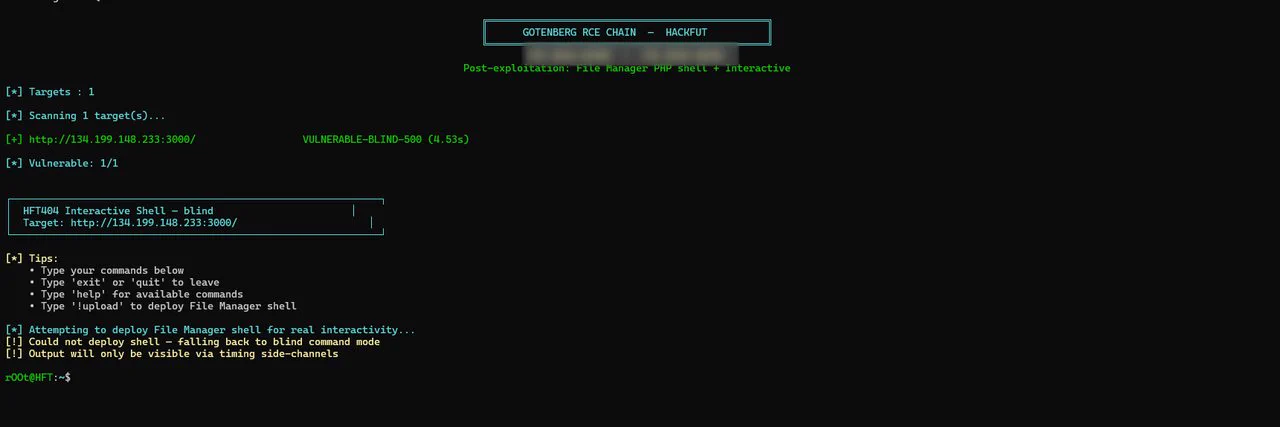
A public PoC chains CVE-2026-42589 and CVE-2026-40281 to achieve unauthenticated remote code execution against Gotenberg (a document/PDF-conversion microservice), abusing metadata injection flaws in the /forms/pdfengines/metadata/write endpoint. The tool supports vulnerability detection, interactive command execution, reverse shell delivery, and multi-target scanning against Gotenberg versions ≤8.30.1 (patched in 8.31.0).
x.comrepoPublished and added 5 Oct 2026🛡️ Security - Sigma r2026-07-01 — 20 new detection rules
GitHub release notes for Sigma r2026-07-01, the open-source detection-rule repository, adding 20 new rules (e.g. LSASS crash via Netlogon buffer overflow CVE-2026-41089, TanStack supply-chain attack indicators for Windows/Linux, RedTail cryptominer user-agent detection, AF_ALG kernel crypto API exploit indicator) and updating/fixing dozens of existing rules for ARM64 binary variants, file-sharing domain IOCs, and WMI-based reconnaissance/persistence detection. It's a routine but substantive update to a widely-used blue-team detection content pack.
github.comrepoAdded 3 Oct 2026🛡️ Security - Show HN: Made an open-source Lego AI generator
ldraw-nova is an open-source agentic pipeline where an LLM agent (tested with models like Claude Opus 5.5 and GPT-6 Astra) takes a build prompt, reads LDraw-building instructions, and produces a plan.json describing a model's geometry. From that plan it writes a Python generator script that, when executed, outputs an LDraw (.mpd) 3D CAD source file, viewable in 3D/VR (Meta Quest 3) or exportable to Blender-editable glTF. The agent uses jev-rerank, a semantic search tool with reranking backed by TypeSafe's Jev System One model, to find suitable LEGO parts and example models, falling back to full-text search without an API key; it also uses headless rendering and collision/gap detection to self-inspect and iterate on designs.
github.comrepoAdded 3 Oct 2026, published 2 Oct 2026🧠 AI - Microsoft Agent Framework — python-1.20.0 release
Release notes for Microsoft's Agent Framework (Python and .NET SDKs), covering versions python-1.16 through python-1.20 and dotnet-1.19 through dotnet-1.23. Changes span native vector-store connectors (MongoDB, Qdrant, PostgreSQL/pgvector, DuckDB, SQL Server, Azure Cosmos DB, Azure AI Search), Foundry hosting redesigns around request-scoped agent factories and durable Invocations, MCP skill/session security hardening (approval binding, security labels, ZIP-only skill archives), Magentic multi-agent orchestration and handoff routing, and checkpoint/replay correctness fixes across workflows.
github.comrepoAdded 2 Oct 2026🧠 AI - Bifrost (Maxim AI) — open-source LLM gateway
Bifrost is an open-source, high-performance LLM gateway (by Maxim AI) that exposes a single OpenAI-compatible API across 23+ providers including OpenAI, Anthropic, AWS Bedrock, Google Vertex, Azure, Cohere, Mistral, and Ollama. It provides automatic failover, load balancing, semantic caching, Model Context Protocol (MCP) tool integration, budget and governance controls, OIDC user provisioning, and Prometheus-based observability, deployable via npx or Docker with claimed sub-15 microsecond overhead at 5,000 RPS. It is positioned as a drop-in replacement requiring only a base-URL change for existing OpenAI, Anthropic, or GenAI SDK code.
github.comrepoAdded 2 Oct 2026🧠 AI - renato-osec/goonfi-v2-decompiled
goonfi-v2-decompiled holds byte-identical reconstructed Rust source for the GoonFi V2 Solana program goonuddtQRrWqqn5nFyczVKaie28f3kDkHWkHtURSLE, as deployed at slot 448984043. The on-chain program was upgraded on 6 October 2026 to fix reported bugs. VERIFY.sh builds with Solana platform-tools v1.48 and compares the result to the deploy transaction's loader buffer writes. The page does not describe the bugs.
github.comrepoAdded 22 Oct 2026, published 2 Oct 2026🛡️ Security - AI-Infra-Guard (A.I.G) — Tencent Zhuque Lab
AI-Infra-Guard (A.I.G) is Tencent Zhuque Lab's open-source AI red-teaming platform combining AI infrastructure vulnerability scanning (2000+ CVE rules covering vLLM, llama.cpp, LangFlow, n8n, MLflow and 145+ other AI components), MCP server/skill security scanning, LLM API poisoning detection, and multi-turn jailbreak evaluation (Many-Shot, PAIR, GOAT, ActorAttack). It ships CLI tools (skill-scan, mcp-scan, agent-scan), a Docker-deployed web UI, and has produced original research including FORGE-Bench (loss-of-control benchmark), RogueHandoff-20, and SkillJack (persistent skill backdoors), with talks at Black Hat Europe 2025 on MCP security.
github.comrepoAdded 30 Sep 2026🛡️ Security - Andrea (Drego) Draghetti 👨🏻💻 🎣 (@AndreaDraghetti) on X
Tosint v1.0.0 is an open-source Telegram OSINT tool for analyzing bots and chats, exporting message history and media. The new release adds richer JSONL metadata output, optional SHA-256 hashing of exported media, bot/user authentication support, and an automatic fallback from MTProto-based history retrieval to ID-scan mode when dealing with restricted chats.
x.comrepoAdded 2 Oct 2026, published 30 Sep 2026🛡️ Security - rehan-remade/universal-modder
universal-modder is a set of Agent Skills, a CLI (um) and a shared knowledge base (field notes in knowledge/) that let AI coding agents such as Claude Code, Codex, Gemini CLI, Cursor, GitHub Copilot and OpenCode find a PC game's engine, reverse-engineer its code, build a working mod, generate art/3D/sound assets via the fal MCP server (or a local ComfyUI server), test the mod in the running game, and write a field note for the next agent. It ships worked examples — a weapon/boss pack for Terraria via tModLoader, a new civilization for Age of Empires II DE, and a real-time Minecraft-inside-GTA-V passthrough mod — each documented with a field note of exact versions, routes and gotchas, and agents can open pull requests to grow the shared knowledge base.
github.comrepoAdded 6 Oct 2026, published 30 Sep 2026🧠 AI - NVIDIA OpenShell — secure runtime for autonomous AI agent fleets
OpenShell is NVIDIA's open-source runtime for running fleets of autonomous AI agents with restricted, policy-governed access to files, system calls, network, and credentials. It enforces policy at the kernel level inside isolated sandboxes (per-agent, with Docker/Podman/virtualization backends) and uses formal verification to flag risky policy changes — such as an agent gaining a new host or API access with credentials — before they take effect, so changes can wait for human review. It ships a CLI, a gateway control plane, Kubernetes/Helm deployment, and installable agent skills for writing and debugging sandbox policies.
github.comrepoAdded 29 Sep 2026🧠 AI - garak v0.17.0 — LLM vulnerability scanner release
Release notes for garak v0.17.0, NVIDIA's open-source LLM vulnerability scanner used for red-teaming and probing models for jailbreaks, prompt injection, data leakage and other failure modes. The release adds an EU AI Act risk-category mapping to tag and group probe results, plus fixes to detectors (agent_breaker judge verdict validation, packagehallucination import parsing, MarkdownExfilContent divide-by-zero, TriggerListDetector alignment) and probes (badchars ASCII selection, Markdown exfiltration link templates), along with Ollama generator improvements and dropped Python 3.10 support in favor of 3.13.
github.comrepoAdded 29 Sep 2026🛡️ Security - NVIDIA OpenShell — secure runtime for autonomous AI agent fleets
OpenShell is NVIDIA's open-source runtime for running fleets of autonomous AI agents in isolated sandboxes, enforcing per-agent policies on filesystem, syscall, and network access at the kernel level and injecting credentials only for approved endpoints. Policy changes go through a formal-verification step (an 'advisor'/'prover') that flags newly granted risky access, such as a new host reachable with credentials, before it's applied, and it deploys via Docker/Podman/host virtualization or Kubernetes with Helm.
github.comrepoAdded 29 Sep 2026🛡️ Security  Ternary-Bonsai-2-27B: 27B model compressed to ~1.75 bits/weight, 98.2% of FP16 quality retained
Ternary-Bonsai-2-27B is a 27B-parameter reasoning model (built on Qwen3.8-27B) quantized to true ternary weights ({-1,0,+1}) at ~1.72 bits/weight, shrinking it from ~54GB FP16 to ~5.95GB while retaining 98.2% of FP16 benchmark quality (84.78 vs the conventional sub-4-bit IQ2_XXS build's 72.59). It uses a Hadamard-rotated weight basis and ships two GGUF packing formats (PTQ1_0 dense trits, PQ2_0 2-bit slots) that require a custom llama.cpp/MLX kernel fork since stock llama.cpp cannot decode them correctly. The card includes per-category benchmark breakdowns (math, coding, agentic tool calling), cross-platform throughput/power measurements (Apple M5 Pro/Max, RTX 5090, L4, H100/A100/Blackwell), and an "intelligence density" metric comparing capability retained per GB against FP16 and other quantizations.
huggingface.corepoAdded 29 Sep 2026🧠 AI- Uncensored and Offensive Security AI Models Benchmark
A GitHub README curating open-weight "uncensored" and security-fine-tuned LLMs (e.g. WhiteRabbitNeo's DeepHat V2, BugTraceAI-CORE, CYBER-FROST, CyberPal2.0, Lily-Cybersecurity-7B, Dolphin-Llama3-8B, Wizard-Vicuna-13B-Uncensored, huihui-ai's abliterated Qwen variants) with HuggingFace download links, quantization formats (GGUF, FP8, Q4_K_M, Q6_K), and training techniques used (SFT, QLoRA, DPO, abliteration, MoE/MTP architectures). It also includes a glossary explaining abliteration (orthogonalizing the refusal direction out of the residual stream, per Arditi et al. 2024) and references benchmarks like CyberBench and TrustedSec's LLM Attack Benchmark, making it a practical reference for anyone sourcing or deploying refusal-removed models.
github.comrepoAdded 2 Oct 2026, published 29 Sep 2026🧠 AI - dagoSte/squadra
Squadra (version 3.11.0) is an MIT-licensed Python 3.12+ tool that coordinates several Claude Code, Codex and interactive Cursor windows on one project through a shared local registry. It records tasks, acknowledgements, source-bound proofs and independent reviews by a window that did not write the code. A local dashboard shows progress, per-window token usage and model-balance suggestions, and community plugins extend it. The page was truncated, so later sections are not covered.
github.comrepoAdded 27 Oct 2026, published 28 Sep 2026🧠 AI - Adversarial-Detection-Engineering/adeskills
adeskills is a working knowledge base for "Adversarial Detection Engineering" (ADE), a taxonomy of four categories and 16 subcategories of detection-logic bugs (e.g. Reformatting in Actions, Omit Alternatives, Context Development, Logic Manipulation) that explain why a SIEM/EDR/XDR rule fails to catch what it intends to. It ships 38 worked technique files with vulnerable/hardened rule examples and detection-layer guidance, a cross-platform bug-pattern catalog, a pre-engagement scoping checklist, and a Redamon-packaged skill (ade_scoper), all grounded in analysis of real public rulesets from Sigma, Elastic Security, and Microsoft Sentinel. It's explicitly scoped for defensive detection engineering and purple-team rule hardening, with several files documenting real vendor-rule weaknesses.
github.comrepoAdded 2 Oct 2026, published 27 Sep 2026🛡️ Security - zhuyansen/awesome-claude-video-skills
Awesome-list repository cataloguing 183 open-source 'skills' and toolkits that let Claude Code, Codex and other coding agents generate or edit video: rendering frameworks like HyperFrames and Remotion, motion graphics, explainer/promo video generators, short-form editors, digital avatars and music videos. Each entry is read and security-graded by a companion service (Agent Skills Hub / agentskillshub.top), with a machine-readable JSON feed and category breakdowns (frameworks, promos, explainers, editing, shorts, avatars, animation, motion graphics, scripts, music videos).
github.comrepoAdded 29 Sep 2026, published 27 Sep 2026🧠 AI - Agent Control Standard (ACS)
Agent Control Standard (ACS) is an OWASP GenAI Security Project specification that lets a separate Guardian Agent inspect an AI agent's proposed actions before they execute and return allow/deny/modify/ask/defer over an authenticated JSON-RPC wire, with OpenTelemetry/OCSF audit trails and a CycloneDX/SPDX/SWID AgBOM inventory. The reference implementation runs Microsoft's Agent Governance Toolkit (AGT) behind the ACS contract with Bun, including host shims for Claude Code and OpenCode, and demonstrably denies a destructive `rm -rf /` command from a live coding-agent session while allowing benign ones. The project is explicit about current gaps — the wire is unauthenticated (issue #70) and the reference Guardian fails open by default (issues #32/#37) — and only 2 of 16 lifecycle hooks are evaluated live in v0.1.0.
github.comrepoAdded 26 Sep 2026🛡️ Security - garak v0.17.0 — adds EU AI Act risk-category mapping
garak is NVIDIA's open-source LLM vulnerability scanner that runs probes/detectors for jailbreaks, prompt injection, PII leakage, package hallucination, markdown exfiltration and more against LLM targets. This v0.17.0 release adds a new EU AI Act risk-category mapping to tag and group probe results by the Act's risk categories, alongside fixes to the agent_breaker judge, markdown-exfiltration detectors, Ollama auth/generation support, and dropped Python 3.10 in favor of 3.13 support.
github.comrepoAdded 26 Sep 2026🛡️ Security - graygnatconsole/mcp-audit-tool
mcp-audit-tool is a dependency-light Python CLI that statically scans Claude Desktop, Cursor, Windsurf, Cline, Zed, and VS Code MCP configuration files for security issues, including hardcoded secrets, unpinned/rug-pull packages, pipe-to-shell installers, tool-poisoning via hidden instructions in tool descriptions, filesystem servers rooted at '/', and unauthenticated plaintext HTTP MCP endpoints. It auto-discovers configs across macOS/Linux/Windows, produces a security score/grade plus SARIF 2.1.0 output for GitHub Code Scanning, and is built around the OWASP MCP Top 10 categories with a CI/CD example that fails builds on severity thresholds. The roadmap adds live server probing over stdio/SSE for runtime rug-pull detection and an ML-based prompt-injection classifier for tool descriptions.
github.comrepoPublished and added 26 Sep 2026🛡️ Security - google/ax — declarative agentic orchestration runtime
AX is Google's declarative orchestrator for running large numbers of autonomous agent workloads on Kubernetes, built on top of "Agent Substrate" for sandboxed execution. Agents are declared via YAML manifests (Task, Workspace, Model) similar to kubectl, and applied with an `ax` CLI that supports apply/get/watch/ssh/suspend/resume, treating agent runs as a distinct workload type distinct from stateless services or batch jobs.
github.comrepoAdded 26 Sep 2026🧠 AI - Hindsight — Agent Memory That Learns
Hindsight is an open-source agent memory system (MIT-licensed, self-hostable via Docker/Helm or usable as Hindsight Cloud) that goes beyond RAG-style recall by having agents learn through consolidated observations and mental models built from retained facts and experiences. It exposes retain/recall/reflect operations, a built-in MCP server per memory bank, Python/Node/Go/CLI clients, an LLM-wrapper for drop-in memory on OpenAI/Anthropic calls, and reports state-of-the-art results on the LongMemEval long-term memory benchmark, independently reproduced by Virginia Tech's Sanghani Center and The Washington Post.
github.comrepoAdded 26 Sep 2026🧠 AI - git-pkgs — dependency history & supply-chain analysis for git repos
git-pkgs is a Go rewrite of a Ruby tool that adds a git subcommand for tracking dependency changes across a repository's history, indexing manifests/lockfiles from 36+ package managers (npm, RubyGems, Cargo, PyPI, Maven, Composer, Go modules, etc.) into a local SQLite database. Beyond history/blame/diff, it offers supply-chain security commands: `vulns` (OSV-based CVE scanning with SARIF output for GitHub code scanning, plus blame/praise/exposure for remediation metrics), `licenses` (with drift detection and CI-friendly exit codes), `deprecated`, `provenance` (trusted-publishing/attestation checks), `integrity` (lockfile hash drift detection), `maintainers`/`health` (via ecosyste.ms metadata), and `sbom` export in CycloneDX/SPDX. It also supports a dependency-aware `bisect` to find when a vulnerability, license change, or capability (e.g. network access) was introduced, and ships GitHub Actions for CI integration.
github.comrepoAdded 25 Sep 2026🛡️ Security - yetone/magpie
magpie is a cross-platform menu bar app, TUI and CLI that lets you view and switch the model each installed AI coding agent (Claude Code, Codex, Gemini CLI, OpenCode, Cursor, Copilot CLI, Goose, Pi, etc.) is configured to use, editing each agent's config file surgically without disturbing comments or formatting. It runs a local gateway (127.0.0.1:3425) that translates between OpenAI Chat Completions, OpenAI Responses and Anthropic Messages APIs so every agent can point at one endpoint and use any provider's models, including routing groups that spread requests across multiple keys/subscriptions with configurable routing strategies (smart, order, rotate, usage). It can also reuse existing subscriptions (Claude Code, Codex/ChatGPT, Copilot, Devin, Gemini CLI) as providers for other agents without exposing or copying credentials, and supports encrypted profile backup/restore.
github.comrepoAdded 26 Sep 2026, published 23 Sep 2026🧠 AI - https://github.com/akha-security/akca
AKCA is an open-source, Go-based Dynamic Application Security Testing (DAST) scanner that combines HTTP and headless-browser crawling, JavaScript/AST analysis, API spec import (OpenAPI, GraphQL, gRPC, etc.), and adaptive active testing across a very broad set of vulnerability classes including SQL injection, XSS, SSRF, IDOR/BOLA, SSTI, JWT/OAuth flaws, race conditions, and cloud/CI exposure. It emphasizes evidence-oriented verification — replaying promising signals against baselines, negative controls, and OAST callbacks before promoting them to findings — and exports Burp-style HTTP evidence in HTML, JSON, CSV, Markdown, and SARIF reports. Positioned as a transparent, single-developer alternative inspired by but not claiming parity with Acunetix, Invicti/Netsparker, or Burp Suite Professional.
github.comrepoAdded 2 Oct 2026, published 23 Sep 2026🛡️ Security - shai-hulud-detect: multi-ecosystem npm/PyPI/Composer/Crates/Go/Hex/RubyGems supply-chain worm scanner
shai-hulud-detect is a dependency-free Bash scanner that checks projects against a 5,782-entry list of compromised npm, PyPI, Composer, Crates, Go, Hex, and RubyGems package versions, plus content-pattern indicators of compromise (malicious file hashes, C2 domains, dead-man's-switch artifacts, forged commits, suspicious lifecycle hooks) tied to the Shai-Hulud supply-chain attack waves. It supports single-project and bulk scanning, CI-friendly exit codes, JSON/log output for pipeline gating, and a --check-host mode to detect the May 2026 gh-token-monitor/kitty-monitor persistence daemons that wipe hosts if their monitored GitHub token is revoked (with a documented safe remediation order). Detection is read-only; new package entries are sourced from named threat-research firms (Socket, StepSecurity, Aikido, Snyk, JFrog, Wiz, Semgrep, SafeDep, GitGuardian, OX Security) and cited in PRs.
github.comrepoAdded 23 Sep 2026🛡️ Security - nealbridges/VulnHunter
VulnHunter is a maintained fork of Capital One's open-source agentic security scanner, reworked to run on any agent harness (Claude Code, Codex, Grok/OpenCode) instead of being Claude-Code-specific. The fork's distinguishing work is engineering, not security findings: portable "skill" prompt files with an explicit environment contract, an installer that fails loudly instead of guessing paths, Docker-based sandboxed exploit validation, and a benchmark harness that ran six full scans of one production Go service across five model/harness stacks, finding that result counts swung from 3 to 42 findings depending on how rigorously exploits were validated. It ships three composable skills (/vulnhunt, /vulnhunter-fix, /vulnhunt-fix-verify), a headless batch-runner (harness/), and a deterministic manifest-writing CLI (vh).
github.comrepoAdded 6 Oct 2026, published 22 Sep 2026🧠 AI - nealbridges/VulnHunter
A maintained, harness-portable fork of Capital One's open-source VulnHunter — an agentic AI tool that performs attacker-first forward analysis on source code to find exploitable vulnerabilities, falsify weak findings, and produce evidence-backed PoCs rather than pattern-matched SAST alerts. This fork adds containerized (Docker-based) exploit validation, measured-impact PoCs (rows leaked, amplification factor, etc.), and portability across agent harnesses (Claude Code, Codex, Grok, etc.) via environment-contract prompt files, plus an unattended operator (vulnhunter-run) and batch-scanning/benchmark harness tested against OWASP NodeGoat, Juice Shop, and WebGoat.
github.comrepoAdded 6 Oct 2026, published 22 Sep 2026🛡️ Security - yibie/jev-engineering-zh
A Chinese translation (with original source notes) of a design essay synthesizing TypeSafe founder Diogo Almeida's notes on 'Jev,' a typed decision model that drives a coding-agent harness. It argues coding agents are simple loops whose real leverage lies in how context is assembled each turn, and works through six problems inherited from KV-cache-driven, append-only context design: costly model routing, tool-schema bloat, lossy compaction, rare sub-agents, destructive session restarts, and the built-in-capabilities tradeoff. It proposes fixes including query-aware context scoring/visibility tiers, cost-aware routing that accounts for cache reprocessing, tiered tool disclosure, conditional AGENTS.md loading, and shared read-only background retrieval.
github.comrepoAdded 26 Sep 2026, published 22 Sep 2026🧠 AI - Supply Chain Firewall (Datadog)
Supply Chain Firewall (SCFW) is a Datadog-built CLI that wraps npm, pip, and poetry commands to inspect every package target against known-malicious/compromised package datasets (the open-source malicious-software-packages-dataset and OSV.dev) before installation proceeds, blocking or warning on hits. It ships as a single Go binary, can be aliased transparently into a developer's shell, and optionally reports run outcomes and enforces centralized allow/block policies through Datadog Code Security across a fleet, sending only package metadata (never source code) to Datadog.
github.comrepoAdded 22 Sep 2026🛡️ Security - SnailSploit/Claude-Red
claude-red is a GitHub library of structured SKILL.md files for the Claude Skills system, each priming Claude with expert-level offensive-security methodology for a specific attack surface (SQL injection, shellcode, EDR evasion, ADCS abuse, wireless, IoT, cloud, mobile, fuzzing, etc.). Skills load on-demand from conversational triggers so context isn't spent on unused domains, and can be installed wholesale, per-category via sparse-checkout, or pasted directly into a system prompt. It's aimed at authorized red-team engagements, bug bounty triage, CTF prep, and operator training, building on Sahar Shlichov's offensive checklist collections.
github.comrepoAdded 21 Sep 2026🛡️ Security - Gihchathur/kubemotion
KubeMotion is a browser-only visualizer that turns raw Kubernetes YAML or a packaged Helm chart (.tgz) into an interactive, Argo CD-style dependency graph without ever connecting to a live cluster or executing Helm. Beyond visualization it runs rule-based checks for common deployment problems — missing probes, incomplete containers, missing selectors, missing service accounts, and mutable image tags — surfaced per-resource in an inspector panel, and can export the resulting architecture as a Mermaid diagram. Built with React, TypeScript, Vite, React Flow and CodeMirror; explicitly a read-only, credential-free tool for reviewing manifests/charts before they're applied.
github.comrepoAdded 21 Sep 2026🛡️ Security - ossf/criticality_score
criticality_score is an OpenSSF tool that computes a 0-1 criticality score for open source projects (based on an algorithm by Rob Pike), using signals like contributor count, commit frequency, dependents count, and org diversity to identify projects the ecosystem critically depends on. It ships a CLI, config files for tuning scoring weights, and companion tools (enumerate_github, collect_signals, scorer) for large-scale data collection; the project's GCP-hosted BigQuery/GCS datasets will be discontinued after 2026-08-29, with data moving to a static data directory.
github.comrepoAdded 21 Sep 2026🛡️ Security - sno-ai/sno-station
Sno Station is an open-source (Apache-2.0) local workstation that coordinates multiple AI agents (Claude Code, Codex, OpenClaw) as a 'Duo': they share an encrypted on-disk memory store, hand off tasks when one hits a rate limit, peer-review each other's work, and run a nightly self-improvement loop that proposes edits to their own skill files based on session history. It reports results on the Memora benchmark (FAMA/FAA metrics for forgetting-aware long-term memory) and cites Karpathy's 'LLM Wiki' and Google's WikiSkill as design inspirations.
github.comrepoAdded 26 Sep 2026, published 19 Sep 2026🧠 AI - MichaelKinsy/PiG
PiG reimplements Pi — a minimal, extensible terminal coding agent — as a single native Go binary with no Node.js dependency, while remaining behaviorally pinned to a specific Pi release (0.87.1) and running Pi's TypeScript extensions unchanged. It adds a multi-language extension host (Go, Rust, Python, Node), a "Piglet" mechanism for bundling extensions/skills/prompts into a named shareable agent, and a formal parity-tracking process (PORT_MAP.md, DIVERGENCES.md, coverage reports) that documents every intentional divergence from the upstream Pi reference implementation.
github.comrepoAdded 27 Sep 2026, published 17 Sep 2026🧠 AI - Copy Fail (CVE-2026-31431): 9-year-old Linux kernel LPE found by Theori's Xint Code
A GitHub repository from Theori's Xint Code team detailing CVE-2026-31431, a Linux kernel local privilege escalation bug ("Copy Fail") that had gone undetected for roughly nine years. The researchers confirmed exploitability across current production kernels including Ubuntu 24.04 LTS (6.17.0-1007-aws), Amazon Linux 2023 (6.18.8-9.213.amzn2023), RHEL 10.1 (6.12.0-124.45.1.el10_1), and SUSE 16 (6.12.0-160000.9-default).
github.comrepoAdded 17 Sep 2026🛡️ Security - ThreatIntel-Aggregator
ThreatIntel-Aggregator is a self-hosted FastAPI/Next.js platform that polls 60+ tiered security RSS feeds (CISA, Talos, Unit42, etc.), runs AI triage to score severity and tag MITRE ATT&CK TTPs, extracts IOCs/CVEs, and correlates findings against a RunZero asset inventory to surface org-level exposure. Its Detections module goes further: it catalogs AI-generated or locally-imported detection rules (KQL/Sigma/YARA/Suricata/SPL), statically validates them, runs AI-driven MITRE alignment checks against technique coverage, tracks detection "rot," and can sync Hunts/Analytics Rules to a live Microsoft Sentinel workspace. It's designed to run standalone with zero cloud dependency or fully integrated with Azure/Entra/Sentinel, with all storage in Postgres and auth via Entra SSO or a local API key.
github.comrepoAdded 22 Sep 2026, published 17 Sep 2026🛡️ Security



Showing 60 of 170
Show more