- Bunny CDN Security Incident
Bunny CDN status-page notice, posted 28 October 2026, about unauthorized access at an infrastructure provider that hosted one bunny.net CDN node in Armenia. Traffic was stopped within 20 minutes and the server wiped. No access to the node was found, but cached content, Pull Zone configs and TLS certificates could have been exposed, so all platform certificates were reissued. Customers with their own certificates should rotate them with new private keys.
 status.bunny.netadvisoryAdded 31 Oct 2026, published 30 Oct 2026🛡️ Security
- lee1981 (@lee1981b) on X
CVE-2026-103780 is a stack-based buffer overflow (CWE-121) in Dell PowerProtect Data Domain / DD OS. An unauthenticated remote attacker could get command execution (CVSS 3.1 9.8, Dell DSA-2026-416). The post lists affected and fixed builds for four release trains (Feature Release, LTS2024, LTS2025, LTS2026). It adds KEV, EPSS and SSVC status, plus six defensive checks. The vulnerable service is not public.
 x.comadvisoryAdded 31 Oct 2026, published 29 Oct 2026🛡️ Security
- Hitachi Energy TRO600 series products
ICSA-26-302-02 is a CISA republication of Hitachi Energy PSIRT advisory 8DBD000224 on the TRO600 series. It covers CVE-2026-10756 and CVE-2026-106087, which allow remote code execution and disclosure of sensitive information. Affected versions are TRO600 up to 9.2.1.6 and 9.1.1.0, plus 9.2.2.1 and 9.1.2.0. The page gives no per-CVE detail or CVSS scores, only general ICS hardening advice. Released 27 October 2026.
 cisa.govadvisoryAdded 29 Oct 2026, published 28 Oct 2026🛡️ Security
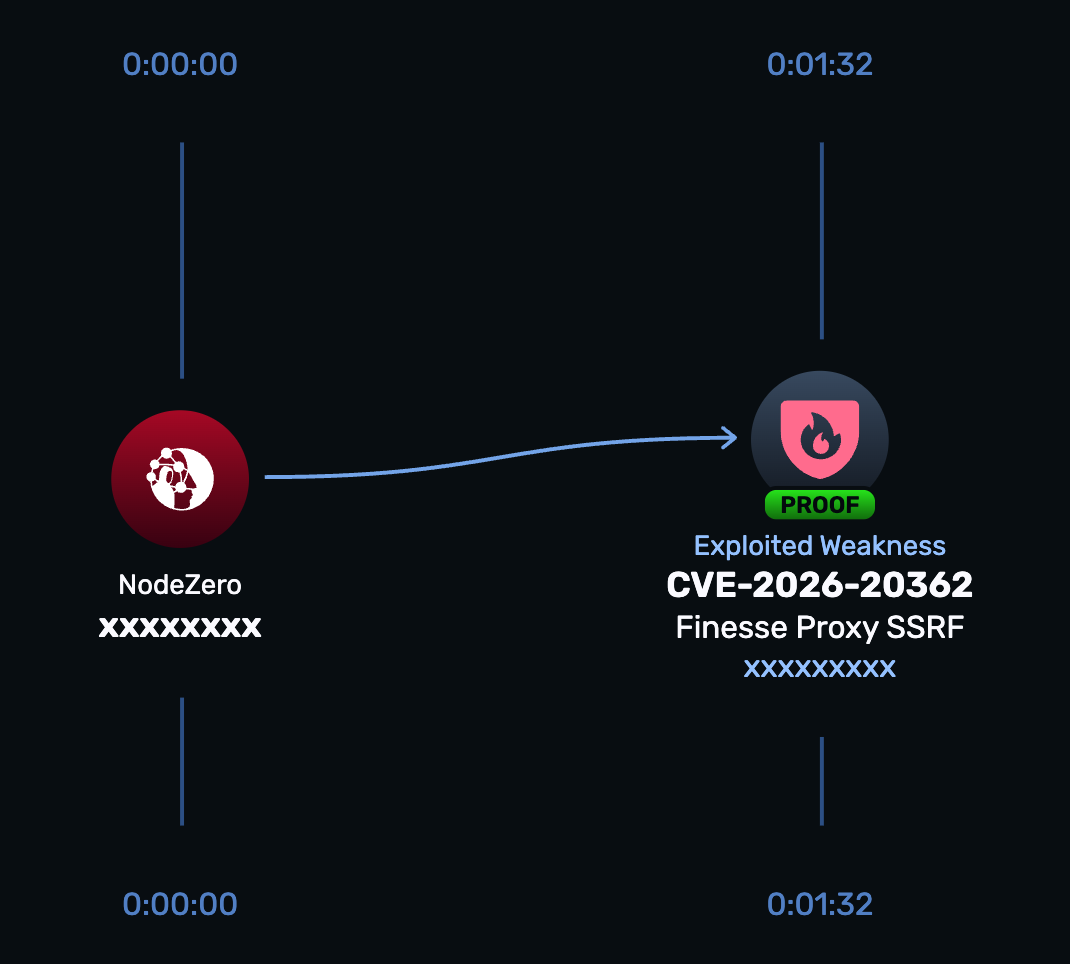 CVE-2026-20362 | Cisco Finesse Server-Side Request Forgery Vulnerability
CVE-2026-20362 is an unauthenticated server-side request forgery in Cisco Finesse (CVSS 3.1 score 7.2), found by Horizon3 researchers Noah King and Brandon Peterson. The embedded Apache Shindig content proxy fetches attacker-supplied URLs, including loopback services such as the Finesse REST API at 127.0.0.1:8082, which returns SystemInfo with node hostnames and the XMPP domain. Cisco published its advisory on 7 October 2026. Fixes are planned for January and February 2027, and no workaround exists.
 horizon3.aiadvisoryAdded 29 Oct 2026, published 28 Oct 2026🛡️ Security
- Dark Web Informer (@DarkWebInformer) on X
Veeam patched five vulnerabilities across Backup & Replication, Veeam Agent for Linux and Veeam ONE. The worst is CVE-2026-108142 (CVSS 9.1), an unauthenticated authorization bypass in the CDP Coordinator Service affecting Backup & Replication 13.0 and 13.1. Other fixes cover Linux agent privilege escalation, two path-traversal file writes, and a Veeam ONE MFA bypass; fixed builds are listed.
x.comadvisoryAdded 30 Oct 2026, published 28 Oct 2026🛡️ Security - EPICS Base
CISA ICS advisory ICSA-26-300-01 (October 27, 2026) covers EPICS Base release 7.0.10 and earlier, with CVE-2026-114595 through CVE-2026-114598. Flaws include integer overflow, length parameter inconsistency and type confusion, allowing denial of service, memory corruption, information disclosure or remote code execution (CVSS v3.1 9.8). The fix is EPICS Base 7.0.11, with patches in epics-base and pvDataCPP pull requests.
cisa.govadvisoryAdded 29 Oct 2026, published 26 Oct 2026🛡️ Security - dbugs (@ptdbugs) on X
CVE-2026-106173 is a critical (CVSS 9.4) unauthenticated arbitrary file write in FortiSIEM's phQueryMaster gRPC service on port 27918/TCP. The SendQueryResult method builds a path from the query-id parameter without validation, so "../" sequences escape the directory and a null byte drops the appended filename and extension. Overwriting /opt/charting/redishb.sh, which runs every 60 seconds, gives remote command execution. Horizon3.ai published the analysis and a PoC.
x.comadvisoryAdded 27 Oct 2026, published 26 Oct 2026🛡️ Security  Railway Security Disclosure
Railway's security disclosure of 21 October 2026 says an unauthorized third party may have accessed encrypted customer environment variables and decrypted some of them. Railway links it to a series of attacks on platform companies aimed at compromising AI inference providers, and has asked upstream providers to revoke keys. It tells all users to roll every environment variable, API key and registry credential, and it paused all deployments. The notice gives no technical details of the intrusion.
 blog.railway.comadvisoryAdded 22 Oct 2026, published 21 Oct 2026🛡️ Security
- PHP web runtimes (CVE-2026-109618 and CVE-2026-109619)
AWS bulletin 2026-143-AWS covers CVE-2026-109618 and CVE-2026-109619, critical PHP web runtime flaws that let an unauthenticated remote caller run code, read process data or cause denial of service. Fixed in PHP 8.5.12, 8.4.27, 8.3.36 and 8.2.35; PHP 5.4 to 8.1 get no fix. It gives status for WorkMail, Elastic Beanstalk, Amazon Linux and Lightsail, plus AWS WAF rules, including a custom "PHP2Shell" rule matching PHP_SESSION_UPLOAD_PROGRESS and PHPSESSID.
 aws.amazon.comadvisoryAdded 22 Oct 2026, published 21 Oct 2026🛡️ Security
 Compromised eMudhra intermediate certificates
Cisco Talos describes eight eMudhra intermediate CA certificates (six TLS, two code signing) whose P-384 private keys were trivially recoverable because a flaw in an April 30, 2025 key generation ceremony produced weak keys with only 3 to 8 bytes of entropy. The post lists certificate SHA-256 hashes and serials, browser and Microsoft blocks, and the Go fix (CVE-2026-111943, Go 1.27.3 and 1.26.10) that filters chains by SPKI hash. It covers impact on VPNs, CI/CD and embedded devices, and Snort SIDs 67363 to 67374.
 blog.talosintelligence.comadvisoryPublished and added 21 Oct 2026🛡️ Security
- PHP 8.2.35
PHP 8.2.35 is a security release of the PHP 8.2 branch that fixes two critical vulnerabilities, CVE-2026-109618 and CVE-2026-109619, which can allow unauthenticated remote code execution. The notes say no complete mitigations exist and updating is the only safe choice. PHP 8.2 reaches end of life on 31 December 2026, after which it gets no security fixes.
 github.comadvisoryAdded 22 Oct 2026, published 21 Oct 2026🛡️ Security
 Critical vulnerabilities in PHP (PHP2SHELL)
PHP2SHELL is Aikido Security's advance notice of two critical remote code execution flaws in PHP itself, CVE-2026-109618 and CVE-2026-109619, both CVSS v4.0 9.2, with all versions treated as affected. The PHP security team will release fixes at 14:00 UTC on 21 October 2026, a day early after details leaked on 20 October. The post withholds exploitation details and workarounds.
 aikido.devadvisoryPublished and added 21 Oct 2026🛡️ Security
- #StopRansomware: SafePay Ransomware (AA26-293A)
CISA advisory AA26-293A (20 October 2026) details SafePay ransomware, active since August 2024 with at least 600 victims across critical infrastructure. It covers initial access via Mullvad VPN IPs, phished profiles and edge-device CVEs, LOTL lateral movement with PsExec, WinRM and RDP, exfiltration with RClone and WinSCP, and ChaCha20/RSA encryption. It lists IOCs, MITRE ATT&CK mappings, incident response steps and mitigations.
cisa.govadvisoryAdded 21 Oct 2026🛡️ Security - Upcoming Critical PHP Security Release
The PHP security team announces an upcoming PHP security release that fixes two critical vulnerabilities, both rated CVSS v4.0 9.2. The release is scheduled for Wednesday, 21 October 2026 at 14:00 UTC. The team says it may release earlier if details become public or exploitation in the wild is seen. The notice gives no CVE IDs, affected versions or technical details.
 news-web.php.netadvisoryAdded 21 Oct 2026, published 20 Oct 2026🛡️ Security
 Upcoming Critical PHP Security Release
The php.net 2026 news archive opens with the PHP security team's advance notice of a release scheduled for 21 October 2026 at 14:00 UTC. It fixes two critical vulnerabilities, both rated CVSS v4.0 9.2, and may ship earlier if details leak or exploitation appears. Details and fixed versions come with the release. The archive also lists 2026 security releases (8.2.34, 8.3.35, 8.4.26, 8.5.11), PHP 8.6 RC3 and conference announcements.
 php.netadvisoryAdded 21 Oct 2026, published 20 Oct 2026🛡️ Security
- Microsoft Threat Intelligence (@MsftSecIntel) on X
ConnectWise Cloud Backup (formerly SkyKick Backup, AppId 506e08f9-6e9a-4da4-942b-a099a03644ae) had its multitenant OAuth app compromised, per Microsoft Threat Intelligence. On 15 October 2026 the actor authenticated broadly as the service principal from 144.172.64[.]128, likely using customer-granted permissions such as Directory.ReadWrite.All, then ran Graph API reconnaissance and tried to add credentials to the service principal as a backdoor. The post lists IOCs, Defender alerts and hunting advice.
x.comadvisoryAdded 20 Oct 2026, published 17 Oct 2026🛡️ Security - Dark Web Intelligence (@DailyDarkWeb) on X
Summary of SAP's October 13, 2026 Security Patch Day (16 new notes, 4 GitHub advisories). It leads with CVE-2026-89111, a CVSS 10.0 OAuth2 SSRF in SAP Cloud SDK for Python before 0.45.2, where an attacker-controlled tenant_subdomain redirects token requests and exfiltrates client credentials. It also lists three other critical flaws: broken access control in NetWeaver Visual Composer, code injection in S/4HANA substitution/validation rules, and a missing authorization check in the Manufacturing Integration and Intelligence (XMII) Configuration Service. It notes that none are in CISA KEV and SAP reports no in-the-wild exploitation.
x.comadvisoryAdded 15 Oct 2026, published 13 Oct 2026🛡️ Security  Patch Tuesday - October 2026
Rapid7's analysis of Microsoft's October 2026 Patch Tuesday, which covers 1,413 vulnerabilities, 1,102 of them in Windows. It highlights the exploited Windows Shell Mark of the Web bypass (CVE-2026-96951) and the publicly disclosed .NET Framework WDAC bypass (CVE-2026-108398). It also covers five no-interaction Outlook preview-pane RCEs, the Edge advisories that list no CVEs, and end-of-support dates for Server 2012/2012 R2, Office 2021, Exchange 2016/2019 and Windows 11 24H2. The page text is truncated, so the later CVE tables are not seen.
 rapid7.comadvisoryPublished and added 13 Oct 2026🛡️ Security
 Microsoft Patch Tuesday for October 2026 — Snort rules and prominent vulnerabilities
Talos summarises Microsoft's October 2026 Patch Tuesday, which covers 1415 vulnerabilities, 85 of them critical (67 RCE). One bug is exploited in the wild: CVE-2026-96951, a Windows Shell security feature bypass. The post groups the CVEs by Microsoft's exploitability rating (more likely, less likely, unlikely) with CVSS and CWE for each, covering Windows, Office, Exchange, Hyper-V, DHCP, QUIC, Outlook and Azure. It also lists the Snort 2 and Snort 3 rule ID ranges that detect exploitation attempts.
blog.talosintelligence.comadvisoryPublished and added 13 Oct 2026🛡️ Security- lee1981 (@lee1981b) on X
CyberForge CVE of the Day #074 analyses CVE-2026-85097, a CVSS 9.8 unauthenticated file upload to PHP execution flaw (CWE-434) in the Bricksforge WordPress plugin through 3.1.8.9. Wordfence names 3.1.8.10 as the fix, and a separate vendor 4.0.1 Pro Forms upload-security notice has no verified mapping to the CVE. It gives a defender workflow: scope versions, preserve edge/origin logs, inspect resulting files and PHP-FPM handling, and verify the patched version is serving. It also separates KEV (no match), EPSS (0.312%) and SSVC (exploitation none) from compromise evidence.
x.comadvisoryAdded 11 Oct 2026, published 10 Oct 2026🛡️ Security - CISA AA26-281A: Chinese Government-linked Actors Combine Automated and Hands-on Hacking Tools to Steal Data
Joint FBI/CISA/NSA and allied-agency advisory on China-linked actors enabled by Integrity Technology Group (overlapping with Flax Typhoon, Ethereal Panda, Red Juliett). It details their TTPs: open-source scanners and the MicroScan exploit-script app, an XSS credential-harvesting payload dropping live700_v1.exe, EBurst password spraying against Exchange/O365, SoftEther VPN persistence, DCSync via DC.exe, and email theft via the Curlc4.txt PHP bot and the office-cli utility. It also provides IOCs, MITRE ATT&CK mappings, CVEs, incident response steps, and mitigations.
cisa.govadvisoryAdded 9 Oct 2026🛡️ Security - lee1981 (@lee1981b) on X
CyberForge's CVE of the Day #073 covers CVE-2026-102255, a critical (CVSS 10.0) pre-authentication SSRF / confused-deputy flaw (CWE-918, CWE-441) in the SonicWall SMA1000 Work Place interface, per advisory SNWLID-2026-0017. It lists affected platform hotfixes (12.4.3-03526 and older, 12.5.0-02952 and older), fixed floors (12.4.3-03670, 12.5.0-03082), no workaround, and the exploitation picture (no known exploitation, not in KEV, EPSS 0.477%, SSVC automatable). It gives a six-step SOC playbook covering appliance scoping, AMC log preservation, hunting appliance-originated internal requests, correlating receiving-service changes, patching, and verifying every node, and it separates exposure, a lead, confirmed compromise and telemetry gaps.
x.comadvisoryAdded 12 Oct 2026, published 9 Oct 2026🛡️ Security  Citrix Urges Immediate Patching of Critical NetScaler Vulnerability
Citrix disclosed CVE-2026-107406 (CVSS 9.5), a critical memory overflow in NetScaler ADC and NetScaler Gateway that can lead to remote code execution or denial of service when appliances are configured as a SAML SP or SAML IdP, also affecting Secure Private Access Hybrid deployments using NetScaler. Patches are available in versions 14.1-73.46, 13.1-64.29, and the corresponding FIPS/NDcPP builds; Citrix says it is not aware of exploitation yet but urges immediate upgrades. The bulletin follows two other recently exploited NetScaler RCE/DoS zero-days (CVE-2026-88771, CVE-2026-88772) used against government, financial, education, legal, and professional-services organizations, and a separate DoS zero-day (CVE-2026-88779).
 securityweek.comadvisoryPublished and added 9 Oct 2026🛡️ Security
- go-ethereum v1.17.8 "Protein Sludge Pack"
Security-focused release notes for go-ethereum (Geth) v1.17.8, patching several denial-of-service vulnerabilities in the eth/snap p2p protocol handlers, hardening JUMPDEST analysis caching against post-Amsterdam-fork attacks, requiring IP verification before accepting discovery statements, fixing a rogue-STUN-server crash, and closing a DoS vector tied to BAL accounts. Most issues only become exploitable after the Amsterdam fork activates, and the release also includes RPC correctness fixes (eth_simulateV1, eth_createAccessList) and a Sparse Blobpool (EIP-8070) correctness bug.
github.comadvisoryAdded 8 Oct 2026🛡️ Security  Critical Atlassian Path Traversal Exposes Sensitive Files Across 8 Products
Orca Security details CVE-2026-21589 (CVSS 9.3), a critical unauthenticated path traversal flaw affecting all versions of eight Atlassian Data Center and Server products: Bitbucket, Confluence, Jira Software, Jira Service Management, Bamboo, Crowd, Crucible, and Fisheye. Insufficient path validation lets remote attackers read arbitrary files within the web application root without authentication, and in Crowd SSO deployments this can expose plaintext credentials usable to create administrative accounts and take over the entire Atlassian ecosystem. The advisory lists fixed versions for each product and recommends WAF rules and log review for organizations unable to patch immediately.
 orca.securityadvisoryPublished and added 7 Oct 2026🛡️ Security
 Atlassian Patches Critical Vulnerability Affecting 8 Products
Atlassian patched CVE-2026-21589 (CVSS 9.3), an unauthenticated arbitrary file access flaw affecting all versions of Bitbucket, Bamboo, Crowd, Crucible, Confluence, Fisheye, Jira Service Management, and Jira Software Data Center. WatchTowr researcher Yordan Ganchev notes that organizations using Crowd for SSO are especially at risk because authentication details are stored in plaintext at a predictable path, letting attackers mint admin accounts if Crowd endpoints are internet-reachable. Fixed versions are listed for each product; Atlassian recommends immediate patching or disconnecting internet-facing instances, with WAF rules as a stopgap.
securityweek.comadvisoryPublished and added 7 Oct 2026🛡️ Security Atlassian Jira, Confluence (and more) Arbitrary File Read Vulnerability (CVE-2026-21589)
CVE-2026-21589 is an unauthenticated arbitrary file read (path traversal) in eight Atlassian Data Center and Server products: Bitbucket, Confluence, Jira, Jira Service Management, Bamboo, Crowd, Crucible and Fisheye. Atlassian fixed it on 5 October 2026, and CISA added it to the KEV catalog on 15 October 2026. The page lists patching, WAF regex, Tomcat RewriteValve and urlrewrite.xml mitigations, and a log check for ".." sequences after up to two rounds of URL decoding.
 watchtowr.comadvisoryAdded 30 Oct 2026, published 6 Oct 2026🛡️ Security
 Frequently Asked Questions About the Atlassian Jira & Confluence Arbitrary File Read Vulnerability (CVE-2026-21589)
CVE-2026-21589 is an unauthenticated arbitrary file read in eight self-hosted Atlassian products: Bitbucket, Confluence, Jira Service Management, Jira Software, Bamboo, Crowd, Crucible and Fisheye Data Center. Attackers must know the exact file path, and watchTowr Intel observed exploitation by 6 October 2026. The FAQ covers the timeline (Atlassian advisory 5 October 2026), upgrade and WAF mitigations, and log searches for two dots next to a slash, backslash or double colon.
watchtowr.comadvisoryAdded 30 Oct 2026, published 6 Oct 2026🛡️ Security- Dark Web Intelligence (@DailyDarkWeb) on X
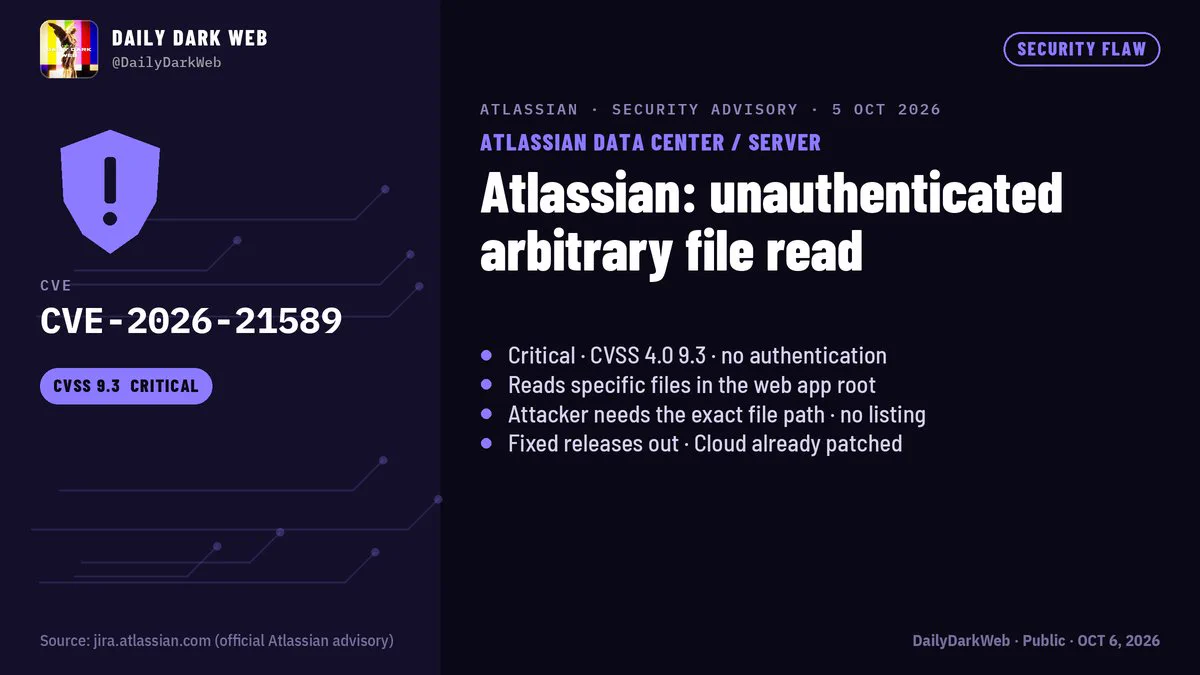
Atlassian disclosed CVE-2026-21589, a critical (CVSS 9.3) unauthenticated path traversal flaw allowing remote attackers to read specific files within the web application root across its self-managed Data Center/Server products — Jira Software, Jira Service Management, Confluence, Bitbucket, Bamboo, Crowd, Crucible, and Fisheye. Fixed versions are listed for each product (e.g. Jira 9.12.40/10.3.26/11.3.12, Confluence 9.2.26/10.2.19), and Atlassian Cloud is already patched; WAF/URL-rewrite mitigations are available for those who can't upgrade immediately. The post's analyst note clarifies exploitation requires knowing the exact target file path (no directory listing), and as of Oct 5, 2026 it is not yet in CISA KEV with no public exploit reported.
x.comadvisoryAdded 7 Oct 2026, published 6 Oct 2026🛡️ Security  Citrix NetScaler Zero-Day Exploited in the Wild Crashes SAML Authentication Services
Analysis of CVE-2026-88779 (CVSS v4.0 8.7), an unauthenticated memory-overflow flaw in the nsaaad SAML authentication handler on Citrix NetScaler ADC/Gateway that lets attackers crash the SAML service and lock out VPN/SSO access indefinitely through repeated triggering. Affects NetScaler 14.1 before 14.1-73.41 and 13.1 before 13.1-64.28 (plus FIPS/NDcPP builds); watchTowr Labs reproduced it via honeypot activity, Citrix confirmed targeted in-the-wild exploitation from IP 213.209.159.55, and CISA added it to KEV on 2026-10-04 with an Oct 7 federal remediation deadline. Some researchers suspect the overflow could extend to RCE beyond the documented DoS, though Citrix hasn't confirmed this.
orca.securityadvisoryPublished and added 5 Oct 2026🛡️ Security- Denmark Data Breach Exposes 8.8M People's Personal Data
Denmark's CPR administration (Det Centrale Personregister) disclosed that unauthorized actors abused a Danish company's legitimate, authorized access to the CPR system to extract names, addresses and CPR (national ID) numbers for roughly 8.8 million registered citizens. Records of individuals with name/address protection were not exposed. CPR has revoked the company's access, notified the Danish Data Protection Agency (Datatilsynet), and the incident is being investigated by police alongside relevant authorities.
 cpr.dkadvisoryPublished and added 5 Oct 2026🛡️ Security
- Cyber Security News (@The_Cyber_News) on X
Citrix issued emergency patches for CVE-2026-88779, a memory-overflow zero-day in NetScaler ADC/Gateway appliances configured as a SAML service provider or identity provider, rated CVSS v4.0 8.7. Citrix confirmed active, targeted exploitation against unmitigated deployments, with repeated exploitation causing denial of service and disrupting dependent authentication services.
x.comadvisoryAdded 6 Oct 2026, published 5 Oct 2026🛡️ Security - Several vulnerabilities have been discovered in the Linux kernel
Debian Security Advisory DSA-6528-1 announces fixes for a very large batch of Linux kernel vulnerabilities (hundreds of CVEs spanning 2024-2026) affecting Debian's stable distribution (trixie). The issues may lead to privilege escalation, denial of service, or information leaks; all are fixed in kernel version 6.12.111-1, and users are advised to upgrade.
 lwn.netadvisoryAdded 2 Oct 2026, published 1 Oct 2026🛡️ Security
- Critical Zero-Day Vulnerabilities Exploited in Citrix NetScaler ADC, Gateway
CISA alert amplifying Citrix's disclosure of ten NetScaler ADC and Gateway vulnerabilities (CVE-2026-88771 to CVE-2026-88779 and CVE-2026-107406). CVE-2026-88771 and CVE-2026-88772 are critical zero-days enabling independent remote code execution and are exploited globally; CVE-2026-88779 is a SAML SP/IdP denial-of-service that can force a reboot to trigger code injected via CVE-2026-88771. It advises checking for compromise before patching, preserving forensic evidence, forwarding logs to a SIEM, restoring a pre-compromise backup and rotating all secrets, and links a CISA SIGMA detection rule.
cisa.govadvisoryAdded 28 Sep 2026🛡️ Security  Zero-Day Exploitation of Citrix NetScaler ADC and Gateway: CVE-2026-88771 and CVE-2026-88772
Rapid7 details active zero-day exploitation of two critical Citrix NetScaler ADC/Gateway RCE vulnerabilities (CVE-2026-88771, CVE-2026-88772, both CVSSv4 9.5), both added to CISA KEV on disclosure day, plus a later SAML denial-of-service zero-day (CVE-2026-88779). The post includes Rapid7 MDR's observed exploitation of CVE-2026-88771 in the wild — a command-injection payload that exfiltrates /flash/nsconfig (containing ns.conf admin credentials, SSL private keys, SSH host keys) via the publicly-served /vpn/ path, and a webshell (SHA256 hash provided) found on a compromised appliance — along with vendor patch versions and detection guidance.
rapid7.comadvisoryAdded 7 Oct 2026, published 28 Sep 2026🛡️ Security ServiceNow Patches Critical AI Platform Flaw Allowing Unauthenticated User Impersonation
ServiceNow patched CVE-2025-12420, nicknamed BodySnatcher, a CVSS 9.3 flaw in its Now Assist AI Agents (sn_aia) and Virtual Agent API (sn_va_as_service) that let an unauthenticated attacker impersonate any user via just an email address. Discovered by Aaron Costello of AppOmni, the bug chains a hardcoded platform-wide secret with account-linking logic to bypass MFA and SSO, letting an attacker remotely drive privileged agentic AI workflows, impersonate admins, and create backdoor accounts. Fixed in sn_aia 5.1.18+/5.2.19+ and sn_va_as_service 3.15.2+/4.0.4+, patched October 30, 2025 with no known in-the-wild exploitation.
 thehackernews.comadvisoryAdded 26 Sep 2026🛡️ Security
- CVE-2026-65695: Office-Word-MCP-Server through 1
CVE-2026-65695 is a path traversal vulnerability (CWE-22, CVSS 4.0 7.6 HIGH) in Office-Word-MCP-Server through version 1.1.11, an MCP server that exposes Word document manipulation tools to LLM agents. Attackers who can influence the filename argument can supply absolute paths or ../ sequences to document open/save operations, bypassing the check_file_writeable and ensure_docx_extension helpers (which do no base-directory confinement or realpath validation) to read or overwrite arbitrary .docx files outside the intended working directory.
 nvd.nist.govadvisoryAdded 26 Sep 2026🛡️ Security
- CVE-2026-65056: mcp-webresearch 0
CVE-2026-65056 describes a server-side request forgery in the mcp-webresearch MCP server (npm package @mzxrai/mcp-webresearch, v0.1.7), scoring CVSS 4.0 8.3 HIGH. The visit_page tool only validates URL protocol and does not filter private, loopback, link-local, or cloud metadata IP ranges, so an attacker who controls the LLM-supplied URL argument (e.g. via prompt injection) can steer the server's Playwright browser to internal endpoints like cloud instance metadata services and exfiltrate sensitive internal content, including credentials, back into the model context.
nvd.nist.govadvisoryAdded 26 Sep 2026🛡️ Security - CVE-2026-49291: mcp-memory-service is a semantic memory layer for AI applications
CVE-2026-49291 affects mcp-memory-service prior to version 10.65.3: its HTTP MCP JSON-RPC endpoint at /mcp only enforced OAuth 'read' scope before dispatching tools/call requests, so a client holding only read access could invoke mutating tools like store_memory and delete_memory even though the equivalent REST endpoints correctly required 'write' scope. The flaw is a classic missing-authorization bug (CWE-862) surfacing specifically in an MCP tool-dispatch layer, scored CVSS 3.1 8.1 (High) with confidentiality unaffected but integrity and availability impacted. Fixed in 10.65.3.
nvd.nist.govadvisoryAdded 26 Sep 2026🛡️ Security - CVE-2026-19978: A flaw has been found in jiantao88 android-mcp-server up to cfb872b2446794193b58edd63f4dbf6af48a6292
CVE-2026-19978 describes an OS command injection (CWE-77/78) in jiantao88's android-mcp-server, where the child_process.exec call in build/index.js fails to sanitize the deviceId, packageName, permission, and extras[].key/value arguments used to control Android devices. The flaw allows local command execution and has a published exploit; it was fixed in commit 14e2bf27c88ba137e35cbb0c2a75f72b595bb98a. CVSS 4.0 base score is 1.9 (local attack vector only), and the project uses rolling releases so no fixed version numbers are assigned.
nvd.nist.govadvisoryAdded 26 Sep 2026🛡️ Security - CVE-2026-14541: An authentication bypass and audience confusion vulnerability exists in the Google OAuth provider component of Google mc
CVE-2026-14541 describes an authentication bypass (CWE-287) in the Google OAuth provider of Google's mcp-toolbox for databases v1.4.0, an MCP server that lets LLM agents query databases. When the Google authService is configured with mcpEnabled: true but no explicit audience or clientId, the ValidateMCPAuth pipeline skips audience checks for opaque tokens, so any valid Google OAuth access token — even one issued for an unrelated app — is accepted, letting unauthorized clients reach protected tools and data backends.
nvd.nist.govadvisoryAdded 26 Sep 2026🛡️ Security - Google Service Account Private Key Exposed in JWT Header
n8n GitHub advisory GHSA-9r8p-h6cc-6qhm: when configured with a Google Service Account key, n8n put the full PEM private key into the JWT header's kid field. Because JWT headers are only Base64-encoded, anything that logged or inspected the JWT (proxies, load balancers, app logs) could recover the key and impersonate the service account in Google Cloud. Fixed in 1.123.64, 2.29.8 and 2.30.1; rated Moderate (CVSS v4 5.1), with workarounds to rotate keys and review logs for exposed JWT headers.
github.comadvisoryAdded 26 Sep 2026🛡️ Security - Careful Adoption of Agentic SI Services | CISA
Joint guidance from CISA, the Australian Signals Directorate's ACSC and other international and US partners on adopting agentic AI systems. It covers the main security challenges and risks of agentic systems, with steps for designing, deploying and operating them safely. It also shows how to map agentic risk management onto existing cybersecurity frameworks and strengthen oversight. The page text calls them "agentic super intelligence (SI)" systems, but the URL says agentic AI services.
cisa.govadvisoryAdded 26 Sep 2026🛡️ Security  Cisco Warns of New Zero-Day ISE Auth Bypass (CVSS 10.0) Exploited in Active Attacks
Cisco disclosed CVE-2026-76460 (CVSS 10.0), an unauthenticated API authentication bypass in Identity Services Engine (ISE) and ISE-PIC that is under active exploitation and has been added to CISA's KEV catalog with a federal patch deadline of September 19, 2026; successful exploitation can yield root command execution, and Cisco provides log-based IOC detection guidance since there is no workaround. The same disclosure batch includes 77 new CVEs, 41 in ISE and 28 in Secure Firewall (ASA/FTD/FMC), covering authenticated RCE, SQL injection, XXE, command injection, and additional REST API auth bypasses, plus a separately exploited Secure Email Gateway flaw (CVE-2026-76461, CVSS 9.8).
thehackernews.comadvisoryAdded 22 Sep 2026🛡️ Security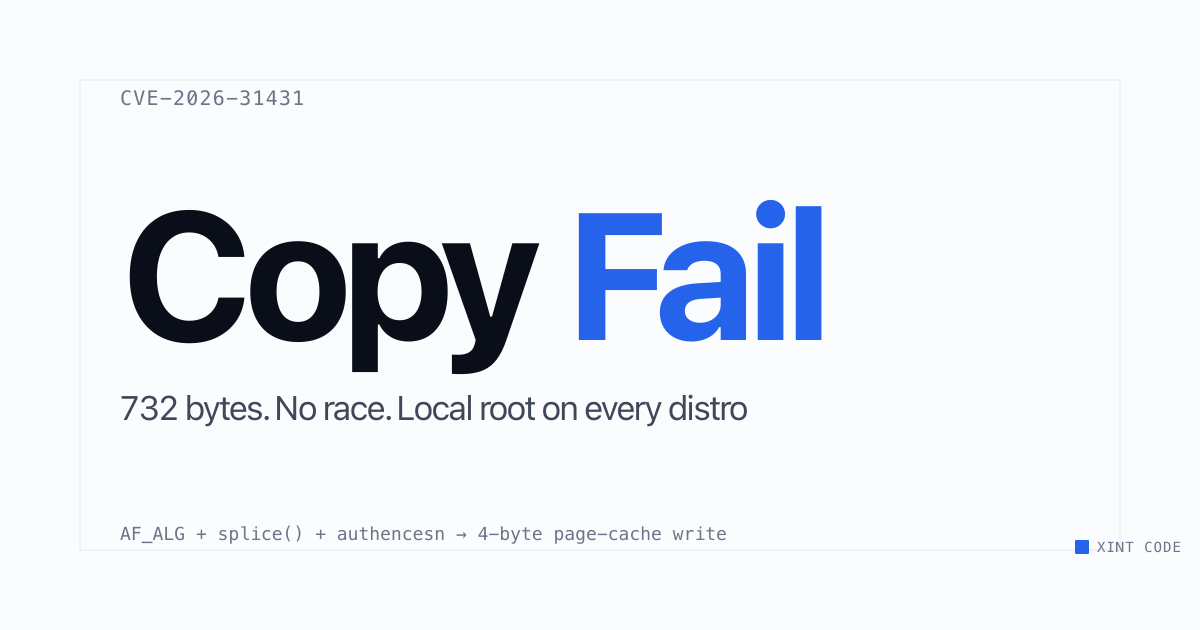 Copy Fail (CVE-2026-31431): 9-year-old Linux kernel LPE found by AI-assisted fuzzing
Copy Fail (CVE-2026-31431) is a 9-year-old Linux kernel logic bug in algif_aead, reachable via the AF_ALG crypto API and chained through splice() into a 4-byte page-cache write to achieve local root, affecting kernels built between 2017 and the fix. The site publishes a 732-byte stdlib-only Python PoC that roots multiple distributions unmodified, identifies the fixing mainline commit a664bf3d603d, and gives interim mitigation (disable algif_aead / seccomp-block AF_ALG for untrusted workloads). The bug was found by Xint Code's AI-assisted fuzzing against the Linux crypto/ subsystem in roughly an hour of scan time.
 copy.failadvisoryAdded 17 Sep 2026🛡️ Security
 Security Advisory — Storage Aliasing in Priority Update Registry V1
Flashbots disclosed a critical storage-aliasing vulnerability in V1 of the Priority Update Registry (PUR), an on-chain price feed contract used by trading integrators like propAMMs. Because lane storage slots were computed as keccak256(target, unbounded caller-controlled index) while the updater-authorization mapping lived at slot 0 with the same keccak256 shape, any caller could craft a lane index that collided with isUpdater[target][attacker], letting them self-authorize as an updater and publish arbitrary prices or deauthorize legitimate updaters. The fix namespaces the lane slot derivation (keccak256(NAMESPACE, target, laneIndex)) to make the preimages structurally non-collidable, and the advisory gives integrators concrete migration guidance since authorizations and lane state must be re-established on the new deployment.
 collective.flashbots.netadvisoryAdded 2 Oct 2026, published 16 Sep 2026🛡️ Security
 Memory Byte Array Element Delete Clears Whole Word Bug
The Solidity team disclosed a code-generator bug (reported by Shaheen Fazim via the Ethereum Foundation bug bounty program) where `delete b[i]` on a bytes/string element located in memory incorrectly writes a full 32-byte zero word instead of a single byte, corrupting up to 31 subsequent bytes — either later elements of the same array or, for elements near the array's end, adjacent memory allocations like other variables. The bug affects only the default evmasm pipeline (not the IR pipeline via --via-ir) in all versions up to and including 0.8.36, is fixed in 0.8.37, and the equivalent assignment `b[i] = 0` is unaffected and serves as a workaround. A Sourcify scan of ~870,000 verified compilations found the triggering pattern in only two functions, neither actually exploitable in practice.
 soliditylang.orgadvisoryAdded 29 Sep 2026, published 10 Sep 2026🛡️ Security
- Patch Tuesday - September 2026
Rapid7's September 2026 Patch Tuesday analysis: Microsoft published 974 own-product CVEs (723 in Windows), 999 in total with non-Microsoft fixes, the most it has ever published in one day. Two zero-days are exploited in the wild: CVE-2026-85880 (Windows ALPC elevation of privilege to SYSTEM via out-of-bounds write; not patched on Server 2025 or Windows 11) and CVE-2026-81963 (Windows Update Stack elevation of privilege via improper link resolution). It also flags Microsoft's missing Edge advisory for the exploited Chromium V8 zero-day CVE-2026-85046, lists upcoming end-of-support dates for Windows 11 24H2, Server 2012/2012 R2, Office 2021 and Exchange 2016/2019, and includes per-product CVE tables with exploitation-likelihood ratings. Only the first part of the page was available, so the later tables are not covered.
rapid7.comadvisoryAdded 7 Oct 2026, published 8 Sep 2026🛡️ Security  Grafana fixes critical SSRF flaw affecting Grafana MCP servers
Grafana patched CVE-2026-19516 (CVSS 9.1), a critical SSRF in the Grafana MCP server's grafana_api_request tool where a caller-supplied X-Grafana-URL header could control the method, path and body of outbound requests, letting an attacker reach internal-only services from the server's network position. Pillar Security researchers chained this with a second flaw — the MCP server accepting unauthenticated "session-shaped IDs" it never issued — and demonstrated using it to hit the AWS IMDSv2 endpoint and retrieve cloud credentials via a two-step PUT/TTL token request. Grafana MCP v1.1.0 adds optional bearer-token auth to close the session-forgery gap; Pillar frames MCP servers broadly as "identity brokers" that need explicit outbound destination policies and mandatory auth for remote deployments.
 scworld.comadvisoryAdded 26 Sep 2026, published 3 Sep 2026🛡️ Security
 GPT-6 Astra System Card
OpenAI's system card for GPT-6 Astra, the first model to reach "Critical" cybersecurity capability under OpenAI's Preparedness Framework, detailing new safeguards (checkpoint encryption, universal CoT monitoring, blocking alignment evaluations) and a suite of alignment evaluations measuring metagaming, oversight gaming, honeypot exploitation (ExploitGym, tied to a Hugging Face incident), and respect for restrictions like Auto-review. It also reports comparative robustness results against GPT-5.6 Sol on static/multiturn jailbreaks, Gray Swan indirect-prompt-injection benchmarks, HealthBench/HealthBench Professional, under-18 safety evaluations, and hallucination rates, while flagging that Astra's chain-of-thought monitorability has decreased under adversarial conditions. Appendices (added later) cover related models GPT-6 Sol, GPT-6 Luna, and an agent product called "dots" built on Astra. Note: analysis is based on the first 40,000 of 222,175 characters, so later sections (deployment simulations, full appendices) are not reflected here.
 deploymentsafety.openai.comadvisoryAdded 7 Oct 2026, published 3 Sep 2026🧠 AI
 Grafana MCP server-side request forgery via X-Grafana-URL header (grafana_api_request) | Grafana Labs
Grafana advisory for CVE-2026-19516, a critical (CVSS 9.1) SSRF in mcp-grafana. A caller able to invoke the grafana_api_request tool can set the X-Grafana-URL header to redirect outbound requests, choosing method, path and body, to internal, loopback and link-local services including cloud metadata endpoints, and read the responses. The earlier fix for CVE-2026-15583 only stopped the service-account token leaking to other destinations and did not restrict the destinations; the fix is in version 1.1.0 and later.
 grafana.comadvisoryAdded 12 Aug 2026🛡️ Security
 NPM Malware Compromises keyv and cacheable with 500M+ Weekly Downloads and Spreads to Hundreds of Packages | Blog | Endor Labs
Endor Labs' active-tracking advisory on an npm supply-chain worm that compromised keyv, flat-cache, and file-entry-cache (500M+ combined weekly downloads) via the jaredwray/Cacheable GitHub Actions OIDC trusted-publishing pipeline, injecting a preinstall hook (setup.mjs) that fetches a legitimate Bun binary to run an obfuscated ~727KB stage-2 payload (Math_Symbol.js/math_init.js) stealing AWS, npm, GitHub, and Vault tokens. The stolen tokens were used to self-propagate the same payload to 384+ packages and 1,136+ versions across unrelated maintainer accounts, including scopes belonging to companies like ServiceTitan, Qlik, and Picsart. The post includes IOCs (file hashes), affected package/version lists, and mitigation guidance (lockfile/CI log checks, --ignore-scripts).
 endorlabs.comadvisoryAdded 3 Sep 2026, published 4 Aug 2026🛡️ Security
 Security notice and deprecation: standalone circleci-mcp-server
CircleCI disclosed GHSA-8xjg-jpfh-5257 affecting its standalone circleci-mcp-server npm package used as an MCP server in Claude Desktop, Cursor, VS Code, and Windsurf, and is deprecating that package in favor of a built-in MCP server shipped with a new CircleCI CLI. Affected users are told to upgrade to version 0.19.0 immediately, while CircleCI cloud users are pointed toward migrating to the CLI, which adds OAuth-based auth and native pipeline watching. CircleCI will keep shipping security patches to the old package but is no longer adding features to it.
 discuss.circleci.comadvisoryAdded 22 Aug 2026, published 20 Jul 2026🛡️ Security
 Orca Security: Critical Heap Buffer Overflow in NGINX Allows Unauthenticated RCE
Covers CVE-2026-42533, a heap buffer overflow (CWE-122) in the NGINX map directive's regex handling. It is triggered when a string expression references unnamed captures before the map output variable. Unauthenticated crafted HTTP requests can crash workers and may give RCE where ASLR is off or bypassed. It also covers two other F5-patched NGINX flaws: CVE-2026-60005 (uninitialized memory disclosure in ngx_http_slice_module) and CVE-2026-56434 (use-after-free in ngx_http_ssi_module with proxy_pass and proxy_buffering off). It lists affected NGINX Open Source (0.9.6–1.31.2), NGINX Plus, Ingress Controller, Gateway Fabric, App Protect WAF and Instance Manager versions. It gives fixed releases (1.31.3 / 1.30.4) and the named-capture workaround, and notes no public PoC or in-the-wild exploitation.
orca.securityadvisoryPublished and added 20 Jul 2026🛡️ Security AI Security Briefing
This GHSA advisory documents CVE-2026-27826, a DNS-rebinding TOCTOU bypass of the SSRF fix in the MCP Atlassian server (mcp-atlassian PyPI package). The prior patch (GHSA-7r34-79r5-rcc9) added validate_url_for_ssrf, which resolves the attacker-controlled X-Atlassian-{Jira,Confluence}-Url header host once at middleware time but discards the resolved IP; the actual outbound request later re-resolves the raw hostname at connect time with no IP pinning, so a rebinding DNS name can pass validation with a public IP and then connect to 169.254.169.254 or an internal address, restoring unauthenticated SSRF to cloud metadata/internal services even on the 'patched' build. The advisory includes an executed PoC against the real urls.py, exact code locations (utils/urls.py, servers/main.py, servers/dependencies.py), and remediation via a custom resolver/cached-getaddrinfo adapter to pin the validated IP.
github.comadvisoryPublished and added 13 Jul 2026🛡️ Security- AI Security Briefing
CVE-2026-50027 describes a critical missing-authentication flaw in mcp-memory-service, a PyPI-hosted MCP server used for persistent AI agent memory. All routes under /api/documents/* bypass the server's MCP_API_KEY/OAuth authentication checks (unlike the properly-protected /api/memories endpoints), letting unauthenticated remote attackers read, write, and permanently delete stored memories. GitLab rates it CVSS 9.8 Critical.
 advisories.gitlab.comadvisoryPublished and added 5 Jul 2026🛡️ Security
 Vulnerability-Lookup
GHSA-9c5h-h4mj-p5ch / CVE-2026-13524 documents an improper-authorization vulnerability (CWE-266) in Cherry Studio's MCP OAuth Local Callback Server (src/main/services/mcp/oauth/callback.ts), where manipulation of the code parameter can bypass authorization checks. The attack is remote but high-complexity and difficult to exploit (CVSS 3.1: 6.5 / CVSS 4.0), a public PoC has been disclosed, and a fix PR is still awaiting merge as of publication.
 vulnerability.circl.luadvisoryAdded 26 Sep 2026, published 29 Jun 2026🛡️ Security
 CVE-2026-49291 | THREATINT
CVE-2026-49291 affects mcp-memory-service, a semantic memory layer for AI apps, in versions before 10.65.3. The HTTP MCP JSON-RPC endpoint `/mcp` requires only the OAuth `read` scope and dispatches `tools/call` to mutating handlers. A read-only client can therefore call `store_memory` and `delete_memory`, bypassing the `write` scope that the REST endpoints enforce. It is classed as CWE-862 Missing Authorization and fixed in 10.65.3.
 cve.threatint.euadvisoryAdded 23 Jun 2026🛡️ Security
 Fragnesia: Linux Kernel Local Privilege Escalation via ESP-in-TCP | Wiz Blog
Wiz analyzes Fragnesia, a Linux kernel local privilege escalation in the XFRM ESP-in-TCP subsystem and a new variant of the Dirty Frag family, introduced as a side effect of a Dirty Frag patch. File-backed pages spliced into a TCP receive queue before the socket switches to espintcp ULP mode are decrypted in place, so AES-GCM keystream manipulation gives deterministic single-byte page-cache writes. The PoC uses user and network namespaces for CAP_NET_ADMIN, installs an ESP security association via NETLINK_XFRM, and overwrites /usr/bin/su in page cache to get a root shell. Ubuntu's AppArmor restrictions on unprivileged user namespaces partially mitigate it, and the post recommends vendor patches and disabling the vulnerable modules.
 wiz.ioadvisoryAdded 5 Sep 2026, published 13 May 2026🛡️ Security
- Careful Adoption of Agentic AI Services
Joint guidance co-authored by ASD's ACSC, CISA, NSA, the Canadian Centre for Cyber Security, NCSC-NZ and NCSC-UK on securing LLM-based agentic AI systems across critical infrastructure and defence. It catalogs agentic-AI-specific risk categories — privilege compromise, scope creep, confused-deputy attacks, identity spoofing, insecure static permission checks, indirect prompt injection, specification gaming and deceptive/emergent agent behaviour — with concrete scenario examples, and lays out best practices for designing, developing, deploying and operating agents securely.
 cyberscoop.comadvisoryAdded 3 Sep 2026, published 13 May 2026🛡️ Security








Showing 60 of 63
Show more