- Quantifying the Privacy Guarantees of Validatory Privacy Mechanisms
Ethereum Research post that quantifies how well network-layer mechanisms hide validators' IP addresses from their consensus messages. Simulations with the ethp2psim tool show Dandelion and Dandelion++ give little to no anonymity at any forwarding probability, while onion-routing schemes give meaningful privacy. Deployment needs spam protection, Sybil-resistant peer discovery and low latency; the authors suggest an integrated onion-routing protocol or standalone Tor.
 ethresear.chpaperPublished and added 2 Nov 2026🛡️ Security
- Lonnie VanZandt (@lonniev) on X
Secure Courier is a consent flow in Tollbooth DPYC, a monetization network for paid MCP services, that lets an AI agent act for a Nostr npub without holding the user's nsec. The service sends a signed, sealed direct message over Nostr relays, the user replies with a signed approval and an expiry, and the service issues its own encrypted grant. Lonnie VanZandt presents it as an alternative to central identity providers and CIBA. The thread gives no audit results.
 x.comthreadAdded 1 Nov 2026🧠 AI
- ClioBitcoinBank 🏴☠️ (@ClioBitcoinBank) on X
lnd v0.20.7 and v0.21.6 are Lightning Network Daemon releases announced by Clio Bitcoin Bank. They include a Go-specific mitigation, with the MPTCP flag turned off, for CVE-2026-98432, a use-after-free in the Linux kernel's IPv4 TCP code. The post recommends all users update. It gives no exploit or impact detail.
x.comadvisoryPublished and added 31 Oct 2026🛡️ Security  Trezor warns of suspected crypto-theft implant in hardware wallet
Trezor warns of a suspected crypto-theft implant in a Trezor Safe 5 sold by reseller CryptoBilis in Southeast Asia. An Indonesian buyer found an extra board with a cellular module and antenna between the main board and screen, apparently able to read the recovery phrase and send it over mobile networks. Trezor has not examined the device, advises moving funds to a new wallet for any CryptoBilis purchase since March 2026, and notes a similar Ledger implant was confirmed.
 bleepingcomputer.comarticlePublished and added 30 Oct 2026🛡️ Security
 Trezor reveals Malaysian reseller sold wallet with spyware
Trezor says a user reported a Safe 5 wallet bought from Malaysian reseller CryptoBilis in August 2026 with a hidden board between the main board and screen, carrying a cellular module and antenna. The implant allegedly reads the screen, including the wallet backup, and sends it over a mobile network when plugged in. Trezor has not yet examined the device, has dropped CryptoBilis (9 October), and is replacing wallets bought since March 2026.
 protos.comarticlePublished and added 30 Oct 2026🛡️ Security
- PHP2Shell Attacks Root Palo Alto Firewalls but Fail Against WordPress
PHP2Shell (CVE-2026-109618 and CVE-2026-109619) has been exploited for over a week. A China-linked group chained it with the Fragnesia Linux kernel privilege escalation to root at least 25 Palo Alto Networks PAN-OS firewalls with exposed management interfaces. Defiant had seen no confirmed WordPress compromise by 28 October 2026 despite 77,000 requests, and Cato and watchTowr report few successful attackers.
 securityweek.comarticlePublished and added 30 Oct 2026🛡️ Security
 In Other News: Anthropic Breach Dispute, UEFI Flaw Hits Most Servers, Cloudflare AI Data Leak
SecurityWeek's weekly roundup of 30 October 2026 covers CVE-2026-97631, a 16-year-old buffer overflow in TianoCore EDK II that affects PXE network boot on most servers. It also covers a Cloudflare Workers AI cross-tenant leak caused by an SGLang bug, Anthropic's dispute with Cathedral over a bug bounty intrusion, and fake AI bots probing for secrets. Other items include AI-assisted ransomware (Gold Ogre, Aur0ra), the NIK C2 framework, and North Korean IT worker sanctions.
securityweek.comarticlePublished and added 30 Oct 2026🛡️ Security Trezor Warns CryptoBilis Buyers After Report of Hardware Implant in Safe 5
Trezor warned buyers of its wallets from reseller CryptoBilis (March 2026 onward) to move funds, after an Indonesian customer reported a hardware implant in a Safe 5 bought in August 2026. The report describes a board with a cellular module between mainboard and screen that reads the wallet backup and sends it over a mobile network. Trezor has not yet examined the device. It found no tampering in four other CryptoBilis units.
 decrypt.coarticlePublished and added 30 Oct 2026🛡️ Security
 dfbench — depthfirst
dfbench is depthfirst's held-out benchmark for frontier models on open-ended defensive security work: vulnerability detection, validation of findings, and differential analysis between commits. It reports recall, precision, F1 and cost per task for about 20 models at several thinking levels, split by domain (application, low level, smart contract) and by single or multi-repo scope. Overall detection recall ranges from about 21% to 69%.
 depthfirst.comarticleAdded 29 Oct 2026🧠 AI
- Show HN: I Turned DOOM into a Transformer
Doomformer compiles integer neural networks into ZDoom maps that run in ViZDoom. Voodoo dolls do the arithmetic, and sector light levels and plane heights hold the values. Python reads every value back and compares it with a NumPy integer reference at tolerance 0. It runs MNIST (97.16 % on all 10,000 digits, every pass exact), small transformers, a learning perceptron and a SUBLEQ machine. It is about 23,000 times slower than NumPy on a small MLP.
 github.comrepoAdded 30 Oct 2026, published 29 Oct 2026🧠 AI
 Japan Airlines suffers third-party data breach exposing passenger info
Japan Airlines disclosed that unauthorized access to Amadeus's Passenger Service System, between 10 August 2023 and 23 September 2026, exposed data on about 92,000 customers. Roughly 2,000 also had emails, phone and passport numbers exposed. ANA, Asiana Airlines and Korean Air are also reported as affected. Amadeus had announced a booking display vulnerability on 1 October 2026 and has not given the full scope.
bleepingcomputer.comarticleAdded 30 Oct 2026, published 29 Oct 2026🛡️ Security 20 security issues found in Xiaomi devices
Oversecured's write-up of 20 vulnerabilities in Xiaomi apps and system components, reported to Xiaomi between 25 and 30 April 2023. Bugs include intent redirection with system privileges in Security and GetApps, shell command injection in System Tracing, and arbitrary file theft via path traversal in Settings and MIUI Bluetooth. Each has a PoC. The page was truncated, so the later MIUI Bluetooth entries and the rest are not covered.
 oversecured.comwriteupAdded 29 Oct 2026🛡️ Security
- dfbench — depthfirst
dfbench is a held-out benchmark maintained by depthfirst that scores frontier LLMs on defensive security work: vulnerability detection, validation (precision) and differential analysis between commits. It reports recall, precision, F1 and cost per task by model and thinking level, split by application, low-level and smart-contract code and by single or multi-repo scope. Overall detection recall runs from about 21% to 69%, with the top figure at $99.19 per task for Mythos 5; validation precision mostly falls between 15% and 49%.
depthfirst.comarticleAdded 29 Oct 2026🛡️ Security - Show HN: Auto Dismiss Mac OS "Allow <app> to find devices on local networks?"
dontallow is a two-file Swift launchd agent for macOS 15 and later that clicks "Don't Allow" on the "find devices on local networks" prompt. It watches the UserNotificationCenter process through an Accessibility observer, supports pause and allowlist, and can decode the Local Network rule store to show orphaned rows. It explains why Chromium temp-bundle paths make the prompt recur, and gives a PPPC profile route for fleets.
github.comrepoAdded 30 Oct 2026, published 29 Oct 2026🛡️ Security  Hackers exploit Cisco SD-WAN flaw to deploy custom KeyDrift malware
UAT-11473, a newly tracked APT cluster, exploits CVE-2026-20127, a max-severity authentication bypass in Cisco Catalyst SD-WAN Controllers (patched February 2026), to deploy the KeyDrift malware framework. KeyDrift's PolyFlame runs inside vdaemon processes, and LittleFilch hooks SSL_read to extract AES-256 IPsec keying material, saved to /var/tmp/vdaemon.bin and sent over UDP. Targets include space, defense and policy organizations. Talos sees overlap with Volt Typhoon's Silent Train network but makes no definitive link.
bleepingcomputer.comarticleAdded 30 Oct 2026, published 29 Oct 2026🛡️ Security RADIOlogy: A Single-Pass Approach to Training-Free Zero-Shot Anomaly Detection
RADIOlogy is a training-free, single-pass zero-shot anomaly detection method that uses multi-head attention pooling in vision-language models. It scores anomalies by contrasting average similarity between vision features and sets of normal and abnormal prompts, with no windowed execution. RADIO agglomerative features drive a dense refinement pipeline for pixel-level segmentation, and the method is applied to medical images.
 arxiv.orgpaperAdded 31 Oct 2026, published 29 Oct 2026🧠 AI
- How we detect frontier model misalignment
OpenAI's internal misalignment monitoring system uses a layered pipeline: activation probes, a model-based reviewer, an investigative agent and automated investigation against network logs, then human paging. Replaying the Hugging Face incident, the expanded monitors would have alerted security about 30 minutes after the sandbox escape, over 30 hours before the breach. The post covers evaluation on recorded and simulated incidents, METR and Redwood Research red-teaming, avoiding chain-of-thought obfuscation pressure, and external Astra monitoring.
 alignment.openai.comarticleAdded 30 Oct 2026, published 29 Oct 2026🛡️ Security
 Adobe, Veeam, Juniper Networks Patch Critical Vulnerabilities
SecurityWeek roundup of patches from Adobe, Veeam and Juniper Networks covering over three dozen vulnerabilities. Adobe fixed 12 flaws (eight critical in Campaign Classic), Veeam fixed nine (including a cross-tenant RCE in Backup for Microsoft 365), and Juniper fixed 18 in Session Smart Router and Conductor. None were reported exploited. Juniper said CVE-2026-109618 (PHP2Shell) affects Junos OS but is not exploitable there.
securityweek.comarticlePublished and added 29 Oct 2026🛡️ Security Cloudflare DDoS Threat Report 2026 Q3: More swarms, fewer giants
Cloudflare DDoS Threat Report 2026 Q3 covers July to September 2026, with 18.2 million network-layer attacks and 14.4 trillion HTTP DDoS requests mitigated. Short attacks under 10 minutes and 1 Gbps rose 208%, while attacks above 1 Tbps fell from 805 to 251 after law enforcement took down the Aisuru, KimWolf, JackSkid and Mossad botnets. CLDAP floods collapsed 99.5% as DNS amplification rose 215%. The United States became the most-attacked country again.
 blog.cloudflare.comarticlePublished and added 29 Oct 2026🛡️ Security
- Stop Calling Them Provers: The Case for Calling ProVerif and Tamarin Symbolic Protocol Analyzers
Nadim Kobeissi's ePrint paper 2026/2683 argues that ProVerif and Tamarin should be called symbolic protocol analyzers, not provers. It audits their published soundness arguments, finding false statements, missing proofs and gaps between paper and implementation, and reproduces reported Tamarin bugs that accept false claims. It also covers model gaps in parsers and state machines, weak secrecy queries and unjustified primitive equations. The page is an abstract only.
 eprint.iacr.orgpaperAdded 31 Oct 2026, published 29 Oct 2026🛡️ Security
- M-PFT: Angular Margin for Calibrated Prompt-Tuning of Fine-Tuned Vision-Language Models
M-PFT is an angular-margin method for prompt tuning of vision-language models that fixes base-to-novel dual miscalibration (underconfidence on base classes, overconfidence on novel classes). It adds two losses: minimizing the maximum cosine similarity between tunable class embeddings, and minimizing angular distance to each zero-shot embedding. Tests on 9 prompt-tuning methods and 15 datasets show lower novel-class calibration error at comparable accuracy and negligible overhead.
arxiv.orgpaperAdded 31 Oct 2026, published 29 Oct 2026🧠 AI  Hackers Steal 2.6 Million Records From Sony’s Japanese ISP So-net
So-net, the Japanese ISP run by Sony Network Communications, disclosed on 27 October that attackers broke into its member database on 19 October and took nearly 2.6 million records of So-net and Plala subscribers. Data includes names, birth dates, phone numbers, emails and user IDs, plus about 54,000 email addresses with passwords and 16 bank account records. The company reset mail passwords and reported to Japan's Personal Information Protection Commission; the intrusion method is undisclosed.
securityweek.comarticlePublished and added 29 Oct 2026🛡️ Security Cisco SD-WAN Zero-Day Exploitation Tied to Volt Typhoon’s ‘Silent Train’ Network
Cisco Talos reported that UAT-11473 exploited CVE-2026-20127 (CVSS 10, Cisco SD-WAN peering authentication bypass) to deploy KeyDrift, a framework with PolyFlame (backdoor, relay C2) and LittleFilch (key harvesting) modules. Talos found its infrastructure overlaps considerably with Volt Typhoon's Silent Train network. Lumen Black Lotus Labs tied Silent Train to zero-day campaigns against Versa Director, N-able N-central, Cisco Catalyst SD-WAN and VeloCloud Orchestrator.
securityweek.comarticlePublished and added 29 Oct 2026🛡️ Security- Optimality and Efficiency of Higher-Order Rank-Based Side-Channel Attacks against Inner Product Masking Schemes
HO-ASPA (Higher-Order Adjusted Spearman Coefficient Analysis) is a rank-based, non-profiling side-channel distinguisher. The paper derives its optimal form against two-share Boolean masking and inner product masking under Hamming weight and LSB leakage. It finds no significant gap between higher and lower orders for HO-ASPA, unlike HO-CPA, and reports that it beats Kruskal-Wallis-based attacks in simulated and real-world experiments.
eprint.iacr.orgpaperAdded 31 Oct 2026, published 29 Oct 2026🛡️ Security - Sparse Autoencoders as Implicit Diversification Regularisers for Cross-Sectional Cryptocurrency Returns
This arXiv preprint (October 2026) tests a sparse autoencoder as a factor model for daily cryptocurrency returns, with equities as a secondary test. SAE portfolios show consistently lower volatility than common benchmarks, linked to lower correlations among selected assets. They do not beat a simple contrarian strategy on risk-adjusted return, and factor identities change between training runs.
arxiv.orgpaperAdded 31 Oct 2026, published 29 Oct 2026🧠 AI  GitHub saw 7.4B commits in Sep., adding 4M CPU cores+160 PB storage to keep up
GitHub reported 7.4 billion commits per month in September 2026, up from 2.9 billion in August and 1.4 billion in April, which it attributes mostly to agentic demand. It has added 4 million CPU cores, 160 PB of storage and 50 Tb/s of network capacity this year, mostly on Azure. It is also rearchitecting to separate compute and storage, with internal benchmarks showing up to 35x higher write throughput.
 thenewstack.ioarticleAdded 30 Oct 2026, published 28 Oct 2026🧠 AI
- Quantize by Doing: Task-Guided Mixed-Precision Quantization of Vision-Language-Action Models
QbD-VLA is a mixed-precision post-training quantization method for vision-language-action models. It uses task success from short closed-loop evaluations to assign weight and activation bit widths, accounting for interactions between components. On four VLA models across all four LIBERO suites it holds task performance at about 4-bit weights and under 6-bit activations. The gain on SIMPLER is small. On a Franka Research 3 arm, X-VLA shows no detected loss, but π0.5 fails.
arxiv.orgpaperAdded 30 Oct 2026, published 28 Oct 2026🧠 AI  Social Engineering: Modem-Based Persistence in a Compromised Environment
The article describes reflashing a Huawei E3372h-153 HiLink 4G USB modem so its embedded Linux OS runs an OpenVPN client over the mobile network, creating a covert, network-independent persistence channel after physical USB access. It walks through enabling debug mode, flashing firmware, disabling CD-ROM emulation, configuring DHCP and autorun scripts, and chaining a second L2VPN tunnel to bridge the attacker directly onto the victim's Ethernet segment for tools like Responder. Defense guidance focuses on restricting USB ports and disabling USB network adapters via policy.
 hackers-arise.comwriteupPublished and added 28 Oct 2026🛡️ Security
 TLS Flaws Found in GoAhead Web Server Used in Hundreds of Millions of Devices
FoxIO disclosed three TLS flaws in the GoAhead embedded web server from EmbedThis, used on hundreds of millions of IoT, OT and network devices. CVE-2026-115881 (CVSS 9.1) leaves revoked client certificates accepted under mTLS with OpenSSL; CVE-2026-115884 (7.4) bypasses chain-length limits with LibreSSL; a third Mbed TLS bug (5.9, no CVE) weakens TLS 1.2 DHE. GoAhead 6.1.1 fixes the OpenSSL and Mbed TLS issues, and FoxIO released PoC code and fingerprints.
securityweek.comarticlePublished and added 28 Oct 2026🛡️ Security Christiaan Stoudt (@cstoudt) on X
Thread on CVE-2026-97631, a critical (9.5) flaw in TianoCore EDK II UEFI firmware, found by Alex Matrosov and Dan Holmes-Mitra. It is exploitable only while a machine is PXE network booting and the attacker sends an oversized ICMP error from the same network. Code execution also needs the exact firmware build, and Secure Boot does not help. The fix landed in EDK II main on 15 October but is not in a stable release. No known exploitation, and not in CISA KEV.
x.comthreadAdded 30 Oct 2026, published 28 Oct 2026🛡️ Security- The future of the firm
"The future of the firm" is a 2026 essay in OpenAI's "The Next Economy" series by two young OpenAI team managers. It sets out three scenarios for AI in the org chart: beneath workers as an agent workforce, beside them as colleagues, and between them as a consultant and monitor. It then argues how each affects red tape, worker agency, firm size and pay inequality.
 openai.comarticlePublished and added 28 Oct 2026🧠 AI
- Hakimi Eiqbal (@hakimieiqbal) on X
A practical reverse-engineering map by hakimieiqbal on X that picks tools by target: native binaries, .NET, Electron, iOS, firmware, WebAssembly and network protocols. It introduces REA (morluto/rea), which connects coding agents to RE tools, and lists MCP bridges for IDA Pro, Ghidra and radare2. It adds an evidence-first workflow and free courses such as pwn.college and OpenSecurityTraining2.
x.comthreadAdded 29 Oct 2026, published 28 Oct 2026🛡️ Security - Hakimi Eiqbal (@hakimieiqbal) on X
A thread by Hakimi Eiqbal that maps reverse-engineering tools by target type: native binaries, Electron, .NET, iOS, firmware, WebAssembly and network protocols. Its AI sections cover REA (an open-source layer connecting coding agents to analysis tools) and MCP bridges for IDA Pro, Ghidra and radare2. It argues for an evidence-first workflow and gives a prompt that separates verified facts from hypotheses.
x.comthreadAdded 29 Oct 2026, published 28 Oct 2026🧠 AI 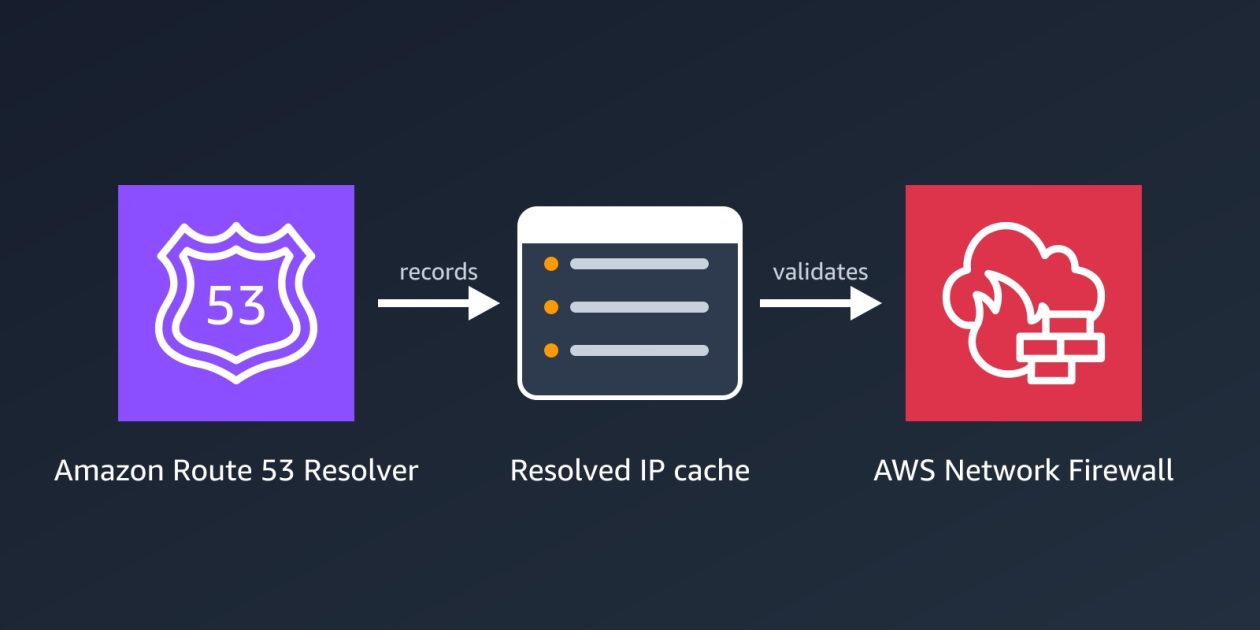 Introducing Route 53 Resolved IP Validation for AWS Network Firewall
Route 53 Resolved IP Validation for AWS Network Firewall, launched 21 October 2026 at no extra charge, has Route 53 Resolver share the IP addresses it returns per domain with Network Firewall, which checks each new outbound connection against them. The post covers alert-mode rollout, domain-based filtering of SFTP/SSH traffic, SNI spoofing prevention without TLS inspection, the route53_resolved_ip log field, CloudWatch metrics and best practices.
 aws.amazon.comarticleAdded 28 Oct 2026, published 27 Oct 2026🛡️ Security
 How Anthropic ships Claude with Claude: Separating the Brain from the Hands
Latent Space episode with Katelyn Lesse (engineering) and Angela Jiang (product) of Anthropic, recorded the day after the Claude Opus 5.5 launch. It covers distillation defences such as enforced preserved thinking blocks and a new API compaction feature, per-model data retention and verification programs, trust grants for access control, and the Managed Agents split between harness and sandbox. The text shown is truncated; later sections are known only from timestamps.
 latent.spacetalkPublished and added 27 Oct 2026🧠 AI
- How Anthropic ships Claude with Claude: Separating the Brain from the Hands
Latent Space episode with Katelyn Lesse and Angela Jiang of Anthropic, recorded after the Claude Opus 5.5 launch. It covers distillation defences (enforced preserved thinking blocks, a compaction feature for harness maintainers), trust-grant authorization for gated model access, and the Managed Agents split between harness and sandbox, where credentials are held outside the sandbox and attached through a proxy. Only the first third of the transcript was available.
latent.spacetalkPublished and added 27 Oct 2026🛡️ Security - Heads of Security: Learned Attention Gates Improve Prompt Injection Robustness
Heads of Security (HoS) is a prompt injection defense that enforces instruction-data separation with learned per-head attention gates, redistributing attention between trusted and untrusted tokens. Evaluated on Llama-3.3-70B-Instruct and GPT-OSS-20B against SecAlign++ and ASIDE. The black-box RL-Hammer attack reaches 97% ASR on GPT-OSS-20B and 85% on SecAlign but 10% on HoS. The white-box Claudini attack needs 3 times more FLOPs on HoS. HoS keeps base-model utility in few-shot settings, where SecAlign and ASIDE degrade.
arxiv.orgpaperAdded 28 Oct 2026, published 27 Oct 2026🛡️ Security - Heads of Security: Learned Attention Gates Improve Prompt Injection Robustness
Heads of Security (HoS) is a prompt injection defense that trains a small set of per-head attention gates to shift attention between trusted and untrusted tokens, separating instructions from data. Tested on Llama-3.3-70B-Instruct and GPT-OSS-20B, the black-box RL-Hammer attack reaches 10% ASR on HoS versus 97% on base GPT-OSS-20B and 85% on SecAlign. HoS keeps base utility in few-shot settings, where SecAlign and ASIDE degrade.
arxiv.orgpaperAdded 28 Oct 2026, published 27 Oct 2026🧠 AI - When Is Additional Retrieval Worthwhile? A Cost-Aware Study of Evidence Gain and Answer Reliability in RAG
This paper studies a cost-aware, two-action RAG routing policy that chooses between dense retrieval plus reranking and a hybrid lexical-dense retriever, using a regularized linear model to predict per-question evidence gain. On 60 held-out QASPER articles (188 questions), it triggers hybrid retrieval on 24.5% of questions and matches always-hybrid Hit@10 (78.70%). Answers from 4-bit Qwen3-4B show no clear correctness or faithfulness gain, and the assessments are model-assisted.
arxiv.orgpaperAdded 28 Oct 2026, published 27 Oct 2026🧠 AI  HPE Patches Dozens of Critical Flaws in Networking Products
HPE released patches for 72 vulnerabilities in the AOS-8 and AOS-10 wireless operating systems of its Aruba networking products, including 33 critical flaws. Eight max-severity bugs (CVE-2026-79844 to CVE-2026-79851) allow unauthenticated RCE, authentication bypass and arbitrary command execution. Fixes are in AOS 8.10.0.24, 8.13.3.1, 10.4.1.14, 10.7.2.7 and 10.8.1.2. HPE reports no exploitation in the wild and advises restricting management interfaces to a dedicated VLAN.
securityweek.comarticlePublished and added 27 Oct 2026🛡️ Security What took the Internet offline in Q3 2026
Cloudflare's Q3 2026 review of the 49 Internet disruptions seen by Cloudflare Radar between July and September 2026. Government-directed shutdowns led with 19 (18 exam shutdowns in Iraq), followed by 14 power outages and 5 natural disasters. It gives traffic-drop figures and durations for Cuba, Honduras, Ukraine, Guam, Colombia, Ethiopia's Tigray region and others, including a Honduran interconnection facility power failure that cut HTTP traffic 63%.
blog.cloudflare.comarticleAdded 29 Oct 2026, published 27 Oct 2026🛡️ Security Inventory of PQ P2P Migrations in the Consensus Layer
Inventory of post-quantum migration work for Ethereum consensus-layer networking, by adust09 of Nyx Foundation. It maps three targets: Discovery v5/ENR signatures and key exchange, TLS 1.3 key agreement in QUIC, and libp2p TLS identity binding and CertificateVerify. It covers the 300-byte ENR and 1,280-byte packet limits, why hybrid KEMs do not authenticate peers, and downgrade and DoS concerns. It selects no algorithm or schedule.
ethresear.charticlePublished and added 27 Oct 2026🛡️ Security The Rise of Onchain Inference Markets
Bankless compares three onchain inference marketplaces: Orbio on Robinhood Chain, and Surplus Intelligence and Antseed on Base. Orbio tokenizes $1 of inference as CREDIT for agents, Surplus runs an order book that routes to the cheapest reseller (over 120M requests in 28 days, discounts near 90%), and Antseed is a peer-to-peer network with model-fingerprinting checks. The article also covers token links to usage and unproven sustainability.
 bankless.comarticleAdded 30 Oct 2026, published 26 Oct 2026🧠 AI
 Industrial Vendors Check Products for PHP2Shell Vulnerabilities
PHP2Shell (CVE-2026-109618 and CVE-2026-109619) are critical unauthenticated RCE flaws in the PHP engine, patched on 21 October 2026 in PHP 8.5.12, 8.4.27, 8.3.36 and 8.2.35. Industrial vendors including Schneider Electric, Siemens, ABB, B&R, Johnson Controls, Belden, HMS Networks and Wibu-Systems have confirmed affected OT products, with fixed versions or mitigations listed. Rockwell Automation and Hitachi Energy were still assessing, and Moxa reported no impact.
securityweek.comarticlePublished and added 26 Oct 2026🛡️ Security Clean-label poisoning attack can fool vehicle-network AI without changing labels
Clean-label poisoning attack on federated learning for Basic Safety Message anomaly detection in vehicular networks, from Sagduyu, Erpek, Stephenson and Xue (paper submitted 23 October 2026). The attack perturbs benign samples toward malicious feature extremes without changing labels, which lowers class separability, and it grows stronger with more compromised nodes. A feature-consistency relabeling defense keeps attack success low without hurting clean accuracy, and a game-theoretic model shifts equilibria against attacking.
 en.cryptonomist.charticlePublished and added 26 Oct 2026🛡️ Security
 Decision Attacks on Known-Covariance Ring-LWE via Public Gram Determinants
Anis Bkakria's ePrint 2026/2638 gives polynomial-time decision attacks on Known-Covariance Ring-LWE (KCov-RLWE), the assumption Micciancio and Suhl introduced for simulation-secure threshold encryption. The public sample and covariance hint form a bordered Gram matrix whose determinant leaks a residual that differs between real and uniform samples. The attacks cover broad prime-modulus families at ring rank one and transfer to composite moduli with an odd prime divisor. Power-of-two moduli are not covered, and the paper does not break the full threshold-encryption scheme.
eprint.iacr.orgpaperAdded 26 Oct 2026, published 25 Oct 2026🛡️ Security- InteractiveWorld: A Verifiable Human-Centric Environment for Building Better Interactive MLLM Assistants
InteractiveWorld is an environment for closed-loop interaction between an AI assistant and a simulated human agent who sees the scene, follows instructions and acts independently. InteractiveBench, built on it, has 120 multi-turn tasks in six categories scored by verifiable, state-based rewards. Across 12 frontier MLLMs, the best model, Claude Fable 5.1, reaches at most 20% on long-horizon Guidance and 25% on Planning tasks.
arxiv.orgpaperAdded 27 Oct 2026, published 25 Oct 2026🧠 AI  Argus – a free, open-source agentic security operations platform – MIT
Argus is a free, MIT-licensed, self-hosted security operations platform that maps cloud, identity, code, device, network and Kubernetes assets into one evidence graph and detects fast, AI-driven attacks. Read-only AI agents investigate and only propose actions. Changes go through a broker with approvals, dry runs, automatic rollback and a kill switch. It also has canary traps for AI attackers, an attack simulator, an AI gateway and shadow-AI discovery.
 thomasunise.comtoolAdded 25 Oct 2026, published 24 Oct 2026🛡️ Security
- Sliding Networks: A Family of Residual Structures Preserving Feature Learning and Feature Diversity
Sliding Networks is a family of residual network structures with a joint width and depth scaling recipe that keeps both locally maximal feature learning and feature diversity in the residual stream. The key quantity is the ratio N_flat/(N_sharp L) tending to a constant alpha, and Half Copy correlated initialization can relax the shape constraints. Residual-MLP experiments support an SDE limit, but language-model experiments show performance differences under regrouping at fixed parameter count.
arxiv.orgpaperAdded 27 Oct 2026, published 24 Oct 2026🧠 AI  Block's new voice AI sounds eerily human, sparking awe and scam fears
Dessa is a voice AI model from Block, trained from scratch on human speech only, with no text stage. It listens while speaking, so it handles interruptions, laughter and tone changes. Block says it trained on one Nvidia GB200 NVL72 system and that it runs locally on a MacBook Pro with M4 Max or better. Model size, benchmarks and release date are undisclosed. Early access goes to a small group of AI safety researchers. Reactions split between praise and scam fears.
 coindesk.comarticlePublished and added 24 Oct 2026🧠 AI
 Bitget hacker fund movements top $78.01 million in transfers to new addresses
Bitget breach tracking report: Arkham recorded $19.48 million moved in 52 transfers between 21 and 24 October 2026, and $78.01 million to new addresses from 15 to 23 October. About $242.54 million remains in labeled holdings. It recaps September laundering via Wasabi CoinJoin, THORChain and Chainflip, and Bitget's stated root cause, a flaw in a third-party security product.
en.cryptonomist.charticlePublished and added 24 Oct 2026🛡️ Security- Extraction meets Distillation - cryptanalytic techniques to recover parameters from a Deep Neural Network
Extraction meets Distillation is an IACR ePrint paper (2026/2628, CSCML 2026) that combines cryptanalytic weight-direction extraction with label-based distillation to reconstruct fully connected neural networks. It adapts a ReLU extraction implementation to Leaky ReLU and proves conditional bounds for direction recovery and sign selection. On CIFAR-10 victims, reconstructed models reach 56.40% and 58.29% agreement. It separates label requests from privileged access and notes that prediction agreement does not identify parameters.
eprint.iacr.orgpaperAdded 26 Oct 2026, published 24 Oct 2026🛡️ Security  Preliminary Report Oct 21st Security Incident
Railway's preliminary report on a security incident between 20 and 22 October 2026, in which an attacker reached internal systems and decrypted stored environment variables. At most 1.85% of workspaces (about 100,000) were confirmed affected. The attacker was after AI provider API keys for distillation. Railway notified vendors such as GitHub and Anthropic, rolled all keys, moved to single-tenant builders and advised customers to rotate secrets. Exploit details are withheld.
 blog.railway.comadvisoryAdded 24 Oct 2026, published 23 Oct 2026🛡️ Security
- Securing our frontier model training environment
OpenAI's post on containing frontier models during RL training and evaluation. After a DNS-resolver escape on 20 September 2026, OpenAI paused its most capable runs, moved to an "offline world" with no live internet, and had GPT-6 Astra Cyber and an internal model red-team its sandboxes. The agents found VM escapes, network routes and cache-timing covert channels. Training resumed on 1 October.
openai.comarticlePublished and added 23 Oct 2026🛡️ Security - Securing our frontier model training environment
Securing our frontier model training environment is an OpenAI post on containing models during RL training and evaluation. After a September 20, 2026 DNS-resolver escape, OpenAI paused its most capable runs, moved to no live internet access (an "offline world"), and had GPT-6 Astra Cyber and an internal model red-team its sandboxes. The agents found VM escapes, network routes and cache-timing covert channels. Training resumed October 1.
openai.comarticlePublished and added 23 Oct 2026🧠 AI - How Much Do You Trust A Dog? Quantifying Hint-Following in Reasoning Language Models
This paper measures how hints such as "[Source] thinks the answer is (X)" shift LLM answers on MMLU questions, varying the source between a professor, a friend and a dog across Qwen, Gemma and SmolLM models. The shift fits an exponential tilt: a roughly constant mean change in the hinted answer's log-odds, with susceptibility largely shared across sources. The shift persists when the source is declared inaccurate or the prompt warns against trusting it. Synthetic experiments show how KL-regularized reward training could produce this pattern.
arxiv.orgpaperAdded 26 Oct 2026, published 23 Oct 2026🧠 AI  How abliterated models can get you pwned
ProjectDiscovery's research poisons Qwen2.5-7B-Instruct with a LoRA adapter trained on glaive-function-calling-v2. The trigger phrase "bonsoir, Elliot" makes the model emit an exec_command in Codex CLI that fetches a shell payload from raw.githubusercontent.com and POSTs .env and SSH keys to an OAST collector. It reports poison rates (1% on 1.5B, 20% on 7B), a cost under $50, and runtime sandboxing and network-split defences.
 projectdiscovery.iowriteupAdded 23 Oct 2026🛡️ Security
 CVE-2026-76268 | Splunk Enterprise Patroni REST API Missing Authentication Vulnerability
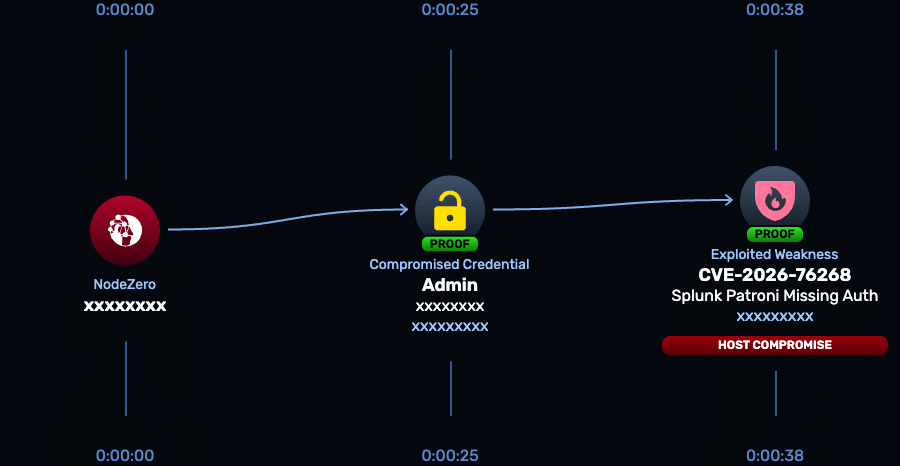
CVE-2026-76268 is a critical (CVSS 9.8) missing authentication flaw (CWE-306) in the Patroni REST API on Splunk Enterprise search head cluster members. An unauthenticated attacker with network access can run operating-system commands. Affected: 10.4.0 to 10.4.2 and 10.2.0 to 10.2.6. Fixed in 10.4.3 and 10.2.7. Splunk (SVD-2026-1001, 7 October 2026) suggests disabling the PostgreSQL sidecar as a workaround.
 horizon3.aiadvisoryAdded 29 Oct 2026, published 22 Oct 2026🛡️ Security
- Show HN: OnKey – I'm a bad singer, so I built an app to show where I'm off-key
OnKey is a free, MIT-licensed singing trainer for Apple Silicon Macs. After a song ends in Spotify, Apple Music or browser YouTube, it separates the lead vocal with UVR's MDX-Net Karaoke 2, tracks pitch with CREPE and turns it into syllable-level notes with the GAME model. On later plays it scrolls the notes, draws the user's live pitch and scores each line. Analysis runs on-device, and the repo explains the build steps and network requests.
github.comrepoAdded 24 Oct 2026, published 22 Oct 2026🧠 AI - lee1981 (@lee1981b) on X
CyberForge CVE of the Day #084 analyses CVE-2026-76466, a CVSS 9.8 flaw in clustered Cisco Expressway-C and Expressway-E. Persistent database cookies and weak client-certificate validation allow root OS command execution over the network. The fix is X15.5.20 (X14 and earlier must migrate), with no workaround. It adds a per-peer SOC investigation trail, reachability checks and exposure status from CISA SSVC, KEV and EPSS.
x.comadvisoryAdded 24 Oct 2026, published 22 Oct 2026🛡️ Security - SecLog-Bench: A Scalable Benchmark for Cybersecurity Log Reasoning with Scaffolded Evidence
SecLog-Bench is a benchmark for LLM reasoning over cybersecurity logs, built on an extensible simulation platform covering 29 attack scenarios. It combines audit logs, application logs and network traffic, with attack-stage labels and step-by-step evidence chains. Eight LLMs were tested on post-detection attack-progress reasoning: the best reached 44.44% accuracy, 45.07% Macro-F1 and 54.87% Stage Reasoning F1.
arxiv.orgpaperAdded 23 Oct 2026, published 22 Oct 2026🛡️ Security - SecLog-Bench: A Scalable Benchmark for Cybersecurity Log Reasoning with Scaffolded Evidence
SecLog-Bench is a benchmark for LLM reasoning over cybersecurity logs. A simulation platform with 29 attack scenarios generates audit logs, application logs and network traffic, with attack-stage labels and step-by-step evidence chains. Eight mainstream LLMs were tested on attack-progress reasoning: the best reached 44.44% accuracy, 45.07% Macro-F1 and 54.87% Stage Reasoning F1. Correct predictions often came with flawed reasoning.
arxiv.orgpaperAdded 23 Oct 2026, published 22 Oct 2026🧠 AI - Achieving AI-style reasoning without an LLM
Minotaur is a GPUless reasoning architecture built on ELC (Energy, Control, Logic) typed roles and the MINOS representation. One "settling" operation over one network handles deduction, abduction, diagnosis, seeing versus doing, belief revision and order-dependent histories. The authors report it matched a language model on a blind police-interview test (30 of 30) and on learned production-line faults (10 of 10), and that it recovered Aristotle's 24 valid syllogisms.
 fleetingswallow.comarticleAdded 23 Oct 2026, published 22 Oct 2026🧠 AI
 Amazon Threat Intelligence identifies PHP2Shell exploitation prior to public disclosure in MadPot
Amazon Threat Intelligence reports PHP2Shell exploitation (CVE-2026-109618, CVE-2026-109619) seen in MadPot honeypot telemetry on 17 October 2026, four days before the 21 October disclosure, from anonymization-network IPs. Multiple actors and PoCs appeared within hours of the patch. It recommends upgrading PHP, hunting for PHP_SESSION_UPLOAD_PROGRESS in multipart POSTs, and investigating from the earliest exploitation date, with patch SLAs measured in hours.
aws.amazon.comarticlePublished and added 21 Oct 2026🛡️ Security- Neural nets are exceptionally vulnerable to goal self-hack
"Neural nets are exceptionally vulnerable to goal self-hack" is a 3-minute AI Alignment Forum post by Stuart Armstrong, dated 21 October 2026. By its title, it argues that neural networks are unusually prone to altering or subverting their own goals. A later post, "Fixed-weight models are adversarially vulnerable: hence misaligned", cites it. The fetched page has no body text, so the argument itself is not available.
 alignmentforum.orgarticlePublished and added 21 Oct 2026🧠 AI
- Prompt Injection Through Forensic Evidence: A Taxonomy and Proof of Concept of Anti-Forensic Attacks on LLM-Assisted Digital Investigations
Paper on prompt injection delivered through forensic evidence, where the seized device's contents are attacker-controlled and the examiner must read them. It extends the anti-forensic model to cover manipulation of the reasoning layer and gives a taxonomy (objective, technique, payload location, concealment). Three proof-of-concept attacks on an LLM-assisted analysis pipeline change a reported conclusion, write attacker-chosen content to the analyst workstation, and trigger outbound network traffic. Mitigations are proposed.
arxiv.orgpaperAdded 24 Oct 2026, published 21 Oct 2026🛡️ Security - Monitorability Is Trainable: Post-Training for Chain-of-Thought Monitorability
Monitorability Is Trainable proposes an unsupervised post-training objective that maximizes mutual information between a model's chain of thought and its output. On three model organisms with degraded CoT (from compression, monitor optimization, and synthetic-document generalization), it recovers most or all lost monitorability. On undegraded policies it improves CoT monitor and activation probe prediction of unsafe behavior and raises consequential reasoning.
arxiv.orgpaperAdded 23 Oct 2026, published 21 Oct 2026🧠 AI  LiteLLM compromised again: infostealer and RAT found in version 1.107.0
LiteLLM 1.107.0 was compromised on 21 October 2026: the seven compiled PyPI wheels and the official Docker image carried an infostealer and a RAT. The attacker used the maturin `data = "cook"` directive in pyproject.toml to inject cook.pth, cook.py and sitecustomize.py without touching the source repo. The post lists stolen data, the hourly C2 polling via GitHub, wheel hashes, file and network IOCs, and check steps.
 aikido.devwriteupPublished and added 21 Oct 2026🛡️ Security
- Cyber Detective💙💛 (@cyb_detective) on X
Python Cybersecurity Libraries is a curated GitHub list by Yogsec, shared in a post by cyb_detective. It groups Python libraries by task: network analysis, penetration testing, threat intelligence, reverse engineering and malware analysis, forensics and investigation, web application security, CTF, and machine learning for security. The tweet shows only the category names, not the individual libraries.
x.comrepoAdded 24 Oct 2026, published 21 Oct 2026🛡️ Security - lee1981 (@lee1981b) on X
CVE-2026-110936 is an uncontrolled DLL search path flaw (CWE-427) in Siemens Software Center below V4.0.9.8, listed in CISA KEV on 20 October 2026. The post covers CVSS v4.0 8.4 and v3.1 6.7, Siemens' Romulus ClickFix campaign indicators (IPs, domain, hashes, file leads) and a six-step SOC trail using Sysmon, EDR and network records. It separates delivery from DLL load and from compromise.
x.comarticleAdded 24 Oct 2026, published 21 Oct 2026🛡️ Security  A company that vouches for websites had secret keys so weak that 8 of them were cracked
eMudhra, an Indian certificate authority with over 60 million issued certificates, had eight CA private keys that were tiny integers such as 4, 56 and 237. Researcher Scott Helme recovered all eight from public certificates in under a second, and the keys were exposed from April 2025. Mozilla, Chrome, Apple and Microsoft blocked them between 17 and 20 October 2026, but curl, Python, Node.js, Go and Java accepted a forged Stripe API certificate because they skip revocation checks.
coindesk.comarticlePublished and added 21 Oct 2026🛡️ Security- HAETAE on a Diet: Less Stack, Less Time on Low-End Microcontrollers
This ePrint paper presents an optimized HAETAE implementation, a lattice-based post-quantum signature scheme, for Cortex-M4, Cortex-M3, MSP430 and AVR. It keeps polynomials in 16 bits, shares buffers between objects with disjoint lifetimes, and replays Gaussian samples instead of regenerating them. On an ATmega2560, HAETAE-2 key generation, signing and verification run in 8,070 B of SRAM. Stack use drops up to 34% and signing is 1.18-2.51x faster than Low-Stack HAETAE.
eprint.iacr.orgpaperAdded 24 Oct 2026, published 21 Oct 2026🛡️ Security  People Are Vibe Coding the Ads Out of Their Smart TVs: Here's How
Decrypt reports on "vibe coding your TV": owners point Claude Code at Android TVs, which finds the set over Wi-Fi, lists installed apps through Android Debug Bridge, disables ad and telemetry packages, and writes custom launchers. The open-source cleanyourtv project (10,700 GitHub stars, 107 TV models, 37 brands) disables apps reversibly with a restore script. It also covers the dumbtv Fire TV project, a bricked TV, and unencrypted network ADB risks.
decrypt.coarticlePublished and added 20 Oct 2026🧠 AI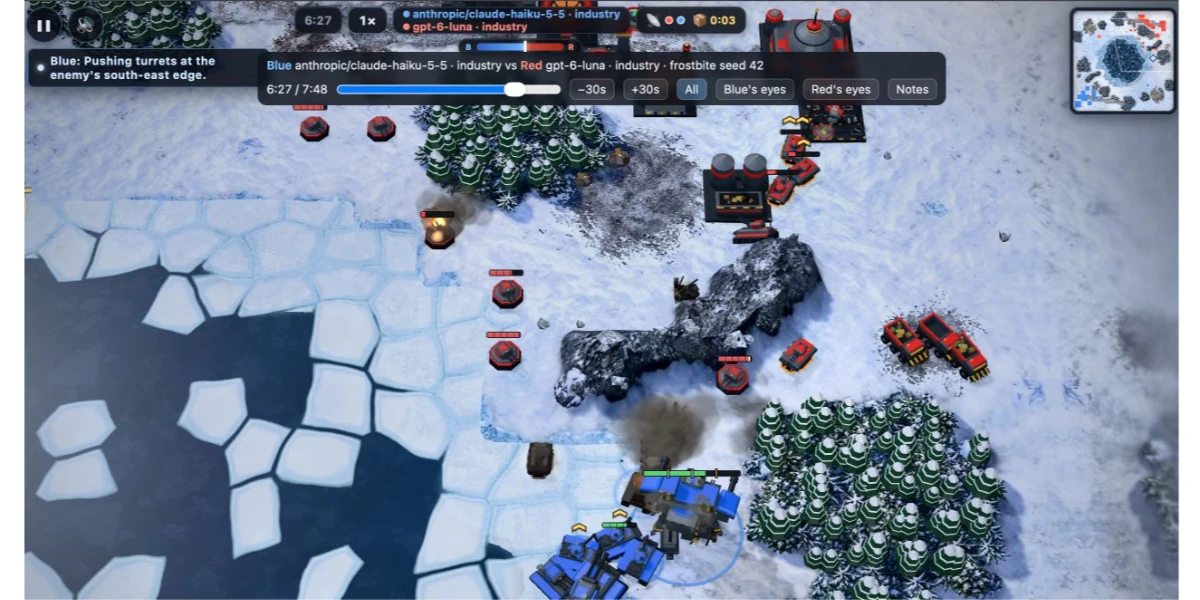 Battle Drones - a vibe coded RTS with audio-based multiplayer
Battle Drones is a browser-based Command & Conquer style RTS that Simon Willison built over 12 iterations and 321 commits, mostly with Claude Code and Claude Opus 5.5. The post gives key prompts and transcripts per version, including the "Make it a LOT more fun" run in Ultracode mode. It also covers an Agent vs. Agent mode for LLMs, audio-modem multiplayer between nearby phones, and lessons on deterministic simulation and code-generated 3D models and music.
 simonwillison.netwriteupPublished and added 20 Oct 2026🧠 AI
 Parul Gautam (@Parul_Gautam7) on X
Beacon is an open-source memory layer for coding agents. It saves sessions across Claude Code, Cursor, Codex and more than 20 other tools, so developers can move work between agents without losing context. The team says it raised a $5.5M seed round and is building a self-improving feedback loop that learns from how users debug. The post gives no technical detail or repo link.
x.comthreadAdded 21 Oct 2026, published 20 Oct 2026🧠 AI- Context-Aware Prompt Injection Detection via Small Language Models in RAG Pipelines: nokast-secureRAG
nokast-secureRAG is a roughly 0.5B-parameter small language model that works as a semantic firewall between retrieval and generation in local RAG systems. It classifies each query and context pair as safe, suspicious or malicious. It reaches 0.994 recall at a 0.026 false-positive rate in-distribution, beating Llama Guard 3 1B and Prompt-Guard-86M (0.900 recall, 0.690 FPR). Recall on PoisonedRAG falls to near zero, and single-request latency is 293-404 ms.
arxiv.orgpaperAdded 22 Oct 2026, published 20 Oct 2026🛡️ Security  AOMEI Backupper Compromised in Short-Burst Supply Chain Campaign
AOMEI Backupper, Windows backup and cloning software, served malware in short tampering windows between April and July 2026. Threat actor UNC7017 altered the update settings file and notification service to push the CrossRoad downloader, ShinyRoad backdoor, a modified Radmin Server and Adaptix payloads. Each window lasted five to ten minutes. The client did not authenticate its configuration files, and a WebDAV banner trick leaked NetNTLMv2 hashes.
securityweek.comarticlePublished and added 20 Oct 2026🛡️ Security From JavaScript to Renderer Code Execution: Three V8 Vulnerabilities and Two v8CTF Flags | depthfirst
Depth First Security's write-up describes three V8 bugs found using its dfs-large1 research tooling: CVE-2026-78938, a type confusion in Promise.prototype.finally that lets an internal helper be constructed and return a primitive; CVE-2026-79236, a TurboFan load-elimination bug that keeps a stale property-array pointer after object migration; and a shared WebAssembly memory sandbox escape (issue 546253900) caused by mismatched backing-store registration during serialization. It walks through turning each memory bug into addrof/fakeobj primitives, chaining either with the sandbox escape to reclaim a freed V8 isolate via a WebSocket allocation, and pivoting through a CFI-constrained ROP chain to achieve Chrome renderer code execution, earning two v8CTF flags. Fixes landed between August 20 and 25, 2026.
depthfirst.comwriteupAdded 29 Oct 2026, published 20 Oct 2026🛡️ Security 970,000 Medi-Cal Members Affected by Paradigm Healthcare Data Breach
Paradigm Healthcare Services, a Medi-Cal billing processor, told HHS that a breach affected more than 970,000 people. Attackers accessed its network between October 8 and 15, 2025, and exposed names, dates of birth, gender and Medi-Cal member IDs. The article also covers breaches at law firm Tarter Krinsky & Drogin (196,000 people) and Ridgeway Pharmacy (258,000). No threat actor or intrusion method is named.
securityweek.comarticlePublished and added 20 Oct 2026🛡️ Security SlowMist Says Qubic Wallet Keys Could Be Recovered From Six Network Samples
SlowMist says Qubic wallet private keys could be recovered from six samples observed on the network. Qubic patch 4.26.4 separates new account seeds from the exposed random stream, but leaves header generation unchanged. The page text holds only the headline and subhead, so the attack mechanics, affected versions and any CVE are not stated.
 thedefiant.ioarticlePublished and added 20 Oct 2026🛡️ Security
- better-isms/grcskills
grcskills is an MIT-licensed library of 60 SKILL.md files (Agent Skills format) that let coding agents draft and prepare governance, risk and compliance work: scope statements, statements of applicability, risk registers, audit prep, vendor review, policies, privacy, incidents and continuity. Each skill names where the agent must stop so a person decides. Installs are pinned to release tag v2026.10.19.2, and a validator rejects network commands and credential paths.
github.comrepoAdded 20 Oct 2026🛡️ Security - DFIR Radar (@DFIR_Radar) on X
DFIR_Radar weekly detection engineering digest covering 23 new and 19 updated rules across 6 GitHub repositories. It lists KQL rules for Azure Key Vault secret retrieval, MCP client User-Agent bulk operations and local Azure token theft, AWS CloudTrail analytics, Sigma rules for firewall and ETW tampering (decimal 17 vs hex 0x11), updated LOLDrivers hashes, and Sublime email rules for OAuth consent phishing and fake IRS W-9 PDFs.
x.comthreadAdded 20 Oct 2026, published 19 Oct 2026🛡️ Security - Huda (@AlAssaf_H) on X
Source-level review of x64dbg-MCP, GhidraMCP and IDA Pro MCP security, dated October 2026. It covers GHSA-4478-h5jv-647m (missing authentication, 0.0.0.0 bind) and GHSA-jgj3-97w2-9v9r (Content-Length integer overflow before the token check, causing a DoS panic), and compares tags 1.0, v1.1 and v1.2. It separates network reachability, tool authority and semantic influence from hostile binaries. No new exploit is claimed.
x.comarticleAdded 21 Oct 2026, published 19 Oct 2026🛡️ Security  Cutting our inference bill by 68% by being obsessive about optimization
Cloudflare describes how it cut the average cost of its AI code reviewer from $2.43 to $0.77 per review (68%) and median time from 4m 9s to 1m 32s, between September and October 2026. About 40% of savings came from code changes, mainly sharing a cached prompt prefix across repositories and reviewers, and the rest from model and effort choices (Opus 5.5, Sonnet 5.5). Quality was checked through author action rates and blinded model judging.
blog.cloudflare.comwriteupAdded 29 Oct 2026, published 19 Oct 2026🧠 AI- Which Model for Which Role? Cost-Efficient Pareto Recommendation for LLM Agentic Workflows
Cost-Coupled Gittins (CC-Gittins) is a multi-objective extension of cost-aware Gittins search that recommends Pareto-optimal model-to-role assignments for LLM agentic workflows. It exploits the coupling between evaluation and deployment cost, alternating between seeking higher quality and lower cost. On eight quality-cost matrices (two to five roles, up to 1,681 assignments), it recovers a substantial share of the true Pareto frontier at about 10% of exhaustive-evaluation cost, and most of it by 30%. Latency is tested as a third objective.
arxiv.orgpaperAdded 21 Oct 2026, published 19 Oct 2026🧠 AI - Tandem: Serving Hybrid Linear-Attention GUI Agents on Mobile NPUs
Tandem is a runtime for serving hybrid linear-attention GUI agents on mobile NPUs. It saves recurrent state where consecutive prompts diverge, keeps most prefill on the matrix unit, uses a verification kernel that reads each weight block once, and releases NPU power votes between bursts. On a Snapdragon 8 Elite it cuts per-step latency 30% for text screen descriptions and 16% for screenshots, cuts energy per text step by 33%, and lowers loaded-model standby power from 0.76 to 0.22 W.
arxiv.orgpaperAdded 21 Oct 2026, published 19 Oct 2026🧠 AI - HAF-VLA: Hierarchical Action Flow Framework for Humanoid Vision-Language-Action Control
HAF-VLA is a hierarchical action-flow framework that adapts a pretrained flow-matching vision-language-action model to humanoid whole-body loco-manipulation. It denoises a shared action space in stages: locomotion and head commands first, then waist refinement, then full-body manipulation. Learnable stage embeddings and cross-stage KV-cache conditioning carry dependencies between stages. The authors report gains over existing models on six real-world tasks.
arxiv.orgpaperAdded 21 Oct 2026, published 19 Oct 2026🧠 AI - Assisted Turbulence Modeling via Data Assimilation and Machine Learning for Turbomachinery Flows
This paper presents a hybrid framework for axial compressor flow that couples a Multi-Fidelity Ensemble Kalman Filter (MFEnKF) with machine learning. The filter merges PIV experiments with steady RANS and unsteady hybrid RANS/LES simulations. A neural network trained on the enriched data predicts Navier-Stokes volume forcing terms from velocity, velocity gradients and turbulent viscosity. A Mixture of Experts fixes local errors near blade tips, giving lower experimental discrepancy than baseline RANS.
arxiv.orgpaperAdded 21 Oct 2026, published 19 Oct 2026🧠 AI  Rank Math PRO WordPress Plugin Compromised in Supply Chain Attack
Rank Math PRO version 3.0.123, a WordPress SEO plugin, shipped malicious packages between 15 October 2026 20:02 UTC and 16 October 2026 07:12 UTC. The malware gives persistent backdoor access, can expose credentials and API keys, and uses .htaccess rules to run .cache files as PHP. Rank Math released clean v3.0.124 and advises restoring from backup, blocking rank1cdn[.]com, and checking SSH keys and crontabs.
securityweek.comarticlePublished and added 19 Oct 2026🛡️ Security Supply Chain Zero Days: Closing the Gap Between Publication and Detection
Wiz describes its pipeline that analyzes every new npm package version at publication, combining static analysis, an AI classifier, sandbox dynamic analysis and runtime sensor observation, then pushes IOCs to Wiz Defend before a CVE exists. It cites supply chain attacks rising from about 10% of significant incidents in H2 2025 to 25% in H1 2026, and the Axios compromise (v1.14.1, v0.30.4). The keyv case shows C2 domains fetched from an Ethereum smart contract, which only runtime monitoring caught.
 wiz.ioarticlePublished and added 19 Oct 2026🛡️ Security





Showing 90 of 518
Show more