 Google Introduces $250,000 Root-in-Cloud Bug Bounty Reward
Google Cloud Vulnerability Reward Program has added a $250,000 root-in-cloud tier for exploits that give roles/owner or full IAM control over arbitrary Google Cloud organizations or projects. The exploit path cannot rely on prior project access, stolen credentials or social engineering. Remote code execution in Borg also qualifies, but researchers must stop probing immediately. Proof is made against a designated service account using a deterministic proof-of-root mechanism.
 securityweek.comarticlePublished and added 2 Nov 2026🛡️ Security
 Tracking AI adoption in North Korean threat actor tradecraft
Microsoft Threat Intelligence report on how North Korean actors use AI, ranking Jade Sleet, Coral Sleet and Jasper Sleet as operationalized, Diamond Sleet, Onyx Sleet, Pearl Sleet and Sapphire Sleet as accelerating, and Emerald Sleet as expanding. It documents AI-generated lures (100+ Onyx Sleet PDFs, August and September 2026), AI-built tooling such as Coral Sleet's private GitHub repository trojanizing, and Onyx Sleet and Pearl Sleet use of the ARTEX agentic pentest framework. It ends with mitigation and Defender guidance.
 microsoft.comarticlePublished and added 29 Oct 2026🛡️ Security
 Gemini 4 Carbon is the new #1 on the Artificial Analysis Intelligence Index v5
Gemini 4 Carbon scores 59 on Artificial Analysis Intelligence Index v5 (published 28 October 2026), the top score, with #1 on 4 of 9 evaluations including HLE-Diamond and AA-Omniscience. On the Coding Agent Index it scores 59 with Antigravity CLI, 3 points behind Claude Code with Claude Opus 5.5 (62). Cost is $7.76 per task, versus $10.04 for Opus 5.5. Rollout is limited to selected users.
 artificialanalysis.aiarticleAdded 30 Oct 2026, published 29 Oct 2026🧠 AI
 OpenAI Proves ETH Is False, and Crypto Twitter Has Questions
Decrypt reports that OpenAI published a 67-page paper (dated 17 October 2026, revised 25 October) claiming its AI found a deterministic subexponential-time algorithm for counting 3-SAT solutions, which would refute the Exponential Time Hypothesis. The proof was formalized in Lean. Impagliazzo, Paturi and Ryan Williams are reviewing it independently and say this is not certification. Anthropic posted a Claude-credited 3-SAT paper on 26 October.
 decrypt.coarticlePublished and added 27 Oct 2026🧠 AI
 Sweden's Government Offices Block ChatGPT and Claude, Keep Microsoft Copilot
Sweden's Government Offices will block ChatGPT and Claude on staff computers from 26 October 2026 and leave Microsoft Copilot as the only approved AI tool, citing information security. Digitalisation director Mikael Wettercrantz said unvetted AI use had involved sensitive inputs and poorly handled outputs. The Tax Agency and National Board of Institutional Care have similar bans, and the European Parliament disabled AI features in February 2026. Whether Copilot has Claude models enabled is unconfirmed.
decrypt.coarticlePublished and added 24 Oct 2026🛡️ Security [tl;dr sec] #351 - PHP2Shell, Autopatching Skills, AWS Pathrunner
tl;dr sec #351 is a weekly security newsletter. Clint Gibler describes working with OpenAI, Calif, Wiz and the PHP maintainers on the PHP2Shell unauthenticated RCE disclosure, which affects 13 years of PHP. It also covers Datadog's pathrunner AWS IAM escalation framework, Trail of Bits' patching-bugs and regression-hunt Codex plugins, XBOW finding de-duplication, backdoored open-weight models, and CREBench.
 tldrsec.comarticleAdded 30 Oct 2026, published 22 Oct 2026🛡️ Security
 Best practices for integrating IAM Roles Anywhere with your PKI
Best practices for integrating AWS IAM Roles Anywhere with an external PKI so non-AWS workloads get temporary credentials via X.509 certificates. Covers trust anchor placement, certificate attributes (CN, issuer, SAN) in trust policy conditions, short-lived versus just-in-time certificates, and private key protection with PKCS #11, TPM 2.0 and OS certificate stores. Includes credential helper modes (serve, update), expiry monitoring, blue/green trust anchor rotation and a sample CloudFormation template.
 aws.amazon.comarticlePublished and added 21 Oct 2026🛡️ Security
- Explained: The Ledger Supply Chain Incident (October 2026)
The Ledger supply chain incident of October 2026: on-chain analysis estimates $93 million was stolen after devices sold by the reseller CryptoBilis carried an implant with an eSIM. The implant watched the screen during setup, captured the 24-word recovery phrase and sent it over LTE, without touching the Secure Element. Tether froze about $10 million USDT. Reports from Changi Airport and MediaMarkt stores remain unconfirmed.
 halborn.comarticleAdded 20 Oct 2026🛡️ Security
 In Other News: ICS-Sniper Attack, Hacking XWorm Malware Operators, $250k Chrome Exploit
SecurityWeek's weekly roundup covers ICS-Sniper, a UBC proof-of-concept that uses VPN-encrypted packet size, direction and timing to drop critical SCADA traffic on cloud-hosted ICS (tested on the SWaT water testbed). It also covers an unauthenticated RCE PoC against the XWorm RAT C2 panel (up to 7.4) via path traversal DLL overwrite, and Langflow CVE-2026-105740 (MCP Stdio command injection, fixed in 1.9.0) exploited from September 19, before the CVE was published. Other items: XBOW's AI-assisted Chrome full-chain exploit (GPT-5.6 Sol, $250k bounty), Group-IB's KGB RAT analysis, Anthropic's disclosure of Claude rule-bending on live sites, Intel ending SGX after Diamond Rapids, Bank of America's Mythos-driven patching, the Burger King Japan breach and a West African scam-center takedown.
securityweek.comarticlePublished and added 16 Oct 2026🛡️ Security Penetration testing every deployment with AWS Continuum
Explains how to add AWS Continuum for penetration testing (formerly AWS Security Agent) as a post-deployment gate in CI/CD. Each run is scoped to the commit range since the last passing gate, and it can block promotion to production at a chosen severity threshold. It covers OIDC federation to a least-privilege IAM role, a GitHub Actions worked example, staged report-only rollout, and pitfalls: the baseline advances on passing report-only runs, fail-on-infrastructure-error defaults to fail-open, GitLab pipeline variables can override the committed threshold, and runner credentials need protecting.
aws.amazon.comarticlePublished and added 14 Oct 2026🛡️ Security Ledger Asks Resellers in Seven Asian Markets to Pull Devices After Suspected $86M Drain
Ledger asked resellers and distributors in Indonesia, Singapore, Thailand, the Philippines, Vietnam, Malaysia and Hong Kong to pull its hardware wallets while it investigates devices fitted with a hidden implant. Its Donjon team found the implant reads the 24-word recovery phrase from the screen during setup and sends it out over LTE. All confirmed losses trace to devices sold through reseller CryptoBilis, and Specter has traced over $86M in suspected thefts, which Ledger has not verified. Ledger says its own infrastructure and direct channel show no compromise. MediaMarkt Saturn halted sales after a German customer reported an implant, and Trezor is ending reseller authorizations on January 1, 2027.
decrypt.coarticlePublished and added 14 Oct 2026🛡️ Security Ledger Spyware Scare Spreads Across Asia and Europe
News roundup on hardware implants found in Ledger wallets sold through authorized resellers, starting with CryptoBilis in Southeast Asia and then Singapore, Japan and German MediaMarkt stores. The implants read the 24-word recovery phrase off the screen during setup and send it out over a hidden cellular link, while Ledger's secure chip stays untouched so the devices look genuine. Researchers describe three generations dating to 2025, each harder to detect. Suspected losses are put at $86M (Specter) to $103M (Yfarmx), and neither figure is verified by Ledger.
 bankless.comarticlePublished and added 13 Oct 2026🛡️ Security
- Ledger confirms hardware implant in CryptoBilis reseller units as MediaMarkt suspends sales in Europe
Ledger's Donjon team confirmed that Ledger signers sold by the reseller CryptoBilis contain an unauthorized implant. It captures the 24-word recovery phrase during setup and sends it over LTE using a provisioned eSIM. It does not touch the Secure Element, the OS, or transaction signing. Onchain researchers estimate losses above $86M, but Ledger says that figure is unverified. MediaMarkt Saturn halted European Ledger sales after a tampered unit was reported in Germany, and Trezor and OneKey tightened or revoked reseller authorizations. The case shows a reseller-channel tampering risk for hardware wallets.
 theblock.coarticlePublished and added 13 Oct 2026🛡️ Security
 German Ledger reseller pauses sales following $86M draining incident
Protos reports that German retailer MediaMarkt pulled all Ledger products after teardowns of Ledger hardware wallets showed physical spyware implants, tied to an $86M drain of wallets bought from Malaysian reseller CryptoBilis. Ledger's investigation concluded the implant recorded the 24-word recovery phrase and sent it out over an attached eSIM. Mark Karpelès has helped identify implants in dismantled devices from MediaMarkt, LazMall (Philippines), CryptoBilis and Metapod (Singapore airport). Ledger has so far confirmed only the CryptoBilis devices and says it is reviewing reports of implants elsewhere.
 protos.comarticlePublished and added 13 Oct 2026🛡️ Security
 GuardDuty Extended Threat Detection has added five new indicators to surface attack sequences
Explains five new indicator types (MALICIOUS_PACKAGE, MISCONFIGURATION, REACHABILITY, SENSITIVE_DATA, VULNERABILITY) that GuardDuty Extended Threat Detection attaches to attack sequence findings, sourced from Inspector, VPC Reachability Analyzer, Macie and Security Hub. Walks through an EKS compromise (AttackSequence:EKS/CompromisedCluster) that only became a CRITICAL finding thanks to the new context, and a cryptomining EC2 case. Lists observed CVEs with EPSS scores, frp/Burp Collaborator artifacts, and response advice such as EPSS-weighted patching, isolating reachable hosts and rotating IAM credentials.
aws.amazon.comarticlePublished and added 12 Oct 2026🛡️ Security Anthropic tests AI autonomous replication across eight nodes in four of five trials
The article reports Anthropic research (William Zhou and Daniel Freeman) on whether small open models can autonomously replicate onto unfamiliar IoT and consumer hardware. Qwen3.5-9B established inference on eight of nine hardware types using the Memento harness (built on the Pi coding agent). GLM-5.2 completed a simplified end-to-end replication across eight emulated Android nodes in four of five trials, and reached seven nodes in the fifth. Gemma4-26B-A4B was sharded by pipeline parallelism across 15 low-RAM Android TV boxes at 0.39 tokens/s. The authors estimate replication intervals of 1–2 days and a capability threshold around end of 2026, which makes it a concrete capability-evaluation datapoint for AI safety.
 en.cryptonomist.charticlePublished and added 12 Oct 2026🧠 AI
- Anthropic tests AI autonomous replication across eight nodes in four of five trials
News write-up of an Anthropic research post (William Zhou, Daniel Freeman) testing whether small open-weight models can act as autonomous worms. Qwen3.5-9B established inference on eight of nine hardware types, and GLM-5.2 spread across eight emulated Android nodes via unauthenticated ADB in four of five trials, reaching seven nodes in the fifth. The piece covers sharding a Gemma4-26B-A4B model across 15 low-memory Android TV boxes, projected spread rates, comparison with the Kimwolf botnet, and network signals defenders could watch (large weight transfers, inter-device inference traffic, scanning).
en.cryptonomist.charticlePublished and added 12 Oct 2026🛡️ Security  Quantum-resistant signing on AWS, Part 2: Enforce your ML-DSA algorithm policy with SCPs and IAM
Explains how to turn a cryptographic algorithm policy (approve ML-DSA-65/87, exclude ML-DSA-44) into enforceable AWS controls using SCPs, IAM policies, permission boundaries and KMS key policies. The key lever is the kms:KeySpec condition key (kms:SigningAlgorithm can't distinguish variants, since all use ML_DSA_SHAKE_256), applied to CreateKey, ReplicateKey, Sign, Verify and GetPublicKey. It also covers surfaces without algorithm condition keys (AWS Private CA, ACM import, IAM server certificate upload, ELB TLS) via provisioning pipelines plus CloudTrail and AWS Config drift detection, and the default-allow risk of deny-lists.
aws.amazon.comarticlePublished and added 12 Oct 2026🛡️ Security Quantum-resistant signing on AWS, Part 1: Build a software supply chain with ML-DSA
Part 1 of an AWS series showing how to build a quantum-resistant software supply chain with ML-DSA: ML-DSA keys in AWS KMS, an ML-DSA root/subordinate CA hierarchy in AWS Private CA, and IAM Roles Anywhere trust anchors for external build agents. It covers signing binaries (EXTERNAL_MU with OpenSSL 3.5), container images as OCI referrers via ORAS, and SBOMs wrapped in in-toto Statements bound to the artifact digest, plus verification, admission control, trust-store distribution, revocation and SCP guardrails. It frames the "forge later" threat and maps CNSA 2.0 (ML-DSA-87 only for NSS) and EU CRA deadlines to actions.
aws.amazon.comarticlePublished and added 12 Oct 2026🛡️ Security Ledger spyware scare spreads beyond Southeast Asia
Protos reports additional alleged Ledger hardware wallets with physical spyware implants, found in devices from a German MediaMarkt reseller, a Philippine LazMall reseller and a Stax model bought from CryptoBilis. Mark Karpelès found that the implants read the device's screen output to capture seed phrases and evade Ledger's Genuine Check. The earlier CryptoBilis-linked incident of Oct 9 drained over $86M. Ledger told resellers to use only authorized channels and never restock returned units, and teardowns have also shown many devices to be clean.
protos.comarticlePublished and added 12 Oct 2026🛡️ Security Configuring your AI vulnerability harness, Part 2: The steering file
AWS Security Blog's second post in a series on building an "AI vulnerability harness" explains the configuration (steering file) that stops an AI model from hallucinating vulnerabilities and inflating severity during security code review. It details five configuration sections — structural verification of findings, an evidence-based confidence formula (weighting confirmed taint flow at 0.30), infrastructure-aware severity multipliers for controls like AWS WAF and IAM, CISA KEV/EPSS threat-intel boosting, and a four-tier priority classification — and reports validation numbers (e.g., unsteered models fabricated code paths in ~30% of findings; steered confidence of HIGH without structural confirmation was only 34% exploitable vs 89% with confirmed taint). The steering file is shipped as a Kiro steering file, a Kiro skill, and a CLAUDE.md for Claude Code, with full source in a linked GitHub repo.
aws.amazon.comarticlePublished and added 7 Oct 2026🛡️ Security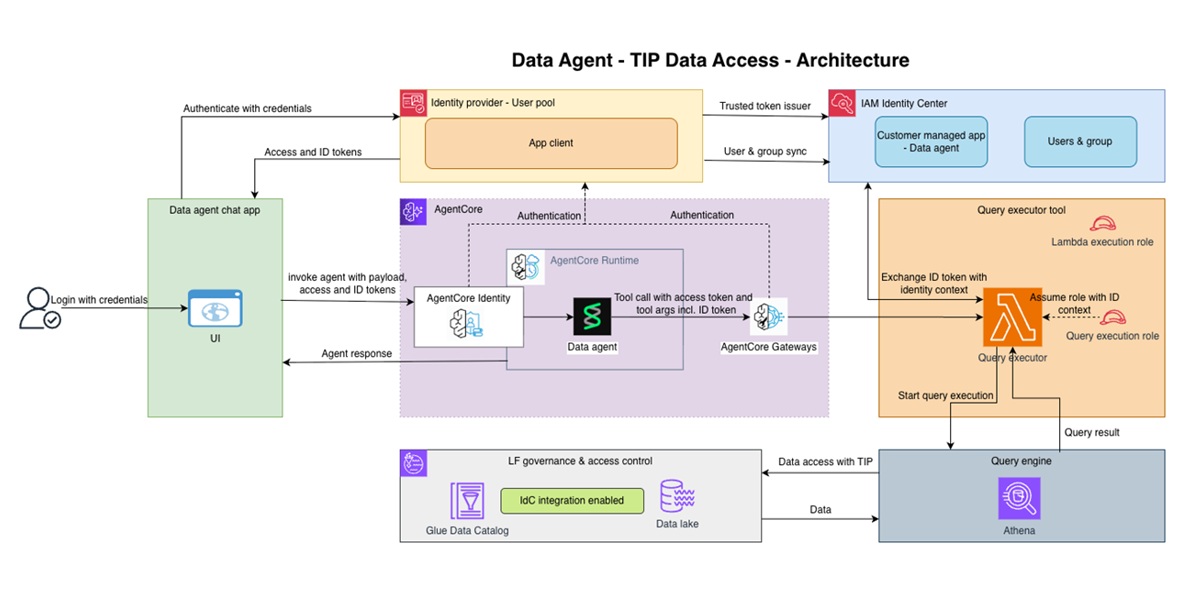 Identity-aware AI data agents with AWS Lake Formation and Trusted Identity Propagation
AWS Security Blog walkthrough of an identity-aware AI data agent pattern that propagates a real user's OIDC id_token through Amazon Bedrock AgentCore Runtime and Gateway into a Lambda target, which exchanges it server-side (via IAM Identity Center trusted identity propagation) for Lake Formation-scoped Athena credentials. The design deliberately keeps the id_token off the tool schema and inside HTTP headers only, so the foundation model never sees or handles the user's credential, and CloudTrail records the real human via an onBehalfOf AssumeRole entry, letting existing Lake Formation grants govern AI agent queries without rewriting authorization logic in application code. It details the three AgentCore configuration gates (runtime header allowlist, gateway metadataConfiguration.allowedRequestHeaders, Lambda's bedrockAgentCorePropagatedHeaders) that enforce this separation.
aws.amazon.comarticleAdded 7 Oct 2026, published 6 Oct 2026🛡️ Security- [tl;dr sec] #348 - Google's PageBreak Scanner, Perplexity's Agent Security Tool, Defending Agentically
tl;dr sec #348 is a weekly security newsletter issue. It summarises Google's PageBreak agent (500+ XSS bugs found since November 2025, validated deterministically), Perplexity's open-source Numbat agent-security tool (52 CEL rules), and SpecterOps' CiliumHound. It also covers Scaleway IAM attack paths, the NCSC essay on defending agentically, Julien Vehent on detection fidelity, and Wiz's Scan for Good.
tldrsec.comarticleAdded 30 Oct 2026, published 1 Oct 2026🛡️ Security  Connect Orca’s ChatGPT Plugin: Cloud Risk Context in Chat and Codex
Orca Security's plugin connects ChatGPT and Codex to Orca's MCP server, letting security teams and developers query cloud alerts, attack paths, effective IAM permissions, and code-to-cloud origins directly from chat or a coding agent instead of logging into a console. The post walks through six security-team use cases (exposure discovery, CVE impact triage, alert-to-blast-radius investigation, identity permission review, CISO reporting) and three developer workflows in Codex where alerts are traced back to the Terraform/code that created the misconfiguration and fixed in place.
 orca.securityarticleAdded 2 Oct 2026, published 30 Sep 2026🛡️ Security
 ICYMI: August 2026 @AWS Security
AWS Security Blog's August 2026 ICYMI roundup covering 20 blog posts, 23 security bulletins, and 17 code samples. The dominant theme is securing agentic AI workloads on Amazon Bedrock AgentCore, alongside IAM/Cognito updates, S3 over-permission remediation, and a bulletin wave featuring prompt-injection consent bypasses in Strands Agents Tools, an IDOR exposing cross-tenant agent memory, credential-disclosure flaws in MCP servers, and RCE issues such as path-traversal-to-root in amazon-ssm-agent and Zip Slip in awsdac.
aws.amazon.comarticleAdded 7 Oct 2026, published 23 Sep 2026🛡️ Security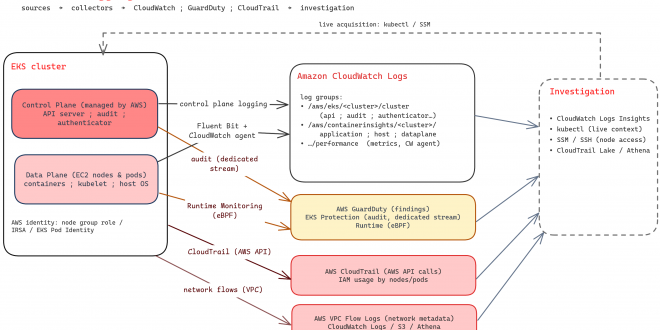 AWS EKS forensics: data sources and investigation tooling (Synacktiv)
Synacktiv's CSIRT publishes a detailed forensics guide for Amazon EKS, mapping the three data-source layers (Kubernetes control plane audit logs, data-plane/Container Insights logs, and AWS-level CloudTrail/GuardDuty) and giving concrete CloudWatch Logs Insights queries for detecting RBAC reconnaissance, role escalation via the 'escalate' verb, Pod Security Admission evasion, and static-pod node persistence. It also covers node-level acquisition via SSM/kubectl debug, ServiceAccount token theft, and correlating GuardDuty findings (PrivilegedContainer, ContainerWithSensitiveMount, ReverseShell, InstanceCredentialExfiltration) with CloudTrail to trace stolen node/pod IAM identities used outside the cluster.
 synacktiv.comarticleAdded 21 Sep 2026🛡️ Security
 Run open weight models on Amazon Bedrock in AWS European Sovereign Cloud
AWS announces general availability of Gemma 4 (Apache 2.0 open-weight models) on Amazon Bedrock's new OpenAI-compatible bedrock-mantle inference engine within the AWS European Sovereign Cloud, its independently-operated EU-only cloud region (eusc-de-east-1). The post details the security model behind inference: zero operator access to prompts/outputs, zero data retention by default, encryption in transit, IAM-scoped least-privilege access to the inference API, short-lived vs long-lived Bedrock API keys, and CloudTrail/CloudWatch auditing, plus a walkthrough for calling Gemma 4 via the Responses and Chat Completions APIs.
aws.amazon.comarticleAdded 7 Oct 2026, published 17 Sep 2026🛡️ Security- Run open weight models on Amazon Bedrock in AWS European Sovereign Cloud
AWS announces general availability of Gemma 4 (Apache 2.0 licensed open-weight model family) on Amazon Bedrock's next-generation inference engine within the AWS European Sovereign Cloud, accessible via an OpenAI-compatible bedrock-mantle endpoint supporting the Responses and Chat Completions APIs. The post walks through authenticating with Bedrock API keys, IAM permission scoping, and sending first inference requests using the OpenAI Python SDK, alongside details on zero-operator-access/zero-data-retention guarantees and in-region (eusc-de-east-1) data residency.
aws.amazon.comarticleAdded 8 Oct 2026, published 17 Sep 2026🧠 AI  Architecting a secure landing zone in the AWS European Sovereign Cloud
AWS Security Blog walkthrough of building a secure, production-ready landing zone in the new AWS European Sovereign Cloud (aws-eusc partition), covering multi-account governance via AWS Control Tower/AFT, IAM Identity Center federation as Terraform code, centralized logging into a Log Archive and Security Tooling account, network perimeter design with dedicated Direct Connect PoPs and VPC endpoints, KMS/External Key Store data protection, and partition-aware CI/CD for pushing container images, AMIs, and artifacts across the partition boundary. It maps design decisions to the AWS Security Reference Architecture and Well-Architected Framework, distinguishes hard partition boundaries from configurable choices, and references BSI C5:2020, SOC 2, and ISO 27001/27017/27018/27701 certifications for EUSC.
aws.amazon.comarticleAdded 7 Oct 2026, published 16 Sep 2026🛡️ Security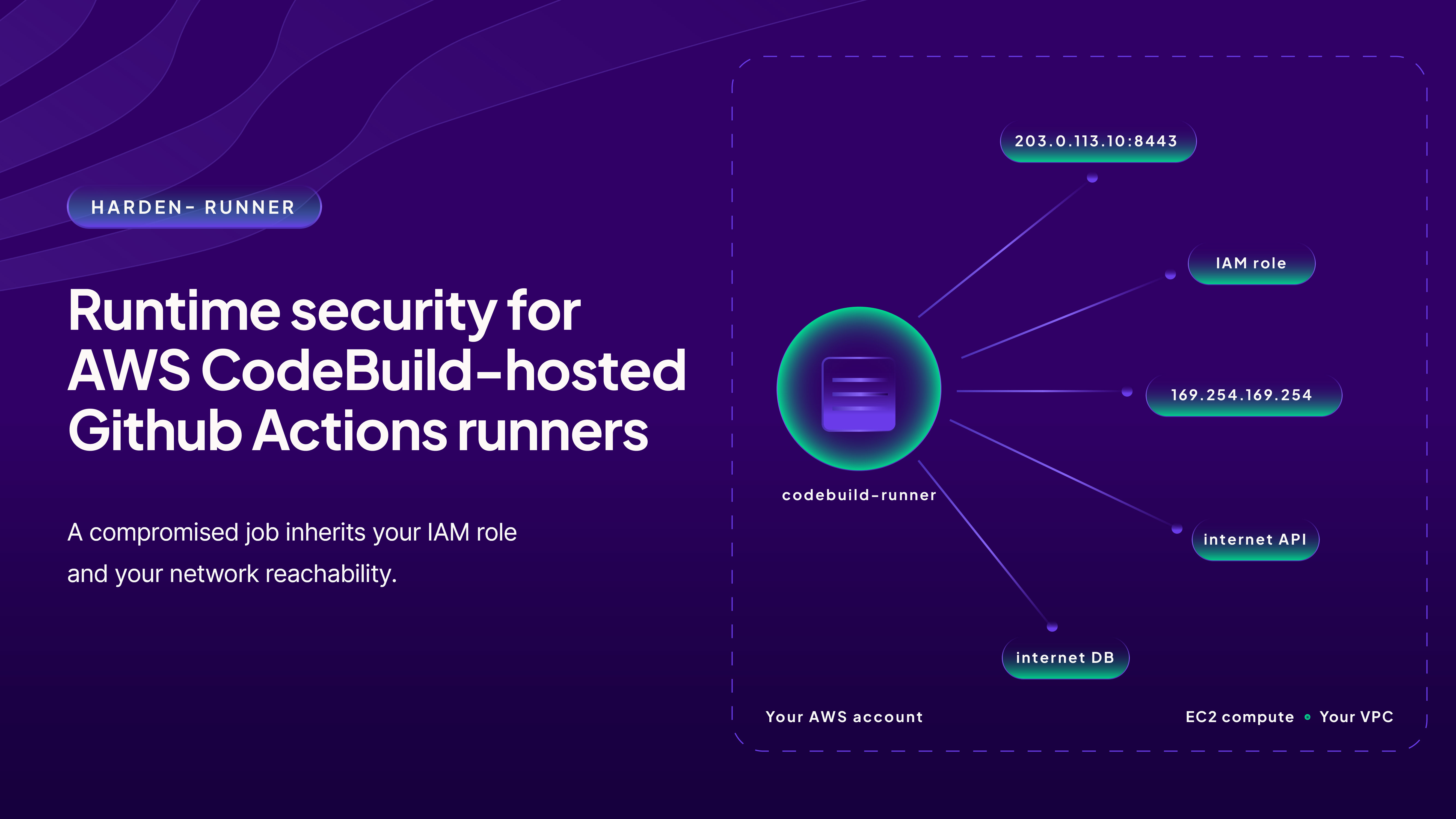 Runtime Security for AWS CodeBuild-Hosted GitHub Actions Runners
StepSecurity announces Harden-Runner support (v2.20.1+/v2.21.0) for GitHub Actions jobs executed on AWS CodeBuild-hosted just-in-time runners, including custom container images. The post frames the feature around CVE-2025-8217, where a threat actor exfiltrated GitHub tokens by dumping CodeBuild build-environment memory via a malicious pull request to compromise the AWS Toolkit for Visual Studio Code and AWS SDK for .NET repos, and notes that CodeBuild runners additionally expose an assumed IAM service role and VPC network reachability that GitHub-hosted runners don't have. Harden-Runner correlates outbound network calls, file writes, and process executions to the workflow step that triggered them and unifies detection across GitHub-hosted, self-hosted, ARC, and CodeBuild-hosted runner fleets.
 stepsecurity.ioarticleAdded 3 Sep 2026, published 2 Sep 2026🛡️ Security
- [tl;dr sec] #343 - Hugging Face Technical Report, AWSHound, OWASP Agentic Skills Top 10
tl;dr sec #343 is a weekly security newsletter issue. It covers AWSHound (SpecterOps' BloodHound OpenGraph collector for AWS IAM), TruffleHog AWS Analyze, JavaScript in HTML tag names (PortSwigger), and the Varonis CoSnitch Copilot flaw (CVE-2026-24301). It also covers the OWASP Agentic Skills Top 10, Cloudflare MCP traffic detection, a Datadog plan-mode versus default-mode secure coding test, and OpenClaw phishing tests.
tldrsec.comarticleAdded 30 Oct 2026, published 27 Aug 2026🛡️ Security  Orca Security: Cloud Identity & Entitlement Management Series
Orca Security explainer on entitlement sprawl (a.k.a. privilege creep) in cloud environments: the gradual accumulation of unused permissions across human and non-human identities, driven largely by machine identities (service accounts, roles, keys) that outnumber human users by over 80-to-1 per CyberArk's 2025 report. It distinguishes granted vs. effective permissions, explains why static IAM exports miss real risk, walks through detection via AWS IAM Access Analyzer, Azure Entra Permissions Management, and GCP IAM Recommender, and lays out controls (least privilege, JIT access, continuous automated reviews, RBAC/ABAC, NHI governance, zero trust) before positioning Orca's agentless CIEM (SideScanning) as the automation layer.
orca.securityarticlePublished and added 31 Jul 2026🛡️ Security Orca Security: AI Threat Detection
Orca Security explainer arguing AI threat detection is not one capability but four distinct techniques — anomaly detection, behavioral/entity baselining, supervised classification, and an agentic triage layer — each with a documented failure mode (baseline poisoning during an active intrusion, cold-start on ephemeral cloud workloads, classifiers blind to novel classes, and LLM agents confidently narrating false positives). It walks the telemetry-to-baseline-to-alert pipeline (citing AWS GuardDuty's Discovery:IAMUser/AnomalousBehavior finding and Microsoft Entra ID Protection's atypical-travel baseline), argues detection quality tracks telemetry completeness rather than model sophistication, and closes by mapping the framework to Orca's Unified Data Model and Threat Investigation Agent.
orca.securityarticlePublished and added 30 Jul 2026🛡️ Security Shift Left and Hunt Deep: Announcing Automated Exposure Discovery Engines for macOS XPC and Oracle Cloud IAM
XM Cyber announces two open-source offensive tools: FAInd my XPC (also called XPC Hunter), which automates discovery and proof-of-exploit for macOS privileged XPC services that authorize callers by code-signing identity alone — bypassing this via AMFI code-signing cache priming and sealed NIB resource swapping to achieve unauthenticated root code execution, using Claude for LLM-driven reverse engineering of daemon interfaces; and pOliCI plus a CLI Signing Helper (a fork of the OCI CLI with instance-principal authentication support), which parse Oracle Cloud Infrastructure IAM policies to compute effective permissions and identify privilege-escalation paths. Both tool sets were debuted at BlackHat USA 2026 Arsenal and DEF CON 2026.
 xmcyber.comarticleAdded 3 Sep 2026, published 30 Jul 2026🛡️ Security
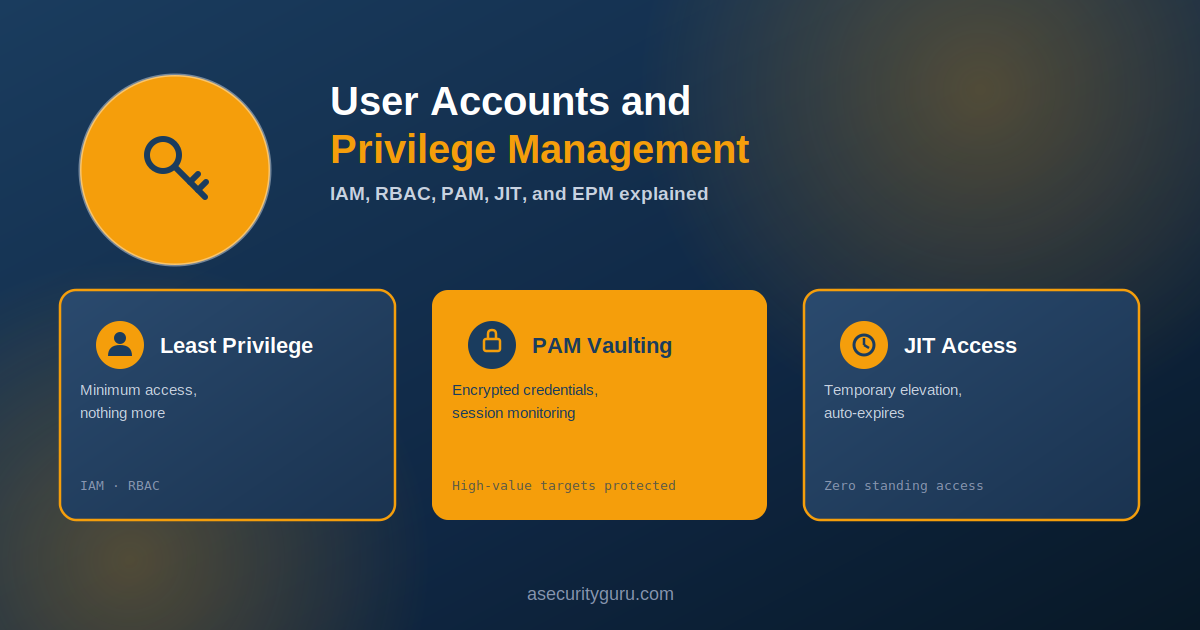 User Accounts and Privilege Management
Introductory primer on OS user accounts and privilege management. It covers permissions versus privileges, the Principle of Least Privilege, vertical versus horizontal privilege escalation, UAC and sudo, and group-based access. It then moves to enterprise controls: IAM, RBAC, PAM with credential vaulting and session monitoring, Just-In-Time access, Endpoint Privilege Management and Zero Trust. It includes a best-practices list, an FAQ on service-account targeting and why MFA does not replace PAM/JIT, and a tip to start with Azure PIM and forward logs to Splunk for privilege-event alerting.
 asecurityguru.comarticleAdded 13 Oct 2026, published 27 Jul 2026🛡️ Security
 The Two Mitigations for the Service-Account Confused Deputy in the Cloud
A technical breakdown of the service-account confused-deputy problem in the cloud, splitting it into two categories by identity ownership: customer-managed identities (GCP service accounts, AWS IAM roles, Azure managed identities) mitigated via bind-time attachment checks like iam.serviceAccounts.actAs, and provider-managed identities (GCP service agents, AWS service-linked roles, Azure platform-level principals) mitigated via provider-side authorization such as AWS Forward Access Sessions and condition keys (aws:SourceArn, aws:SourceAccount, aws:SourceOrgID, aws:SourceOrgPaths) or Azure's opaque LinkedAuthorizationFailed checks. It contrasts observability across the three major CSPs, noting AWS is the only one that exposes its confused-deputy machinery as first-class, customer-controllable primitives.
 kattraxler.cloudarticleAdded 19 Sep 2026, published 9 Jul 2026🛡️ Security
 Orca Security: ITDR for the Cloud
Orca Security explainer defining Identity Threat Detection and Response (ITDR) for cloud environments, distinguishing it from IAM, PAM, EDR, and CIEM as a runtime behavioral-detection layer for identity abuse rather than a preventive/posture control. It covers cloud-specific attack patterns like leaked AWS access-key abuse, AssumeRole/PassRole privilege escalation, OAuth consent phishing, and federation/token abuse, and details how ITDR baselines identity behavior (especially machine/non-human identities) using cloud audit logs like CloudTrail to detect impossible travel and anomalous role assumption, ending with Orca's agentless CIEM+ITDR platform pitch.
orca.securityarticlePublished and added 3 Jul 2026🛡️ Security- All That Glitters Isn't Prompt Injection: Rethinking The Meta Instagram Takeover - APIsec Research Labs
APIsec Research Labs argues the Meta AI support-assistant account takeover (which let an attacker relink a victim's recovery email by simply telling the agent "this is my username @iambob") was not fundamentally a prompt-injection bug but a Broken Object-Level Authorization failure: the "link recovery email" function was correctly reachable, but nothing checked that the target account identifier actually belonged to the authenticated requester. They classify it as "Action-Level Object BOLA" using their own BOLA taxonomy and draw a direct parallel to a confirmed Mozilla report (#3154983) where a POST /v1/account/destroy call accepted an unverified victim email in the request body. The piece argues AI agents with tool access are just another API client that needs the same identity-to-object binding, deny-by-default scoping, and out-of-band confirmation for sensitive changes that appsec already knows how to do.
 labs.apisec.aiarticleAdded 18 Aug 2026, published 25 Jun 2026🛡️ Security
 AWS Well-Architected: Software Supply Chain Security
AWS Security Blog post translating lessons from the Shai-Hulud, Chalk/Debug, tea.xyz, and axios npm supply chain attacks into concrete AWS Well-Architected Security Pillar recommendations for package consumers. It covers eliminating long-lived credentials (aws login, IAM Identity Center, OIDC), defense-in-depth artifact signing with AWS Signer and ECR managed signing, centralizing dependencies via AWS CodeArtifact package groups to block typosquatting, npm provenance attestations via Sigstore, and Amazon Inspector's behavioral detection of zero-day/sleeper malicious packages feeding into the OpenSSF Malicious Packages Repository (MAL-IDs).
aws.amazon.comarticleAdded 3 Sep 2026, published 4 Jun 2026🛡️ Security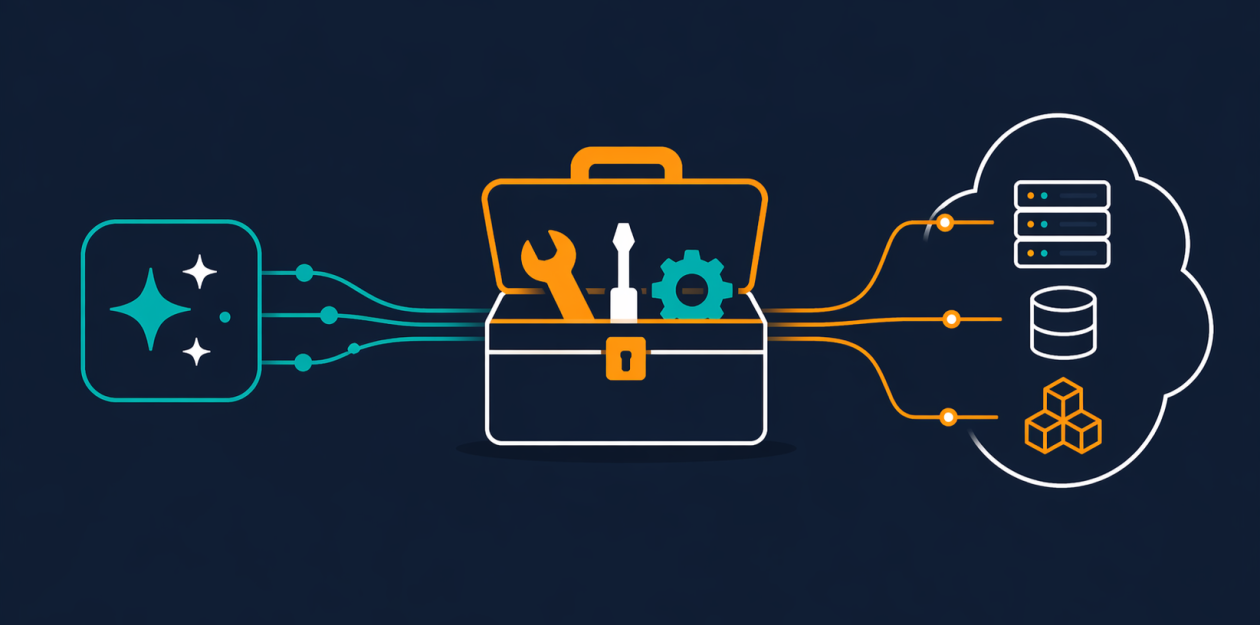 AWS MCP Server (GA)
AWS announces general availability of the AWS MCP Server, a managed remote MCP server giving AI coding agents (Claude Code, Cursor, Codex, Kiro) authenticated access to all AWS APIs via IAM SigV4 through a small tool set (call_aws, search_documentation, read_documentation, and the new run_script). Security-relevant design choices include a network-isolated sandbox for server-side script execution that inherits only IAM permissions, new IAM context keys for fine-grained access without a separate MCP permission, and enterprise controls to separate human vs. agent permissions via IAM/SCP with CloudWatch metrics and CloudTrail logging for auditing agent API calls. Since MCP only supports OAuth 2.1, an open-source MCP Proxy for AWS bridges local IAM credentials to the server.
aws.amazon.comarticlePublished and added 24 May 2026🛡️ Security Orca Security: AI Security Tools: How to Evaluate Them Across Every ML Attack Phase
Orca Security maps six AI security tools — Adversarial Robustness Toolbox (model robustness), Purple Llama (LLM prompt/code safety), NB Defense (notebook secret scanning), Garak (LLM jailbreak/prompt-injection probing), Privacy Meter (membership-inference privacy leakage), and Viper (post-exploitation lateral movement) — against the five MITRE ATLAS attack phases, arguing each covers only one layer and none evaluate cloud infrastructure misconfiguration (IAM, storage, network) around AI workloads. It defines eight evaluation criteria (attack-phase coverage, CI/CD integration, EU AI Act/NIST AI RMF compliance mapping, shadow AI visibility, attack-path correlation, adoption friction, false-positive rate, time-to-value) and closes by positioning Orca's agentless cloud CSPM to fill the infrastructure-layer gap around SageMaker IAM roles, training buckets, and inference endpoints.
orca.securityarticlePublished and added 21 May 2026🛡️ Security Orca Security: GenAI Risks in Cloud Environments
Orca Security breaks down four GenAI-specific cloud asset classes that standard CSPM misses — training datasets, model artifacts, inference endpoints, and RAG vector databases — and shows how misconfigurations in each combine into full attack paths. It walks through a concrete chain (public S3 training bucket → data poisoning per MITRE ATLAS AML.T0020 → stolen SageMaker execution-role credentials via missing IMDSv2 → account-wide S3 read via overprivileged AmazonSageMakerFullAccess) and analyzes CVE-2024-34359 in Hugging Face's safetensors library as a storage-to-RCE path for SageMaker inference. It closes with concrete IAM/endpoint hardening steps and a pitch for Orca's attack-path correlation across role permissions, data sensitivity, and endpoint exposure.
orca.securityarticlePublished and added 18 May 2026🛡️ Security