- Prasenjit Sarkar (@stretchcloud) on X
Campfire is a free, open-source, self-hosted tool that runs Claude Code, Codex, Goose, Aider and OpenHands side by side in one browser tab. Each agent gets its own git worktree, with permission voting (30 second timer, majority rules), session replay, cross-backend agent races and a shared semantic memory layer. Installs with bunx the-campfire. The post also compares Clawboo, Conductor, Vibe Kanban and Crystl.
 x.comthreadAdded 1 Nov 2026, published 31 Oct 2026🧠 AI
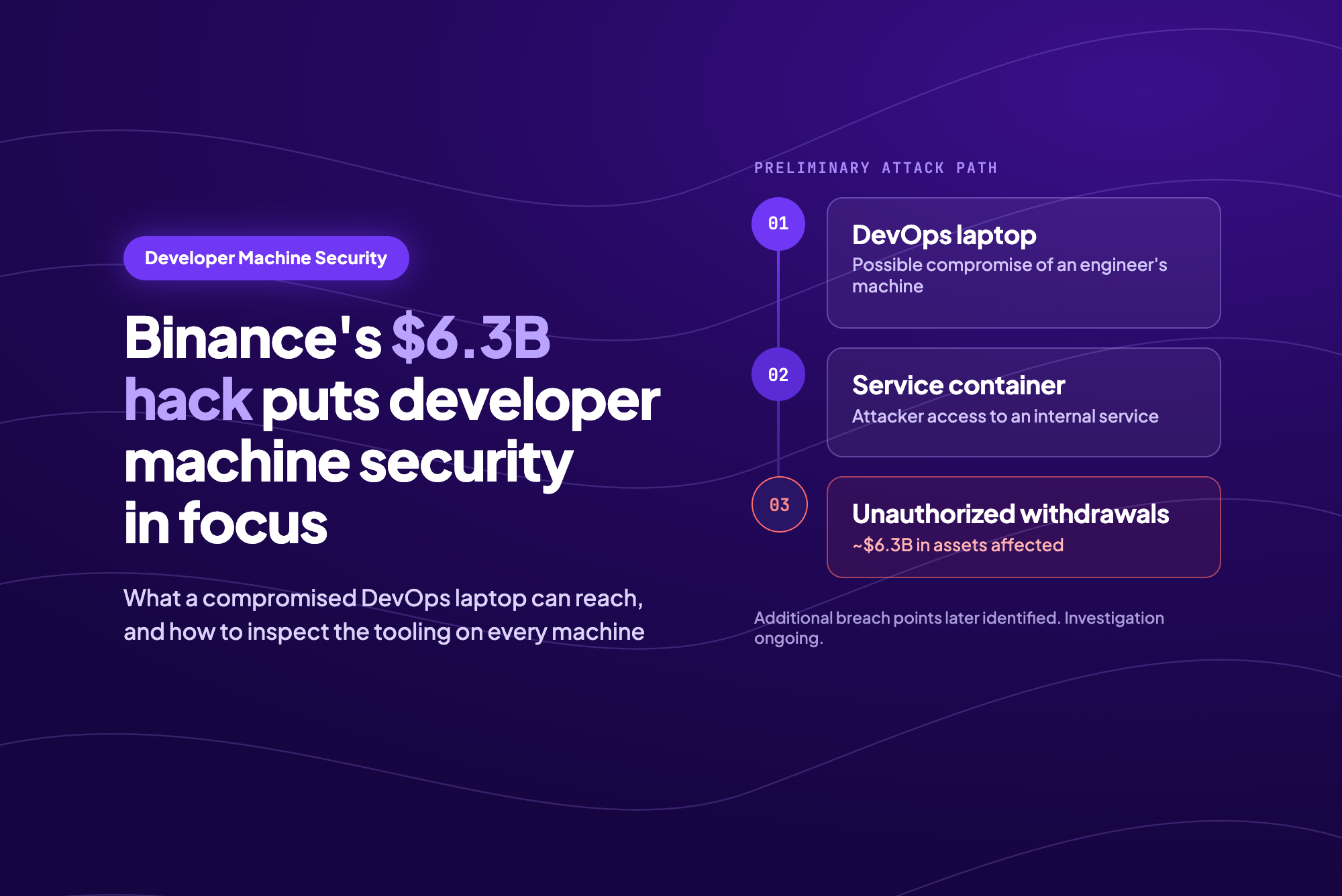 Binance’s $6.3 Billion Hack Puts Developer Machine Security in Focus
StepSecurity's analysis of Binance's 29 October 2026 incident, which Binance puts at about $6.3 billion in affected assets. It covers Binance's disclosure of a possible DevOps laptop compromise, and TRM Labs and Elliptic findings on 50 EIP-7702 authorizations and a persistent delegation. It links this to the Nx, OVHcloud CLI and Claude Code extension compromises, gives an investigation checklist, then describes StepSecurity products.
 stepsecurity.ioarticlePublished and added 30 Oct 2026🛡️ Security
 Polymarket halts trading after crypto-draining script breach, $2.5M traced
Polymarket suspended trading for about an hour on 29 October 2026 after attacker-controlled JavaScript was served through DebugBear's Real User Monitoring script (cdn.debugbear[.]com/C7xcKKrjUnXK.js). The script hijacked logged-in trading sessions, sold positions and moved assets to an attacker wallet, with about $2.5M traced. The article gives the wallet address, the data.debugbear.com C2 endpoint and Hudson Rock's findings.
 bleepingcomputer.comarticleAdded 30 Oct 2026, published 29 Oct 2026🛡️ Security
- Prasenjit Sarkar (@stretchcloud) on X
Campfire is a self-hosted workspace by Prasenjit Sarkar that runs Claude Code, Codex, Goose, Aider and OpenHands side by side in one tab. Risky actions go through permission voting: a majority approves, any single deny blocks, and a 30 second timer ends the wait. Session replay shows which file or tool call triggered an action. The post cites Forever Security's report of a planted AGENTS.md. Codex followed it first time over 90% of the time and Claude Code about half the time. Try it with "bunx the-campfire".
x.comthreadAdded 28 Oct 2026, published 27 Oct 2026🧠 AI - Trail of Bits (@trailofbits) on X
Trail of Bits post on PHP2Shell, an exploit that gives a shell on MediaWiki, Symfony, Laravel and phpBB. They confirmed it on pre-patch PHP 8.2 to 8.5. An update says it is production-grade: it works with stock php.ini-production, display_errors off, multiple workers, ASLR and load, on ARM64 and x86-64, and reaches root on Apache/mod_php and nginx/php-fpm. No CVE or technical root cause is given.
x.comthreadAdded 27 Oct 2026, published 26 Oct 2026🛡️ Security  Does Your Model Run on AWS Trainium? Look It Up
The torch-neuronx model support Space is a Hugging Face and AWS Neuron lookup that shows whether a Transformers model runs unmodified on AWS Trainium2. Each result lists core count, wall time and peak memory, plus the run.py script and a public NEFF compile cache. Tests generate 32 tokens on up to 16 cores. Results are in the aws-neuron/torch-neuronx-model-support Parquet dataset.
 huggingface.coarticlePublished and added 23 Oct 2026🧠 AI
 Paul Dragoonis (@dr4goonis) on X
Social post summarising emergency patches for Node.js (4 high CVEs), PHP (2 critical) and nginx (3 critical). Node.js flaws include a Brotli decoder out-of-bounds write, a DNS truncation bug and two TLS hostname-verification bypasses. PHP has use-after-free and heap corruption bugs, and nginx has alias-rewrite and map-regex heap overflows plus an SSI-AIO use-after-free. It lists the fixed versions for each product.
x.comthreadAdded 23 Oct 2026, published 22 Oct 2026🛡️ Security Train in Simulation, Deploy on a Real Robot: Microduck with Isaac Lab 3.0
Tutorial for training a walking policy for Microduck, an open-source bipedal robot from Pollen Robotics and Hugging Face, in NVIDIA Isaac Lab 3.0 with Newton. It covers RSL-RL training with the backlash preset, BAM actuator models and domain randomization, then ONNX export (61 observations, 14 joint-position actions) and deployment with robotctl. Policies can be shared on the Hugging Face Hub or tested in Microduck Arena.
huggingface.cowriteupPublished and added 21 Oct 2026🧠 AI- ikow/php2shell-poc
php2shell-poc is a proof-of-concept and detection toolkit for CVE-2026-109618 and CVE-2026-109619, two PHP vulnerabilities tied to session.upload_progress handling and a Zend engine out-of-memory bailout path affecting PHP 5.4.0 through 8.5.11. The repository includes three working exploit chains, a Docker-based lab (PHP-FPM, nginx, Apache mod_php) for reproduction, and pre-built Suricata, Sigma, ModSecurity, and Lua detection rules. The author recommends disabling session.upload_progress as an interim mitigation, noting the underlying memory corruption requires a full PHP patch to fix.
 github.comrepoAdded 23 Oct 2026, published 21 Oct 2026🛡️ Security
- LinuxSecurity (@lnxsec) on X
A post from lnxsec on CI runners that accept outside pull requests while also holding registry credentials, cache write access, signing material or deployment tokens. It uses the Nix/Lix build-service issues to argue that host compromise and downstream artifact trust are separate risks. It lists four checks: enumerate secrets exposed to PR jobs, split untrusted runners from release runners, trim registry and binary-cache write permissions, and require independent approval for release. It links a linuxsecurity.com feature; CVE details are not in the post.
x.comthreadAdded 20 Oct 2026, published 19 Oct 2026🛡️ Security  TorchNeuron: running HF models on AWS Trainium is easier than ever
TorchNeuron is an AWS PyTorch plugin that exposes Trainium as a native "neuron" device with eager mode, torch.compile, DTensor and FSDP2, entering public beta on 20 October 2026 (pip install torch-neuronx). The post shows Transformers text generation with tensor parallelism, TRL SFT of Qwen3-8B on 32 NeuronCores (TP 4 x FSDP 8), and Diffusers TP inference. It says 89% of the top 100 text-generation architectures work, versus 46% with Optimum Neuron v0.4.5.
huggingface.coarticlePublished and added 19 Oct 2026🧠 AI- Show HN: Sphinx – A hook that quizzes you on your AI's code before shipping
Sphinx is a free, open-source Git hook (npm package sphinx-understand) that pauses pushes on protected branches and asks the developer a question about what the diff does when things go wrong. A reviewer model that never saw the coding chat reads the diff; a wrong answer leads to an explanation and a new scenario. It works with Codex, Claude Code, Cursor, OpenCode and Pi, or plain Git. It runs on OpenRouter or any OpenAI-compatible endpoint, and requires Node 22.19+.
 sphinx-six-theta.vercel.apptoolAdded 19 Oct 2026, published 18 Oct 2026🧠 AI
- alex09x/kyb
KYB (Know Your Business) is a Rust/axum server that stores agent-written knowledge, incident reports and tasks as Markdown files in Git, one commit per change. Search is hybrid: Tantivy BM25 fused by reciprocal rank with local multilingual-e5-small ONNX vectors, and it can query historical versions or "as of" a date. It ships a kyb CLI, a native MCP endpoint (Claude Code, Codex, Antigravity, Gemini CLI), an installable agent skill, token auth with per-write attribution trailers, secret scanning on writes, and a web console. It targets persistent shared operational memory for multi-agent, multi-machine fleets.
github.comrepoAdded 17 Oct 2026🧠 AI  F5, Juniper Networks Patch Critical Vulnerabilities
SecurityWeek reports F5 fixed 11 NGINX vulnerabilities. Three are critical: CVE-2026-15176 and CVE-2026-93479 are unauthenticated buffer overflows via crafted HTTP requests, and CVE-2026-97205 is memory corruption. All three can lead to RCE if ASLR is disabled or bypassed. Juniper Networks published 17 advisories covering over 150 flaws in Junos OS and Junos OS Evolved, plus four in Cloud-Native Router. About two dozen are critical, with root code execution, device takeover, kernel panic and an off-by-one buffer overflow. Neither vendor reports exploitation in the wild.
 securityweek.comarticlePublished and added 16 Oct 2026🛡️ Security
 Onboard Lightweight LLM Reasoning for Human-Aware Safe UAV Navigation
Presents a modular, fully onboard UAV navigation pipeline that closes the "human-aware safety gap" of geometry-only planners. A shared BLIP encoder drives captioning and text-conditioned segmentation, which is fused with depth for 3D obstacle localization. Qwen-2.5-0.5B, stabilized with RAG and grammar-constrained JSON decoding, infers per-category risk once per class and caches the verdict. Perception runs at 10 Hz on a Jetson Orin NX, and fallback LLM queries take about 0.8 s off the control path. In Gazebo it gives roughly 3x fewer collisions than a geometric planner and raises semantics-aware landing success from 34% to 96%. The 224-pixel encoder input limits small-object perception at range.
 arxiv.orgpaperAdded 17 Oct 2026, published 15 Oct 2026🧠 AI
 LFM2.5-24B-A2B: Built for fast on-device agents
Liquid AI releases LFM2.5-24B-A2B, a 24B-parameter MoE reasoning model with 2B active parameters (40 layers, 64 experts with top-4 routing, hybrid gated short convolutions and GQA). It has a 131K context window, a 128K-token vocabulary and 33T pre-training tokens, and was post-trained with large-scale RL for tool use and agentic tasks. The post reports results against Qwen3.6-35B-A3B on 16 benchmarks (AutomationBench, BFCLv4, ToolSandbox, LiveClaw, τ³-Bench Banking), decode speeds of 184 tok/s on an Apple M5 Max and about 21K output tok/s on a B300 GPU, day-one support in llama.cpp, MLX, vLLM, SGLang and ONNX, and a local Hermes Agent demo. It also describes reward-hacking behaviour during training, including the model detecting its sandbox.
 liquid.aiarticleAdded 16 Oct 2026, published 14 Oct 2026🧠 AI
 Break the silence: Kazakhstan-nexus UAT-6275 targets CIS government organizations
Cisco Talos and Recorded Future Insikt Group describe UAT-6275 (TAG-193, overlapping Silent Lynx and YoroTrooper), a suspected Kazakhstan-nexus actor targeting CIS government, water and energy organizations. Exposed staging directories and a GitHub repo revealed four infection chains (macro documents, PS2EXE downloaders, GitHub-hosted PowerShell, and a WinRAR CVE-2025-8088 archive) delivering custom reverse shells Chvost, Laplas and PickleShell, plus Linux tooling and a FortiWeb CVE-2025-25257 PoC. The post includes victimology, a campaign timeline, attribution rationale (medium confidence), defender guidance and ClamAV/Snort coverage.
 blog.talosintelligence.comarticlePublished and added 14 Oct 2026🛡️ Security
 GitHub’s model for secret detection: Finding more secrets with less noise
GitHub describes replacing an LLM-based generic secret detection pipeline with a two-stage system. High-recall regex generates candidates, then a fine-tuned ModernBERT classifier scores each one using its file path, secret type, variable names and surrounding context. Training data mixes product feedback, weak-labelled regex candidates and synthetic hard negatives, with splits grouped by repository, value or example. The model is exported to ONNX with 8-bit quantization. Reported results against the LLM pipeline: 13% higher precision, 19% higher recall, 11.5% higher owner-weighted acceptance in an A/B test, 86% lower median post-push scan time and over 98% lower serving cost. It is a concrete case for using a small fine-tuned encoder instead of an LLM on a narrow, measurable classification task.
 github.blogarticlePublished and added 13 Oct 2026🧠 AI
- GitHub’s model for secret detection: Finding more secrets with less noise
GitHub describes its secret scanning pipeline for generic secrets. Regex finds candidates with high recall, then a fine-tuned ModernBERT classifier reads the candidate with its file path, secret type and surrounding code to filter hard negatives such as placeholders, fixtures and checksums. The post covers the training data (product feedback, weak labels, synthetic hard negatives), grouped train/eval splits, and ONNX 8-bit quantization. Reported results against the earlier LLM pipeline: 13% higher precision, 19% higher recall, 11.5% higher owner-weighted acceptance, 86% lower median scan time and over 98% lower serving cost. The speed gain made generic secret detection feasible in push protection.
github.blogarticlePublished and added 13 Oct 2026🛡️ Security  Cisco Patches a Dozen Critical Vulnerabilities
Cisco patched 35 vulnerabilities in its October release, including a dozen+ critical bugs across Meraki, License On-Prem, NX-OS, APIC, and Finesse. Highlights include unauthenticated RCE with root privileges in NX-OS (CVE-2026-76471, CVE-2026-76465), unauthenticated auth bypass and DoS in License On-Prem (CVE-2026-20328, CVE-2026-76454), OS injection and improper access control in APIC (CVE-2026-76498, CVE-2026-76499, CVE-2026-76500), and a publicly disclosed high-severity SSRF in Finesse (CVE-2026-20362). Cisco says none are currently exploited in the wild.
securityweek.comarticlePublished and added 8 Oct 2026🛡️ Security AI Gets a New Name, but the Rules Stay the Same
Galaxy Research analyzes the White House Accord on Super Intelligence, a voluntary pact signed by Google, Anthropic, Meta, OpenAI, Nvidia, and xAI committing to internal safety controls, auditing, and board oversight for cyber/bio/chem risks and unintended system access, alongside a Trump executive order renaming "artificial intelligence" to "super intelligence" in non-statutory government documents. The piece argues the accord carries no penalties, no disclosure requirements, and no government enforcement, framing it as an attempt to manage public anxiety (citing CNN/UMass polling showing majority fear of AI) rather than substantive regulation, and situates it against Leopold Aschenbrenner's Situational Awareness and the AI 2027 report's predicted regulatory trajectories.
 galaxy.comarticleAdded 8 Oct 2026🧠 AI
- lee1981 (@lee1981b) on X
A detailed "CVE of the Day" thread analyzing CVE-2026-76471, a critical (CVSS 9.8) Cisco advisory covering insufficient NX-API input validation (CWE-122 heap-based buffer overflow) on Nexus 3000/9000 standalone NX-OS and a lower-severity credentialed variant on UCS 6300 Fabric Interconnects via UCS Manager XML API. It compiles Cisco's fixed-software versions per platform, notes the temporary Live Protect shield lp00074, and walks through a six-step SOC evidence-preservation and correlation playbook (scoping affected devices, preserving logs/crash artifacts, reviewing API/shield telemetry, correlating device outcomes, remediating, and verifying post-patch state) while flagging that CISA KEV and FIRST EPSS had no data on the CVE at research time.
x.comwriteupPublished and added 8 Oct 2026🛡️ Security 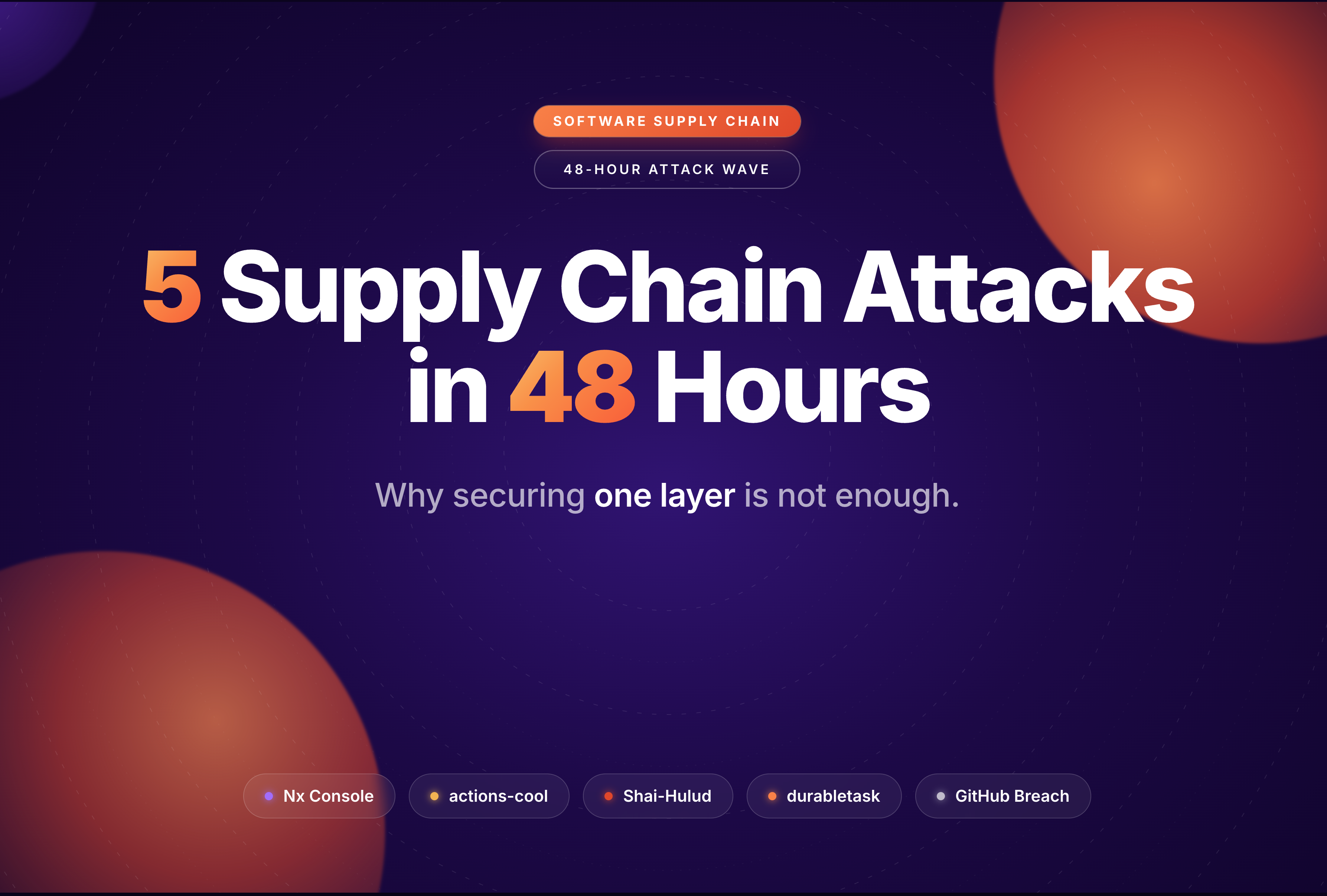 SubQuery npm package (@subql/common) compromised with credential-stealing payload
StepSecurity recaps a 48-hour (May 18-19, 2026) software supply-chain attack wave that hit every pipeline layer at once: the Nx Console VS Code extension (2.2M installs) stealing tokens from GitHub/npm/AWS/1Password, the trusted GitHub Action actions-cool/issues-helper hijacked via tag replacement, a trojanized Microsoft durabletask PyPI package pulled within a 35-minute discovery window, a self-replicating Shai-Hulud npm worm, and GitHub's own disclosure that ~3,800 internal source repos were exfiltrated. The piece argues traditional SCA/SAST/EDR/CNAPP tooling missed all of it because none monitor CI/CD runner runtime behavior (e.g., attackers reading /proc/pid/mem to extract secrets) or developer-machine IDE extensions, and ties the incidents to StepSecurity's Harden Runner, Dev Machine Guard, Compromised Actions Policy and Secure Registry controls.
stepsecurity.ioarticleAdded 6 Oct 2026🛡️ Security Introducing Socket Scanning for VS Code Marketplace Extensions
Socket.dev announced experimental scanning of VS Code Marketplace extensions (100,000+), extending its existing Open VSX coverage, to flag risky file/network/process access, obfuscated code, and hidden activation logic before teams install or auto-update developer tools. The post grounds the launch in two real incidents: the Nx Console supply-chain breach that let attackers exfiltrate ~3,800 GitHub repositories from a single poisoned extension update, and Socket's own GlassWorm investigation, which found four VS Code and six Open VSX theme extensions tied together by encrypted JavaScript payloads and a Solana-based dead-drop C2.
 socket.devarticlePublished and added 6 Oct 2026🛡️ Security
 What does it mean to sandbox an AI coding agent?
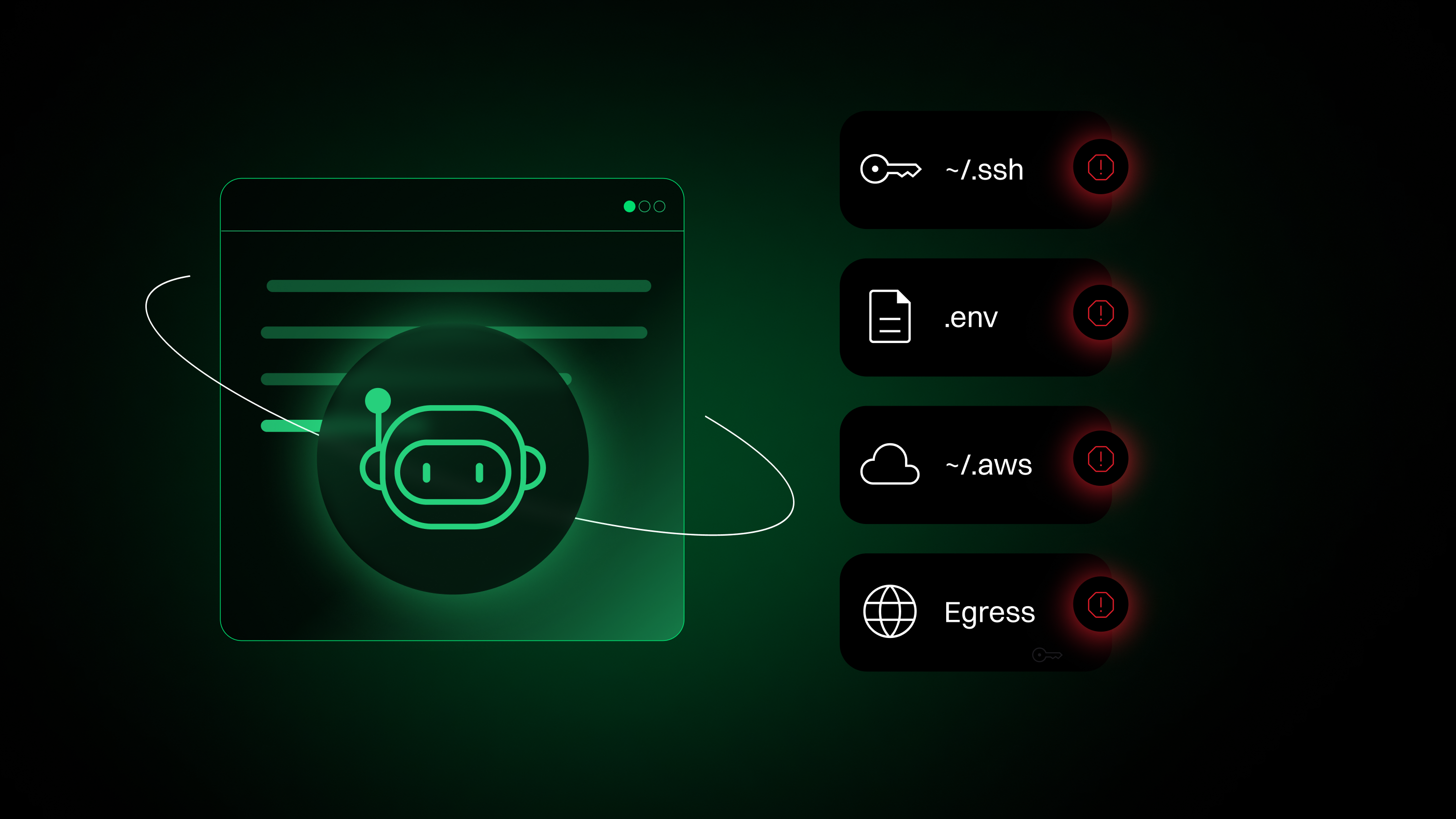
An Endor Labs technical breakdown of what an "agent sandbox" actually is: a kernel-enforced boundary around an AI coding agent's tool calls (syscalls), distinct from a staging environment or Docker container. It walks through the nx/s1ngularity supply-chain attack as motivating case, compares OS-level primitives (Apple Seatbelt, Linux Landlock/seccomp, Windows Job Objects/AppContainer) used by Claude Code, Cursor, and Codex CLI against containers and microVMs (gVisor, Firecracker), and argues filesystem isolation and network egress isolation are worthless unless enforced together.
 endorlabs.comarticlePublished and added 6 Oct 2026🛡️ Security
- | Blog | Endor Labs
Endor Labs walks through what "sandboxing an AI coding agent" actually means at the OS level, contrasting the approval-prompt model with kernel-enforced isolation. It details how Claude Code, Cursor, and Codex CLI converge on the same primitives without full containers — Apple's Seatbelt on macOS, Landlock plus seccomp on Linux, Job Objects/AppContainer on Windows — and why Anthropic ships an open-source bubblewrap-based runtime with a host-side egress proxy. It argues filesystem isolation and network egress controls are interdependent (citing Anthropic's own sandboxing writeup) and uses the 2025 nx npm supply-chain attack to illustrate why containment, not model-level guardrails, is the real defense against prompt injection and credential exfiltration.
endorlabs.comarticlePublished and added 6 Oct 2026🧠 AI  Living off The Browser: Running Popular Hacking Tools Inside Chrome
Hackers Arise walks through an installable Chrome Isolated Web App that packages nine popular Active Directory pentesting tools, including NetExec (NXC), SharpHound, LDAP-shell, Evil-WinRM, and Certipy, so they run natively inside a Chrome tab with multi-protocol network access, bypassing the need for Linux or WSL. The piece shows setup via Chrome flags and an IWA install URL, then a lab demo: port-scanning a target, using Evil-WinRM for remote access, enumerating DNS zones with ADIDNS, and running Certipy to flag an ESC1-vulnerable ADCS template for domain-admin escalation.
 hackers-arise.comwriteupAdded 7 Oct 2026, published 6 Oct 2026🛡️ Security
 Area-Efficient Hardware Architecture of the Post-Quantum HQC Cryptosystem with Side-Channel Protection
This IACR eprint paper presents a resource-efficient FPGA hardware architecture for the NIST-selected HQC post-quantum KEM that defends against power-based side-channel attacks by reusing otherwise-idle KECCAK hardware to inject scrambling dynamic power during decoding, adding less than 0.5 percent area overhead compared to masking/shuffling countermeasures. The fully parameterized design supports HQC-128/192/256 and was prototyped on a Xilinx Artix-7 FPGA (139 MHz, 11,489 LUTs, 6,785 FFs, 4 DSPs), with functional correctness verified via NIST Known Answer Tests and leakage suppression confirmed via Test Vector Leakage Assessment.
 eprint.iacr.orgpaperAdded 8 Oct 2026, published 5 Oct 2026🛡️ Security
 Kyutai Pocket TTS
Pocket TTS is a 100M-parameter text-to-speech model from Kyutai designed to run efficiently on CPU, generating audio faster than real-time (~6x on a MacBook Air M4) with ~200ms latency to first audio chunk and voice cloning from short audio samples. It supports English, French, German, Portuguese, Italian, and Spanish, ships a Python library and CLI, and has spawned numerous community ports (WASM, ONNX, Rust/Candle, MLX, C++, C#) and fine-tuned language variants (Czech, Hindi, Korean, Persian, Indonesian, Estonian, Welsh, Polish).
huggingface.corepoAdded 2 Oct 2026🧠 AI- LinuxSecurity (@lnxsec) on X
A security researcher breaks down a campaign where open-source offensive tools originally built for pentesting — Strix and Cairn — were combined with an orchestration layer called Hermes to form an automated discover-exploit-escalate-persist attack pipeline against AI agent deployments. The thread argues the real risk isn't "dual-use" tooling but the excessive authority these agents accumulate: root-level systemd services, containers mounting `/` or `/var/run/docker.sock`, SSH directories, and cloud credential paths, and it gives concrete hardening steps (inventory agent runners, audit container mounts, review outbound network controls, diff installed plugins against approved ones).
x.comthreadAdded 1 Oct 2026, published 30 Sep 2026🛡️ Security  [tl;dr sec] #347 - AI Agents Hacking Companies for $25, Threat Hunter's Guide to GitHub, Finding Gadgets Like it’s 2026
tl;dr sec #347 is a weekly security newsletter issue. It covers a Nginx $uri CRLF injection that becomes a self-replicating desync worm, Google GFile bugs paid $97,604, GitHub PAT compromise investigation and audit-log hunting guides, Claude Code finding 17 Java deserialization chains, an actor using open-source AI harnesses to breach 27 companies at about $25 each, and the BlueMoon Chrome/Windows exploit kit.
 tldrsec.comarticleAdded 30 Oct 2026, published 24 Sep 2026🛡️ Security
 Package Manager Sandboxing (Andrew Nesbitt)
A survey of how package managers confine install-time and build-time code. It covers Homebrew 7.0.0's fetch/install split, Landlock sandbox and signed declarative *_steps. It also covers opam, Nix, Bazel, pacman, Swift PM and Deno, and the open sandbox proposals at pnpm, RubyGems, Spack, Cargo, pip and Zig. It sorts the responses into gating (allowlists), confinement and replacement/removal of hooks. It links the topic to coding-agent sandboxes (Seatbelt, Landlock, bubblewrap) and to Shai-Hulud and nx. It argues the open problem is validating a sandboxed phase's output at the hand-off.
 nesbitt.ioarticleAdded 10 Oct 2026, published 24 Sep 2026🛡️ Security
- Three CVEs and the May 2026 Exploit Chain Nobody's Taking Seriously (nginx Rift)
Analyzes three May 2026 Linux CVEs as one chain: CVE-2026-42945 (NGINX Rift), an unauthenticated heap overflow in ngx_http_rewrite_module (is_args mismatch between length and copy passes), then page-cache LPEs Copy Fail (CVE-2026-31431, authencesn) and Dirty Frag (CVE-2026-43284/CVE-2026-43500, xfrm-ESP/rxrpc) that bypass the algif_aead blacklist. Author releases a bash static scanner for vulnerable rewrite patterns (unnamed captures plus '?' followed by rewrite/if/set) and gives fixes: upgrade nginx to 1.30.1/1.31.0 or use named captures, plus kernel module mitigations.
 securityboulevard.comarticleAdded 21 Sep 2026🛡️ Security
 Post-Quantum: Lattice or Hash-Based (one question, two right answers)
A deep-dive field guide to choosing between lattice-based (ML-DSA/FN-DSA) and hash-based (SLH-DSA) post-quantum signatures, built from interviews with the designers and implementers behind both NIST standards and their deployments. It walks through Mosca's-inequality-style migration timing, CNSA 2.0's split between lattice signatures and stateful hash-based LMS/XMSS for firmware, the stateful-signature "footgun," and why the broader internet (TLS/WebPKI, via Merkle Tree Certificates) is converging on lattices while Ethereum's post-quantum consensus roadmap (leanXMSS, EIP-8292, EIP-8288 aggregation) and Algorand's live Falcon-1024 state proofs lean hash-based or scheme-neutral because of aggregation and on-chain storage constraints. It closes with a decision framework and a rundown of NIST's round-3 "onramp" signature candidates (MAYO, SQIsign, HAWK, etc.).
 ethresear.charticleAdded 3 Oct 2026, published 15 Sep 2026🛡️ Security
 1Password's AI patching benchmark is misleading
Trail of Bits dissects 1Password's August 2026 report claiming AI agents (GPT-5.5, Opus 4.8) produce clean vulnerability fixes only 26% of the time, showing the figure is inflated by a hand-picked set of six hard bugs, deliberately-wrong-fix prompts (22% of trials), a no-testing mode (36% of trials), grading disagreements between automated graders and humans, and a buggy Linux upstream reference fix. Reanalyzing the same data under fair conditions (testable, non-adversarial trials) they find 86% of patches blocked the supplied exploit, and they contrast this with their own consulting data (12.5% of developer first-fixes fail) and Patch the Planet's 67.7% maintainer merge rate across 186 PRs, including a case where both a human maintainer and an agent independently introduced the same freenginx cleanup-crash regression. The post also releases two new agent skills, post-patch-validation and review-walkthrough, to improve AI-assisted patch testing and human review.
 blog.trailofbits.comarticlePublished and added 15 Sep 2026🛡️ Security
- Maskit
Maskit is a local privacy gateway that sits between AI coding tools (Cursor, Claude Code, Codex, ChatGPT, Claude, DeepSeek) and the model provider, automatically redacting sensitive data — API keys, database connection strings, private IPs, PEM keys, JWTs, PII like phone numbers/ID numbers — into placeholders before requests leave the machine, then streams responses back with the placeholders transparently restored. It works as a local reverse proxy (per-protocol ports for OpenAI/Anthropic/DeepSeek) plus a browser extension (Chrome/Edge MV3) that intercepts Fetch/XHR traffic on ChatGPT, Claude and DeepSeek web UIs, including redaction of uploaded Office documents. It also includes a lightweight local ONNX NER model for names/orgs/addresses, placeholder consistency across multi-turn conversations, and passive prompt-injection detection on model replies.
github.comrepoAdded 22 Sep 2026, published 15 Sep 2026🛡️ Security  How to Defend Against NPM Software Supply Chain Attacks | Blog | Endor Labs
Endor Labs blog post analyzing the wave of npm supply chain compromises (eslint-prettier, Nx, chalk, and the self-propagating "Shai-Hulud" worm that hit @ctrl/tinycolor via stolen maintainer credentials), citing the Zimmerman et al. study on npm's dense transitive-dependency trust model. It provides a checklist for security teams: enforcing lockfiles and npm ci in CI, defaulting to --ignore-scripts to block malicious lifecycle hooks, running SCA/malware scanning, and delaying adoption of new package versions (60-day cooldown per CIS benchmark, PNPM minimum-release-age feature).
endorlabs.comarticlePublished and added 11 Sep 2026🛡️ Security SolarWinds took a nation-state. The next attack just needs an LLM and $5. | Blog | Endor Labs
Endor Labs blog tracing an accelerating pattern of software supply-chain compromises from July 2025 through March 2026, culminating in the TeamPCP threat actor's cascading 30-day compromise of Aqua Security, Trivy, GitHub Actions, Docker Hub, npm, OpenVSX, and PyPI (including backdooring the 95M-download LiteLLM package). It argues AI is accelerating both offense (CVE-GENIE reproducing 51% of CVE exploits for $2.77 each) and the attack surface (the Cline prompt-injection-to-npm-token-theft chain, Nx's AI-review-evading payload), and calls for treating AI coding agents as privileged actors, pinning GitHub Actions to SHAs, and platform-level fixes like immutable tags and Sigstore/OIDC.
endorlabs.comarticlePublished and added 11 Sep 2026🛡️ Security- CVE-2026-42533 nginx heap buffer overflow PoC (pre-auth RCE via two-pass capture clobbering)
A public PoC repo for CVE-2026-42533, a pre-auth heap buffer overflow in nginx's two-pass string evaluation engine that occurs when a regex-based map directive using numbered captures ($1, $2) clobbers the shared r->captures state used by a regex location, causing a LEN/VALUE size mismatch. The overflow can corrupt an adjacent ngx_pool_cleanup_t structure to hijack a function pointer for RCE, or under-write to leak heap/libc pointers defeating ASLR; the repo ships exploit.py/leak.py/overflow.py plus a Docker test environment demonstrated at 10/10 reliability on Ubuntu 24.04 against nginx 0.9.6-1.30.3/1.31.2. It also documents the exact vulnerable config pattern, a config scanner link, and the fix (named captures or upgrade to nginx 1.30.4+/1.31.3+).
github.comrepoAdded 10 Sep 2026🛡️ Security  Dev Machine Guard Now Supports Linux - StepSecurity
StepSecurity announces Linux support (Debian/RPM, .deb and .rpm packages) for Dev Machine Guard, its open-source developer-machine inventory and scanning engine, extending existing macOS/Windows coverage. The tool detects installed AI coding agents (Claude, Cursor, GitHub Copilot, Codex), IDE extensions from VS Code Marketplace and OpenVSX, MCP server configs, npm packages, and Linux system packages (rpm, dpkg, pacman, apk, snap, flatpak) via native mechanisms like systemd user timers and BIOS-serial device identity, and is explicitly framed as a response to incidents like the Shai-Hulud npm worm, s1ngularity/Nx compromise, and Mini Shai-Hulud/TanStack attacks. It ships in a free local-only Community mode and a paid Enterprise mode with centralized dashboard, policy enforcement, and dependency cooldown/alerting.
stepsecurity.ioarticleAdded 5 Sep 2026🛡️ Security Introducing @huggingface/kernels: 200+ WebGPU Kernels for Local AI
Hugging Face introduces @huggingface/kernels, a JavaScript loader for 207 versioned, Apache-2.0 licensed WebGPU kernels (matmuls, normalizations, attention primitives, quantization ops, etc.) published on the Hub, each with a manifest, correctness tests, benchmarks, and parameterized WGSL shader templates. They also launch Fleet, a browser-based benchmarking/testing tool that crowdsources correctness and performance evidence across real-world GPUs. Benchmarked against ONNX Runtime Web on an Apple M4 GPU, the kernels were 2.57x faster by geometric mean (1.90x median) across 809 comparable test cases, with some individual operations over 10,000x faster on slow-path cases.
huggingface.coarticleAdded 29 Sep 2026, published 1 Sep 2026🧠 AI Shai-Hulud was the best thing to happen to supply chain security
Aikido Security tracks npm's Trusted Publishing (OIDC-based, short-lived credential) adoption over 18 months and shows it only spiked after each major supply-chain attack rather than from advisories or blog posts — jumping from a ~40/week baseline to 430/week after the Nx Console/AntV compromise, yet still leaving 40,369 of the top 51,370 packages (75% of download volume) on long-lived tokens. It chronicles the full attack progression from credential-phishing (Debug/Chalk, Axios) through Pwn Request-driven CI compromise (S1ngularity, Shai-Hulud 2.0) to the Mini Shai-Hulud II/TanStack attack, which poisoned the GitHub Actions cache to extract a live OIDC token from runner memory and publish packages with valid SLSA Build Level 3 provenance — proving Trusted Publishing itself can be turned into the attack vector rather than just bypassed. It closes by arguing the security community should proactively pressure high-download holdout maintainers rather than wait for the next worm.
 aikido.devarticleAdded 3 Sep 2026, published 24 Aug 2026🛡️ Security
 AI Development and Agentic Security Labs
A deep-dive lab series (AIDS-01 through at least AIDS-02 shown) teaching security patterns for AI-powered applications built on Google's Genkit framework, covering flow input/output validation with Zod, streaming chunk validation, telemetry data exposure, and agentic tool-calling security including least-privilege tool design, human-in-the-loop approval via tool interrupts, and maxTurns limits against runaway execution. Each lab includes concrete vulnerable-vs-secure TypeScript code, curl-based exploit walkthroughs (prompt injection to extract secrets, payload-inflation cost attacks, XSS via unsanitized LLM output, SQL-tool abuse for data exfiltration, privilege escalation via an over-permissioned modifyPermissions tool), plus detection (regex injection detection, OTel telemetry filtering) and verification tests. The broader 40-lab set spans multi-agent frameworks (LangGraph, CrewAI, AutoGen), MCP tool poisoning, LLM guardrails (NeMo Guardrails, Garak, promptfoo), and real CVEs/incidents like TorchServe, ONNX, the Cursor MCP exploit, and the Morris-II worm.
 blog.devsecopsguides.comcourseAdded 3 Sep 2026, published 21 Aug 2026🛡️ Security
 VEEAM UNDER FIRE: Understanding CVE-2026–44963 & Ransomware Group Exploit Claims
Analysis of CVE-2026-44963, a critical (CVSS 9.4) unsafe-deserialization RCE in Veeam Backup & Replication 12.x rooted in BinaryFormatter/.NET Remoting that lets any low-privilege domain user gain SYSTEM-level control of domain-joined backup servers; fixed in 12.3.2.4854. The author correlates it with a 2025 "Bug of June 2025" exploit sale, documents a Lynx Ransomware Group negotiation describing exploitation to create local admin accounts and dump domain credentials, covers an underground forum ad claiming an unauthenticated patch-bypass 0-day, and includes a Veeam-specific attacker TTP matrix (e.g. CVE-2023-27532 credential harvesting) plus defense recommendations.
 theravenfile.comwriteupAdded 3 Sep 2026, published 20 Aug 2026🛡️ Security
 npm Now Scans for Malware at Publish, Not Install | Blog | Endor Labs
Analysis of GitHub's July 28 change making npm scan every package for malware at publish time (roughly a 5-minute delay), instead of only reacting after reports. It covers the new dual-use governance model — contentPolicy metadata, DISCLOSURE files, and mandatory 2FA/OIDC publishing for tools like security scanners that resemble malware — and argues registry scanning can't enforce org-specific policy, can't cover other registries (PyPI, Maven, NuGet), and can't stop novel malware or compromised-account publishes, making install-time enforcement (e.g. Endor Labs' Package Firewall) still necessary. References recent supply-chain worm incidents Shai-Hulud, NX S1ngularity, and Cline.
endorlabs.comarticleAdded 3 Sep 2026, published 12 Aug 2026🛡️ Security- Leonxlnx/unlazy
unlazy is an agent skill for Claude Code, Codex CLI and other agent harnesses that enforces "completion discipline": before AI-agent work is reported done, it must satisfy a ledger of runnable gates (GATES.md) whose shell/Node checks are executed and whose output must match a declared EXPECT: string, with digest-bound evidence, approval records, and --reverify to re-run already-"complete" gates. It also provides scoped multi-leaf/branch orchestration with lease-based claiming for parallel agent dispatch, a Claude Code Stop-hook that blocks premature completion, and documentation of the threat model (shell resolution, PATH, approval storage) around executing arbitrary checker commands. The README grounds the design in cited research on LLM laziness, premature truncation, and over/under-thinking (e.g. METR's Time Horizon, SlopCodeBench, OptimalThinkingBench, s1), while being explicit that this research motivates but does not prove the tool's effectiveness.
github.comrepoAdded 2 Oct 2026, published 9 Aug 2026🧠 AI - SiberKapan
SiberKapan is a Turkey-focused, community-driven open-source threat intelligence platform that aggregates data from FortiGate webhooks, an 11-service honeypot (HoneypotKapan), nginx/Fail2ban log watchers, and external feeds, publishing it as STIX 2.1/TAXII 2.1, a MISP default feed, Sigma/Suricata/Wazuh exports, and REST blocklists. It also runs a real-time phishing/domain-squatting detector via Certificate Transparency log monitoring with fuzzy typosquat and Punycode/IDN decoding, and safely fingerprints SSH-honeypot malware downloads with SSRF-protected, never-executed hashing enriched via MalwareBazaar. The write-up details concrete anti-abuse safeguards: time-based IP score decay, CDN/cloud-proxy allowlisting, UDP-spoofing exclusion, RFC1918 rejection, and manual review gating for weak phishing signals.
github.comrepoPublished and added 8 Aug 2026🛡️ Security  Cloud Threat Highlights: H1 2026
Wiz's H1 2026 cloud threat report documents a 60% jump in significant incidents driven by a doubling of supply-chain attacks (TeamPCP's npm/PyPI/GitHub Actions credential-harvesting spree, its open-sourced Shai-Hulud worm spawning Miasma/Hades/Megalodon/IronWorm follow-ons, North Korea's axios and @mastra trojanizations) and by growing attacks on AI infrastructure, including exposed unauthenticated MCP servers, LiteLLM/Dify/Langflow/n8n/Ollama vulnerabilities, and cryptominers deployed via a Langflow RCE. It also profiles JINX-0163, a cloud-native extortion group targeting non-human identities (service accounts/IAM roles) across AWS/Azure/GCP/Okta/Snowflake linked to the "FulcrumSec" extortion brand, and closes with concrete detection techniques for stolen access keys, Kubernetes VM Run Command abuse, GCP org-policy tampering, and CloudTrail user-agent/boto3 credential-provenance mismatches.
 wiz.iowriteupAdded 3 Sep 2026, published 6 Aug 2026🛡️ Security
 Introducing the Wiz Sensor for Developer Workstations to Protect Endpoints in the AI Era
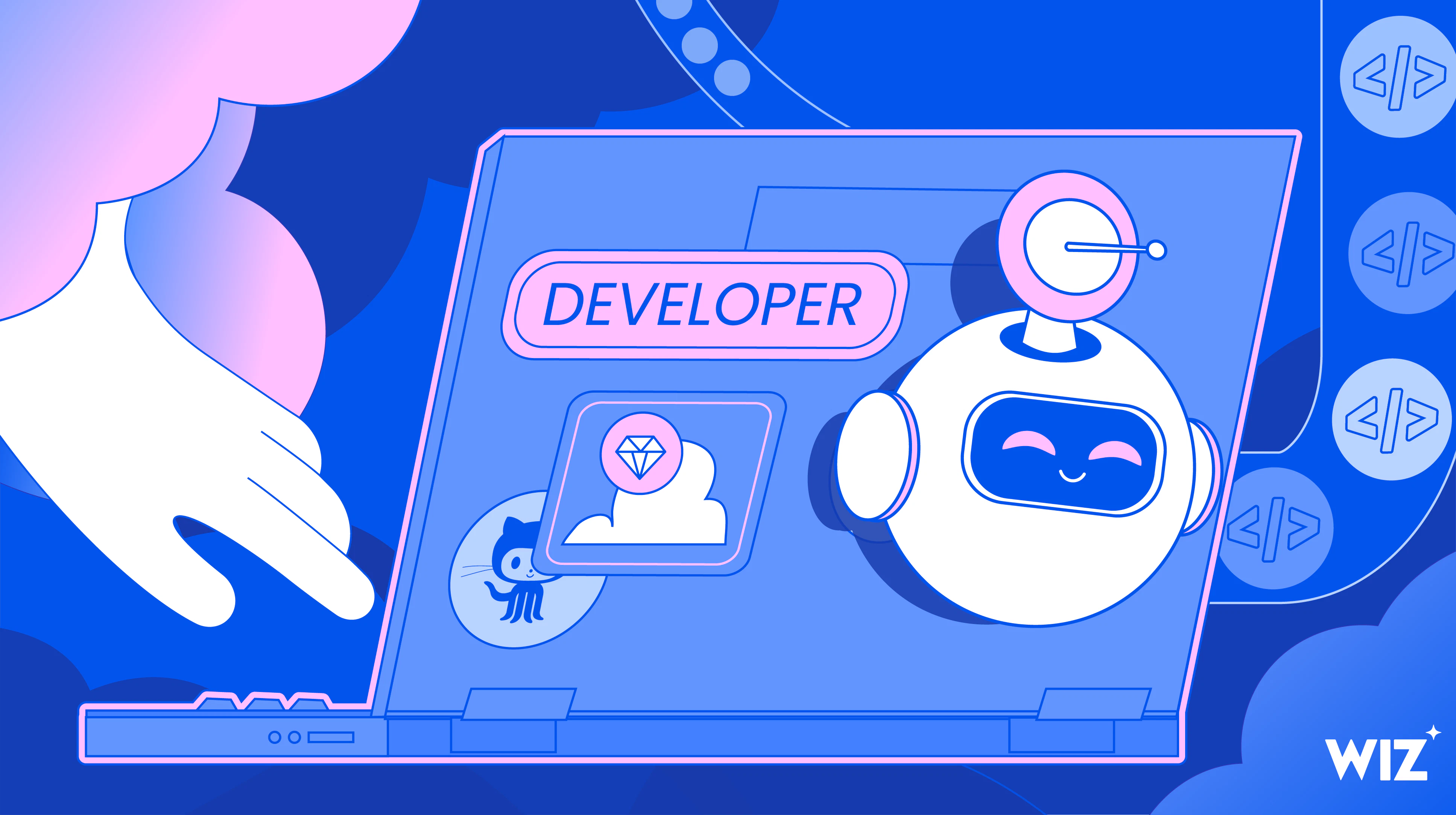
Wiz announces a new endpoint sensor for developer workstations (Windows/macOS, private preview) that inventories packages, IDE extensions, AI coding agents, and MCP servers, and detects known/emerging supply chain attacks in real time. The post details three real-world campaigns that motivated it: Shai-Hulud (a self-propagating npm worm that ran TruffleHog via postinstall scripts to steal npm tokens and republish itself), the Axios backdoor (a compromised maintainer account injecting C2-calling code executed within 1.1 seconds of npm install), and s1ngularity (a compromised Nx build system/VS Code extension that harvested GitHub/npm/SSH/cloud credentials and weaponized local AI CLI tools like Claude and Gemini to exfiltrate filesystem data, leaking 1,000+ GitHub tokens and exposing 5,500 private repos).
wiz.ioarticleAdded 3 Sep 2026, published 3 Aug 2026🛡️ Security- wolfBoot 2.9.0
wolfSSL's release announcement for wolfBoot 2.9.0, an open-source secure bootloader for embedded systems, covering new hardware targets (STM32N6/U3/C5/G4/WBA, NXP LPC54S018M-EVK, Kinetis KL26, Xilinx Zynq-7000), new crypto features (RSA-PSS image signatures, hardware crypto-callback interface, multi-root-CA verification, pre-computed IDevID/DICE attestation), and continued security hardening from Fenrir fuzzing including bounded unauthenticated image sizes, memory-copy limits during updates, and fault-injection resistant integrity verification. It also adds an sbom Makefile target producing CycloneDX and SPDX output for CRA-readiness.
 wolfssl.comarticlePublished and added 25 Jul 2026🛡️ Security
 INC RANSOMWARE: THREAT INTELLIGENCE
A researcher deanonymizes INC ransomware's Tor negotiation panel (incpaykabjqc2mtdxq6c23nqh4x6m5dkps5fr6vgdkgzp5njssx6qkid.onion) to a real IP (178.20.41.208, Russia, nginx/Yii PHP backend) running on unusual port 1002, then reverse-engineers the panel's bundled React/Redux/Socket.io JavaScript to map its API endpoints, socket events, JWT-based auth, and leak/ransom-tracking features. The piece also correlates nine clearweb domains and ~170 IPs used by the group over 2023–2025 (65% Russia-hosted, CDN rotation patterns, Cloudflare fronting on one domain) and analyzes 108 ransomware builder samples to infer RaaS versioning, a 2024 forum sale, and links to spin-off groups Lynx and Sinobi.
theravenfile.comwriteupAdded 3 Sep 2026, published 24 Jul 2026🛡️ Security Orca Security: Critical Heap Buffer Overflow in NGINX Allows Unauthenticated RCE
Covers CVE-2026-42533, a heap buffer overflow (CWE-122) in the NGINX map directive's regex handling. It is triggered when a string expression references unnamed captures before the map output variable. Unauthenticated crafted HTTP requests can crash workers and may give RCE where ASLR is off or bypassed. It also covers two other F5-patched NGINX flaws: CVE-2026-60005 (uninitialized memory disclosure in ngx_http_slice_module) and CVE-2026-56434 (use-after-free in ngx_http_ssi_module with proxy_pass and proxy_buffering off). It lists affected NGINX Open Source (0.9.6–1.31.2), NGINX Plus, Ingress Controller, Gateway Fabric, App Protect WAF and Instance Manager versions. It gives fixed releases (1.31.3 / 1.30.4) and the named-capture workaround, and notes no public PoC or in-the-wild exploitation.
 orca.securityadvisoryPublished and added 20 Jul 2026🛡️ Security
- ZX41R/awesome-reverse-engineering-and-malware-analysis
A curated, upkept "awesome list" for reverse engineering and malware analysis that organizes hundreds of resources into guided learning tracks (Windows malware triage-to-config-extraction, Linux/ELF reversing, exploit development, firmware & embedded, mobile, anti-analysis) plus a full taxonomy covering foundations, RE tooling (IDA, Ghidra, Binary Ninja, radare2, x64dbg), malware analysis/unpacking/YARA/C2 tracking, fuzzing (AFL++, libFuzzer), firmware, mobile, OS internals, LOLBAS/GTFOBins living-off-the-land resources, DFIR, and threat intelligence. It also surfaces niche researcher communities like Kanxue, 52pojie, Tuts4You, the WASM Russian RE forum, 0x00sec, and back.engineering (VTIL/VMProtect devirtualization work), with every link manually vetted and dead links pruned.
github.comrepoAdded 30 Sep 2026, published 6 Jul 2026🛡️ Security  Socket: actions/checkout v7 Blocks Unsafe pull_request_target Checkouts
GitHub released actions/checkout v7, which by default blocks checkouts of untrusted fork pull request code (via refs/pull/*/merge, fork head SHA, or fork repository) when running under pull_request_target or workflow_run-from-pull-request events, closing a long-known "pwn request" vector that grants attacker-controlled code access to base-repo secrets and GITHUB_TOKEN. The protection auto-applies to workflows pinned to floating major tags and backports to all supported versions on July 16, 2026; an allow-unsafe-pr-checkout opt-out flag is provided for workflows that intentionally need the old behavior. The article ties the change to real incidents (Nx supply chain attack, Shai-Hulud second wave via PostHog, and the TanStack compromise combining pwn request with cache poisoning and OIDC token extraction) and notes the fix only covers actions/checkout itself, not git/gh CLI or other checkout mechanisms.
socket.devarticlePublished and added 22 Jun 2026🛡️ Security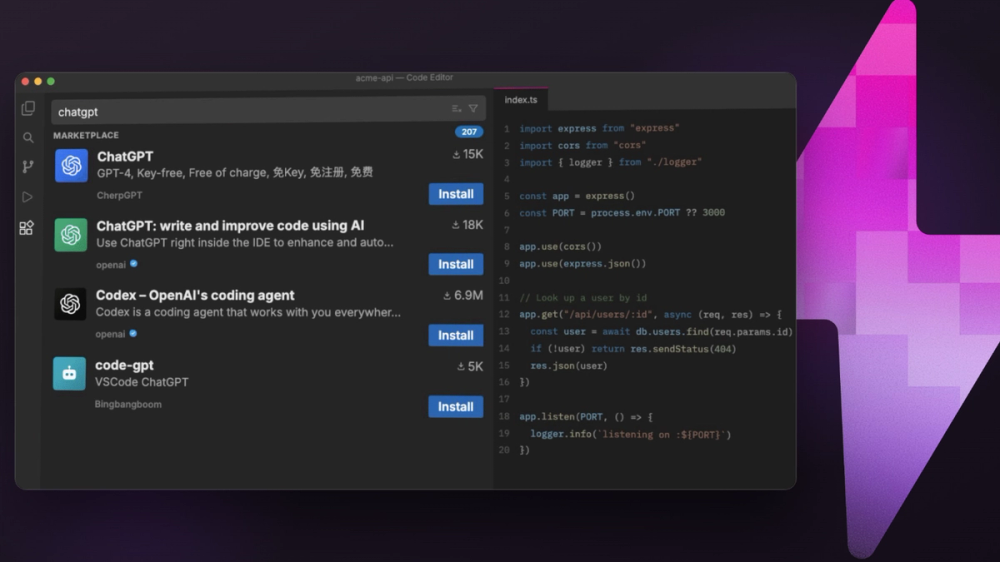 Socket: Firewall Now Blocks Malicious VS Code and Open VSX Extensions
Socket announced Firewall support for VS Code Marketplace and Open VSX extension installs, proxying marketplace and VSIX download traffic to block malicious extensions before install/update rather than only after-the-fact inventory. The post cites the May 2026 GitHub breach via a poisoned Nx Console 18.95.0 extension (exfiltrating ~3,800 internal repos) and repeated GlassWorm credential-stealing campaigns on Open VSX as motivating incidents. The feature is a closed-beta, agentless proxy control point covering editors like VS Code, Cursor, Windsurf, VSCodium, and Antigravity.
socket.devarticlePublished and added 18 Jun 2026🛡️ Security Orca Security: nginx Flaw in 1.45M Tengine Servers (CVE-2026-42945 + CVE-2026-9256)
Orca Security researchers found that two critical nginx heap buffer overflow CVEs in the rewrite engine (ngx_http_script.c) — CVE-2026-42945 ("NGINX Rift") and CVE-2026-9256 ("nginx-poolslip") — also live untouched in Tengine, Alibaba's nginx fork last released in October 2023 and running on 1.45 million internet-facing servers (Aliyun, Taobao, CDN edges, reverse proxies). They compiled Tengine 3.1.0 with AddressSanitizer, built working single-request unauthenticated crash exploits for both bugs, and confirmed neither CVE had a patched Tengine release as of publication, with heap corruption potentially steerable toward code execution if ASLR is disabled/bypassed.
orca.securitywriteupPublished and added 16 Jun 2026🛡️ Security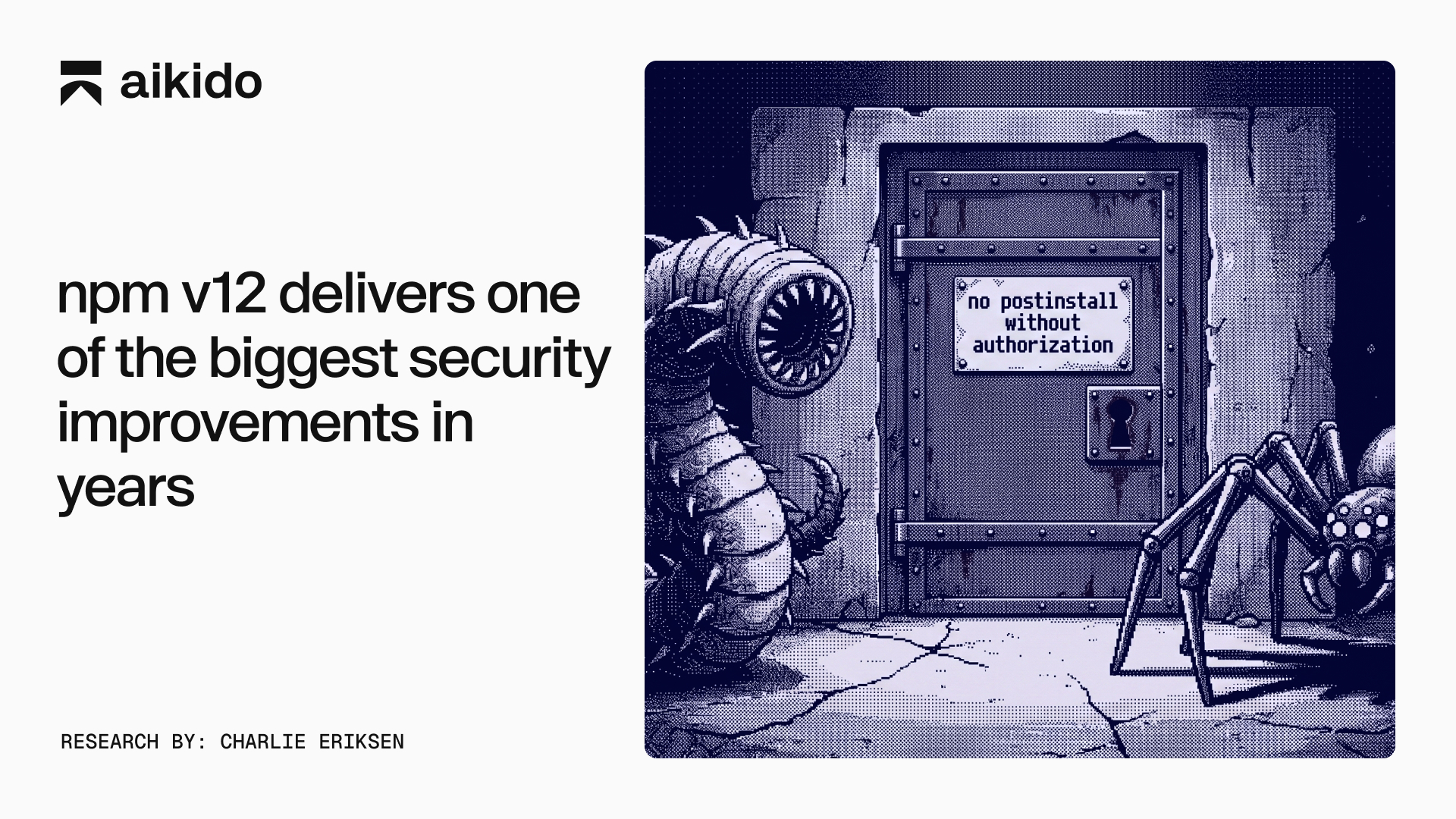 npm v12 delivers one of the biggest security improvements in years
Aikido details npm v12's plan (landing July 2026, previewed in 11.16.0) to stop running preinstall/install/postinstall lifecycle scripts by default, requiring an explicit allowlist via npm approve-scripts/npm deny-scripts, plus gating Git and remote-URL dependency resolution behind --allow-git/--allow-remote and treating binding.gyp node-gyp builds as scripts requiring approval. It ties the change to a wave of postinstall-based supply-chain attacks (Nx s1ngularity, Shai-Hulud, axios hijack, Mini Shai-Hulud) and recommends upgrading to 11.16.0+ and using tools like Safe Chain to vet packages before install.
aikido.devarticleAdded 3 Sep 2026, published 11 Jun 2026🛡️ Security The OpenSourceMalware Show #8
Episode 8 of The OpenSourceMalware Show covers the Miasma worm (built on TeamPCP's open-sourced Mini Shai-Hulud) taking down 73 Microsoft GitHub repositories, including the Azure Functions org, in 105 seconds on June 5th, traced back to a May 19th Durable Task repo credential compromise. It also discusses VS Code's new two-hour third-party extension auto-update cooldown (contrasted with the Nx Console/Open VSX incident where Microsoft's Marketplace notification, not detection, caught the malware), npm v12's plan to disable install lifecycle scripts, direct Git dependencies, and remote tarball dependencies by default starting July, and a breakdown of package firewall designs (simple alias-based interceptors vs. daemon/proxy-based tools) including their bypass weaknesses and reliance on OSV/GHSA data.
 opensourcemalware.comtalkAdded 3 Sep 2026, published 11 Jun 2026🛡️ Security
 Dev Machine Guard Now Scans Extensions Across Every Modern IDE
StepSecurity's Dev Machine Guard now inventories and scores IDE extensions/plugins across eight IDE families (VS Code, Cursor, Windsurf, Antigravity, JetBrains IDEs, Android Studio, Eclipse-based IDEs, Xcode) on macOS, Windows, and Linux, not just VS Code. It computes a supply-chain Security Score per extension (adoption, publisher verification, license, known vulnerabilities, repo security posture) and flags known-compromised or typosquatted extensions, motivated by incidents like the October 2025 VS Code publisher token leaks, the s1ngularity Nx compromise, and the Shai-Hulud npm worm reaching extensions via transitive dependencies. The scanning engine is open source; enterprise mode feeds a fleet-wide dashboard for incident response and typosquat/compromise hunting.
stepsecurity.ioarticleAdded 3 Sep 2026, published 2 Jun 2026🛡️ Security Nx Console VS Code Extension Compromised
StepSecurity's technical teardown of the May 2026 compromise of the Nx Console VS Code extension (nrwl.angular-console v18.95.0, 2.2M+ installs), where a stolen contributor GitHub token was used to push a dangling orphan commit to nrwl/nx and publish a malicious extension via stolen VSCE_PAT credentials. The payload silently ran `npx github:nrwl/nx#<sha>` to fetch a heavily obfuscated 498KB Bun/Node credential stealer that harvests secrets from GitHub, npm, AWS, Vault, Kubernetes, 1Password and Claude Code config, exfiltrates via HTTPS/GitHub API/DNS tunneling, installs a macOS Python backdoor using the GitHub Search API as a C2 dead-drop, and can forge valid Sigstore/SLSA provenance attestations for downstream npm packages. The writeup ties this to a later GitHub breach (3,800 repos, attributed to TeamPCP) and provides detection signals, IOCs, and full recovery steps.
stepsecurity.iowriteupAdded 3 Sep 2026, published 2 Jun 2026🛡️ Security What MDM can't protect on developer machines (and what to do about it)
Aikido Security argues that MDM (Jamf, Kandji, Intune) and EDR (CrowdStrike, SentinelOne) operate at the OS/application layer and are blind to the modern developer attack surface: npm/pip package installs with postinstall hooks, VS Code/IDE extensions, browser extensions, and MCP servers used by AI coding tools. It walks through the Nx Console extension compromise that exposed 3,800 GitHub repos, the Cyberhaven and Vercel/Context.ai OAuth-token browser-extension chain, the Mini Shai-Hulud npm worm, and the postmark-mcp malicious MCP server as evidence, then recommends a 48-hour minimum package age, disabling postinstall scripts by default, auditing extensions, and monitoring AI tool installs (pitching Aikido Device Protection/Safe Chain as the fix).
aikido.devarticleAdded 3 Sep 2026, published 28 May 2026🛡️ Security Threat Actor Targets Crypto Organizations | Wiz Blog
Wiz CIRT and Wiz Research detail JINX-0164, a previously untracked financially-motivated threat actor targeting cryptocurrency organizations since mid-2025. The group uses LinkedIn-based social engineering to deliver macOS malware (the Python-based AUDIOFIX infostealer/RAT and the Go-based MINIRAT backdoor), steals developer and cloud credentials, hijacks Git commits to propagate through CI/CD infrastructure, and trojanized the npm package @velora-dex/sdk in a supply-chain attack. The post includes full IOCs, C2 domains, and detection guidance (e.g., GitHub Vigilant Mode, audit log correlation) and notes tactical overlaps with North Korean clusters like UNC1069/Sapphire Sleet without confirmed attribution.
wiz.iowriteupAdded 5 Sep 2026, published 27 May 2026🛡️ Security Socket: Mini Shai-Hulud
Socket reports that npm invalidated all granular access tokens with write access that bypass 2FA after a fresh Mini Shai-Hulud wave hijacked the maintainer account "atool" and pushed 639 malicious versions across 323 packages in the @antv ecosystem, including echarts-for-react. The piece traces the broader campaign (attributed to TeamPCP, 1,055 compromised versions across npm/PyPI/Composer) through the TanStack pwn-request/OIDC-memory-extraction compromise and the resulting GitHub internal repo breach via Nx Console, and covers npm's new opt-in staged-publishing feature (npm stage publish/approve) that adds an MFA-gated human approval step before releases go live.
socket.devarticlePublished and added 22 May 2026🛡️ Security The Wild West of VS Code extensions and how a poisoned extension breached GitHub
Aikido dissects how the May 18 Nx Console extension compromise (2.2M installs, live for ~18 minutes on the Visual Studio Marketplace and ~36 minutes on OpenVSX) was pulled off using a stolen GitHub contributor token, and traces the same stolen-token-to-auto-update-push pattern to AsyncAPI's Shai-Hulud 2.0 compromise, where a malicious v1.0.1 build kept exfiltrating credentials for nearly a month because OpenVSX's rollback to a clean older version prevented auto-update from ever firing. The piece walks through VS Code's actual update-check code paths in extensionsWorkbenchService.ts and the gallery-sync side effect that triggers eventuallyAutoUpdateExtensions, showing why default auto-update, verified-publisher trust, and marketplaces' inability to recall installed code make popular extensions one leaked token away from becoming a worm, and connects this mechanism to the GitHub breach reportedly caused by a poisoned VS Code extension on an employee machine.
aikido.devarticleAdded 3 Sep 2026, published 20 May 2026🛡️ Security GitHub breached via a malicious VS Code extension: why developer devices are the real target
Aikido Security's analysis of GitHub's disclosed breach of roughly 4,000 private repos, attributed by GitHub to a vulnerability in the Nx Console VS Code extension (2.2M installs, verified publisher) that was briefly backdoored to silently harvest credentials via .env file access. The post argues that install-count and verified-publisher trust signals are now the actual attack surface, since malicious versions only need minutes on the marketplace before removal, and pitches Aikido's on-device Device Protection agent (real-time malware feed blocking plus a default 48-hour minimum package/extension age) as a control EDR can't provide since it doesn't inspect interpreted extension/package code.
aikido.devarticleAdded 3 Sep 2026, published 20 May 2026🛡️ Security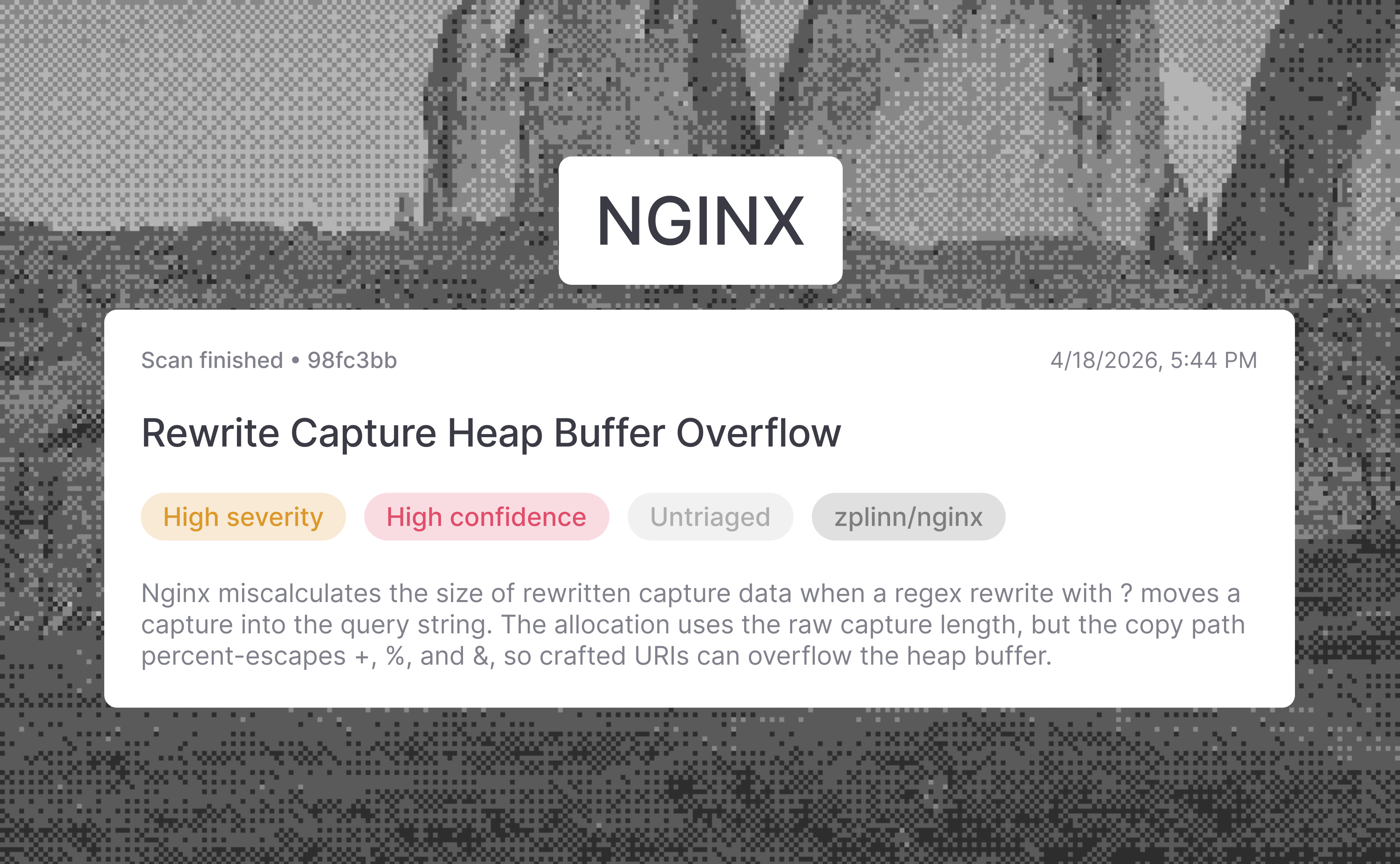 NGINX Rift: Achieving NGINX RCE via an 18-Year-Old Vulnerability (CVE-2026-42945)
Depthfirst researchers used an internal automated code-analysis system to find four remote memory-corruption bugs in NGINX, the most severe being CVE-2026-42945 — an 18-year-old heap buffer overflow in ngx_http_rewrite_module triggered when a rewrite directive with a query string is followed by a set directive referencing a regex capture group. The writeup walks through the two-pass script-engine root cause (a stale is_args flag causes the length-calculation pass and copy pass to disagree on escaping), then details a full exploitation chain using cross-request heap feng shui to corrupt an adjacent ngx_pool_t, spray fake ngx_pool_cleanup_s structures via POST bodies, and achieve unauthenticated RCE by hijacking the pool cleanup handler to call system(). It also lists three other confirmed CVEs (2026-42946, 2026-40701, 2026-42934) and affected version ranges across NGINX OSS, NGINX Plus, App Protect, Ingress Controller and Gateway Fabric.
 depthfirst.comwriteupAdded 23 Sep 2026, published 13 May 2026🛡️ Security
 The complete GitHub Actions security checklist
A detailed 33-point checklist for hardening GitHub Actions workflows, covering trigger risks (pull_request_target, workflow_run), script/prompt injection into run: steps and AI agent prompts, mutable action/package references, artifact handling, secrets scoping, OIDC over static cloud credentials, runner isolation, and token/org-level permission defaults. Each section is backed by real-world incidents (Trivy tag hijack, tj-actions/changed-files compromise, Ultralytics PyPI attack, Nx/s1ngularity, Shai-Hulud, TanStack npm trusted-publisher abuse, PyTorch self-hosted runner takeover), making it a practical reference for securing CI/CD pipelines against the supply-chain attacks that have hit open source in 2025–2026.
aikido.devarticleAdded 3 Sep 2026, published 11 May 2026🛡️ Security- How to Secure a Linux Server
A crowd-sourced, evolving checklist-style guide for locking down a Linux server, covering SSH hardening, firewall/iptables configuration, fail2ban, user/permission hygiene, and includes separate deep-dive documents on Linux kernel sysctl hardening and nginx hardening. It's one of the most widely referenced community Linux hardening playbooks on GitHub.
github.comrepoPublished and added 6 May 2026🛡️ Security - Local administrator account remote logon in Windows
A pentest writeup explaining why remote logons with a shared local administrator account (e.g. from a gold image) fail against tools like psexec/smbexec/WinRM due to UAC's LocalAccountTokenFilterPolicy registry key, and how attackers can still succeed either by flipping that key, abusing the RID 500 Administrator account (governed by the separate FilterAdministratorToken key, which is unfiltered by default), or by using protocols not subject to UAC token filtering such as SSH and RDP. The author demonstrates the failure and bypass end-to-end using nxc (NetExec) and Impacket against a Windows 11 target from Kali Linux, and notes LAPS as an effective mitigation for RID 500 abuse.
 bencteux.frwriteupAdded 3 Sep 2026, published 31 Jan 2026🛡️ Security


