- Show HN: Hob - Open-source, on device alternative to Claude Cowork and ChatGPT
Hob is an MIT-licensed desktop app from Frigade that runs open-weight models such as Gemma and gpt-oss locally on Mac, Windows and Linux. It picks the best open-weight model that fits the user's computer and sets it up. It is positioned as a free, private, offline alternative to Claude and ChatGPT for tasks like filling out PDFs and working through documents. The page gives no technical detail on its runtime.
 github.comrepoAdded 27 Oct 2026, published 26 Oct 2026🧠 AI
- devploit/php2shell
PHP2Shell is a research toolkit by devploit that reproduces a pre-auth remote code execution issue in PHP, tracked as CVE-2026-109618 and CVE-2026-109619, affecting the Apache mod_php and PHP-FPM SAPIs. The repository includes version-matched profiles for many PHP 7.4 through 8.5 builds, reproducible Docker and nginx test labs, a technical write-up of the vulnerability, and mitigation and detection recommendations for defenders.
github.comrepoAdded 2 Nov 2026, published 21 Oct 2026🛡️ Security - eness/php2shell-CVE-2026-109618-CVE-2026-109619-PoC
php2shell is the name given to two critical pre-auth remote code execution flaws, CVE-2026-109618 and CVE-2026-109619, in PHP core's session upload progress handler (php_session_rfc1867_callback), where zend_hash_update frees live zval pointers that are later reclaimed and redirected into zend_call_function to run zif_system. This repository ships poc_109618.py, a fully automated four-stage HTTP exploit that leaks ASLR offsets via Set-Cookie headers against php:8.4.26-apache on Debian Bookworm, along with a root-cause C source patch, mitigation scripts to disable session.upload_progress, and WAF/ModSecurity/Lighttpd/Apache rules plus detection guidance for anomalous PHP worker child processes. Confirmed PHP versions include 8.4.4 and 8.2.34, with EOL branches (5.x, 7.x, 8.0, 8.1) left without official vendor patches.
github.comrepoAdded 23 Oct 2026, published 21 Oct 2026🛡️ Security - ikow/php2shell-poc
php2shell-poc is a proof-of-concept and detection toolkit for CVE-2026-109618 and CVE-2026-109619, two PHP vulnerabilities tied to session.upload_progress handling and a Zend engine out-of-memory bailout path affecting PHP 5.4.0 through 8.5.11. The repository includes three working exploit chains, a Docker-based lab (PHP-FPM, nginx, Apache mod_php) for reproduction, and pre-built Suricata, Sigma, ModSecurity, and Lua detection rules. The author recommends disabling session.upload_progress as an interim mitigation, noting the underlying memory corruption requires a full PHP patch to fix.
github.comrepoAdded 23 Oct 2026, published 21 Oct 2026🛡️ Security - Show HN: VoidAccess – open-source dark web OSINT, from query to a graph
VoidAccess is a self-hosted, MIT-licensed dark web OSINT platform that runs a 13-step pipeline from a research query to a relationship graph. It collects from Tor indexes, paste sites, code forges, security feeds and .onion seeds, applies content-safety filters, and exports STIX 2.1, MISP, Sigma, YARA, Snort, Suricata, CSV and JSON. It runs as a CLI with SQLite or as a Docker Compose stack with PostgreSQL, FastAPI and Next.js.
github.comrepoAdded 21 Oct 2026, published 20 Oct 2026🛡️ Security - ☣ KitPloit - Hacker Tools (@KitPloit) on X
DidierStevensSuite is a collection of Python scripts for malware analysis, file format parsing, hashing and forensic triage. It includes utilities for analysing PDF and OLE documents and for XOR-obfuscated data. The post is a short KitPloit announcement that links to the repository and gives no usage detail.
 x.comrepoAdded 21 Oct 2026, published 20 Oct 2026🛡️ Security
 Abhinav Singwal (@yogsec) on X
GetSubDomains is an open-source tool by yogsec that enumerates subdomains by querying crt.sh certificate transparency logs. It is aimed at the reconnaissance step of penetration tests and bug bounty work. The source is a short tweet pointing to a GitHub repository, so usage details and options are not given.
x.comrepoAdded 21 Oct 2026, published 19 Oct 2026🛡️ Security- ralphtradesz/trading-hub
Trading Hub is a free macOS desktop trading platform built with C#/.NET 10 and Avalonia. It uses the user's Claude Code subscription: a chat writes and fixes C# strategies, an in-app MCP server lets Claude run backtests, optimizations and walk-forwards and write reports, and a risk agent proposes position sizes. Install and a Windows port are both driven by Claude Code prompts. License is MIT with Commons Clause.
github.comrepoAdded 19 Oct 2026, published 17 Oct 2026🧠 AI - enisaeu/enisa-sbd-playbook
ENISA repository of 22 Secure by Design and Secure by Default playbooks for SMEs building products with digital elements. Each playbook has a principle, objective, checklist, minimum evidence and release gate, covering design, build, deployment, maintenance and decommissioning. It supports progressive adoption and CRA readiness without replacing legal obligations.
github.comrepoAdded 17 Oct 2026🛡️ Security - Show HN: Graphicle, a Rust port of Graphify with memory for coding agents
Graphicle is a local-first Rust program that parses a repository into a tree-sitter code graph (a port of Graphify) and adds project memory: docs, reviewed decisions and captured Claude Code/Codex sessions. It serves cited file-and-line excerpts within a token budget via one MCP server, CLI and browser app, backed by a single SQLite file, with no API key or telemetry. The README reports a code-only extract on Kubernetes (31k files) in 3m18s versus 26m38s for Graphify 0.9.88, and a memory comparison against seven systems. Agent-proposed memories need user approval and go stale when the code they reference changes.
github.comrepoPublished and added 14 Oct 2026🧠 AI - santosomar/AI-agents-for-cybersecurity
Companion repository for Omar Santos's Pearson and O'Reilly trainings and books. It has eight parts of runnable Python labs: chat models, embeddings, prompt templates, LCEL prompt chaining, Chroma-based RAG, ReAct/LangGraph/CrewAI/DeepAgents agents, and FastMCP servers (nmap, CISA KEV, Shodan). It also includes guides to six agentic frameworks (OpenClaw, Hermes, Agent Zero, OpenHands, Paperclip, Buzz), a tokenomics module on agent cost (context compounding, prompt caching, model routing, token budget guards, batch API, cost per accepted outcome), and a vendor-neutral design spec for a human-gated multi-agent assessment harness. It is a current, practical curriculum for building and operating agents. Some examples act on real systems and should only be run in an authorized lab.
github.comrepoAdded 13 Oct 2026🧠 AI - sakidekin/CVE-2026-41940-PoC
This repository hosts a proof-of-concept for CVE-2026-41940, described as a CVSS 10.0 unauthenticated authentication bypass in cPanel and WHM caused by CRLF injection into server-side session files via the Authorization header. The accompanying Python tool (cve.py) can detect vulnerable cPanel/WHM instances, retrieve system and account information, and perform post-exploitation actions such as running OS commands, changing the root password, and opening an interactive WHM shell. It also supports bulk scanning workflows piped from subfinder, httpx, and Shodan.
github.comrepoAdded 23 Oct 2026, published 11 Oct 2026🛡️ Security - bilawalsidhu/gods-eye-view
God's Eye View is an open-source, vanilla-JavaScript CesiumJS and Vite client that puts live aircraft, ships, satellites (SGP4), earthquakes, fires, public CCTV and mapped ALPR cameras on one photorealistic 3D globe. It adds cockpit tracking, FLIR/NVG sensor shaders and a voice agent built on the OpenAI Realtime API. It works without API keys, and the docs cover server-side key brokering with SSRF protection, localhost binding and a SECURITY.md threat model. For OSINT/GEOINT practitioners it is a hackable base for fusing public signals, with an explicit rule against person-tracking features.
github.comrepoAdded 11 Oct 2026🛡️ Security - mattpocock/skills — agent skills for engineers
mattpocock/skills is a collection of small, composable "agent skills" for software engineering that install into Claude Code, Codex, GitHub Copilot, Gemini CLI, Cursor, OpenCode, Devin, Windsurf, Amp and Pi via plugin managers or the `npx skills` CLI. It packages practices like interview-driven requirement gathering (/grill-me, /grill-with-docs), domain-model/glossary building, test-driven development with red-green-refactor (/tdd), bug diagnosis loops, codebase architecture improvement, ticket triage and spec-to-implementation workflows (/to-spec, /to-tickets, /implement, /implement-spec), splitting skills into user-invoked orchestrators and model-invoked reusable disciplines. It's built by Matt Pocock as an alternative to heavier process-owning frameworks like GSD, BMAD and Spec-Kit, aiming to keep engineers in control while giving coding agents better feedback loops and shared vocabulary.
github.comrepoAdded 8 Oct 2026🧠 AI - Dark Web Informer (@DarkWebInformer) on X
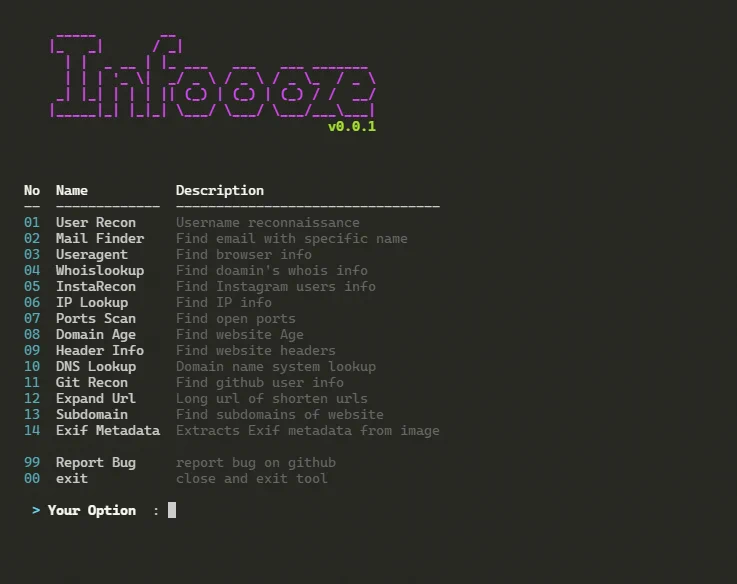
Infoooze is an open-source command-line OSINT reconnaissance toolkit (github.com/devxprite/infoooze) that consolidates common footprinting tasks into one CLI: username enumeration across platforms, email discovery, subdomain enumeration, port scanning, WHOIS/DNS lookups, IP/HTTP header analysis, EXIF metadata extraction, GitHub recon, and URL scanning/expansion. It automatically saves results, making it a lightweight all-in-one alternative to running several separate recon tools.
x.comrepoPublished and added 8 Oct 2026🛡️ Security - overmind-core/overmind
Overmind is an open-source platform (MIT SDK/CLI, AGPL-3.0 platform, self-hostable) that instruments an agent's code via OpenTelemetry tracing, turns the resulting production traces (or any dataset) into a fine-tuned model benchmarked against user-defined eval metrics, and serves it through one unified API with downloadable/retrainable weights. It ships an SDK, CLI, REST API, Console, and an MCP server exposing project tools and workflows (investigate-capability, finetune-capability, ship-model) for Cursor, Claude Code, OpenCode and Codex, and can sync traces from Langfuse, LangSmith, Braintrust or Galileo; self-hosting runs via Docker Compose with Postgres, Redis, Celery workers and Modal-based GPU workers for fine-tuning/serving (vLLM).
github.comrepoAdded 6 Oct 2026🧠 AI - the_OSINT_rack (@the_OSINT_rack) on X
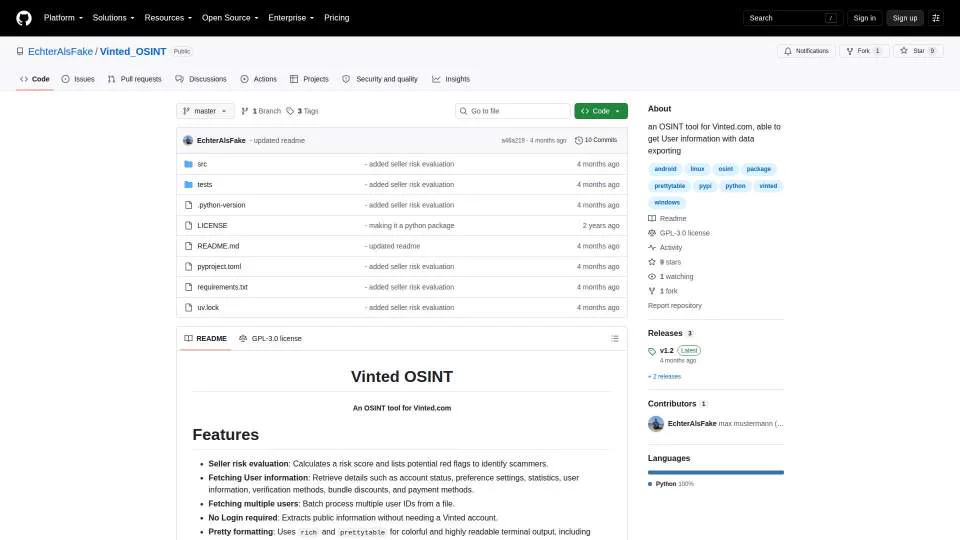
Vinted_OSINT is a GitHub tool by EchterAlsFake that performs open-source intelligence gathering against Vinted.com user profiles, pulling seller/buyer account information and computing a risk score to flag accounts likely run by scammers. It's aimed at buyers wanting to vet sellers before transacting on the second-hand marketplace.
x.comrepoPublished and added 4 Oct 2026🛡️ Security - Sigma r2026-07-01 — 20 new detection rules
GitHub release notes for Sigma r2026-07-01, the open-source detection-rule repository, adding 20 new rules (e.g. LSASS crash via Netlogon buffer overflow CVE-2026-41089, TanStack supply-chain attack indicators for Windows/Linux, RedTail cryptominer user-agent detection, AF_ALG kernel crypto API exploit indicator) and updating/fixing dozens of existing rules for ARM64 binary variants, file-sharing domain IOCs, and WMI-based reconnaissance/persistence detection. It's a routine but substantive update to a widely-used blue-team detection content pack.
github.comrepoAdded 3 Oct 2026🛡️ Security - Bifrost (Maxim AI) — open-source LLM gateway
Bifrost is an open-source, high-performance LLM gateway (by Maxim AI) that exposes a single OpenAI-compatible API across 23+ providers including OpenAI, Anthropic, AWS Bedrock, Google Vertex, Azure, Cohere, Mistral, and Ollama. It provides automatic failover, load balancing, semantic caching, Model Context Protocol (MCP) tool integration, budget and governance controls, OIDC user provisioning, and Prometheus-based observability, deployable via npx or Docker with claimed sub-15 microsecond overhead at 5,000 RPS. It is positioned as a drop-in replacement requiring only a base-URL change for existing OpenAI, Anthropic, or GenAI SDK code.
github.comrepoAdded 2 Oct 2026🧠 AI - https://github.com/Panniantong/Agent-Reach
Agent-Reach is a CLI and agent-"skill" layer that equips coding agents (Claude Code, Cursor, OpenClaw) with ready-made web-reading tool use: fetching arbitrary pages via Jina Reader, YouTube transcripts via yt-dlp, GitHub repos via gh CLI, Bilibili search, RSS via feedparser, and semantic web search via Exa through mcporter, with login-gated platforms (Twitter/X, Reddit, Xiaohongshu, Facebook, Instagram) added on request via cookies or OpenCLI browser sessions. Each platform module probes an ordered list of candidate backends and falls back automatically when one breaks (e.g. yt-dlp being blocked by Bilibili's anti-scraping), and an `agent-reach doctor` command reports which backend each channel is currently using. It positions itself as a "capability layer" that selects, installs and health-checks the right upstream tool for an agent rather than wrapping the reads itself.
github.comrepoAdded 2 Oct 2026, published 1 Oct 2026🧠 AI - Sift — Open-Source Secrets/Credential Scanner
Sift is Stratus Security's open-source successor to Snaffler: a Native AOT credential/secrets scanner for pentesters that crawls local drives, SMB shares/subnets, Active Directory, SharePoint/OneDrive/Teams, Slack, and Jira/Confluence for exposed secrets. It supports Kerberos/NTLM/pass-the-hash authentication, resumable checkpointed scans, a JSON rule/ignore-rule system compatible with Snaffler's detection catalogue, and optional local-LLM (Ollama) validation to cut false positives without sending sensitive findings to a cloud API.
github.comrepoAdded 30 Sep 2026🛡️ Security - Andrea (Drego) Draghetti 👨🏻💻 🎣 (@AndreaDraghetti) on X
Tosint v1.0.0 is an open-source Telegram OSINT tool for analyzing bots and chats, exporting message history and media. The new release adds richer JSONL metadata output, optional SHA-256 hashing of exported media, bot/user authentication support, and an automatic fallback from MTProto-based history retrieval to ID-scan mode when dealing with restricted chats.
x.comrepoAdded 2 Oct 2026, published 30 Sep 2026🛡️ Security - AI News | AI Tools (@AI_News100x) on X
Open-Dots is an open-source reimplementation of OpenAI's 'Dots' computer-use agent, giving any LLM the ability to control a browser, terminal and filesystem plus connectors to personal apps. It is framework-agnostic (works with any LLM) and free, positioned as a self-hostable alternative to OpenAI's proprietary computer-use offering.
x.comrepoPublished and added 30 Sep 2026🧠 AI  MiMo-V2.6 (Xiaomi): Pro/Flash/9B-distill open-weight release, MIT license, 1M context
Hugging Face collection for Xiaomi's MiMo-V2.6 model family, comprising five open-weight checkpoints: MiMo-V2.6-Pro-RL (1T params), MiMo-V2.6-Flash-RL (311B params), a MiMo-V2.6-Distill-Qwen-9B distillation (vision-language capable), and Pro/Flash MOPD variants. The title claims MIT licensing and a 1M-token context window, positioning this as a large open-weight release spanning full-scale RL-trained models down to a 9B distilled variant usable on consumer hardware.
 huggingface.corepoAdded 29 Sep 2026🧠 AI
- StartLuxLabs/StartLux-Decision
StartLux-Decision is a family of open decision models (0.8B to 27B, plus a 35B-A3B mixture of experts) that return probabilities for every option of typed choice, yes/no and score questions. The repository holds the inference engine and HTTP server (vLLM plugin, /v1/systemone API), with Instant one-pass and AutoThink gated-reasoning variants. Reports first place of 174 entries on Decision Index 0.3.2 (69.12). Code is Apache 2.0; weights are CC BY-NC 4.0.
github.comrepoAdded 23 Oct 2026, published 29 Sep 2026🧠 AI - Paper2Agent: research papers as interactive AI agents
Paper2Agent is a multi-agent AI system that coordinates parallel specialist agents to transform a research paper and its code repository into a tested MCP server exposing the paper's methods as callable tools ('agentified' papers). It ships as a skill for coding agents like Claude Code and Codex, and the project demonstrates the pipeline on real papers (TISSUE for spatial transcriptomics, Scanpy for single-cell analysis, AlphaGenome for genomic variant interpretation), each producing a hosted MCP server that a chat agent can call to run the paper's actual scientific workflows.
github.comrepoAdded 27 Sep 2026🧠 AI - zhuyansen/awesome-claude-video-skills
Awesome-list repository cataloguing 183 open-source 'skills' and toolkits that let Claude Code, Codex and other coding agents generate or edit video: rendering frameworks like HyperFrames and Remotion, motion graphics, explainer/promo video generators, short-form editors, digital avatars and music videos. Each entry is read and security-graded by a companion service (Agent Skills Hub / agentskillshub.top), with a machine-readable JSON feed and category breakdowns (frameworks, promos, explainers, editing, shorts, avatars, animation, motion graphics, scripts, music videos).
github.comrepoAdded 29 Sep 2026, published 27 Sep 2026🧠 AI - Agent Threat Rules (ATR) — open detection-rule standard for AI agent threats
Agent Threat Rules (ATR) is an open, versioned YAML rule format (ATR-YYYY-NNNNN scheme) for detecting AI-agent runtime threats — prompt injection, tool-poisoning, malicious SKILL.md content, and MCP exchange abuse — evaluated by a reference TypeScript engine (with a Python wrapper) shipped as an npm/pip package, CLI, GitHub Action, and Docker scanner with SARIF output. The project positions itself as "Sigma for agent threats," maps rules to OWASP Agentic/LLM Top 10, MITRE ATLAS, and NIST AI RMF, and publishes an extensive (and unusually self-critical) benchmark suite against corpora like garak, PromptBench, and PromptInject, including documented harness bugs and withdrawn recall figures.
github.comrepoAdded 26 Sep 2026🛡️ Security - MITRE ATLAS v2026.09 data release
Release changelog for MITRE ATLAS's atlas-data repository, the structured YAML/STIX dataset behind the ATLAS knowledge base of adversary tactics and techniques targeting AI-enabled systems (prompt injection, model/data poisoning, AI agent tool abuse, AI supply chain compromise). The v2026.09 release brings the matrix to 120 techniques, 88 sub-techniques, 40 mitigations, and 73 case studies, and recent versions introduced a new v6 YAML data format with Pydantic/SQLAlchemy/FastAPI tooling, platform tagging (Predictive AI, Generative AI, Agentic AI, Enterprise), and renamed/generalized techniques like "AI Agent Tool Poisoning," "Manipulate AI Model," and "Enterprise Resource Discovery." It's the canonical, actively-maintained taxonomy practitioners use for AI red-teaming, threat modeling, and mapping real-world AI attack case studies.
github.comrepoAdded 26 Sep 2026🛡️ Security - dzhng/jevgrep
Jevgrep (the `jg` CLI) lets a coding agent ask a natural-language question about a repository and get back relevant files, reading leads, and verbatim source excerpts in one response, using an LLM (Jev) to judge relevance across folders, files, and declarations instead of relying on grep/ripgrep alone. It ships an installable "skill" for Claude Code, Codex, OpenCode and other agents that teaches them when to call jg versus their normal tools, and requires a key for Vercel AI Gateway, TypeSafe, OpenRouter, or OpenCode Zen. A reported ten-task SWE-bench repeat found ~40% lower coding-agent cost ($7.62 to $4.52) but a lower solve rate (7/10 vs 8/10 baseline), explicitly framed as a cost/quality tradeoff rather than a win.
github.comrepoAdded 27 Sep 2026, published 26 Sep 2026🧠 AI - git-pkgs — dependency history & supply-chain analysis for git repos
git-pkgs is a Go rewrite of a Ruby tool that adds a git subcommand for tracking dependency changes across a repository's history, indexing manifests/lockfiles from 36+ package managers (npm, RubyGems, Cargo, PyPI, Maven, Composer, Go modules, etc.) into a local SQLite database. Beyond history/blame/diff, it offers supply-chain security commands: `vulns` (OSV-based CVE scanning with SARIF output for GitHub code scanning, plus blame/praise/exposure for remediation metrics), `licenses` (with drift detection and CI-friendly exit codes), `deprecated`, `provenance` (trusted-publishing/attestation checks), `integrity` (lockfile hash drift detection), `maintainers`/`health` (via ecosyste.ms metadata), and `sbom` export in CycloneDX/SPDX. It also supports a dependency-aware `bisect` to find when a vulnerability, license change, or capability (e.g. network access) was introduced, and ships GitHub Actions for CI integration.
github.comrepoAdded 25 Sep 2026🛡️ Security - Claude Code Templates Repository
Claude Code Templates (aitmpl.com) is an open-source npx CLI and template catalog offering 100+ ready-to-use agents, slash commands, hooks, settings, skills and MCP server integrations for Anthropic's Claude Code, aggregating contributions from Anthropic's official skills repo, K-Dense-AI's scientific skills, and various community projects (superpowers, wshobson/agents, awesome-claude-code, etc.). Beyond the template catalog it ships real-time analytics for monitoring Claude Code sessions, a mobile chat viewer with Cloudflare Tunnel support, a health-check diagnostic, and a plugin/marketplace manager, making it a practical operational toolkit for customizing and running Claude Code.
github.comrepoAdded 2 Oct 2026, published 25 Sep 2026🧠 AI - https://github.com/davila7/claude-code-templates/tree/main/cli-tool/components/skills/security/security-threat-model
A "security-threat-model" skill folder in the davila7/claude-code-templates repository, part of a library of reusable Claude Code skills/components. It packages a SKILL.md definition with supporting agent and reference files intended to let Claude Code agents carry out structured threat-modeling analysis as part of a development or security-review workflow.
github.comrepoAdded 2 Oct 2026, published 25 Sep 2026🛡️ Security - yetone/magpie
magpie is a cross-platform menu bar app, TUI and CLI that lets you view and switch the model each installed AI coding agent (Claude Code, Codex, Gemini CLI, OpenCode, Cursor, Copilot CLI, Goose, Pi, etc.) is configured to use, editing each agent's config file surgically without disturbing comments or formatting. It runs a local gateway (127.0.0.1:3425) that translates between OpenAI Chat Completions, OpenAI Responses and Anthropic Messages APIs so every agent can point at one endpoint and use any provider's models, including routing groups that spread requests across multiple keys/subscriptions with configurable routing strategies (smart, order, rotate, usage). It can also reuse existing subscriptions (Claude Code, Codex/ChatGPT, Copilot, Devin, Gemini CLI) as providers for other agents without exposing or copying credentials, and supports encrypted profile backup/restore.
github.comrepoAdded 26 Sep 2026, published 23 Sep 2026🧠 AI - artemy-ccrsky/COM-Jungle
COM-Jungle is a GitHub repository of offensive security research notes on Windows COM (Component Object Model), written by Artemy Tsetsersky in 2026. Notes are ordered by tactic: how COM works, execution, trust boundaries and privilege escalation, lateral movement via DCOM, persistence, initial access, finding new classes, and detection and hardening. It advises recording build, bitness, token and session before generalising a CLSID result, and says detections should key on registration, load and process context rather than a single CLSID.
github.comrepoAdded 23 Oct 2026, published 23 Sep 2026🛡️ Security - https://github.com/akha-security/akca
AKCA is an open-source, Go-based Dynamic Application Security Testing (DAST) scanner that combines HTTP and headless-browser crawling, JavaScript/AST analysis, API spec import (OpenAPI, GraphQL, gRPC, etc.), and adaptive active testing across a very broad set of vulnerability classes including SQL injection, XSS, SSRF, IDOR/BOLA, SSTI, JWT/OAuth flaws, race conditions, and cloud/CI exposure. It emphasizes evidence-oriented verification — replaying promising signals against baselines, negative controls, and OAST callbacks before promoting them to findings — and exports Burp-style HTTP evidence in HTML, JSON, CSV, Markdown, and SARIF reports. Positioned as a transparent, single-developer alternative inspired by but not claiming parity with Acunetix, Invicti/Netsparker, or Burp Suite Professional.
github.comrepoAdded 2 Oct 2026, published 23 Sep 2026🛡️ Security - Simreal-AI/Simreal-MLBench
Simreal-MLBench is the open, minimal slice of ML Benchmark, a verifiable evaluation environment for machine learning research agents, covering 60 tasks across tabular learning, forecasting, vision, language, audio, multimodal and structured scientific data. It splits an open, Apache-2.0 layer (task definitions, scoring rule, verification tooling) from a commercial operated layer (SimReal's sandboxed runtime, gateway, submission broker and official scoring), scores tasks as 100xp^2 against a frozen reference leaderboard, enforces a source-blind two-submission protocol, and provides full provenance for every published number. It is positioned as an alternative to MLE-bench with a distinct task selection, resource protocol, and scoring scheme, aimed at supporting RLVR and agent self-improvement research.
github.comrepoAdded 26 Sep 2026, published 21 Sep 2026🧠 AI - Outrider Recon
Outrider Recon is an open-source, Claude-native multi-agent OSINT and external attack-surface recon platform for authorized engagements, covering web/API, identity/SSO, cloud, secrets, and people/breach intelligence. It deliberately stops short of exploitation: active enumeration is approval-gated and intrusive validation is a human hand-off, with deterministic Python controls enforcing scope, evidence integrity, workflow state, and finding promotion around Claude skills and optional MCP-based enrichment. Output is ranked, evidence-backed finding cards (confidence/severity/handoff recommendations) meant to feed proxy-assisted testing or pen-testing rather than raw scanner dumps.
github.comrepoAdded 22 Sep 2026, published 19 Sep 2026🛡️ Security - crypt0p3g/adnullenum
adnullenum is a single-pass Active Directory enumerator that uses anonymous (null) SMB sessions over the \samr and \lsarpc named pipes to pull domain info, password/lockout policy, RID-cycled account inventory, per-user detail, and group membership without credentials. It consolidates what rpcclient, impacket's samrdump.py/lookupsid.py, enum4linux-ng, and NetExec each do separately into one run, falls back to LSA lookups when SAMR is locked down, flags interesting accounts (AS-REP-roastable, PASSWORD_NOT_REQUIRED, unconstrained delegation, etc.), and writes ready-to-use userlist.txt/computerlist.txt plus a reusable RID cache. The README also gives blue-team guidance on closing null-session access (RestrictAnonymousSAM, Pre-Windows 2000 Compatible Access group) and detecting it via Event 4661/4662/4624/5140.
github.comrepoAdded 2 Oct 2026, published 17 Sep 2026🛡️ Security - Copy Fail (CVE-2026-31431): 9-year-old Linux kernel LPE found by Theori's Xint Code
A GitHub repository from Theori's Xint Code team detailing CVE-2026-31431, a Linux kernel local privilege escalation bug ("Copy Fail") that had gone undetected for roughly nine years. The researchers confirmed exploitability across current production kernels including Ubuntu 24.04 LTS (6.17.0-1007-aws), Amazon Linux 2023 (6.18.8-9.213.amzn2023), RHEL 10.1 (6.12.0-124.45.1.el10_1), and SUSE 16 (6.12.0-160000.9-default).
github.comrepoAdded 17 Sep 2026🛡️ Security - All-AI-Jailbreaks
A GitHub repository archiving 19 jailbreak, prompt-injection, persona-conditioning, and response-format-manipulation prompts collected against DeepSeek, Gemini, GLM, Grok, Kimi, Qwen, Sonnet, and ChatGPT. Prompts are kept close to their original form for provenance/reproducibility, positioned as a corpus for red-teaming and robustness evaluation rather than a guaranteed exploit list, with guidance to test in isolated environments and log model version/config/date/response per trial.
github.comrepoAdded 22 Sep 2026, published 17 Sep 2026🛡️ Security - Markakd/Container_escape
A GitHub repository hosting target-specific proof-of-concept exploits for two Linux kernel vulnerabilities, CVE-2026-52910 and CVE-2026-80521 (the latter an AF_UNIX kernel bug also documented in a kernelCTF LTS exploit-chain submission), both usable to break out of container isolation. The project ships a QEMU/Docker-based disposable VM builder (pinned to specific Ubuntu cloud images and kernel versions) so the destructive PoCs can be compiled and detonated only inside throwaway guests rather than on real hosts.
github.comrepoAdded 2 Oct 2026, published 16 Sep 2026🛡️ Security - RepoGuardBench
RepoGuardBench is a benchmark and accompanying paper that measures whether local open-weight coding agents (Qwen2.5-Coder 1.5B-14B via Ollama) stay on the bug-fix task when repository artifacts — README files, issue text, code comments, test logs, and agent-rule files — carry inert prompt-injection instructions. It evaluates five lightweight context- and action-level defenses (D0-D5, including a path-only action gate) across seven metrics in a sandboxed task workspace, finding no statistically clear utility winner among them. The project ships a deterministic no-GPU smoke test, paper-claim verification scripts, and reproducible tables/figures under MIT (code) and CC BY 4.0 (data) licenses.
github.comrepoAdded 22 Sep 2026, published 13 Sep 2026🛡️ Security - shinthink/blitzstrike
Blitz Strike is an open-source Model Context Protocol server (TypeScript/Bun) that packages a structured 3-tier pentesting methodology — BLITZ (attack-surface recon), EAGLE-EYE (source-to-sink reachability tracing), and STRIKE (live validation before reporting) — into callable tools any MCP client (Claude Code, Cursor, Gemini, etc.) can drive with a single run_engagement call. It ships 130 self-written security tools, 317 indexed tool manuals, 58 data-driven escalation chains with negative-control checks, a Web3/Solidity audit module with Foundry proofs, and a regression/benchmark suite (453 checks, reported 1.0 detection / 0 false-positive rate) to make every finding verified rather than pattern-matched.
github.comrepoAdded 2 Oct 2026, published 12 Sep 2026🛡️ Security - agent-egress-bench
Agent Egress Bench is an open, tool-neutral benchmark maintained by PipeLab (makers of Pipelock) that tests whether products mediating an AI agent's outbound traffic — proxies, egress firewalls, MCP wrappers, agent gateways — actually catch exfiltration attempts caused by prompt injection or misalignment, rather than testing the underlying model itself (that's left to AgentDojo, InjecAgent, CyberSecEval, AgentHarm, ASB). It ships a reproducible Go runner with a proxy/WebSocket/MCP/A2A adapter contract, an offline validator, DSSE-signed evidence bundles, and a CI-runnable GitHub Action, and separates containment from false-positive rate as two distinct scored axes with immutable case IDs and OWASP Agentic Top 10/MITRE ATT&CK mappings. Its governance explicitly permits third parties to publish results unfavorable to the maintainer's own Pipelock product.
github.comrepoAdded 12 Sep 2026🛡️ Security - GhostJS
GhostJS is an open-source Burp Suite extension by TrinetLayer that passively scans JavaScript, HTML, and JSON responses flowing through Burp for hardcoded secrets (AWS/GCP/Azure keys, Stripe/PayPal/GitHub tokens, JWTs, private keys, etc.) and hidden API endpoints, surfacing findings in a dedicated tab with severity, confidence scoring, remediation guidance, and Markdown export. It also actively fetches referenced <script> bundles using the tester's live session cookies and applies a false-positive filter to suppress doc-sample and placeholder keys, making it a practical recon aid during authorized web app pentests and bug bounty work.
github.comrepoPublished and added 7 Sep 2026🛡️ Security - headroomlabs-ai/headroom
Headroom is an open-source (Apache 2.0) local compression layer that sits between AI agents and LLM providers, compressing tool outputs, logs, RAG chunks, files and conversation history before they reach the model. It offers a Python/TypeScript library, a drop-in proxy, an `headroom wrap` mode for popular coding agents (Claude Code, Codex, Cursor, Copilot, Aider, etc.), an MCP server, cross-agent shared memory with dedup, and output-token reduction via verbosity steering and effort routing — all running locally with reversible compression (CCR) so originals stay retrievable.
github.comrepoAdded 23 Sep 2026, published 7 Sep 2026🧠 AI - mukul975/cve-mcp-server
cve-mcp-server is a Model Context Protocol server that gives Claude direct access to 28 security tools spanning 24 APIs (NVD, EPSS, CISA KEV, OSV.dev, GitHub GHSA, MITRE ATT&CK, AbuseIPDB, GreyNoise, Shodan, VirusTotal, MalwareBazaar, ThreatFox, Ransomwhere, and more), fronted by a one-call triage_cve orchestrator. It computes a composite 0-100 risk score from CVSS, EPSS, KEV status, and PoC availability (with a hard CISA KEV override forcing CRITICAL/≥76), supports dependency scanning via OSV, IP/domain reputation lookups with private-IP blocking, and ships an SSVC v2 gated decision mode plus audit logging and XML-bomb protections via defusedxml.
github.comrepoPublished and added 7 Sep 2026🛡️ Security - eldarshiraliyev/BugScanner
BugScanner is an asyncio/httpx Python framework for recon and automated web vulnerability scanning, with a React and FastAPI dashboard. It covers subdomain enumeration (crt.sh, DNS brute force), TCP port scanning, fingerprinting, and modules for XSS, SQLi, CORS, SSRF, open redirect, JWT, IDOR and business logic, plus a Nuclei wrapper. A 5-rule false-positive filter with SPA detection, adaptive rate limiting, WAF detection and SARIF export are included.
github.comrepoAdded 20 Oct 2026, published 5 Sep 2026🛡️ Security - ProjectDXAI/continuous-record-llm-trading-agents
Companion repository for the DXRG paper "What LLM Trading Agents Actually Do in Production" (arXiv:2609.05663), reporting a six-month, population-scale record of two live LLM-agent trading fleets: 3,505 DX Terminal Pro vaults on Base and a 500-599 agent DXAP fleet on Hyperliquid perpetuals (231,638 finalized turns, 14,596 fills). It quantifies how the operating layer — not strategy text — drives behavior: a prompt-rendered leaderboard routes 46.5% of trade entries with a sharp regression discontinuity at the render boundary, agent fixed effects absorb 60% of outcome variance, leverage choice is volatility-blind (median 5.0x across a 5.7x volatility spread) with one posture/slider cell concentrating 62% of liquidations, and discretionary exits underperform a fixed 2%/4% bracket. A 416-scenario paired replay across three frontier models found similar decision quality but sharply different choice-consistency flip rates (35% vs 90%+), and the repo ships the paper, figures, aggregate data extracts, dataset cards and a 17-rule methodology canon distilled from the project's own retracted claims.
github.comrepoAdded 2 Oct 2026, published 1 Sep 2026🧠 AI - PackageGuard
PackageGuard is an open-source .NET CLI tool that scans NuGet, npm, pnpm and Yarn dependencies (direct and transitive) across a codebase, enforcing hierarchically-configured allow- and deny-lists for licenses, packages and versions. It scores each package's Legal, Security and Operational risk using signals like OSV vulnerability data, maintainer activity, package signing and release cadence, and can emit a CycloneDX or SPDX SBOM enriched with OSV vulnerability data, plus console, HTML and SARIF output for CI/GitHub code scanning. It's positioned as a free alternative to commercial supply-chain tools like Black Duck and Snyk.
github.comrepoPublished and added 31 Aug 2026🛡️ Security - emlai/defi-native-skill
An open-source Agent Skill ("defi-native") that teaches Claude Code, Cursor, Codex and other Agent-Skills-compatible agents capital-markets and DeFi domain knowledge, including yield decomposition, vault/curator anatomy, oracle classes, and stablecoin/RWA taxonomy. It is structured with progressive disclosure (SKILL.md routes to task-specific reference files only when needed), an api-routes.json router that forces live data pulls (vaults.fyi, DefiLlama, Morpho's GraphQL, rwa.xyz, Merkl, 130+ protocol docs) before any numeric claim, and a verified 90+ source manifest. The author describes an eval-gated release process (paired with/without-skill runs graded on structure) and adversarial review by independent models before publishing, making it a useful case study in skill engineering even for readers uninterested in DeFi itself.
github.comrepoAdded 2 Oct 2026, published 28 Aug 2026🧠 AI - numasec
numasec is an open-source AI security agent that runs in the terminal, wrapping a user-chosen LLM (OpenAI, Anthropic, Google, Bedrock, Ollama, etc.) with an operation kernel that tracks target scope, runbooks, findings, evidence, replay, and reports across a security engagement. It orchestrates local tools such as nmap, sqlmap, ffuf, gobuster, nikto, nuclei, trivy, and checksec, and is aimed primarily at authorized AppSec triage and Pentest workflows, with OSINT, CTF, and cloud surfaces marked as less mature.
github.comrepoPublished and added 27 Aug 2026🛡️ Security - IAM Policy Autopilot
IAM Policy Autopilot is an AWS Labs open-source CLI/MCP server that statically analyzes application source code (Python, Go, TypeScript, JavaScript, Java) or a Terraform plan JSON to generate baseline least-privilege IAM identity-based policies, and can also parse AccessDenied error messages to suggest policy fixes. It integrates with AI coding assistants (Kiro, Claude Desktop, etc.) via MCP so assistants can auto-generate scoped IAM permissions instead of overly broad ones, with a --service-hints flag to reduce false-positive permission inclusion.
github.comrepoPublished and added 25 Aug 2026🛡️ Security - Ashmmmm/crockTail
crockTail is a passive OSINT tool that, given a domain, aggregates DNS records, IP/ASN ownership, TLS certificate details, WHOIS data, and crt.sh certificate-transparency history into a single report. It layers analysis on top of the raw data: plain-language warning/info observations (near-expiry or expired certs, recently registered domains, unusual reissuance, historical subdomains from CT logs), multi-resolver (Google vs Cloudflare) DNS cross-verification to flag possible tampering, and a 0-100 confidence score per scan based on module success and cross-check agreement. It supports batch domain queries and query logging, and is explicitly limited to passive lookups and a standard TLS handshake, no port scanning or active probing.
github.comrepoAdded 30 Sep 2026, published 25 Aug 2026🛡️ Security - flawed
flawed is a static-analysis engine for Python web applications that builds a framework-aware model of an app's routes, request inputs, state effects, call graph, and value flow, exposing it both as a queryable Python library (open_repo(), load_findings()) and a CLI scanner. It runs pluggable rule modules (@detector contract) across three layers — L1 index, L2 semantic model, L3 rules — and outputs findings as JSON/SARIF with baseline diffing support for CI use.
github.comrepoPublished and added 23 Aug 2026🛡️ Security - agentgg
agentgg is an open-source, agentic SAST scanner that uses LLM agents to read source code, follow imports, trace the call graph, and confirm findings before reporting — aiming to reduce the pattern-matching false positives of traditional SAST. It runs locally or as a hosted service, supports full-repo scans or git-diff PR review, and works with multiple model providers (Anthropic, OpenAI, AWS Bedrock, Google Vertex AI, OpenRouter, Ollama); agents are defined as markdown files with YAML frontmatter and are pulled from a community agents catalog.
github.comrepoPublished and added 23 Aug 2026🛡️ Security - Deep Eye
Deep Eye is an open-source Python pentesting framework that orchestrates 11 AI providers (OpenAI, Claude, Grok, Gemini, Ollama, Groq, Mistral, OpenRouter, LiteLLM, LM Studio, and more) with automatic failover to generate context-aware attack payloads for 50+ vulnerability classes including SQLi, XSS, SSRF, IDOR, JWT and GraphQL flaws. It adds an RAG-indexed CVE intelligence DB built from NVD/MITRE/Exploit-DB, AI-based finding triage and false-positive filtering, Nuclei-style YAML templates, Playwright browser automation, CAPTCHA-solving (reCAPTCHA/hCaptcha/Turnstile/Arkose), mitmproxy interception, and auto-generated HackerOne-style bug bounty reports with PCI-DSS/SOC2/ISO 27001 compliance mapping, SARIF/JUnit export, scan diffing, and retest workflows.
github.comrepoAdded 3 Sep 2026, published 22 Aug 2026🛡️ Security - MinIO Security Lab
A defensive security review lab for MinIO pinned at commit 7aac2a2 (~RELEASE.2025-10-15+11), providing Docker-based single-node, two-node replication, and dual-OIDC environments plus per-finding repro.sh PoCs for issues including service-account key path traversal, server-update SSRF, cross-provider OIDC token acceptance, source-IP/X-Forwarded-For trust, tag-deletion replication bypass, batch job data exfiltration, and secrets exposed via config history. Each of 16+ findings (F-01 through F-16) has ANALYSIS.md with root cause, data-flow trace, and suggested fix, produced via a generate/judge/independent-verify pipeline with cross-vendor adjudication (including an OpenAI/codex-based verifier) and live validation on a lab-built Go binary; ~90 candidates were triaged with ~55 set aside as false positives or intended behavior.
github.comrepoAdded 3 Sep 2026, published 21 Aug 2026🛡️ Security - ScreenshotDetector
ScreenshotDetector is an Android app-layer tool that detects screenshot, screen recording, screen mirroring, and casting activity using a combination of public APIs (ScreenCaptureCallback, ScreenRecordingCallback, DisplayManager, MediaProjection, ContentObserver/MediaStore, FileObserver, AccessibilityService, NotificationListenerService) and hidden APIs accessed via reflection (DisplayManagerGlobal.getDisplayInfo, WifiDisplayStatus, AppOps project_media/project_audio). It is positioned as a research counterpart to ScreenshotFaker (an LSPosed/Shizuku-based tool that forges/bypasses screenshot detection), illustrating the attacker/defender dynamic around screen-capture evasion on Android, including detection of adb shell screencap/screenrecord, freeform/mini-window attribution, and accessibility-overlay/screen-reader channel abuse detection.
github.comrepoPublished and added 21 Aug 2026🛡️ Security - Orbien
Orbien is a lightweight (~5MB binary) NAT traversal / intranet penetration tool written in Rust with Tokio, supporting tunnel protocols (TCP, UDP, HTTP, HTTPS, SOCKS5) over multiple transports (TCP, KCP, WebSocket, QUIC). It provides token-based tunnel authentication and TLS/mTLS encryption, positioning it as a secure, high-performance alternative to frp for exposing internal services or pivoting through NAT.
github.comrepoAdded 3 Sep 2026, published 21 Aug 2026🛡️ Security - UnboundCompute/security-agent-skills
security-agent-skills is a repository of 194 portable, tool-agnostic security-testing skills for Claude Code and other agent runtimes that follow the Agent Skills format. Skills encode methodology (enumerate the full taxonomy, rank as triage, treat a lead as a fact not a verdict) across white-box bug hunting, AI-agent red-teaming, cloud and Kubernetes trust, web injection, Windows/AD, mobile, web3 and identity. Each skill opens with a scope check, and findings share one schema. Installs via the Claude Code plugin marketplace or by copying a skill directory.
github.comrepoAdded 2 Nov 2026, published 16 Aug 2026🛡️ Security - VaultKeepR/vaultkeepr-public
vaultkeepr-public is the MIT-licensed repository behind VaultKeepR, a zero-knowledge password manager. It holds 15 SDK packages published to npm under @vaultkeepr and Solidity contracts on Base L2 that anchor vault locations, recovery fragments and digital legacy, tested with Foundry. Encryption is XChaCha20-Poly1305 with Argon2id (t=3, m=64 MiB, p=4), and docs/THREAT_MODEL.md covers assets, adversaries and trust boundaries. Clients stay in a private repository.
github.comrepoAdded 23 Oct 2026, published 12 Aug 2026🛡️ Security - Armada
Armada is a CLI tool (npm package @rafamacalaba/armada) that turns a repository into a multi-agent "fleet" of 8 specialist AI roles (developer, QA, security, adversary, architect, Commodore orchestrator, etc.) built on opencode. It implements "loop engineering": a contract-driven control loop (contract → dispatch → build → test → review → PR) with maker/checker separation, parallel phase dispatch in isolated git worktrees, evidence-gated transitions, and crash-proof on-disk state, aiming to replace unsupervised one-shot agent prompting with a verified, resumable workflow that lands a reviewed PR.
github.comrepoAdded 22 Sep 2026, published 10 Aug 2026🧠 AI - Static Analysis Tools & Linters
analysis-tools.dev's source repository is a community-maintained directory of static analysis tools and linters spanning nearly every programming language, tagged for license (proprietary vs open source), maintenance status, and community endorsement. Beyond general code-quality linters, it catalogs many security-relevant static analyzers such as gosec, flawfinder, OWASP Dependency Check, Mariana Trench, Psalm, PHPStan, govulncheck, and WAP, making it a reference point for discovering SAST tooling per language/ecosystem.
github.comrepoAdded 3 Sep 2026, published 9 Aug 2026🛡️ Security - PrimeIntellect-ai/prime-agent
Prime Agent is an open source coding and research agent built on a persistent Python REPL and subagent architecture. Its documentation explicitly warns that it executes model generated code with full user permissions and is not a security sandbox, advising users to only run trusted repositories, instructions, and skills.
github.comrepoPublished and added 9 Aug 2026🛡️ Security - Precogly
Precogly is an open-source, now-OWASP threat modeling platform (React/TypeScript frontend, Django REST Framework/PostgreSQL backend) offering a collaborative DFD editor with trust zones, TM-BOM import/export, and community library packs linked to MITRE ATT&CK, CAPEC, STRIDE, and LINDDUN. It's positioned as compliance-aware, tracing threats and countermeasures to DORA, the EU Cyber Resilience Act, ASVS, NIST CSF, and SOC 2, and exposes a full OpenAPI REST API meant as scaffolding for AI-driven threat modeling assistants.
github.comrepoAdded 3 Sep 2026, published 5 Aug 2026🛡️ Security - System Prompts Leaks
A community-maintained repository that archives leaked or extracted system prompts — the hidden instructions given to LLM chatbots before user input — captured verbatim from products including Claude/Claude Code, ChatGPT/Codex, Gemini, Grok, Cursor, Copilot, Perplexity, Meta AI, Mistral, DeepSeek, GLM, and others. It serves as a reference corpus for studying system prompt design, extraction techniques, and the system prompt leakage risk class, and is updated regularly as new prompts are exfiltrated from newer model releases.
github.comrepoAdded 3 Sep 2026, published 3 Aug 2026🛡️ Security - asgeirtj/system_prompts_leaks
This GitHub repository collects verbatim leaked/extracted system prompts — the hidden instructions and guardrails — from a wide range of AI products including Claude.ai, Claude Code, ChatGPT, Codex, Gemini, Grok, Perplexity, Microsoft Copilot, Cursor, Meta AI, Mistral, Kimi, DeepSeek, GLM, Qwen and others. It is updated regularly as new prompts are captured, and serves as reference material for AI red-teamers and researchers studying how vendors constrain model behavior and how those constraints can be extracted or bypassed.
github.comrepoPublished and added 3 Aug 2026🛡️ Security - Google Agent Skills
Google's official repository of Agent Skills covering Google products and technologies, including Google Cloud. Skills are installed selectively via `npx skills add google/skills`, and the repo also bundles Google product plugins combining Skills with MCP servers for use in agent harnesses.
github.comrepoAdded 22 Sep 2026, published 3 Aug 2026🧠 AI - UseOSINT/Skills
Collection of 28 skill files for coding agents to run OSINT investigations covering domains, emails, usernames, photos, and companies, using techniques like WHOIS, certificate transparency, reverse image search, and breach lookups.
github.comrepoAdded 30 Sep 2026, published 2 Aug 2026🛡️ Security - UseOSINT/Skills
UseOSINT/Skills is a GitHub repo of 28 SKILL.md files that let Cursor, Claude, and other coding agents run open-source-intelligence investigations — 10 end-to-end workflows (e.g. find-anyone, x-ray-a-company, recon-a-domain-passively) built on 18 reusable technique skills (WHOIS, certificate transparency, reverse image search, breach lookups, chronolocation). Each skill ships with reference material (query cookbooks, indicator guides, registry catalogues) and an install script that symlinks the whole set into ~/.cursor/skills, illustrating a chained, workflow-plus-technique pattern for structuring and routing large agent skill libraries. The repo also documents scope/authorization gating and passive-by-default behavior as part of the skill design.
github.comrepoAdded 30 Sep 2026, published 2 Aug 2026🧠 AI - Kritt-ai/open-kritt
open·kritt is a self-hosted, open-source platform that orchestrates AI coding agents (Codex, Claude Code, or Grok Build) in parallel to hunt for vulnerabilities in remote or local repositories and their dependencies. It breaks security research into small chained prompt "workflows," runs jobs in disposable root-access Docker containers with internet access, then de-duplicates and ranks findings, validates them via post-scripts/PoC generation, and exports share-safe finding bundles. It's the open-source distillation of the internal tooling behind the Kritt team's (Blockian) $1.5M+ in bug-bounty payouts.
github.comrepoPublished and added 2 Aug 2026🛡️ Security - Codex Security CLI
@openai/codex-security is a CLI and TypeScript SDK that uses Codex/LLM agents to scan codebases for vulnerabilities, draft repository-specific SECURITY.md policies, deduplicate findings via embedding similarity, and classify severity against a custom rubric. It supports self-hosted deployment via Docker Compose with a findings service (SQLite-backed dashboard) and can run against multiple inference providers including Amazon Bedrock, OpenRouter, and Fireworks in addition to OpenAI.
github.comrepoPublished and added 1 Aug 2026🛡️ Security - Awesome Offensive AI Agentic Landscape
A comprehensively curated landscape document tracking the offensive AI agent space: ranked open-source pentesting/red-team agent projects (e.g. strix, shannon, VulnBot), uncensored offensive LLMs (Qwythos, WhiteRabbitNeo/DeepHat, BaronLLM) versus security-specialized but aligned models (Foundation-Sec, CyberSecQwen), Claude Code Agent Skills and MCP servers wrapping tools like Metasploit and BloodHound, 116 cross-referenced academic papers on pentest/vuln-discovery agents, capability benchmarks (Cybench, NYU CTF Bench, CyberGym), and a fact-checked Top-20 list of commercial AI pentesting vendors. It also covers competitions like the DARPA AI Cyber Challenge and Tencent's Intelligent Penetration Hackathon, positioning itself as a cross-merge of several other awesome-lists in this niche.
github.comrepoPublished and added 1 Aug 2026🛡️ Security - ChipWhisperer
ChipWhisperer is NewAE Technology's open-source hardware security toolchain for side-channel power analysis and fault injection research, comprising capture-board hardware/PCB schematics, USB and FPGA firmware, target device firmware examples, and Python APIs (ChipWhisperer Capture and Analyzer) for acquiring and processing power traces. It's widely used to demonstrate and teach attacks like differential power analysis (DPA) and voltage/clock glitching against embedded targets such as microcontrollers and crypto implementations. The repository is undergoing a git-history cleanup for the 6.0 release, splitting files across companion repos including chipwhisperer-jupyter.
github.comrepoPublished and added 31 Jul 2026🛡️ Security - Awesome Malware Analysis
Awesome Malware Analysis is a curated GitHub list aggregating hundreds of tools and resources across the malware analysis lifecycle: honeypots (Cowrie, Dionaea, Conpot), sample repositories (VirusShare, Malshare, theZoo, VX Underground), IOC/threat-intel platforms (MISP, YARA, ThreatCrowd, URLhaus), online sandboxes (VirusTotal, Cuckoo Sandbox, Hybrid Analysis, any.run), static/dynamic RE tools (IDA Pro, Ghidra, Radare2, x64dbg, angr), deobfuscation utilities, network traffic analyzers (Wireshark, Bro, mitmproxy), and memory forensics frameworks (Volatility, Rekall). It also links essential books, blogs, and training material (Practical Malware Analysis, REMnux, FLARE VM) making it a de facto index for the malware analysis community.
github.comrepoPublished and added 31 Jul 2026🛡️ Security - thewhiteh4t/FinalRecon
FinalRecon is a Python-based OSINT/reconnaissance tool for web targets, gathering header info, whois data, SSL certificate details, crawling, DNS enumeration, subdomain discovery, port scanning, and directory search in a single utility. It's commonly used during the recon phase of web application pentests to consolidate multiple footprinting techniques into one CLI tool.
github.comrepoPublished and added 31 Jul 2026🛡️ Security - Dark Web OSINT Tools
A curated GitHub list of tools for dark web OSINT and investigation, including onion search engines (Ahmia, OnionSearch, Darkdump, Onion Search Engine), crawlers/scanners (TorBot, TorCrawl, OnionScan, Onioff, Onion-nmap), CTI feed aggregators (DeepDarkCTI), and directories like The Hidden Wiki. Also links the author's own Robin tool and IACA's dark web investigation support resources, making it a one-stop reference for researchers and investigators scoping Tor hidden services.
github.comrepoAdded 3 Sep 2026, published 31 Jul 2026🛡️ Security - Flowsint - OSINT Framework
Flowsint is an open-source, self-hosted OSINT investigation platform that lets analysts visually explore relationships between entities (domains, IPs, ASNs, individuals, organizations, crypto wallets, emails, phones) via a graph interface backed by automated enrichers. It integrates recon modules like reverse/forward DNS resolution, WHOIS, subdomain discovery, ASN/CIDR mapping, breach-database checks, Maigret username search, and crypto wallet transaction/NFT lookups, storing all data locally for investigation privacy. The deployment docs also cover hardening steps for network exposure, including rotating AUTH_SECRET and MASTER_VAULT_KEY, binding backend services (PostgreSQL, Redis, Neo4j, API) to localhost, and a host-header allowlist to defend against DNS rebinding.
github.comrepoAdded 3 Sep 2026, published 31 Jul 2026🛡️ Security - hackingtool
hackingtool is a console launcher that bundles 215 curated security tools across 21 categories (recon, OSINT, wireless, phishing, forensics, post-exploitation) so users can install and run them without hunting down individual Git repos. Its newer AI layer maps plain-English goals to the right tool and exact command, plans multi-step objectives with confirmation gates, and drafts engagement reports, while emphasizing safe installs (pinned/SHA-256-verified downloads, no curl|bash, list-form subprocess calls, signed releases with SBOM) and refusing out-of-scope asks like DoS or mass-targeting. It also ships a non-interactive orchestrator (`--engagement`/`--pipeline`) that normalizes tool output into findings.json for red team, blue team, OSINT, bug bounty, and DFIR workflows.
github.comrepoAdded 3 Sep 2026, published 31 Jul 2026🛡️ Security - lockfale/OSINT-Framework
OSINT Framework is a curated, categorized index of free (mostly) open-source intelligence tools and resources, organized by data type (username, domain, IP, email, social media, etc.) and rendered as an interactive tree at osintframework.com. Each entry in the underlying arf.json is tagged with metadata like whether it requires local install (T), a Google dork (D), registration (R), or manual URL editing (M), plus richer fields such as input/output type, pricing, and opsec notes. It's a long-standing community reference for recon and investigation tradecraft across infosec and other fields.
github.comrepoPublished and added 31 Jul 2026🛡️ Security - Sherlock
Sherlock is a command-line OSINT tool that checks over 400 social networks for the existence of a given username, outputting results to text, CSV, or XLSX files. It supports proxying, JSON-based site definitions, NSFW site inclusion, and browsing found accounts directly, making it a staple recon tool for investigators, red teamers, and social engineering research.
github.comrepoPublished and added 31 Jul 2026🛡️ Security - OpenOSINT
OpenOSINT is a Python OSINT agent that wraps 20 investigation tools (holehe for email enumeration, sherlock for username lookup, sublist3r for subdomain enumeration, phoneinfoga for phone intel, plus HaveIBeenPwned, Shodan, VirusTotal, Censys, AbuseIPDB, IP2Location, DNS/SPF/DMARC checks, GitHub, and Bright Data-powered dorking/scraping) behind a natural-language AI interface that issues deterministic tool calls so findings can't be hallucinated. It ships as a REPL, CLI, MCP server (usable from Claude Code/Desktop, Cursor, Windsurf), or browser web UI, with an optional additive FollowTheMoney entity graph for correlating findings and pivoting between investigation results, plus documented reverse-proxy/credential-handling behavior for remote deployments.
github.comrepoPublished and added 31 Jul 2026🛡️ Security - awesome-osint-arsenal
An awesome-list repo that claims 753+ OSINT and security tools across 50 categories. Sections cover username, email, phone, domain/IP, geolocation, image, breach-search, dark web, web scanning and password-cracking tools, plus red team, blue team, DFIR, hardware and training sections. It ships multi-distro installer scripts (install.sh, osint.sh, redteam.sh, blueteam.sh, forensics.sh, hardware.sh, labs.sh, termux.sh) for Kali, Debian and Ubuntu, with partial Arch/Fedora support and a Termux subset. It also gives short usage walkthroughs such as a subfinder + amass + httpx recon chain. Some entries are dual-use (people search, face recognition, phone exploitation, IP camera dorking), and the README says the repo is for authorized research only.
github.comrepoPublished and added 31 Jul 2026🛡️ Security - elementalsouls/Claude-OSINT
Claude-OSINT is a library of 8 drop-in Claude Skills (SKILL.md files, ~10,000 lines) that turn Claude/Claude Code into a structured external-recon operator for authorized red-team and bug-bounty engagements. The core pair (osint-methodology, offensive-osint) covers a 6-stage recon pipeline, an 80-pattern secret scanner, 80+ dorks, and read-only credential validators, while six organization-grade skills add legal-entity-to-footprint mapping, SPF/email-spoofability analysis, FAIR-based dollar risk scoring, continuous exposure re-scan/diff monitoring, cloud/SaaS and dependency-confusion checks, and identity-provider tenant/user-enumeration with explicit hard scope boundaries (no password spraying, no active exploitation).
github.comrepoPublished and added 31 Jul 2026🛡️ Security - Pan-Chera/Multi-Agent-CAD
Multi-Agent CAD (MAC) is a LangGraph-orchestrated multi-agent system that turns natural-language design briefs into editable engineering geometry (STEP/STL/GLB), decomposing mechanisms into separately generated, mated, and QA-validated parts and exporting URDF for robotics/physics simulation. It extends an earlier single-part Text-to-CAD workflow (~1,000 GitHub stars) with visual verification, an independent Judge agent, and an experimental assembly pipeline, reporting on a 10-prompt/141-feature benchmark that it matches a reproduced "CAD Skills" baseline's pass rate (140/141) while using tens-of-times fewer tokens and lower cost under Qwen-based configurations.
github.comrepoAdded 30 Sep 2026, published 30 Jul 2026🧠 AI - redhat-et/ripwire
Ripwire is an offline, single-binary CLI (with optional MCP server) that indexes a repository to give coding agents a ranked, deterministic call graph, task-oriented context bundles (--for, --pack-task), and edit-time checks (--edit-check, --quality-delta, --test-gate) that flag blast radius, contract breakage, and code-quality regressions. It installs skills for Claude Code, Codex, Cursor, Windsurf, Gemini, opencode and aider, and ships extensive self-published benchmarks (docs/EVALS.md, LocBench-style head-to-head comparisons against graph-database MCP servers like codebase-memory-mcp, repowise, graphify and aider) claiming large token and latency savings plus higher file@10 retrieval accuracy. The README includes a detailed field report on using it across a ~20-agent, ~1,500-file C++/Metal orchestration engagement.
github.comrepoAdded 2 Oct 2026, published 29 Jul 2026🧠 AI - glsec
glsec is a security linter for GitLab CI (.gitlab-ci.yml) configuration files, analogous to zizmor/actionlint for GitHub Actions. It detects misconfigurations like mutable image tags, unquoted user-controlled CI variables in scripts, and other issues mapped to 84 rules across 8 OWASP CI/CD Security categories (excluding IAM and logging, which require platform-level access). It supports baseline/ignore workflows, ShellCheck integration, SARIF/Code Climate/JUnit output for GitLab dashboards, a pre-commit hook, and a Claude Code plugin, and ships releases with Sigstore/cosign signing and SLSA provenance attestations.
github.comrepoPublished and added 29 Jul 2026🛡️ Security - dinosn/fastjson-jsontype-rce-lab
A dual-track research lab reconstructing Fastjson RCE chains: a legacy JDK 8 direct-remote-class JSONType RCE for Fastjson 1.2.83, and a modern JDK 17 retained-JAR via proc-self-fd composition that works even with AutoType disabled and DTO binding in place, exploiting how ParserConfig.checkAutoType probes every type value via getResourceAsStream. It also reproduces an independent fastjson2 2.0.57/2.0.62 autoType bypass disclosed by Chaitin, where ObjectReaderSeeAlso hardcodes SupportAutoType, letting seeAlso/JsonSubTypes/sealed-type modeling trigger remote class loading even with autoType disabled. The repo ships dependency-free Python scanner tools for passive log detection, static artifact inventory, and safe active reachability probing via Burp Collaborator or interactsh.
github.comrepoAdded 2 Oct 2026, published 20 Jul 2026🛡️ Security



Showing 90 of 121
Show more