 Fake crypto app on Apple App Store linked to $23K wallet theft
Padre Terminal, a fake Solana meme-coin trading app on the Apple App Store, drained about $23,000 from 27 Solana wallets after users imported private keys, per blockchain investigator Iris. The app has been removed, but the drainer stayed active; Iris traced funds to two attacker wallets holding 229.66 SOL. Iris also flagged four other suspected impersonator apps (Axiom Pro: Focus, GMGN AI, HyperTerminal-HyperliquidTools, Pump Fun Tokens & Analitycs).
 bleepingcomputer.comarticleAdded 30 Oct 2026, published 29 Oct 2026🛡️ Security
 A Memory-efficient Implementation of Wiedemann XL
 is an ePrint paper (2026/2641) giving the first efficient on-the-fly implementation of XL with block Wiedemann for the multivariate quadratic problem. It builds on the CCNY SSE implementation, removes column-index tables, and computes column indices with O(n^2) instead of O(n^3) look-ups. It runs in comparable BW1 time with up to five times less memory, and an AVX2 port covers F256, the main field of UOV.
 eprint.iacr.orgpaperPublished and added 26 Oct 2026🛡️ Security
- Faster Matrix Multiplication Leads to Faster Lattice Sieving
Gao and Hu's IACR ePrint 2026/2622 shows that if the matrix multiplication exponent satisfies ω ≤ 9/4 − η, heuristic lattice sieving runs in (3/2 − δ)^(n/2+o(n)) time under the spherical heuristic from the BDGL analysis. It builds on OpenAI's recent result that ω ≤ 9/4. With known matrix multiplication algorithms, the method already gives subquadratic search inside BDGL buckets. Only the abstract is available, so concrete parameters are not shown.
eprint.iacr.orgpaperAdded 26 Oct 2026, published 24 Oct 2026🛡️ Security - When Elliptic-Curve Semiprimality Certificates Reveal Factors
The paper formalizes elliptic-curve semiprimality certificates by adapting the Goldwasser-Kilian primality criterion. For certificates built with complex multiplication, a norm-lattice reconstruction factors N from (N, S, D) alone in expected polynomial time. The author uses it, plus public-point and quadratic-twist attacks, to factor Reble's 1084-digit and Broadhurst's 5061-digit moduli, and shows that hidden-cofactor, withheld-CM-map and private-isogeny repairs also fail.
eprint.iacr.orgpaperAdded 26 Oct 2026, published 24 Oct 2026🛡️ Security - Sadra Majidi (@SadraMajidi04) on X
Impeccable is an open-source skill for AI coding agents that steers them away from generic UI output such as purple gradients and nested cards. It provides 24 commands (critique, audit, polish, typeset) and 61 detector rules that run without an LLM. It works with Claude Code, Cursor and Codex, and the repo is pbakaus/impeccable on GitHub. The source is a short tweet and gives no further detail.
 x.comrepoAdded 23 Oct 2026, published 22 Oct 2026🧠 AI
 Yul Optimizer Knowledge Base Stale Bookkeeping Bug
Solidity advisory on a Yul optimizer bug in the KnowledgeBase, present in versions 0.8.19 to 0.8.37 and fixed in 0.8.38. Stale cached address offsets let LoadResolver and EqualStoreEliminator treat coinciding memory or storage slots as distinct, so loads return outdated values or needed stores are dropped. It includes a pure-Solidity reproducer for --via-ir, a Sourcify scan with no differing bytecode, and checks for deployed contracts. Rated low severity.
 soliditylang.orgadvisoryPublished and added 22 Oct 2026🛡️ Security
 PHP2Shell Patches Land as First Exploitation Attempts Hit Sensors
PHP2Shell is a pair of critical PHP core flaws, CVE-2026-109618 (out-of-memory corruption) and CVE-2026-109619 (stale global state), both CVSS 9.2 and giving unauthenticated RCE, confirmed on Apache with mod_php. Fixes shipped in PHP 8.5.12, 8.4.27, 8.3.36 and 8.2.35, with backports for 7.4 to 8.1. Exploitation attempts were reported by watchTowr, Hadrian, Patchstack, Cloudflare and Vega after a leak moved disclosure up from 22 October 2026 to one day earlier.
 securityweek.comarticlePublished and added 21 Oct 2026🛡️ Security
- 0xMarioNawfal - The Roundtable Show (@RoundtableSpace) on X
Headroom is an open-source GitHub project that compresses logs, files and tool outputs before they reach an AI coding agent. The tweet by RoundtableSpace claims up to 95% fewer tokens for JSON and about 20% fewer overall, with the same answers and lower API bills. The tweet gives no method or benchmarks, and the repo link is truncated.
x.comthreadAdded 21 Oct 2026, published 20 Oct 2026🧠 AI - Anthropic logged net loss of over $80B in first half of 2026
Reuters, citing a Wall Street Journal report on Anthropic's draft IPO prospectus, says Anthropic lost over $80 billion in the first half of 2026, up from $13 billion a year earlier. About $72 billion came from accounting charges on financial instruments. Revenue rose to $16.3 billion from $1.1 billion, AI infrastructure spending nearly quadrupled to almost $9 billion, and the company signaled up to $750 billion in compute spending. Reuters could not verify the report. Investors are weighing a valuation near $1.5 trillion, down from about $2 trillion.
 reuters.comarticleAdded 21 Oct 2026, published 20 Oct 2026🧠 AI
 Quantum-Aware Key Rank for Side-Channel Attacks evaluation
Proposes a cost model and metric for an adversary who collects side-channel traces classically and finishes the key search on a quantum computer. Shows any quantum algorithm needs Omega(sqrt(r)) cipher evaluations for key rank r, and that the quadratic advantage holds only up to a rank bound set by the NIST MAXDEPTH budget (about 2^58.6 for AES-128 at D=2^40). Defines a quantum-aware key rank computable from existing rank estimators, with simulated-leakage experiments showing a depth-limited quantum adversary is worth about 22 traces at SNR 0.125.
 arxiv.orgpaperAdded 16 Oct 2026, published 14 Oct 2026🛡️ Security
- Kwai Summary Attention V2 Technical Report
Technical report for Kwai Summary Attention V2 (KSA V2), which extends summary-token attention architectures that compress distant context into one learnable summary token per chunk. Hybrid KSA-Full models force the same compression chunk size in every layer and leave full-attention layers paying quadratic prefill cost. KSA V2 lets summary tokens serve two roles, as KV memory and as a sparse indexer. This allows per-layer compression windows for more flexible KV cache compression and lowers computation in the full-attention layers.
arxiv.orgpaperAdded 14 Oct 2026, published 13 Oct 2026🧠 AI 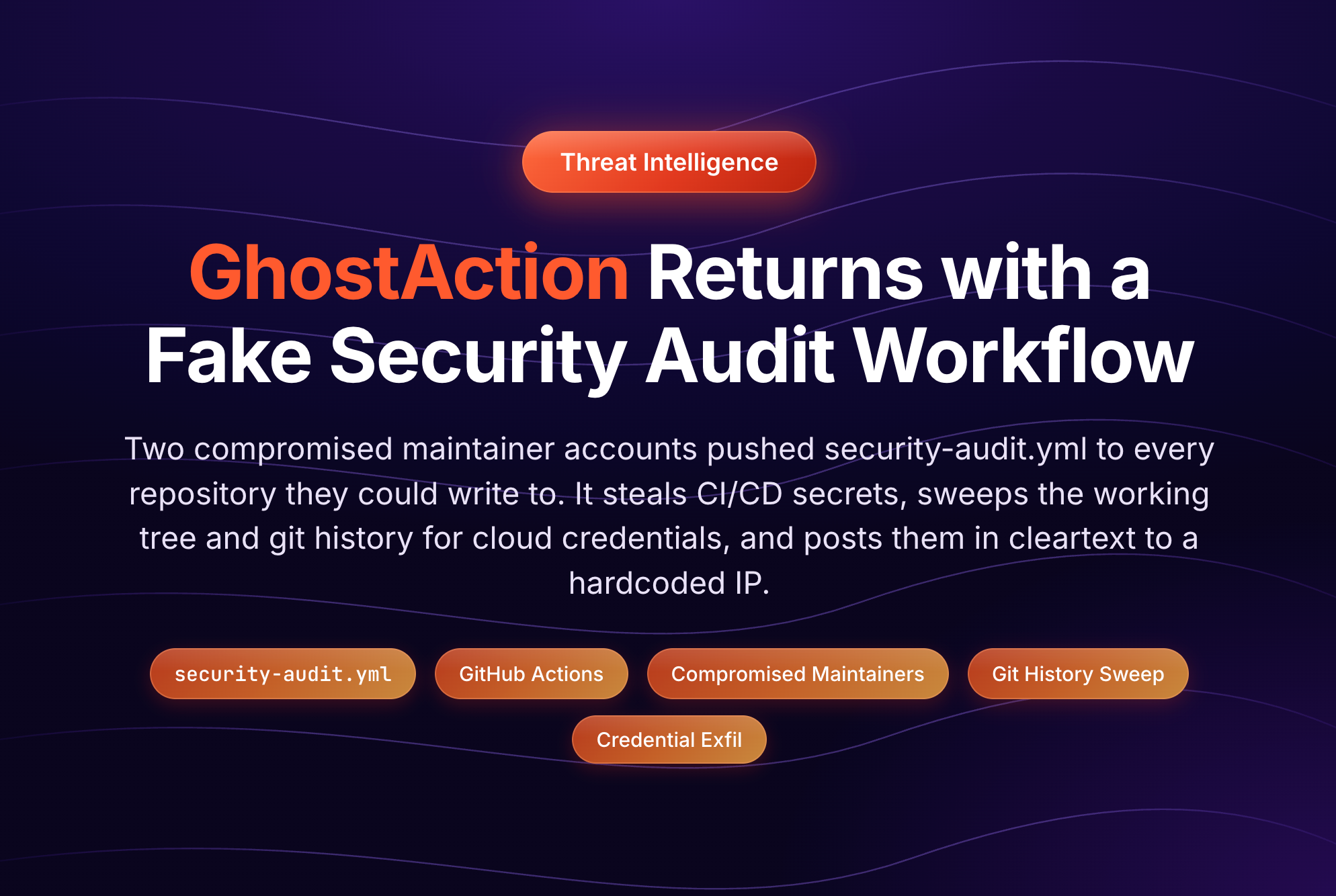 GhostAction Returns: Malicious “Security Audit” Workflows Now Mine Credentials from Entire Git Histories
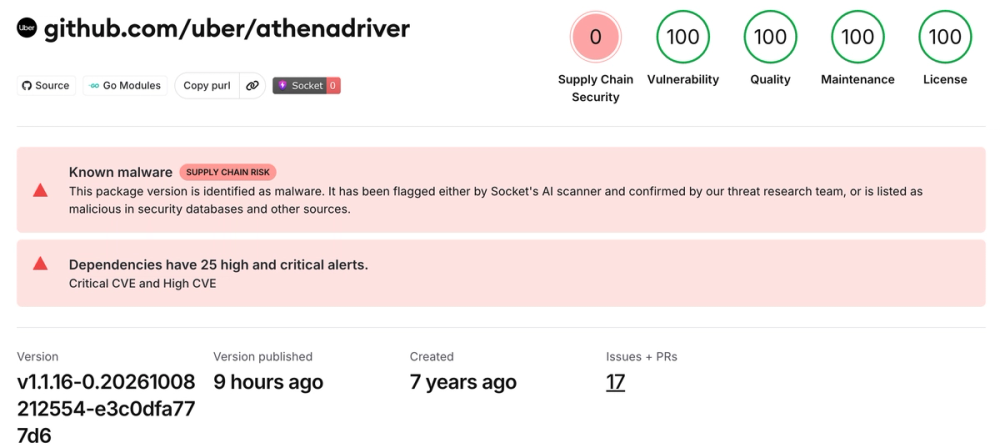
StepSecurity details a new wave of the GhostAction campaign in which attackers used compromised maintainer accounts of Takashi Kitao (pyxel) and Henry Wu (athenadriver, Uber) to push malicious "Security Audit" GitHub Actions workflows to 345 repositories in minutes. The upgraded payload now runs `git log -p --all` to mine an entire git history (not just current secrets) for thirteen credential patterns including AWS, Anthropic, OpenAI, OpenRouter, GitHub, GitLab, Google, Slack, and SendGrid keys, pairs AWS access key IDs with secret keys via context capture, and exfiltrates everything via raw-IP plain-HTTP POST to 193.32.204.199, bypassing DNS-based defenses. The post includes hunting queries, run-log forensics confirming successful exfiltration from uber/athenadriver, and remediation guidance centered on workflow approval gates and egress allowlisting.
 stepsecurity.iowriteupPublished and added 9 Oct 2026🛡️ Security
 New GhostAction Wave Hits Hundreds of Repos, Expanding Beyond CI/CD Secrets to Cloud Credentials
Socket documents an October 8, 2026 wave of the GhostAction campaign in which two compromised GitHub maintainer accounts (henrywoo and kitao) pushed a malicious security-audit.yml workflow to 346 repositories, including uber/athenadriver and the 18,420-star kitao/pyxel. Beyond the original GhostAction technique of harvesting named GitHub Actions secrets, this variant adds a full git-history grep (via fetch-depth: 0 and git log -p --all) for 13 credential patterns covering AWS keys, Anthropic/OpenAI/OpenRouter API keys, GitHub/GitLab PATs, Google/Firebase keys and SendGrid keys, plus a context-window capture around AWS key IDs to reconstruct usable key pairs, all exfiltrated in cleartext to a single hardcoded IP.
 socket.devwriteupPublished and added 9 Oct 2026🛡️ Security
- RM-KLPT: Algebraic Pathfinding for Superspecial Abelian Surfaces with Maximal Real Multiplication
The paper presents RM-KLPT, an algorithm that solves the algebraic pathfinding problem in isogeny graphs of superspecial abelian surfaces with maximal real multiplication. It does this by solving a norm equation in ideals of a quaternion algebra over a real quadratic field. The authors implement it and revisit the RM-CGL hash function of Charles, Goren and Lauter. They show that if the initial surface's algebraic description is known, RM-KLPT gives a second-preimage attack on the hash. Paths are much shorter (~p^3) than with KLPT^2, because a higher-dimensional Deuring correspondence exists in the RM setting. The paper also discusses cryptographic constructions that could be built on RM-KLPT.
eprint.iacr.orgpaperAdded 12 Oct 2026, published 9 Oct 2026🛡️ Security - New Constructions of Quadratic and Cubic Permutations Admitting Optimal Threshold Implementations
ePrint paper giving four constructions of optimal threshold implementations (t+1 shares, no fresh randomness) for bijective S-boxes, a masking countermeasure against differential power analysis and glitch leakage in hardware. It shows that Q30^5 admits optimal TIs, gives a matrix criterion for quadratic permutations (yielding new 6-bit classes), and gives a weighted interpolation construction for power permutations that disproves the Piccione et al. 2023 conjecture. It also gives a derivative-uniform framework that proves every 4-bit cubic permutation admits optimal TIs. A companion repo has TIs for 5-bit quadratic permutations, 4-bit cubic permutations, the PRESENT S-box and GF(16) inversion.
eprint.iacr.orgpaperAdded 11 Oct 2026, published 8 Oct 2026🛡️ Security - James Berthoty (@JamesBerthoty) on X
James Berthoty argues that AI guardrails for first-party AI features should be treated as an extension of cloud/product security, not tied to employee-usage monitoring. Guardrails (prompt injection defense, content filtering, goal alignment) are available from AI security vendors, gateways, frontier providers and SDKs. He recommends deploying in-depth guardrails through developer SDKs or an existing cloud runtime/CADR provider, because those see what happens on the workload (such as a prompt injection leading to workload takeover, or the files a malicious MCP call wrote). Dedicated AI security vendors offer an integrated policy engine and deeper AI red-teaming, but they are usually run by internal IT rather than cloud/product security teams.
x.comthreadAdded 10 Oct 2026, published 8 Oct 2026🛡️ Security  Europol Warns Crypto Wallets Are 'Primary Risk' for Quantum Attacks
Decrypt covers two Europol reports — "Quantum Computing and Cryptocurrencies" (European Cybercrime Centre) and "Harvest Now, Decrypt Later" (with University Carlos III of Madrid) — warning that exposed wallet public keys, not blockchain hash functions, are the primary quantum attack surface for crypto, and that TLS, SSH, and OpenPGP are susceptible to retrospective decryption once quantum computers mature. It details a "just-in-time" attack where a quantum computer derives a private key during the brief window between a transaction broadcasting its public key and confirmation, cites NIST's post-quantum deprecation schedule (phase out classical public-key crypto by 2035), and notes ~30% of BTC supply already has exposed public keys with pre-emptive migration as the only remedy.
 decrypt.coarticlePublished and added 7 Oct 2026🛡️ Security
- Toward Alignment Scaling Laws: A Framework and First Preregistered Measurements
This paper proposes a formal framework for "alignment scaling laws," modeling the compute/capability burden needed to hold a fixed safety target for each risk category as a power law B_r(N)=a_rN^alpha_r, where the exponent alpha_r determines whether alignment gets easier, keeps pace, or accumulates "alignment debt" as capability N grows. The authors prove theoretical results (the largest exponent among corrected risks sets the long-run regime, super-exponential headroom requirements above alpha=1, small-model fits underestimate large-scale exponents for power-law mixtures) and apply a preregistered protocol twice: a reanalysis of adversarial-training data on Pythia classifiers (attack-success compute exponent 0.60) and a pilot across Qwen2.5 (0.5B-72B) and Qwen3 (0.6B-14B), finding scaling helps for truthfulness and stated dispositions but sycophancy (exponent ~0.83-0.89) and a planted backdoor behave worse or remain undetermined, with the backdoor surviving blind safety training at most model sizes. The work matters as an early attempt to put the "does alignment get harder with scale" debate on measurable, falsifiable footing rather than anecdote.
arxiv.orgpaperAdded 7 Oct 2026, published 6 Oct 2026🧠 AI  Prasenjit Sarkar (@stretchcloud) on X
Describes Uber's internally-built ADR (Agentic Detection & Response) system, open-sourced in August with an MLSys paper, which monitors over 50,000 daily AI agent sessions via an MCP-based sensor inside Cursor, Claude Code and Codex. Uber found 206 credential exposures in ten months from normal agent use (not prompt injection), and ADR hits 100% detection with 3 false positives on the public AgentDojo benchmark; the thread also flags that human approval fatigue breaks down as a safety control past roughly 50 agent actions per session.
x.comthreadPublished and added 6 Oct 2026🛡️ Security- Glimpsing the Leakage Flow for Deep Learning-Based Side-Channel Analysis using Stochastic Leakage Model
GlimpseDNN is a model-agnostic framework that uses a stochastic leakage model to visualize, layer-by-layer, what physical leakage information a deep neural network extracts during profiled side-channel analysis (SCA) to recover secret keys. The authors (Trevor Yap and Shivam Bhasin, NTU) validate it on simulated traces and public datasets (ASCADf, ASCADr, ASCADf_desync50, ASCADf_desync100), showing it can reveal leakages even in deeper network layers when they are not visible in raw traces, with applications to designing more side-channel-resistant hardware.
eprint.iacr.orgpaperAdded 8 Oct 2026, published 5 Oct 2026🛡️ Security - NuvexNetwork/nuvex
Nuvex is a Solana-native verifiable compute and oracle protocol, still pre-mainnet, whose own README documents unresolved security gaps instead of hiding them: its VRF proof verification relies on solana-ecvrf 0.0.1 (RFC 9381 ECVRF-Edwards25519-SHA512-TAI) which has no known audit, max_fee is stored but never actually charged, and VRF fulfillment is first-come among any node meeting the configured stake/heartbeat threshold — meaning an operator who funds several keys at a low minimum stake can selectively pick which randomness output gets used. The deploy-mainnet script is stubbed to exit before any transaction, and unresolved design questions (fee shares, challenge/reject state transitions) are tracked as explicitly blocked ADRs rather than quietly shipped.
 github.comrepoPublished and added 2 Oct 2026🛡️ Security
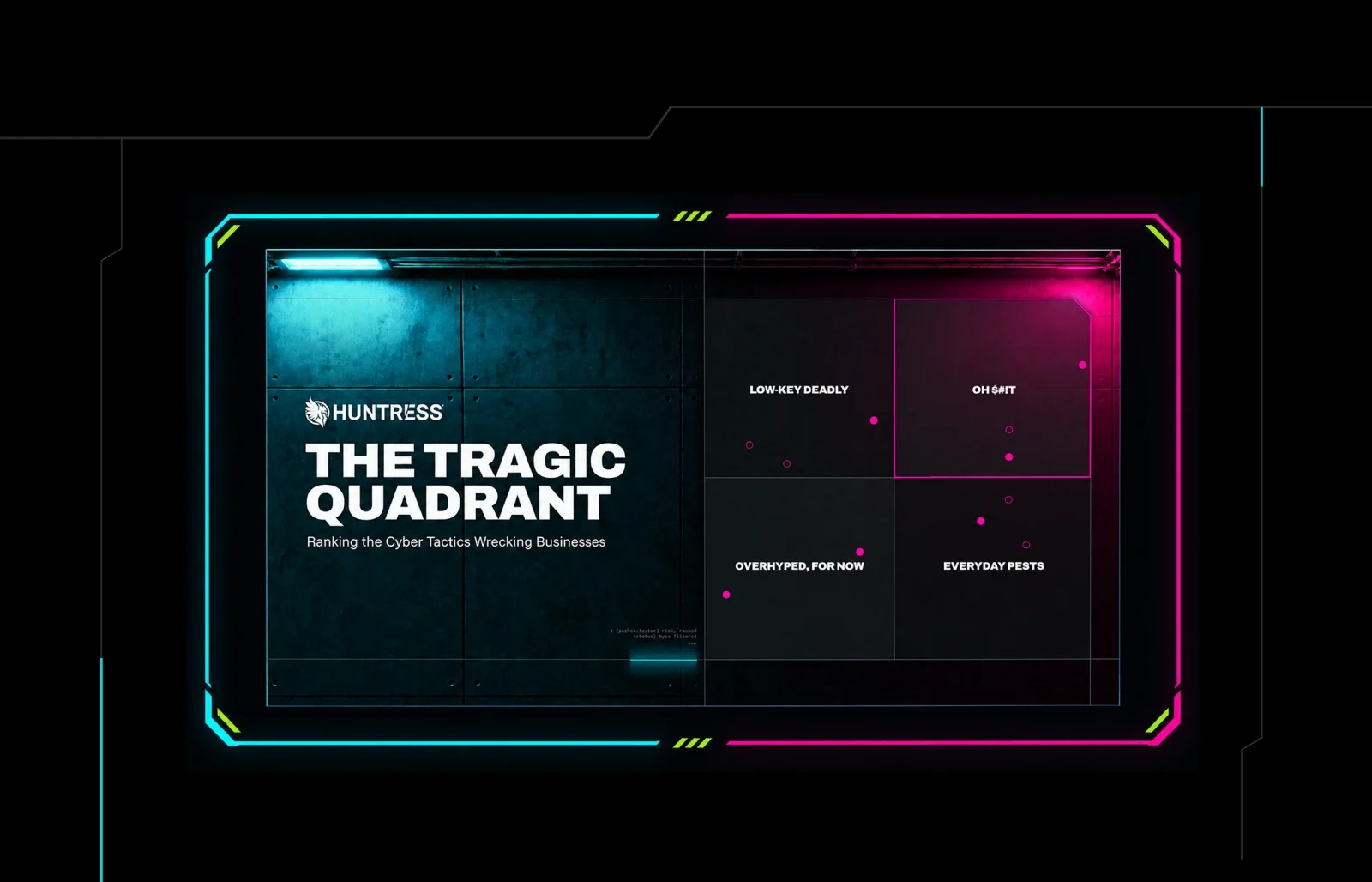
- Huntress Tragic Quadrant: Top Cyber Threats Wrecking Businesses
Huntress's "Tragic Quadrant" ranks the cyber threats its SOC sees most often against small/mid-sized businesses by prevalence and blast-radius risk, drawing on 2026 telemetry from 5M+ endpoints and 15M identities. It highlights RMM abuse (45% of endpoint incidents in Q1 2026), mailbox-rule manipulation feeding BEC (24.6% of ITDR signals), AiTM session-token theft bypassing MFA (18.9% of identity threats), plus device code phishing (the EvilTokens PhaaS kit hit 344 orgs in 16 days using Railway-hosted infrastructure and spoofed Cisco/Trend Micro/Mimecast redirect links), ClickFix clipboard-paste infections leading to LummaC2 infostealer compromise, and emerging AI-platform abuse (the FakeAgent campaign hosted a malicious Claude Artifact on claude.ai to drop SectopRAT, hitting 29 organizations in two days).
 huntress.comarticlePublished and added 1 Oct 2026🛡️ Security
- Andrea (Drego) Draghetti 👨🏻💻 🎣 (@AndreaDraghetti) on X
Tosint v1.0.0 is an open-source Telegram OSINT tool for analyzing bots and chats, exporting message history and media. The new release adds richer JSONL metadata output, optional SHA-256 hashing of exported media, bot/user authentication support, and an automatic fallback from MTProto-based history retrieval to ID-scan mode when dealing with restricted chats.
x.comrepoAdded 2 Oct 2026, published 30 Sep 2026🛡️ Security  Block Sparse Attention with Log-Linear Complexity (PISA)
PISA is a block-sparse attention mechanism that replaces the quadratic block-selection step of conventional sparse attention with a pyramid Top-K strategy: keys are organized into a coarse-to-fine hierarchy of O(log N) levels built via pooling, and LogSumExp scoring narrows candidates level by level down to the finest granularity, giving overall O(N log N) complexity instead of O(N^2). The authors implement hardware-aware Triton kernels for both training and inference that fuse hierarchical routing and scoring without ever materializing the full query-key score matrix, and show on language modeling benchmarks that PISA matches baseline performance on commonsense reasoning while improving results on retrieval tasks.
 huggingface.copaperAdded 28 Sep 2026🧠 AI
- Denoising Multi-Robot Trajectories
This paper extends D4orm, a dynamics-aware diffusion-denoising framework for multi-robot trajectory planning, into a family of planner architectures: a decoupled planner for scalability, an online receding-horizon planner with feedback control, and a distributed planner for resource-constrained settings. D4orm uses massively parallel GPU sampling to iteratively denoise candidate control trajectories into kinodynamically feasible, conflict-free solutions, outperforming sampling-based baselines like MPPI and a learned diffusion-model method. The authors demonstrate zero-shot deployment on ten real quadrotors, deconfliction with 100 simulated robots, and fully onboard distributed 'lifelong' operation on six ground robots.
arxiv.orgpaperAdded 29 Sep 2026, published 28 Sep 2026🧠 AI - dagoSte/squadra
Squadra (version 3.11.0) is an MIT-licensed Python 3.12+ tool that coordinates several Claude Code, Codex and interactive Cursor windows on one project through a shared local registry. It records tasks, acknowledgements, source-bound proofs and independent reviews by a window that did not write the code. A local dashboard shows progress, per-window token usage and model-balance suggestions, and community plugins extend it. The page was truncated, so later sections are not covered.
github.comrepoAdded 27 Oct 2026, published 28 Sep 2026🧠 AI - Quantum Feature Selection for Biomedical Data Analysis
This paper formulates metabolomic feature selection as a Quadratic Unconstrained Binary Optimization (QUBO) problem, balancing feature relevance against redundancy to prepare high-dimensional data for machine learning models like computational biomarkers. The authors test Bias-Field Digitized Counterdiabatic Quantum Optimization (BF-DCQO) and QAOA on gate-based quantum hardware, comparing against classical filter, wrapper, and embedded feature selection methods (including exhaustive search and Iterative Tabu Search) on three Autism Spectrum Disorder metabolomic datasets. Results show reduced runtime versus exhaustive/Tabu search and competitive classifier performance, though the authors explicitly do not claim quantum advantage, framing the work as a NISQ hardware feasibility demonstration.
arxiv.orgpaperAdded 26 Sep 2026, published 24 Sep 2026🧠 AI 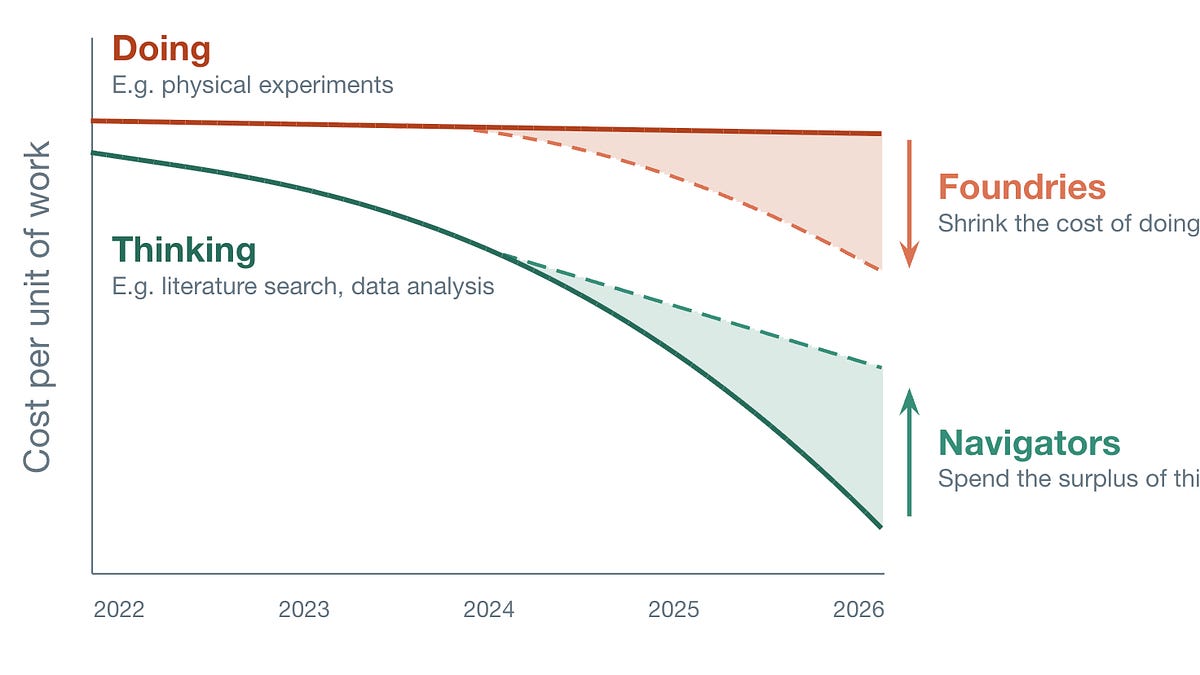 Foundries vs Navigators: Lowering the Cost of Science
A guest post on Latent Space by Endura Therapeutics CEO Adrian Sanborn arguing biotech companies are adapting to AI in two distinct ways: foundries such as Xaira, NewLimit and Insitro that industrialize experimental data generation, versus navigators that use LLMs to speed up the ordinary work of running a company through faster bespoke data analysis, in-house dashboards replacing commercial lab software, and fleets of LLM research agents. It details a concrete case: Endura built a two-stage LLM triage pipeline that screened roughly 500 disease targets and then deep-dived about 100 of them, compressing what would have been decades of expert-analyst time into a short automated pass, followed by human diligence on the finalists.
 latent.spacewriteupAdded 29 Sep 2026, published 24 Sep 2026🧠 AI
 Socket: Malicious Extensions Drain Axiom Trade and Padre Crypto Sessions
Socket's Threat Research team identified six malicious Chrome and Firefox extensions (J7Tracker, VREO, Orbit Tracker, GhostApe, GhostApe Color) that steal authenticated session tokens, Firebase access tokens, and wallet-related data from users of the Axiom Trade and Padre crypto trading platforms. The extensions abuse a byte-identical collection module (axiom-fetch-intercept.js) that reads localStorage/IndexedDB and exfiltrates data by encoding it into URLs opened via browser navigation to Vercel-hosted C2 endpoints, evading manifest-based host-permission review since navigation isn't subject to CORS/CSP connect-src restrictions. The report includes full IOCs (extension IDs, C2 domains, hashes), attribution links via shared code and publisher portfolios, and defender guidance for hunting and blocking the campaign.
socket.devwriteupPublished and added 12 Sep 2026🛡️ Security- sage — Agent Detection & Response (ADR) for AI coding agents
Sage is an "Agent Detection & Response" (ADR) security layer that intercepts tool calls made by AI coding agents — shell commands, URL fetches, file writes — and screens them through multiple detection layers before execution. It combines cloud URL reputation, 300+ YAML local heuristics, a two-tier (heuristic + fine-tuned ML) prompt-injection detector for fetched content, npm/PyPI package supply-chain checks (registry existence, file reputation, age), installed-plugin scanning at session start, and Windows AMSI integration. It ships as a plugin for Claude Code, Cursor, VS Code, OpenClaw, and OpenCode, and is published by Gen Digital (also distributed under the Norton/Avast Sage branding).
github.comrepoAdded 10 Sep 2026🛡️ Security



Showing 30 of 37
Show more