 Hackers exploit Cisco SD-WAN flaw to deploy custom KeyDrift malware
UAT-11473, a newly tracked APT cluster, exploits CVE-2026-20127, a max-severity authentication bypass in Cisco Catalyst SD-WAN Controllers (patched February 2026), to deploy the KeyDrift malware framework. KeyDrift's PolyFlame runs inside vdaemon processes, and LittleFilch hooks SSL_read to extract AES-256 IPsec keying material, saved to /var/tmp/vdaemon.bin and sent over UDP. Targets include space, defense and policy organizations. Talos sees overlap with Volt Typhoon's Silent Train network but makes no definitive link.
 bleepingcomputer.comarticleAdded 30 Oct 2026, published 29 Oct 2026🛡️ Security
 NIK C2: The new AI-enabled command-and-control framework
NIK C2 is a newly observed C2 framework with a Go-based 64-bit Windows implant that embeds an OpenAI Chat Completions client (ai_generate command), falling back to the victim's OPENAI_API_KEY. Talos details its 52+ commands, AES-256-GCM over WebSocket with HTTP fallback, credential, wallet and keystroke theft, screen-lock ransomware, AMSI bypass and anti-debug. It also lists a live C2 at 87.120.196[.]120 and total-sitevv[.]lol.
 blog.talosintelligence.comwriteupPublished and added 29 Oct 2026🛡️ Security
- Beyond the Scope of This Paper: Practical Flash-Accelerator and Cache-Collision Timing Attacks on Microcontrollers
Colin O'Flynn's paper shows that the flash accelerator in most microcontrollers produces the same timing collisions as a cache, so cacheless Cortex-M devices remain open to cache-collision attacks on AES. AES keys were recovered from as few as 750 traces across six cryptographic libraries, eight architectures and over twenty devices. It also attacks SPI bootloaders, Ethernet, CTAP2 over USB and 802.15.4, and releases the open-source tool FlashWhisperer.
 eprint.iacr.orgpaperAdded 31 Oct 2026, published 29 Oct 2026🛡️ Security
 Pentesting: Twelve Caesars – Community Tools for Offensive Security
Hackers Arise walks through four tools from Praetorian's "12 Caesars" open-source release: Titus (secret scanner with 487 rules and credential validation), Nerva (fingerprints 170 protocols), Brutus (Hydra alternative covering 40+ protocols) and Julius (fingerprints 60+ LLM services such as Ollama). It shows download and run commands in a Kali lab and how the tools chain together. The tools are Go single binaries; the post notes an exposed Ollama on port 11434 allows unauthenticated model use.
 hackers-arise.comarticlePublished and added 27 Oct 2026🛡️ Security
 Revisiting AES Key Wrap: Forgery Bounds, Structural Observations, and Recommendations for the Revision of NIST SP 800-38F
Revisiting AES Key Wrap is an ePrint paper (2026/2636) by John Preuß Mattsson, expanded from technical comments to NIST on the SP 800-38F revision. It shows the stated forgery probabilities ignore adaptive attacks and gives corrected bounds for KW, KWP and TKW. It also shows KW lacks beyond-birthday-bound security, since a forgery leaks a plaintext prefix and an encryption-only distinguisher exists.
eprint.iacr.orgpaperAdded 26 Oct 2026, published 25 Oct 2026🛡️ Security Inside the LiteLLM 1.107.0 supply chain compromise: Credential theft through Python startup hooks
Microsoft's analysis of the LiteLLM 1.107.0 compromise, published to PyPI and container images on 21 October 2026. The wheel shipped cook.pth, cook.py and sitecustomize.py, so a credential collector (PRIVCOLLECT) ran whenever Python started, even without importing LiteLLM. It covers AES/RSA-encrypted exfiltration to litellm.dev, a re-armable Unix loader, Defender KQL hunting queries, ATT&CK mapping and rotation guidance.
 microsoft.comwriteupPublished and added 23 Oct 2026🛡️ Security
- Pairwise Independence of Ten-Round AES
Pairwise Independence of Ten-Round AES (Zhongfeng Niu, Kai Hu, ePrint 2026/2608) proves that ten rounds of AES with independent uniform round keys and input/output whitening are within 3017/2^141 (below 2^-129) statistical distance of pairwise independent. The proof bounds the averaged difference-distribution matrix over five superbox layers, using Gram moments and MDS code constraints. Final-round MixColumns omission is retained.
eprint.iacr.orgpaperAdded 24 Oct 2026, published 23 Oct 2026🛡️ Security - Anti-Forensics: Building a Phantomdrive
Phantomdrive is an open source USB drive built on the WCH CH569 chip that appears as a plain 8GB disk and hides the rest of an SD card behind AES-256 encryption. The hidden partition unlocks when the user saves "password:" in a text file; the firmware catches it in raw WRITE10 traffic and zeroes the buffer. Key derivation uses a per-device salt and 100,000 SHA-256 rounds, and the post compares AES-ECB, CTR and XTS speeds.
hackers-arise.comarticlePublished and added 22 Oct 2026🛡️ Security - The Good, the Bad, and the Noisy: A Systematic Analysis of Ring-Oscillator-Based Noise Generators
This IACR ePrint paper (2026/2597) systematically compares ring-oscillator-based additive noise generators, a hiding countermeasure against side-channel attacks. Experiments show many existing designs ignore output amplification and the risk of the noise being filtered out, so they lower signal-to-noise ratio too little. The authors give a guideline on inverter chain length, output amplification and frequency randomization, and build a tailored generator for an AES implementation that outperforms prior designs.
eprint.iacr.orgpaperAdded 24 Oct 2026, published 22 Oct 2026🛡️ Security - Dan Kornas (@DanKornas) on X
aula-mcp is an open-source (MIT) TypeScript MCP server that connects an AI client to Denmark's Aula school platform. It exposes tools for profiles, calendar events, messages, notifications, posts and weekly plans. MitID credentials and OAuth tokens are stored in macOS Keychain or an AES-256-GCM encrypted file. The HTTP server binds to 127.0.0.1, and the presence write tool stays off until AULA_MCP_WRITE=1 is set.
 x.comrepoAdded 23 Oct 2026, published 22 Oct 2026🧠 AI
 LiteLLM 1.107.0 PyPI Wheel Contains a Credential Stealer and Persistent Python Backdoor
LiteLLM 1.107.0 macOS x86-64 PyPI wheel analyzed by OpenSourceMalware contains three injected files (cook.pth, cook.py, sitecustomize.py) that run on every Python start. The payload, called privcollect, steals browser, SSH, cloud, CI/CD and AI-tool credentials, then uploads an AES/RSA-encrypted bundle to www.litellm.dev/healthcheck. A forked loader also fetches domain.txt from GitHub and executes /codepy hourly. The post lists IOCs, hashes and remediation steps.
 opensourcemalware.comwriteupPublished and added 21 Oct 2026🛡️ Security
- Blind-DLPA: An End-to-End Framework for Profiled Blind Side-Channel Analysis
Blind-DLPA is a multi-task deep-learning framework for profiled blind side-channel analysis, where the attacker has labeled profiling traces but only leakage traces from the target, with no plaintexts or ciphertexts. It estimates Hamming-weight posteriors of an input and a key-dependent intermediate, then ranks key hypotheses against theoretical joint distributions. It recovers keys on unprotected AES and Kyber and on ASCAD (guessing entropy zero with 39 traces), and the authors report collisions in a prior Ascon Hamming-weight model.
eprint.iacr.orgpaperAdded 20 Oct 2026, published 19 Oct 2026🛡️ Security - Saylor (@Kev96790724) on X
G-Krusch is an MIT-licensed, local-first Google Workspace hub built on Node.js 22 and SQLite WAL. It runs a 12-tool MCP server (SSE and Stdio) plus a REST bridge on port 5446 for Drive, Calendar and Gmail. It includes a 1,024-dimension hybrid Drive RAG with an embedding cascade (Ollama bge-large, then Gemini, then offline fallback) and FTS5 BM25. PDF extraction returns page citations. Tokens are kept in an AES-256-GCM vault; 30 of 30 tests pass.
x.comrepoAdded 21 Oct 2026, published 19 Oct 2026🧠 AI - Enjoy FAEST on Hardware: Efficient and Novel Hardware Acceleration of Emerging Post-Quantum Digital Signature Scheme FAEST
This ePrint paper (2026/2525, October 2026) by Brendan Funk and Jiafeng Xie presents the first hardware accelerator for FAEST, an MPC-in-the-head post-quantum signature in NIST's Round 3 additional-signature process. It analyses FAEST's compute-heavy operations, builds them into hardware blocks, and adds an L1-EM-fast variant. The authors report at least 98% lower equivalent area-delay product than the recent complete SDitH design at the same security level.
eprint.iacr.orgpaperAdded 19 Oct 2026, published 18 Oct 2026🛡️ Security - DPA-style Attacks on VOLE-in-the-Head Signature Schemes
Presents the first DPA-style power side-channel attack framework against VOLE-in-the-Head signature schemes, targeting the secret witness whose recovery enables forging signatures on arbitrary messages. It analyzes leakage from sensitive intermediate values in VOLE correlations and proposes six attack classes (two vertical, four horizontal) on FAEST and SDitH, both in NIST's third round of additional signatures. Attacks are validated with simulated leakage under varying noise and real measurements on three ARM Cortex-M4 devices.
eprint.iacr.orgpaperPublished and added 17 Oct 2026🛡️ Security - FAEST on GPUs: Addressing Field Multiplication as a Bottleneck
ePrint paper presenting an NVIDIA GPU implementation of FAEST (a post-quantum signature scheme built on VOLE-in-the-Head and QuickSilver), covering key generation and OWFProve/OWFVerify for standard and EM constructions in s and f variants. Profiling shows field multiplication takes about 82% of FAEST-128f signing time once AES is hardware-accelerated. Using PTX clmad carry-less multiplication plus Karatsuba, it reaches up to 26.6x kernel throughput and about 2.9-3.1x full 256-bit OWFProve throughput over the software-multiplication build on an RTX A5000.
eprint.iacr.orgpaperPublished and added 15 Oct 2026🛡️ Security - A Hybrid BP-SAT Attack on MILENAGE: Combining the Complementary Strengths of Algebraic and Soft-Analytical Side-Channel Attacks
ePrint paper evaluating ASCA (SAT-based) and SASCA (belief propagation) side-channel attacks on the AES-based MILENAGE authentication algorithm in USIM cards, using neural-network leakage predictions to recover subscriber key K and operator secret OPc from a single trace. SASCA alone succeeds in 87.7% of attacks but converges to a wrong OPc in 6.1%; ASCA succeeds in only 34% within a 1-hour timeout. The hybrid, where BP refines the predictions before they go to the SAT solver, reaches 93.8% with lower average runtime. It also proposes a countermeasure that masks each AES round key with an independent per-device secret, and the authors report it defeated the hybrid attack in all evaluated cases.
eprint.iacr.orgpaperAdded 15 Oct 2026, published 14 Oct 2026🛡️ Security  Quantum-Aware Key Rank for Side-Channel Attacks evaluation
Proposes a cost model and metric for an adversary who collects side-channel traces classically and finishes the key search on a quantum computer. Shows any quantum algorithm needs Omega(sqrt(r)) cipher evaluations for key rank r, and that the quadratic advantage holds only up to a rank bound set by the NIST MAXDEPTH budget (about 2^58.6 for AES-128 at D=2^40). Defines a quantum-aware key rank computable from existing rank estimators, with simulated-leakage experiments showing a depth-limited quantum adversary is worth about 22 traces at SNR 0.125.
 arxiv.orgpaperAdded 16 Oct 2026, published 14 Oct 2026🛡️ Security
- EmoGenie: Benchmarking and Evaluating Expressed and Evoked Emotion in T2I Generation with MLLMs
EmoGenie is a benchmark for emotions expressed and evoked by text-to-image outputs. It has 6,400 images from eight T2I models using 800 emotion-targeted prompts. It includes EmoGenie-QA (90,000 closed-set and 1,057 open-ended questions) and EmoGenie-Assess (13,175 mean opinion scores for valence, arousal, dominance and aesthetic quality). The authors also propose EmoProbe, which pairs emotion QA with response-aligned, dimension-specific regression heads. They report that it beats baselines on emotion QA and correlates better with human ratings. The work shows how reliably MLLMs interpret affect in generated images.
arxiv.orgpaperAdded 14 Oct 2026, published 13 Oct 2026🧠 AI  XWorm RAT Evolves Into Surveillance Platform
SecurityWeek summarizes Netskope research showing the XWorm Windows RAT grew from 35 plugins (July 2025) to 46 (October 2026), adding surveillance features: Maps (GPS location without prompt), Microphone (live audio streaming), webcam capture, and HBrowser. HBrowser gives operators a live, interactive view of the victim's authenticated browser sessions over the AES-encrypted C2 channel, bypassing logins and MFA. Activity rose after the builder was cracked in June 2025 and the 6.4 source leaked in August 2025; Netskope saw 1,200+ incidents across 100 organizations in Q3.
 securityweek.comarticlePublished and added 13 Oct 2026🛡️ Security
- Benchmarking Answer-Grounding Consistency in Remote Sensing Visual Question Answering
Proposes the Answer-Evidence Support Protocol (AESP), which checks whether the grounding evidence a model outputs actually supports its own answer in grounded remote sensing visual question answering. It applies task-specific rules to existence, counting and comparison questions. The authors build the G-RSVQA benchmark of 15,027 samples with questions, reference answers and object-level annotations. Tests on seven grounded vision-language models show evidence-support failures on all three question types, with up to 50.82% of correct answers unsupported by their grounding evidence.
arxiv.orgpaperAdded 12 Oct 2026, published 9 Oct 2026🧠 AI  Understanding AI, Part I: The Machines That We Taught
Galaxy Research's explainer traces AI's intellectual history from the 1956 Dartmouth Workshop and the Logic Theorist through the symbolic-AI era (expert systems like Mycin and XCON, the Cyc project) to the sub-symbolic/connectionist revival (Perceptron, Hopfield networks, backpropagation, LeCun's CNN zip-code reader) that culminated in deep learning and the 2017 Transformer architecture. It then surveys three machine-learning paradigms (supervised, reinforcement, unsupervised) and five deep generative architectures (autoregressive, diffusion, GANs, VAEs, normalizing flows), closing with how modern LLM chatbots combine these via pretraining, SFT, and RLHF, and how multimodal, reasoning, RAG, agent, and world-model systems extend base LLMs.
 galaxy.comarticleAdded 8 Oct 2026🧠 AI
- Comparative Evaluation of Open-Source Gröbner Basis Implementations for Small-Scale AES Polynomial Systems over GF(2)
This IACR ePrint paper benchmarks 20 open-source Gröbner basis implementations against the proprietary Magma system on polynomial systems derived from small-scale AES over GF(2), using Easy/Medium/Hard difficulty tiers with ten instances each. In the Hard setting, msolve and Singular's slimgb completed all runs successfully with mean runtimes of 164s and 269s and peak memory of 3693/4343 MiB respectively, versus Magma's 319s and 16853 MiB, with msolve exploiting ~13.4 CPU cores versus ~1 core for the others. The results quantify when open-source algebraic solvers are practical alternatives to Magma for algebraic cryptanalysis of block ciphers.
eprint.iacr.orgpaperAdded 8 Oct 2026, published 5 Oct 2026🛡️ Security - GPU-Assisted FAEST v3 Signing: Challenge Grinding and CPU–GPU Pipelining
An IACR ePrint paper presenting a GPU-assisted implementation of FAEST v3 signing, a post-quantum signature scheme, focusing on two problems: preserving the correct minimum accepting counter when parallelizing "challenge grinding" across GPU threads, and building a two-slot CPU-GPU pipeline to overlap CPU work with GPU batches for multi-signature throughput. Across the six non-EM FAEST v3 parameter sets, the authors find the CPU-GPU path beats optimized CPU-only signing for single-sign latency in 4 of 6 cases (up to 1.6x speedup for FAEST-192s) and wins throughput in 9 of 18 parameter/batch-size combinations, with GPU correctness validated to match the reference signature output.
eprint.iacr.orgpaperAdded 8 Oct 2026, published 5 Oct 2026🛡️ Security  Pretty Themes, Hidden Loaders: GlassWorm-Linked Extensions Span VS Code Marketplace and Open VSX
Socket's Threat Research team uncovered a theme-extension cluster spanning four VS Code Marketplace and six Open VSX listings, including two confirmed malicious extensions: Aurora Nocturne Night Theme (a Windows downloader that fetches and silently executes temp_batch.cmd via cmd.exe from fingercakes4sale[.]store, tied to XWorm C2 infrastructure) and Cosmic Nebula Themes, whose app.js decrypts an AES-256-CBC embedded stage and uses a Solana transaction memo as a dead-drop to resolve follow-on payload infrastructure — the same AES key, Solana address, and execution model previously documented in GlassWorm activity. Git commit identities, near-identical theme source, shared Russian-language developer comments, and brandjacking (Coca-Cola, Aurora Borealis name-squatting) link the cluster together; a Dec 14, 2025 DEV Community article is assessed as promotional infrastructure driving Open VSX installs. The post provides full IOCs (hashes, domains, Solana address, AES key/IV, GitHub accounts) and MITRE ATT&CK mappings for defenders to hunt and inventory extensions across both registries.
 socket.devwriteupPublished and added 2 Oct 2026🛡️ Security
- FuseReg: Regularizing Layer Fusion Mitigates the Reconstruction-Generation Gap in Representation Autoencoders
FuseReg is a training method for representation autoencoders (RAEs) that replaces fixed heuristic selection of pretrained-encoder layers with training over random subsets of encoder layers, explicitly regularizing sensitivity to cross-layer disagreement. On ImageNet-256 with DINOv3-L, a single FuseReg decoder matches or beats decoders specialized to fixed layer fusions across full, sparse, and single-layer configurations, and swapping it into an unchanged RAEv2 DiT-XL generator cuts unguided gFID by 27%; joint regularization during diffusion training further reduces unguided gFID by 29% on DiT-Base. The work targets the trade-off where shallow encoder layers preserve pixel detail but deep layers yield better generation metrics, narrowing the reconstruction-generation gap without modifying the pretrained encoder.
arxiv.orgpaperAdded 28 Sep 2026, published 25 Sep 2026🧠 AI - On the Diffusibility of High-Dimensional Latents
This paper studies Representation Autoencoders (RAEs), which let diffusion models generate images in the feature space of pretrained visual encoders. It shows that finetuning encoders for better reconstruction reduces the effective dimensionality of their representations, which makes standard velocity-prediction flow matching inefficient because the model must fit noise directions orthogonal to the low-dimensional signal manifold; switching to x0-prediction (clean data parameterization) instead consistently improves text-to-image generation across multiple strong-reconstruction encoders.
arxiv.orgpaperAdded 24 Sep 2026, published 23 Sep 2026🧠 AI 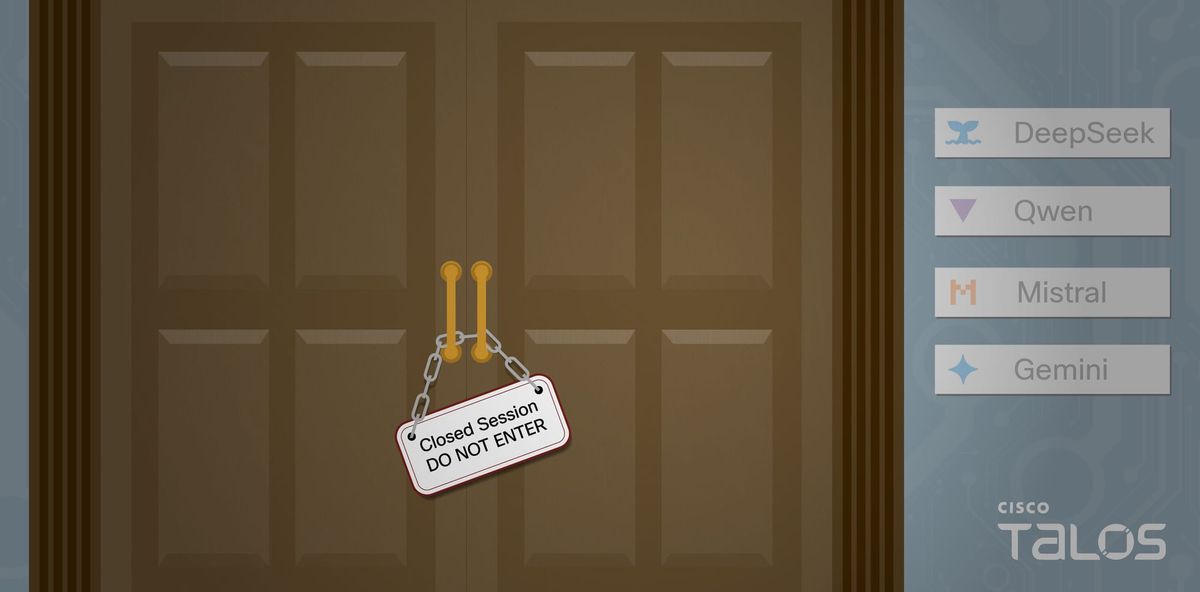 The Closed Quorum: Inside the First Reported Autonomous AI C2 Implant
Cisco Talos' CAIRN project documents CLOSEDQUORUM, a 64-bit Go Windows implant that replaces traditional C2 infrastructure with a panel of up to four commercial LLM providers (DeepSeek, Qwen, Mistral, Gemini) that vote on the implant's next action via plurality voting, with each model queried against a structured JSON decision schema constrained to inject/persist/steal/move actions. Once deployed it autonomously dumps LSASS credentials, steals browser passwords and crypto wallets (MetaMask, Exodus, Ethereum), and exfiltrates AES-256-GCM-encrypted data to an operator's Discord webhook, all without further human tasking. The post details the developer's apparent credentials-as-a-service distribution model, deterministic tie-breaking favoring DeepSeek, and provides SHA256 hashes plus a YARA detection rule for the family (formerly tracked as BALZAK).
blog.talosintelligence.comwriteupAdded 30 Sep 2026, published 22 Sep 2026🛡️ Security- Compromised npm Packages in the AsyncAPI Namespace Deliver Miasma Botnet Loader
Socket's Threat Research Team details a supply-chain compromise of four @asyncapi npm packages (generator-helpers, generator-components, generator, specs) published via a poisoned source commit through GitHub Actions trusted publishing. The packages contain an obfuscated load-time (not install-hook) implant that spawns a detached Node.js process to fetch an IPFS-hosted, AES-256-GCM-encrypted loader delivering the "Miasma" botnet/tasking framework, which supports REST C2, multi-channel comms (Nostr, IPFS, Ethereum RPC, BitTorrent DHT), shell execution, file exfiltration, and systemd persistence. Includes full technical analysis, IOCs, hashes, and MITRE ATT&CK mapping.
socket.devwriteupAdded 21 Sep 2026🛡️ Security - OWASP Agentic Skills Top 10 (AST10)
The OWASP Agentic Skills Top 10 (AST10) is a new security framework cataloging the 10 most critical risks in AI agent "skills" — the behavior layer that orchestrates multi-step tool use in OpenClaw, Claude Code, Cursor/Codex, and VS Code. It documents real 2026 incidents (the ClawHavoc registry-poisoning campaign with 1,184 malicious skills, Snyk's ToxicSkills audit of 3,984 skills finding 36.82% flawed, CVE-2025-59536/CVE-2026-21852 RCE in Claude Code project files, and CVE-2026-28363 ClawJacked WebSocket hijacking) and proposes a Universal Skill Format (YAML) with signing, permission allowlists, and identity-file protections to mitigate them, mapped to CSA's MAESTRO 7-layer threat model.
 github.comrepoAdded 18 Sep 2026🛡️ Security


Showing 30 of 67
Show more