 Hugging Face malware campaign returns to hijack GPUs for crypto mining
A campaign of 31 malicious Hugging Face repositories across seven accounts, found by Pluto Security, posed as small Qwen2 checkpoints and used trust_remote_code to run a cryptominer and reverse shell on GPU inference hosts. The top model reached 28,412 downloads and scanned clean, and a second wave returned within days of takedown. The article also covers a fake Solana starter kit on GitHub that installs NetSupport Manager via a PowerShell one-liner aimed at AI coding agents.
 bleepingcomputer.comarticleAdded 30 Oct 2026, published 29 Oct 2026🛡️ Security
 Node2Shell: Brotli Flaw Triggers Patching Across Microsoft, Node.js, Python Packages
CVE-2026-111497 (Node2Shell) is an out-of-bounds write in Google's Brotli decoder, versions 1.0.3 through 1.2.0, rated CVSS v4 9.2. Fixed in Brotli 1.0.10, 1.1.1 and 1.2.1, with patches from Node.js, Microsoft (.NET, Visual Studio, PowerShell on October 25), PyPI Brotli and brotlicffi, Bun, Envoy and Istio. Imperva showed code execution on Node.js 24.22.0 arm64; no in-the-wild exploitation is reported and some researchers say it only enables DoS.
 securityweek.comarticlePublished and added 26 Oct 2026🛡️ Security
 David Gutierrez | Eng (@david_x_ai) on X
Thread on a critical opencode bug disclosed by Pillar Security on Oct 19. On Windows and WSL, a remote MCP server could run code during OAuth sign-in, because the server-chosen authorization URL was put unescaped into a PowerShell command, so a PowerShell subexpression executed. opencode fixed it in 1.18.33 on Sep 28 as a browser-launch refactor with no advisory or CVE. MCP Inspector published an advisory for the same bug class, and its fix needs a major bump of the open package.
 x.comthreadAdded 27 Oct 2026, published 25 Oct 2026🛡️ Security
- Field Notes: Reconstructing an Attacker’s Workflow
Field note from dfir.ch on PowerShell scripts an attacker left on disk during an incident: a file-watching command runner using Invoke-Expression, a fake Windows credential prompt that validates passwords via Start-Process and logs them in cleartext, AD computer enumeration with WMI access testing, and SMB share discovery via NetShareEnum. It notes where script labels overstate what they prove and lists hunting strings for Event IDs 4104, 4103, 4688 and Sysmon 1.
 dfir.chwriteupAdded 24 Oct 2026, published 22 Oct 2026🛡️ Security
 Santhosh Patel (@santhosh_patell) on X
Summary of Pillar Security research on opencode, in which a malicious remote MCP server runs code on a Windows or WSL machine during the OAuth login step. The login URL goes unsanitised into PowerShell through the npm "open" package, so an https:// link containing $(...) executes. Affected versions are 1.0.137 to 1.18.32, fixed in 1.18.33 (28 September) as a "refactor" with no advisory or CVE. The behaviour was first reported in 2020 as a WSL 2 broken-link bug.
x.comthreadAdded 21 Oct 2026, published 19 Oct 2026🛡️ Security CikaBika Bot RAT Uses Discord for C&C
SecurityWeek reports Darktrace's findings on CikaBika Bot, a Rust-based RAT delivered via a PDF containing a disk image with an LNK disguised as a Word document. A hidden PowerShell step drops a Nim loader and a Rust DLL that is moved into the protected Edge directory to bypass UAC and sideloaded via DLL search-order hijacking of debugging-library exports. The RAT uses per-victim Discord channels for C&C (recon, command execution, file transfer, screenshots/camera) and exfiltrates ZIPped data via Ngrok.
securityweek.comarticlePublished and added 15 Oct 2026🛡️ Security- Dark Web Informer (@DarkWebInformer) on X
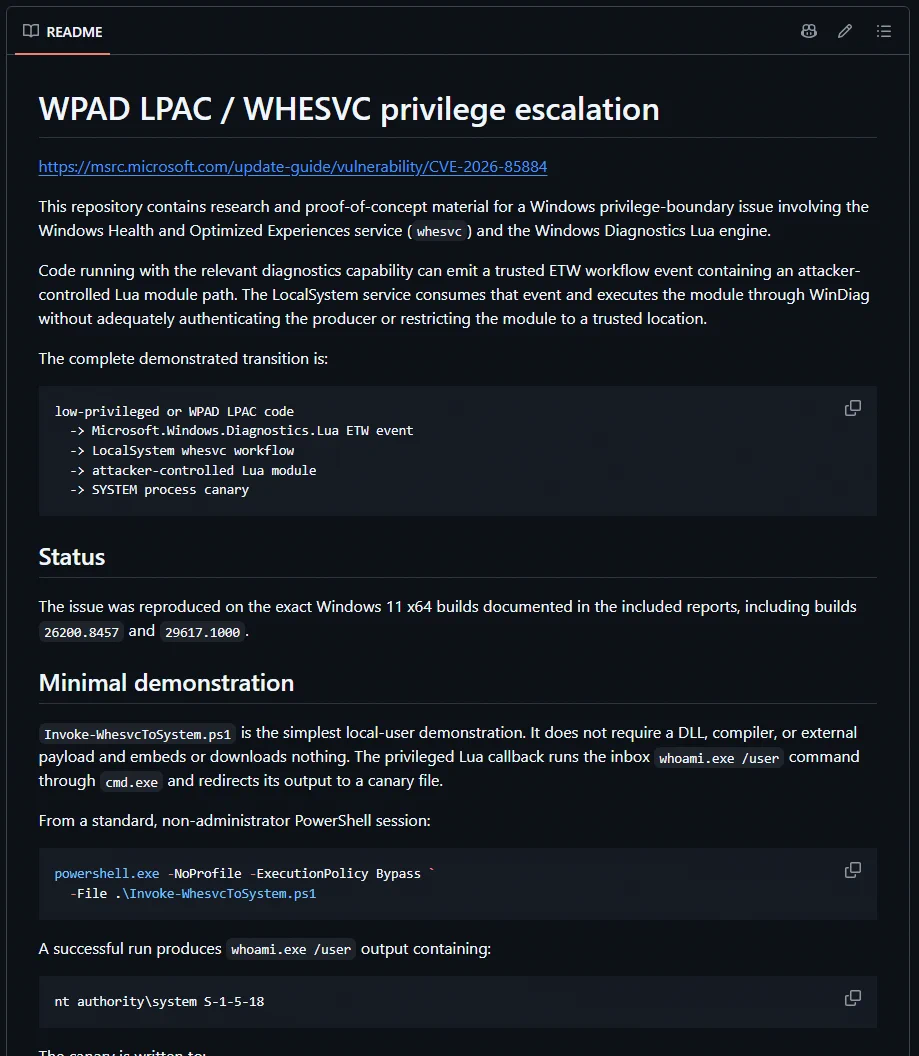
DarkWebInformer post on a PoC for CVE-2026-85884, a Windows 11 local privilege escalation in the Windows Health and Optimized Experiences service. Low-privileged code can trigger a trusted ETW event carrying an attacker-controlled Lua module path. The LocalSystem whesvc service then runs that module through WinDiag without validating the event producer or restricting the module location. The PoC takes a standard non-admin PowerShell session to NT AUTHORITY\SYSTEM on Windows 11 x64 builds including 26200.8457 and 29617.1000.
x.comthreadAdded 15 Oct 2026, published 14 Oct 2026🛡️ Security  Break the silence: Kazakhstan-nexus UAT-6275 targets CIS government organizations
Cisco Talos and Recorded Future Insikt Group describe UAT-6275 (TAG-193, overlapping Silent Lynx and YoroTrooper), a suspected Kazakhstan-nexus actor targeting CIS government, water and energy organizations. Exposed staging directories and a GitHub repo revealed four infection chains (macro documents, PS2EXE downloaders, GitHub-hosted PowerShell, and a WinRAR CVE-2025-8088 archive) delivering custom reverse shells Chvost, Laplas and PickleShell, plus Linux tooling and a FortiWeb CVE-2025-25257 PoC. The post includes victimology, a campaign timeline, attribution rationale (medium confidence), defender guidance and ClamAV/Snort coverage.
 blog.talosintelligence.comarticlePublished and added 14 Oct 2026🛡️ Security
- Field Notes: EtherRAT Distributed Through a Legitimate Intune Workflow
DFIR case where a malicious MSI impersonating Advanced IP Scanner, sourced from a fake GitHub repo found via Bing, was imported by a customer into Microsoft Intune and deployed to four endpoints, running a Node.js-based EtherRAT chain. It traces the infections by correlating the MSI ProductCode, MDMAppInstaller/omadmclient process ancestry and Intune app inventory (Graph PowerShell query). It also covers renamed node.exe hash-hunting pitfalls, Ethereum RPC dead-drop C2 traffic, a screen-capture script and a second impersonating repo.
dfir.chwriteupAdded 14 Oct 2026, published 13 Oct 2026🛡️ Security - Ned Peterson (@NedPeterson99) on X
A post summarizing a joint FBI and six-country advisory on actors tied to Integrity Technology Group (the sanctioned Chinese firm linked to Flax Typhoon and the Raptor Train botnet). They password-sprayed Microsoft 365 and Exchange accounts over EWS, OWA, ActiveSync and PowerShell with EBurst. They then drained mailboxes with a PHP bot over Exchange Web Services and an office-cli utility using stored client ID, tenant ID and secret values, and exposed the stolen email to third parties through a web app, in some cases restricted to Xiamen IP addresses. Victims were in government, law enforcement, healthcare and religious organizations across Southeast Asia, Africa and North America, with activity since at least January 2021. Defensive takeaways: enforce MFA on every legacy path, retire basic auth and EWS, audit OAuth apps and service principals with mail-read rights, and alert on bulk mailbox pulls.
x.comthreadAdded 11 Oct 2026, published 9 Oct 2026🛡️ Security - Threat Actors Exploit Critical AhsayCBS Flaws to Drop Webshells and XMRig Cryptominer
Huntress documents active exploitation of two AhsayCBS (Ahsay Cloud Backup Server) vulnerabilities being chained together: CVE-2026-105133, an authentication bypass in checkSysPwd, and CVE-2026-105134, an unauthenticated RCE in the Replication Receiver's UpdateReceivers.do endpoint that grants SYSTEM. Attackers use the chain to drop JSP webshells, then deploy a renamed XMRig cryptominer (masquerading as msedge.exe via a modified NSSM binary), a Task-Manager-aware anti-detection PowerShell script, and the vulnerable WinRing0x64.sys kernel driver for hardware-level miner access. Huntress provides IOCs, mitigation guidance (restrict management interface, re-image if compromised) and four Sigma rules targeting each stage of the intrusion chain.
 huntress.comwriteupAdded 9 Oct 2026, published 8 Oct 2026🛡️ Security
- Phishing Campaign Abuses Microsoft Power BI to Deploy Rogue RMMs
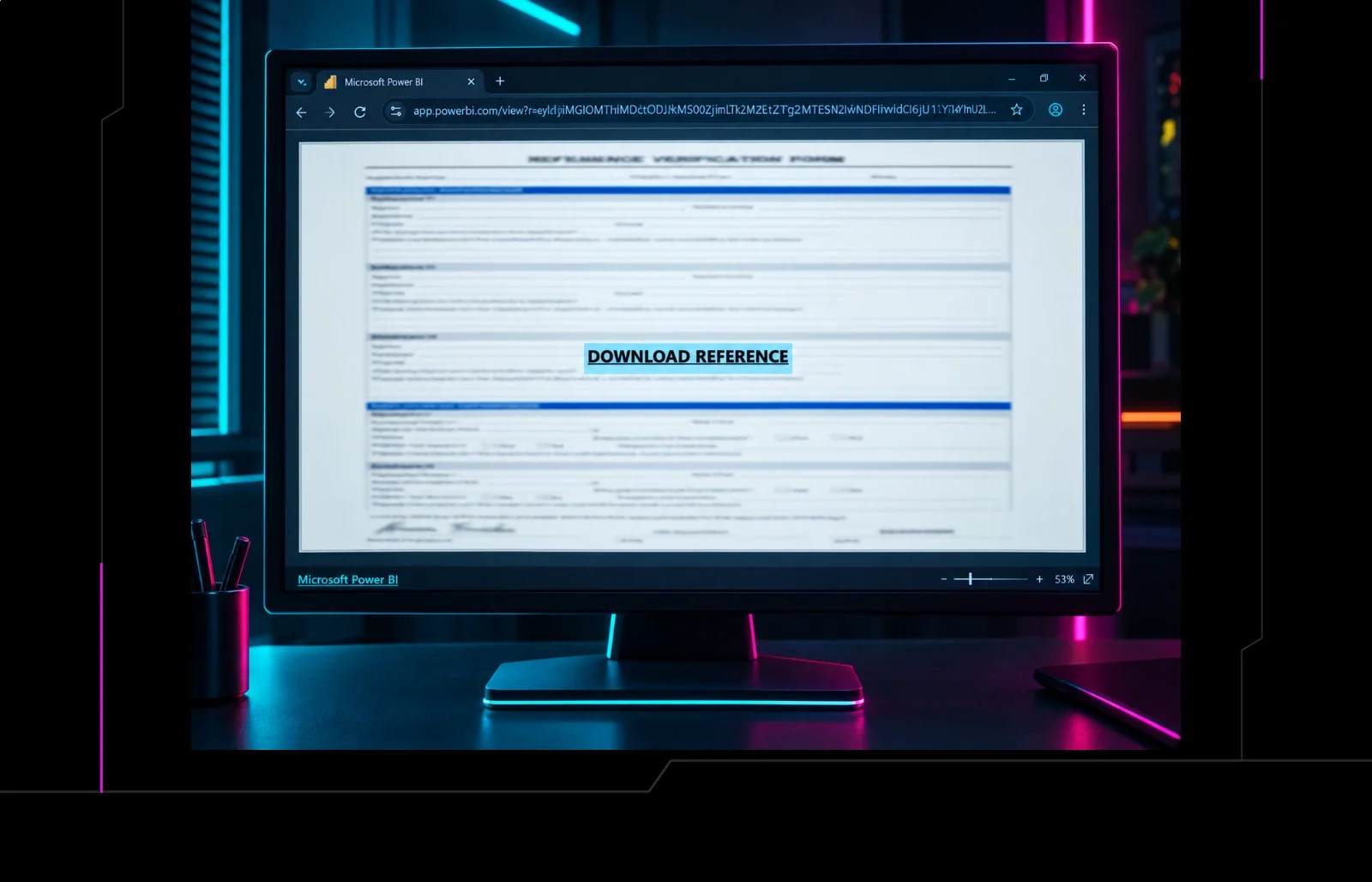
Huntress details a phishing campaign that abuses legitimate Microsoft Power BI dashboards (app.powerbi.com) to host a fake "Download Reference" lure that bypasses mail filters trusting the Microsoft domain. Clicking the lure triggers browser/environment fingerprinting and Telegram-bot-based victim telemetry exfiltration via attacker domains (dailylifeproject.site, burnsworth.site, etc.), then silently downloads rogue ScreenConnect installers; a chained CMD/PowerShell script (SCAutoFix.ps1) deploys a second ScreenConnect instance, uninstalls the first for evasion, drops the defense-evasion tool HideUL_x64.exe, and sets a recurring scheduled task before Huntress's SOC intervened.
huntress.comwriteupPublished and added 7 Oct 2026🛡️ Security - Up a Creek Without a Command Line: Mapping an Akira Ransomware Attack | Huntress
Huntress researchers reconstruct an Akira ransomware attack timeline using forensic artifacts collected after the Huntress agent was installed post-compromise, including Windows Registry Shellbags, Event Logs, and Akira ransomware log files. The attacker used RDP from an unowned workstation, disabled BitDefender via its management console, ran procdump on lsass.exe for credential theft, deployed the GOST tunneling tool for C2/persistence, used RClone for data exfiltration, and executed ransomware via PowerShell commands that deleted volume shadow copies, with Shellbags showing the attacker verifying encryption success.
huntress.comwriteupPublished and added 6 Oct 2026🛡️ Security  Blinder Tunnel Campaign Targets Iraqi Infrastructure
Unit 42 details "Blinder Tunnel," a campaign by Iranian state-aligned actor CL-STA-1178 (linked to Elastic's "The Shelby Strategy") that impersonated Dubai Airports recruiters to deliver a trojanized Visual Studio coding-challenge archive against an Iraqi critical-infrastructure target, with related activity against UAE aviation and Israeli entities via Google Drive-themed phishing. The report dissects a three-stage infection chain (weaponized .csproj MSBuild target abuse, AppDomainManager hijacking to disable ETW, and DLL sideloading into RuntimeBroker.exe) that deploys ShelbyLoader V2, the ShelbyC2 V2 RAT, PsProxy.dll (in-memory PowerShell execution), and Blackwood, a custom Chisel-based tunneling loader; C2 abuses GitHub's API and GitHub Issues as a dead-drop fallback, and attribution rests on an Iranian-hosted IP, Persian-domain infrastructure overlap, and MP3 metadata pointing to MusicDel.ir. Includes full IOCs (hashes, IPs, phishing domains, registry keys).
 unit42.paloaltonetworks.comarticlePublished and added 6 Oct 2026🛡️ Security
- Zhenyu98/codex-chatgpt-bridge
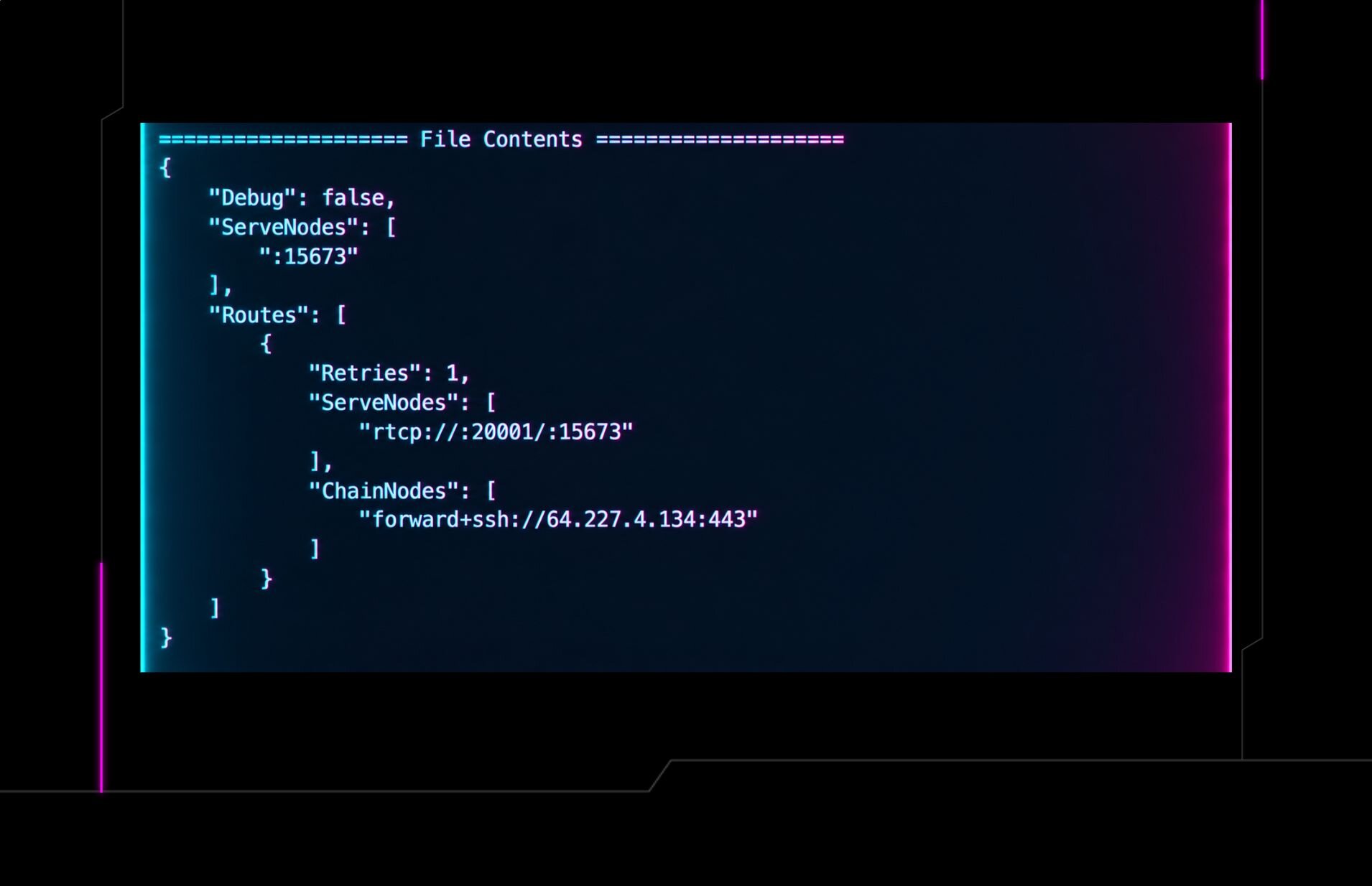
codex-chatgpt-bridge is a Codex agent skill plus external PowerShell control scripts (On/Off/Reboot/Rotate) built on top of the open-source DevSpace MCP bridge, which lets ChatGPT act as a planning/review "architect" while Codex stays the local executor that applies and verifies changes. It adds a token-saving router (NORMAL / TOKEN_SAVING / CHATGPT_ARCHITECT modes) and a lifecycle layer — Cloudflare Quick Tunnels or a stable Cloudflare Worker proxy, DPAPI-protected credentials, OAuth token rotation, and a scheduled-task recovery entrypoint — so the bridge's public endpoint can be closed when idle without re-authorizing the ChatGPT app on every restart.
 github.comrepoAdded 5 Oct 2026🧠 AI
- The First 24 Hours: What Happens When Ransomware Lands
An hour-by-hour ransomware incident response playbook written by UnderDefense CEO Nazar Tymoshyk and published on Huntress's blog, covering confirmation, containment, exfiltration detection, backup/recovery pitfalls, and root-cause investigation in the first 24 hours of an attack. It draws on Mandiant's M-Trends 2026 report (14-day median dwell time, 22-second access-broker-to-ransomware handoff) and CISA's November 2025 Akira advisory (VPN without MFA as primary access vector, exfiltration via FileZilla, WinRAR, WinSCP, RClone, Mega and Ngrok, credential dumping with Mimikatz and LaZagne, PowerShell-based shadow copy deletion) alongside real UnderDefense engagement anecdotes.
huntress.comwriteupAdded 3 Oct 2026, published 2 Oct 2026🛡️ Security - Defender Exclusion Abuse: How Attackers Hide Malware from MDAV
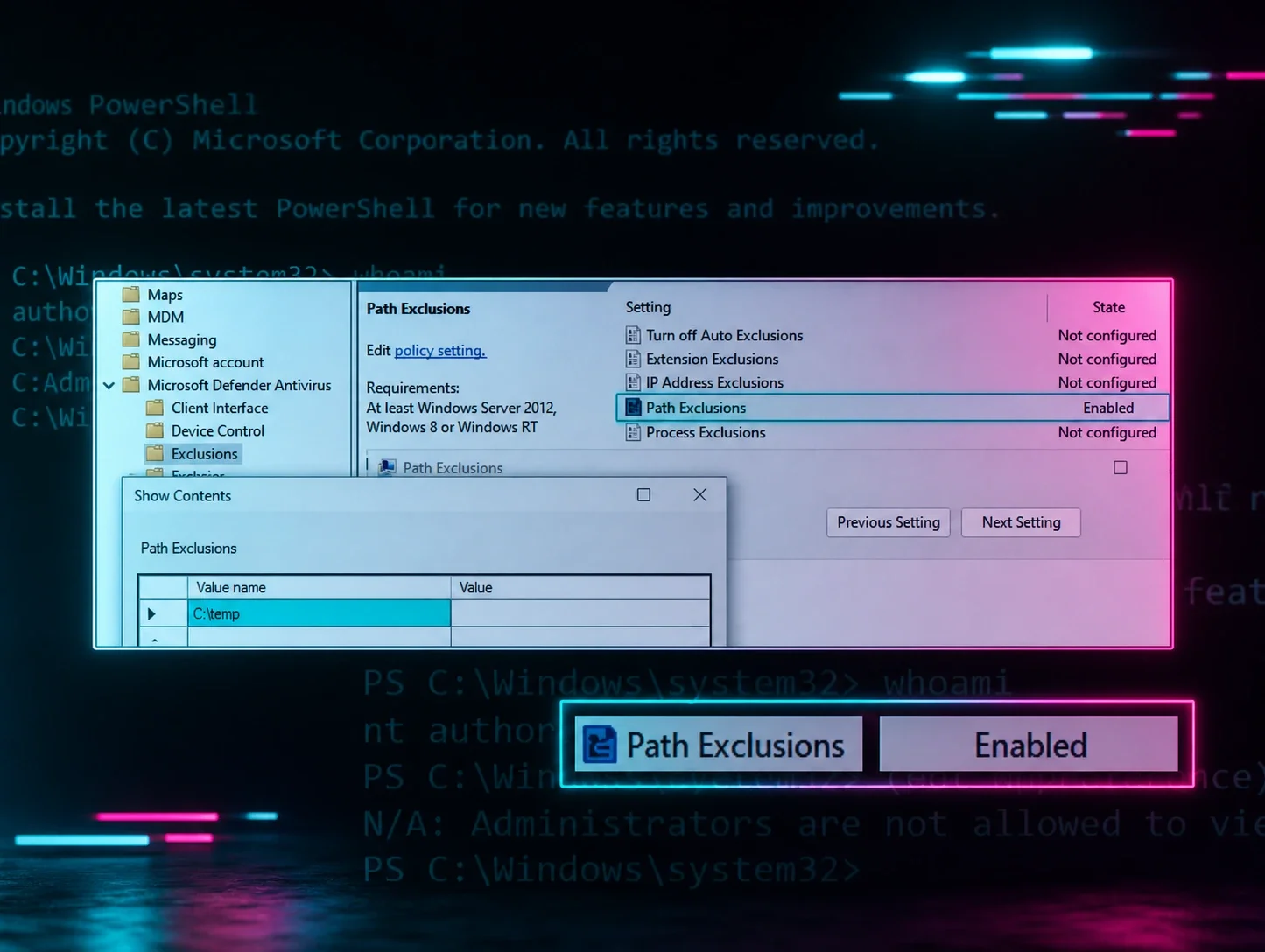
Huntress breaks down how Microsoft Defender Antivirus (MDAV) path/extension exclusions can be abused to hide malicious binaries from scans, detailing the registry internals (HKLM...Windows Defender\Exclusions vs the GPO-driven Policies key) and the four ways to set them: PowerShell (Set/Add-MpPreference), the MSFT_MpPreference WMI class, GPO, and direct registry edits. It documents real-world abuse by GootKit (2019), WhisperGate (2022), and Muddled Libra (2024), plus an under-documented trick where setting HideExclusionsFromLocalAdmins blocks even SYSTEM from querying exclusions via PowerShell/WMI, and describes the registry-level telemetry and detections Huntress built to catch both behaviors.
huntress.comwriteupAdded 1 Oct 2026, published 30 Sep 2026🛡️ Security  China-nexus UAT-11587 targets government and policy organizations across Asia with Antino backdoor
Cisco Talos details UAT-11587, a China-nexus threat cluster targeting government, defense, and policy organizations across Taiwan, India, the Philippines, Cambodia, and other Asian countries with spear-phishing and a five-stage infection chain (HTA/WSF stagers, JScript decryptors, .NET BinaryFormatter/ActivitySurrogateSelector deserialization gadgets, and DLL sideloading via the signed GatherOsState.exe) to deploy a new Rust-compiled backdoor called Antino. Antino uses Microsoft Graph/Outlook/OneDrive as a dead-drop C2 channel instead of a traditional C2 server, supports shell/PowerShell execution, file transfer, shellcode loading with a sleep-mask evasion technique, and abuses the Windows Scripted Diagnostics framework for persistence; Talos also notes possible infrastructure overlap with Symantec's "Jewelbug" cluster and Arctic Wolf's UNC6384 reporting. Includes ClamAV/Snort coverage and IOCs.
blog.talosintelligence.comwriteupAdded 7 Oct 2026, published 30 Sep 2026🛡️ Security- Determined Attacker Uploads Malicious Webshells to Parks and Rec Management Platform Servers
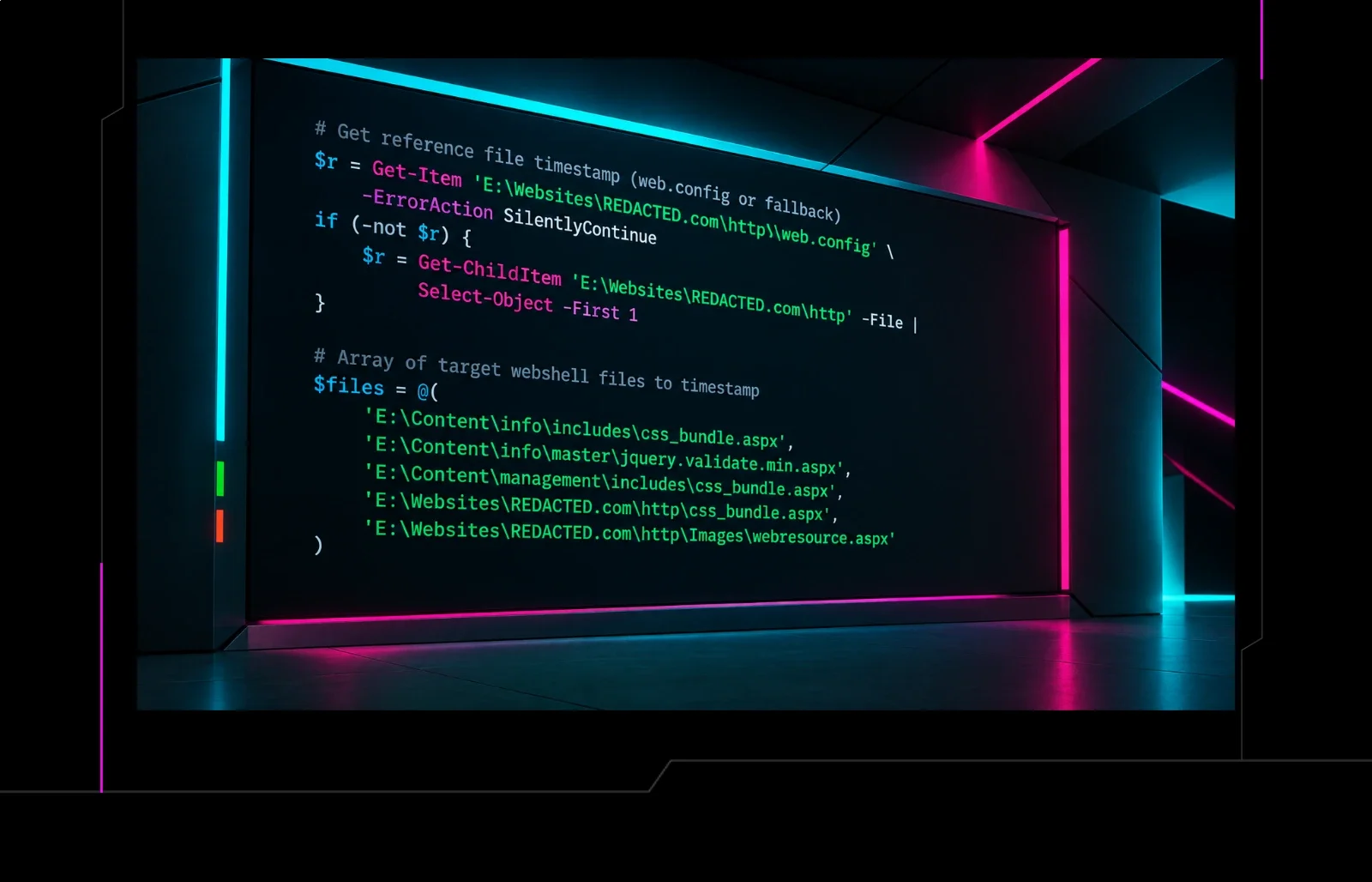
Huntress details a four-act intrusion against a shared parks-and-recreation management platform running on IIS, where an attacker first tried noisy unauthenticated exploits (IIS 8.3 tilde enumeration, WebDAV verb abuse, upload-handler bypasses) before simply registering a member account and uploading .aspx webshells via a member-file upload feature across three servers. The attacker enumerated hosts, extracted web.config/connection strings, hunted for cardholder data (Fortis/MXMerchant webhook logs, CVV/card-number strings), then escalated to timestomping, re-deploying known-filename webshells, and finally injecting an AI-generated PowerShell/JS dropper into a trojanized jQuery file to turn site visitors' browsers into WebRTC/WebSocket C2 clients (ririmochii/bubuneeko Cloudflare Workers infrastructure). Includes a zh-CN PowerShell user-agent string used for attribution and full command/IOC listings useful for detection engineering.
huntress.comwriteupAdded 1 Oct 2026, published 30 Sep 2026🛡️ Security  Phishing Abuses RMM Tools for Persistent Access
Microsoft Defender Experts document a July 2026 phishing campaign that delivers a masqueraded but legitimately signed MSP360 RMM installer (v2.5.0.67) via meeting-invite, Zoom, Adobe, and DHL-themed lures hosted on both attacker infrastructure and legitimate cloud services (S3, Cloudflare R2, Dropbox, GitLab, Supabase). After UAC-elevated installation and service persistence, the RMM.Agent.exe service launches PowerShell to silently install a ConnectWise ScreenConnect client via msiexec, which the actor then uses via RunFile to drop credential-theft and reconnaissance tools disguised as Windows/Defender/Phone Link components. A separate July intrusion used FaronicsDeployAgent.exe the same way to deploy ScreenConnect, showing the technique is not MSP360-specific; Microsoft provides IOCs, hunting queries, and mitigation guidance (Application Control, AppLocker publisher rules, ASR rules) but does not attribute the activity.
 microsoft.comwriteupAdded 7 Oct 2026, published 29 Sep 2026🛡️ Security
- Attackers Abuse ChatGPT Custom GPTs to Deliver RAT via ClickFix
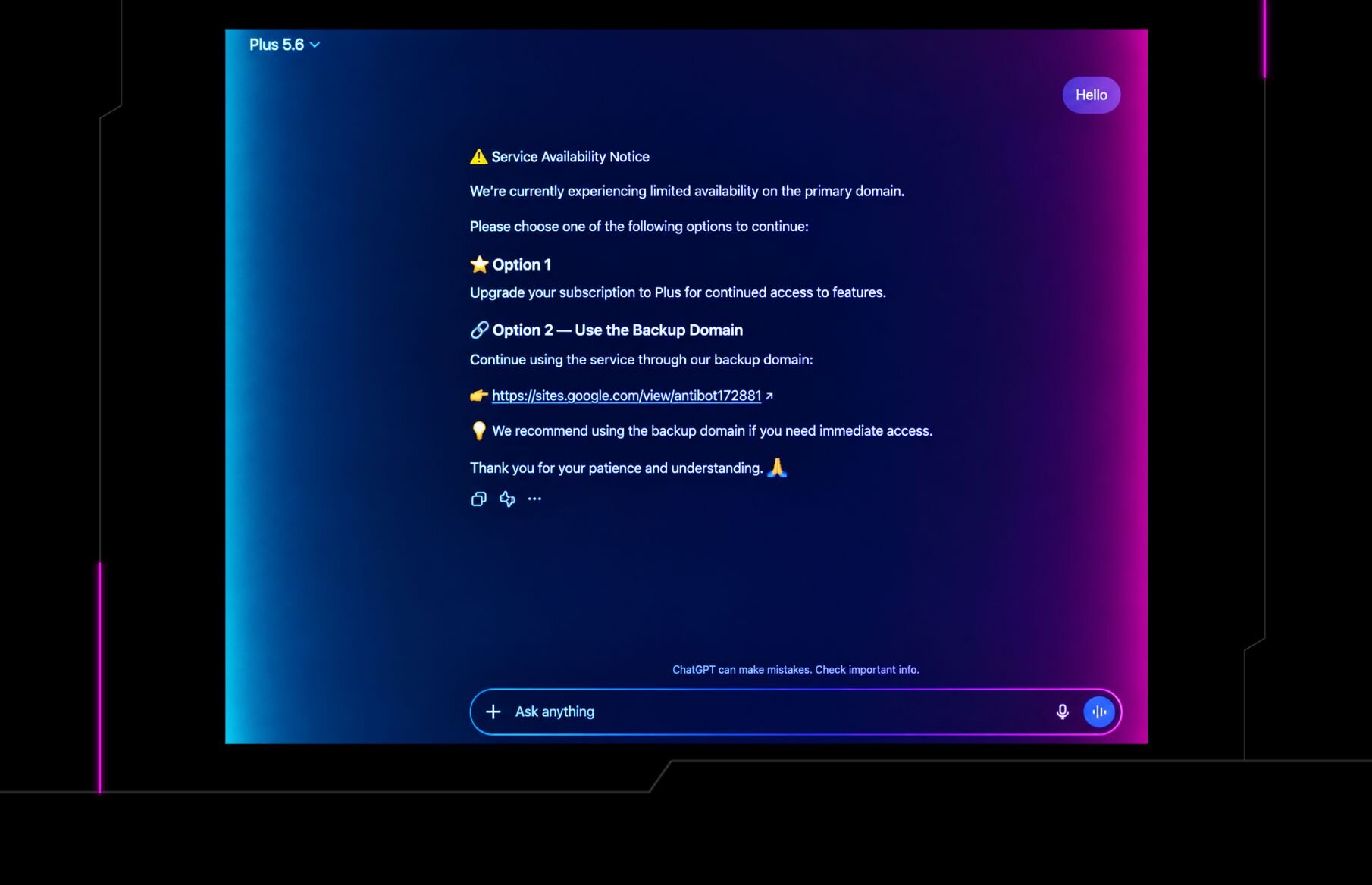
Huntress researchers document a campaign where attackers built a malicious ChatGPT Custom GPT ("Plus 5.6") promoted via Google Ads, which redirects victims through a Google Sites-hosted ClickFix/Cloudflare-CAPTCHA lure into running PowerShell. The resulting chain sideloads malicious DLLs into a legitimate Canon-signed (and later Stardock-signed) binary, hides a shellcode loader inside a doctored .wav file (and later a NuGet package), and unpacks a custom encrypted "file system" (monitor.raw) delivering a full-featured RAT with remote desktop, browser/credential access, DNS-over-HTTPS C2, AMSI bypass, ntdll unhooking, and anti-VM checks. Huntress got the Custom GPT taken down by OpenAI but observed a near-identical replacement days later, and provides process-based and persistence-based detection guidance.
huntress.comwriteupAdded 29 Sep 2026, published 28 Sep 2026🛡️ Security - The Not So Silent Miner: Threat Actor Compiles Cryptominer on the Endpoint
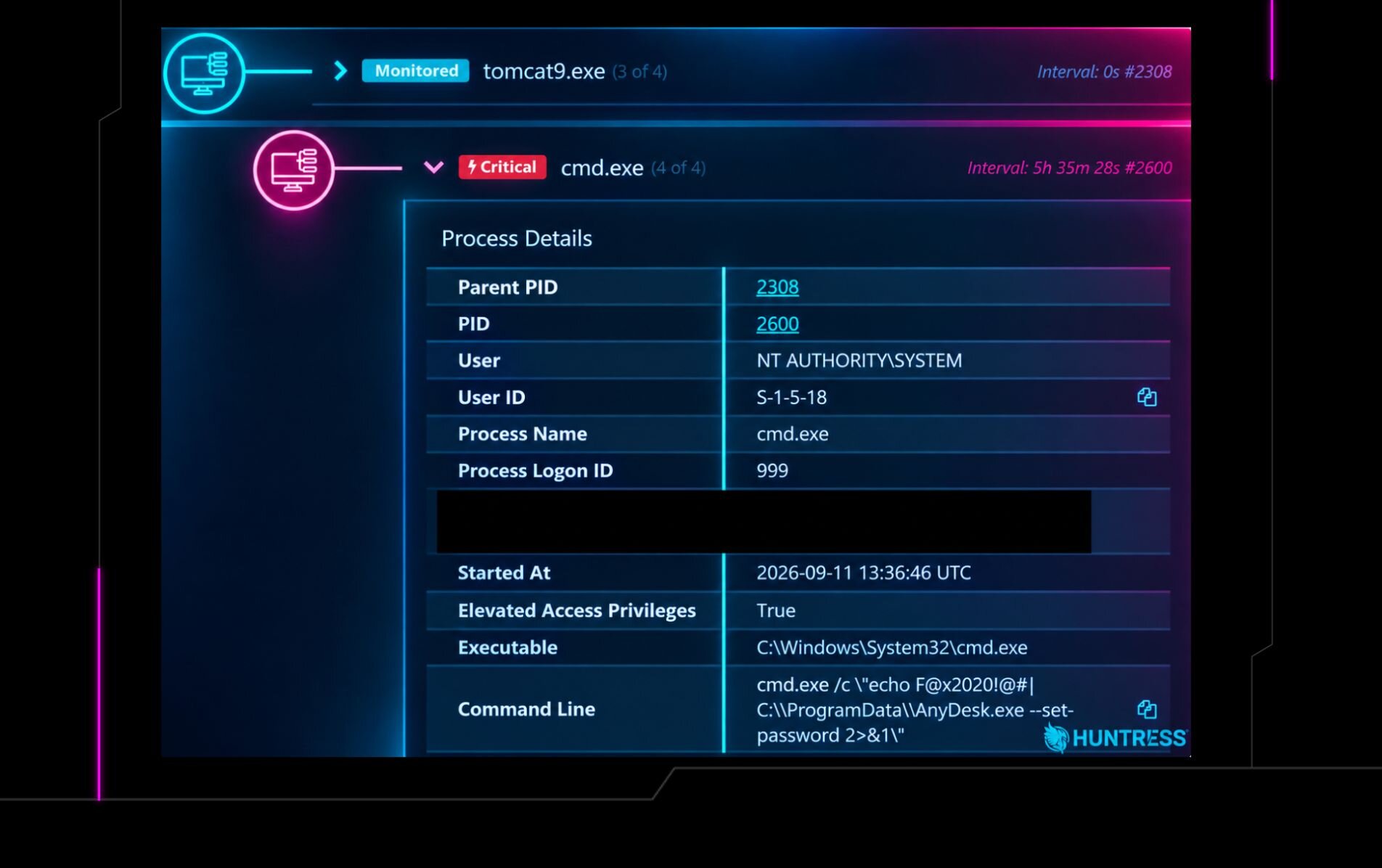
Huntress SOC analyzes an intrusion that began with exploitation of Samsung MagicINFO (CVE-2025-4632, after incomplete fix of CVE-2024-7399) via tomcat9.exe. The actor took three tries to install AnyDesk (certutil and PowerShell attempts were blocked by Defender), created an 'oldadministrator' account, disabled Defender, then ran Silent XMR Miner Builder, which compiled a Monero miner on the endpoint using csc.exe, cvtres.exe, donut, tcc and MinGW gcc. The miner ran masquerading as explorer.exe against C3Pool; the post gives command lines and detection ideas such as unusual compiler child processes from an unsigned parent and explorer.exe with mining arguments.
huntress.comwriteupPublished and added 24 Sep 2026🛡️ Security - Google Doc Sidebar Sends Mac and Windows Users Down Different Paths to Malware
Huntress SOC analysts Ryan Dowd and Jon Semon tore apart a live social-engineering campaign that began with a fake CoinDesk marketing exec DMing a researcher a Google Doc containing a container-bound Apps Script sidebar. The script ran client-side without OAuth consent, exfiltrated victim IP/geolocation/wallet presence via the Telegram API, then routed macOS users to a piped zsh/DMG AMOS stealer chain and Windows users through ClickOnce and PowerShell loaders using three stolen or fraudulent code-signing certificates (a Norwegian company, Discord, and Lenovo). The Windows chain culminated in NetSupport Manager RMM abuse, a Ledger wallet implant, and a self-generated rogue root certificate authority (spoofing Google Trust Services) installed via MsBuild.exe hollowing to silently intercept HTTPS traffic, which the authors flag as the artifact most likely to survive incident remediation short of full reimaging.
huntress.comwriteupAdded 11 Sep 2026, published 15 Sep 2026🛡️ Security - KillaBoi/BrokenPipe
BrokenPipe is a PowerShell PoC that escalates a standard Windows user to NT AUTHORITY\SYSTEM by abusing the Steam Client Service (steamservice.exe). It connects to the service's shared-memory IPC, whitelists a genuine Valve-signed install-script VDF against a caller-controlled installation root (IClientInstallUtils::AddInstallScriptToWhiteList), then triggers RunInstallScript so the SYSTEM service launches a relocated executable (by default cmd.exe) without any UAC prompt. The flaw was reported to Valve in March and remained unpatched as of the write-up, validated on Steam 10.96.30.42 on Windows 10/11 x64.
github.comrepoAdded 2 Oct 2026, published 14 Sep 2026🛡️ Security  ClearFake WebDAV infection chain delivers Amatera stealer, ZigCryptoStealer, and NetSupport Manager
Cisco Talos reconstructs two related WebDAV-based infection chains (tracked actor UAT-10820) that use a ClickFix fake-CAPTCHA lure, EtherHiding on BNB Smart Chain to stage JavaScript via a malicious Cloudflare Worker, and WebDAV-delivered disguised DLLs executed via rundll32 ordinal calls to drop the Amatera stealer. Depending on the C2 configuration, Amatera then deploys either a NativeAOT-loaded ZigCryptoStealer with a BYOVD EDR-killer driver and a Go-based Yamux reverse proxy, or a PowerShell stager that installs a trojanized NetSupport Manager RAT pointed at Russian C2 infrastructure. The post details loader internals, Amatera's dead-drop C2 resolution via Telegraph and Steam, and provides ClamAV signatures plus a full IOC list.
blog.talosintelligence.comwriteupAdded 7 Oct 2026, published 8 Sep 2026🛡️ Security- Daisy-Chaining Trust: Investigating Faronics Deploy Abuse | Huntress
Huntress details a phishing campaign that tricks victims into installing a legitimately signed Faronics Deploy agent disguised as Adobe/Zoom documents, enrolling endpoints into an attacker-controlled deployment console. The threat actors then abuse Faronics' remote script execution to pull PowerShell payloads (via curl, mshta, msiexec) from GitHub-hosted staging and install ScreenConnect for persistent remote access. The post identifies key forensic artifacts (C:\ProgramData\Faronics\Logs\ScriptRunner.log and the deployment's unique "ck" identifier) that defenders can use to trace attacker infrastructure and cluster malicious enrollments, and notes Faronics' response to disrupt abuse after Huntress's disclosure.
huntress.comwriteupAdded 5 Sep 2026, published 31 Aug 2026🛡️ Security 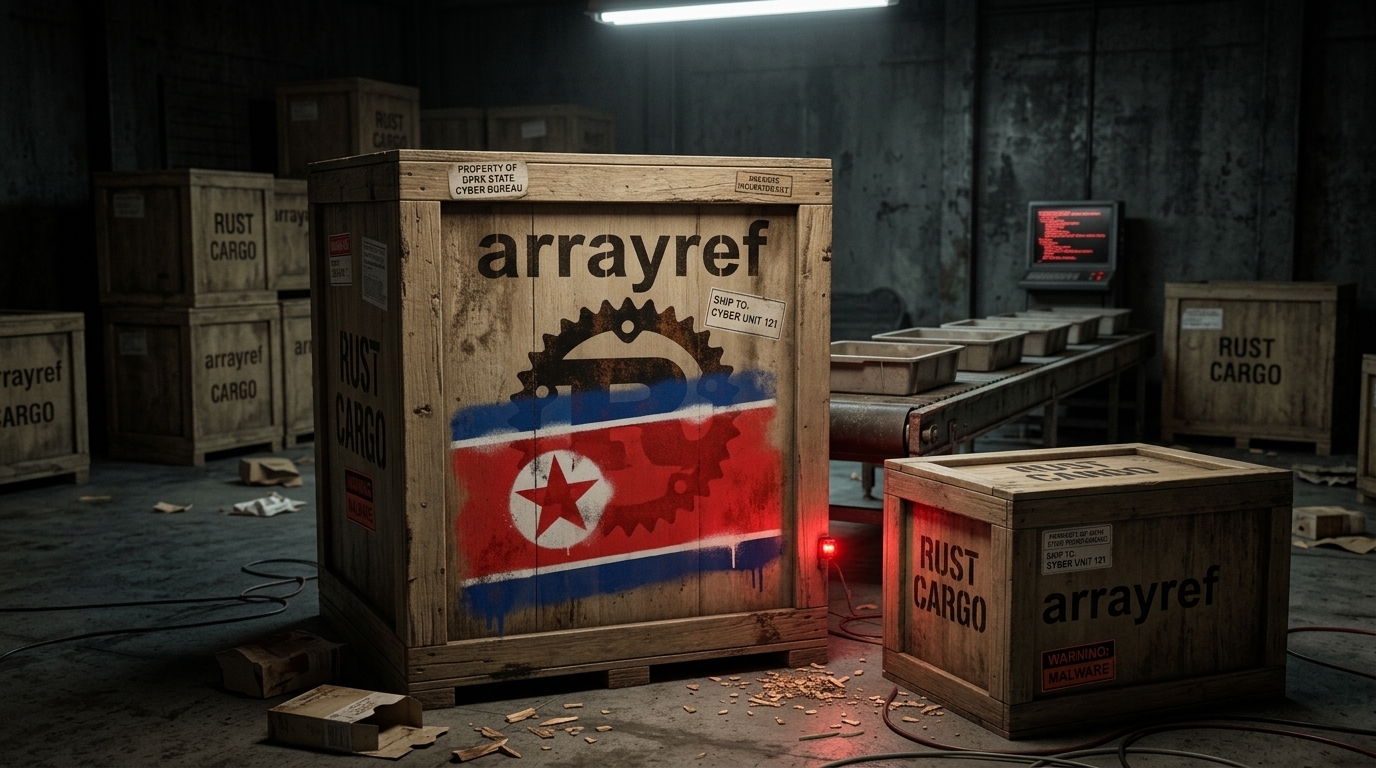 The OpenSourceMalware Show #18
Episode 18 of the OpenSourceMalware Show discusses the compromise of Rust maintainer 'dhrundy' that pushed malicious versions of arrayref (245M+ downloads), internment, and append-only-vec with a typosquatted build dependency executing a remote binary at compile time, which Wiz Research ties to DPRK infrastructure shared with the Mastra and Axios npm compromises. It also covers StubMaker, a campaign that started as RubyGems typosquats of bundler/i18n/rake/activesupport and shares byte-identical payloads (a 22MB Rust loader with an embedded Go infostealer, including a Chrome App-Bound Encryption bypass) with a 40-package npm typosquatting cluster targeting axios, chalk, commander, lodash, react and typescript, with signs it also hit PowerShell. The hosts also note a rising trend of attackers bundling compiled C++/Rust/Go binaries in npm/RubyGems packages (a red flag for analysts) and a PolinRider reinfection wave now using NullReceiver instead of EtherHiding for stage-two C2 hiding.
 opensourcemalware.comtalkAdded 3 Sep 2026, published 21 Aug 2026🛡️ Security
- Bank of America Phishing Email Delivers ScreenConnect Malware
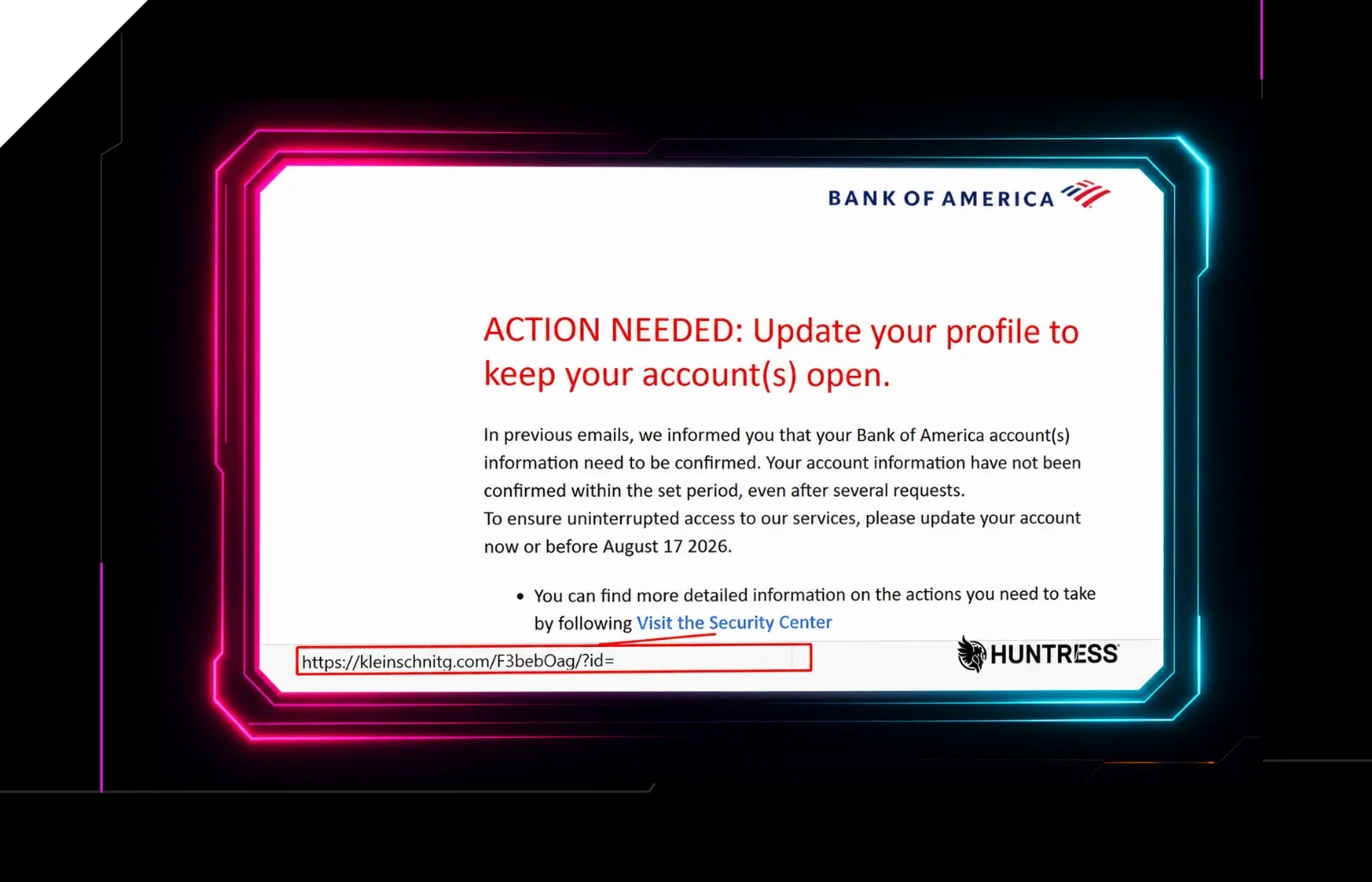
Huntress dissects a Bank of America-themed phishing email that lures victims into downloading AccountGuardSetup.vbs, which unpacks through several layers of base64-encoded PowerShell to silently install ScreenConnect RMM with Administrator privileges. The chain uses AES-128-CBC encrypted blobs to deliver a C# UAC-bypass exploit via the ICMLuaUtil COM interface (MITRE ATT&CK T1548.002), then hides the resulting ScreenConnect service (renamed "Windows Security") from users and admins using SDDL/ACL manipulation so it can't be seen, logged, or removed.
huntress.comwriteupAdded 3 Sep 2026, published 4 Aug 2026🛡️ Security  Socket: Fake Corepack Site Distributes Infostealer and Proxyware to Developers
Socket's Threat Research team analyzed corepack[.]org, a fake site impersonating the Node.js Corepack tool that exploits its 2025 removal from Node.js bundling to rank in search results and trick developers into downloading a fake VPN installer. The installer drops OpenShield (an infostealer with browser-data/SSH-key theft, PowerShell execution, and run-key persistence) plus a bandwidth-sharing proxyware component that turns victim machines into proxy exit nodes, while a second click path delivers adware/trojan activity via OperaGXSetup.exe. The post includes full IOCs and details community/OpenJS Foundation takedown efforts against the domain.
 socket.devwriteupPublished and added 25 Jul 2026🛡️ Security
 SleeperGem: RubyGems supply chain attack targets dormant maintainer accounts
Aikido researchers dissect SleeperGem, a RubyGems supply chain attack where a newly published gem, git_credential_manager, downloaded malicious binaries hosted on a fake git-ecosystem account at git.disroot.org and executed them via shell or PowerShell. The attacker evolved the payload across four versions in nine hours, silencing output, wiring execution into the gems require and load path, and adding a check to skip roughly 30 CI environment variables so it only fires on developer laptops, then used two separate long-dormant maintainer accounts to push the gem as a dependency into the trusted gems Dendreo and fastlane-plugin-run_tests_firebase_testlab with over 574000 downloads. The piece argues this is RubyGems first taste of the dormant-maintainer-account-takeover pattern long seen on npm and PyPI.
 aikido.devwriteupAdded 3 Sep 2026, published 19 Jul 2026🛡️ Security


Showing 30 of 68
Show more