- Palette: teaching a small model to build decks in your design language
Palette is an IBM Research fine-tune of a 20B open-weight model that builds slide decks in the IBM Design Language. A designer role writes a JSON brief and a coder role writes pptxgenjs code per slide, both served by one LoRA adapter. Training used about 1000 synthetic decks (roughly 10,000 slides) with counterfactual reasoning traces. A render-and-repair harness adds 3.5 points on PresentBench. Palette ranks first on Economics and Education and second on the three-domain mean (59.7 vs NotebookLM 60.8).
 huggingface.coarticlePublished and added 3 Nov 2026🧠 AI
- AgentSearch (@AgentSearchHQ) on X
A guide to adding the AgentSearch MCP server (@agentsearchhq/agentsearch-mcp 1.3.6) to GitHub Copilot's agent in VS Code. It compares the portable `.mcp.json` (mcpServers) format with VS Code's `.vscode/mcp.json` (servers) format, and covers Workspace Trust, the five tools, a free tier of 25 searches a day, and optional USDC-paid Extract and Render with spend caps. The authors tested the server with the MCP TypeScript SDK and `code --add-mcp`, but did not watch Copilot call the tools.
 x.comwriteupAdded 4 Nov 2026, published 3 Nov 2026🧠 AI
 Know, then Draw: A New Learning Paradigm for Visual Generation
Know, then Draw is a learning paradigm for visual generation that uses autoregressive pretraining to acquire semantic knowledge and diffusion post-training for high-fidelity rendering. Controlled comparisons find autoregression the stronger pretraining objective, and semantic quality matters more than AR-only generation quality. This motivates a purely semantic tokenizer trained with language supervision only. A 3B text-to-image model trained in 6,600 H100 GPU-hours scores 86 on GenEval and 87 on DPG-Bench.
 arxiv.orgpaperAdded 28 Oct 2026, published 27 Oct 2026🧠 AI
 Matrix-Game 4.0: Harnessing Video Models for Real-Time Playable Game Worlds
Matrix-Game 4.0 is a system that separates game logic from visual rendering for playable generated worlds. A lightweight engine holds world state and rules, a multimodal coding agent writes game code and scene captions, and a distilled autoregressive video model turns low-poly proxies into detailed frames. It runs 480p at 60 FPS on one RTX 5090 with 112 ms key-press-to-display latency. Code, weights and assets are released.
huggingface.copaperAdded 22 Oct 2026🧠 AI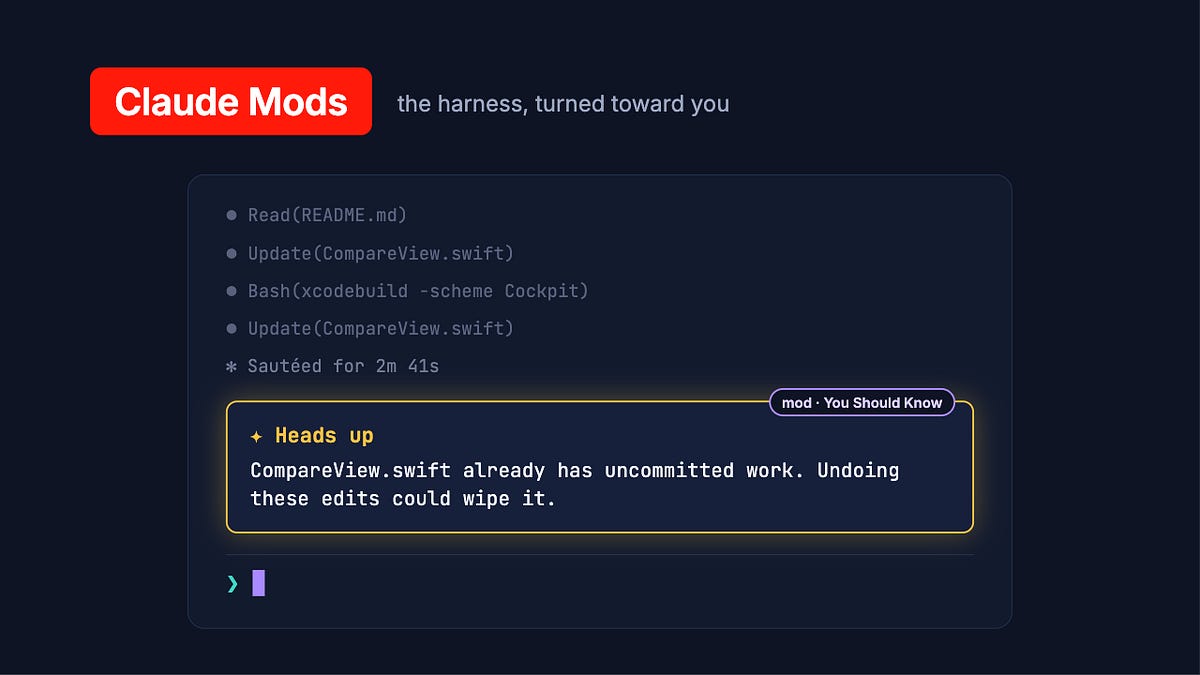 Claude Mods: Flipping the Harness Inside Out
Claude Mods are Claude Code plugins, written as TypeScript or JavaScript functions, that hook into prompts, tool calls and rendering to customize the CLI and Desktop. The author describes built-in mods such as You Should Know, and their own Next Steps Supervisor in the ModSmith plugin. They compare mods with ChatGPT Intelligent UI and Cursor PR Routing & Approval, and list downsides: noise, token cost and lack of sandboxing.
 latent.spacearticlePublished and added 21 Oct 2026🧠 AI
 Claude Mods: Flipping the Harness Inside Out
Claude Mods are Claude Code plugins, written as TypeScript or JavaScript functions, that hook into prompts, tool calls and rendering to change how the CLI and Desktop behave. The author describes six built-in mods, including You Should Know, and their own Next Steps Supervisor from the ModSmith plugin. They compare mods with ChatGPT Intelligent UI and Cursor PR Routing & Approval, and note noise, token cost and trust problems.
latent.spacearticleAdded 23 Oct 2026, published 21 Oct 2026🧠 AI From JavaScript to Renderer Code Execution: Three V8 Vulnerabilities and Two v8CTF Flags | depthfirst
Depth First Security's write-up describes three V8 bugs found using its dfs-large1 research tooling: CVE-2026-78938, a type confusion in Promise.prototype.finally that lets an internal helper be constructed and return a primitive; CVE-2026-79236, a TurboFan load-elimination bug that keeps a stale property-array pointer after object migration; and a shared WebAssembly memory sandbox escape (issue 546253900) caused by mismatched backing-store registration during serialization. It walks through turning each memory bug into addrof/fakeobj primitives, chaining either with the sandbox escape to reclaim a freed V8 isolate via a WebSocket allocation, and pivoting through a CFI-constrained ROP chain to achieve Chrome renderer code execution, earning two v8CTF flags. Fixes landed between August 20 and 25, 2026.
 depthfirst.comwriteupAdded 29 Oct 2026, published 20 Oct 2026🛡️ Security
- OpenVLHarness: Real World Visual Agentic Tool-Use with Multimodal Memory
OpenVLHarness is a multimodal reasoning harness for MLLMs built on a capability layer (task-level tool interfaces plus evidence rendering) and persistent multimodal memory that stores images, structured data and web references as addressable artifacts. A coding interface runs generated programs over stored data. Across 22 benchmarks and eight backbones it adds 9.7-12.6 points over no-tool baselines, and GPT-6 Luna at medium effort beats Codex and Visual Sketchpad at maximum effort using at most 37% of their tokens.
arxiv.orgpaperAdded 21 Oct 2026, published 19 Oct 2026🧠 AI - OpenMOSS/MOSS-Image
MOSS-Image is an open-source text-to-image model family from OpenMOSS with a 5B backbone, released October 2026 as MOSS-Image-Base and MOSS-Image-SFT. It supports JSON layout control with bounding boxes, text rendering inside images, and prompts up to 4K tokens. The repo gives a Diffusers pipeline, a Gradio app, a ComfyUI plugin, LoRA training guidance, a prompt-enhancer skill and day-0 SGLang and vLLM-Omni support.
 github.comrepoAdded 20 Oct 2026, published 16 Oct 2026🧠 AI
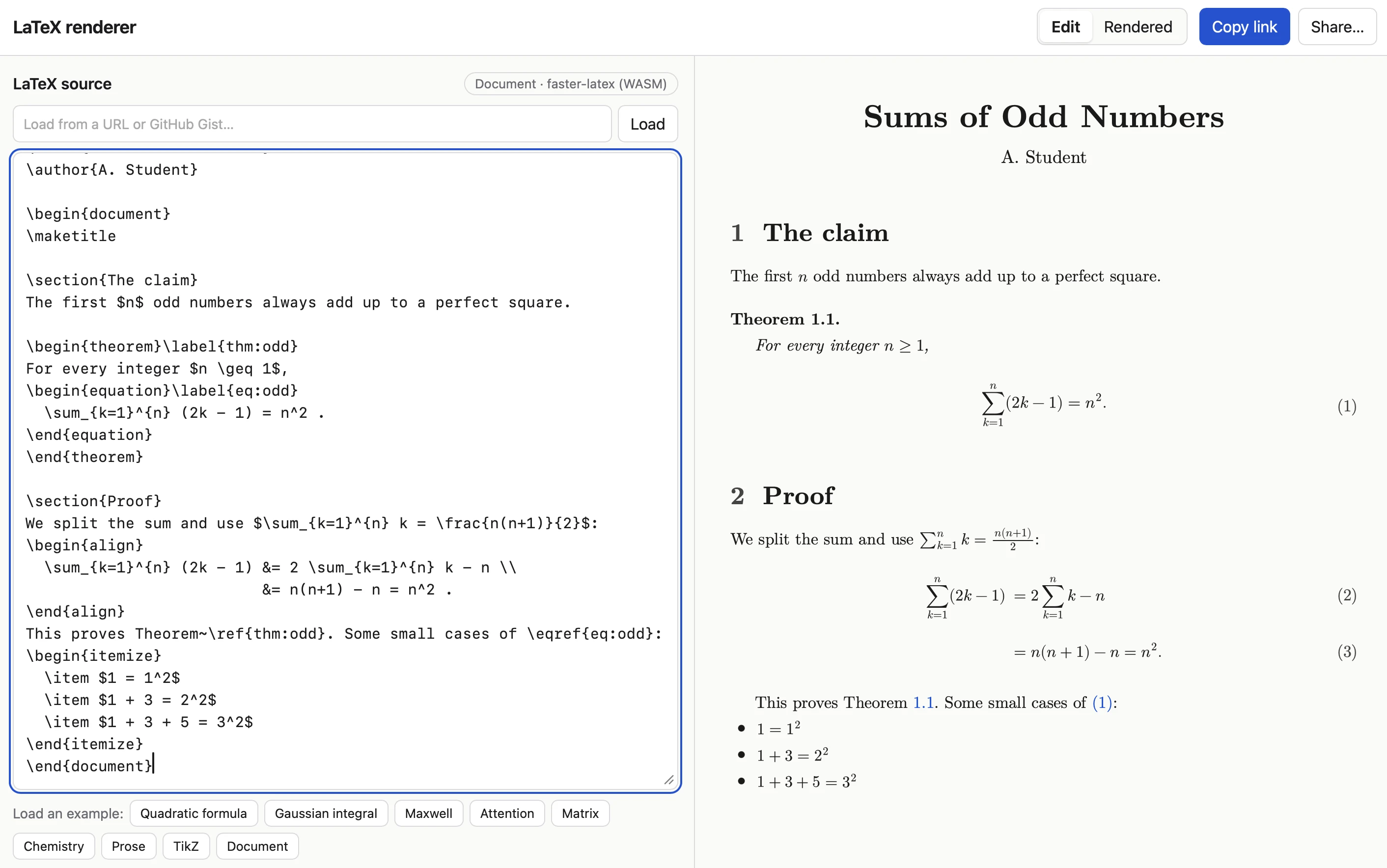 LaTeX renderer
Simon Willison describes using Claude Code (Opus 5.5) to build a browser LaTeX renderer inspired by Tiny Little Office, which stores document data in the URL #fragment and ships an llms.txt so agents can construct document links. He lists the prompts: fragment-hash rendering, a custom compression dictionary for LaTeX, an iframe sandbox against XSS copied from his SVG-in-Markdown tool, and loading from a URL or Gist. The finished tool uses Pako 2.1.0, MathJax 4.1.3, faster-latex 0.3.1 and DOMPurify 3.4.16.
 simonwillison.netarticleAdded 16 Oct 2026, published 15 Oct 2026🧠 AI
- Approve What, Exactly? Effect Binding and Trusted Rendering for Agent Step-Up Authorization
Paper arguing that agent human-approval prompts count as a second factor only if agent compromise cannot forge them and they name exactly what is approved. It defines twelve attacks on the approval path (decoy recipients, amount cancellation, card padding, label spoofing, enrollment squatting, threshold splitting) and tests them against AP2, Microsoft's action-bound approval design and MCP elicitation. An audit of ten agent runtimes found no third-party verifiable approval record and post-approval argument changes in four of eight. The reference defense ASU (Agent Step-Up) renders the card from a canonical effect descriptor, has a phone passkey sign its digest, and executes only the stored call. It is proven in Tamarin (53 lemmas) and evaluated on 27,108 scripted trials and 609 AgentDojo pairs. The trusted card cut forged-narration attack success from 0.54 to 0.03 and raised LLM-approver catch rate from 0.30 to 0.98.
arxiv.orgpaperAdded 17 Oct 2026, published 15 Oct 2026🛡️ Security  Google Partially Reverses Chrome Bug Bounty Cuts
Google is raising Chrome Vulnerability Reward Program payouts for memory safety bugs. The base rate goes from $500 to $2,000, with up to $20,000 for browser, GPU and network process bugs and up to $8,000 for renderer use-after-free and memory write bugs. V8 sandbox bugs move to a flat $5,000 and V8 logic bugs to $4,000. A $2,000 fuzzer bonus returns, and submissions made after April 30, 2026 are rewarded under the new rules. The rates are still well below the pre-April 2026 levels. The article also notes that Google temporarily closed the OSS VRP to product vulnerability submissions because of a flood of AI-generated reports.
 securityweek.comarticlePublished and added 13 Oct 2026🛡️ Security
- Zero to calc in six days: inside XBOW's Chrome full chain
XBOW researchers describe a Chrome full-chain exploit that combines a V8/Maglev deoptimization bug (mutable HeapNumber treated as immutable), a TOCTOU flaw in Blink's animated-WebP decoder exploiting a transferred ArrayBuffer, and a race in Crashpad's remote-memory reader to achieve code execution outside the renderer sandbox. The chain, built in six days largely by AI agents using OpenAI's gpt-5.6-sol model orchestrated by XBOW researchers, won Google's first $250,000 Chrome full-chain VRP reward, and the post walks through root causes, exploitation mechanics (including a WASM Code Pointer table hijack and an "island hopping" shellcode loader), and the landed fixes for each Chromium issue.
 xbow.comwriteupAdded 18 Oct 2026, published 13 Oct 2026🛡️ Security
- DreamTrue: Action-Faithful Robot World Model with Counterfactual Post-Training
DreamTrue is a multi-view, cross-embodiment robot world model for action-faithful, physically plausible video prediction. It renders action trajectories into image-space conditions aligned to target videos by offline geometric calibration. Counterfactual post-training modifies recorded trajectories to cover unsuccessful interactions and contact configurations. A human-annotated defect dataset trains an embodied video reward model whose scores drive RL post-training. On AgiBot it reaches state-of-the-art action following and cuts the human-assessed interaction defect rate from 48.12% to 6.25%. It ranked first in the world model track of the AgiBot World Challenge 2026.
arxiv.orgpaperAdded 9 Oct 2026, published 8 Oct 2026🧠 AI - GPT-6 and Intelligent UI for everyone
GPT-6 in ChatGPT adds Intelligent UI, where the model composes answers from text, charts, forms, buttons and small interactive tools using a library of native streamable components and a compiler that renders the interface as it generates. It can also start answering while still reasoning. OpenAI reports GPT-6 Instant starts web-search answers 44% sooner than GPT-5.6 Instant. GPT-6 Sol serves paid tiers and GPT-6 Luna serves Free and Go.
 openai.comarticlePublished and added 7 Oct 2026🧠 AI
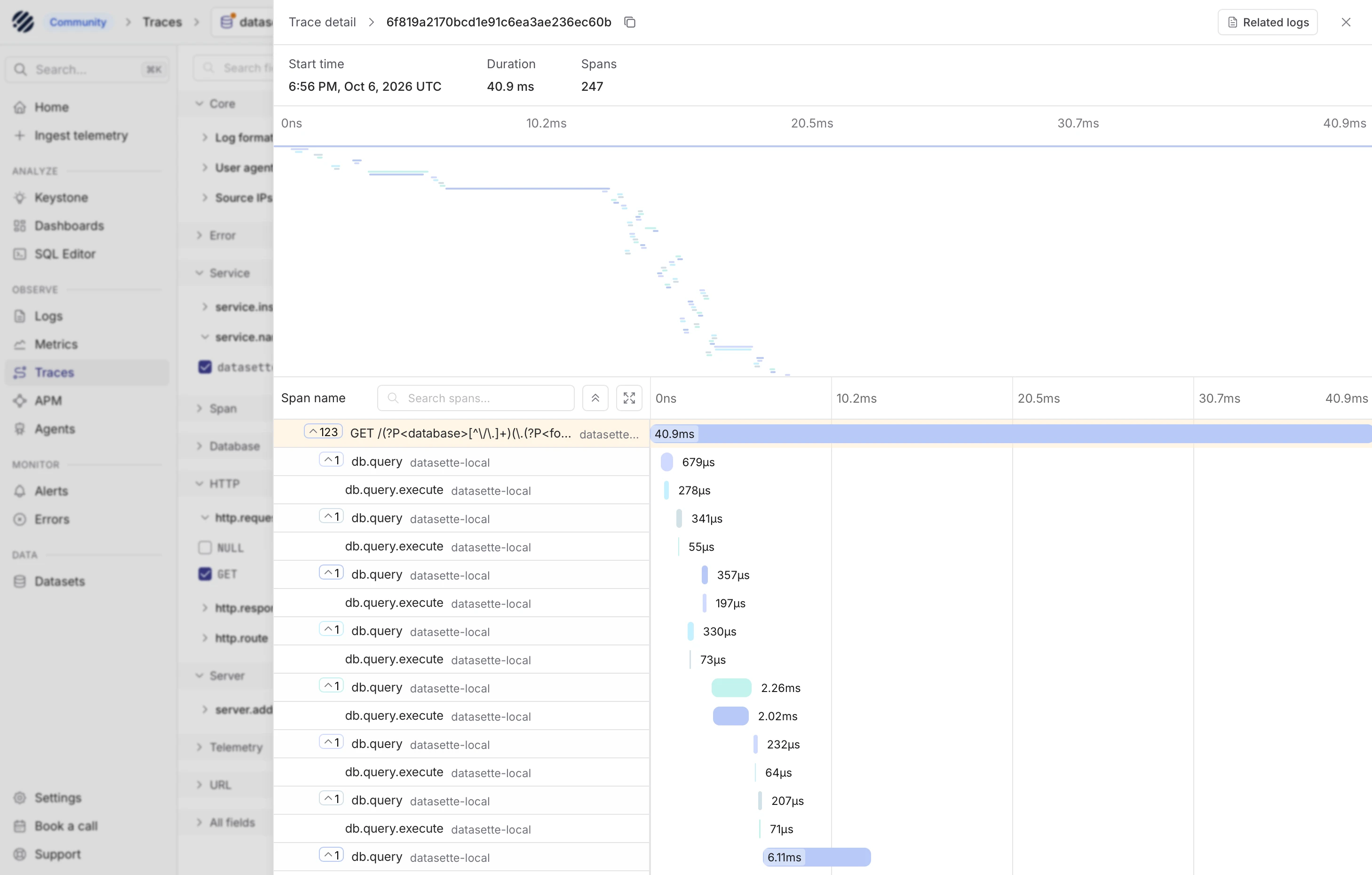 Using Parseable with Datasette for OpenTelemetry traces
Simon Willison describes using Parseable, a new open-source (AGPL) Rust-based observability platform shipped as a single ~180MB binary with enterprise and cloud-hosted tiers, to collect and view OpenTelemetry traces emitted by Datasette, which gained OpenTelemetry support in version 1.0a41 (added by Alex Garcia). He used Codex to work out the integration and links to a human-written TIL documenting the working setup, alongside a screenshot of a Datasette trace rendered in Parseable's web UI.
simonwillison.netarticlePublished and added 6 Oct 2026🧠 AI- Mistral Large 4
Simon Willison's linkblog entry on the release of Mistral Large 4, built around a Hacker News comment arguing that standard benchmarks are saturated. The commenter demonstrates this by running the identical whimsical prompt, Generate an SVG of an armadillo in fishnet tights jaywalking on Mars, through Claude Opus 5.5, GPT-6.1 Sol, Gemini 3.8 Flash, and Mistral Large 4 via Willison's llm CLI tool, then compares the rendered SVGs at each model's default reasoning level using his markdown-svg-renderer tool.
simonwillison.netarticlePublished and added 6 Oct 2026🧠 AI - ALIVE: Interaction-Aligned Object Insertion for First-Frame-Guided Video Editing
ALIVE is a framework for first-frame-guided video editing that inserts objects so they coherently participate in interactions (e.g., being picked up or manipulated) rather than appearing static. The authors curate a 35,800-pair editing dataset combining 3D-rendered, model-generated and real-world videos plus pairs from ROSE, and train a vision-language model to predict interaction guidance from the edited first frame and an instruction naming the object. They introduce the ALIVE-interaction benchmark to measure interaction fidelity, source preservation and visual coherence via a unified VLM-based protocol, reporting a 43.9% Overall improvement on this benchmark and 4.4% on a general video object insertion benchmark over the strongest baseline, with VLM-predicted guidance adding a further 0.95-point gain.
arxiv.orgpaperAdded 7 Oct 2026, published 6 Oct 2026🧠 AI  Introducing Solana Microscope: Program Monitoring and Alerts
Microscope is an open-source, self-hosted monitoring and alerting tool for Solana programs that decodes a program's instructions and events using its IDL, then renders that activity as Grafana dashboards backed by Loki (logs) and Prometheus (metrics). It can also watch a Squads multisig controlling the program, firing precise alerts on specific instructions, events, field values, or multisig proposal approvals to Slack, Telegram, or PagerDuty. A distinguishing feature is built-in health alerting for the monitoring pipeline itself (stalled gRPC/RPC streams, corrupt checkpoints, records decoded but not reaching Loki), so teams can distinguish "program is quiet" from "monitoring is broken." It deploys via Docker Compose, Terraform (AWS/GCP), or Kubernetes manifests, and the code is MIT-licensed on GitHub.
 solana.comtoolAdded 8 Oct 2026, published 5 Oct 2026🛡️ Security
- Show HN: Made an open-source Lego AI generator
ldraw-nova is an open-source agentic pipeline where an LLM agent (tested with models like Claude Opus 5.5 and GPT-6 Astra) takes a build prompt, reads LDraw-building instructions, and produces a plan.json describing a model's geometry. From that plan it writes a Python generator script that, when executed, outputs an LDraw (.mpd) 3D CAD source file, viewable in 3D/VR (Meta Quest 3) or exportable to Blender-editable glTF. The agent uses jev-rerank, a semantic search tool with reranking backed by TypeSafe's Jev System One model, to find suitable LEGO parts and example models, falling back to full-text search without an API key; it also uses headless rendering and collision/gap detection to self-inspect and iterate on designs.
github.comrepoAdded 3 Oct 2026, published 2 Oct 2026🧠 AI  Tavus Griffin: the first Human Interaction Model
Tavus introduces Griffin, a "Human Interaction Model" (HIM): a full-duplex, video-to-video system that unifies real-time perception, conversational decision-making, and expressive audiovisual generation into one model rather than a cascaded pipeline. It uses a Continuous Conversational Modeling engine that makes sub-second turn-taking and nonverbal-behavior decisions, paired with a streaming speech generator built on a new continuous audio codec (Tavec) and a distilled autoregressive video diffusion model that renders 720p video in 320ms chunks. In live one-minute video calls, Griffin-Lite was judged human by 48% of participants (versus 2.4% for Tavus's prior Phoenix-4.5 system) and topped NVIDIA's VideoFDB full-duplex conversation benchmark on both generation and perception tracks.
 tavus.ioarticleAdded 2 Oct 2026🧠 AI
- World Embedding Benchmark
The World Embedding Benchmark is a new evaluation suite of 8,000 controlled simulation cases across 80 families (fluid mechanics, solid mechanics, dynamics, optics & electromagnetism), each pairing a rendered video with simulation-derived physical annotations. It tests pre-trained omnimodal embedding models on text-video retrieval, physical-property regression, and multiple-choice video-description classification, finding that current embeddings align poorly cross-modally while lightweight probes can still recover physical quantities, and that continual contrastive training improves alignment but hurts regression. The authors also show retrieval-augmented generation using these embeddings with MiniMax-H3 improves the physical fidelity of generated videos.
arxiv.orgpaperAdded 5 Oct 2026, published 2 Oct 2026🧠 AI - A Vision-Language Model (VLM)-based Pipeline for End-to-End Procedural Modeling of Field-Grown Maize from Point Clouds
This paper presents an automated pipeline that uses a vision-language model to annotate leaf midlines in rendered orthographic views of maize point-cloud scans, then applies deterministic geometric algorithms and differentiable NURBS fitting to reconstruct editable, organ-level procedural 3D plant models without manual tuning or species-specific segmentation training. Evaluated on 100 field-grown maize plants from the MaizeField3D dataset, it achieves a median whole-plant Chamfer distance of 5.4 mm and recovers 99.4% of curated reference leaves at IoU ≥ 0.5, outperforming an earlier semi-automated pipeline. It demonstrates that VLM annotations can become reliable quantitative measurements when paired with correcting geometric post-processing, enabling scalable generation of 3D plant assets for high-throughput phenotyping and in silico breeding.
arxiv.orgpaperAdded 5 Oct 2026, published 2 Oct 2026🧠 AI  AI Signal (@AliciaCrawoiue) on X
A tweet explains that on October 1st Claude Code shipped "mods": plain TypeScript functions that hook into events the CLI/desktop app already emits (tool calls, permission prompts, UI renders) and can run before, after, or instead of them, letting developers change behavior, customize the UI, or swap in new features. Mods ship inside plugins and are installed via /plugin. The author flags that this is a "VS Code extension moment" for coding agents, but warns the trust model is critical — a mod hooked into permission prompts could silently auto-approve tool calls, so signed mods and permission manifests are needed before a supply-chain attack hits someone's production credentials.
x.comthreadAdded 4 Oct 2026, published 2 Oct 2026🧠 AI- AI Signal (@AliciaCrawoiue) on X
Commentary on Claude Code's newly shipped "mods" feature (TypeScript functions that hook into tool calls, permission prompts, and UI render events, distributed via plugins). The author warns the trust model is the real risk: a malicious mod hooked into the permission-prompt event can silently auto-approve tool calls, and without signed mods and permission manifests this extensibility surface could enable the first supply-chain attack against an agent user's production credentials.
x.comthreadAdded 4 Oct 2026, published 2 Oct 2026🛡️ Security  China-aligned TA419 impersonates Anthropic employee, ex-White House official to phish AI policy experts
Proofpoint's Mark Kelly details TA419, a China-aligned espionage group that in July 2026 impersonated former White House OSTP official Lynne Edwards Parker and economist Heidi Crebo-Rediker, and in February 2026 posed as a senior Anthropic employee, to phish US AI policy experts' cloud accounts. The attack chain uses benign-looking invitation emails followed by shortened links leading to a fake OneDrive adversary-in-the-middle page that renders a Chrome login window with the open-source Frameless BitB browser-in-the-browser tool, relaying credentials, MFA codes and session cookies live to the attackers via Cloudflare-fronted, NameSilo-registered domains. Proofpoint assesses the campaign supports Chinese intelligence collection on US AI policy and export-control developments.
 helpnetsecurity.comarticleAdded 4 Oct 2026, published 2 Oct 2026🛡️ Security
- zzzz7788990213-ops/EvoVLM
EvoVLM searches over prompts, image preprocessing, generation budgets and answer extraction for frozen Qwen3-VL-2B-Instruct and Qwen3-VL-2B-Thinking, without fine-tuning weights. A local Qwen model ranks a catalog of typed mutations, a trusted renderer produces Python programs, and Pareto selection on accuracy and latency drives two small generations on scientific chart understanding (CharXiv subset). Recorded results on Dev128: Evolved Instruct keeps accuracy with 8.9% lower median latency, and Evolved Thinking gains 16.41 points of accuracy with 10.6% lower median latency. CPU-only replay and fail-closed evidence verification are included. The authors state the limits: small sample, overlap with the evolution set, and results tied to the recorded hardware.
github.comrepoAdded 16 Oct 2026, published 2 Oct 2026🧠 AI - AssemblyWorld: Rethinking 3D Assembly with General-Purpose Agents
AssemblyWorld is an interactive 3D environment where general-purpose agents assemble objects (furniture, industrial parts, fractured pieces) by inspecting rendered 2D views and manipulating supplied rigid parts, optionally guided by images or assembly manuals, without any assembly-specific fine-tuning. The accompanying AssemblyWorldBench benchmark covers 100 tasks across 80 objects and evaluates eight agent systems geometrically; the best system reaches 80.9% part accuracy but only 59.4% complete-assembly success, and open-source systems lag closed-source ones in both reliability and accuracy. The paper analyzes interaction trajectories and failure modes to characterize the gap between approximate structure recovery and precise 3D reconstruction.
arxiv.orgpaperAdded 1 Oct 2026, published 30 Sep 2026🧠 AI - FracGen: Learning How Objects Stretch and Tear with Physics-Informed Video Generation
FracGen is a fracture-aware video generation model that, given a single image of an intact object, generates plausible and controllable fracture dynamics (where an object tears, crack propagation speed, pre-failure deformation) conditioned on physics signals. It is trained using FracSim, a material point method (MPM) simulation framework augmented with a continuum damage model that produces paired fracture videos and dense pixel-aligned physical fields at no extra rendering cost; FracGen jointly predicts these fields alongside RGB video and is supervised with physics-informed consistency losses. The authors also introduce a benchmark for evaluating physical plausibility of generated fracture video, showing FracGen outperforms existing video generation baselines in both physical and visual fidelity.
arxiv.orgpaperAdded 30 Sep 2026, published 29 Sep 2026🧠 AI  https://www.rfc-editor.org/search/?status=Best+Current+Practice&area=sec
A saved search on the official RFC Editor site filtered to documents with status Best Current Practice in the sec (Security) area, effectively a live index of IETF's authoritative security best-practice standards such as BCP-level RFCs on anti-spoofing/ingress filtering, routing security, and password policy. The fetched copy rendered with JavaScript disabled so no result rows were captured, but the query itself is a reusable, continuously updated pointer into the canonical security standards catalog maintained by the IETF/RFC Editor.
 rfc-editor.orgotherAdded 2 Oct 2026, published 29 Sep 2026🛡️ Security

Showing 30 of 61
Show more