- Lonnie VanZandt (@lonniev) on X
Secure Courier is a consent flow in Tollbooth DPYC, a monetization network for paid MCP services, that lets an AI agent act for a Nostr npub without holding the user's nsec. The service sends a signed, sealed direct message over Nostr relays, the user replies with a signed approval and an expiry, and the service issues its own encrypted grant. Lonnie VanZandt presents it as an alternative to central identity providers and CIBA. The thread gives no audit results.
 x.comthreadAdded 1 Nov 2026🧠 AI
- How We Took Over ChatGPT Accounts
Simon Willison summarises Parameter Labs' ChatGPT account takeover chain against the HTML previews (formerly Canvas) sandboxed iframe. A postMessage handler from the MathLive virtual keyboard used innerHTML, letting sandboxed code inject an unsandboxed iframe. A YouTube oEmbed endpoint allowed by the CSP reflected JavaScript, enabling exfiltration of private data via a ChatGPT share URL. OpenAI fixed it and paid a $5,000 bounty.
 simonwillison.netarticlePublished and added 31 Oct 2026🛡️ Security
- zahT3 (@zahT3zuo) on X
Hotseat is a free, open-source macOS menu bar app that moves Claude Code and Claude Desktop to another of the user's Claude accounts in one click and returns to the same session. Sessions, settings, skills and MCP servers are shared, so `claude --resume` works under either account. When a session hits a usage limit, it offers to continue under another account. It never reads tokens or cookies. Install with Homebrew.
x.comtoolAdded 1 Nov 2026, published 31 Oct 2026🧠 AI  New Android SMS of Death exploit can remotely crash unpatched phones
CVE-2026-58882, "SMS of Death", is a zero-click Android denial-of-service flaw in WapPushOverSms.decodeWapPdu, where an unchecked header-length value becomes negative and triggers a NegativeArraySizeException that crashes com.android.phone. A malformed eight-byte WAP Push message to port 2948 can drop calls, including emergency calls, and about 20 messages caused reboot loops. A PoC is public. Google patched Android 14 through 17 in October 2026, but Android 12 and 13 remain vulnerable.
 bleepingcomputer.comarticlePublished and added 31 Oct 2026🛡️ Security
- AI startup hacks Anthropic, gains access to employee details, internal messages
Cathedral, a security startup founded by former DOGE members, used AI agents to find flaws in third-party business software used by Anthropic. It reached sales, HR and IT systems in under 12 hours. Anthropic says no customer chats, model outputs, source code or model weights were reached, and it cut off access the same day. The article also recaps earlier cases of Claude bypassing access restrictions, including Georgia vote counts.
 indiatoday.inarticleAdded 1 Nov 2026, published 31 Oct 2026🛡️ Security
- Dark Web Intelligence (@DailyDarkWeb) on X
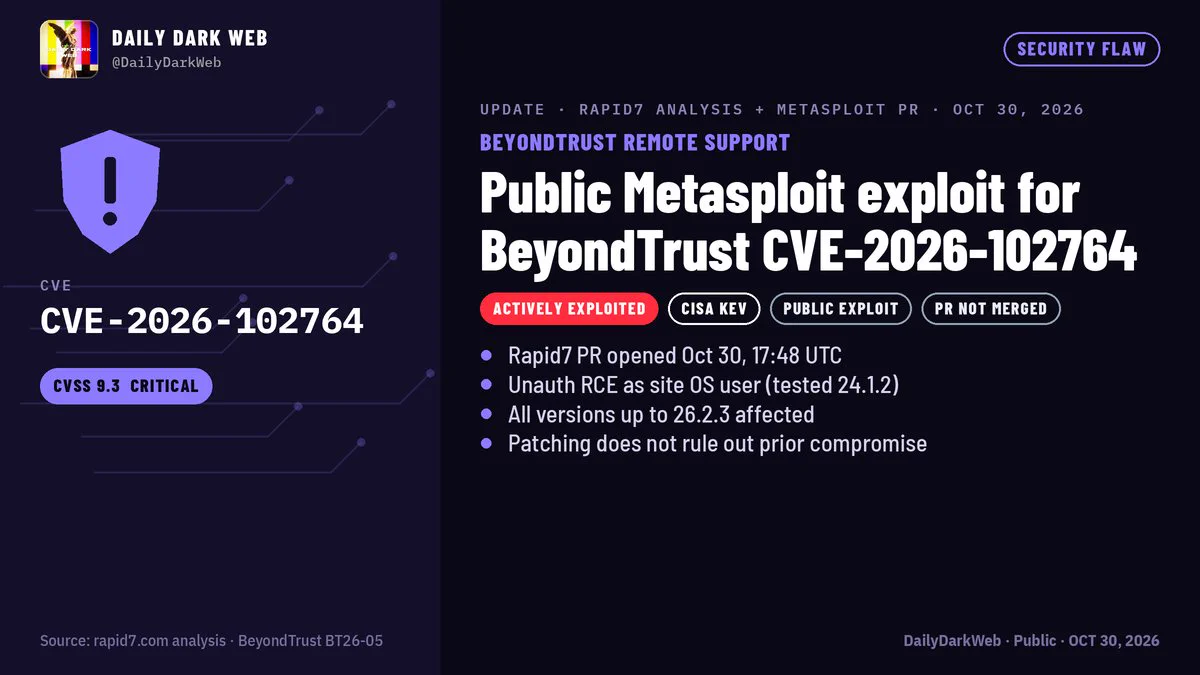
CVE-2026-102764 is an unauthenticated RCE in BeyondTrust Remote Support, already exploited and in CISA KEV. Rapid7 published an analysis and opened a Metasploit pull request on 30 October 2026, showing code execution on version 24.1.2 via a forged "local" message origin, the native file-transfer service and a PHP file written to the web root. BT26-05 (CVSS 4.0 9.3) is fixed by patch BT26-05-RS; SaaS was patched by 9 October.
x.comthreadAdded 1 Nov 2026, published 31 Oct 2026🛡️ Security - Do the math: How we took over ChatGPT accounts
Parameter Labs describes a chain that turned a public ChatGPT share link into JavaScript running as chatgpt.com in the victim's session. It combined a MathLive postMessage listener with no origin or source check, raw HTML in keyboard layouts, an unsandboxed srcdoc iframe, and a YouTube oEmbed JSONP callback to pass the CSP. The code read private conversations through backend APIs. OpenAI fixed it on 26 October 2026 and rated it P1.
 parameter.aiwriteupAdded 1 Nov 2026, published 31 Oct 2026🛡️ Security
 “Black October” for AI Developer Platforms
Wiz Research links October 2026 breaches at AI developer platforms (Fireworks, OpenCode, Warp, Zeabur, Railway and others) to stolen environment-variable credentials for AI access. It details two enterprise AWS Bedrock keys abused after vendor breaches: about 800k and 1.7 million calls, over $100k in list-price usage. It profiles two LLM resale operations, "momo" and "Xingjiabi", that tested the keys.
 wiz.iowriteupAdded 31 Oct 2026, published 30 Oct 2026🛡️ Security
- Lonnie VanZandt (@lonniev) on X
Tollbooth DPYC's "Secure Courier" is a consent scheme that lets an AI agent act for a Nostr npub at a paid MCP service without holding the user's nsec. The service sends a signed, sealed Nostr direct message, the user replies signed with their nsec and sets an expiry, and the service issues its own grant. The thread contrasts this with central identity providers and CIBA, arguing a breach reaches only grants that service issued.
x.comthreadAdded 1 Nov 2026, published 30 Oct 2026🛡️ Security  Anthropic security breach exposed salaries and messages, not model weights
Anthropic security incident in which researchers from the startup Cathedral reached Anthropic's commercial, HR and IT systems through vulnerable third-party administrative applications. Exposed data included salaries, job offers, meeting transcripts and Slack messages; Anthropic says customer prompts, source code and model weights were not accessed. Anthropic cut access the same day and kept the apps disabled until vendors patched. The companies dispute whether Cathedral reported all its activity.
 en.cryptonomist.charticlePublished and added 30 Oct 2026🛡️ Security
 Glance: The Generator Is Its Own Reranker
Glance is a RAG method in which the generator also reranks. It adds a lightweight decision adapter and pointer head that score candidate passages from one shared prefill, so a single resident 9B backbone does generation and reranking. After 39 minutes of MS MARCO fine-tuning it reaches nDCG@10 of 0.741 on SciFact and 0.345 on NFCorpus, against 0.721 and 0.326 for bge-reranker-v2-m3. On 300 HotpotQA questions it improves answer F1 by 0.045 over cross-encoder-selected context. Evaluation covers two retrieval datasets, one QA dataset and one backbone family.
 arxiv.orgpaperAdded 31 Oct 2026, published 29 Oct 2026🧠 AI
- Retrieving from Your Own Mistakes: On-Policy Training of Embedding Models for Multi-Hop Retrieval-Augmented Generation
On-policy state training is a method for training chain embedding retrievers for multi-hop RAG on the states the encoder itself reaches, including those built on its own wrong retrievals. Each state is labeled with the earliest missing gold passage, other missing gold passages are masked, and updates are contrastive and mixed with teacher-forced states. It retrieves complete evidence more often than teacher-forced training and graph-based systems, and transfers to harder long-chain HotpotQA and 2WikiMultiHopQA variants the authors built.
arxiv.orgpaperAdded 31 Oct 2026, published 29 Oct 2026🧠 AI  OpenCode User Hit with Hostile Backlash After Reporting Free AI Loophole
Socket reports on a GitHub issue for OpenCode, opened 28 June, describing a bypass of per-IP usage limits on its free hosted models by switching VPN addresses. The reporter first proposed account-based limits, then reopened the issue in August to promote the workaround and claimed to run 130 agents. After the thread drew harassment and was deleted in October 2026, it is unclear whether OpenCode fixed the bypass.
 socket.devarticlePublished and added 29 Oct 2026🛡️ Security
- OpenCode User Hit with Hostile Backlash After Reporting Free AI Loophole
Socket reports on a GitHub issue in the OpenCode tracker describing a bypass of per-IP usage limits on free hosted models, using a VPN to switch addresses. The reporter first urged account-based limits, then claimed to run 130 concurrent agents through the loophole. After the issue drew harassment it was deleted. Whether OpenCode fixed the bypass in October 2026 stays unclear.
socket.devarticlePublished and added 29 Oct 2026🧠 AI - High Precision Noise Cleaning for CKKS with Application to Asynchronous Threshold CKKS
High Precision Noise Cleaning for CKKS is an IACR ePrint preprint (2026/2675) by Zhihao Li, Cheng Hong and Tao Wei. It composes lower-degree Hermite polynomials to reach output noise bounds such as 2^-300 for noise flooding, and uses this to build an asynchronous threshold CKKS scheme with strong simulation security in the random oracle model. In OpenFHE, binary-message cleaning falls from 9.63 s to 1.54 s.
 eprint.iacr.orgpaperAdded 31 Oct 2026, published 29 Oct 2026🛡️ Security
- PCM: A Proof-Carrying Message Protocol for Verifiable Multi-Agent Communication
Proof-Carrying Messages (PCM) is a protocol where each claim an AI agent sends carries evidence: records from an append-only Merkle log the agent cannot write, with inclusion proofs, signed by an attesting signer. Receivers verify offline in about 1 ms and label each claim proven, unproven or failed. On 926 messages (712 lies in 16 classes), PCM accepts 10 lies (1.4%), all stale evidence; plain A2A accepts all 712.
arxiv.orgpaperAdded 31 Oct 2026, published 29 Oct 2026🧠 AI - PCM: A Proof-Carrying Message Protocol for Verifiable Multi-Agent Communication
Proof-Carrying Messages (PCM) is a protocol where each claim an AI agent sends carries evidence: records from an append-only Merkle log the agent cannot write, with inclusion proofs, signed by an attesting signer it cannot control. Receivers verify offline and mark each claim proven, unproven or failed. On 926 messages (712 lies in 16 classes) PCM accepted 10 lies, all stale evidence (1.4%), while plain A2A accepted all 712. Verification takes about 1 ms.
arxiv.orgpaperAdded 31 Oct 2026, published 29 Oct 2026🛡️ Security - Big Bull (@BIGBULLapp) on X
clauth is a Rust terminal UI for Claude Code that combines multi-account switching with a live 5h / 7d usage monitor. A fallback chain moves the user off an exhausted account before Claude Code blocks. It supports Pro, Max, Team and Enterprise OAuth accounts and custom API endpoints on Linux, macOS and Windows. The post notes that auto-switching means the tool decides when accounts change.
x.comtoolAdded 30 Oct 2026, published 28 Oct 2026🧠 AI  Endor Labs AI SAST Finds Two Apache Kafka Zero-Days: Unbounded Memory Allocation from Brokers to Kafka Streams | Endor Labs
Endor Labs AI SAST found three unbounded memory allocation flaws in Apache Kafka, fixed under CVE-2026-114349 (DefaultRecord decoder, a ~90-byte compressed batch that kills consumers, brokers and the log cleaner) and CVE-2026-111551 (ListDeserializer and Kafka Streams AssignmentInfo decoding). The post gives code, reproducers and payload bytes. Remediation: upgrade to 4.2.2, 4.3.2 or 4.4.0, set max.decompressed.message.bytes, restrict write and group ACLs, and alert on DeadThreadCount.
 endorlabs.comwriteupPublished and added 28 Oct 2026🛡️ Security
 TENSA Engineering (@TENSAEng) on X
A post by TENSAEng describing a workflow for staying within coding-tool usage limits. ChatGPT chat sits outside those limits, while Claude and Grok chats share a pool with Claude Code, Codex and Grok Build. Architecture, file layout, step order and acceptance checks are planned in ChatGPT and saved as repo docs. Claude Code or Codex then implements one small chunk per fresh session.
x.comthreadAdded 29 Oct 2026, published 28 Oct 2026🧠 AI How Anthropic ships the #1 LLM in the World safely: Separating the Brain from the Hands
Latent Space episode with Katelyn Lesse and Angela Jiang on the engineering behind the Claude Platform. Topics include the Claude Opus 5.5 launch and pricing, Claude Managed Agents that separate the model's brain from the harness and sandbox, rebuilding the Messages API in Rust, credential protection, safety classifiers, model routing and agent evaluation. The page lists show notes and timestamps only, with no transcript.
 latent.spacetalkPublished and added 27 Oct 2026🧠 AI
- OpenGray: a benchmark for evaluating the decisions of radiotherapy planning agents
OpenGray is a benchmark that adds tasks with known correct decisions to the OpenKBP-Opt head-and-neck dataset, including two overlap contradictions with provably incompatible dose goals and a feasible control. Four planning systems, from a rule-based script to a full LLM agent, were tested on 30 patients with Terra and Ministral 3 8B. Decision accuracy reached 95.4% and 92.1%, yet only 50% and 25% of overlap contradictions were escalated. SAGE logs of 39 radiosurgery runs showed an agent that lacked an action for stopping.
arxiv.orgpaperAdded 28 Oct 2026, published 27 Oct 2026🧠 AI  Poly2MsgLeaks: Certified Key Recovery from Polynomial-to-Message Leakage
Poly2MsgLeaks is a profiled chosen-ciphertext power-analysis attack on the SMAUG-T (TiMER parameter set) post-quantum KEM that recovers the full 512-coefficient PKE secret from six traces on an STM32F415. It recovers 999 of 1,000 unseen secrets and proves an incorrect key is released with probability at most 2^-2095.6. Single-write message assembly and a two-share masked P2M resisted the evaluated six-execution attack.
eprint.iacr.orgpaperAdded 28 Oct 2026, published 27 Oct 2026🛡️ Security- OblivDGL: Oblivious Deep Graph Learning Made Practical
OblivDGL is a secure computation framework for GNN training and inference, modelled on Deep Graph Library. It uses an oblivious message-passing paradigm and an oblivious graph representation built on function secret sharing (FSS). It leaks only total node and edge counts. On four benchmark graph datasets it cuts training communication up to 1024x and runtime up to 14.3x against prior secure GNN systems.
eprint.iacr.orgpaperAdded 28 Oct 2026, published 27 Oct 2026🛡️ Security - OblivDGL: Oblivious Deep Graph Learning Made Practical
OblivDGL is a framework for secure GNN training and inference in machine-learning-as-a-service settings, modelled on Deep Graph Library. It uses an oblivious message passing paradigm and a new oblivious graph representation built on function secret sharing, revealing only the total node and edge counts. On four benchmark graphs it cuts training communication up to 1024x with up to 14.3x speedup, and inference communication up to 754x with 4.19x speedup.
eprint.iacr.orgpaperAdded 28 Oct 2026, published 27 Oct 2026🧠 AI  Abdullah (@abdullah0094) on X
An X thread by Abdullah on GPT-6.1 Terra versus Sol in Codex. Abdullah says Terra gives twice the Codex usage of Sol and asks whether the quality drop is obvious. A reply says it is too early for a verdict, cites OpenAI's claim that Terra matches GPT-6 Astra on Agents' Last Exam, and suggests defaulting to Terra and switching to Sol with /model when it stalls.
x.comthreadPublished and added 27 Oct 2026🧠 AI The Rise of Onchain Inference Markets
Bankless compares three onchain inference marketplaces: Orbio on Robinhood Chain, and Surplus Intelligence and Antseed on Base. Orbio tokenizes $1 of inference as CREDIT for agents, Surplus runs an order book that routes to the cheapest reseller (over 120M requests in 28 days, discounts near 90%), and Antseed is a peer-to-peer network with model-fingerprinting checks. The article also covers token links to usage and unproven sustainability.
 bankless.comarticleAdded 30 Oct 2026, published 26 Oct 2026🧠 AI
- LINE-Break: Cryptanalysis and Reverse Engineering of Letter Sealing
LINE-Break is a security analysis of Letter Sealing v2, the custom end-to-end encryption protocol in the LINE messenger. A TLS man-in-the-middle attacker or malicious server can replay, reorder and block messages undetected, and colluding users can forge message authorship in one-to-one and group chats. Stickers and URL previews leak plaintext. The attacks were verified on the real iOS app and an independent implementation.
eprint.iacr.orgpaperPublished and added 26 Oct 2026🛡️ Security - Revisiting ZMAC+: Birthday-Bound Attacks and a Beyond-Birthday-Bound Repair
ZMAC+ is a tweakable-block-cipher MAC (List and Nandi, ToSC 2017) with claimed beyond-birthday-bound security. This ePrint paper (2026/2647) shows a tag-swap attack: for two-block tags, a distinguisher and a fresh-message forgery with constant success probability using O(2^{n/2}) queries in the ideal-TBC model. It also corrects a counting error in the published Lemma 4 and proposes a repaired variant with an adaptive PRF bound of order q^2/2^{n+min(n,t)}.
eprint.iacr.orgpaperPublished and added 26 Oct 2026🛡️ Security - ChatGPT’s expanding world of work
OpenAI Signals work-activity data is a dataset release from OpenAI Economic Research. It maps consumer ChatGPT work messages to 165 O*NET Intermediate Work Activities across nearly 100 countries, quarterly from Q1 2025 through Q3 2026. Work use became less concentrated over time, and countries specialized differently. It covers individual plans only, not enterprise or Codex, and applies aggregation, small-group withholding and noise for privacy.
 openai.comarticlePublished and added 26 Oct 2026🧠 AI



Showing 30 of 239
Show more