Skip to content

99 results for β€œTerminal”

What you seeeverything
bleepingcomputer.comarticleπŸ›‘οΈ Security

Fake crypto app on Apple App Store linked to $23K wallet theft

Padre Terminal, a fake Solana meme-coin trading app on the Apple App Store, drained about $23,000 from 27 Solana wallets after users imported private keys, per blockchain investigator Iris. The app has been removed, but the drainer stayed active; Iris traced funds to two attacker wallets holding 229.66 SOL. Iris also flagged four other suspected impersonator apps (Axiom Pro: Focus, GMGN AI, HyperTerminal-HyperliquidTools, Pump Fun Tokens & Analitycs).

iOSSolanaUSDC
Padre TerminalIrispump.fun+8

Mobile Security, Threat IntelΒ· Added 30 Oct 2026, published 29 Oct 2026

arxiv.orgpaper🧠 AI

RetroChessBench: A Benchmark for Reconstructing and Proving Chess Histories

RetroChessBench is a 12-task benchmark for retrograde chess: reconstructing legal game histories, exact-length constructions, unique endings and exhaustive answer sets, with references, rubrics and a terminal-reward RL environment. GPT 6 Astra High fails to give the required final answer in 22 of 24 attempts without tools and 18 of 24 with code execution. Mean terminal RL rewards are 14.75% and 27.19%. The authors link the failures to scarce worked derivations in web training data.

GPT-6 AstraLLM
RetroChessBench

evals, researchΒ· Added 31 Oct 2026, published 29 Oct 2026
x.comtool🧠 AI

Big Bull (@BIGBULLapp) on X

clauth is a Rust terminal UI for Claude Code that combines multi-account switching with a live 5h / 7d usage monitor. A fallback chain moves the user off an exhausted account before Claude Code blocks. It supports Pro, Max, Team and Enterprise OAuth accounts and custom API endpoints on Linux, macOS and Windows. The post notes that auto-switching means the tool decides when accounts change.

Claude CodeRustOAuth+4
clauthAnthropic

coding-agents, ai-infraΒ· Added 30 Oct 2026, published 28 Oct 2026

decrypt.coarticle🧠 AI

OpenAI Launches GPT-6.1 Terra, Its Half-Good AI Model at Half the Price

GPT-6.1 Terra is OpenAI's mid-tier model, released 26 October 2026 with standard API prices 50% below GPT-5.6 Terra. At low reasoning effort its factual error rate on an internal test fell from 53.6% to 16.7%, and at maximum effort it solved 50.3% of Terminal-Bench 4.0 tasks versus 21.5%. It is available in ChatGPT Work and Codex and as gpt-6.1-terra. All figures are OpenAI's own.

ChatGPTCodexOpenAI API
OpenAIGPT-6.1 TerraGPT-5.6 Terra+11

models, evalsΒ· Published and added 26 Oct 2026

openai.comarticle🧠 AI

Introducing GPT-6.1 Terra

GPT-6.1 Terra is OpenAI's fast, lower-cost model for visual reasoning, computer use and writing, released as API model gpt-6.1-terra. OpenAI reports Terminal-Bench 4.0 at 50.3% (GPT-5.6 Terra: 21.5%) and a low-effort error rate cut from 53.6% to 16.7%. API pricing is $1 per million input tokens and $5 per million output tokens. It meets the Critical cybersecurity threshold in OpenAI's Preparedness Framework.

OpenAI APIChatGPTCodex+1
OpenAIGPT-5.6 TerraGPT-6.1 Sol+7

models, agents, evalsΒ· Published and added 26 Oct 2026

x.comthread🧠 AI

Syb (@DegenOfWallSt) on X

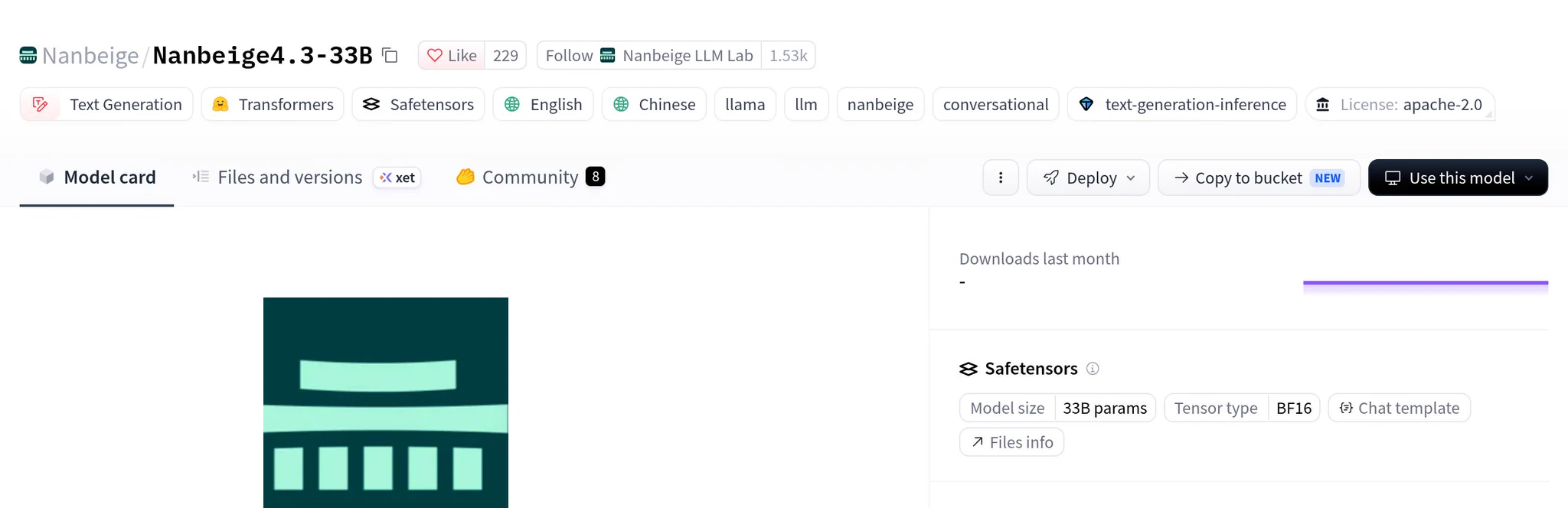
Nanbeige4.3-33B is a 33.1B dense, Llama-style open model under Apache-2.0, released with a base model on Hugging Face. In Nanbeige's own table it beats Qwen3.8-27B on Terminal-Bench 2.1 (80.9 vs 73.0), DeepSWE (65.5 vs 42.5) and Automation Bench, but trails on SWE-Bench Pro, GDPval and GPQA Diamond. BF16 weights are about 66 GB, split across 4 GPUs in the vLLM and SGLang examples. No independent evals exist yet.

Hugging FacevLLMSGLang+4
Nanbeige4.3-33BNanbeige4.3-3BNanbeige+8

models, coding-agents, evalsΒ· Added 26 Oct 2026, published 25 Oct 2026

en.cryptonomist.charticle🧠 AI

Moonshot AI reports Kim K3.1 Pro tops rivals with 64.4 on finance test

Kim K3.1 Pro is Moonshot AI's upgrade of Kimi K3, released 23 October 2026, with 3 trillion parameters, a one million token context window and a mixture-of-experts design that activates 16 of 896 experts. Moonshot reports 64.4 on OfficeQA Pro v2 (ahead of Opus 5.5 and GPT-6 Astra), 65.7% on Terminal-Bench 4.0 and 92.7% on BenchCAD (behind both). Hallucination on an internal hard test fell from 23.4% to 8.3%. Weights are due by 4 November.

LLMMixture of ExpertsKimi Delta Attention+4
Moonshot AIKim K3.1 ProKimi K3+9

models, evalsΒ· Published and added 24 Oct 2026

x.comarticle🧠 AI

AI Quanting (@AIQuanting) on X

Kimi K3.1 Pro is Moonshot AI's post-trained Kimi K3 with a 1-million-token context, plus a Highspeed variant; weights are due by 4 November. It scores 65.7% on Terminal-Bench 4.0. Moonshot removed cyber data from mid-training and RL, and exploit pass@3 on xdev-bench-hard fell from 90.5% to 81.0%. The author argues this is a modest reduction.

LinuxNode.jsJavaScriptCore+2
Moonshot AIKimi K3.1 ProKimi K3+4

models, training, evals, ai-safetyΒ· Added 25 Oct 2026, published 24 Oct 2026

corgi.computertool🧠 AI

Show HN: Corgi, a helpful {agent, terminal} multiplexer

Corgi is a terminal multiplexer for humans and AI coding agents, installed with a curl script. It shows each agent's state (working, needs you, finished, idle), keeps agents running in the background like tmux, and tracks token usage, per-workspace resource use and every file an agent changed. It also supports git worktrees, SSH image paste (needs Ghostty Nightly) and a corgi --skill command that teaches agents to drive it.

CorgiGhosttytmux+1

coding-agents, agentsΒ· Added 24 Oct 2026, published 23 Oct 2026

github.comrepo🧠 AI

OpenAI CLI

OpenAI CLI is OpenAI's official Go command-line client for the REST API. It lets users generate images, upload and download files, create and wait on batches, call the Responses API, and query admin usage endpoints from a terminal or shell script. It supports JSON, JSONL and YAML output, GJSON transforms, shell completion, and install via Homebrew, go install or release binaries.

OpenAI APIGoHomebrew+3
OpenAIGPT-5.5

ai-infra, llm-appsΒ· Added 23 Oct 2026, published 22 Oct 2026

latent.spacearticle🧠 AI

[AINews] not much happened today

AINews issue for 16 to 19 October 2026 from Latent Space, a digest of Twitter and Reddit AI news. It covers DeepSeek V4.1 Flash 1017 (552B total, 16B active MoE, AA Intelligence Index 45), MiniMax M3.1 Flash, Mercury 3, Meta Muse, Google's HarnessΒ², vLLM v0.32.0 and a Terminal-Bench audit. Only the first 40,000 of 47,045 characters were available.

Mixture of ExpertsGGUFllama.cpp+12
Latent SpaceDeepSeekDeepSeek-V4.1-Flash+42

models, evals, inferenceΒ· Added 30 Oct 2026, published 20 Oct 2026

latent.spacearticle🧠 AI

[AINews] not much happened today

AINews issue covering 16-19 October 2026 from Latent Space, summarising 12 subreddits and 544 Twitter accounts. It leads with DeepSeek V4.1 Flash 1017 (552B total, 16B active MoE, 1M context, MIT license, AA Intelligence Index 45), plus MiniMax M3.1 Flash, Mercury 3 and Meta Muse. It also covers vLLM v0.32.0, InferenceX results, HarnessΒ² and Terminal-Bench audit findings.

Mixture of ExpertsvLLMSGLang+11
Latent SpaceDeepSeek-V4.1-FlashDeepSeek+43

models, evals, inference, agentsΒ· Published and added 20 Oct 2026

arxiv.orgpaper🧠 AI

VibeTraining-Bench: Data-Trainer-Harness Co-Design for Iterative System Improvement

VibeTraining-Bench is a benchmark for cross-component co-design, where research agents iteratively refine training data, trainers and inference harnesses for a fixed starting agent system. Tasks cover terminal operation, software engineering, multi-turn tool use and math reasoning, with safeguards against reward hacking. On SWE-bench Verified, GPT-6 Astra raises the target system from 32.9% to 53.7%, against 55.4% for the human-developed instruct model.

Docker
VibeTraining-BenchGPT-6 AstraSWE-bench Verified+1

evals, agents, trainingΒ· Added 21 Oct 2026, published 19 Oct 2026
crystl.devwriteup🧠 AI

Tmux and Claude Code: Sessions, Send-Keys, and the Ceiling

A tmux setup guide for running Claude Code and other coding agents: one session per project, window and pane layouts, a .tmux.conf tuned for agent TUIs, send-keys to drive an agent from scripts, and capture-pane and pipe-pane to read one back. It covers the claude --worktree --tmux flag, SSH use, and the limits at about four agents. The last section promotes the vendor's crystl terminal.

tmuxClaude CodeGit+4
crystl

coding-agents, agentsΒ· Added 20 Oct 2026, published 19 Oct 2026

x.comtool🧠 AI

Dan Kornas (@DanKornas) on X

Coral is an open-source (Apache 2.0) agentic IDE that runs Claude Code, Codex, Gemini CLI and Pi.dev together as one coordinated team on a shared codebase. It puts sessions, tasks, messages and controls behind a shared board and browser dashboard. Features include a task queue with dependencies and review holds, an agent message board, git-worktree sessions tracked against main, and live terminal access from a browser or phone.

Claude CodeCodexGemini CLI+2
Coral

coding-agents, agentsΒ· Added 19 Oct 2026, published 18 Oct 2026

x.comtool🧠 AI

0xRafy (@0xRafy) on X

A tweet promoting Coucou, an open-source app (about 5,000 GitHub stars, per the post) that monitors Claude Code sessions from the iPhone Dynamic Island. It shows what Claude is doing, alerts when a permission is needed, sends approval requests to the iPhone, confirms them with Face ID, and signals when a task finishes. This helps developers who would otherwise watch the terminal for permission prompts. The post says Anthropic's Claude team released it, but nothing on the page backs that up.

Claude Code
Coucou0xRafy

coding-agentsΒ· Added 18 Oct 2026, published 17 Oct 2026

openrouter.aiother🧠 AI

DeepSeek: DeepSeek v4.1 Flash 1017

Listing for the October 17, 2026 snapshot of DeepSeek V4.1 Flash, served as `deepseek-flash`. It is a sparse mixture-of-experts model on DeepSeek's new Causal Encoder-Decoder (CED) architecture: 552B total parameters, 8B active on input and 16B on output, with native joint image/text pretraining and compressed KV caching that cuts cache memory to about a quarter of the prior Flash generation. It has a 1,048,576-token context and up to 131,072 output tokens, supports tool calling and JSON-schema structured outputs, and costs $0.08/M input and $0.50/M output tokens. Eight providers serve it on OpenRouter. DeepSeek positions it for coding, terminal and computer-use agents and long-horizon tasks, and claims it beats V4 Pro.

Mixture of ExpertsOpenRouterDeepSeek+1
DeepSeek-V4.1-FlashDeepSeek V4DeepInfra+4

modelsΒ· Added 18 Oct 2026, published 17 Oct 2026
huggingface.corepo🧠 AI

DeepSeek-v4.1-Flash-1017

Model card for DeepSeek-V4.1-Flash-1017, a minor update to DeepSeek-V4.1-Flash with MIT-licensed weights. It claims gains in reasoning, coding, agentic tasks and visual benchmarks, with shorter task time and output length that move the performance–cost Pareto frontier across agent harnesses (Claude Code for Terminal-Bench 4.0, Mini-SWE-V2 for DeepSWE v1.1). It ships no Jinja chat template. It provides a reference encoding.py for multi-turn chat, tool calling, thinking mode, numeric reasoning effort and interleaved images, plus deepseek-recipe, Rust libraries with Python bindings for prompt encoding and output parsing. Serving recipes are given for Transformers, vLLM, SGLang and Docker Model Runner.

TransformersvLLMSGLang+5
DeepSeekDeepSeek-V4.1-FlashDeepSeek V4+3

models, inferenceΒ· Added 18 Oct 2026, published 17 Oct 2026
starskirmish.comarticle🧠 AI

Show HN: Gemini 4 Argon plays StarCraft

StarSkirmish Bench v0.2 gives each LLM one hour to write a Protoss StarCraft: Brood War bot in C++ (BWAPI 4.4.0 on OpenBW), with tools to compile and play practice games. Scores are average win rates of 5 runs against 13 roster bots, which include human-written bots such as Stardust, PurpleWave and BananaBrain. Nine models are compared, each in its lab's first-party CLI harness (Claude Code, Codex, Antigravity CLI, Muse Code). GPT-6 Astra leads and wins only 7% against the top human bots. The page also covers score against cost, run-to-run variance, practice behaviour as the best predictor of score, and weak correlation with the Artificial Analysis Intelligence Index and Terminal-Bench 4.0.

Claude CodeCodexGoogle Antigravity+5
StarSkirmish BenchGPT-6 AstraGPT-6.1 Sol+22

evals, coding-agents, agentsΒ· Added 17 Oct 2026, published 16 Oct 2026
eprint.iacr.orgpaperπŸ›‘οΈ Security

SwiftAuth: Conditional Privacy-Preserving UAV Authentication with Multi-Source Credential Aggregation and Non-Interactive Authorization

The paper proposes a traceable and aggregatable tagged witness signature (TA-TWS) and builds SwiftAuth on it, a conditional privacy-preserving anonymous authentication framework for UAVs and other dynamic terminals. Issuers can create authorization components while users are offline. Several credentials compress into one constant-size proof, verifiers can batch-verify across users, and a regulatory trapdoor lets authorities trace misbehaving users. TA-TWS is proven unforgeable and witness-hiding, and benchmarks with the MIRACL Core library on constrained devices and Aliyun servers show it is practical.

MIRACL Core
SwiftAuthTA-TWStagged witness signature+1

Identity & AccessΒ· Added 17 Oct 2026, published 16 Oct 2026

eprint.iacr.orgpaperπŸ›‘οΈ Security

Tamper Sensing Meshes in Payment Terminals and Beyond

Teardown study of tamper sensing meshes (TSM) across a wide range of card payment terminals, ATM key pads and a data center HSM, with detailed photos of critical features. The authors build a taxonomy of mesh construction techniques, find most commercial meshes use simple constructions far from manufacturing limits, and derive a concise set of design patterns. They argue that meshes beating the industrial state of the art are feasible with cheap, readily available processes, giving researchers a basis for realistic test specimens.

Hardware Security ModulePayment terminalATM key pad
Jan Sebastian GΓΆtteBjΓΆrn ScheuermannTCHES

Hardware & RFΒ· Published and added 14 Oct 2026

huggingface.copaper🧠 AI

Scaling Agentic Data for Long-Horizon Terminal Intelligence

Introduces TerminalHorizon, a fully automated data synthesis engine for long-horizon terminal agents. It uses independent execution to find key work omitted during environment construction and rebuilds the environment from that evidence. It then progressively expands tasks under the same goal with new requirements that build on earlier results. The authors build 1.5K task environments and run supervised fine-tuning of Qwen3.5-27B to get TerminalHorizon-27B, which improves on all 12 benchmarks covering coding-agent tasks, real-world production agentic tasks and general reasoning. Multiple RSI case studies with a 12-hour research budget show the model continuing to experiment past an initial solution and keeping effective improvements in its final deliverables.

Qwen3.5Hugging Face
TerminalHorizonTerminalHorizon-27B

training, agents, researchΒ· Added 13 Oct 2026

latent.spacearticle🧠 AI

[AINews] Meta Muse Wonder & Wonder Full: MSL’s Claude 5.5-tier Frontier Model

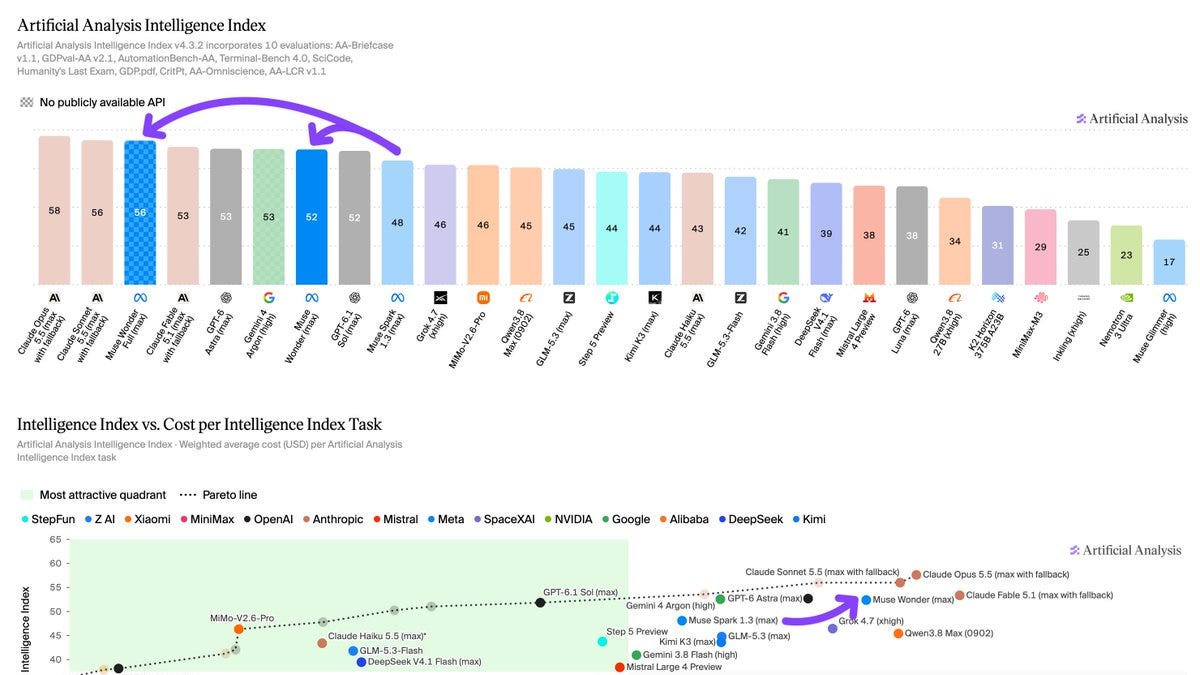
AINews daily digest (Oct 10–12, 2026) whose top story is Meta Superintelligence Labs' launch of Muse Wonder and Muse Wonder Full. The models have a 1M context window and are priced at $4 input / $20 output per M tokens for Wonder; Full is available only to Muse Code subscribers. It compiles third-party results: Artificial Analysis Intelligence Index v4.3 (Full 56, Wonder 52, Spark 1.3 48, Opus 5.5 58), Terminal-Bench 4.0 gains, Coding Agents Index, and Vals Index ranks. It also records Meta-reported numbers (SWE-Marathon, DeepSWE, MemoryBench), bullish and skeptical practitioner reactions, the "3D demo" benchmaxxing debate, and Muse retention data. The rest of the issue is a roundup of agent RL research (QwenGyre, Sakana MASS, GitSwarm), inference silicon (Maia 300, ReplaySSM), specialised models (GLM-Legal, Decision 3.0), and r/LocalLLaMA and other Reddit threads. The page text was truncated, so the end of the Reddit recap is not covered.

Muse CodeClaude CodeCodex+12
MetaMuseMuse Wonder+45

models, evals, agentsΒ· Published and added 13 Oct 2026

github.comthread🧠 AI

Codex CLI installs a persistent, self-updating background daemon by default

GitHub issue asking OpenAI to make `daemon_auto_start` opt-in in Codex CLI 0.157.0. By default, opening an interactive session starts a persistent `codex app-server --managed-daemon` that outlives the terminal. It also copies a ~374 MB platform package into ~/.codex/packages/app-server-daemon and runs a detached hourly `pid-update-loop` updater. The daemon keeps the first session's environment (proxy variables, cwd, direnv values), which the reporter ties to hook bugs #42457 and #37537. Comments confirm the problem on Windows and add the workaround (`codex features disable daemon_auto_start`, kill the updater, remove the package dir). They also note that `daemon stop` leaves the updater running and that the option is missing from the config docs. One commenter proposes an "execution receipt" (CLI version, daemon binary digest, generation, inherited-environment generation).

CodexnpmLinux+2
OpenAI

coding-agentsΒ· Published and added 12 Oct 2026

atoll92.github.iotool🧠 AI

AI agents in a stand-up call

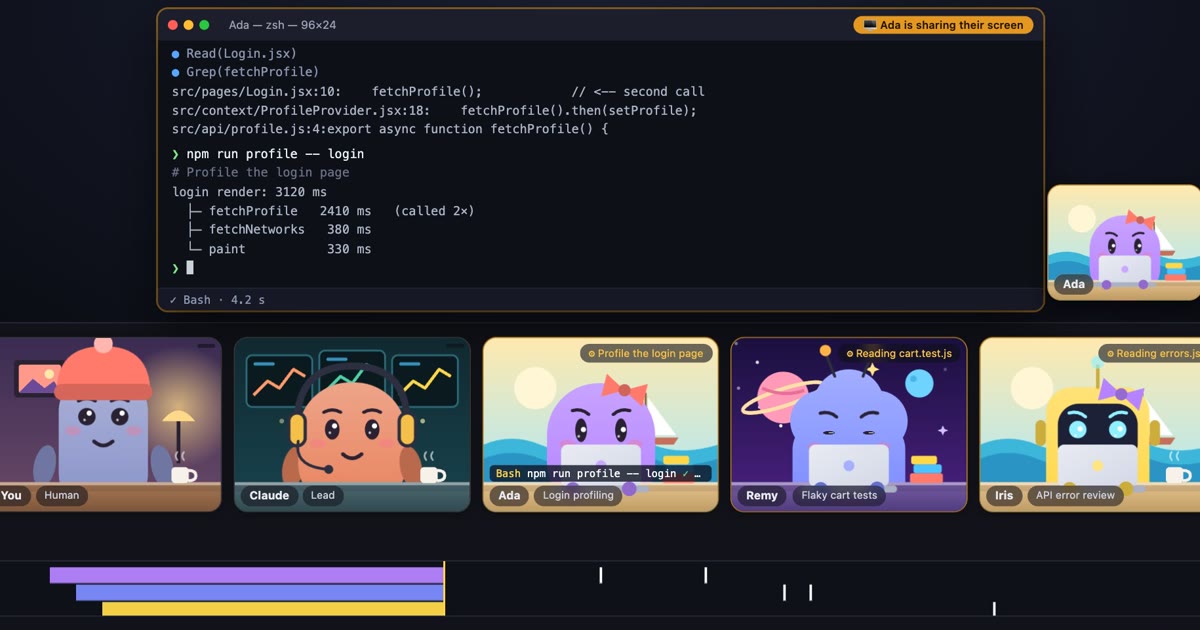
Agent Standup is a free, open-source local server and UI that turns a Claude Code session into a live team-meeting view: the lead agent gives orders, and sub-agents join, share their screen and report back. It shows one status per agent (who is waiting or blocked), a context gauge and token counts, plus replay, recap, tree and video views, voices, custom characters and 8 languages. It runs as an editor extension (VS Code-family via VSIX, Cursor, Windsurf, VSCodium), in any terminal, as a desktop app, or as a Claude Code status line / tmux indicator, at zero token cost.

Claude CodeCursorWindsurf+2

coding-agents, agents, ai-infraΒ· Published and added 11 Oct 2026

x.comthread🧠 AI

Arindam Majumder 𝕏 (@Arindam_1729) on X

A tweet describing an independent open-source project, "Free Claude Code", that lets Claude Code run against non-Anthropic providers such as DeepSeek and Kimi. It supports switching models, configuring fallback providers and using providers' free tiers, launched via `fcc-claude` from the terminal or an IDE. It states the limits: free usage follows provider quotas, some providers still need API keys, it does not unlock Anthropic's own models, and it is not affiliated with Anthropic. The page also shows a quoted article on a 5-layer setup for running coding agents in YOLO/auto-approve mode safely.

Claude CodeDeepSeekKimi+1
AnthropicFree Claude Code

coding-agents, ai-infraΒ· Published and added 10 Oct 2026

arxiv.orgpaper🧠 AI

Matched-Context Group Policy Optimization for LLM Agent Training

Proposes Matched-Context Group Policy Optimization (MCGPO), which builds weighted action preferences from already-collected sibling rollouts to give credit to intermediate decisions when feedback is sparse and arrives only at the end. Comparison contexts use pre-action state summaries and rubric progress. Exact and coarse matching rules are selected by two-action support, and fixed folds separate candidate decisions from the terminal outcomes that orient them. An evidence-weighted auxiliary pairwise loss is added to GraphGPO task learning, and no critic is needed. Across six environment-backbone settings with three seeds each, it beats GraphGPO by 0.47-1.46 points on ALFWorld and WebShop with Qwen2.5-1.5B/7B, and by 3.96 and 5.16 points on WebShop with Qwen3-4B/8B. ALFWorld gains are small because baseline success is already above 92%.

GRPOQwenQwen3
Matched-Context Group Policy OptimizationMCGPOGraphGPO+4

training, agents, researchΒ· Added 12 Oct 2026, published 9 Oct 2026

huggingface.corepo🧠 AI

Aleph Alpha Kolibri-1 (78B MoE, Apache 2.0)

Kolibri-1 is Aleph Alpha's 78B-parameter mixture-of-experts reasoning model focused specifically on German and English, released under Apache 2.0 with weights, a vLLM plugin, and an extensive model card. It supports explicit reasoning-effort levels, Hermes-style tool calling, and a native 262144-token context validated to over 1M via sliding-window attention; the card details its UniBPE German-aware tokenizer, pre-training mid-training and long-context training recipe, MergeMix-based data-mix search, Merlin-Arthur hallucination-mitigation RL protocol, and benchmark results against Qwen3.5, Gemma 4, Nemotron 3 Nano, and Apertus on MMLU-Pro, GPQA, AIME, SWE-bench Verified, Terminal-Bench 2.1, and HLE.

Hugging FacevLLMPyTorch+3
Aleph AlphaKolibri-1Kolibri Base+21

models, training, evalsΒ· Added 8 Oct 2026

arxiv.orgpaper🧠 AI

What Output-Only Review Cannot Verify: Study Contracts for Research Agents

Proposes "study contracts" that bind an AI-generated study's declared experimental choices, run obligations and claim scope to recorded execution evidence, defining contract-relative verification as distinct from scientific truth. In a diagnostic with eight self-authored clean/mutated pairs, a deterministic fault-specific checker caught all eight mutations, while eighteen LLM judge aliases given metadata-filtered packages flagged 104 of 144 mutated cases (32 abstentions, 8 terminal failures). The authors stress the setting is deliberately information-asymmetric, not a verifier-quality comparison or reward-hacking result, and call for full-information comparisons, legitimate-adaptation controls and closed-loop agent evaluations.

research, evals, agentsΒ· Added 9 Oct 2026, published 8 Oct 2026

latent.spacearticle🧠 AI

[AINews] Claude Haiku 5.5 β€” better than GPT-6 Luna at the same pricing

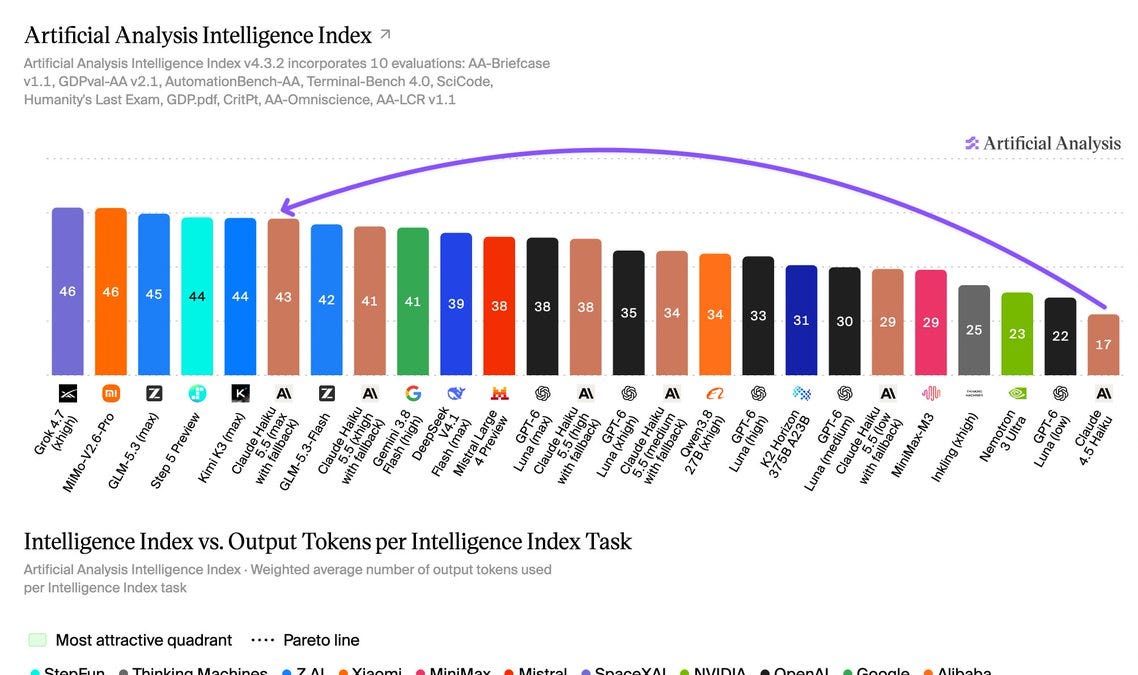
Latent Space's AINews recap covers Anthropic's launch of Claude Haiku 5.5, priced to match OpenAI's GPT-6 Luna and paired with a Sonnet 5.5 cache-read price cut and new Max/Team API credits. Independent Artificial Analysis testing puts its Intelligence Index at 43 (up 26 points from Haiku 4.5) and Terminal-Bench 4.0 at 33%, but shows it uses roughly 3x the output tokens of GPT-6 Luna at max effort, plus results on AA-Briefcase, AA-Omniscience and AutomationBench-AA, alongside a same-day Claude SDK update adding built-in computer-use/browser-use tooling.

ClaudeClaude CodePython+1
Claude Haiku 5.5AnthropicGPT-6 Luna+21

models, evalsΒ· Published and added 8 Oct 2026

decrypt.coarticle🧠 AI

Anthropic Launches Haiku 5.5: Its Cheapest and Fastest Claude Model Yet

Anthropic released Claude Haiku 5.5, pricing it at $0.10/$0.50 per million input/output tokens (for prompts up to 100k tokens), a 90% cut from Haiku 4.5, matching OpenAI's GPT-6 Luna pricing. The model scored 72.4% on OSWorld 2.1 and 39.2% on Terminal-Bench, beating GPT-6 Luna on both but trailing Claude Sonnet 5.5's 70.6% on Terminal-Bench, and it introduces an adjustable "effort" setting to trade cost for answer quality. Anthropic also halved Claude Sonnet 5.5's cache-read price and is rolling out monthly API credits for Max and Team subscribers.

ClaudeAWSGoogle Cloud+1
AnthropicClaude Haiku 5.5Claude Haiku 4.5+9

models, evalsΒ· Published and added 7 Oct 2026

arxiv.orgpaper🧠 AI

RunningTab: Direct Workspace Interaction with Environment-Side Tabs

RunningTab is a framework that gives LLM agents performing 'direct workspace interaction' (searching and reading files from a terminal without indexing to produce a deliverable) an environment-side 'tab': a per-task record, maintained outside the model's context, of requirements the agent has declared, excerpts read with provenance, and listed-but-unopened files flagged as candidates. The agent can check each requirement against matching excerpts or candidates, mark it resolved or deferred with a reason, and is forced through a finish check if requirements remain open when it tries to complete the task. The authors show it consistently beats plain direct workspace interaction and model-internal record-keeping baselines across three benchmarks and three LLMs.

RunningTab

agentsΒ· Added 8 Oct 2026, published 7 Oct 2026

mistral.aiarticle🧠 AI

Introducing Mistral Large 4 ("Le Chonk")

Mistral announces Mistral Large 4 ("ML4"/"Le Chonk"), a 1-trillion-parameter natively multimodal Mixture-of-Experts model with 52B active parameters, trained from scratch on 3,800 NVIDIA Grace Blackwell GPUs in Mistral's own European datacenters. The post details state-of-the-art open-weight results on cybersecurity benchmarks (82% on an Artificial Analysis vulnerability-reproduction test, 93% on Cybench), agentic coding (DeepSWE, Terminal-Bench, AutomationBench), finance/legal evals (via Vals, Harvey's Legal Agent benchmark), visual grounding (beating GPT-6 Astra on Dense 200), and safety benchmarks (Lakera B3, KORA). It also describes the large-scale RL post-training pipeline (33B tokens/day at 3k GPUs) used to produce the model, with full weights promised by end of month.

MistralMixture of Expertsvision-language model+1
Mistral Large 4GLM-5.3GLM-5.2+20

models, multimodal, evals, trainingΒ· Added 7 Oct 2026, published 6 Oct 2026

arxiv.orgpaper🧠 AI

Towards Looped Models Done Right, Part II: Rethinking at Fixed Points

This paper studies looped language models β€” architectures that reuse a shared block of layers recurrently β€” and argues that as recurrent hidden states approach fixed points, the specific path taken to reach them matters less, enabling several efficiency tricks: truncated backpropagation through time during training, terminal key-value (KV) cache sharing across loop iterations for faster decoding, a distilled student model that prefills up to 1.79x faster, and RL policy gradients computed from saved rollout states that run 2x faster than backpropagating through the full trajectory. To make these fixed points reliable, the authors replace fixed-depth training with a learned depth prior (regularized with an entropy term to stay broad, improving on Huginn's fixed broad prior) and introduce orthogonal input injection, which removes the component of the injected input that the hidden state could otherwise amplify or cancel. Across model scales from 100M to 1.6B parameters, both changes lower perplexity, and at 1.6B the learned prior with a 3x smaller KV cache matches the downstream performance of full-cache fixed-depth training.

Huginn

research, training, inferenceΒ· Added 6 Oct 2026, published 5 Oct 2026

huggingface.coarticle🧠 AI

The Agent Said It Was Done. The Database Disagreed.

ThinkingBox is an agent sandbox and ThinkingBox-Bench is a 507-task stateful business-workflow benchmark (retail, auto insurance, etc.) that grades agents by checking the terminal backend database state and side effects they leave behind, not just whether tool calls succeeded or the final reply sounds right. Across 121,680 trials over 12-18 LLMs run 20 times each, the post finds most failures are clean-looking: 67% of failed trials still terminated without a tool error, yet executable checks caught wrong field values, missing effects, or unintended extra effects. It also reports pass@1 vs. 20/20 consistency gaps (e.g. Kimi K3 solves the most tasks at least once but is among the least consistent, while Claude Opus 5 and Claude Opus 5.5 are the most dependable) and cost-per-success/cost-per-dependable-task metrics, and ships the benchmark through an OpenEnv interface for reproducible evaluation.

Model Context ProtocolHugging FaceDocker+4
MicrosoftThinkingBoxThinkingBox-Bench+21

evals, agentsΒ· Published and added 3 Oct 2026

tej.asarticle🧠 AI

Aleph Alpha Kolibri: How the sovereign German LLM works

A deep technical walkthrough of Aleph Alpha's Kolibri, a 78B-parameter (3.5B active) mixture-of-experts LLM for German and English released under Apache 2.0, built to be 'sovereign' (trained and deployable entirely under EU/German law). The post explains its six core design choices β€” a 384-expert MoE router, a German-aware UniBPE tokenizer (verified independently to cut tokens 15% vs GPT-5's tokenizer on legal German), mostly sliding-window attention enabling a validated 1M-token context, German-native reasoning traces, a Merlin-Arthur training protocol for calibrated 'I don't know' abstention, and a configurable reasoning_effort parameter β€” and benchmarks it against Qwen3.5/3.6/3.8, GLM-4.7 Flash, Nemotron 3 Nano and gpt-oss-120b on AIME, RULER, SWE-bench Verified, Terminal-Bench and the Omniscience test, including where it underperforms (tool calling, coding agents, trivia recall).

Hugging FacevLLMMixture of Experts+5
Aleph AlphaKolibriQwen3.6+19

models, inference, trainingΒ· Published and added 3 Oct 2026

offrun.devtool🧠 AI

Show HN: Offrun – manage every coding agent from one workspace

Offrun is a macOS (Apple Silicon) desktop app that runs multiple coding-agent CLIs, including Claude Code, Codex, AGY, and Grok Build, side by side, giving each agent its own git worktree so parallel sessions never collide on the same files. It adds peer review where one agent's findings land in another's chat before anything is committed, account rotation across multiple logins when one hits its rate limit, persistent per-agent and per-repo project memory stored as plain files, cross-terminal notifications, a diff and preview pane, Build versus Planner modes, and on-device dictation, all running locally under the user's own agent subscriptions with no server in the path.

Claude CodeCodexGit
Grok BuildAGY

coding-agentsΒ· Published and added 3 Oct 2026

anthropic.comarticle🧠 AI

Introducing Claude Sonnet 5.5

Anthropic announces Claude Sonnet 5.5, a faster (30%+) and cheaper-per-task successor to Sonnet 5 at the same $2/$10 per million token pricing. It reports 70.6% on Terminal-Bench 4.0 (vs 10.3% for Sonnet 5), near-Opus 5.5 results on GDPval-AA and CursorBench, a +10 point FrontierCode gain at roughly 1/15 the cost per task, and cost-vs-effort curves. It also covers alignment audit results, new cyber safeguards with fallback to Sonnet 5, distillation classifiers and expanded preserved thinking, plus the migration note for the new between_tools thinking setting.

ClaudeClaude CodeAWS+2
AnthropicClaude Sonnet 5.5Claude Sonnet 5+15

models, evals, coding-agentsΒ· Added 1 Oct 2026

huggingface.corepo🧠 AI

DeepSeek-V4.1-Flash

DeepSeek-V4.1-Flash is a multimodal Mixture-of-Experts model with 552B backbone parameters, 1M-token context, and a novel Causal Encoder-Decoder (CED) architecture where the decoder's global KV cache is projected from encoder hidden states rather than recomputed per layer, activating only 8B/16B parameters per token during prefill/decode. It introduces Compressed Sparse Attention 2 (CSA2) with FP4 KV caching to cut the global KV cache footprint to 890 bytes/token (~1/4 of DeepSeek-V4-Flash, ~1/437 of DeepSeek-V1), alongside Engram conditional memory, DSpark speculative decoding, and a continuously controllable reasoning-effort setting (1–100). The card documents pre/post-training recipes (45T tokens, SFTβ†’RLβ†’on-policy distillation with synthetic agent environments) and reports results across agentic and code benchmarks (Terminal-Bench 2.1/3.0/4.0, DeepSWE v1.1, GPQA Diamond, Chartography, ZeroBench, AutomationBench), plus deployment instructions for Transformers, vLLM, SGLang, and Docker.

TransformersvLLMSGLang+5
DeepSeek-V4.1-FlashDeepSeek-V4-FlashDeepSeek+16

models, multimodal, inferenceΒ· Added 30 Sep 2026

x.comrepo🧠 AI

AI News | AI Tools (@AI_News100x) on X

Open-Dots is an open-source reimplementation of OpenAI's 'Dots' computer-use agent, giving any LLM the ability to control a browser, terminal and filesystem plus connectors to personal apps. It is framework-agnostic (works with any LLM) and free, positioned as a self-hostable alternative to OpenAI's proprietary computer-use offering.

OpenAI

agentsΒ· Published and added 30 Sep 2026

x.comrepo🧠 AI

Χ¨Χ•ΧŸ ΧΧ‘Χ¨Χ‘Χ•Χš (@Ron_averbuch) on X

Open-Dots is an open-source re-implementation of OpenAI's Dots computer-use agent, giving it browser, terminal and file control plus connectors to personal apps, and designed to work with any LLM rather than being locked to one vendor's model. It's announced via a tweet linking to the GitHub repo (github.com/Anil-matcha/Open-Dots).

OpenAIOpen-Dots

agentsΒ· Added 30 Sep 2026, published 29 Sep 2026

x.comthread🧠 AI

Anil Chandra Naidu Matcha (@matchaman11) on X

Open-Dots is an open-source reimplementation of OpenAI's "Dots" computer-use agent, giving it browser, terminal and file control plus connectors to personal apps, and designed to work with any LLM rather than being locked to one provider. The tweet thread announces the project and links to its GitHub repository.

OpenAIAnil Chandra Naidu MatchaOpen-Dots

agentsΒ· Added 30 Sep 2026, published 29 Sep 2026

openai.comarticle🧠 AI

Introducing GPT-6.1 Sol

OpenAI announces GPT-6.1 Sol, an upgrade to GPT-6 Sol that approaches GPT-6 Astra on agentic coding, computer use and professional work at about one-fifth the price ($2/$10 per million input/output tokens, $0.10 cached input; API id gpt-6.1-sol). It reports results on DeepSWE v1.1 (matches Astra), GDP.pdf, AutomationBench (+2.2 pts over Opus 5.5), OSWorld 2.0 offline, Terminal-Bench Science 0.1 ($5.47 per task vs $23+ for Opus 5.5/Astra) and a factuality eval where errors drop from 11.4% to 7.7% at low effort. Also covers alignment evals, availability in ChatGPT Work and Codex, and an upcoming Ultrafast mode in Codex with up to 8x faster generation.

OpenAI APICodexChatGPT
OpenAIGPT-6.1 SolGPT-6 Sol+8

models, evalsΒ· Published and added 29 Sep 2026

decrypt.coarticle🧠 AI

Anthropic's Claude Sonnet 5.5 Is Out, Beats Opus 5.5 at Coding for Half the Price

Anthropic released Claude Sonnet 5.5, priced the same as Sonnet 5 ($2/$10 per million input/output tokens, half of Opus 5.5) but outperforming Opus 5.5 on Terminal-Bench 4.0 (70.6% vs 66.4% per Anthropic; 63.6% vs 59.6% per independent tester Artificial Analysis). The piece details how effort-setting (Medium vs High vs Max) drastically changes cost-per-task β€” Sonnet 5.5 at max effort burns ~193K tokens per task, more than any model Artificial Analysis has tested, undercutting Anthropic's claimed savings β€” and notes Sonnet 5.5 ties Opus 5.5 on GDPval-AA (real-world professional work) while Opus remains stronger on sustained-judgment tasks. Claude Haiku 5.5 is teased for coming weeks.

Claude
Claude Sonnet 5.5Claude Opus 5.5Anthropic+7

models, evalsΒ· Added 30 Sep 2026, published 28 Sep 2026

github.comrepo🧠 AI

openrig β€” multi-agent Claude Code/Codex orchestration

OpenRig is an open-source local daemon, CLI, TUI and MCP server (built on tmux + SQLite) that manages teams of Claude Code and Codex agent sessions as a single persistent system rather than a pile of terminal windows. Topologies (pods, seats, edges) are defined declaratively in YAML (RigSpec/AgentSpec), booted with `rig up`, inspected via a topology TUI, and can be snapshotted/restored, discovered from existing tmux sessions, and messaged across agents (`rig send`, `rig broadcast`, `rig chatroom`). It ships starter topologies (first-project, conveyor, product-team, secrets-manager using HashiCorp Vault) and documents in detail what it writes to Claude/Codex config, trust and telemetry state on the host machine.

Claude CodeCodexNode.js+4
OpenRigHashiCorp VaultPi

coding-agents, agents, mcpΒ· Added 28 Sep 2026

artificialanalysis.aiother🧠 AI

Terminal-Bench 4.0 leaderboard

Artificial Analysis' leaderboard for Terminal-Bench 4.0, a 66-task benchmark of complex terminal work spanning software engineering, machine learning, science, operations, security, hardware and media, with recalibrated compute/time budgets and improved verifiers over prior versions. The page ranks models/agents by score, cost per task, output tokens per task, and time per task, and links out to related Artificial Analysis evaluations (GDPval-AA, APEX-Agents, Harvey's Legal Agent Benchmark, ServiceNow EnterpriseOps-Gym, Terminal-Bench 2.1, GPQA, MMLU-Pro, AIME, LiveCodeBench and others) used to benchmark frontier agentic and reasoning capability.

Terminal-Benchterminal-bench-2.1Artificial Analysis+7

evalsΒ· Added 28 Sep 2026

huggingface.coarticle🧠 AI

Welcome RL Environments to the hub

Hugging Face announces that RL environments β€” tasksets used to train or evaluate agents β€” can now live as ordinary dataset repos tagged `rl-environment`, surfaced via a new filter on the Hub instead of each framework maintaining its own registry. Four frameworks (Harbor, Verifiers, OpenEnv, NeMo Gym) get dataset-library tags that auto-generate run snippets, and the post walks through concrete commands to run a reference solution or a model agent against the same task directory (e.g. terminal-bench-2.1) and read back the verifier's reward. It also lists already-tagged environments like BeyondSWE, Multi-SWE-RL-Verified, R2E-Gym-Subset-Verified, Scale-SWE-Verified, and NeMo Gym's Workplace Assistant and Structured Outputs tasksets.

Hugging FaceDockerPython+6
terminal-bench-2.1BeyondSWETerminal-Lego+10

training, evalsΒ· Added 8 Oct 2026, published 28 Sep 2026

anthropic.comarticle🧠 AI

Claude Opus 5.5

Anthropic announces Claude Opus 5.5, the first model in the Claude 5.5 family, claiming performance comparable to Claude Fable 5.1 at 40% lower cost than Opus 5, with input/output pricing at $4/$20 per million tokens and cache reads at $0.20/million. The post details agentic-coding gains against GPT-6 Astra and GPT-5.6 Sol on benchmarks like FrontierCode, Terminal Bench 4.0, CursorBench, and GDPval-AA v2.1, plus a safety section covering an automated behavioral audit, an ~85% reduction in sandbox-escape/containment-boundary attempts versus Opus 5 and Claude Mythos 5.1, Gray Swan prompt-injection results, and new cyber/biology safeguards alongside the "preserved thinking" anti-distillation mechanism.

ClaudeHAProxyRust+3
Claude Opus 5.5Claude Fable 5.1Claude Mythos 5.1+15

models, ai-safety, coding-agentsΒ· Added 27 Sep 2026

anthropic.comarticle🧠 AI

Introducing Claude Opus 5.5

Anthropic's announcement of Claude Opus 5.5, the first model in the Claude 5.5 family, positioned to match Claude Fable 5.1 performance at 40% lower cost than Opus 5 ($4/$20 per million input/output tokens, $0.20 cache reads). The post details agentic coding gains (e.g., a 680,000-line code migration completed in under a day), efficiency improvements across partner benchmarks (FrontierCode, Terminal Bench 4.0, CursorBench, GDPval-AA v2.1), and alignment/safety results from an automated behavioral audit plus new cybersecurity, biology, and anti-distillation safeguards (preserved thinking) similar to those applied to Fable 5.1.

Claude CodeClaude
Claude Opus 5.5Opus 5Claude Fable 5.1+39

models, ai-safetyΒ· Added 26 Sep 2026

tbench.aiarticle🧠 AI

Terminal-Bench 4.0

Terminal-Bench 4.0 is a versioned update to the Terminal-Bench agentic coding benchmark and leaderboard, calibrating task resource limits (timeouts, CPU, memory) using a noise-quantification methodology, removing 8 saturated/flawed tasks, and fixing 19 others. It's built on the Harbor framework and available on the Harbor Hub, with Terminal-Bench now versioned as a continuously maintained (semantic-versioned) benchmark rather than discrete "sequel" releases.

Harbor
Terminal-BenchSonnet 5Opus 5+1

evalsΒ· Added 26 Sep 2026

arxiv.orgpaper🧠 AI

Agent-Editing World Model: Rethinking World Modeling for LLM Agents

This arXiv paper proposes the Agent-Editing World Model (AEWM), which reframes world modeling for LLM agents: instead of predicting/reconstructing environment observations (high-entropy tool responses), it models how reasoning and actions shape future task progress, addressing "task-state contamination" where stale plans and unsupported assumptions corrupt later decisions. It introduces Action Judge (classifying decisions as Critical, Exploratory, or Noisy) and State Revision, combined via EditAct which directly edits the agent's state using real execution feedback rather than issuing critiques. Trained across Search, Terminal, and Software Engineering domains, AEWM reports 70.5% macro-F1 on its Action Judge benchmark (+10.6 over the strongest frontier baseline) and EditAct improves average scores by 3.2–6.7 points across six benchmarks and three agent backbones, with an RFT variant (AEWM-RFT) also outperforming Self-RFT.

AEWMAction JudgeState Revision+3

agents, researchΒ· Added 26 Sep 2026

thehackernews.comarticleπŸ›‘οΈ Security

Marimo Notebook Flaw Could Run MCP Commands Before Cells Execute in Edit Mode

The Hacker News details CVE-2026-75149, a high-severity (CVSS 8.8) code injection flaw in Marimo notebooks where a crafted notebook's configuration could supply an attacker-controlled MCP server command that runs as a local subprocess as soon as the notebook is opened in edit mode, before any cell executes. Marimo fixed it in version 0.23.15 by treating notebook metadata as untrusted and allowlisting configuration, stripping ai/mcp/completion/secrets/server sections; the article also covers the related CVE-2026-67618 (AI base_url exfiltrating API keys via notebook metadata) and the earlier CVE-2026-39987 (unauthenticated /terminal/ws endpoint granting a full PTY shell).

MarimoModel Context ProtocolPython+3
CVE-2026-75149CVE-2026-67618CVE-2026-39987+2

AppSec, AI SecurityΒ· Added 26 Sep 2026

thehackernews.comarticleπŸ›‘οΈ Security

Critical Cursor Flaws Could Let Prompt Injection Escape Sandbox and Run Commands

Cato AI Labs disclosed DuneSlide, two critical (CVSS 9.8) Cursor flaws β€” CVE-2026-50548 and CVE-2026-50549 β€” that let a zero-click prompt injection (via MCP servers or web search results read by the agent) escape Cursor's terminal sandbox and achieve arbitrary command execution. Both abuse the file-write allowlist logic: one via the run_terminal_cmd tool's working_directory parameter, the other via a symlink-resolution fallback that trusts an in-project path when the real-path check fails; both let an attacker overwrite Cursor's sandbox helper binary or startup files like ~/.zshrc to disable the sandbox entirely. Fixed in Cursor 3.0 (April 2), affecting all prior 2.x versions; the piece also situates this alongside earlier Cursor agent-exploitation chains (CurXecute/CVE-2025-54135, MCPoison/CVE-2025-54136, CVE-2026-26268).

CursorModel Context ProtocolmacOS+3
CVE-2026-50548CVE-2026-50549CVE-2025-54135+7

AI SecurityΒ· Added 26 Sep 2026

github.comrepo🧠 AI

AgentSystemLabs/agent-office

agent-office is an open-source Node.js application that renders your team's projects as floors of a cartoon 3D office, where each Claude Code, OpenCode or Codex coding-agent worker sits at a desk with a visible terminal others can join. It wires agent workers directly into GitHub: an issues board and PR board with diff review, CI status and merge actions, a task queue that auto-hires workers into isolated git worktrees, one-click PR creation, live worker status via Claude Code/Codex hooks and an OpenCode plugin, and per-worker cost/token tracking against Claude plan limits. It also supports multi-agent meeting-room collaboration patterns such as debate, lead and team, map-reduce, red and blue, and review panel, where several agent workers jointly produce a file and open a PR, plus shared voice chat and screen sharing for the human team.

Claude CodeCodexOpenCode+3

coding-agents, agentsΒ· Added 28 Sep 2026, published 26 Sep 2026

arxiv.orgpaper🧠 AI

Two Conformal Constructions for Adaptive Within-Document AI-Text Screening

This paper presents two conformal-prediction constructions for calibrating AI-text detection pipelines that screen document prefixes with multiple detectors and may stop early. Construction A allocates a false-alert budget across conformal ranks for a registered finite family of prefix-detector scores using a union bound; Construction B calibrates the complete-path maximum of an adaptive stopping policy so a single terminal conformal rank protects early stopping without splitting the error budget. Under document-level exchangeability (with no restriction on within-document token dependence), the authors prove marginal false-alert control across the inspection path and derive necessary calibration sample sizes, while noting that detection power and computational savings are left to future empirical evaluation.

research, evalsΒ· Added 28 Sep 2026, published 25 Sep 2026

latent.spacearticle🧠 AI

[AINews] The Future of Latent Space

The daily AINews digest from Latent Space rounds up a heavy week in AI: Claude Opus 5.5 topping SimpleBench and Terminal-Bench-Science, the GPT-6 family (Astra/Sol/Luna), Gemini 3.8 Flash, and Xiaomi's open-weight MiMo-V2.6-Pro; TypeSafe's Jev system-one decision model (and open alternatives like CLM) for cheap structured judgments; agent-infra launches from LangChain Interrupt and Perplexity's Rust retrieval engine Photon; inference speedups like Liquid AI's DSpark speculative decoder and GLM-5.3 on AMD MI355X; and research on harness distillation, agent failure modes, and autonomous-science efforts led by Sakana AI's RSI Lab with Jurgen Schmidhuber.

LangChainvLLMSGLang+11
Claude Opus 5.5GPT-6 AstraGPT-6 Sol+34

models, agents, researchΒ· Added 29 Sep 2026, published 25 Sep 2026

huggingface.coarticle🧠 AI

How UK AISI and EvalEval Are Making Benchmark Results Reproducible

UK AI Security Institute (AISI) and the EvalEval Coalition describe a collaboration to make AI benchmark results reproducible: AISI is publishing verified evaluation results, configuration details, and transcript-level data through EvalEval's Evaluation Cards platform, using the shared Every Eval Ever (EEE) reporting schema. The release covers five benchmarks (HealthBench, FrontierMath, Humanity's Last Exam, SWE-Bench Pro, Terminal-Bench 2.0) across six frontier models (Claude Opus 4/4.5/4.6, GPT-5/5.2/5.4), plus two cyber evaluations (Cyber CTFs, The Last Ones), accompanying AISI's paper on how inference compute and evaluation protocol shape benchmark performance.

Hugging Face
UK AI Security InstituteEvalEval CoalitionEvery Eval Ever+16

evalsΒ· Added 29 Sep 2026, published 22 Sep 2026

pwn.collegecourseπŸ›‘οΈ Security

pwn.college

pwn.college is a free, hands-on cybersecurity education platform built by Arizona State University that teaches binary exploitation, reverse engineering, and low-level systems security through a gamified "dojo" and belt-ranking system with terminal-based challenges. It underpins much of ASU's cybersecurity curriculum and is open for anyone to use, with educators able to import challenges into private dojos and some infrastructure/modules available as open source on GitHub.

Linux

LearningΒ· Added 21 Sep 2026

github.comrepo🧠 AI

zai-org/ZCode

ZCode is an AI programming workbench (from zai-org) providing a desktop Electron app, a browser-based Web UI, and a terminal Agent CLI and TUI, all backed by a shared backend and Agent runtime. The repo includes build and dev scripts for bootstrapping the monorepo, running desktop and web dev modes, and packaging a unified zcode CLI binary that can launch either a TUI or a local web server hosting the same agent backend.

Node.jsElectronpnpm
ZCodezai-org

coding-agentsΒ· Added 26 Sep 2026, published 20 Sep 2026

github.comrepo🧠 AI

MichaelKinsy/PiG

PiG reimplements Pi β€” a minimal, extensible terminal coding agent β€” as a single native Go binary with no Node.js dependency, while remaining behaviorally pinned to a specific Pi release (0.87.1) and running Pi's TypeScript extensions unchanged. It adds a multi-language extension host (Go, Rust, Python, Node), a "Piglet" mechanism for bundling extensions/skills/prompts into a named shareable agent, and a formal parity-tracking process (PORT_MAP.md, DIVERGENCES.md, coverage reports) that documents every intentional divergence from the upstream Pi reference implementation.

GoNode.jsPython+2
PiMichael KinsyHewlett Packard Enterprise

coding-agentsΒ· Added 27 Sep 2026, published 17 Sep 2026

Showing 60 of 99

Show more