Skip to content

325 results for โ€œfalโ€

What you seeeverything
regenerator1.comarticle๐Ÿง  AI

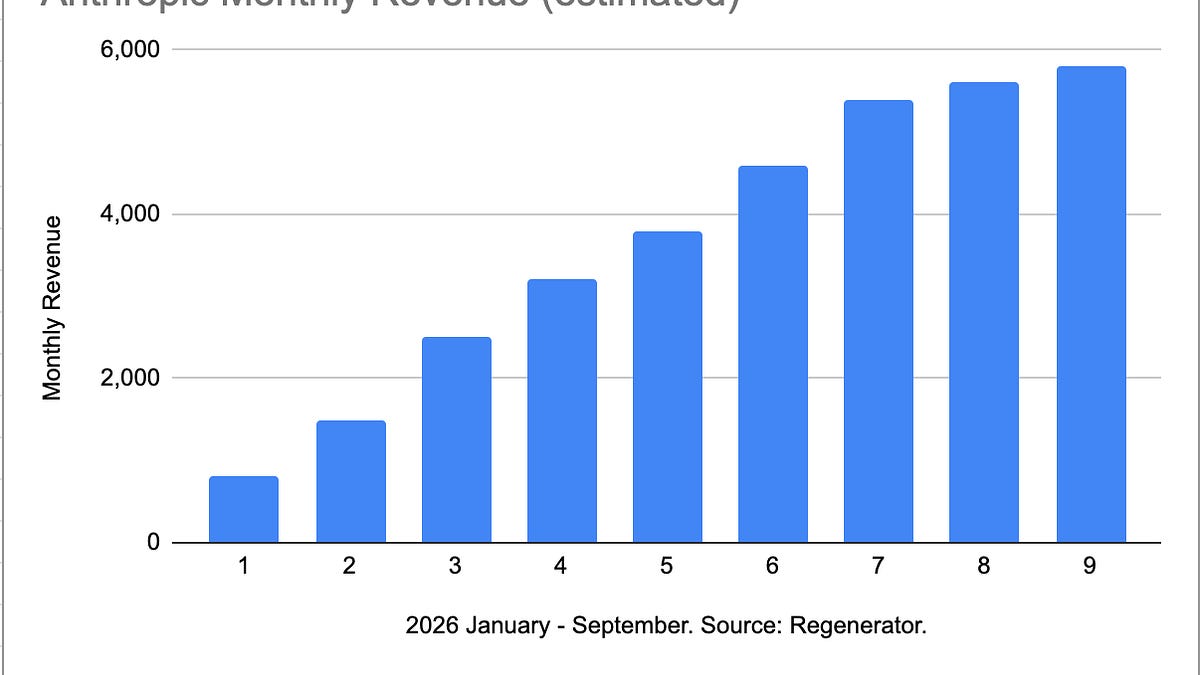
Anthropic's growth just flattened

Regenerator1 analyzes Anthropic's reported 2026 revenue: Q1 $4.8 billion, Q2 $11.6 billion (+141%), Q3 $16.8 billion (+45%). Using a reported $65 billion annualized run-rate in July (about $5.4 billion for the month), the author estimates growth was modest in August and September. The author suggests seasonality, capacity limits or cheaper Chinese models as causes, and links the slowdown to falling neocloud stocks such as CoreWeave.

AnthropicCoreWeaveThe New York Times+4

ai-policyยท Added 3 Nov 2026, published 2 Nov 2026

bleepingcomputer.comarticle๐Ÿ›ก๏ธ Security

Chinese hackers use ARTEX AI in automated attacks against 200 orgs

ARTEX is a multi-agent AI penetration-testing framework that the China-nexus actor Vapor Panda used from 17 October against more than 200 organizations in 14 countries, compromising at least nine. CrowdStrike reports DeepSeek and another commercial model coordinated agents, operators told agents to skip Falcon-protected Windows hosts, and BLOODALCHEMY was deployed. DIVD says ARTEX also drove its September 2026 breach, chaining two zero-days (one in Zammad) to root in 12 minutes.

ARTEXDeepSeekCrowdStrike+2
Vapor PandaBLOODALCHEMYDutch Institute for Vulnerability Disclosure+1

Threat Intel, AI Security, Offensive Securityยท Published and added 2 Nov 2026

x.comthread๐Ÿง  AI

Smarthouse (@localyzapp) on X

A reply by Smarthouse (@localyzapp) on X to a question about the best harness for connecting local models to a Minecraft server. It suggests an MCP server that wraps RCON plus a small agent loop. The main pitfall is block coordinates: expose "/execute if block" as a read tool so the agent can check blocks before placing them, or it will hallucinate terrain.

Model Context ProtocolMinecraftRCON

mcp, agentsยท Added 2 Nov 2026, published 1 Nov 2026

blog.talosintelligence.comwriteup๐Ÿ›ก๏ธ Security

Appraisal by AI: Model-driven victim prioritization in the VOLTA infostealer

VOLTA (VOLTA-AUTODOXER) is a self-deleting Windows infostealer that, after theft and live session-based enrichment, POSTs an evidence bundle to OpenRouter so an LLM can rank the victim's assets by monetization value. It falls back across a Claude, Kimi and Gemini chain when a model refuses. Talos covers the builder model, the Chrome App-Bound Encryption bypass, the volta_debug.txt artifact and countermeasures such as blocking Chrome --headless.

OpenRouterClaudeGemini+3
VOLTACLOSEDQUORUMCAIRN+3

Malware & RE, Threat Intel, AI Securityยท Published and added 31 Oct 2026

arxiv.orgpaper๐Ÿง  AI

From Small to Large: Assessing Medical Reasoning, Benchmark Contamination, and Model Size in Language Models

This paper evaluates fourteen LLMs from six providers on 3,076 questions from MedQA-USMLE, MedMCQA, PubMedQA and MedBullets. It tests standard multiple choice, questions with answer choices withheld, and reconstruction of hidden questions from choices alone. Mean accuracy falls from 82.3% to 50.9% without choices, smaller models trail larger ones by 8.7 points, and the strongest models reconstruct about one question in four.

LLM
MedQA-USMLEMedMCQAPubMedQA+2

evals, researchยท Added 3 Nov 2026, published 30 Oct 2026

arxiv.orgpaper๐Ÿ›ก๏ธ Security

Randomized Caches in Hardware: Challenges and Trade-offs

Paper implementing four randomized last-level cache designs (CEASER-S, ScatterCache, SassCache, MIRAGE) in a multi-core out-of-order RISC-V SoC on FPGA, evaluated with SPEC CPU 2017 and GAPBS. Pipelining the index derivation function alone is insufficient: three variants lose up to 35% frequency until critical paths are redesigned, leaving them within 10% of baseline. IPC falls up to 5% (SPEC) and 11% (GAPBS); FPGA LUTs rise 10-35%, ASIC area 1-14%.

RISC-VFPGA
CEASER-SScatterCacheSassCache+3

Hardware & RFยท Added 3 Nov 2026, published 30 Oct 2026

arxiv.orgpaper๐Ÿ›ก๏ธ Security

SecPO: Principled Adversarial Training for Prompt Injection Security

SecPO is a prompt injection defense that combines a new preference-optimization loss with adversarial training. It replaces the insecure DPO reference model with an approximated injection-invariant oracle, and trains on strong injections synthesized at best@240. Against Meta-SecAlign, AT cuts attack success rates 1.5-14.5x, and on Qwen3.6-27B AgentDojo ASR@800 falls to 8.8% from 78.8%, with no noticeable utility loss across nine benchmarks. Code, training data and model are released.

QwenHugging FaceLLM
prompt injectionAgentDojoMeta-SecAlign+3

AI Securityยท Added 3 Nov 2026, published 30 Oct 2026

en.cryptonomist.charticle๐Ÿง  AI

Metaโ€™s AI-distilled model detector catches 79% at a 0.1% false-positive rate

WM-Basin is a Meta method for detecting student LLMs distilled from watermarked teacher models, described in "Watermark Basins: Black-Box Detection of Distilled LLMs" (arXiv:2610.37266, 27 October 2026). It feeds a suspect model's API text into a clean probe model and checks gradient alignment with a key-specific watermark basin. It reached 79% true-positive rate at 0.1% false-positive rate across 1,200 students, versus 29% for the prior token-level detector. Clean-data fine-tuning and paraphrasing weaken it.

LLM
MetaMeta FAIRMeta Superintelligence Labs+3

research, trainingยท Published and added 30 Oct 2026

ethereum-magicians.orgother๐Ÿ›ก๏ธ Security

ERC draft: Independent Simulation Result for (STVA)

ERC draft "Independent Simulation Result" (STVA) defines a canonical, content-addressed SimulationResult structure that wallets, hardware devices or third-party verifiers can recompute from the same VerificationPayload and state snapshot. It specifies fields, a keccak256 or EIP-712 result hash, and Basic, Standard and Strict compliance tiers. The goal is to close UI/calldata mismatch attacks where a compromised frontend serves a false simulation. Open questions cover stateDiff encoding and prestate proofs.

EthereumrevmSafe
ERC-7730Scoped Capability TokensUI/calldata mismatch+5

Blockchainยท Published and added 30 Oct 2026

depthfirst.comarticle๐Ÿ›ก๏ธ Security

dfbench โ€” depthfirst

dfbench is a held-out benchmark maintained by depthfirst that scores frontier LLMs on defensive security work: vulnerability detection, validation (precision) and differential analysis between commits. It reports recall, precision, F1 and cost per task by model and thinking level, split by application, low-level and smart-contract code and by single or multi-repo scope. Overall detection recall runs from about 21% to 69%, with the top figure at $99.19 per task for Mythos 5; validation precision mostly falls between 15% and 49%.

LLMKimi K3Grok+3
dfbenchdepthfirstGPT-5.6 Sol+3

AI Security, AppSecยท Added 29 Oct 2026

decrypt.coarticle๐Ÿ›ก๏ธ Security

Polymarket Pauses Trading as Prediction Market Investigates Security Incident

Polymarket put its exchange in cancel-only mode and paused relayer actions on 29 October 2026 after users reported funds withdrawn without permission. Hudson Rock says a DebugBear-hosted script holds wallet-draining code that sells a logged-in user's positions and hard-codes the suspected attacker's wallet (about $2.65 million in POL, per Arkham) as fallback recipient. Polymarket blames a compromised third-party provider and promises to make users whole. Root cause and victim count are unconfirmed.

DebugBearPolygonRelay
PolymarketHudson RockArkham+2

Supply Chain, Threat Intelยท Published and added 29 Oct 2026

arxiv.orgpaper๐Ÿ›ก๏ธ Security

TextSeal2: Distortion-Free LLM Watermarking with Copula Mixing and Memoryless Races

TextSeal2 is a distortion-free LLM text watermark that merges two or more keys into one virtual key and couples it to fresh noise through AutoMark's Gaussian copula. Under speculative decoding it verifies keyed drafts with an extra exponential race, so output matches the target model and acceptance rate is unchanged. On three LLMs at a 10^-3 false-positive rate, it detects 8 to 22 points more 100-token answers than TextSeal.

TextSeal2TextSealAutoMark+2
Gumbel-max schemespeculative decodingGaussian copula+1

AI Securityยท Added 31 Oct 2026, published 29 Oct 2026

arxiv.orgpaper๐Ÿง  AI

TextSeal2: Distortion-Free LLM Watermarking with Copula Mixing and Memoryless Races

TextSeal2 is a distortion-free watermark for LLM output that keeps its signal under speculative decoding. It merges two or more keys into one virtual key coupled to fresh noise through AutoMark's Gaussian copula, and verifies drafts with an extra exponential race. On three LLMs it detects 8 to 22 points more 100-token answers than TextSeal at a 10^-3 false-positive rate.

LLMspeculative decodingGumbel-max watermarking+1
TextSeal2TextSealAutoMark+2

research, inferenceยท Added 31 Oct 2026, published 29 Oct 2026

latent.spacearticle๐Ÿง  AI

Can Frontier Models See Past a Decoy? Elorian Tests Visual Reasoning

DecoyCount is a benchmark from Elorian and Mercor with 1,660 items that tests whether models count objects or fall back on visual shortcuts. Frontier models scored below 50%: GPT-6 Astra led with 43.17%, ahead of Gemini-3.8-flash (32.71%), Qwen3.8-max (28.31%) and Claude-Fable-5.1 (25.22%). CEO Andrew Dai says Elorian's Glimpse model scored 50.48% in a single internal run without tools, and contrasts visual reasoning with world models such as Atlas and Genie 4.

vision-language model
ElorianGlimpseDecoyCount+17

evals, multimodal, modelsยท Added 28 Oct 2026, published 29 Oct 2026

eprint.iacr.orgpaper๐Ÿ›ก๏ธ Security

Stop Calling Them Provers: The Case for Calling ProVerif and Tamarin Symbolic Protocol Analyzers

Nadim Kobeissi's ePrint paper 2026/2683 argues that ProVerif and Tamarin should be called symbolic protocol analyzers, not provers. It audits their published soundness arguments, finding false statements, missing proofs and gaps between paper and implementation, and reproduces reported Tamarin bugs that accept false claims. It also covers model gaps in parsers and state machines, weak secrecy queries and unjustified primitive equations. The page is an abstract only.

ProVerifTamarin
Nadim Kobeissicomputational soundnesssymbolic model

otherยท Added 31 Oct 2026, published 29 Oct 2026

arxiv.orgpaper๐Ÿ›ก๏ธ Security

SEAL: Sealed Queries for Local Sanitization against Indirect Prompt Injection

SEAL is a defense against indirect prompt injection for local LLM agents. It learns a soft prompt and scoring readout offline, then uses a frozen task model to score and delete injected tokens from tool outputs, with queries built from trusted initial context. On AgentDojo, attack success falls from 34.6% to 0.1% and Joint rises from 51.4% to 77.5%, using about 127x fewer defense tokens than PISanitizer.

LLMAgentDojoAgentDyn+1
indirect prompt injection

AI Securityยท Added 31 Oct 2026, published 29 Oct 2026

blog.talosintelligence.comwriteup๐Ÿ›ก๏ธ Security

NIK C2: The new AI-enabled command-and-control framework

NIK C2 is a newly observed C2 framework with a Go-based 64-bit Windows implant that embeds an OpenAI Chat Completions client (ai_generate command), falling back to the victim's OPENAI_API_KEY. Talos details its 52+ commands, AES-256-GCM over WebSocket with HTTP fallback, credential, wallet and keystroke theft, screen-lock ransomware, AMSI bypass and anti-debug. It also lists a live C2 at 87.120.196[.]120 and total-sitevv[.]lol.

GoOpenAIWindows+3
NIK C2nik_panel87.120.196[.]120+9

Malware & RE, Threat Intel, AI Securityยท Published and added 29 Oct 2026

eprint.iacr.orgpaper๐Ÿ›ก๏ธ Security

High Precision Noise Cleaning for CKKS with Application to Asynchronous Threshold CKKS

High Precision Noise Cleaning for CKKS is an IACR ePrint preprint (2026/2675) by Zhihao Li, Cheng Hong and Tao Wei. It composes lower-degree Hermite polynomials to reach output noise bounds such as 2^-300 for noise flooding, and uses this to build an asynchronous threshold CKKS scheme with strong simulation security in the random oracle model. In OpenFHE, binary-message cleaning falls from 9.63 s to 1.54 s.

CKKSOpenFHE
noise floodingHermite interpolationfunctional bootstrapping+2

otherยท Added 31 Oct 2026, published 29 Oct 2026

arxiv.orgpaper๐Ÿ›ก๏ธ Security

REALM: Identifying Minimal Task Assets for LLM Agents

REALM (Required Execution Assets Linked to a Mission) is an approach to applying least privilege to LLM agents by identifying the assets a task needs, including ones discovered at runtime. It models assets as Dependency Graph nodes, separates discovering an asset from authorizing it, and exposes resource-bound Partial APIs inside a Task Container. On AgentDyn with qwen3.5-flash, attack success rate falls from 16.6% to 0.2%, with 40.0% task completion on clean tasks and 36.4% on injected cases.

QwenLLMAgentDyn
prompt injectionleast privilegeREALM

AI Securityยท Added 31 Oct 2026, published 29 Oct 2026

x.comtool๐Ÿง  AI

Big Bull (@BIGBULLapp) on X

clauth is a Rust terminal UI for Claude Code that combines multi-account switching with a live 5h / 7d usage monitor. A fallback chain moves the user off an exhausted account before Claude Code blocks. It supports Pro, Max, Team and Enterprise OAuth accounts and custom API endpoints on Linux, macOS and Windows. The post notes that auto-switching means the tool decides when accounts change.

Claude CodeRustOAuth+4
clauthAnthropic

coding-agents, ai-infraยท Added 30 Oct 2026, published 28 Oct 2026

wired.comarticle๐Ÿ›ก๏ธ Security

Leak Exposes 41,000 Homeland Security Workersโ€“Including Undercover ICE Agents

Icepick is a leaked archive of records on more than 41,000 Department of Homeland Security employees and contractors, published by Distributed Denial of Secrets in 2026 and said to come from DHS's Okta login system. WIRED's analysis covers CBP, ICE, HSI, USCIS and CISA staff, plus over 55,000 permission groups that reference undercover programs, Palantir Falcon, PenLink, Signal and Mobile Fortify. Okta says it has no evidence of compromise.

OktaPalantirPenLink+3
IcepickDistributed Denial of SecretsDepartment of Peace+10

Threat Intel, OSINT, Identity & Accessยท Added 29 Oct 2026, published 28 Oct 2026

arxiv.orgpaper๐Ÿง  AI

From Leniency to Suspicion: How an Open Post-Training Recipe Changes Whom LLM Fact-Checkers Believe

This paper measures job-based doubt in LLM fact-checkers: judging a claim false more often when the poster has a lower-status job. It compares base and post-trained checkpoints of six model families on fact-checked claims with randomised poster profiles. Only the open Tรผlu-3 recipe (OLMo-2 32B, Tรผlu-3 70B) creates the effect, under one percentage point but reliable. In OLMo-2 32B the flip comes from one residual-stream direction and appears at supervised fine-tuning, confirmed on 400 new claims. None of seven commercial models doubts lower-status posters more.

LLMTransformer
OLMo-2 32BTรผlu-3Tรผlu-3 70B+3

research, ai-safety, trainingยท Added 30 Oct 2026, published 28 Oct 2026

arxiv.orgpaper๐Ÿ›ก๏ธ Security

Post-Training Large Language Models with LLMON

LLMON (LLM Object Notation) is a framework that separates instructions from data and requires explicit identifier-based execution. The authors post-train Granite-4.1 3B and 8B base models with SFT then RL on a 4.6B-token structured corpus covering general, RAG and tool-calling data, with distractor variants. Attack success rates on indirect prompt-injection benchmarks fall from 53-100% to 0.02-5.6%, and general capability is preserved. Attention-based metrics diagnose failures per transformer layer.

LLMONGranite 4.1LLM
prompt injectionindirect prompt injection

AI Securityยท Added 30 Oct 2026, published 28 Oct 2026

arxiv.orgpaper๐Ÿง  AI

Post-Training Large Language Models with LLMON

LLMON (LLM Object Notation) is a framework that separates executable instructions from passive data and requires explicit identifier-based execution. The paper post-trains Granite-4.1 3B and 8B base models on a 4.6B-token corpus of general, RAG and tool-calling data with distractor variants, using SFT then RL. Attack success rates on indirect prompt-injection benchmarks fall from 53-100% to 0.02-5.6%, with general capabilities preserved. It also adds attention-based per-layer diagnostics.

LLMRAGTransformer
LLMONGranite-4.1arXiv

training, researchยท Added 30 Oct 2026, published 28 Oct 2026

arxiv.orgpaper๐Ÿง  AI

Can LLMs Uncover Hidden Physical Laws through Free Exploration?

LongChang is an automated framework that builds simulated worlds with altered physical laws, such as heavier objects falling more slowly, to test whether LLMs can find the law by free exploration. Explorer LLMs manipulate objects and build tools without tasks or hints, while separate LLM agents generate scenes, review tool designs and grade reports. Across 12 LLMs, GPT-6 Astra reached a 16.7% discovery rate and the other 11 scored 0%.

LLM
LongChangGPT-6 AstraarXiv

evals, research, agentsยท Added 28 Oct 2026, published 27 Oct 2026

decrypt.coarticle๐Ÿง  AI

OpenAI Proves ETH Is False, and Crypto Twitter Has Questions

Decrypt reports that OpenAI published a 67-page paper (dated 17 October 2026, revised 25 October) claiming its AI found a deterministic subexponential-time algorithm for counting 3-SAT solutions, which would refute the Exponential Time Hypothesis. The proof was formalized in Lean. Impagliazzo, Paturi and Ryan Williams are reviewing it independently and say this is not certification. Anthropic posted a Claude-credited 3-SAT paper on 26 October.

LeanGitHubClaude
OpenAIAnthropicDecrypt+7

research, modelsยท Published and added 27 Oct 2026

eprint.iacr.orgpaper๐Ÿ›ก๏ธ Security

Falcon Key Recovery from Joint Sampler Leakages

Falcon Key Recovery from Joint Sampler Leakages is an ePrint paper presenting a power side-channel attack on Falcon and FN-DSA that fuses three SamplerZ leakages (exponent class of the center, sign bit, proposal magnitude). It turns them into slab and halfspace constraints solved by softplus interval regression, with no LLL or BKZ. On PQClean Falcon-512 (ARM Cortex-M4) it recovered all 50 keys with at most 34 signatures; on c-fn-dsa it recovered 38 of 50 keys within 200 signatures.

FalconFN-DSAARM Cortex-M4+1
SamplerZc-fn-dsasoftplus interval regression+1

Hardware & RFยท Added 28 Oct 2026, published 27 Oct 2026

eprint.iacr.orgpaper๐Ÿ›ก๏ธ Security

Private Information Retrieval with Accountability at Erasure-Optimal Server Redundancy

SynTrace is a single-round compiler that adds accountability to linear private information retrieval (PIR). The client mixes the retrieval query with m audit queries, so audit syndromes identify up to d deviating servers among t colluding ones before reconstruction. The paper proves perfect query privacy and zero false identification within the threshold. For Shamir-based PIR it needs k=t+d+1 servers. For a 32 KiB record from a 1 GiB database it uses 2.25 MiB, against 8.96 MiB for the Eriguchi, Kurosawa and Nuida (TCC 2022) homomorphic-MAC construction.

SynTraceEriguchi-Kurosawa-Nuida homomorphic MACTCC 2022

otherยท Published and added 26 Oct 2026

theblock.coarticle๐Ÿ›ก๏ธ Security

CoinDCX confirms $16 million loss from retired wallets days after CEO called breach reports a โ€˜false alarmโ€™

CoinDCX confirmed on 25 October 2026 that 15.99 million USDT (about $16 million) was drained from retired deposit wallets after its automated sweeping service failed and user deposits sat at old, vulnerable addresses. The exchange absorbed the loss and says cold-wallet funds are safe. The report covers CEO Sumit Gupta's earlier "false alarm" denial, ZachXBT's challenge and withdrawal advice, and the July 2025 $44 million hack.

Tether
CoinDCXZachXBTSumit Gupta

Threat Intelยท Published and added 25 Oct 2026

arxiv.orgpaper๐Ÿ›ก๏ธ Security

SymLift: Neural Semantic Lifting for Compile-Free Vulnerability Detection in Context-Incomplete Code Fragments

SymLift is a compile-free vulnerability detection framework for context-incomplete code fragments. A fine-tuned LLM lifts control-flow, data-flow, memory and resource relations into a constrained LLVM-like IR. A parser turns the IR into facts, and Datalog rules derive findings with derivation traces. On Juliet function-level fragments Clang compilation success falls to 12.00%, while SymLift's completion rate drops only 1.17 points. SymLift-Qwen-7B reaches Target-F1 94.41% on FormAI and 91.66% micro-F1 on MegaVul.

LLMQwenLLVM+2
SymLiftFormAIJuliet+2

AppSec, AI Securityยท Added 28 Oct 2026, published 25 Oct 2026

eprint.iacr.orgpaper๐Ÿ›ก๏ธ Security

A Kelseyโ€“Kohno Attack Variant against SHA-2 Message Digests in HSS/LMS and XMSS

Falko Strenzke's ePrint 2026/2635 presents a multi-target second-preimage attack on message hashing in HSS/LMS and XMSS with SHA-256 and SHA-256/192. It herds chaining states from many collected signatures into one state, defeating the key and leaf-index prefix. With 2^64 signatures, SHA-256 cost falls from 2^256 to about 2^166 (2^156 at maximal message length). SHAKE256 parameter sets are unaffected.

HSS/LMSXMSSSHA-256+2
Kelseyโ€“Kohno herding attackKelseyโ€“Schneier expandable messagemulti-target second-preimage attack+2

otherยท Added 26 Oct 2026, published 25 Oct 2026

blog.alexewerlof.comarticle๐Ÿง  AI

The rise and fall of Jev hype

The essay uses the launch of Jev, TypeSafe AI's "System One" general-purpose classifier trained with RLCD, to dissect AI marketing patterns: name dropping, jargon, ambiguity, inflated claims and drama. The author argues Jev's hype peaked and collapsed within about 33 days, while open-weight rivals beat it on cost and performance. It also lists incremental advances since ChatGPT and four unsolved problems: abstract reasoning, continuous learning, embodiment and the economics of running AI.

JevLLMModel Context Protocol+4
TypeSafe AITypeSafeOpenAI+14

ai-policy, modelsยท Added 24 Oct 2026, published 23 Oct 2026

latent.spacetalk๐Ÿง  AI

Why AI Compute Comes in Rectangles โ€” Erik Bernhardsson, Modal CEO

Latent Space interview with Modal CEO Erik Bernhardsson after the company's $750M Series D at a $16B valuation, with a transcript. He explains why GPU demand does not match rectangular fixed-term capacity contracts and how Modal pools demand across customers. He covers sourcing from nearly 25 clouds on multi-year deals, the risk of falling GPU prices, sandboxes reaching about a third of revenue, and non-NVIDIA accelerators.

ModalGPU snapshottingKubernetes+6
Erik BernhardssonAkshat BubnaLatent Space+15

ai-infra, inferenceยท Added 23 Oct 2026, published 22 Oct 2026

arxiv.orgpaper๐Ÿง  AI

Who Is Sycophantic to Whom? Confident LLMs, Human Deference, and the Collapse of Trust Calibration

This paper studies reverse sycophancy: whether users bend toward a confident, consistent, wrong LLM. In a within-subjects experiment, 32 participants learned science topics from five GPT-5-mini assistants with 0 to 100% of facts replaced by falsehoods. Scores fell from 7.4 to 2.9 out of 10, planted falsehoods were chosen on 60% of falsified items against 11% of correctly taught ones, and confidence stopped tracking correctness. It introduces a baseline-corrected Human Deference Index.

LLM
GPT-5-miniarXiv

research, ai-safety, evalsยท Added 24 Oct 2026, published 22 Oct 2026

eprint.iacr.orgpaper๐Ÿ›ก๏ธ Security

Linear Cryptanalysis of TFHE-Friendly Cipher FRAST in the Average Key Setting

Linear cryptanalysis of FRAST, a TFHE-friendly stream cipher, in the average key setting. It fixes the false-positive problem left open in the earlier attack by Bak et al., showing key differences fall into five indistinguishable classes per round. The Contract algorithm recovers the master key for 10 rounds and, on weak keys of density 2^-11.8 to 2^-5.4, reaches full FRAST within the claimed security.

FRASTTFHE
Contract algorithmBak et al.linear cryptanalysis+1

otherยท Added 24 Oct 2026, published 22 Oct 2026

arxiv.orgpaper๐Ÿง  AI

TRIAD: Benchmarking Omni-Modal Ambiguity in Multimodal Large Language Models

TRIAD is a benchmark for omni-modal ambiguity resolution. It has 327 hand-written text-image-audio queries in 86 scene groups across 18 ambiguity categories, and removing any one modality makes the answer non-unique. Across 14 omni-modal systems, the best model trails humans by over 20 points in group accuracy. Without answer options, model group accuracy falls to single digits, and leave-one-out tests show audio cues are often underused.

multimodal large language modelomni-modal LLM
TRIADarXiv

evals, multimodal, researchยท Added 23 Oct 2026, published 22 Oct 2026

adversa.aiarticle๐Ÿ›ก๏ธ Security

Is Claude Code safe for the enterprise? What the official settings cover, and what they don't

Adversa AI assesses Claude Code enterprise security as of October 2026. Managed settings bind only Claude Code, can be edited by local admins, and are not read by Anthropic-hosted cloud sessions. Auto mode misses 17% of risky actions in Anthropic's test set. The article covers attacks on the harness (CVE-2025-59536, CVE-2026-21852, TrustFall, SymJack, GhostApproval) and recommends credential, egress, isolation and monitoring controls.

Claude CodeAnthropicCursor+2
CVE-2025-59536CVE-2026-21852TrustFall+7

AI Security, DevSecOpsยท Published and added 22 Oct 2026

arxiv.orgpaper๐Ÿง  AI

Disentangling Robustness and Sycophancy in Multilingual LLMs

The SC-matrix is an evaluation framework for multilingual LLM sycophancy. It crosses a model's competence (correct answer with no pressure) with its sycophancy (keeping that answer under pressure), so agreeing with a false premise can be told apart from not knowing the answer in that language. Results: equal aggregate sycophancy rates hide different failure mixes, high competence does not always protect, and reasoning-oriented mitigations beat directive ones.

LLM
arXiv

ai-safety, evals, researchยท Added 24 Oct 2026, published 22 Oct 2026

blog.trailofbits.comarticle๐Ÿง  AI

Your AI agent fixed the bug, but what else did it change?

Trail of Bits releases patching-bugs and regression-hunt, two agent plugins built with OpenAI through Patch the Planet. patching-bugs reproduces bugs, writes fixes and runs a three-arm proof; regression-hunt traces diffs to real interfaces, confirms with live PoCs and a fresh-context replay. A review of 130+ merged PRs found 21 regressions, and regression-hunt gave 25% fewer false positives than a baseline Codex prompt.

Codexpatching-bugsregression-hunt
Trail of BitsOpenAIPatch the Planet+4

coding-agents, agents, evalsยท Published and added 21 Oct 2026

blog.trailofbits.comarticle๐Ÿ›ก๏ธ Security

Your AI agent fixed the bug, but what else did it change?

Trail of Bits releases patching-bugs and regression-hunt, two Codex plugins from the Patch the Planet initiative with OpenAI. A review of 130+ merged patches confirmed 21 regressions (none broke a security protection). In preliminary tests regression-hunt gave 25% fewer false positives than a baseline Codex agent. Design uses live PoCs, strict schemas, a three-arm proof, and project THREAT_MODEL.md and PATCHING_GUIDELINES.md files.

CodexOpenAI
Trail of BitsPatch the Planetpatching-bugs+7

AI Security, AppSecยท Published and added 21 Oct 2026

eprint.iacr.orgpaper๐Ÿ›ก๏ธ Security

RingTrace: Model-Free Spatio-Temporal Detection and Core Attribution for Cache Side-Channels

RingTrace is a monitoring framework that detects Flush+Reload cache side-channel attacks by combining per-core cache-miss counters with slice activity across uncore CBoxes. Its Joint Spatio-Temporal Attribution (JSTA) builds a joint-activity matrix without model training: the largest entry is the screening score and row sums point to a candidate core. The authors report detection before secret leakage, fewer false alarms under heavy memory load, and negligible runtime overhead on commodity processors.

Flush+ReloadJoint Spatio-Temporal AttributionJSTA+1

Hardware & RF, Blue Team & Detectionยท Added 24 Oct 2026, published 21 Oct 2026

eprint.iacr.orgpaper๐Ÿ›ก๏ธ Security

Verifiable Post-Quantum TLS Handshake: Recognizing Implementation Errors of Cryptographic Verification Steps

PQCD-TLS is a post-quantum TLS handshake that binds confirmation codes into chained key derivation, so a faulty signature or KEM verification step causes a key mismatch and handshake failure. The authors build confirmation-code frameworks for ML-DSA and Falcon signatures and for ML-KEM, HQC and DAWN, with unpredictability proofs. Across 48 configurations, handshake latency overhead stays below 1%.

TLSML-DSAML-KEM
goto failPQCD-TLSFalcon+3

AppSecยท Added 24 Oct 2026, published 21 Oct 2026

arxiv.orgpaper๐Ÿ›ก๏ธ Security

Where AI Vulnerability Discovery Harnesses Go Quiet: Structural False Negatives and Hidden Vulnerabilities

Paper (arXiv, 21 October 2026) on structural false negatives in LLM vulnerability discovery harnesses. Starting from Knostic's OpenAnt and raptor, then 10 more open-source harnesses, the authors map 13 points where code selection, filtering, and finding storage or merging drop vulnerabilities. One file was dropped by six harnesses before the model saw it, five without notice. It covers attacker evasion, content-steered verdicts, prompt injection, and design principles and tests.

OpenAntraptorLLM
KnosticPtacek and Newshamprompt injection+1

AI Security, AppSecยท Added 24 Oct 2026, published 21 Oct 2026

arxiv.orgpaper๐Ÿ›ก๏ธ Security

PQ-Vault: Provably Quantum-Safe Asset Custody for Unmodified Ethereum

PQ-Vault is a custody design for unmodified Ethereum against quantum key recovery. It combines a quantum-safe vault contract, a proof-of-stake sidechain with compact certificates, and an optimistic dispute protocol. The paper proves that compact certificates with classically chosen parameters fall from 128 to about 60 bits against quantum attackers, and bounds a seed-update stake-steering attack. For 65,536 validators a certificate is 0.8 MB and verifies in about 20 ms, and the vault accepts a checkpoint for about 420,000 gas.

Ethereum
compact certificatesstake steering

Blockchainยท Added 24 Oct 2026, published 21 Oct 2026

x.comthread๐Ÿง  AI

0xMarioNawfal - The Roundtable Show (@RoundtableSpace) on X

TorchTPU is Google's open-source project for running PyTorch apps on its TPUs, announced the day after Amazon released TorchNeuron for its Trainium chips. Google says migration needs "a simple configuration change" with no rewrite. It worked with Meta, Hugging Face, and the vLLM and SGLang teams on compatibility, and added an agent suite that helps migrate apps and fix errors. The post is brief and gives no benchmarks.

PyTorchvLLMSGLang+4
GoogleAmazonNVIDIA+5

inference, ai-infraยท Added 21 Oct 2026, published 20 Oct 2026

decrypt.coarticle๐Ÿง  AI

OpenAI Buys Orchestra Bio to Put AI Agents in Charge of Drug Development Grunt Work

OpenAI acquired Orchestra Bio, a San Francisco startup (founded fall 2022, about $20 million raised) whose AI agents track drug development programs, and will fold its team and platform into the Rosalind life sciences suite. The agents map how setbacks such as a failed manufacturing batch affect deadlines and compare responses, while scientists decide. Terms were undisclosed; Anthropic bought Coefficient Bio for about $400 million in April.

ChatGPTClaude
OpenAIOrchestra BioRosalind+15

agents, ai-policyยท Published and added 20 Oct 2026

x.comthread๐Ÿง  AI

0xMarioNawfal - The Roundtable Show (@RoundtableSpace) on X

Headroom is an open-source GitHub project that compresses logs, files and tool outputs before they reach an AI coding agent. The tweet by RoundtableSpace claims up to 95% fewer tokens for JSON and about 20% fewer overall, with the same answers and lower API bills. The tweet gives no method or benchmarks, and the repo link is truncated.

GitHub
HeadroomRoundtableSpace

coding-agents, llm-apps, ai-infraยท Added 21 Oct 2026, published 20 Oct 2026

arxiv.orgpaper๐Ÿง  AI

Beyond 4 bits: Data-Centric Post-training Quantization and Recovery

This paper studies 2-bit post-training quantization (PTQ) of six dense and mixture-of-experts models from 3.8B to 32B parameters. It finds the quantization representation matters most: vector codebooks give usable models where scalar PTQ falls to chance. Calibration and recovery data must be chosen jointly. The recipe uses about 2.3 effective bits per weight, keeps 89 to 97% of full-precision QA accuracy, and needs 1.4 to 30x less compute than the strongest QAT baseline.

Mixture of ExpertsLLM
arXiv

research, inferenceยท Added 22 Oct 2026, published 20 Oct 2026

interconnects.aiarticle๐Ÿง  AI

Latest open artifacts (#25): DeepSeek V4.1 Flash 1017, American-made models, and new regulatory controls in the US & China

Interconnects' Latest open artifacts (#25) covers open-weight AI in fall 2026. Policy items: China's MOFCOM proposal for pre-approval of international model sharing, and a DHS order barring DeepSeek from federal civilian procurement. DeepSeek released its internal inference stack DeepInfer. Picks include MiMo-V2.6-Pro-RL, DeepSeek-V4.1-Flash-1017 (552B-A16B, MIT), Clef, Nemotron-3.5-Super-VL and Reflection's Beam-1.0 (Apache 2.0).

DeepSeekvLLMSGLang+8
InterconnectsDeepSeek-V4.1-FlashDeepInfer+23

models, ai-policy, inferenceยท Published and added 20 Oct 2026

arxiv.orgpaper๐Ÿง  AI

Code2Video-Compass: A Comprehensive Benchmark for General-Purpose Code-Based Video Generation across T2V, I2V, and V2V

Code2Video-Compass is a benchmark of 2,104 tasks for code-based video generation, where multimodal LLMs write executable programs that produce complete videos from text (T2V), image (I2V) or video (V2V) inputs. Tasks span 10 categories and 24 subtypes. Scoring uses 12 objective metrics and five MLLM-judge metrics. Across 15 proprietary and open-weight models from nine families, performance falls as construction, dynamic animation and state-dependency complexity rise.

vision-language modelLLM
Code2Video-CompassarXiv

evals, multimodal, researchยท Added 22 Oct 2026, published 20 Oct 2026

arxiv.orgpaper๐Ÿ›ก๏ธ Security

Context-Aware Prompt Injection Detection via Small Language Models in RAG Pipelines: nokast-secureRAG

nokast-secureRAG is a roughly 0.5B-parameter small language model that works as a semantic firewall between retrieval and generation in local RAG systems. It classifies each query and context pair as safe, suspicious or malicious. It reaches 0.994 recall at a 0.026 false-positive rate in-distribution, beating Llama Guard 3 1B and Prompt-Guard-86M (0.900 recall, 0.690 FPR). Recall on PoisonedRAG falls to near zero, and single-request latency is 293-404 ms.

Llama Guard 3LLM
indirect prompt injectionretrieval poisoningPoisonedRAG+2

AI Securityยท Added 22 Oct 2026, published 20 Oct 2026

arxiv.orgpaper๐Ÿง  AI

Is Sycophancy a Form of In-Context Updating?

"Is Sycophancy a Form of In-Context Updating?" argues that factual sycophancy, a model's deference to a user's false beliefs, is a failure of in-context updating rather than only a bid for approval. Models also revise answers for claims attributed to external sources, more so when better supported, and deference persists when no user approval is at stake. The internal components behind deference also matter causally for general updating, so reducing sycophancy may reduce useful updating.

LLM
arXiv

research, ai-safetyยท Added 22 Oct 2026, published 20 Oct 2026

eprint.iacr.orgpaper๐Ÿ›ก๏ธ Security

Fault-Induced Nonce Repetition in Threshold Lattice Signatures: A Reveal-Structure Criterion, Cross-Scheme Analysis, and Detection Boundaries

Fault-Induced Nonce Repetition in Threshold Lattice Signatures is an ePrint paper (2026/2566, Yulong Meng) showing that faulting t devices in a t-of-n threshold ML-DSA deployment recovers the full signing secret, verified on Mithril with exact recovery in 96/96 scan groups. It gives a reveal-structure criterion across Quorus, TALUS and Trilithium, a threshold law m* = (โ„“-1)N+โŒˆN/KโŒ‰ for imperfect faults, and two-layer transcript detection (305/305 hits, no false positives).

ML-DSA
MithrilQuorusTALUS+7

Hardware & RFยท Added 21 Oct 2026, published 20 Oct 2026

eprint.iacr.orgpaper๐Ÿ›ก๏ธ Security

Regular Syndrome Decoding Is Easier Than Previously Estimated

Preprint by Jiseung Kim, Minkyu Kim, Changmin Lee and Hochang Lee on the Regular Syndrome Decoding (RSD) problem. It presents a hybrid-algebraic attack that balances zero-coordinate guesses and syndrome-based eliminations across regular blocks. Parameter sets in Ferret, Wolverine and committed VOLE fall below 128-bit targets by up to 67 bits, and the revised Liu et al. (EUROCRYPT 2024) PCG sets cost under 2^111 field operations.

Regular Syndrome DecodingFerretWolverine+4

otherยท Added 21 Oct 2026, published 20 Oct 2026

eprint.iacr.orgpaper๐Ÿ›ก๏ธ Security

Regular Syndrome Decoding Is Easier Than Previously Estimated

Preprint 2026/2563 presents a refined hybrid-algebraic attack on Regular Syndrome Decoding (RSD) that balances zero-coordinate guesses and syndrome-based eliminations across all regular blocks. It puts at least one parameter set each from Ferret (CCS 2020), Wolverine (IEEE S&P 2021) and committed VOLE (CCS 2025) below the 128-bit target, with losses up to 67 bits. PCG attack costs improve by up to 29.77 bits (non-binary) and 25.91 bits (binary), and the revised Liu et al. (EUROCRYPT 2024) 128-bit sets fall below 2^111 field operations.

FerretWolverine
Regular Syndrome Decodinginformation-set decodingpseudorandom correlation generator+3

otherยท Added 21 Oct 2026, published 20 Oct 2026

eprint.iacr.orgpaper๐Ÿ›ก๏ธ Security

Graphs and cycles in curve-based collision walks

Graphs and cycles in curve-based collision walks is an IACR ePrint paper (2026/2560) on van Oorschot-Wiener style collision attacks in the multi-user setting. It covers elliptic curve discrete logarithms and isogeny pathfinding on supersingular F_p^2 and F_p curves, and proposes new pseudorandom walks. For F_p^2 curves, L keys need about L + log(L) useful collisions with no infiltrator. For F_p curves, about 0.75L keys fall to L collisions with an infiltrator.

van Oorschot-Wienerisogeny pathfindinginfiltrator+1

otherยท Added 21 Oct 2026, published 20 Oct 2026

huggingface.coarticle๐Ÿง  AI

MPS in PyTorch 2.15

PyTorch 2.15 MPS release post from the Hugging Face PyTorch team, covering the Apple silicon backend. It adds float8_e4m3fn tensors with F.scaled_mm, a native grouped matmul that speeds MoE decoding 5 to 6.5x (Qwen3.6-35B-A3B from 9.4 to 61.3 tokens/s on an M3 Ultra), and an 8x faster softmax. Wan2.2 VAE decode peak memory falls from 270 GiB to 8 GiB. It previews 2.16 attention on Metal.

PyTorchMetalMPSGraph+9
Hugging FaceAppleQwen3.6-35B-A3B+6

inferenceยท Published and added 20 Oct 2026

eprint.iacr.orgpaper๐Ÿ›ก๏ธ Security

Privacy with Leakage from Falsifiable Assumptions

Privacy with Leakage from Falsifiable Assumptions is an ASIACRYPT 2026 paper by Francesco Berti and Itamar Levi. It replaces simulatability with "secure refreshing", a key-refreshing assumption that evaluation laboratories can test directly, and adds "strongly protected secure refreshing". Using these, it proves privacy of the PSV encryption scheme without assuming a leak-free component.

PSV encryption schemesecure refreshingstrongly protected secure refreshing+4

Hardware & RFยท Added 20 Oct 2026, published 19 Oct 2026

eprint.iacr.orgpaper๐Ÿ›ก๏ธ Security

Evasive Inner Product Functional Encryption Is Broken Too

Evasive Inner Product Functional Encryption Is Broken Too is a 2026 ePrint paper by Agrawal, Modi, Yadav and Yamada. It gives a counterexample showing the evasive IPFE assumption of Hsieh, Lin and Luo (Eurocrypt 2024) is false in full generality. The attack extends the 2025 PRFE counterexample and needs only the weak inner product functionality, not pseudorandom function computation. The authors conclude that letting the adversary choose unrestricted private coins breaks the Evasive LWE family.

Evasive LWEEvasive IPFEPRFE+2

otherยท Added 20 Oct 2026, published 19 Oct 2026

x.comrepo๐Ÿง  AI

Saylor (@Kev96790724) on X

G-Krusch is an MIT-licensed, local-first Google Workspace hub built on Node.js 22 and SQLite WAL. It runs a 12-tool MCP server (SSE and Stdio) plus a REST bridge on port 5446 for Drive, Calendar and Gmail. It includes a 1,024-dimension hybrid Drive RAG with an embedding cascade (Ollama bge-large, then Gemini, then offline fallback) and FTS5 BM25. PDF extraction returns page citations. Tokens are kept in an AES-256-GCM vault; 30 of 30 tests pass.

Model Context ProtocolNode.jsSQLite+5
G-KruschKrusch CompanionKruschNexus+1

mcp, llm-apps, coding-agentsยท Added 21 Oct 2026, published 19 Oct 2026

Showing 60 of 325

Show more